The purpose of this paper is to clarify how Quality 5.0 is conceptualised in the emerging literature and to consolidate a coherent research agenda.
The study adopts a systematic literature review of 37 selected contributions that are analysed along four dimensions: Industry 5.0 pillars, quality aspects, human roles and enabling technologies. A qualitative gap analysis is then conducted to identify limitations, which are synthesised into higher-level research avenues.
The findings indicate that Quality 5.0 research is predominantly shaped by human-centric perspectives and hybrid human–technology configurations. Human roles are mainly framed as decision maker and knowledge provider supported by AI, IoT and data-driven technologies. Major gaps persist, including missing operational metrics, weak integration with quality practices, limited empirical validation, insufficient data and AI governance and unresolved interoperability and capability challenges. These gaps are consolidated into a gap-driven research agenda around three research avenues: (1) operationalising human-centric and sustainable quality, (2) validation, capability building, and organisational change and (3) governance and integration of Quality 5.0 Systems.
This paper advances the Quality 5.0 discourse by moving beyond fragmented conceptualisations and proposing an integrated, gap-driven research agenda that systematically links Industry 5.0 principles, human roles, quality dimensions and enabling technologies. By doing so, it provides structured guidance for both researchers and practitioners to implement Quality 5.0 as a coherent socio-technical quality management paradigm, supporting the integration of human-centric and sustainability indicators, digital technologies and governance mechanisms within quality management systems.
1. Introduction
The evolution of quality management has historically mirrored broader industrial and socio-technical transformations. In recent years, the transition toward Quality 4.0 has been primarily associated with the digitalisation of quality practices through data analytics, automation, and advanced information systems (Maganga and Taifa, 2023). While this shift has significantly enhanced monitoring, prediction, and control capabilities, it has also exposed the limitations of a predominantly technology-driven perspective on quality (Sader et al., 2022). In parallel with the emergence of Industry 5.0 (I5.0), quality management is increasingly called to move beyond a purely digital paradigm and to realign its objectives with human-centric, sustainable, and resilient value creation (European Commission, 2021). This transition is reflected in the growing diffusion of “5.0” paradigms across multiple managerial domains, embedding I5.0 pillars within their current asset, such as Lean 5.0 (Fani et al., 2024), Operator 5.0 (Gladysz et al., 2023), Maintenance 5.0 (Psarommatis et al., 2023), suggesting a broader reorientation toward socio-technical systems in which technology serves, rather than replaces, human and societal goals (Fani et al., 2025). Recent contributions have further interpreted the transition from Industry 4.0 (I4.0) to I5.0 as a systemic and sustainability-oriented rebalancing rather than a simple technological evolution. In particular, I5.0 has been conceptualised as a socio-ecological adjustment in which digitalisation is embedded within broader environmental, social, and organisational objectives (Ciasullo et al., 2024; Ciasullo and Ferrara, 2025). This perspective reinforces the view that the 4.0–5.0 shift represents a normative evolution, integrating technological capabilities with human well-being, sustainability, and responsible governance. Within the domain of quality management, this broader transition implies a redefinition of quality beyond efficiency and performance metrics toward more holistic and socio-technical configurations.
Within this context, Quality 5.0 is not simply an incremental extension of Quality 4.0, but a conceptual shift in how quality is defined, pursued, and governed (Ali and Johl, 2022; Antomarioni et al., 2025). Rather than focussing exclusively on product and process performance, Quality 5.0 expands the scope of quality to include human well-being, organisational adaptability, and broader sustainability and resilience objectives. This transition challenge traditional quality paradigms by emphasising human agency in decision-making, long-term societal value, and the capacity of quality systems to remain robust under uncertainty and disruption (Maljugić et al., 2024). In this perspective, the effectiveness of Quality 5.0 does not depend solely on technological sophistication, but on the ability to integrate digital solutions into coherent quality management systems that are measurable, governable, and aligned with human and societal objectives (Frick and Grudowski, 2023). Despite growing interest, Quality 5.0 research remains fragmented and largely conceptual. As a result, the boundaries between Quality 4.0 and Quality 5.0 are sometimes blurred, and the practical implications of adopting a Quality 5.0 perspective remain insufficiently clarified (Stefanovic et al., 2024). This fragmentation highlights the need for a systematic and integrative synthesis of the emerging literature. In particular, there is a lack of structured reviews that simultaneously examine how Quality 5.0 is conceptualised, which dimensions of quality are addressed, how human roles are redefined, and which technologies are mobilised in support of the three I5.0 pillars. Moreover, while individual studies often acknowledge limitations and future research directions, there is limited effort to consolidate these insights into a coherent set of cross-cutting research gaps capable of guiding future investigations.
To address these limitations, and rather than offering a purely descriptive review, this study advances Quality 5.0 by consolidating its conceptual foundations and articulating a theory-informed research agenda. To this end, the paper adopts a systematic literature review aimed at synthesising the emerging body of knowledge on Quality 5.0 and clarifying how quality management is evolving under the principles of I5.0. The review pursues three main objectives. First, it analyses how Quality 5.0 is conceptualised and operationalised across different industrial contexts. Second, it classifies existing contributions along a set of integrated analytical dimensions, namely I5.0 pillars, quality aspects, human roles, and enabling technologies. Third, it identifies recurrent and structural research gaps and consolidates them into a set of overarching research avenues intended to support the development of measurable, governable, and empirically grounded Quality 5.0 systems.
Accordingly, the study addresses the following research questions: (1) how is Quality 5.0 conceptualised and operationalised in the current literature; and (2) which cross-cutting research gaps emerge and how can they be translated into a coherent research agenda for advancing Quality 5.0.
The remainder of the paper is organised as follows. Section 2 describes the systematic review methodology adopted in this study. Section 3 presents the results of the descriptive and content analyses. Section 4 develops a gap-driven research agenda based on the synthesis of the reviewed literature. Finally, Section 5 discusses the main conclusions, implications, and directions for future research.
2. Methodology
To enlarge and systematize the emerging body of knowledge on Quality 5.0, the research methodology consisted in performing a SLR, composed of three main phases: search criteria, article selection, and article analysis (Denyer and Tranfield, 2009; Smart et al., 2017). In the first phase, the investigation dimensions were chosen according to the aim of the research namely understanding how the transition toward Quality 5.0 is being conceptualized and operationalized across industrial domains. A document search was performed through a query on the scientific database Scopus®, which is the most diffused one for industrial engineering and has a broader coverage (Ren et al., 2019). To search for contributions, the query was used on titles, abstracts, and keywords: TITLE-ABS-KEY (“quality 5.0”) OR TITLE-ABS-KEY (human-cent* AND “industry 4.0” AND (“quality management” OR “quality control” OR “defect detection” OR “defect prediction” OR “defect prevention” OR repair OR “zero defect”) ). After running the query, a set of refinement filters was applied. Specifically, the results were restricted to articles, conference papers and reviews, and were further narrowed to documents published in English, thus guaranteeing the inclusion of peer-reviewed, and academically robust contributions. Although the search string explicitly focuses on the human-centric dimension, this choice is in line with prior conceptualisations of 5.0 paradigms (e.g. Lean 5.0). The human-centric pillar is used as the primary entry point, as it represents the most distinctive element of the transition from I4.0 to I5.0 (Fani et al., 2024), and is intrinsically linked to quality through human decision-making, expertise, and responsibility in quality management processes. Sustainability and resilience are not excluded a priori but are implicitly captured through their integration into human-centred, digitally enabled quality practices and adaptive quality management systems.
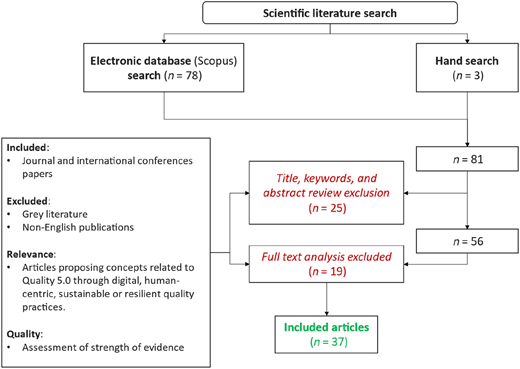
Inclusion criteria required that papers explicitly or implicitly demonstrated how quality management practices are evolving toward Quality 5.0 through digital augmentation, human–machine collaboration, sustainable quality practices, or resilient quality models. A first analysis of titles, abstracts, and keywords reduced the initial 78 Scopus records (plus 3 identified via hand-search, for a total of 81) to 56 documents. The subsequent full-text screening led to the exclusion of 19 contributions that did not substantively address Quality 5.0 concepts, resulting in a final sample of 37 articles.
Although the final sample may appear numerically limited, this reflects the emergent nature of Quality 5.0 as a research domain. As shown in the descriptive analysis, scholarly contributions explicitly addressing Quality 5.0 have only begun to accumulate in recent years. In line with established systematic review practices in emerging and pre-paradigmatic fields (Sassanelli et al., 2019; Trevisan et al., 2026), the objective of this study is not statistical generalisation but conceptual synthesis and gap identification. Therefore, the sample size is considered appropriate for an in-depth qualitative and thematic analysis of an evolving body of literature.
The search strategy is illustrated in Figure 1.
The analysis was then performed on the selected sample using several classification drivers (Bucci et al., 2026; Taddei et al., 2022): type of research output (approach, framework, guideline, methodology, model, tool), sector or domain, I5.0 pillar, quality dimension, human role, technology focus, both explicit and implicit research gaps. The results of this synthesis are presented in Section 3.
Following the approach suggested by Elo and Kyngäs (2008), gaps were extracted independently by two researchers to enhance reliability and reduce individual bias, while a third author supported the harmonization and consolidation of the thematic categories. Specifically, the gap extraction process was conducted in two main stages. In the first stage, gaps were extracted independently by two researchers to enhance reliability. This initial extraction was conducted using an open coding approach, without predefined gap categories, allowing gaps to emerge inductively from the content of each study. After the independent coding and preliminary comparison, recurrent and conceptually aligned gaps were inductively clustered into seven consolidated higher-level categories (G1–G7), representing the most structurally recurring limitations identified across the reviewed studies. To assess inter-rater reliability, Cohen's Kappa coefficient was calculated based on the initial independent coding. Given the multi-label nature of the coding scheme, the coefficient was computed on the full binary coding matrix (presence/absence of G1–G7 across 37 articles), resulting in 259 coding decisions. The observed agreement was Po = 0.92, while the expected agreement by chance was Pe = 0.55, yielding a Cohen's Kappa value of k = 0.83, which indicates almost perfect agreement according to established benchmarks (Landis and Koch, 1977). Minor discrepancies were resolved through third-author arbitration, leading to a harmonized and consolidated dataset. In the second stage, the confirmed gaps were provisionally assigned to primary thematic areas based on the dominant focus of each contribution. An inductive thematic synthesis was then applied, where conceptually related gaps were grouped into broader clusters using the SLIP logic (Maeda, 2006), in which units of meaning are progressively sorted, labelled, integrated, and prioritized. The iterative synthesis ultimately led to the emergence of a set of overarching research avenues, each representing a coherent domain of underexplored issues within Quality 5.0. These avenues form the basis of the research agenda presented in Section 4, where they are further articulated and translated into actionable research questions for future studies on Quality 5.0.
3. Findings
3.1 Descriptive analysis
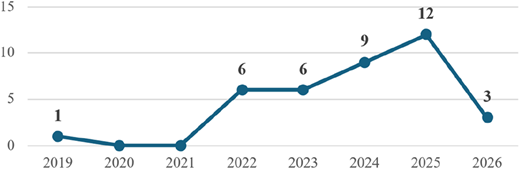
Figure 2, presenting the publications' chronological distribution, shows that research explicitly addressing Quality 5.0 is a recent and rapidly accelerating phenomenon. Even without applying temporal filters, the earliest contribution included in our dataset dates back only to 2019. After an initial period of very limited activity (one paper in 2019 and none in 2020–2021), the number of publications begins to grow in 2022 and 2023, stabilizing at six contributions per year. A sharper increase is visible in 2024 (nine papers), followed by a further rise in 2025 (twelve papers), indicating an accelerating trajectory of scientific attention and suggesting that the field is still evolving.
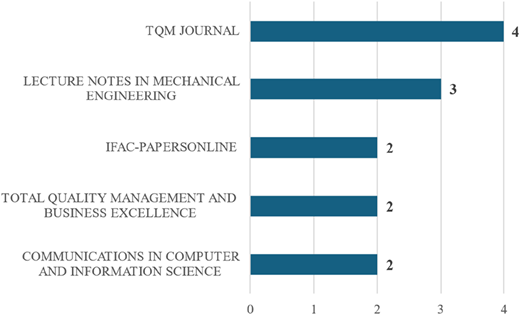
Figure 3 presents the distribution of the selected documents across the top five publication sources. The TQM Journal emerges as the most recurrent outlet, followed by Lecture Notes in Mechanical Engineering. The remaining venues, each contribute two papers, confirming that Quality 5.0 research is currently dispersed across both quality-focused and engineering-oriented sources.
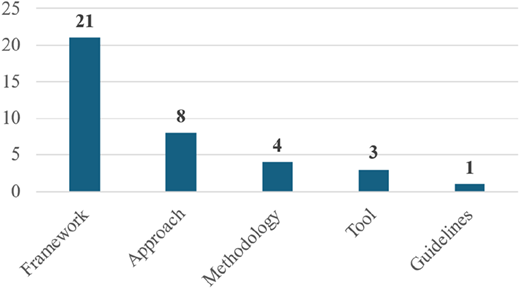
Figure 4 shows that the majority of contributions adopt a framework-oriented perspective (21 papers), indicating that Quality 5.0 is still in a conceptual and formative phase. Approaches (8 papers) and methodologies (4 papers) appear less frequently, while tools (3 papers) and guidelines (1 paper) remain marginal. This distribution confirms that the field is predominantly exploratory, with limited operational or validated solutions currently available.
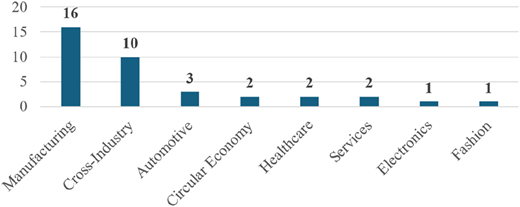
Figure 5 highlights that Quality 5.0 research is predominantly rooted in the manufacturing domain (16 papers), with an additional 10 cross-industry contributions reinforcing its broad industrial relevance. Other sectors (automotive, circular economy, healthcare, services, electronics, and fashion) are only marginally represented, remaining an emerging paradigm whose diffusion beyond manufacturing is at an early stage.
3.2 Content analysis
To deepen the understanding of how the transition toward Quality 5.0 is emerging, a qualitative content analysis was conducted on the 37 selected studies.
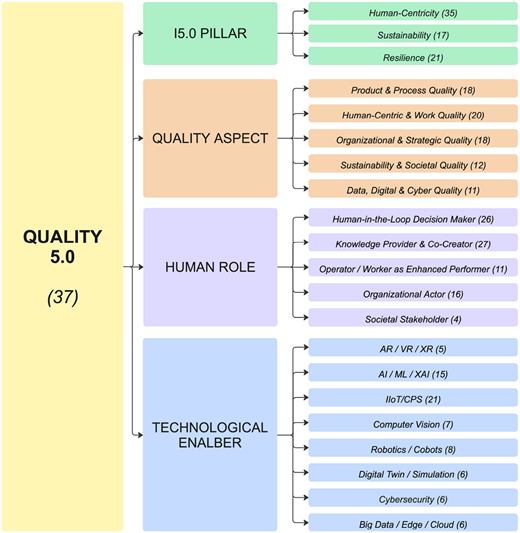
Before detailing the results, Figure 6 provides an overview of the coding structure adopted for the content analysis. The included articles were classified along four dimensions: the I5.0 pillars, the quality aspects addressed, the role attributed to humans, and the enabling technologies discussed. This structure guided the synthesis presented in the subsequent subsections (see Table 1). For analytical consistency, each dimension was operationalised through analytically distinct sub-categories capturing recurrent conceptual patterns across the reviewed studies. With respect to quality aspects, Product and Process Quality refers to operational outcomes such as defect reduction, process stability, and detection or prediction accuracy. Human-Centric and Work Quality captures contributions addressing cognitive load, skills, safety, well-being, and quality of working life. Organizational and Strategic Quality encompasses governance, leadership, cultural transformation, and the evolution of quality management practices, while Sustainability and Societal Quality extends quality objectives toward circular economy principles, environmental performance, and societal value creation. Finally, Data, Digital and Cyber Quality concerns the reliability, security, and trustworthiness of digital assets, data infrastructures, and AI-based models supporting quality decisions. Human roles were distinguished according to the nature and level of human involvement within Quality 5.0 systems. Human-in-the-Loop Decision Makers retain decision authority by supervising, interpreting, or correcting AI-supported outputs. Knowledge Providers and Co-Creators actively contribute expertise and feedback to the development and adaptation of quality systems, while the Enhanced Operator role reflects operational augmentation through cognitive support, training, ergonomics, and error reduction. At a higher level, Organizational Actors shape Quality 5.0 transformations through leadership, culture, and capability building, whereas Societal Stakeholders extend the human role beyond the organizational boundary to include citizens, patients, and users as beneficiaries or co-producers of quality outcomes.
3.2.1 Alignment with I5.0 pillar
The analysis shows that Quality 5.0 research is predominantly driven by the Human-Centricity pillar, explicitly addressed in 35 out of 37 studies. This is consistent with the human-centric focus adopted as the primary entry point in the search strategy and reflects the dominant framing of Quality 5.0 in the literature. This strong emphasis shows how the transition beyond Quality 4.0 is being conceptualised primarily through the renewed centrality of people, either as empowered decision-makers, knowledge contributors, or co-creators of quality outcomes. Human-centric elements are especially pronounced in works focussing on augmented operators and human–AI collaboration (Margetis et al., 2025; Moencks et al., 2022; Mohoje et al., 2026; Souza et al., 2026), as well as in frameworks emphasising leadership, skills, and organisational culture (Capolupo et al., 2025; Carvalho et al., 2024; Souza et al., 2022; Stefanovic et al., 2024). Several contributions conceptualise human-centricity as both a design principle and an operational requirement, where workers must retain agency, interpretability, and control in increasingly digitalised quality environments (Hattinger and Stylidis, 2023; Leberruyer et al., 2024; Mitcheltree et al., 2024; Presciuttini et al., 2025). Sustainability emerges explicitly in 17 studies, though typically with narrower scopes and varying levels of operationalisation. Some papers place sustainability at the core of their contribution, reinterpreting quality as societal or environmental value creation (Arsovski, 2019; Deleryd and Fundin, 2025; Fundin et al., 2025). Others integrate sustainability through circular-economy principles (Deore and Matai, 2025; Gatell and Avella, 2024; Psarommatis et al., 2023; Rickli et al., 2025; Voulgaridis et al., 2024) or through resource efficiency and digital sustainability in data-driven ecosystems (Bajic et al., 2023; Hattinger and Stylidis, 2023). Social sustainability is central in healthcare studies, which expand Quality 5.0 toward equity, participation, and planetary health (Thompson, 2023, 2024). The Resilience pillar appears in 21 contributions, often in connection with robust decision-making, system reliability, and the capacity to operate under variability or disruptions. Studies addressing zero-defect manufacturing (Mitcheltree et al., 2024; Mitsiaki et al., 2025; Presciuttini et al., 2025) and digital–cyber resilience (Calabrò et al., 2024; Waheed and Marchetti, 2023) highlight resilience as a technical requirement for future quality systems. Other works emphasize organisational or human resilience, focussing on adaptive behaviours, operator expertise, and workforce readiness (Chaabi, 2022; Hattinger and Stylidis, 2023; Psarommatis et al., 2023; Yasue et al., 2025). Several integrative frameworks combine all three pillars (Arsovski, 2019; Bajic et al., 2023; Carvalho et al., 2024; Rickli et al., 2025; Traini et al., 2024), suggesting a convergence toward multi-dimensional Quality 5.0 models in which human-centricity, sustainability, and resilience are interdependent rather than isolated constructs.
3.2.2 Quality aspects
The analysis of the quality aspects within the selected contributions shows five complementary categories. Human-Centric & Work Quality and Product & Process Quality emerge as two recurrent perspectives (20 and 18 documents respectively), indicating that the transition is strongly rooted in operational performance and worker-centred enhancement. Many studies focus on zero-defect manufacturing, defect detection and prediction, and operational stability (Leberruyer et al., 2024; Margetis et al., 2025; Mitsiaki et al., 2025; Presciuttini et al., 2025; Psarommatis et al., 2023; Silva et al., 2022; Souza et al., 2026), while others emphasise process robustness during complex or variable tasks such as disassembly (Rickli et al., 2025) or repair operations (Moencks et al., 2022). Parallel to this, a substantial body of work highlights human-work quality through cognitive assistance, reduced mental load, improved skills, and safer or more meaningful work experiences (Chaabi, 2022; Mohoje et al., 2026; Mondal and Samaddar, 2023; Vitti et al., 2026; Yasue et al., 2025), reflecting a clear convergence with the human-centric paradigm of I5.0. A third cluster relates to Organizational and Strategic Quality (18 contributions). These works examine quality through organisational transformation, leadership, culture, and strategic alignment, often in the context of digital transition (Antomarioni et al., 2025; Balouei Jamkhaneh et al., 2022; Fundin et al., 2025; Souza et al., 2022; Stefanovic et al., 2024). Several studies explore how Quality 4.0 practices must evolve to integrate human-centricity, resilience, or hybrid human–machine systems (Calabrò et al., 2024; Hattinger and Stylidis, 2023; Traini et al., 2024), suggesting a shift from operational tools to broader socio-technical ecosystems. Sustainability & Societal Quality appears in 12 papers, indicating that the sustainability dimension of Quality 5.0 is emerging. Some contributions embed sustainability directly into the reconceptualization of quality, from societal value creation (Arsovski, 2019; Deleryd and Fundin, 2025; Fundin et al., 2025) to circular-economy-enabled process quality (Bajic et al., 2023; Deore and Matai, 2025; Gatell and Avella, 2024; Rickli et al., 2025). Healthcare studies (Thompson, 2023, 2024) further extend the societal scope of quality, framing it around equity, trust, and planetary health. Finally, Data, Digital & Cyber Quality is explicitly addressed in 11 studies, reflecting growing attention to the quality of digital assets and trustworthiness of cyber-physical ecosystems. Topics include data veracity, model reliability, and predictive consistency in AI-supported quality processes (Bajic et al., 2023; Presciuttini et al., 2025; Traini et al., 2024). Others focus on trustworthiness, cybersecurity-by-design, and privacy protection as necessary conditions for ensuring reliable quality performance in highly connected ecosystems (Calabrò et al., 2024; Mitcheltree et al., 2024; Waheed and Marchetti, 2023). A further group addresses digital traceability and lifecycle information quality, highlighting the role of interoperable data structures and product-level transparency (Voulgaridis et al., 2024). Finally, studies examining algorithmic governance and decision quality underline the need for robust oversight of AI-based systems within quality management (Ahangar et al., 2025; Balouei Jamkhaneh et al., 2022; Mitsiaki et al., 2025; Souza et al., 2022).
3.2.3 Human roles
Across the analysed contributions, the human role emerges as a multidimensional construct that spans operational, cognitive, organisational, and societal levels. The most recurrent pattern is the Human-in-the-Loop decision maker: in 26 papers, humans actively supervise, validate, or complement automated decision processes. This is particularly evident in operator-support systems, such as AR-based quality control (Mohoje et al., 2026; Souza et al., 2026) or XAI-enabled predictive quality frameworks (Presciuttini et al., 2025), where workers interpret model outputs, approve corrective actions, or intervene when automation reaches its limits. Similar dynamics appear in zero-defect or anomaly-detection contexts (Leberruyer et al., 2024; Margetis et al., 2025), where human oversight ensures trust, calibration, and robustness. A second recurring role is the Knowledge Provider and Co-Creator, identified in 27 papers, where human expertise becomes an essential input for intelligent systems. In maintenance and diagnostic scenarios (Bajic et al., 2023; Vitti et al., 2026), workers contribute tacit knowledge, participate in model refinement, or guide the selection of influential process parameters. This co-creation dynamic is equally visible in design-oriented frameworks (Mitsiaki et al., 2025) and hybrid knowledge digital twins (Traini et al., 2024), where expert feedback and contextual interpretation enable systems to adapt to real-world variability. At organisational level, several contributions also highlight human co-creation in the evolution of quality culture (Carvalho et al., 2024; Fundin et al., 2025), with complementary work showing that serious games can support shared understanding and capability building (Brauner and Ziefle, 2022). The Enhanced Operator, although less pervasive (11 papers), represents a core embodiment of human–technology augmentation. These studies examine the improvement of situational awareness, cognitive load reduction, training effectiveness, and error-proofing. Operators are supported by adaptive interfaces (Margetis et al., 2025), AR/XR-guided procedures (Rickli et al., 2025), or smart vision and cognitive assistance tools (Silva et al., 2022), which position them as empowered performers rather than passive executors. Beyond operational settings, 16 papers conceptualise humans as Organizational Actors who influence quality transformation through leadership, culture, capability building, and workforce resilience. This organisational perspective characterises contributions addressing Human Resource Management 5.0 (Capolupo et al., 2025), change management in I5.0 transitions (Chaabi, 2022), or the evolution of quality roles and competencies (Souza et al., 2022; Stefanovic et al., 2024). In these cases, humans act as strategic enablers of Quality 5.0 rather than as system users. Finally, a smaller subset of contributions (4 papers) extends the human role to Societal Stakeholders, particularly in healthcare and sustainability-oriented quality frameworks. Here, patients, citizens, and communities are portrayed as co-producers of value (Thompson, 2023, 2024) or as beneficiaries of societal-centred quality paradigms (Deleryd and Fundin, 2025). These studies reflect the broader vision of Quality 5.0 as a socio-technical system that transcends the shop floor.
3.2.4 Technological enablers
The technological landscape emerging from the reviewed studies is dominated by data-intensive, connected, and human-augmenting solutions, rather than by isolated automation tools. IIoT/CPS and AI/ML/XAI are the most recurrent enablers (21 and 15 papers, respectively), often combined to support monitoring, prediction and adaptive decision-making in complex quality contexts. For instance, AI-driven anomaly detection and predictive quality are embedded in ZDM and maintenance scenarios (Leberruyer et al., 2024; Presciuttini et al., 2025; Psarommatis et al., 2023), while human-interpretable XAI is explicitly adopted to sustain operator trust and transparency (Ahangar et al., 2025; Mitcheltree et al., 2024). IoT and CPS infrastructures underpin real-time data collection and cyber-physical integration in frameworks such as Maintenance 5.0 and smart Quality Control (Bajic et al., 2023; Mitsiaki et al., 2025; Vitti et al., 2026), and more broadly in Quality 4.0/Quality 5.0 transitions (Balouei Jamkhaneh et al., 2022; Souza et al., 2022). Computer vision (7) is typically integrated with AI and IoT to enable in-process inspection and anomaly detection (Margetis et al., 2025; Mitsiaki et al., 2025). Immersive and interface technologies are tightly coupled with human-centricity. AR/VR/XR appears in a limited number of studies (5 papers), yet where present it plays a central role in augmenting perception, guidance, and training. AR-based support for assembly and defect inspection (Margetis et al., 2025; Mohoje et al., 2026) and XR–cobot environments for complex disassembly (Rickli et al., 2025) explicitly position extended reality as a key enabler for the augmented worker, while serious-game and simulation environments (Brauner and Ziefle, 2022) explore XR-like logics for learning and decision rehearsal.
A further cluster concerns Digital Twins and simulation, which appear in hybrid knowledge frameworks and cyber-physical quality architectures (Traini et al., 2024; Voulgaridis et al., 2024; Yasue et al., 2025), and Robotics/Cobots, often framed as part of broader human–machine collaboration ecosystems (Gatell and Avella, 2024; Hattinger and Stylidis, 2023; Rickli et al., 2025). Finally, Cybersecurity and Big Data/Edge/Cloud capabilities emerge as transversal infrastructural layers (6 studies each). Security-by-design and trustworthiness are central (Calabrò et al., 2024; Mitcheltree et al., 2024; Waheed and Marchetti, 2023), while edge-enabled big-data reduction (ID 54) and data-driven supply chains (Balouei Jamkhaneh et al., 2022; Mondal and Samaddar, 2023; Souza et al., 2022) address the scalability and sustainability of digital quality solutions. Overall, technologies are rarely studied in isolation: they are increasingly configured as socio-technical stacks that must simultaneously sustain quality performance, human centrality, and system robustness.
3.3 Gap analysis
Despite the growing body of literature on Quality 5.0, the gap analysis shows that current limitations are less related to the availability of advanced technologies than to their incomplete translation into operational, governable, and empirically validated quality systems. Across the reviewed studies, seven recurrent and cross-cutting gap categories (G1–G7) emerge. A first group of gaps concerns the weak operationalisation of human-centricity (G1) (Margetis et al., 2025; Moencks et al., 2022; Mohoje et al., 2026) and the absence of coherent performance measurement systems (G6) (Deleryd and Fundin, 2025; Thompson, 2024). Although human-centricity, sustainability, and societal value are widely recognised as core principles of Quality 5.0, they are rarely associated with measurable constructs or systematically embedded into quality performance frameworks. As a result, Quality 5.0 remains largely principle-driven rather than performance-driven.
Secondly, the analysis highlights structural gaps in empirical validation and organisational readiness, namely limited empirical evidence and generalisability (G3) (Chaabi, 2022; Fundin et al., 2025; Stefanovic et al., 2024), together with insufficient attention to skills, roles, and change management (G7) (Balouei Jamkhaneh et al., 2022; Capolupo et al., 2025).
A third group of gaps relates to governance and systemic integration, including limited alignment with established quality management practices (G2) (Calabrò et al., 2024; Mitsiaki et al., 2025; Presciuttini et al., 2025), insufficient AI and data governance (G4) (Ahangar et al., 2025; Leberruyer et al., 2024), and persistent interoperability and scalability challenges across digital infrastructures (G5) (Bajic et al., 2023; Margetis et al., 2025; Rickli et al., 2025). While multiple digital technologies are increasingly combined within socio-technical solutions, their integration at the level of quality governance and management systems remains underdeveloped. Many contributions remain conceptual or context-specific, providing limited insight into long-term adoption and organisational transformation. Overall, these gaps indicate that advancing Quality 5.0 requires moving beyond conceptual alignment toward measurable, governable, and empirically grounded quality systems.
Table 2 summarizes the identified research gaps emerging from the systematic review of the Quality 5.0 studies.
4. Research agenda
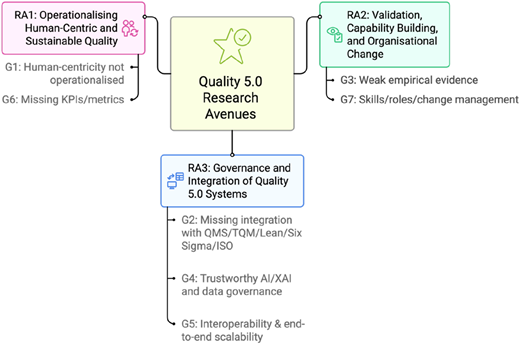
Based on the findings of the systematic literature review, a research agenda structured around three complementary research avenues is proposed to guide future studies on Quality 5.0. The agenda is grounded in the systematic identification of recurrent gaps across the reviewed literature and aims to support the advancement of theoretically informed and empirically grounded research. By explicitly linking emerging research questions to unresolved issues in the operationalisation, governance, and validation of Quality 5.0, the agenda provides a coherent framework for orienting future contributions in digital, human-centric, and sustainable quality management (see Figure 7).
The first research avenue, Operationalising Human-Centric and Sustainable Quality, addresses the most pervasive limitations emerging from the content analysis, namely the gap between the strong normative emphasis on human-centricity and sustainability and their weak operational translation into quality management practices.
Although human-centricity is the dominant I5.0 pillar across the reviewed studies, the analysis shows that it is rarely associated with measurable constructs, decision models, or explicit trade-off mechanisms. Similarly, sustainability and societal value are frequently invoked but seldom embedded into quality KPIs or performance measurement systems. Within the Quality 5.0 paradigm, sustainability should be understood as a multi-dimensional construct integrating environmental performance (e.g. resource efficiency, energy intensity, emissions reduction), social sustainability (e.g. worker safety, equity, and long-term employability), and economic with lifecycle-oriented systemic resilience. However, across the reviewed studies, these dimensions are predominantly treated at a strategic or normative level, rather than as operational quality variables.
This avenue therefore calls for research aimed at operationalising human-centric and sustainable quality through measurable indicators, such as cognitive load, trust in automation, empowerment, and well-being, as well as sustainability-oriented metrics including energy consumption per defect, carbon intensity per unit of output, circularity ratios across the product lifecycle, or integrated well-being indices linked to process capability. The associated research questions (RQ1.1–RQ1.4) focus on how human-centred and sustainability-oriented indicators can be defined, combined, and embedded into real-time decision-support systems, enabling managers to explicitly manage trade-offs between operational performance, human well-being, and sustainability outcomes. These issues are particularly salient in studies on augmented operators and AI-supported quality control, where the lack of metrics limits both governance and adoption (Deleryd and Fundin, 2025; Mitcheltree et al., 2024).
The second research avenue, Validation, Capability Building, and Organisational Change, responds to the weak empirical grounding and limited organisational perspective identified across the reviewed literature.
While many studies propose conceptual frameworks or pilot implementations, the content analysis reveals a scarcity of longitudinal, multi-site, and cross-sector empirical validations demonstrating sustained quality improvements. At the same time, although human roles are central to Quality 5.0 narratives, limited attention is paid to the evolution of competencies, professional roles, and change management processes required to support adoption. This avenue therefore emphasises the need for robust empirical research designs and for a stronger focus on capability building at both individual and organisational levels. The associated research questions (RQ2.1–RQ2.4) explore how Quality 5.0 solutions can be validated over time, which new skills and roles are required for quality professionals in human–AI collaborative environments, and how leadership, culture, and reskilling strategies influence the effectiveness of Quality 5.0 transformations. These issues are particularly relevant in studies addressing organisational quality, HRM 5.0, and cultural change, where implementation guidance remains limited (Capolupo et al., 2025; Stefanovic et al., 2024).
The third research avenue, Governance and Integration of Quality 5.0 Systems, builds on the observation that advanced digital technologies are increasingly deployed in combined socio-technical stacks rather than as isolated solutions. The content analysis shows that AI, XAI, IoT/CPS, AR/XR, and data platforms are frequently integrated at the technical level to support monitoring, prediction, and human–machine interaction. However, this technological integration is rarely matched by a corresponding integration at the level of quality governance. In particular, the alignment of these digital solutions with established Quality Management Systems, ISO standards, PDCA cycles, and continuous improvement routines remains limited (Calabrò et al., 2024; Gatell and Avella, 2024). In parallel, concerns related to trustworthy AI, explainability, accountability, and data governance are widely acknowledged, yet they are seldom embedded into operational quality processes or translated into formal roles, procedures, and decision rights within Quality 5.0 systems. The proposed research questions (RQ3.1–RQ3.4) address how Quality 5.0 solutions can be integrated into QMS and standards, how AI and data governance can be operationalised under real-time industrial constraints, and how interoperability between MES and QMS can enable closed-loop quality feedback across the product lifecycle. These challenges are particularly evident in AI-driven quality and cyber-resilient systems, where governance remains fragmented (Ahangar et al., 2025; Silva et al., 2022; Waheed and Marchetti, 2023). Table 3 summarizes the Quality 5.0 Research Agenda and related proposed RQs.
5. Conclusions
This paper set out to systematically review and synthesise the emerging body of literature on Quality 5.0, with the aim of clarifying how quality management is evolving under the principles of I5.0.
From a theoretical perspective, this study shows that Quality 5.0 is emerging as a socio-technical paradigm in which human-centricity, sustainability, and resilience are intertwined with digital quality systems, rather than as a mere extension of Quality 4.0. The paper contributes an integrated analytical framework structuring the literature across I5.0 pillars, quality aspects, human roles, and technologies, revealing a persistent gap between normative human-centric aspirations and their weak operationalisation. While quality is increasingly framed as a human–machine co-creation process extending beyond product and process performance, human contributions and sustainability dimensions remain poorly translated into measurable and governable constructs. Finally, the study advances the field by proposing a gap-driven research agenda that provides a coherent roadmap for developing measurable, governable, and empirically validated Quality 5.0 systems.
This study offers relevant implications for practitioners involved in quality management, digital transformation, and I5.0 implementation. Practitioners are therefore encouraged to embed human-in-the-loop decision-making, trustworthy AI, and integrated data flows into existing QMS and continuous improvement routines. In parallel, investments in reskilling and participatory approaches are essential to enable effective human–AI collaboration and support sustainable adoption of Quality 5.0 systems.
The findings highlight the need for policy and standardisation support to address the lack of operational definitions and metrics for human-centricity, sustainability, and societal value in Quality 5.0. Policymakers can foster alignment by extending ISO-based quality frameworks to incorporate human-centric, digital, and sustainability requirements, and by linking AI governance, data governance, and cybersecurity regulations to quality management objectives. Finally, investments in education, lifelong learning, and workforce reskilling are essential to support human–AI collaboration and enable an inclusive and sustainable Quality 5.0 transition.
This study is subject to some limitations that also suggest avenues for future research. First, the analysis is based solely on academic literature, excluding practitioner-oriented sources and primary empirical evidence. Future studies should incorporate interviews, surveys, or field research to examine how Quality 5.0 principles are interpreted and implemented in practice. Second, future research should explore contextual differences across industries and regions, and support the development of operational frameworks, metrics, and training approaches to enable the practical deployment of Quality 5.0.