

The purpose of this paper is to incorporate Chinese traditionality (CT) and patriotism (PAT) within the theory of reasoned action (TRA). It tests the moderating effect of gender with the aim to provide a deeper understanding of why Chinese tourists choose to take domestic travels.
Data is collected from 370 Chinese tourists. Convenience sampling is used. Structural equation modelling is used to test the proposed hypotheses.
The results of this paper show that PAT is positively related to tourists’ attitudes (ATs) and Chinese domestic travel intention (CTI). Moreover, CT is found to influence PAT, ATs and subjective norms (SNs) directly, as well as CTI indirectly. However, the positive relationship between PAT and SNs is not supported. Additionally, the influence of PAT on CTI for females is significantly higher than that for males.
The current paper adopts convenience sampling; data is collected using an online questionnaire which may cause sample bias and even reduce the reliability of the data. Future studies may adopt quota sampling based on the population of each province to gain more reliable data. Further research can consider including more constructs to better understand why Chinese people choose to travel domestically.
This paper is one of the first attempts to include PAT and CT within the TRA and contributes to the pool of literature on the TRA. It provides a comprehensive understanding of CTI. Second, PAT and CT are linked to the TRA, which expands the application of PAT and CT to the context of hospitality and tourism. Finally, the moderating role of gender contributes to the knowledge regarding the moderating effect between their respective relationships.
性别在中国传统与爱国主义对中国国内旅游意愿影响中的调节作用
摘要
本研究将中国传统性与爱国主义引入理性行为理论, 同时将性别作为调节变量, 目的在于探究中国游客选择国内游的原因。
通过分析便利抽样所收集的370份中国游客样本, 运用结构方程模型验证本研究的假设。
中国游客爱国主义能够正向显著影响其国内游的态度和旅游意向; 此外, 中国传统性也直接影响游客的爱国主义、态度和主观规范, 并且分别通过爱国主义、态度和主观规范间接影响旅游意向; 然而, 爱国主义和主观规范之间的关系却并没有得到验证; 最后, 女性游客的爱国主义对于旅游意向的影响作用显著高于男性游客。
首先, 本研究运用网络调研的方式进行便利抽样, 这一点有可能产生样本偏差, 甚至降低了样本的可信度, 未来研究可以根据各省人口数量采用配额抽样的方式进行抽样, 以期进一步提高数据的可信度; 其次, 更多的变量应当被引入研究, 以进一步探究中国游客选择国内游的原因。
首先, 本研究是为数不多的将爱国主义和中国传统性引入理性行为理论, 这一点进一步拓展了关于理性行为理论的研究范围, 也进一步加深了对于国内游原因的认识; 其次, 将爱国主义和中国传统性这一概念引入旅游领域, 进一步拓展了关于两者研究的边界; 最后, 在中国国内游的研究领域中, 将性别作为调节变量引入本研究一定程度上填补了在该领域研究中的不足。
La influencia de la moderación de género en la tradición China y el patriotismo en la intención de viajar dentro de China
Este research incorpora los conceptos a de la tradicionalidad China (TC) y el patriotismo (PAT) a la teoría de La Acción razonada (TAR), teniendo en cuenta el efecto moderador de género, con el objetivo de profundizar en la comprensión de porqué los turistas chinos eligen realizar viajes domésticos/nacionales.
A partir de los datos recolectados de 370 turistas chinos utilizando las muestras de cuestionarios realizados de manera on-line, éste estudio usa un modelado de ecuaciones estructurales para probar las hipótesis propuestas.
Los resultados demuestran que el PAT está positivamente relacionado con las actitudes del viajero y la intención de viaje nacional chino (IVNC).Es más, la tradicionalidad China (TC) influye en el Patriotismo (PAT), las actitudes del viajero chino (AVC) y también en las normas subjetivas (NS) directamente.Adicionalmente, la influencia del PAT en la intención de viaje del viajero doméstico chino, especialmente en mujeres, es significativamente mayor que en hombres.
Primero, el estudio adopta un muestreo de conveniencia y recopila cuestionarios on-line, lo que puede causar un sesgo en la muestra e incluso reducir la confiabilidad de los datos obtenidos.Los futuros estudios pueden adoptar un muestreo por cuotas basado en el número de población de cada una de las provincias de China, para obtener datos más relevantes.
Este estudio es uno de los primeros en incluir el PAT y el TC dentro de la TAR, que amplía la literatura sobre la TAR y proporciona una comprensión más completa de las actitudes del viajero chino.Segundo, el PAT y la TC están vinculados al TAR, el cuál expande la aplicación del PAT y la TC en el contexto del turismo en todas sus ramas.Por último, el rol moderador de género contribuye al conocimiento, sobre el efecto moderador entre sus respectivas relaciones.
1. Introduction
Chinese domestic tourism makes a major contribution to the regional development and wellbeing of citizens (Weaver et al., 2015), emphasizing mostly on “the majority of Chinese tourism demand” (Long et al., 2018, p. 2). However, Chinese domestic tourism is still underexamined in the tourism literature (Canavan, 2015; Larsen and Wolff, 2019; Pu et al., 2019; Yang et al., 2014). Some scholars argue “there is limited knowledge on the determinants of China’s domestic tourism” (Bao and Xie, 2018, p. 1). Of the few studies that focussed on Chinese domestic tourism, the main area of investigation has been on the impact of economic factors; research on psychographics is still in an infancy (Massidda and Etzo, 2012). It is believed that in most of the East Asian countries, especially China, traditional beliefs and values will guide thought and practice (Tian and Pasadeos, 2012). Also, tourism literature is largely lacking in political ideologies (Mathews, 1975), requiring further investigation (Stepchenkova and Shichkova, 2017). Thus, Chinese traditionality (CT) and patriotism (PAT) are introduced into this study. Though the effects of PAT and CT on behavioural intention have been studied extensively in the context of marketing and human resource management (HRM), respectively, their effects on domestic travel intention, especially in China, are still at an infancy stage in the tourism literature.
The theory of reasoned action (TRA) mainly explains that behavioural intention is determined by attitudes (ATs) and subjective norms (SNs). It remains one of the most influential and insightful research models for predicting individual behavioural intention and actual behaviour (Bagozzi, 1982). TRA has a good predictive power for individual behaviour intention in various contexts (Sheppard et al., 1988). Some examples of studies where TRA has been applied are: intention to conserve water (Untaru et al., 2016), ecolabel product usage (Nadlifatin et al., 2016), intentions to watch e-sports (Xiao, 2020), environmentally sustainable apparel purchasing intention (Copeland and Zhao, 2020), intentions to attend university events (Harb et al., 2021) and hybrid gambling machines usage (Gainsbury et al., 2020) to name a few. The TRA has also been extensively used in hospitality and tourism, for example, travel intention of sports tourists (Song et al., 2021) and heritage tourists (Lee et al., 2021) and residents’ support for tourism (Çelik and Rasoolimanesh, 2021). In a nutshell, “in diverse behavioural domains, the prediction capability of the reasoned action theory” […] “has been demonstrated” (Han, 2021, p. 1024). Drawing on the above, TRA was chosen as the basis of this study to predict domestic travel intention in China. Moreover, scholars have argued that the inclusion of some other constructs within the framework of the TRA may increase its predictive power (Fishbein and Ajzen, 2010), with the theory of planned behaviour (TPB) as one of the representatives. However, this study prefers to use the TRA as the fundamental theoretical model, because the TRA is related to voluntary behaviour and Chinese domestic travel is considered voluntary (Chen and Raab, 2012).
Most studies with a focus on gender have been conducted among Western travellers as opposed to Chinese domestic travellers (Xu et al., 2017; Yang et al., 2017). Among the very few studies on gender in China, the majority have focussed on the impact of women’s participation in ethnic tourism on their status improvement (Xu and Gu, 2018) or female tourists (Tang and Zhu, 2007; Qin and Lin, 2014). The impact of gender on tourist behaviour has been largely ignored (Huang and van der Veen, 2018).
This study attempts to bridge these gaps between theory and practice. It includes PAT and CT into the framework of the TRA and examines their impact on AT, SNs and Chinese domestic travel intention (CTI) and tests the moderating effect of gender (Figure 1).
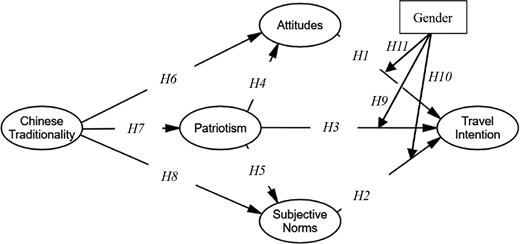
The theoretical contributions are as follows. Firstly, this study is one of the first attempts to include PAT and CT within the TRA and evaluate their impact on CTI. It enriches and extends the literature on the TRA and provides a more comprehensive understanding of CTI and adds to the limited evidence concerning PAT and CT as direct or indirect predictors of CTI. Secondly, PAT and CT are linked to the TRA, which expands the application of PAT and CT in the context of hospitality and tourism. Thirdly, the current study findings showed that people from collectivistic countries (e.g. China) were more influenced by their level of SNs in their decision-making process. However, in individualistic countries, the most influential factor was AT. Finally, the moderating role of gender adds to the existing body of knowledge through their respective relationships in non-Western contexts. Findings of the present study can not only be helpful to Chinese industry practitioners seeking to develop more effective tourist-attracting policies and strategies but also are valuable to some eastern Asian countries with similar cultures.
2. Literature review
2.1 Chinese domestic tourism
Domestic tourism tends to be dominant in terms of the number of tourists and economic contribution (Massidda and Etzo, 2012). Moreover, domestic tourists can be more loyal, easier to satisfy and promote positive word-of-mouth (WOM) as compared to inbound tourists (Larsen and Wolff, 2019). Numerous studies have been conducted to explore the determinants of domestic travel intention. However, most of the studies on domestic tourism have been conducted in the context of developed countries (Canavan, 2015; Eusébio et al., 2017; Gálvez et al., 2014; Jeuring, 2017). Only limited studies on domestic tourism have been conducted in the context of developing countries. Fewer studies have focussed on Chinese domestic tourism, not to mention the determinants of Chinese domestic tourism (Bao and Xie, 2018).
Among the very few studies on Chinese domestic tourism, the majority have focussed on specific tourist destination, such as Chengdu (Pu et al., 2019), Confucian Temple in Nanjing (Zhang et al., 2018), Xinjiang Province (Qiu et al., 2018), Beijing (Peng and Xiao, 2018), Zhangjiajie (Luo et al., 2018) and Guilin (Bao and Xie, 2018) to name a few examples. The literature on Chinese domestic tourism in general (with the whole China as tourist destination) is scarce with the exception of Dong et al. (2019), Yang et al. (2014) and Wang (2010) studies. Dong et al. (2019) study used the spatial econometric model to analyse the impact of air pollution on Chinese domestic tourism. Wang (2010) found that income and transportation were the most influential factors of Chinese domestic tourism arrivals using the data from the China Statistical Yearbook. Yang et al. (2014) examined the impact of income and price on Chinese domestic tourism drawing on data from the National Household Tourism Survey.
Based on the review of above-mentioned literature, individual’s PAT and CT have been largely neglected in the tourism literature. Thus, the current study includes PAT and CT within the TRA aiming to deepen the understanding towards why Chinese tourists choose domestic tourist attractions.
2.2 The theory of reasoned action
The TRA was firstly introduced by Fishbein and Ajzen (1975) for predicting individual’s behavioural intention and actual behaviour. TRA posits that an individual’s behavioural intention is determined by ATs and SNs. According to Azjen (1980), ATs refer to an individual’s evaluation of performing a certain behaviour. SNs refer to an individual’s perception of pressure from the persons who are important to him or her (Fishbein and Ajzen, 1975).
In hospitality and tourism, TRA has been applied to predict tourists’ and residents’ behavioural intention, such as travel intention of sports tourists (Song et al., 2021) and heritage tourists (Lee et al., 2021) and residents’ support for tourism (Chen and Raab, 2012; Çelik and Rasoolimanesh, 2021). Han (2021) concluded that “in diverse behavioural domains, the prediction capability of the reasoned action theory” […] “has been demonstrated” (p. 1024). Scholars often include new constructs within the framework of the TRA to improve its predictive power. The current study also includes PAT and CT within the TRA and investigates the determinants of CTI.
TRA has also been successfully applied to predict tourist intention in Chinese hospitality and tourism. Park et al. (2017) studied 736 Chinese undergraduate and graduate students in Macau and concluded that SNs and AT were both positively related to their travel intention to Japan. Wang and Wong (2020) also revealed that Chinese residents’ green purchase ATs and SNs positively and significantly influenced their green purchase intention towards the selection of environmentally friendly hotel directly and indirectly, respectively. A survey of 778 Chinese mainland tourists to Hong Kong revealed that their ATs and SNs affected their travel intention (Lo and Qu, 2014).
Drawing on the above discussion, the following hypotheses are proposed:
Chinese tourists’ attitude positively affects their Chinese domestic travel intention.
Chinese tourists’ subjective norms positively affect their Chinese domestic travel intention.
2.3 Patriotism
PAT was described “as an affective attachment towards the in-group implying feelings of belongingness, responsibility and pride” (Mummendey et al., 2001, p. 160). The existing research on PAT has mainly been in marketing; PAT is shown as an important predictor that impacts an individual’s decision-making process, such as purchasing domestic products (Han, 1988; Ishii, 2009), liking a mega event (Alonso Dos Santos et al., 2019; Chang et al., 2020), supporting sponsors (Chang et al., 2020; Petrovici et al., 2015) and media consumption intention (Brown et al., 2016; Choe et al., 2019). However, the studies on factors (e.g. PAT) influencing Chinese domestic tourism are mainly qualitative investigations that cannot quantify its impact (Wang, 2010). Moreover, given that “goals of red tourism are intended to promote patriotism” in China (Tang et al., 2021, p. 2), most of the studies on PAT are related to red tourism. Zhao et al. (2021) revealed the positive influence of red tourism on the PAT education of college students and explored a feasible way to achieve it. Zhong et al. (2021) argued that it was not absurd to associate playful children with serious and solemn red tourism. They suggest it can strengthen children’s local experience and PAT. Studies on the impact of PAT on travel intention, especially on domestic travel intention, are largely absent and demand investigation.
Only three studies have attempted to examine the relationship between PAT and travel intention or travel motivation in China. Hsu et al. (2007) conducted qualitative interviews with 27 seniors from Beijing and Shanghai; their finding showed that PAT was one of their motivations for leisure travel. Studies in China reflected the following. Juan et al. (2017) study based on the evaluations on Q-sample statements found that it was PAT that caused tourists to cancel their visit to South Korea. Cheng and Wong (2014) also found that PAT was a critical factor influencing Chinese tourists’ visit to Japan.
In non-Chinese contexts, some studies have also verified the significant influence of PAT on AT, SNs and behavioural intention. Stepchenkova and Shichkova (2017) stated that “the patriotic reasons are a factor in people’s preferences for domestic destinations over destinations abroad” (p. 95). They argued that the context is in a situation of political and economic conflict with the country that provides the source market, which implies that the higher the individual’s patriotic feelings, the more inclined he/she is to choose domestic travel. A survey of 600 Korean residents revealed that PAT can influence their ATs and SNs for the demilitarized zone (DMZ) Peace Park development, both directly and indirectly (Kim et al., 2019).
The above discussion informs the following hypotheses:
Chinese tourists’ patriotism positively affects their Chinese domestic travel intention.
Chinese tourists’ patriotism positively affects their attitudes.
Chinese tourists’ patriotism positively affects their subjective norms.
2.4 Chinese traditionality
Respect and acceptance of customs and norms of a traditional society conceptualized as “traditionality” are particularly deeply rooted in Chinese societies, and act as important predictors of individual’s attitudes and behaviours (Huo et al., 2014). Considering the Confucian culture and the rapid industrialization that China has been experiencing, China provides an appropriate context to examine how this country-specific traditionality affects individual’s attitudes and behaviour (Yang et al., 2020; Huo et al., 2014). Rooted in Confucian ideology, CT refers to the degree of unconditional obedience an individual has for their valued others (Li et al., 2017). Individuals with high levels of CT tend to show the following five aspects, namely: male dominance, conservatism and endurance, filial piety and ancestor worship, fatalism and defensiveness and submission to authority (Yang et al., 1989). Among these five aspects, submission to authority is the most prominent one. CT is, hence, posited to reflect the cultural value of one’s submission to authority in the present study, which is also aligned with some previous studies (Wang and Zhang, 2020; Zhao, 2014).
There are research gaps still evident in extant literature despite the advances in examining the effect of CT on individual’s attitudes and subsequent behaviours, To the best of our knowledge, previous studies on CT have mainly focussed on HRM (Li et al., 2017; Wang et al., 2020; Xu et al., 2021; Yao et al., 2019). In hospitality and tourism, studies are still scarce with the studies by Yang et al. (2020) and Wang and Zhang (2020) as exceptions. However, both studies only tested the moderating effect of CT, research on its direct and indirect effects is largely ignored, although CT was regarded as an important predictor of individual’s attitudes and behaviours (Huo et al., 2014).
Li and Ngo (2017) found that CT of employees was positively related to their job attitudes (organizational commitment and job satisfaction) based on the data collected in two large Chinese firms. Pek and Leong (2003) studied working adults in Singapore and found that CT significantly predicted their attitudes towards women. Also, Yao et al. (2019) suggested that “individuals with different levels of traditionality display great differences in attitudes” (p. 548).
Drawing on the above discussion, the following hypothesis is developed:
Chinese tourists’ Chinese traditionality positively affects their attitudes.
For individuals, traditionality reflects the degree of recognition and adherence to traditional culture values (Xie et al., 2008). As the core content of Chinese traditional cultural values, loving one’s motherland has played an indispensable role in the inheritance of Chinese civilization (Lu, 2020). Thus, CT captures extent to which individuals love hihe/sher own country, namely, the higher level of CT, the more he/she loves motherland. Tian and Pasadeos (2012) also found that individual traditionality has been used to stir up patriotic feeling.
The following hypothesis is proposed:
Chinese tourists’ Chinese traditionality positively affects their patriotism.
In China, everyone has been educated to play their own prescribed role since childhood. Meanwhile, they are also required to respect, obey and be loyal to authority. As a result, a kind of social order has been formed, and driven by this social order, Chinese society has been running for thousands of years (Wang et al., 2012). Thus, individuals with a high degree of traditionality believe more in fatalism and a lower desire for self-determination (Yang et al., 1989). Instead, “they are more inclined to seek external sources to motivate their own behaviours” (Xu et al., 2021, p. 6), which causes them habitually to look at how the valued others do before perform a given behaviour. Traditionality is considered as a kind of acceptance of customs and norms of a traditional society (Huo et al., 2014) precisely because of this. For individuals, the higher the traditionality, the higher their SNs.
Based on the above discussion, we hypothesize:
Chinese tourists’ Chinese traditionality positively affects their subjective norms.
2.5 Gender
Tourism, emerged and grew with the gendered society, is also gendered in its construction, presentation and consumption (Pritchard and Morgan, 2000). This requires that tourism studies integrate gender (Xu and Gu, 2018). However, the studies on tourism and gender only account for a small portion of tourism studies in general (Figueroa-Domecq et al., 2015). Moreover, most of the limited studies on gender and tourism have been conducted in the settings of Western countries, resulting in the related study in China being still scarce (Xu et al., 2017; Yang et al., 2017). Because of the complex interaction between gender and tourism and its unique Chinese characteristics (Xu and Gu, 2018), the strength and mechanism of interaction in China might vary. Drawing on the above, the study of Chinese gendered tourist’s behaviour remains a rich area that remains to be explored.
Among the few studies on gender and tourism in China, most have focussed on the impact of women’s participation in ethnic tourism on their status improvement (Xu and Gu, 2018) or female tourists (Tang and Zhu, 2007; Qin and Lin, 2014). Su et al. (2020) found that Chinese Hui minority embroiderers’ participation in tourism can lead to not only economic independence but also political empowerment. Morais et al. (2005) revealed that tourism brought economic and non-economic impacts on Chinese Bai and Mosuo minority women. However, Feng (2013) argued that the increased flexibility of females’ roles followed by the growth of ethnic tourism did not necessarily empower them; instead, it may have maintained their subordination to males. Hao et al. (2021) found that Guimi tourism can empower Chinese women to counteract sociocultural constraints based on their investigation of 28 Chinese Guimi tourists.
Obviously, the above-mentioned studies further indicate that research on gender and tourism in China is “women-focused” rather than “gender-focused” (Feng, 2013). Moreover, the extant literature indicates a dearth of research concerning the impact of gender on tourism behaviour (Huang and van der Veen, 2018), even though the social role theory argues that how males and females should behave in the society determines different roles they play, which leads to gender differences in the decision-making process (Eagly, 1987; Eagly and Wood, 1991).
Several studies exhibit the moderating role of gender influencing an individual’s attitudes and behaviours (Akinci and Aksoy, 2019; Khan et al., 2020; Meng and Han, 2018; Moon, 2021). Moreover, Huang and van der Veen (2018) revealed that the difference of tourists’ behaviour may be attributable to gender.
Moon (2021) have attested that gender moderated the impact of customers’ SNs on their intention regarding green restaurant patronage. In an investigation of hotel guests, Casado-Díaz et al. (2020) found that the influence of their AT toward water conservation on the behaviour for females was stronger than that for males.
Additionally, “words used to describe the many attitudes” […] “are now called patriotism” (Westheimer, 2006, p. 609) and “patriotism is often used for attitude(s) that would in the theoretical literature be described as nationalistic” (Miščević, 2020, p. 769). Kleingeld (2003) argued that PAT sometimes was regarded as an attitude on the part of the state or citizen. Therefore, in essence, PAT is a kind of attitudes towards one’s own country. Considering the moderating role of gender between attitudes and behaviours, it is reasonable to infer that gender also has a moderating effect between PAT and behaviours. Thus, we pose:
The relationship between Chinese tourists’ patriotism and Chinese domestic travel intention is stronger for women than for men.
The relationship between Chinese tourists’ subjective norms and Chinese domestic travel intention is stronger for women than for men.
The relationship between Chinese tourists’ attitudes and Chinese domestic travel intention is stronger for women than for men.
3. Methodology
Most studies investigating predictors of Chinese domestic tourism are mainly qualitative investigations that cannot quantify the impact (Wang, 2010); quantitative method is applied in this study. Also, structural equation modelling (SEM) can calculate and test the relationship between observed and unobserved constructs at once in a single research model. Additionally, PLS-SEM is superior to typical SEM in terms of data normality, sample size and for complex models with MGA (Hair et al., 2017). Thus, PLS-SEM is used to analyse the research model in present study.
3.1 Survey instrument
The questionnaire comprises two sections. In Section 1, several questions on demographics were asked. Section 2 includes the measured items of five constructs. Based on similar (the same) research objects or (and) research site, a selection of recently published articles was chosen. Within the selected articles, the ones with more suitable measured items to this study were finally retained. CTI was measured with three items adopted from Kim et al. (2019). Five items from Wang and Zhang (2020) were used to evaluate CT. The AT and SNs constructs were represented by three items (Shen and Shen, 2020) and five items (Li and Wu, 2019; Stylos and Bellou, 2018), respectively. The operationalization of PAT followed Choe et al. (2019) and Kim et al. (2019) and had six items.
All the items of five constructs were developed in English. Back-translation was used to translate the English version to Chinese one. All the items of five constructs were measured by a seven-point Likert type scale from 1 (strongly disagree) to 7 (strongly agree).
3.2 Sampling method and data collection
Given that obtaining a list of domestic tourists is impossible, only non-probability sampling method can be adopted. Also, in terms of self-selection bias, internet surveys are no more dangerous than other types of non-probability sampling (Stanton, 1998) and have the advantage of being low cost and high efficiency and offer easy access to some difficult-to-reach tourists (Kim et al., 2018). Hence, in the current study, an online convenience sampling method was adopted for the survey. We designed and made the online questionnaires through a professional survey platform (www.wjx.cn). As WeChat is the most frequently used Chinese social APP in smartphone (Zhang et al., 2020b), we distributed the questionnaires link or QR code on WeChat Moments and WeChat groups to Chinese mainland residents aged at least 18 years old in November 2019 and encouraged WeChat friends to forward to their own WeChat Moments and WeChat groups. Participants only need to click the link or scan the QR code to fill in online. Shopping e-vouchers were offered to participants to encourage their participation. A total of 407 questionnaires were obtained and 370 questionnaires were retained for the final analysis. Moreover, the respondent-to-questionnaire-item ratio in this study is 16.8:1, which fulfils the recommended minimum sample size (Gorsuch, 1983).
3.3 Common method bias
Given that all the data were obtained from the same source, Harman’s one-factor method is used to detect the common method bias (CMB) (Podsakoff et al., 2003). The results demonstrate that the items explained 70.4% of the total variance and the largest factor explained 41.1% of the variance which is lower than 50%. Thus, CMB is not contaminant for research result in present study.
4. Results
4.1 Sampling profile
Table 1 profiles the sample. Of all 370 participants, 180 were male (48.6%) and 190 were female (51.4%), which is in line with the male-to-female ratio among Chinese mainland residents. Regarding age, more than half of the respondents were aged 18–45 years (61.6%). High school education accounted for the largest proportion (32.3%), while primary school accounted for the smallest one followed by postgraduate. Most of the participants were middle income earners (78.1% had a monthly income between 2,001 and 8,000 RMB). The profiles are similar to that of the sample in the study by Xu et al. (2019).
Demographic information of respondents
| Demographic characteristics | Frequency | (%) |
|---|---|---|
| Gender (370) | ||
| Female | 190 | 51.4 |
| Male | 180 | 48.6 |
| Age (370) | ||
| 18–25 | 70 | 18.9 |
| 26–35 | 87 | 23.5 |
| 36–45 | 71 | 19.2 |
| 46–55 | 71 | 19.2 |
| 56–65 | 47 | 12.7 |
| ≥66 | 24 | 6.5 |
| Education (370) | ||
| Primary school | 5 | 1.4 |
| Junior middle school | 98 | 26.5 |
| High school | 119 | 32.2 |
| College | 66 | 17.8 |
| Undergraduate | 64 | 17.3 |
| Postgraduate | 18 | 4.9 |
| Job (370) | ||
| Office worker | 122 | 33.0 |
| Self-employed | 86 | 23.2 |
| Farmer | 84 | 22.7 |
| Student | 15 | 4.1 |
| Retired | 38 | 10.3 |
| Others | 25 | 6.8 |
| Income (370) | ||
| ≤¥2,000 | 38 | 10.3 |
| ¥2,001–4,000 | 126 | 34.1 |
| ¥4,001–6,000 | 104 | 28.1 |
| ¥6,001–8,000 | 59 | 15.9 |
| ¥8,001–10,000 | 17 | 4.6 |
| ≥10,001 | 26 | 7.0 |
4.2 Measurement model
We use SPSS 25 and SmartPLS 3.3.2 to test the research model, and a two-step approach comprising measurement and structural models was adopted for the whole analysis.
In the first step, the reliability and validity of measurement model were assessed. As demonstrated in Table 2, factor loadings (ranging from 0.713 to 0.920), Cronbach’s α (ranging from 0.730 to 0.942) and composite reliability (ranging from 0.847 to 0.954) were all above the thresholds of 0.708, 0.7 and 0.7, respectively, suggesting the internal consistency was satisfactory (Hair et al., 2019). The convergent validity was evaluated with average variance extracted (AVE). In Table 2, AVE values (ranging from 0.627 to 0.777) were above the cut-off value of 0.5 suggested by Hair et al. (2019), which confirmed the adequate convergent validity.
Measurement model analysis
| Constructs | Items | Factor loading | Cronbach’s α | CR | AVE |
|---|---|---|---|---|---|
| Attitudes | AT1 | 0.893 | 0.730 | 0.847 | 0.651 |
| AT2 | 0.802 | ||||
| AT3 | 0.717 | ||||
| Subjective norms | SNs1 | 0.775 | 0.877 | 0.911 | 0.671 |
| SNs2 | 0.847 | ||||
| SNs3 | 0.829 | ||||
| SNs4 | 0.837 | ||||
| SNs5 | 0.806 | ||||
| Patriotism | PAT1 | 0.815 | 0.942 | 0.954 | 0.777 |
| PAT2 | 0.912 | ||||
| PAT3 | 0.860 | ||||
| PAT4 | 0.920 | ||||
| PAT5 | 0.887 | ||||
| PAT6 | 0.889 | ||||
| Chinese traditionality | CT1 | 0.835 | 0.851 | 0.893 | 0.627 |
| CT2 | 0.743 | ||||
| CT3 | 0.713 | ||||
| CT4 | 0.827 | ||||
| CT5 | 0.831 | ||||
| Chinese domestic travel intention | CTI1 | 0.906 | 0.823 | 0.893 | 0.737 |
| CTI2 | 0.760 | ||||
| CTI3 | 0.902 |
Then discriminate validity was assessed by Fornell–Larcker criterion analysis and heterotrait–monotrait ratio of correlations (HTMT). As shown in Table 3, the square roots of AVE values of each construct were greater than their respective correlations with other constructs. HTMT values (in parentheses) were all lower than 0.9. Thus, satisfactory discriminant validity was established (Fornell and Larcker, 1981; Henseler et al., 2015).
4.3 Structural model
Before assessing the structural relationship, collinearity was examined with VIF values. In the current study, VIF values were all lower than 5, suggesting collinearity was not a limit (Hair et al., 2019). Then, a bootstrapping resampling method (5,000) was used to calculate the coefficient of determination (R2), predictive relevance (Q2), statistical significance and path coefficients. Given that R2 values of 0.75, 0.50 and 0.25 can be considered substantial, moderate and weak, R2 values of AT (0.486), PAT (0.331), SNs (0.206) and CTI (0.362) were satisfactory in present study (Hair et al., 2019). Moreover, Q2 values larger than 0 established accepted predictive relevance of structural model. In this study, Q2 values were both positive (AT: 0.305; PAT: 0.251; SNs: 0.134; and CTI: 0.253), which confirmed the model’s predictive relevance. Table 4 detailed the results of the hypotheses test. As demonstrated in Table 4, AT, SNs and PAT were all found to influence CTI positively, thus supporting H1, H2 and H3. Moreover, PAT and CT were both positively related to AT; thus, H4 and H6 were supported. Also, CT was found to positively influence PAT and SNs, respectively, thus supporting H7 and H8. However, PAT was not significantly related to SNs, thus rejecting H5.
Results of structural model
| Hypotheses | Path | Original sample | Standard error | t-value | p-value | Effect size (f2) | Support |
|---|---|---|---|---|---|---|---|
| H1 | AT → CTI | 0.243 | 0.067 | 3.629 | 0.000 | 0.060 | Yes |
| H2 | SNs → CTI | 0.364 | 0.040 | 9.118 | 0.000 | 0.193 | Yes |
| H3 | PAT → CTI | 0.201 | 0.057 | 3.521 | 0.000 | 0.041 | Yes |
| H4 | PAT → AT | 0.313 | 0.062 | 5.043 | 0.000 | 0.128 | Yes |
| H5 | PAT → SNs | −0.035 | 0.048 | 0.724 | 0.469 | 0.001 | No |
| H6 | CT → AT | 0.469 | 0.053 | 8.803 | 0.000 | 0.286 | Yes |
| H7 | CT → PAT | 0.576 | 0.042 | 13.669 | 0.000 | 0.496 | Yes |
| H8 | CT → SNs | 0.472 | 0.049 | 9.664 | 0.000 | 0.188 | Yes |
To test the moderating effect of gender, PLS-MGA was conducted to examine the difference between female and male by using Welch–Satterthwait test (Hair et al., 2017). As shown in Table 5, the impact of PAT on CTI for females was significantly higher than that for males, as predicted by H9. However, the impact of SNs and ATs on CTI showed no significant difference between males and females; thus, H10 and H11 were rejected.
Results for moderation of gender: Welch–Satterthwait test
| Hypotheses | Path | Path coefficients difference (female–male) | t-value | p-value | Support |
|---|---|---|---|---|---|
| H9 | PAT → CTI | 0.298 | 2.687 | 0.008 | Yes |
| H10 | SNs → CTI | −0.081 | 1.009 | 0.314 | No |
| H11 | AT → CTI | −0.108 | 0.883 | 0.379 | No |
The research model further suggests that ATs, SNs and PAT might act as a mediator between CT and CTI. The bootstrapping resampling method (5,000) was also used to test the mediation effects. Table 6 demonstrates that CT had a significantly indirect effect on CTI through ATs, PAT and SNs. It is also confirmed that PAT has the strongest mediation effect between CT and CTI (β = 0.116, p = 0.002).
5. Conclusions
5.1 Discussion
The present study incorporates CT and PAT within the TRA aiming to deepen the understanding towards why Chinese tourists choose to take domestic travels. Of 11 hypotheses, 8 were supported, which contributed considerably to expanding the related literature and implication for practitioners.
As predicted by H1 and H2, ATs and SNs were found to be related to CTI positively, which is in line with the findings of previous studies (Untaru et al., 2016; Park et al., 2017; Kim et al., 2019). These positive and significant relationships further proved that the TRA with inclusion of CT and PAT has a strong predictive power for predicting CTI. The positive relationships between PAT and CTI as well as PAT and AT as predicted by H3 and H4 are in line with the findings of previous studies as well. Kim et al. (2019) found that the level of residents’ PAT positively influenced their attitudes toward DMZ Peace Park development. Choe et al. (2019) discovered that PAT directly influenced one’s intention to watch the game via media platforms. Alonso Dos Santos et al. (2019) revealed that the higher level of PAT for fans of 2018 World Cup, the more positive attitudes toward sponsors and intention to buy their products. Most of the existing research on PAT have verified its negative influence on the attitudes and purchase intention of foreign products, while this research further verifies that PAT can positively influence the attitudes and intention to purchase domestic tourism products.
Surprisingly, the positive influence of PAT on SNs predicted by H5 was insignificant, conflicting with the findings of preceding studies. In the study of Kim et al. (2019), the level of residents’ PAT positively influenced their SNs for DMZ Peace Park development. The varying results may be attributable to different measurement items of SNs, behaviour itself and influence of distance. In this study, the SNs were evaluated with five items adopted from Li and Wu (2019) and Stylos and Bellou (2018), while Kim et al. (2019) used four items to measure SNs. Moreover, CTI was investigated in this study, whereas in the study of Kim et al. (2019), travel intention to DMZ Peace Park, a park created in a situation of political conflict between the South Korean and the North Korean, was investigated. More importantly, in the study by Kim et al. (2019), the relationship between PAT and SNs was very weak (Cohen’s ƒ2 = 0.003); even PAT was not related to the SNs among the residents who lived far away from DMZ Peace Park development, which implies that distance plays an important role between PAT and SNs. In this study, no specific domestic scenic spot was designated as destination. Given the large territory of China, some participants who set a far away attraction as their domestic travel destination have to behave differentially from the people they valued. Thus, more research is needed to further verify the influence of tourists’ PAT on their SNs.
Our findings of CT’s positive impact on ATs, PAT and SNs (respectively supporting H6, H7 and H8) align with the findings of previous studies. Li and Ngo (2017) found that workers with higher level of CT were more inclined to hold positive job attitudes. Tian and Pasadeos (2012) suggested that individual traditionality could stir up their patriotic feelings. Moreover, this study revealed that CT exerted indirect influence on CTI through ATs, PAT and SNs, respectively, which further confirms the importance of CT’s indirect ability to predict a given behaviour.
Regarding H9, gender merely moderated the relationship between PAT and CTI. When the tourist is a female, the effect of PAT on CTI is strengthened. The finding of the study by Han (1988) may account for the moderating effect of gender between PAT and CTI. Han (1988) found that, compared with male consumers, female consumers are more patriotic, and this higher patriotic tendency will further affect their purchase intention towards domestic products. Given that in their eyes, purchasing domestic products is a kind of manifestation of being patriotic. Similarly, considering that domestic travel is also a kind of domestic product, for female tourists, PAT will have a stronger influence on CTI than that for male tourists, which further enriches the scenario of gender as a moderator.
However, gender has no significant moderating effect between SNs and CTI (H10) as well as ATs and CTI (H11), which, however, is in line with previous studies (Meng and Han, 2018; Shin et al., 2020). Meng and Han (2018) found that gender did not moderate the impact of Chinese working-holiday-makers’ ATs or SNs on their travel intention. In the study of Shin et al. (2020), gender difference was not found between consumers’ AT and their purchasing intention or consumers’ SNs and their purchasing intention. However, some different findings have been found in some previous studies (Casado-Díaz et al., 2020; Moon, 2021). Moon (2021) found that gender significantly moderated the relationship between consumers’ SNs and their intention to visit a green restaurant. Casado-Díaz et al. (2020) identified that the association between guests’ attitudes towards in-room water-conservation and reported behaviour was greater for women than that for men. The different findings might be explained by the different attributes of behaviour itself. Han et al. (2018) argued that “women were particularly active in such pro-environmental behaviours” (p. 7). In the studies of Moon (2021) and Casado-Díaz et al. (2020), both types of behaviour are environmentally friendly and sustainable behaviour (dining in green restaurant and water-conservation in hotel), which results in the gender difference. However, the type of behaviour investigated in this study is domestic travel intention. These differential findings imply that gender difference seems only to exist between AT and environmentally friendly and sustainable behaviour as well as SNs and environmentally friendly and sustainable behaviour, which was also supported by some other studies (Meng and Han, 2018; Huang and van der Veen, 2018). In the study investigating working-holiday tourism, there was no significant gender differences in the links from ATs or SNs to travel intention (Meng and Han, 2018). Also, Huang and van der Veen (2018) found that gender did not moderate the relationship between AT and travel intention. These findings further confirm that gender may only play a moderating role between AT and pro-environmental behaviours as well as SNs and pro-environmental behaviours but not so much on some ordinary travel intention. Thus, more research across different contexts is needed to further verify the moderating role of gender.
5.2 Theoretical and practical implications
This study examined the decision-making process of CTI by using and extending the framework of the TRA. It makes several contributions to tourism literature. Firstly, results from structural analysis confirm the suitability and validity of the TRA for explaining CTI and represents a substantial improvement over the TRA, which might be regarded as a powerful response to TRA model extension (Untaru et al., 2016). Researchers in the field of consumer behaviour (e.g. travel behaviour) have found that R2 values of 0.25 is considered high (Hair et al., 2017). Based on the results of this study, 36.2% of the variance in CTI was explained by exogenous variables, confirming the predictive validity of the TRA theoretical framework and demonstrating that the “TRA is open to deepening and expanding as suggested by different scholars” (Harb et al., 2021). Secondly, added constructs that have not been previously tested were identified to be important drivers of CTI, which address the gaps and establish the links between CT and CTI as well as PAT and CTI. Specifically, when the degrees of CT and PAT are higher, the individual tends to travel domestically. This research has altered the previous research status of CT and PAT mainly used in the field of HRM and marketing, respectively, and extended it to the tourism field, especially the research on the factors affecting an individual’s domestic travel intention. Thirdly, SNs were found to be the strongest predictor of domestic travel intention in this study, which contrasts with what other studies have found that AT is usually the greatest antecedent in the TRA model (Untaru et al., 2016; Nadlifatin et al., 2016; Gainsbury et al., 2020). However, this finding is consistent with preceding studies (Lee et al., 2021). One plausible explanation might be that people from collectivistic countries (e.g. China) are more influenced by their level of SNs in their decision-making process (Lee and Green, 1991; Hsu and Huang, 2012). To be specific, Chinese domestic tourism decision-making process and destination selection are strongly affected by the social influence of reference group. Finally, Yang et al. (2017) concluded that the existing studies concerning gender were mainly conducted in the context of Western travellers. The current study has been conducted in China further enriches the literature on gender in the setting of eastern countries. The findings regarding the moderating effect of gender confirm the influence of this construct during an individual’s decision-making process. To elucidate, the influence of PAT on CTI for female tourists is significantly greater than that of male tourists. The findings of this study confirm the role of gender in tourism behaviour which was largely ignored in previous studies (Huang and van der Veen, 2018).
Moreover, this study also makes some practical implications. As shown in the study results, an individual’s level of PAT greatly influences their domestic travel intention. Thus, relevant government departments should strengthen the PAT education amongst all Chinese people. For example, schools should increase the proportion of PAT education in the curriculum; more efforts should be made to display historical documentaries or patriotic educational films amongst students; more revolutionary memorial sites should be open to the public for free; and marketing and advertising efforts should focus on red tourism. The results of this study also suggest that CT should be further strengthened. Useful guidance is provided regarding CT and how it influences tourists’ PAT, ATs and SNs directly and CTI indirectly. Because of its positive impact, it is vital to integrate CT within tourist attractions development and publicity activities. For example, national and local destination marketing organizations should design on-line quiz on CT for the public and participants with high scores should be rewarded with free tickets or small gifts. Also, more efforts should be made to strengthen advertising in some special locations such as historical museums. In addition, advertising campaigns should be designed specifically targeting on female tourists, such as female-specific Yoga tourism, cosmetic surgery tourism and Guimi tourism. Further, female-themed hotel or female-only floor might attract more domestic female tourists. As female tourists are more sensitive and vulnerable to tourism risk, it is crucial for destination management to find ways to mitigate and alleviate their risk perception, such as supplying potential female tourists with all necessary information including recommended routes, transportation, hotels and restaurants on their homepage. It can even cooperate with the local police to have high security standards. Given that the positive impact of ATs on CTI, industry practitioners should be focussed on creating a favourable AT toward domestic destination. For example, domestic destinations could donate to charity or areas suffering from natural disasters, provide scholarships or grants for school dropout children or lifetime free tickets to people who have made outstanding contributions to the society. These measures will create favourable ATs among the public, thereby attracting more Chinese people to visit and ultimately realizing the sustainable development of tourist attractions. Finally, the findings also demonstrate that SNs are especially important to CTI. SNs can not only directly affect CTI but also act as a mediator between CT and CTI. Hence, local policymakers should make full use of the contributions of families and friends such as by organizing “Recommendation Reward” activities. Participants who successfully recommend destinations he/she has ever visited to their relatives or friends will be rewarded. They should also be encouraged to share their travel experiences and travel tips on Chinese major apps, such as WeChat, Sina Weibo (the most popular microblog-based social media in China), TikTok, Kuaishou, Xiaohongshu and other media. Such activities will greatly increase the potential tourists, thereby benefiting destinations and, ultimately, bringing about sustainable development of destinations. As eastern Asian countries have deep affinities with Chinese culture, the present study can serve as a resource for not only practitioners in the Chinese tourism industry seeking to develop more effective policies and strategies to attract tourists but also some eastern Asian countries with similar cultures. For instance, based on Confucian ideology, ethical and social principles have been developed and applied in Korea and Japan where PAT and traditionality might give people an incentive to travel domestically.
5.3 Limitations and future research
This study has several limitations which may provide direction for future studies. Firstly, China’s vast territory and large population make it impossible to adopt random sampling. Therefore, this study adopts convenience sampling and collects questionnaires online. Although this sampling method is very low cost and efficient, it may cause sample bias and even reduce the reliability of the data. Thus, future studies may adopt quota sampling on the basis of the population of each province to gain more reliable data. Secondly, although this study examined the impact of CT, PAT, SNs and ATs on CTI, the influence of these exogenous constructs on outbound travel intention remains untested. Future research may consider examining the impact of these exogenous constructs on domestic and outbound travel intentions simultaneously and compare the differences between them. Thirdly, this study only incorporated CT and PAT within the framework of TRA; thus, more constructs may be incorporated to better understand why Chinese people choose to travel domestically, such as tourism ethnocentrism (Kock et al., 2019), Confucian Culture (Zhang et al., 2020a), communism (Henderson, 2007) and so on. Finally, this study was conducted before COVID-19 pandemic. Recent research has demonstrated that COVID-19 pandemic was an important influencing factor of travel intention. Future study may consider how the pandemic impact travel intentions.
The authors are grateful to the survey respondents who gave up their time to participate in this research.Funding: Research on the Coupling Development of Huizhou Intangible Cultural Heritage and Tourism Industry and Cultural Resources Compensation under the Background of Cultural and Tourism Integration (2020xskq005). Protection of Huizhou Intangible Cultural Heritage and Tourism Development from the Perspective of Stakeholder Theory (SK2020A0465).

