This study aims to investigate the role of artificial intelligence (AI) and knowledge management (KM) in advancing sustainable development within the health-care sector. It explores how AI-driven KM systems can foster the achievement of key Sustainable Development Goals (SDGs) while highlighting the challenges constraining their large-scale adoption.
This study offers a broader perspective, including thematic and content analysis of academic and practitioner sources. Scientific papers were selected from the Scopus database, while newspaper articles were retrieved via NexisUni to reflect a professional view. Textual data were analyzed using Leximancer 4.0 to identify key themes and co-occurrences across both domains, allowing for a comparative reading of conceptual trends, governance issues and operational applications.
The analysis highlights a shared recognition of AI and KM as enablers of health-care innovation and sustainability. A synthesis of academic and practitioner perspectives on the evolution of the health-care sector reveals a complementary relationship, despite differing primary concerns. Scholarly discourse emphasizes the foundational significance of ethics, governance and inclusive knowledge systems, while practical applications focus on the imperatives of implementation, competitiveness and collaboration. Importantly, these seemingly distinct priorities converge in their shared recognition of the critical importance of human-centered, responsible and cross-sectoral approaches.
By combining academic and practitioner insights, this study bridges the gap between research and application, offering a comprehensive view of AI’s transformative role in sustainable health care and contributing to both scholarly and practitioner debates while demonstrating how AI and KM can actively support SDG achievement in complex health-care systems.
1. Introduction
Artificial intelligence (AI) is increasingly shaping the transformation of the health-care sector by enhancing medical practices, from diagnosis and treatment to health-care system efficiency (Kraus et al., 2021). Recent studies highlight the role of AI in supporting decision-making in clinical settings such as trauma and emergency surgery, demonstrating the growing confidence among health-care professionals in AI-driven tools (Cobianchi et al., 2023). As global health systems face increasing pressure to deliver equitable, efficient and sustainable services, AI offers powerful tools that go beyond technology, supporting transformation and improving access, efficiency and care quality (Koebe, 2025; Kraus et al., 2021; Koebe and Bohnet-Joschko, 2023). In this context, knowledge management (KM) becomes a crucial complementary aspect. AI-driven KM systems enhance the collection, organization and application of knowledge, allowing health-care providers to manage data more effectively, recognize complex patterns and make evidence-based decisions that benefit both patients and health infrastructures (Jarrahi et al., 2023; Taherdoost and Madanchian, 2023).
By combining AI and KM, health-care providers can build intelligent infrastructures that foster innovation, enhance patient care and optimize resource use (Stoumpos et al., 2024). The integration of AI and KM enhances operational performance and holds significant potential for contributing to sustainable development (Dal Mas et al., 2024; Koebe, 2025; Taherdoost and Madanchian, 2023). In particular, Sustainable Development Goals (SDGs) defined by the United Nations, and specifically SDG 3 (Good health and well-being), place emphasis on access to quality health-care services and resilient systems. Despite growing efforts, significant barriers continue to hinder the achievement of global sustainability goals, particularly within the health-care sector. According to the 2024 Sustainable Development Report, a persistent legal and structural gap in the right to health continues to undermine the achievement of SDG 3 while also negatively affecting progress on several interconnected goals. Many health systems remain constrained by uneven legal frameworks and chronic underfunding, which limit access to essential services and delay the advancement of universal health coverage. These financial and institutional fragilities reflect a broader systemic issue that weakens health-care outcomes and the implementation of sustainable development policies at large. Only 16% of the SDG targets are currently on track worldwide, underscoring the urgent need for new, transformative approaches to accelerate their achievement.
To address this gap, the present study explores the potential of AI and KM as strategic tools that can support the achievement of the SDGs, particularly those related to health and well-being. While AI and KM are increasingly recognized for their capacity to enhance decision-making, improve efficiency and facilitate innovation in health care, their explicit role in accelerating progress toward the SDGs remains under-investigated. This is especially true when considering both contributions from scholars and the perspectives of professionals and organizations. By integrating academic literature and practitioner insights, this research aims to provide a more comprehensive understanding of how AI and KM can be harnessed to improve health-care systems and contribute to global sustainability objectives, revealing areas where academic theories may not fully address the complexities of real-world practice. Based on these considerations, this study seeks to answer the following research question (RQ):
What is the contribution of AI and KM to the achievement of the SDGs in health care from an academic and practitioner perspective?
To explore the role of AI and KM in enhancing sustainable practices in health care, this study adopts a structured methodological approach that combines thematic and content analysis of both academic and practitioner sources. Scientific articles were selected from the Scopus database, while professional perspectives were captured through a targeted selection of newspaper articles from NexisUni. The choice to integrate practitioner literature in the analysis, mainly from business journals, is given by the fact that it often highlights the actual problems, obstacles and solutions being implemented by professionals in the field. This can reveal gaps in academic research that may not address the practical complexities faced on the ground, especially regarding AI implementation. All texts were analyzed using Leximancer 4.0.
Both academics and practitioners recognize AI and KM as drivers of innovation and sustainability in health care. Academics stress ethical governance, data security and inclusive learning, while practitioners focus on competitiveness, technology deployment and collaboration. Despite differing emphases, both agree on the need for human-centered AI, responsible innovation and broad knowledge sharing. However, data privacy and algorithmic bias remain critical issues requiring thoughtful policy responses. The rest of the paper reviews previous literature in Section 2 and details the methodology in Section 3. Then, the study presents the findings in Section 4, discusses them and their main implications for theory and practice in Section 5 and concludes with limitations and future research directions in Section 6.
2. Literature review
In the context of the ongoing digital transformation, incorporating new technologies has the potential to contribute significantly to achieving these goals. In particular, among these new technologies, AI emerges as a transformative tool to accelerate progress toward health-related issues (Kraus et al., 2021). Furthermore, AI has emerged as a transformative factor within KM, particularly within the health-care system (Taherdoost and Madanchian, 2023). KM, broadly defined as the process of creating, storing, sharing and applying knowledge to enhance organizational decision-making and innovation, plays a pivotal role in modern health-care organizations (Abubakar et al., 2019; Alavi and Leidner, 2001). Indeed, effective KM practices ensure that every employee has access to the appropriate and highest quality of information available at the time when a decision needs to be undertaken. Knowledge can be categorized as either individual or organizational. Individual knowledge refers to an individual’s ability to make judgments and decisions based on their knowledge, whereas organizational knowledge encompasses knowledge as a resource that enables a workforce to make decisions based on collectively constructed knowledge. This collective knowledge is acquired by organizations through KM processes (Merali, 2000; Tsoukas and Vladimirou, 2001). Between the early 2000s and 2018, studies on this research field have often been focused on social networks, autonomous media and human−computer interactions, underscoring the strategic importance of KM for organizations (Gaviria-Marin et al., 2018). Considering health care, by leveraging AI, KM is greatly enhanced, as AI automates data analysis, identifies patterns and generates actionable insights. This capability allows organizations to process vast amounts of health data and uncover correlations that were previously inaccessible through manual processes (Jarrahi et al., 2023). Indeed, advanced AI algorithms enable deep-learning models to support clinical decision-making, policy planning and the efficient integration of electronic health records, ensuring a continuous knowledge exchange across different health-care settings (Rajkomar et al., 2018). AI-driven KM systems have the potential to reduce knowledge loss, optimize resource utilization and enhance global collaboration through advanced knowledge-sharing platforms (Jarrahi et al., 2023; O’Leary, 1998).
AI contributes significantly by enhancing disease detection, streamlining resource allocation and expanding access to medical services through telemedicine and mobile health applications (Aceto et al., 2020). For example, predictive AI algorithms support early identification of disease outbreaks, enabling timely and targeted responses in vulnerable regions (Panch et al., 2018). AI-driven automation of administrative tasks, such as scheduling and documentation, allows health-care providers to focus more on patient care, further maximizing the efficiency of KM processes within health-care systems (Bose, 2003). Furthermore, AI facilitates the integration of electronic health records and big data analytics, providing insights that optimize health-care planning and improve patient outcomes (Koebe and Bohnet-Joschko, 2023). These advancements not only foster progress toward universal health coverage but also exemplify how technology-driven innovation can bridge health-care disparities, particularly in underserved areas (Olu et al., 2019). AI-based KM supports knowledge retention and collaboration (Choy et al., 2018). The integration of AI and KM within health care extends its impact beyond direct health improvements, enhancing progress across multiple SDGs (Table 1).
3. Methodology
3.1 Content and thematic analysis
To answer the RQ, this study adopts a thematic and content analysis approach, widely used to analyze textual data and uncover patterns of meaning. Thematic analysis helps identify recurring concepts across large text corpora and complements bibliometric analysis through a systematic protocol (Furrer et al., 2020). As noted by Krippendorff (2018), it enables valid inferences from texts to their contexts, offering insights into thematic structures (Hsieh and Shannon, 2005). The availability of computational tools has expanded content analysis by enabling integration of diverse data and cross-domain comparison. Here, it is used to juxtapose academic and practitioner discourses, organizing content into theoretical categories on AI, KM and SDGs. Coding followed a direct content analysis approach and was refined iteratively (Hsieh and Shannon, 2005).
3.2 Data collection
The analysis includes academic and practitioner sources to ensure a comprehensive and comparative view. The combination of Scopus and Nexis Uni was selected to ensure a comprehensive and balanced representation of both scholarly discourse and real-world application (Massaro et al., 2020). For academic sources, the study adopts the Scopus database because it is the largest abstract and citation database of peer-reviewed literature, covering a wide range of disciplines including science, technology, medicine, social sciences and the humanities (Biancuzzi et al., 2022; Falagas et al., 2008; Massaro et al., 2016). Following Rosa et al. (2020), the keyword search string was: “artificial intelligence” OR “machine learning” OR “data processing” AND “healthcare” OR “medical centre” AND “environmental, social and governance” OR “ESG” OR “environmental” OR “social” OR “governance.” The search was performed on December 20, 2024. This query initially returned 5,300 records. After applying inclusion criteria (peer-reviewed journals, English language, relevant subject areas such as medicine and business/management), the final academic data set included 1,020 documents. For practitioner sources, newspaper articles were retrieved from the NexisUni database, a widely used repository of journalistic and professional content (Brehmer et al., 2018). Nexis Uni provides access to a broad range of full-text news, business and legal sources, including newspapers, magazines, press releases and Web-based publications, and has been adopted in prior studies to explore organizational narratives and public discourse (Brehmer et al., 2018; Cook et al., 2018; Massaro et al., 2020). This helps us to identify overlaps, divergences and emerging themes that bridge the gap between theory and practice, giving a higher value to our work. Analyzing practitioner sources, we can identify the real-world problems, challenges and solutions being discussed and implemented in this research field. Also, for this second research, we adopted the same word string used in the Scopus database. However, given the lack of metadata, such as abstracts or keywords in Nexis Uni, we implemented a filtering strategy to ensure contextual relevance. Specifically, we retained only articles where key terms appeared within a five-word span. This criterion enhanced the thematic coherence of the selected documents. The initial search on Nexis Uni returned more than 10,000 documents. We refined the selection by including only documents written in English, which reduced the count to 1,560. Next, we filtered the results to retain only those classified as newspaper articles, leading to a final pool of 413 documents. After eliminating duplicates and irrelevant content through manual screening, the final practitioner sample consisted of 395 documents.
3.3 Data analysis
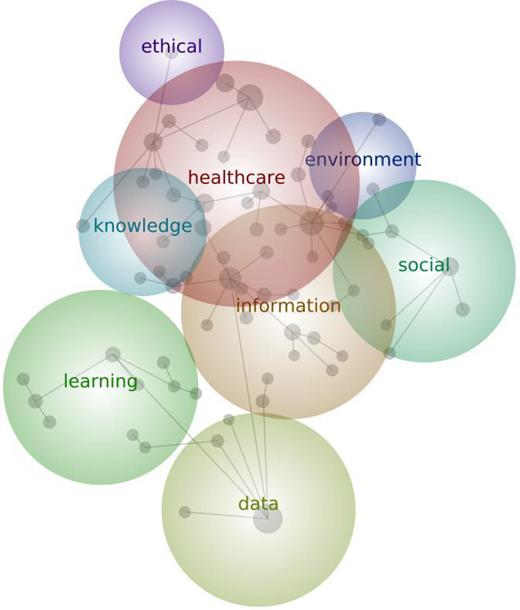
First, textual data were uploaded into Leximancer 4.0, a widely used text mining software that performs automated content analysis by identifying the main concepts in a text and visualizing their relationships. It allows researchers to extract dominant themes and generate conceptual maps with high reliability and reproducibility (Massaro et al., 2020; Sotiriadou et al., 2014). The software generated conceptual maps showing key themes and their semantic links across academic and practitioner data sets (Figure 1). Second, a direct content analysis was conducted using a coding framework grounded in literature on AI, KM and SDGs. Themes identified by Leximancer were validated, and additional insights were captured. NVivo coding, as suggested by Miles et al. (2014), ensured alignment with the original language and priorities. This dual approach offers methodological rigor and contextual depth for comparing how AI and KM are conceptualized in academic and practitioner discourses on health-care sustainability.
4. Results
4.1 Artificial intelligence and knowledge management in health care: insights from academic sources
This section explores how academic literature frames the interplay between AI and KM in the health-care sector. Thematic analysis using Leximancer highlighted key concepts such as “healthcare,” “patients,” “social,” “learning,” “data” and “environment.”
In the “healthcare” sector, AI is primarily examined for its role in improving patient outcomes and transitioning from physical to digital care. AI technologies enhance cost efficiency and quality of service delivery, especially through contact-reduced care and digital health assistance (Barbieri et al., 2023). For instance, wearable sensors and digital biomarkers, including Photoplethysmography (PPG)-based detection systems, enable continuous remote patient monitoring and data collection (Gangl and Krychtiuk, 2023). Another significant cluster focuses on “data,” particularly the dual role it plays in enabling algorithmic learning and reconfiguring vertical and horizontal health-care networks. These networks support hierarchical (vertical) or collaborative (horizontal) structures, which AI can enhance to deliver more accurate diagnostics in real time (Caserta and Romero, 2024; Guo et al., 2020). During the COVID-19 pandemic, automated data systems proved crucial in helping public administrations manage patient traceability and shape territorial policies (Tuzii and Bottari, 2022). The integration of these technological advancements, aimed at enhancing human health and well-being, contributes to achieving SDG 3 (good health and well-being), SDG 9 (industry, innovation and infrastructure), SDG 10 (reduced inequalities) and SDG 11 (sustainable cities and communities) by fostering the development of an innovative infrastructure designed to support public health.
However, the use of data also raises critical ethical concerns. Managing clinical information requires strict safeguards to ensure privacy and security (Thantilage et al., 2023). As digital surveillance technologies such as drones, cameras and Internet of Things (IoT) devices become more embedded in health-care settings, scholars have called attention to the risks of constant monitoring and erosion of patient autonomy (Dabla et al., 2021; Mittelstadt and Floridi, 2016). Massive data repositories increase the chances of data leaks or unauthorized use (Luxton et al., 2016), and in areas like mental health care, such risks are magnified by the sensitive nature of the information involved (Rubeis, 2022). Concepts like datafication − reducing human complexity to digital formats − may compromise patient individuality, while bias can emerge during the preprocessing phase of AI systems (Becker et al., 2018). Though AI is recognized for its potential to improve data management and offset workforce shortages, its rapid deployment also prompts concerns over job displacement and ethical decision-making (Mwase et al., 2025).
The pandemic has acted as a catalyst for digital transformation, driving home both the opportunities and risks associated with AI adoption in health care (Gangl and Krychtiuk, 2023). On the social front, while some scholars believe digitalization could help reduce disparities, many highlight how it often reinforces existing health inequalities linked to socioeconomic status (Weiss et al., 2018). Moreover, despite AI’s analytical power, tools like large language models lack empathy − an essential element for fostering patient trust and adherence (Sorin et al., 2024).
“Learning” is another dominant theme, cited over 13,000 times in the analyzed literature. Academics distinguish between AI’s learning functions and knowledge sharing. For instance, Platform24’s AI triage engines reduce human intervention in referrals, improving efficiency (Björkdahl et al., 2024). At the same time, AI enables innovative knowledge flows through semisupervised learning, chatbots, metaverse applications and other digital tools (Hajian et al., 2024; Lazarus et al., 2024). In fields like radiography, these tools not only assist in detection and classification but also contribute to new knowledge creation by identifying the most predictive features in data sets (Rainey et al., 2023). Consequently, KM emerges as a strategic umbrella encompassing various processes (such as knowledge creation, mapping, storage and sharing) all of which are critical for fostering collaborative environments in hospitals (du Plessis, 2007; Karamitri et al., 2017). These challenges are key to advancing SDG 4, SDG 3, SDG 9 and SDG 10 by promoting inclusive education and innovation. Social dimensions are also widely discussed, and it has been cited 7.445 times in the analysis. Social media use surged during the pandemic, impacting mental wellness and shaping digital coping strategies (Pappa et al., 2020). Applications like the “adapt-café” project promoted nutrition, physical activity and social interaction during lockdowns, reflecting how digital health tools were mobilized for broader well-being (Meinert et al., 2020). These considerations fall under the broader ESG, where social criteria are becoming increasingly significant in academic and corporate assessments (Clément et al., 2023).
Environmental sustainability is another relevant area with the word “environment,” which has been cited 3.223 times in the analyzed documents. AI plays a moderating role in developing green supply chains and promoting responsible resource usage in hospitals through e-learning and m-learning platforms (Benzidia et al., 2021; Halbusi et al., 2024). These systems contribute to environmental education while also supporting financial sustainability, a dual goal emphasized in discussions around renewable energy, water conservation and emission reduction (Gleißner et al., 2022; Jabbour et al., 2015; Leung and You, 2023). These challenges continue to contribute to achieving SDG 3, SDG 9 and SDG 11, while also extending their impact to SDG 13 (climate action) and SDG 15 (life on land), thereby expanding the conversation to encompass environmental concerns. Although not clustered explicitly, governance remains a vital component. Effective health-care management requires transparent structures, internal controls, risk mitigation and ethical leadership, especially as health-care systems grow more complex (Cagliano et al., 2011; Sepetis et al., 2024). A synthesis of these conceptual relationships is presented in Table 2.
4.2 Artificial intelligence and knowledge management in health care: insights from practitioner sources
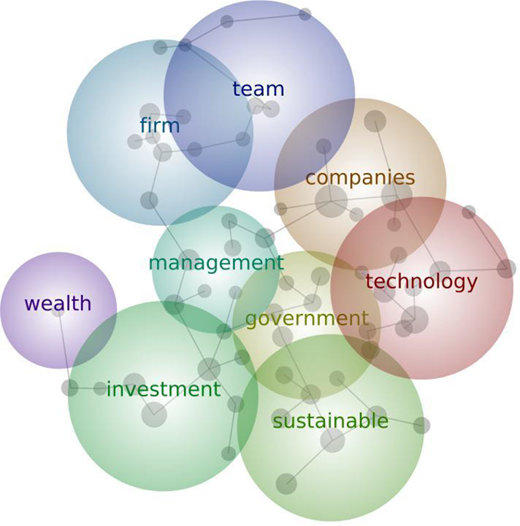
This section seeks to investigate how AI in health care is framed from a professional perspective, analyzing practitioner documents resulting from the NexisUni database. Analyzing practitioner content can reveal areas where academic theories may not fully address the complexities of real-world practice. Figure 2 shows that AI within the health-care context is related to many concepts, such as “technology,” “sustainability” and “companies,” alongside others grounded in finance, human capital and KM.
Considering the central recurrent concept of technology (with 1,911 mentions), this could be considered an umbrella term containing several elements linked to emerging technologies such as AI, data analysis, the IoT and digitalization. Geoff Martha, CEO of Medtronic, underscores the transformative role of robotics, miniaturization and AI, which are increasingly being embedded into surgical machinery to reshape clinical practices (Medtronic, 2024). Similarly, Spectrum.Life emphasizes the relevance of digital-first strategies, leveraging AI-driven recommendations to enhance health-care outcomes and preventive care models. These efforts reflect a shift toward smarter, contact-reduced health care enabled by automation and real-time support systems (Spectrum.Life, 2023). This aligns seamlessly with the achievement of SDG 3 and SDG 9, reinforcing efforts to enhance health, well-being and innovation.
These terms are connected to both “companies” and “government,” pointing to the development of public−private ecosystems for digital health innovation. These collaborations, often framed through public−private partnership (PPP) models, are key to advancing AI-driven infrastructures and services, particularly in contexts where public systems seek to integrate emerging technologies to improve outcomes and reduce systemic inefficiencies. A clear example of the government’s effort to develop this kind of opportunity is India, which has created three centers of excellence for AI to realize the vision of “Make AI in India and Make AI Work for India” as a first step for the building of a robust AI infrastructure (The Hindu, 2023). Likewise, Denmark and Korea’s bilateral initiative − the “Digital New Deal” − demonstrates how smart hospital development is integrated into international PPP frameworks, aiming to scale health-care innovation by 2025 (The Korea Herald, 2021). In this context, international cooperation plays a vital role in achieving SDG 17 (Partnership for the goals), strengthening global collaboration to maximize mutual benefits and drive sustainable development forward.
Other relevant themes relate to the business dimension of AI adoption, such as “companies” (2,918 mentions) and “business” (2,686 mentions). AI is not merely a technological advancement but a driver of competitive differentiation, value creation and strategic realignment. Data-intensive operations are increasingly seen as foundational to competitiveness. Alteryx highlights how over 90% of business leaders in the Asia-Pacific view data analytics and AI as critical tools for sustaining enterprise performance in the current landscape (APJAltery, 2021).
The concept of sustainability is closely related to the business world, primarily linked to the notion of “investment.” ESG-focused investments are gaining traction, with Kenvue linking human and environmental health in a unified approach to responsible innovation (Kenvue, 2024). Similarly, Shiok Meats attracts family office investors by aligning with SDG principles, showcasing the role of sustainability as a value lever in new health technologies (Shiok Meats, 2023). These narratives point to a convergence between social responsibility, environmental stewardship and long-term financial returns. As Jason Boyes of Infratil noted, sustainability is no longer at odds with profitability, and investors expect both simultaneously (Infratil, 2024).
An important meaning has been given to “team” which underlines the human component of business and its fundamental role in the health-care industry. Within this concept, we find the word “experience,” one of the main components of knowledge. The G7 Global Plan for Universal Health Coverage (UHC) emphasizes the central role of knowledge management and human resources as the primary pillars of the plan’s success (G7 UHC Plan, 2023). As stated by Muck Rack, upgrading skills and updating knowledge in the health-care sector will become a nonnegotiable issue for individuals and organizations as roles continue to require more skills than ever before, with greater demand for both technological and human capabilities (Stony Brook Medicine, 2025). Institutions such as Stony Brook Medicine are innovating teaching methodologies, integrating AI and simulation-based learning to cultivate interdisciplinary collaboration and high-quality care delivery. Once again, our analysis highlights AI as a key catalyst for achieving SDG 4, reinforcing its role in advancing quality education, accessibility and innovation in learning.
This opens an important issue related to how KM practices are increasingly shaped by technological infrastructures and cross-sector collaborations, reinforcing AI’s centrality in organizational learning, strategic alignment and sustainable innovation in health-care sector (Table 3).
5. Discussion
This study offers an overview of how AI and KM are shaping sustainable development in the health-care sector, drawing on both academics’ sources and practitioners’ perspectives. The analysis demonstrates strong convergence in recognizing AI’s capacity to transform health-care delivery, support KM practices and address sustainability targets, particularly the SDGs (Barbieri et al., 2023; du Plessis, 2007; Kenvue, 2024).
From the academic perspective, the discourse centers on structural, ethical and governance dimensions. Key themes include the digital transformation of patient care (Gangl and Krychtiuk, 2023), the role of AI in enabling vertical and horizontal health-care network structures (Caserta and Romero, 2024; Guo et al., 2020) and the ethical implications of datafication, surveillance and algorithmic bias (Becker et al., 2018; Mittelstadt and Floridi, 2016; Rubeis, 2022). Scholars emphasize the importance of robust knowledge ecosystems and organizational learning environments, where AI is not seen as a replacement for human professionals but as a complement that enhances clinical decision-making and patient outcomes (Hajian et al., 2024; Rainey et al., 2023). Additionally, the academic narrative is strongly embedded in ESG thinking, particularly in relation to environmental sustainability (Benzidia et al., 2021) and social inequalities (Clément et al., 2023; Weiss et al., 2018).
Practitioner sources, such as business journals, trade publications and industry reports, place a stronger emphasis on implementation, competitiveness and innovation. AI is portrayed as a tool to achieve strategic agility, support smart infrastructure (Medtronic, 2024) and enable public−private partnerships for health-care transformation (The Hindu, 2023; The Korea Herald, 2021). ESG is frequently discussed regarding investment strategy, where AI and sustainability are aligned to generate social value and financial returns (Infratil, 2024; Shiok Meats, 2023). Companies leverage AI to increase efficiency, build investor trust and develop human capital through AI-enhanced training (G7 UHC Plan, 2023; Stony Brook Medicine, 2025). While ethical and collaborative dimensions are acknowledged, they are often framed as facilitators of innovation rather than critical safeguards.
These perspectives are not contradictory but complementary. The academic lens offers a normative, critical framework that interrogates AI integration’s ethical and socio-environmental implications in health care. In contrast, the practitioner lens provides real-world insights into deployment, value creation and strategic alignment. Together, they offer a more holistic view of AI and KM’s transformative potential, underscoring the importance of cross-sector collaboration to ensure that technological advancement remains anchored in societal values and inclusive governance. Both perspectives on the impact and achievements of the SDGs identified SDG 3 (good health and well-being) and SDG 9 (industry, innovation and infrastructure) as being most relevant to our analysis. Academics emphasized the importance of social and global partnerships (SDG 17), while practitioners focused more on environmental issues, specifically SDG 12 (responsible consumption and production) and SDG 13 (climate action). Finally, both analyses highlighted the crucial role of AI in health care, which contributes to achieving SDG 4 (quality education) by improving educational quality through innovative solutions for the future.
A comparison of the two perspectives is synthesized in Table 4, offering an overview of their main insights and implications taking into consideration the main implication on SDGs achievement.
6. Conclusion
This study offers a comprehensive analysis of how AI and KM are interpreted and applied in the health-care sector from both academic and practitioner perspectives. The findings show a shared focus on innovation and sustainability, with differing academic and practitioner priorities; academia stresses ethical and governance concerns, whereas practitioners focus on strategic implementation and value creation. AI and KM contribute to SDGs 3, 4, 8, 9, 10 and 13 and additionally support SDGs 7, 11, 12, 15 and 17. Longitudinal studies in future could examine how AI and KM practices evolve in response to policy reforms, technological advancements and societal expectations.