This paper aims to present a comprehensive systematic literature review (SLR) that examines the intersection of emotional marketing and sustainable consumption in the context of building a sustainable future.
The study adopts a SLR approach to analyze 240 research articles to understand the relationship between emotional marketing and sustainable consumption using the TCCM (Theory–Context–Characteristics–Methodology) framework. Rigorous inclusion and exclusion criteria were applied to select Scopus-indexed articles published between 2010 and 2025.
As consumers increasingly seek products aligned with ethical and environmental values, understanding the emotional dimensions that drive sustainable consumption has become imperative. By synthesizing existing knowledge, this study contributes to the ongoing discourse on integrating emotions into sustainable consumption practices for the creation of socially responsible societies.
The study provides valuable insights for practitioners and stakeholders. These insights can be utilized to design targeted interventions and marketing strategies aimed at fostering sustainable consumption.
The study enhances theoretical understanding by elucidating the relationship between emotional marketing and sustainable consumption and highlighting its role in advancing sustainability-oriented consumer behavior.
This study extends existing academic literature by systematically consolidating knowledge on the role of emotional marketing in sustainable consumption. It is particularly relevant for marketers, policymakers and practitioners engaged in neuromarketing and consumer behavior research.
1. Introduction
The modern business environment has undergone a substantial shift in consumer preferences, driven by growing awareness of sustainability and environmental responsibility. Emotional marketing and sustainable consumption are closely connected within the broader framework of societal marketing, collectively shaping consumer behavior. Contemporary consumers seek not only functional value but also emotional satisfaction, psychological identification, and alignment with social objectives. As a result, emotional marketing has become a critical tool for building brand image and supporting sustainable development (Bin, 2023). Consumer emotions significantly influence decision-making processes, making emotional marketing increasingly relevant in encouraging sustainable consumption choices (Sharma et al., 2023). By engaging emotional and psychological dimensions, emotional marketing fosters deeper consumer–brand relationships through emotions such as empathy, joy, fear and concern.
Within sustainable consumption, emotional marketing emphasizes the environmental and social benefits of eco-friendly choices, reinforcing consumers’ sense of responsibility. This study examines the relationship between emotional marketing and sustainable consumption through a systematic review of the literature. Societal marketing further strengthens this relationship by integrating emotional cues that promote long-term sustainable behaviors. When emotional marketing strategies are aligned with societal marketing objectives, brands can influence enduring changes in consumption patterns. Although prior research indicates that weaker brands are more likely to adopt sustainability-oriented marketing strategies than stronger brands, emotional marketing remains effective in promoting sustainable consumption and facilitating new product adoption (Zhang et al., 2022). The primary challenge for firms lies in effectively linking emotions with sustainable consumption to support sustainable societies.
Technological advancements such as artificial intelligence, augmented reality and virtual reality have enhanced firms’ ability to analyze consumer needs and emotional responses. Tools, including eye-tracking, data analytics and feature extraction, enable firms to assess the behavioral and economic impacts of emotional marketing on sustainable consumption (Talafubieke et al., 2021). These technologies support the transition from a product-centric to a customer-centric paradigm, emphasizing emotional engagement and consumer psychology (Rini and Absah, 2017). Social media platforms further amplify emotional influence, as consumers share emotionally driven experiences that shape purchasing behavior (Bheekharry, 2022).
Recent studies highlight the psychological and contextual factors influencing sustainable behavior. Valor et al. (2018) describe sustainability as a morally desirable yet emotionally demanding responsibility, often leading to cognitive dissonance. Royo et al. (2018) demonstrate that emotionally engaging narratives and sustainable product designs generate stronger cognitive and affective responses, enhancing receptivity toward sustainable products. Wilkie et al. (2024) further argue that sustainability campaigns are more persuasive when aligned with evolutionary motives such as self-preservation, social status and belongingness. Hartmann and Apaolaza-Ibáñez (2013) emphasize the importance of contextual adaptation, showing that emotionally framed green advertising is more effective when tailored to local environments.
Consumer emotions also moderate satisfaction and demand based on product attributes (Xu, 2020). Empirical evidence confirms that emotional marketing significantly influences purchase behavior (Hartani et al., 2020). Emotions such as pride, fear, compassion and achievement enhance brand attachment and promote sustainable consumption (Wang and Wu, 2016; Staton et al., 2012). Firms that integrate emotional considerations into their strategies tend to achieve superior performance outcomes (Zhu et al., 2022).
Overall, emotional marketing, supported by societal marketing principles, plays a pivotal role in shaping sustainable consumption behaviors. Accordingly, this study examines the antecedents, outcomes, mediators and moderators of emotional marketing and sustainable consumption through a Theory–Context–Characteristics–Methodology (TCCM)-based systematic literature review (Paul and Rosado-Serrano, 2019).
The study focusses on the following research questions to fulfill the objectives, as follows:
What is the current literature about emotional marketing and sustainable consumption?
What are the existing studies on the topics of emotional marketing and sustainable consumption?
What theories, contexts, concepts, and techniques have been studied related to emotional marketing and sustainable consumption, and what are future directions in research?
2. Conceptual background
Emotional marketing focuses on creating emotional connections between brands and consumers, recognizing that purchasing decisions are strongly influenced by emotions. By fostering trust, loyalty and meaningful brand relationships, emotional marketing shapes consumer behavior and enhances long-term engagement. Robinette and Brand (1999) define emotional marketing as the development of dependable relationships that make consumers feel valued, thereby strengthening brand loyalty and purchase intentions. Sustainable consumption, by contrast, has its roots in broader debates on consumption and consumerism and gained prominence following the Rio Earth Summit in 1992 (Jackson, 2004). It refers to consumption patterns that minimize environmental harm while enhancing individual and societal well-being. Rather than consuming less, sustainable consumption emphasizes consuming more efficiently and responsibly to improve quality of life (United Nations Environment Programme, 1999). Ofstad (1994) further describes it as meeting basic needs while reducing waste, emissions, and the use of toxic materials without compromising future generations. Rising awareness of environmental and social issues has increased demand for sustainable alternatives, prompting organizations to integrate sustainability into marketing strategies. Emotional marketing plays a critical role in this process by appealing to consumers’ values, emotions and aspirations. Techniques such as storytelling make sustainability messages more relatable and engaging, reinforcing pro-environmental attitudes. Thus, the intersection of emotional marketing and sustainable consumption highlights how emotional drivers can be strategically leveraged to promote responsible consumption behaviors and support sustainability goals. Recent studies have contributed to the theoritical development on emotional marketing and has conceded that emotional marketing is a catalyst for sustainable consumption by emphasizing the role of both positive and negative emotions in shaping environmentally responsible consumer behavior. Recent systematic reviews suggest that emotions such as pride, hope, guilt, empathy and eco-anxiety significantly influence consumers’ sustainable purchase intentions and long-term behavioral change, although positive emotions need further exploration (Sadiq et al., 2026). Reviews have also highlighted that digital marketing, AI-enabled personalization, and social media campaigns can effectively accelerate sustainable consumption when emotional appeals are bundled with authenticity and consumer trust (Rosário and Dias, 2025; Tiwari et al., 2025). Contemporary studies further indicates that sustainable consumption is driven by mindful and responsible consumption orientations rather than purely economic considerations (De et al., 2025). Moreover, literature reviews emphasize the need to integrate emotional, psychological and contextual factors into unified theoretical frameworks for understanding sustainable consumer behavior (Bergianti, 2025). These studies reinforce the importance of emotional marketing as a strategic tool for promoting sustainability while highlighting promising avenues for future research on cross-cultural contexts, AI-mediated consumer engagement, and emotionally driven sustainable consumption.
3. Methodology
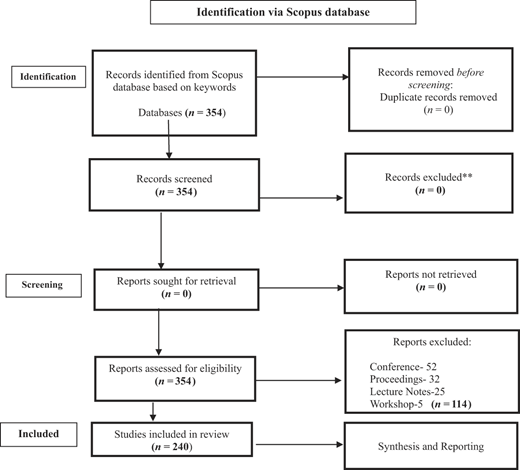
This study employs a systematic literature review (SLR) to examine research on emotional marketing and sustainable consumption. Following PRISMA guidelines (Chauhan et al., 2023), a comprehensive keyword-based search was conducted using the Scopus database. After applying clearly defined inclusion and exclusion criteria, 240 relevant studies were selected for analysis. The review integrates the TCCM framework to systematically map the literature, identify research gaps, and propose future research directions, consistent with prior SLR methodologies (Paul and Rosado-Serrano, 2019; Tobon et al., 2020). Keywords were identified through a multi-stage process, including an exploratory review of seminal and highly cited studies, followed by refinement based on titles, abstracts and author keywords. Terms related to emotional marketing (e.g. emotional branding, brand attachment, emotional appeals) and sustainable consumption (e.g. green consumption, ethical consumption, circular economy) were combined using Boolean operators to capture interdisciplinary studies. Retrieved articles were iteratively evaluated and refined to ensure relevance. Synthesized findings inform overarching insights and research implications, with additional details presented in Figure 1. To maintain the rigor, relevance and quality of the review process, a few exclusion criteria were used during screening and selection of articles. Those studies that were not directly involving emotional marketing or sustainable consumption were excluded, as were those studies that did not make a theoretical or empirical contribution, and those that worked on unrelated marketing fields. To keep the material uniform and academically sound, non-English publications, conference abstracts, editorials, book reviews, dissertations and unpublished manuscripts were not included. Also, duplicate records among databases were eliminated in the initial screening phase. Most articles that did not provide full texts or lacked methodological detail were excluded, to guarantee the validity and transparency of the analysis. In addition, studies that took place outside of the specified time frame and studies that did not specifically investigate the emotional appeals and sustainable consumption were excluded. These exclusion criteria aided to attain high quality and contextually relevant studies, appropriate for the objectives of the review, for the final data set.
Table 1 shows the number of articles on emotional marketing and sustainable consumption from the time period 2012–2025 from the Scopus database. Table 1 illustrates the distribution of research articles across journals that contributed two or more papers to the present systematic literature review. Journals such as Sustainability (Switzerland), Journal of Cleaner Production, Frontiers in Psychology, International Journal of Consumer Studies, and Sustainable Production and Consumption emerge as the most prominent publication outlets, indicating their strong scholarly focus on emotional marketing and sustainable consumption. To maintain clarity and avoid overcrowding, journals with only one published article were excluded from the figure. In total, 44 additional journals contributed one article each, collectively accounting for 44 articles out of the 240 articles reviewed. Instead, we have now explicitly noted in the text that 44 additional journals contributed one article each, accounting for 44 articles (approximately 0.4% per journal) out of the total 240 articles included in the review.
4. Emotional marketing
Drawing on brand equity theory, Zhang et al. (2022) propose an emotional branding communication model in which storytelling strengthens emotional appeals and promotes sustainable consumption. Storytelling emphasizes symbolic and emotional meaning over functional attributes and, consistent with consumption value theory, significantly influences sustainable consumption behaviors (Kim et al., 2019). Prior research highlights emotional marketing as a key mechanism for strengthening consumer–brand relationships through brand attachment, self-expression and emotional appeals, ultimately fostering loyalty and positive brand attitudes (Choi, 2019; Platania et al., 2020; Bou Saada et al., 2022). Digital platforms further enhance emotional marketing by enabling interactive and personalized engagement (Tymchenko et al., 2023). Emotional value often outweighs economic and cultural factors in purchase decisions, positioning emotional marketing as a critical driver of sustainable consumption and customer loyalty in contemporary markets (Rytel, 2010; He et al., 2022).
5. Sustainable consumption
Sustainable consumption seeks to influence purchasing behavior while advancing Sustainable Development Goals (SDGs) by reducing the ecological, social and economic impacts of goods and services (Salido-Andres et al., 2022). Although consumer environmental awareness is increasing, it does not always result in sustainable behavior due to multiple interrelated drivers, including behavioral, sociodemographic, contextual and product-related factors (Pretner et al., 2021). The concept remains multidimensional and somewhat ambiguous but has gained growing academic and policy attention. Governments play a critical role through regulation, incentives and policy frameworks, while consumers are central to the circular economy via sustainable purchasing, recycling and innovation. However, further research is needed on product use, recycling and upcycling behaviors (Vidal-Ayuso et al., 2023). Digital technologies also present significant opportunities to promote sustainable consumption, although regulatory frameworks often lag behind these developments (Pellegrino et al., 2023; Gossen and Lell, 2023). Coordinated communication, data analytics, education and multi-stakeholder collaboration are essential for fostering sustainable consumption and achieving long-term environmental and societal benefits. Table 2 highlights the findings from recent articles on sustainable consumption.
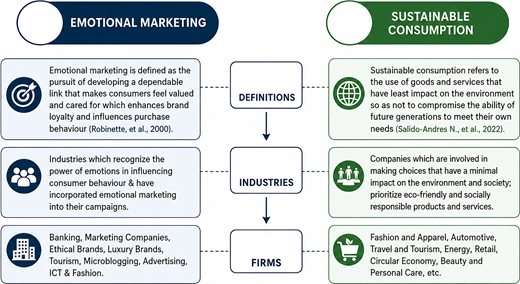
In Figure 2, the salient features and characteristics of sustainable consumption and emotional marketing, as derived from the literature review, are presented.
6. Research agenda
Previous research on emotional marketing and sustainable consumption has predominantly relied on quantitative methodologies and systematic literature reviews, respectively. In the domain of sustainable consumption, systematic literature reviews and bibliometric analyses have emerged as the most frequently employed research approaches (Table 2). Existing studies in this area have extensively examined themes such as the circular economy, the SDGs, technological innovation and sustainable development. In contrast, research on emotional marketing has largely focused on constructs including trust, brand love and attachment, emotional appeals, ethics and consumer behavior across diverse contexts (Table 3). The empirical evidence further indicates that the majority of studies on emotional marketing and sustainable consumption have been conducted in developed economies, particularly in Europe and North America. This geographic concentration highlights the need for broader contextual exploration. Future research should therefore seek to unravel the complex interplay between emotional appeals embedded in marketing strategies and the promotion of sustainable consumption patterns across varied sociocultural and economic settings. In addition, researchers should investigate the psychological mechanisms through which emotional marketing influences sustainable consumer behavior and explore the role of different marketing channels–both traditional and digital–in amplifying these effects. Insights derived from such investigations can provide actionable guidance for marketers aiming to foster sustainable consumption practices. Based on the research gaps identified in the existing literature, directions for future research are proposed using the TCCM framework (Paul and Rosado-Serrano, 2019). The following section elaborates on theory development, contextual dimensions, study characteristics and methodological approaches.
6.1 Theory development (T)
From a theoretical perspective, the literature reveals diverse frameworks for examining emotional marketing and sustainable consumption. Studies on emotional marketing apply brand equity theory (Zhang et al., 2022), empathy-based models (Xu, 2020) and sentiment analysis to capture consumer emotions across digital contexts (Nimitha et al., 2023; Meena et al., 2023). In sustainable consumption research, the Theory of Planned Behavior explains sustainability-oriented awareness (Agu et al., 2022), while Social Practice Theory offers a holistic view of consumption as socially embedded routines (Ariztia, 2017). Future research should integrate advanced approaches such as predictive modeling, neuro-marketing techniques, the satisfaction–dissatisfaction continuum (Kano, 2018), and the 5C model to deepen understanding of emotional responses and consumer decision-making.
6.2 Context (C)
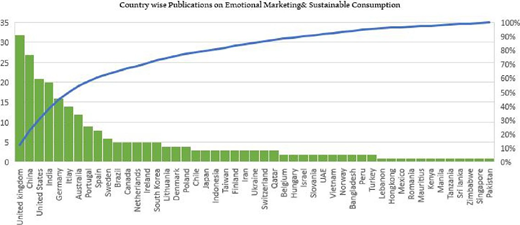
From a geographical perspective, the literature reveals that most empirical studies have been conducted in developed countries and are largely based on single-country analyses, particularly in the UK, the USA, Germany and China (Figure 3). In contrast, a substantial number of studies on sustainable consumption have been conducted in India, reflecting growing scholarly interest in sustainability-related issues within developing economies. However, apart from India, limited research has examined the intersection of emotional marketing and sustainable consumption in other developing countries. This highlights significant opportunities for future research in emerging and developing economies. Greater collaboration between researchers from developed and developing countries could help bridge existing contextual gaps and generate more inclusive and globally relevant insights. With respect to application areas, emotional marketing research has been conducted in domains such as ethical marketing and financial services (Hartani et al., 2020), luxury brands (Platania et al., 2020), spa and wellness services (Abdullah and Aziz, 2019), and tourism (Talafubieke et al., 2021).
In contrast, the majority of studies on sustainable consumption have predominantly focused on broader themes such as sustainable development and the circular economy. This imbalance suggests the need for more integrative research that applies emotional marketing perspectives to sustainability-oriented consumption contexts across a wider range of industries and geographical settings.
6.3 Characteristics (C)
Emotional marketing research primarily emphasizes the emotional and psychological dimensions of consumer behavior, whereas sustainable consumption studies focus on broader themes such as the circular economy and sustainable development. Prior studies have explored diverse variables to explain the interaction between emotional marketing and sustainable consumption. Emotional marketing research highlights factors such as brand-related emotions, trust, consumer–brand relationships, ethical considerations, and emerging technologies like virtual reality. In contrast, sustainable consumption research concentrates on demographic, psychographic, behavioral and psychological variables influencing eco-friendly choices. The integration of emotional marketing and sustainable consumption is valuable in aligning consumers’ emotions and values with environmentally responsible behaviors, thereby encouraging sustainable attitudes and actions.
The key antecedents and consequences associated with the relationship between emotional marketing and sustainable consumption identified in the literature are summarized in Table 4.
6.4 Methodologies (M)
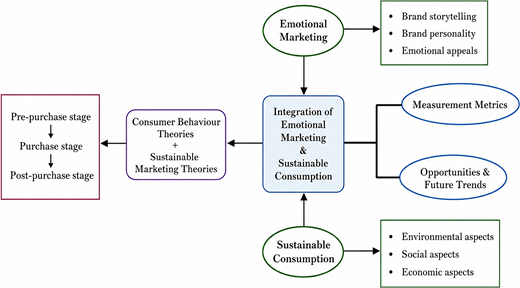
Table 3 includes the research methods used in 240 papers used in this study for review. The review shows that some of the well-known methods used in the studies on emotional marketing and sustainable consumption includes include correlation, qualitative research, systematic literature review, case studies, sentiment analysis and behavioral studies. Emotional marketing and sustainable consumption have become an advanced form simple case studies (Kim et al., 2019); Agyeiwaah (2020); Kagendo-Kiarie (2022) to literature reviews and meta-analysis (Chen, 2020); Carletto, Ferriani and Silva (2023); Scalco, Noventa, Sartori and Ceschi (2017).Empirical studies conducted by Jiang et al. (2023); Lee (2021); da Silveira et al. (2022) contributed in the theoretical development in the field of emotional marketing. The qualitative methods progressed from Qualitative methods (Chamberlin and Callmer, 2021) to Qualitative content analysis (Jacob-John et al., 2023). However, the future researches can possibly focus on methods such as thematic analysis, mixed methods, Cluster analysis and longitudinal studies for profound understanding of emotional appeals and sustainable consumption. Figure 4 illustrates the conceptual framework; it demonstrates the relevance of consumer behavior and sustainable marketing theories in integrating emotional marketing with sustainable consumption. The framework is based on the theories of Consumer Behavior and Sustainable Marketing Theories that describe the influence of consumers’ emotional state, values and environmental awareness on purchasing. The following independent variables were found: Emotional marketing and Sustainable consumption. Brand Storytelling, Brand Personality and Emotional Appeals are part of emotional marketing to build an emotional connection and shape the consumer’s attitude. Sustainable consumption is depicted by the three elements: the environmental, social and economic aspects, indicating consumers’ awareness of sustainability and ethical consumption. Consumer buying behavior is the dependent variable, which is measured by the various stages of buying behavior. Furthermore, the measurement metrics and opportunities & future trends serve as supporting variables to assess the effectiveness and the future potential of integration of emotional and sustainable marketing. The framework’s overall findings support the idea that a strong emotional connection and sustainability efforts can positively impact consumer buying decisions and long-term brand relationships.
7. Discussion and future research agenda
This study underscores the multifaceted role of emotional marketing in shaping sustainable consumption patterns and synthesizes existing research in this domain. It highlights how emotional appeals such as fear, joy and empathy influence consumers’ perceptions, attitudes and purchasing decisions toward sustainable offerings. The proposed conceptual framework (Figure 4) illustrates the integration of emotional marketing elements with environmental, social and economic dimensions to promote pro-environmental behavior. By mapping the evolution of theories, methodologies and variables over the past two decades, the study guides future research directions. It further calls for examining moderating factors, long-term behavioral effects, and ethical considerations to deepen understanding of emotional marketing’s role in sustainable development.
8. Theoritical and managerial implications
This study brings a multitude of aspects of emotional marketing to the surface to create sustainable consumption patterns and offers an extensive overview of the research efforts that have been conducted in a variety of other sectors including retail, fashion, food and beverage, tourism, renewable energy and consumer goods. It provides evidence of the differential effect of specific emotional appeals, such as fear appeals about climate risk, positive framing of green lifestyles, empathy-driven storytelling, evoking feelings of nostalgia, pride and guilt on consumers’ perceptions of the environment, their attitudes toward sustainability, trust in brands, and their purchase intentions for products and services that support the environment. The study also explores the use of these strategies in the context of digital advertising campaigns, social media, cause-related marketing, green packaging communication, corporate social responsibility (CSR) and experiential marketing that adopts a sustainability approach. The proposed conceptual framework is designed to show how emotional marketing components interact with the environmental, social and economic sustainability aspects, facilitating pro-ecological actions, responsible consumption, participation in recycling, saving energy and brand loyalty in the long-term to sustainable brands. Furthermore, the study reviews the dominant theories, research methods and key variables over the last 2 decades: Theory of Planned Behavior (TPB), Value-Belief-Norm (VBN) theory, Stimulus-Organism-Response (SOR) framework, consumer environmental consciousness, emotional engagement, green perceived value and sustainable purchase intention. The review also reveals new trends in methodology like “neuromarketing,” “sentiment analysis,” “personalization” by AI, “big data” and cross-cultural comparisons. In addition, the study highlights the importance of future research on moderating and mediating variables, including culture, age, income, digital literacy, environmental awareness and social norms and the effects of emotional marketing interventions over the long-term. It also focuses on key ethical issues about emotional manipulation, greenwashing, authenticity, data privacy and consumer well-being to enhance the impact, trustworthiness and societal value of emotional marketing to the cause of sustainable development.
9. Conclusion
To sum up, the present review offers a thorough overview of the ever-expanding literature on the study of emotional marketing and sustainable consumption. The TCCM framework is used to systematically uncover the recurring themes, theoretical underpinnings, situational contexts and methodological approaches that pervade the existing research in this field. The results illustrate the significant role of emotional marketing in influencing consumers’ sustainable purchasing behaviors, which have been found to increase the psychological involvement, value congruence and pro-environmental decision-making of consumers. In an era of growing environmental and social pressures around the world, the use of emotional marketing in sustainability efforts is a research opportunity and a practical need for both organizations and policymakers that are striving to encourage responsible consumption patterns. This review points out how crucial it is to craft messages that evoke emotion by matching beliefs, ethics and personal values to consumers to elicit meaningful, lasting behavioral change. Although this area has received a growing amount of academic interest, there are several areas that remain unfilled. Little work has been undertaken, however, that investigates the role of emotional marketing in achieving other social sustainability goals, including social equity, community health and well-being, and societal environmental responsibility. In addition, the use of digital technologies, social media platforms, artificial intelligence and immersive communication tools is on the rise, offering new possibilities and challenges that need to be explored further to understand digitalization’s role in increasing emotional engagement in sustainable consumption settings. The review also highlights the importance of longitudinal and cross-cultural research to better reflect the dynamic qualities of emotional reactions and their lasting impacts on attitudes and behaviors. Further research is needed on the various emotional aspects, new technological situations, and cross-disciplinary analysis to build up a better theoretical and practical understanding. In conclusion, this review contributes to the literature by summarizing current knowledge, highlighting gaps in the research, and outlining a future research agenda. It highlights the role of emotional marketing as a strategy for influencing positively sustainable consumption and toward a more socially and environmentally responsible future.
Data declaration
To avoid data discrepancy and ensure the ethical viability, transparency and reproducibility of the research, the authors hereby provide the following data declaration details.
Data collection source
The bibliographic data used in this study were collected from the Scopus database, which is a recognized and widely used abstract and citation indexing platform for peer-reviewed literature.
Data collection time period
The data for this study were collected covering publications from the period 2010 to 2025.
Data collection methodology
The data were retrieved systematically using relevant keywords, search strings, inclusion and exclusion criteria, and subject-specific filters within the Scopus database. Duplicate records, incomplete entries, and irrelevant documents were screened and excluded to ensure data accuracy and reliability. The collected dataset was then organized and analyzed according to the objectives of the study using appropriate analytical and bibliometric methods.
Copyright and data usage
The data used in this research were obtained from the Scopus database for academic and research purposes only. No copyrighted full-text content was reproduced in this manuscript without proper citation or permission. The authors acknowledge that Scopus content remains the intellectual property of its respective publishers and database providers. Any required permissions or institutional access necessary for data retrieval were duly complied with during the research process. The authors confirm that the data presented in this manuscript are authentic, ethically collected, and accurately reported to the best of their knowledge.