


The purpose of this study is to evaluate the impact of psychological entitlement and perceived organizational justice on cyberloafing.
In this study, a cross-sectional research design based on a questionnaire method was used to collect the required data from a sample of 226 employees working at selected universities in the city of Isfahan, Iran. To test the research hypotheses, structural equation modeling was used.
According to the findings, psychological entitlement could have a significant impact on perceived organizational justice and consequently perceived organizational justice could significantly influence cyberloafing. Moreover, psychological entitlement could significantly influence cyberloafing and finally, psychological entitlement could have a significant effect on cyberloafing through perceived organizational justice.
This research provides valuable insight for studying the relationship among psychological entitlement, perceived organizational justice and cyberloafing.
1. Introduction
Cyberloafing or spending work time using the internet for non-work purposes is an important concern for organizations, as access to the internet has expanded through the use of different electronic devices such as smartphones and tablets (Andel et al., 2019). In this respect, the study by Zoonen et al. (2014) indicated that 84.1% of employees had made use of Facebook and Twitter at least once a day. According to Andel et al. (2019), employees spend approximately 2 h per day engaging in cyberloafing behaviors. There are various viewpoints toward the consequences of cyberloafing (Wu et al., 2020). Previous research suggests that using the internet and social media at work have some positive outcomes such as job performance (Moqbal et al., 2013); better work–life balance (Malik et al., 2010); job satisfaction (Koch et al., 2012) and organizational commitment (Ali-Hassan et al., 2011). On the other hand, many studies have shown that cyberloafing has different negative organizational outcomes (Wu et al., 2020), costing organizations almost $85bn per year (Andel et al., 2019). For example, cyberloafing has been found to cause psychological stress (Sonnentag et al., 2018) and negative emotions (Sonnentag, et al., 2017). In addition, cyberloafing reduces organizational productivity (Taylor, 2007) and work engagement (O’Neill et al., 2014). Given the various consequences of using the internet at work; so far, studies have been conducted to identify the factors influencing cyberloafing behaviors. However, it seems that no research has been carried out on the impact of the psychological entitlement and perceived organizational justice on cyberloafing. In this respect, a sense of entitlement means that one person feels that he/she deserves more pay, recognition, positive feedback and other rewards (Lerner and Mikula, 1994). This feeling is accompanied by aggression, greediness, non-ethical behaviors, conflicts and other negative results (Campbell et al., 2004; Harvey and Martinko, 2009). Perceived organizational injustice can also lead to cyberloafing. It is argued that people in organizations are those who perceive the fairness of organizational procedures and transitions by checking and comparing workloads, working time, pay levels, benefits and welfare facilities (Fernandes and Awamleh, 2006). Accordingly, the administrator of an organization may perceive justice in the existing procedures and processes while the subordinates have an unfair perception of them (Lambert and Hogan, 2013). According to the stated contents, the purpose of this study was to evaluate the impact of psychological entitlement and perceived organizational justice on cyberloafing.
2. Theoretical literature and hypothesis development
2.1 Social media
Social media are powerful internet-based means of communication used inside and outside the workplace (Holland et al., 2016). There are different perspectives on the advantages and disadvantages of social media. A relationship can be also observed between job satisfaction and willingness to use social media at work (Robertson and Kee, 2016). Furthermore, the use of social media can have a positive impact on job performance (Ali-Hassan et al., 2015). The research results also reported that most of the employees involved in the service sector have agreed that the use of cell phones had improved their productivity while employees working in the production sector believed that the use of cell phones during their work had brought about negative effects (Sarwar and Ghafoor, 2014). Using social media can also have positive effects on access to work-related data, communication with colleagues, as well as knowledge and information sharing. Also, the researchers found that the negative effects of social media tools could outweigh the positive ones if their use at work had not been well managed by human resources management (Munene and Nyaribo, 2013).
2.2 Psychological entitlement
Psychological entitlement refers to a stable and pervasive sense that one deserves more and is entitled more than others (Vatankhah and Raoofi, 2018). In this respect, researchers have found that a sense of entitlement is correlated with restlessness at work (Harvey and Harris, 2010), conflicts with supervisors and low levels of job satisfaction (Harvey and Martinko, 2009). In recent years, entitlement has drawn the attention of many researchers (Brown et al., 2009). Although some researchers use entitlement and narcissism instead of each other (Twenge and Campbell, 2009), entitlement can be subsumed for narcissism (Raskin and Terry, 1988). That is, the narcissists have positive and loving views of themselves (DuBrin, 2012). Among the traits of narcissistic individuals; a sense of powerfulness, superiority, arrogance, self-acceptance and entitlement can be also highlighted (Foster and Campbell, 2005; Raskin and Terry, 1988).
2.3 Perceived organizational justice
Perceived organizational justice is concerned with employees’ subjective fairness perceptions in their employment relationship (Hameed et al., 2019). Therefore, the perception of no justice in the workplace can be considered as one of the basic factors affecting the occurrence of aggressive behaviors which can, in turn, heavily damage the creation and maintenance of social capital within an organization (Greenberg and Baron, 2000). As employees in an organization feel that they have been treated unfairly, they can respond emotionally (with less commitment) and behaviorally (increased turnover and decreased consequential behaviors) (Vaezi et al., 2017). It should be noted that, in each social exchange, humans try to compare interests and costs and they would consider it as injustice if it is supposed that costs are greater than interests (Blakely et al., 2005). When employees compare their share with those who slack off, their motivation to make efforts decreases or they take rests to moderate the perceived unfairness (Felps and Mitchell, 2006). Investigations into organizational justice can be based on three dimensions of distributive, procedural and interactional justice (Nadiri and Tanova, 2010). Interacting with each other, these three dimensions of justice can shape the generally perceived justice for individuals at work (Golparvar and Nadi, 2011). Distributive justice refers to perceived justice concerning the allocation of organizational returns and resources (Greenberg and Colquitt, 2005). Procedural justice can also refer to the fairness of methods used for determining occupational consequences (Naami and Shekarshekan, 2005). Procedural justice stands for justice perceived from the ways used to decide about features and results (Nasiri and Beheshti Rad, 2015). Interactional justice also refers to relationships between individuals and organizational behaviors accompanied by respect (Eberlin and Tatum, 2008). This kind of justice has been defined as the quality of interpersonal behaviors especially those by supervisors (Greenberg and Colquitt, 2005).
2.4 Cyberloafing
Employees’ non-work-related internet at work (such as online shopping, watching online videos (e.g. YouTube), surfing non-work-related online websites and browsing social networking sites (e.g. Facebook and Twitter) is termed as cyberloafing (Koay and Soh, 2018). Currently, we are living in the world of information technology (IT) using computers, tablets, cell phones and the internet. Given that the presence of computers in organizations has led to an increase in productivity, employees have lost their sight of work (Askew, 2012). Despite the benefits of IT, cyberloafing is considered as one of its disadvantages (Cinar and Karcioglu, 2015). So, cyberloafing is a reality within today’s organizations in a way that companies have increased access to high-speed internet which is necessary for research and communications (Cinar and Karcioglu, 2015).
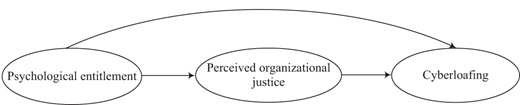
2.5 Relationship between psychological entitlement and perceived organizational justice
The psychological entitlement means that individuals feel that they deserve more pay, recognition, positive feedback and rewards than others without considering their share at an organization. This feeling can have outcomes such as aggression, greediness, non-ethical behaviors, conflicts and other negative ones (Harvey and Martinko, 2009). It should be noted that individuals in an organization are those who perceive the fairness of organizational procedures and interactions by examining and comparing workload, working time, pay levels, benefits and welfare facilities (Fernandes and Awamleh, 2006). The fact that perceived organizational justice stands for equitable distribution of pay and salaries, fair and equal procedures, as well as respect and dignity at work (Vaezi et al., 2017); the consequences of lack of justice in an organization can cause aggressive behaviors, slacking and low commitment. Thus, individuals with a sense of entitlement are likely to perceive the absence of justice in an organization more than others and consequently, the outcomes of non-perception of justice such as reduced performance and increased deviant behaviors can occur more in entitled and narcissist individuals. Accordingly, H1 was developed as follows:
There is a significant relationship between psychological entitlement and perceived organizational justice.
2.6 Relationship between perceived organizational justice and cyberloafing
When employees compare their share with those committing cyberloafing, their level of motivation to make efforts is reduced and they seek more rests to moderate the perceived injustice (Felps and Mitchell, 2006). As employees find an organization’s behavior toward resource distribution, rewards and interactions between individuals unjust; they also tend to attempt cyberloafing (Lim, 2002). In the study by Zoghbi examining the effect of interactional justice on cyberloafing (Zoghbi, 2006), the results revealed that interactional justice had a negative effect on fear of punishment and such a fear could moderate the relationship between organizational justice and cyberloafing. Thus, the probability of cyberloafing among employees increases if they find their organization’s behavior unfair. If such employees also feel that their cyberloafing will be monitored by their organization and they will be severely punished, such behaviors are likely to occur less than ever before. Having a sense of injustice about organizational decision-making and, in general, organizational procedures can have more effects on the distribution of organizational benefits and how interactions occur in an organization in terms of deviant behaviors such as cyberloafing. In general, all three types of organizational justice can negatively affect cyberloafing (Zoghbi and Gonzalez, 2008). Therefore, H2 of this research was developed:
There is a significant relationship between perceived organizational justice and cyberloafing.
2.7 Relationship between psychological entitlement and cyberloafing
Psychological entitlement causes restlessness at work (Harvey and Harris, 2010), conflicts with supervisors (Harvey and Martinko, 2009) and low job satisfaction (Harvey and Martinko, 2009). Given that individuals with a sense of entitlement are known as the narcissist with traits such as a sense of arrogance and powerfulness, they consider themselves entitled to have power and demonstrate deviant behaviors such as cyberloafing. Accordingly, H3 addressed in this study was developed as follows:
There is a significant relationship between psychological entitlement and cyberloafing.
2.8 Relationship between psychological entitlement and cyberloafing through perceived organizational justice
According to the results, a sense of entitlement was correlated with cyberloafing. Given the fact that perceived organizational justice was correlated with cyberloafing, it was concluded that the sense of entitlement could indirectly affect cyberloafing through the mediating role of perceived organizational justice. Thus, H4 of the research was developed as follows:
There is a significant relationship between psychological entitlement and cyberloafing through perceived organizational justice.
The conceptual model of research is presented in Figure 1.
3. Research methodology
The statistical population of this study included employees working at selected universities in the city of Isfahan chosen through a simple random sampling method. The data collection instrument was a questionnaire. To calculate the sample size in the studies of structural equations, the relationship of 5q ≤ n ≤ 15q is normally used in which q refers to the number of questions in the questionnaire and n stands for the sample size (Safari et al., 2018). Given that there were 29 items in the questionnaire, 250 questionnaires were distributed, of which, 226 questionnaires included the correct data and they were used for data analysis. The overall response rate was estimated at 90.4%. All items were adapted from existing literature and based on validated scales and were measured with a five-point Likert scale ranging from extremely disagree (1) to extremely agree (5).
To measure perceived organizational justice, the questionnaire developed by Niehoff and Moorman (1993) was used. The sense of entitlement and cyberloafing were also measured through the questionnaires by Campbell et al. (2004) and Lim (2002), respectively. The content validity of the questionnaire was verified by several sessions and confirmed by the academia experts in the field of organizational behavior and psychology. The construct validity of the structural model was also measured by factor analysis. The values of factor loadings for the variables were shown in Table 1. In this respect, the results of factor analysis confirmed the validity of all the variables.
Results of confirmatory factor analysis
| Variables | Items | Factor loadings |
|---|---|---|
| Organizational justice | 1. My working schedule is fair | 0.86 |
| 2. I think that my pay level is fair | 0.54 | |
| 3. I see the volume of my work quite fair | 0.70 | |
| 4. The rewards I receive from the organization are fair altogether | 0.76 | |
| 5. All work-related decisions are made by the manager in an unbiased manner | 0.58 | |
| 6. Before making a decision, my manager is ensured that the views of all employees are heard | 0.81 | |
| 7. To make work-related decisions, my manager collects correct and complete information | 0.84 | |
| 8. All work-related decisions are equally implemented for employees | 0.66 | |
| 9. The employees are allowed to express their opinions about the decisions made | 0.71 | |
| 10. When decisions are made about my job, the manager treats me with respect and modesty | 0.81 | |
| 11. When decisions are made about my job, the manager shows sensitivity to my personal needs | 0.72 | |
| 12. When decisions are made about my job, the manager treats me honestly | 0.90 | |
| 13. When decisions are made about my job, the manager provides acceptable explanations | 0.83 | |
| 14. The manager explains very clearly about all decisions made about my job | 0.81 | |
| Psychological entitlement | 15. Honestly, I feel that I deserve to receive more things than others | 0.60 |
| 16. Excellent events should happen to me | 0.69 | |
| 17. If I were on the Titanic, I would deserve to be on the first life boat! | 0.79 | |
| 18. I deserve the best | 0.81 | |
| 19. I deserve more things in life | 0.91 | |
| 20. People like me deserve more rest and comfort | 0.65 | |
| 21. I am entitled to all things | 0.53 | |
| Cyberloafing | 22. I browse sports websites at work | 0.58 |
| 23. I browse investment websites at work | 0.41 | |
| 24. I browse entertainment websites at work | 0.54 | |
| 25. I browse news websites at work | 0.76 | |
| 26. I browse websites unrelated to my job in the workplace | 0.67 | |
| 27. I download information unrelated to my job in the workplace | 0.86 | |
| 28. I purchase my personal items online in the workplace | 0.86 | |
| 29. I send and receive personal emails at work | 0.69 |
The reliability of the questionnaire was calculated using Cronbach’s alpha method. As shown in Table 2 the reliability of each factor is above 70%, therefore, the reliability of the questionnaire was confirmed. The SPSS 20 and AMOS 20 software were used for data analysis.
4. Results
To test the research hypotheses, structural equation modeling was used. For this purpose, initially, the fitness of the measurement models was separately analyzed and the results of confirmatory factor analysis for the models were confirmed. As observed in Table 3, all three models have a good fit.
Fit indices of measurement models
| Fit index | CMIN/DF | GFI | IFI | CFI | RMSEA |
|---|---|---|---|---|---|
| Model | |||||
| Organizational justice | 3 | 0.9 | 0.93 | 0.93 | 0.09 |
| Psychological entitlement | 1.21 | 0.98 | 0.99 | 0.99 | 0.03 |
| Cyberloafing | 2.94 | 0.95 | 0.96 | 0.96 | 0.09 |
| Goodness of fit | <3 | >0.9 | >0.9 | >0.9 | <0.1 |
Notes:
CMIN/DF = normed chi-square; GFI = goodness of fit index; IFI = incremental fit index; CFI = comparative fit index; RMSEA = root mean squared error of approximation
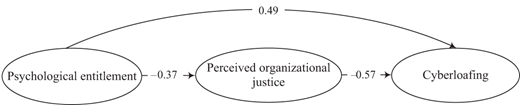
After testing the fitness of each measurement model, the structural model of the research was examined. In this respect, the structural model of the study and the fit indices of the model were presented in Figure 2 and Table 4, respectively.
Fit indices of the structural model
| Fit index | CMIN/DF | GFI | IFI | CFI | RMSEA |
|---|---|---|---|---|---|
| Model | |||||
| Structural model | 1.81 | 0.90 | 0.95 | 0.95 | 0.06 |
| Goodness of fit | <3 | >0.9 | >0.9 | >0.5 | <0.1 |
Two indices named critical ratio (CR) and p were used to test the significance of hypotheses. The critical ratio is computed through regression weight divided by the standard error. Based on the significance level of 0.05, CR should be greater than 1.96 and under –1.96 (Salehzadeh et al., 2016). Table 5 shows the regression coefficients and values of CR and p associated to each hypothesis. As can be seen, all hypotheses are verified.
The results of testing research hypotheses
| Path | β | CR | P | Results |
|---|---|---|---|---|
| Psychological entitlement has a significant impact on perceived organizational justice | −0.37 | −4.48 | 0.001 | Confirmed |
| Perceived organizational justice has a significant impact on cyberloafing | −0.57 | −5.76 | 0.001 | Confirmed |
| Psychological entitlement has a significant impact on cyberloafing | 0.49 | 4.89 | 0.001 | Confirmed |
The bootstrap method is used for testing the mediation relationship (Table 6). Considering the fact that zero cannot be among the upper and lower bounds, the mediation hypothesis is confirmed (Safari et al., 2018).
5. Discussion
This study was an attempt to evaluate the impact of psychological entitlement on cyberloafing through the mediating role of perceived organizational justice. The results of this research confirmed all the hypotheses. Despite the ever-growing importance of the internet and social media and their effects on the quality of individuals’ working environment, conducting few investigations in this domain due to the high speed of changes was considered as a research gap.
According to previous literature, there are different behaviors at work (Appelbaum and Roy-Girard, 2007). When behaviors at work are out of the norms defined within an organization, their consequences can become very all-encompassing and then affect the entire levels of an organization such as the processes of decision-making, productivity and financial costs (Coccia, 1998). Researchers have labeled these behaviors with various names including deviant behaviors in the workplace (Robinson and Bennett, 1995). In this respect, deviant behaviors are recognized when “rituals and customs as well as internal policies and regulations of an organization” are violated by an individual or a group (Robinson and Bennett, 1995). One type of deviant behavior is cyberloafing at working time and workplace. Cyberloafing is a new concept and it has not been investigated sufficiently. It is also predicted that the relationship between cyberloafing and other variables at work will be investigated in future studies (Cinar and Karcioglu, 2015).
Moreover, we are living in the age of knowledge and IT which includes instruments such as computers, tablets and cell phones, as well as the internet. In spite of the benefits of IT, employees do their personal everyday tasks at work. Cyberloafing is also considered as one of the disadvantages of IT (Cinar and Karcioglu, 2015) defined as a kind of abuse from the internet access provided by a company because it is used for personal purposes by individuals during working hours. Cyberloafing is similarly known as a voluntary activity as individuals get involved in activities that are enjoyable for them.
One of the main variables of this study was the psychological entitlement. The given sense emerges when an individual expects excessive and optimistic support for one’s skills and achievements (Harvey and Harris, 2010). People who consider oneself entitled expect high levels of bonuses without attention to their own share (Harvey et al., 2009). The current generation of employees has a tendency to narcissism and entitlement and they are also endowed with higher self-confidence than previous generations. Moreover, it is argued that the sense of entitlement causes stress; because individuals are exposed to optimistic and unpleasant expectations and feel that they are recognized insufficiently by managers and colleagues (Harvey and Harris, 2010).
The other variable in this study was perceived organizational justice. Particularly, the findings revealed that employees would get involved in cyberloafing as organizations treat employees unfairly in terms of the distribution of rewards, procedures and behaviors (Lim, 2002). It is also acceptable that employees have justifications for cyberloafing within working time as they perceive injustice from managers. For example, they would say that “My boss is not grateful. So, I do whatever every time I like. Cyberloafing is my reaction to the unfair treatment demonstrated by my boss” (Lim, 2002).
5.1 Managerial implications
The importance of internet resources toward modern organizations is undeniable; they are integrated into operational processes to improve communication, foster productivity and enhance employee efficiency. However, some employees also take this as an opportunity to slack by cyberloafing when at work (Koay, 2018). Therefore, it is very important for an organization to identify factors influencing cyberloafing behaviors. The results of evaluating the impact of psychological entitlement on perceived organizational justice suggested that employees feeling entitled could have lower levels of perceived organizational justice. Moreover, entitled employees have weaker social ties with others. Hence, cyberloafing is a perfect alternate for the purpose of helping them in the virtual world. In this regard, it makes sense to avoid future problems through recruiting individuals without narcissism and a sense of entitlement during the employment process (Harvey et al., 2009). It should be noted that there are several criteria to measure a sense of entitlement which can be used by managers (Campbell et al., 2004). In addition, the results of evaluating the impact of perceived organizational justice on cyberloafing showed that the perception of unfairness within an organization could add to cyberloafing. Thus, to reduce cyberloafing behaviors, organizations need to promote justice in the workplace. In this regard, the volume of work, working schedule and pay level must be fair and all work-related decisions must be made by the managers in an unbiased manner (Lim, 2002). In addition to what was mentioned above, organizations should be able to take steps forwards to reduce cyberloafing; for example, they should monitor the online activities of their employees if needed and also express their own expectations of employees within the policies of the organization (Lim, 2002). Furthermore, organizations can educate employees about the dangers of online threats, online surfing and cyberloafing; and support attitudes that promote a positive work environment (Koay and Soh, 2018). Overall, managers should directly target variables that serve as the impetus for cyberloafing behaviors.
5.2 Limitations and directions for further research
With regard to the importance of the internet and its common use, the impact of psychological entitlement and perceived organizational justice was measured and evaluated simultaneously. It was also suggested to measure the impacts of other factors such as leadership styles, occupational attitudes and job performance on cyberloafing (Harvey et al., 2009). In addition, future research can use a qualitative research method to identify unknown factors that can potentially influence cyberloafing behaviors. Furthermore, it should be noted that cyberloafing can be practiced via internet access within an organization or through cell phones, laptops and tablets. Therefore, the severity of the effect of different methods on cyberloafing needs to be measured. Probable consequences of cyberloafing need to be explored in the future, such as hacking into computer systems and abusing data in the workplace which can be related to online behaviors. Besides, it is estimated that the number of employees who consider themselves entitled is on the rise in organizations. Thus, it can be an interesting question for future research (Campbell et al., 2010). The results of this study were obtained in the context of universities in the city of Isfahan; thus, it is possible to reach different findings in other organizations, cities and countries (due to cultural differences). Some employees in the statistical population had been also affected by some situational factors (such as lack of time); so their levels of participation in terms of appropriate response rate for the questionnaire were low. Given the time constraints, some demographic and psychological characteristics were not included in this study. As mentioned by Andel et al. (2019), cyberloafing is often considered a counterproductive type of withdrawal behavior. However, recent research suggests that cyberloafing may have some unexpected positive workplace outcomes. Therefore, future research can examine the positive consequences of cyberloafing.

