


Automobile industry has been the backbone of manufacturing sector in any country. During the past decade, passenger car industry has emerged as the one of the growing sectors in the Indian economy. Technological features in the passenger cars industry has been evolving in the global market, and customers have been the most important stakeholders to judge the requirement of these features. Therefore, the purpose of this paper is to analyze the customers’ need for these emerging technologies using Kano model of customer satisfaction.
This paper has used the Kano model to assess the customer satisfaction for Indian passenger car companies. Overall, 250 customers of passenger cars from Northern India have been surveyed using well-structured questionnaire designed as per the Kano model. On the basis of responses, this study has categorized the technological attributes of passenger cars as attractive, must be, one-dimensional and indifferent.
“Auto Gear Shift” system has emerged as a must be attribute. “Premium surround system” has been categorized under one-dimensional attribute. “Communication between vehicles,” “integration with smart phone,” “connecting applications,” “dual-stage airbags,” “in-dash navigation system,” “rearview camera,” “heated and cooled seats,” “built-in fourth generation long term evolution,” “Wi-Fi system” and “automated window cleaning system” have emerged as attractive features. The customers have been indifferent about “gesture control,” “reality display on car wind screen” and “run-on-flat tyre.” In contradiction to the popular belief, this study has found that customers have shown Indifferent attitude toward “hydrogen fuel-operated cars” and “battery cars.”
This present study gives insight about the acceptability of various emerging technological features in Indian car market. This study has fulfilled the existing dearth in assessing the customers’ insight about the implementation of these emerging technologies in Indian cars. This paper will be helpful to the manufacturers to inculcate the voice of the customers in designing the new technologies for the passenger cars.
Previous studies across the globe have applied Kano model for assessing customers’ satisfaction in various industries, but according to the authors’ knowledge, hardly any study was conducted in context of technological attributes for Indian passenger car companies.
1. Introduction
The emerging technologies have changed the face of the automobile sector across the globe. The application of the technological advancements plays a very significant role in designing and manufacturing of automobiles. The customer’s needs are changing proportionally with the changing technological trends in the automobile industry. Customer satisfaction results in future revenues for the companies and minimizes the quality falters, which further results in decrease in price elasticity (Anderson and Sullivan, 1993).
Quality has a positive impact on customer loyalty. The study conducted by Kaura et al.(2012) and Saini, 2010 found that there is a positive relationship between the service quality and the customer loyalty. So enhancing customer satisfaction is always considered as a dominant factor by the goods and service providers.
During the past decades, there has been tremendous technological development in the passenger cars segments.
Passenger car industry is one of the fast-growing industries at the global platform. Various technologies have emerged in the automobile sector across the globe. These technologies are now also introduced in the developing countries such as India. The present paper tries to explore the readiness of Indian consumers for accepting the emerging technological attributes in the car industry. This paper tries to find the status quo of Indian car customers for these changes.
“Connecting vehicles,” “self-driving cars,” “Automatic Gear Shift,” “gesture control” and “hydrogen fuel cars” are some of the technological features, which have emerged in the car industry at the global platform. As the inclusion of any new technology in the passenger car adds burden to the cost of the company, it is a need of an hour to get customers’ voice incorporated in the initial stage of designing. Therefore, the present paper tries to capture the customers’ acceptability for these emerging features and helps the car manufacturers to know which of these attributes should be included or excluded in the long run.
How technology can help in making safer car has become one of the major issues in the passenger car companies. Pre-collision technology such as “communication between vehicles,” “rearview cameras” and “dual-stage airbags” are some of the emerging technological trends addressing the safety needs of these cars’ customers.
It has been revealed through the results of various studies that satisfied customer makes repetitive purchases and recommends the product to others too.
Kotwal(2009) conducted a study on the preferences of the customers about the space comfort and luxury in the car companies and concluded that there is tremendous development in the Hatchback segment. Customer satisfaction is all about providing customers more benefits than the cost they pay (Liu and Yen, 2010). There is a positive relationship between customer satisfaction and financial performance of the firm (Gupta and Zeithaml, 2006).
Sagar and Chandra (2004) conducted a research on Indian car industry and studied relationship among factors such as intense competition, preferences of the consumer and government policies. The study concluded that most of the Indian car companies are incorporating latest technologies in their models.
The Kano models has been widely used by authors to assess the quality attributes of the products and also been widely implemented in many studies such as Richins, 1983; Matzler and Hinterhuber, 1998; Anderson and Sullivan, 1993; Fuchs, 2002; Zhang and Von Dran, 2002 and Kuo, 2004.
2. Kano model
Noriaki Kano developed the Kano model in the year 1984 (Kano et al., 1984). The main objective of the model is to find the requirements fulfilled by the products or services with customer satisfaction. The fundamental concept of the Kano Model is shown in Figure 1.
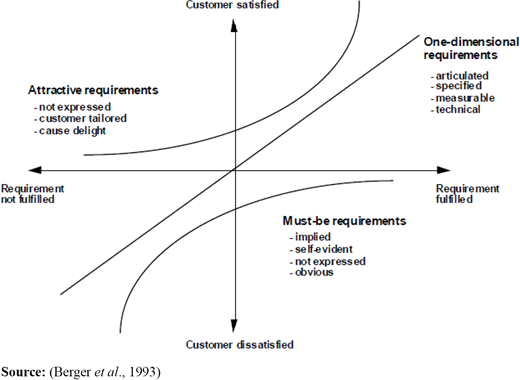
The horizontal axis shows the extent to which the product fulfills the customers’ requirement. The vertical axis shows the extent to which the customer is satisfied with the product or service. The starting point of Kano model is to identify the product requirement by walking into the customers’ shoes (Sauerwein et al., 1996).
The requirements are classified as “attractive,” “must be,” “one-dimensional” and “indifferent.”
Must be requirement: It is the minimum criterion that must be met by the manufacturer. If these features are not present in the product or service, then the customer will not be satisfied, and the customer will lose interest in the product or services.
One-dimensional requirement: It represents the needs that are directly related to customer satisfaction. The more the product is functional regarding the particular need, the more the level of satisfaction. If such requirements are fulfilled, then it provides more satisfaction to the customer and results in giving competitive edge to the company.
Attractive requirement: Under this area, the customer will be more satisfied if the product fulfills the functional requirement but will be not dissatisfied if the product or service is less functional.
Indifferent: It represents the attributes for which customers will not care about whether they are present or absent. The majority of customers do not care about certain attributes, which might provide little value to them.
Other than these four significant requirements, the responses are also classified as “questionable” and “reverse requirements”. The questionable requirements are those which indicate the contradictory response of the customer for the given pair of questions. The reverse requirement indicates that the customer does not require products or features, and they want the reverse of the same (Sauerwein et al., 1996). But these two responses are not taken for assessing the satisfaction level of customers.
3. Review of literature
The Kano model has been widely used by a number of authors to evaluate the customer satisfaction for products and services (Lofgren and Witell, 2008; Wu et al., 2010). Kano model helps in anticipating the future in terms of what should be provided and what should be avoided to get satisfied customers (Määttänen et al., 2014).
The model is widely used in various disciplines across manufacturing and service sector. For example, Sohn et al. (2017) studied Kano model to assess the dimensions of quality in logistics service; Velikova (2017) used Kano Model to analyze the drivers of wine festival satisfaction using penalty–reward contrast analysis approach; Gustavsson et al. (2016) applied Kano model in health-care sector; Määttänen et al.(2014) applied the model to assess the customer satisfaction attributes for green facilities management; Oh et al. (2012) used Kano Model to identify the quality attributes of e-shopping mall; and further Kano model is applied in home delivery services by Chen et al. (2011). The model has been widely studied in the banking sector (Bhattacharya and Rahman, 2004), electronic services (Fundin and Nilsson, 2003; Nilsson-Witell and Fundin, 2005) and also in e-ticketing service (Shahin, 2004).
To classify the customer’s needs in product design, the Kano model has been widely used across various industries (Jiao and Chen, 2006; Xu et al., 2009; Yu and Ko, 2012). It is also used in product development stage to understand customers’ insights as to how they evaluate products and services (Lofgren and Witell, 2008).
It is also been applied by Shahin and Shahiverdi (2015) in the Iran automobile industry to estimate the customer lifetime value for new product development. The study conducted by Asian et al. (2019) on Iranian automotive industry has proposed a new approach for evaluation and indexing third party logistics providers using the Kano model. Avikal et al.(2020) have conducted a study for classification of aesthetic attributes of sports utility vehicle car profile using quality function deployment and Fuzzy Kano model-based approach. Chen (2018) conducted study on evaluation of car center’s service quality using modified Kano model. Ma et al. (2019) have conducted study on future vehicle driving services using Kano models. Sugarindra and Pratama (2018) have conducted a research to identify the features in car modification through mobile application using Kano model. Yanget et al. (2015) have conducted a study on assessing the customer satisfaction level for battery electric vehicles using Kano model and found that the immature technology and lack of large-scale production results into higher price of the battery electric vehicles, but it does not create customer dissatisfaction. However, lower price will significantly increase customer satisfaction.
In view of such wide application and simplicity, the researcher used the Kano model to assess customer satisfaction for the emerging technology trends in the car industry. As is evident, many studies have been conducted to assess the customer satisfaction for various attributes in the automobile industry, but hardly any of these studies anticipated the future technological requirement of Indian passenger car customers; therefore, the present study tries to fill this research gap.
4. Methodology
4.1 Surveying the customers
The list of 17 emerging technological attributes was prepared through content analysis of automobile magazines/blogs and interviews with the company’s experts. The technological attributes and their respective blogs/websites are deciphered in Table 1.
Technological attributes and the supporting reference
Note:
4G LTE = Fourth generation long term evolution
These 17 technological attributes of the cars were exposed to a pair of functional and dysfunctional questions. Functional questions are those that are asked in the positive way, and dysfunctional are those that are asked in a negative manner.
For example:
Functional questions: How would you feel if the Automatic Gear Shift system would be present in your car?
Options:I like it/It must be that way/I’m neutral/I can live with it/I dislike it.
Dysfunctional questions: How would you feel if Automatic Gear Shift system would not be present in your car?
Options:I like it/It must be that way/I’m neutral/I can live with it/I dislike it.
The survey was conducted in the Northern region of India, and in total, 250 complete questionnaires was collected. The cities considered for the survey are Lucknow, Kanpur and the National Capital Region (NCR) because of the high population in these regions. Moreover, Northern India has one of the highest demands for diesel cars. The overall contribution of Delhi and the NCR is 14% to the country’s total sale for cars (Khan, 2016).
The main purpose of formulating the questions was to inculcate the voice of customers to fulfill the technological requirement from the customers’ viewpoint (Sauerwein, 1996). Kano models evaluation criteria was used to understand the customers’ voice. The voice of customer is of prime importance for the companies. This model helps in giving the future direction and also indicates guidelines as to what should be offered to the customers to keep them satisfied.
4.2 Evaluation table
The next step is to summarize the results of the survey. The results are summarized using Kano evaluation table. Each of these attributes was represented as attractive (A), must be (M), indifferent (I) and one-dimensional (O). The two more requirements that is questionable requirement (Q) and reverse requirement (R) were also included.
The model analyzes these requirements of the customers. Kano evaluation table, categorizing each of these customers’ requirements, is shown in Table 2.
Kano evaluation table
| Dysfunctional | ||||||
|---|---|---|---|---|---|---|
| Functional | Like | Expect it | Do not care | Live with | Dislike | |
| Like | Q | A | A | A | O | |
| Expect it | R | I | I | I | M | |
| Do not care | R | I | I | I | M | |
| Live with | R | I | I | I | M | |
| Dislike | R | R | R | R | Q | |
Customer Requirements Mmust be, Oone-dimensional, Aattractive, Iindifferent, Qquestionable (invalid), Rreversal (invalid)
4.3 Determining category of product
The categories of the attributes are evaluated with the help of the frequency of the customers’ responses. The results are interpreted according to the frequency of the answers. The maximum value of O, A, M, I, R and Q must be adopted. However, if the results have two same frequency, the following priorities must be considered M > O > A > I (Sauerwein et al., 1996).
5. Data analysis and interpretation
5.1 Profile of the respondents
The survey was conducted in the Northern region of India. In total, 250 questionnaires were collected. The socio-economic profile of the respondents is shown in Table 3. It can be seen from Table 3 that most of the respondents are youths between the age group of 18 and 35 years, as can be observed by various studies, which indicate that these days younger generation has emerged as a prominent cars’ customers. As a result, this trend works to the benefit of automakers that produce “aspirational” vehicle models especially for younger buyers (Mandal, 2016; Das, 2020).
5.2 Customer need analysis
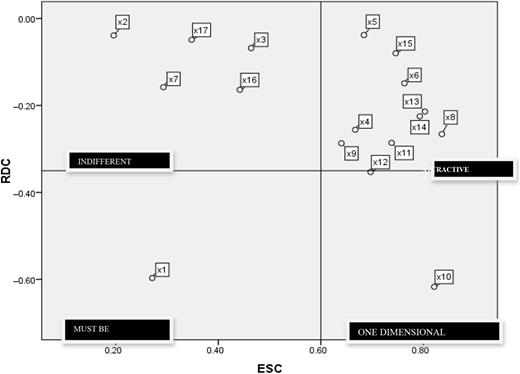
To set priorities, the order must be > one-dimensional > attractive > indifferent should be followed. Customer’s enhanced satisfaction coefficient (ESC) and reduced dissatisfaction coefficient (RDC) were calculated using the following equations (1) and (2):
A positive customer satisfaction coefficient ranges in value from zero to one. If the value is closer to one, then that attribute has a higher influence on customers’ satisfaction. The negative customer satisfaction also operates similarly.
The ESC and RSC are plotted on the graph. All of the attributes are visually presented in Figure 2 (Table 4).
Summary of Kano model analysis for emerging technology in passenger cars companies
| Attributes | Description | A | R | I | O | M | Q | Total | Grade | ESC | RDC |
|---|---|---|---|---|---|---|---|---|---|---|---|
| x1 | Automatic Gear Shift | 40 | 23 | 49 | 20 | 112 | 6 | 250 | M | 0.271 | −0.597 |
| x2 | Gesture control | 41 | 12 | 180 | 4 | 5 | 8 | 250 | I | 0.196 | −0.039 |
| x3 | Reality display on car wind screen | 101 | 6 | 120 | 9 | 7 | 7 | 250 | I | 0.464 | −0.068 |
| x4 | Connecting applications | 98 | 78 | 30 | 15 | 29 | 0 | 250 | A | 0.657 | −0.256 |
| x5 | Communication between vehicles | 155 | 7 | 70 | 5 | 4 | 9 | 250 | A | 0.684 | −0.038 |
| x6 | Integration with smart phone | 154 | 11 | 40 | 20 | 14 | 11 | 250 | A | 0.763 | −0.149 |
| x7 | Run-on-flat tyres | 42 | 20 | 145 | 23 | 12 | 8 | 250 | I | 0.293 | −0.158 |
| x8 | Dual-stage airbags | 120 | 38 | 32 | 53 | 2 | 5 | 250 | A | 0.836 | −0.266 |
| x9 | In-dash navigation system | 79 | 77 | 32 | 20 | 24 | 18 | 250 | A | 0.640 | −0.287 |
| x10 | Premium surround sound system | 55 | 2 | 37 | 142 | 6 | 8 | 250 | O | 0.821 | −0.617 |
| x11 | Rearview camera | 115 | 30 | 35 | 40 | 20 | 10 | 250 | A | 0.738 | −0.286 |
| x12 | Blind spot detection | 98 | 2 | 58 | 70 | 15 | 7 | 250 | A | 0.697 | −0.353 |
| x13 | Heated and cooled seats | 178 | 6 | 6 | 10 | 40 | 10 | 250 | A | 0.803 | −0.214 |
| x14 | Built-in 4G LTE Wi-Fi system | 144 | 18 | 28 | 32 | 18 | 10 | 250 | A | 0.793 | −0.225 |
| x15 | Automated window cleaning system | 138 | 40 | 47 | 12 | 4 | 9 | 250 | A | 0.746 | −0.080 |
| x16 | Battery cars | 75 | 15 | 114 | 25 | 12 | 9 | 250 | I | 0.442 | −0.164 |
| x17 | Hydrogen fuel-operated cars | 52 | 8 | 104 | 5 | 3 | 78 | 250 | I | 0.348 | −0.049 |
6. Findings
The present study has provided insights about the acceptability of various emerging technological features in Indian car market. The major findings of the research are as follows:
Auto Gear Shift system has emerged as the only must be attributes. Therefore, this feature should be included in Indian passenger cars to retain the interest of the customers.
The “premium surround system” is categorized under one-dimensional attribute. One-dimensional attribute helps the company to get a more satisfied customer and, hence, to have a competitive edge over other manufacturers.
“Integration with a smart phone,” “connecting applications,” “dual-stage airbags,” “in-dash navigation system,” “rearview camera,” “heated and cooled seats,” “blindspot detection,” “built-in 4G LTE Wi-Fi system” and “automated window cleaning system” are found to be the attractive features. These features result in more satisfaction to the customers, but the customers will not be dissatisfied if these features are not present.
Customers were found to be indifferent toward “gesture control,” “reality display on car wind screen,” “run-on-flat tyres,” Further, the research contradicted the popular belief that customers are concern about the environment, as they were found to be indifferent toward “hydrogen fuel-operated cars” and “battery cars.”
The manufacturers while designing the new car models or modifying the existing models can incorporate these findings. Inculcating the voice of the customers in designing the new technologies for the passenger cars will improve the overall profitability of these companies.
The Kano model analysis of the technological attributes of the car is given in Table 5.
Results of Kano model analysis for technological attributes of cars
| Indifferent | Attractive |
|---|---|
| Gesture control | Communication between vehicles |
| Reality display on the car wind screen | Integration with a smart phone |
| Run-on-flat tyre Battery cars | Connecting applications Blindspot detection |
| Hydrogen fuel-operated cars | Dual-stage airbags |
| – | In-dash navigation system |
| – | Rearview camera |
| – | Heated and cooled seats |
| – | Built-in 4G LTE, Wi-Fi system |
| – | Automated window cleaning system |
| Must be | One-dimensional |
| Automatic Gear Shift | Premium surround sound system |
7. Future scope of this study
The present study has been conducted in Northern India using Kano model. This study can be extended across presence across nation India and across the globe. The variations in the customer satisfaction across the demographic profile can also be assessed. As technological attributes are ever emerging, the present research can be used in the longevity studies as well.
8. Conclusion
Technological changes are sprouting at a very fast pace particularly in the passenger cars industry. In light of the technological changes, the manufacturers need to know about the acceptability of the new technological features by the Indian customers, as they are quite different from global customers. It is also concluded that these customers are not too much concerned about the environmental issues, as they are indifferent toward the use of hydrogen fuel-operated and battery cars. Further, “Automatic Gear Shift” is found to be a necessary feature to be included in the cars to retain the interest of the Indian customers. “Premium surround sound system” provides a competitive edge to car companies in India.
With increasing gross national income, easily available financing options and availability of world-class features in cars, the Indian passenger car industry has become a leading market. But car manufacturers face huge challenges to satisfy and retain customers; therefore, incorporating customers voice is the key to car manufacturers growth and success.
The research is not funded by any organization.

