


The purpose of this paper is to provide practitioners and researchers a more condensed and structured perspective on the adoption of information management systems by the health-care industry, given the spread and the increased amount of research concerning the topic.
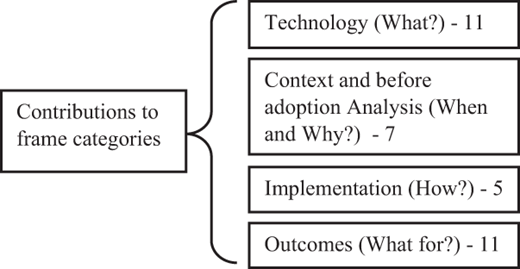
This paper is a literature review. A Technology (What?) – Context and before adoption Analysis (When and Why?) – Implementation (How?) – Outcomes (What for?) framework is used to present the trends concerning information technology adoption in an accessible manner.
The main finding is that small or large health-care organizations should no longer focus on information systems’ adoption but should adopt a digital transformation paradigm. By considering this paradigm, management practices related to information technologies’ adoption projects should be complemented by practices related to the continuous organizational changes and readaptation of the organizational strategy, to benefit the advantages information systems can offer.
The main recommendation for health-care industry managers is to adopt specific practices to manage the digital transformation process of their organizations, as they should understand that it is no longer about adopting information technologies, but about managing the associated organizational change.
Instead of focusing on specific information systems’ adoption as other papers do, this paper provides a holistic understanding of the information technologies and management practices which are used in the field.
1. Introduction
We live in a new well-connected world, dominated by the internet. Health care is recognized as an industry with a low acceptance of information technology. Only few information technology (IT) systems, such as Electronic Health Records (EHRs), have been widely accepted by the US industry (Hopper, 2015). The rate of implementation of integrated health-care IT systems, similar to business Enterprise Resource Planning software, is low, and the basic solutions provided by Microsoft (e.g. Microsoft Word) and Google (Google Drive) dominate the market. This poor acceptance has been associated with different causes such as the different revenue streams within the industry (public, individuals, companies), the multiple employees categories and the lack of their proper training, the complex outsourced infrastructure for different and not interconnected organizational processes, the high costs for computerization, and the organizational culture as a whole (Hopper, 2015). This low acceptance of integrated solutions diminishes continuous improvement capabilities, since most used techniques as lean management, Six Sigma, and Lean Six Sigma are implemented based on data availability (Henrique and Godinho Filho, 2020).
The research concerning health-care information technology has been focused in time with analyzing the impact of technology adoption, more papers providing evidence on the positive impact it has towards medical outcomes (Kruse and Beane, 2018), but the outcomes concerning costs are contradictory (Chaudhry et al., 2006). In this context, being a manager who must take IT solutions’ adoption or replacement decisions is not an easy job. This article is an analysis of different literature reviews concerning how managers should adopt information technology in health care, the results being a structured and condensed perspective, using a Technology (What?) - Context and before adoption Analysis (When and Why?) – Implementation (How?) – Outcomes (What for?) framework. This framework is similar to the frameworks used for design propositions in general (Denyer et al., 2008) and it can be used as a reference by practitioners during IT systems’ adoption. The construction of this framework is required by both practice and research since most papers cover narrow topics concerning IT adoption and fail to cover the needs of clinicians, health-care administrators, and health-care policy makers (Jones et al., 2014).
The paper is structured as followed: Section 2 details the used methodology, Section 3 contains the results by the use of the already specified framework, while Section 4 presents the discussion and conclusions.
2. Methodology
This study is a literature review of the most important and recent sources which deal with health information systems (HIS) adoption management practices, the methodology proposed by Tranfield for conducting systematic literature review being considered (Tranfield et al., 2003).
Identification and screening: since there are many papers which cover this topic, we have decided to perform a review of existing reviews concerning the topic. The approach used for identifying relevant sources was searches in google scholar, the most comprehensive online database, for reviews related to information technology in the health-care industry. The initial search of the combination “healthcare” “systematic literature review” “information systems”, conducted in December 2020, has delivered about 14.200 results. The second search of the combination “health-care information systems” “systematic literature review” led to about 900 results, the decision made was to select from these results the 147 papers with more than 30 citations for screening. To ensure that the articles included correspond to the topic, the inclusion criteria for the screening of abstracts were used: a) published after 2000; b) address the adoption of information systems in the health-care industry. A number of 56 papers met these criteria, the full papers analysis led to the acceptance of 24 papers from the sample. Other four papers referenced by these papers were included in our sample, which finally equaled 28 papers.
Extracting: Each article has been further analyzed considering its contribution to the proposed framework. The contribution of articles to the framework categories is presented in Figure 1, some papers being used in more than one category. Later, for each category the articles were analyzed in detail to provide the most important ideas and best practices regarding information technology adoption. All these ideas are presented in the results section.
3. Results
3.1 Technologies (What?)
Digital transformation has been recognized as changing the health-care ecosystem, the main systems adopted by this industry being EHRs, Health-care Information Systems, HIS and customer health-care technologies (Mehta and Pandit, 2018). A general perspective concerning the existing software in the medical area, based on our analysis, is provided in Figure 2.
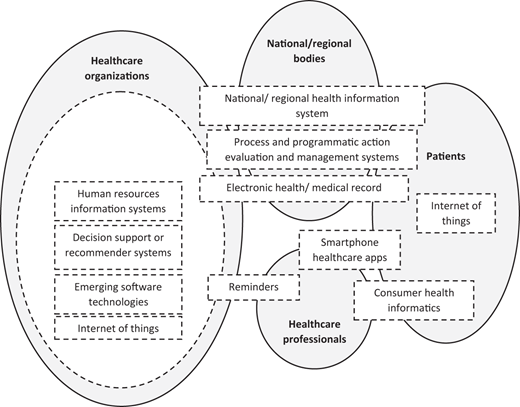
Four key stakeholders have been identified, the major users for whom the software is mainly addressed: health-care organizations, patients, health-care professionals, and national/regional bodies. For providing medical services, it can be observed that most technologies are used by more stakeholder categories.
At the heart of health-care information systems is the Electronic Health/Medical Records of patients, which is the memory of the health-care process. EHRs are systems used to keep patients data, as single data files or longitudinal collections covering different medical processes, used for primary care (Ludwick and Doucette, 2009) or any other medical process. EHRs are built by considering the side of patients, for whom all their health records are kept. The same software is called electronic medical record when the organizations which provide medical care introduce information and data into the system (Ludwick and Doucette, 2009), and even electronic patient registries (Tomasi et al., 2004). EHRs’ advanced features include human resource information systems, decision support systems, emerging software technologies as the Big Data, or Internet of things in relation to different available equipment. The use of human resource information is related to the management strategy of the organization, and less to the operational benefits, their goal being to motivate human resources and to increase the transparency concerning human resources performance (Tursunbayeva et al., 2016). Decision support or recommender systems have been introduced in health care both for nursing care (Duan et al., 2011), medical care in general (Jones et al., 2014), or smaller parts of the medical process, as medication administration. This way, professionals’ decisions are easier since they can consider the actions previously performed in similar cases by themselves or other colleagues. Medical simulation could be also included in this category, being around for many years (Vonderembse et al., 2017). Internet of things is related to the use of multiple internet connected equipment for creating an interconnected system of individuals, equipment, services and networks anywhere and anytime (Rajeswari et al., 2018), a continuous connection between things. There are several examples of IoT in use as the use of ECG equipment, temperature sensors, blood pressure and glucose sensors. One emerging technology (Kruse et al., 2016) associated with EHRs is Big Data, which offers the premises for analyzing huge amount of complex data, identifying patterns which can guide medical decisions, and providing decision support concerning costs and quality problems, are its major benefits (Mehta and Pandit, 2018).
By considering the same patient in the center approach of the medical service, but also considering the exchange capabilities of IT systems in general, another type of HIS has appeared – the regional or national health information system. It is built on the premise that different stakeholders (clinics, hospitals, pharmacies, laboratories etc.) change information and improve care delivery at regional/national level (Mäenpää et al., 2009). These systems are built for improving tailored health-care services, prevention, access to medical care, adherence of different stakeholders to the same standards and policies, but their use is also associated to increased informational risks and with increased privacy and hardware requirements (Mäenpää et al., 2009). These systems can vary in terms of size and features, like EHRs.
Health-care professionals are addressed by reminder apps, usually associated with HIS, but also standalone applications, education focused smartphone apps, and consumer health-care applications in which they communicate with patients. Reminders have been introduced as extensions of HIS and are used for reminding health-care professionals that some patients need different treatments or interventions. They increase the quality of practice given that specific procedures are performed at the right time and in the right order, but they can also be stressful for professionals (Backman et al., 2017).
Patients’ software has increased its diversity lately, starting with smartphone apps, consumer health-care applications and also different apps integrated in different medical appliances which are capable of communicating to the internet, the so-called internet of things. Consumer health informatics is designed to communicate directly with consumers, who introduce information concerning their health state, and later receive personalized health information (Gibbons et al., 2011). Its benefits are related to diminishing the costs for reaching consumers, can enhance the interventions performed by professionals, and improve the feedback provided to consumers/patients (Gibbons et al., 2011).
One category of consumer HIS which is gaining ground is the health-care applications for smartphones. As smartphone technology becomes cheaper and accessible to everyone, there are multiple companies which have developed software for different users’ categories: consumers/patients, medical professionals, students, and medical organizations. The main functions they have are (Mosa et al., 2012): disease diagnosis, drug reference, medical calculator, literature search, clinical communication, hospital information system, medical training and education, chronic illness disease management and general health-care applications.
3.2 Context and before adoption analysis (When and Why?)
There are multiple causes for adopting IT in the medical field (Vonderembse et al., 2017). These causes, as part of the larger context which contributes to the adoption of these technologies, are reported as poorly analyzed by literature (Jones et al., 2014). One part of literature is concerned with building frameworks for evaluating already adopted HIS by organizations. For example, a set of recommendations are provided by Ammenwerth et al. (2003): the evaluation should be performed as a project, in an organized manner, by establishing the goal, the tools, the time needed, in a balanced manner; the evaluation should be documented at all phases, the use of already used methods of evaluation being recommended; all stakeholders should be involved, including employees and managers, especially when further support is needed; a thorough evaluation is recommended, including the use multidisciplinary methods and triangulation of methods. While analyzing the frameworks used in the field for analyzing HIS, Andargoli et al. (2017) observed that most frameworks do not provide proper reporting formats, while the ones that do prove to enhance the quality of those evaluations. An important observation is that most HIS evaluations are an ongoing process, not a one-time project, a formative approach which targets continuous improvement being thus the best practice.
Another approach used for analyzing the existing information systems is the maturity analysis, which considers different levels for self-assessment: initiation, contagion, control, integration, data administration and maturity, as previously established by Richard Nolan (Carvalho et al., 2016). However, depending on the type of organization and the goal of the evaluation, a maturity model can be identified and used as the existing research provides multiple models for multiple uses (Carvalho et al., 2016). These maturity models are useful especially when the self-assessment has a recurring character and this way the progress can be assessed.
3.3 Implementation (How?)
3.3.1 General approaches for HIS implementation.
As a general perspective, HIS implementation should not be made as implementing information technology in business. Health care has multiple characteristics which differentiates it in comparison to other industries (Connell and Young, 2007): the multiple stakeholders involved (patients, doctors, external services providers, managers), the increased complexity of the medical process and its multiple goals nature, the importance of the clinical function which sometimes is in balance with the management one, and the need for software to deal with more person-to-person knowledge transfer than a normal business might. Secondly, a differentiation should be made between HIS adoption, which means the installation and making available the software, and HIS implementation, which refers to wide use of the technology by all affected parties (Sligo et al., 2017). Successful implementation is more related with changing the way things are performed, or change management, than adoption of technology. Also called digital transformation (Matt et al., 2015), it should be considered an important process by all managers, and multiple efforts should be allocated for implementing this long-term strategy.
3.3.2 Success factors which can affect HIS implementation process.
Project management success varies by project types, industries, nationalities, individuals and organizations (Müller and Jugdev, 2012). Based on the performed analysis, these factors have been grouped in different categories by considering the Technology–Organization–Environment framework proposed by Tornatzky et al. (1990).
Firstly, the technology itself can influence the success of the adoption. Ludwick and Doucette (2009) has determined that the most important success factors are “systems’ graphical user interface design quality, feature functionality, project management, procurement and users’ previous experience affect implementation outcomes”. This factor has been also recognized in other papers (Lau et al., 2010; Ross et al., 2016). Technology should be fitted to internal context, the continuous adoption to internal changes being recognized as diminishing the barriers of adaptability and to increase acceptance and adoption (Ross et al., 2016). Surprisingly, costs of the solution are not the main barrier for technology adoption, as observed by comparing the barriers identified by Ross et al. (2016).
When it comes to organizational factors, human resources, the most important resources in health care, have an important role in HIS adoption. Gagnon et al. (2012) observe that health-care professionals influence the adoption of HIS: their positive perceptions concerning the benefits of the systems (usefulness), followed by the perceptions regarding ease of use, were identified as main drivers for adoptions, while the perceptions concerning the lack of fit between the adopted systems and work practices, the low familiarity with information technology, and the lack of time were the main barriers for adoption. In some cases, the major barrier for IT adoption is health-care professionals’ acceptance of these technologies (Ross et al., 2016; Tomasi et al., 2004), the gradual introduction and continuous training and communication with human resources being recommended. Other organizational success factors have been also considered in literature. It is revealed that there should be a socio-technical fit between the organization which receives the software, and the software itself (Ludwick and Doucette, 2009; Ross et al., 2016). The existence of adequate resources and support is recognized as important for the adoption of information technologies (Mair et al., 2012; Ross et al., 2016). Leadership is a very important determinant of the success of information technologies adoption (Ross et al., 2016). It appears that clinical leaders who have technical medical IT skills and prior experience with IT project management are more committed in performing the adoption of new technologies and to engage in proactive behaviors and partnerships with IT professionals (Ingebrigtsen et al., 2014).
The only environmental factor we have identified in the selected papers is the legislation which can hamper HIS implementation (Ross et al., 2016).
3.4 Outcomes (what for?)
There are many opinions concerning the impact measurement related to information technology adoption in health care. Backman et al. (2017) consider that information technology adoption in health care is not too much analyzed, Sligo et al. (2017) consider that proving the cost-effectiveness of HIS adoption in comparison to the traditional mode of delivering health care is a challenge, while Rahimi and Vimarlund (2007) consider that a standard framework for measuring HIS adoption is missing.
There are more reviews which perform a wide analysis of the outcomes or impact of HIS adoption by considering all fields and software types. The benefits identified by Tomasi et al. (2004) are increased standardization of services as physicians adhere to standardized therapeutic plans, and cost reduction. Another categorization considers the adherence to guideline-based care by the use of reminders and decision support systems, enhanced surveillance and monitoring based on large-scale screening and aggregation of data, and decreased medication errors (Chaudhry et al., 2006). A more recent categorization includes quality of care benefits (improved processes and customer satisfaction), productivity, and patient safety (Colicchio et al., 2016). Finally, the outcomes refer to quality of care, medication safety, and efficiency (Sligo et al., 2017).
Wider approaches are concerned with providing analysis frameworks which cover all benefits. An example is the one provided by Lau et al. (2007), who provide a framework which explains how different outcomes are interconnected. Quality, referring to system (functionality, performance and security), information (content and availability), and service (responsiveness), determines use levels among stakeholders (current use and intention) and user satisfaction (competency, satisfaction and ease of use). Use and user satisfaction further influence the net benefits measured as net benefits related to quality (patient safety, appropriateness/effectiveness and health outcomes), access (access to service and patient/caregiver participation), and productivity (efficiency, care coordination and net costs). This framework explains how information systems create value within organizations, being used as a reference model for managers in evaluating outcomes levels for different adoption projects (Lau et al., 2010).
Negative outcomes related to HIS adoption have also been observed. The main refer to process implications, such as order entry, staff interaction, and provider-to-patient communication (Buntin et al., 2011). Sometimes, after HIS are adopted, the previous performance is not improved or the adoption process takes longer than considered. These cases have been however rarely reported and are related to lower number of adopted functionalities (Buntin et al., 2011).
4. Discussion and conclusions
By considering all the dimensions affected by HIS introduction, namely the health-care process, the relation with patients, clinician diagnosis support (Sligo et al., 2017), it could be argued that health-care organizations are part of the digital transformation process, a long-term process which involves not only the acquisition and use of a software technology, but the “transformations of key business operations and affects products and processes, as well as organizational structures and management concepts” (Matt et al., 2015). This paper provides condensed information regarding HIS adoption by considering this digital transformation approach.
We have evaluated the available technologies (What?), the practices which should be followed by managers before adoption (When and Why?) and during the adoption (How?), and the outcomes which should be targeted in relation to HIS adoption process (What for?). Technologies are so different and cover different needs of different stakeholders. Based on the current analysis, some advices are given for health-care organizations managers:
Begin with the end in mind and establish targets. One major aspect to consider is to answer the question: which is the goal of HIS adoption before starting the process? Given the multiple parts involved in technology adoption, it is normal that success is perceived in terms of time, costs and efficiency by managers, as it is analyzed in terms of usability, safety, accessibility by clinicians. Any IT system adoption is hard to be measured in terms of outcomes (Sligo et al., 2017), but an equilibrium between all stakeholders goals should be established;
Be aware of the moving target which is digital transformation and measure the current level of your organization into this transformation. The analysis concerning the needs for information technology can be a one-time effort, but we recommend a continuous monitoring of information technology and systems from your organization. A maturity model can be used to track the evolution and also to communicate the targeted goals concerning this digital transformation process. The advantage of maturity models is that they contain benchmarks or targets for your organization, targets which can changed in time depending on environmental changes;
Re-analyze the available technologies to identify which are the opportunities for improving your organization services. The number of available technologies and their complexity increases as they become more accessible. One part of improving health-care organizations services is related to these technologies, the adoption of patient-centered technologies being one trend in health care. The digital transformation is not only about the organization, it is about how people live their lives. We have provided here a list of the available technologies, but they are in a continuous development, and they should be monitored this way;
Manage the context before disruptive adoptions. Medical organizations are complex systems where the medical process is the most important one. This way, medical professionals are important participants whose resistance concerning the adoption of new HIS is related to the poor preparedness made by managers. We have provided here some success factors which determine the successful adoption of HIS. They refer to the complexity which describes the nature of health-care organizations and they should be considered by managers before starting wide changes in their organizations.
As a general conclusion, HIS adoption is not about adoption itself, but about the change management which has to be performed in health-care organizations to gain the full benefits which can be associated with this change process. Future research should focus on the digital transformation of health-care organizations instead of analyzing the traditional information systems’ adoption.
This work was supported by the grant Partnership for the transfer of knowledge in biogenomics applications in oncology and related fields – BIOGENONCO, Project co-financed by FEDR through Competitiveness Operational Programme 2014 – 2020, contract no. 10/01.09.2016.

