


This paper aims to investigate the impact of total rewards on retention. The finding relies on need satisfaction approach as a mechanism. This is done by investigating the role of need satisfaction of “autonomy, competence and relatedness” as possible mediators between elements of total rewards and retention.
This paper focussed on exploring the literature published in various popular databases .Based on the conceptual analysis, a set of possible frameworks linking the three constructs has been stated for future research.
The research has evolved with few possible frameworks to model the assertions by investigating and corroborating it with quantitative studies to be empirically tested.
The originality lies in applying self-determination theory framework of need satisfaction mechanism in explaining the relationships between total rewards and retention, thereby adding new insights to the employee retention literature.
Introduction
Why do some industries experience lower voluntary employee turnover as compared to ones with highest even after implementing total rewards program? Is it not taking into account changing needs and requirements of the employees? Employees are biggest differentiators for attaining sustainable competitive advantage (Taamneh et al., 2018) and rewarding them is the biggest investment (Bryant and Allen, 2013). Thus, rewarding them goes beyond paying salaries for stimulating performance and achieving organizational results. For example, the total rewards preference model highlights the importance of employees’ preferences having a positive influence on attracting, motivating and retaining key employees (Close and Martins, 2015). Over the period of 20–25 years, vast research has hinted towards the fact that total rewards – the sum of all kind of financial and non-financial rewards – is a critical lever in achieving higher retention (Alhmoud and Rjoub, 2020).
Still there exists limited information on need satisfaction approach of total rewards which is instrumental in driving positive workplace outcomes (Thibault Landry and Whillans, 2018). This happens because these organizations view employees as a single group with homogenous needs while proactive organisations always ensure in considering an employee’s requirements before offering them the benefits (Silverman and Reilly, 2003). The current study relies on self-determination theory’s (SDT) conceptualization of psychological needs which is dominated by the studies saying that satisfaction of these needs leads to positive workplace outcomes such as job commitment, satisfaction, engagement and lower turnover (Haivas et al., 2014; Bharath and Sreedevi, 2021). The study seeks to use SDT perspective to study employee retention as a function of total rewards through need satisfaction.
Methodology: identifying relevant studies
The authors carried out an extensive review of total rewards related studies using databases, namely, Google Scholar, EBSCO, Proquest ABI, JSTOR, Emerald and Sage. The scholarly articles were searched using keywords such as “total rewards and retention”; “total rewards and need satisfaction”; “the relationship between total rewards and retention”; “need satisfaction and employee retention”; “linkage between total rewards and retention”; “the effect of need satisfaction on employee retention.” Initially articles were thoroughly read and analysed looking at their keywords, titles and abstracts. There were instances where the full articles were read so as to determine the type of the study. It was found that research work (Table 1) on rewards has been evident since 1983 and on total rewards on since 1999, and since then research on total rewards has witnessed substantial change. Hence, articles from the year 1983 to 2021 have been considered for review in this paper. Finally, a total of 90 articles were shortlisted. Studies were segregated as per theoretical-based literature consisting of empirical studies having theoretical underpinnings and atheoretical studies consisting of field studies, conceptual articles and exploratory surveys.
Articles segregated according to the type of the study
| Type of study | Sub-type | No. of articles |
|---|---|---|
| Theory based literature | Empirical | 43 |
| Conceptual (Qualitative reviewing of literature with theoretical base) | 6 | |
| Atheoretical studies | Field studies | 7 |
| Exploratory surveys | 6 | |
| Conceptual articles (Practitioner’s prescription/reports on implementation) | 24 |
For the purpose of systematically reviewing the literature and developing a conceptual framework, we have considered theory-based studies. The process enhances our understanding on theoretical perspectives of total rewards construct along with its association with workplace outcomes.
Review of literature
Total rewards
Recent years have seen a rise in scholarly and practitioners’ works pertaining to embracing total rewards – a holistic approach of rewarding an employee in all the possible manner that an employee value in his employment relationship with the organization (Prouska et al., 2016). The transformational journey from compensation to total rewards has been well captured by Jiang et al. (2009) when he stated that “[w]hat once was ‘compensation’, or ‘total compensation’ has evolved into an interdependent triad of total rewards.” Total rewards represent an organization’s strategy of rewarding employees by integrating different components or practices such as learning and development with high-quality work life along with packages of competitive compensation and benefits (Nienaber et al., 2011).
Theory-based literature
The theory-based review of total rewards is diverse, embracing conceptual and empirical scholarly works with varied theoretical perspectives and empirical findings. Table 2 displays the studies with their theoretical orientation, central hypotheses of the theories, variables included along with their empirical findings.
Theory based literature
| Sl. no. | Source | Theory | Central hypotheses | Variables | Empirical finding |
|---|---|---|---|---|---|
| 1 | Bohlander and Snell (2004) | Expectancy theory | Employees expect rewards they value in exchange for effort they put in on the job. It is a cognitive process where employees make choices which reward motivates them. | Pay-for-performance and rewards, the attractiveness of the rewards sought and the probability of obtaining those rewards | Supported |
| 2 | De Gieter and Hofmans (2015) | Total rewards, Turnover intention and task performance | Supported | ||
| 3 | Martin and Ottemann (2016) | Workforce generational cohorts, organizational rewards packages, attraction and retention | Supported | ||
| 4 | Rybnicek et al. (2019) | McClelland’s need theory | Employees differ regarding the level of their need for achievement, affiliation and power. If an organization wants to direct employee behaviour it should offer rewards that promise need-fulfilment. | rewards, leadership and needs for power, achievement and affiliation | Supported |
| 5 | Cerasoli et al. (2014) | Intrinsic motivation, external reward, and performance | Supported | ||
| 6 | Chiboiwa et al. (2010) | Reward system, employee turnover | Supported | ||
| 7 | Morgan et al. (2013) | Herzberg theory | Money is hygiene factor. Money alone is not capable of motivating an employee. | Rewards, job satisfaction and intent to stay | Mixed |
| 8 | Huang and Tianshu (2013) | Total rewards and work engagement | Supported | ||
| 9 | Mabaso and Dlamini (2021) | Total rewards and organizational commitment | Supported | ||
| 10 | Twenge et al. (2010) | Self-determination theory of motivation | SDT distinguishes between intrinsic motivation and extrinsic motivation. External rewards undermine intrinsic motivation. Intrinsic motivation is said to arise when three basic psychological needs, namely, the need for relatedness, the need for competence and the need for autonomy are fulfilled. | Work values, extrinsic rewards, intrinsic rewards, social rewards | Mixed |
| 11 | Akhtar et al. (2015) | Total rewards and Retention | Supported | ||
| 12 | De Gieter and Hofmans (2015) | Turnover intention and task performance | Mixed | ||
| 13 | Thibault Landry and Whillans (2018) | Rewards, well-being, engagement, retention | Supported | ||
| 14 | Cao et al. (2013) | Equity theory | Employees who are under-rewarded will display negative behaviour at workplace as compared to those over-rewarded. | Total rewards and organizational justice, turnover intention | Supported |
| 15 | De Gieter and Hofmans (2015) | Turnover intention and task performance | Mixed | ||
| 16 | Rai et al. (2019) | Total rewards, Intention to say | Supported | ||
| 17 | Mulvey et al. (2000) | Maslow’s theory | Employees are motivated to satisfy needs in a hierarchy of importance. Employees constantly desire better circumstances; they always want what they do not yet have. | Monetary and non-monetary rewards; employee turnover | Not supported |
| 18 | Martin and Ottemann (2016) | Goal setting theory | Goal setting is an important lever of performance management which has linkages with engagement, motivation and work meaningfulness. Linking rewards to goal attainment is more likely to motivate effort when individuals have a reasonable expectancy of achieving the goal. | Workforce generational cohorts, organizational rewards packages, attraction and retention | Supported |
| 19 | Schlechter et al. (2014) | Generational theory | Based on generational theory, members of each generation can be grouped into cohort and each cohort can be identified as a unique employee group with different work values and reward preferences | Total rewards, retention | Supported |
| 20 | Bussin and van Rooy (2014) | Total rewards preferences, retention | Supported | ||
| 21 | Smit et al. (2015) | Total rewards and demographic variables, retention, perceived organisational support and perceived supervisor support | Supported | ||
| 22 | Peluso et al. (2017) | Social exchange theory | SET postulates a mutual relationship and mutual obligation between employees and organization based on perception what employees get in terms of rewards in return for being committed to the organization. This determines their positive and negative attitude towards their job and the organization | Total rewards, job satisfaction, affective commitment and innovative behaviour at work | Supported |
| 23 | Gulyani and Sharma (2018) | Total rewards, work engagement and work happiness | Supported | ||
| 24 | Rai et al. (2019) | Total rewards, Intention to say | Supported | ||
| 25 | Alhmoud and Rjoub (2020) | Employees’ generation, total rewards, retention | Supported |
Of the selected articles, 38 articles have focused on different theories to explore different perspectives and associations of total rewards with consequences (workplace outcomes). These articles have used 16 different theories directly addressing rewards and workplace outcomes. Theory-based studies on total rewards have had been mostly empirical (Twenge et al., 2010; Mabaso and Dlamini, 2021) with very few conceptual studies (Martin and Ottemann, 2016). The survey of these studies suggests that total rewards owe its theoretical roots to theories of motivation, namely, Maslow theory (Mulvey et al., 2000); equity theory (Rai et al., 2019); expectancy theory (Martin and Ottemann, 2016); and Herzberg’s two-factor theory (Mabaso and Dlamini, 2021). Dominant theories of motivation revolved around a central hypothesis – employees’ attitude towards total rewards, behaviour and performance are a function of personal expectancies, fulfilment of needs and perceived fairness of receiving the rewards. Table 2 details the findings of individual studies relying on different theories to develop framework and empirically testing the associations between total rewards and organizational outcomes.
Theoretical results and research gaps
Few observations that paved the way for identifying research gaps while analysing the literature are discussed below.
Lack of focus on basic psychological need satisfaction
In spite of owing its evolution to theories of motivation, actual empirical works have ignored the relationship between total rewards and satisfaction of basic psychological needs except a few (Thibault Landry and Whillans, 2018). Ryan and Deci (2017) opined that in spite of enormous amount of research taking place on compensation and rewards, a very few of them have considered its relationship with need satisfaction of employees and its mediation between rewards and workplace positive outcomes.
Redundancy of social exchange theory (SET) theory
As compared to SET (Cropanzano and Mitchell, 2005), SDT is more non-obligatory, more consensual and suited to the interests of organizational management (Gagné and Deci, 2005). Further, in a series of studies conducted by Rosen et al. (2014), SET is found to be redundant having lesser utility in predicting outcomes with SDT in a sense that “socio-emotional or personal resources exchanged” led to need satisfaction and predicted SET associated outcomes. Lian et al. (2012), in their study, used three competing theories, namely, SDT, SET and justice alternatively to better understand the relation between abusive supervision and organizational deviance. The results showed that abusive supervision had a stronger effect (through basic need satisfaction) on organizational deviance and that of SET and justice were not significant.
Basic psychological need subdued in total rewards
Most of the articles have ignored the impact of basic needs satisfaction on retention. Other studies treated basic needs satisfaction to be inherent in total rewards in terms of choice and rewards preferences (Fobian and Maloa, 2020) rather than treating needs satisfaction as a predictor of positive workplace outcomes. A handful of recent studies have considered needs satisfaction as an antecedent of retention (Rathi and Lee, 2017).
Shift towards non-motivational theories
Recently, total rewards studies based on generational theory, Herzberg’s’ theory and SET shifted the focus towards a transactional and obligatory strategy of mutual give and take depending on your demographic patterns (Gulyani and Sharma, 2018; Alhmoud and Rjoub, 2020).
Dearth of research in collectivistic country like India
A study in Indian work setup may offer understanding into differences in employee needs satisfaction and expectations of employees to continue working for an organization. Literature on need satisfaction approach to rewards – retention relationships – is very limited (Rathi and Lee, 2017).
Development of conceptual model
Studies have affirmed that total rewards are the best strategy to attract, engage and retain workforce (Alhmoud and Rjoub, 2020). Hill and Tande (2006) have highlighted that “88% of highly skilled employees leave the organizations for reasons that are not based on money, but the main reasons were limited development opportunities (39%), unhappiness with management (23%), lack of recognition (17%) and other reasons (10%).” Based on these academic instances, it is proposed that:
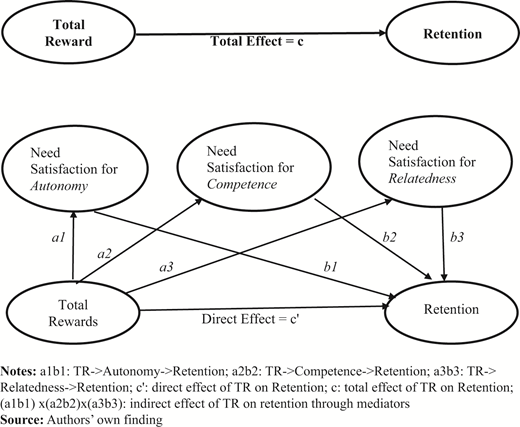
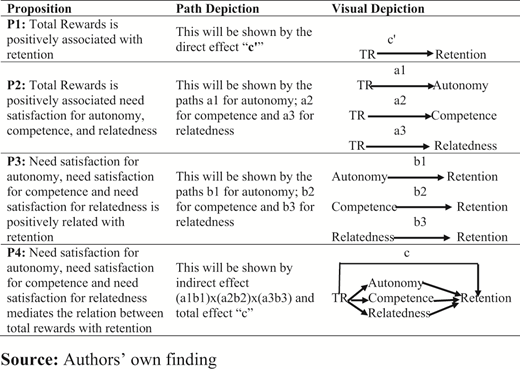
Total rewards is positively associated with retention.
Limited research is found on exploring the impact of total rewards on basic psychological need satisfaction. Ryan and Deci (2017) rightly pointed out “although there has been an enormous amount of research on rewards in organizations, very little of it has considered the relation of pay to basic psychological need satisfaction of employees which mediated between rewards and critical positive outcomes.” Similar arguments were put forward by Deci et al. (2017). The relation between total rewards and SDT’s need satisfaction is based on the assumption that components of total rewards have two aspects, namely, informational and controlling aspects (Ryan and Deci, 2017). The theorized relationships between tangible rewards and need satisfaction were as follows: tangible reward is designed to be salient in controlling aspect thereby reducing the feelings of autonomy (Deci et al., 1999); intangible reward is salient in informational aspect, i.e. it provides information on performance and development opportunities, thereby satisfying individuals’ need for competence (Vansteenkiste and Deci, 2003); and the processes through which the tangible reward is administered may be or may not be related to need for relatedness. Therefore, one would expect that both tangible and intangible rewards are related to need satisfaction autonomy, competence and relatedness (Baard et al., 2004; Deci and Rayn, 2001). Owing to very scarce or no empirical evidence but with theoretical underpinning, the authors propose the following:
Total rewards is positively associated with need satisfaction for autonomy, competence and relatedness.
There have been few studies with findings indicating that the need satisfaction for “autonomy, competence and relatedness” enhance intention to stay because satisfaction of needs will lead to employees becoming more committed towards the organization and hence developing tendency to remain with the organisation (Greguras and Diefendorff, 2009; Haivas et al., 2014). There are few evidences highlighting the influential role of needs satisfaction of the need for autonomy and competence on retention. For example, Rathi and Lee (2017) stressed on a same reason that employees experiencing autonomy and competence are more unlikely to sacrifice and leave their present job because of organizational fit experienced by the employees. With respect to need satisfaction for relatedness, previous studies have found that high-quality relationships at work are important for employee retention (Rathi and Lee, 2017). The above-mentioned studies provide the ground for the following proposition.
Need satisfaction for autonomy, need satisfaction for competence and need satisfaction for relatedness are positively related with retention.
Academic literature instances are limited. Tiwari and Garg (2019) and Gözükara and Şimşek (2015) have used need satisfaction as a mediator with respect to job performance leadership, work engagement, job satisfaction and commitment. A recent study by Steindórsdóttir et al. (2020) used need satisfaction as a mediator between perceived masery climate and retention. A handful of studies have considered needs satisfaction as a potential mediator between pay and retention (Olafsen et al., 2015). Therefore, it is proposed that total rewards facilitating basic psychological need satisfaction will result in greater retention.
Need satisfaction for autonomy, need satisfaction for competence and need satisfaction for relatedness mediate the relation between total rewards with retention.
Combining all the propositions, the proposed research model explaining the causality between the constructs is depicted in Figure 1 and the summative propositions are presented in Figure 2.
Research implications and limitations
The model proposed in this paper is exploratory, and the most important research implication is that the proposed model has identified interplay of psychological mechanism of need satisfaction while understanding the relationship between total rewards and retention. Given the multidimensional nature of total rewards, the framework calls for operationalizing a scale to measure the satisfaction of employees with respect to total rewards. This will enable to empirically test the proposed linkages with rest of the variables, viz., mediators and outcome. The authors might like to investigate the collective effect of need satisfaction taken as a composite variable (Baard et al., 2004) along with studying the individual effect of each need satisfaction as carried on by Van den Broeck et al. (2010).
The four propositions have implications for research in human resource management and organizational psychology. Studies should explicitly consider the interaction between variations in informational and controlling aspect of total rewards and need satisfaction mechanism. More specifically, the study will be more appropriate in explaining variations and its salience in experiencing autonomy, competence and relatedness, thereby affecting the intention to stay. Empirical findings on propositions reflecting interaction between need satisfaction and retention can aid in extending the significance of SDT’s assumption of positive outcomes.
The study suffers from unavoidable limitations. Our literature study report failed to discuss other factors, mainly demographic characteristics (e.g. age, gender, qualification and experience) which might play equally significant role in influencing the impact of total rewards and retention. Other moderators such as cultural dimensions and attitude towards money that may give new insights have not been included in our study. In countries with high level of power distance, employees will lead to lower need satisfaction for autonomy and competence (Tepper et al., 2007). Similarly, attitude towards money marked by how employees value money and want to make more money directly influences their retention (Tang et al., 2000). These limitations will offer direction to future researchers in designing their studies by incorporating the moderators excluded in our study.
Conclusion
The research on total rewards and retention spanned from 1990s and still continue to be in demand. Most of the studies chosen for the present study were atheoretical, prescription based and exploratory in nature undertaken by consultants or consulting firms. Analysis of the research on total rewards and retention highlighted unique trends about the theories used. Some supported the central hypotheses with some refuting it. However, most of the research have tried to report positive impact of total rewards on retention via different mediators such as organizational justice, work engagement, commitment, job satisfaction and so on. Further, theory-based studies on total rewards have been mostly empirical focussing on scale development (Twenge et al., 2010; Mabaso and Dlamini, 2021) with very few conceptual studies (Martin and Ottemann, 2016). There has been a steep decline in applying qualitative methods. Our understanding of need satisfaction mechanism influencing rewards–retention relationship will provide new insight into retention literature by focussing on the fact that total rewards is not only about monetary rewards but also inclusive of everything that employees value.

