


This study aims to systematically review the existing literature and develop an understanding of work-life balance (WLB) and its relationship with other forms of work-related behavior and unearth research gaps to recommend future research possibilities and priorities.
The current study attempts to make a detailed survey of the research work done by the pioneers in the domain WLB and its related aspects. A total of 99 research work has been included in this systematic review. The research works have been classified based on the year of publication, geographical distribution, the methodology used and the sector. The various concepts and components that have made significant contributions, factors that influence WLB, importance and implications are discussed.
The paper points to the research gaps and scope for future research in the area of WLB.
The current study uncovered the research gaps regarding the systematic review and classifications based on demography, year of publication, the research method used and sector being studied.
Introduction
In this technological era, work is becoming demanding with changing nature of work and working patterns (Thilagavathy and Geetha, 2020). The proactive, aggressive and demanding nature of business with the intention of reaching the top requires active involvement and comprehensive devotion from the employees, thereby compromising their work-life balance (WLB) (Turanlıgil and Farooq, 2019). Research concerning the work-life interface has exploded over the past five decades because of the changing trends in the nature of gender roles, families, work and careers (Powell et al., 2019). Researchers in this domain has published many literature reviews with regard to WLB. It is argued that the study of WLB remains snowed under by a lack of conceptual clarity (Perrigino et al., 2018). Thus, research and theory only partially view the employees’ work-life needs and experiences.
Despite the plethora of research work concerning WLB, individuals still struggle to balance work and life (Powell et al., 2019). Therefore, the current study aspires to systematically review the existing literature on WLB, uncover the research gaps in the area pertaining to balancing work and life and show directions for future research. To accomplish this objective, the existing literature on WLB has been reviewed from 1990 to 2019. This review started with the following research questions:
How WLB is conceptualized in the past?
What are the factors that significantly influenced WLB?
In which geographical areas were the WLB studies undertaken?
Which sectors remain unstudied or understudied with regard to WLB?
Methodology
We systematically conducted the literature review with the following five steps, as shown in Figure 1. The first step was to review the abstracts from the database like EBSCO, Science Direct, Proquest and JSTOR. The articles from publishers like ELSEVIER, Emerald insight, Springer, Taylor and Francis and Sage were considered. The literature survey was conducted using the search terms WLB, balancing work and family responsibility and domains of work and life between the period 1990 to 2019. This search process led to the identification of 1,230 relevant papers. Inclusion criteria: The scholarly articles concerning WLB published in the English language in journals listed in Scopus, web of science or Australian business deans council (ABDC) were included in this review. Exclusion criteria: The scholarly articles concerning WLB published in languages other than English were not taken into consideration. Similarly, unpublished papers and articles published in journals not listed in Scopus, web of science or ABDC were excluded.
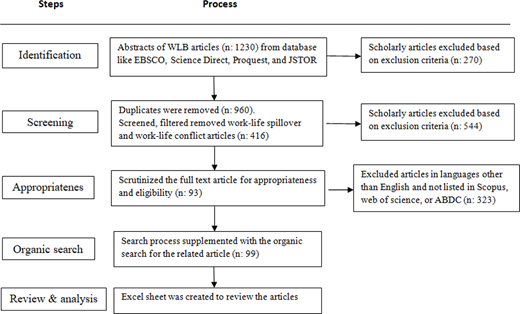
In the second step, we identified the duplicates and removed them. Thus, the total number of papers got reduced to 960. Following this, many papers relating to work-life spillover and work-life conflict were removed, resulting in further reduction of the papers to 416. Subsequently, in the third step, the papers were further filtered based on the language. The paper in the English language from journals listed in Scopus, web of science or ABDC were only considered. This search process resulted in the reduction of related papers to 93. The fourth step in the search process was further supplemented with the organic search for the related articles, leading to 99 papers illustrated in Appendix Table 1. In the fifth step, an Excel sheet was created to review the paper under different headings and the results are as follows.
Journals details
| Name of the journal | No. of papers | 1990–1999 | 2000–2009 | 2010–2019 |
|---|---|---|---|---|
| The International Journal of Human Resource Management | 8 | – | 1 | 7 |
| Journal of Vocational Behavior | 5 | 1 | 3 | 1 |
| Academy of Management Review | 4 | – | – | 4 |
| Human Resource Management Review | 4 | – | 1 | 3 |
| Academy of Management Journal | 3 | – | – | 3 |
| Asia Pacific Journal of Human Resources | 3 | – | – | 3 |
| European Journal of Work and Organizational Psychology | 3 | – | 3 | – |
| Others (below three papers) | 69 | 9 | 15 | 44 |
| Total | 99 | 10 | 23 | 65 |
Literature review
Evolution and conceptualization of work-life balance
WLB concern was raised earlier by the working mothers of the 1960s and 1970s in the UK. Later the issue was given due consideration by the US Government during the mid of 1980. During the 1990s WLB gained adequate recognition as the issue of human resource management in other parts of the world (Bird, 2006). The scholarly works concerning WLB have increased, mainly because of the increasing strength of the women workforce, technological innovations, cultural shifts in attitudes toward the relationship between the work and the family and the diversity of family structures (Greenhaus and Kossek, 2014). The research works on WLB include several theoretical work-family models. Though the research on WLB has expanded to a greater extend, there are considerable gaps in our knowledge concerning work-family issues (Powell et al., 2019).
Moreover, in studies where WLB and related aspects are explored, researchers have used different operational definitions and measurements for the construct. Kalliath and Brough (2008) have defined WLB as “The individual’s perception that work and non-work activities are compatible and promote growth in accordance with an individual’s current life priorities.” WLB is “a self-defined, self-determined state of well being that a person can reach, or can set as a goal, that allows them to manage effectively multiple responsibilities at work, at home and in their community; it supports physical, emotional, family, and community health, and does so without grief, stress or negative impact” (Canadian Department of Labor, as cited in Waters and Bardoel, 2006).
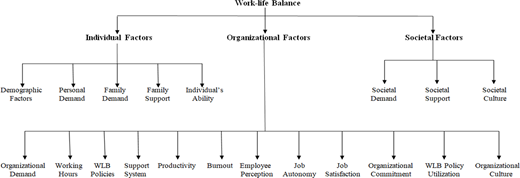
Figure 2 depicts the flowchart of the framework for the literature survey. It clearly shows the factors that have been surveyed in this research article.
Individual factors
The individual factors of WLB include demographic variables, personal demands, family demands, family support and individual ability.
Work-life balance and demography.
WLB has significant variations with demographic variables (Waters and Bardoel, 2006). A significant difference was found between age (Powell et al., 2019), gender (Thilagavathy and Geetha, 2020) and marital status (Powell et al., 2019) regarding WLB. There is a significant rise in women’s participation in the workforce (Jenkins and Harvey, 2019). WLB issues are higher for dual-career couples (Crawford et al., 2019).
Many studies were conducted on WLB with reference to sectors like information technology (IT), information technology enabled services, Banking, Teaching, Academics and Women Employment. A few WLB studies are conducted among services sector employees, hotel and catering services, nurses, doctors, middle-level managers and entrepreneurs. Only very scarce research has been found concerning police, defense, chief executive officers, researchers, lawyers, journalists and road transport.
Work-life balance and personal demands.
High work pressure and high family demand lead to poor physical, psychological and emotional well-being (Jensen and Knudsen, 2017), causing concern to employers as this leads to reduced productivity and increased absenteeism (Jackson and Fransman, 2018).
Work-life balance and family demands.
An employee spends most of the time commuting (Denstadli et al., 2017) or meeting their work and family responsibilities. Dual career couple in the nuclear family finds it difficult to balance work and life without domestic help (Dumas and Perry-Smith, 2018; Srinivasan and Sulur Nachimuthu, 2021). Difficulty in a joint family is elderly care (Powell et al., 2019). Thus, family demands negatively predict WLB (Haar et al., 2019).
Work-life balance and family support.
Spouse support enables better WLB (Dumas and Perry-Smith, 2018). Family support positively impacted WLB, especially for dual-career couples, with dependent responsibilities (Groysberg and Abrahams, 2014).
Work-life balance and individual’s ability.
Though the organizations implement many WLB policies, employees still face the problems of WLB (Dave and Purohit, 2016). Employees achieve better well-being through individual coping strategies (Zheng et al., 2016). Individual resources such as stress coping strategy, mindfulness emotional intelligence positively predicted WLB (Kiburz et al., 2017). This indicates the imperative need to improve the individual’s ability to manage work and life.
Organizational factor
Organizational factors are those relating to organization design in terms of framing policies, rules and regulations for administering employees and dealing with their various activities regarding WLB (Kar and Misra, 2013). In this review, organizational factors and their impact on the WLB of the employee have been dealt with in detail.
Work-life balance and organizational work-life policies.
The organization provides a variety of WLB policies (Jenkins and Harvey, 2019). Employee-friendly policies positively influenced WLB (Berg et al., 2003). Further, only a few IT industries provided Flexi timing, work from home and crèches facilities (Downes and Koekemoer, 2012). According to Galea et al. (2014), industry-specific nuance exists.
Work-life balance and organizational demands.
Organizations expect employees to multi-task, causing role overload (Bacharach et al., 1991). The increasing intensity of work and tight deadlines negatively influenced WLB (Allan et al., 1999). The shorter time boundaries make it challenging to balance professional and family life (Jenkins and Harvey, 2019). Job demands negatively predicted WLB (Haar et al., 2019).
Work-life balance and working hours.
Work does vacuum up a greater portion of the personal hours (Haar et al., 2019). This causes some important aspects of their lives to be depleted, undernourished or ignored (Hughes et al., 2018). Thus, employees find less time for “quality” family life (Jenkins and Harvey, 2019).
Work-life balance and productivity.
Organizational productivity is enhanced by the synergies of work-family practices and work-team design (Johari et al., 2018). Enhanced WLB leads to increased employee productivity (Jackson and Fransman, 2018).
Work-life balance and burnout.
WLB is significantly influenced by work exhaustion (burnout). Negative psychological experience arising from job stress is defined as burnout (Ratlif, 1988). Increased work and non-work demands contribute to occupational burnout and, in turn, negatively predict WLB and employee well-being (Jones et al., 2019).
Work-life balance and support system.
Support from Colleagues, supervisors and the head of institutions positively predicted WLB (Ehrhardt and Ragins, 2019; Yadav and Sharma, 2021). Family-supportive organization policy positively influenced WLB (Haar and Roche, 2010).
Work-life balance and employee perception.
The employee’s perception regarding their job, work environment, supervision and organization positively influenced WLB (Fontinha et al., 2019). Employees’ awareness concerning the existence of WLB policies is necessary to appreciate it (Matthews et al., 2014). The employee’s perception of the need for WLB policies differs with respect to their background (Kiburz et al., 2017).
Work-life balance and job autonomy.
Job autonomy is expressed as the extent of freedom the employee has in their work and working pattern (Bailey, 1993). According to Ahuja and Thatcher (2005), autonomy and flexibility enable employees to balance competing demands of work-life. Job autonomy will enhance WLB (Johari et al., 2018).
Work-life balance and job satisfaction.
Job satisfaction is the driving force for task accomplishment and employees’ intention to stay (Brough et al., 2014). Employees’ positive perception concerning their job enhances job satisfaction (Singh et al., 2020; Yadav and Sharma, 2021). WLB and job satisfaction are positively correlated (Jackson and Fransman, 2018).
Work-life balance and organizational commitment.
Alvesson (2002) describes organizational commitment as a mutual and fair social exchange. WLB positively predicted organizational commitment (Emre and De Spiegeleare, 2019). Work-life policies offered by an organization lead to increased loyalty and commitment (Callan, 2008).
Work-life balance and work-life balance policy utilization.
The utilization of WLB policies (Adame-Sánchez et al., 2018) helps meet job and family demands. Despite the availability of WLB policies, their actual adoption is rather small (Waters and Bardoel, 2006) and often lag behind implementation (Adame-Sánchez et al., 2018).
Work-life balance and organizational culture.
Employees perceive WLB policy utilization may badly reflect their performance appraisal and promotion (Bourdeau et al., 2019). Hence, seldom use the WLB policies (Dave and Purohit, 2016). The perception of the organization culture as isolated, unfriendly and unaccommodating (Fontinha et al., 2017); a lack of supervisor and manager support and a lack of communication and education about WLB strategies (Jenkins and Harvey, 2019). This leads to counterproductive work behavior and work-family backlash (Alexandra, 2014). As a result, growing evidence suggests a dark side to WLB policies, but these findings remain scattered and unorganized (Perrigino et al., 2018). Organizational culture significantly affects WLB policy utilization (Callan, 2008; Dave and Purohit, 2016).
Societal factors
Societal changes that have taken place globally and locally have impacted the individual’s lifestyle. In this modern techno world, a diversified workforce resulting from demographic shifts and communication technology results in blurring of boundaries between work and personal life (Kalliath and Brough, 2008).
Work-life balance and societal demands.
Being members of society, mandates employee’s participation in social events. But in the current scenario, this is witnessing a downward trend. The employee often comes across issues of inability to meet the expectation of friends, relatives and society because of increased work pressure. Societal demands significantly predicted WLB (Mushfiqur et al., 2018).
Work-life balance and societal culture.
Societal culture has a strong influence on WLB policy utilization and work and non-work self-efficacy. Specifically, collectivism, power distance and gendered norms had a strong and consistent impact on WLB Policy utilization by employees (Brown et al., 2019). Women’s aspiration to achieve WLB is frequently frustrated by patriarchal norms deep-rooted in the culture (Mushfiqur et al., 2018).
Work-life balance and societal support.
WLB was significantly predicted by support from neighbors, friends and community members (Mushfiqur et al., 2018). Sometimes employees need friend’s viewpoints to get a new perspective on a problem or make a tough decision (Dhanya and Kinslin, 2016). Community support is an imperative indicator of WLB (Phillips et al., 2016).
Analyzes and results
Article distribution based on year of publication
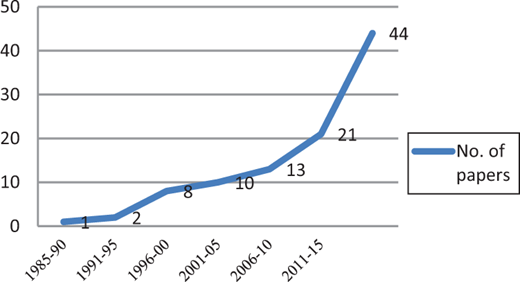
The WLB studies included for this review were between the periods of 1990–2019. Only a few studies were published in the initial period. A maximum of 44 papers was published during 2016–2019. Out of which, 17 studies were published during the year 2019. In the years 2018, 2017 and 2016 a total of 12, 7 and 8 studies were published, respectively. The details of the article distribution over the years illustrate a rising trend, as shown in Figure 3.
Geographical distribution
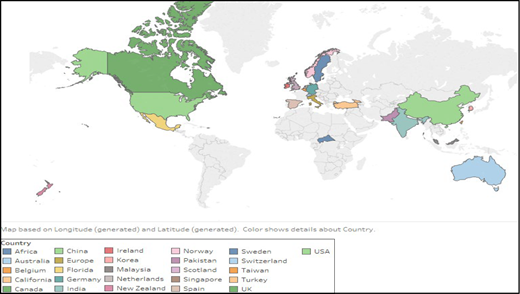
Papers considered for this review were taken globally, including the research works from 26 countries. American and European countries contributed to a maximum of 60% of the publications regarding WLB research. Figure 4 illustrates the contribution of different countries toward the WLB research.
Basic classification
The review included 99 indexed research work contributed by more than 70 authors published in 69 journals. The contribution worth mentioning was from authors like Allen T.D, Biron M, Greenhaus J. H, Haar J.M, Jensen M.T, Kalliath T and Mc Carthy A. The basic categorization revealed that the geographical distribution considered for this review was from 26 different countries, as shown in Figure 4. The research was conducted in (but not limited to) countries like Africa, Australia, Canada, China, India, Israel, The Netherlands, Norway, New Zealand, Pakistan, Singapore, Sweden, Turkey, the USA and the UK. American and European countries together contributed to the maximum of 60% of publications. Further, the categorization uncovered that 7 out of the 99 journals contributed to 30% of the WLB papers considered for this review, clearly illustrated in Table 1.
Methodology-based categorization of papers
The basic information like research methods, sources of data, the proportion of papers using specific methodologies were considered for methodology-based categorization. The categorization revealed that 27 out of 99 papers reviewed were conceptual and the remaining 72 papers were empirical. The empirical papers used descriptive, exploratory, explanatory or experimental research designs. Further, categorization based on the data collection method revealed that 69 papers used the primary data collection method. Additionally, classification uncovered that 57 papers used the quantitative method, whereas 11 papers used the qualitative approach and four used the mixed method. The most prominent primary method used for data collection was the questionnaire method with 58 papers, while the remaining 20 papers used interview (10), case study (5), experimental studies (3), daily dairy (1) or panel discussion (1).
Sector-based categorization of papers
The sector-based categorization of papers revealed that 41.6% (30 papers) of research work was carried out in service sectors. This is followed by 40.2% (29 papers) research in the general public. While one paper was found in the manufacturing sector, the remaining nine papers focused on managers, women, the defense sector, police and the public sector, the details of which are showcased in Table 2.
Sector-based categorization of papers
| Sectors being studied | No. of papers | (%) |
|---|---|---|
| General population | 29 | 40.2 |
| Education services | 11 | 15.2 |
| Health care services | 7 | 9.7 |
| Financial services (banking and insurance) | 6 | 8.3 |
| Managers | 5 | 6.9 |
| IT services | 4 | 5.5 |
| Hotel management | 2 | 2.7 |
| Government employee | 2 | 2.7 |
| Women | 2 | 2.7 |
| Manufacturing | 1 | 1.3 |
| Others | 3 | 4.1 |
Research gap
Individual factor
Work-life balance and demography.
The literature survey results demonstrated that the impact of employee education and experience on their WLB had not been examined.
The literature survey has uncovered that the relationship between income and WLB has not been explored.
The influence of domestic help on WLB has not been investigated.
Much of the research work has been carried out in developed countries like the US, UK, European countries and Australia. In contrast, very scarce research works have been found in developing countries and underdeveloped countries.
Not much work has been done in WLB regarding service sectors like fire-fighters, transport services like drivers, railway employees, pilots, air hostesses, power supply department and unorganized sectors.
Work-life balance and individual’s ability.
A review of the relevant literature uncovered that studies concerning the individual’s ability to balance work and life are limited. The individual’s ability, along with WLB policies, considerably improved WLB. Individual strategies are the important ones that need investigation rather than workplace practices.
Kiburz et al. (2017) addressed the ongoing need for experimental, intervention-based design in work-family research. There are so far very scares experimental studies conducted with regard to WLB.
Organizational factor.
A very few studies explored the impact of the WLB policies after the implementation.
Studies concerning the organizational culture, psychological climate and WLB policy utilizations require investigation.
Organizational climates influence on the various factors that predict WLB needs exploration.
Societal factor.
The impact of the societal factors on WLB is not explored much.
Similarly, the influence of societal culture (societal beliefs, societal norms and values systems) on WLB is not investigated.
Discussion and conclusion
The current research work aspires to conduct a systematic review to unearth the research gaps, and propose direction for future studies. For this purpose, literature with regard to WLB was systematically surveyed from 1990 to 2019. This led to identifying 99 scientific research papers from index journals listed in Scopus, the web of science or the ABDC list. Only papers in the English language were considered. The review section elaborated on the evolution and conceptualization of WLB. Moreover, the literature review discussed in detail the relationship between WLB and other related variables. Further, the research works were classified based on the fundamental information revealed that a maximum of 44 papers was published during the year 2016–2019. The geographical distribution revealed that a maximum of research publications concerning WLB was from American and European countries. Further, the basic classification revealed that 7 out of the 69 journals contributed to 30% of the WLB papers considered for this review. The methodology-based classification unearthed the fact that 73% of the papers were empirical studies. Additionally, the categorization uncovered that 79% (n = 57) of papers used quantitative methods dominated by survey method of data collection. Sector-based categorization made known the fact that a maximum of 41.6% of research work was carried out in the service sector. The research gaps were uncovered based on the systematic literature review and classifications and proposed future research directions.
Limitations
We acknowledge that there is a possibility of missing out a few papers unintentionally, which may not be included in this review. Further, papers in the English language were only considered. Thus, the papers in other languages were not included in this systematic review which is one of the limitations of this research work.
Implications
The discussion reveals the importance and essentiality of the individual’s ability to balance work and life. Consequently, the researchers have proposed future research directions exploring the relationship between the variables. WLB is an important area of research; thus, the proposed research directions are of importance to academicians. The review’s finding demonstrates that there are very scarce studies on the individual’s ability to balance work and life. This leaves a lot of scopes for researchers to do continuous investigation in this area. Hence, it is essential to conduct more research on developing individuals’ ability to balance work and life. There are a few experimental studies conducted so far in WLB. Future experimental studies can be undertaken to enhance the individual’s ability to balance work and life.
Funding: This research did not receive any specific grant from funding agencies in the public, commercial or not-for-profit sectors.
Conflict of interest: The authors declare that they have no conflict of interest.
Data availability: The data that support the findings of this study are available on request from the corresponding author.
Compliance of ethical standard statement: The results reported in this manuscript were conducted in accordance with general ethical guidelines in psychology.
References
Further reading
Appendix
Table 1 List of papers included in the review

