Directors’ human capital has long been recognised as vital to ensuring effective corporate governance. While previous studies have sought to link director human capital with specific firm-level outcomes, there are persistent challenges facing researchers who seek to understand better what kind of human capital makes a difference to effective board role execution. This study aims to understand whether the way directors fulfil their roles and contribute to boardroom dynamics is shaped by any human capital they gain via senior executive experience.
We draw insights from 30 in-depth, semi-structured interviews with Indian directors to capture their perceptions and experiences of how a specific kind of human capital, namely the C-suite experience, affects directors' boardroom dynamics and board role execution.
We highlight how directors with executive experience appear to have a more salient set of human capital to draw on. Specifically, they report navigating governance processes differently, displaying a more contextualised understanding of boardroom dynamics and having a broader understanding of the firm’s problems. Doing so enables them to foster constructive board-management relationships and improve their service role execution.
Our qualitative data are drawn from a purposively sampled group in a specific governance system (India). While this does not threaten the key theoretical insights, it does raise questions about their generalisability to other governance contexts.
Directors with executive experience build trust through their orientation towards and understanding of management without diminishing their capacity to scrutinise management decisions. The human capital of these directors appears to engender a more effective and contextualised boardroom dynamic that facilitates the execution of socialised accountability through balancing the control and service roles.
Our findings highlight the potential importance of a shared understanding of the communication and collaboration processes of corporate governance (i.e. a common transactional memory framework) between directors and management. Directors who share this understanding with management are more likely to effectively engage in the service role while not compromising the control role. This shared understanding appears to allow these directors and executives to encode, store and retrieve relevant information they need more effectively, engendering the trust between them that seems to foster socialised accountability.
Boards are thought to contribute to their firm’s success by fulfilling two fundamental roles: control (often labelled monitoring) and resource provision (often termed service) – (see, for example, Hillman and Dalziel, 2003; Veltrop et al., 2021). The control role is generally associated with agency theory, which posits that corporations have developed “decision systems that separate the management (initiation and implementation) and control (ratification and monitoring) of important decisions” (e.g. see Fama and Jensen, 1983: 331) in a bid to ameliorate the problems associated with the separation of ownership from control. In short, directors perform decision control to reduce the agency costs that arise when agents (i.e. executives) do not act in the best interest of their principals (i.e. shareholders) (Fama and Jensen, 1983). In contrast, resource dependence theory suggests directors contribute to firm performance by providing management with service, namely access to resources such as advice, legitimacy, and links to other organisations (Hillman et al., 2009). Effective execution of both these roles is, in turn, thought to be contingent upon board capital, namely the “human capital (experience, expertise, reputation) and [the] relational capital (network of ties to other firms and external contingencies)” that the board of directors possess (Hillman and Dalziel, 2003: 383; see also Nicholson and Kiel, 2004).
Despite general agreement on this link between board capital and board role performance, there are persistent challenges facing researchers who seek to understand better what kind of human capital makes a difference to effective board role execution. For instance, the independence necessary for effective control (Jensen and Meckling, 1976) is thought to reduce the trust needed for impactful service behaviour such as advice-giving (Westphal, 1999), potentially straining the relationship between management and the board of directors (Sundaramurthy and Lewis, 2003). Executives may perceive the oversight exercised by [independent] directors as excessive and so be less willing to share information openly with the board, leading to a level of mutual distrust between management and the board. This situation can negatively affect the board’s ability to offer valuable advice and may also limit access to the information considered necessary for exercising control.
Current research on the relationship between directors’ human capital and their board role performance often overlooks the complex processes involved when governing. In opting for a simplified input-output model, the field largely treats underlying governance dynamics as a “black box” or underexplored phenomenon (e.g. Watson et al., 2021). If we are to develop a deeper understanding of how boards balance control and collaboration, it is crucial to engage with the key players themselves – the directors (McNulty et al., 2013; Stiles and Taylor, 2001) rather than simply assuming that directors can effectively handle both control and service roles simultaneously (Kor and Sundaramurthy, 2009; see also Parker, 2007 for the similar balancing of strategic and operational issues). Directly questioning directors about how they execute their roles may deepen insights into mismatches between the expectations placed on independent directors and their actual qualifications, abilities, and experience relevant to these roles (Carpenter and Westphal, 2001).
This study aims to understand how a specific kind of human capital, namely the C-suite experience, affects the board role execution. We use in-depth semi-structured interviews with 30 Indian directors to explore the difference in human capital that develops for individuals having executive experience compared to directors drawn from other occupations (e.g. professionals such as lawyers and accountants, academics and so on). Our findings suggest that this specific aspect of human capital allows a director to manage better the balance between controlling and servicing management. It enables a more positive board-management dynamic and, ultimately, more effective role execution. These findings suggest that a more nuanced understanding of the effects of specific director knowledge and experience may help explain the tension between objectivity and trust required for socialised accountability at the board level (i.e. taking responsibility for the company’s actions and presenting them transparently to stakeholders) (Roberts, 2001).
The paper proceeds as follows. First, we develop the research question by reviewing human capital and corporate governance literature. Next, we describe our qualitative research method involving in-depth interviews with 30 directors serving on publicly traded Indian companies. Third, we present our findings, which suggest that directors with executive experience have a broader scope of knowledge, a better understanding of information provision processes, and an enhanced ability to navigate boardroom dynamics compared to directors without such experience. Finally, we discuss the contributions and implications of our study for board composition and effectiveness, acknowledge limitations, and provide suggestions for future research.
Theoretical framework and development of the research question
Early research into human capital posited that investments in education, training, and health enhance an individual’s productivity, akin to investments in physical capital (Becker, 1964; Schultz, 1961). Later, researchers broadened the sources of individual value creation to include social relationships and cultural capital (Coleman, 1988). It is now widely accepted that success in human endeavours (particularly economic success) is not merely a result of material resources but also the result of the intangible assets embodied in individuals and communities, even if that can be difficult to quantify (e.g. Bessieux-Ollier et al., 2023; McCracken et al., 2018; Nielsen et al., 2017 – for a summary of the difficulties in accounting for people see Flamholtz et al., 2020).
Research into corporate governance has followed this logic, with a board’s human capital long theorised as essential to effective corporate governance (e.g. Hillman and Dalziel, 2003; Nicholson and Kiel, 2004). In the board setting, human capital is often conceptualised at the group level, whereby the board’s human capital represents the collective attributes of directors that benefit the firm (Johnson et al., 2013; Hillman and Dalziel, 2003). In this paper, however, we seek to understand how a specific dimension of human capital translates to board role execution and, therefore, concentrate on individual director human capital. We take director human capital as an individual director’s knowledge, skills, expertise, experience, and reputation (Becker, 1964; Coleman, 1988; Nicholson and Kiel, 2004). Our focus on the individual reflects a desire to better understand the “black box” of corporate governance (Leblanc and Gillies, 2005; Huse, 2005) by examining how human capital shapes the boardroom dynamic and role execution.
Many attributes are thought to enhance an individual’s human capital. From a technical perspective, human capital is developed via formal qualifications in areas such as accounting, finance, and law (Blundell et al., 1999; Becker, 1964) as well as informally via functional and professional expertise developed during one’s career in management roles (Bailey and Helfat, 2003) and/or a profession (Kor, 2003). Similarly, working in industries that differ in their munificence, uncertainty, growth, competitiveness, and regulatory constraints (Roberts et al., 2005), as well as experience in firms that differ in their cultures, resources, and capabilities (Teece et al., 1997) are thought to contribute to an individual’s human capital through developing a potential or underlying capability to fulfil the work-related responsibilities. Further, to grasp how human capital contributes to governance effectiveness, it is necessary to understand the expected roles and responsibilities predicted by influential governance theories.
Agency theory focuses on the critical role directors play in overseeing executives to prevent them from prioritising personal interests over those of the shareholders, a situation that arises from the division between ownership and management (Jensen and Meckling, 1976). This theory posits that executives have more information than shareholders and can use this information asymmetry advantage for personal gain. Director independence is considered critical to curbing this self-interest (Elms and Grosvold, 2024). Additionally, from a human capital perspective, agency theory posits that financial expertise (a specific but narrow element of human capital) can enhance the director control role through improved monitoring (Jensen and Zajac, 2004). Studies of this phenomenon generally seek to link indirect measures of directors’ financial expertise, such as director education (Goh, 2009; Vinnari and Näsi, 2013) or career history (DeFond et al., 2005; Martinov-Bennie et al., 2015) with some form of agency cost (e.g. financial misstatements) and/or firm performance.
The resource dependence perspective (RDP) provides a different insight into the purpose of the board of directors. Under the RDP, directors add value via a set of wide-ranging resources (i.e. knowledge, insights, and connections to the external environment) they bring to a firm. Since executives already bring their human capital to the firm they work for, the theory focuses on the resources independent directors possess (Hillman et al., 2000). At a fundamental level, independent directors leverage their human capital to offer strategic guidance to top executives and connect the firm with external resources, such as strategic partnerships and funding opportunities (Hillman et al., 2009; Lester et al., 2008). Thus, they fulfil roles variously characterised as providing service, advice, or support. Despite variations in role terminology, the underlying principle is that directors’ human capital is crucial for advising on strategic decisions, enhancing a firm’s legitimacy, and securing essential resources with research highlighting how specific types of human capital have measurable impacts on firm outcomes. For example, directors’ international experience correlates with higher international sales (Carpenter et al., 2001), financial expertise helps focal firms with reduced acquisition activities (Jensen and Zajac, 2004), political experience benefits highly regulated sectors (Hillman, 2005), and industry experience supports the growth of younger companies (Kor and Misangyi, 2008).
As this summary shows, both agency theory and the RDP propose clear theoretical connections between a director’s human capital and the respective control and service roles (Withers et al., 2012). However, despite decades of research based on both theories, a clear and consistent link between specific aspects of director human capital and board role effectiveness is yet to emerge (Khanna et al., 2013; Johnson et al., 2013; Volonté and Gantenbein, 2016). One reason for this lack of consistency may lie in the distinct and sometimes contradictory perspectives the two theories provide.
Agency theory has a relatively narrow focus on a director’s motivation (i.e. their independence) and a specific type of human capital (namely financial expertise) such that these two narrow attributes are considered universally applicable. In contrast, the RDP argues for the value of a wide-ranging set of human capital that works best when tailored to the specific context of the firm being governed (Hillman and Dalziel, 2003). A fundamental difference in the two theoretical approaches is evident here: while the agency theory suggests a more universal application of certain human capital types, the RDP underlines the importance of context-specific human capital (and indeed a variety of human capitals) for board effectiveness.
The ambiguous findings might also be due to how the two theories diverge in predicting the impact of director independence on board role performance. Agency theory suggests that directors must be free from social and business entanglements with the executives they oversee (Eisenhardt, 1989), as any such connections are seen as likely to impede the control role. In contrast, the RDP (like all collaborative models – e.g. see Davis et al. (1997) stewardship theory) counters this independence narrative by emphasising the importance of social connections to the service role. Social connections between executives and directors are thought to nurture trust and reduce executives’ impression management, encouraging them to seek input from directors (e.g. Pernelet and Brennan, 2023; Westphal, 1999). Trust between directors and executives also emboldens the directors to provide more honest feedback, with the assurance that executives will consider their insights (Sundaramurthy and Lewis, 2003).
Given the varying theoretical predictions about the relationship between human capital and board role execution, we aimed to explore an attribute that might benefit both roles and so help reconcile the theoretical tension traditionally associated with them. This approach contrasts with the preponderance of papers that focus on the effects of human capital on a single role (c.f. Hillman and Dalziel, 2003; Nicholson and Kiel, 2004; Sundaramurthy and Lewis, 2003) often driven by the predominant argument that a board’s human capital necessitates choosing between “detached outsiders or knowledgeable insiders” (Sundaramurthy and Lewis, 2003: 397). Instead, we suggest that independent directors with prior executive experience possess attributes that could allow them to bridge this divide. For our study, we take executive experience to mean a high level of work experience gained from performing C-suite level roles (Gray and Nowland, 2013). Executives make decisions requiring broad business acumen and an understanding of a firm’s various functional interrelationships, leading some to claim that executive experience is the most relevant experience a director can possess (e.g. see Gray and Nowland, 2013).
Experience in C-suite can be conceptualised as an exposure to a form of socialised accountability (Roberts, 2001). In a governance setting, socialised accountability refers to a group-based mechanism involving an intertwined execution of the board’s control and service roles (Nicholson et al., 2017; Roberts, 2001; Stein, 2008; Stewart, 1984). In terms of control, prior studies in the management literature suggest that directors with previous management experience have greater strategic insight, enabling them to better ensure management’s decisions are aligned with the long-term direction and goals of the business (Johnson et al., 2013). Thus, directors with executive experience are more likely to make better acquisition decisions (Kroll et al., 2008), understand complex business operations, and be more familiar with effective management practices and pitfalls (Gray and Nowland, 2013). They are also generally considered to possess the financial acumen necessary for effective control (DeFond et al., 2005). In addition to the understanding and insights they bring, directors with executive experience are thought to have greater credibility with management (Valenti and Horner, 2019), be more willing to challenge management (Jensen and Zajac, 2004), and have more influence on the board (Wang et al., 2015) such that any insights are more likely to change the behaviour and the decisions of the managers they govern.
In terms of the service role, studies on top management teams reveal that senior executives’ knowledge and skills are rooted in their previous professional experiences (Bailey and Helfat, 2003; Carpenter and Westphal, 2001; Kor, 2003) as it shapes their thinking, frame of reference, and perceptions in very salient ways (Westphal and Fredrickson, 2001). The executive backgrounds help directors forecast business trends and overcome cognitive biases in strategic decisions (Finkelstein and Hambrick, 1996). Thus, former executives build an empathetic approach towards other leaders, paving the way for collective cognition (Cannon-Bowers and Salas, 2001; Du and Xu, 2018). Shared cognition enhances communication, teamwork, and the development of relationships – all essential elements of the board’s service role (e.g. Westphal, 1999; Hillman et al., 2009). Additionally, they develop specific skills and tacit or procedural knowledge about how firms and industries operate, which might allow them to provide superior advice. For instance, Westphal and Milton (2000) find that experienced directors can interpret business situations more effectively.
While this literature suggests a director with a C-suite experience might be able to question and support the management team simultaneously, there is also significant literature suggesting the behaviours required of control and advising rely on fundamentally contradictory boardroom dynamics that would undermine such a dual role. For instance, the rigorous questioning essential for the control role can strain the board’s relationships with the CEO and other executives, sometimes leading to overt conflict and forming board factions or oppositional sub-groups (Sundaramurthy and Lewis, 2003). Extreme positions may thus arise where either the board dominates decision-making, or the CEO ignores board concerns, effectively reducing the board to a mere formality (Forbes and Milliken, 1999; Hogg, 1996). Such scenarios see a deterioration in the quality of boardroom interactions and governance effectiveness (Adams et al., 2010).
While control requires questioning that may lead to strained relationships, the service role depends on trust between the board and management (Westphal, 1999). A strong, positive relationship between independent directors and executives is thought to increase the frequency of advice and counsel interactions (Westphal, 1999). Directors depend on executives to stay informed about significant activities, operations, and decisions (Forbes and Milliken, 1999). Access to detailed organisational information can bridge gaps in a director’s specific knowledge of the company (Pye and Pettigrew, 2005). The process of eliciting and providing information is fundamentally important to governance yet appears complex (Brennan et al., 2016). For instance, the process is skewed by an asymmetry favouring management that allows management to delay sharing meeting agendas with the board until it’s too late for a meaningful board meeting preparation (Hooghiemstra and Manen, 2004), or they might present information in such an overwhelming and complex manner that it becomes difficult for directors to process and understand the key points (Nadler, 2004). Management may resort to these tactics to sidestep potential scrutiny from the directors and undermine the board’s control role (Free et al., 2021).
Taken together, these two aspects of boardroom behaviours highlight how the boardroom dynamic plays a pivotal role in linking the human capital of directors to board role execution. Specifically for our purposes, theory suggests the two key roles need different board dynamics, namely collaboration and trust are thought to aid the service role (Rose et al., 2014; Westphal, 1999), while the control role requires significant independence from and scepticism of management (Eisenhardt, 1989). While there is evidence that the trust needed for the service role might inhibit control (Westphal, 1999), others have begun to investigate how this tension might be better managed to perform both roles optimally (e.g. Nicholson et al., 2017; Roberts et al., 2005; Sundaramurthy and Lewis, 2003). We aim to extend this latter approach by investigating both (1) whether experience as an executive provides a greater capacity for an individual to perform both the control and service roles and (2) whether the dynamics of the board are affected by the human capital developed during their C-suite level roles. Thus, our research question focuses on how the specific human capital that directors with C-Suite experience bring affects their role performance. Formally, we seek to understand:
How, if at all, is the human capital gained as an executive important to effective board dynamics and role performance?
Research method
Most studies of board human capital adopt an upper echelons perspective (Hambrick, 2007; Khanna et al., 2013), relying on survey and archival data-gathering techniques (Gabrielsson and Huse, 2004). While findings from these studies may identify mathematical relationships involving demographic characteristics associated with human capital measures such as executive experience (Johnson et al., 2013), they fail to directly interrogate how executive experience as a dimension of human capital aids in specific board role performance.
To overcome the limitations of this approach, we decided to employ in-depth semi-structured interviewing to capture the perceptions and experiences of 30 experienced Indian directors to capture their insights concerning the phenomena of interest (Willig, 2013). All participants were drawn from boards of publicly traded companies listed on India’s two major stock exchanges. India has a well-developed corporate sector and regulatory system, and its stock exchange is the 11th largest worldwide in market capitalisation and listed firms (Desjardins, 2017). Companies listed on the exchange (and their boards) are regulated by the Securities and Exchange Board of India (SEBI) and subject to Clause 49 of the Listing Agreement in the Companies Act, 2013. This clause emphasises the importance of independent directors to effective corporate governance and defines the meaning of director independence by placing specific demands on board composition in terms of independence (e.g. at least 50% of directors should be independent if the board chair is an executive and between 33% and 50% independent if the chair is non-executive). These requirements align with similar jurisdictions (e.g. Australia, Canada, Ireland, Israel) worldwide (OECD, 2023).
While independence is emphasised in Indian regulations, the human capital requirements for independent directorships are generally left to the discretion of boards (for an exception, there are requirements for financial expertise and literacy to be working on the Audit Committee).
Participants
Given the current demography (Pettigrew, 1992) or “black box” approach (Leblanc and Gillies, 2005) prevailing in the field, there is little research into the mechanisms of how human capital influences board functioning. This gap prompted us to choose purposive sampling, a targeted or selective (i.e. non-random) approach to identifying participants. The purposive sampling approach allowed us to focus on participants who we expected would be able to provide deep insights into how human capital relates to board functioning. Specifically, we first selected directors who were independent of management to control for the effect of this key demographic factor (Lippi and Battista, 2017). We then focused on individuals who had (1) previous executive experience or (2) did not have previous executive experience, as this was the core attribute that might help us to answer the research question. Through purposive sampling, we were also able to consider and balance other potentially important director attributes that might influence board functioning, such as industry experience and gender.
We used three different approaches to recruit a cohort of 30 Indian directors (16 men and 14 women) who serve on the boards of companies listed on the Indian stock exchange. Initially, one interviewee was recruited (in May 2019) through alum ties to the first author’s university. Given the difficulty in recruiting experienced directors of listed entities (Goldstein, 2002), we relied primarily on snowball sampling. Snowball sampling leverages participants’ professional networks and is effective when studying elite groups like boards of directors (Goldstein, 2002) who can be difficult to recruit via other methods. This sampling method led to 23 referrals, resulting in 21 participants (91% response rate). To supplement this approach and ensure enough participants, we also recruited directors from the Rocket Reach website [1] (the world’s largest and most accurate database of emails and direct dials of corporate leaders). Using the search words “independent directors”, “India”, “independent”, “executive”, “chair” and “CEO”, a total of 25 directors were approached, and some 4 participated (16% response rate). A further four directors out of a total of 13 attendees were recruited during a three-day director masterclass in November 2019 (some five were approached because they had directorship positions at that time, while the remaining eight were aspirants), indicating an 80% response rate for this sub-group.
Theoretically, saturation is a major criterion for sample size in qualitative research (Hagaman and Wutich, 2017). Some 20–30 interviews are generally considered to provide a theoretical saturation limit, the point of diminishing return where additional data do not provide any new information. Thus, the number of 30 interviews was considered an adequate sample to achieve the purposes and address the research question of this study. Data saturation occurred before the 30 interviews were complete – for instance, very few pieces of new information emerged from the final few interviews.
Given our theoretical interest in a specific aspect of human capital (i.e. executive experience), we sought to balance a mix of directors with and without previous experience as executives. Our logic was that experience as an executive would provide an individual with broad expertise and confidence in dealing with multiple domains of management (e.g. marketing, finance, legal, HR, production, purchase, technology, sustainability, etc) (Carpenter and Westphal, 2001), particularly compared with individuals who may come from a single discipline background. All up, we recruited 17 directors with experience as an executive (labelled DE) and 13 directors who did not have experience as an executive (labelled DO). Of the 17 DEs, 6 were full-time directors (i.e. retired from active management roles), while 11 were both directors and active CEOs/executives in other firms at the time of interviewing. Of these 11, three had launched their own companies. Notably, several of these DEs work together as independent directors on the same boards, including the board of a global NGO (e.g. DE1, DE2, DE16). However, at the time of interviewing, only a couple of them shared at least one company as executives and independent directors (DE5 and DE10 and DE1 and DE4). Of the 13 DOs, seven had a career in consultancy firms, three in corporate law, two were academics, and one was drawn from public administration. Further details on participants can be found in Table 1.
To examine the possible impact of the recruitment method on the data, we conducted an ANOVA analysis of four key attributes of the directors: age, executive experience, number of board positions and years of board experience. The Kruskal-Wallis H test results highlighted no statistically significant difference across the three recruitment methods for either participant age or executive/entrepreneurial role experience. Similarly, there was no statistical difference in the experience of participants recruited through referrals or Rocket Reach [1]. The Kruskal-Wallis H test did, however, show the director masterclass recruits were less experienced in terms of both years of board experience and the number of non-executive positions, as might be expected in a training forum (see Appendix 1 for full results). Given the relatively low number of participants (4), we do not believe this affected the results. Of all the 13 DOs recruited in this study, only two participants share a board; namely, DO7 shares a position on one board with DE11. Finally, although our sample included a broad representation of firm age, size, industry, and ownership structures, we did not detect any differences in respondent experiences related to these attributes.
Interviews
Interviews were semi-structured and conducted by the lead author in [English]. The interview questions were refined based on the responses and insights gained early in the interview process. Questions were open-ended and designed to provide an opportunity for participants to express their views while also allowing the interviewer to ask further clarifying or probing questions (see Foddy, 1993 for the guidelines used to develop questions). The interview questions, along with prompts, were framed for clarity in meaning (Rubin and Rubin, 2011). A copy of the initial interview protocol is contained in Appendix 2.
Interviews were conducted synchronously either in person, over Zoom, or by telephone. The choice of interview mode was necessitated by both the busyness of the interviewees and the ongoing impact of the COVID-19 pandemic on in-person meetings. The interviewer noticed some differences in the quality of information collected through the three methods; specifically, the quality of responses appeared less fulsome for phone interviews and may reflect participants struggling to give their undivided attention to the interview in that mode. There were no discernible differences in Zoom or in-person meetings.
Interviews did not occur in the chronology of their recruitment; some participants were extremely busy and gave interview slots up to two months after agreeing to participate. Therefore, parallel recruitment from other sources (Rocket Reach website, Directors Masterclass) and interviews were conducted (Out of a total of 30, 27 interviews were conducted during August 2019-July 2020, while the last three were conducted in January 2021). Each interview took between [60] – [90] minutes and averaged 77 minutes approximately. There was some variation across recruitment types, with snowball interviews lasting an average of approx. 83 minutes versus 66 minutes for others, likely due to the predisposition of interviewees identified via direct referral. While there was some variation in response time, we did not identify any qualitative differences in responses.
Data analysis
Data analysis proceeded through an iterative method of continuous comparison between data and theory as new connections were unearthed and more complex formulations developed along with a deepening understanding (Eisenhardt, 1989) about the topic phenomenon of this study. This iterative process entailed transcribing each interview before deconstructing the data into relevant codes and reconstructing it to extract meaningful insights into the research question. The dataset comprised 2,320 minutes of recordings representing some 226,955 words. Records of the raw data, field notes, data transcripts, and a reflexive journal were created to provide evidence of the decisions and choices made regarding theoretical and methodological issues throughout the study (Koch, 1994).
The first author carried out data coding primarily using the pair-coding approach in a three-tiered approach during April- May 2022 and then during August- November 2023, consisting of open, axial, and selective coding (Cascio et al., 2019). The second author also undertook coding for a sampled subset of data and tested the coding for dependability by seeking explanations of coding uncertainties, code meanings and alternative interpretations (Cascio et al., 2019). The process helped maintain a focus on the research question and coding consistency. The interaction between the authors enabled in-the-moment discussions and reflections about the data and the evolving codes and themes to build a consensus on the text analysis.
Initial codes focused on participant insights into role execution. These initial codes were largely devoid of content specifics but were important in providing a framework for the emerging ideas. They served as a foundation upon which subsequent layers of coding were derived via inductive reasoning. The three open codes included directors believing that “Executive experience increases the scale and scope of the service role”, “Directors with executive experience facilitate the information flows to enable them to undertake the service role better”, and “Directors with executive experience have an understanding of the dynamics of the boardroom that allows them to contribute to the service role better than those directors without that experience”. Axial coding reassembled this initial coding regime into a series of interconnecting concepts to reflect the relationships emerging from the data. The axial codes include directors believing that having “broad functional knowledge”, “understanding of the information flows” and “board dynamics” are important to an effective service role performance as an independent director.
The final step involved selective coding, which began with identifying a core variable (i.e. Effectiveness of the advising role) that encompasses the data. After the core variable was identified, selective coding was used by rereading the transcripts and selectively coding any data that pertained to the core variable. The selective code, “effectiveness of the advising role,” was the core variable that emerged from axial coding. The “effectiveness of the advising role” connects with the axial code of broad functional knowledge because DEs’ executive experience was believed to increase the scale and scope of their service role, which in turn was viewed as contributing to a better service role performance by DEs. In addition, DEs facilitate the information flow, believing that doing so enables them to undertake the service role better. DEs’ understanding of the boardroom dynamics is perceived to allow them to contribute to the service role better than those directors without that experience. We sought to consolidate common experiences and insights while those based on limited data or single instances were discarded. Coding ended when we had exhausted insights from the information. The aggregated codes and categories formed the basis of the study’s findings and conclusions.
Findings
This study aimed to understand whether the way directors fulfil their roles and contribute to boardroom dynamics relates to the human capital they gain via senior executive experience. Data analysis showed directors with limited executive experience (i.e. those with a background in consultancy, academia, or the law – DOs) behaved differently when performing the service (or advice) role compared with those directors drawn from the ranks of executives (DEs). Participants reported both DOs and DEs seek and use information provided by the management of the focal firm to advise or guide executive functioning. Participants similarly reported that both DOs and DEs acknowledge the importance of effective boardroom dynamics (see findings elaborated below) to undertake this role and that establishing this dynamic requires considerable effort and understanding.
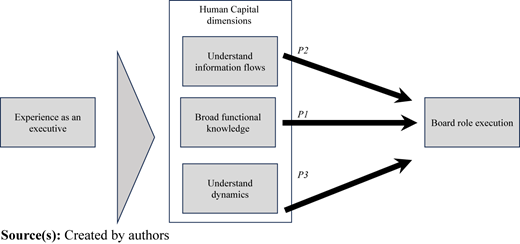
Differences emerged, however, in how effectively DEs and DOs were reportedly able to contribute to this mechanism. Analysis of the data indicates that directors with executive experience (DEs) are able to contribute to a positive dynamic more easily compared with directors who have not worked as executives (DOs). Based on this key insight and an inductive, iterative coding of the data that followed, we present a model to explain this difference. Specifically, we propose that executive-level experience develops three dimensions of a director’s understanding of the governance function, which in turn facilitate a more positive dynamic and effective role execution. The following sections provide brief excerpts to justify our insights into the three dimensions, and we provide a more structured presentation of the link between the data and insights in Table 2.
Broad functional knowledge and the role execution
Interview data clearly indicated that directors with an executive background (DEs) are more likely to (1) provide advice and guidance to management and (2) call for adjustments in the strategic direction of the business as part of their control function. While it is logical that the experience of former executives might easily translate to the service/control functions, what emerged from the data was the number and complexities of difficulties faced by directors without this background (DOs) compared to their DE colleagues.
First, DOs reported difficulty contributing beyond their specific functional area of expertise. For instance, DO3 reflected that “I come from PR background … But on other issues … and there are many. … I may not be that vocal”. DOs were not only limited by the narrowness of their technical expertise, but they appeared more generally to have difficulty developing an “organisational perspective, rather than just a limited perspective on my area of expertise” (DO5). This lack of contextual understanding went beyond the strategic and technical nature of the organisational matters; it affected the ability of DOs to understand the process of advising and controlling itself. For instance, DO1 noted how they were “tongue-tied … because … I did not know if … it is the right question or not yet”. In contrast, experience as an executive appeared to provide DEs with additional contextual understanding and a breadth of knowledge that made them far more likely to engage in the service/control functions. Perhaps and importantly, evidence suggested that management was more open to incorporating the proposed advice and control measures coming from DEs. For instance, DE1, who works simultaneously as a CEO and director on different boards, noted:
… a lot of the directors are not in agreement with you; that is what you call a diversion … Like if there is an investment I want to make, and they (my directors) don’t agree, then I say, “fine, we will not make it” [emphasis added].
This comment demonstrates two key insights: (1) the explicit recognition of the weight that executive experience brings to role execution and (2) the close relationship between the advice-giving and control roles. Therefore, any input to a proposal to invest might be categorised as advice, but, at some point, that advice transforms into control where, for instance, when a director refuses to agree to a proposed investment. The impact of this experience as an executive was regularly cited in interviews and led us to propose:
Director experience as an executive is associated with a broader scope of functional knowledge that facilitates board role execution.
Understanding the information provision process
In addition to the greater scope of functional knowledge, participants reported that DEs expressed an understanding of the amount and type of work required to make an effective boardroom decision. More specifically, participants reported that DEs understand the nature of the work undertaken by senior executives when bringing decisions before the board and the impact of the associated governance processes on the management team.
In line with the well-documented episodic nature of board meetings and the non-executive status of directors (e.g. Forbes and Milliken, 1999; Nicholson et al., 2017), we fully expected all directors to experience information asymmetry compared with executives. While asymmetry for both DEs and DOs was evident, we were surprised at the consistent difference between DEs and DOs in their general disposition towards this asymmetry. For instance, DE14 stated, “I have been a CFO myself … many times, you’re simply unprepared to circulate [board meeting agenda] because the decision-making takes time”. This recognition of the costs and limitations inherent to information provision translated into an attitude where the DEs (in general) appeared more empathetic to the problems faced by management and, as a result, were more effective in accessing relevant information compared with DOs. Former executives were less likely to have an overriding sceptical orientation to the information-providing processes and appeared more likely to understand the possible constraints on the provision of information. Thus, DEs likely build positive relationships with management via information receiving process and by showing an awareness that “once the information comes and once your point is kind of addressed, one should be grateful enough to accept it and not keep on pushing the same thing for ego’s sake” (DE6).
The focus of DEs seemed more attuned to the need to balance the volume of information requested with the workload implications for management. To do so, these directors appeared to draw from their accumulated experience in different management domains, unlike DOs, who seem to project a relatively sceptical (verging at times on hostile) orientation to the information provision process. DOs were more likely to suggest executives were motivated to obfuscate during the information provision phase. For instance, DO11 reported that “management … does not share much information … they try to hide … in fact management plays a defensive game.”
In addition to an enhanced realisation of the information provision processes, DEs were more clearly aware of the importance of understanding the board’s governance processes, the interaction between these processes and any service they might provide. For instance, they did not see management’s reticence to take advice as a problem of trust, but rather that management may not have understood their perspective – they might need to explain it better during the information exchange in the board room. As DE10 stated, “they (independent directors) have to play a little more of an advocacy and enquiry role …” which translates into a communication process aimed at bridging the gap between directors and executives and having the advice acted on. For instance, DE2 observed that:
The important thing you need to do is support the management. It is not an opportunity for you to show how much you know … It’s more of coaching, mentoring and also guiding. … I work very well with the management because … I have worked as executive myself … I can clearly explain to them what is important from my perspective as an independent director … it is also … like continuous improvement model …
Thus, understanding the information flow process at a governance level not only changes directors’ orientation to the information seeking/receiving process but also the adoption of any advice provided to management. This leads us to propose:
The understanding of boardroom information flows gained with executive experience facilitates board role execution.
Understanding how to navigate boardroom dynamics
As well as having a broader set of contextual knowledge and understanding of the information provision processes in governance, DEs were much more likely to report they were comfortable negotiating the complex interpersonal boardroom dynamics compared with DOs. For instance, one former CEO (DE10) recounted how their prior experience in leadership meant they understood how important it is to be
… aligning [with] people who are equal, who had emotions in play and yet do the fair thing. … but you have to take tough calls of this nature … Eventually, …I successfully navigated the crisis at firm X.
In contrast, DOs would report that they were far less comfortable with the dynamics in the boardroom and cite behaviours consistent with being unsure of their role and how to contribute to the service or advice function. For instance, DOs would report that they “had to get tuned to the boardroom discussions and the atmosphere that prevails in the board of directors” (DO6), with some even reporting that they would “sometimes, outside board meetings, discuss with the MD etc. Look, do you mind if I raise these issues?” (DO1).
While understanding the boardroom dynamics did not appear to directly affect the specific advice provided, DEs reported the importance of maintaining a positive governance dynamic and working relationships with executives, doing so appeared particularly important to having their domain-specific advice listened to and adopted by the management team. For instance, DE12 recounted:
Their [management’s] ambition [was] to … grow internationally … I felt that they're probably spending unnecessary time in developing their international strategy. They didn't possibly reap richer in the domestic arena … I could clearly see that … having spearheaded the global strategic ventures myself in my last role … as executive director of global strategy at ABC. So, I sort of challenged them … They were adamant … but I argued from a position of strength … from my years of understanding … Eventually, they saw merit in what I said and listened to me … Believe me, that shifted the colour of the script for five years.
More directly DE10 reported:
Firm X had just undergone a hostile takeover … I was the independent director who was in the middle of the fray … and there were … four (independent) directors on the board with me. This was a huge challenge for me because as human beings, we do get emotionally involved with other people that we work with. To rise above that … yet do the fair thing. … I think my CEO role at ABC helped me to intervene …
These indicative quotes highlight that directors draw on their career experiences and accumulate business acumen to intervene in tough situations of strategic importance. In so doing, the DEs reported they were more able to overcome executives’ objections to their advice because of their enhanced understanding of the dynamics at play in the boardroom. Understanding the dynamic aided DEs in both the service and control roles. When exercising the control role, DEs did not focus on a desire to override management in some form of power play. Instead, DEs saw the control role as a necessary mechanism for ensuring that the focal firm’s strategy and operations were headed in the right direction. Thus, DE1 reflected on the give-and-take process to maintain the dynamics needed for effective advice-giving:
… there are discussions and debates … it is an ongoing process of developing understanding and showing that you respect counterviews … logic … I don’t treat my directors as adversaries rather I value them … in fact, they add lot of value to our strategy.
In contrast, the thirteen DOs did not report similar success in negotiating the boardroom dynamics. More typical was the response of DO12, a participant who teaches at a university and did not engage as readily in the service role:
I have not taken as many leads in expressing the issues … When issues are being presented … then one does not feel the need to participate in that way or lead because … you’re in [a] group.
What emerged from the data was the importance of understanding that experience as an executive was a key factor in understanding and navigating boardroom dynamics, leading to proposition number three:
Director experience as an executive improves understanding of and confidence to engage in effective boardroom dynamics that facilitate board role execution.
Figure 1 summarises our insights into the dimensions of director human capital that are important for effective role execution.
Discussion and conclusion
We set out to examine how the human capital accumulated through experience as an executive was related to board role execution and the dynamics that enable their role performance (RQ). In asking this question, we were guided by scholarly arguments that individual directors’ board behaviour and their contribution to board roles are, at least in part, contingent upon their human capital (Hillman and Dalziel, 2003). Specifically, there is a long literature on how experience as an executive may benefit directors when undertaking their governance functions (Kor and Sundaramurthy, 2009; Kroll et al., 2008; Westphal, 1999). Participants described how executive experience was often required for superior board role performance at an individual level. In essence, directors with executive experience reported they were more likely to contribute to and guide discussions due to the added insights provided by their functional background. Importantly, DEs reported they were more likely to consider the impact of their behaviours (e.g. requesting information) on management (i.e. workload implications). In contrast, DOs reported lower confidence levels in understanding the issues under discussion and governance processes in general. This difference appears, to a lesser extent, to extend to motivation attributions by the two different groups of directors. Instead, DOs would ascribe management behaviour to defensiveness on management’s part, while their DE counterparts would often comment how, in their executive careers, they were subject to challenging time pressures that affected their capacity to service the board. Therefore, DEs appeared more successful in managing the boardroom dynamics to gain access to information and influence managerial decision-making through the service role.
The main contribution of this research lies in highlighting how directors who shared senior management experience (DEs) appeared to share a mental map (Van den Bossche et al., 2011) of the operational aspects of governance compared with their counterparts who lacked such experience and insight (DOs). As a result, DEs possessed three distinct and identifiable dimensions of human capital that enabled better role execution. First, they had a greater scope and contextualisation of specific knowledge. The literature has long recognised the value to firms in appointing directors with current or prior executive experience (Bhardwaj, 2022; Khanna et al., 2013; Roberts et al., 2005; Du and Xu, 2018). While some of this appeal may come from the legitimacy gained via their executive role(s), our findings support the view that the repetitive exposure to managerial decision processes increases these directors’ broad expertise and confidence in dealing with multiple domains of management (e.g. marketing, finance, legal, HR, production, purchase, technology, sustainability etc) (Carpenter and Westphal, 2001), particularly compared with individuals who may come from a single discipline background. Thus, having senior management experience may provide a broader horizon of understanding and mean these individuals are better equipped to perform the board roles as independent directors (Pye and Pettigrew, 2005; Van der Walt and Ingley, 2003; Du and Xu, 2018).
A second dimension of human capital emerged due to DEs’ exposure to the processes and dynamics of corporate governance as an executive, a lesser understood phenomenon of human capital. Our findings suggest executive experience inculcates a pronounced sensitivity in the DEs to empathise with the pressures and challenges associated with management functioning (Hambrick et al., 1993; Roberts et al., 2005), mainly through their understanding of the challenges related to governance information flows. Third, and relatedly, years of experience in reporting to boards appeared to equip DEs with a better understanding of and ability to navigate the dynamics in the boardroom. While it could be argued that this insight is a function of tenure (i.e. DEs will often have many years, even decades, of experience in the boardroom before taking on an independent director role), the tasks involved in servicing a board likely provide a layer of insight beyond that of being a director. For instance, they must execute the board’s directions, prepare reports on organisational performance and strategic impact, and present these reports to the board. In short, they are part of a process of receiving and acting upon feedback from the board that shapes their understanding of how governance works and, in turn, helps them provide better service to management.
The second key contribution of this piece lies in uncovering the potential importance of these hitherto underexplored aspects of director human capital (i.e. information flow and board dynamics experience) to the emerging interest in group-based accountability mechanisms at the governance level (Nicholson et al., 2017; Roberts, 2001; Stein, 2008). Accountability in the context of board governance requires the questioning of management by directors with consequences flowing from management’s explanation of and justification for their decisions (Roberts, 2001; Stewart, 1984). This emergent stream suggests that the board invokes socialised accountability, where individual directors adjust their behaviours and roles in response to the issues facing the board (see Elms and Nicholson, 2020). As such, directors switch between the shareholder guardian (e.g. Jensen and Meckling, 1976; Gray and Jenkins, 1993) and management advisor roles depending on the issue in the boardroom. In so doing, they can avoid the entrenching of us vs them positions that may arise from playing a singularly focused role based on either social ties or independence. Our data clearly showed that DEs could engender trust through their orientation towards and understanding of management while still scrutinising management decisions. What is likely to emerge is a more effective and contextualised boardroom dynamic that facilitates the execution of both service and control roles.
In contrast, the stories shared by some participants without executive experience (the DOs) revealed they appeared not to trust executives, echoing the dysfunctional board dynamics often present in scholarly work (e.g. Groysberg and Bell, 2013). In response, executives, perhaps fearing criticism and disapproval, could hesitate to share challenges and failures (in running the focal firm’s operations) with these DOs. Quite likely and as enunciated by the DOs in this study, executives may frame agenda items in a manner that cannot be understood or even circulate the agenda at the last hour before the board meeting to give directors insufficient time to process agenda items mentally. This explains why boards generally do not benefit from their resources.
Focusing on directors with executive experience raises the potential problems associated with homogeneity in the backgrounds of directors and management. However, there is little evidence to suggest this is a significant concern. The predominant logic favouring diversity in board composition suggests that “information and decision-making … can be improved via variance in group composition … through the increase in the skills, abilities, information, and knowledge that diversity brings” (Williams and O’Reilly, 1998, p. 87). Despite this pervasive logic, research on the relationship between diversity and team performance is, at best, mixed (Stahl et al., 2010; van Knippenberg and Julija, 2016). Instead, emerging evidence suggests sufficient trust (or, more precisely, psychological safety) and leadership behaviours are critical to enable any such benefits to develop (see Veltrop et al., 2021). In terms of the relationship between cognitive conflict (or divergent perspectives on task-oriented matters – see Forbes and Milliken, 1999) and the service role, direct studies of board diversity suggest either no significant relationship with service task performance (Wan and Ong, 2005) or a negative impact (van Ees et al., 2008).
This insight into the control-collaboration paradox provides the basis for a third contribution by highlighting the importance of collective or shared cognition (Cannon-Bowers and Salas, 2001). DOs clearly reported greater difficulty in role execution (control and service) due to the lack of shared understanding of important elements of the corporate governance process (e.g. Pye and Pettigrew, 2005). Primarily driven by the logic of agency theory, corporate governance research has concentrated on issues of motivation and interest alignment (Daily and Dalton, 1993) with recent attempts to integrate information processing approaches (Boivie et al., 2021) and decision-making biases such as group polarisation (Zhu, 2013) largely ignoring the potential influence of collective cognition.
Instead, our data provide evidence that having a common understanding of the communication and collaboration processes – or the transactional memory framework (Bachrach et al., 2019) – appears important to effectively engaging the talents of the board. This transactive memory allows directors and executives to encode, store, and retrieve the relevant information they need more effectively. When directors become more aware of the distribution of knowledge across the group and the processes used to facilitate sharing that knowledge, the effectiveness of the service role increases. Thus, a fruitful area for future research may be understanding the necessity for sufficient overlap in cognitive maps between key members of the board and their executives. Similarly, we have shown that several aspects of human capital may simultaneously be salient – for instance, domain and process knowledge. Thus, having a director with different domain knowledge but shared process knowledge (i.e. how the governance process operates) seems a potent combination. This theoretical perspective may help address questions on, for instance, whether an overlap of or divergence in human capital characteristics can help overcome challenges of other compositional differences (e.g. gender minorities’ marginalisation on boards).
Importantly, the findings broadly imply the value of populating boards with directors with prior C-suite experience. This implication may sound counterintuitive as directors with non-corporate backgrounds (DOs) bring a fresh “outsider” perspective to business issues (Van der Walt and Ingley, 2003). Additionally, DOs with professional backgrounds such as law, academics, economics, finance, PR, and HR can provide in-depth guidance to business policy in these areas. Moreover, denying boardroom entry to directors from diverse backgrounds may jeopardise government initiatives (e.g. quota laws) to balance boards’ gender diversity since many women directors follow non-corporate pathways into the boardrooms (Sheridan et al., 2014). We suggest that rather than having strict criteria for boardroom candidature based on background, other process changes, such as one-on-one mentoring initiatives (e.g. pairing each DO with a seasoned DE), can address the challenges facing DOs. Similarly, a thorough induction of DOs, including shadowing executives in the field, may reduce the differences in human capital that we observe. Reforms such as these may assist DOs in better understanding how executives perform daily operations and implement strategy and, more importantly, how executives and boards interact to stay relevant to each other.
Limitations
While this study provides potentially important contributions to the governance literature, we also recognise several limitations. First, we recognise that our qualitative data were drawn from a purposively sampled group in a specific governance system (India). While this is not a threat to the theoretical insights (as the very point of purposeful sampling is to represent specific features of the participants studied), it does lead to questions of generalisability in the other corporate governance contexts. Future research could explore the relationship we highlight in different settings, particularly settings with more developed equity markets (e.g. the US and UK) or where governance formats differ (e.g. in dual board systems). Similarly, quantitative studies could examine the size and robustness of these insights through large-scale studies that examine the relationships we detail.
Second, we recognise that we did not directly study the effect of executive experience on the control role (i.e. we did not conclude that it improved monitoring per se). Instead, we found that the orientation to management of DEs that helped perform the service role did not appear to undermine the control role. These same directors clearly reported a willingness and ability to question management. An area we did not pursue was often the fine line between service and control – for instance, participant data on the importance of their advice being adopted could be conceptualised as their ability to control management actions. A direct, simultaneous study of both roles would best confirm this tentative conclusion. Third, we did not systematically examine social ties (e.g. whether they share the same club memberships or attended the same graduate schools) and, therefore, social ties may be an unexplained phenomenon in our study (e.g. see Wang et al., 2024 for the effect of social ties on audit outcomes).
Finally, we note that the nature of executive experience provides a possible confounding factor for a director’s level of boardroom experience. Given that senior executives gain extensive exposure to the boardroom through their executive roles, there is a clear correlation (and potential confound) between boardroom experience and executive experience. For instance, an executive who has been a CEO for ten years before their first board appointment will have a decade of exposure to how boards work. This means their understanding of board processes will be well developed, arguably due to experience on a board rather than as an executive. This is a key aspect of our findings. While we acknowledge this limitation, we do not believe that it detracts from our overall finding – that is, experience as an executive provides this dimension of human capital and its effect on their understanding of board processes.