The purpose of the present study is to investigate the demand side of non-financial reporting, especially integrated reporting. We investigate (1) what type of content the users of online integrated reports access most frequently and (2) whether users search for non-financial content and content that integrated reports must contain to comply with the requirements of the International Integrated Reporting Framework (IIRF).
We perform big data analysis on the log files associated with user access to five online integrated reports over a period of 12 months to investigate what type of information users access most frequently when they visit online integrated reports. Content analysis enabled us to match the usage data (page impressions) to certain topics within the integrated reports. Our analysis, which is based on data reflecting over one million webpage views, indicates which types of integrated-report content attract the users’ attention and which do not.
Our results confirm that integrated reports in general, and specific components in particular, are of significant value to users. In contrast to what other studies suggest, we find no evidence that users seek financial information to a much greater extent than non-financial information. Specifically, our results show that usage between financial and non-financial information is quite evenly distributed and differs depending on the metric under consideration; considering usage by topic impressions financial information is used more frequently, scaling topic impressions by report pages addressing a specific topic, non-financial information displays higher usage. With respect to specific topics, our analysis shows that the topics that attracted most interest from our sample of users are performance, financial statements, company profile and value creation. Furthermore, our findings confirm the importance of integrated reporting from a user perspective.
The results of our study are of practical value to both standard setters and (potential) preparers for two main reasons: first, they provide user-centric evidence about the importance of non-financial information and empirically confirm that integrated reporting has become widely accepted among users; second, they provide evidence about the topics that are of specific interest for users and therefore should also be considered by preparers and standard setters more carefully.
The present study enriches the literature on financial and sustainability reporting with informative insights into which of the topics that integrated reports contain attract most interest from users. Moreover, our results are based on actual data on the usage of such reports that reflect real user-journeys, rather than on artificial data, created for research purposes.
1. Introduction
The increasing emphasis on sustainability and transparency is profoundly reshaping the landscape of corporate reporting. Recent regulations, such as the publication of the Corporate Sustainability Reporting Directive (CSRD), the creation of European Sustainability Reporting Standards (ESRS) and the publication of the IFRS Sustainability Standards, highlight the indispensable role of non-financial reporting in the world of corporate reporting. While regulators often emphasize the diverse demand side of non-financial information, exemplified by concepts such as double materiality (Ruiz-Lozano et al., 2022), there is limited evidence about the demand side of corporate information including both non-financial and financial information.
Although prior research, mostly qualitative, confirms the importance of non-financial information in individual decision making for financial users (e.g. Milne and Chan, 1999; Cohen et al., 2011; De Villiers et al., 2023), its transferability is limited. First, such research primarily revolves around financial users and disregards the broader user group of financial reports composed of a diverse range of stakeholders (Slack et al., 2010). Second, methodological constraints associated with interviews, questionnaires and experiments often lead to the results from such studies to be obtained from artificial and unique settings, which limits their replicability.
Emerging evidence, mostly derived from experiments, confirms the importance of the presentation of non-financial and financial information, especially its integration, in shaping user behaviour (Bucaro et al., 2020; Ko et al., 2024). In this context, the most important framework is the concept of Integrated Reporting (IR), designed to provide a holistic picture of the value creation of a firm over time. IR aims to improve information for external user while simultaneously improving internal decision making. Although its existence was questioned following its integration into the Value Reporting Framework and the creation of the International Sustainability Standards Board (ISSB) (de Villiers and Dimes, 2023), the recent commitment of the International Accounting Standard Board (IASB) and the ISSB to uphold the main principles and concepts of the IR framework underscores its continued relevance. This commitment is further validated by the reliance of both the revised IFRS Management Commentary Practice Statement (IASB, 2021) and the IFRS S1 (ISSB, 2023) on the fundamental principles of the IR framework.
Despite the considerable increase in academic research on IR over the last few years, there is still no consensus on how useful it is in practice (Gibassier et al., 2018). One main argument the critics of IR put forward is that integrating different types of reporting tends to favour financial over non-financial information (Brown et al., 2015; de Villiers et al., 2014). On the other side of the debate, the proponents of IR argue that deficiencies of traditional corporate reporting are overcome by the adoption of integrated reporting. Specifically, the advantages concern the broader reporting scope on both financial and non-financial information (IIRC, 2013) and that all resources and relationships in the context of value creation of a firm in the short, medium and long term are considered (Cohen and Simnett, 2015). Against the backdrop that one of the key aims of IR is to consider the users in mind, the calls on researchers to investigate the user side of IR have been multiplying (Adams, 2015; Stubbs et al., 2015; Cheng et al., 2014). The studies that have emerged in response to such calls primarily apply traditional qualitative methods, such as questionnaires and interviews (e.g. Atkins and Maroun, 2015; Slack and Tsalavoutas, 2019), or perform experiments (e.g. Reimsbach et al., 2018; Bucaro et al., 2020; Ko et al., 2024). As most of these studies focus on a specific group of users – mostly the providers of financial capital – their results are not readily transferable to other types of users and often provide only small-sample evidence.
The emergence of online reporting presents new opportunities to researchers to investigate how the usage patterns of firms’ reports have been evolving among users. These opportunities are amplified by the parallel emergence of big data analysis, which allows to detect patterns that may be less visible in small samples. The advantages of big data led us to gather and analyse a large volume of usage data in the form of the log files associated with online integrated reports. In this paper, we investigate (1) if users access both non-financial and financial content, (2) what topics users accessed and searched for within annual reports and (3) the extent to which users accessed specific components that integrated reports typically contain, such as content on value creation. Our sample is based on five online integrated reports, published by five globally active firms over a period of 12 months. In total, our sample comprises 347,014 page visits corresponding to over a million page impressions. Furthermore, we considered 16,475 search requests made within the online reports.
To match the data on report-page impressions with the content of the pages, we first performed content analysis on the individual pages of all five reports in our sample, classifying each page according to the topic or topics associated with that page. Second, we analysed the usage of this report sites with respect to page impressions, i.e. how often specific report sites were accessed by the users of the online integrated reports. Our results show that, typically, users actively accessed pages providing information on a company’s performance, financial statements, profile and value creation. We also compared usage data on pages containing non-financial information and on pages containing financial information. The results of this comparative analysis show that both types of information are of great interest to the users of integrated reports and highlight the importance of specific components of such reports. This exploratory study provides initial insights into user perceptions of integrated reporting. To the best of our knowledge, our study is the first to provide user-based evidence of the importance of reporting, especially integrated reporting, from the demand-side perspective.
Our paper makes four contributions. First, it expands previous research on the importance of non-financial information (Hummel et al., 2022; Mittelbach-Hörmanseder et al., 2021; De Villiers et al., 2023) by providing insights into specific topics users prioritize when accessing annual reports. Simultaneously, the present study is among the first to present granular evidence about distinct topics that users of annual reports actively assess in a real context, consequently without restricting the choice to an artificial environment that is obviously restricted (De Villiers et al., 2023). Recent calls for a more distinct and detailed consideration of sustainability information, focusing on the different ESG perspectives (Dinh et al., 2023), have arisen. Through our topic analysis approach and the consideration of real usage data, we are among the first to provide evidence about specific topic interests of users of corporate information.
Second, our study is among the first to provide evidence that both financial and non-financial information seem to be at least equally important to users of integrated reports when presented in one single report. This finding advances the ongoing debate on the acceptance and utility of IR by confirming that specific components of IR offer demonstrable value to corporate report users. Despite a short period of uncertainty regarding the future of IR, recent announcements by the IASB and the ISSB underscore its continuing importance. In particular, the existing draft of the Management Commentary issued by the IASB emphasizes the value creation perspective, aligning closely with the main principles of IR. Furthermore, the recent publication by the European Financial Reporting Advisory Group (EFRAG, 2024), addressing the connectivity of financial and sustainability information, highlights the growing regulatory focus on this issue. Thus, our study contributes to the broader debate concerning the integration of financial and non-financial information, a critical issue that is at the forefront of recent regulatory advances.
Third, by capturing the actual access to corporate annual reports, we are able to broaden the focus beyond shareholders to include both share- and stakeholders. Prior studies focusing on the use of financial and non-financial data for decision-making often only examined shareholder behaviour. In contrast, our approach overcomes this bias and allows us to consider the behaviour of a broader range of stakeholders of the company, not limited to shareholders. This approach provides a more comprehensive understanding of how different stakeholder groups engage with corporate information.
Fourth, in terms of methodology, to our knowledge, no previous study has used the log files of online reports to investigate users’ interests of integrated reports. The main advantage of using log files is that it allows us to process raw usage data directly, instead of estimating usage indirectly. A second advantage is that log files are automatically generated every time a user visits a webpage to access a report, instead of being artificially generated for the purposes of a study. This strengthens significantly the external validity of our results. The third advantage of using log files, and big data more generally, is that processing a large volume of data enables researchers to detect patterns that may be less visible, if at all, in small samples. Lastly, our research is a response to the growing number of calls on investigating the demand side of reporting, in general, and integrated reporting in particular (Adams, 2015; Stubbs et al., 2015; Cheng et al., 2014; Rinaldi et al., 2018; Songini et al., 2023).
The results we present here are relevant to both standard setters and the (prospective) preparers of company reports. Our evidence highlights the significance of specific components of corporate reporting and reveals the topics that are of particular interest to users. Moreover, we provide evidence about the importance of integrated reporting from the users’ perspective. Thus, our results contribute to the broader discourse on developing corporate reporting practices and by addressing the demand side of corporate reporting, our study provides practical guidance for the preparation of reports that are comprehensive and stakeholder-oriented.
2. Existing literature and research questions
2.1 Usage of non-financial information
Academic research has confirmed that the disclosure of non-financial information has grown importantly in recent years (Haji et al., 2022; Stolowy and Paugam, 2018). Parallel to this development, we have observed multiple regulatory efforts aimed at mandating the provision of non-financial information, including notably the CSRD, the EU Taxonomy and the Sustainable Finance Disclosure Regulation (Hummel and Jobst, 2024). One important aspect of this regulatory advances is the recent development of distinct sustainability reporting standards, including the EFRS by the EFRAG for the EU as well the IFRS Sustainability Standards by the ISSB. Both standard setters aim at providing sustainability disclosure addressing various needs of different stakeholders.
Thus, while regulators may consider the demand side of non-financial information as central, there is limited empirical evidence available on this aspect for non-financial as well as financial information. Most of the existing studies in this area apply either surveys (e.g. Orens and Lybaert, 2010; Cohen et al., 2015) or conduct experiments (e.g. Reimsbach et al., 2018; De Villiers et al., 2023), both generally focusing on financial analysts. Within the former, Orens and Lybaert (2010) found that for the Belgian setting the usage of non-financial information by financial analysts was associated to the specific context of a firm. Expanding the focus beyond specific types of non-financial information, Cohen et al. (2011) explored the demand among nonprofessional investors, while Cohen et al. (2015) investigated professional investors' preferences for non-financial information. Both studies revealed that, among the categories of economic information, governance and corporate social responsibility, economic information ranked highest in demand, followed by governance, with non-financial information ranking last.
The second strand, which adopts an experimental approach, examines the importance of non-financial information in individual decision-making (e.g. De Villiers et al., 2023; Milne and Chan, 1999; Rikhardsson and Holm, 2008; Ghosh and Wu, 2012; Reimsbach et al., 2018). This is often analysed in the context of voluntary audit or assurance (e.g. Sheldon and Jenkins, 2020; Reimsbach et al., 2018). Ghosh and Wu (2012) confirmed that analysts incorporated both financial and nonfinancial information into their recommendations. Focusing on the presentation of non-financial and financial information, Reimsbach et al. (2018) conducted an experimental study involving 104 professional investors. Their results suggested that the reporting format did not enhance acquisition of sustainability information, though integrated reports increased the accessibility of sustainability information due to its integration with financial information. Bucaro et al. (2020) could not confirm these results for the presentation of non-financial information in an experiment involving 213 prospective investors and found that the integration of financial information and CSR information emphasized financial information, while a separate CSR report encouraged investors to adopt a multidimensional perspective. In a recent eye-tracking experiment, Ko et al. (2024) found that investors’ consideration of financial and non-financial information differed depending on the presentation format. Incorporating the cost for the access to information, De Villiers et al. (2023) applied a choice-based conjoint experimental design to examine the extent to which shareholders valued non-financial information. Their results, drawn from a sample of 65 experienced retail shareholders indicated that shareholders were willing to pay for financial disclosure and environmental disclosure, but were reluctant to pay for social disclosure.
While the existing literature indeed confirms the importance of non-financial information for investors, two important weaknesses persist. First, prior research has predominantly considered financial users, no clear evidence exists about the actual usage of non-financial and financial information considering a broader set of users. Second, surveys and experiments often rely on hypothetical situations and may not correctly reflect real-world situations. Against this backdrop and the emphasis that regulators put on diverse users of corporate information existing findings offer limited insights into the demand side. To address this gap and offer a more comprehensive view of the demand side, the present study investigates the usage patterns within annual reports using log files and addresses our primary research question:
What specific sections do users of annual reports actively access, and how does this attention vary between financial and non-financial information?
2.2 Importance of integrated reporting
Considering the abovementioned results highlighting the importance of the presentation of financial and non-financial information (Reimsbach et al., 2018; Ko et al., 2024; Bucaro et al., 2020), the concept of integrated reporting (IR) plays a significant role. Compared to traditional reporting formats, the concept of IR emphasizes connectivity, aiming at presenting a holistic picture of the value creation of a firm over time. The first adoption of mandatory non-financial reporting in the EU through the Non-Financial Reporting Directive (NFRD, Directive, 2014/95/EU) brought IR to the forefront of the corporate reporting discussions within the European Union [1]. The directive explicitly listed IR as a potential framework that companies could use to comply with the directive. With the consolidation of the Integrated Reporting Council (IIRC) under the ISSB in 2022 (de Villiers and Dimes, 2023) and the creation of the ESRS by the EFRAG, concerns about its future were raised. These concerns, however, have since diminished as the IASB as well as the ISSB have explicitly affirmed their commitment to the principles of integration (IFRS Foundation, 2022). Recent advances by the IFRS Foundation in context with the Integrated Reporting and Connectivity Council (Foundation, 2024) along with the publication of the IASB’s revised Management Commentary Practice Statement and the ISSB’s IFRS S1, which are based on the fundamental principles of the IR framework, have solidified the role of Integrated Reporting as a cornerstone for future corporate reporting frameworks.
In academic research, IR has received increased attention, as noted in recent literature reviews (Songini et al., 2023; Rinaldi et al., 2018), which build upon the foundational work by de Villiers et al. (2014). However, the majority of studies in the literature predominantly focus on the supply side of IR, concentrating on the role of preparers (Gibassier et al., 2018; Vesty et al., 2018; McNally and Maroun, 2018, e.g. Chaidali and Jones, 2017; Stubbs and Higgins, 2018). While quantitative analyses have expanded due to the growing availability of data (Songini et al., 2023), research on the demand side of IR remains limited. Existing studies in this area rely on interviews with specific user groups, especially in South Africa, to assess the usefulness of integrated reporting. Moreover, research has explored the quality of IR and its effects on the capital market (e.g. Barth et al., 2017; Lee and Yeo, 2015; Zhou et al., 2017; Lai et al., 2018) [2].
A smaller body of research consists of qualitative studies employing questionnaires and interviews with IR users (Atkins and Maroun, 2015; Slack and Campbell, 2016; Stubbs et al., 2015). Among the first exploratory studies employing semi-structured interviews is the work by Atkins and Maroun (2015), who conducted in-depth interviews with 20 institutional investors from the South African institutional investment industry. Their findings suggest that investors reacted positively to IR, considering it an improvement over traditional annual reporting formats. In 2014 and 2015, Slack and Campbell (2016) also conducted in-depth interviews, following the semi-structured approach, and found little evidence of demand for IR among professional equity investors. Stubbs et al. (2015) conducted a pilot research study in 2014 with four Australian participants in the International Integrated Reporting Council’s “IIRC Pilot Programme Investors Network” and came to a similar conclusion. In a further study, Slack and Tsalavoutas (2019) also conducted semi-structured interviews with 22 mainstream equity market participants. Their results are in line with those of Stubbs et al. (2015), confirming limited evidence for using IR as a mainstream reporting tool. However, the interviewees’ common theme from these positive opinions was the link of value creation underpinned by firm strategy and the reporting of associated key performance indicators across business.
Concerning the broader connectivity of financial and non-financial information, recent research by Wang et al. (2024) analysed the capital market effects of connected financial and sustainability information in the UK, where strategic reporting has been mandatory since 2013. Their findings confirmed that greater connectivity between financial and non-financial information is associated with capital market benefits, further emphasizing the value of integrated approaches to corporate reporting.
Of particular importance in the context of IR are the eight content elements required by the IIRF: (1) an overview of the organization and its external environment, (2) governance, (3) business model, (4) risks and opportunities, (5) strategy and resource allocation, (6) performance outlook, (7) basis of preparation and presentation (8) and general reporting guidelines (IIRC, 2013, p. 4). These elements have gained renewed attention as the IASB’s revised Management Commentary Practice Statement (IASB, 2021), which directly relates to them, further emphasizing their institutional significance and their role in shaping the broader corporate reporting landscape.
Thus, regulatory developments and prior studies highlight the importance of connectivity between financial and non-financial information, where IR plays a key role in providing a holistic view of a firm’s value creation. Given this context, it is important to investigate whether users actively engage with the specific content elements outlined in the IIRF. The extent to which these elements are accessed can provide insights if IR is meeting user needs. If users do not access these elements, it could indicate that IR is falling short of delivering its intended benefits. Conversely, if users do engage with them, it would validate the relevance and utility of the framework in practice. Thus, we pose a second question that concerns the usefulness and relevance of IR:
Do users specifically access the content elements that an integrated report following the <IR> framework should contain?
2.3 Importance of sustainability topics
An important aspect of non-financial information, and its most important difference from financial information, lies in its broad scope. Non-financial information cover a wide range of topics, lack a uniform unit of measurement and have less clearly defined boundaries compared to financial information. The most common classification is the ESG (Environment, Social, Governance) framework, which aggregates topics into these three categories. Each of this categories includes a multitude of specific topics (Hummel et al., 2022), which have recently been further delineated through the development of distinct sustainability reporting standards comprised of EFRS and the IFRS Sustainability Standards.
This particularity was also considered in early studies focusing on the demand for non-financial information using survey methodology. For instance Deegan and Rankin (1997) and de Villiers and van Staden (2012) found that shareholders expressed a strong interest for environmental disclosure, even perceiving them as material. Additionally, survey respondents were in favour of mandatory environmental disclosures (de Villiers and van Staden, 2012). The same phenomenon was evidenced by Epstein and Freedman (1994), who observed that individual investors demanded more social disclosure in their survey of 246 US investors.
Also, in the area of experimental studies on the demand side, the importance of distinct categories and topics has been analysed. Focusing on social disclosures, Milne and Chan (1999) found that decision usefulness of narrative social disclosures for investment decision-making was not significant. Milne and Patten (2002) explored environmental disclosures in the chemical industry and its legitimizing effect and found that the impact of environmental information on the investment decision depended on the time horizon. Solomon and Solomon (2006) focus on institutional investors in the UK and found that social, ethical and environmental disclosure were viewed as decision-useful. Reimsbach et al. (2020) also used an experimental approach and confirmed that perception of different non-financial topics varied between capital market participants and potential employees. Considering the cost for such information, most recently De Villiers et al. (2023) found that shareholders were willing to pay for environmental disclosure, but were reluctant to pay for social disclosure.
In line with those results, Mittelbach-Hörmanseder et al. (2021) assessed the value relevance of distinct topics following the implementation of the NFRD in Europe. Their results confirmed that the effect of sustainability information varies depending on the specific topic being analysed. This evidence reinforces the need for a more granular understanding of how distinct categories and topics of non-financial information are perceived by users.
Understanding which non-financial topics users actively access is important for multiple stakeholders. For preparers of integrated reports, this information can guide the prioritisation and presentation of content, ensuring that reports better align with user needs and expectations. Additionally, these insights enable preparers to streamline content communication through other channels, improving overall engagement with stakeholders. Regulators and standard-setters, such as the ISSB and EFRAG, could use this knowledge to refine reporting standards and frameworks, enhancing their relevance and effectiveness. Finally, academics and researchers could leverage these findings to explore the relationship between specific non-financial topics and decision-making, contributing to the broader discourse on the importance of integrated reporting.
In light of these findings, and responding to recent calls for research with a more detailed focus on specific topics (Dinh et al., 2023), our third research question addresses the relevance of distinct categories and topics for users:
What topics covered within non-financial information do users specifically access?
To address these research questions, we analyse a large sample of data showing which content within an integrated report users actually accessed. To date and to the best of our knowledge, this is the first study to do so, either by means of usage analysis or through a survey. In the following section, we provide a detailed explanation of our methodology.
3. Methodology
3.1 Sample selection
The present study is based on five listed firms that are global market leaders in the chemical or pharmaceutical industries, ranking among the 500 largest European companies (FT Europe 500) at the time of the study. We consider one industry in order to control for industry-specific differences.
For our analysis, we collected the log files of these five companies’ online annual reports for the fiscal year 2016 [3]. Notably, all five reports are labelled as integrated reports by the reporting firms. These online reports are published by the companies as microsites; each page within the reports (e.g. the income statement or CEO letter) was published as single HTML page with a distinct address (URL). However, the range of microsites composing these online reports varies from 118 to 273 (with an average of 176.4 microsites). However, it is crucial to underline that the length of a microsite is not prescribed by any constraints. To facilitate comparison and offer insights into the overall presentation format, we also examined the accompanying PDF versions of these reports (which are not the focus of our analysis). In this context, the number of PDF-pages ranges between 240 and 344, with an average of 271.6 pages. This provides a reference point for the “measurable” page lengths of the reports. Regarding content, all five reports integrate both financial and non-financial information within one single document, constituting the 2016 annual report for each respective firm. Additionally, all five sample firms include their consolidated financial statements in accordance with the International Financial Reporting Standards (IFRS). Furthermore, all five firms were constituents of the FT500 at the time of the study. With respect to the presentation of the reports, it is worth noting that all five online reports were conceptualized and implemented by the same reporting agency. Thus, the high degree of comparability among the online reports provides a robust basis for addressing our research questions.
To collect our data, which cover the period one year after publication of every report, we used the web analysis tool Matomo (formerly Piwik) [4]. Our total sample consists of 881 “report pages” contained in the online integrated report of five companies [5]. To extract meaningful data, we performed big data analysis on the sample of the log files we collected from the five companies. The log files represent direct usage and real requests for information, submitted by numerous users to the servers that host the five integrated reports (Rowbottom and Lymer, 2009). In contrast to the traditional research methods that are usually applied in accounting, such as interviews or questionnaires, big data analysis enables us to estimate usage directly. The log files of web servers capture the content that a user accesses automatically; this increases the external validity of our analysis.
The content of online reports is typically presented on an HTML “microsite”. A microsite is a webpage or a small cluster of webpages that have their own domain or subdomain. They are distinct entities within a website. The advantage of microsites is that, unlike other formats, such as a PDF file, they can be formatted so as to present content optimally on screen devices. For example, microsites are highly searchable, interactive and can accommodate embedded multimedia content (Barrantes, 2018). Also, online reports satisfy the needs of today’s (digital) users, while traditional printed reports are increasingly disappearing from the corporate reporting market (Mittelbach-Hoermanseder et al., 2020). Finally, compared to other methods (e.g. surveys) big data analysis relies on real data, generated automatically by users, rather than data generated for the purposes of a specific study (Kim and Kuljis, 2010). At the same time, log files give no information on what users do with the knowledge they access. Researchers who use big data analysis assume that information that has been actively requested will also be read, at least partially (Rowbottom and Lymer, 2009). Another limitation is that researchers have no influence on the data collection itself, which is carried out by an external statistical tool (in this case: Matomo).
In the context of our study, to answer our research questions, we examined the usage patterns that emerged from the log files of server requests made for the pages of integrated reports in two ways: first, we analysed “page visits”; that is, all website requests made by a user either for the first time or at least after 30 minutes after a previous request. We used this measure in the page visit analysis. Here, we took into account “page impressions”; that is, the individual pages in an online report that users accessed during the period of investigation, being equal to a page visit. For the purpose of our analyses, each page visit represents one integrated report user. It is important to note, that in the context of online reports and in contrast to printed report, “individual pages” refer to HTML pages on which content of the online report is published. We will refer to these webpages as “report pages” throughout the whole paper. Second, we analysed the searches each user performed during each visit within the online integrated report; that is, the terms that users searched for within the reports they accessed (search term analysis).
3.2 Content analysis
To gain insight into what content the users of the online integrated reports in our sample were interested in, we began with content analysis, allocating each report page to a specific topic category. Following Kim and Kuljis (2010) and Krippendorff (2013), we based our coding scheme on the IIRF, taking into account the characteristics of online integrated reports. Specifically, we based our coding on the content elements listed in Section 4 of the IIRF, complementing them with the typical components of financial information (e.g. financial reports and financial notes) and of non-financial information (e.g. references to the Global Reporting Initiative, GRI and to “sustainability”). We also included more general terms, such as “investment”. Our coding scheme, which we present in Appendix, comprises 39 topic categories.
Once we defined our topic categories, we allocated each report page to a main topic and, where necessary, to a secondary topic [6]. For example, a report page that presents a financial statement will always be classified first in the category financial statements (primary topic) and additionally in the category that describes best the specific statement, i.e. balance sheet, income statement, cash-flow statement or statement of changes in equity (secondary topic). In total, we coded 881 report pages, resulting in 1,345 topic allocations. This corresponds to 1.53 topic categories per report page on average.
3.3 Page visit analysis
To investigate what content the users of online integrated reports access most, we analysed the log files of the reports in our sample and also performed content analysis as described further up. From the log-file analysis, we excluded visits to report pages that present non-specific content, such as service pages (e.g. “help”, lists of search results, “downloads”). We also filtered out landing pages and any pages that we classified as “other”, i.e. pages whose content is not relevant to our analysis. Our refined sample contains 1,295 topic allocations corresponding to 829 report pages and 857,193 topic impressions in total; “topic impression” corresponds to the number of topic allocations after elimination of the pages described above. The number of topic impressions is higher than the number of page impressions (588,374) because we allocated 1.56 topics to every report page on average.
To analyse what type of content users accessed the most, we use two measures. First, we estimate the usage relative to all topic impression and calculated the total number of views for every topic i and scaled by the total number of all topic impressions. This allows us to measure the interest users show in specific topics, relative to all other topics and all page impressions and provides us how many percent of all topic impressions were concentrated on each topic. We calculated this measure as follows:
where Topici is the sum of all visited report pages addressing a specific topic i and TTI is the sum of all topic impressions, i.e. 857,193. As certain topics, e.g. performance and financial statements, are given greater coverage by report pages than others in integrated reports, usageTI may be biased. Taking this possibility into account, we also calculated usagetp. to measure the usage of a certain topic per report page addressing this specific topic. We calculated this measure as follows:
where Topici is the sum of all visited report pages addressing topic i, and Pagesi is the number of report pages addressing topic i. Thus, usagetp, scales interest in a topic on the basis of all report pages dedicated to the respective topic.
To aggregate the main topics of interest to users, we applied both metrics: usageti captures all report pages the users in our sample visited, while: usagetp captures the number of report pages dedicated to a specific topic. As a result, the number of report pages dedicated to one topic should not bias our results.
3.4 Search term analysis
Log files also contain information on the search queries that users perform when visiting a site. This allowed us to extract the words (“search terms”) users searched for within a report through the search function of the report. The search function is an integrated search tool within each of the analysed online integrated report. To preserve anonymity of our report sample, we removed any search terms that may reveal the companies’ identity (e.g. a search request including the company name) as well as search terms that we considered not conclusive, such as “and” “or” or numbers for example. Due to technical restrictions, we consider only single word occurrences of all search requests in our analysis. However, users sometimes searched for compound terms such as “management report” for example. In this case, the output for the purposes of our study would by one hit for “management” and one for “report”. However, this still enables us to provide reliable evidence on the topics that users searched for within the integrated reports in our sample.
4. Findings
4.1 Descriptive statistics
Table 1 displays both the separate and aggregated reach statistics for each of the five reports in our sample. The tabulated results are based on the raw data we extracted from the log files. In total, we registered 347,014 page visits and 1,100,543 page impressions; that is, within every page visit, users accessed more than one report page, 3.17 report pages on average. The data sample also contains 16,475 search requests made within the online reports.
In Table 2 we present comparative statistics on the five companies in our sample, based on rankings with respect to the number of employees, total sales and EBIT (“earnings before interest and taxes”).
Companies B and C rank always first or second in all cases and are followed by company A in the third place, company E in the fourth and company D in the fifth place. All companies except C refer to the IIRF within their online integrated reports; moreover, companies A and B participated in the “IIRC Pilot Programme Investors Network” (IIRC, 2014). In contrast, the online integrated reports of companies D and E never published an integrated report before in any format.
The reach statistics also show that the reports of companies B (100,628 visits) and C (135,120 visits) were by far the most widely used in our sample during the period our research covers. Page visits and page impressions are both related to the size rankings in absolute terms. This is in line with prior research, which shows that the reach of an online report can be determined by different factors, including a company’s size, market capitalisation or free float. Considering the evidence that employees access firms’ reports (Rowbottom and Lymer, 2009), it also aligns with the present observation that larger firms have more visits.
With regard to the average number of page impressions per page visit, we were not able to detect a clear pattern. On average, users viewed 3.17 report pages during a single visit, ranging from 2.89 to 4.13 pages per report. On average, a page visit lasted 212 seconds. We should add that all five reports were published in English. Three were additionally provided in at least one other language; however, user interest concentrates on the English versions (65.2%).
4.2 Topic results
To analyse the five integrated reports thematically, after the content analysis, we allocated a total of 813,832 [7] page impressions to the topics we defined (see Appendix Table A1), which corresponds to a total sample of 1,345 topic allocations. Following the methodology outlined in Section 4.2, we allocated one main topic and, where applicable, one or more secondary topics to each page. This translates into 1,049,961 topic impressions for a total of 881 individual report pages. After eliminating the landing pages and pages in the “other” topic category, we ended up with a sample of 1,295 page allocations corresponding to 829 report pages. Our final sample, on which we base the remaining analyses, contains a total of 857,193 topic impressions.
4.2.1 Usage of non-financial information (RQ1)
With respect to our first research question, we present the results in Table 3. The categorization into the two broad categories financial information and non-financial information reveals that when we measure the usage of pages concerning specific topics relative to all topic impressions, i.e. usageti, pages containing financial (54.01%) receive more attention than non-financial information (45.99%) [8]. However, looking at the usage by topic pages (usagetp), we observe the reverse pattern: in the case of pages with content on non-financial topics we measure 723.33 impressions by topic page, while in the case of pages containing financial information this figure amounts to 617.30. Among the five firms under consideration, topic impressions for financial information were higher than for non-financial information for three of the firms, whereas for the remaining two firms, the opposite was the case. Thus, our first analysis shows that non-financial information is an integral part of company reporting from a user’s perspective. This finding is particularly interesting in the context of the debate on whether non-financial information is or is not important to users compared with financial information. It also provides evidence that non-financial information has become increasingly important to the users of company reports, especially of integrated reports.
In order to gain a more in-depth view about the specific topics that users actively assessed, we investigate the usage per specific topic. The results on the interest the users in our sample showed in specific topics (in alphabetical order) are presented in Table 4. As the table shows, the topic performance attracted by far the highest usage in terms of usageti; more precisely, report pages featuring content on performance attracted 12.85% of the 857,193 topic impressions.
The next topic in which users were most interested is segment performance: pages related to this topic attracted 7.62% of all topic impressions. This is followed by financial statements (6.36%) and financial notes (6.19%). In particular, income statement attracted 4.63% topics views. Pages with content on sustainability attracted 4.02% of topic impressions, followed by accounting (3.52%), remuneration (3.43%), value creation (3.26%) and company profile (3.18%). In sum, we see that the topics that attract the greatest attention from users contain information on performance, accounting information as well as certain types of non-financial information.
Interestingly, report pages with information on taxes are the least viewed, attracting only 0.16% of users’ topic impressions and ranking last no matter which metric we consider. However, as mentioned in Section 4.3, some topics, such as performance and financial statements, may bias the results, because they not only are among the most visited but also are covered most within the online integrated reports in terms of report pages. For that reason, we also calculated usagetp, scaling the topic impressions by the number of report pages attributed to the respective topic (as outlined in Section 4.3.). We present our results in the last two columns of Table 4.
These results (see Table 4) show a different picture: specifically, in our sample of 1,295 topic allocations, the topic CEO statement, which accounts for one report page per sample integrated report, attracts most topic impressions in relation to the amount of report pages dedicated to a specific topic, in that case to the CEO statement. This topic is closely followed by the topic business model, for which we measured 1955.55 impressions by topic page. The topic value creation, which corresponds to 1744.50 impressions by topic page comes next. It is followed by the topics company profile (1705.13), financial statements (1703.13) and three topics addressing performance; namely performance (1669.39), regional performance (1555.13) and non-financial performance (1301.18). The topics future and outlook (1283.06) and storytelling (1176.50) rank last.
In order to aggregate the results, we obtained by applying the two different measures, we examined which topics are among the top 10 in both rankings. The results we present in Table 5 confirm that information on performance and on financial statements, as well as on two of the topics that integrated reports typically cover, company profile and value creation, attract particular attention from users. These four topic categories are among the top 10 in both rankings; that is measuring usage by topic impressions and by topic pages.
In sum, our results confirm that non-financial information is indeed important from a user’s perspective, and that presenting non-financial and financial information in the same document does not diminish the users’ interest, as Milne and Gray (2013) and Thomson (2015) warned it might do.
4.2.2 Importance of integrated reporting (RQ2)
To address research question II concerning the usage of components specific to IR, we create a thematic cluster titled “IIRC components”. This cluster centres on content elements that are either characteristic of IR or explicitly (or solely) required by the IR framework. In light of the focus of research question II, namely crucial IR-related topics, we selected the topics “business model, corporate governance, future and outlook, risks, strategy and value creation” for our “IRRC components” thematic cluster. These topics align with the core elements essential to the practice of IR as well as the IASB’s Management Commentary practice statement draft.
As displayed in Table 6, the thematic cluster gets 16.79% of all topic impressions; for impressions by topic page this amounts to 688.74. Table 6 shows that usage by report page was highest for report pages concerning a company’s business model, value creation and future and outlook; these were followed by strategy, risks and corporate governance. Thus, our results provide evidence about the value creation concept from the user’s perspective and add to the ongoing debate about the importance of this concept for investors (Slack and Tsalavoutas, 2019). Also, comparing the visits of the thematic cluster “IIRC components” to distinct financial statements, we find evidence that only the income statement is accessed more often, registering 882.60 impressions by topic page.
In order to gain a more holistic view about the importance of IR specific components we created two additional thematic clusters for matter of comparison, namely “financial reporting” and “sustainability” (see Tables 7 and 8). Overall, our results show that topics relating to sustainability and the typical components of integrated reports attract as much interest as topics relating to financial reporting from the users of online integrated reports. Concerning topic impressions, both clusters register approximately 17% of all topic impressions. Specifically, we recorded 592.08 impressions by topic page for sustainability, 688.74 for the components that IIRC requires integrated reports to contain and 526 for the components contained in traditional financial reports (including financial statements and financial notes). Thus, we cannot confirm prior evidence that integrated reporting, especially in the context of the IIRC content elements impedes the usage non-financial information. On the contrary, our results indeed confirm the importance of both integrated reporting components, especially the topics business model and value creations as well as sustainability. The results are displayed in Tables 6 and 8
4.2.3 Topic-specific results (RQ3)
By addressing our first research question, we have provided evidence that users of annual integrated reports indeed access non-financial information. To enhance this analysis with more detailed insights into the non-financial information (Dinh et al., 2023), we examine the components of the thematic cluster “sustainability”. The ranking presented in Table 7 reveals that within this cluster, pages with content on non-financial performance garnered over 1,000 page views. Sustainability as a broader theme and pages concerning supply chain and GRI index rank second and third, respectively. Subsequent topics of interest include those related to employees, human rights and safety, followed by environment and social. While firm-specific factors may influence the patterns we observe, our findings highlight the importance of non-financial performance, sustainability and also the supply chain. The latter is of particularly noteworthy, given the recent agreement of the corporate sustainability Due Diligence Directive (CSDDD, directive 2019/1937) by the European Parliament in June 2023.
In view of the recent regulatory advancements regarding distinct sustainability reporting standards based on the three ESG categories – environment, social and governance – introduced by the EFRAG, along with the recently published IFRS S2 focusing on climate-related disclosure, we complement our analysis and provide evidence about the usage pattern with respect to these categories (untabulated) [9].
Our findings show varying levels of usage across ESG categories. From a topic-page perspective, environment and social receive comparable attention, while governance lags behind. Specifically, the environment category, consisting solely of the environment topic, spans 38 pages and receives an average of 529.68 impressions by topic page. The social category, composed of four distinct topics (employees, human rights, safety, and social) covers 78 pages and achieves an average of 531.45 impressions by topic page. A closer examination of the social category shows that pages related to employees and safety are among the topics most actively accessed by users, with three topics—employees, human rights and safety—each exceeding 500 impressions by topic page, indicating strong user interest in these areas. In contrast, the governance category exhibits lower usage, with an average of 311.14 impressions by topic page. These findings suggest that users place more emphasis on the environmental and social dimensions of ESG reporting, while governance topics receive comparatively less attention.
Placing these findings in the context of the respective ESRS highlights the importance of all environment-related ESRS and IFRS S2, as well as ESRS S1, which regulates the disclosure requirements for a firm’s own workforce.
4.3 Search term analysis
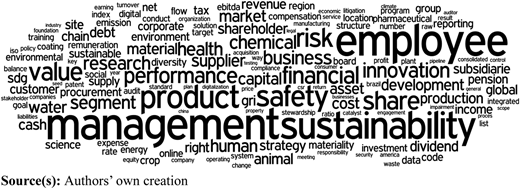
Unlike printed integrated reports, online reports allow users to search for specific terms within a report with an integrated search function. These searches are logged automatically, providing an excellent source of data for analysis. In the five reports in our sample, a total of 16,475 search queries submitted through the search function incorporated in the report pages were registered. Our analysis is based on single-term searches, because of technical limitations. For example, the search term “corporate governance” enters our analysis through two hits, one hit for “corporate” one for “governance”. “Linking” words, such as “and”, “or” and so on were eliminated. Consequently, the results of this analysis indicate the topics that users researched, rather than exact search terms in their queries. Table 9 provides an overview of the 25 most common words users searched for in the reports, while Figure 1 illustrates the relative frequencies of the 250 most common word queries in the form of a word cloud.
These results expand the insights that we gained from the page-visit analysis: in contrast to the rankings that are based on the page-visit analysis, the ranking we derive from analysing the words that users searched for shows that words that concern the human aspect of business, such as “management” (255 hits) and “employees” (254 related hits), are the most common words in the submitted queries in our sample. We also see that users searched for the words “sales” (234 hits), “product” (187 hits), “sustainability” (220 hits), “safety” (169 hits), “risk” (152 hits). and the word “share” comes ninth (148 hits). Finally, in the tenth place with 148 hits, the word “value” indicates that users searched for “value creation”.
Overall, the search-term analysis reinforces the results of the page-visit analysis and illustrates that users show significant interest in non-financial topics. However, to interpret these results, we need to take into account that the structure of both traditional annual reports and integrated reports may invite access to the financial content – for example by means of eye-catching headings that provide direct links to financial content, whereas specific non-financial information can only be encountered either while scrolling through a page or through a targeted search for specific words. Therefore, users may search for non-financial information more frequently, not because they are not interested in financial information, but because they do not need to search for financial information – the report’s structure guides them easily to it. This possible explanation notwithstanding, our results indicate that the users of integrated reports do seek and collect non-financial information.
4.4 Further analyses
We conducted some additional analyses to explore usage patterns of IR across the sample firms and revisited the longstanding question in financial accounting regarding the importance of distinct financial statements.
First, when considering IR practices, one needs to consider that in practice IR is more understood as a conceptual framework than a clear accounting standard (Obeng et al., 2021) and that firms may not completely follow the IR framework (Songini et al., 2023). Thus, we also look into the usage patterns by firms (results not tabulated). The usage patterns for the thematic cluster “IIRC Components” vary from 8.77% to 23.03% of topic impressions by firm, with an average of 17.98%. More specifically, three firms’ page impressions exceed 20% of topic impressions for “IIRC Components”, all of which reference the IIRC in their reports. In contrast, the report that neither references the IIRC nor follows the IR framework and simply describes “This integrated Annual Report combines our financial and our sustainability reporting” received the least page views on the IR thematic cluster (this report is also below average with respect to the thematic cluster “non-financial information”). Considering the components of the IR thematic cluster for the four firms that reference the IIRC we confirm the importance of “value creation” which received between 3.47% and 6.21% of topic views. Consequently, our firm-specific analysis complements findings primarily derived from experimental studies (e.g. Reimsbach et al., 2018). It suggests that the integration of financial and non-financial information does not deter users from accessing non-financial information. Moreover, it offers initial evidence that the label “integrated reporting” may play a role in shaping user behaviour, particularly when firms explicitly reference the IIRC.
Second with regard to financial information, a prevailing question that continues to remain is about the supremacy of the income statement over other financial statements and has endured over time (Dichev, 2008; Finger, 1994; Buckmaster and Jones, 1997). Also in light of the more recent finding by Cascino et al. (2021) who show that financial statements remain a primary information source for investment professionals, we also investigate the usage patterns of distinct financial statements. Although Drake et al. (2019) found that the importance of financial statements varied depending on the specific task at hand, their survey participants generally considered the balance sheet, the income statement and the statement of cashflows to be more important than the equity statement and OCI. To contribute to this debate, we refine our topic allocation and consider only the pages containing the financial statements themselves and omit distinct financial notes. Our results (not tabulated) indicate that the income statement received 3.48% of topic impressions, followed by the balance sheet with 1.88%, and the cash flow statement and the statement of changes in equity with 0.65% and 0.36% of topic impressions, respectively. We observe a similar ranking when considering impressions by topic page. However, when including pages that provide further information (e.g. financial notes) related to the distinct financial statements, the income statement retains the highest topic impressions, with 1168.15 impressions for every report page concerning the income statement (see Table 9). Pages containing information on cash flow statements have the second-highest usage by report page with 555.67 impressions by topic page, followed by pages containing information on changes in equity (427.11) and on the balance sheet (376.42). Thus, the usage patterns clearly show that the income statement is the financial statement most accessed by users of annual reports. However, concerning the remaining financial statements the evidence is not finally clear.
5. Discussion
In response to recent calls for more in-depth understanding of the role and importance of non-financial information for shareholders (De Villiers et al., 2023; Dinh et al., 2023) and the need to explore the benefits and challenges of IR for companies (Songini et al., 2023), our study provides important exploratory evidence. By analysing data extracted from actual annual reports usage, we rely on an open-ended approach that allows users unrestricted access to navigate all microsites that constitute the online annual reports under consideration. This differs from existing studies based on experimental settings or interviews, where users’ choices are limited to predefined selections adapted (or simplified) for research purposes.
In light of the growing regulatory efforts and arising concerns about information overload on the other (Stolowy and Paugam, 2018), our findings offer important insights. First, we observe that users are at least equally accessing non-financial and financial information, thus challenging the criticism that integrating different types of information in one report tends to favour financial over non-financial information (Brown et al., 2015; de Villiers et al., 2014).
Additionally, our results highlight the role of IR in shaping future sustainability reporting. Specifically, our findings confirm that content related to value creation is indeed actively accessed by users of annual integrated reports, which aligns with prior evidence acknowledging benefits of IR (Cohen and Simnett, 2015; Stubbs et al., 2015). This supports the ongoing efforts by the ISSB and the IASB to embed IR principles into their reporting standards, such as IFRS S1 and the revised Management Commentary. Similarly, the CSRD and EFRAG are also advancing the integration of financial and non-financial information, placing significant emphasis on the connectivity. For instance, EFRAG’s recent paper addressing the connectivity between sustainability and financial disclosures aims to enhance faithful representation, reduce greenwashing and improve decision-usefulness for stakeholders. With the ratification of the CSRD, the separate publication of a sustainability report was eliminated, mandating firms to disclose financial and sustainability information in a single report. Our results, based on integrated reports prepared under the IR framework, contribute to the debate on various degrees of integration. While the ISSB’s IR framework offers one of the most comprehensive approaches to connectivity, the CSRD and the EFRAG also pursue meaningful steps towards aligning financial and sustainability disclosure within a unified structure.
Furthermore, our study offers detailed evidence on specific topics that users access within annual reports. This level of detail not only informs reporting strategies but also provides important insights to standard setters, such as the ISSB and the EFRAG, as they refine their ESG reporting frameworks. For example, the ESRS explicitly address distinct categories withing environmental, social, and governance (ESG) dimensions, while IFRS S2 focuses on climate-related disclosures. At the same time, our findings suggest potential avenues for future research, particularly the importance of CEO letters and the relatively low interest in pages related to taxes, which are areas for further investigation. Moreover, in the context of the expanding body of textual analysis in the accounting literature, our results provide evidence for specific topics to consider (Hummel et al., 2022).
However, as it is the case with all research, our data are subject to certain limitations that have to be considered when interpreting the results. We acknowledge that the usage data under consideration exclusively represent user behaviour within online reports and do not consider non-specific content such as downloads of PDF-reports. Also, we cannot observe who uses the annual reports and how the information is processed by the users. In light of the findings by Hodge and Pronk (2006), suggesting a preference among non-professional investors for HTML-formatted reports, and Rowbottom and Lymer (2009), who observed that primarily employees accessed firms’ sustainability information, we are confident in capturing a broad user base that has not been subject to prior research yet. While this may impose certain constraints on the scope of our results, we believe that the novel insights we provide significantly contribute to shaping further developments in corporate reporting. These insight are particularly important in understanding what the content of corporate reporting should be (Rajgopal, 2021; Federsel et al., 2023; Fülbier and Sellhorn, 2023).
Looking forward, diversifying research methodologies and addressing specific themes within corporate reporting, especially IR will be essential in advancing our understanding of the landscape of corporate reporting. Our finding serve as a foundation for this ongoing exploration, emphasizing the importance of understanding how integrated reports are used in practices and how they can better meet the needs of a multitude of stakeholders.
6. Conclusion
The present paper is among the first to analyse the actual use of annual integrated reports. Previous research has confirmed the importance of non-financial information for financial investors and the relevance of its presentation, especially the integration of non-financial and financial information. However, due to methodological constraints and the limitation to the investigations of mostly financial users of annual reports, the evidence gained is narrowly framed. In view of this gap, the present paper examines the importance of non-financial information and the importance of IR in accordance with the IR framework, all from a user-centric perspective. Drawing on the log files of the online integrated reports that five globally active companies publish online, we performed big data analysis to identify the types of content that the users of these reports access and the words for which they searched most frequently within the reports.
In our content analysis, we used two different metrics to measure the users’ relative interest in specific topics contained in our sample reports. Our results reveal that the users in our sample were interested primarily in content concerning a company’s performance and financial statements, as well as in some of the typical content of integrated reports, such as information on the company’s profile and value creation. This study also provides evidence that non-financial information has gained in importance compared to financial information. Moreover, our content analysis also shows that the companies’ income statements attracted more user attention than the remaining financial statements.
Our study is among the first to provide evidence that reporting non-financial information in general, and integrated reporting in particular is relevant to the users of online reports. In contrast to studies that rely on more traditional methods, such as interviews, our study relies on the analysis of the log files associated with the online integrated reports in our sample. The main advantage of this method is that researchers can access user-generated data without having to interact with the users (Kim and Kuljis, 2010). Nevertheless, this approach is not without limitations. First, it is not possible to derive direct conclusion from log files about who the users of integrated reports are, how they use the information they request online and whether they find it useful. Second, anonymous log-file data (in this case) do not allow us to track individual user-journeys; that is, what steps a user takes between landing on a webpage and reaching specific content or completing an action within a website. We are confident, however, that both these limitations will prompt further research into user profiles and user journeys in the context of corporate reporting.
The authors would like to express their gratitude to nexxar, the Austrian reporting agency, for providing access to the proprietary usage data used in this study. Please be advised this data, specifically pertaining to the underlying firms, is subject to proprietary constraints and contractual agreements. And we thank all research assistants involved in providing support throughout this project.
Notes
Until now IR has only become mandatory in South Africa where it is a Johannesburg Stock Exchange (JSE) listing requirement based on the King Code.
The evidence largely confirms that mandatory IR has positive effects on the capital market.
The authors processed the anonymised usage data, obtained from the Austrian reporting agency nexxar. As the data employed in this study pertain to the underlying firms, they are subject to proprietary constraints and contractual agreements.
User data was analysed anonymously in this research. For example, the page visits could not be assigned to the IP addresses or other personal data of the users.
Only the “report pages” in HTML were analysed within this study. Accesses to downloads (e.g. PDF documents or XLS files) were not included in this analysis.
To ensure that the thematic allocation was performed as objectively as possible, we applied the following procedure: two researchers independently allocated report page to one or two topic categories. The two researchers then compared their results and, where they differed, they allocated the page in question to one topic by consensus. On that basis, two research assistants were trained to code the report pages of the remaining four integrated reports. Once the coding was complete, the two researchers examined the coded pages, following the procedure already described where a page had been coded differently by the two research assistants.
The remaining page impressions correspond to various service pages, such as the help page or a page displaying search results. As this content is not relevant to our thematic analysis, we removed the respective pages from the sample.
For the cluster allocation, see Appendix last column.
We approximate the categories as follows: environment encompasses the topic environment, for social we consider the topics employees, human rights, safety and social and for governance the topic corporate governance.
References
Appendix
In this paper, “page” refers to a webpage, not a printed page