


Drawing on role identity theory, this study explores how relationship dynamics and boardroom norms shaped directors' interpretation and enactment of accountability in a high-profile case of corporate governance failure.
This qualitative case study analyses data from public inquiry documents, including director witness interviews and official reports, to give rare insight into boardroom practices.
Strong relational ties within a boardroom can create tension between directors' friendship obligations and their fiduciary duties to shareholders, weakening behavioural independence despite formal independence classifications. In addition, limited reinforcement of directors' role standards weakens directors' identification with the role, allowing a competing friendship identity to become more salient and contributing to director disengagement and accountability failure.
The findings suggest a need for regulators to reconsider definitions of board independence and for boards to actively reinforce director role expectations through formal and informal board practices.
The study extends role identity theory within corporate governance by introducing friendship as a distinct boardroom role identity and showing how competing identities can redirect directors' accountability. It also demonstrates the value of public inquiry data for governance research by providing rare insider accounts of director behaviour and boardroom processes that are usually inaccessible to researchers.
Introduction
Corporate boards serve as internal accountability mechanisms, providing oversight to ensure that management acts in the interests of the firm and its shareholders (Brennan and Solomon, 2008). In practice, board effectiveness depends on directors actively enacting accountability by “challenging, questioning, probing, discussing, testing, informing, debating, exploring [and] encouraging” (Roberts et al., 2005, p. S6). These behavioural expectations are reinforced through best practice principles and corporate law. For example, in the landmark Australian legal case ASIC v Healey (2011) FCA717, the presiding judge made clear that “What each director is expected to do is to take a diligent and intelligent interest in the information available to him or her, to understand that information, and apply an enquiring mind to the responsibilities placed upon him or her” (p. 20).
Despite well-established normative and legal standards, boards sometimes fail to provide effective oversight, with serious consequences for a wide range of stakeholders (Cole et al., 2021). This disconnect raises an important question for corporate governance research and practice: if directors' duties and expected behaviours are clearly articulated and institutionally reinforced, why does board accountability still break down in practice? Within corporate governance research, there is often an implied assumption that when board structure and formal independence requirements are met, directors will both understand and fulfil their oversight responsibilities. Yet repeated governance failures suggest that compliance with formal standards does not necessarily translate into effective accountability in practice. This calls into question the idea that directors will consistently prioritise and enact the behaviours associated with their oversight role.
A related tension within the literature concerns how social ties shape board accountability. While some studies suggest that cohesiveness among executives and board members promotes trust and familiarity, facilitating information sharing and open discussion in the boardroom (Adams and Ferreira, 2007; Du and Xu, 2018; Forbes and Milliken, 1999), others argue that these ties can weaken board independence and promote board passivity (Hoitash, 2011; Westphal, 1999). These contrasting perspectives suggest that relational cohesion may strengthen boards under some conditions yet undermine accountability under others. However, when and how interpersonal relationships influence director behaviour remains unclear. Partly, this reflects the difficulty of observing interpersonal relationships within boards, leading research to rely on observable interlocks as proxies for social ties (Hoitash, 2011). While these measures capture structural connectedness, they provide limited insight into the depth and significance of interpersonal relationships or how directors manage competing relational and fiduciary obligations.
Taken together, these issues suggest that board accountability cannot be fully understood through structural indicators alone but instead requires attention to how directors interpret and prioritise their role responsibilities in practice. This study addresses these underexplored aspects of board accountability by asking: How do relationship dynamics and boardroom norms shape directors' interpretation and enactment of accountability within corporate boards?
A cornerstone of corporate governance in research and practice is the assumption that independent directors will act in the best interests of a firm (van Ees et al., 2009). Grounded in the economic logic of agency theory (Fama and Jensen, 1983; Jensen and Meckling, 1976), this assumption rests on the idea that independent directors are motivated to develop reputations as effective monitors and experts in decision control (Fama, 1980). Yet empirical evidence has failed to demonstrate a consistent relationship between board independence and firm performance (e.g. Alzoubi et al., 2024; Bhagat and Black, 2001; Solarino and Boyd, 2023), suggesting that structural independence, on its own, is insufficient to ensure effective oversight. From a behavioural perspective, a more plausible explanation is that directors' engagement with board tasks depends on how they interpret and enact their role, which is likely to be shaped by intrinsic motivations, identities and self-interest (Elms and Grosvold, 2024; Hambrick et al., 2015; Huse, 2005). To better understand these behavioural influences, this study draws on identity theory (Stryker, 1980), with a particular focus on how directors' role-based identities influence their engagement with oversight responsibilities.
Identity theory suggests that individuals hold multiple identities derived from the professional and social roles they occupy, each associated with its own behavioural expectations and norms. Individuals are intrinsically motivated to enact behaviours consistent with the identities they perceive as most central to their self-concept (Stryker, 1980). In corporate governance research, directors' identities have been shown to shape their sense of accountability and engagement in boardroom processes (e.g. Bettinelli et al., 2023; Elms and Nicholson, 2020; Golden-Biddle and Rao, 1997; Hillman et al., 2008). Unlike economic theories that emphasise extrinsic incentives to align behaviour, identity theory focuses on the intrinsic motivations that guide behavioural choices. By applying identity theory to the boardroom context, this study offers a psychological perspective for understanding how relational dynamics and boardroom norms both shape and are shaped by directors' role identities.
This study draws on an in-depth case study of Crown Resorts (Crown), an Australian-listed firm and operator of casino and gaming venues. As a publicly listed entity, Crown's board is formally accountable to its shareholders for ensuring effective oversight and responsible corporate conduct. In 2020, Crown was subject to multiple high-profile public inquiries following allegations of money laundering and links to organised crime groups. These inquiries drew strong criticism of Crown's corporate governance, particularly the board's failure to provide effective oversight. As one inquiry report noted, “Perhaps the board was not told what was going on. The alternative, to adopt an old expression from the railroad industry, is that the board fell asleep at the wheel” (Victorian Inquiry, 2021, p. 3). This judgment appears to be at odds with expected board behaviour, highlighting a failure in board accountability (Roberts et al., 2005).
The Crown case provides an interesting and relevant context for exploring board accountability for several reasons. First, the majority of Crown's directors were designated by Crown as independent, which, under traditional governance assumptions, suggests they would be incentivised to provide effective oversight (Fama and Jensen, 1983). Yet contrary to this expectation, the inquiries indicated that some, if not all, of the independent directors lacked sufficient motivation to fulfil their oversight responsibilities. Second, the board was heavily influenced by a majority shareholder. While dominant shareholders can enhance oversight and reduce agency costs (Courteau et al., 2017), research has also shown that they may engage in self-dealing or expropriation of minority shareholders (Dahya et al., 2008). This dynamic has the potential to reshape accountability within the boardroom and increase the risk of conflicts of interest among directors. Moreover, many directors had social ties to the majority shareholder, raising questions about how these friendships interacted with their fiduciary obligations. Finally, the nature and availability of data from the inquiries offer a rare opportunity to examine board accountability and director behaviour through first-hand accounts, providing insights into board norms, relationships and practices that are typically hidden from the public eye (Leblanc and Schwartz, 2007).
The case analysis revealed three interrelated findings. First, all directors appeared to have strong relational ties with the majority shareholder, creating tension between their obligations as a friend and their fiduciary duty as a director to act in the interests of all shareholders. Second, the board’s norms and practices provided limited opportunities to reinforce the director role, likely weakening directors' identification with their formal governance role. Third, the combination of a weakened director identity and a dominant, competing friendship identity ultimately contributed to disengagement and accountability failure.
The study makes important contributions to accountability and corporate governance research and practice. First, it responds to calls for greater attention to the relational and behavioural dimensions of accountability (Gendron et al., 2007; Huse, 2005; Roberts et al., 2005) by providing empirical insight into how interpersonal relationships and boardroom practices shape directors' interpretations of, and engagement with, their oversight responsibilities. Second, the study extends role identity theory within corporate governance (e.g. Elms and Nicholson, 2020; Hillman et al., 2008) by introducing the concept of friendship role identity to the boardroom context and showing how competing identities can redirect directors' accountability. Third, by drawing on role identity theory, the findings identify role reinforcement as a key antecedent shaping the salience of the director identity and directors' engagement with their oversight responsibilities (Stryker, 1980; Stryker and Burke, 2000). Finally, the study questions the reliance on formal independence classifications as indicators of director motivation, showing how directors' behaviour may instead be shaped by identity-based motivations and relational dynamics within the boardroom (Elms and Grosvold, 2024; Roberts et al., 2005).
The remainder of this paper is structured as follows. First, the theoretical framework is outlined, with a summary of the relevant role identity and accountability literature. Next, the research case background is introduced, followed by a description of the research methodology. The findings and analysis are then presented before the paper concludes with a discussion of its contributions, implications and directions for future research.
Theory and prior research
Role identity theory
Identity is an umbrella term concerned with the meaning a person attaches to the reflexive question, “Who am I?” (Brown, 2015). Identity theory (Stryker, 1980) encompasses multiple forms of identity, including personal, social and role-based identities, with the latter being the focus of this study. Roles are defined as structural positions a person holds in society, such as parent, friend, teacher, manager or director (Stryker and Burke, 2000). Each role (or position) carries its own set of expected behaviours, considered appropriate by others and used internally by those who occupy the role to guide their own behaviour and actions (Stryker and Burke, 2000). Since individuals typically occupy multiple roles and positions, they hold multiple identities, each differing in its importance to a person's overall self-concept.
A central concept in identity theory is the salience hierarchy, which individuals use to manage multiple identities by ranking them according to their relative importance (Stryker, 1980). The more salient an identity, the greater the behavioural investment and attention (Cassidy and Trew, 2001). Individuals are motivated to fulfil the expectations of salient identities because doing so enhances self-esteem and self-efficacy (Stryker, 1980). This helps explain why individuals occupying the same formal role may behave differently, and not always in line with expectations, depending on how they prioritise that role relative to other salient identities.
Role identities are not fixed; rather, they are shaped through social experience. Individuals are more likely to invest in identities that align with how they wish to be perceived (Burke and Stets, 2009) and those that are linked to social rewards such as status, credibility or influence (Cassidy and Trew, 2001). Meanwhile, weaker identities involve less emotional investment and can easily be suppressed or abandoned (Caza et al., 2018; Gendron and Spira, 2010). Contextual cues, such as workplace norms, leadership signals and peer behaviour, also influence identity salience and enactment (Ashforth, 2001).
The coexistence of multiple identities has been widely studied. Research has shown that identities can coexist harmoniously and enhance one another (Burke and Stets, 2009). Problems arise when a situation activates two or more identities with competing demands and priorities (Ashforth et al., 2008; Kreiner et al., 2006; Vough et al., 2024). For example, a manager required to evaluate an underperforming employee who is also a friend may struggle to reconcile the expectations attached to their managerial and friendship identities (Stets and Harrod, 2004).
Individuals respond to and resolve competing identities in various ways. The most cited strategy is to default to the more salient identity (Stryker, 1980). Weaker identities are less likely to generate internal conflict because they lack salience and emotional investment (Settles, 2004; Burke and Stets, 2009). When weaker identities compete with stronger ones, individuals prioritise the more salient identity and align their behaviour with its expectations (Stryker and Burke, 2000; Ramarajan, 2014). However, when two strongly held identities conflict, resolving the conflict becomes more difficult. In such cases, individuals may reinterpret role expectations to reconcile competing demands (Kreiner et al., 2006), temporarily suppress one identity (Stets and Harrod, 2004) or abandon it altogether (Caza et al., 2018). These strategies highlight the malleability of identity in the face of competing expectations.
Dellaportas et al. (2019) illustrate these dynamics in a professional context. Their study of an accountant who defrauded clients shows how a weakly held professional identity was abandoned in favour of a more dominant and self-serving alternative. Lacking strong professional socialisation, the accountant reframed unethical behaviour through an alternative identity that justified non-compliance with their professional standards (Dellaportas et al., 2019). In a boardroom context, Elms and Grosvold (2024) explain how directors may prioritise their personal identity as board members over their director duty to shareholders, choosing to remain on a board beyond recommended tenure limits. These studies illustrate how fragile identities can be displaced by more self-serving alternatives, particularly when role reinforcement is weak.
Accountability and director identity
Accountability can be broadly understood as a relationship in which one party is required to explain and justify its actions to another, who has the right to question and assess those actions (Bovens, 2007). This process involves the “giving and demanding of reasons for conduct” (Roberts and Scapens, 1985, p. 447). Importantly, accountability is enacted not only through formal mechanisms such as reporting and control systems but also informally through social interactions and relational practices (Roberts, 2001). Within organisations, accountability operates in multiple directions, reflecting the diverse relationships within and around organisations (Mansouri and Rowney, 2014). For example, a board is accountable upward to shareholders, downward to those affected by its decisions, inward to fellow board members and outward to external stakeholders.
Within the corporate governance literature, accountability underpins the board's role in monitoring and control, serving as a mechanism to safeguard shareholder interests (Brennan and Solomon, 2008; Roberts et al., 2005). Much of this literature has emphasised accountability to shareholders upward, reflecting the agency theory perspective that the board's primary role is to protect shareholder interests (Fama and Jensen, 1983). As a result, board accountability has often been conceptualised in formal, structural terms, grounded in directors' fiduciary duties and corporate governance codes (Goodman et al., 2021). However, these interpretations have been criticised for overlooking the behavioural and relational dimensions of boardroom dynamics (Huse, 2005; Roberts et al., 2005; van Ees et al., 2009). As Huse (2005) observes, “creating accountability is about bridging the gap between board role expectations and actual board task performance” (p. S65), implying that accountability is not an automatic outcome of board design, but must be actively created through a board's norms, processes and director interactions.
Subsequent research has supported this behavioural view, showing that board accountability is enacted not only through formal rules but through social and relational processes. Drawing on what Roberts (2001) terms socialising processes of accountability, these studies emphasise trust, interdependence and shared responsibility among board members. Brennan et al. (2016) conceptualise board accountability as a relational process, shaped by the interactions between directors and managers. Similarly, Nicholson et al. (2017) identify board routines, including questioning, justification and alternating between challenge and support, that foster and reinforce accountability norms. Bhardwaj et al. (2025) likewise highlight the importance of communication, collaboration and a shared understanding between directors and managers. Collectively, these studies indicate that without behavioural reinforcement, accountability risks becoming symbolic, performed through formal procedures but lacking genuine engagement (Gendron et al., 2007; Nicholson et al., 2017; Roberts et al., 2005).
Here, role identity becomes central. When directors strongly identify with their role of director, they are more likely to engage in accountability routines and contribute meaningfully to board oversight (Elms and Nicholson, 2020; Hillman et al., 2008; Nicholson et al., 2017). Non-executive directors, who serve in a part-time capacity rather than as full-time executive directors, typically hold other professional roles that may compete with the demands and expectations of their director role. Hillman et al. (2008) theorise how the relative salience of non-executive directors' multiple identities – such as CEO, shareholder, customer and supplier – shapes engagement in the boardroom and execution of role responsibilities. Building on this, Elms and Nicholson (2020) provide empirical evidence that non-executive directors who strongly identify with the director role feel more broadly accountable to shareholders and contribute across a wider range of board tasks, whereas those who identify primarily as functional experts on the board will limit their accountability to narrow domains. Organisational culture can also influence how directors interpret their role and approach boardroom interactions. For example, Golden-Biddle and Rao (1997) show how organisational identity shapes how directors construct and enact their director role, affecting whether they challenge, support, or withdraw in the face of conflict.
Overall, the literature suggests that a strong director role identity motivates directors to enact the standards of the director role; however, there is limited understanding of how director role identity is shaped and enacted within the boardroom. Moreover, both research and practice often assume that directors are uniformly aware of, and sufficiently motivated to perform the expected behaviours of their role, despite anecdotal and empirical evidence to the contrary. Although governance codes and laws outline the formal expectations for directors, there are no mandatory qualifications, professional memberships or training requirements to guide how board accountability should be exercised. As a result, directors are likely to rely on personal experience, board norms and informal cues when interpreting their role responsibilities (Westphal and Zajac, 2013). This suggests that board accountability depends not only on the existence of formal structures but also on how directors interpret and perform their roles within the boardroom's social context.
Due to the difficulty of accessing the inner workings of the boardroom, there is limited empirical understanding of why directors differ in how they interpret and carry out accountability expectations. This study addresses this limitation by drawing on inquiry reports, first-hand accounts and email exchanges that provide rare insight into boardroom practices, allowing for a deeper exploration of how these processes and dynamics contribute to directors' engagement or disengagement from oversight responsibilities.
Case background
Crown resorts
In January 2020, Crown was Australia's largest gaming and entertainment company, operating casino and entertainment complexes in Melbourne and Perth, with plans underway to open a third site in Sydney. Crown was listed on the Australian Stock Exchange (ASX) in 2007, with the seller, Consolidated Press Holdings (CPH), retaining 46.1% of the shares. CPH, a company controlled by the Packer family, had a long-standing presence in corporate Australia, primarily through its media interests. In the early 2000s, under the leadership of James Packer (hereafter “JP”), the third-generation Packer, CPH shifted its commercial focus toward the gambling and casino sector. As the majority shareholder, JP continued to exert significant influence over Crown, serving as Executive Chair until 2015 and as a Non-Executive Director from April 2017 to March 2018.
Preceding the official inquiries, Crown faced legal issues and criticism concerning unethical practices. In 2016, eighteen Crown employees were arrested in China for promoting illegal gambling by arranging trips to Crown's Australian casinos. In 2017, Crown employees reportedly handed out “picks” that allowed customers to jam poker machine buttons for continuous play (a practice banned in Australia). In 2019, investigative journalists alleged Crown had facilitated money laundering and established links with organised crime groups.
Following these allegations, in August 2019, the NSW Independent Liquor and Gaming Authority announced an official public inquiry to investigate whether Crown was fit to hold a casino licence for its planned site in Sydney. The inquiry lasted 106 days from January to November 2020, and the final report was handed down on 1 February 2021. The report concluded Crown was unfit to hold a casino license for the planned Sydney location. Following the findings of the NSW Inquiry, Victoria and Western Australia launched royal commissions [1] to determine whether Crown should hold a casino license at its Melbourne and Perth casinos. While these inquiries were shorter, they produced similar critical findings regarding Crown’s deficiencies in risk management and failures of corporate governance.
During 2021, nine of Crown's eleven directors resigned. In February 2022, Crown accepted a US$6.3bn takeover by a US private equity firm and was delisted from the ASX. No legal actions were brought against Crown's directors. However, Crown received a A$450 million financial penalty for failing to comply with anti-money laundering laws, highlighting the serious nature of the activities that took place while the board was “asleep at the wheel”. Key events relating to the inquiries are detailed in the timeline provided in Table 1.
Timeline of key events
| Year | Event |
|---|---|
| 2007 | May: Consolidated Press Holdings (CPH) divests its Casino assets to Crown Limited (Crown) and it is listed on ASX. CPH retain 46.1% of the shares in Crown. Mr Packer, owner of CPH, becomes Exec. Chair of Crown |
| 2015 | August: Mr Packer steps down as Executive Chair and Mr Rankin is appointed non-executive Chairman of Crown |
| December: Mr Packer resigns from Crown board | |
| 2016 | October: 18 Crown employees are arrested in China on charges of promoting illegal gambling activities |
| October: Crown commences building its Sydney casino, due to be opened in 2020 | |
| 2017 | February: Mr Alexander, an executive director, replaces Mr Rankin as Exec. Chair |
| April: Mr Packer is appointed non-executive director of Crown. He is classified as non-independent due to his significant shareholding | |
| 2018 | March: Mr Packer resigns as a director of Crown |
| 2019 | May: Mr Packer agrees to sell 20% of his shares in Crown to Melco, a Hong Kong based company that allegedly has family ties to organized crime syndicates |
| July: A media investigation is aired alleging Crown facilitated money laundering through its casinos and has established links to organized crime syndicates from China | |
| August: The NSW gaming regulator announces it will conduct an inquiry to determine whether Crown is fit to hold a casino licence for its planned new casino in Sydney | |
| 2020 | January: NSW Inquiry commences |
| January: Mr Alexander steps down as Executive Chairman of Crown, remaining on the board as an executive director. Ms Coonan is appointed non-executive Chairman of Crown. Ms Coonan is classified as independent | |
| November: NSW Inquiry concludes | |
| 2021 | February: The NSW Inquiry finds Crown unsuitable to hold its license without “significant cultural, operational and managerial change” |
| February: The Victorian government announces a Royal Commission into the suitability of Crown to continue holding a casino gaming license in Melbourne | |
| March: The Western Australian government announces a Royal Commission into the suitability of Crown to continue holding a casino gaming license in Perth | |
| October: Victorian Royal Commission delivered its report finding Crown is unsuitable to hold a casino license on the basis that it has engaged in conduct that is “illegal, dishonest, unethical and exploitative” | |
| 2022 | February: Crown is purchased by Blackstone, a US based private equity group |
| March: Western Australian Royal Commission delivered its report finding Crown is unsuitable to hold a casino license for its Perth casino |
According to Crown's 2019 Annual report, the Crown board comprised 11 directors, seven of whom were classified by Crown as independent, thereby meeting the recommendation that a majority of the board be independent. The four non-independent directors included an Executive Chair and three nominee directors [2] who were employees of CPH. Crown did not meet the recommendation for an independent chair, but explained this by stating, “The Board believes that Crown's Executive Chairman is well placed to act on behalf of shareholders and in their best interests as a whole” (Crown Annual Report, 2019, p. 36). The annual report indicated that all other recommendations of the ASX corporate governance guidelines had been complied with.
During 2019, the Crown board met eleven times, which is similar to other large listed ASX companies. Crown had eight board committees: Audit & Corporate Governance; Corporate Responsibility; Finance; Investment; Nomination & Remuneration; Occupational Health & Safety; Responsible Gaming; and Risk Management. Committees met between two and seven times in 2019, except the Finance and Investment Committees, which did not meet. The Risk Management Committee met six times, up from four in 2018 and two in 2016. The annual report included a skills competency matrix, which shows that all eleven members of the board had experience in risk management, corporate governance and legal and regulatory matters, including “regulatory and contractual frameworks governing gaming matters” (Crown Annual Report, 2019, p. 34). Details of the structure and composition of the board, extracted from the 2019 Annual Report, are provided in Table 2.
Crown board of directorsa
| Director code | Board role | Gender | Joined board | Resigned board | Independent? | Formal governance training? | Industry background | Committee membership |
|---|---|---|---|---|---|---|---|---|
| JA | Exec Chair | M | Jul-07 | Oct-20 | No | No | Media | Investment |
| Resp. gaming | ||||||||
| HCb | NED | F | Dec-11 | Aug-21 | Yes | No | Government, Politics | Audit & CG (Ch.) |
| Corp. Resp. (Ch.) | ||||||||
| Finance (Ch.) | ||||||||
| PJH | NED | M | Sep-10 | Apr-21 | Yes | No | Medical | OHS (Ch.) |
| Resp. gaming (Ch.) | ||||||||
| Nom and Rem | ||||||||
| AD | NED | M | Jan-15 | Feb-21 | Yes | No | Football | Risk Mgt |
| JHc | NED | F | May-18 | Aug-22 | Yes | No | Government, Politics | OHS |
| Risk Mgt | ||||||||
| AKc | NED | F | May-18 | Aug-22 | Yes | Yes | Entertainment and Gaming | Audit & CG |
| Finance | ||||||||
| Resp. gaming | ||||||||
| HM | NED | M | Feb-11 | Feb-21 | Yes | No | Media | Corp. Resp. (Ch.) |
| Nom & Rem (Ch.) | ||||||||
| GD | NED | M | Jul-07 | Oct-19 | Yes | No | Aviation | Nom & Rem (Ch.) |
| Risk Mgt (Ch.) | ||||||||
| JPY | NED – Nominee | M | Dec-18 | Feb-21 | No | Yes | Government, Education | Corp. Resp |
| OHS | ||||||||
| GJ | NED – Nominee | M | Apr-18 | Feb-21 | No | No | Media | Investment (Ch.) |
| MJ | NED – Nominee | M | Jul-07 | Feb-21 | No | No | Media, Accounting | Audit & CG |
| Finance | ||||||||
| Investment | ||||||||
| Nom & Rem | ||||||||
| OHS |
Note(s): NED is a non-executive director, Ch. is the Chair of the committee
Committee abbreviations: Audit & CG is Audit and Corporate Governance, Corp. Resp. is Corporate Responsibility, OHS is Occupational Health and Safety, Nom & Rem is Nomination and Remuneration
aInformation is sourced from 2019 Crown Annual Report
bHC was appointed Independent Chair in January 2020
cJH and AK remained as directors until Crown was delisted
Casino and gambling industry in Australia
The Australian casino and gaming industry operates within a highly regulated environment due to its high-risk exposure to money laundering, corruption and criminal influence. Casinos are regulated and licensed at the state level. For example, the New South Wales (NSW) Independent Liquor and Gaming Authority regulates casinos in NSW, and the Victorian Commission for Gambling and Liquor Regulation oversees casinos in Victoria. At the federal level, casinos are subject to strict anti-money laundering and counter-terrorism financing laws that require casinos to establish compliance programs, provide employee risk awareness training, conduct customer due diligence, monitor transactions for suspicious activity and report such activity promptly (Anti-Money Laundering and Counter-Terrorism Financing Act, 2006).
A known problem within the industry is money laundering facilitated through junket operators, third-party agents who bring high-rolling gamblers to the casino. Junket operations played a central role in the money laundering allegations against Crown, with inquiry evidence revealing that some junket partners had direct links to organised crime groups. These problems are not unique to Crown; following the Crown inquiries, Australia's second-largest casino operator, Star Entertainment, has also faced regulatory scrutiny over ethical and governance failures (Kidd, 2024).
Research methodology
The study adopts a single-case study approach to extend theory by deriving insights from public inquiry documents. The case provides a unique opportunity to examine boardroom processes and director behaviour through detailed, externally scrutinised records.
Data sources
The predominant data sources for this study comprise documents produced through two inquiries conducted separately under state legislation: the NSW inquiry under section 143 of the Casino Control Act 1992 and the Victorian Royal Commission into the Casino Operator and Licence. Data were accessed and downloaded from the official government websites associated with each inquiry. Two types of documents were analysed: (1) the official inquiry reports issued at the conclusion of each process and (2) transcripts of witness interviews conducted during the public hearings. Due to COVID-19 restrictions, these hearings were conducted via video conferencing platforms, with full transcripts made publicly available.
Public records are a valuable data source as they provide access to information that may otherwise be unobtainable and unobservable (Bowen, 2009). In this study, the inquiry documents offer rare insights into boardroom norms, processes and behaviours that are usually inaccessible to researchers (Leblanc and Schwartz, 2007). The documents were generated through a formal legal process in which evidence was collected under oath, subject to cross-examination and supplemented by internal documents. The legal frameworks through which the data were produced, together with the official status of the reports, enhance the credibility of the data (Mackieson et al., 2019; Dellaportas et al., 2019). A challenge associated with using public records as a data source is that they may lack sufficient detail to answer a specific research question, as they are produced for purposes other than research (Bowen, 2009). In the present study, this was addressed by adopting an exploratory, inductive approach and framing the research question broadly to allow patterns to emerge from the data rather than pursuing a narrowly defined, deductive question.
The interview transcripts analysed in this study include ten interviews with directors serving at the time of the inquiry and three with past directors (all from the NSW Inquiry). An additional interview with the newly appointed independent Chair of Crown [3] from the Victorian Inquiry was included in the data. In total, these 14 interviews amounted to 1,466 transcript pages. Although these interviews were conducted under oath, which increases their trustworthiness, they may still be subject to selective recall and retrospective bias (Howard-Grenville et al., 2021). As with all interview data, the accounts provided represent participants' interpretations and versions of events rather than a definitive account of events (Alvesson, 2003). To strengthen reliability, the interview transcripts were triangulated with the official inquiry reports. Table 3 summarises the director witness interview transcripts included in the analysis.
Transcripts of director witness interviews
| Witness (director) | Date of appearance | State of inquiry | Page reference | Total pages |
|---|---|---|---|---|
| Current directorsa | ||||
| MJ: CPH Nominee director appointed 2007 | 25 Sept 2020 | NSW | pp. 2901–3022 | 300 |
| 28 Sept 2020 | NSW | pp. 3023–3144 | ||
| 29 Sept 2020 | NSW | pp. 3145–3201 | ||
| GJ: CPH Nominee director appointed 2007 | 29 Sept 2020 | NSW | pp. 3022–3267 | 319 |
| 30 Sept 2020 | NSW | pp. 3268–3341 | ||
| JPY: CPH Nominee director appointed 2007 | 01 Oct 2020 | NSW | pp. 3345–3424 | 79 |
| JA: Executive chair appointed 2007 | 01 Oct2020 | NSW | pp. 3425–3461 | 141 |
| 02 Oct 2020 | pp. 3462–3566 | |||
| HM: Independent director appointed to board 2010 | 9 Oct 2020 | NSW | pp. 3822–3915 | 93 |
| AD: Independent director appointed 2014 | 12 Oct 2020 | NSW | pp. 3917–4029 | 337 |
| 13 Oct 2020 | pp. 4030–4075 | |||
| AK: Independent director appointed 2018 | 13 Oct 2020 | NSW | pp. 4078–4114 | 36 |
| PJH: Independent director appointed 2010 | 13 Oct 2020 | NSW | pp. 4114–4154 | 106 |
| 14 Oct 2020 | pp. 4157–4220 | |||
| JH: Independent director appointed 2018 | 14 Oct 2020 | NSW | pp. 4221–4271 | 156 |
| 15 Oct 2020 | pp. 4272–4377 | |||
| HCb: Independent director appointed 2011 | 16 Oct 2020 | NSW | pp. 4379–4502 | 253 |
| 20 Oct 2020 | pp. 4503–4632 | |||
| 08 July 2021 | Victoria | pp. 3725–3863 | 138 | |
| Past directors | ||||
| RD: Independent director: 2007–2017 | 24 Aug 2020 | NSW | pp. 1598–1609 | 11 |
| BB: Independent director: 2009–2017 | 8 Oct 2020 | NSW | pp. 3757–3820 | 63 |
| GD: Independent director: 2007–2019 | 21 Oct 2020 | NSW | pp. 4635-4724 | 89 |
| Totals: 13 Directors | 14 interviews | 1,466 pages | ||
Position held by current directors is based on the 2019 Crown Annual Report
HC was appointed Independent Chair in January 2020
The predominance of NSW data reflects the broader scope and earlier timing of this inquiry. It was the first inquiry to comprehensively examine Crown's governance failures and captured a larger number of director testimonials. In contrast, the Victorian Inquiry focused more heavily on operational aspects, and the only director interviewed was the serving Chair. A third inquiry, the Perth Casino Royal Commission (Western Australia, 2022), was subsequently held but has not been included in this study. This is because it draws heavily on evidence from the earlier NSW and Victorian inquiries and contributes minimal additional insight relevant to the research aim. The Report of the Inquiry under Section 143 of the Casino Control Act 1992; NSW Inquiry, 2021) and the Final Report of the Royal Commission into the Casino Operator and Licence (Victorian Inquiry, 2021) total 1,420 pages and are summarised in Table 4.
Inquiry reports
| Document title | Date published | State of inquiry | Pages |
|---|---|---|---|
| Inquiry under section 143 of the Casino Control Act 1992 (NSW) Volume 1 and 2 | 1 February 2021 | NSW | 768 |
| Royal Commission into the Casino Operator and Licence (VIC) Volume 1,2 and 3 | 15 October 2021 | Victoria | 652 |
| Totals | 1,460 pages |
Data analysis
The analysis process involved sourcing, selecting, making sense of and then synthesising data from the inquiry documents. Given the large volume of accessed data, the document analysis process began with a high-level review of all published documents to identify the sections, pages and excerpts most relevant to the research question. This was followed by a more thorough examination of the data deemed important. The central analysis was performed through data coding. At a broad level, the data coding process involved breaking the data into segments and assigning each segment a meaningful label, such as a word or phrase, that represented that data segment. This coding process reduced the data to a manageable amount and enabled interaction with the data, providing an opportunity for reflection on the emergent themes and concepts. All coding was performed using NVivo, software designed for qualitative research.
Data coding was performed inductively and followed an iterative approach that involved moving between the data, the literature and emerging concepts, adopting what is known widely in the literature as “the Gioia method” (Gioia et al., 2013). The first stage used open coding to develop initial concepts related to the research question, group the data into smaller segments and assign a first-order concept that captured the data’s meaning. These concepts were generated inductively by examining how directors understood their role, their responses to key events and their reasoning for action or inaction. Phrases were coded using participants' own words where possible to preserve meaning and remain close to the data. As new concepts emerged, they were compared with existing ones to identify similarities, differences or interesting patterns within the data. Similar responses were grouped and refined to ensure consistency and reduce redundancy.
The second stage of coding involved clustering related first-order concepts into more meaningful second-order themes. This was achieved by reviewing the data associated with each first-order code and asking: “What is really going on here?” Concepts that conveyed similar ideas or behavioural patterns were grouped under broader conceptual categories. This stage involved more interpretive work, drawing connections between the first-order concepts and consulting relevant literature to identify concepts that captured their theoretical significance. In particular, literature on role identity and accountability was used to examine how the patterns observed in the data related to existing theoretical explanations of director behaviour. Concepts that did not relate to the research question were set aside, leaving 19 first-order concepts, which were clustered into six second-order themes. The third and final stage of the analysis was to aggregate the second-order themes into three higher-level dimensions that conveyed meaning from the data and addressed the research aim. These three aggregated dimensions form the basis of the findings. The data reduction and coding process is illustrated in Figure 1. Supporting evidence for the second-order themes is provided in Table 5, drawing from the director interviews and the inquiry reports. Further detail, discussion and supporting evidence for each of the three aggregated dimensions are provided in the following findings section.
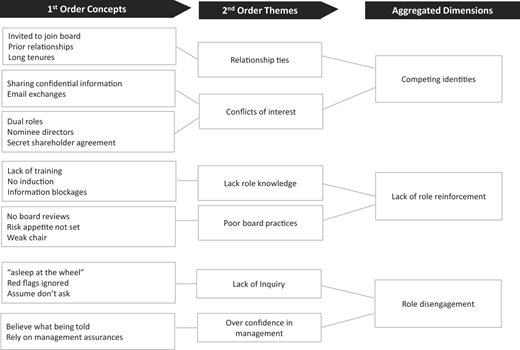
Data reduction. Source(s): Figure created by author
Data reduction. Source(s): Figure created by author
Second-order themes and supporting evidence
| 2nd order theme | Extracts from director interviews | Extracts from inquiry reports |
|---|---|---|
| Relational ties | Q: Could you tell us how you came to be a director of Crown? | It is clear that [BB] was considered by [JP] to be a “good friend”, and it is apparent that their association was the catalyst for [BB] to join the Crown Board |
| A: I was invited to be a director. The chairman at the time was [JP] | ||
| Q: Do you have to make any formal application or anything like that? | ||
| - NSW Inquiry report p-508 | ||
| A: No, I don't believe that I did at the time | ||
| - witness interview HM p-3826 | ||
| Conflicts of interest | I remain committed to serving the best interests of Crown and, most importantly, you - witness interview AD p-4058 | There is no doubt that the lines of reporting were blurred; risks were not properly identified; identified risks were not properly notified; conflicts or potential conflicts were not recognised; and the corporate needs of Crown were not given precedence over the corporate needs or desires of [the major shareholder] |
| - NSW Inquiry report p-446 | ||
| Lack role knowledge | Q: In terms of joining of the board, were you given any induction training or other training in respect of preparing you for the role of director of the companies? | A further rather unedifying and significant step was the one-hour online AML training for the Board introduced during latter parts of the Public Hearings. This was 13 months after the allegations were exposed in the print media, 10 months after Counsel Assisting opened the Public Hearings referring to the problems in the accounts and after months of what may reasonably be described as devastating evidence of the obvious indicia of money laundering within the accounts |
| A: Not that I recall | ||
| - witness interview BB p-3826 | ||
| - NSW Inquiry report p-347 | ||
| Poor board practices | Q: Has the board of Crown Resorts conducted any review, itself, of the circumstances which led to this corporate governance problem? | Crown's ineffectual corporate governance, in particular the failure to set risk appetite of the company with disastrous consequences in China in 2016, is the responsibility of all directors who served at the time |
| A: Not that I'm aware of - witness interview PJH p-4140 | ||
| - NSW Inquiry report p-510 | ||
| Lack of inquiry | Well, I made the presumption those obligations were being met - witness interview JA p-3496 | Crown's directors were not informed of very significant matters of which they should have been informed … |
| – NSW Inquiry report p-347 | ||
| Over confidence in management | Q: Did it occur to you at the time that in having [management] prepare an investigation report, they were, in a sense, investigating themselves? | It should be recognized that in mid-2019 the Crown Board was dealing with numerous and significant matters affecting Crown's corporate reputation …. Instead of pursuing and obtaining the explanation from [management], the Crown Board permitted [management] to prepare a report … requiring it to place implicit trust in [management] to report accurately to them on the very matters in respect of which the [regulator] had been critical of |
| A: No, it did not occur to me at the time | ||
| Q: … it didn't occur to you at the time that management may be a little self-interested in the investigation? | ||
| A: I trusted management to act in the best interests of Crown and give us an honest appraisal to the board | ||
| - NSW Inquiry report p-556 | ||
| - witness interview PJH p-4173 |
Because of the high-profile nature of the case and the extensive media coverage surrounding the inquiries, particular care was taken to minimise the potential for researcher bias during the analysis. A reflexive journal was used to note any prior assumptions or expectations and to consider how they might have influenced how the data were being interpreted. For example, media narratives frequently framed the governance failures as negligence, alleged misconduct and the influence of the dominant shareholder. While some of these themes were later supported by the data, the journal helped ensure that interpretations remained grounded in the inquiry evidence rather than media representations and that coding remained based solely on the official inquiry documents. In addition, the coding structure was peer-reviewed by two academics familiar with the case and the theoretical framework. Finally, the concepts and themes drawn from director interviews were triangulated with the public inquiry reports to support the validity of interpretations.
Findings
This section presents the three aggregated dimensions that emerged from the analysis, supported by illustrative detail and evidence from the source data. The first describes the circumstances that gave rise to directors' competing identities: as a friend and as a director. The second examines the board practices that resulted in limited role reinforcement and a lack of leadership. The third describes widespread director disengagement, evidenced by minimal inquiry and an overreliance on management. Each dimension is described in turn.
Competing identities: am I a friend or a director?
The first significant theme of the data highlighted the existence of strong personal ties between Crown's directors and the major shareholder (JP). This was most obvious by the revelation that all directors who served on the Crown board at the time of the allegations had been hand-selected by JP. During the inquiries, each director was asked to describe their appointment to the Crown board. Their responses highlighted a consistent pattern of informal selection practices, a reliance on established and personal relationships, and the bypassing of any formal application processes. Take, for example, the following response from one independent director when asked how they came to join the board of Crown:
Q: Could you tell us how you came to be a director of Crown?
HM: I was invited [by JP] to be a director.
Q: Did you have to make any formal application or anything like that?
HM: No, I don’t believe that I did at the time. And I don’t believe that it was necessary in that way.
– Witness interview with HM (independent director [4]) p-3826
The significance of this practice – i.e. the majority shareholder hand-selecting directors – is highlighted by the following extracted remark made by counsel assisting the Inquiry [5] during the final director witness interview. In this exchange, counsel appeared shocked by the revelation:
It just – I mean, I can’t take it any further, but it just does seem quite strange that each director that we asked said they were asked to join the board by [JP].
– Witness interview with GD (former independent director) p-4687.
Given the evidence detailed above and the clear pivotal role JP played in the selection of all directors to the Crown board, it was not surprising that the data showed a strong sense of loyalty to JP. Take, for example, the following excerpts from an email exchange between one independent director and JP that were read out during the interviews:
AD: James, just dropping you a note to see how you are. Hope all well and that you’re looking after yourself. Reminding you that if there’s anything you need, don’t hesitate to reach out.
JP: Andrew, thanks for reaching out and always good to be in touch.
– Witness interview with AD (Independent director) p-4055
The tone of the above exchange suggests mutual support, trust, and a personal bond between the two individuals, characteristics more typical of a friendship than of a professional relationship. This sentiment is evident in expressions such as the offer of assistance for “anything you need” and the response that it is “always good to be in touch”. The support and friendship were further emphasised in another extracted email from the same independent director, who not only acknowledges the dual interests but also appears to prioritise the majority shareholder's interests above all others in stating:
As previously said, I remain committed to serving the best interests of Crown and, most importantly, you. P-4058
A further example of friendship between Crown's directors and JP was detailed in an email exchange between JP and JA, who at the time was serving as Executive Chair of Crown. In this email, an excerpt of which is offered below, JP asks whether there had been “any news” from a board meeting, prompting JA to respond:
My friend, just finished a 4-hour Crown Resorts board meeting, all good. Formalised amongst other things the process to find a new CEO …. independent directors have calmed down since your share sale [6], good in camera session at the end and nothing negative about [the share sale] … … I will keep you posted of anything significant, as always. Warmest JA.
– NSW Inquiry report p. 502
The email extract above refers to a board meeting followed by an “in camera” session at its conclusion. In-camera sessions are ordinarily convened to enable candid discussion among directors without external influence. While it was unclear from the inquiry findings who was present at the “in camera” session, it would have excluded JP, who at the time was not a serving director. As later noted in the NSW Inquiry report, JP was therefore “not merely receiving confidential information, but confidential information which should have remained secret to those who took part in the ‘in camera’ session” (p. 179).
In addition to the disclosure of information, the tone and content of the email highlight a strong friendship and a sense of loyalty to JP. This is made apparent by the salutation, “my friend” and the promise to keep JP informed of anything significant “as always”, suggesting an established pattern of informal reporting. The extent to which information was shared, without consideration of whether it is in the interests of Crown or not, also illustrates how a conflict is likely to have arisen on the Crown board as directors juggled their dual roles as a friend and as a director. Both the existence and consequence of these conflicts were referred to several times throughout the inquiries, including in the following excerpt from the NSW inquiry report, which discusses the close relationship between JP's family and JA:
It is probable that the relationship between [JA] and [JP’s] family operated in the same fashion over all the years of their friendships. Whatever the late [JP’s father] and then [JP] wanted was what was done. Any assumption that it was all for the best proved to be unjustified.
– NSW Inquiry report p. 505
A further notable illustration of these loyalties was the establishment of a Controlling Shareholder Protocol in 2018, following JP's resignation from the board, which permitted the sharing of confidential information with his private company, CPH. Although intended to manage the tension between JP's interests as controlling shareholder and Crown's governance obligations, the NSW Inquiry found the protocol to be poorly drafted and inappropriately applied, enabling confidential information to flow “in a free-flowing unchecked manner” (NSW Inquiry, p. 181). Crucially, this information was unavailable to other shareholders, providing a striking example of directors prioritising their friendship role over their director role. Such protocols are uncommon in Australia and, given their governance significance, should be disclosed to the market.
Lack of director role reinforcement
The second key theme from the data was the lack of reinforcement of the director’s role. The data showed that limited onboarding, induction or training was provided to directors at the time of joining the Crown board or while serving. Consider, for example, the following responses from two independent directors when asked whether they had received any training or induction on joining the board:
Q: Were you given any training or information in relation to the way in which casinos were regulated, for example?
HM: Not – not specifically, I’d have to say.
– Witness interview with HM (independent director) p-3830
Q: Did you subsequently receive any training in casino regulation and management?
GD: Casino management? No. I didn’t get any training in casino management, no.
– Witness interview with GD (former independent director) p-4676
Crown's non-executive directors had varied backgrounds across a range of industries, including aviation, investment banking, medicine, advertising, football and politics, but only one director (appointed in 2017) had a background in the gambling industry. Based on the evidence presented during the inquiries concerning the relevant period, there was limited indication that formal training was offered to, or sought out by, directors to enhance their understanding of Crown's regulatory environment. Importantly, in the context of the gambling industry, this included familiarity with anti-money laundering laws, suggesting that most of the board were not well informed on a critical area of risk. While some directors had resigned prior to the inquiries, the inquiry evidence included interviews with the majority of directors who served during the relevant period, including three of the four directors who had since resigned.
The inquiries highlighted that, despite money laundering being a known risk inherent in casino operations, the board had not received any training on money laundering. Even after the accusations and evidence of money laundering emerged during the inquiries, many directors had not yet taken sufficient steps to inform themselves of the anti-money laundering laws. For example, the following exchange illustrates Crown's belated attempt to provide directors with a one-hour online training module on anti-money laundering laws, introduced 13 months after the allegations were made and 10 months after the start of the inquiries:
Q: Have you undertaken any training in anti-money laundering obligations?
PJH: I did the module that Crown has initiated, yes.
Q: And when did you do that, Professor Horvath?
PJH: About two weeks ago.
Q: Is there some reason why you hadn’t undertaken that training module many years earlier?
PJH: Mainly because I thought that the reading of the material, the reports, the briefings I was receiving from management was sufficient to keep me up to date with issues. Perhaps in hindsight it would have been appropriate to have done it earlier.
– Witness interview with PJH (independent director) p-4169/70
The above extract points to a culture in which directors appeared unmotivated to seek additional information and relied on what management presented to them. The fact that the director acknowledges the limitation of this “in hindsight” further supports this claim.
In addition to a lack of training relating to the Casino industry and related regulations, according to the published annual reports, at the start of the inquiries, only two of the 11 Crown board members had completed formal governance training, and both directors had been appointed in the prior two years. This means that in 2017, the period to which many of the allegations relate, no members of the Crown board had undertaken any formal governance training.
Finally, in the absence of formal governance training, the board chair could not be relied on to role model effective directorial behaviour. Until January 2020, the Chair of the board was non-independent. The position was initially held by JP and subsequently by JA in a combined role as Executive Chairman and CEO. Moreover, JA was described during the Inquiries as a poor role model of good governance, as evidenced in the following judgment from the NSW Inquiry findings:
JA’s stewardship led Crown to disastrous consequences. This included processes that exposed its directors to conflicts of interest and remote management by JP and a failure to protect Crown’s casino licensees from the infiltration of criminal elements through, at the very least, its lack of robust Junket approval processes and a lack of proper oversight and monitoring of risks to money laundering
in its subsidiaries' bank accounts.
– NSW Inquiry report p. 503
Overall, the findings describe a lack of role reinforcement and role modelling by senior directors, enabling poor governance practices to persist. One significant example was the board's failure to establish a risk appetite statement [7], despite the high level of risk inherent in the gambling and casino industry and the expectation, in best-practice guidelines, that boards are responsible for setting the firm’s risk appetite. A former independent director acknowledges this oversight in the following exchange from the interviews.
Q: Do you recall a risk appetite ever having been set by the board?
BB: I do not.
Q: Can you explain why that hadn’t happened, when it’s in the ASX principles?
BB: I can’t. I can’t. I would have imagined that it was something that board members in general were regarded as having to be collectively responsible for.
Q: You didn’t make a conscious decision not to set a risk appetite; it just seems to have escaped somebody’s notice?
BB: I think that’s fair.
– Witness interview with BB (former independent director) p-3778
That such a basic governance responsibility could simply “escape notice” illustrates a broader culture of complacency, in which weak role reinforcement allowed critical oversight duties to go unnoticed.
Director role disengagement
The final theme from the data pointed to widespread disengagement from the core responsibilities of the director role. This was evidenced by a consistent lack of challenge, inquiry and questioning of management – accountability behaviours critical to the execution of the director role. Instead, directors appeared to default either to a passive lack of inquiry or to an explicit acceptance of management's representations without verification.
Take, for example, the following exchanges with members of the board, which evidence a lack of inquiry: directors did not actively seek information but assumed matters were being handled appropriately. In the first extract, a director was being probed about Crown's operations in China. Despite acknowledging that he did not have a specific understanding of whether Crown had employees operating in China, he also confirmed that he did not seek further clarification:
Q: But you did not ask?
AD: No, I did not.
– Witness interview with AD (independent director) p. 3976
In a second example, another independent director was questioned about allegations reported in the media that money laundering had occurred through specific bank accounts linked to Crown. The director acknowledged that he had read the article and agreed that the issue had not been raised at board level. He was then asked why he had taken no steps himself to examine the matter:
Q: And why did you take no steps yourself?
HM: I believed it was being handled by all the executives
Q: Were you told that the executives were looking at it or did you just assume?
HM: I assumed they were.
– Witness interview with HM (independent director) p-3869
Here, despite the seriousness of publicly reported money laundering allegations, the director relied on assumptions rather than verification and did not seek assurance that the matter had been independently examined. Together, these responses describe directors operating on untested assumptions rather than actively seeking information through questioning.
A second form of disengagement points to the explicit acceptance of management's representations, indicating a more conscious decision by directors to accept what they were told. This is illustrated in the following excerpts from witness interviews with two independent directors:
GD: I just knew that we were being told that we were operating in a proper manner.
– Witness interview with GD (former independent director) p-4641
JPY: I’ve relied on assurances from management … As a non-exec director, I’m not sure what additional steps are available.
–Witness interview with JPY (nominee director) p-3398
While directors can rely on information from management, they are expected to take steps to ensure the information is accurate and trustworthy. Simply stating “I'm not sure what additional steps are available” again suggests a failure in board culture to embed the expectations of the director role. As a result, and as noted in the NSW inquiry report, “Crown's directors were not informed of very significant matters of which they should have been informed” (p. 347). This statement, combined with the data presented above, illustrates a broad pattern of disengagement from the responsibilities of the director role, whether through a lack of inquiry or a conscious overreliance on management. Further, the data indicate that this disengagement was not only a failure in individual oversight but part of a broader cultural norm within the board that mistook deference for oversight.
Perhaps the most significant example of director disengagement occurred at Crown's Annual General Meeting (AGM) in 2019. The AGM represents a key mechanism of accountability through which directors report to and are answerable to shareholders for the company's performance and governance decisions. As explained earlier, Crown had entered into a Controlling Shareholder Protocol with its majority shareholder, facilitating an unrestricted flow of confidential information not made available to other shareholders. Importantly, the details of this agreement had not been disclosed to the broader shareholder base. During the 2019 AGM, a minority shareholder directly questioned the independent directors about the nature of the information accessible to the majority shareholder under this agreement and whether the majority shareholder had received special briefings or access to information not available to other shareholders. Although the question was directed to the independent directors, the Executive General Manager (Exec GM) intervened and provided a materially misleading response. All independent directors were aware that the Controlling Shareholder Protocol existed and that it allowed privileged access to information. Yet none of the independent directors corrected the Exec GM or responded to the shareholder's question, allowing the inaccurate statement to stand unchallenged. The independent directors' silence at this moment illustrates how informal norms of deference can override formal mechanisms of accountability.
This incident was explored during the NSW inquiry, where the independent directors offered varying accounts and explanations for their silence. While some sought to justify their inaction, others defended management's response. In the following exchanges, two independent directors reflect on their silence as a missed opportunity, acknowledging the oversight only in hindsight:
Q: Why, as an independent director, did you sit by and allow [Exec GM] to give that answer without correcting it?
AD: Look, before any of the independent directors, including myself, had a chance to speak, [Exec GM] had intervened and was giving the answer. In hindsight, one of the independent directors, including myself, should have corrected him and – and said that there’s a controlling shareholder protocol in place. It would have answered [the shareholder’s] question. I’m not – I’m not sure why I didn’t.
– Witness interview with AD (independent director) p-4067
HC: I’m saying that I didn’t appreciate the incompleteness of the answer at the time.
– Witness interview with HC (independent director) p-4456
Another independent director defended the Exec GM's answer, downplaying the significance of the omission and accepting management's representation without challenge:
GD: I didn’t think it was that bad of an answer [by Exec GM] at the end of the day. I mean, he was – he didn’t quite specify straight out that there is an independent protocol, but that was no secret.
– Witness interview with GD (former independent director) p-4720
Meanwhile, one independent director simply disclaimed any recollection of the incident altogether:
PJH: I have no recollection of that interchange.
– Witness interview with PJH (independent director) p-4152
Taken together, these responses highlight significant disengagement from directors' role responsibilities, either by failing to act, speak up or by consciously deferring to management's account. They also raise an unresolved question about the secrecy surrounding the protocol. While one director implied the arrangement was “no secret”, the fact that it was withheld from public disclosure and left uncorrected in response to the direct shareholder question suggests it was a selective secret known inside the boardroom but concealed from shareholders. This exchange at the AGM demonstrates how the boards' deference to management, inaction, and misaligned priorities allowed serious accountability failures to unfold, without challenge or intervention from those entrusted to oversee management on behalf of all shareholders.
Discussion
The findings from this study show that relational dynamics and boardroom norms shape how directors interpret and enact their oversight responsibilities. Of particular significance in this case was the fact that the majority shareholder had personally selected each of Crown's directors to the board. Prior governance research cautions that relationship-based board appointments can weaken monitoring efforts, as directors may feel indebted to and less inclined to challenge those responsible for their appointment (e.g. Bebchuk and Fried, 2004; Westphal et al., 2012). The Crown case provides empirical support for this concern, with the evidence indicating that directors shared confidential firm information with the majority shareholder that was not disclosed to other shareholders.
The allegiance between Crown directors and the majority shareholder can be seen as a friendship identity. The literature characterises the friendship role identity as a consciously adopted identity, pursued for its anticipated benefits (Thoits, 2003). In this context, the benefit was appointment to the board of one of Australia's most prestigious firms. Like other role identities, when central to a person's self-concept, the friendship identity guides behaviour in line with its expectations (Stryker, 1980). Since the perceived benefits associated with a role determine its salience (Burke and Stets, 2009) and given that the majority shareholder held significant esteem and social power, directors likely viewed their friendship role as a salient identity within the boardroom. As this identity became more salient, loyalty-based expectations associated with the friendship role became more influential than fiduciary expectations, shaping how directors interpreted their responsibilities.
The prioritisation of the friendship identity appeared to be further enabled by the weak reinforcement of the director role requirements within the boardroom. Reinforcement of role expectations and behaviours is critical for strengthening identity salience (Stryker and Burke, 2000). This aligns with the accountability literature, which emphasises that repeated, socially embedded boardroom practices such as questioning, probing, and challenging reinforce and foster a shared sense of accountability (Brennan et al., 2016; Nicholson et al., 2017; Roberts et al., 2005). In the case of Crown, accountability practices were largely absent. Directors rarely questioned or probed management, there was little evidence of structured training or role modelling by senior directors, and key governance mechanisms were ignored or poorly implemented. In this environment, the director role identity appeared weakly reinforced, creating space for the competing friendship identity to take precedence and for passivity to become embedded within board norms.
Individuals typically hold multiple identities, both professional and social, such as manager, director, accountant, friend, parent and spouse (Stryker and Burke, 2000). While these identities often co-exist harmoniously, tension can arise when the demands of two or more identities compete (Ashforth et al., 2008; Burke and Stets, 2009; Horton et al., 2014). The case of Crown illustrates how such tensions can emerge in boardrooms when the expectations associated with the dual identities of “director” and “friend” are difficult to reconcile. This tension was particularly evident at the 2019 AGM, when the independent directors appeared caught between the expectations of transparency and honesty toward all shareholders and the need to maintain relational loyalty to the majority shareholder. Identity theory suggests that tensions of this nature are resolved according to the relative salience of each identity (Stryker, 1980). Directors who identify strongly with their director role are motivated to demonstrate competence and commitment to that role by fulfilling its associated responsibilities (Elms and Nicholson, 2020). Thus, in the context of the 2019 AGM, a highly salient director identity would have prioritised transparency and the protection of all shareholders' interests. However, when the director role identity is comparatively weak, the relative salience of other identities increases, making directors more likely to align their behaviour with the expectations associated with those identities. The evidence from this case suggests that the friendship identity was sufficiently salient to override fiduciary role expectations.
Taken together, these findings support a reinforcing process in which weak role reinforcement reduces the salience of the director role identity, increasing the behavioural influence of a competing friendship identity and undermining directors' engagement with their fiduciary role expectations. Figure 2 summarises this process by illustrating how director role reinforcement functions as a critical antecedent of director role identity. When role reinforcement is strong, accountability practices are repeatedly enacted, strengthening director role identity and promoting active engagement. Conversely, when director role reinforcement is weak, the director role identity becomes less salient, creating space for competing identities – such as a friendship role identity – to influence and guide behaviour, thereby reducing directors' engagement with their oversight responsibilities. The model is presented as a feedback loop in which director (dis)engagement influences board norms, thereby strengthening or weakening director role reinforcement and director role identity.
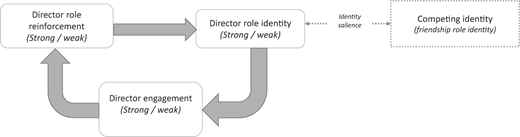
Role reinforcement and relative identity salience shape director role identity and engagement in the boardroom. Source(s): Figure created by author
Role reinforcement and relative identity salience shape director role identity and engagement in the boardroom. Source(s): Figure created by author
Overall, these findings highlight that formal governance structures alone are insufficient to ensure accountability. Instead, accountability is enacted through the interplay of relational dynamics, identity-based motivations and behavioural norms within the boardroom. In the case of Crown, strong relational ties with the major shareholder fostered a salient friendship identity, redirecting directors' motivations toward loyalty and harmony over fiduciary obligations, which in turn shaped boardroom behaviour through reduced questioning and deference to management. Effective governance, therefore, depends not only on formal structures but also on the identities directors prioritise and the practices through which those identities are reinforced.
Contributions to the literature and research
This study makes several contributions to accountability and corporate governance literature by providing empirical insights into why accountability can fail even when formal governance structures are in place.
First, this study advances board accountability research by offering a psychological explanation for the gap between formal governance structures and enacted accountability. Drawing on identity theory and firsthand accounts of boardroom behaviour, the findings show how personal relationships can redirect directors' sense of accountability. In the case of Crown, directors’ perceived obligations appeared to shift away from shareholders as a whole and toward the majority shareholder, whose expectations shaped the board's norms and practices. The case illustrates how strong relationships can redirect directors' sense of accountability despite the presence of structural accountability mechanisms such as board meetings, committee structures and formal independence requirements. By illustrating this process of accountability redirection, the study responds to calls for research that moves beyond structural conceptions of accountability (Huse, 2005; Roberts et al., 2005) and provides insight into why formal governance structures alone are insufficient to ensure effective oversight (Brennan et al., 2016; Gendron et al., 2007; Nicholson et al., 2017).
Second, a related contribution is to extend prior empirical and theoretical work on director identity by introducing friendship as a distinct role identity within the boardroom. Prior research recognises that directors occupy multiple identities, including those stemming from being a CEO, shareholder, customer, supplier, functional expert or volunteer (e.g. Elms and Nicholson, 2020; Hillman et al., 2008; Golden-Biddle and Rao, 1997). While these studies have focused primarily on professional identities, less attention has been paid to how non-professional identities stemming from personal relationships influence director behaviour. The findings show how social ties in the boardroom can become problematic when a friendship identity becomes more salient than the identity associated with the director role. In doing so, the study contributes to an ongoing debate on whether personal ties enhance or undermine board effectiveness (i.e. Adams and Ferreira, 2007; Hoitash, 2011; Westphal, 1999) by demonstrating that the impact of social ties depends on the relative salience of friendship and director role identities.
Third, the findings extend role identity theory in corporate governance by identifying role reinforcement as a critical antecedent of director role salience and, in turn, accountability enactment. While prior research has shown that role adaptation can be challenging (Ibarra, 1999), this study demonstrates that the process is further complicated when board norms and relational dynamics are misaligned with formal role expectations. Much of the existing literature assumes that directors are adequately prepared for and motivated to perform their oversight responsibilities (Boivie et al., 2016). However, the findings from this study show that weak and misaligned board norms can diminish the salience of the director identity, reducing motivation to fulfil their monitoring role. In the absence of effective role-reinforcing practices, boards may become passive or deferential to management, limiting their capacity to provide meaningful oversight. By demonstrating how the presence or absence of role reinforcement shapes accountability enactment, the study advances understanding of how directors engage with their governance responsibilities in practice, positioning role reinforcement as critical for board accountability.
Fourth, the findings challenge the assumption that structural independence can reliably serve as a proxy for effective oversight. Studies grounded in agency theory typically assume that independent directors are sufficiently independent from managerial influence and motivated to provide effective oversight (Fama and Jensen, 1983). The findings from this study show that formal classifications of independence can fail to capture informal social ties and loyalties. As such, directors formally designated as independent may still face conflicts in practice when confronted with competing relational demands, demonstrating that independence can be undermined not only by economic dependence but also by social ties and loyalties. This helps explain why formal indicators of independence do not reliably predict board oversight effectiveness and why directors vary in their willingness to enact oversight responsibilities, even when formal independence criteria are met. In doing so, the study contributes to ongoing calls for board accountability research to move beyond narrow agency-based models and adopt more pluralistic theoretical frameworks that recognise the psychological and relational dimensions of director motivation (Hambrick et al., 2015; Westphal and Zajac, 2013; van Ees et al., 2009).
Finally, methodologically, the study demonstrates the value of public inquiry data for governance research. In this case, inquiry reports, extracted emails and witness interview transcripts provided rare insider accounts of director behaviour and boardroom processes that would otherwise be inaccessible. This enabled a deeper examination of how accountability is enacted in practice rather than inferred solely from structural proxies. As such, public inquiry data offer a valuable methodological resource for advancing research on board accountability.
Contribution to practice
This study raises important policy implications regarding how board independence is defined and assessed. Under the “comply or explain” approach adopted by many corporate governance regimes, including Australia, directors are largely responsible for self-classifying their own independence. The findings from this study highlight the limitations of this model, particularly when social ties and informal relationships, often not captured under the definition, can compromise directors' capacity for objective oversight. Regulatory bodies should consider providing more guidance on what constitutes independence and how social connections can impair it. For example, boards could be required to disclose the processes and criteria used for nominating and appointing new directors, enhancing transparency and impartiality. More broadly, this insight contributes to ongoing debates about the limits of board self-regulation that underpin corporate governance frameworks in many countries (Elms and Grosvold, 2024; Mensi-Klarbach et al., 2021).
Identity theory suggests that identities are invoked by situational cues that work to prioritise one identity over another (Stryker, 1980; Ashforth, 2001). For boards, commencing meetings with a conflict-of-interest declaration or a clear statement of the meeting’s objectives is a practical way for Board Chairs to facilitate a rise in the salience of directors' role identity vis-à-vis competing identities. Similarly, this study highlights the importance of role reinforcement through director training, board inductions and the role modelling of good governance practice to reinforce the expected behaviours of the director role. The inquiries reinforce these suggestions, showing that accountability failures at Crown stemmed not only from weak structures but also from a deficient governance culture. As was observed in the NSW Inquiry report, “culture is what people do when no one is watching” (p. 555), highlighting again that formal rules are insufficient unless supported by informal norms and behaviours.
Conclusion
This study set out to examine how relationship dynamics and boardroom norms shape directors' interpretation and enactment of accountability within corporate boards. Drawing on a high-profile case of governance failure, the findings show that directors' oversight behaviour cannot be fully understood through structural governance mechanisms alone. Instead, accountability is shaped by how relational dynamics influence the salience of directors' role identities and the behaviours they enact in the boardroom. By demonstrating how relational identities can shape directors' engagement with their fiduciary duties, the study provides insight into why formally independent boards may still experience accountability failures. The findings highlight the importance of considering the psychological and relational dynamics that shape director behaviour alongside structural governance arrangements. More broadly, the study suggests that effective board accountability depends not only on formal governance structures but also on the identities directors prioritise and the boardroom practices that reinforce those identities.
The study draws on a unique and rich data set derived from public inquiry documents, providing detailed insight into boardroom dynamics that are rarely accessible to researchers. However, several related limitations should be noted along with opportunities for future research. First, the findings reflect a specific organisation and industry context and may not be directly transferable to other settings. Nevertheless, the study contributes to analytical generalisation (Parker and Northcott, 2016; Yin, 2013), offering deep insights into how director disengagement can manifest in contexts characterised by weak role reinforcement. These insights may be relevant to other boards that share similar norms and practices, particularly where relational cohesion is strong. Second, the study focuses on directors' oversight role, but directors also contribute through resource provision and strategic advice (Hillman and Dalziel, 2003), which are not addressed in this study. Future research could extend this analysis by examining how conflicts of interest and identity tensions affect directors' performance across these broader functions, including whether friendship influences the monitoring and advisory roles in distinct ways.
A finding of this study is that friendship in the boardroom can interfere with directors' fiduciary duties, a finding that is at odds with prior literature (e.g. Adams and Ferreira, 2007). Future research would benefit from further examination of how friendship in the boardroom is managed and prioritised relative to directors' fiduciary duties. For example, interview-based studies could explore the circumstances under which friendship benefits board functioning and what structural triggers and boardroom cues increase the salience of friendship relative to directors' professional role identity. Comparative case designs could also be used to assess how different board cultures, leadership structures, and norms reinforce or constrain relational identities and the outcome for board accountability.
Future research could also assess the effectiveness of interventions such as inductions, training, board evaluations and conflict-of-interest declarations in strengthening director engagement. Finally, a longitudinal study would be valuable in examining whether and how the reforms recommended by the Crown inquiries, such as strengthening independence, risk governance frameworks and board culture, translated into behavioural change over time.
I would like to acknowledge and thank Professor Parker and the anonymous reviewers for their constructive and insightful feedback, which has strengthened this paper immeasurably. I also acknowledge the participants at the 2024 ICGS conference especially Prof. Ruth Aguilera who provided valuable feedback on an early draft of this paper.
Notes
A Royal Commission is the highest form of public inquiry in Australia, established by the government to investigate matters of significant public importance, with broad powers to summon evidence and witnesses. While the Victorian and Western Australian investigations into Crown were Royal Commissions, the NSW Public Inquiry was conducted under the Casino Control Act 1992 (NSW) and was not a Royal Commission.
Nominee directors are appointed by a substantial shareholder or other stakeholder to represent the nominator's interests on the board. Under Australian law, nominee directors have the same legal and fiduciary duties as other directors.
In January 2020, Helen Coonan (HC) replaced John Alexander (JA) as Chair of the board. Ms Coonan was classified as a non-executive independent Chair.
Directors are identified in the inquiry extracts according to their formal classification in the 2019 Annual Report.
“Counsel assisting” refers to the senior barrister appointed to assist the Commissioner in conducting the inquiry, including questioning witnesses.
The “share sale” refers to a 2019 transaction in which JP's company, CPH, sold a 19.99% Crown stake to Melco Resorts, a Macau-based casino operator.
A risk appetite statement is an articulation of the level and type of risk an organisation is willing to accept. It is referred to in the ASX Corporate Governance Principles & Recommendations as part of the board's role in setting the organisation's risk appetite and overseeing its risk management framework.

