The recently emerging agile-blended learning (AB learning) is novel to researchers and practitioners alike, and previous research has not examined the characteristics that the AB learning approach has presented in metropolitan learners. The significance of the AB learning approach has been neglected.
This systematic review aims to explore the AB learning strategies for metropolitan learners by examining recent literature from 2020 to 2024 using the PRISMA searching process, coding and analysis. The review included 68 studies after screening articles obtained from the Web of Science and Scopus databases.
The results present the current focus of AB learning in literature as flexibility, learner autonomy, technology mediation and collaboration of the AB learning approach for metropolitan learners. The review also provides implications for the future directions of AB learning research.
This paper presents an evaluation of the AB learning approach, specifically designed for metropolitan learners and highlights its distinctive characteristics inherent to AB learning.
Introduction
Innovation has transformed instructional design in higher education. Scholars and practitioners lead the exploration of technology-assisted learning, resulting in numerous innovative approaches in the 21st century (Chan, 2023a, b; Chan et al., 2024; Tang, 2020). This exploration benefits classrooms through face-to-face, online and blended modalities. Agile-blended (AB) learning combines traditional instruction with digital tools, catering to diverse student needs (Li, 2023). It allows students to advance at personalised paces from any location, fostering a tailored learning experience (Chan, 2023a; Li, 2023; Tang and Chan, 2024). This model incorporates constructivist learning theories (Li and Wong, 2025a) to address the educational demands of adults with busy work schedules (Li, 2023). In our pursuit to offer a thorough examination of AB learning within higher education in metropolitan areas, we conducted a systematic literature review. This review delves into AB learning as a pedagogical strategy uniquely crafted to satisfy the educational requirements of learners in urban environments. While traditional blended learning systematically integrates face-to-face and online modalities, and agile learning emphasises iterative responsiveness (Li, 2023), AB learning distinctively combines both approaches with metropolitan-specific adaptations like transit-compatible micro-modules. Anchored in four core tenets – flexibility, collaboration, learner autonomy and technology mediation (Li, 2023) – this approach has emerged as an essential component of educational practice in the post-pandemic era, which has seen the swift adoption of blended learning. The review includes journal articles from 2020 to 2024 to ensure relevance, providing a contemporary lens on AB learning. The review is anchored by two guiding research questions:
What are the key features of the AB learning approach?
How do the features of AB learning facilitate effective learning experiences for metropolitan learners in conjunction with the associated challenges?
Methodology
Literature search process
We searched the Web of Science (WoS) and Scopus database. The search string, used for both databases and drawing from the understanding of blended learning and the study’s theme, was (agile OR blended) AND (teaching OR learning OR online OR virtual OR face-to-face) AND (technology OR flexibility OR collaboration OR autonomy OR adaptive OR personalised OR group work OR cooperative learning) AND (metropolitan OR university OR higher education OR urban).
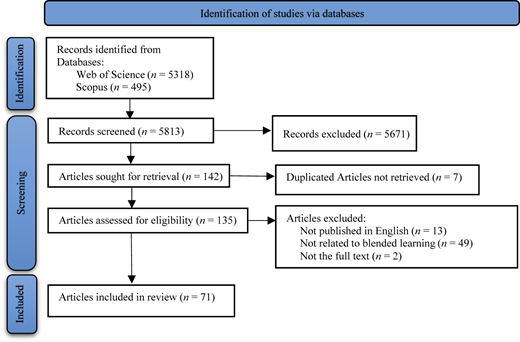
The range of years was designated as 2020–2024. To ensure relevance and mitigate the risk of encountering outdated online or technological factors, we deliberately focused this review on the most recent literature. A total of 5,813 results, comprising 5,318 results in WoS and 495 results in Scopus, were retrieved.
Rationale for keyword selection
Our keyword selection process followed a systematic two-stage approach to ensure both relevance and methodological neutrality. First, we conducted a preliminary scoping review, which revealed four dominant themes consistently characterising AB learning: (1) co-operative constructs (e.g. “group work”, “co-operative learning”) foundational to social-constructivist pedagogy, (2) learner autonomy for self-directed learning, (3) adaptive systems (e.g. “personalised”, “adaptive”) for tailored instruction and (4) group work dynamics in metropolitan contexts. These findings perfectly aligned with Li’s (2023) theoretical framework of AB learning.
To prevent selection bias, we took three precautions: counterbalancing specific terms with more abstract keywords, adhering to PRISMA guidelines and documenting all search steps. This two-fold approach – empirically guided by preliminary results but theoretically anchored – prevented our search from predetermining findings while still covering AB learning’s distinctive features.
Selection procedure
The results were further narrowed down to 5,813 based on the inclusion and exclusion criteria. The criteria for collecting target articles include (1) full-text articles on empirical studies published in English; (2) articles related to blended learning; (3) articles published in a peer-reviewed journal indexed in WoS or Scopus and (4) articles published from January 2020 to December 2024. Exclusion criteria include: (1) articles composed in languages other than English; (2) articles that do not focus on blended learning or for which the full text was not available; (3) conference proceedings or book reviews and (4) articles published before January 2020 or after December 2024. After applying the inclusion criteria, the initial pool of 5,813 articles was reduced to 135. Subsequently, exclusion criteria were applied to refine the selection, leading to the inclusion of 71 articles review. Figure 1 presents an overview of the research selection procedure based on the recommendation statement of the Preferred Reporting Items for Systematic Reviews and Meta-Analysis (PRIMSA; Moher et al., 2009).
Analysis
Two researchers independently reviewed the selected articles to ensure a thorough evaluation. They discussed any disagreements to reach a consensus, and if necessary, a third researcher acted as an adjudicator for final decisions. The results were further scrutinised to confirm that each feature was distinct and unambiguous, with an inductive code constructed from the categorical themes of the results. Certain studies encompassed various features, and those that belonged to multiple inductive categories were classified under each applicable category.
Results and discussion
RQ1: What are the key features of the AB learning approach?
The results were categorised into four categories: flexibility, collaboration, learner autonomy and technology mediation.
Flexibility. Agile learning prioritises rapid adjustments to learner needs, focusing on iterative pacing without the blended learning component (Kadenic and Tambo, 2023), limiting its ability to provide comprehensive resource access.
Traditional blended learning, on the other hand, focuses on structured flexibility, offering choices in content, methods, timing and location through pre-designed online systems. It facilitates students in customising their educational experiences to fit individual needs, interests and skills. The flipped classroom model provides flexibility to meet students’ specific needs and encourages engagement with asynchronous materials and participation in tailored workshops (Bobbink et al., 2022; Fleischmann, 2021). However, it lacks the real-time adaptability of AB learning.
The flexibility of AB learning combines the strengths of both approaches, emphasising the dynamic integration of online and face-to-face modalities. It enhances convenience by allowing students to determine when and where they learn, surpassing traditional classrooms (Li, 2014; Wong, 2024). Additionally, it provides access to extensive online resources, such as archived lectures, recorded classes and webinars, while incorporating agile adjustments to meet learners’ evolving needs (Bobbink et al., 2022).
Collaboration. Agile learning enhances collaboration by fostering a dynamic and flexible learning environment that encourages spontaneous and iterative group work, facilitating the sharing of diverse perspectives and the development of innovative solutions through collaborative problem-solving. Students find this approach meaningful, with the learning attained being transferable to other contexts, thus enabling effective collaboration and enhancing knowledge acquisition and problem-solving as a result of its iterative and adaptive nature (Noguera et al., 2018).
Conventional blended learning focuses on structured collaboration in the form of face-to-face group discussions and online forums. These face-to-face group interactions offer significant benefits for deep student engagement and meaningful teacher interaction, providing immediate, constructive feedback that in turn boosts motivation and enhances academic work quality (Din Eak and Annamalai, 2024; Zhu et al., 2021). Although useful for providing academic interactions within defined boundaries, this model is frequently devoid of adaptive responsiveness for distributed urban learners.
AB learning supports collaboration through a Community of Inquiry (CoI) framework, where learners with social and emotional outlooks are viewed as “real people”. This approach is unique in maintaining connections in online discussions through the combined use of asynchronous and synchronous interactions (Armellini et al., 2021; Frolova et al., 2023). AB learning develops dynamic learning environment that combine the immediacy of real-time engagement with delayed interactions, extending beyond static pre-recorded content (Wong, 2024). The method enriches education by connecting sociocultural and educational settings while embracing task-based approaches (Pramila-Savukoski et al., 2023) that enhance practical capability through collaborative workshops. Localised peer networks and group work support the maintenance of important socioemotional connections; thus, AB learning has become highly suitable for metropolitan contexts.
Learner autonomy. Agile learning places a strong emphasis on self-direction and rapid iteration, where the focus remains on learner-driven pacing and ongoing adaptation (Noguera et al., 2018). Though this supports responsiveness to immediate learning requirements, the method often neglects the provision of sufficient scaffolding to avoid learner overwhelm, especially for students needing more structured support in developing autonomous learning competencies.
Conventional blended learning offers baseline support for autonomy by providing access to varied online resources (Adinda and Mohib, 2020). It enables learners to revise archived lectures and recorded sessions at their convenience, providing some flexibility that facilitates self-directed learning (Monk et al., 2020). Its static nature, however, tends to constrain personalised feedback mechanisms and adaptive learning pathways, while its dependence on conventional teaching approaches tends to overshadow the possibility for learners to take initiative and explore knowledge on their own, thereby constraining the cultivation of learner autonomy.
AB learning combines the advantages of both approaches, with a dramatic increase in learner autonomy. By integrating motivation-boosting elements like online discussions and peer reviews, AB learning creates an environment where self-directed learning thrives (Wong, 2024). It transforms distance education into a valuable resource for independent study, empowering students to select the lectures and materials that most effectively meet their needs while fostering self-education and self-organisation skills (Lai et al., 2024). This blending of approaches guarantees that students are provided with support and resources needed to build their autonomous learning competencies, thus promoting a proactive and self-directed learning experience (Orlaniuk-Malitskaia et al., 2023).
Technology mediation. Agile learning focuses on lightweight, specialised tools such as Kanban boards that have been expertly designed for task management and rapid iteration. Such tools provide remarkable flexibility and are ideal for quick changes and iterative workflows. However, this strategy leads to fragmented learning experiences.
Traditional blended learning, on the other hand, enhances educational experiences and supports personalised learning and data-driven instruction by incorporating a variety of technology tools (Shea et al., 2013). This strategy effectively brings together several tools from across categories, such as Microsoft 365 and Google Suite, to create a rich and flexible learning environment. The fact that it is static in nature, however, means that it cannot respond dynamically to the needs of individual learners or the high-speed demands of urban education, in many cases lacking the agility required for genuinely adaptive learning experiences.
AB learning represents an evolution in education technology by combining the best aspects of both approaches with the incorporation of new solutions for metropolitan learners (Wong, 2024). Building upon blended learning’s foundation of technology-mediated experiences, AB learning employs computer-mediated communication to create a collaborative and adaptive learning space. While maintaining the context-dependent flexibility seen in traditional models, the approach adds real-time responsiveness and sophisticated data-driven personalisation (Brohus et al., 2022). Specifically, AB learning addresses metropolitan challenges by offering solutions that mitigate digital divides while supporting learners’ mobility (Wong et al., 2025).
RQ2: How do the features of AB learning facilitate effective learning experiences for metropolitan learners in conjunction with the associated challenges?
Flexibility. AB learning enhances students’ experiences by accommodating diverse needs and preferences, ensuring inclusivity and accessibility beyond educational barriers (Cronje, 2022; Li et al., 2022; Papachristopoulos, 2024; Saikia et al., 2024). Initiatives like “Lab in a Bag”, a type of blended learning, transform education from the setting found in traditional classrooms, allowing students to interact with materials whenever they choose and at their own speed using online resources (Baker et al., 2020; Brohus et al., 2022; Jeffery et al., 2020; Kelly et al., 2021). Some platforms, such as Thinglink, provide universal access to essential learning tools, irrespective of a student’s location or background. This approach mixes pre-recorded and live content, making learning easier for everyone, no matter their pace or style (Asaad Hamza Sheerah, 2020; Stahl, 2021; Swaminathan et al., 2022; Tang and Zhang, 2024).
AB learning creates an active environment where students lead knowledge construction and revisit content for deeper understanding. It fosters community, boosting confidence and engagement with lower deferral rates (Buck and Tyrrell, 2022). In professional education, AB learning’s adaptability equips students with essential competencies through activities connecting classroom learning to real-world application (Cao et al., 2023). The flipped classroom model enhances engagement and performance (Bobbink et al., 2022) and is praised for interactivity, evidence-based learning and expert-led workshops (Fleischmann, 2021). Ultimately, blended learning’s flexibility is crucial in modern education, offering tailored experiences that enhance engagement, comprehension and academic success (Delgado-Cepeda, 2021; Reyes et al., 2022; Wong and Chan, 2025).
AB learning not only offers flexibility in time, location and access to study materials but also presents challenges. First, unstable high-speed Internet connections can create barriers, especially for students facing the digital divide due to limited access and financial constraints (Wong et al., 2025). Second, low digital proficiency and insufficient instructor feedback can reduce the effectiveness of blended learning. This issue is intensified in fields like physical education, which may struggle with online instruction. Third, AB learning’s perceived transactional distance often surpasses that in traditional classrooms due to fewer face-to-face interactions (Boelens et al., 2017). As a result, students require greater self-discipline to combat feelings of isolation and online communication’s less-spontaneous nature, risks that can foster procrastination.
Collaboration. Collaboration enhances learning in blended and online environments through interactive design. It enables learners to track their progress, receive feedback and engage with the material, fostering autonomy (Alkhannani, 2023; Peramunugamage et al., 2024). Online platforms expand the classroom, facilitating dynamic interactions between students and teachers without physical limits (Brown et al., 2023). Discussion boards and chat rooms improve participation and support diverse communication styles for all students (McKenzie et al., 2022). Tools like Google Documents enhance interactive assignments, boosting creativity in language lessons (Turchyn et al., 2023). Technical support reduces cognitive load, while prompt responses from classmates and teachers enhance the quality of work (Nathaniel and Black, 2021; Zhu et al., 2021). Collaborative learning fosters analytical thinking, problem-solving, teamwork, communication and technological skills (Pramila-Savukoski et al., 2023; Rattanasak, 2023).
Additionally, effective communication from tutors is highly valued, with clear and diverse explanations being essential for student understanding (Armellini et al., 2021). Sustained interactive dialogue and topical discussions are pivotal in increasing satisfaction with the learning process, fostering a collaborative environment where experiences, feedback and support are freely exchanged (Frolova et al., 2023; Ustun and Tracey, 2021; Uçar et al., 2024). Moreover, the flipped classroom model, which integrates teacher-led discussions with self-study, benefits from collaborative strategies. Despite valuing face-to-face interaction, many students favour a blended learning approach, particularly in specialised fields like pharmacology. Collaboration personalises the learning process to meet individual needs, showing effectiveness in blended learning environments that integrate online and offline interactions (Meulenbroeks, 2020). On the other hand, it faces challenges in promoting engaging student interactions. The physical distance of online learning often reduces engagement and peer collaboration (Nikolopoulou and Zacharis, 2023). Individual preferences further complicate this; introverted students may find group work less appealing. For example, cultural and geographical diversity impacts Taiwanese students’ comfort in participating, as highlighted by Hsu and Hsieh (2014). This discomfort extends online, where students might hesitate to share knowledge. Technological discomfort is an additional major barrier in blended learning (Bower, 2015; Szeto and Cheng, 2016). Students may struggle with video and audio tools, causing anxiety that hampers participation. To address these challenges, educators can form smaller, diverse groups to enhance participation. Technological training can reduce anxiety and build confidence and asynchronous discussions let students share insights without the pressure of live interaction.
Learner autonomy. Autonomy is essential in AB learning environments, fostering self-directed learning skills for professional growth. Blended learning enhances student engagement, motivation and self-regulated learning by integrating online resources and technology (Govindan et al., 2023). Online peer reviews and forums support this self-directed learning (Suwardika et al., 2024). Educators are equipped with versatile tools, while students have access to diverse learning options tailored to their needs (Adinda and Mohib, 2020).
The autonomy of the student-centred design in AB learning incorporates smart tools that allow students to engage at their own learning pace, enhancing their competencies and fostering critical, divergent and creative thinking (Chen, 2022). Its effectiveness is evident across disciplines, including applied sciences, where it has led to improved academic results. Its benefits also extend to flexible learning opportunities, robust self-regulated learning and teamwork, which are crucial for elevating the effectiveness of vocational education and its alignment with market needs for skilled professionals (Monk et al., 2020; Yangari and Inga, 2021). Additionally, AB learning’s core is self-assessment, which promotes efficient study methods and nurtures independent learning (Sudirta et al., 2022). This autonomy in exploration and information discovery stimulates students’ creative thinking. Evidence shows that a well-designed blended learning model invigorates students’ motivation, fosters the growth of independent learning skills and refines self-directed learning behaviours (Nikolopoulou and Zacharis, 2023; Zavyalova, 2020).
While blended learning enhances benefits for self-motivated students, it presents hurdles for those lacking self-regulation (Frolova et al., 2023). These students are vulnerable to technology distractions and personal interruptions and a lack of intrinsic motivation and feelings of isolation can hinder their studies. Such challenges can impact essential learning processes, including reading and preparing for in-person classes. To address these issues, educators can establish structured schedules and clear guidelines to improve self-regulation skills. Regular check-ins and support resources can boost motivation and lessen isolation.
Technology mediation. Technology mediation in AB learning significantly enhances learning experiences by complementing traditional in-person teaching methods. In distance education, it requires systematic integration of digital tools to enhance learning flexibility and accessibility (Li and Wong, 2025b). While digital tools cannot fully replicate face-to-face instruction’s social dynamics, their integration into educational practices offers substantial benefits for both theoretical and experimental learning (Dankers et al., 2022). The capacity of digital tools to log and store information is highly valuable. This functionality not only assists in the immediate facilitation of student learning but also promotes the long-term development of curricula by enabling reuse, evaluation and revision (Brohus et al., 2022). Educators have effectively employed diverse technological tools to support the learning process. Furthermore, technology-mediated blended learning fosters personalised learning, often arising as a natural outcome of remote teaching facilitated by digital technologies (Kayi, 2024). This methodology cultivates self-directed learning and exemplary course delivery, both of which are critical elements of a robust educational experience. Moreover, the significance of information and communication technology tools in boosting engagement is consistently emphasised in the literature. These systems’ quality significantly influences users’ perceptions of their usability and utility, shaping attitudes, norms and behaviour. These perceptions ultimately affect the intention to explore and embrace blended learning methodologies (Ohanu et al., 2023). AB learning, with its technology mediation, presents a shift in education but faces challenges limiting its effectiveness (Kumar et al., 2024). First, low-quality blended learning tools deter learners. Poor graphics and sound can alienate the students from digital resources (Fresen, 2018). This highlights the need for reliable technology, like stable cameras and microphones, to support learning. Additionally, many teachers lack the skills to integrate new digital tools effectively, reducing instructional quality. Moreover, students often perceive technology as an obstacle, turning to unreliable sources for help (Broadbent, 2017; Kodama et al., 2024). Their limited digital literacy (Brown, 2016) and time management issues can also lead to disengagement (Zacharis, 2015). The fast-changing technology landscape poses difficulties for adult learners (Chen et al., 2016; Lim et al., 2024), who must invest considerable time to learn how to navigate educational technologies (Prasad et al., 2018). Finally, unequal technology access and issues like unreliable Internet connectivity are serious concerns. Slow Internet speeds can further hinder online learning (Safford and Stinton, 2016).
Conclusion
This study presents a literature review on AB learning in metropolitan areas. Rapid technological advancements and complex human behaviour hinder the identification of all blended learning sub-features. The findings indicate that researchers focus on elements enhancing blended learning’s effectiveness for metropolitan learners. The review shows widespread adoption of AB learning across educational contexts. Despite varied terminology, the focus on combining different modes highlights flexibility, collaboration, learner autonomy and technology mediation as key principles. Effective assessment strategies must address both process and outcome measures in agile-blended learning contexts (Li et al., 2025). Educational institutions must establish sustainable foundations through comprehensive readiness assessment strategies to foster innovation and student engagement (Wong and Li, 2025).
This review has several limitations. First, WoS and Scopus were the only two search engines used in this study. Future studies can include more search engines to provide a more comprehensive review. Second, this study included journal articles solely in English. Future research can include articles in other languages to conduct a more culturally inclusive review. Third, related articles published before 2020 were not included in this study. Future research should include articles before 2020 and compare the difference between pre-pandemic and post-pandemic AB learning.
Overall, this review’s findings emphasise the importance of incorporating AB learning principles in educational practices. By embracing these four features, educators can create engaging and effective learning environments that cater to students’ diverse preferences.