This article develops an evidence-informed conceptual model for secure open and distance education (ODE) in Vietnamese prisons. It treats prison digital learning as constrained-access ODE for incarcerated learners and people preparing for release and examines its potential contribution to upskilling, reskilling and reintegration under custodial constraints.
The article uses secondary evidence synthesis, combining legal-policy mapping, digital-skills contextual analysis and thematic interpretation of published reintegration materials. It does not estimate programme effects or validate an intervention; instead, it derives model components and design principles for secure custodial ODE.
The synthesis identifies a capability misalignment between current prison education and the digital capabilities increasingly required for post-release work, services and continued learning. It proposes three need domains – foundational digital skills, transferable vocational skills and transition-oriented support – which inform a four-component model: secure digital access, tiered skills curriculum, guided learning support and post-release bridging.
Because the article relies on secondary evidence, the model is conceptual rather than field-validated. It offers a policy-oriented basis for cautious pilot design, future field research and secure digital learning pathways for custodial learners.
The article extends ODE scholarship to a custodial setting where access is legally, institutionally, technologically and security-mediated. It reframes prison digital learning as a secure ODE design problem rather than a technology-adoption issue.
1. Introduction
Digital transformation is reshaping learning, work and access to public services. In correctional institutions, education therefore has a reintegration function: it helps prisoners prepare for lawful lives after release. In Vietnam, the national digital transformation agenda stresses wider access to knowledge and digital services, while the Law on Criminal Judgment Execution (National Assembly of Vietnam, 2019) recognises prisoners’ rights to general education and vocational training. Together, these policy directions frame prison education as capability development, not only institutional management.
International scholarship supports this view. Maruna (2001) links desistance to self-reconstruction, positive identity formation and meaningful learning opportunities rather than control or punishment alone. In technology-dependent societies, prison education must therefore move beyond literacy and traditional vocational preparation to include digital skills, adaptive capacity and access to digitised social resources (UNDP and UNESCO, 2022).
Reintegration now requires digital participation alongside employment or trade skills. Formerly incarcerated people may need to search for information, access public services, prepare job applications, pursue continuing education and connect with support networks through digital channels (ADB, 2021; ADB and LinkedIn, 2022; UNDP and UNESCO, 2022). In Vietnam, prison education still focuses mainly on legal education, literacy, career guidance, vocational training and reintegration classes, with little systematic digital learning. Evidence on digital readiness indicates wider upskilling pressure that may affect people leaving prison as they re-enter digitalised labour markets and service systems (PwC Vietnam, 2021).
Research has examined prisoner education, prison vocational training and educational digital transformation, but little work analyses digital learning in Vietnamese prisons as support for upskilling, reskilling and reintegration. Vietnamese literature remains largely descriptive or centred on conventional provision, leaving the relationship between digital skills, learning access and reintegration under-analysed.
Against this background, the article positions prison digital learning as a secure, constrained-access form of open and distance education (ODE) for a highly excluded learner group. Prisoners are distant from education not mainly geographically but because their access is legally, institutionally, technologically and security-mediated. The central question is not whether digital technology should enter prisons, but how learning access can be widened safely, how learners can be supported under custody and how prison-based learning can connect to post-release reintegration.
The article is therefore an evidence-informed conceptual model paper, not a field-based evaluation of an existing programme. It uses secondary legal, policy, contextual and scholarly evidence to derive a secure ODE model for custodial settings. Its contribution is not to measure prisoners' digital skills or test programme effects but to specify the educational, institutional and security conditions under which digital learning could plausibly support reintegration-oriented ODE. The article addresses three research questions.
How is current prison education in Vietnam positioned in relation to digital capability development and constrained-access ODE?
What learning needs and implementation barriers can be derived from available secondary evidence?
What components should inform an evidence-informed model for secure, reintegration-oriented ODE in Vietnamese prisons?
2. Conceptual foundations for secure ODE in custodial settings: desistance, digital capability and reintegration
This section develops the foundations for a secure ODE model in Vietnamese prisons by connecting three ideas: prison education as reintegration support, digital capability as a condition of participation in a digitalised society, and ODE as an access framework for structurally excluded learners whose opportunities are legally, institutionally and security-mediated.
2.1 Prison education and social reintegration
Prison education is a core component of rehabilitation and reintegration. In custody, education does more than transmit knowledge or vocational skills; it can support self-reflection, future orientation, adaptive capacity and preparation for lawful participation after release. Desistance theory is relevant because Maruna (2001) links movement away from crime to positive identity formation, self-reconstruction and opportunities to build a different life narrative. Prison education has value when it helps incarcerated learners develop capabilities they can carry into life after imprisonment.
International research also links prison education to employment, continued learning and social participation after release. Its reintegration value depends not only on course availability but on whether content reflects the social and labour market conditions people face after release. As work, public services and civic participation become more digitalised, prison education cannot remain limited to literacy, legal education or traditional vocational preparation. It must also address the digital conditions of reintegration.
In Vietnam, the Law on Criminal Judgment Execution (National Assembly of Vietnam, 2019) establishes the legal basis for prisoners’ education and job training, including legal knowledge, civic education, literacy and vocational skills. Decree No. 49/2020/ND-CP (Government of Vietnam, 2020) addresses community reintegration, while Resolution No. 54/2022/QH15 (National Assembly of Vietnam, 2022) and Decree No. 09/2023/ND-CP (Government of Vietnam, 2023) concern labour, career guidance and vocational training outside prison facilities. These documents place prison education and vocational preparation within a broader reintegration pathway. Yet available policy and practice-based materials suggest that provision still centres on legal education, literacy, career guidance, vocational training and reintegration classes, with limited evidence of systematic digital learning for post-release capability development.
The implication is not that prison education is absent in Vietnam, but that its current orientation may be insufficiently aligned with digital reintegration demands. This is the starting point for considering digital learning as part of reintegration-oriented education.
2.2 Digital learning in custodial settings as secure ODE
Digital learning in custodial settings is not simply the introduction of computers, tablets, online platforms or digitised materials into prisons. It is shaped by educational access, institutional routines, security requirements, learner support and post-release continuity. This makes it a form of secure ODE rather than a conventional technology-adoption issue.
ODE is relevant because it has historically addressed how to reach learners separated from conventional provision by geography, work, social disadvantage or institutional barriers. Prisoners are an extreme case of this access problem. Their distance from education is legal, institutional, technological and security-mediated: they cannot freely access institutions, open Internet resources, digital platforms or community-based support. Any prison ODE model must therefore be built around controlled access, curated content, supervised learning and institutional accountability.
International scholarship on prison digital learning identifies three common functions. First, it can widen access to learning materials and structured courses where space, time and staffing are constrained. Second, it can develop basic digital skills for post-release participation. Third, it can strengthen continuity between prison-based learning and community education, employment or reintegration services. Ithaka S+R (2023), for example, shows that technology in prison higher education can improve access to materials, course participation and foundational digital skills. UNICRI (2024) likewise frames digital rehabilitation as support for learning, upskilling and reintegration rather than prison management alone.
However, prison digital learning cannot replicate ordinary online education. Security is not an external constraint added after educational design; it is a threshold condition of design. Prison systems require adapted infrastructure, approved devices, curated content, restricted connectivity, monitoring protocols, data protection and clear lines of responsibility. Educational value depends not on how much technology is introduced, but on whether it forms a safe, guided and reintegration-oriented learning environment.
The ODE scholarship also shows why learner support is central. Access alone is insufficient; learners need academic, administrative, motivational and sometimes affective support to persist and succeed. This is especially important in custody, where learners may have uneven educational backgrounds, low digital confidence, disrupted learning histories, psychological vulnerability or limited trust in formal institutions. A secure prison ODE, therefore, requires both access design and support design. Without guidance, digital learning risks becoming passive content delivery. Without security design, it may be rejected as unsafe.
The Asian Association of Open Universities Journal (AAOUJ) scholarship reinforces this argument. Srivastava et al. (2020) identify access, learner support, information and communications technology integration, inclusive education and disadvantaged learner groups as recurring ODE concerns, while Singh (2013) provides a custodial precedent through IGNOU's intervention in Tihar Central Jail. Paliwal (2019) and Bordoloi (2018) show how online distance learning can widen access for learners excluded by geography and social conditions. Zuhairi et al. (2020), Wani et al. (2023) and Ahmed et al. (2025) further highlight the importance of learner support, institutional assistance and digital literacy for participation and motivation. This interpretation is also consistent with UNESCO's (2015) view of education as a common good for groups excluded from ordinary opportunities.
Accordingly, this article conceptualises prison digital learning as secure ODE: technology-mediated learning that widens access under controlled conditions, organises learner support, develops digital capability through structured progression and connects learning to reintegration after release.
2.3 Digital capability, upskilling and reskilling after release
Digital skills are increasingly important for accessing employment, public services, information, continuing education and social support networks. For people preparing for release from prison, digital exclusion can become a reintegration barrier. A person may gain legal knowledge or a traditional vocational skill in prison, yet still struggle after release if they cannot search for jobs, prepare applications, access online services, use digital payments, communicate with support organisations or continue learning.
In this article, digital capability means more than operating devices. It is the ability to use digital tools safely, access and evaluate information, complete employment-related tasks, engage in continuing learning and navigate digitalised public and social services. Digital learning is therefore both a delivery arrangement and a capability-building process. In custody, learners need not only access to materials but also structured support to acquire capabilities they can use after release.
Digital capability has five interrelated dimensions: basic operational capability; information-search and evaluation capability; safety and responsibility online; employability-related digital capability; and learning-to-learn capability for continued education after release. These dimensions matter because reintegration requires not only access to devices but also the ability to use digital systems for work, services, learning and support.
These dimensions connect directly to upskilling and reskilling. Upskilling strengthens existing capabilities so learners can participate more effectively in changing work and social environments. Reskilling develops new capabilities for different forms of work, learning or social participation. In prison education, both should be understood not narrowly as labour market training but as reintegration capabilities that help people navigate life after release.
PwC Vietnam's Digital Readiness Report (2021) and UNDP and UNESCO (2022) cannot directly measure prisoners' digital skills. They do, however, provide contextual evidence that digital adaptability, safe digital participation and technology-related learning are increasingly important for vulnerable groups and the wider labour market. This matters because people leaving prison may already face stigma, disrupted education, weak employment networks and limited access to continuing learning. Restricted digital learning during imprisonment may intensify these disadvantages.
Digital capability should therefore be treated as reintegration capital: it shapes whether prison-based education can transfer into post-release opportunities. Foundational digital skills enable basic participation in digital society. Transferable vocational skills connect prison education to changing labour markets. Transition-oriented support helps learners convert training into action after release. These three dimensions later inform the model's curriculum and support components.
2.4 Research gaps in the Vietnamese context
Three gaps can be identified in Vietnam. First, an empirical gap: legal, policy and practice-based materials discuss prison education, vocational training and reintegration but provide limited direct evidence on prisoners' digital capabilities, digital-learning readiness or experiences of technology-mediated education. Second, a conceptual gap: discussions of prison technology often alternate between technological optimism and security reductionism, without explaining how digital learning can be organised as secure, guided and reintegration-oriented ODE. Third, a model gap: existing discussions do not specify how secure access, curriculum progression, learner support and post-release continuity should connect in Vietnamese custody. This article addresses these gaps by developing an evidence-informed conceptual model from secondary legal, policy, contextual and scholarly evidence.
2.5 Analytical framework of the article
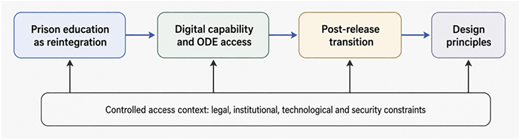
Based on the preceding discussion, this article adopts an analytical framework linking four conceptual foundations to four model components. This framework guides the evidence synthesis and model derivation presented later.
The first foundation is constrained educational access. In ODE, access is central, but in prisons it is shaped by law, institutional control, security requirements, technology restrictions and limited contact with external providers. This foundation leads to the first model component: a secure digital access environment, where access to devices, content and platforms is controlled yet educationally meaningful.
The second foundation is digital capability as reintegration capital. Digital capability includes information access, safe digital participation, employment-related digital tasks, continuing learning and navigation of digitalised public and social services. It leads to the second component: a tiered skills-based curriculum that progresses from foundational digital participation to employment-related and transferable skills.
The third foundation is learner support in ODE. Distance and technology-mediated learning work only when learners receive academic, motivational and administrative support. In prisons, support is even more important because learners may have disrupted educational histories, low confidence, limited self-directed learning experience and restricted access to external help. This foundation leads to guided learning support delivered by teachers, prison education staff, facilitators or external education partners.
The fourth foundation is post-release transition. Prison education becomes reintegrative only when learning can transfer into life outside custody. Digital skills and vocational preparation have limited value if they are not linked to further education, job seeking, public service access or community support. This foundation leads to a post-release bridging mechanism, such as learning records, referral pathways, module recognition, links to open universities or vocational providers and coordination with reintegration services.
Together, these foundations show why the proposed model is not based on a technical assumption that prisons should adopt digital platforms. Constrained access requires a secure digital environment; digital capability requires a tiered curriculum; learner support requires guided assistance; and post-release transition requires a bridging mechanism between custody and community. The model is therefore a secure ODE framework for reintegration-oriented learning, not a field-validated intervention or general technology-adoption blueprint.
Figure 1 shows that secure ODE in custody requires more than digital access. Access must be secure; curriculum must build reintegration-relevant capability; learning must be guided; and prison-based education must connect to post-release pathways. The figure also clarifies that the model is generated from conceptual and contextual synthesis rather than a purely technical design assumption.
3. Research methodology
3.1 Research design
This article is designed as an evidence-informed conceptual model paper. It uses secondary evidence synthesis with mixed-source analysis to develop a secure ODE model for digital learning in Vietnamese prisons. This design is appropriate for a custodial context where primary fieldwork is constrained by legal, ethical and security considerations. The article does not estimate prisoners' digital skills, evaluate an existing programme or make causal claims. It synthesises legal-policy documents, secondary quantitative indicators, contextual qualitative materials and ODE scholarship to derive plausible learning needs, implementation barriers and design principles for secure custodial ODE.
3.2 Evidence base and source types
The article draws on four types of secondary evidence: legal and policy documents; digital skills and readiness reports; Vietnamese practice-based and contextual materials on prison education and reintegration; and international ODE, prison education and custodial digital-learning scholarship. Together, these sources provide legal, contextual, empirical and conceptual support for an evidence-informed model of secure ODE in Vietnamese prisons. Their analytical roles are summarised in Table 1.
Together, these sources establish the institutional framework, clarify the digital capability context, illuminate current provision and reintegration difficulties and support the interpretation of prison digital learning as secure ODE.
3.3 Evidence collection and selection procedures
Evidence collection used a targeted review rather than a systematic review or primary field study. Materials were selected if they met at least one of four criteria: relevance to prison education, vocational training or reintegration; discussion of digital skills, digital learning or technology access; relevance to Vietnam's correctional, educational or labour market context or comparative value for ODE, custodial education or digital rehabilitation.
Two cautions guided selection. First, broad digital-skills evidence was not treated as a proxy for prisoners' digital capability. Second, international prison digital-learning models were not transferred uncritically to Vietnam. International sources were used for conceptual and comparative insight, while Vietnamese legal, policy and practice-based sources provided contextual grounding.
3.4 Analytical procedures for model derivation
The evidence was analysed through four linked procedures. Legal-policy mapping examined how Vietnamese documents frame prisoners' education, vocational training and reintegration support. Contextual digital capability synthesis interpreted digital readiness and inclusion reports as evidence of the wider environment into which people leaving prison must return. Thematic interpretation of contextual materials organised recurring issues such as employment adaptation, stigma, self-confidence, learning continuity and service access. Model derivation then mapped need domains and barrier mechanisms against possible design responses.
The aim was not to produce statistically representative findings or validate an intervention, but to derive plausible need domains, barrier mechanisms and model components. Table 2 makes this evidentiary logic explicit by summarising how the main analytical claims were derived from the secondary evidence base.
3.5 Trustworthiness and analytical rigour
Trustworthiness was strengthened through source triangulation, analytical transparency and inferential caution. Legal and policy documents established the institutional basis for prison education and reintegration support; digital-skills reports clarified the broader capability context; Vietnamese practice-based materials offered illustrative insight into current provision and reintegration difficulties and ODE and/or custodial learning scholarship supported conceptual interpretation.
Analytical transparency was maintained by showing the movement from evidence synthesis to model derivation. The analysis first identifies a capability mismatch between current prison education and digital reintegration conditions, then derives plausible need domains and barrier mechanisms and finally translates these into four model components. Secondary quantitative reports and journalistic materials are used as contextual evidence, not as direct measures of prisoners' digital capability or field-validated findings.
3.6 Research ethics
This article did not involve surveys, interviews, prison observation or intervention with incarcerated or formerly incarcerated individuals. It used publicly available legal documents, policy materials, reports, journal articles and contextual sources and collected no personally identifiable data.
Ethical caution remains necessary because the article discusses a vulnerable and institutionally constrained population. Prisoners and formerly incarcerated people are represented as potential learners rather than passive objects of correctional intervention. Interview-based journalistic and institutional materials are used for contextual interpretation only, not as primary qualitative data or evidence of saturation or representativeness.
Any future pilot should include safeguards for learner selection, data protection, approved educational content, proportionate monitoring and post-release learning pathways.
3.7 Limitations of the conceptual model development
The article has three main limitations. First, because it relies on secondary evidence, it cannot provide statistically representative conclusions about prisoners' digital skills, learning needs or educational experiences in Vietnam. Digital-skills reports describe broader readiness and inequality patterns, not prisoners' capabilities. Second, without fieldwork with prisoners, prison education staff, managers, vocational trainers or post-release organisations, the article cannot assess learner perceptions, staff readiness or operational feasibility in actual custody. Third, the model has not been tested through implementation or pilot evaluation, so it should be read as a theoretically and contextually grounded framework, not evidence of programme effectiveness. Future studies should test the model through prison-based needs assessments, stakeholder interviews, feasibility studies, small-scale pilots and evaluations of learner engagement, skills development, security governance and post-release continuity.
4. Evidence synthesis and model derivation
This section synthesises the evidence and explains model derivation. Given the secondary evidence design, its claims should be read as evidence-informed analytical inferences, not field-validated empirical findings. The section proceeds in five steps: it examines Vietnam's prison education policy-practice context, interprets digital capability as a reintegration issue, identifies plausible learning need domains, synthesises barrier mechanisms for secure custodial ODE and derives the four model components.
4.1 Policy-practice context: prison education and digital capability misalignment
The available legal, policy and practice-based sources do not suggest that prison education is absent in Vietnam. They point instead to a specific misalignment: existing provision is legally and vocationally oriented, while post-release life increasingly requires digital participation. Prison education supports legal awareness, basic literacy, vocational participation and preparation for lawful conduct, but available sources offer limited evidence of systematic digital learning for digitalised labour markets, public services and continuing education.
At the policy level, the Law on Criminal Judgment Execution (National Assembly of Vietnam, 2019) establishes a legal basis for prisoners’ education and job training. Decree No. 49/2020/ND-CP (Government of Vietnam, 2020) addresses community reintegration, while Resolution No. 54/2022/QH15 (National Assembly of Vietnam, 2022) and Decree No. 09/2023/ND-CP (Government of Vietnam, 2023) concern labour, career guidance and vocational training outside prison facilities. These instruments place prison education within a broader reintegration pathway. However, they do not yet specify a framework for secure digital learning, digital capability development or ODE-based continuity between custody and post-release life.
Practice-based materials suggest that provision commonly centres on legal and literacy education, career guidance, vocational training and pre-release reintegration classes. These activities remain important for legal awareness, basic learning and preparation for lawful conduct. However, they show limited integration of foundational digital participation, employment-related digital tasks or continuity with digitalised public services and further learning pathways. The central gap is not the absence of prison education, but the weak specification of digital capability as a reintegration condition.
This mismatch may reproduce a reintegration disadvantage. Learners may leave prison with legal knowledge and some vocational exposure, yet without the digital capabilities needed to search for work, access online public services, continue learning or communicate with support networks. Prison education then risks preparing them for only part of the social environment they must re-enter. The core inference is not simply that digital learning is absent but that current provision may underprepare learners for digital reintegration conditions.
4.2 Contextual evidence on digital capability and reintegration risk
The secondary quantitative evidence is contextual rather than population-representative for prisoners. PwC Vietnam's Digital Readiness Report (2021), based on 1,146 responses collected between 12 November and 27 December 2020, indicates strong upskilling pressure in Vietnam: 84% of respondents would learn new skills or completely retrain to improve future employability, 93% were already learning new skills to better understand or use technology and 43% identified learning and adapting to new technologies as the workplace skill they most wanted to develop. These indicators do not measure prisoners' digital skills. Their relevance is to show the digital expectations of the labour market and society into which people leaving prison return.
The inference is therefore cautious. The article does not claim that prisoners have the same digital profile as the PwC sample or other vulnerable groups. It argues only that when the wider labour market rewards digital adaptability, groups with restricted access to technology-based learning may face heightened reintegration risk. UNDP and UNESCO (2022) are used similarly: as contextual evidence that digital literacy, safety and participation are especially consequential for vulnerable and marginalised groups.
Digital capability mediates access to employment information, online applications, public services, continuing education and social support networks. A person may leave prison with legal awareness or a traditional vocational skill, yet still face exclusion if they cannot navigate digitalised systems of work, welfare and learning. Digital capability gaps should therefore be understood as reintegration-related capability gaps, not merely technical deficits. Claims in this section are analytically derived propositions about capability needs, not direct empirical findings about the Vietnamese prison population.
4.3 Analytically derived learning need domains
Because direct prison-based digital learning data are unavailable, the learning needs discussed here are analytically derived domains rather than directly measured learner needs. Contextual and illustrative materials, including interview-based journalistic sources and annual development reporting, suggest that post-release difficulties often involve social adaptation, employment search, stigma, low confidence and re-establishing a legitimate place in the community. These sources do not offer a complete empirical account, but they support the cautious inference that reintegration-oriented education must go beyond general education or narrow vocational training.
On this basis, three interrelated need domains are proposed: foundational digital skills, transferable vocational skills and transition-oriented learning support.
The first need domain is foundational digital skills. This refers to basic capabilities such as using digital devices, handling online information, understanding basic Internet functions, engaging safely with digital platforms and accessing commonly used digital services. In a context where public services, job information and learning channels are increasingly digitised, the absence of such skills may create barriers at the earliest stage of reintegration.
The second need domain is transferable vocational skills. Traditional vocational training may support employability, but its post-release value may be limited if it is disconnected from changing labour market conditions. Even occupations not normally classified as technology-sector work increasingly involve digital elements, such as online communication, digital payment, inventory systems, job-search platforms or basic workplace software. Prison education therefore needs to connect vocational preparation with adaptable skills that can transfer into contemporary work environments.
The third need domain is transition-oriented learning support. Reintegration is not only a matter of acquiring content or completing training modules. It also involves motivation, self-confidence, future orientation, guidance and continuity after release. Digital learning should therefore include supported pathways, learning records, counselling or advising functions and links to education, employment or community support after release. Without such support, digital learning risks becoming a passive content-delivery mechanism rather than a reintegration infrastructure.
Together, these three need domains reposition digital learning as potential reintegration infrastructure. Its value lies not in digitising prison education for its own sake, but in building basic digital participation, connecting vocational learning to changing labour markets and sustaining learning continuity beyond release.
4.4 Barrier mechanisms for secure custodial ODE
The synthesis identifies four barrier mechanisms for secure custodial ODE: security/access control, infrastructure/equipment, pedagogy/guided support and post-release transition. These are not generic implementation issues. Security determines institutional acceptability; infrastructure determines operational feasibility; guided support determines whether technology becomes meaningful learning and post-release transition determines whether capabilities remain useable after release.
Table 3 summarises the four barrier mechanisms that shape the feasibility of secure custodial ODE in Vietnamese prisons.
These barriers show why prison digital learning cannot be designed as conventional online learning. A secure custodial ODE model must address security governance, operational feasibility, learner support and post-release continuity together.
4.5 Model derivation: four components of secure custodial ODE
Based on the preceding synthesis, the article proposes a four-component conceptual model for secure ODE in Vietnamese prisons. It is not a technical blueprint, implementation manual or field-validated intervention but an evidence-informed analytical framework that translates capability mismatch, need domains and barrier mechanisms into design principles for future pilots.
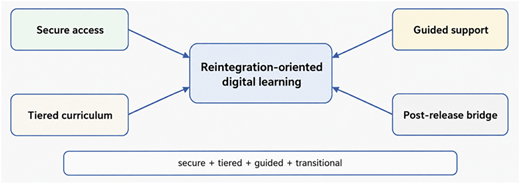
Figure 2 presents the model as an integrated learning ecology. Secure access responds to the security threshold; a tiered curriculum addresses differentiated digital and vocational needs; guided support responds to learning-effectiveness constraints and a bridging mechanism helps prison-based learning transfer into post-release life.
The model consists of four mutually dependent components. A secure digital access environment provides controlled educational access through approved devices, curated content, restricted connectivity, monitoring and institutional protocols. A tiered skills-based curriculum moves learners from foundational digital participation to employment-related digital tasks and adaptable vocational skills. Guided learning support offers academic, motivational and progress-related assistance through teachers, prison education staff, facilitators or external partners. A post-release bridging mechanism connects completed learning to continued education, job seeking, public service access and community reintegration through learning records, referrals, module recognition and service coordination.
The derivation logic is straightforward: the capability mismatch justifies digital learning; the need domains specify curriculum and support priorities; the barrier mechanisms define safe implementation conditions and the model components translate these insights into a structured ODE design. The model should therefore be read as a plausible, contextually grounded framework for future pilot research, not as evidence that digital learning is already effective in Vietnamese prisons.
5. Discussion: theoretical, policy and pilot design implications
Building on the evidence synthesis and model derivation, this section discusses the framework's implications for ODE scholarship, prison education policy and future pilot design. It does not restate the four components but explains why the model matters.
The discussion advances three arguments. First, the Vietnamese prison context extends “distance” in ODE from geographical separation to legal, institutional, technological and security-mediated exclusion. Second, digital capability should be understood as reintegration capital, not a narrow technical skill. Third, secure prison digital learning must avoid two false solutions: technological solutionism and security absolutism. The model offers a structured route from conceptual argument to cautious pilot development without overstating the evidence.
5.1 Reframing custodial learning as constrained-access ODE
The first implication concerns ODE scholarship. ODE has traditionally addressed access for learners separated from conventional education by geography, work, disability, socio-economic disadvantage or institutional barriers. The Vietnamese prison context extends this agenda by showing that “distance” is not always spatial. In custody, distance is produced by law, institutional control, security requirements, restricted technology access and weak continuity between prison-based learning and community opportunities.
This reframing shifts the focus from technology provision to educational access under constraint. In prisons, openness cannot mean unrestricted Internet access or ordinary online learning. It must mean governed widening of learning opportunities through controlled access, curated content, guided support and post-release connection. The model is therefore a secure ODE framework for an extreme case of constrained educational access.
5.2 Digital capability as reintegration capital
The second implication concerns digital capability in prison education. For incarcerated learners and people preparing for release, digital capability is not merely technical. It shapes access to employment information, online applications, public services, continuing education, support organisations and everyday transactions after release. A person may leave prison with legal awareness or a traditional vocational skill but still struggle in a society where work, services and learning are digitally mediated.
This article interprets digital capability as reintegration capital: a resource that helps people convert education and training into post-release participation. This extends desistance-oriented understandings of prison education. Desistance involves identity reconstruction, future orientation and lawful social roles; in contemporary society, these processes increasingly depend on navigating digital systems. Digital learning should therefore be integrated into reintegration pathways rather than treated as a stand-alone technology module.
5.3 Between technological solutionism and security absolutism
Prison digital learning is vulnerable to two opposing but limited positions. The first is technological solutionism: the assumption that devices, platforms, artificial intelligence or digital content can solve prison education and reintegration problems by themselves. This view treats technology as visible innovation while leaving unresolved questions about learner needs, support, progress monitoring and post-release transfer.
The second is security absolutism: the assumption that digital technology is primarily a security threat and therefore has little legitimate place in prison education. This may appear institutionally cautious, but it risks preserving digital exclusion and weakening reintegration. The proposed model offers a third position. It is secure but not exclusionary, digital but not technologically naïve and educational but not detached from reintegration. It does not require unrestricted Internet access; it may begin with offline materials, closed platforms, approved devices, curated content, monitored access and staged progression.
5.4 Policy implications: from educational provision to reintegration infrastructure
The policy implication is that prison education should be understood as part of reintegration infrastructure. Legal education, literacy, vocational training and pre-release preparation remain important, but they need to be complemented by digital capability development if they are to remain relevant to contemporary labour markets, public services and continuing learning pathways.
This requires four shifts: recognising digital capability as part of reintegration-oriented education; developing secure access through approved content, device control, monitoring rules and data protection; treating learner support as a core condition of custodial ODE; and building post-release continuity through learning records, referral pathways, recognition of completed learning and links to external education or employment services. Such a shift also requires coordination among prison authorities, education providers, vocational institutions, open universities, employment services and community reintegration organisations.
5.5 Pilot design logic: testing the model without overstating the evidence
Because the proposed model is evidence-informed rather than field-validated, it should guide cautious pilot development rather than immediate system-wide implementation. A pilot should begin with a limited target group, such as prisoners approaching release or newly released individuals, because digital capability is most directly connected to job search, public service access, continuing education and reintegration at this stage. Eligibility criteria should be transparent and fair.
Table 4 summarises a staged pilot logic: readiness assessment, controlled access design, small-scale implementation, guided support, post-release linkage and evaluation before scaling. This sequence keeps the model grounded in evidence while recognising that actual feasibility depends on institutional capacity, learner characteristics, security procedures and partnerships outside prison.
6. Conclusion and recommendations
6.1 Conclusion
This article has developed an evidence-informed conceptual model for secure ODE in Vietnamese prisons. Its central argument is that prison digital learning should not be treated as the mere introduction of technology into custodial settings but as a secure, guided and reintegration-oriented form of ODE for learners whose educational access is legally, institutionally, technologically and security-mediated.
The article identifies a capability misalignment between current prison education provision and the digital conditions of post-release life. Although legal education, literacy, vocational training and reintegration preparation remain important, available evidence suggests that digital capability development is weakly specified. In response, the article proposes three analytically derived need domains – foundational digital skills, transferable vocational skills and transition-oriented learning support – and translates them into a four-component model: secure digital access environment, tiered skills-based curriculum, guided learning support and post-release bridging mechanism.
The article's contribution is twofold. Conceptually, it extends ODE scholarship by showing that “distance” in custodial settings is not only geographical but also legal, institutional, technological and security-mediated. Practically, it offers a framework for designing cautious, secure and reintegration-oriented pilots. Since the model is based on secondary evidence, it should be read as a foundation for future field-based validation rather than as evidence of programme effectiveness.
6.2 Recommendations
Four recommendations follow from the proposed model. First, prison education policy should recognise digital capability as part of reintegration-oriented education, complementing legal education, literacy, vocational training and pre-release preparation. Second, digital learning initiatives should begin with secure and controlled access through approved devices, curated content, restricted connectivity, access logs and clear institutional protocols. Third, learning should be organised through a tiered curriculum and guided support so that learners move from foundational digital participation to employment-related tasks, transferable vocational skills and continuing-learning opportunities. Fourth, prison-based learning should be linked to post-release pathways through learning records, referrals, module recognition and coordination with vocational providers, open universities, employment services or community reintegration organisations.
Future practice should begin with small, carefully governed pilots rather than system-wide implementation. Future research should examine digital readiness, staff capacity, security governance, learner engagement, learning outcomes and post-release continuity through needs assessments, stakeholder interviews, feasibility studies and small-scale pilot evaluations.