


Customer social participation (CSP) is a new phenomenon that has emerged with the evolution of social media. Current literature designates customer participation in social media as “CSP”. Although CSP has been investigated in the online brand community context in social media, it has been little investigated in the context of student customers using WhatsApp – a highly trending social media platform among learners. Thus, this study aims to investigate the effectiveness of CSP in informal WhatsApp groups for academic purposes among undergraduate students of management studies.
The study adopted a single cross-sectional survey design. A structured online questionnaire was employed. Using convenience sampling technique, data were collected from 170 undergraduates of the Bachelor of Management Studies programme at the Open University of Sri Lanka.
The results revealed significant positive effects of functional, social and hedonic benefits with CSP. Meanwhile, the relationship between psychological benefits and CSP was insignificant. Furthermore, there is no influence of age and level of study on CSP among the learners in informal WhatsApp groups. Moreover, at present, the level of CSP in WhatsApp for academic purposes among students is moderate.
The role of the student as the customer and student behaviour in informal WhatsApp groups established for academic purposes have been little investigated in the field of open and distance education services. In this context, this study empirically validated the model of participation benefits and CSP in WhatsApp groups informally established for academic purposes.
1. Introduction
Internet is more than just a new medium of information transfer because it is becoming increasingly social and communal (Preece and Shneiderman, 2009; Kamboj and Rahman, 2017). Internet with web 2.0 commenced to facilitate platform-based online interaction among people from 2004, for example, with platforms such as Facebook, YouTube, Twitter, etc. This created a new paradigm of individual and social life. It facilitated various forms of communication such as blogs, collaborative projects, social networking sites (SNS), content communities and virtual communities (Kaplan and Haenlein, 2010; Ali et al., 2017). In this backdrop, the growth of online communities has become one of the mega trends around the world, with social media (Armstrong and Hagel, 1996; Kozinets, 1999; Preece, 2000; Wang et al., 2002; Wang and Fesenmaier, 2004; Kaplan and Haenlein, 2010; Rishika et al., 2013; Kang et al., 2014; Chae and Ko, 2016; Kamboj and Rahman, 2017). This increase of better informed, networked, empowered and active consumers who prefer personalized experience led to a rapid move of firm-centric value co-creation processes to the customer's side (Prahalad and Ramaswamy, 2004), which, in turn, led many researchers to investigate customer participation in social media (e.g. Preece and Shneiderman, 2009; Nambisan and Baron, 2009; Rishika et al., 2013). Later, studies designated customer participation in social media as customer social participation (CSP) (e.g. Chae and Ko, 2016; Kamboj and Rahman, 2017). From a marketing point of view, identifying higher education as a service, and students as customers of the institutions providing the service, is not a novel approach (Long et al., 1999; Sim and Idrus, 2003; Allen and Withey, 2017; Guilbault, 2018), but investigations on CSP in educational services, from the point of view of student as a customer, are at an infant stage.
Interestingly, social media is considerably popular among students as a new form of communication; and a tendency of grouping, or creating communities, on these platforms for learning purposes can be perceived among students (Ali et al., 2017; Owusu et al., 2019; Hady and Al-Tamimi, 2021). WhatsApp is one such new social media platform introduced in 2009 (Karapanos et al., 2016); it is the third largest social media platform – with around two billion monthly active users worldwide – after Facebook and YouTube (Kemp, 2021). Meanwhile, Sri Lanka was the second highest downloader of WhatsApp during the first quarter of 2021, showing a 31% increase in quarterly growth compared to the previous quarter (Statista, 2021). This proves the popularity of WhatsApp globally, and locally. Although WhatsApp is a platform primarily popular for informal purposes (Jailobaev et al., 2021), it has been gradually adapted for educational purposes as well (Mansour, 2016; Gasaymeh, 2017; Owusu et al., 2019; Alqahtani et al., 2018; Gazit et al., 2019). Several studies have shown the acceleration of use of WhatsApp as a formal educational tool following the outbreak of the Covid-19 pandemic (Bordoloi et al., 2021; Rameez et al., 2020), with teachers in higher education opting to conduct audio-visual classes through WhatsApp, providing a much needed respite to learners during the pandemic (Bordoloi et al., 2021).
As a case in point, learners in the Bachelor of Management Studies (BMS) degree programme offered by the Faculty of Management Studies of the Open University of Sri Lanka are observed to form communities, or groups, in WhatsApp for academic purposes, in spite of the availability of a supplementary learner management system (LMS) for all courses, and an official Facebook community. This indicates that WhatsApp is substantially used informally by undergraduate students as a facilitating tool for academic purposes in the BMS degree programme. With the pandemic situation, education services have shifted to online mode in many countries. Nevertheless, Bordoloi et al. (2021) explain the situation faced by India, which is no different from that of Sri Lanka (Priyadarshani and Jesuiya, 2021; Rameez et al., 2020), where this abrupt shift to digital teaching impacts many learners belonging to disadvantaged groups, due to Internet inaccessibility and unaffordable technology. It is, therefore, wiser to identify students' priorities, challenges, interests and learning preferences before adopting unplanned and hurried ways of teaching (Bordoloi et al., 2021). However, the success of an online community is determined by the active participation of community users (Kang et al., 2014); what motivates customers to participate in such a community is more attitudinal and psychological (Wang and Fesenmaier, 2004; Rishika et al., 2013) and rapidly changes with technology (Kamboj and Rahman, 2017). Thus, in order to bridge this research gap, this study addresses the following research questions:
What is the existing level of perceived benefits of participation among learners on WhatsApp groups informally established for academic purposes?
What is the existing level of CSP among learners on WhatsApp groups informally established for academic purposes?
What is the relationship between the perceived participation benefits and the CSP in WhatsApp groups informally established by learners for academic purposes?
Do learners' age and level of study have an influence on the level of CSP?
2. Literature review and hypotheses development
2.1 “Student as a customer” perspective
With the institution of education marketing, education has been identified as a service that provides the basis for learning and demonstration (Allen and Withey, 2017). This has influenced the emergence of a concept recognizing a student as a customer (Long et al., 1999; Sim and Idrus, 2003). It is still a relatively new concept to education (Allen and Withey, 2017; Guilbault, 2018), with “student customer” still being a controversial subject of ongoing, unresolved debate. However, students perceive themselves as co-creators and would prefer to see themselves as customers. A student becoming a co-creator depends on two factors: (1) whether education is being facilitated, and (2) whether active learning is happening (Guilbault, 2018); this proves that the student is the main stakeholder in the education service. According to the service-dominant logic, the fundamental pillar of services is that value is created by the customer (Vargo and Lusch, 2004). Grönroos (2011); this further triggers the argument on value in use, stating “the value for the user is created or emerges during usage, which is a process of which the customer as user is in charge (p. 287)”. In other words, “value is created by the user, for the user (p. 288)”. Value is also termed as the difference between the benefits and the sacrifices in a given offering (Kotler and Keller, 2016).
With the emergence of education as a revenue-generating business and non-traditional students as a profitable market segment, the student customer is identified as the “fourth wave” in the evolution of education in the United States (Allen and Withey, 2017). They, further elaborate on how these new non-traditional students form a mix of ages, experience, life-stages and different educational expectations. The student profile of the Open University of Sri Lanka aligns with this definition of the non-traditional student segment (The Open University of Sri Lanka, 2018); it is, therefore, constructive to investigate the CSP of students using WhatsApp for educational purposes in this context.
2.2 WhatsApp in education
WhatsApp is a smartphone application that can be operated on most devices and operating systems currently available (Bouhnik and Deshen, 2014; Jailobaev et al., 2021). Although it is considered a form of mobile instant messaging (Church and Oliveira, 2013; Padmavathy et al., 2018; Cruz-Cárdenas et al., 2019; Martinez-Comeche and Ruthven, 2021), it is also technically identified as a social networking application, which facilitates people wider access to information (Bouhnik and Deshen, 2014). WhatsApp provides a variety of functions, such as text messages, images, audio files, video files and links to web addresses (Church and Oliveira, 2013; Bouhnik and Deshen, 2014; Jailobaev et al., 2021) at low cost (Chaputula et al., 2020). Thus, this simple operating system allows access to people of different ages and backgrounds; a person only requires a smartphone with an active Internet connection to install the application and join WhatsApp (Bouhnik and Deshen, 2014). One of the unique features available on WhatsApp is the option to create a group and communicate within its boundaries. The member who creates the group becomes its administrator and retains the privilege of adding or removing participants without approval from other group members. This aside, all of the participants in the group enjoy equal rights (Sayan, 2016).
2.3 Customer social participation
The notion of customer participation in social media is a vague phenomenon that still requires a universal definition (Chae and Ko, 2016; Kamboj and Rahman, 2017). It is an extension of the phenomenon of customer participation in online co-creation set-ups (Prahalad and Ramaswamy, 2004; Dong and Sivakumar, 2017). CSP originates from brand community literature (Chae and Ko, 2016; Kamboj and Rahman, 2017) and has been investigated in the perspectives of marketing in various industries, brands and in different social technologies such as Facebook and Twitter (Wang and Fesenmaier, 2004; Casaló et al., 2010b; Chae and Ko, 2016; Kamboj and Rahman, 2017).
Several scholars have defined the construct of CSP in different ways (e.g. Preece and Shneiderman, 2009; Rishika et al., 2013; Chae and Ko, 2016; Kamboj and Rahman, 2017). For example, Rishika et al. (2013), in their study related to the fashion brand industry, used the concept of “Customers' Social Media Participation” to describe customers' participation behaviour in SNS, and defined it as the frequency a customer visits a firm's Facebook page, whereas Chae and Ko (2016) defined it as “an effort to achieve co-creation of values through required, but voluntary, interactive participation of the customers in service production and delivery process in social media (p. 2)”. Chae and Ko (2016) identify three forms of CSP: customer-customer, customer-firm and customer-media, and in simple terms, describe CSP as customer social media participation (Chae and Ko, 2016; Kamboj and Rahman, 2017). However, the concept of CSP is little investigated in the perspective of student customers in education. In the context of this study, WhatsApp is not formally integrated to the LMS, or to the learner support system of the Open University of Sri Lanka; hence, this study identifies CSP from the customer to customer perspective and in similarity to Chae and Ko's (2016) definition, this study refers to the CSP as an effort among the customers (students) to achieve co-creation of values for educational purposes through voluntary active participation and interaction with other members of the community in production and delivery processes in social media.
2.4 Antecedents of customer social participation
CSP has been investigated using different theoretical perspectives, but what motivates customers to participate in online communities is little known (Gretzel and Yoo, 2008; Kamboj and Rahman, 2017). Thus, most studies still identify the dimensions of CSP from literature on offline and online brand community behaviour relating to online fashion brand communities (e.g. Rishika et al., 2013; Chae and Ko, 2016) and travel brand communities (e.g. Kamboj and Rahman, 2017). However, several studies have been conducted to identify the motives of participation, and the motivations or benefits sought by the customers as the antecedents of CSP (e.g. Wang and Fesenmaier, 2004; Burke et al., 2009; Casaló et al., 2010b; Kamboj and Rahman, 2017).
Different typologies have identified the benefits of a product or a service (Candi and Kahn, 2016). However, benefits are identified as value propositions, which firms deliver to satisfy the needs of the customers. In other words, the total customer benefit is the perceived monetary value of economic, functional and psychological benefits a customer expects from an offering (Kotler and Keller, 2016). There are different aspects such as the products, services, personnel and image involved in an offering, or a brand, but in identifying different typologies of benefit categorization, Kotler's definition is more generally accepted (Candi and Kahn, 2016). In the context of online communities, Wang and Fesenmaier (2004) identify functional, social, psychological and hedonic benefits while Kang et al. (2014) identifies functional, socio-psychological, hedonic and monitory benefits. Chung and Buhalis (2009) elaborate three types of benefits sought by online community users in Korea: information acquisition, socio-psychological and hedonic. However, Kamboj and Rahman (2017) identify antecedents of CSP in online communities as social, psychological, hedonic and functional attributes. Their work was similar to the motivation/benefit model proposed by Wang et al. (2002); revalidated in 2004. This study adopts Wang et al.’s (2002) framework, and thus, identifies the four main benefits of participation as functional, social, psychological and hedonic benefits.
Functional Benefits are defined as perceived utility received from a product due to its ability to fulfil functional, utilitarian or physical purposes (Sheth et al., 1991). Moreover, functional benefits depict the attributes of a product or a service that satisfy the intrinsic needs of a person, including physiological and safety needs (Candi and Kahn, 2016). In the context of brand communities, the functional benefits of online communities sought by its users are exchanges of products or services between members (Armstrong and Hagel, 1996). But in general, users seek information support for learning and facilitating decision making, convenience and the efficiency of fulfilling specific activities, irrespective of time and geographical limitations (Wang et al., 2002; Wang and Fesenmaier, 2004).
Social Benefits are defined by several classifications in benefit typology (Park et al., 1986; Sheth et al., 1991): benefits relating to self-image and customer desire to belong to a specific group as a member (Mittal and Lee, 1989) and benefits including communicating with other members, building relationships, exchanging ideas and opinions and getting involved (Preece, 2000; Wang and Fesenmaier, 2004).
Psychological Benefits refer to the trust among community users (Wang and Fesenmaier, 2004; Kamboj and Rahman, 2017). Online communities offer psychological benefits and create a sense of belonging (Wang and Fesenmaier, 2004; Kamboj and Rahman, 2017; Cruz-Cárdenas et al., 2019) by providing functional and social benefits. For example, most SNS content is third party information and trust in such information occurs gradually with the fulfilment of functional and social benefits (Wang and Fesenmaier, 2004). Further, they highlighted that online knowledge consumption is learned along with group-specific cultural norms, specialized languages and concepts, i.e. the identities of other group members. Hence, the initial intent to search for information transforms into a source of community, where, upon perceiving affinity with other users and identifying with them, a sense of belonging and affiliation is developed among members of a community.
Hedonic Benefits involves the multi-sensory, fantasy and emotive aspects of a person's experience with products. In this perspective, products are viewed as subjective symbols rather than objective ones (Hirschman and Holbrook, 1982). In the online context, members also join online communities for their own enjoyment and entertainment purposes (Kamboj and Rahman, 2017). Han et al. (2018) states members, who receive better entertainment experiences, engage in online communities with ease and pleasure. Entertainment and fun have a strong link with hedonic motivations (Cruz-Cárdenas et al., 2019).
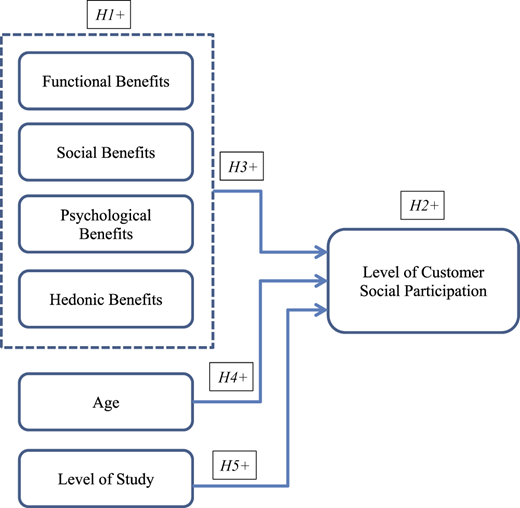
The existing level of perceived benefits of participation in WhatsApp groups for academic purposes is high.
2.5 Customer social participation in WhatsApp for educational purposes
CSP has been identified as a quantitative construct in several studies (Chae and Ko, 2016; Kamboj and Rahman, 2017). Since it is an extension of customer participation and has originated from online brand community literature, it is measured using levels of contribution of group members (Casaló et al., 2010; Tsai and Bagozzi, 2014), frequency of visits to, or degree of participation in, a social media group (Wang and Fesenmaier, 2004; Rishika et al., 2013; Agag and El-Marsy, 2016), and active participation (Kang et al., 2014; Chae and Ko, 2016; Kamboj and Rahman, 2017). Kang et al. (2014) highlights that customer active participation is inevitable for success of an online community in Facebook. Accordingly, this study uses the active participation measure proposed by Kang et al. (2014). In this context, although several studies in education suggest that students are active in WhatsApp for personal and social purposes (Gasaymeh, 2017; Gazit and Aharony, 2018) and learning purposes (Al-Rahmi, 2016; Khoza, 2020).
The existing level of CSP in WhatsApp groups for academic purposes is high.
2.6 Perceived participation benefits and customer social participation in WhatsApp for educational purposes
Several studies highlight the benefits of WhatsApp for education, professional advancement, information sharing and social interaction (Amry, 2014; Padmavathy et al., 2018; Gazit and Aharony, 2018; Gazit et al., 2019; Martinez-Comeche and Ruthven, 2021). WhatsApp can facilitate the creation of a pleasing environment to promote association among students. Also, students use WhatsApp groups for four main purposes: communicating, enriching their social atmosphere, creating dialogue and encouraging sharing, and as a learning platform. Al-Rahmi et al. (2016) too assert students use social media for learning. Moreover, students derive academic advantages such as accessibility of learning materials, teacher availability and the continuation of learning beyond class hours (Bouhnik and Deshen, 2014). Meanwhile, in contrast, a study of WhatsApp use in everyday life in Madrid asserts that many participants think WhatsApp is frequently amusing; but find the repetitive process of checking for and replying to texts, without significant variation in conversation topics or participants, sometimes boring; and the overload of information stressful (Martinez-Comeche and Ruthven, 2021).
However, as mentioned previously in Antecedents of CSP, several studies have identified that customer active participation in an online community is driven by the customer motivations, or benefits sought by customers (e.g. Wang and Fesenmaier, 2004; Burke et al., 2009; Kang et al., 2014; Kamboj and Rahman, 2017). In this study the perceived benefits considered were functional, social, psychological and hedonic benefits and CSP is the active participation in the WhatsApp group.
There is a significant positive relationship between participation benefits (functional, social, psychological and hedonic) and the level of CSP in informal WhatsApp groups for academic purposes.
2.7 Age and study level
SNS are used by many individuals of different ages, social statuses and education levels in their everyday lives (Aharony, 2014). In their study, Gazit and Aharony (2018) highlight that age, the level of the group and group subject play an important role in the level of participation in WhatsApp among students in Madrid. Several studies relating to the use of social media at undergraduate and postgraduate study levels in medical education have investigated the use of Facebook, YouTube and Twitter, but not that of WhatsApp (Coleman and O'Connor, 2019). Furthermore, quite interestingly, social interaction and contact among older students was observed to be less on WhatsApp; and they spent less time on WhatsApp compared to young students, who spend longer times on it (Aharony, 2014; Montag et al., 2015). However, there is evidence of WhatsApp currently being popular among people of all ages as well (e.g. Rosales and Ardèvol, 2016).
The level of CSP varies in relation to the learner's age
The level of CSP varies in relation to the learner's level of study
The conceptual framework of the study, thus advanced, is shown in Figure 1.
3. Methodology
This study has adopted the quantitative approach based on a single cross-sectional survey design to ascertain the effectiveness of CSP of undergraduates in informal WhatsApp groups for academic purposes.
3.1 Population, sample and data collection
The population of the study was composed of the undergraduates enrolled in the BMS degree programme at the Open University of Sri Lanka in the academic year of 2019/2020. According to Jayasinghe et al. (2018), approximately 3,720 students were following this four-year degree programme. However, the target population is the learners who are members of informal WhatsApp groups formed for academic purposes. Since this population is unknown and permission is lacking to access these groups, convenience sampling technique was used to select the sample. Researchers planned a sample of 400 (n = 400); which is 2.5% based on measurement error table (Krejcie and Morgan, 1970). The data were collected using a structured online survey questionnaire.
The instrument was opened from the 01st of December 2020 to the 31st of March 2021. At the end of this period 170 completed questionnaires (42.5%) were returned and these were included in the data analysis.
3.2 Operationalization
This study adopted the online community participation benefit scale developed by Wang et al. (2002). The instrument (Appendix 1) consists of two sections: the first section consists of three questions on respondents' characteristics relating to respondents' age, gender and programme level; the second section consists of items on a seven-point scale to measure the benefits of participation and four items to measure the level of social instrument consisted of four items to measure the functional benefits, five to measure the social benefits, five to measure the psychological benefits and four to measure the hedonic benefits. The CSP was considered as customer active participation and measured using four items (Wang and Fesenmaier, 2004; Kang et al., 2014).
4. Data analysis
4.1 Sample profile
Table 1 depicts the age, gender and programme level of the respondents from the BMS degree programme. The highest number of respondents were in the age range of 24–29 (70.6%), while the lowest number of respondents were in the age range of 35–39 (5.9%). In all, 71.8% of the respondents were females and male representation was 28.2%. The majority of the respondents were from BMS Level 05 (45.9%), followed by those in Level 06: 24.1%, Level 03: 15.9% and finally Level 04: 14.1%.
4.2 Validation of measurement properties
Before validating the measurement properties, to ensure the normality of data, Skewness and Kurtosis analyses were performed (Appendix 2). Results show that all the skewness of perceived benefits: Functional Benefits (FB), Social Benefits (SB), Psychological Benefits (PB) and Hedonic Benefits (HB), and CSP was in the range of 0 to −1. Furthermore, Kurtosis values of all the variables were in the range between +2 and −2. Hence, it can be concluded that the data distribution is symmetric and central peaks of all the variables were sharp and ensured normality.
Results of correlation analysis
| Variables | FB | SB | PB | HB | CSP |
|---|---|---|---|---|---|
| FB | |||||
| SB | 0.392** | ||||
| PB | 0.348** | 0.580** | |||
| HB | 0.372** | 0.570** | 0.726** | ||
| CSP | 0.479** | 0.426** | 0.400** | 0.561** | 1 |
Next, the instrument validity and reliability were measured. Table 2 presents the results of validation of measurement properties.
Validity and reliability
| Sampling adequacy | Construct reliability | Convergent validity | Discriminant validity | |||||||
|---|---|---|---|---|---|---|---|---|---|---|
| KMO | Bartlett's | (α) | CR | AVE | FB | SB | PB | HB | CSP | |
| FB | 0.747 | 315.762 | 0.850 | 0.708 | 0.606 | 0.606 | ||||
| SB | 0.818 | 381.087 | 0.858 | 0.732 | 0.620 | 0.229 | 0.620 | |||
| PB | 0.898 | 704.053 | 0.934 | 0.731 | 0.706 | 0.154 | 0.336 | 0.706 | ||
| HB | 0.813 | 455.920 | 0.897 | 0.758 | 0.730 | 0.121 | 0.324 | 0.527 | 0.730 | |
| CSP | 0.785 | 321.228 | 0.854 | 0.721 | 0.705 | 0.138 | 0.0181 | 0.160 | 0.314 | 0.705 |
According to Table 2, KMO and Bartlett's test results for all the variables were higher than the threshold level (p < 0.05). Hence, all the variables can be factorized and all the correlation coefficients were far from zero (p < 0.05). Hence, sampling adequacy for all the variables was ensured. Construct reliability was ensured through the Cronbach Alpha (α) value estimation. Cronbach alpha (α) value was greater than 0.7. Thus, internal consistency of the measurement properties was ensured. Thereafter, construct validity was measured through convergent validity (CR > AVE), meanwhile AVE was greater than the shared variance values and discriminant validity was ensured.
Objective 1: To identify the learners' existing level of perceived benefits of participation in WhatsApp groups for academic purposes.
Table 3 below shows the results of the one-sample t-test performed to investigate the objective.
Results of one sample t test
| Dimension | Test value = 4 | ||||||
|---|---|---|---|---|---|---|---|
| t | Sig. (2-Tailed) | Mean difference | Mean | SD | 95% confidence interval of the difference | ||
| Lower | Upper | ||||||
| FB | 13.769 | 0.000 | 1.222 | 5.722 | 1.157 | 1.047 | 1.397 |
| SB | 5.938 | 0.000 | 0.580 | 5.080 | 1.274 | 0.387 | 0.772 |
| PB | 3.434 | 0.001 | 0.384 | 4.884 | 1.461 | 0.164 | 0.606 |
| HB | 5.354 | 0.001 | 0.370 | 4.871 | 1.441 | 0.152 | 0.589 |
| CSP | 5.187 | 0.000 | 0.530 | 5.040 | 1.356 | 0.334 | 0.745 |
Table 3 depicts that perceived benefits of participation, functional benefits (M = 5.722, SD = 1.157, t = 13.769), social benefits (M = 5.080, SD = 1.271, t = 5.938), psychological benefits (M = 4.884, SD = 1.461, t = 3.434) and hedonic benefits (t = M = 4.871, SD = 1.44, t = ) and CSP (M = 5.040, SD = 1.356, t = 5.187) were significant at p < 0.05. Hence, the learners have a positive perception of using WhatsApp for academic purposes in relation to the benefits received.
Objective 2: To identify the learners' existing level of CSP in WhatsApp groups for academic purposes.
First, three levels of CSP groups were formed based on mean values.
Table 4 shows the mean value ranges to identify the level of CSP; low level of CSP was in the mean range of “1–3.59”, moderate level of CSP was in the range of “3.6–5.59” and high level of CSP in the range of “5.6–7”.
Mean value ranges
| Mean value range | Level of active participation |
|---|---|
| 1–3.59 | Low |
| 3.6–5.59 | Moderate |
| 5.6–7 | High |
Then, a frequency analysis was performed to identify the number of responses received in each category. Table 5 below shows the results of the frequency analysis.
Existing level of customer social participation in WhatsApp groups
| Level | Frequency | Percent | Valid percent | Cumulative percent |
|---|---|---|---|---|
| Low | 27 | 15.9 | 15.9 | 15.9 |
| Moderate | 76 | 44.7 | 44.7 | 60.6 |
| High | 67 | 39.4 | 39.4 | 100.0 |
| Total | 170 | 100.0 | 100.0 |
According to Table 5, a majority of the respondents show a moderate level of participation (44.7%) in these groups and 39.4% of responses indicated a high level of CSP, while 15.9% of the learners have indicated a low level of participation in informal WhatsApp groups for academic purposes
Objective 3: To investigate the relationship between the perceived participation benefits and CSP in WhatsApp groups informally established by learners for academic purposes.
Table 6 presents the results of multiple regression: model fit, beta coefficient values and t-statistics.
Strong and weak participation benefits
| Model | Unstandardized coefficients | Standardized coefficients | t | Sig. | Adj. R^ | F stat. | Sig. | |
|---|---|---|---|---|---|---|---|---|
| B | Std. Error | Beta | ||||||
| Constant | 1.283 | 2.791 | 0.006 | 0.353 | 24.056 | 0.000 | ||
| FB | 0.200 | 0.459 | 0.171 | 2.412 | 0.017 | |||
| SB | 0.223 | 0.083 | 0.209 | 2.019 | 0.045 | |||
| PB | −0.210 | 0.110 | −0.226 | −1.915 | 0.057 | |||
| HB | 0.514 | 0.085 | 0.546 | 6.041 | 0.000 | |||
According to Table 6, the strength of association between the perceived participation benefits and the level of customer participation is R^ = 0.353 (p < 0.05). This indicates that variation of CSP explained by the four benefits of participation is 35.3%. Furthermore, F statistic was 24.056 (p < 0.05); thus, the goodness of fit of the model is satisfactory.
Beta coefficient of Functional benefits (FB) = 0.171 (0.017 < 0.000) Social benefits (SB) = 0.209 (0.045 < 0.05), Psychological benefits (PB) = −0.226 (0.057 > 0.05), Hedonic benefits (HB) = 0.546 (0.000 < 0.05). This indicates that three factors: FB, SB and HB, are the significant variables in the model; while PB has a negative insignificant relationship with CSP. The most significant benefit is Hedonic benefits for learners' level of social participation in informal WhatsApp groups for educational purposes.
Objective 4: To investigate whether the learners' age and level of study have an influence on level of CSP.
A discriminant analysis was then performed to determine whether the learners' age and level of study have an influence on the level of CSP.
According to Table 7, value of Wilks' ƛ was 0.978 and it transforms to a chi-square of 3.845 (0.427 > 0.05) for age. The value of Wilks' ƛ of level of study was 0.998 and chi-square was 0.053 (0.819 > 0.05). Hence, age and level of study do not influence participation in groups.
5. Discussion and conclusion
This study was conducted to investigate the effectiveness of CSP in informal WhatsApp groups for academic purposes among the undergraduates of BMS (Hons) degree programme at the Open University of Sri Lanka. The results revealed that the level of perceived benefits of participation is high among the learners. Furthermore, functional, social and hedonic benefits are significant participation benefits sought by the learners joining these informal WhatsApp groups. However, psychological benefits have an insignificant negative relationship with CSP. In contrast, it is asserted that psychological factors significantly predict the level of participation in WhatsApp groups (Gazit and Aharony, 2018) and social and informational usage are more significant predictors of participation in WhatsApp for academic purposes (Gazit et al., 2019). However, in this study, as in Lin and Lu's (2015), hedonic benefits make the highest contribution to CSP among the learners in the WhatsApp groups. Findings also show that a low-level (35.3%) variation of CSP is explained by the perceived benefits of WhatsApp groups. It implies perceived benefits are individual and context-specific (Gazit and Aharony, 2018).
Moreover, CSP in WhatsApp among the learners is at a moderate level. But there are a considerable number of learners that frequently use WhatsApp for academic purposes. The popularity of WhatsApp use for academic purposes among the BMS undergraduates implies that WhatsApp is an effective tool to improve interaction and uninterrupted communication among the learners.
The level of CSP among learners does not vary with relation to differences in age and study level. On a similar note, Rosales and Ardèvol (2016) identify that WhatsApp is a popular application among people of all ages. The study by Khoza (2020) identifies that students treat WhatsApp as their “master”, rather than an LMS, whereas Al-Rahmi (2016) asserts that student-collaborative interactive learning happens in social media with peers, and supervisors for research projects. Further, new learning models arising from within the student demographic are vital; models integrated with social media are on the rise ((Allen and Withey, 2017). This proves the necessity of integrating WhatsApp as a learning tool for all the course levels of the degree programme. Thus, irrespective of the age and the level of the students, WhatsApp can be adopted as a strategic tool in conjunction with Moodle platforms or LMS (Bouhnik and Deshen, 2014; Chaputula et al., 2020). Further, it can be used separately for student collaboration and group based activities such as discussion forums, brainstorming sessions and etc.
Student customers, with different demographic profiles, in the United States are searching for products and services relating to education and valuable learning experiences, that best advantage them for competing and advancing in their workplace (Allen and Withey, 2017). A similar context is visible in the target market of the Open University of Sri Lanka. However, Sri Lanka is a developing country with limited resources and access. During the pandemic learners in Sri Lanka are also struggling as Bordoloi et al. (2021) correctly mentions the struggle in India during Covid-19, from the learners' perspective, to move to online education with limited technology and resource access. Further to this, they highlight that knowing students' interests and learning preferences helps align technology and pedagogy. Moreover, WhatsApp can be used to connect students with teachers and the faculty, enabling access to the competitive higher education marketplace. Customers are value creators; thus, opportunities to engage with customers via technologies they use can enable firms to become a part of the value creation process as more than value facilitators. Furthermore, firms can directly interact with customers (Gronroos, 2011).
This study has several limitations. Firstly, CSP in behavioural aspects such as feelings, or emotions, were not considered due to the quantitative nature of the study. Secondly, the scope of the study was limited to the learner-created WhatsApp groups of undergraduates reading for the BMS degree at the Open University of Sri Lanka. Hence, CSP in WhatsApp groups created by undergraduates in Engineering, Social Sciences, Natural Sciences, Law and other fields can be investigated in the future. Also, since this study shows that perceived benefits account for only a low variation of CSP, further studies can be carried out to investigate the influence of factors other than perceived benefits on CSP in informal WhatsApp groups in relation to open and distance education practices.
The authors would like to acknowledge The Open University of Sri Lanka.
References
Appendix 1 Effectiveness of customer social participation for academic purposes: A case of informal WhatsApp groups.
Questionnaire
Your age
Gender
Male
Female
Study Level in the degree programme
Level 03
Level 04
Level 05
Level 06
Please select the right check box to rate your level of agreement on following statements.
1 = Highly disagree
2 = Disagree
3 = Somewhat disagree
4 = Neither disagree nor agree
5 = Somewhat agree
6 = Agree
7 = Highly agree
Perceived Participation Benefits
Functional benefits
I get the benefits of obtaining up-to-date information about the courses.
I conveniently communicate with others in my study level.
I share my experiences in the lectures.
I use this to overcome the technical issues during the lecture.
Social benefits
I receive benefit of making new friends.
I can be an active educational activist on behalf of the group members.
I see this will be helpful me to create my self-identity.
I can organise socialize activities with my group members.
Psychological benefits
I am seeking a sense of establishing a self-identity in the group.
I am seeking a sense of a recognized person in the group.
I am seeking a sense of getting involved with other members.
I am seeking a sense of belonging to the group.
Hedonic benefits
I am amused by other members.
I am having fun by sharing views.
I am seeking enjoyment in this group.
I am being entertained on this group.
Active participation
I take an active part in the WhatsApp groups created for academic purpose by the students in the University.
I frequently provide useful information to other members.
In general, I post messages and responses on the WhatsApp group with great enthusiasm and frequency.
I do my best to participate in activities of the group.

