

Initial BRJ-X Airline Advisor Council meeting
Initial BRJ-X Airline Advisor Council meeting
Keywords Aircraft,Bombardier Aerospace
A total of 14 airlines from seven countries attended the first BRJ-X Airline Advisory Council convened in Montreal recently by Bombardier Aerospace. The council is an integral part of the market evaluation process for Bombardier's proposed five-abreast, 90-seat class, BRJ-X Series of regional jet aircraft.
The proposed BRJ-X would be the largest offering in Bombardier's stable of commercial regional aircraft currently comprising the 37-78 seat Q Series Dash 8 turboprop family and the 50-70 seat family of Canadair Regional Jet aircraft.
"Bombardier has identified a gap in aircraft capacity in the 80 to 110-seat range and we forecast a requirement for 2,500 aircraft over a 20-year delivery period," explained Steve Ridolfi, vice president, marketing and aircraft programs for Bombardier Aerospace, Regional Aircraft. "The BRJ-X Series would fit between the smaller 50 to 70-seat Canadair Regional Jet family and larger 111-170-seat mainline jet aircraft," he said.
"The BRJ-X family of aircraft will be designed to have the lowest possible operating costs in terms of fuel, crew, maintenance and ownership," said Mr Ridolfi. "Acquisition and ownership costs of these larger regional jets must be kept low since regional airlines are the low-cost producers in the airline industry" (Figures 1 and 2).
The formal Airline Advisory Council consultation process could lead to a decision to proceed with the new class of aircraft next year. The council will continue to meet throughout the full development cycle of the aircraft. Type certification and first delivery would be late 2003.
During the market consultation process, Bombardier will confirm current and emerging customer requirements for the new aircraft class through the Airline Advisory Council,select key suppliers and partners, and complete pre-launch design and analyses.
 Figure 1 Aircraft take-off weight jet aircraft
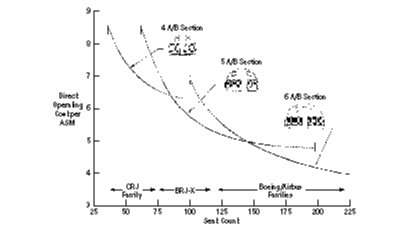
Figure 2 Direct operating cost effect of cross-section/weight
"The airline advisory process represents an important step in the pre-launch phase for the BRJ-X Series," said Robert Gillespie, president, Bombardier Aerospace, Regional Aircraft. "First, it formally introduces the aircraft and the program to our core customers and allows Bombardier to incorporate airline input into the design process from the start."
John Holding, executive vice president, engineering, Bombardier Aerospace, told Airline Advisory Council delegates that the BRJ-X development schedule would be a 36-month program from formal program launch to certification. "Our BRJ-X plan is clearly ambitious,"said Mr Holding. "It will encompass accelerated pre-launch activity over earlier traditional programs, freeze configuration and ensure all partners are on-board at time of launch and result in the introduction of a Joint Conceptual Definition Phase," he said.
This joint definition phase, said Mr Holding, will see all program partners selected and aircraft configuration frozen at the time of official program launch.
Bombardier has set up successful partnerships in three current programs; the Global Express long-range business jet, CRJ Series 700 and Dash 8 Q400 aircraft.
Through partnering on those programs, the company has proven its ability to design and produce new high-technology aircraft for the world marketplace, Mr Holding said.
Bombardier officials have currently selected a "double-bubble" fuselage cross-section over a circular design for the BRJ-X to allow for greater aisle height, increased passenger shoulder room at the cabin sidewall, and greater underfloor baggage height and volume. Overall cabin interior width for the aircraft type is preliminarily set at 128.5 inches (3.264m) (Figures 3 and 4).
Power plants under consideration for the BRJ-X include the CFM 56-9, BR 715 and the PW6000. Thrust class requirements are in the 19,000 to 22,000lb range with Full Authority Digital Engine Control (FADEC).
 Figure 3 General arrangement
The Airline Advisory Council also conducted preliminary discussions on the use of fly-by-wire or conventional flight control systems, steel versus carbon brakes, hydraulics,electrical power and avionics options, auxiliary power unit requirements,aircraft servicing and optional in-cabin entertainment and information systems.
Bombardier made public its plans for the BRJ-X class of aircraft during the Farnborough International Air Show in the United Kingdom in September 1998. The announcement followed an exploration of the 90-seat class of regional aircraft which began soon after the launch of its 70-seat CRJ Series 700 in January 1997.
At that time, it was determined that the world's regional airline fleets would have to grow both in size and capacity in order to keep up with the growth in mainline fleets. Over the next 20 years, the worldwide mainline fleet is expected to grow to 24,300 aircraft or 5.5 million seats while it is anticipated that the regional fleet will grow to 13,900 aircraft or 690,000 seats over the same period, almost doubling the number of aircraft in each segment respectively.
Bombardier Aerospace, a unit of Bombardier Inc., is the world's third largest civil aircraft manufacturer with its Canadair and de Havilland operations in Canada, Learjet in the USA and Shorts in the UK. Leading the 20- to 70-passenger regional carrier market, Bombardier Aerospace offers complete families of Dash 8® turboprop and Canadair Regional Jet® aircraft.
 Figure 4 Interior cross-section BRJ-X
It has the industry's widest range of business jets, from the light and mid-size Learjet® series to the widebody Challenger® and ultra long-range Global Express®.
It also produces the Canadair 415 firefighting/maritime mission aircraft and designs and manufactures airframe components and aircraft engine nacelles.
Details from Bombardier Inc. Tel: +1 (426) 375 3030.

