
Skip to article sections
Purpose

The purpose of this paper is to examine the relationship between bankers' perspectives and their intention to engage in green and climate financing activities after the COVID-19 pandemic in Bangladesh. In particular, it examines how do bankers' perspectives on deep ecological awareness, the normative structure of social pressure and environmental innovative technology affect their intentions toward green financing activities?

Design/methodology/approach

As a genuinely interdisciplinary theme, the idea of bounded rationality has gained substantial popularity in the social sciences, especially in green finance and technology. Based on this understanding, a theoretical framework grounded in the theory of bounded rational planned behavior was established to address the objectives of the present paper. Data were collected from bankers employed by selected commercial banks in Bangladesh following a random sampling procedure and analyzed using the partial least square structural equation modeling technique.

Findings

The findings show that all of the predictors appear to be robust in predicting the green financing intention of the sampled bankers in Bangladesh. The mediating variables also have significant effects.

Practical implications

Bankers' deep ecological awareness appeared to be a highly significant predictor of their attitudes toward bounded rational intention based on deep ecological awareness. Similarly, the social normative structure also appears to be a robust antecedent of subjective norms, which influence respondents’ bounded rational intention toward green and climate (G&C) financing.

Social implications

G&C financing practices can help reduce carbon emissions and other pollutants, thereby improving overall environmental sustainability and ecological conditions.

Originality/value

Few studies have focused on the G&C financing perspective in Bangladesh. This research is one of the empirical studies that will certainly add value for clients, institutions and policymakers in financing and banking sectors.

During the post-COVID-19 pandemic, policy measures have been adopted extensively to address public health concerns and promote a quick economic recovery. Significantly less focus has been placed on preventing climate change and environmental degradation (United Nations Development Programme, 2021). One of the most important reasons is the lack of the financial resources required by many governments in the south Asian and the Asia Pacific regions (Rubbaniy, Khalid, Rizwan, & Ali, 2022; UNDP, 2021). However, there are many strategic options to mobilize green finance through banking activities to combat climate change (Rubbaniy et al., 2022).

In this regard, empirical reports indicate that there are crucial policy gaps and barriers to green finance, one of which is the lack of investment-ready projects (Jahanger, Usman, Murshed, Mahmood, & Balsalobre-Lorente, 2022). To facilitate green growth and sustainable development in the region, this bottleneck needs to be overcome in alignment with each nation's strategic development vision (Sun & Chen, 2022). In this situation, a variety of financial instruments such as project finance, funds and facilities, thematic bonds and debt for climate swaps can be explored with commercial banks playing a monumental role (Jiang, Yu, Jahanger, & Balsalobre-Lorente, 2022). If all commercial banks could come forward to provide the necessary funds for the growing private sector for green and climate investment opportunities, it would be easier to overcome the extant challenges to climate change and to achieve a green and sustainable future (Pu & Yang, 2022). Hence, it is necessary to comprehend the bankers' perspective, especially their environmental knowledge and awareness, attitudes, perceptions of green technology and intentions toward green and climate finance (G&C finance).

However, to the best of the authors' knowledge, little rigorous research has been carried out on these factors that may influence bankers' bounded or contextual rationality toward green and climate financing investments in the South Asian region, particularly in Bangladesh. Thus, the main purpose of this paper is to examine the relationship between bankers' perspectives across different dimensions and their intentions toward green financing activities after the COVID-19 pandemic in Bangladesh. In particular, it examines how do bankers' perspectives of deep ecological awareness, the normative structure of social pressure and environmental innovative technology respectively affect attitudes, subjective norms and perceived behavioral control, respectively, which, in turn, affect their bounded rational intentions toward green and climate financing activities? Moreover, the study also intends to explore how do attitudes, subjective norms and perceived behavioral control mediate the relationships between deep ecological awareness, the normative structure of social pressure and environmental innovative technology and bankers' bounded rational intentions toward G&C finance?

To answer these questions, a theoretical model based on the theory of bounded rational planned behavior (TBRPB), as its basis was established. Using measurement scales designed to assess different aspects of deep ecological awareness, the normative structure of social pressure and innovative environmental technology, a survey instrument was developed to test the various relationships implied by TBRPB. Data were collected from the bankers employed at prominent commercial banks in Bangladesh, and the analysis of this data set (n = 395) helps answer questions about different presumed relationships between the above-mentioned variables pertaining to G&C financing activities.

The structure of this paper is as follows: first, the TBRPB is briefly reviewed, along with the relevant literature on different constructs. Next, the research model and hypotheses are presented, followed by a discussion of the research method and findings from the data analysis. A discussion of the meaning and implications of the results ends the paper.

Since the 1950s, a new perspective on rationality and its constraints has emerged, driven by the clear realization that various factors significantly impact sound judgment, reasoning and decision-making within limited internal and external contexts (Wildfeuer, 2024). In this regard, American economist Herbert Simon (1916–2001) proposed the idea of “bounded” or “limited” rationality. Due to the severe limitations in human cognitive and computational capabilities, knowledge remains perpetually incomplete and time is constrained. These cognitive attributes lead to behavioral outcomes that greatly influence the decision-making process (Wildfeuer, 2024). As an interdisciplinary subject, the concept of bounded rationality has recently gained considerable attention in the social sciences (Wildfeuer, 2024).

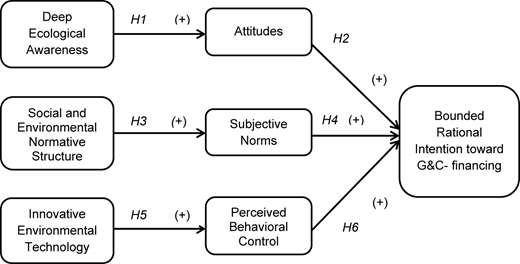
Thus, the present study incorporates the theory of bounded rational planned behaviour (TBRPB; Ashraf, 2018, 2023) as a theoretical basis for formulating the research framework. As noted earlier, TBRPB is based on the famous notion of “bounded rationality” pioneered by Herbert A. Simon, a Nobel Laureate in Economics. TBRPB is a modified theoretical framework that revises the theory of planned behavior (TPB) put forward by Ajzen (1991). In fact, TPB is an overarching model of the theory of reasoned action (TRA) formulated jointly by Fishbein and Ajzen (1975). According to Ajzen (1991), TPB is constructed on the basis of the universal assumption of mainstream neoclassical economics that every individual human being is infinitely rational in all circumstances. TBRPB has replaced the infinite or unbounded rational intention variable with the bounded rational intention (BRI), since human behavior is contextual, information-based and limitedly rational, according to Simon (1957, pp. 198). Notably, this concept has also been further advanced by other Nobel Laureate economists, such as Daniel Kahneman and Robert H. Thaler. In TBRPB, actual behavior is directly influenced by the factor of BRI, which is influenced by attitude, subjective norms (SNs) and perceived behavioral control (PBC). As TBRPB allows the incorporation of extra variables into the model (Ashraf, 2023), the study has employed an overarching model, incorporating three other variables such as deep ecological awareness (DEA), social and environmental normative structure (SENS) and innovative environmental technology (IET) which influence attitude, SNs and PBC respectively, and these, in turn, influence the BRI construct toward G&C financing activities.

TBRPB effectively helps formulate a precise research model for investigating how different relevant environmental constructs influence the immediate antecedents of Islamic bankers’ BRI toward the specific behavior of G&C financing. This theory has also been used by several previous studies in different domains, such as climate risk analysis (Botzen, Thepaut, & Banerjee, 2025), climate loss mitigation measures (Mol, Botzen, Blasch, Kranzler, & Kunreuther, 2024), organic food purchase (Ratan, Ashraf, Tat, & Latiff, 2021), Facebook commerce (f-commerce) (Ashraf, Alam, & Lidia, 2021), green financing (Asma, 2021), halal food purchase (Ashraf, 2019) and investors' sukuk purchase intention (Ashraf, 2023).

The research model articulated in the study, presented in Figure 1, is grounded on TBRPB. The behavior in question is green and climate financing behavior. As mentioned earlier, the typical TBRPB model would include the bounded rational intention variable as a construct antecedent to green and climate financing behavior. However, as the data in this study were all gathered at one point in time, it is not possible to include both bounded rational intention to perform the behavior and the behavior itself in the model (George, 2004). Intentions focus on future behavior while reports of actual behavior show what happened in the past. Past behavior is at best a surrogate for future behavior and not always a good one (George, 2004). Therefore, green and climate financing actual behavior is not included in the model; instead, there is a direct path from attitudes BRI toward G&C financing. The association between subjective norms and bounded rational intention has also been specified as a direct relationship. Similarly, the direct association between perceived behavioral control and bounded rational intention is retained.

In relation to environmental concerns, there is a socio-philosophical movement pioneered by the Norwegian philosopher, Arne Naess. It is called deep ecology. This idea pioneered a platform for ecological awareness and a social movement based on the belief that humans must fundamentally shift their relationship with nature from viewing it solely in terms of its utility values to its inherent value, which is termed as deep ecological awareness (Madsen, 2023). Deep ecological awareness (DEA) is, thus, not only a way of thinking about the impact of a business organization's operations on the condition of the natural environment (Zhang, Wang, Zhong, Yang, & Siddik, 2022), but also a way of recognizing nature's inherent value, which needs to be properly cared for (Madesn, 2023).

Some studies suggest that a company's environmental or deep ecological awareness can be materialized through its operational activities and effective use of materials and products (Zhang et al., 2022; Zheng, Siddik, Masukujjaman, Fatema, & Alam, 2021). These issues can encourage constructive and consistent business projects that intend to attain well-defined long-term goals of natural resource conservation and company productivity (Shaumya & Arulrajah, 2017). Moreover, paper conservation, reduced energy consumption and lower carbon emissions from financing activities can help achieve a nation’s long-term growth and development of a nation (Zheng et al., 2021). The studies discussed above suggest that deep ecology awareness of green practices could positively influence people's attitudes toward case-specific intentions to achieve positive outcomes through G&C financing (Madsen, 2023). Thus, it can be hypothesized that

H1.

Deep ecological awareness positively influences attitudes toward bounded rational intention toward G&C financing.

H2.

Positive attitudes positively influence bounded rational intention toward G&C financing.

Social integration and equality have become relevant in determining the relationships between banks and communities especially in the 21st century (Akomea-Frimpong, 2021). An individual's social and environmental concerns relate to their beliefs about what important others in society think about the behavior in question (Basha, Masson, Shamsudin, Hussain, & Salem, 2015). According to the background theory subjective norms should, in turn, positively affect one's inclination to engage in a specific behavior (Thøgersen et al., 2015). In this respect, if G&C financing is perceived as socially desirable, according to what important others think about it, an individual is more likely to intend to engage in G&C financing. Several studies in other fields have shown that a positive normative structure influences subjective norms positively, such as in green banking (Asma, 2021), in halal food purchase (Ashraf, Joarder, & Ratan, 2019) and in f-commerce (Ashraf et al., 2021). These studies demonstrated that the subjective norms have positive relationships with people's bounded rational intention in different domains, including Ashraf (2023) in Islamic microfinance, Wang, Liu, and Qi (2014) in green finance, Ma, Zhu, Liu, and Huang (2023) in the sustainable environment. Thus, the following hypotheses can be drawn:

H3.

Beliefs about what important others think about G&C financing positively influence an individual's subjective norms regarding bounded rational intention.

H4.

Subjective norms about G&C financing should positively influence bounded rational intention.

Improved innovative environmental technology can enhance perceived behavioral control that, in turn, influences behavioral intention (Basil, Basil, & Deshpande, 2020). A few studies report that innovative environmental technologies can have a positive effect on people's perceived control over their behavior (Jugert et al., 2016; Thaker, Howe, Leiserowitz, & Maibach, 2018; Becheur & Das, 2018). In this respect, Jugert et al. (2016) maintain that new technology is essential to activate behavioral control which would lead to environmentally responsible individual behavior. New techniques designed for green finance products could make data more accessible to credit analysts and facilitate monitoring of green loan performance of the (Akomea-Frimpong, Adeabah, Ofosu, & Tenakwah, 2021; Amidjaya & Widagdo, 2019). There is also a continuous effort to build a broad-based database on climate change with the aid of high-tech data-capture and storage mechanisms (Azhgaliyeva & Liddle, 2020; Chen, Siddik, Zheng, Masukujjaman, & Bekhzod, 2022). Thaker et al. (2018) showed that people who have higher levels of perceived collective efficacy are more likely to support water conservation behavior. Becheur and Das (2018) argued that individual self-efficacy induced by technological innovation concerns individuals' belief in whether they can perform a given action that would have intended effects on the green economy through G&C financing. Hence, it can be conjectured that

H5.

Innovative environmental technology should positively influence perceived behavioral control toward bounded rational intention regarding G&C financing.

According to TBRPB, a person's perceived behavioral control also positively influences bounded rational intention (Ashraf, 2023; Massad & Berardelli, 2016). Regarding G&C financing, if a person is self-confident in their ability to perform behaviors related to G&C financing, they should feel that they can control those behaviors (Weng et al., 2015). The more control an individual perceives over their ability to perform G&C financing, the more likely they are to engage in it. Based on these above-mentioned studies, it can be hypothesized that:

H6.

Positive perceptions about PBC should positively influence BRI toward G&C financing.

Several studies conducted in different domains, such as Ashraf and Hoque (2023) in Islamic microfinance, Ashraf et al. (2019) in halal food purchase, and Ashraf (2018) in organic food purchase, have shown that attitude plays a mediating role in the relationship between knowledge or awareness and intention toward actual behavior. Similarly, subjective norms mediate the relationship between normative structure and intention toward actual behavior; and perceived behavioral control mediates the relationship between technological control and intention toward behavior. Thus, the following hypotheses can be drawn:

H7.

Attitude mediates the relationship between bankers' deep ecological awareness and bounded rational intention toward G&C financing.

H8.

Subjective norms mediate relationship between environmental normative structure and bounded rational intention toward G&C financing.

H9.

Perceived behavioral control mediates the relationship between innovative environmental technology and bounded rational intention toward G&C- financing.

Grounded in the theory of bounded rational planned behavior (TBRPB), this study aimed to ascertain the limited rational intention behavior toward green and climate finance among participating bankers in a developing country like Bangladesh. The common features of this South Asian nation help the study to demonstrate how comparative ethnographies allow investigators to (1) contextualize issues identified by the respondents during fieldwork, (2) evaluate issues that take place in a single research setting and (3) discover how conceptions are utilized by research participants in diverse settings. In alignment with a cross-sectional research design, items from a self-administered and structured survey of the constructs were utilized in this study (see Table 3).

As mentioned earlier, a survey questionnaire was formulated to address the aims of the study. It comprised two sections. The first section contained the demographic profiles of the respondents of the bank and the second section listed the items of the variables that were adapted from past literature. The demographic information includes gender, age, education, monthly income, religion and marital status of the respondents. The items of attitudes and PBC were adapted from Ashraf et al. (2019). The items of IET-related efficacy were adapted from Wolters and Steel (2021). The items of SENS and SNs were adapted from Taylor and Todd (1995). The items of BRI and DEA were adjusted with the studies of Ashraf (2018) and Aslam and Jawaid (2022), respectively.

Data collection was initiated with a pre-set closed-ended questionnaire. To evaluate the items of the constructs, the questionnaire utilized a 5-point Likert scale in which 1 represents strongly disagree and 5 represents strongly agree. The concept of G& C financing was clarified on the cover page of the questionnaire to make the item statements understandable to the respondents. The data were gathered from the employees of commercial banks in Bangladesh through a questionnaire constructed on Google Forms. The survey questionnaire was linked to the employees of the banks, selecting them from the employee lists using a random sampling procedure. A total of 504 questionnaires were shared with the bank employees and ultimately 395 responses were gathered. However, some of the returned questionnaires were incomplete and full of errors. Finally, 390 data were selected for statistical analyses. Notably, a pilot test was done with 35 data points to check the reliability of the survey instrument.

The preliminary screening of data for detecting outliers and missing values was performed using the Statistical Package for the Social Sciences (SPSS) following Hair, Hult, Ringle, and Sarstedt (2017). The demographic variables were also analyzed with the same SPSS software. Then, the data were analyzed for testing hypotheses by following the partial least-squares structural equation modelling (PLS-SEM) approach. For examining the predictive influence of different exogenous variables on endogenous variables, the use of prediction-oriented PLS-SEM is most useful (Hair et al., 2017). The data analyses were conducted in two phases, following the guidance of Anderson and Gerbing (1988), which are: first, measurement model assessment and second, structural model assessment.

A brief of the respondents' demographic profile is provided in Table 1.

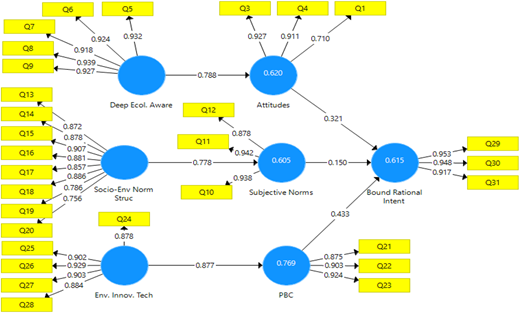
In this assessment, reliability, convergent validity and discriminant validity were examined. According to Hair et al. (2017), the minimum value of item loading, Cronbach's Alpha, composite reliability (CR) and average variance extracted (AVE) should be 0.70, 0.70, 0.70 and 0.50 to ensure item reliability, construct reliability and convergent validity of the constructs, respectively. In Table 2, it is observed that all four values exceed the recommended threshold levels. Thus, it is ensured that the construct reliability and convergent validity of the study are attained. In Figure 2, the path analysis based on the technique of PLS-SEM is presented.

Both the Fornell and Larcker (1981) method and the Heterotrait-Monotrait (HTMT) approach were applied to investigate discriminant validity, as provided in Table 3. The Fornell and Larcker method shows that the coefficient of correlation value of any cell is smaller than the square root of the AVE values in its corresponding row or column. Hence, the discriminant validity was achieved (Hair et al., 2017). The HTMT approach recommends that all the ratio values be less than 0.85 (Hair et al., 2017). The HTMT approach shows that all the ratio values are less than 0.85. Thus, it is sufficient to show that discriminant validity is attained.

This assessment followed five steps as directed by Hair et al. (2017). Overall results of the assessment are presented in Table 4. Firstly, the multicollinearity test was done. In this assessment, the VIF (variance inflation factor) values were checked. Table 4 shows that all VIF values are below 3.30. Hence, it is clear that there is no multicollinearity problem in the present study, according to the guidance provided by Kock and Lynn (2012).

Secondly, path values are examined using the bootstrapping technique with 5,000 resamples. As provided in Table 4, it is evident that all the path relationships are positively significant at the p-value of 0.000, except the path between SNs and BRI, which is positively significant at the p-value of 0.20. Hence, these outcomes indicate that all the hypotheses are supported.

Thirdly, the explanatory power of the predictors of the dependent variables in terms of the coefficient of determination (R2) was evaluated. As represented in Table 4, it shows that all four R2 values for attitude, SNs, PBC and BRI are 0.620, 0.605, 0.769 and 0.615, respectively, which indicate that the models have substantial explanatory power.

Fourthly, the effect size was checked by determining the value of f2, as guided by Hair et al. (2017). According to their recommendations, the f2 values of 0.02, 0.15 and 0.35 are considered as trivial, mediocre and substantial effects, respectively (Cohen, 1988). They illustrate that all the independent variables have substantial effects on their corresponding dependent variables except one trivial effect of SNs on BRI.

Finally, the predictive relevance (Q2) of the model was determined following the guidelines of Henseler, Ringle, and Sinkovics (2009). According to Hair et al. (2017), if the Q2 value is more than zero, the underlying model is considered to have predictive relevance. As depicted in Table 4, all the Q2 values are much larger than zero, which indicates that the predictive relevance is substantially strong.

Green and climate finance is a type of financial activity in which banks strive to conduct their everyday operations as conscientious members of society by taking internal and external environmental sustainability into consideration. The current study is an empirical effort to comprehend the factors influencing bankers' BRI toward green and climate financing behavior. Based on the underlying theory of the bounded rationality, namely TBRPB, the study examined the structural influence of DEA, SENS and IET on attitudes, SNs and PBC control respectively, and then examined the impact of attitudes, SNs and PBC on BRI toward G&C financing in Bangladesh.

The model evaluated in this study shows that all the hypothesized relationships are statistically significant. Specifically, bankers' DEA positively influences their attitudes toward BRI. This outcome is consistent with the results of previous studies, such as Fuji (2006). In turn, positive attitude, in turn, directly and significantly influences BRI toward G&C financing. The statistical influence of SENS on SNs is positive and significant. These findings are supported by previous studies, such as Nasar, Kamarudin, Rizal, Ngoc, and Shoaib (2019), Tunҫel and Betül (2021) and Ashraf et al. (2019), which indicate that the knowledge, beliefs and attitudes of bankers regarding green and climate finance practices positively impact the diverse sources of green financing, contributing to sustainable economic development in Bangladesh. Consequently, it can be inferred that green and climate finance practices, which encompass employee-related practices, are essential for the advancement of sustainable financing within private commercial banks in Bangladesh (Chen et al., 2022).

The analyses demonstrate that subjective norms related to G&C financing positively influence BRI toward G&C financing. This indicates that the intention toward G&C financing behavior under bounded rationality is the consequence of the environmental normative structure (SENS), specifically the influence of people involved in the decision-making process. This result is supported by the findings of several previous scholarly works in different fields (Choukir, Aloulou, Ayadi, & Mseddi, 2019; Dalila, Latif, Jaafar, Aziz, & Afthanorhan, 2020; Eid, Badewi, Selim, & El-Gohary, 2019). The hypothesized positive influence of IET on PBC is statistically significant. This means that bankers have abilities that can enhance their ultimate behavioral control when performing G&C financing activities under bounded rationality. This structural link has is consistent with the findings of past studies in different domains (Doanh & Bernat, 2019). Finally, the study shows that BRI toward G&C financing is a function of PBC and this result is consistent with previous empirical evidence (Zaremohzzabieh et al., 2019). Thus, it can be concluded that commercial banking activities exert both direct and indirect influences banks’ green project financing and environmental performance, due to their role in facilitating sustainable development within the country (Chen et al., 2022).

As the study uses TBRPB to examine bankers' intentions toward G&C financing, its findings have several research and practical implications. From the standpoint of research implications, the theory has provided a strong theoretical foundation in several contexts, such as the examination of intention toward organic food purchase (Ratan et al., 2021), f-commerce (Ashraf et al., 2021), green financing (Asma, 2021) and halal food purchase (Ashraf, 2019). The idea of bounded rationality has also been used in network marketing (Kiet & Kim, 2008) and in digital shopping (Massad & Berardelli, 2016). Among the three antecedents of G&C financing intention, attitudes and PBC were found to be highly significant, but SNs were less significant at the 0.05 level. The effect of SNs on intention has been found to be generally weaker than the influence of attitude (Ham, Jeger, & Ivkovi_C, 2015). These outcomes are also similar to the assertions in the TPB and the TBRPB models in which researchers have also observed a weaker link between SNs and intention (Ajzen, 1991; Ashraf, 2015; Chen et al., 2022)

The overall findings of the research present significant practical implications for researchers, academics, managers, bankers, government officials, financial institutions and investors in Bangladesh, with the aim of promoting G&C-financing in environmentally sustainable projects and improving banks’ environmental performance. Initially, the empirical findings suggest that G&C-financing initiatives positively influence the environmental performance of banks. Therefore, banking regulators ought to prioritize the enhancement of G&C-financing initiatives in their daily operations by providing online banking services, options for online bill payments, remote deposit capabilities, mobile banking, green debit and credit cards and similar services to improve the environmental performance of banks.

Furthermore, the empirical data indicate that the relationship between green banking practices and banks' environmental performance was significantly mediated by green funding. Therefore, banking institutions should allocate more funds to eco-friendly projects including waste management, green industry development, renewable energy, alternative energy sources and energy efficiency projects in order to improve their environmental performance. The country's pursuit of sustainable economic development and the accomplishment of the Sustainable Development Goals (SDGs) will benefit from the banking authorities’ rigorous supervision of private commercial banks' financing operations. Hence, to protect and make our environment greener, we must take some practical initiatives that focus on businesses and relevant centers, emphasize environmental factors and implement greening efforts at the corporate level

Although the current study contributes to understanding the G&C financing intention of bankers in a developing country like Bangladesh, it has a few limitations. First, the study considers DEA as an antecedent of the attitude of bankers toward G&C financing activities. Future studies can explore other variables related to environmental problems to examine G&C financing adoption and practices. Second, this study considers only bankers as survey respondents to assess G&C financing intention. In the future, bank clients and investors could be included in the survey to study G&C financing practices. Third, this research was conducted in a developing-country context. Future research can replicate the research model in developed countries. Finally, the current study used the TBRPB model as its theoretical base. In the future, scholars can expand on our findings by examining the long-term impacts and various contextual elements that affect the link between intentions, actions and performance. Our research provides a basis for future investigations into enhancing environmental strategies alongside sustainable financial tools and specific contextual elements, thus advancing the growing discipline of sustainable finance and promoting environmentally conscious business practices.
Ajzen
,
I.
(
1991
).
The theory of planned behaviour
.
Organizational Behaviour and Human Decision Processes
,
50
(
2
),
179
–
211
. doi: .
Akomea-Frimpong
,
I.
,
Adeabah
,
D.
,
Ofosu
,
D.
, &
Tenakwah
,
E. J.
(
2021
).
A review of studies on green finance of banks, research gaps and future directions
.
Journal of Sustainable Finance and Investment
,
12
(
4
),
1241
–
1264
. doi: .
Amidjaya
,
P. G.
, &
Widagdo
,
A. K.
(
2019
).
Sustainability reporting in Indonesian listed banks: Do corporate governance, ownership structure and digital banking matter?
.
Journal of Applied Accounting Research
,
21
(
2
),
231
–
247
. doi: .
Anderson
,
J. C.
, &
Gerbing
,
D. W.
(
1988
).
Structural equation modeling in practice: A review and recommended two-step approach
.
Psychological Bulletin
,
103
(
3
),
411
–
423
. doi: .
Ashraf
,
M. A.
(
2015
), “
Explaining the factors that affect nonparticipation of microfinance using TPB among the rural poor in Bangladesh
”.
A Doctoral Thesis, University Utara Malaysia, Malaysia
.
Ashraf
,
M. A.
(
2018
).
Use of bounded rationality theory to understand participation of women in Islamic microfinance
.
Enterpreneurship Development and Microfinance
,
29
(
3/4
),
186
–
208
.
Ashraf
,
M. A.
(
2019
).
Consumer behaviour in halal food purchase in Bangladesh: An analysis using SEM
.
Journal of Islamic Marketing
,
10
(
3
),
893
–
910
.
Ashraf
,
M. A.
(
2023
).
Theory of Islamic planned behaviour: Applying to investors’ sukuk purchase intention
.
Journal of Islamic Accounting and Business Research
,
14
(
4
),
554
–
573
. doi: .
Ashraf
,
M. A.
, &
Hoque
,
S. M. S.
(
2023
).
Islamic reasoned action: An Islamic behavioral model in the case of Islamic microfinance model in Bangladesh
.
Journal of Economic Cooperation and Development
,
44
(
2
),
1
–
18
.
Ashraf
,
M. A.
,
Joarder
,
M. H. R.
, &
Ratan
,
S. R. A.
(
2019
).
Consumers’ anti-consumption behavior toward organic food purchase: An analysis using SEM
.
British Food Journal
,
121
(
1
),
104
–
122
. doi: .
Ashraf
,
M. A.
,
Alam
,
M. M. D. A.
, &
Lidia
,
A.
(
2021
).
Making decision with an alternative mind-set: Predicting entrepreneurial intention toward f-commerce in a cross-country context
.
Journal of Retailing and Consumer Services
,
60
(
1
), 102475. doi: .
Aslam
,
W.
and
Jawaid
,
S. T.
(
2022
), “
Green banking adoption practices: Improving environmental, financial, and operational performance
”,
International Journal of Ethics and Systems, Pre-print
.
Asma
,
D. N.
(
2021
), “
Determinants of behavioural intention toward green banking: From student’s perspective
”,
M.A. Thesis, Department of Economics, United International University, Dhaka, Bangladesh
.
Azhgaliyeva
,
D.
, &
Liddle
,
B.
(
2020
).
Introduction to the special issue: Scaling up green finance in Asia
.
Journal of Sustainable Finance and Investment
,
10
(
2
),
83
–
91
.
Bandura
,
A.
(
2006
). Guide for constructing self-efficacy scales. In
F.
 
Pajares
, &
T. C.
 
Urdan
(Eds.),
Self-efficacy beliefs of adolescents
(pp. 
307
–
337
).
United States of America
:
Information Age Publishing
.
Basha
,
M. B.
,
Masson
,
C.
,
Shamsudin
,
M. F.
,
Hussain
,
H. I.
, &
Salem
,
A. S.
(
2015
).
Consumers attitude towards organic food
.
Procedia Economics and Finance
,
31
,
444
–
452
. doi: .
Basil
,
D. Z.
,
Basil
,
A. M.
, &
Deshpande
,
S.
(
2020
).
Toward developing an environmental efficacy construct
.
Journal of Social Marketing
,
10
(
1
),
1
–
17
.
Becheur
,
I.
, &
Das
,
A.
(
2018
),
From elicitation to persuasion: Assessing the structure and effectiveness of differential emotions in anti-drunk-driving campaigns
.
Journal of Promotion Management
,
24
(
1
),
83
–
102
. doi: .
Botzen
,
W. J. W.
,
Thepaut
,
L. D.
, &
Banerjee
,
S.
(
2025
).
Kahneman’s insights for climate risks: Lessons from bounded rationality, heuristics and Biases
.
Environmental and Resource Economics
,
88
(
10
),
2663
–
2688
. doi: .
Chen
,
J.
,
Siddik
,
A. B.
,
Zheng
,
G. -W.
,
Masukujjaman
,
M.
, &
Bekhzod
,
S.
(
2022
).
The effect of green banking practices on banks’ environmental performance and green financing: An empirical study
.
Energies
,
15
(
4
),
1292
. doi: .
Chin
,
M. Y.
,
Ong
,
S. L.
,
Ooi
,
D. B.
, &
Puah
,
C. H.
(
2022
),
The impact of green finance on environmental degradation in BRI region
.
Environment, Development and Sustainability
,
17
:
1
–
16
,
2022 Oct, PMID: 36277420; PMCID: PMC9575646
. doi:
Choukir
,
J.
,
Aloulou
,
W. J.
,
Ayadi
,
F.
, &
Mseddi
,
S.
(
2019
),
Influences of role models and gender on Saudi Arabian freshman students’ entrepreneurial intention
.
International Journal of Gender and Entrepreneurship
,
11
(
2
),
186
–
206
. doi: .
Cohen
,
J.
(
1988
).
Statistical power analysis for the behavioural sciences
( (2nd ed.) ).
Hilldale NJ
:
Routledge
.
Dalila
,
D.
,
Latif
,
H.
,
Jaafar
,
N.
,
Aziz
,
I.
, &
Afthanorhan
,
A.
(
2020
).
The mediating effect of personal values on the relationships between attitudes, subjective norms, perceived behavioural control and intention to use
.
Management Science Letters
,
10
(
1
),
153
–
162
. doi: .
Doanh
,
D. C.
, &
Bernat
,
T.
(
2019
).
Entrepreneurial self-efficacy and intention among Vietnamese students: A meta-analytic path analysis based on the theory of planned behavior
.
Procedia Computer Science
,
159
,
2447
–
2460
. doi: .
Eid
,
R.
,
Badewi
,
A.
,
Selim
,
H.
, &
El-Gohary
,
H.
(
2019
).
Integrating and extending competing intention models to understand the entrepreneurial intention of senior university students
.
Education + Training
,
61
(
2
),
234
–
254
. doi: .
Fishbein
,
M.
, &
Ajzen
,
I.
(
1975
).
Belief, attitude, intention, and behavior: An introduction to theory and research
.
Reading, MA
:
Addison-Wesley
.
Fornell
,
C.
, &
Larcker
,
D. F.
(
1981
).
Structural equation models with unobservable variables and measurement error
.
Journal of Marketing Research
,
18
(
1
),
39
–
50
. doi: .
Fuji
,
S.
(
2006
).
Environmental concern, attitude toward frugality, and ease of behavior as determinants of pro-environmental behavior intentions
.
Journal of Environmental Psychology
,
26
,
262
–
268
.
George
,
J. F.
(
2004
).
The theory of planned behavior and internet purchasing
.
Internet Research
,
14
(
3
),
198
–
212
. doi: .
Hair
,
J. F.
,
Hult
,
G. T. M.
,
Ringle
,
C. M.
, &
Sarstedt
,
M.
(
2017
).
A primer on partial last squares structural equation modeling
.
Thousand Oaks: California
:
Sage
.
Ham
,
M.
,
Jeger
,
M.
, &
Ivkovi_C
,
A. F.
(
2015
).
The role of subjective norms in forming the intention to purchase green food
.
Economic Research-Ekonomska Istraživanja
,
28
(
1
),
738
–
748
. doi: .
Henseler
,
J.
,
Ringle
,
C. M.
, &
Sinkovics
,
R. R.
(
2009
).
The use of partial least squares path modeling in international marketing
.
Advance in Internernational Marketing
,
20
,
277
–
320
.
Jahanger
,
A.
,
Usman
,
M.
,
Murshed
,
M.
,
Mahmood
,
H.
, &
Balsalobre-Lorente
,
D.
(
2022
).
The linkages between natural resources, human capital, globalization, economic growth, financial development, and ecological footprint: The moderating role of technological innovations
.
Resources Policy
,
76
, 102569. doi: .
Jiang
,
T.
,
Yu
,
Y.
,
Jahanger
,
A.
, &
Balsalobre-Lorente
,
D.
(
2022
).
Structural emissions reduction of China’s power and heating industry under the goal of ‘double carbon’: A perspective from input-output analysis
.
Sustainable Production and Consumption
,
31
,
346
–
356
. doi: .
Jugert
,
P.
,
Greenaway
,
K. H.
,
Barth
,
M.
,
Büchner
,
R.
,
Eisentraut
,
S.
, &
Fritsche
,
I.
(
2016
).
Collective efficacy increases pro-environmental intentions through increasing self-efficacy
.
Journal of Environmental Psychology
,
48
,
12
–
23
.
Khan
,
M. A.
,
Riaz
,
H.
,
Ahmed
,
M.
, &
Saeed
,
A.
(
2021
).
Does green finance really deliver what is expected? An empirical perspective
.
Borsa Istanbul Review
,
22
(
3
),
586
–
593
. doi: .
Kiet
,
H. A. T.
, &
Kim
,
B. J.
(
2008
),
Network marketing with bounded rationality and partial information
.
Physica A: Statistical Mechanics and its Applications
,
387
(19/20)
,
4896
-
4902
.
Kock
,
N.
, &
Lynn
,
G.
(
2012
).
Lateral collinearity and misleading results in variance-based SEM: An illustration and recommendations
.
Journal of the Association for Information Systrms
,
13
(
7
),
546
–
580
. doi: .
Ma
,
M.
,
Zhu
,
X.
,
Liu
,
M.
, &
Huang
,
X.
(
2023
).
Combining the role of green finance and environmental sustainability on green economic growth: Evidence from G-20 economies
.
Renewable Energy
,
207
,
128
–
136
. doi: .
Madsen
,
P.
(
2023
).
Deep ecology
,
Available from:
 Link to the website
Massad
,
V. J.
, &
Berardelli
,
K.
(
2016
),
The roles of bounded rationality and ethical self- efficacy in online shopping orientation
.
Academy of Marketing Studies Journal
,
20
(
3
),
26
.
Mol
,
J. M.
,
Botzen
,
W. J. W.
,
Blasch
,
J. E.
,
Kranzler
,
E. C.
, &
Kunreuther
,
H. C.
(
2024
).
All by myself? Testing descriptive social norm-nudges to increase flood preparedness among homeowners
.
Behavorial Public Policy
,
8
(
1
),
121
–
153
. doi: .
Nasar
,
A.
,
Kamarudin
,
S.
,
Rizal
,
A. M.
,
Ngoc
,
V. T. B.
, &
Shoaib
,
S. M.
(
2019
).
Short-Term and long-term entrepreneurial intention comparison between Pakistan and Vietnam
.
Sustainability
,
11
(
23
),
6529
. doi: .
Pu
,
Z.
, &
Yang
,
M.
(
2022
).
The impact of city commercial banks’ expansion on China’s regional energy efficiency
.
Economic Analysis and Policy
,
73
,
10
–
28
. doi: .
Ratan
,
S. R. A.
,
Ashraf
,
M. A.
,
Tat
,
H. H.
, &
Latiff
,
A. S. A.
(
2021
).
Effects of food safety and perceived social support on mediating consumers’ attitude toward organic food purchase behaviour
.
Food Research
,
5
(
4
),
350
–
359
. doi: .
Rubbaniy
,
G.
,
Khalid
,
A. A.
,
Rizwan
,
M. F.
, &
Ali
,
S.
(
2022
).
Are ESG stocks safe-haven during COVID-19?
.
Studies in Economics and Finance
,
39
(
2
),
239
–
255
. doi: .
Shaumya
,
K.
, &
Arulrajah
,
A.
(
2017
).
The impact of green banking practices on banks environmental performance: Evidence from Sri Lanka
.
Journal of Finance and Bank Management
,
5
(
1
),
77
–
90
. doi: .
Simon
,
H. A.
(
1957
).
Administrative Behavior: A Study of Decision-making Processes in Administrative Organization
( (Second Edition) ).
New York
:
Macmillan
.
Sun
,
H.
, &
Chen
,
F.
(
2022
),
The impact of green finance on China’s regional energy consumption structure based on system GMM
.
Resources Policy
,
76
(
C
), 102588. doi: .
Taylor
,
S.
, &
Todd
,
P. A.
(
1995
).
Assessing IT usage: The role of prior experience
.
MIS Quarterly
,
19
(
4
),
561
–
570
. doi: .
Thaker
,
J.
,
Howe
,
P.
,
Leiserowitz
,
A.
, &
Maibach
,
E.
(
2018
).
Perceived collective efficacy and trust in government influence with public engagement with climate change- related water conservation policies
.
Environmental Communication
,
13
(
5
),
681
–
699
. doi: .
Thøgersen
,
J.
,
De Barcellos
,
M. D.
,
Perin
,
M. G.
, &
Zhou
,
Y.
(
2015
).
Consumer buying motives and attitudes towards organic food in two emerging markets: China and Brazil
.
International Marketing Review
,
32
(
3/4
),
389
–
413
. doi: .
Tunҫel
,
N.
, &
Betül
,
E.
(
2021
). The impact of environmental concern on consumers’ attitude and intention toward electric vehicles: The role of demographic. In
U.
 
Akkucuk
(Ed.),
Descriptive Technologies and Ec-Innovation for Sustainable Development
(pp. 
245
–
267
).
Turkey
:
Boğaziҫi University
.
UNDP
(
2021
). National human development report 2021,
Advancing Human Development in Bangladesh-Looking Ahead
,
New York
.
Wang
,
P.
,
Liu
,
Q.
, &
Qi
,
Y.
(
2014
).
Factors influencing sustainable consumption behaviors: A survey of the rural residents in China
.
Journal of Cleaner Production
,
63
,
152
–
165
. doi: .
Weng
,
E. S.
,
Malyshev
,
S.
,
Lichstein
,
J. W.
,
Farrior
,
C. E.
,
Dybzinski
,
R.
,
Zhang
,
T.
, …
Pacala
,
S. W.
(
2015
).
Scaling from individual trees to forests in an Earth system modeling framework using a mathematically tractable model of height-structured competition
.
Biogeosciences
,
12
(
9
),
2655
–
2694
. doi: .
Wildfeuer
,
A. G.
(
2024
). Rationality and bounded rationality. In
J. C.
 
Chennattuserry
,
M.
 
Deshpande
, &
P.
 
Hong
(Eds.),
Encyclopedia of New Populism and Responses in the 21st Century
.
Singapore
:
Springer
. doi: .
Wolters
,
E. A.
, &
Steel
,
B. S.
(
2021
).
Environmental efficacy: Climate change beliefs, ideology, and public water policy preferences
.
International Journal of Environmental Research and Public Health
,
18
(
13
),
7000
. doi: .
Zaremohzzabieh
,
Z.
,
Ahrari
,
S.
,
Krauss
,
S. E.
,
Samah
,
A. A.
,
Meng
,
L. K.
, &
Ariffin
,
Z.
(
2019
).
Predicting social entrepreneurial intention: A meta-analytic path analysis based on the theory of planned behavior
.
Journal of Business Research
,
96
,
264
–
276
. doi: .
Zhang
,
X.
,
Wang
,
Z.
,
Zhong
,
X.
,
Yang
,
S.
, &
Siddik
,
A. B.
(
2022
).
Do green banking activities improve the banks’ environmental performance? The mediating effect of green financing
.
Sustainability
,
14
(
2
),
989
. doi: .
Zheng
,
G. W.
,
Siddik
,
A. B.
,
Masukujjaman
,
M.
,
Fatema
,
N.
, &
Alam
,
S. S.
(
2021
).
Green finance development in Bangladesh: The role of private commercial banks (PCBs)
.
Sustainability
,
13
(
2
),
795
. doi: .
Chen
,
S.
,
Huang
,
Z.
,
Drakeford
,
B. M.
, &
Failler
,
P.
(
2019
).
Lending interest rate, loaning scale, and government subsidy scale in green innovation
.
Energies
,
12
(
23
),
4431
. doi: .
Naes
,
A.
(
1972
).
Shallow and the deep. Long-range ecology movements: A summary
.
Inquiry
,
16
(
1
),
95
–
100
.
Rahman
,
S. A.
,
Alam
,
M. M. D.
, &
Taghizadeh
,
S. K.
(
2019
).
Do mobile financial services SENSure the subjective well-being of micro-entrepreneurs? An investigation applying UTAUT2 model
.
Information Technology for Development
,
1
–
24
.
Published in Arab Gulf Journal of Scientific Research. Published by Emerald Publishing Limited. This article is published under the Creative Commons Attribution (CC BY 4.0) licence. Anyone may reproduce, distribute, translate and create derivative works of this article (for both commercial and noncommercial purposes), subject to full attribution to the original publication and authors. The full terms of this licence may be seen at Link to the terms of the CC BY 4.0 licence.

Data & Figures

Figure 1
A diagram illustrating the research model for green and climate financing behavior.A diagram of the research model for green and climate financing behavior. The model includes several key components: Deep Ecological Awareness, Social and Environmental Normative Structure, Innovative Environmental Technology, Attitudes, Subjective Norms, Perceived Behavioral Control, and Bounded Rational Intention toward Green and Climate (G&C) financing. Deep Ecological Awareness positively influences Attitudes, which in turn positively influences Bounded Rational Intention toward G&C financing. Social and Environmental Normative Structure positively influences Subjective Norms, which also positively influences Bounded Rational Intention toward G&C financing. Innovative Environmental Technology positively influences Perceived Behavioral Control, which positively influences Bounded Rational Intention toward G&C financing. The diagram uses arrows to indicate the directional relationships between these components.

Research framework. Source: Authors' own work

Figure 1
A diagram illustrating the research model for green and climate financing behavior.A diagram of the research model for green and climate financing behavior. The model includes several key components: Deep Ecological Awareness, Social and Environmental Normative Structure, Innovative Environmental Technology, Attitudes, Subjective Norms, Perceived Behavioral Control, and Bounded Rational Intention toward Green and Climate (G&C) financing. Deep Ecological Awareness positively influences Attitudes, which in turn positively influences Bounded Rational Intention toward G&C financing. Social and Environmental Normative Structure positively influences Subjective Norms, which also positively influences Bounded Rational Intention toward G&C financing. Innovative Environmental Technology positively influences Perceived Behavioral Control, which positively influences Bounded Rational Intention toward G&C financing. The diagram uses arrows to indicate the directional relationships between these components.

Research framework. Source: Authors' own work

Close Figure 1
Figure 2
A diagram of path analysis showing relationships between various constructs.The diagram illustrates a path analysis model with several constructs represented by blue circles. These constructs include Deep Ecological Awareness, Attitudes, Subjective Norms, Bound Rational Intent, Perceived Behavioral Control, and Environmental Innovation Technology. Each construct is connected by arrows indicating the direction of influence or relationship. The constructs are linked to specific questions labeled in yellow boxes, with numerical values indicating the strength of these connections. For example, Deep Ecological Awareness is connected to questions Q6, Q7, Q8, and Q9 with values such as 0.924, 0.918, and 0.939. Similarly, Attitudes are linked to questions Q1, Q2, Q3, Q4, and Q5 with values like 0.927 and 0.911. Subjective Norms are connected to questions Q10, Q11, and Q12 with values including 0.942 and 0.878. Bound Rational Intent is linked to questions Q29, Q30, and Q31 with values such as 0.953 and 0.948.

Path analysis. Source: Authors' own work

Figure 2
A diagram of path analysis showing relationships between various constructs.The diagram illustrates a path analysis model with several constructs represented by blue circles. These constructs include Deep Ecological Awareness, Attitudes, Subjective Norms, Bound Rational Intent, Perceived Behavioral Control, and Environmental Innovation Technology. Each construct is connected by arrows indicating the direction of influence or relationship. The constructs are linked to specific questions labeled in yellow boxes, with numerical values indicating the strength of these connections. For example, Deep Ecological Awareness is connected to questions Q6, Q7, Q8, and Q9 with values such as 0.924, 0.918, and 0.939. Similarly, Attitudes are linked to questions Q1, Q2, Q3, Q4, and Q5 with values like 0.927 and 0.911. Subjective Norms are connected to questions Q10, Q11, and Q12 with values including 0.942 and 0.878. Bound Rational Intent is linked to questions Q29, Q30, and Q31 with values such as 0.953 and 0.948.

Path analysis. Source: Authors' own work

Close Figure 2
Table 1

Demographic profile of the respondents (n = 390)

VariablesPercentVariablesPercent
  Employee of 
Age Full Fledged Islamic Banks 
25 to 3027.0Islami Bank Bangladesh4.3
31 to 3533.2Al Arafah Islami Bank4.0
36 to 4026.0Social Islami bank4.0
>4013.8Standard Bank4.2
Gender Exim Bank4.7
Male65  
Female35First Security Islami Bank2.8
Marital Status Shahjalal Islami Bank3.0
Single21.5Union Bank4.8
Married78.2Global Islami Bank5.2
Separated/Divorced0.3Investment Corporation of Bangladesh Islami Bank9.1
  Banks Having Islami 
  Banking Branches 
Education Arab Bangladesh Bank3.6
Under-Graduate17.0City Bank2.7
Graduate70.8United Commercial Bank3,1
Post-Graduate22.2Pubali Bank4.8
Monthly Income (BDT) National Credit and Commerce Bank4.9
25,000–45,00038.3Prime Bank3.4
45,001–60,00042.1Southeast Bank3.1
60,001–90,00015.6Dhaka Bank3.3
Above 90,0004.0Mercantile Bank4.7
Religion One Bank5.0
Islam85.2Bangladesh Commerce Bank4.2
Hindu11.8Premier Bank3.0
Christian3.0Jamuna Bank2.0
Others0.0Bank Al Falah2.0
  Non-Resident Bangladesh Commercial Bank2.1
  Bengal Commercial Bank3.2
Source(s): Author’ own work
Table 2

Reliability and convergent validity

ConstructItemLoadingsαCRAVE
AttitudesQ1 Adoption of G&C finance is a good idea0.7100.8100.8890.731
 Q3 I like to adopt G&C finance and procedure0.927   
 Q4 Adoption of G&C finance will be pleasant0.911   
 Taylor and Todd (1995)     
BoundedQ29 I like to adopt G&C finance, because I care for our environment0.9530.9340.9580.883
RationalQ30 I intend to adopt G&C finance that can induce healthy living0.948   
IntentionQ31 I like to adopt G&C finance that can improve societal well-being0.917   
 Ashraf (2018)     
Deep EcologyQ5 G&C finance is reliable for us0.9320.9600.9690.861
AwarenessQ6 Taking care of the environment through G&C finance is a sound idea0.924   
 Q7 G&C finance is an innovative financial solution0.918   
 Q8 Starting up G&C finance is good to help save the environment0.914   
 Q9 G&C finance will help build up a sustainable environment0.927   
 Ashraf et al. (2019)     
InnovativeQ25 I would be able to implement green technology0.9020.9410.9550.809
EnvironmentalQ26 It is important to implement green technology0.929   
TechnologyQ27 I like to adopt Green technology, for I care for our environment0.903   
 Q28 I intend to adopt green tech. that can induce our healthy living0.884   
 Bandura (2006), Khan, Riaz, Ahmed, and Saeed (2021) & Chin, Ong, Ooi, and Puah (2022)     
Social & EnvQ13 My friends think that I should adopt G&C finance0.8720.9470.9560.730
Norm. StructureQ14 Generally speaking, I want to do what my friends think I should do0.878   
 Q15 My colleague think that I should adopt G&C finance0.907   
 Q16 Generally speaking, I want to do what my colleague think I should do0.881   
 Q17 My seniors think that I should adopt G&C finance0.857   
 Q18 Generally speaking, I want to do what my seniors think I should do0.886   
 Q19 My parents think that I should adopt G&C finance0.786   
 Q20 Generally speaking, I want to do what my parents think I should do0.756   
 Ashraf et al. (2019)     
PerceivedQ21 Adoption of G&C finance is entirely within my control0.8750.8840.9280.811
BehavioralQ22 I have the resources to adopt G&C finance0.903   
ControlQ23 I feel comfortable to adopt G&C finance0.924   
 Taylor and Todd (1995)     
SubjectiveQ10 My friends advise me to adopt G&C finance0.9380.9090.9430.846
NormsQ11 My seniors advise me to adopt G&C finance0.942   
 Q12 My parent advise me to adopt G&C finance0.878   
 Taylor and Todd (1995)     

Note(s): α = Cronbach's Alpha; CR=Composite Reliability; AVE = Average Variance Extracted

Source(s): Authors' own work
Table 3

Discriminant validity (Fornell and Larcker method)

ConstructATTBRIDEAEITSENSPBCSN
ATT0.855      
BRI0.6670.940     
DEA0.7880.7020.928    
IET0.5630.7620.6060.899   
SENS0.5950.5600.6090.6080.854  
PBC0.5690.7070.6060.8770.5710.901 
SN0.6670.6290.7660.6190.7780.6110.920
Heterotrait-Monotrait – HTMT Approach
ATT       
BRI0.765      
DEA0.8040.742     
IET0.6530.8130.640    
SENS0.6750.5930.6340.646   
PBC0.6710.7720.6550.8150.621  
SN0.7780.6830.8220.6720.829682 

Note(s): ATT = Attitude, BRI=Bounded Rational Intention, DEA = Deep Ecology Awareness, SENS= Social and Environmental Normative Structure, PBC= Perceived Behavioral Control, SN=Subjective Norm, IET= Innovative Environmental technology. Italic diagonal elements in the upper panel represent square-roots of the constructs' AVEs

Source(s): Authors' own work
Table 4

Outputs of the structural path analyses

HsRelationshipBetaStand. Errort-valueSupportedR2f2Q2VIF
Direct effects
H1DEA → ATT0.7880.03820.491***Yes0.6201.6340.4481.000
H2ATT → BRI0.3210.0664.844***Yes0.6150.1370.5341.949
H3SENS → SN0.7780.03721.194***Yes0.6051.5310.5071.000
H4SN → BRI0.1500.0652.323*Yes 0.028 2.104
H5IET → PBC0.8770.02338.149***Yes0.7693.3230.6171.000
H6PBC → BRI0.4330.0696.238***Yes 0.282 1.726
Indirect effects
H7DEA→ATT→BRI0.2530.0574.436***Yes    
H8IET→PBC→BRI0.3800.0655.860***Yes    
H9SENS→SN→BRI0.1170.0512.290*Yes    

Note(s): *p < 0.05; ***p < 0.001

ATT = Attitude, BRI=Bounded Rational Intention, DE = Deep Ecological Awareness, SENS= Social and Environmental Normative Structure, PBC=Perceived Behavioral Control, SN=Subjective Norm, EIT = Environmental Innovative technology

Source(s): Authors' own work

Supplements

References

Ajzen
,
I.
(
1991
).
The theory of planned behaviour
.
Organizational Behaviour and Human Decision Processes
,
50
(
2
),
179
–
211
. doi: .
Akomea-Frimpong
,
I.
,
Adeabah
,
D.
,
Ofosu
,
D.
, &
Tenakwah
,
E. J.
(
2021
).
A review of studies on green finance of banks, research gaps and future directions
.
Journal of Sustainable Finance and Investment
,
12
(
4
),
1241
–
1264
. doi: .
Amidjaya
,
P. G.
, &
Widagdo
,
A. K.
(
2019
).
Sustainability reporting in Indonesian listed banks: Do corporate governance, ownership structure and digital banking matter?
.
Journal of Applied Accounting Research
,
21
(
2
),
231
–
247
. doi: .
Anderson
,
J. C.
, &
Gerbing
,
D. W.
(
1988
).
Structural equation modeling in practice: A review and recommended two-step approach
.
Psychological Bulletin
,
103
(
3
),
411
–
423
. doi: .
Ashraf
,
M. A.
(
2015
), “
Explaining the factors that affect nonparticipation of microfinance using TPB among the rural poor in Bangladesh
”.
A Doctoral Thesis, University Utara Malaysia, Malaysia
.
Ashraf
,
M. A.
(
2018
).
Use of bounded rationality theory to understand participation of women in Islamic microfinance
.
Enterpreneurship Development and Microfinance
,
29
(
3/4
),
186
–
208
.
Ashraf
,
M. A.
(
2019
).
Consumer behaviour in halal food purchase in Bangladesh: An analysis using SEM
.
Journal of Islamic Marketing
,
10
(
3
),
893
–
910
.
Ashraf
,
M. A.
(
2023
).
Theory of Islamic planned behaviour: Applying to investors’ sukuk purchase intention
.
Journal of Islamic Accounting and Business Research
,
14
(
4
),
554
–
573
. doi: .
Ashraf
,
M. A.
, &
Hoque
,
S. M. S.
(
2023
).
Islamic reasoned action: An Islamic behavioral model in the case of Islamic microfinance model in Bangladesh
.
Journal of Economic Cooperation and Development
,
44
(
2
),
1
–
18
.
Ashraf
,
M. A.
,
Joarder
,
M. H. R.
, &
Ratan
,
S. R. A.
(
2019
).
Consumers’ anti-consumption behavior toward organic food purchase: An analysis using SEM
.
British Food Journal
,
121
(
1
),
104
–
122
. doi: .
Ashraf
,
M. A.
,
Alam
,
M. M. D. A.
, &
Lidia
,
A.
(
2021
).
Making decision with an alternative mind-set: Predicting entrepreneurial intention toward f-commerce in a cross-country context
.
Journal of Retailing and Consumer Services
,
60
(
1
), 102475. doi: .
Aslam
,
W.
and
Jawaid
,
S. T.
(
2022
), “
Green banking adoption practices: Improving environmental, financial, and operational performance
”,
International Journal of Ethics and Systems, Pre-print
.
Asma
,
D. N.
(
2021
), “
Determinants of behavioural intention toward green banking: From student’s perspective
”,
M.A. Thesis, Department of Economics, United International University, Dhaka, Bangladesh
.
Azhgaliyeva
,
D.
, &
Liddle
,
B.
(
2020
).
Introduction to the special issue: Scaling up green finance in Asia
.
Journal of Sustainable Finance and Investment
,
10
(
2
),
83
–
91
.
Bandura
,
A.
(
2006
). Guide for constructing self-efficacy scales. In
F.
 
Pajares
, &
T. C.
 
Urdan
(Eds.),
Self-efficacy beliefs of adolescents
(pp. 
307
–
337
).
United States of America
:
Information Age Publishing
.
Basha
,
M. B.
,
Masson
,
C.
,
Shamsudin
,
M. F.
,
Hussain
,
H. I.
, &
Salem
,
A. S.
(
2015
).
Consumers attitude towards organic food
.
Procedia Economics and Finance
,
31
,
444
–
452
. doi: .
Basil
,
D. Z.
,
Basil
,
A. M.
, &
Deshpande
,
S.
(
2020
).
Toward developing an environmental efficacy construct
.
Journal of Social Marketing
,
10
(
1
),
1
–
17
.
Becheur
,
I.
, &
Das
,
A.
(
2018
),
From elicitation to persuasion: Assessing the structure and effectiveness of differential emotions in anti-drunk-driving campaigns
.
Journal of Promotion Management
,
24
(
1
),
83
–
102
. doi: .
Botzen
,
W. J. W.
,
Thepaut
,
L. D.
, &
Banerjee
,
S.
(
2025
).
Kahneman’s insights for climate risks: Lessons from bounded rationality, heuristics and Biases
.
Environmental and Resource Economics
,
88
(
10
),
2663
–
2688
. doi: .
Chen
,
J.
,
Siddik
,
A. B.
,
Zheng
,
G. -W.
,
Masukujjaman
,
M.
, &
Bekhzod
,
S.
(
2022
).
The effect of green banking practices on banks’ environmental performance and green financing: An empirical study
.
Energies
,
15
(
4
),
1292
. doi: .
Chin
,
M. Y.
,
Ong
,
S. L.
,
Ooi
,
D. B.
, &
Puah
,
C. H.
(
2022
),
The impact of green finance on environmental degradation in BRI region
.
Environment, Development and Sustainability
,
17
:
1
–
16
,
2022 Oct, PMID: 36277420; PMCID: PMC9575646
. doi:
Choukir
,
J.
,
Aloulou
,
W. J.
,
Ayadi
,
F.
, &
Mseddi
,
S.
(
2019
),
Influences of role models and gender on Saudi Arabian freshman students’ entrepreneurial intention
.
International Journal of Gender and Entrepreneurship
,
11
(
2
),
186
–
206
. doi: .
Cohen
,
J.
(
1988
).
Statistical power analysis for the behavioural sciences
( (2nd ed.) ).
Hilldale NJ
:
Routledge
.
Dalila
,
D.
,
Latif
,
H.
,
Jaafar
,
N.
,
Aziz
,
I.
, &
Afthanorhan
,
A.
(
2020
).
The mediating effect of personal values on the relationships between attitudes, subjective norms, perceived behavioural control and intention to use
.
Management Science Letters
,
10
(
1
),
153
–
162
. doi: .
Doanh
,
D. C.
, &
Bernat
,
T.
(
2019
).
Entrepreneurial self-efficacy and intention among Vietnamese students: A meta-analytic path analysis based on the theory of planned behavior
.
Procedia Computer Science
,
159
,
2447
–
2460
. doi: .
Eid
,
R.
,
Badewi
,
A.
,
Selim
,
H.
, &
El-Gohary
,
H.
(
2019
).
Integrating and extending competing intention models to understand the entrepreneurial intention of senior university students
.
Education + Training
,
61
(
2
),
234
–
254
. doi: .
Fishbein
,
M.
, &
Ajzen
,
I.
(
1975
).
Belief, attitude, intention, and behavior: An introduction to theory and research
.
Reading, MA
:
Addison-Wesley
.
Fornell
,
C.
, &
Larcker
,
D. F.
(
1981
).
Structural equation models with unobservable variables and measurement error
.
Journal of Marketing Research
,
18
(
1
),
39
–
50
. doi: .
Fuji
,
S.
(
2006
).
Environmental concern, attitude toward frugality, and ease of behavior as determinants of pro-environmental behavior intentions
.
Journal of Environmental Psychology
,
26
,
262
–
268
.
George
,
J. F.
(
2004
).
The theory of planned behavior and internet purchasing
.
Internet Research
,
14
(
3
),
198
–
212
. doi: .
Hair
,
J. F.
,
Hult
,
G. T. M.
,
Ringle
,
C. M.
, &
Sarstedt
,
M.
(
2017
).
A primer on partial last squares structural equation modeling
.
Thousand Oaks: California
:
Sage
.
Ham
,
M.
,
Jeger
,
M.
, &
Ivkovi_C
,
A. F.
(
2015
).
The role of subjective norms in forming the intention to purchase green food
.
Economic Research-Ekonomska Istraživanja
,
28
(
1
),
738
–
748
. doi: .
Henseler
,
J.
,
Ringle
,
C. M.
, &
Sinkovics
,
R. R.
(
2009
).
The use of partial least squares path modeling in international marketing
.
Advance in Internernational Marketing
,
20
,
277
–
320
.
Jahanger
,
A.
,
Usman
,
M.
,
Murshed
,
M.
,
Mahmood
,
H.
, &
Balsalobre-Lorente
,
D.
(
2022
).
The linkages between natural resources, human capital, globalization, economic growth, financial development, and ecological footprint: The moderating role of technological innovations
.
Resources Policy
,
76
, 102569. doi: .
Jiang
,
T.
,
Yu
,
Y.
,
Jahanger
,
A.
, &
Balsalobre-Lorente
,
D.
(
2022
).
Structural emissions reduction of China’s power and heating industry under the goal of ‘double carbon’: A perspective from input-output analysis
.
Sustainable Production and Consumption
,
31
,
346
–
356
. doi: .
Jugert
,
P.
,
Greenaway
,
K. H.
,
Barth
,
M.
,
Büchner
,
R.
,
Eisentraut
,
S.
, &
Fritsche
,
I.
(
2016
).
Collective efficacy increases pro-environmental intentions through increasing self-efficacy
.
Journal of Environmental Psychology
,
48
,
12
–
23
.
Khan
,
M. A.
,
Riaz
,
H.
,
Ahmed
,
M.
, &
Saeed
,
A.
(
2021
).
Does green finance really deliver what is expected? An empirical perspective
.
Borsa Istanbul Review
,
22
(
3
),
586
–
593
. doi: .
Kiet
,
H. A. T.
, &
Kim
,
B. J.
(
2008
),
Network marketing with bounded rationality and partial information
.
Physica A: Statistical Mechanics and its Applications
,
387
(19/20)
,
4896
-
4902
.
Kock
,
N.
, &
Lynn
,
G.
(
2012
).
Lateral collinearity and misleading results in variance-based SEM: An illustration and recommendations
.
Journal of the Association for Information Systrms
,
13
(
7
),
546
–
580
. doi: .
Ma
,
M.
,
Zhu
,
X.
,
Liu
,
M.
, &
Huang
,
X.
(
2023
).
Combining the role of green finance and environmental sustainability on green economic growth: Evidence from G-20 economies
.
Renewable Energy
,
207
,
128
–
136
. doi: .
Madsen
,
P.
(
2023
).
Deep ecology
,
Available from:
 Link to the website
Massad
,
V. J.
, &
Berardelli
,
K.
(
2016
),
The roles of bounded rationality and ethical self- efficacy in online shopping orientation
.
Academy of Marketing Studies Journal
,
20
(
3
),
26
.
Mol
,
J. M.
,
Botzen
,
W. J. W.
,
Blasch
,
J. E.
,
Kranzler
,
E. C.
, &
Kunreuther
,
H. C.
(
2024
).
All by myself? Testing descriptive social norm-nudges to increase flood preparedness among homeowners
.
Behavorial Public Policy
,
8
(
1
),
121
–
153
. doi: .
Nasar
,
A.
,
Kamarudin
,
S.
,
Rizal
,
A. M.
,
Ngoc
,
V. T. B.
, &
Shoaib
,
S. M.
(
2019
).
Short-Term and long-term entrepreneurial intention comparison between Pakistan and Vietnam
.
Sustainability
,
11
(
23
),
6529
. doi: .
Pu
,
Z.
, &
Yang
,
M.
(
2022
).
The impact of city commercial banks’ expansion on China’s regional energy efficiency
.
Economic Analysis and Policy
,
73
,
10
–
28
. doi: .
Ratan
,
S. R. A.
,
Ashraf
,
M. A.
,
Tat
,
H. H.
, &
Latiff
,
A. S. A.
(
2021
).
Effects of food safety and perceived social support on mediating consumers’ attitude toward organic food purchase behaviour
.
Food Research
,
5
(
4
),
350
–
359
. doi: .
Rubbaniy
,
G.
,
Khalid
,
A. A.
,
Rizwan
,
M. F.
, &
Ali
,
S.
(
2022
).
Are ESG stocks safe-haven during COVID-19?
.
Studies in Economics and Finance
,
39
(
2
),
239
–
255
. doi: .
Shaumya
,
K.
, &
Arulrajah
,
A.
(
2017
).
The impact of green banking practices on banks environmental performance: Evidence from Sri Lanka
.
Journal of Finance and Bank Management
,
5
(
1
),
77
–
90
. doi: .
Simon
,
H. A.
(
1957
).
Administrative Behavior: A Study of Decision-making Processes in Administrative Organization
( (Second Edition) ).
New York
:
Macmillan
.
Sun
,
H.
, &
Chen
,
F.
(
2022
),
The impact of green finance on China’s regional energy consumption structure based on system GMM
.
Resources Policy
,
76
(
C
), 102588. doi: .
Taylor
,
S.
, &
Todd
,
P. A.
(
1995
).
Assessing IT usage: The role of prior experience
.
MIS Quarterly
,
19
(
4
),
561
–
570
. doi: .
Thaker
,
J.
,
Howe
,
P.
,
Leiserowitz
,
A.
, &
Maibach
,
E.
(
2018
).
Perceived collective efficacy and trust in government influence with public engagement with climate change- related water conservation policies
.
Environmental Communication
,
13
(
5
),
681
–
699
. doi: .
Thøgersen
,
J.
,
De Barcellos
,
M. D.
,
Perin
,
M. G.
, &
Zhou
,
Y.
(
2015
).
Consumer buying motives and attitudes towards organic food in two emerging markets: China and Brazil
.
International Marketing Review
,
32
(
3/4
),
389
–
413
. doi: .
Tunҫel
,
N.
, &
Betül
,
E.
(
2021
). The impact of environmental concern on consumers’ attitude and intention toward electric vehicles: The role of demographic. In
U.
 
Akkucuk
(Ed.),
Descriptive Technologies and Ec-Innovation for Sustainable Development
(pp. 
245
–
267
).
Turkey
:
Boğaziҫi University
.
UNDP
(
2021
). National human development report 2021,
Advancing Human Development in Bangladesh-Looking Ahead
,
New York
.
Wang
,
P.
,
Liu
,
Q.
, &
Qi
,
Y.
(
2014
).
Factors influencing sustainable consumption behaviors: A survey of the rural residents in China
.
Journal of Cleaner Production
,
63
,
152
–
165
. doi: .
Weng
,
E. S.
,
Malyshev
,
S.
,
Lichstein
,
J. W.
,
Farrior
,
C. E.
,
Dybzinski
,
R.
,
Zhang
,
T.
, …
Pacala
,
S. W.
(
2015
).
Scaling from individual trees to forests in an Earth system modeling framework using a mathematically tractable model of height-structured competition
.
Biogeosciences
,
12
(
9
),
2655
–
2694
. doi: .
Wildfeuer
,
A. G.
(
2024
). Rationality and bounded rationality. In
J. C.
 
Chennattuserry
,
M.
 
Deshpande
, &
P.
 
Hong
(Eds.),
Encyclopedia of New Populism and Responses in the 21st Century
.
Singapore
:
Springer
. doi: .
Wolters
,
E. A.
, &
Steel
,
B. S.
(
2021
).
Environmental efficacy: Climate change beliefs, ideology, and public water policy preferences
.
International Journal of Environmental Research and Public Health
,
18
(
13
),
7000
. doi: .
Zaremohzzabieh
,
Z.
,
Ahrari
,
S.
,
Krauss
,
S. E.
,
Samah
,
A. A.
,
Meng
,
L. K.
, &
Ariffin
,
Z.
(
2019
).
Predicting social entrepreneurial intention: A meta-analytic path analysis based on the theory of planned behavior
.
Journal of Business Research
,
96
,
264
–
276
. doi: .
Zhang
,
X.
,
Wang
,
Z.
,
Zhong
,
X.
,
Yang
,
S.
, &
Siddik
,
A. B.
(
2022
).
Do green banking activities improve the banks’ environmental performance? The mediating effect of green financing
.
Sustainability
,
14
(
2
),
989
. doi: .
Zheng
,
G. W.
,
Siddik
,
A. B.
,
Masukujjaman
,
M.
,
Fatema
,
N.
, &
Alam
,
S. S.
(
2021
).
Green finance development in Bangladesh: The role of private commercial banks (PCBs)
.
Sustainability
,
13
(
2
),
795
. doi: .
Chen
,
S.
,
Huang
,
Z.
,
Drakeford
,
B. M.
, &
Failler
,
P.
(
2019
).
Lending interest rate, loaning scale, and government subsidy scale in green innovation
.
Energies
,
12
(
23
),
4431
. doi: .
Naes
,
A.
(
1972
).
Shallow and the deep. Long-range ecology movements: A summary
.
Inquiry
,
16
(
1
),
95
–
100
.
Rahman
,
S. A.
,
Alam
,
M. M. D.
, &
Taghizadeh
,
S. K.
(
2019
).
Do mobile financial services SENSure the subjective well-being of micro-entrepreneurs? An investigation applying UTAUT2 model
.
Information Technology for Development
,
1
–
24
.

Languages

or Create an Account

Close subscription notice
Close access options
