Skip to article sections
Purpose

Artificial intelligence (AI) is transforming medical education, enhancing knowledge acquisition, teaching, assessment, and curriculum delivery. While AI offers the potential to democratise access and improve inclusivity, little is known about how equity is addressed in AI-enabled medical education. This scoping review maps current evidence, identifies gaps, and provides insights for equitable implementation.

Design/methodology/approach

A scoping review was conducted following the Joanna Briggs Institute methodology. Peer-reviewed literature was identified through MEDLINE, Evidence-Based Medicine Reviews (Health Technology Assessment), Health and Psychosocial Instruments and Global Health. Screening, data extraction, and thematic analysis were performed by multiple reviewers. Quantitative data were summarised descriptively, and qualitative data were synthesised to identify narrative themes.

Findings

Of 256 records identified, 80 full-text articles were reviewed, and 35 studies were included. Most were published between 2022 and 2025 and originated predominantly from high-income countries. AI applications focused on large language models (48%), with curriculum design (49%) being the most common area of focus. Equity themes were: (1) equitable access (demographic, geographic, and distributed learning disparities); (2) bias (algorithmic, cultural, and socioeconomic); and (3) AI literacy (limited curricular exposure and preparedness).

Originality/value

Previous literature reviews have examined AI and its ethical use in medical education, but not through an equity lens. This scoping review highlights that medical education is at a pivotal juncture, shaped by converging imperatives: inclusivity and the rapid evolution of AI. To expand access and standardisation, equitable implementation requires AI literacy, contextually relevant tools, and active bias mitigation. Future research should prioritise inclusive, contextually appropriate, and accessible AI interventions across medical education.

Artificial intelligence (AI) is rapidly transforming how both healthcare and medical education are delivered (Ahsan, 2025; Duan et al., 2025; Greengrass, 2024). Over the past decade, AI has evolved from early adoption to become an embedded, accepted, and integral component of medical education (Gordon et al., 2024). Currently, AI is used across many areas, including student selection, knowledge acquisition, teaching modalities, assessment, curriculum design and delivery, and administrative processes (Duan et al., 2025; Gordon et al., 2024). AI is not only a transformative tool for teaching and learning, but a core competency that future medical practitioners need to master (Greengrass, 2024).

Several broad scoping and narrative literature reviews have examined how AI is being applied and its ethical use in medical education (Ahsan, 2025; Gordon et al., 2024; Rincón et al., 2025). However, few have focused on issues surrounding equitable access. Gordon et al. (2024) emphasised the importance of collaboration between educators, policymakers, and AI developers to ensure “AI tools are available to all without bias” (Gordon et al., 2024). Despite this, their review did not explicitly evaluate included studies through an equity lens (Gordon et al., 2024). Similarly, Ahsan et al. (2025) and Rincón et al. (2025) did not focus on equity but raised concerns that AI favours high-resource settings, exacerbating existing disparities in medicine and widening the gap for underrepresented groups (Ahsan, 2025; Rincón et al., 2025). Key issues included limited technological infrastructure, financial constraints, biased datasets, poor connectivity in rural areas and limited support for educators and students in effective use (Ahsan, 2025; Akefe et al., 2025; Rincón et al., 2025). However, if purposefully implemented, with attention to geographical needs, resource availability and cultural context, AI has the capacity to enhance and democratise accessibility and equity in medical education (Ahsan, 2025; Bray et al., 2025; Rincón et al., 2025).

Equity is the state in which everyone has a fair and just opportunity (Organisation for Economic Co-operation and Development, 2012). Efforts to create a more equitable medical profession have led to strategies aimed at widening access and participation for diverse, underrepresented, and disadvantaged groups to study medicine (Fuller et al., 2025; George et al., 2025). These strategies vary and are shaped by unique cultural, geographic, economic and political contexts (George et al., 2025). Educating a more diverse cohort of medical professionals will help to ensure the workforce is representative of the communities they serve, which is anticipated to address workforce shortages and enhance health outcomes (Fuller et al., 2025; George et al., 2025). Widening access and participation are two separate yet interconnected concepts; widening access refers to reducing barriers to admission to medical school (opening the door), while widening participation ensures that the medical education is delivered in an inclusive teaching environment, which is accessible and appropriate for diverse and underrepresented populations (Akefe et al., 2025; Case, 2025; George et al., 2025).

AI offers the potential to widen access and participation in medicine by enhancing learning opportunities and making education more inclusive across diverse contexts (Ahsan, 2025; Akefe et al., 2025). Yet, despite its promise, there remains a limited literature synthesis addressing equitable access within AI-enabled medical education. This scoping review seeks to map existing approaches, therefore, identify gaps, and generate insights that can guide equitable implementation across a range of educational, cultural, and geographic settings.

This paper followed the Joanna Briggs Institute scoping review methodology, which is grounded in the foundational work of Askey and O'Malley (2005) and subsequently refined by Levac et al. (2010) (Arksey and O'Malley, 2005; Levac et al., 2010; M. Peters et al., 2024). The methodology comprised a five-step process (1) identifying the research question, (2) identifying relevant studies, (3) study selection, (4) charting the data and (5) collating, summarising and reporting the results (Arksey and O'Malley, 2005; Levac et al., 2010; M. Peters et al., 2024).

The scoping review aimed to capture a breadth of literature; hence, the broad question “what is known regarding equitable access to AI and medical education” was used to develop the search strategy.

The eligibility/inclusion criteria were defined using the PCC (Population, Concept, Context) framework, as recommended for scoping reviews (Aromataris and Munn, 2019).

  1. Population: Medical undergraduate or medical postgraduate degree (pre-professional registration).

  2. Concept: Equitable access to AI in medical education.

  3. Context: Any setting related to tertiary or higher education institutions globally, providing training to become a medical practitioner (pre-professional registration).

A comprehensive search strategy was developed to identify relevant peer-reviewed literature. The final search was conducted on August 27, 2025, across four major electronic databases: MEDLINE, Evidence-Based Medicine Reviews–Health Technology Assessment, Health and Psychosocial Instruments and Global Health. These databases were selected for their broad coverage of medical education literature.

The search strategy included a combination of controlled vocabulary (e.g. MeSH terms) and free-text terms. Keywords included, but were not limited to:

  1. “Equity”

  2. “Access”

  3. “Medical Education”

  4. “Artificial Intelligence”

Boolean operators (AND, OR) were used to combine search terms, and filters were applied to limit results to English-language publications. No date restrictions were applied to ensure the inclusivity of older foundational studies, as well as recent developments.

The inclusion and exclusion criteria used for study selection are summarised in Table 1.

The full search strategy, including specific database queries, is available in the Supplementary Material ( Appendix).

All search results were exported into a reference management software (EndNote) (Clarivate, 2023), duplicates were removed and thereafter exported to Covidence (Veritas Health Innovation, 2021). Title and abstract screening were conducted independently by two reviewers (JB and NW) using the predefined eligibility criteria (Table 1). If consensus could not be reached at this stage, the full text was reviewed.

For studies deemed potentially relevant, the full texts were retrieved and assessed for inclusion (JB, NW, CC, CM, JM, EM). Discrepancies during the full-text screening stage were resolved through discussion with a third reviewer (JB, JM, CM), who provided an independent opinion to ensure consistency and reduce bias.

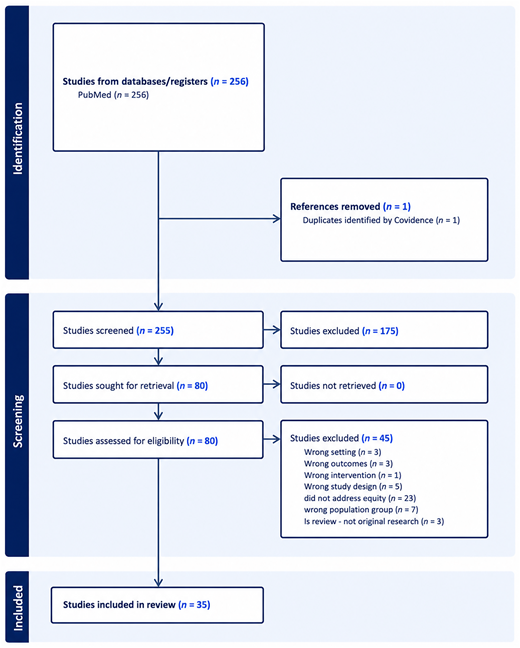
The Preferred Reporting Items for Systematic Reviews and Meta-Analyses extension for Scoping Reviews (PRISMA-ScR) flow diagram illustrates the study selection process, including the number of records identified, screened, included, and excluded, along with the reasons for exclusion (Tricco et al., 2018) (Figure 1).

A standardised data charting form was developed and piloted across a sample of five studies to ensure clarity and relevance. The charting process was iterative and flexible, allowing for the refinement of data items as familiarity with the literature deepened. The authors collaboratively reviewed and agreed upon the final data extraction table.

The following data were extracted from each study: Bibliographic information, study design and methodology, geographic location and institutional context, study population characteristics, type of AI, and context of AI and equity in medical education.

All data were independently extracted by one reviewer (JB) and cross-verified for accuracy by other reviewers (JM, NW). Any inconsistencies were resolved through consensus or consultation with a third reviewer.

Quantitative and qualitative analyses were undertaken to collate and map the data. Descriptive statistics were used to collate the quantitative data. Qualitative thematic analysis was employed to develop relevant themes to address the objective of the scoping review. Notable patterns, facilitators, barriers, and research gaps were highlighted to inform future research directions and policy implications. Given the scoping nature of this review, no formal quality appraisal or risk of bias assessment was conducted (Peters et al., 2024).

The search results yielded 256 studies for full-text screening (August 2025), with one duplicate removed (Figure 1). After abstract and title screening, 80 studies remained for full-text review. Following further evaluation against the inclusion and exclusion criteria, 45 studies were excluded. The primary reason for exclusion was the absence of a focus on equity (n = 23). Other reasons included ineligible population group (n = 7), ineligible study design (n = 5), ineligible population setting (n = 3), outcomes did not align with the focus (n = 3), was not original research (n = 3), and intervention was outside the inclusion criteria (n = 1) (Figure 1).

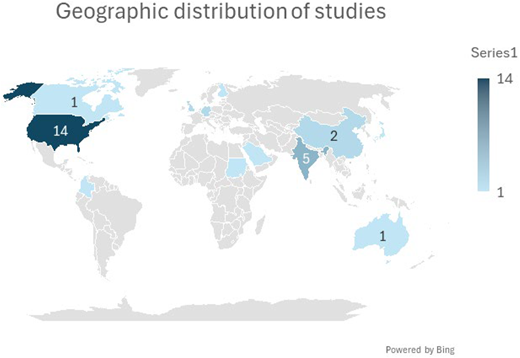
Table 2 presents a quantitative description of the included studies. Of the studies reviewed, 97% (n = 34) were published between 2022 and 2025, with 51% (n = 18) in 2025. The studies originated from 16 countries, with the largest proportion (40%, n = 14) from the United States of America (USA). India contributed the second-highest number of studies (14%, n = 5). Notably, 66% of the countries were represented by a single study (Figure 2).

A variety of study methodologies were employed, with 29% (n = 10) case-based or educational intervention studies. The next most common methodology was comparative performance/observational studies (23%, n = 8), followed by commentary/perspective pieces (20%, n = 7). Most studies (54%, n = 19) involved participant-based research, with “medical students only” being the most studied group (37%, n = 13).

The types of AI investigated were categorised into eight categories. As individual studies sometimes referenced more than one type of AI, a total of 48 instances of AI types were identified. Large Language Models (LLM), particularly iterations of ChatGPT, were the most common category (48%, n = 23) followed by Machine Learning (15%, n = 7).

The areas of medical education 21’ studies most frequently addressed were curriculum-related topics (49%, n = 17), followed by general or non-specific themes (23%, n = 8), and distributed learning (14%, n = 5) (Table 2). Notably, only one study included an equity-related term (socio-economic disparities) in the study keywords (Monzon and Hays, 2025), and one included an equity-related term in the article title (disparities) (Mishra et al., 2025) (Table 3).

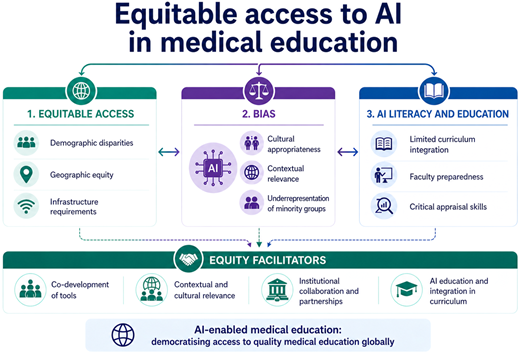
Three overarching equity-related themes were identified across the included studies: (1) equitable access, (2) bias and (3) AI literacy and education, with many studies addressing multiple themes (Table 3, Figure 3). Within equitable access, sub-themes related to demographics (e.g. socioeconomic status, gender, culturally and linguistically diverse (CALD)) and geography (e.g. low resource settings, urban–rural disparities). Within bias, sub-themes centred on algorithmic bias (e.g. cultural appropriateness, under-representation of minority groups). AI literacy and education were underpinned by curriculum development. Across all themes, the literature highlighted facilitators and barriers, along with recommendations to support more equitable integration of AI into medical education.

Access through an equity lens was described as both a facilitator and a barrier to democratising medical education globally, with concepts of demographic, geographic, and distributed learning often overlapping.

3.3.1 Demographic access

Demographic access included gender, CALD and socio-economic measures such as income. Studies that focused on gender reported contrasting results (Ahmed et al., 2025; Jebreen et al., 2024; Mashburn et al., 2025; Sunmboye et al., 2025). Two studies conducted in low- and middle-income countries (LMICs) reported gender-related disparities, with female students demonstrating lower levels of knowledge and access to LLMs and reporting less favourable perceptions of AI compared to their male counterparts (Ahmed et al., 2025; Jebreen et al., 2024). In contrast, a German study found females had higher self-rated confidence after using an LLM compared to males and employed different problem-solving techniques, e.g. more fact checking of the LLM (Mashburn et al., 2025). This latter finding was reinforced by a United Kingdom study that found female students exhibited a higher level of concern regarding inaccuracies in AI-generated content, and therefore were more likely to engage in behaviours aimed at mitigating these risks (Sunmboye et al., 2025).

Access to AI for CALD populations was framed in two ways: by its ability to bridge existing educational divides, but also as a source of concern that it could exacerbate existing access inequities. One study stated English literacy as a major barrier, noting that English is the de facto standard academic language globally (Biri et al., 2023). However, another study found that Generative AI facilitated more equitable access by successfully translating medical education resources into users' first language (Shimizu et al., 2023). Despite this, other studies raised equity concerns due to LLMs lower accuracy on non-English examinations, reflecting their English-dominant training data and limited handling of linguistic nuances (Cherif et al., 2024; Meyer et al., 2024). AI has the potential to reduce medical education disparities for CALD populations, provided that issues of language accessibility and appropriateness are addressed and collaborative contextual adaptation of AI tools occurs (Jagannath et al., 2025; Spallek et al., 2023). For example, Spallek et al. (2023) highlight that when LLM educational resources are specifically developed for and co-designed with specific population groups, such as Aboriginal and Torres Strait Islander students in Australia, they have a higher acceptability and ability to meet their needs (Spallek et al., 2023).

Costs surrounding AI were another conflicting concept (Ahmed et al., 2025; Divito et al., 2024; Rueff et al., 2025; Scherr et al., 2023). Medical students from low-socioeconomic backgrounds were found to be less likely to use LLMs (Ahmed et al., 2025), with one study addressing this issue by providing funding so all students had equitable access to a subscription version of an LLM (Rueff et al., 2025). It was noted that while some versions of LLM were cost-free, therefore more accessible, there were subscription versions of LLMs, which provide higher usage limits, and more sophisticated functionality. This may extend the divide amongst students based on their socio-economic background (Divito et al., 2024; Scherr et al., 2023).

3.3.2 Geographic access

Studies highlighted the presence of a medical education divide both between and within countries, with AI seen as a facilitator and barrier to the global standardisation of medical education (Biri et al., 2023; Divito et al., 2024; Jagannath et al., 2025; Ma et al., 2023; Mishra et al., 2025; Mondal, 2025; Noel, 2024; Pu et al., 2025; Theros et al., 2025). Studies used terms such as developing countries (Biri et al., 2023; Pu et al., 2025), underdeveloped regions (Ma et al., 2023), low-resource settings (Divito et al., 2024; Jagannath et al., 2025; Mishra et al., 2025; Mondal et al., 2024; Noel, 2024; Theros et al., 2025) and rural areas (Ahmed et al., 2025; Bray et al., 2025) when describing geographic settings of interest. Collaboration and sharing of AI platforms between institutions with formal partnerships or open-access globally were deemed to be an important facilitator to bridging this divide (Jagannath et al., 2025; Theros et al., 2025; Yli-Hallila et al., 2025). For example, one study described a virtual microscopy platform that was developed collaboratively and shared between institutions, providing an accessible standardised resource that had functionality for context-specific adaptation (Yli-Hallila et al., 2025).

While the accessibility of AI tools was generally seen as positive, due to their low cost, availability of internet access, and the abundance of available information, this was not universal across geographic regions (Biri et al., 2023; Divito et al., 2024; Jebreen et al., 2024; Kıyak and Kononowicz, 2024; Ma et al., 2023; Mishra et al., 2025; Mondal et al., 2024; Noel, 2024; Pu et al., 2025; Theros et al., 2025; Yli-Hallila et al., 2025). For example, Jebreen et al. (2024) surveyed Palestinian medical students' perceptions of AI in the curriculum, finding strong support for its inclusion but noting major barriers to its usage, due to limited access to technology, the internet, and electricity (Jebreen et al., 2024).

Distributed learning was categorised by hub and spoke models, where AI-enabled centralised teaching was accessed by remote learners (Ahmed et al., 2025; Bray et al., 2025; Caudell et al., 2003; Gin et al., 2025; Mondal et al., 2024; Mukadam et al., 2025; Scherr et al., 2023; Spear et al., 2022). This model was particularly relevant in rural areas (Ahmed et al., 2025; Bray et al., 2025; Gin et al., 2025; Mondal et al., 2024), in geographically distributed partner institutions (Caudell et al., 2003; Yli-Hallila et al., 2025), and for locations without a simulation centre (Scherr et al., 2023). It also addressed unequal access to a clinical setting during the COVID-19 pandemic (Spear et al., 2022).

A common application of distributed learning was the use of virtual patient simulations (Ahmed et al., 2025; Bray et al., 2025; Caudell et al., 2003; Mukadam et al., 2025). These were described as an effective supplement to traditional educational methods when access to standardised patients was limited. This facilitated learner engagement with a diverse, yet contextually appropriate patient population and enabled them to practice clinical scenarios (Ahmed et al., 2025; Mukadam et al., 2025).

Concerns relating to AI perpetuating existing biases in medical education were commonly associated with LLMs exhibiting algorithmic bias (Abouammoh et al., 2025; Bray et al., 2025; Cherif et al., 2024; Gin et al., 2025; Kıyak and Kononowicz, 2024; Laverde et al., 2025; Ma et al., 2023; Mashburn et al., 2025; Meyer et al., 2024; Monzon and Hays, 2025; Robleto et al., 2024; Sauder et al., 2024; Scherr et al., 2023; Sharma et al., 2025; Smirnova et al., 2025; Spallek et al., 2023; Theros et al., 2025; Xu et al., 2024). The type of algorithmic bias was not always transparently described (Monzon and Hays, 2025; Sauder et al., 2024; Sharma et al., 2025; Theros et al., 2025; Xu et al., 2024). However, when specified, biases included cultural (Abouammoh et al., 2025; Laverde et al., 2025; Meyer et al., 2024; Robleto et al., 2024; Spallek et al., 2023), geographic (Bray et al., 2025; Cherif et al., 2024), gender (Laverde et al., 2025; Spallek et al., 2023), social (Laverde et al., 2025; Ma et al., 2023; Mashburn et al., 2025; Robleto et al., 2024; Scherr et al., 2023) and age and disability (Robleto et al., 2024).

In AI-enhanced medical education, biases may emerge in contexts such as using LLMs to generate multiple-choice questions (Kıyak and Kononowicz, 2024), develop virtual patient chatbots (Laverde et al., 2025) and student self-directed learning (Meyer et al., 2024; Spallek et al., 2023). In studies that surveyed medical students about their perceptions of AI, concerns about the existence of biases were common, although detailed explanations were rarely provided (Abouammoh et al., 2025; Cherif et al., 2024; Mashburn et al., 2025; Robleto et al., 2024; Sharma et al., 2025; Xu et al., 2024).

Studies included recommendations on strategies to mitigate biases; these included raising students and educators awareness of the existence of algorithm bias (Mashburn et al., 2025; Sauder et al., 2024; Scherr et al., 2023; Sharma et al., 2025; Xu et al., 2024), collaboration between stakeholders and end users in model development (Gin et al., 2025; Monzon and Hays, 2025; Spallek et al., 2023), the implementation of monitoring and critical evaluation frameworks by universities (Gin et al., 2025; Robleto et al., 2024; Smirnova et al., 2025; Theros et al., 2025) and the development of context-specific Generative AI (Bray et al., 2025; Cherif et al., 2024; Kıyak and Kononowicz, 2024; Spallek et al., 2023). Addressing the latter strategy, Cherif et al. (2024) noted that the prevalence of Western-centric internet may not be representative of slight variations in clinical presentations and disease epidemiology in certain contexts, like African and Asian populations (Cherif et al., 2024).

3.4.1 AI literacy and education

Several studies recommended the critical need to improve AI literacy via education for both students and faculty (Ahmed et al., 2025; Gin et al., 2025; Jagannath et al., 2025; Sunmboye et al., 2025; Theros et al., 2025; Xu et al., 2024). Limited AI literacy was compounded by minimal exposure to AI within existing medical curricula (Jagannath et al., 2025; Ma et al., 2023; Theros et al., 2025). For example, a multi-institutional survey of medical students found that none of the participating universities had a formal AI education program (Jebreen et al., 2024). Another study found regional disparities, with students in lower resource settings less likely to have undertaken AI-related coursework, prompting authors to recommend a national initiative in AI curriculum design (Ma et al., 2023). Prior exposure to AI education appeared to have a protective effect against AI shortcomings, with these students more likely to critically review and verify AI-generated information (Xu et al., 2024).

Recommendations for integrating AI into curricula emphasised the importance of context-specific approaches that reflect population-specific AI usage (Abouammoh et al., 2025; Bray et al., 2025; Mashburn et al., 2025; Mondal, 2025). In low-resource settings, it was noted that, additional resources and infrastructure are required to support this (Ahmed et al., 2025; Jebreen et al., 2024). The breadth of AI literacy recommended to address equity concerns ranges from awareness of how LLMs generate information to the need to develop and teach skills such as computer coding (Ahmed et al., 2025; Gin et al., 2025).

In addition to curriculum design, studies also recommended that university AI policies include equity guidelines (Monzon and Hays, 2025; Rueff et al., 2025). To keep pace with the rapid evolution of AI, Rueff et al. (2025) presented a case study of a step-wise process of integrating national AI policy guidelines into the curriculum (Rueff et al., 2025). Faculty AI literacy was identified as critical, with recommendations including faculty supervision of AI models (Robleto et al., 2024) and faculty-led teaching on appropriate AI use (Sauder et al., 2024). Shimuzu et al. (2023) proposed a curriculum framework involving collaboration between students and faculty, highlighting the need to learn alongside Generative AI. They suggest that this would require a shift in cognitive domains from “know and understand” to “apply and analyse” (Shimizu et al., 2023).

The scoping review identified three overarching and intersecting equity themes across the literature: equitable access, bias, and AI literacy and education. Collectively, these findings illustrate a paradox: while AI offers unprecedented potential to democratise access, addressing long-standing barriers that have historically limited inclusivity and equity within medical education, it simultaneously risks reinforcing structural inequities embedded within educational and technological systems. This duality underscores the need for AI literacy and education that is contextual and equity-centred (Varsik and Vosberg, 2024). This pattern reflects the inverse equity hypothesis, whereby newly introduced innovations are initially adopted by wealthier or better-resourced groups, who typically have the least need, before eventually diffusing to more disadvantaged populations (Victora et al., 2000).

Consistent with this pattern, AI was commonly described as a mechanism to enhance access to learning and information across geographic boundaries, yet its benefits were often contingent on resource availability and contextualisation (Ahmed et al., 2025; Biri et al., 2023; Bray et al., 2025; Caudell et al., 2003; Divito et al., 2024; Gin et al., 2025; Jagannath et al., 2025; Jebreen et al., 2024; Kıyak and Kononowicz, 2024; Ma et al., 2023; Mishra et al., 2025; Mondal et al., 2024; Mukadam et al., 2025; Noel, 2024; Pu et al., 2025; Scherr et al., 2023; Spear et al., 2022; Theros et al., 2025; Yli-Hallila et al., 2025). This tension is particularly relevant for LMICs, where pre-existing inequities have been exacerbated by the delayed adoption and more limited integration of AI-enabled medical education compared to high-income countries (Ahsan, 2025; Naseer et al., 2025). In these contexts, limitations in digital infrastructure and local contextualisation are compounded by institutional readiness challenges, alongside the dominance of Western-centric internet resources and English as the de facto language of medicine (Ahsan, 2025; Jagannath et al., 2025). For example, an asynchronous AI course for medical students developed in the USA, with the explicit intention of improving access for learners from LMICs, was instead found to disadvantage non-English speakers, highlighting the potential of an unintended linguistic bias (Jagannath et al., 2025).

Taken together, these factors illustrate how well-intentioned digital education initiatives may inadvertently reproduce or exacerbate existing inequities. Addressing these challenges in LMICs requires not only alternative access models such as partnerships, targeted grants, and sustainable funding arrangements but also deliberate design choices that embed cultural competency and accessibility features from the outset (Jagannath et al., 2025; Kıyak and Kononowicz, 2024). In particular, collaborations between well-resourced and under-resourced institutions offer a pathway to co-develop AI tools that are locally adaptable, affordable, and contextually appropriate for LMIC settings (Kıyak and Kononowicz, 2024; Yli-Hallila et al., 2025). The predominance of studies from high-income countries in this scoping review further highlights the need for expanded research in LMIC contexts to support evidence-informed and contextually appropriate practice.

Moreover, despite the rapid growth of AI in medical education, equity-focused research remains peripheral within the literature. The scoping review confirms that medical education is positioned at a pivotal juncture, shaped by converging imperatives: the pursuit of greater inclusivity and the rapid evolution of AI (Akefe et al., 2025). The momentum of AI in this space is evident in publication trends, with over half (51%) of the included studies published in 2025. Notably, only one study incorporated an equity-related keyword (Monzon and Hays, 2025), and another referenced an equity term in the title (Mishra et al., 2025). Many studies instead examined AI integration more broadly, often referring to “underrepresented” students collectively or listing multiple groups without a focus on any specific equity population (Ahmed et al., 2025; Gin et al., 2025; Meyer et al., 2024). This lack of specificity limits the ability to generate targeted, actionable insights for particular equity populations.

Globally, there is no universal list of equity groups in medical education, as classifications vary by country and context (Jones et al., 2019; Lv et al., 2025). Equity groups of focus in the scoping review included females, CALD populations, students from low socio-economic backgrounds, rural background students, and First Nations students (Ahmed et al., 2025; Biri et al., 2023; Cherif et al., 2024; Jagannath et al., 2025; Jebreen et al., 2024; Kıyak and Kononowicz, 2024; Mashburn et al., 2025; Meyer et al., 2024; Mondal et al., 2024; Rueff et al., 2025; Scherr et al., 2023; Shimizu et al., 2023; Spallek et al., 2023; Sunmboye et al., 2025). Only one paper briefly mentioned students with a disability as an equity group (Robleto et al., 2024), and another explicitly excluded participants unable to use the provided AI hardware due to physical disability (Mukadam et al., 2025). This omission is notable given the potential of AI to support learning for students with disabilities, provided tools are designed for inclusivity (Varsik and Vosberg, 2024; Zhao et al., 2025). Another equity group notably absent from the reviewed literature were LGBTQIA + students, despite their recognition as a priority equity group in national medical education standards (Australian Medical Council, 2023). As with other underrepresented cohorts, LGBTQIA + learners face structural barriers within medical education (Wong et al., 2024). Moreover, heteronormative assumptions are deeply embedded in the language and data used to train AI models, risking the perpetuation of bias and misrepresentation (Wong et al., 2024).

Concerns regarding algorithmic bias were common across studies, with particular emphasis on how LLMs reflect and reinforce the assumptions embedded within their training data. Most AI platforms are trained before public release and do not update continuously, therefore any biases embedded in the training data will persist unless addressed by retraining or fine-tuning (Bhargava and Singhal, 2024; Qiu et al., 2025). At a fundamental level of AI literacy, students and faculty require education on the principles and mechanisms underpinning the development of LLMs (Ahmed et al., 2025; Sauder et al., 2024; Sunmboye et al., 2025).

AI literacy in medical education has been described as minimal, with both students and faculty requiring further support (Jebreen et al., 2024; Theros et al., 2025). Without adequate literacy, there is a risk of overreliance on AI tools and a lack of critical evaluation (Bearman and Ajjawi, 2025; Theros et al., 2025). Given the rapid pace of AI integration, medical schools need to prioritise embedding AI literacy into their curricula to ensure informed and equitable use. A proactive approach is warranted, as accreditation bodies internationally are increasingly recognising digital competence as an essential component of medical education and are likely to formalise such expectations in future standards (Australian Medical Council and Australian Digital Health Agency, 2021; Sapci and Sapci, 2020; Schubert et al., 2025).

Beyond literacy and education, the co-creation of contextually appropriate AI tools with students, faculty and priority equity groups is essential (Kıyak and Kononowicz, 2024; Yli-Hallila et al., 2025). Effective partnerships should encompass data governance, tool development, and ongoing monitoring to ensure inclusion and prevent inequitable outcomes (Jones et al., 2019; Spallek et al., 2023). Further research is needed to obtain contextually translatable evidence on how AI-enabled equitable tools can be co-developed and implemented effectively.

While much of the literature on geographic inequity is focused on LMICs, geographic disparities also persist within high-income countries (Bray et al., 2025; Caudell et al., 2003; Mondal et al., 2024). In this context, AI-enabled distributed learning has been shown to expand access for rural students, enabling them to remain in their communities without compromising educational quality (Bray et al., 2025; Caudell et al., 2003; Mondal et al., 2024; Mukadam et al., 2025). For instance, Bray et al. (2025) proposed that AI-powered tools, including virtual patient simulations, personalised learning platforms, clinical decision support systems, and automated performance evaluations, could transform rural medical education by democratising access to resources, standardising learning across regions, and providing tailored learning pathways (Bray et al., 2025).

These innovations are significant given the maldistribution of the medical workforce, which affects countries regardless of income level (World Health Organization, 2021). Rural communities consistently have experienced fewer doctors-to-population ratios compared to metropolitan areas (Fuller et al., 2025; Medical Deans Australia and New Zealand, 2024; World Health Organization, 2021). One key strategy to address this is to provide end-to-end medical training for students from rural backgrounds within their own communities (Fuller et al., 2025). Until recently, structural barriers, such as centralised pre-clinical education in metropolitan centres, have hindered this approach (Fuller et al., 2025; McGrail et al., 2023). In this context, AI-enabled distributed learning offers a potential mechanism to overcome these barriers, supporting more equitable, place-based training models without compromising educational quality.

As scoping reviews map and collate literature rather than critically appraise study quality, the included studies may have varied in research rigour (Peters et al., 2015). Furthermore, as included studies encompassed a broad range of methodologies, AI modalities, contexts and population groups, the ability to synthesise findings and draw generalisable conclusions may have been compromised. Restricting the search to English-language peer-reviewed literature may have excluded relevant studies in other languages, particularly from non-English speaking LMICs, potentially underrepresenting global perspectives and indicative of the high percentage of studies from high-income countries.

The scoping review relied on pre-defined search terms such as “equity” and “access,” but not all studies that address disparities or inclusivity explicitly used these terms. Consequently, some relevant studies may have been missed, and “access” alone does not necessarily indicate an equity focus. This limitation highlights the challenge of capturing the full breadth of literature on equity in AI-enabled medical education, particularly when terminology is inconsistent or context-specific.

Additionally, the rapid evolution of AI technologies and their integration into medical education means that some included studies may already be outdated, limiting the currency of the review findings. The COVID-19 pandemic also accelerated the adoption of digital and AI-enabled learning, and studies conducted before or during the pandemic may not fully capture post-pandemic educational practices and equity challenges. These factors should be considered when interpreting the generalisability of the findings.

AI presents unprecedented opportunities to widen access and participation in medicine for underrepresented groups and standardise medical education globally. Realising these benefits requires AI literacy, contextually relevant tools, and deliberate strategies to mitigate bias. Medical schools should prioritise embedding AI literacy and education into the curriculum for students and faculty in anticipation of international accreditation standards increasingly mandating AI competence. Future research should focus on developing and evaluating AI interventions that are inclusive, contextually appropriate, and widely accessible.Table A1 

We acknowledge the contributions of the Harnessing AI and Technology for Equitable and Ethical Medical Education project team, including John Turchini, Curtis Lee, and Lachlan McOmish, for their contributions to the development and implementation of the project, which provided the foundation for this work.
Abouammoh
,
N.
,
Alhasan
,
K.
,
Aljamaan
,
F.
,
Raina
,
R.
,
Malki
,
K.H.
,
Altamimi
,
I.
,
Muaygil
,
R.
,
Wahabi
,
H.
,
Jamal
,
A.
,
Alhaboob
,
A.
,
Assiri
,
R.A.
,
Al-Tawfiq
,
J.A.
,
Al-Eyadhy
,
A.
,
Soliman
,
M.
and
Temsah
,
M.-H.
(
2025
), “
Perceptions and earliest experiences of medical students and faculty with ChatGPT in medical education: qualitative study
”,
JMIR Medical Education
, Vol. 
11
, e63400, doi: .
Ahmed
,
W.M.M.
,
Abdalmotalib
,
M.M.
,
Elbadawi
,
M.H.
,
Mohammed
,
G.T.F.
,
Mohamed
,
W.M.I.
,
Mohammed
,
F.S.B.
,
Salih
,
H.S.
and
Mohamed
,
H.O.Y.
(
2025
), “
Shaping the future of medical education: a cross-sectional study on ChatGPT attitude and usage among medical students in Sudan
”,
PLoS One
, Vol. 
20
No. 
5
, e0324698, doi: .
Ahsan
,
Z.
(
2025
), “
Integrating artificial intelligence into medical education: a narrative systematic review of current applications, challenges, and future directions
”,
BMC Medical Education
, Vol. 
25
No. 
1
, p.
1187
, doi: .
Akefe
,
I.O.
,
Adegoke
,
V.A.
,
Akefe
,
E.
,
Schweitzer
,
D.
and
Bolaji
,
S.
(
2025
), “
An innovative approach to medical education: leveraging generative artificial intelligence to promote inclusion and support for indigenous students
”,
Trends in Higher Education
, Vol. 
4
No. 
3
, p.
36
, doi: .
Arksey
,
H.
and
O'Malley
,
L.
(
2005
), “
Scoping studies: towards a methodological framework
”,
International Journal of Social Research Methodology
, Vol. 
8
No. 
1
, pp. 
19
-
32
, doi: .
Aromataris
,
E.
and
Munn
,
Z.
(
2019
),
JBI Reviewer's Manual
,
JBI
. doi: .
Australian Medical Council
(
2023
), “
Guidance matrix – version 1 december 2023. (Supporting the 2023 standards for assessment and accreditation of primary medical programs)
”,
available at:
 Link to the website
Australian Medical CouncilAustralian Digital Health Agency
(
2021
), “
Horizon Paper: health Workforce Reform Leveraged through Medical Education and Accreditation: a review of the current and future directions of the AMC and its partners using the example of the health reform priority – building a digitally capable medical workforce
”,
available at:
 Link to the website
Bearman
,
M.
and
Ajjawi
,
R.
(
2025
), “
Artificial intelligence and gender equity: an integrated approach for health professional education
”,
Medical Education
, Vol. 
59
No. 
10
, pp. 
1049
-
1057
, doi: .
Bhargava
,
S.
and
Singhal
,
S.
(
2024
), “
Challenges, solutions, and best practices in post deployment monitoring of machine learning models
”,
International Journal of Computer Trends and Technology
, Vol. 
72
No. 
11
, pp. 
63
-
71
, doi: .
Biri
,
S.K.
,
Kumar
,
S.
,
Panigrahi
,
M.
,
Mondal
,
S.
,
Behera
,
J.K.
and
Mondal
,
H.
(
2023
), “
Assessing the utilization of large language models in medical education: insights from undergraduate medical students
”,
Cureus
, Vol. 
15
No. 
10
, e47468, doi: .
Bray
,
N.N.
,
Wheeler
,
D.
and
Zumwalt
,
J.
(
2025
), “
AI-enhanced rural medical education: bridging gaps and building trust
”,
Academic Medicine
, Vol. 
100
No. 
9S
, pp. 
S39
-
S42
, doi: .
Case
,
J.M.
(
2025
), “
Widening access and participation: exploring discourses in academic writing from the USA and the UK
”,
Higher Education
, Vol. 
90
No. 
2
, pp. 
355
-
369
, doi: .
Caudell
,
T.P.
,
Summers
,
K.L.
,
Holten
,
J.
,
Hakamata
,
T.
,
Mowafi
,
M.
,
Jacobs
,
J.
,
Lozanoff
,
B.K.
,
Lozanoff
,
S.
,
Wilks
,
D.
,
Keep
,
M.F.
,
Saiki
,
S.
and
Alverson
,
D.
(
2003
), “
Virtual patient simulator for distributed collaborative medical education
”,
Anatomical Record. Part B, New Anatomist
, Vol. 
270
No. 
1
, pp. 
23
-
29
, doi: .
Cherif
,
H.
,
Moussa
,
C.
,
Missaoui
,
A.M.
,
Salouage
,
I.
,
Mokaddem
,
S.
and
Dhahri
,
B.
(
2024
), “
Appraisal of ChatGPT's aptitude for medical education: comparative analysis with third-year medical students in a Pulmonology examination
”,
JMIR Medical Education
, Vol. 
10
, e52818, doi: .
Clarivate
(
2023
), “
Endnote
”,
(Version 21) [Computer software], available at:
 Link to the website
Divito
,
C.B.
,
Katchikian
,
B.M.
,
Gruenwald
,
J.E.
and
Burgoon
,
J.M.
(
2024
), “
The tools of the future are the challenges of today: the use of ChatGPT in problem-based learning medical education
”,
Medical Teacher
, Vol. 
46
No. 
3
, pp. 
320
-
322
, doi: .
Duan
,
S.
,
Liu
,
C.
,
Rong
,
T.
,
Zhao
,
Y.
and
Liu
,
B.
(
2025
), “
Integrating AI in medical education: a comprehensive study of medical students' attitudes, concerns, and behavioral intentions
”,
BMC Medical Education
, Vol. 
25
No. 
1
, p.
599
, doi: .
Fuller
,
L.
,
Beattie
,
J.
,
McGrail
,
M.R.
,
Versace
,
V.L.
and
Rogers
,
G.D.
(
2025
), “
Place-based rural health professional pre-registration education programs: a scoping review
”,
Frontiers of Medicine
, Vol. 
12
, 1546701, doi: .
George
,
R.E.
,
Dueñas
,
A.N.
,
Brown
,
M.E.L.
,
Oladipo
,
E.T.O.
,
Danquah
,
A.
,
Nadarajah
,
V.D.V.
,
Singaram
,
V.S.
,
Aitken
,
D.
and
Finn
,
G.M.
(
2025
), “
Aspiration to admission: widening access to medical education: AMEE Guide No. 181
”,
Medical Teacher
, Vol. 
47
No. 
10
, pp. 
1
-
12
, doi: .
Gin
,
B.C.
,
LaForge
,
K.
,
Burk-Rafel
,
J.
and
Boscardin
,
C.K.
(
2025
), “
Macy foundation innovation report Part II: from hype to reality: innovators' visions for navigating AI integration challenges in medical education
”,
Academic Medicine: Journal of the Association of American Medical Colleges
, Vol. 
100
No. 
1
, pp. 
S22
-
S29
, doi: .
Gordon
,
M.
,
Daniel
,
M.
,
Ajiboye
,
A.
,
Uraiby
,
H.
,
Xu
,
N.Y.
,
Bartlett
,
R.
,
Hanson
,
J.
,
Haas
,
M.
,
Spadafore
,
M.
,
Grafton-Clarke
,
C.
,
Gasiea
,
R.Y.
,
Michie
,
C.
,
Corral
,
J.
,
Kwan
,
B.
,
Dolmans
,
D.
and
Thammasitboon
,
S.
(
2024
), “
A scoping review of artificial intelligence in medical education: BEME Guide No. 84
”,
Medical Teacher
, Vol. 
46
No. 
4
, pp. 
446
-
470
, doi: .
Greengrass
,
C.
(
2024
), “
Navigating the AI revolution in medicine—adopting strategies for medical education
”,
Medical Science Educator
, Vol. 
35
No. 
2
, pp. 
1055
-
1061
, doi: .
Jagannath
,
P.
,
Perera
,
N.
,
Minton
,
L.
,
Bass
,
R.
,
Milner
,
D.
and
Perchik
,
J.
(
2025
), “
Increasing accessibility: effectiveness of a remote artificial intelligence education curriculum for international medical graduates
”,
The Clinical Teacher
, Vol. 
22
No. 
2
, e70047, doi: .
Jebreen
,
K.
,
Radwan
,
E.
,
Kammoun-Rebai
,
W.
,
Alattar
,
E.
,
Radwan
,
A.
,
Safi
,
W.
,
Radwan
,
W.
and
Alajez
,
M.
(
2024
), “
Perceptions of undergraduate medical students on artificial intelligence in medicine: mixed-methods survey study from Palestine
”,
BMC Medical Education
, Vol. 
24
No. 
1
, p.
507
, doi: .
Jones
,
R.
,
Crowshoe
,
L.
,
Reid
,
P.
,
Calam
,
B.
,
Curtis
,
E.
,
Green
,
M.
,
Huria
,
T.
,
Jacklin
,
K.
,
Kamaka
,
M.
,
Lacey
,
C.
,
Milroy
,
J.
,
Paul
,
D.
,
Pitama
,
S.
,
Walker
,
L.
,
Webb
,
G.
and
Ewen
,
S.
(
2019
), “
Educating for indigenous health equity: an international consensus statement
”,
Academic Medicine
, Vol. 
94
No. 
4
, pp. 
512
-
519
, doi: .
Kıyak
,
Y.S.
and
Kononowicz
,
A.A.
(
2024
), “
Case-based MCQ generator: a custom ChatGPT based on published prompts in the literature for automatic item generation
”,
Medical Teacher
, Vol. 
46
No. 
8
, pp. 
1018
-
1020
, doi: .
Laverde
,
N.
,
Grévisse
,
C.
,
Jaramillo
,
S.
and
Manrique
,
R.
(
2025
), “
Integrating large language model-based agents into a virtual patient chatbot for clinical anamnesis training
”,
Computational and Structural Biotechnology Journal
, Vol. 
27
, pp. 
2481
-
2491
, doi: .
Levac
,
D.
,
Colquhoun
,
H.
and
O'Brien
,
K.K.
(
2010
), “
Scoping studies: advancing the methodology
”,
Implementation Science
, Vol. 
5
No. 
1
, p.
69
, doi: .
Lv
,
G.
,
Jiang
,
X.
,
Franklin
,
J.
,
Li
,
M.
,
Yuan
,
J.
and
Lu
,
Z.K.
(
2025
), “
Diversity and equity in medical education over the past decade: applications, matriculations, and the growing gaps
”,
BMC Medical Education
, Vol. 
25
No. 
1
, p.
947
, doi: .
Ma
,
M.
,
Li
,
Y.
,
Gao
,
L.
,
Xie
,
Y.
,
Zhang
,
Y.
,
Wang
,
Y.
,
Zhao
,
L.
,
Liu
,
X.
,
Jiang
,
D.
,
Fan
,
C.
,
Wang
,
Y.
,
Demuyakor
,
I.
,
Jiao
,
M.
and
Li
,
Y.
(
2023
), “
The need for digital health education among next-generation health workers in China: a cross-sectional survey on digital health education
”,
BMC Medical Education
, Vol. 
23
No. 
1
, p.
541
, doi: .
Mashburn
,
P.
,
Weuthen
,
F.A.
,
Otte
,
N.
,
Krabbe
,
H.
,
Fernandez
,
G.M.
,
Kraus
,
T.
and
Krabbe
,
J.
(
2025
), “
Gender differences in the use of ChatGPT as generative artificial intelligence for clinical research and decision-making in occupational medicine
”,
Healthcare
, Vol. 
13
No. 
12
, p.
1394
, doi: .
McGrail
,
M.R.
,
Doyle
,
Z.
,
Fuller
,
L.
,
Gupta
,
T.S.
,
Shires
,
L.
and
Walters
,
L.
(
2023
), “
The pathway to more rural doctors: the role of universities
”,
Medical Journal of Australia
, Vol. 
219
No. 
S3
, pp. 
S8
-
S13
, doi: .
Medical Deans Australia and New Zealand
(
2024
), “
Position paper: thriving rural doctors: place-based solutions to medical workforce challenges in remote, rural and regional Australia and New Zealand
”,
available at:
 Link to the website
Meyer
,
E.G.
,
Linsenmeyer
,
M.
,
Holzhausen
,
Y.
,
Yap
,
M.
,
Ryan
,
M.S.
and
Chen
,
H.C.
(
2024
), “Use of entrustable professional activities in pre-licensure health professions education”, in
Ten Cate
,
O.
,
Burch
,
V.C.
,
Chen
,
H.C.
,
Chou
,
F.C.
and
Hennus
,
M.P.
(Eds),
Entrustable Professional Activities and Entrustment Decision-Making in Health Professions Education
,
Ubiquity Press
, pp. 
145
-
156
, doi: .
Mishra
,
V.H.
,
Dudhane
,
R.
,
Noman
,
O.
and
Sani
,
T.A.
(
2025
), “
The impact of artificial intelligence on reducing disparities in access to quality medical education globally
”,
The Nigerian Postgraduate Medical Journal
, Vol. 
32
No. 
3
, p.
271
, doi: .
Mondal
,
H.
(
2025
), “
Ethical engagement with artificial intelligence in medical education
”,
Advances in Physiology Education
, Vol. 
49
No. 
1
, pp. 
163
-
165
, doi: .
Mondal
,
H.
,
De
,
R.
,
Mondal
,
S.
and
Juhi
,
A.
(
2024
), “
A large language model in solving primary healthcare issues: a potential implication for remote healthcare and medical education
”,
Journal of Education and Health Promotion
, Vol. 
13
No. 
1
, p.
362
, doi: .
Monzon
,
N.
and
Hays
,
F.A.
(
2025
), “
Leveraging generative artificial intelligence to improve motivation and retrieval in higher education learners
”,
JMIR Medical Education
, Vol. 
11
, e59210, doi: .
Mukadam
,
A.
,
Suresh
,
S.
and
Jacobs
,
C.
(
2025
), “
Beyond traditional simulation: an exploratory study on the effectiveness and acceptability of ChatGPT-4o advanced voice mode for communication skills practice among medical students
”,
Cureus
, Vol. 
17
No. 
5
, e84381, doi: .
Naseer
,
M.A.
,
Saeed
,
S.
,
Afzal
,
A.
,
Ali
,
S.
and
Malik
,
M.G.R.
(
2025
), “
Navigating the integration of artificial intelligence in the medical education curriculum: a mixed-methods study exploring the perspectives of medical students and faculty in Pakistan
”,
BMC Medical Education
, Vol. 
25
No. 
1
, p.
273
, doi: .
Noel
,
G.P.J.C.
(
2024
), “
Evaluating AI-powered text-to-image generators for anatomical illustration: a comparative study
”,
Anatomical Sciences Education
, Vol. 
17
No. 
5
, pp. 
979
-
983
, doi: .
Organisation for Economic Co-operation and Development
(
2012
),
Equity and Quality in Education: Supporting Disadvantaged Students and Schools
,
OECD Publishing
, doi: .
Peters
,
M.D.J.
,
Godfrey
,
C.M.
,
Khalil
,
H.
,
McInerney
,
P.
,
Parker
,
D.
and
Soares
,
C.B.
(
2015
), “
Guidance for conducting systematic scoping reviews
”,
JBI Evidence Implementation
, Vol. 
13
No. 
3
, pp. 
141
-
146
, doi: .
Peters
,
M.
,
Godfrey
,
C.
,
McInerney
,
P.
,
Munn
,
Z.
,
Tricco
,
A.C.
and
Khalil
,
H.
(
2024
), “Scoping reviews”, in
Aromataris
,
E.
,
Lockwood
,
C.
,
Porritt
,
K.
and
Jordan
,
Z.
(Eds),
JBI Manual for Evidence Synthesis
,
JBI
,
available at:
 Link to the website
Pu
,
J.
,
Hong
,
J.
,
Yu
,
Q.
,
Yu
,
P.
,
Tian
,
J.
,
He
,
Y.
,
Huang
,
H.
,
Yuan
,
Q.
,
Tao
,
L.
and
Peng
,
Z.
(
2025
), “
Accuracy, satisfaction, and impact of custom GPT in acquiring clinical knowledge: potential for AI-assisted medical education
”,
Medical Teacher
, Vol. 
47
No. 
9
, pp. 
1502
-
1508
, doi: .
Qiu
,
T.A.
,
He
,
Z.
,
Chugh
,
T.
and
Kleiman-Weiner
,
M.
(
2025
), “
The lock-in hypothesis: stagnation by algorithm
”, in
Singh
,
A.
,
Fazel
,
M.
,
Hsu
,
D.
,
Lacoste-Julien
,
S.
,
Berkenkamp
,
F.
,
Maharaj
,
T.
,
Wagstaff
,
K.
,
Zhu
,
J.
(Eds.),
Proceedings 42nd International Conference on Machine Learning
,
PMLR
,
2025
, pp.
50526
50571
,
available at:
 Link to the website
Rincón
,
E.H.H.
,
Jimenez
,
D.
,
Aguilar
,
L.A.C.
,
Flórez
,
J.M.P.
,
Tapia
,
Á.E.R.
and
Peñuela
,
C.L.J.
(
2025
), “
Mapping the use of artificial intelligence in medical education: a scoping review
”,
BMC Medical Education
, Vol. 
25
No. 
1
, p.
526
, doi: .
Robleto
,
E.
,
Habashi
,
A.
,
Kaplan
,
M.-A.B.
,
Riley
,
R.L.
,
Zhang
,
C.
,
Bianchi
,
L.
and
Shehadeh
,
L.A.
(
2024
), “
Medical students' perceptions of an artificial intelligence (AI) assisted diagnosing program
”,
Medical Teacher
, Vol. 
46
No. 
9
, pp. 
1180
-
1186
, doi: .
Rueff
,
G.
,
Monaco
,
P.
,
Rusinol
,
A.E.
and
Hernandez
,
M.
(
2025
), “
Challenges in the rapid and responsible integration of generative artificial intelligence (AI) into a New medical school curriculum
”,
Cureus
, Vol. 
17
No. 
6
, e86796, doi: .
Sapci
,
A.H.
and
Sapci
,
H.A.
(
2020
), “
Artificial intelligence education and tools for medical and health informatics students: systematic review
”,
JMIR Medical Education
, Vol. 
6
No. 
1
, e19285, doi: .
Sauder
,
M.
,
Tritsch
,
T.
,
Rajput
,
V.
,
Schwartz
,
G.
and
Shoja
,
M.M.
(
2024
), “
Exploring generative artificial intelligence-assisted medical education: assessing case-based learning for medical students
”,
Cureus
, Vol. 
16
No. 
1
, e51961, doi: .
Scherr
,
R.
,
Halaseh
,
F.F.
,
Spina
,
A.
,
Andalib
,
S.
and
Rivera
,
R.
(
2023
), “
ChatGPT interactive medical simulations for early clinical education: case study
”,
JMIR Medical Education
, Vol. 
9
, e49877, doi: .
Schubert
,
T.
,
Oosterlinck
,
T.
,
Stevens
,
R.D.
,
Maxwell
,
P.H.
and
Van Der Schaar
,
M.
(
2025
), “
AI education for clinicians
”,
eClinicalMedicine
, Vol. 
79
, 102968, doi: .
Sharma
,
S.
,
Saboo
,
N.
and
Baig
,
V.N.
(
2025
), “
Exploring undergraduate medical students' perspectives towards artificial intelligence in healthcare: a qualitative study from India
”,
JMA Journal
, Vol. 
8
No. 
3
, pp. 
718
-
729
, doi: .
Shimizu
,
I.
,
Kasai
,
H.
,
Shikino
,
K.
,
Araki
,
N.
,
Takahashi
,
Z.
,
Onodera
,
M.
,
Kimura
,
Y.
,
Tsukamoto
,
T.
,
Yamauchi
,
K.
,
Asahina
,
M.
,
Ito
,
S.
and
Kawakami
,
E.
(
2023
), “
Developing medical education curriculum reform strategies to address the impact of generative AI: qualitative study
”,
JMIR Medical Education
, Vol. 
9
, e53466, doi: .
Smirnova
,
A.
,
Barone
,
M.A.
,
Zabar
,
S.
and
Kalet
,
A.
(
2025
), “
Introducing the next Era in assessment
”,
Perspectives on Medical Education
, Vol. 
14
No. 
1
, pp. 
1
-
8
, doi: .
Spallek
,
S.
,
Birrell
,
L.
,
Kershaw
,
S.
,
Devine
,
E.K.
and
Thornton
,
L.
(
2023
), “
Can we use ChatGPT for mental health and substance use education? Examining its quality and potential harms
”,
JMIR Medical Education
, Vol. 
9
, e51243, doi: .
Spear
,
L.G.
,
Dimperio
,
J.A.
,
Wang
,
S.S.
,
Do
,
H.M.
and
Folio
,
L.R.
(
2022
), “
Rethinking clinical trial radiology workflows and student training: integrated virtual student shadowing experience, education, and evaluation
”,
Journal of Digital Imaging
, Vol. 
35
No. 
3
, pp. 
723
-
731
, doi: .
Sunmboye
,
K.
,
Strafford
,
H.
,
Noorestani
,
S.
and
Wilison-Pirie
,
M.
(
2025
), “
Exploring the influence of artificial intelligence integration on personalized learning: a cross-sectional study of undergraduate medical students in the United Kingdom
”,
BMC Medical Education
, Vol. 
25
No. 
1
, p.
570
, doi: .
Theros
,
J.
,
Soetikno
,
A.
and
Liebovitz
,
D.
(
2025
), “
Foundations of AI for future physicians: a practical, accessible curriculum
”,
Medical Teacher
, Vol. 
47
No. 
10
, pp. 
1601
-
1603
, doi: .
Tricco
,
A.C.
,
Lillie
,
E.
,
Zarin
,
W.
,
O'Brien
,
K.K.
,
Colquhoun
,
H.
,
Levac
,
D.
,
Moher
,
D.
,
Peters
,
M.D.J.
,
Horsley
,
T.
,
Weeks
,
L.
,
Hempel
,
S.
,
Akl
,
E.A.
,
Chang
,
C.
,
McGowan
,
J.
,
Stewart
,
L.
,
Hartling
,
L.
,
Aldcroft
,
A.
,
Wilson
,
M.G.
,
Garritty
,
C.
,
Lewin
,
S.
,
Godfrey
,
C.M.
,
Macdonald
,
M.T.
,
Langlois
,
E.V.
,
Soares-Weiser
,
K.
,
Moriarty
,
J.
,
Clifford
,
T.
,
Tunçalp
,
Ö.
and
Straus
,
S.E.
(
2018
), “
PRISMA extension for scoping reviews (PRISMA-ScR): checklist and explanation
”,
Annals of Internal Medicine
, Vol. 
169
No. 
7
, pp. 
467
-
473
, doi: .
Varsik
,
S.
and
Vosberg
,
L.
(
2024
), “
The potential impact of artificial Intelligence on equity and inclusion in education (OECD artificial intelligence papers No. 23; OECD artificial intelligence papers
”, Vol. 
23
, doi: .
Veritas Health Innovation
(
2021
), “
Covidence [Systematic review software] [Computer software]
”,
available at:
 Link to the website
Victora
,
C.G.
,
Vaughan
,
J.P.
,
Barros
,
F.C.
,
Silva
,
A.C.
and
Tomasi
,
E.
(
2000
), “
Explaining trends in inequities: evidence from Brazilian child health studies
”,
The Lancet
, Vol. 
356
, 9235, pp. 
1093
-
1098
, doi: .
Wong
,
E.
,
Urbanowicz
,
R.J.
,
Bright
,
T.J.
,
Tatonetti
,
N.P.
,
Hsiao
,
Y.-W.
,
Huang
,
X.
,
Moore
,
J.H.
and
Peng
,
P.-C.
(
2024
), “
Advancing LGBTQ+ inclusion in STEM education and AI research
”,
Patterns
, Vol. 
5
No. 
6
, 101010, doi: .
World Health Organization
(
2021
), “
WHO guidelines on health workforce development, attraction, recruitment and retention in rural areas
”,
available at:
 Link to the website
Xu
,
A.Y.
,
Piranio
,
V.S.
,
Speakman
,
S.
,
Rosen
,
C.D.
,
Lu
,
S.
,
Lamprecht
,
C.
,
Medina
,
R.E.
,
Corrielus
,
M.
,
Griffin
,
I.T.
,
Chatham
,
C.E.
,
Abchee
,
N.J.
,
Stribling
,
D.
,
Huynh
,
P.B.
,
Harrell
,
H.
,
Shickel
,
B.
and
Brennan
,
M.
(
2024
), “
A pilot study of medical student opinions on large Language Models
”,
Cureus
, Vol. 
16
No. 
10
, e71946, doi: .
Yli-Hallila
,
A.
,
Bankhead
,
P.
,
Arends
,
M.J.
,
Lehenkari
,
P.
and
Palosaari
,
S.
(
2025
), “
QuPath Edu and OpenMicroanatomy: open-source virtual microscopy tools for medical education
”,
Journal of Anatomy
, Vol. 
246
No. 
5
, pp. 
846
-
856
, doi: .
Zhao
,
X.
,
Cox
,
A.
and
Chen
,
X.
(
2025
), “
The use of generative AI by students with disabilities in higher education
”,
The Internet and Higher Education
, Vol. 
66
, 101014, doi: .
Published by Emerald Publishing Limited. This article is published under the Creative Commons Attribution (CC BY 4.0) licence. Anyone may reproduce, distribute, translate and create derivative works of this article (for both commercial and non-commercial purposes), subject to full attribution to the original publication and authors. The full terms of this licence may be seen at Link to the terms of the CC BY 4.0 licence.

Data & Figures

Figure 1
Flowchart of the PRISMA-Scr process for scoping reviews.The flowchart illustrates the stages of the PRISMA-Scr process for scoping reviews. It begins with the identification phase, where studies from databases or registers, specifically PubMed, total 256. One reference is removed due to duplicates identified by Covidence. This leaves 255 studies to be screened. Out of these, 175 studies are excluded, resulting in 80 studies sought for retrieval. All 80 studies are retrieved, and none are excluded at this stage. These 80 studies are then assessed for eligibility, with 45 studies excluded for various reasons such as wrong setting, wrong outcomes, wrong intervention, wrong study design, not addressing equity, wrong population group, or being a review rather than original research. Finally, 35 studies are included in the review.

Preferred Reporting Items for Systematic Reviews and Meta Analysis extension for scoping reviews (PRISMA-Scr)

Figure 1
Flowchart of the PRISMA-Scr process for scoping reviews.The flowchart illustrates the stages of the PRISMA-Scr process for scoping reviews. It begins with the identification phase, where studies from databases or registers, specifically PubMed, total 256. One reference is removed due to duplicates identified by Covidence. This leaves 255 studies to be screened. Out of these, 175 studies are excluded, resulting in 80 studies sought for retrieval. All 80 studies are retrieved, and none are excluded at this stage. These 80 studies are then assessed for eligibility, with 45 studies excluded for various reasons such as wrong setting, wrong outcomes, wrong intervention, wrong study design, not addressing equity, wrong population group, or being a review rather than original research. Finally, 35 studies are included in the review.

Preferred Reporting Items for Systematic Reviews and Meta Analysis extension for scoping reviews (PRISMA-Scr)

Close modal
Figure 2
A world map showing the geographic distribution of studies.A world map illustrating the geographic distribution of studies. The map highlights various regions with different shades of blue, indicating the number of studies conducted in each area. The United States has the highest concentration with 14 studies. Other notable regions include Canada, Russia, China, and Australia, each with 1 study. India and the Middle East region are marked with 2 and 5 studies, respectively. The map uses a gradient scale where darker shades represent a higher number of studies. The purpose of the map is to visually represent the spread and concentration of research studies across different parts of the world.

Global distribution of studies

Figure 2
A world map showing the geographic distribution of studies.A world map illustrating the geographic distribution of studies. The map highlights various regions with different shades of blue, indicating the number of studies conducted in each area. The United States has the highest concentration with 14 studies. Other notable regions include Canada, Russia, China, and Australia, each with 1 study. India and the Middle East region are marked with 2 and 5 studies, respectively. The map uses a gradient scale where darker shades represent a higher number of studies. The purpose of the map is to visually represent the spread and concentration of research studies across different parts of the world.

Global distribution of studies

Close modal
Figure 3
A diagram illustrating the conceptual framework of equity in AI-enabled medical education.The diagram presents a conceptual framework for achieving equitable access to AI in medical education. It is divided into three main sections: Equitable Access, Bias, and AI Literacy and Education. The first section, Equitable Access, includes factors such as demographic disparities, geographic equity, and infrastructure requirements. The second section, Bias, addresses cultural appropriateness, contextual relevance, and the underrepresentation of minority groups. The third section, AI Literacy and Education, highlights limited curriculum integration, faculty preparedness, and critical appraisal skills. Below these sections, the diagram lists Equity Facilitators, which include co-development of tools, contextual and cultural relevance, institutional collaboration and partnerships, and AI education and integration in the curriculum. The overall structure emphasizes the importance of addressing these factors to democratize access to quality medical education globally.

Conceptual framework of equity in AI enabled medical education

Figure 3
A diagram illustrating the conceptual framework of equity in AI-enabled medical education.The diagram presents a conceptual framework for achieving equitable access to AI in medical education. It is divided into three main sections: Equitable Access, Bias, and AI Literacy and Education. The first section, Equitable Access, includes factors such as demographic disparities, geographic equity, and infrastructure requirements. The second section, Bias, addresses cultural appropriateness, contextual relevance, and the underrepresentation of minority groups. The third section, AI Literacy and Education, highlights limited curriculum integration, faculty preparedness, and critical appraisal skills. Below these sections, the diagram lists Equity Facilitators, which include co-development of tools, contextual and cultural relevance, institutional collaboration and partnerships, and AI education and integration in the curriculum. The overall structure emphasizes the importance of addressing these factors to democratize access to quality medical education globally.

Conceptual framework of equity in AI enabled medical education

Close modal
Table 1

Scoping review inclusion and exclusion criteria

InclusionExclusion
PopulationMedical undergraduate or medical postgraduate degree students (pre-professional registration)
Faculty in medical undergraduate or medical postgraduate degrees
Supervisors of medical undergraduate or medical postgraduate degree students
Study participants who are not involved in a medical undergraduate or medical postgraduate degree (pre-professional registration)
ConceptEquity and access to AI in medical educationAccess when not presented through an equity lens
ContextMedical undergraduate or medical postgraduate degree (pre-professional registration)Medical education post professional registration
Health education that does not include medical education
OtherOriginal studiesReviews
Studies not in English
Table 2

Studies' characteristics

VariablePercentage (N = 35)
Year of publication2002 3% (1) (Caudell et al., 2003)
2022 3% (1) (Spear et al., 2022)
2023 14% (5) (Biri et al., 2023; Ma et al., 2023; Scherr et al., 2023; Shimizu et al., 2023; Spallek et al., 2023)
2024 29% (10) (Cherif et al., 2024; Divito et al., 2024; Jebreen et al., 2024; Kıyak and Kononowicz, 2024; Meyer et al., 2024; Mondal et al., 2024; Noel, 2024; Robleto et al., 2024; Sauder et al., 2024; Xu et al., 2024)
2025 51% (18) (Abouammoh et al., 2025; Ahmed et al., 2025; Bray et al., 2025; Gin et al., 2025; Jagannath et al., 2025; Laverde et al., 2025; Mashburn et al., 2025; Mishra et al., 2025; Mondal, 2025; Monzon and Hays, 2025; Mukadam et al., 2025; Pu et al., 2025; Rueff et al., 2025; Sharma et al., 2025; Smirnova et al., 2025; Sunmboye et al., 2025; Theros et al., 2025; Yli-Hallila et al., 2025)
The primary country of study originated fromAustralia 3% (1) (Spallek et al., 2023)
Canada 3% (1) (Smirnova et al., 2025)
China 6% (2) (Ma et al., 2023; Pu et al., 2025)
Colombia 3% (1) (Laverde et al., 2025)
Finland 3% (1) (Yli-Hallila et al., 2025)
Germany 6% (2) (Mashburn et al., 2025; Meyer et al., 2024)
India 15% (5) (Biri et al., 2023; Mishra et al., 2025; Mondal, 2025; Mondal et al., 2024; Sharma et al., 2025)
Japan 3% (1) (Shimizu et al., 2023)
Palestine 3% (1) (Jebreen et al., 2024)
Saudi Arabia 3% (1) (Abouammoh et al., 2025)
Sudan 3% (1) (Ahmed et al., 2025)
Tunisia 3% (1) (Cherif et al., 2024)
Turkey and Poland 3% (1) (Kıyak and Kononowicz, 2024)
United Kingdom 6% (2) (Mukadam et al., 2025; Sunmboye et al., 2025)
United States of America 40% (14) (Bray et al., 2025; Caudell et al., 2003; Divito et al., 2024; Gin et al., 2025; Jagannath et al., 2025; Monzon and Hays, 2025; Noel, 2024; Robleto et al., 2024; Rueff et al., 2025; Sauder et al., 2024; Scherr et al., 2023; Spear et al., 2022; Theros et al., 2025; Xu et al., 2024)
Types of studiesCase based or Educational Intervention Studies 29% (10) (Caudell et al., 2003; Jagannath et al., 2025; Mukadam et al., 2025; Rueff et al., 2025; Sauder et al., 2024; Scherr et al., 2023; Spear et al., 2022; Theros et al., 2025; Xu et al., 2024; Yli-Hallila et al., 2025)
Comparative Performance/Observational study 23% (8) (Cherif et al., 2024; Laverde et al., 2025; Mashburn et al., 2025; Meyer et al., 2024; Noel, 2024; Pu et al., 2025; Robleto et al., 2024; Smirnova et al., 2025)
Commentary/Perspective 20% (7) (Bray et al., 2025; Divito et al., 2024; Kıyak and Kononowicz, 2024; Mishra et al., 2025; Mondal, 2025; Mondal et al., 2024; Spallek et al., 2023)
Cross sectional survey 11% (4) (Ahmed et al., 2025; Biri et al., 2023; Ma et al., 2023; Sunmboye et al., 2025)
Educational Intervention 3% (1) (Monzon and Hays, 2025)
Mixed methods descriptive study 3% (1) (Jebreen et al., 2024)
Qualitative 11% (4) (Abouammoh et al., 2025; Gin et al., 2025; Sharma et al., 2025; Shimizu et al., 2023)
Study participantsMedical students only 37% (13) (Ahmed et al., 2025; Biri et al., 2023; Cherif et al., 2024; Jagannath et al., 2025; Jebreen et al., 2024; Ma et al., 2023; Mukadam et al., 2025; Robleto et al., 2024; Rueff et al., 2025; Sharma et al., 2025; Sunmboye et al., 2025; Xu et al., 2024; Yli-Hallila et al., 2025)
Medical students, faculty, and supervisors 17% (6) (Abouammoh et al., 2025; Gin et al., 2025; Mashburn et al., 2025; Pu et al., 2025; Shimizu et al., 2023; Spear et al., 2022)
No participants 46% (16) (Bray et al., 2025; Caudell et al., 2003; Divito et al., 2024; Kıyak and Kononowicz, 2024; Laverde et al., 2025; Meyer et al., 2024; Mishra et al., 2025; Mondal, 2025; Mondal et al., 2024; Monzon and Hays, 2025; Noel, 2024; Sauder et al., 2024; Scherr et al., 2023; Smirnova et al., 2025; Spallek et al., 2023; Theros et al., 2025)
Artificial Intelligence in studies* (Multiple AI types may be included within a single study n = 48)Diagnostic AI 4% (2) (Gin et al., 2025; Robleto et al., 2024)
Nonspecific AI (general) 4% (2) (Jagannath et al., 2025; Sunmboye et al., 2025)
Generative AI 10% (5) (Gin et al., 2025; Monzon and Hays, 2025; Noel, 2024; Rueff et al., 2025; Shimizu et al., 2023)
Machine Learning 15% (7) (Jebreen et al., 2024; Ma et al., 2023; Robleto et al., 2024; Sharma et al., 2025; Spear et al., 2022; Theros et al., 2025; Yli-Hallila et al., 2025)
Large Language Models 48% (23) (Abouammoh et al., 2025; Ahmed et al., 2025; Biri et al., 2023; Bray et al., 2025; Cherif et al., 2024; Divito et al., 2024; Gin et al., 2025; Kıyak and Kononowicz, 2024; Laverde et al., 2025; Mashburn et al., 2025; Meyer et al., 2024; Mondal, 2025; Mondal et al., 2024; Monzon and Hays, 2025; Mukadam et al., 2025; Pu et al., 2025; Rueff et al., 2025; Sauder et al., 2024; Scherr et al., 2023; Sharma et al., 2025; Spallek et al., 2023; Theros et al., 2025; Xu et al., 2024)
Precision education 4% (2) (Bray et al., 2025; Gin et al., 2025)
Simulated Patients/Virtual Reality 10% (5) (Bray et al., 2025; Caudell et al., 2003; Gin et al., 2025; Laverde et al., 2025; Mishra et al., 2025)
Personalised Learning 6% (3) (Bray et al., 2025; Mishra et al., 2025; Smirnova et al., 2025)
Medical Education area of focusAssessment 11% (4) (Cherif et al., 2024; Kıyak and Kononowicz, 2024; Meyer et al., 2024; Smirnova et al., 2025)
Clinical Decision making 3% (1) (Mashburn et al., 2025)
Curriculum 49% (17) (Divito et al., 2024; Jagannath et al., 2025; Jebreen et al., 2024; Laverde et al., 2025; Mishra et al., 2025; Monzon and Hays, 2025; Mukadam et al., 2025; Noel, 2024; Pu et al., 2025; Robleto et al., 2024; Rueff et al., 2025; Sauder et al., 2024; Scherr et al., 2023; Shimizu et al., 2023; Spallek et al., 2023; Theros et al., 2025; Yli-Hallila et al., 2025)
Distributed learning 14% (5) (Bray et al., 2025; Caudell et al., 2003; Mondal, 2025; Mondal et al., 2024; Spear et al., 2022)
General focus 23% (8) (Abouammoh et al., 2025; Ahmed et al., 2025; Biri et al., 2023; Gin et al., 2025; Ma et al., 2023; Sharma et al., 2025; Sunmboye et al., 2025; Xu et al., 2024)
Table 3

Study extraction data, authors, year, participant information and how equity was addressed

Authors, year, country of originParticipant informationHow equity was addressed
Abouammoh et al. (2025)
Saudi Arabia
6 male medical students, 6 medical faculty (66% male)
  • Cultural bias concerns about LLM.

  • Context-specific AI integration into the medical curriculum is required

Ahmed et al. (2025), Sudan1,443 medical students from both public and private universities. (65.8% female)
  • Examinations of AI engagement across demographics revealed that hearing about and using ChatGPT: less likely among females, lower-income students, and students with poor internet quality

  • Institutions to integrate AI tools like ChatGPT into the curriculum through fostering digital literacy

  • Equitable access achieved by strengthening infrastructure/resources in underserved areas (rural)

Biri et al. (2023), India172 medical students (55.2% females, 43.6% males, and 1.2% preferred not to say)
  • Students viewed LLMs as vital for improving learning, accessibility, and the quality of medical education in developing countries

  • LLMs emerged as valuable supplementary resources, particularly in low-resource settings

Bray et al. (2025), USANo participants
  • AI can democratise access to learning resources, standardise distributed learning, and personalise training in rural medicine's unique needs

  • Virtual patient simulations can expose learners to diverse patient populations and include clinical scenarios often limited in rural settings

Caudell et al. (2003), USANo participants
  • The primary objective of this project is to determine whether an immersive virtual environment can be developed to enhance human comprehension and support distributed learning

  • Further evaluation of emerging technologies, such as immersive virtual reality, is required to overcome geographic barriers

Cherif et al. (2024), Tunisia244 third-year students
  • ChatGPT showed limitations in handling content from non-Western institutions and non-English examinations, such as the French-language Tunisian exam, where its performance was lower than in English assessments

Divito et al. (2024), USANo participants
  • Free access to ChatGPT was a positive, but limited functionality and potential future cost increases raise concerns about equitable access in low-resource settings with limited computer or internet availability

Gin et al. (2025), USA25 participants (learners 12%, faculty/institutional leaders 60%, and AI representatives 28%)
  • AI to enable decentralised (distributed) teaching, described a “hub-and-spoke” model whereby learners at remote locations receive equivalent education

  • Adversarial training was recommended as a technique to identify and mitigate bias in AI model development

Jagannath et al. (2025), USA357 international medical students (from 28 countries)
  • Participation in a radiology course asynchronously rather than synchronously increases access for remote students in low-resource settings

  • There is an unmet need for AI education in medical education, as participants reported inadequate exposure to AI in their medical school curriculum

Jebreen et al. (2024), Palestine349 medical students. (71.92% female, 29.23% living in the Gaza Strip)
  • No universities had a formal AI program, due to funding shortages and a lack of material and technical support

  • Males had a higher perception score about AI in medical education than females

  • Living in Gaza Strip was raised as an access issue with limited internet and electricity

Kıyak and Kononowicz (2024), Turkey and PolandNo participants
  • The use of a customised case-based MCQ generator can produce contextually relevant questions, thus addressing equity concerns

  • Equity in access can be improved through partnerships and funding that enable educators globally to benefit from advanced technology

Laverde et al. (2025), ColombiaNo participants
  • Virtual patient models provide scalable, personalised learning but are limited by development costs

  • Concerns about AI biases

Ma et al. (2023), China2,122 medical students (51% female, from 467 colleges)
  • Over 50% had completed digital health courses, though regional disparities persisted across China

  • A national initiative was recommended for the curriculum design of AI.

Mashburn et al. (2025), GermanyTwo groups were included: ChatGPT (1) (n = 27) and a research group (2) (n = 32); only group 1 demographics reported (63% female, 88.2% medical students)
  • Gender-specific problem-solving strategies were found in AI interactions, emphasising the importance of AI literacy

  • Understanding these gender-associated tendencies is essential for designing AI tools that accommodate diverse learning approaches

Meyer et al. (2024), GermanyNo participants
  • GPT-3.5's and GPT-4's medical proficiency were assessed, finding differences compared to other languages

  • AI accuracy varies by language, reflecting the dominance of languages more represented in training data

Mishra et al. (2025), IndiaNo participants
  • Commentary specifically focused on equity

  • Personalised learning can be achieved via online platforms, which is valuable in resource-limited settings with limited access to qualified instructors and up-to-date materials

  • By analysing performance data across contexts, AI can identify learning gaps and tailor instruction to regional health needs and student abilities

Mondal (2025), IndiaNo participants
  • Institutions should ensure that all students have equitable access to AI tools, regardless of socioeconomic status

  • Institutions should develop contextual resources and guidelines to educate students on AI, mitigating the digital divide that could disadvantage certain groups of students

Mondal et al. (2024), IndiaNo participants
  • The accuracy of ChatGPT in the MCQ on primary health care was seen as a decision support tool, assisting remote medical education

  • Despite finding a level of accuracy, LLMs are still reliant on the quality of the data on which they are trained

Monzon and Hays (2025), USANo participants
  • Concerns about bias, equity in access

  • Universities should implement AI equity policies

  • Only study to include an equity-related term in keywords (socio-economic disparities)

Mukadam et al. (2025), United Kingdom27 regionally based medical students (59.3% female, from three universities)
  • AI-based standardised patients can supplement learning, particularly for independent practice in regional areas

  • Enhances access as traditional standardised patient programs can be difficult to access due to logistical constraints and costs

Noel (2024), USANo participants
  • AI medical illustrations have the potential to enhance the field of anatomy education; however, none of the AI generators were able to produce illustrations that were deemed both detailed and accurate

  • It predicted that with more training, AI-powered text-to-image generators may be a cost-effective solution, especially for institutions with limited resources

Pu et al. (2025), China128 participants (19.5% medical students, 53.2% residents, 27.3% physicians, 58.5% female)
  • In participants' perceptions of AI, physicians had the highest willingness to customise GPT into teaching hospitals

  • This is important because in China, where teaching capacity varies, therefore, customised GPTs combined with traditional methods could help bridge the gap

Robleto et al. (2024), USA73 first year medical students
  • Students raised concerns around biases of AI models

  • To address students' recommended physician supervision of the AI was required

Rueff et al. (2025), USA90 second-year medical students
  • Adoption of policy recommendations for AI integration into curricula

  • In the study, funding was available to support all students' ability to access the paid AI version to ensure equitable access

Sauder et al. (2024), USANo participants
  • Faculty literacy is required about Generative AI to educate students on how it should be optimally used in medical education

  • A limitation of Generative AI is the bias of the algorithms

Scherr et al. (2023), USANo participants
  • ChatGPT-based clinical simulations provide a cost-effective and scalable way to bridge knowledge gaps, offering an equitable option to resource-intensive simulation centres

Sharma et al. (2025), India66 medical students. (52% male)
  • Students raised AI biases as a concern and unequal access

  • AI can complement human tasks by facilitating remote learning in areas with limited human resources

Shimizu et al. (2023), Japan55 participants (89.1% faculty, 10.9% medical students, 90% male)
  • Strengths, weaknesses, opportunity, and threats framework were developed for AI in medical school curricula

  • A positive finding was improved literacy in second languages

Smirnova et al. (2025), CanadaNo participants
  • Reshaping assessment in medical education with movement toward precision education to address each learner's needs and goals

  • AI in assessment viewed as a means to address systemic inequities

Spallek et al. (2023), AustraliaNo participants
  • Viewpoint on whether GPT-4's outputs are accessible, unbiased, or include any potentially false or stigmatising language when writing text for diverse audiences

  • GPT-4 can tailor information to specific audiences, but limited training on some subpopulations may reduce accuracy and increase bias

Spear et al. (2022), USAMedical students and other learners (700 visits to the site in 20 days)
  • Addressed equity through providing access to students who were prohibited from being on-site at medical facilities during the pandemic

  • Example of an effective remote model that did not compromise learning but enhanced equity access

Sunmboye et al. (2025), United Kingdom230 medical students (59% female)
  • AI model highlighted that equitable AI integration must account for demographic and access-related factors

  • Disparities in access and cost of AI tools may exacerbate existing inequalities within the student populations

  • Medical schools should integrate AI literacy into their curricula, ensuring students can evaluate AI.

Theros et al. (2025), USANo participants
  • Concerns LLM algorithmic bias

  • AI education remains absent from most medical curricula

  • AI can democratise medical education, making it feasible for low-resource settings to teach foundational AI concepts without financial or technical barriers

Xu et al. (2024), USA102 medical students (75.5% preclinical years)
  • The utilisation of AI and LLM tools and perspectives on the current and future role of AI in medicine

  • Concerns about algorithmic bias of LLMs, as not trained on the most up-to-date data

  • Previous AI knowledge and exposure correlated with more conscientious use of these tools, such as cross-checking information

  • AI should be taught in the medical curriculum

Yli-Hallila et al. (2025), Finland75 participants (79% medical students, 21% dentistry students)
  • The AI tool serves learning in many kinds of environments and can bridge educational gaps and provide standardised resources globally

  • The results of this pilot demonstrated the feasibility of AI platform for sharing teaching material between partners

Table A1

Search strategy used in OVID MEDLINE, Evidenced Based Medicine Reviews–Health Technology Assessment, Health and Psychosocial Instruments and Global Health

#Search termResults
1equit*.mp73,305
2access*.mp888,789
3“artificial intelligence”.mp107,190
4AI.mp84,371
5“medical education”.mp72,466
61 or 2936,486
73 or 4152,797
8“medical teaching”.mp1,658
9“training doctors”.mp224
105 or 8 or 974,013
116 and 7 and 10256
12“training of doctors”.mp960
135 or 8 or 9 or 1274,664
146 and 7 and 13256

Note(s): All terms were searched using the .mp. Field (title, abstract, keyword, and subject heading)

Supplements

References

Abouammoh
,
N.
,
Alhasan
,
K.
,
Aljamaan
,
F.
,
Raina
,
R.
,
Malki
,
K.H.
,
Altamimi
,
I.
,
Muaygil
,
R.
,
Wahabi
,
H.
,
Jamal
,
A.
,
Alhaboob
,
A.
,
Assiri
,
R.A.
,
Al-Tawfiq
,
J.A.
,
Al-Eyadhy
,
A.
,
Soliman
,
M.
and
Temsah
,
M.-H.
(
2025
), “
Perceptions and earliest experiences of medical students and faculty with ChatGPT in medical education: qualitative study
”,
JMIR Medical Education
, Vol. 
11
, e63400, doi: .
Ahmed
,
W.M.M.
,
Abdalmotalib
,
M.M.
,
Elbadawi
,
M.H.
,
Mohammed
,
G.T.F.
,
Mohamed
,
W.M.I.
,
Mohammed
,
F.S.B.
,
Salih
,
H.S.
and
Mohamed
,
H.O.Y.
(
2025
), “
Shaping the future of medical education: a cross-sectional study on ChatGPT attitude and usage among medical students in Sudan
”,
PLoS One
, Vol. 
20
No. 
5
, e0324698, doi: .
Ahsan
,
Z.
(
2025
), “
Integrating artificial intelligence into medical education: a narrative systematic review of current applications, challenges, and future directions
”,
BMC Medical Education
, Vol. 
25
No. 
1
, p.
1187
, doi: .
Akefe
,
I.O.
,
Adegoke
,
V.A.
,
Akefe
,
E.
,
Schweitzer
,
D.
and
Bolaji
,
S.
(
2025
), “
An innovative approach to medical education: leveraging generative artificial intelligence to promote inclusion and support for indigenous students
”,
Trends in Higher Education
, Vol. 
4
No. 
3
, p.
36
, doi: .
Arksey
,
H.
and
O'Malley
,
L.
(
2005
), “
Scoping studies: towards a methodological framework
”,
International Journal of Social Research Methodology
, Vol. 
8
No. 
1
, pp. 
19
-
32
, doi: .
Aromataris
,
E.
and
Munn
,
Z.
(
2019
),
JBI Reviewer's Manual
,
JBI
. doi: .
Australian Medical Council
(
2023
), “
Guidance matrix – version 1 december 2023. (Supporting the 2023 standards for assessment and accreditation of primary medical programs)
”,
available at:
 Link to the website
Australian Medical CouncilAustralian Digital Health Agency
(
2021
), “
Horizon Paper: health Workforce Reform Leveraged through Medical Education and Accreditation: a review of the current and future directions of the AMC and its partners using the example of the health reform priority – building a digitally capable medical workforce
”,
available at:
 Link to the website
Bearman
,
M.
and
Ajjawi
,
R.
(
2025
), “
Artificial intelligence and gender equity: an integrated approach for health professional education
”,
Medical Education
, Vol. 
59
No. 
10
, pp. 
1049
-
1057
, doi: .
Bhargava
,
S.
and
Singhal
,
S.
(
2024
), “
Challenges, solutions, and best practices in post deployment monitoring of machine learning models
”,
International Journal of Computer Trends and Technology
, Vol. 
72
No. 
11
, pp. 
63
-
71
, doi: .
Biri
,
S.K.
,
Kumar
,
S.
,
Panigrahi
,
M.
,
Mondal
,
S.
,
Behera
,
J.K.
and
Mondal
,
H.
(
2023
), “
Assessing the utilization of large language models in medical education: insights from undergraduate medical students
”,
Cureus
, Vol. 
15
No. 
10
, e47468, doi: .
Bray
,
N.N.
,
Wheeler
,
D.
and
Zumwalt
,
J.
(
2025
), “
AI-enhanced rural medical education: bridging gaps and building trust
”,
Academic Medicine
, Vol. 
100
No. 
9S
, pp. 
S39
-
S42
, doi: .
Case
,
J.M.
(
2025
), “
Widening access and participation: exploring discourses in academic writing from the USA and the UK
”,
Higher Education
, Vol. 
90
No. 
2
, pp. 
355
-
369
, doi: .
Caudell
,
T.P.
,
Summers
,
K.L.
,
Holten
,
J.
,
Hakamata
,
T.
,
Mowafi
,
M.
,
Jacobs
,
J.
,
Lozanoff
,
B.K.
,
Lozanoff
,
S.
,
Wilks
,
D.
,
Keep
,
M.F.
,
Saiki
,
S.
and
Alverson
,
D.
(
2003
), “
Virtual patient simulator for distributed collaborative medical education
”,
Anatomical Record. Part B, New Anatomist
, Vol. 
270
No. 
1
, pp. 
23
-
29
, doi: .
Cherif
,
H.
,
Moussa
,
C.
,
Missaoui
,
A.M.
,
Salouage
,
I.
,
Mokaddem
,
S.
and
Dhahri
,
B.
(
2024
), “
Appraisal of ChatGPT's aptitude for medical education: comparative analysis with third-year medical students in a Pulmonology examination
”,
JMIR Medical Education
, Vol. 
10
, e52818, doi: .
Clarivate
(
2023
), “
Endnote
”,
(Version 21) [Computer software], available at:
 Link to the website
Divito
,
C.B.
,
Katchikian
,
B.M.
,
Gruenwald
,
J.E.
and
Burgoon
,
J.M.
(
2024
), “
The tools of the future are the challenges of today: the use of ChatGPT in problem-based learning medical education
”,
Medical Teacher
, Vol. 
46
No. 
3
, pp. 
320
-
322
, doi: .
Duan
,
S.
,
Liu
,
C.
,
Rong
,
T.
,
Zhao
,
Y.
and
Liu
,
B.
(
2025
), “
Integrating AI in medical education: a comprehensive study of medical students' attitudes, concerns, and behavioral intentions
”,
BMC Medical Education
, Vol. 
25
No. 
1
, p.
599
, doi: .
Fuller
,
L.
,
Beattie
,
J.
,
McGrail
,
M.R.
,
Versace
,
V.L.
and
Rogers
,
G.D.
(
2025
), “
Place-based rural health professional pre-registration education programs: a scoping review
”,
Frontiers of Medicine
, Vol. 
12
, 1546701, doi: .
George
,
R.E.
,
Dueñas
,
A.N.
,
Brown
,
M.E.L.
,
Oladipo
,
E.T.O.
,
Danquah
,
A.
,
Nadarajah
,
V.D.V.
,
Singaram
,
V.S.
,
Aitken
,
D.
and
Finn
,
G.M.
(
2025
), “
Aspiration to admission: widening access to medical education: AMEE Guide No. 181
”,
Medical Teacher
, Vol. 
47
No. 
10
, pp. 
1
-
12
, doi: .
Gin
,
B.C.
,
LaForge
,
K.
,
Burk-Rafel
,
J.
and
Boscardin
,
C.K.
(
2025
), “
Macy foundation innovation report Part II: from hype to reality: innovators' visions for navigating AI integration challenges in medical education
”,
Academic Medicine: Journal of the Association of American Medical Colleges
, Vol. 
100
No. 
1
, pp. 
S22
-
S29
, doi: .
Gordon
,
M.
,
Daniel
,
M.
,
Ajiboye
,
A.
,
Uraiby
,
H.
,
Xu
,
N.Y.
,
Bartlett
,
R.
,
Hanson
,
J.
,
Haas
,
M.
,
Spadafore
,
M.
,
Grafton-Clarke
,
C.
,
Gasiea
,
R.Y.
,
Michie
,
C.
,
Corral
,
J.
,
Kwan
,
B.
,
Dolmans
,
D.
and
Thammasitboon
,
S.
(
2024
), “
A scoping review of artificial intelligence in medical education: BEME Guide No. 84
”,
Medical Teacher
, Vol. 
46
No. 
4
, pp. 
446
-
470
, doi: .
Greengrass
,
C.
(
2024
), “
Navigating the AI revolution in medicine—adopting strategies for medical education
”,
Medical Science Educator
, Vol. 
35
No. 
2
, pp. 
1055
-
1061
, doi: .
Jagannath
,
P.
,
Perera
,
N.
,
Minton
,
L.
,
Bass
,
R.
,
Milner
,
D.
and
Perchik
,
J.
(
2025
), “
Increasing accessibility: effectiveness of a remote artificial intelligence education curriculum for international medical graduates
”,
The Clinical Teacher
, Vol. 
22
No. 
2
, e70047, doi: .
Jebreen
,
K.
,
Radwan
,
E.
,
Kammoun-Rebai
,
W.
,
Alattar
,
E.
,
Radwan
,
A.
,
Safi
,
W.
,
Radwan
,
W.
and
Alajez
,
M.
(
2024
), “
Perceptions of undergraduate medical students on artificial intelligence in medicine: mixed-methods survey study from Palestine
”,
BMC Medical Education
, Vol. 
24
No. 
1
, p.
507
, doi: .
Jones
,
R.
,
Crowshoe
,
L.
,
Reid
,
P.
,
Calam
,
B.
,
Curtis
,
E.
,
Green
,
M.
,
Huria
,
T.
,
Jacklin
,
K.
,
Kamaka
,
M.
,
Lacey
,
C.
,
Milroy
,
J.
,
Paul
,
D.
,
Pitama
,
S.
,
Walker
,
L.
,
Webb
,
G.
and
Ewen
,
S.
(
2019
), “
Educating for indigenous health equity: an international consensus statement
”,
Academic Medicine
, Vol. 
94
No. 
4
, pp. 
512
-
519
, doi: .
Kıyak
,
Y.S.
and
Kononowicz
,
A.A.
(
2024
), “
Case-based MCQ generator: a custom ChatGPT based on published prompts in the literature for automatic item generation
”,
Medical Teacher
, Vol. 
46
No. 
8
, pp. 
1018
-
1020
, doi: .
Laverde
,
N.
,
Grévisse
,
C.
,
Jaramillo
,
S.
and
Manrique
,
R.
(
2025
), “
Integrating large language model-based agents into a virtual patient chatbot for clinical anamnesis training
”,
Computational and Structural Biotechnology Journal
, Vol. 
27
, pp. 
2481
-
2491
, doi: .
Levac
,
D.
,
Colquhoun
,
H.
and
O'Brien
,
K.K.
(
2010
), “
Scoping studies: advancing the methodology
”,
Implementation Science
, Vol. 
5
No. 
1
, p.
69
, doi: .
Lv
,
G.
,
Jiang
,
X.
,
Franklin
,
J.
,
Li
,
M.
,
Yuan
,
J.
and
Lu
,
Z.K.
(
2025
), “
Diversity and equity in medical education over the past decade: applications, matriculations, and the growing gaps
”,
BMC Medical Education
, Vol. 
25
No. 
1
, p.
947
, doi: .
Ma
,
M.
,
Li
,
Y.
,
Gao
,
L.
,
Xie
,
Y.
,
Zhang
,
Y.
,
Wang
,
Y.
,
Zhao
,
L.
,
Liu
,
X.
,
Jiang
,
D.
,
Fan
,
C.
,
Wang
,
Y.
,
Demuyakor
,
I.
,
Jiao
,
M.
and
Li
,
Y.
(
2023
), “
The need for digital health education among next-generation health workers in China: a cross-sectional survey on digital health education
”,
BMC Medical Education
, Vol. 
23
No. 
1
, p.
541
, doi: .
Mashburn
,
P.
,
Weuthen
,
F.A.
,
Otte
,
N.
,
Krabbe
,
H.
,
Fernandez
,
G.M.
,
Kraus
,
T.
and
Krabbe
,
J.
(
2025
), “
Gender differences in the use of ChatGPT as generative artificial intelligence for clinical research and decision-making in occupational medicine
”,
Healthcare
, Vol. 
13
No. 
12
, p.
1394
, doi: .
McGrail
,
M.R.
,
Doyle
,
Z.
,
Fuller
,
L.
,
Gupta
,
T.S.
,
Shires
,
L.
and
Walters
,
L.
(
2023
), “
The pathway to more rural doctors: the role of universities
”,
Medical Journal of Australia
, Vol. 
219
No. 
S3
, pp. 
S8
-
S13
, doi: .
Medical Deans Australia and New Zealand
(
2024
), “
Position paper: thriving rural doctors: place-based solutions to medical workforce challenges in remote, rural and regional Australia and New Zealand
”,
available at:
 Link to the website
Meyer
,
E.G.
,
Linsenmeyer
,
M.
,
Holzhausen
,
Y.
,
Yap
,
M.
,
Ryan
,
M.S.
and
Chen
,
H.C.
(
2024
), “Use of entrustable professional activities in pre-licensure health professions education”, in
Ten Cate
,
O.
,
Burch
,
V.C.
,
Chen
,
H.C.
,
Chou
,
F.C.
and
Hennus
,
M.P.
(Eds),
Entrustable Professional Activities and Entrustment Decision-Making in Health Professions Education
,
Ubiquity Press
, pp. 
145
-
156
, doi: .
Mishra
,
V.H.
,
Dudhane
,
R.
,
Noman
,
O.
and
Sani
,
T.A.
(
2025
), “
The impact of artificial intelligence on reducing disparities in access to quality medical education globally
”,
The Nigerian Postgraduate Medical Journal
, Vol. 
32
No. 
3
, p.
271
, doi: .
Mondal
,
H.
(
2025
), “
Ethical engagement with artificial intelligence in medical education
”,
Advances in Physiology Education
, Vol. 
49
No. 
1
, pp. 
163
-
165
, doi: .
Mondal
,
H.
,
De
,
R.
,
Mondal
,
S.
and
Juhi
,
A.
(
2024
), “
A large language model in solving primary healthcare issues: a potential implication for remote healthcare and medical education
”,
Journal of Education and Health Promotion
, Vol. 
13
No. 
1
, p.
362
, doi: .
Monzon
,
N.
and
Hays
,
F.A.
(
2025
), “
Leveraging generative artificial intelligence to improve motivation and retrieval in higher education learners
”,
JMIR Medical Education
, Vol. 
11
, e59210, doi: .
Mukadam
,
A.
,
Suresh
,
S.
and
Jacobs
,
C.
(
2025
), “
Beyond traditional simulation: an exploratory study on the effectiveness and acceptability of ChatGPT-4o advanced voice mode for communication skills practice among medical students
”,
Cureus
, Vol. 
17
No. 
5
, e84381, doi: .
Naseer
,
M.A.
,
Saeed
,
S.
,
Afzal
,
A.
,
Ali
,
S.
and
Malik
,
M.G.R.
(
2025
), “
Navigating the integration of artificial intelligence in the medical education curriculum: a mixed-methods study exploring the perspectives of medical students and faculty in Pakistan
”,
BMC Medical Education
, Vol. 
25
No. 
1
, p.
273
, doi: .
Noel
,
G.P.J.C.
(
2024
), “
Evaluating AI-powered text-to-image generators for anatomical illustration: a comparative study
”,
Anatomical Sciences Education
, Vol. 
17
No. 
5
, pp. 
979
-
983
, doi: .
Organisation for Economic Co-operation and Development
(
2012
),
Equity and Quality in Education: Supporting Disadvantaged Students and Schools
,
OECD Publishing
, doi: .
Peters
,
M.D.J.
,
Godfrey
,
C.M.
,
Khalil
,
H.
,
McInerney
,
P.
,
Parker
,
D.
and
Soares
,
C.B.
(
2015
), “
Guidance for conducting systematic scoping reviews
”,
JBI Evidence Implementation
, Vol. 
13
No. 
3
, pp. 
141
-
146
, doi: .
Peters
,
M.
,
Godfrey
,
C.
,
McInerney
,
P.
,
Munn
,
Z.
,
Tricco
,
A.C.
and
Khalil
,
H.
(
2024
), “Scoping reviews”, in
Aromataris
,
E.
,
Lockwood
,
C.
,
Porritt
,
K.
and
Jordan
,
Z.
(Eds),
JBI Manual for Evidence Synthesis
,
JBI
,
available at:
 Link to the website
Pu
,
J.
,
Hong
,
J.
,
Yu
,
Q.
,
Yu
,
P.
,
Tian
,
J.
,
He
,
Y.
,
Huang
,
H.
,
Yuan
,
Q.
,
Tao
,
L.
and
Peng
,
Z.
(
2025
), “
Accuracy, satisfaction, and impact of custom GPT in acquiring clinical knowledge: potential for AI-assisted medical education
”,
Medical Teacher
, Vol. 
47
No. 
9
, pp. 
1502
-
1508
, doi: .
Qiu
,
T.A.
,
He
,
Z.
,
Chugh
,
T.
and
Kleiman-Weiner
,
M.
(
2025
), “
The lock-in hypothesis: stagnation by algorithm
”, in
Singh
,
A.
,
Fazel
,
M.
,
Hsu
,
D.
,
Lacoste-Julien
,
S.
,
Berkenkamp
,
F.
,
Maharaj
,
T.
,
Wagstaff
,
K.
,
Zhu
,
J.
(Eds.),
Proceedings 42nd International Conference on Machine Learning
,
PMLR
,
2025
, pp.
50526
50571
,
available at:
 Link to the website
Rincón
,
E.H.H.
,
Jimenez
,
D.
,
Aguilar
,
L.A.C.
,
Flórez
,
J.M.P.
,
Tapia
,
Á.E.R.
and
Peñuela
,
C.L.J.
(
2025
), “
Mapping the use of artificial intelligence in medical education: a scoping review
”,
BMC Medical Education
, Vol. 
25
No. 
1
, p.
526
, doi: .
Robleto
,
E.
,
Habashi
,
A.
,
Kaplan
,
M.-A.B.
,
Riley
,
R.L.
,
Zhang
,
C.
,
Bianchi
,
L.
and
Shehadeh
,
L.A.
(
2024
), “
Medical students' perceptions of an artificial intelligence (AI) assisted diagnosing program
”,
Medical Teacher
, Vol. 
46
No. 
9
, pp. 
1180
-
1186
, doi: .
Rueff
,
G.
,
Monaco
,
P.
,
Rusinol
,
A.E.
and
Hernandez
,
M.
(
2025
), “
Challenges in the rapid and responsible integration of generative artificial intelligence (AI) into a New medical school curriculum
”,
Cureus
, Vol. 
17
No. 
6
, e86796, doi: .
Sapci
,
A.H.
and
Sapci
,
H.A.
(
2020
), “
Artificial intelligence education and tools for medical and health informatics students: systematic review
”,
JMIR Medical Education
, Vol. 
6
No. 
1
, e19285, doi: .
Sauder
,
M.
,
Tritsch
,
T.
,
Rajput
,
V.
,
Schwartz
,
G.
and
Shoja
,
M.M.
(
2024
), “
Exploring generative artificial intelligence-assisted medical education: assessing case-based learning for medical students
”,
Cureus
, Vol. 
16
No. 
1
, e51961, doi: .
Scherr
,
R.
,
Halaseh
,
F.F.
,
Spina
,
A.
,
Andalib
,
S.
and
Rivera
,
R.
(
2023
), “
ChatGPT interactive medical simulations for early clinical education: case study
”,
JMIR Medical Education
, Vol. 
9
, e49877, doi: .
Schubert
,
T.
,
Oosterlinck
,
T.
,
Stevens
,
R.D.
,
Maxwell
,
P.H.
and
Van Der Schaar
,
M.
(
2025
), “
AI education for clinicians
”,
eClinicalMedicine
, Vol. 
79
, 102968, doi: .
Sharma
,
S.
,
Saboo
,
N.
and
Baig
,
V.N.
(
2025
), “
Exploring undergraduate medical students' perspectives towards artificial intelligence in healthcare: a qualitative study from India
”,
JMA Journal
, Vol. 
8
No. 
3
, pp. 
718
-
729
, doi: .
Shimizu
,
I.
,
Kasai
,
H.
,
Shikino
,
K.
,
Araki
,
N.
,
Takahashi
,
Z.
,
Onodera
,
M.
,
Kimura
,
Y.
,
Tsukamoto
,
T.
,
Yamauchi
,
K.
,
Asahina
,
M.
,
Ito
,
S.
and
Kawakami
,
E.
(
2023
), “
Developing medical education curriculum reform strategies to address the impact of generative AI: qualitative study
”,
JMIR Medical Education
, Vol. 
9
, e53466, doi: .
Smirnova
,
A.
,
Barone
,
M.A.
,
Zabar
,
S.
and
Kalet
,
A.
(
2025
), “
Introducing the next Era in assessment
”,
Perspectives on Medical Education
, Vol. 
14
No. 
1
, pp. 
1
-
8
, doi: .
Spallek
,
S.
,
Birrell
,
L.
,
Kershaw
,
S.
,
Devine
,
E.K.
and
Thornton
,
L.
(
2023
), “
Can we use ChatGPT for mental health and substance use education? Examining its quality and potential harms
”,
JMIR Medical Education
, Vol. 
9
, e51243, doi: .
Spear
,
L.G.
,
Dimperio
,
J.A.
,
Wang
,
S.S.
,
Do
,
H.M.
and
Folio
,
L.R.
(
2022
), “
Rethinking clinical trial radiology workflows and student training: integrated virtual student shadowing experience, education, and evaluation
”,
Journal of Digital Imaging
, Vol. 
35
No. 
3
, pp. 
723
-
731
, doi: .
Sunmboye
,
K.
,
Strafford
,
H.
,
Noorestani
,
S.
and
Wilison-Pirie
,
M.
(
2025
), “
Exploring the influence of artificial intelligence integration on personalized learning: a cross-sectional study of undergraduate medical students in the United Kingdom
”,
BMC Medical Education
, Vol. 
25
No. 
1
, p.
570
, doi: .
Theros
,
J.
,
Soetikno
,
A.
and
Liebovitz
,
D.
(
2025
), “
Foundations of AI for future physicians: a practical, accessible curriculum
”,
Medical Teacher
, Vol. 
47
No. 
10
, pp. 
1601
-
1603
, doi: .
Tricco
,
A.C.
,
Lillie
,
E.
,
Zarin
,
W.
,
O'Brien
,
K.K.
,
Colquhoun
,
H.
,
Levac
,
D.
,
Moher
,
D.
,
Peters
,
M.D.J.
,
Horsley
,
T.
,
Weeks
,
L.
,
Hempel
,
S.
,
Akl
,
E.A.
,
Chang
,
C.
,
McGowan
,
J.
,
Stewart
,
L.
,
Hartling
,
L.
,
Aldcroft
,
A.
,
Wilson
,
M.G.
,
Garritty
,
C.
,
Lewin
,
S.
,
Godfrey
,
C.M.
,
Macdonald
,
M.T.
,
Langlois
,
E.V.
,
Soares-Weiser
,
K.
,
Moriarty
,
J.
,
Clifford
,
T.
,
Tunçalp
,
Ö.
and
Straus
,
S.E.
(
2018
), “
PRISMA extension for scoping reviews (PRISMA-ScR): checklist and explanation
”,
Annals of Internal Medicine
, Vol. 
169
No. 
7
, pp. 
467
-
473
, doi: .
Varsik
,
S.
and
Vosberg
,
L.
(
2024
), “
The potential impact of artificial Intelligence on equity and inclusion in education (OECD artificial intelligence papers No. 23; OECD artificial intelligence papers
”, Vol. 
23
, doi: .
Veritas Health Innovation
(
2021
), “
Covidence [Systematic review software] [Computer software]
”,
available at:
 Link to the website
Victora
,
C.G.
,
Vaughan
,
J.P.
,
Barros
,
F.C.
,
Silva
,
A.C.
and
Tomasi
,
E.
(
2000
), “
Explaining trends in inequities: evidence from Brazilian child health studies
”,
The Lancet
, Vol. 
356
, 9235, pp. 
1093
-
1098
, doi: .
Wong
,
E.
,
Urbanowicz
,
R.J.
,
Bright
,
T.J.
,
Tatonetti
,
N.P.
,
Hsiao
,
Y.-W.
,
Huang
,
X.
,
Moore
,
J.H.
and
Peng
,
P.-C.
(
2024
), “
Advancing LGBTQ+ inclusion in STEM education and AI research
”,
Patterns
, Vol. 
5
No. 
6
, 101010, doi: .
World Health Organization
(
2021
), “
WHO guidelines on health workforce development, attraction, recruitment and retention in rural areas
”,
available at:
 Link to the website
Xu
,
A.Y.
,
Piranio
,
V.S.
,
Speakman
,
S.
,
Rosen
,
C.D.
,
Lu
,
S.
,
Lamprecht
,
C.
,
Medina
,
R.E.
,
Corrielus
,
M.
,
Griffin
,
I.T.
,
Chatham
,
C.E.
,
Abchee
,
N.J.
,
Stribling
,
D.
,
Huynh
,
P.B.
,
Harrell
,
H.
,
Shickel
,
B.
and
Brennan
,
M.
(
2024
), “
A pilot study of medical student opinions on large Language Models
”,
Cureus
, Vol. 
16
No. 
10
, e71946, doi: .
Yli-Hallila
,
A.
,
Bankhead
,
P.
,
Arends
,
M.J.
,
Lehenkari
,
P.
and
Palosaari
,
S.
(
2025
), “
QuPath Edu and OpenMicroanatomy: open-source virtual microscopy tools for medical education
”,
Journal of Anatomy
, Vol. 
246
No. 
5
, pp. 
846
-
856
, doi: .
Zhao
,
X.
,
Cox
,
A.
and
Chen
,
X.
(
2025
), “
The use of generative AI by students with disabilities in higher education
”,
The Internet and Higher Education
, Vol. 
66
, 101014, doi: .

Languages

or Create an Account

Close Modal
Close Modal