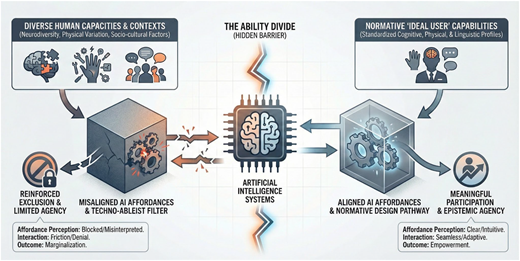
This article investigates how artificial intelligence (AI) reshapes digital inequality in education by introducing the concepts of the AI divide and ability divide. It examines how exclusion emerges not only from unequal access or skills but from differential capacities to perceive, interpret and mobilize AI-mediated affordances.
The study is conceptual and theory-driven. It draws on transformative learning theory, critical disability studies and affordance theory to analyze how AI intersects with structural inequality, techno-ableist design and policy discourses of adaptability.
The analysis reveals that AI integration risks reinforcing normative expectations of capability and marginalizing learners who deviate from these standards. Denial to change introduced or mediated by AI is better understood as a socio-cultural response to disruption rather than a deficit. A co-evolutionary model of transformative education is proposed, positioning AI as a catalyst for rethinking purposes, norms and power relations in education.
The article advances the concept of the ability divide to capture emerging inequalities in AI-mediated learning. It contributes a novel theoretical synthesis of affordance theory, disability studies and transformative learning, providing a framework for designing equitable, inclusive and agency-affirming educational practices.
1. Introduction
The rapid proliferation of artificial intelligence (AI) in educational contexts has altered the landscape of digital equity. While previous scholarship has extensively documented the digital divide between those with and without access to digital technologies (van Dijk, 2005), the emergence of AI introduces more complex dimensions of inequality that transcend traditional notions of technological access (Carter et al., 2020). This article argues that AI integration in education has generated what can be termed an “ability divide” (Bulathwela et al., 2024; Hodøl et al., 2025): a multifaceted form of exclusion operating not merely through differential access to technology, but through varying capacities to perceive, understand and productively engage with AI-mediated affordances (i.e. “the great divide,” Campbell, 2003), as well as potential mis/matches (i.e. misalignments between technological design and user capabilities) (Koller, 2012).
Unlike conventional analyses of educational technology focusing on infrastructure, skills training or pedagogical implementation, and building on research into the digital divide, this investigation examines deeper structural mechanisms through which AI systems reproduce and potentially amplify existing patterns of social stratification. Drawing on theoretical frameworks from transformative learning theory (Mezirow, 1997), critical disability studies (Campbell, 2009) and affordance theory (Gibson, 1979), the analysis contends that meaningful participation in an AI-shaped future requires more than technical competencies (i.e. AI Literacy, OECD, 2025a, b) or adaptability (Toffler, 2022). Instead, it demands reconsiderations of how educational systems construct and recognize legitimate forms of capability, knowledge production and agency.
The analysis proceeds through interconnected theoretical movements. First, it traces the evolution from digital divides to AI-specific forms of exclusion, demonstrating how AI systems create new categories of abilities that intersect with but extend beyond traditional markers of educational disadvantage. Second, it examines denial of technological innovation not as individual or institutional deficiency but as a response to socio-economic disruption, status threats and cultural displacement that often accompany technological change. Third, the analysis critically interrogates prevailing discourses of “adaptability” in educational policy, questioning whether persistent demands for flexibility place unreasonable burdens on individuals while obscuring systemic failures to create genuinely inclusive learning environments. Fourth, it analyzes AI affordances through the lens of ableism, revealing how seemingly neutral technological capabilities can systematically exclude particular bodies, minds and ways of being from meaningful educational participation.
Finally, transformative education is proposed as a framework capable of addressing these multidimensional challenges. Rather than merely optimizing existing structures for AI integration, transformative approaches seek to fundamentally reimagine the purposes, processes and power relations constituting learning in AI-mediated contexts.
Taken together, these interconnected lines of inquiry converge on a central question that guides the present analysis: How does the integration of AI in educational contexts generate new forms of inequality that go beyond the classical digital divide and what role do differential abilities to perceive, interpret and productively engage with AI-mediated affordances play in this process? By addressing this question through the lens of affordance theory, critical disability studies and transformative learning, the article seeks to move beyond access-centric framings and toward a more nuanced understanding of inclusion, agency and equity in present and future education.
2. Beyond access: affordances, dis/ability and the AI divide in education
In the context of digitalization, scholarly debate initially focused on the digital divide (van Dijk, 2005) between those with and without access to digital technologies. This first-level digital divide concerned material resources as well as basic operational skills. However, as digitalization advanced, it became evident that mere access alone is insufficient to ensure societal participation. The second-level digital divide (diMaggio and Hargittai, 2001; van Dijk, 2005; Ragnedda, 2020) foregrounds the extent to which individuals and groups possess the necessary competencies to actively, creatively and critically employ digital technologies for education, self-expression, social interaction and both professional and personal development. While some individuals may have access to digital devices, they may nonetheless lack the skills to use them productively for their own purposes, to participate in societal discourses or to open up new spaces for learning and action. The second-level digital divide thus highlights differences in media and digital literacy, which often reinforce existing social inequalities (van Dijk, 2005).
2.1 Tensions between competence, literacy and ability
With the growing ubiquity of AI across all domains of life, the requirements for societal participation are shifting once again. The so-called AI divide builds upon both the first- and second-level digital divide but extends beyond them (Autenrieth et al., 2025). It refers to inequalities arising from the fact that individuals and groups must not only have access to AI systems and be able to operate them technically, but above all develop the capacity to learn autonomously with AI, to engage in critical reflection and to act effectively in interaction with intelligent systems. In this regard, educational biography and social background play an important role, yet the implications concern society as a whole. The AI divide encompasses technological, cognitive, social, cultural and ethical dimensions alike. This raises a fundamental question: which competencies must individuals acquire in order to become, and remain, capable of agency in an AI-shaped society?
In the educational domain, competence is conceptualized as the interplay of knowledge, skills, motivational and volitional components, reflection and the capacity for autonomous and responsible action (Weinert, 2001). It also encompasses the willingness for self-regulation, goal orientation and the active co-construction of learning and working processes. The evolution of AI has led to an increasing number of tasks, once exclusively reserved for humans, being performed by machines (Bengio et al., 2025). The orchestration of such powerful systems entails new requirements, demanding from learners a high degree of judgment, creativity and regulatory competence. Central to this is the ability to employ AI as a partner for problem-solving, innovation and the design of (learning) processes, while simultaneously formulating and actively pursuing one's own goals (Brynjolfsson, 2022). Within this framework, leadership competence assumes a particularly salient role. Leadership is not merely understood as a formal managerial function but rather as the capacity to initiate change processes, inspire others, provide orientation and actively shape learning cultures (Leithwood et al., 2004). In a VUCA world, characterized by volatility, uncertainty, complexity and ambiguity (Bennett and Lemoine, 2014; Bennis and Nanus, 1985), that is being radically transformed by AI, attributes such as empathy, social intelligence, perspective-taking and conflict management are gaining increasing relevance. The tensions between competence, literacy and ability are not merely terminological but reflect different ontological framings: competence (Weinert, 2001) is conceived as an individually acquirable disposition, literacy oscillates between individual capacity and culturally embedded practice, while ability is relationally and structurally constituted. These tensions matter because dominant AI literacy frameworks (e.g. OECD, 2025a, b) primarily address individual acquisition, thereby individualizing responsibility, while the ability divide foregrounds structural mismatches between normative AI design and diverse learners. A purely competence- or literacy-oriented response to the AI divide therefore risks obscuring the very structural asymmetries that the ability divide makes visible.
Yet, while these competencies, along with a sense of self-efficacy and agency, are fundamental to participation, societal reality demonstrates that they are not sufficient on their own. Nevertheless, individual and collective forms of denial or skepticism toward technological innovation emerge, even in contexts where the necessary competencies are present. These attitudes and dynamics, which can be subsumed under the perspective of denial, substantially shape how the AI divide materializes and whether, and how, it can ultimately be bridged (Ertmer, 1999).
2.2 Affordances and ability
The relationship between affordance and ability proves to be central for understanding the material-discursive constitution of ability and disability within socio-technical arrangements. Whereas the concept of affordance highlights the relational possibilities for action between actors and their material environment, the notion of ability refers to the socially constructed and normatively regulated expectations of capability that determine who is recognized as a competent subject. The entanglement of these two perspectives makes it possible to analyze the complex mechanisms through which certain bodies and practices are systematically excluded from opportunities for participation.
The concept of “affordance” was originally introduced by James J. Gibson (1979) within the framework of his ecological theory of perception. According to Gibson, affordances refer to the action possibilities that the environment offers in relation to the abilities and goals of an individual. These are not purely subjective perceptions, but rather relational properties: that is, they emerge from the interaction between an actor and their environment. As Gibson puts it: “Affordances are what the environment offers the animal, what it provides or furnishes, either for good or ill” (Gibson, 1979, p. 137). Affordances are thus neither exclusively properties of the environment nor of living beings, but rather emerge in the specific relationship between the material characteristics of an object and the abilities, motivations and action possibilities of an acting subject (Kammer, 2018, p. 339).
The point of departure is the recognition that affordances are never neutral but always presuppose specific bodily forms and abilities. As Gibson (1979) emphasizes, affordance refers to the offering and enabling character of objects, what the environment “offers,” “provides” or “furnishes” to living beings (Gibson, 1979, p. 137). Yet this seeming openness obscures the fact that most designed environments and artefacts are oriented toward a normalized, “species-typical” imagined subject (Garland-Thomson, 2011, p. 336). The affordances of digital media technologies, for instance, often presuppose bodies and competencies that have been molded within particular ableist regimes and thereby exclude other bodily forms from (inter)action and use. The central question, therefore, is: which practices and bodies are systematically excluded by affordances? The relationship between affordance and ability thus constitutes a productive analytical field for investigating the material-discursive production of (dis)ability. It underscores that ability is not an individual attribute but emerges, or is obstructed, in the dynamic encounter between bodies and designed environments. A critical perspective on this relationship is indispensable for interrogating an interpretive sovereignty of the able and for opening spaces to accommodate diverse forms of being-in-the-world (ibid.).
In the field of media education and instructional design, the concept was taken up by Norman (2013), who applied it to the design of everyday objects and user interfaces. Norman particularly emphasized “perceived affordances,” i.e. the action possibilities perceived by users in the context of human-technology interaction. Affordances are understood here as socially and culturally embedded potentials that only emerge through the interplay of technology, user and context; they are therefore not purely technical properties. From the perspective of media education, the notion of “hidden affordances” (Gaver, 1991) proves to be a valuable extension: these are affordances that elude direct perception and can only be discovered through active, exploratory engagement. This highlights that users cannot grasp the full potential of an object a priori; rather, affordances only become visible and effective in practical interaction (Bucher and Helmond, 2018, p. 239).
Digital media affordances are often differentiated along three central dimensions. This model originates from e-learning research by Kirschner et al. (2003), who identified educational, social and technological affordances as foundational categories. This classification is internationally recognized and is frequently adapted in instructional design and media pedagogy to comprehensively describe the diverse potentials of digital media.
Educational affordances: These include features of digital media that actively support and shape learning processes. Examples include adaptive feedback systems, personalized learning paths, collaborative writing tools or accessible formats that consider diverse learning needs. In the sense of media education, educational affordances promote purposeful and reflective learning with digital media and foster instructional design competencies among teachers and learners.
Social affordances: These refer to the ways in which digital media enable and shape social interaction, participation and collaboration. Examples include communication and collaboration tools, social networks, forums and platforms that support self-representation, peer learning and co-construction. Social affordances create spaces for collaborative learning, critical engagement with media and social inclusion.
Technological affordances: This category encompasses the technical properties and potentials of digital media that enable specific forms of information processing, presentation and interaction. This includes multimodal content (text, image, video, animation), algorithmic curation of learning and information materials, mobility, interface diversity or data analysis functions. Technological affordances are crucial for designing media-based learning environments and for fostering media literacy in digitally mediated contexts.
2.3 AI and the ability divide: affordances and the question of ableism
While affordances can potentially open up possibilities for action for all learners, it must be noted that these possibilities are not equally accessible or realizable. Drawing on the concept of the AI Divide (Carter et al., 2020), this can be described as an “Ability Divide” (Bulathwela et al., 2024; Hodøl et al., 2025): a gap between those who are able to perceive, understand and actualize digital and AI-based affordances, and those who, for various reasons, are unable to do so. The ability divide is not solely technological or infrastructural in nature; it also encompasses cognitive, linguistic, physical, social and socioeconomic conditions. It constitutes a contingent constellation of abilities, access opportunities and structures of social recognition. This points to a fundamental condition of affordances: for an affordance to become effective, it must be perceived as such, evaluated as relevant and translated into action. Individual or institutional denial (the conscious or unconscious rejection of technological innovation) can also lead to affordances not being perceived or being actively blocked.
In the context of AI, the spectrum of affordances expands significantly. AI systems such as generative language models or adaptive learning assistants not only offer new forms of support, but also fundamentally transform the demands placed on teachers and learners. The potential applications are diverse: automated speech recognition for nonspeaking students, personalized task generation, diagnostic feedback loops or real-time support in linguistically or cognitively diverse learning groups. The affordances of these new technologies include individualized support, accessibility, adaptive feedback and assistance in heterogeneous classrooms. However, the effectiveness of these affordances depends crucially on how they are didactically implemented, critically reflected upon, and made accessible to all. Not all learners and educators have the same access, competencies, or resources to equally benefit from AI-based opportunities. For instance, consider an AI-driven speech-to-text tool deployed in a classroom. While it offers a powerful affordance for a student with dysgraphia (writing difficulties), allowing them to participate fully, the same tool may fail to recognize the input from a student with an articulation disorder due to physical disability. In this scenario, the technology is technically “accessible” to both, but the affordance, the actual utility, is fractured by the tool's normative training data, thereby widening the ability divide.
These affordances bring with them new challenges, particularly with regard to didactic integration, ethical reflection, and power asymmetries (cf. Williamson, 2023). Williamson (2023) emphasizes that AI in education must not be viewed in isolation as a technical innovation. Rather, its introduction is deeply intertwined with social, political and economic processes. The implementation of AI in educational institutions is the result of diverse conflicts of interest and reflects existing social power relations. On the one hand, AI can support personalized and inclusive learning; on the other hand, it can also reinforce existing inequalities and structures of control, for example, through biased algorithms, lack of accessibility or opaque data practices. Williamson therefore calls for pedagogical practice and technological development to be subjected to continuous, socially and ethically informed reflection. The central challenge lies in ensuring the accessibility and meaningfulness of AI-based affordances for all learners. This requires not only technical infrastructure but also a conscious, inclusion-oriented design of teaching scenarios as well as the continuous professionalization and participation of all educational stakeholders.
Ableism represents a complex network of beliefs, processes and practices that construct particular understandings of self, body and social relationships based on perceived abilities. As Campbell (2003) defines it, ableism produces a particular kind of self and body (the corporeal standard), while Wolbring (2008) expands this definition to encompass “a set of beliefs, processes and practices that produce - based on abilities one exhibits or values - a particular understanding of oneself, one's body and one's relationship with others” (Wolbring, 2008, pp. 252–253).
Rather than viewing ability and disability as fixed categories, contemporary ableism theory emphasizes the processual nature of these concepts. Campbell's (2019) notion of “abledness” serves as a hegemonic referential category to differentiate the “'normal” from the “dispensable,” while “ablement” describes the formation of the “abled' person” (Campbell's, 2019, p. 147). These concepts highlight the fluidity of ableist categorizations and challenge the stability of the dis/ability binary.
The construction of “capable subjects” is central and closely intertwined with both individual and, above all, socially shaped understandings of abilities, structures and practices. Which abilities are taken as self-evident, and which must be acquired in order to be recognized as a capable subject? Such assumptions and expectations regarding so-called essential abilities serve to sustain ableist – and therefore hierarchical – orders. These orders are further marked by a powerful boundary between the “able” and the “not able,” which Campbell (2003) describes as the “great divide.”
In the context of (media) education ableist assumptions manifest through implicit expectations about prerequisite skills – reading, computing, abstract thinking, planning and teamwork abilities. These expectations can systematically exclude certain individuals from participation. The determination of who can do what, to what extent, which abilities can be expected, who genuinely cannot perform certain tasks versus who is merely simulating, and who deserves support – all these judgments fall under what Buchner (2022) describes as the interpretive authority of the able-bodied, considered a form of “able-bodied entitlement.”
The integration of AI systems in particular can exacerbate existing inequalities when certain abilities, bodies or forms of expression are constructed as “normal” and others are implicitly excluded. This points to the concept of ableism, rooted in Disability Studies, which in recent debates on digital technologies has been described as techno-ableism (Shew, 2020). Techno-ableism refers to an ideological framework in which abilities are normatively defined and technological systems are designed according to these norms. As a consequence, affordances cannot be conceived as neutral: they address certain subjects while others are excluded through design, datasets or interfaces. The design and use of affordances are furthermore inseparably linked to demands for adaptability. As outlined in chapter 2.2, educational subjects are increasingly expected to flexibly adapt to technological innovations. This entails the risk that education becomes oriented primarily toward “adaptive” subjects, while those who (do not yet) conform to this ideal are excluded.
Both ableism, with its focus on dis/ability, and affordances are characterized by contingency and mutability, since digital media technologies, as well as social and cultural contexts, are subject to constant change. This temporal dimension underscores that neither phenomenon is ever fully fixed, but remains open to new uses and meanings, accounting for a “multi-directionality of agency” (Bucher and Helmond, 2018) within socio-technological practices. Discourses on affordances and ableism share a critical perspective on normativity and exclusion: while normative bodies often experience material anonymity, others are systematically excluded. This becomes evident both in exclusion, through infrastructural and spatial barriers, and in affordances, which presuppose certain bodily forms and competencies while excluding other modes of use. At the same time, digital technologies are marked by a wide diversity of affordances, which can be expanded through accessibility measures.
Bringing the two concepts together enables an expanded analysis of material and technical barriers (see Figure 1): a focus on dis/ability can be described as situations in which affordances are either inaccessible or only partially accessible to certain bodies. In this sense, affordances become a central analytical tool for showing how design, technology and social norms shape which bodies are afforded participation – and which are excluded. Both perspectives make clear that the analysis of specific socio-material practices is essential for driving structural change that enables equal participation.
Therefore, access cannot be understood solely in technical terms; it also concerns subjective perspectives of meaning and the fit between the individual and the learning environment. From an educational theory perspective, this can be understood as a mis/match between individual prerequisites and structural demands (cf. Koller, 2012). Affordances do not unfold in a vacuum but in concrete pedagogical scenarios in which social inequality, cultural patterns of recognition and normative conceptions of achievement become effective. Critical reflection on these imbalances is a prerequisite for shaping affordances inclusively.
At the same time, this points to a fundamental problem of pedagogical action: Who can act, when, how and under what conditions – and who cannot? Accordingly, the mere availability of technology cannot be equated with its effectiveness. Affordances only unfold their potential scope of impact within the framework of well-considered pedagogical settings accompanied by professionalized reflection. This is particularly true for inclusive education, which depends on digital technologies not only being functionally implemented but also critically and didactically framed. The central challenge, therefore, does not lie in the technology itself but in the question: What pedagogical constellations enable a just, meaningful and difference-sensitive use of AI? An inclusive approach to AI integration thus requires more than technological availability: it calls for continuous reflection on recognition, exclusion and the structural conditions of agency. Digital affordances must be designed not only to rely on adaptation but to open up multiple pathways for participation, even for those whose abilities do not conform to ableist norms of normality.
A critical examination of affordances – and abilities – therefore also requires consideration of attitude (denial), structural exclusion (ability divide), and the socially imposed expectations of adaptability. Only through the interplay of these perspectives does it become apparent how differentially and powerfully affordances operate in the context of AI. Is the question whether people should adapt to the logics of digital technologies, or the other way around?
3. A critical perspective on adaptability
Adaptability refers to the capacity of individuals and societies not merely to respond to change and uncertainty, but to engage with them productively and creatively (Toffler, 2022). It encompasses flexible thinking, openness to new information, the ability to question established routines and the readiness to adjust one's strategies to shifting conditions. In times of rapid technological transformations, global interconnectedness and the continuous restructuring of work and life contexts, adaptability has emerged as a key competence for the future (World Economic Forum, 2025). However, a lack of adaptability may lead to overload, withdrawal or opposition when individuals or groups primarily perceive change as a threat. Such dynamics can reinforce social division and exclusion, as those who disengage from transformation risk being cut off from essential resources and innovation processes. In an evolving world, participation and equity increasingly depend on the extent to which individuals and communities are able to act adaptively, whether in technological, social or cultural contexts.
While adaptability is widely regarded as essential for successfully navigating change (Toffler, 2022; World Economic Forum, 2025), it is equally important to subject this demand to critical scrutiny. Particularly in a society where developments in AI profoundly reshape domains of work and life, the pressing question arises as to how much adaptability can realistically be demanded and expected.
When adaptability is highlighted as a key competence for the future (World Economic Forum, 2025), it is often framed around the idea that flexible and adaptable individuals are best equipped to respond to changes in the labor market and thereby secure their employability. However, such a focus on adaptability falls short of addressing the demands of a society shaped by AI. Rather than simply calling for more individual flexibility, we must also understand why many people exhibit denial toward these very changes. Denial describes the active or passive rejection, skepticism or refusal toward technological innovations, for example. This phenomenon is not limited to individual persons, but can also occur at the level of institutions, educational establishments, leaders or in politics (Ertmer, 1999). Denial differs from mere ignorance or competency deficits, as it frequently arises from attitudes, beliefs, uncertainties or feelings of being overwhelmed.
Consequently, adopting reductive views of new technology often serves as a coping mechanism against this overwhelming complexity. We see this manifested in the assertion that AI is nothing more than an “algorithmic parrot,” a sentiment that often reflects a wishful denial of its transformative capacities. This belief allows individuals to maintain a sense of control by pigeonholing AI as a mere tool, thereby precluding the need to engage with it as a potential relational partner.
Historically, comparable dynamics can be observed, such as in the resistance to the introduction of new technologies by the machine-breakers in early industrial history (Randall, 2004). Transformation-related defensive attitudes often stem from fears of losing control or status, as well as uncertainties regarding societal changes themselves. Technology skepticism thus has not only an individual dimension, but also social and cultural ones. In the present, denial toward digitalization and AI manifests in diverse forms. It affects not only individuals, but also school administrators, teaching staff, education policy and larger societal groups (see, e.g., The Pencil Metaphor in William and Flora Hewlett Foundation, 2015).
Denial thus operates not only as individual behavior, but also unfolds its effects at structural and institutional levels. Therefore, it is necessary to systematically understand the causes of denial and to comprehend it not solely as a deficit or something technologically solvable, but also as an expression of societal, cultural and political tensions (Morozov, 2014). Only in this way can measures be developed that enable a differentiated and reflective engagement with technological innovations and ensure genuine participation for all actors. The analysis of denial makes clear that dealing with technological innovation is not only a question of knowledge or competency acquisition, but also depends on how individuals and groups cope with change and uncertainty and thus requires systemic educational efforts. However, a large proportion of people are no longer part of the institutional education system and thus cannot be reached through corresponding educational measures. For these groups, the appeal to individual adaptability remains insufficient, particularly as existential vulnerabilities are likely to increase in the coming years when technological innovations devalue or render obsolete existing occupations, competencies and passions. This is already evident in particularly exposed professions such as software development, where early-career professionals face the challenge of seeing their fields both transformed and questioned by AI systems (Brynjolfsson et al., 2025). Many individuals have invested years in building skills, networks and professional identities, only to be confronted with the prospect that their previous domains of activity are destabilized or eliminated. Not everyone can – or wishes to – constantly reinvent themselves or advance into “new frontiers.” This raises the pressing question of how professional continuity, persistence or the pursuit of individual passions can be socially valued under conditions of profound technological transformation. The debate on adaptability must therefore not be limited to the responsibilities of schools and universities, but must instead account for the lived realities of all generations and occupational groups.
Moreover, it is questionable whether an inclusive society can (or should) demand a high degree of adaptability from all its members. With regard to participation, recognition and quality of life, social structures must be established that provide security and value individuals regardless of their willingness or capacity to adapt (see, e.g. Piketty, 2020). Such structures may include new forms of social security, the support of niche cultures or the strengthening of noneconomic spheres of activity. Empirical evidence from Bernhard et al. (2025), based on a randomized controlled trial, demonstrates that an unconditional basic income does not lead to withdrawal from work. On the contrary, participants report increased well-being and security, and they use the additional freedom to take risks, try new things, or invest in further education. This suggests that economic relief does not foster passivity, but rather opens pathways for self-efficacy and agency.
In such a society, educational processes would no longer be reduced to preparing individuals for adaptation and flexibility in response to predominantly economic realities. Instead, they would create spaces for self-determination, creative development and meaningful activity, irrespective of immediate economic utility. Following Arendt's Vita activa (1958), this would entail understanding education not merely as preparation for gainful employment but as enabling forms of activity that derive meaning from acting together and contributing to the common good.
This perspective underscores that education and societal institutions must not only demand adaptive performance but must also create the structural conditions that provide security, foster agency and enable diverse forms of participation. Precisely at this juncture, the pervasiveness of AI raises the question of how such spaces of agency can be designed and what competencies are necessary not merely to access AI systems, but to integrate them reflectively, creatively and responsibly into processes of education, work and life.
Against this backdrop, the central challenge for education and societal development lies in strengthening individuals' capacities for judgment, communication, empathy, leadership and for making creative and responsible decisions. The analysis of current developments makes clear that education in the context of AI cannot be conceived merely as adaptation to technological innovation, but rather as a comprehensive empowerment to co-shape a society increasingly permeated by intelligent systems. The answer to the question of how the AI divide can be bridged and social participation secured depends crucially on how these new key competencies are cultivated and recognized at the societal level.
4. Transformative education in the AI era
Against the backdrop of the interrelations between the AI divide and AI-related affordances, the crucial question arises of how equitable participation can be ensured in a world increasingly shaped by AI, and what form of education is required under such conditions. This question becomes even more pressing when revisiting Papert's (1992) early observation that digital technologies indeed hold the potential to open learning processes and foster creativity, yet schools often neutralize this potential by assimilating innovation into established routines and structures. Instead of transformation, what frequently emerges is consolidation. In light of AI, this observation gains renewed relevance: here, too, the risk persists that transformative possibilities may be reduced to mere efficiency gains, with technological innovations primarily serving to stabilize traditional patterns.
This dynamic is intensified by a structural dilemma: while social and technological change accelerates at an exponential pace, it remains largely adults (teachers, educational administrators, and policymakers) who define the institutional framework of educational processes. Transformative learning (Mezirow, 1997) highlights the particular challenge that adults already operate within consolidated “frames of reference,” those fundamental assumptions and interpretive schemata through which they make sense of experience. While children and young people grow up in a lifeworld that evolves more rapidly than these frames of reference can adapt, educational policy makers often reproduce the very mechanisms that perpetuate the ability divide and the AI divide. This results in a paradoxical imbalance of power: those most in need of new forms of learning are structurally granted the least influence over the institutional design of such processes.
Transformative education thus emerges as a dual challenge: it must engage both learners and educators, enabling both groups to critically interrogate their existing interpretive frameworks. Only when educational processes themselves become spaces in which power relations, normative assumptions about ability, and structural exclusions are reflexively addressed can the identified inequities be systematically overcome. Transformative educational approaches (Mezirow, 1997; Koller, 2012) provide a theoretical and practical foundation for this task. They extend beyond the mere technical “repair” of existing systems and instead open new horizons of possibility for teaching and learning with and through AI.
Through critical reflection, learners revise assumptions and develop more inclusive, autonomous ways of understanding the world. Mezirow stresses that education should help learners make their own interpretations rather than act on the purposes, beliefs, judgments and feelings of others (Mezirow, 1997). In contexts shaped by AI, this becomes crucial: rather than adapting to machine-driven instruction, learners and educators must critically interpret and co-create meaning with and about AI. Koller's concept of transformative “Bildung” (Bildung is a German concept, often translated as education/formation, and encompasses holistic personal formation beyond instrumental knowledge transmission) likewise emphasizes radical questioning of previous frameworks and the creation of new world- and self-relations (Koller, 2012). In this sense, education and AI enter into a co-evolutionary relationship: AI is not simply a tool to be integrated, but a catalyst and counterpart in re-examining education's aims, fostering critical consciousness, autonomy and responsible citizenship beyond mere knowledge transmission.
Learning cultures must evolve accordingly. Adaptation to AI challenges top-down pedagogies and calls for inquiry-oriented, reflexive practices that strengthen epistemic agency. Students should not only use AI but also question its outputs, investigate biases and decide when and how to rely on it. Supportive environments normalize mistakes, debate (including with AI-generated answers) and multiple perspectives. Research increasingly frames generative AI as an epistemic partner, underscoring the need to safeguard human agency in symbiosis with intelligent systems.
For teachers, this co-evolution requires their own transformative learning. Professional learning communities (PLCs, Huijboom et al., 2021) and communities of practice (Wenger et al., 2002) foster inquiry, dialogue and collective capacity. Studies confirm that PLCs enhance the impact of digital professional development on innovative practice when they are autonomous, collaborative and reflective (Liu et al., 2024). Such spaces allow teachers to jointly evaluate AI tools, reflect on possibilities and challenges, and align them with pedagogical values. Reflective teacher education, following Schön's (2017) Reflective Practitioner, further prepares educators to examine their beliefs and practices. Structured reflection, potentially even supported by AI-based tools, helps teachers balance openness to AI's potential (Chu and Wang, 2024) with awareness of its limitations and ethical pitfalls (Holmes et al., 2019).
Tensions remain between adaptive expectations and transformative goals. While adaptive AI minimizes struggle through personalization, transformative education values productive struggle and disorienting dilemmas (Mezirow, 1995). Over-reliance on adaptive systems risks narrowing learning to efficiency, diminishing teachers' roles and students' cognitive growth. A co-evolutionary approach means deliberately balancing adaptability with opportunities for deeper critical transformation.
AI also reshapes what epistemic agency and competence mean. Equitable co-evolution should expand students' ability to evaluate AI outputs, detect bias and understand knowledge provenance (OECD, 2025a, b). For teachers, competence shifts from delivering content toward mentoring, facilitating and designing relational learning experiences (Gentile et al., 2023). Key competencies include digital and data literacy, ethics, and social pedagogy (UNESCO, 2024).
Finally, a co-evolutionary perspective must confront equity and inclusion. Without intentional efforts, an AI divide may widen existing inequalities (Carter et al., 2020). This calls for investments in under-resourced schools (Kim and Wargo, 2025; Ateeq et al., 2024) and for co-design with educators and communities (Autenrieth et al., 2025). Ableist assumptions embedded in AI systems can marginalize learners who deviate from normative progress models (Campbell, 2019; More, 2024). A transformative, relational pedagogy ensures that AI dismantles rather than reinforces barriers by creating multiple learning pathways and encouraging critical engagement in a multifaceted way. For instance, a constructive lesson could move beyond simply having students use an LLM to generate an essay on DEI. Instead, the educational focus shifts to utilizing AI to discuss DEI-related viewpoints found on social media from perspectives of people with diverse backgrounds. By doing so, the learner actively directs the system, transforming a potential easy answer into an exercise in critical literacy.
4.1 Theoretical implications
The synthesis advanced here contributes to three theoretical conversations. With respect to affordance theory (Gibson, 1979; Norman, 2013), we extend the notion of perceived affordances by foregrounding how AI systems embed normative assumptions about user capabilities into their training data and interfaces, thereby producing differential affordance perception along ableist lines. This moves affordance theory beyond the human-object interface toward a socio-technical framing. For critical disability studies (Campbell, 2009, 2019; Shew, 2020), we apply and extend the concept of techno-ableism to AI-mediated educational settings, demonstrating how the “great divide” between abled and disabled subjects is reconstituted through algorithmic systems whose normative training data systematically misrecognize nonconforming users.
For transformative learning theory (Mezirow, 1997; Koller, 2012), we propose a co-evolutionary extension: rather than positioning AI as an external object to be critically interpreted, we frame the relation between learners, educators, and AI systems as mutually shaping, requiring transformation on both sides of the human–machine relation. While these contributions are theoretical in nature, they open concrete avenues for empirical inquiry. Future empirical research could operationalize the Ability Divide in several ways: (1) classroom-based mixed-methods studies using think-aloud protocols to capture differential affordance perception across diverse learner profiles; (2) comparative institutional studies contrasting schools with and without participatory AI co-design processes and (3) the development of validated instruments measuring affordance-mismatch in AI-mediated learning environments.
4.2 Implications for policy and practice
The analysis suggests three priorities: First, policy must shift from access-centric metrics toward affordance-sensitive frameworks that account for differential abilities to perceive and use AI, requiring participatory co-design with marginalized learners and educators. Second, adaptability should be reframed as a systemic responsibility rather than an individual burden, with structural supports for those whose competencies are disrupted by technological change. Third, practitioners should balance adaptive AI with deliberately transformative pedagogies that foster critical engagement, productive struggle and multiple pathways for participation beyond normative expectations of capability.
Seen this way, AI in education is not a matter of technical integration but of cultural and relational co-evolution. Human and machine intelligences shape each other in practice. By drawing on transformative learning theory (Mezirow, 1995; Koller, 2012), fostering collective teacher learning and prioritizing equity, AI can become a co-actor in building inclusive, critical and emancipatory futures of education. At the same time, however, it is essential to critically examine how digital technologies and AI systems interact with individual users and how societal power relations and regimes of ableism are inscribed into these interactions. Only by addressing these dynamics can AI-supported education move beyond efficiency gains and open spaces for participation, recognition and equity.
Generative-AI
In the preparation of this manuscript, ChatGPT-5 (OpenAI) was used exclusively for linguistic enhancement (spelling, grammar and style). The tool served solely for stylistic refinement; all conceptual content, argumentation and findings were entirely developed and remain the full responsibility of the authors.