


This study examines the association of negative earnings disaggregation and growth to incrementally increase the low value relevance of loss-making firms on the Indonesian Stock Exchange (IDX).
Using data from IDX-listed loss-making firms from 2017 to 2021, this study collected 652 firm-year observations and employed multiple linear regression analysis to test the hypothesis. The independent variables in this study are negative earnings, book value, comprehensive accruals, cash flow and growth. The dependent variable is stock price, while the control variable is industry type.
The results show that both negative earnings disaggregation and growth are able to increase the value relevance of losses. However, the incremental increase generated by growth is higher than negative earnings disaggregation for the loss-making firms.
The limitation of this study is in the sample selection criteria, which only uses nonfinancial IDX-listed loss firms with positive book values.
The combination of book value and growth has a higher association with stock price than the combination of earnings and book value or book value and comprehensive accruals. Nevertheless, financial statements used in measuring book value, comprehensive accruals and growth have proven to be effective in the equity valuation of loss-making firms in Indonesia.
Our study provides new empirical insights into the value relevance of loss-making firms, addressing the limitations of previous studies that focus solely on earnings and book value as the main variables. This study extends the previous model by incorporating the disaggregation of negative earnings into comprehensive accruals and growth derived from the implicit cost of capital (ICC), enhancing the low value relevance of earnings and book value in loss-making firms. Consequently, the study offers a comprehensive evaluation of the increased explanatory power of reported earnings, book value, comprehensive accruals and growth.
1. Introduction
Financial statements are a key source of information for investors, with earnings' explanatory power determining its value relevance for equity valuation (Barth et al., 2001). Recent studies has revealed an increase in the value relevance of earnings, particularly following the implementation of International Financial Reporting Standards (IFRS) (Chehade and Procházka, 2024; Srivastava and Muharam, 2021, 2022). However, other studies present contrasting findings, indicating that the value relevance of earnings has diminished (Alfraih, 2016; Almujamed and Alfraih, 2019a, b; Badu and Appiah, 2018; Benkraiem et al., 2021; Suwardi, 2020).
IFRS adoption has shifted equity valuation by reducing earnings' value relevance while increasing the emphasis on book value due to its fair value measurement and asset-liability approach (Suwardi, 2020). During crises like the 2008 Global Financial Crises (GFC), earnings' value relevance declined in Southeast Asian countries, while book value remained stable (Eugenio et al., 2019). In contrast, both earnings and book value lost relevance in Kuwait, with book value driving the decline (Almujamed and Alfraih, 2019a). This suggests IFRS may increase volatility in regions with weaker economic fundamentals during crises.
The shift in value relevance from earnings to book value is also driven by the rise of loss-making new economy firms, which rely on high-tech sectors and key intangible assets like research and development (R&D), branding, and international partnerships (Barth et al., 2023). These assets are crucial but often underrepresented in traditional accounting metrics (Barach, 2017). Firms that capitalize R&D investments show greater value relevance, as observed in China (Wang and Fan, 2014), and India, where breaking down earnings into accrual components enhances financial statement relevance for firms with high intangible assets (Kumari and Mishra, 2020).
Negative earnings are less relevant for equity valuation as they lack persistence and reliability (Collins et al., 1997; Sin and Watts, 2000). In Vietnam and Pakistan, book value is more relevant than earnings for loss-making firms (Chaudhry and Sam, 2014; Nguyen and Dang, 2023) while in India, both positive and negative earnings remain value-relevant for investment decisions (Bashir et al., 2023). Our study then investigates the value relevance of negative earnings in Indonesia, as prior studies in India (Bashir et al., 2023), Vietnam (Nguyen and Dang, 2023), and Pakistan (Chaudhry and Sam, 2014) focus on the value relevance of loss-making firms using earnings and book value, but do not explore the underlying causes of the low value relevance of negative earnings or how accrual accounting and growth can address this issue. To bridge this gap, our study introduces comprehensive accruals and growth to enhance the value relevance of earnings and book value for loss-making firms.
The study of the value relevance of loss in developing countries like Indonesia is essential due to the high number of loss-making firms despite overall economic stability. Figure 1 highlights a rising trend in non-financial firms reporting negative earnings on the IDX from 2017 to 2021, averaging 26–28% of total firms. In 2020, during the COVID-19 pandemic, this figure surged to 43%. The prevalence of negative earnings may impact the value relevance of financial statements for investors.
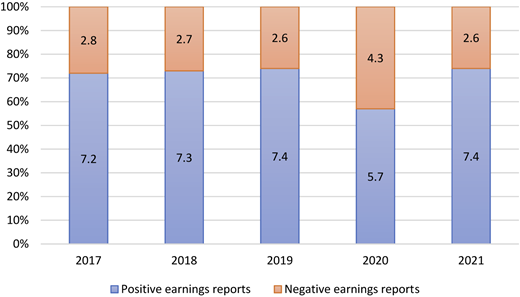
Frequency of negative earnings report on IDX (2017–2021). Source(s): Authors’ own work
Frequency of negative earnings report on IDX (2017–2021). Source(s): Authors’ own work
To enhance the value relevance of losses, our study employs two approaches. First, we extend the study of Collins et al. (1999) using the idea of Beisland (2011) in the disaggregation of negative earnings with a more recent model developed by Larson et al. (2018). Unlike income statement-based negative earnings, comprehensive accruals that assessed through the asset-liability approach are part of equity on the balance sheet. This aligns with Chaudhry and Sam (2014), who found that for loss-making firms, value relevance shifts from earnings in income statement to book value in balance sheet. Therefore, disaggregating negative earnings improves the low persistence of losses, as accrual components provide new information for predicting firm value (Barth et al., 2016; Kumari and Mishra, 2020; Larson et al., 2018).
The second approach extends the study of Collins et al. (1999) by incorporating the growth rate based on the residual income model (RIM) and ICC from Penman et al. (2023). Unlike earnings disaggregation which uses current earnings, this method relies on actual future earnings. Growth enhances book value by increasing the value relevance of losses, as it reflects future earnings potential adjusted for risk levels like ICC. Given the positive relationship between growth rate and ICC as a risk proxy in RIM (Penman et al., 2023; Penman and Zhang, 2020), this model introduces new valuation insights for loss-making firms, which have not been empirically tested in prior studies (Beisland, 2011; Collins et al., 1997, 1999).
This is the first study that use comprehensive accruals and growth from RIM and ICC in equity valuation of loss-making firms in Indonesia. Our findings indicate that both negative earnings disaggregation and growth improve the value relevance of losses, with growth having a stronger incremental impact. This suggests that investors prioritize growth and book value over accrual components in current negative earnings. Overall, our study reaffirms the value relevance of financial statements for investment decisions.
1.1 Indonesia’s institutional setting
Indonesia transitioned from Dutch to United States-style accounting after 1967, adopting Indonesian Accounting Principles (PAI) in 1973, based on US Generally Accepted Accounting Principles (GAAP). In 2008, the Indonesian Institute of Accountants (IAI) announced full IFRS convergence by 2012 to attract more foreign investment (Maradona and Chand, 2018). Before IFRS, Indonesia relied on historical cost accounting. Implementing IFRS 13 and IFRS 9 is challenging due to complex fair value measurement, inactive markets, and the need for skilled professionals (Siregar et al., 2020). These difficulties weaken stock return-accounting number associations (Suwardi, 2020) and increase credit risk due to higher loan loss provisions in the banking sector amid economic volatility (Mita and Rahmah, 2023).
Indonesia experienced economic volatility, notably during the 1997 Asian Financial Crisis, when International Monetary Fund (IMF) recommended reforms, such as a floating exchange rate and subsidy cuts, led to capital flight and worsened the crisis. However, during the 2008 GFC, Indonesia avoided a recession, achieving Gross Domestic Product (GDP) growth of 6.1% in 2008 and 4.5% in 2009, ranking third among G20 nations (Azwar and Tyers, 2020; Sangsubhan and Basri, 2012). Effective policy responses, a low export-to-GDP ratio, limited global market exposure, and low sensitivity to external demand shocks helped Indonesia mitigate the impact of the 2008 GFC (Ardiyono and Patunru, 2023; Chatib Basri and Rahardja, 2010).
Despite external economic volatility, Indonesia’s strong economic fundamentals have enabled firms to withstand and recover from global market risks. This study helps users better understand the valuation of firms with negative earnings, especially during crises. Additionally, it provides insights for adjusting policies and investment strategies by considering accrual comprehensive income, book value, and growth in evaluating loss-making firms in Indonesia.
2. Literature review and hypothesis development
2.1 Literature review
Signaling theory suggests that information asymmetry occurs when management has more knowledge than creditors and investors, leading to stock mispricing (Buckley et al., 2012; Morris, 1987; Ripamonti et al., 2018). Financial statements help reduce this asymmetry. Early studies showed stock prices react to earnings (Ball and Brown, 1968; Beaver, 1968), but later research found a decline in earnings' explanatory power, especially in loss-making firms (Badu and Appiah, 2018; Clout and Willett, 2016; Collins et al., 1997; Lev and Zarowin, 1999). To address this, incorporating book value into earnings models improves financial statement relevance for such firms (Collins et al., 1999; Sin and Watts, 2000).
The shift in value relevance from earnings to book value has been reinforced by IFRS adoption in developing countries. Studies in Kuwait and Qatar show a decline in both, with earnings dropping more sharply (Alfraih, 2016; Almujamed and Alfraih, 2019b). In Saudi Arabia, IFRS adoption improved financial statement relevance, particularly for book value, due to fair value measurement (Alomair et al., 2022; Chehade and Procházka, 2024). During the 2008 GFC, book value remained relevant in in Singapore, Malaysia, Hong Kong, Indonesia, Philippines, and Taiwan, while earnings lost significance (Eugenio et al., 2019). However, in Kuwait, book value relevance declined significantly, while earnings was not statistically significant (Almujamed and Alfraih, 2019a). These findings suggest IFRS’s fair value approach may increase financial statement volatility, particularly in regions like the Middle East, where economic fundamentals are more vulnerable to global crises.
In addition to IFRS adoption, global factors like the rise of new economy or high-tech industry influencing changes in earnings value relevance. Barth et al. (2023) found that increasing loss-making new economy firms in the U.S. shifted valuation focus to book value. In China, Wang and Fan (2014) showed that capitalizing R&D boosted stock prices, while expensing R&D lowered valuations. Khidmat et al. (2019) highlighted the positive role of R&D and Free Cash Flow in earnings and book value relevance. Kumari and Mishra (2020) in India found that disaggregated earnings better explained market equity values, especially in intangible-heavy firms. Srivastava (2023) criticized traditional earnings calculations for misaligning intangible expenses with revenues, while Gu et al. (2023) showed that adjusting for intangible investments makes loss-making firms’ earnings as informative as those of profitable firms.
Nguyen and Dang (2023) found in Vietnam that earnings are more relevant than book value for profitable firms, but for loss-making firms, book value is more significant while earnings become insignificant. Chaudhry and Sam (2014) reported similar findings in Pakistan, showing a shift in explanatory power from earnings to book value for firms with negative earnings. However, Bashir et al. (2023) in India found that both positive and negative earnings are value-relevant, though they did not fully explain the low value relevance of negative earnings which is a key issue in the value relevance of loss-making firms.
The lower value relevance of negative earnings suggests that additional information is needed to be fully understood by the market. Yasar et al. (2020) highlighted that while financial statements provide information, market participants interpret signals differently. This study further analyzes the financial information by integrating comprehensive accruals and growth alongside book value to improve the limited value relevance of earnings for loss-making firms.
2.2 Hypothesis development
A firm’s equity value is based on the present value of future cash flows. In Saudi Arabia, IFRS adoption increased the value relevance of earnings and book value but had little impact on cash flow (Chehade and Procházka, 2024). Book value saw the most significant improvement, indicating that investor view earnings and book value as better predictors of future cash flows than cash flow itself. Accrual-based earnings have a stronger link to equity value since accruals help align revenue recognition with cash flows over time (Ball and Nikolaev, 2022; Dechow, 1994; Dechow and Dichev, 2002). However, loss-making firms face reduced equity valuation relevance, as negative earnings are seen as transitory (Nguyen and Dang, 2023; Sixpence and Adeyeye, 2018).
Nevertheless, Beisland (2011) found that accruals and cash flow components within losses still contain persistent information that helps explain a firm’s future cash flow. Accruals are defined as the difference between changes in non-cash assets and liabilities (Richardson et al., 2005). This aligns with the clean surplus assumption and capital maintenance concept, linking net asset changes to earnings and dividends. Thus, the disaggregating of negative earnings into comprehensive accruals and cash flow components enhances the value relevance model beyond those of Beisland (2011) and Collins et al. (1999).
First, comprehensive accruals capture current investments tied to business growth and bridge timing differences between economic events and cash flows (Larson et al., 2018; Ohlson, 2014). Unlike Beisland (2011), who measures accruals using changes in working capital, Larson et al. (2018) define accruals more broadly as changes in shareholders' equity minus changes in cash and cash equivalents. Limiting accrual measurement to working capital excludes noncurrent asset accruals from equity valuation. This mismatch between income and expenses in capitalizing noncurrent assets, such as intangible investments, can reduce the value relevance of earnings (Barth et al., 2023; Green et al., 2022; Gu et al., 2023; Srivastava, 2023).
Comprehensive accruals represent all of the firm’s non-cash net assets on the balance sheet that measured under asset-liabilities recognition and fair value treatment. This means that total comprehensive accruals not only reflect working capital accruals, but also accruals derived from capitalization and revaluation of noncurrent assets, including from acquisition and divesture activities (Larson et al., 2018). Thus, using comprehensive accruals will undoubtedly improve the mismatch between income and expenses in the studies of Barth et al. (2023) and Gu et al. (2023).
Second, cash flow complements accruals in assessing a firm’s liquidity, debt repayment ability, and investment flexibility (Lee et al., 2017). Combining accruals and cash flow components provides stronger signals about firm performance than negative earnings alone. Investors evaluate not just current losses but also long-term adaptability and resource allocation efficiency. The advantage of using a comprehensive accrual model lies in its ability to align balance sheet accruals with cash flows, directly explaining equity value from the balance sheet (Barth et al., 2016; Casey et al., 2017; Larson et al., 2018). Therefore, our first hypothesis is structured as follows:
The value relevance of earnings disaggregation into comprehensive accruals and cash flow is higher than that of aggregate earnings in loss-making firms.
Financial statements provide key information for investors and creditors in firm valuation. Creditors assess a loss-making firm’s ability to meet debt obligations, while investors estimate potential returns. When firms incur losses, value relevance shifts from earnings in the income statement to book value on the balance sheet (Ahmadi, 2017; Nguyen and Dang, 2023). Book value reflects the present value of expected future normal earnings, serving as a proxy for future earnings or liquidation value (Collins et al., 1999; Ohlson, 1995). A firm experiencing loss will strive to achieve future profitability by reducing unproductive assets or investing in productive assets that expected to drive high earnings growth (Collins et al., 1997; Lawrence et al., 2017; Riedl et al., 2021).
Penman and Zhang (2020) found that expected earnings growth is positively linked to stock returns. However, the projection of future earnings based on book value carries risks. Penman and Yehuda (2019) found that return-earnings regression reflects cash flow and discount-rate news, while Li (2020) showed that losses contain future cash flow information and risks. A loss-making firm with positive book value may anticipate future profitability, but uncertainties, such as uncollectible receivables, can lead to discrepancies between expected and actual earnings. This uncertainty implies that expected earnings growth from current book value carries inherent risk (Penman et al., 2023).
Investors need to know the risk-adjusted earnings growth to estimate the return on their investments in loss-making firms. Therefore, using future expected earnings growth from RIM and ICC can help users as an input to valuation in pricing loss-making firms. ICC is the internal rate of return of an accounting-based valuation model that reconciles current price to near-term future earnings and long-term growth rate (Penman, 2016; Penman et al., 2022). Future expected earnings growth is critical to the equity valuation of loss-making firms due to the transitory nature of negative earnings. Negative earnings are not persistent because if they are persistent, then investors would rather liquidate the firm than suffer losses indefinitely (Hayn, 1995).
Low or negative current earnings may indicate high future earnings growth if book value remains positive, as it serves as a proxy for expected normal earnings. However, high future earnings growth also implies greater risk, leading investors to demand higher expected returns (Penman and Reggiani, 2018; Penman and Zhang, 2020). This risk-adjusted expectation is reflected in stock prices, preventing a drastic decline despite negative earnings. Investors consider book value and future earnings growth when deciding whether to hold or liquidate their investments. Thus, in loss-making firms, growth enhances book value relevance by signaling future earnings potential adjusted for risk. Therefore, our second hypothesis is structured as follows:
Growth significantly contributes to adding the value relevance of earnings and book value incrementally in loss-making firms.
3. Research method
3.1 Sample selection
All data regarding audited financial statements and share prices were obtained from the IDX website, Yahoo Finance, and the respective firms’ websites. We acknowledge the limitation of our data collection period, which only extends until 2021 that resulting in a reporting lag between the data collection period and the completion of this research report. The 2017–2021 observation period was chosen to assess the COVID-19 impact through robustness checks using split sampling for pre- and during-pandemic periods. This analysis is particularly relevant as the number of loss-making firms nearly doubled in 2020, and Indonesia’s GDP growth declined to −2.1% in 2020 and 3.7% in 2021, compared to an average of 5.1%–5.2% during 2017–2019, with a recovery to 5.0%–5.3% in 2022–2024 (OECD, 2020, 2024).
Our study examines the impact of negative earnings (EARN), book value (BV), comprehensive accruals (COMPACC), cash flow (CF), and growth (Growth) on stock price (P), with industry type (INDY) as a control variable. Multiple linear regression was used, ensuring assumptions of normality, multicollinearity, autocorrelation, and heteroscedasticity were met. Analysis included correlation assessments, adjusted R2, F-tests, and t-tests. Robustness checks involved split sampling (pre- and post-COVID-19), fixed-effect regression, and sensitivity analysis by incorporating alternative measures for accruals (AC) and growth (g) from prior studies.
Table 1 summarizes the sample selection process.
3.2 Model specification
The value relevance of earnings analysis is based on the Ohlson (1995) model, which assumes that a firm’s equity value equals the present value of expected future dividends (PVED).
where Pt is the equity value in the market at time t, Rf is the discount rate that is assumed to be constant, and is the expected dividends to be received at time .
The second assumption in the Ohlson’s model is the clean surplus relationship, which can be formatted as net capital contribution or changes in book value equal to earnings minus dividends.
yt−1 is the book value at time t−1, yt is the book value at time t, dt is the dividend at time t and xt is the earnings at time t.
Suppose the firm value equals the present value of expected future dividends. In that case, the clean surplus relationship can substitute dividends for earnings and book value in the present value formula or model.
Using the PVED formula and clean surplus relation, it can be implied that the market value of equity is the book value (yt) plus the present value of future expected abnormal earnings (xa). This model is known as the residual income model (RIM).
The third assumption in Ohlson’s model is the time series behavior of abnormal earnings and introduces it as an information set variable or vt in his model. vt is other information outside of abnormal earnings that is used to capture the dynamics of abnormal earnings. Based on these three assumptions, the Ohlson’s model can be structured as follows:
Ohlson’s model then used as a basis for Collins et al. (1999) in their research on the value relevance of negative earnings by deleted the vt variable and replaced it with an intercept and error terms in their empirical testing model.
The final model of Collins et al. (1999) was used as the first regression model, with industry types (INDY) added as control variables to account for potential effects on the value relevance of loss.
where Pt is the equity value in the market at time t, Earnt is the earnings at time t, BVt−1 is the book value at time t−1.
In line with the capital maintenance concept and IFRS adoption in Indonesia, the second model defines earnings as the change in net asset valuation over time rather than revenue minus expenses. Comprehensive income (CI) is used, as it closely reflects economic earnings under the clean surplus relationship.
Comprehensive accruals (COMPACC) represent changes in non-cash net assets, while cash flow (CF) reflects the cash component of comprehensive income (CI), calculated as CI minus COMPACC (Larson et al., 2018). Following prior research, CI is used as an earnings substitute (Djaballah, 2019; Khan et al., 2018). Disaggregating CI into COMPACC and CF allows for the formulation of the second regression model.
The third model in this study was created by reverse engineering the RIM from Ohlson (1995) model which has been augmented with r and g (Penman et al., 2023).
where Pt is the equity value in the market at time t, BV is the is the book value at time t, Earnt+1 is the earnings at timet+1, r is the implicit cost of capital, and g is the growth.
If all growth is priced at risk so that , then (Penman et al., 2023). By substitute (r-g) as the risk-free rate or , r and g can be calculated as follows:
By using growth in the first model then the third regression model can be structured as follows:
Table 2 summarizes the description and measurement of the variables in this study.
Variables definition
| Variables | Measurement |
|---|---|
| Pt | The stock price of the third month after the fiscal year. (Collins et al., 1999) |
| Earnt | Total firm’s earnings on year t. (Collins et al., 1999) |
| BVt−1 | Total firms’ equity on year t−1. (Collins et al., 1999) |
| COMPACCt | Total change in common stockholders' equity – total change in cash and cash equivalents. (Larson et al., 2018) |
| CFt | Comprehensive income – comprehensive accruals. (Larson et al., 2018) |
| Growth | Implicit cost of capital – central bank of Indonesia rate. Implicit cost of capital = (book value on year t + earnings on year t+1/central bank of Indonesia rate – stock price on year t) x central bank of Indonesia rate/book value on year t. (Penman et al., 2023) |
| INDY | Nominal values range from 1 (energy) to 11 (transportation and logistics). (Sun and Sari, 2016) |
Source(s): Authors’ own work
The initial regression model violated the normality assumption, leading to the application of the Yeo-Johnson transformation (Yeo and Johnson, 2000) to correct the sample distribution. The final model then can be written as follows:
4. Result
4.1 Descriptive statistic, classical assumption, and correlations
Table 3 shows that the stock prices have a mean value of 5.782, earnings have a mean value of −2.676, and the book value mean is 4.999, which means that the stock price is still higher than its book value even though the firms suffer from negative earnings. As for the mean, standard deviation, minimum and maximum values of the other variables in this study can be seen in Table 3.
Descriptive statistic
| Variables | N | Mean | SD | Minimum | Maximum |
|---|---|---|---|---|---|
| LogP | 652 | 5.782 | 1.314 | 2.773 | 8.968 |
| LogEarn | 652 | −2.676 | 1.465 | −7.389 | −0.006 |
| LogBV | 652 | 4.999 | 1.429 | 0.811 | 9.228 |
| LogCOMPACC | 652 | −1.654 | 2.797 | −7.359 | 7.477 |
| LogCF | 652 | −0.399 | 2.494 | −7.088 | 6.622 |
| LogGrowth | 652 | 0.398 | 0.597 | −2.644 | 5.856 |
| INDY | 652 | 5.26 | 2.975 | 1 | 11 |
Source(s): Authors’ own work
Table 4 shows that the classical assumption test confirms the regression model’s validity by ensuring the data is normally distributed and free from autocorrelation, multicollinearity, and heteroscedasticity issues.
Classical assumption test
| No. | Classical assumption test | Model 1 | Model 2 | Model 3 | |
|---|---|---|---|---|---|
| 1. | Kolmogorov-Smirnov | Asymp. sig. | 0.200* | 0.200* | 0.200* |
| Monte Carlo sig. | 0.394 | 0.367 | 0.337 | ||
| 2. | Durbin-Watson | 1.979 | 1.987 | 2.049 | |
| 3. | Tolerance Value | LogEarn | 0.677 | 0.673 | |
| LogBV | 0.663 | 0.923 | 0.628 | ||
| LogCOMPACC | 0.565 | ||||
| LogCF | 0.590 | ||||
| LogGrowth | 0.929 | ||||
| INDY | 0.975 | 0.975 | 0.968 | ||
| 4. | VIF | LogEarn | 1.477 | 1.485 | |
| LogBV | 1.509 | 1.083 | 1.592 | ||
| LogCOMPACC | 1.770 | ||||
| LogCF | 1.695 | ||||
| LogGrowth | 1.076 | ||||
| INDY | 1.026 | 1.026 | 1.033 | ||
| 5. | Glejser Test | LogEarn | 0.202 | 0.834 | |
| LogBV | 0.577 | 0.067 | 0.918 | ||
| LogCOMPACC | 0.178 | ||||
| LogCF | 0.087 | ||||
| LogGrowth | 0.720 | ||||
| INDY | 0.240 | 0.169 | 0.021 | ||
Note(s): *0.200 is the maximum value reported by SPSS for asymptotic significance in the Kolmogorov-Smirnov test
Source(s): Authors’ own work
Table 5 presents the Pearson Bivariate Correlation test results, showing a positive and significant correlation between stock prices and book value, comprehensive accruals, cash flow, and growth. Additionally, the absence of a correlation coefficient above 0.8 supports the classical assumption test, confirming no multicollinearity issues in the sample.
Pearson correlation
| No | Variable | 1 | 2 | 3 | 4 | 5 | 6 |
|---|---|---|---|---|---|---|---|
| 1 | LogP | 1 | |||||
| 2 | LogEarn | −0.211** | 1 | ||||
| 3 | LogBV | 0.365** | −0.178** | 1 | |||
| 4 | LogCOMPACC | 0.175** | 0.402** | −0.209** | 1 | ||
| 5 | LogCF | 0.136** | 0.295** | 0.091* | −0.635** | 1 | |
| 6 | LogGrowth | 0.202** | −0.131** | 0.383** | −0.084* | 0.078* | 1 |
Note(s): **indicates significance at 0.01 level, *indicates significance at 0.05 level
Source(s): Authors’ own work
4.2 Result and discussion
Table 6 shows that the F-values for all three models are statistically significant at the 5% level, confirming their validity for measuring value relevance. The adjusted R2 values for the first, second, and third models are 15.3%, 17.6%, and 23.6%, respectively. As the second model has a higher adjusted R2 than the first, the first hypothesis is not rejected. This suggests that disaggregating earnings into comprehensive accruals and cash flow improves value relevance for loss-making firms compared to aggregate earnings.
Regression results
| Year 2017–2021 (N = 652) | |||||||||
|---|---|---|---|---|---|---|---|---|---|
| Model 1 | Model 2 | Model 3 | |||||||
| Adj. R2 | F-test Sig. | Coef. | Adj. R2 | F-test Sig. | Coef. | Adj. R2 | F-test Sig. | Coef. | |
| Pooled data | 0.153 | 0.000 | 0.176 | 0.000 | 0.236 | 0.000 | |||
| Intercept | 4.359* | 4.394* | 3.719* | ||||||
| LogEarn | 0.004 | 0.027 | |||||||
| LogBV | 0.360* | 0.392* | 0.436* | ||||||
| LogCOMPACC | 0.097* | ||||||||
| LogCF | 0.064* | ||||||||
| LogGrowth | 0.659* | ||||||||
| INDY | −0.069* | −0.073* | −0.059* | ||||||
Note(s): *indicates significance at 0.05 level
Source(s): Authors’ own work
The t-test results show that negative earnings have no significant association with stock prices in both the first and third regression models, confirming that earnings are not a key factor for investors in loss-making firms (Barth et al., 2023; Gee-jung, 2017; Gu et al., 2023). However, book value in the first model is significantly associated with stock prices, with a regression coefficient of 0.360, indicating that higher book value corresponds to higher share prices. These findings support the view that when earnings lose relevance, value relevance shifts from earnings in the income statement to book value in the balance sheet, consistent with prior research (Ahmadi, 2017; Barth et al., 2023; Nguyen and Dang, 2023).
Nevertheless, negative earnings can still contribute to equity valuation when disaggregated into comprehensive accruals and cash flow. The t-test results from the second regression model show that book value, comprehensive accruals, and cash flow significantly impact stock prices, with regression coefficients of 0.392, 0.097, and 0.064, respectively. This suggests that higher levels of these components are associated with higher share prices for loss-making firms. These findings align with Beisland (2011), demonstrating that disaggregating negative earnings enhances the value relevance of financial statements.
The second regression model shows that the regression coefficient for comprehensive accruals is higher than that for cash flow. This occurs because, under favorable earnings conditions, cash flow relevance increases with earnings quality (Agnes Cheng et al., 2013). However, when negative earnings become irrelevant due to their non-persistent nature, both cash flow relevance and earnings quality decline (Dechow et al., 2010). As a result, cash flow has a lower explanatory power compared to comprehensive accruals.
These findings indicate that investors in loss-making firms do not focus solely on aggregate negative earnings but instead analyze comprehensive accrual components as signals of future positive earnings and cash flows. This suggests that accruals have greater predictive ability than cash flows, as they capture current investments and bridge timing differences between transactions and cash flows. Additionally, comprehensive accruals and cash flow enhance the value relevance of book value by aligning balance sheet accruals with cash flow, providing a clearer explanation of equity value (Barth et al., 2016; Casey et al., 2017; Larson et al., 2018).
The second hypothesis also is not rejected, as the third model’s higher adjusted R2 confirms that growth enhances the value relevance of earnings and book value in loss-making firms. The t-test results show that book value and growth significantly influence stock prices, with regression coefficients of 0.436 and 0.659, respectively. This indicates that higher book value and growth lead to increased share prices. These findings align with Penman and Zhang (2020), who found a positive relationship between earnings growth and stock returns and Penman and Yehuda (2019) who emphasized that investors prioritize growth and book value over transitory negative earnings in equity valuation.
The test results also indicate that growth contributes more to value relevance than accrual and cash flow components in the presence of negative earnings. This suggests that the growth-based approach from Penman et al. (2023) is more effective in explaining stock prices than the earnings disaggregation method from Beisland (2011) for loss-making firms. Investors have anticipated future earnings growth, which is reflected in current stock prices, preventing a sharp decline when firms report negative earnings (Sin and Watts, 2000).
The test results also indicate that, in the presence of negative earnings, growth contributes more to value relevance than accrual and cash flow components. This suggests that the growth-based approach proposed by Penman et al. (2023) is more effective in explaining stock prices than the earnings disaggregation method from Beisland (2011) for loss-making firms. Investors anticipate future earnings growth, which is reflected in current stock prices, thereby preventing a sharp decline when firms report negative earnings (Sin and Watts, 2000).
Even though book value can indicate future earnings potential or liquidation options for loss-making firms, it is insufficient on its own. Growth serves as a key signal, providing insight into long-term growth rates, risks, and expected returns (Penman, 2016; Penman et al., 2022; Penman and Reggiani, 2018; Penman and Zhang, 2020). Since losses are temporary and signal for low but positive future earnings (Hayn, 1995), growth helps investors confirm expectations of higher future returns. Additionally, losses contain information about future cash flows and risks (Li, 2020). Thus, incorporating growth enhances the value relevance of book value in assessing a firm’s market value, particularly in uncertain or risky conditions, such as those involving loss-making firms.
4.3 Robustness check
For robustness checks, we conducted a split-sample analysis for the periods before (2017–2019) and after (2020–2021) the COVID-19 pandemic, as shown in Table 7. Additionally, we applied fixed-effect regression in Table 8, as the Hausman test confirmed its suitability over random-effect regression.
Split sample regression results
| Year 2017–2019 (N = 316) | Year 2020–2021 (N = 336) | |||||
|---|---|---|---|---|---|---|
| Model 1 | Model 2 | Model 3 | Model 1 | Model 2 | Model 3 | |
| Adj. R2 | Adj. R2 | Adj. R2 | Adj. R2 | Adj. R2 | Adj. R2 | |
| Pooled data | 0.101 | 0.124 | 0.256 | 0.198 | 0.216 | 0.231 |
| Coef. | Coef. | Coef. | Coef. | Coef. | Coef. | |
| Intercept | 4.837* | 4.837* | 3.786* | 3.891* | 3.964* | 4.189* |
| LogEarn | 0.040 | 0.061 | −0.031 | −0.011 | ||
| LogBV | 0.299* | 0.319* | 0.424* | 0.409* | 0.454* | 0.452* |
| LogCOMPACC | 0.092* | 0.099* | ||||
| LogCF | 0.069* | 0.070* | ||||
| LogGrowth | 0.905* | 0.432* | ||||
| INDY | −0.063* | −0.069* | −0.055* | −0.066* | −0.068* | −0.058* |
Note(s): *indicates significance at 0.05 level
Source(s): Authors’ own work
Fixed effect regression results
| Year 2017–2021 (N = 652) | ||||||
|---|---|---|---|---|---|---|
| Model 1 | Model 2 | Model 3 | ||||
| R2 | Coef. | R2 | Coef. | R2 | Coef. | |
| Pooled data | 0.139 | 0.157 | 0.224 | |||
| Intercept | 4.837* | 4.783* | 4.411* | |||
| LogEarn | 0.053 | 0.055 | ||||
| LogBV | 0.299* | 0.296* | 0.346* | |||
| LogCOMPACC | 0.041* | |||||
| LogCF | 0.029* | |||||
| LogGrowth | 0.396* | |||||
| INDY | −0.060* | −0.061* | −0.051* | |||
Note(s): *indicates significance at 0.05 level
Source(s): Authors’ own work
The test results in Tables 7 and 8 align with the overall sample findings, confirming that the third model has greater explanatory power than the first and second models for loss-making firms. However, Table 7 reveals that during the COVID-19 pandemic, the explanatory power of book value, comprehensive accruals, and cash flow was higher than before the pandemic. Additionally, a sensitivity analysis was conducted using the accrual variable (AC) from Kumari and Mishra (2020) as an alternative proxy for comprehensive accruals (COMPACC) and the growth variable (g) from Sloan and Wang (2023) as an alternative proxy for Growth. AC is defined as earnings (Earn) minus cash flows from operations (CF), whereas g is quantified as:
Where S is sales or revenue, P is the stock price, r is the required rate of return, δ is the dividend payout ratio, and NM is the net margin, which is calculated by dividing earnings by sales. The results of this sensitivity test can be seen in Table 9.
Regression results using alternative measure
| Year 2017–2021 (N = 652) | |||||||||
|---|---|---|---|---|---|---|---|---|---|
| Model 1 | Model 2 | Model 3 | |||||||
| Adj. R2 | F-test Sig. | Coef. | Adj. R2 | F-test Sig. | Coef. | Adj. R2 | F-test Sig. | Coef. | |
| Pooled data | 0.153 | 0.000 | 0.165 | 0.000 | 0.220 | 0.000 | |||
| Intercept | 4.359* | 4.437* | 3.482* | ||||||
| LogEarn | 0.004 | 0.020 | |||||||
| LogBV | 0.360* | 0.339* | 0.416* | ||||||
| LogAC | 0.042* | ||||||||
| LogCF | 0.021* | ||||||||
| Log_g | 0.583* | ||||||||
| INDY | −0.069* | −0.071* | −0.058* | ||||||
Note(s): *indicates significance at 0.05 level
Source(s): Authors’ own work
5. Conclusion
This study shows that negative earnings do not significantly impact stock prices, while disaggregating negative earnings into comprehensive accruals and cash flows enhances the value relevance of book value in loss-making firms. Additionally, growth further increases the value relevance of both book value and negative earnings, with a greater impact than comprehensive accruals and cash flow in loss-making firms. Comprehensive accruals are crucial for valuing loss-making firms as they reflect changes in non-cash book value, while growth represents the risk-adjusted future earnings rate. The greater impact of growth on value relevance suggests that investors in Indonesia prioritize growth and book value over accrual components in negative earnings when assessing stock prices.
This study has several implications. First, it extends the value relevance model for negative earnings by incorporating the comprehensive accrual model from Larson et al. (2018) and growth from RIM and ICC based on Penman et al. (2023). The ability of book value, comprehensive accruals, and growth to explain stock market value confirms the continued value relevance of financial statements for investment decisions. Second, findings highlight that book value and comprehensive accruals under the asset-liability approach and fair value treatment have a stronger association with stock prices than negative earnings. Additionally, combining book value and growth shows a higher association with stock prices than the combination of earnings and book value or book value and comprehensive accruals in valuing loss-making firms.
This study is limited to loss-making firms in the non-financial industry with positive book values. Future research should explore the value relevance of accruals and cash flow in loss-making firms within the financial industry or non-financial firms with negative book values.
The authors would like to thank the Faculty of Economics and Business Satya Wacana Christian University for facilitating this research collaboration. In addition, the authors would also like to thank the editor of the journal and the anonymous reviewers for their insightful comments. It really contributed to the improvement of the paper. Academic colleagues acting as internal and external reviewers have strongly contributed to the quality of the paper. The authors would like to thank Dr Sparta from Indonesia Banking School, Jakarta, together with Dr Supatmi and Dr Linda Ariany from Satya Wacana Christian University for their suggestions and recommendations that enhanced the quality of this paper.

