


This article aims to examine strategies to address the persistent fiscal gap between Indonesia's defense budget needs and its available fiscal capacity by optimizing the role of strategic defense companies.
An approach with mixed methods is employed. The study quantitatively applies an ARIMA model for the identification of the fiscal gap and for the projection of state revenue. It uses process-tracing qualitatively to analyze policy alternatives, then validates findings via stakeholder interviews.
The study finds that Indonesia faces a growing fiscal gap in defense budgeting, projected to persist through 2045 if revenue growth remains modest. Five state-owned strategic defense companies, Pindad, PAL Indonesia, PTDI, LEN and DAHANA, have the potential to support defense financing, yet currently underperform with none generating over IDR 5 trillion in profit. Proposed strategies to enhance their contributions include capital injection, private sector collaboration, bond issuance and international partnerships.
ARIMA projections depend on historical data accuracy and assume stability in macroeconomic trends. Policy recommendations are context-specific and may not be generalizable.
The study provides actionable insights for policymakers seeking alternative defense financing mechanisms. It highlights how defense SOEs can bridge fiscal gaps through improved performance and strategic reforms.
This research is one of the first to comprehensively assess Indonesia's fiscal gap in defense from both economic and strategic perspectives, integrating empirical modeling with defense policy analysis.
1. Introduction
The ongoing Russia–Ukraine war, initiated in 2020, as well as Israel–Palestine war that began in late 2023 and is currently spreading to several Middle Eastern countries, has raised global concerns about the risk of war. The risk of war has also increased in the Korean peninsula due to the increasing development of nuclear weapons by North Korea (IISS, 2024). As a result, several countries are rearranging their defense strategies to confront such emerging threats.
The Russia–Ukraine conflict not only has an impact on the countries directly involved, but also affects Indonesia. As a country that depends on international trade and global economic stability, Indonesia faces challenges such as fluctuations in energy prices, a weakening rupiah exchange rate and the need to strengthen defense. According to Sebastian and Marzuki (2023), Indonesia's response is influenced by domestic economic development priorities and strategic relations with Russia, while efforts to improve defense capabilities are reflected in the acquisition of modern defense equipment (Sebastian and Marzuki, 2023). In addition to the impact on the economic and geopolitical stability of countries such as Indonesia, the Russia–Ukraine war also has enormous financial consequences for countries directly involved in this conflict.
The financial toll of the war is enormous, including both direct costs and broader economic losses. Ukraine, a primary participant in the war, has struggled to finance the war independently. To reduce its budget deficit, the country has received significant financial assistance from donor institutions and others. According to data from Visual Capitalist, by the end of 2023, international war aid to Ukraine reached $233 billion, as shown in Table 1.
Top 10 Donor institutions for Ukraine
| Donor | Military (billion USD) | Humanitarian | Financial | Total |
|---|---|---|---|---|
| EU Institutions | 5.9 | 2.2 | 81.4 | 89.5 |
| U.S. | 44.4 | 3.7 | 25.1 | 73.2 |
| Germany | 18.0 | 2.6 | 1.4 | 22.1 |
| UK | 7.0 | 0.6 | 7.0 | 14.6 |
| Norway | 3.9 | 0.2 | 3.8 | 7.9 |
| Japan | 0.0 | 1.0 | 5.8 | 6.8 |
| Canada | 1.8 | 0.4 | 3.6 | 5.8 |
| Poland | 3.2 | 0.4 | 0.9 | 4.5 |
| Netherlands | 2.6 | 0.6 | 1.1 | 4.3 |
| Denmark | 3.7 | 0.3 | 0.1 | 4.1 |
| Total | 90.5 | 12.2 | 130.1 | 232.9 |
The European Union institutions provided the majority of the international aid, contributing $90 billion, with $81 billion allocated as financial assistance and the remainder as military and humanitarian support. The United States (US) was the second-largest contributor, disbursing $73 billion, which consisted of $44 billion in military aid, $25 billion in financial aid and the remaining in humanitarian aid. Germany and the United Kingdom also contributed significantly, providing $22 billion and $15 billion, respectively. Additional support came from various other countries such as Japan, Canada, Poland, the Netherlands and Denmark (Lu, 2023).
Aid from the US is expected to increase along with the new presidential policies. The president has the authorization to immediately transfer goods and services from stocks, up to a funding limit set by law, in response to an “unforeseen emergency” in Ukraine (Arabia et al., 2024).
On the Russian side, the direct costs of war have been extremely high. Based on simulations conducted in 2022, the costs of Russian military operations against Ukraine reached 3.01 trillion rubles. The costs consisted of operations (1.68 trillion rubles), materials (0.8 trillion rubles) and compensation (0.5 trillion rubles), as shown in Table 2 (Shatz and Reach, 2022). These figures are expected to be considerably higher when there is an estimate up to the beginning of 2024. Additionally, the indirect costs, particularly economic funds such as high inflation, exchange rate volatility, interest rates, as well as energy and food commodity prices, are not included in the estimates. When these components are considered, the total costs of war will significantly increase.
Costs of Russian military operations
| Cost category | Cost breakdown |
|---|---|
| Operations | Seven months of air operations and ground operations trillion rubles |
| Materiel | Precision munitions replacement cost and combat weapons and equipment/loss replacement cost trillion rubles |
| Compensation | Combat, reserve, mercenary and compensatory pay trillion rubles |
| Total | trillion rubles |
Wars in these regions have significantly increased global risks, posing two major threats. Firstly, there is an increasing fragmentation between countries which could lead to the expansion of war zones and more countries being engaged in war. Secondly, the global economy faces deterioration due to the disruption of the international trade chain caused by the endless war (Kanegaonkar, 2024).
The simulation results from Liadze et al. (2022) showed that Russia–Ukraine war would sharply increase the global inflation rate and affect several countries. Based on the simulation, the global inflation rate reached more than 18% in 2022 and remained above 12% in 2023. In Russia, the inflation rate was expected to increase more than 21% in 2022 before decreasing to around 4% in 2023 as shown in Figure 1. Additionally, the high inflation affects the US and the United Kingdom as countries due to their engagement in war.
 The vertical axis of the grouped vertical bar graph is labeled “abs difference from the base, percentage points,” and ranges from 0.0 to 3.5 in increments of 0.5 units on the left, and from 0 to 24 in increments of 3 units on the right. The horizontal axis of the graph has five categories. From left to right, they are: “World,” “United States,” “United Kingdom,” “Eurozone,” and “Russia (R H S).” A legend at the bottom specifies that for each category, two vertical bars are shown, representing “2022” and “2023.” The data from the bars on the graph is as follows: For the “abs difference from the base, percentage points”: World: 2022: 2.87; 2023: 1.89. United States: 2022: 2.53; 2023: 1.08. United Kingdom: 2022: 1.78; 2023: 1.64. Eurozone: 2022: 2.42; 2023: 0.83. Russia (R H S): 2022: 3.21; 2023: 0.60. Values according to the scale on the right: World: 2022: 19.66; 2023: 13.15. United States: 2022: 17.34; 2023: 7.37. United Kingdom: 2022: 12.21; 2023: 11.42. Eurozone: 2022: 16.55; 2023: 5.71. Russia (R H S): 2022: 22.04; 2023: 3.97. Note: All numerical values are approximated.
Inflation rates in several countries due to Russia–Ukraine War. Source: Liadze et al. (2022)
The vertical axis of the grouped vertical bar graph is labeled “abs difference from the base, percentage points,” and ranges from 0.0 to 3.5 in increments of 0.5 units on the left, and from 0 to 24 in increments of 3 units on the right. The horizontal axis of the graph has five categories. From left to right, they are: “World,” “United States,” “United Kingdom,” “Eurozone,” and “Russia (R H S).” A legend at the bottom specifies that for each category, two vertical bars are shown, representing “2022” and “2023.” The data from the bars on the graph is as follows: For the “abs difference from the base, percentage points”: World: 2022: 2.87; 2023: 1.89. United States: 2022: 2.53; 2023: 1.08. United Kingdom: 2022: 1.78; 2023: 1.64. Eurozone: 2022: 2.42; 2023: 0.83. Russia (R H S): 2022: 3.21; 2023: 0.60. Values according to the scale on the right: World: 2022: 19.66; 2023: 13.15. United States: 2022: 17.34; 2023: 7.37. United Kingdom: 2022: 12.21; 2023: 11.42. Eurozone: 2022: 16.55; 2023: 5.71. Russia (R H S): 2022: 22.04; 2023: 3.97. Note: All numerical values are approximated.Inflation rates in several countries due to Russia–Ukraine War. Source: Liadze et al. (2022)
In Indonesia, the war has resulted in three dominant impacts. First, the sharp rise in global oil prices compelled the government to substantially increase energy subsidies, with allocations soaring to Rp502 trillion in 2022 to stabilize domestic fuel prices, placing significant strain on fiscal space. Second, while Indonesia temporarily benefited from higher export revenues in commodities like coal and palm oil, this reliance exposed the economy to volatile global commodity markets, creating long-term fiscal risks. Lastly, the geopolitical uncertainty necessitated shifts in Indonesia's diplomatic and defense strategies to prepare for potential external threats, emphasizing the importance of resilience amidst prolonged global instability (Gatra, 2024). Another indicator of the worsening global economy directly felt by Indonesia is the weakening of the rupiah exchange rate against the US dollar. In early 2020, the rupiah value was Rp13,895 per US dollar, but by the end of March 2024, it had depreciated to Rp15,662, a decline of 12.7%. At the onset of the Russia–Ukraine war, the rupiah was valued at Rp16,741 per US dollar as shown in Figure 2, highlighting the substantial indirect economic costs of the ongoing conflict.
 The line graph is titled “Kurs J I S D O R U S dollars per Rupiah.” The horizontal axis shows the dates “1 February 2020,” “3 February 2020,” “5 February 2020,” “7 February 2020,” “9 February 2020,” “11 February 2020,” “1 February 2021,” “3 February 2021,” “5 February 2021,” “7 February 2021,” “9 February 2021,” “11 February 2021,” “1 February 2022,” “3 February 2022,” “5 February 2022,” “7 February 2022,” “9 February 2022,” “11 February 2022,” “1 February 2023,” “3 February 2023,” “5 February 2023,” “7 February 2023,” “9 February 2023,” “11 February 2023,” “1 February 2024,” “3 February 2024.” The vertical axis ranges from 6000 to 19500 in increments of 1500. A line represents the data trend across the time period. Three specific points on the line are labeled: “13895” around 1 February 2020, “16741” around 5 February 2020, and “15662” around 3 February 2024. The line starts at (1 February 2020, 13895), rises to a peak at (5 February 2020, 16741), continues almost in a straight line with fluctuations, and ends at (3 February 2024, 15662).
Rupiah exchange rate against the US dollar. Source: Bank Indonesia, 2024
The line graph is titled “Kurs J I S D O R U S dollars per Rupiah.” The horizontal axis shows the dates “1 February 2020,” “3 February 2020,” “5 February 2020,” “7 February 2020,” “9 February 2020,” “11 February 2020,” “1 February 2021,” “3 February 2021,” “5 February 2021,” “7 February 2021,” “9 February 2021,” “11 February 2021,” “1 February 2022,” “3 February 2022,” “5 February 2022,” “7 February 2022,” “9 February 2022,” “11 February 2022,” “1 February 2023,” “3 February 2023,” “5 February 2023,” “7 February 2023,” “9 February 2023,” “11 February 2023,” “1 February 2024,” “3 February 2024.” The vertical axis ranges from 6000 to 19500 in increments of 1500. A line represents the data trend across the time period. Three specific points on the line are labeled: “13895” around 1 February 2020, “16741” around 5 February 2020, and “15662” around 3 February 2024. The line starts at (1 February 2020, 13895), rises to a peak at (5 February 2020, 16741), continues almost in a straight line with fluctuations, and ends at (3 February 2024, 15662).Rupiah exchange rate against the US dollar. Source: Bank Indonesia, 2024
Changes in geopolitical conditions and security risks arising from the war will have an impact on national security strategies. Each country needs to reformulate its defense and security strategies to maintain conducive conditions for economic activities and ensure proper implementation of policies (Schick, 2008).
In the midst of various economic and political fragmentation, countries have to be pragmatic and prioritize their interests. They also need to put more effort into dominating others to control resources and meet domestic needs Mearsheimer (2001). This step is universal because no country can fully fulfill its needs independently (Mankiw, 2015). Therefore, strong defense strategies are needed to create security stability to achieve state policy goals and optimize economic value. The strategies must be pragmatic and flexible in addressing various situations and conditions (Subianto, 2021). The complexity of modern warfare poses increasing challenges for these defense strategies (Strachan and Herberg-Rothe, 2007). Modern warfare includes all defenses associated with land, sea, air and nuclear forces (Chun, 2001; Paret et al., 2010; Till, 2018).
Conventional defense strategies are often not suitable for current conditions (Norheim-Martinsen and Nyhamar, 2015). Considering the rapid development of information technology, war can be carried out through cyber technology and social media. Therefore, defense system must include cyber defense and social media strategies (Ucko and Marks, 2020). An extremely high budget is needed to create comprehensive nonconventional defense strategies that are in accordance with the present challenges. Many countries are facing public pressure to reduce military and defense budgets, specifically those that adopt a democratic system of government (Kanegaonkar, 2024; Norheim-Martinsen and Nyhamar, 2015).
The demand for budget reduction is often caused by government's limited fiscal capacity, which affects its ability to finance the large defense budget needs. Fiscal limitation affects not only small and developing countries but also larger ones with significant military budgets (Avant, 2005). The term “fiscal gap” refers to the projected difference between a government's programmatic expenditures and its revenue, which must be addressed through measures such as tax increases, spending cuts, or a combination of both to stabilize federal debt levels (Kosiak, 2025). For instance, Russia as one of the major countries is experiencing a considerable fiscal gap between its military needs and available financing budget (Goryunova et al., 2015). Similarly, the US is experiencing a large fiscal gap between military budget needs and available resources. The competition of this country with Russia and China has driven a significant overhaul of its defense budget. As a result, government is required to address this fiscal limitation to further enhance defense expenditure (Lunina and Bilousova, 2025).
Fiscal limitation in financing the military budget increases the national security risk and can destabilize a country. This budget reduction affects the planning and execution of defense strategies, thereby enhancing the potential risks (Hoffman, 2017). The challenge of maintaining a limited defense budget is increasing along with recent changes in the global financial system, which have intensified pressure on the planning and execution of national defense strategies (Kanegaonkar, 2024).
Indonesia faces challenges in meeting the needs of an adequate defense budget amid fiscal constraints. Although the defense budget allocation increased from Rp115.5 trillion in 2019 to Rp135.4 trillion in 2024 (Aulia Fitri, 2024), the percentage to Gross Domestic Product (GDP) is still around 0.8%, lower than other countries (Kompasiana, 2024). Defense Minister Prabowo Subianto stated that Indonesia's defense budget is still the lowest in Asia. These budget constraints can affect efforts to modernize the main tools of weapon systems (alutsista) and the development of nonconventional defense strategies, such as cyber defense, which require significant investment (Sutrisna and Ihsanuddin, 2024). In addition, public pressure to increase spending in other sectors, such as education and health, adds complexity in prioritizing defense budgets.
To address these budget constraints, some countries select to privatize their defense and security systems. This privatization is often carried out in two ways: including (1) outsourcing the execution of defense systems and (2) privatizing financing systems for state defense and security programs (Avant, 2005). The choice of financing privatization was made because budget cuts tend to increase security risks. Reduced budget allocations affect the preparation and execution of defense strategies, creating problems as defense challenges grow increasingly complex and require a bigger budget (Hoffman, 2017).
Some private companies are interested in participating in the privatization program for state defense and security programs as a result of their potential for high profitability. There are three types of benefits that such companies can obtain by participating in the government's defense program. Firstly, they may experience an increase in stock prices in the financial market, specifically those listed on the capital market. Secondly, private companies benefit from the profitability of their operational business. Thirdly, these companies benefit from incentives provided to managers (Mayer-Sommer and Bedingfield, 1989). In addition to privatization, closing fiscal gap can be carried out by optimizing the role of defense company to increase profit margins. The profits obtained from these companies can be used to finance the needs of fulfilling military strategies (Prihandoko et al., 2023). Even in developed countries, particularly the US, the profits from defense company are used to finance military needs, such as planning, financing think tank study, covering policy-making costs, as well as developing war machines and equipment (Marshall, 2020).
The improvement in the performance of defense company can lead to greater consolidation, which increases market concentration. A high concentration tends to enhance market power, enabling these companies to become monopoly players and generate higher profit margins (Wood et al., 2021). However, improving performance and profitability presents significant challenges. One of the major challenges is to generate rational costs that can enhance cost efficiency. Increased cost efficiency positively contributes to higher profits generated by defense company (Alqahtami et al., 2023).
Based on the above description, this study aims to develop defense strategies for the Indonesian government, focusing on the post-Russia-Ukraine and Israel–Palestine military budgets to achieve the objectives of Emas in 2045. The analysis begins with the calculation of fiscal gap in Indonesian State Budget, commonly known as Anggaran Pendapatan dan Belanja Negara (APBN). After this calculation, the next step is to analyze the possibility of increasing the role and function of defense company to address fiscal gap.
Indonesia used to be known for its significant military strength, which is reflected in the country's military rank. However, in recent years, Indonesia's military ranking has shown a decline compared to previous years. In 2015, Indonesia ranked 12th in the world with a Power Index of 0.5231 (Republika.co.id, 2015). However, in 2023, Indonesia's ranking dropped to 13th with an index score of 0.2221 Indonesia used to be known for its significant military strength, which is reflected in the country's military ranking. However, in recent years, Indonesia's military ranking has shown a decline compared to previous years. This drop in the ranking may be due to the inadequate military budget. Research shows that there is a gap between the ideal value of the military budget and the budget value listed in the state budget, which shows a considerable gap. For example, Indonesia's military spending in 2019 only reached 0.6% of GDP, far below the ideal standard of 2% of GDP advocated by many countries (Yulivan et al., 2024). In addition, research related to this topic, especially in Indonesia, is still very limited.
This study seeks to explore the extent of the fiscal gap in Indonesia's defense budget and how the operational performance of strategic defense companies can be optimized to address this challenge. It also examines alternative financing mechanisms that could be adopted to overcome fiscal constraints effectively while ensuring the sustainability of Indonesia's defense sector. By addressing these aspects, the research provides a comprehensive framework tailored to Indonesia's unique conditions and strategic needs. This study also addresses research gaps by focusing on Indonesia's defense budget, a topic with limited empirical analysis in the context of fiscal gaps and defense company optimization. Previous studies primarily discuss defense financing in developed countries, leaving a lack of context-specific solutions for Indonesia.
Additionally, the study provides both empirical and strategic insights into determining the optimal military budget needs and assessing fiscal capacity of government. It also examines the methods used to address the identified fiscal gap by improving the operational performance of defense company. By addressing the three premises, the analysis identifies the existence and extent of fiscal gap and proposes strategies to bridge it. A mixed method, including both quantitative and qualitative analyses, was adopted. The quantitative analysis was used to predict the magnitude of fiscal capacity in a time series manner. The time series procedure that was adopted include univariate analysis and Autoregressive Integrated Moving Average (ARIMA) method.
The qualitative analysis used the Process-Tracing and Event Study methods by directly engaging policymakers. It was also used to deeply explore the results of the quantitative analysis, offering a comprehensive understanding of the issues. Therefore, this current study is expected to provide alternative solutions for the Indonesian government's defense strategies, addressing various challenges including limited funding and the potential engagement of defense company. By combining quantitative and qualitative methods, this research fills the gap by providing a comprehensive framework tailored to Indonesia's unique challenges and needs.
2. Literature review
This study was grounded in the theory of Neorealism and Offensive Neorealism proposed by Mearsheimer (2001). The theory was recognized to be the evolution of classical realism, explaining the central state of power and other countries as potential threats. Based on this view, countries continuously prepare their military strength as a proactive measure against potential threats (Pariyatman et al., 2023).
According to the theory of Neorealism and Offensive Neorealism, countries strived to dominate others to control resources, which they could further use for interests and needs. To expand their dominance, countries used various efforts, including economic, socio-cultural, technological and military strategies (Ucko and Marks, 2020).
In a state of military readiness, each troop needed to be fully prepared both physically and mentally. This required proper planning and maintenance of equipment, ammunition, training and support systems to ensure readiness for war. Although planning had to be detailed, it must remain flexible to adapt to various changes in the field (Von Clausewitz, 2007).
Military strategies included tactical plans and overarching war strategies designed to control others. In a military context, strategies could be translated as the use of armed forces to achieve military and political objectives such as controlling a country (Paret, 1986). Paret et al., 2010 also defined strategies as the development and use of state resources to execute war policies. Therefore, strategies were pragmatic, and greatly influenced by geographical, social, economic and political conditions, as well as the underlying causes of war (Paret, 1986).
Defense and military strategies now extended beyond the purchase of military instruments and equipment, including social, economic and educational sector budgets. Contemporary strategies leveraged not only military means but also nonmilitary equipment such as exploiting social and political divisions, weakening the economy, supporting separatist groups and engaging in other social activities (Ucko and Marks, 2020).
The integration of defense strategies with broader societal sectors can be seen in examples from countries like Australia, Sweden and Turkey. In Australia and Sweden, defense spending is positively linked with investments in education and healthcare, reflecting a balanced approach to national security and social welfare (Njifen and Anemann, 2023). Meanwhile, Yildirim and Sezgin (2002) found that although defense spending tends to compete with healthcare budgets, it complements expenditures on education, demonstrating how defense priorities can align with certain social sectors.
All steps and strategies to dominate other countries required a large defense and military budget, which was frequently unpredictable. This unpredictability happened because the timing of military strategies could not be predicted with certainty, resulting in a significant budget needed to reduce defense risks in the future (Gray, 2014).
Events that threatened national security could further increase defense and military budget. According to the theory of Great Power Competition (GPC), increasing a state's power was based on the need for survival. When there was a threat to the political and economic stability of a specific country, there would be an increase in its defense and military strength (Mearsheimer, 2001).
To finance a huge budget, most countries relied solely on both the state budget and financing. When government expenditures were funded by the state budget, they fell in the context of public financial policy (Syamsurijal et al., 2023). Therefore, defense and military budgets were considered to be part of public financial management policy.
All activities that required public financial management were regulated by government in collaboration with the parliamentary council. They jointly worked together to select which programs were prioritized for national funding. The selection of priority programs was structured through fiscal policy, which was arranged for a certain period, usually in one calendar year of the budget (Arifin and Soeria Atmadja, 2017).
In the United States, spending on national security is allocated to support the United States military, including active troops, reservists, as well as retired and military veterans. Overall, the program covers about 89% of total spending in the national security category. The remaining funding is divided equally between spending on international affairs and domestic security. In theory, some of the spending on nondefense security could be reduced to balance the increase in defense spending. In practice, however, it is difficult to imagine this being done so easily, even if these spending changes are judged to be in line with the general view of US national security (Kosiak, 2025).
When compared to the United States, which allocates 89% of its national security budget to the military, Indonesia takes a more cautious approach in allocating its defense budget. The size of Indonesia's defense budget each year is determined by financial capabilities and economic conditions, with a focus on modernization, defense equipment development and protection of border areas. Based on SIPRI's analysis (2012–2022), Indonesia's defense budget shows a steady upward trend, reflecting a commitment to improving military professionalism and the independence of the defense industry through partnerships with SOEs and BUMS. Although the increase is gradual to maintain the balance of the national budget, these efforts are geared towards confronting increasingly complex security threats and supporting overall national development (Seftiana et al., 2020).
Fiscal policy issued by government had three main functions, including allocation, distribution and stabilization (Musgrave and Musgrave, 1989). The allocation function ensured government and Parliament prepared a budget allocation for each ministry and state institution based on planned activities and programs. This financing could be carried out comprehensively without the participation of the private sector.
The distribution function was related to how to channel state revenue and expenditure to create equitable welfare across all societal levels. Meanwhile, the stabilization function focused on restoring nonideal economic conditions to their ideal conditions when faced with disruptions, requiring government intervention through stimulus measures. Both distribution and stabilization functions could be carried out through tax and state expenditure policies (Seidman, 2003).
The effectiveness of the allocation, distribution and stabilization functions largely relied on fiscal capacity, which referred to the financial resources collected from state revenues to support the national budget. This capacity was also considered nondebt financing when addressing any fiscal gap. Previous reviews showed that the need to fund the national budget was commonly known as fiscal needs (Askolani and Machdalena, 2014).
This study aimed to analyze fiscal needs for optimal defense and military programs in relation to the available fiscal capacity, identifying the gap between defense and military needs and available capacity. Previous investigations, such as those conducted by Goryunov et al. (2015), assessed fiscal needs for military programs against available capacity. The study found that Russian fiscal policy was insufficient to address the long-term fiscal gap. In the context of Indonesia, few analyses examined fiscal gap between the need for optimal defense and military programs with the available capacity.
3. Methodology
This study used mixed methods that integrated quantitative and qualitative analyses (Creswell, 2010). Sugiyono (2016) reported that mixed methods combined both analyses in a study activity to produce more comprehensive, valid, reliable and objective data. According to Creswell (2010), mixed methods could be carried out with the following strategies.
Sequential mixed methods. This method included sequential explanatory, exploratory and transformative strategies.
Concurrent mixed methods. This method could be carried out with concurrent triangulation, embedded and transformative strategies.
Transformative mixed methods. This method covered a procedure that used theoretical perspectives as an overarching framework, consisting of both qualitative and quantitative data to shape topics, data collection methods and study results.
This study adopted the first strategy, which was carried out in stages (sequential mixed methods). The first stage was to forecast fiscal capacity in the next 20 years using quantitative univariate time series analysis with Autoregressive Integrated Moving Average (ARIMA) method. This method was selected based on empirical evidence that development targets were set by assessing past achievements and adjusting supporting components. For instance, the determination of state revenue achievements was often based on past performance, considering contributions from taxes, customs, public service agencies, state-owned enterprise (SOE) dividends and other sources.
The qualitative analysis was used to determine the optimal defense and military budget, identifying any fiscal gap between needs and available capacity. Moreover, the analysis explored potential solutions to fulfill the budget needs, focusing on increasing the role of defense company.
3.1 Data collection
Data were collected using both quantitative and qualitative analyses, each selected in accordance with the type of data to be collected. Qualitative data were collected through observation and documentation, while quantitative data were sourced from secondary documentation.
According to Gulo (2002), the observation method included collecting data through direct observation processes in the field. The method recorded information as witnessed during the study. Nonpartisan observation, which directly observed the subject without active participation, was used (Usman and Akbar, 1995). Meanwhile, the documentation method, as outlined by Moleong (2010), used documents as a source of data to test, interpret and predict. In this study, the documents included the State Revenue and Expenditure Budget for fiscal year 1983–2022, the first quarter and regulations related to state financial management. This state budget data is used to understand the growth trend of the state budget, including the allocation for the defense sector. Based on an analysis using the ARIMA model, it was found that the average annual growth of state revenue was 1.5%. This trend is then compared with the ideal budget needs of the defense sector obtained from literature reviews and interviews. The results of this comparison show that the ideal needs of the defense sector cannot be met if it only relies on the current trend of national revenue growth. Therefore, the results of this analysis underscore the importance of budget reform and the exploration of alternative sources of revenue to cover the fiscal gap.
The variables derived from the State Budget consisted of total state revenues published by the Ministry of Finance quarterly. The total state revenue data were subjected to statistical treatment, including seasonal adjustment and deflation, making it free from seasonal elements and price changes.
3.2 Quantitative analysis
In this empirical study, revenue was characterized as Rev ∈{IT, VAT, Others} and Exp∈{Cexp, Rexp}. IT referred to income tax, VAT represented value-added tax and Others represented other forms of income. Cexp indicated central government expenditure and Rexp represented transfer to local governments.
Government revenues were categorized into two, including taxes and nontaxes, excluding grant receipts. The term government expenditure consisted of central government expenditure, which covered recurring expenses (mostly allocated for wages/salaries and purchase of goods/services), capital expenditure and interest payments (IRP). Additionally, this study examined transfer expenditure to regions and, ideally, social assistance.
The observation period was conducted from the first quarter of 1983 to the fourth quarter of 2022. Fiscal data were obtained from the Ministry of Finance, and all nominal variables were converted to real values through gross domestic product (GDP) deflator.
3.2.1 Estimation model
This section aimed to develop an analytical framework based on formal analytical propositions. According to government budget constraint theory, total government expenditure (Exp) had to be sufficiently financed by total domestic revenue (Rev), a variable of fiscal capacity. When Rev was insufficient to cover Exp, debt became the available financing option, resulting in future interest payments (IRP). The total fiscal balance, whether a deficit or surplus, was the difference between Rev and Exp.
When IRP was removed from Exp, the primary fiscal balance (PB) would be obtained.
Furthermore,
The empirical formula for this study would follow the theoretical model, where fiscal gap represented the difference between fiscal capacity obtained from the prediction of state revenue and the expenditure required to finance Indonesian defense strategies. This expenditure requirement was determined through qualitative analysis, including in-depth interviews with policymakers in the Ministry of Defense. Therefore, the calculation formula included the following.
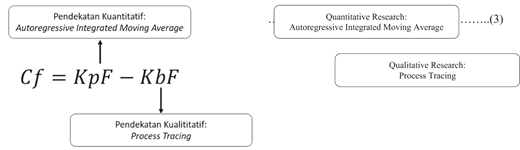
Where:
CF: Fiscal Gap
KpF: Fiscal Capacity
KbF: Fiscal Needs
In the process of estimating KpF projection for the next 20 years, this study adopted time series data analysis. This was because all variables used to calculate KpF have been absorbed into the ARIMA estimation model, as shown in Equations (4) and (5).
= KpF value in the previous period
= error term value in the previous period
= dummy variable to distinguish between normal periods and economic recession periods, where 1 was for recession periods and 0 was for normal periods
= error term assumed to be independent and identically distributed (IID)
In this study, the process of selecting the ARIMA model parameters (p, d, q) was carried out using a visual Correlogram analysis approach with Auto Correlation Function (ACF) and Partial Auto Correlation Function (PACF) graphs. The ACF graph was used to identify the value of q (moving average order), while the PACF graph helped determine the value of p (autoregressive order). The parameter d (differencing) was set to ensure the data were stationary, thereby eliminating long-term trend effects and fulfilling the stationarity assumption required by the ARIMA model. Once the data achieved stationarity, the selection of the best ARIMA model was based on the highest Adjusted R-Square value and the lowest Akaike Information Criterion (AIC). This criterion was chosen as it reflects the model's ability to explain data variability effectively while ensuring the error terms are minimized. By integrating these steps, the methodology ensures that the selected ARIMA model is robust, transparent and suitable for replicating in future studies.
3.3 Qualitative method
The qualitative analysis used the process-tracing Method, which allowed policy analysis by identifying historical causal mechanisms. This method aimed to determine the causal relationship between conditions and their results by analyzing a series of events in one or several cases (Putra and Sanusi, 2019). The operationalization of process-tracing could be presented in Figure 3.
 The timeline diagram shows three horizontal arrows running from left to right across three sections. Each arrow has a circle numbered “1,” “2,” and “3, respectively, in the center.” On the left of each circle, a triangle labeled “Event” is placed. Below each circle, a rectangular box labeled “Policy Formulation” has an upward arrow, extending from the top edge, pointing up toward the circle. From each circle, two dashed arrows labeled “Policy Alternative” extend diagonally upward to the right and diagonally downward to the right. To the right of each arrow, a rectangular box is positioned, labeled “Status Quo of Implementation.” Below the entire arrow, a wide bar is labeled “Time Span,” with “The past” written below its left side, below the first arrow, “The Present” written below the middle arrow, and “The Future” written below the third arrow on the right side.
Operationalization of the process-tracing method in public policy analysis. Source: Putra and Sanusi (2019)
The timeline diagram shows three horizontal arrows running from left to right across three sections. Each arrow has a circle numbered “1,” “2,” and “3, respectively, in the center.” On the left of each circle, a triangle labeled “Event” is placed. Below each circle, a rectangular box labeled “Policy Formulation” has an upward arrow, extending from the top edge, pointing up toward the circle. From each circle, two dashed arrows labeled “Policy Alternative” extend diagonally upward to the right and diagonally downward to the right. To the right of each arrow, a rectangular box is positioned, labeled “Status Quo of Implementation.” Below the entire arrow, a wide bar is labeled “Time Span,” with “The past” written below its left side, below the first arrow, “The Present” written below the middle arrow, and “The Future” written below the third arrow on the right side.Operationalization of the process-tracing method in public policy analysis. Source: Putra and Sanusi (2019)
Qualitative data were collected through interviews and documentation. Interviews were conducted with several informants selected based on their representation of institutional elements and engagement in the creation of the state's financial management, both during the New Order and the Reform Era. In the two institutions studied, there was a minimum of four informants, with the number increasing until the data/information obtained was saturated. The selection of informants was carried out using purposive sampling, a method that included choosing data sources based on certain criteria (Sugiyono, 2011).
The informants selected to answer the formulation of this study problem included the following.
Indonesian Minister of Defense for the 2019–2024 period
Commander of the Indonesian National Armed Forces for the 2023–2025 period
Chief of Staff of the Army (KSAD) for the period
Chief of Staff of the Air Force (KSAU) for the period
Chief of Staff of the Navy (KSAL) for the period
Chairman of the Budget Agency of the Indonesian Parliament
Head of Fiscal Policy Agency of the Indonesian Ministry of Finance
These seven informants hold pivotal positions within Indonesia's defense system, representing each branch of the military – Army, Navy and Air Force – as well as other key stakeholders involved in defense budgeting processes. They play essential roles in proposing, deliberating and approving military budget allocations, making their insights highly relevant for addressing the research questions.
To check the validity of the data, this study adopted two methods, including triangulation and observation persistence.
Triangulation was a data validity method that used external sources or comparisons to verify the data (Lexy, 2018).
Observation Persistence aimed to identify key characteristics and elements in a situation closely related to the study problem, allowing for a detailed focus on relevant aspects.
The procedure and analysis strategies of this process-tracing method were carried out through the following steps.
Conceptualizing the cause–effect relationship.
Selecting cases
Collecting valid evidence or evaluating empirical evidence
Hypothesis testing of the operationalization of empirical tests. These steps were carried out deductively to test hypotheses with conclusions, both from qualitative and quantitative analysis.
4. Results and discussion
4.1 Descriptive statistics of observation data
The forecasting process in this study used a univariate time series analysis regression model, particularly ARIMA, as outlined in the model (5). As previously explained, the variable studied was the total state revenue (Total Revenue). This variable had been adjusted for seasonal influenced and deflated to remove the effect of different base years. Descriptive statistics for each variable were presented in Table 3 below.
Descriptive statistics of variables
| Total revenue (MILIAR RP) | |
|---|---|
| Mean | 199.919,20 |
| Median | 181.649,40 |
| Maximum | 350.195,00 |
| Minimum | 72.536,27 |
| Std. Dev | 85.921,94 |
| Skewness | 0.14 |
| Kurtosis | 1.65 |
| Jarque-Bera | 12.44 |
| Probability | 0.00 |
| Sum | 31.387.312,00 |
| Sum Sq. Dev | 1.150.000.000.000,00 |
| Observations | 157.00 |
Based on Table 3, this study analyzed 157 observation points, covering the period from the first quarter of 1983 to the first quarter of 2022. The average total state revenue per quarter during the period was IDR 199,919.2 billion with a maximum value of IDR 350,195 billion and a minimum value of IDR 72,536.27 billion. Meanwhile, the standard deviation value during the observation period was IDR85,921.94 billion.
4.2 Quantitative model analysis
Following ARIMA model analysis procedure, the first step included conducting a stationarity test on the data at the “level”. This covered two tests, comprising a visual test using a Correlogram graph and a unit root test. The visual test results using the Correlogram graph showed that the Autocorrelation graph exceeded the ballet line from the first period, gradually declining until the last period. The results showed that the total state revenue data at the “level” was not stationary, as presented in Table 4. Based on this Correlogram visual test, the data at the level was not suitable for processing using Autoregressive Moving Average (ARMA).
Level data visual correlogram test
| AC | PAC | Q-stat | Prob | |
|---|---|---|---|---|
| 1 | 0.982 | 0.982 | 154.25 | 0.000 |
| 2 | 0.959 | −0.143 | 302.32 | 0.000 |
| 3 | 0.935 | −0.006 | 444.15 | 0.000 |
| 4 | 0.915 | 0.062 | 580.63 | 0.000 |
| 5 | 0.897 | 0.069 | 712.83 | 0.000 |
| 6 | 0.882 | 0.033 | 841.48 | 0.000 |
| 7 | 0.868 | 0.000 | 966.81 | 0.000 |
| 8 | 0.852 | −0.031 | 1088.5 | 0.000 |
| 9 | 0.835 | −0.038 | 1206.2 | 0.000 |
| 10 | 0.817 | −0.018 | 1319.5 | 0.000 |
| 11 | 0.800 | 0.026 | 1428.9 | 0.000 |
| 12 | 0.784 | 0.014 | 1534.8 | 0.000 |
| 13 | 0.768 | −0.048 | 1636.9 | 0.000 |
| 14 | 0.750 | −0.033 | 1735.1 | 0.000 |
| 15 | 0.731 | −0.056 | 1828.9 | 0.000 |
| 16 | 0.710 | −0.017 | 1918.2 | 0.000 |
| 17 | 0.692 | 0.059 | 2003.7 | 0.000 |
| 18 | 0.676 | 0.030 | 2085.9 | 0.000 |
| 19 | 0.661 | −0.032 | 2164.9 | 0.000 |
| 20 | 0.646 | −0.019 | 2240.8 | 0.000 |
| 21 | 0.629 | −0.023 | 2313.4 | 0.000 |
| 22 | 0.610 | −0.039 | 2382.3 | 0.000 |
| 23 | 0.591 | −0.002 | 2447.4 | 0.000 |
| 24 | 0.571 | −0.040 | 2508.7 | 0.000 |
| 25 | 0.552 | −0.016 | 2566.3 | 0.000 |
| 26 | 0.533 | 0.001 | 2620.6 | 0.000 |
| 27 | 0.515 | −0.027 | 2671.5 | 0.000 |
| 28 | 0.496 | −0.003 | 2719.1 | 0.000 |
| 29 | 0.477 | −0.030 | 2763.5 | 0.000 |
| 30 | 0.456 | −0.047 | 2804.4 | 0.000 |
| 31 | 0.435 | −0.022 | 2841.9 | 0.000 |
| 32 | 0.414 | −0.015 | 2876.1 | 0.000 |
| 33 | 0.393 | −0.017 | 2907.2 | 0.000 |
| 34 | 0.373 | −0.009 | 2935.4 | 0.000 |
| 35 | 0.352 | −0.011 | 2960.9 | 0.000 |
| 36 | 0.332 | −0.010 | 2983.6 | 0.000 |
To strengthen the results of the Correlogram test, a unit root test was conducted using Eviews 12 statistical software, as presented in Table 5. By using the Augmented Dicky–Fuller statistical test, the t-statistic and the probability values were −0.104258 and 0.9459, respectively. Given the high probability value, hypothesis 0 (zero) was accepted, indicating that the data had a unit root or was not stationary. Therefore, the total state revenue data at the level was unsuitable for processing using univariate time series analysis, particularly ARMA.
Results of the unit root test for level data
| t-statistic | Prob.* | ||
|---|---|---|---|
| Augmented Dickey-Fuller test statistic | −0.104258 | 0.9459 | |
| Test critical values | 1% level | −3.474874 | |
| 5% level | −2.880987 | ||
| 10% level | −2.577219 | ||
| Null Hypothesis: TOTREV has a unit root Exogenous: Constant Lag Length: 8 (Automatic – based on SIC, maxlag = 13) *MacKinnon (1996) one-sided p values | |||
| Variable | Coefficient | Std. error | t-statistic | Prob |
|---|---|---|---|---|
| TOTREV(−1) | −0.000469 | 0.004498 | −0.104258 | 0.9171 |
| D(TOTREV(−1)) | 0.934155 | 0.082033 | 11.38751 | 0.0000 |
| D(TOTREV(−2)) | −0.623148 | 0.112749 | −5.526859 | 0.0000 |
| D(TOTREV(−3)) | 0.536734 | 0.120962 | 4.437215 | 0.0000 |
| D(TOTREV(−4)) | −0.810922 | 0.118975 | −6.815887 | 0.0000 |
| D(TOTREV(−5)) | 0.597425 | 0.119955 | 4.980391 | 0.0000 |
| D(TOTREV(−6)) | −0.364378 | 0.120644 | −3.020281 | 0.0030 |
| D(TOTREV(−7)) | 0.185092 | 0.111640 | 1.657943 | 0.0996 |
| D(TOTREV(−8)) | −0.267975 | 0.081291 | −3.296481 | 0.0012 |
| C | 1504.761 | 991.4244 | 1.517777 | 0.1314 |
| R-squared | 0.596353 | Mean dependent var | 1858.838 | |
| Adjusted R-squared | 0.570028 | S.D. dependent var | 6794.086 | |
| S.E. of regression | 4455.033 | Akaike info criterion | 19.70663 | |
| Sum squared resid | 2.74 E+09 | Schwarz criterion | 19.90915 | |
| Log likelihood | −1448.291 | Hannan–Quinn criter | 19.78891 | |
| F-statistic | 22.65367 | Durbin–Watson stat | 2.016641 | |
| Prob(F-statistic) | 0.000000 | |||
Note(s): Augmented Dickey-Fuller test equation
Dependent Variable: D(TOTREV)
Method: Least Squares
Date: 05/15/24 Time: 06:50
Sample (adjusted): 1985Q2 2022Q1
Included observations: 148 after adjustments
According to statistical rules, the data were processed using univariate time series analysis, necessitating the first differencing treatment. After the first differencing was carried out on the level data, the stationarity test was repeated using the visual Correlogram and the unit root test.
The results of the visual Correlogram test were presented in Table 6, indicating that the autocorrelation data now moved randomly around its baseline. Based on the random movement in the table, it was strongly suspected that the data were stationary. To confirm this assumption, the unit root test was further conducted, as shown in Table 7.
Visual correlogram test of first differencing data
| AC | PAC | Q-stat | Prob | |
|---|---|---|---|---|
| 1 | 0.574 | 0.574 | 52.392 | 0.000 |
| 2 | 0.165 | −0.246 | 56.739 | 0.000 |
| 3 | −0.036 | −0.021 | 56.950 | 0.000 |
| 4 | −0.258 | −0.289 | 67.720 | 0.000 |
| 5 | −0.191 | 0.199 | 73.682 | 0.000 |
| 6 | −0.106 | −0.147 | 75.534 | 0.000 |
| 7 | −0.141 | −0.083 | 78.820 | 0.000 |
| 8 | −0.171 | −0.187 | 83.685 | 0.000 |
| 9 | −0.227 | −0.093 | 92.323 | 0.000 |
| 10 | −0.246 | −0.123 | 102.58 | 0.000 |
| 11 | −0.150 | −0.014 | 106.40 | 0.000 |
| 12 | −0.013 | −0.016 | 106.43 | 0.000 |
| 13 | 0.122 | 0.050 | 108.98 | 0.000 |
| 14 | 0.173 | −0.057 | 114.16 | 0.000 |
| 15 | 0.054 | −0.173 | 114.66 | 0.000 |
| 16 | −0.053 | −0.066 | 115.15 | 0.000 |
| 17 | −0.053 | 0.002 | 115.66 | 0.000 |
| 18 | −0.037 | −0.055 | 115.91 | 0.000 |
| 19 | 0.034 | −0.027 | 116.12 | 0.000 |
| 20 | 0.100 | −0.011 | 117.94 | 0.000 |
| 21 | 0.133 | 0.108 | 121.19 | 0.000 |
| 22 | 0.107 | −0.040 | 123.31 | 0.000 |
| 23 | 0.028 | −0.016 | 123.45 | 0.000 |
| 24 | 0.022 | 0.062 | 123.54 | 0.000 |
| 25 | −0.009 | −0.061 | 123.55 | 0.000 |
| 26 | 0.004 | 0.063 | 123.56 | 0.000 |
| 27 | 0.077 | 0.043 | 124.70 | 0.000 |
| 28 | 0.043 | 0.030 | 125.05 | 0.000 |
| 29 | −0.009 | 0.030 | 125.07 | 0.000 |
| 30 | 0.003 | 0.116 | 125.07 | 0.000 |
| 31 | −0.018 | 0.025 | 125.14 | 0.000 |
| 32 | −0.045 | 0.004 | 125.54 | 0.000 |
| 33 | −0.035 | 0.013 | 125.79 | 0.000 |
| 34 | −0.109 | −0.121 | 128.20 | 0.000 |
| 35 | −0.193 | −0.102 | 135.75 | 0.000 |
| 36 | −0.207 | −0.077 | 144.52 | 0.000 |
Results of the unit root test of first difference data
| t-statistic | Prob.* | ||
|---|---|---|---|
| Augmented Dickey-Fuller test statistic | −6.350253 | 0.0000 | |
| Test critical values | 1% level | −3.474874 | |
| 5% level | −2.880987 | ||
| 10% level | −2.577219 | ||
| Null Hypothesis: D(TOTREV) has a unit root Exogenous: Constant Lag Length: 7 (Automatic – based on SIC, maxlag = 13) *McKinnon and pills (1996) one-sided p values | |||
| Variable | Coefficient | Std. error | t-statistic | Prob |
|---|---|---|---|---|
| TOTREV(−1)) | −0.814722 | 0.128298 | −6.350253 | 0.0000 |
| D(TOTREV(−1),2) | 0.748748 | 0.121157 | 6.179977 | 0.0000 |
| D(TOTREV(−2),2) | 0.125128 | 0.120097 | 1.041899 | 0.2993 |
| D(TOTREV(−3),2) | 0.661895 | 0.114712 | 5.770078 | 0.0000 |
| D(TOTREV(−4),2) | −0.149617 | 0.097792 | −1.529940 | 0.1283 |
| D(TOTREV(−5),2) | 0.448000 | 0.098035 | 4.569779 | 0.0000 |
| D(TOTREV(−6),2) | 0.083331 | 0.084428 | 0.987013 | 0.3254 |
| D(TOTREV(−7),2) | 0.268792 | 0.080625 | 3.333868 | 0.0011 |
| C | 1411.101 | 417.8953 | 3.376685 | 0.0010 |
| R-squred | 0.474950 | Mean dependent var | 51.63514 | |
| Adjusted R-squared | 0.444731 | S.D. dependent var | 5957.285 | |
| S.E. of regression | 4439.154 | Akaike info criterion | 19.69320 | |
| Sum squared resid | 2.74 E+09 | Schwarz criterion | 19.87546 | |
| Log likelihood | −1448.297 | Hannan-Quinn criter | 19.76725 | |
| F-statistic | 15.71706 | Durbin–Watson stat | 2.017163 | |
| Prob(F-statistic) | 0.000000 | |||
Note(s): Augmented Dickey–Fuller Test Equation
Dependent Variable: D(TOTREV,2)
Method: Least Squares
Date: 05/15/24 Time: 06:50
Sample (adjusted): 1985Q2 2022Q1
Included observations: 148 after adjustments
Based on the results of the unit root test, the t-statistic value was −6.350253 and the probability value was 0.0000, indicating that the data at the first difference level no longer contained a unit root or was stationary. When the data were stationary, the next stage of processing could proceed using ARIMA.
Based on the results of the visual Correlogram test in Table 6, several possible combinations of ARIMA orders for predicting total state revenue data included AR (1), AR (2), AR (4), MA (1) and MA (4). This study conducted several experiments with all the orders to assess their effect on changes in total state revenue. According to these experiments, the best combination of ARIMA orders identified comprised AR (1), AR (2) and MA (4). In other words, the best model selected was ARIMA(2,1,4), where p = 2, d = 1 and q = 4. This model selection was based on the interpretation of significant patterns in the Correlogram graphs (Table 6) and confirmed by the highest Adjusted R-Square value and the lowest AIC (Table 7), which indicates the model's ability to accurately explain data variability. This approach provides a strong foundation for forecasting validity, supports methodological transparency and enhances the replicability of the study in the future. The results of processing ARIMA model using Eviews 12 software were presented in Table 8.
Data processing results using ARIMA model
| Variable | Coefficient | Std. error | t-statistic | Prob |
|---|---|---|---|---|
| C | 1596.043 | 425.8120 | 3.748234 | 0.0003 |
| AR(1) | 0.806761 | 0.074053 | 10.89437 | 0.0000 |
| AR(2) | −0.304252 | 0.083328 | −3.651244 | 0.0004 |
| MA(4) | −0.502837 | 0.067909 | −7.404610 | 0.0000 |
| SIGMASQ | 23,152,724 | 2,116,071 | 10.94137 | 0.0000 |
| R-squared | 0.505854 | Mean dependent var | 1652.231 | |
| Adjusted R-squared | 0.492764 | S.D. dependent var | 6867.045 | |
| S.E. of regression | 4890.743 | Akaike info criterion | 19.87257 | |
| Sum squared resid | 3.61 E+09 | Schwarz criterion | 19.97032 | |
| Log likelihood | −1545.060 | Hannan-Quinn criter | 19.91227 | |
| F-statistic | 38.64445 | Durbin–Watson stat | 1.872179 | |
| Prob(F-statistic) | 0.000000 | |||
| Inverted AR Roots | 0.40 +0 .38i | 0.40-0.38i | ||
| Inverted MA Roots | 0.84 | 0.00-0.84i −00 +0 .84i | −0.84 | |
Based on data processing using ARIMA model, the variables AR (1), AR (2) and MA (4) had probability values of less than 0.05, indicating that the three variables were statistically significant at a confidence level of 5%. Therefore, AR (1), AR (2) and MA (4) significantly affected the total state revenue. Additionally, the model achieved an AIC value of 19.873, further confirming its optimal fit and efficiency in balancing model complexity and goodness of fit.
This study obtained an adjusted R-square value of 0.492764, suggesting that ARIMA model explained 49.2764% of the changes in total state revenue. Meanwhile, the remaining R-square value (50.7236%) was influenced by other variables outside the model. The adjusted R-square value was the largest when compared to other ARIMA orders, making this combination the most suitable for forecasting total state revenue.
Regarding limitations, implementing the ARIMA model does present certain challenges, particularly in ensuring data stationarity and addressing complex seasonal patterns. To overcome these limitations, we applied differencing to nonstationary data and utilized visual analysis to ensure that the data patterns met the model's assumptions. Parameter adjustments were carried out iteratively to obtain the most suitable model. Thus, the methodology employed not only produces accurate results but is also transparent and replicable for future research.
C. Forecasting of total state revenue using ARIMA model
After identifying AR (1), AR (2) and MA (4), the next step was to forecast the total state revenue in the future using a combination of these orders. ARIMA model was mathematically represented based on the data presented in Table 9 as follows.
Estimated total state revenue in 2025–2045 using ARIMA model
| Year | Estimated total state revenue (billion Rp) | Estimated state revenue growth (%) |
|---|---|---|
| 2025 | 1,460,417.90 | |
| 2026 | 1,485,954.60 | 1.75 |
| 2027 | 1,511,491.30 | 1.72 |
| 2028 | 1,537,028.00 | 1.69 |
| 2029 | 1,562,564.60 | 1.66 |
| 2030 | 1,588,101.40 | 1.63 |
| 2031 | 1,613,638.00 | 1.61 |
| 2032 | 1,639,174.80 | 1.58 |
| 2033 | 1,664,711.40 | 1.56 |
| 2034 | 1,690,248.20 | 1.53 |
| 2035 | 1,715,784.80 | 1.51 |
| 2036 | 1,741,321.50 | 1.49 |
| 2037 | 1,766,858.20 | 1.47 |
| 2038 | 1,792,394.90 | 1.45 |
| 2039 | 1,817,931.60 | 1.42 |
| 2040 | 1,843,468.20 | 1.40 |
| 2041 | 1,869,005.00 | 1.39 |
| 2042 | 1,894,541.60 | 1.37 |
| 2043 | 1,920,078.30 | 1.35 |
| 2044 | 1,945,615.00 | 1.33 |
| 2045 | 1,971,151.70 | 1.31 |
| Average | 1.51 | |
Based on this model and the use of the Eviews data processing tool, the estimated total state revenue from 2025 to 2045 was provided in Table 7.
Based on ARIMA model presented in Table 9, with a combination of AR (1), AR (2) and MA (4) orders, the total state revenue in 2045 would be IDR 1,971.15 trillion. This estimated total revenue data were compared with the total defense budget needs until 2045 to determine fiscal gap between available capacity and defense budget needs. The amount of defense budget needed was obtained from the results of in-depth interviews with several sources, which were further detailed in sub-chapter 4.4.
4.4 Estimated defense budget needs
Based on the tracing process carried out both through literature reviews and interviews with informants, the ideal defense budget needs were IDR 1,700 trillion. The estimated needs were targeted to be met in 5 years, thereby allowing a budget of IDR 340 trillion to be available per year.
According to the 2023 state budget, the defense budget was set at IDR 52.4 trillion, resulting in a significant fiscal gap of around IDR 287.6 trillion for the year. This fiscal gap was expected to occur and grow larger when the fulfillment of the ideal military budget needs relied only on the current state budget posture.
Based on the results of the estimated calculation using ARIMA time series analysis model as in Table 7 above, the average annual growth of state revenue was around 1.5%. Given the modest growth, it was doubtful that defense budget needs could be met solely through the current revenue trend. Therefore, inorganic steps outside the state budget were needed to fulfill the ideal defense budget needs. The results of interviews with informants showed that four alternative solutions were used to address the fiscal gap between budget availability and defense budget needs.
Optimization of Defense Company
Optimization of Defense Assets
Optimization of the Role of 3rd Parties (Private)
Combination of Optimization of Defense Company, Defense Assets and the Role of the Private Sector
From the results of in-depth interviews with these informants, the most feasible step for the short term was the Optimization of Defense Company. The results showed that there were five strategic companies with the greatest potential to generate optimal profits to address the fiscal gap, including Perindustrian Angkatan Darat (Pindad), Penataran Angkatan Laut (PAL) Indonesia, Dirgantara Indonesia (PTDI), Lembaga Elektronika Nasional (LEN) and Dahana company (DAHANA) (Figure 4).
 The diagram shows a rectangular box in the center labeled “Defense Industries.” Five lines extend outward from the box. The top line connects to the logo and text “pindad,” with an icon of a small rocket moving in a path towards the sun. The left line connects to the text “Dahana” with a small colored start symbol. The right line connects to the text “PAL INDONESIA” with a small icon of a polygon. The bottom left line connects to the red text “LFN” with a star symbol. The bottom right line connects to a logo with three diagonal shapes and the text “DIRGANTARA INDONESIA.”
Potential companies in defense company. Source: results of informant interviews, 2024
The diagram shows a rectangular box in the center labeled “Defense Industries.” Five lines extend outward from the box. The top line connects to the logo and text “pindad,” with an icon of a small rocket moving in a path towards the sun. The left line connects to the text “Dahana” with a small colored start symbol. The right line connects to the text “PAL INDONESIA” with a small icon of a polygon. The bottom left line connects to the red text “LFN” with a star symbol. The bottom right line connects to a logo with three diagonal shapes and the text “DIRGANTARA INDONESIA.”Potential companies in defense company. Source: results of informant interviews, 2024
When the fiscal gap for the defense budget needs was distributed to the five strategic companies, each would need to contribute IDR 57.52 trillion per year. Based on the potential and performance achievements, this target was realistic.
4.4.1 Pindad company
Pindad was an Indonesian defense manufacturing company established in 1808 in Surabaya under the initiative of the Governor General of the Dutch East Indies, Herman Willem Daendels. In 1950, the Indonesian government acquired the company and changed its name to Pindad in 1962. Pindad was one of SOE with healthy financial performance in terms of assets and profitability. Based on the 2022 Annual Report (the latest annual report that could be accessed), this company reported a 39.6% increase in revenue with IDR 6,439.05 billion in 2022 and a net profit of IDR 101.68 billion. The report also found an inventory turnover (days) of 180 days and favorable financial ratios, including the debt-to-asset ratio, equity and others, indicating a healthy condition.
The company had succeeded in making various achievements in both defense and industrial sectors through its superior products such as assault rifles, pistols, ammunition of calibers and others. The weapons and ammunition have contributed to the Indonesian Army's victories in international shooting competitions over the years. Furthermore, the company supplied special vehicles such as Anoa and Komodo Pindad, which were exported to various countries, as presented in Table 10.
Leading defense equipment of Pindad
| Superior defense equipment | Type | Production category | User |
|---|---|---|---|
| Tiger | Medium Tanks | International Cooperation | Indonesia |
| Dwarf Buffalo | Armored Personnel Carrier (APC) | Independent | Indonesia, Brunei, Bangladesh, Philippines, Ghana, Malaysia, Cambodia |
| Komodo Dragon | Light Armored Vehicle (AV) | Independent | Indonesia |
| Rhinoceros | Armored Personnel Carrier (APC) | Independent | Indonesia |
| Cobra | Armored Personnel Carrier (APC) | International Cooperation | Indonesia |
| Big Tiger (maung) | Light Utility Vehicle (LUV) | National Cooperation | Indonesia |
| Remote Control Weapon System (RCWS) | Weapon System | International Cooperation | Indonesia |
Considering its various advantages, Pindad was one of the mainstay companies positioned to help bridge the fiscal gap for defense budget needs.
4.4.2 PAL Indonesia company
PAL Indonesia Company, established in 1980 and headquartered in Surabaya, East Java, specializes in shipbuilding and engineering. The company constructed various types of ships, including military ships, commercial ships and offshore support vessels. Its military ships offerings included patrol boats (Fast Patrol Boat, FPB) of 28 m, 38 m and 57 m, fast missile boats (KCR) of 60 m, Landing Platform Dock (LPD) ships of 124 m and 125 m, strategic sealift vessels (SSV) of 123 m, hospital support ships, missile escort destroyers (PKR) or 105 m frigates, and Nagapasa-class submarines as shown in Table 11.
Leading defense equipment of PAL company Indonesia
| Superior defense equipment | Production category | User |
|---|---|---|
| Landing Platform Dock (LPD) | Independent | Indonesia, Philippines |
| Fast Attack Craft (FAC) | Independent | Indonesia, Senegal, Guinea-Bissau, Gabon |
| Fast Patrol Boat (FPB) | Independent | Indonesia, Senegal |
| Strategic Sealift Vessel (SSV) | Independent | Indonesia, Philippines, Nigeria |
| Hospital Ship | Independent | Indonesia |
| Martadinata-class Frigate | International Cooperation | Indonesia |
| Nagapasa-class Submarine | International Cooperation | Indonesia |
The company could independently produce FPB, LPD, SSV and hospital support ships. PAL collaborated with Dutch shipyard Damen Schiede Naval Ship Building (DSNS) for the Martadinata-class frigate and partnered with Daewoo Shipbuilding and Marine Engineering (DSME) company in South Korea for submarines.
In addition to warships, PAL produced commercial vessels, such as bulk carriers, container ships and tankers. These vessels were designed to meet the needs of the shipping sector and were built to international standards. Furthermore, PAL Company constructed offshore support vessels, including Anchor Handling Tugs (AHT), Platform Supply Vessels (PSV) and Diving Support Vessels (DSV) to support offshore oil and gas operations. The company also provided other engineering services, such as heavy equipment fabrication and machinery, with products containing cranes, boilers and turbines (Prihandoko et al., 2023).
PAL Company served as a functional executor of the Maintenance and Repair of Indonesian Warships owned by the Navy by carrying out routine maintenance and overhauls on various vessels, including surface ships and submarines. The company also actively participated in project auctions and promoted the use of domestic defense equipment products held by the Ministry of Defense or the Navy.
At the international level, PAL has promoted its main ship design products to potential consumers such as the Philippine and Malaysian navies. The company also participated in overseas project auctions, including the Philippine LD, UAE LPD 163 M and Malaysian Litoral Mission Ship.
Considering its diverse product range, extensive experience and global project portfolios, PAL had significant market potential among countries, private sectors, as well as SOE. The company had promising business prospects, driven by both domestic and international market demand.
4.4.3 Dirgantara Indonesia company
PTDI was an SOE established in 1976 in Bandung, Indonesia. Engaged in the aviation and defense company, PTDI was the only aircraft manufacturer in Indonesia as well as in Southeast Asia. This company fulfilled the needs of civil airlines, military operators and specialized missions, playing an important role in the development of the aviation sector. PTDI has produced various types of aircraft, such as the CN235 for civil and military transport, Maritime Surveillance Aircraft, Maritime Patrol Aircraft and Coast Guard aircraft, presented in Table 12. Generally, the company has delivered nearly 400 aircraft to about 50 operators worldwide.
Leading defense equipment of PTDI
| Superior defense equipment | Type | Production category | Users |
|---|---|---|---|
| CN-235 | Transport/Multipurpose Aircraft | International Cooperation | Indonesia, Senegal, Malaysia, South Korea, Pakistan, UAE, Burkina Faso |
| CN-295 | Transport/Multipurpose Aircraft | International Cooperation | Indonesia |
| N-219 | Transport/Multipurpose Aircraft | International Cooperation | Indonesia |
| NC-212i | Transport/Multipurpose Aircraft | International Cooperation | Indonesia, Thailand, Philippines |
| Bell-412 | Multipurpose Helicopter | Independent (Licensed) | Indonesia |
| AS-550 | Multipurpose Helicopter | Independent (Licensed) | Indonesia |
| Super Puma | Transport Helicopter | Independent (Licensed) | Indonesia |
| AS-565 | Anti-Submarine Helicopter | Independent (Licensed) | Indonesia |
| N-245* | Transport/Multipurpose Aircraft | International Cooperation | Indonesia |
| Black Hawk* | Attack Helicopter | International Cooperation | Indonesia |
| Surface-to-Surface Missile (SSM)* | Missile | Local Cooperation | Indonesia |
| Black Eagle* | Drone | Local Cooperation | Indonesia |
| KFX/IFX* | Fighter Jet | International Cooperation | South Korea and Indonesia |
PTDI had several superior products, including the N219, a 19-seat regional civil transport aircraft, the CN235, a medium-scale multipurpose transport aircraft, the NC212i, a military transport aircraft and the Nurtanio Colibri, a light helicopter. As a superior company, it had an integrated operational process, starting from design and development, to aircraft production.
Based on the available information, PTDI had substantial potential, evidenced by its proven capacity, experience, as well as design and production capabilities. The company benefited from skilled human resources (HR), expertise and a global partnership network. Although PTDI succeeded in marketing its products to the international market, the majority of the superior products were still centered on domestic users. For the dual-function strategy, PTDI has succeeded in selling its products for civil aviation, particularly the CN-235 series and several types of transport helicopters. This made the company to be included in defense companies, which was capable of addressing the fiscal gap.
4.4.4 LEN company
LEN was founded in 1965. The company was believed to have enormous potential, and in 1991, its ownership status changed to Limited Liability Company (Persero). Currently, LEN operated through five subsidiaries, including Eltran Indonesia, Surya Energi Indotama, Len Railway Systems (RLS), Len Telekomunikasi Indonesia (LTI) and Len Rekaprima Semesta.
LEN focused on defense sectors and served as the holding company for DEFEND ID, which consisted of Pindad, Dirgantara Indonesia, Dahana and PAL Indonesia. This holding company aimed to promote the independence of the Indonesian defense sector and maintain state sovereignty. LEN had C5ISR (Command, Control, Communication, Computers, Cyber, Intelligence, Surveillance and Reconnaissance) capabilities. The company had a great opportunity to meet domestic and international market needs by providing technology products in accordance with market needs. Several factors that supported the potential of domestic and foreign markets included the following.
Infrastructure Development: The Indonesian government continued to promote infrastructure, including transportation, telecommunications and energy networks. LEN could play an active role in these national projects by offering innovative technologies and solutions.
Digitalization and Modernization: There was a strong push for digitalization in various sectors such as finance and banking, education, health and government. LEN products and services in telecommunications and electronics could support such initiatives.
Defense and Security: With increasing security threats domestically and internationally, the need for more sophisticated and efficient defense systems was increasing. LEN, with its defense products, was well-positioned to fulfill the needs.
The international market offered great opportunities for LEN to grow its business, focusing on countries such as Asia and Africa with similar needs for technology and infrastructure. Several factors that supported the potential of the international market included the following.
Product Exports: LEN has successfully exported its products to countries in Asia and Africa. These markets required reliable technology to support their economic growth. The company could offer solutions that have been proven effective in Indonesia.
International Cooperation: By building strategic partnerships with local companies in target countries, LEN could expand its reach and increase market penetration. This cooperation also helped in understanding local market needs and adjusting products and services accordingly.
As a defense company, LEN had the potential to continue to grow and contribute positively to address the fiscal gap in budget needs.
4.4.5 Dahana company
Dahana Company, also known as “DAHANA” was a member of DEFEND ID SOE Holding in defense companies and specialized in integrated explosives services. The company had four business lines, including Explosives Manufacturing, Drilling and Blasting, Related Services and Defense Related.
DAHANA products and services were widely used by Indonesian companies, comprising general mining (metal, minerals and coal), quarry and construction (the cement industry, asphalt and andesite stone quarrying), construction projects (dams, tunnels, irrigation, demolition of old buildings and port deepening), oil and gas (oil well casing perforation operations, and seismic operations), as well as military operations. As a pioneer in the blasting sector with a trusted reputation, DAHANA provided complete blasting services in the process stages. The company has significant market potential, serving various companies across Indonesia, including mining, quarrying, construction, oil and gas, as well as defense. In Indonesia, DAHANA operated in 15 provinces, including Semen Padang (West Sumatra), Karimun (Riau Islands), Semen Baturaja (South Sumatra), MHU (East Kalimantan), HPU KJB East Kalimantan, KBL KSM (East Kalimantan), IMK (Central Kalimantan), CK BMDD (South Kalimantan), Adaro Indonesia (South Kalimantan), KBL CCM (North Kalimantan), JR Bolaang Mongondow (North Sulawesi), Semen Tonasa (South Sulawesi), CPM (Central Sulawesi) and NHM (North Maluku). Its products were also exported to countries such as Canada, Oman, Iran, Egypt, China, Qatar, Australia, ASEAN and others.
According to the 2022 Annual Report, DAHANA reported a profit of IDR 260.70 billion with a capital-to-total activity ratio of 43.31. The revenue breakdown included IDR 3.31 trillion from nondefense businesses and IDR 0.007 trillion from defense sector activities. Given its ability and extensive market opportunities, DAHANA became one of the companies that could address the fiscal gap for the current military budget needs.
5. Conclusions and recommendations
In conclusion, the analysis results showed that a substantial fiscal gap would persist between the ideal defense budget needs and the available budget, extending through 2045. When the analysis only relied on the current linear growth of state revenues, the fiscal gap tended not to be addressed. Therefore, unconventional measures were needed to cover the fiscal gap. Among the various alternative solutions, optimizing the role of the strategic defense company served as a feasible option to be carried out in a short time.
The results further identified five strategic companies with the greatest potential to generate optimal profits to address the fiscal gap: Perindustrian Angkatan Darat (Pindad), Penataran Angkatan Laut (PAL) Indonesia, Dirgantara Indonesia (PTDI), Lembaga Elektronika Nasional (LEN) and Dahana Company (DAHANA) (Figure 4). However, the performance of these companies had not yet reached maximum capacity due to limited assets. None of these companies reported a net profit exceeding IDR 5 trillion. To enhance their performance and profitability, additional capital investment was deemed necessary to significantly expand the number of productive assets.
The study's findings align with Neorealism and Offensive Neorealism theory, which emphasize the importance of military and economic strength in addressing potential threats (Mearsheimer, 2001). According to these theories, states strive to dominate resources and secure strategic advantages through economic, technological and military measures (Ucko and Marks, 2020).
Building on this theoretical framework, practical strategies must be devised to address the fiscal limitations that hinder the optimization of strategic defense companies. Building on this theoretical framework, practical strategies must be devised to address the fiscal limitations that hinder the optimization of strategic defense companies. Regarding limitations, implementing the ARIMA model does present certain challenges, particularly in ensuring data stationarity and addressing complex seasonal patterns. To overcome these limitations, we applied differencing to nonstationary data and utilized visual analysis to ensure that the data patterns met the model's assumptions. Parameter adjustments were carried out iteratively to obtain the most suitable model. Thus, the methodology employed not only produces accurate results but is also transparent and replicable for future research.
Several strategies could address the capital needs, including private sector engagement (joint investment) and bond issuance by companies or the government, which could enhance the production capacity of Indonesia's five strategic defense companies. However, these strategies present notable risks. One key concern is the potential reduction in state control over critical defense assets, as privatization or private sector involvement may shift priorities toward profit-driven objectives. The extent of this impact varies across countries, influenced by differences in market structures and trust-based networks (Weiss, 2021). Another significant risk involves increased fiscal liabilities, which may arise if strategies such as bond issuance or large-scale investments fail to deliver expected returns. Such outcomes could strain public finances, particularly if fiscal risks are not managed effectively, potentially redirecting resources from essential sectors like healthcare, education or infrastructure. To mitigate these risks, robust risk management frameworks are essential. Additionally, international collaboration, such as technology transfers, joint production or co-investment with countries possessing advanced defense technologies, could reduce fiscal burdens while modernizing defense capabilities, aligning with global defense trends (Mandel, 2001). The government also had to explore and use other alternatives to address the fiscal gap more effectively and efficiently.

