Given the importance of governance in attaining outreach and financial sustainability of microfinance institutions (MFIs), the study comprehensively explores and synthesizes existing literature to clarify the complex relationship between governance and performance in the microfinance industry.
This study employed a bibliometric analysis and systematic literature review. Relevant articles were collected from Scopus and Web of Science, covering the period between 1999 and 2023. Following the Preferred Reporting Items for Systematic Reviews and Meta-Analyses protocol, a total of 88 articles were systematically analyzed.
The study yielded several key findings. First, research on governance and dual performance in MFIs is predominantly concentrated in the Asian region. Second, the analysis revealed that determining the impact of governance on MFIs’ performance remains a challenge due to the variability associated with legal status, the diverse contexts studied, sample selection biases, varied methodologies and researchers' nuanced selection of indicators. Third, our review identified a significant number of indicators: 151 for governance, 51 for financial performance and 45 for social performance. Notably, most reviewed studies have paid little attention to the environmental aspect of performance. Finally, the study documented the absence of a single, unified theoretical framework capable of fully elucidating this complex association.
The article offers significant value by illuminating the key contributions of research on the nexus between governance and MFI performance. Furthermore, it critically assesses the limitations of previous studies and identifies promising avenues for future research in this domain.
1. Introduction
Over the past fifty years, microfinance, particularly microcredit, has garnered significant attention from researchers, policymakers, and beneficiaries. It is well-established as a crucial financial mechanism, providing both financial and non-financial services to low-income individuals often excluded from conventional financial markets and traditional bank credit due to perceived risk and lack of creditworthiness (Ledgerwood, 1999). To achieve their mission, most MFIs today pursue a dual objective: providing financial support to vulnerable population—referred to as outreach or social performance (SP)—and maintaining financial viability, ensuring their continuous capacity to serve the poor, known as financial sustainability of financial performance (FP) (Ghosh and Guha, 2019; Ibrahim et al., 2018; Wale, 2015a, b; Bassem, 2009; Hartarska, 2005). While SP remains the ultimate goal of MFIs, achieving FP is widely acknowledged as the indispensable means to attain it (Bardhan et al., 2021).
The challenge of balancing both financial and social performance has become prominent for MFIs over the last decade (Awaworyi Churchill, 2020; Bassem, 2012; Thrikawala et al., 2015). This difficulty has, in some cases, led to bankruptcies and a subsequent shift in investor strategies within the sector (Iqbal et al., 2019; Kyereboah-Coleman and Osei, 2008; Uchenna et al., 2020). A significant reason cited for this challenge is potential shortcomings in MFI governance practices (Beisland et al., 2014), which has consequently spurred increased research interest in understanding governance’s impact on MFI performance (Hideto Dato et al., 2020). This growing academic interest stems from concerns about potential weaknesses and the inherent complexity of MFI governance structures. While studies by Djan and Mersland (2022), Hideto Dato et al. (2020), and Bibi et al. (2018) suggest that robust corporate governance can ensure MFI financial sustainability while upholding their social mission, others like Anwar et al. (2021), Hussain et al. (2021), and Müller and Uhde (2013) argue for the role of public governance mechanisms. However, existing literature often treats corporate and public governance as separate entities, resulting in fragmented analyses that overlook their dynamic interplay. Addressing this, it becomes imperative to integrate corporate and public governance perspectives, adopting a holistic approach that fully considers microfinance’s unique responsibilities, challenges, and objectives. This innovative approach not only enriches the theoretical discourse on governance but also facilitates the development of more robust governance models, offering significant practical implications for policymakers and sector leaders.
To thoroughly investigate the nexus between governance and performance in MFIs, this systematic review addresses the following research questions:
How has research on this topic evolved over time and geographically?
What measures have been used to quantify governance mechanisms and their impact on MFIs’ performance?
What are the limitations of previous research, and what new avenues and implications are emerging for future studies?
While Rasel and Win (2020) conducted the sole prior systematic review on governance within microfinance, adopting the Tranfield et al. (2003) approach, this present study offers several distinct advantages. First, this review adopts the PRISMA methodology, elevating the transparency and reliability of its findings through clearly articulated inclusion and exclusion criteria. Unlike the more flexible Tranfield method, PRISMA provides a standardized framework that ensures reproducibility and facilitates comprehensive evidence synthesis, allowing for a meticulously filtered and methodologically sound body of research. Second, rather than an exhaustive coverage of general microfinance governance, this study uniquely focuses on the nuanced relationship between governance and MFI performance. It comprehensively describes the evolution of relevant articles, identifies influential authors, and discusses prevalent theories connecting governance and performance through a combined bibliometric analysis and systematic literature review. Third, the review offers a detailed exposition of all variables used to measure governance and dual performance (financial and social), a feature often absent in prior Systematic Literature Reviews (SLRs). Lastly, and most significantly, this study integrates insights from both corporate and public governance into the discussion of MFI performance, with a particular emphasis on public governance—a dimension less explored in microfinance literature. This integration is crucial because existing research often examines these domains in isolation, overlooking the interplay between internal governance practices (e.g. board composition, women in leadership) and broader institutional and regulatory frameworks. By synthesizing these perspectives, our study offers a more comprehensive understanding of governance dynamics and their multifaceted influence on microfinance performance, thereby contributing novel insights into governance mechanisms within this unique context.
The remainder of the paper is structured as follows: Section 2 details the employed research methodology. Section 3 presents the bibliometric analysis. Section 4 explores the impact of governance on MFIs’ performance. Finally, Section 5 discusses the limitations and shortcomings identified through the systematic review, proposes avenues for future research, and highlights potential implications.
2. Research design and methodology
This systematic review and bibliometric analysis followed the PRISMA protocol. We conducted a comprehensive literature search to identify studies examining the relationship between governance and MFI performance, subsequently applying predefined inclusion and exclusion criteria for study selection.
2.1 Inclusion and exclusion criteria
To ensure the rigor and quality of the selected literature, specific inclusion and exclusion criteria were established (Table 1). This review focused exclusively on peer-reviewed journal articles indexed in reputable databases, given their quality assurance and systematic evaluability. While the scope was limited to studies published in English and French, no specific publication period restrictions were imposed. This decision aimed to ensure comprehensive coverage by incorporating research across the entire available timeframe.
2.2 Information sources
To identify a comprehensive set of relevant articles, our study systematically searched journals indexed in two major scientific databases: Scopus and Web of Science. Additionally, to evaluate the methodological rigor and quality of the selected studies, a straightforward assessment approach based on the framework developed by Ahmad and Omar (2016) was applied.
2.3 Search strategy and keyword selection
A precise keyword selection is critical to ensure the search results comprehensively capture the existing literature. For this review, the search terms were primarily informed by those successfully employed in the systematic review by Rasel and Win (2020), which demonstrated efficacy in identifying relevant literature. The resulting search equations, tailored for each database, are presented in Table 2.
2.4 Selected studies
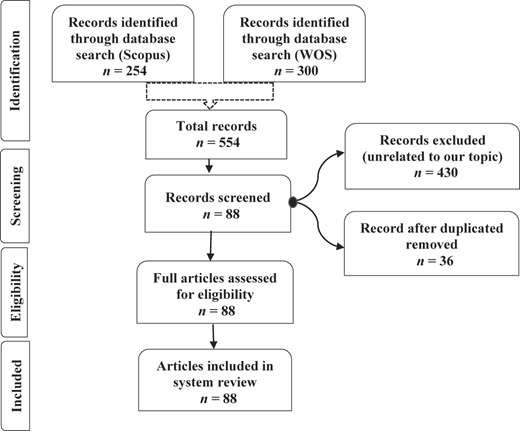
The study selection process is outlined in Figure 1. Our initial literature searches across Scopus and WOS yielded 554 articles. Of these, 430 articles were excluded for not meeting the eligibility criteria, and 36 duplicate articles were removed. This systematic filtering resulted in a final sample of 88 articles for analysis.
We utilized NVIVO software to analyze the 88 selected articles, specifically to identify frequently occurring words and themes in Figure 2. This analysis revealed that “performance” was a central concept within the sampled literature, followed by “governance” and other related terms. The detail of these selected articles can be found in the Supplementary files (online) provided along with this article.
3. Bibliometric analysis
This study employs bibliometric analysis to investigate the relationship between governance and microfinance performance. Specifically, it examines the characteristics of prior studies by analyzing publication trends over time, database distributions, leading journals, prolific authors, co-authorship networks, and keyword co-occurrence patterns. Furthermore, this analysis highlights the diverse contextual settings, theoretical frameworks, and key variables identified within the literature.
3.1 Publication trends and key contributors
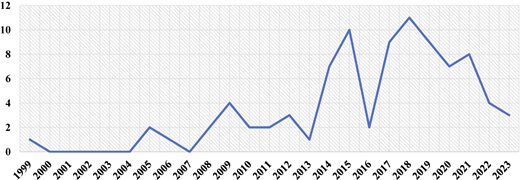
Figure 3 illustrates the attributes of the examined studies, revealing a fluctuating but generally upward trend in academic publications on the governance and performance of MFIs from 1999 to 2023. While there is a consistent upward trajectory in the number of articles, occasional dips occurred in 2016 and 2023. These variations might reflect researchers’ ongoing efforts to identify novel research gaps and contribute significantly to this evolving domain. The sustained surge in article volume underscores the dynamic nature of this subject, attracting the attention of both researchers and practitioners.
Tables 3 and 4 provide an overview of the publishers and journals that have published articles on MFI governance and performance. Emerald leads the publication count with 21 articles, followed by Wiley (13 articles) and Elsevier (12 articles). The remaining articles are distributed among 20 other publishers.
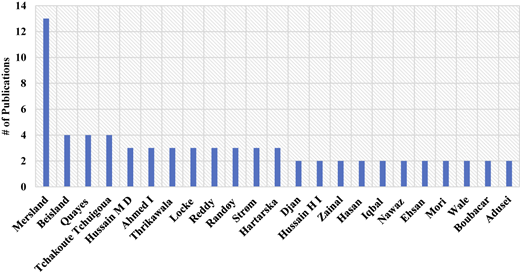
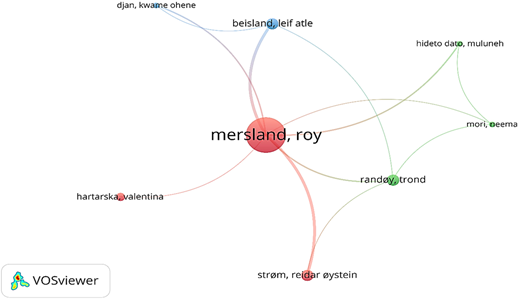
Subsequently, we identified the most influential authors in the field, with results presented in Figure 4. Our findings indicate that Mersland is the most prolific author on this subject, contributing 13 works. To complement this, we analyzed authors’ collaborative relationships, depicted in Figure 5 using VOSVIEWER software. For this visualization, a minimum author publication threshold of two was applied, identifying 158 authors for analysis. In the network map, each node represents an individual author, while the lines and proximity between them signify collaborative relationships. Nodes positioned closer together indicate stronger connections, and larger nodes represent authors with higher credibility based on their publications and citations. Mersland, notably, stands out as a central figure in terms of collaboration, reflected by his prominent, larger node. Moreover, a thicker line in the cartographic representation denotes a stronger collaborative bond between two authors.
3.2 Co-occurrence analysis of governance and performance in microfinance research
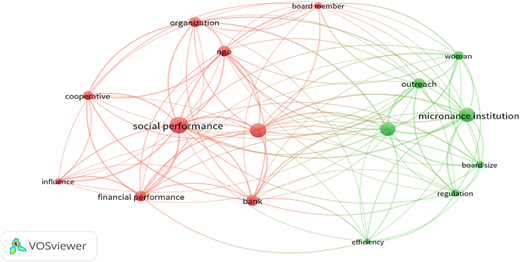
The VOSviewer network map (Figure 6) reveals the co-occurrence of key terms in the literature related to governance and performance. Two primary clusters emerged from this analysis: one centered on corporate governance, social performance, and financial performance; and another on microfinance institutions, governance mechanisms, and gender. The map highlights the central role of governance structures in influencing both financial and social outcomes, with a particular emphasis on gender dynamics within microfinance institutions. The strong relationships observed between these terms suggest a significant interplay between governance and performance in the microfinance context.
3.3 Studied contexts
Regarding the geographical distribution of studies, our analysis revealed a significant concentration of research in the Asia-Pacific region and in mixed-context studies, each contributing 31% of the total articles. Africa closely follows at 23%, while unspecified contexts account for 10%, and Europe represents only 4%. These results differ from prior research, such as that by Rasel and Win (2020), who reported limited research on governance in Asia. In contrast, our study indicates that Asia is a hub for extensive research on governance and performance due to several key factors. First, the region’s dynamic economic landscape, coupled with the origin and rapid expansion of microfinance, provides an ideal context for analyzing governance practices. Second, Asia’s sustained economic growth, diverse governance structures, and ongoing institutional reforms continue to attract research interest. Furthermore, the region’s abundant data and global integration facilitate empirical research, while potential policy implications reinforce its importance. In conclusion, Asia’s distinctive cultural and historical contexts, combined with its favorable research environment, make it a preferred field for studying the interplay between governance and performance in microfinance.
3.4 Applied theories in the articles
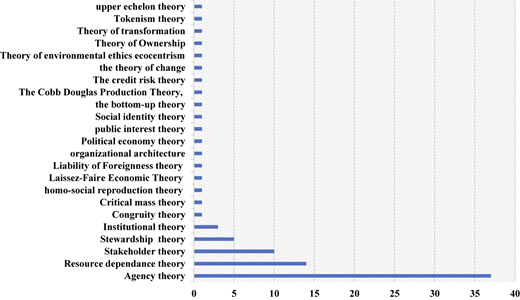
Our analysis identified 23 distinct theoretical approaches applied within the reviewed literature. Figure 7 shows their distribution, with agency theory being the most frequent (37 times, 42.52%), followed by resource dependency theory (16.09%), stakeholder theory (11.49%), stewardship theory (5.74%), and institutional theory (3.45%). Notably, the literature is heavily rooted in corporate governance theories, primarily drawing from two principal approaches: the shareholder approach and the stakeholder approach. The shareholder approach is often explained through the institutionalist perspective on microfinance, while the stakeholder approach is primarily elucidated by the welfare-oriented perspective.
3.5 Operationalized variables
3.5.1 Measures of financial performance
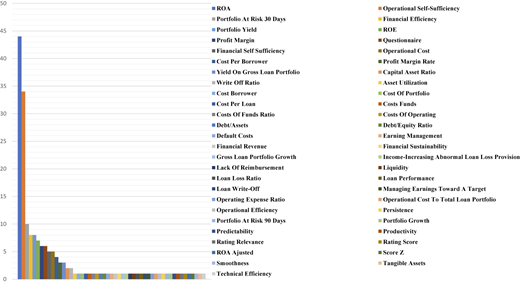
This analysis identified 51 indicators used in the reviewed studies to measure financial performance. The most prevalent among these were Return on Assets (ROA) (24%), operational self-sufficiency (19%), portfolio at risk (5%), financial efficiency, portfolio yield, and Return on Equity (ROE) (each at 4%). Notably, Hartarska’s (2005) study was among the first to empirically examine the effect of governance on MFIs’ performance, operationalizing FP through ROA and operational self-sufficiency. This pioneering use, along with the indicators' specific relevance to microfinance, likely explains their widespread use (See Figure 8).
3.5.2 Measures of social performance
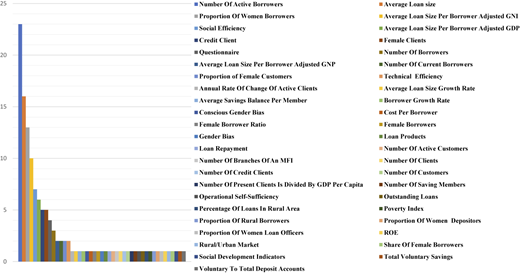
The complexity of measuring social performance (SP) is reflected by the 45 diverse indicators identified in the reviewed literature. Two primary dimensions, Breadth of Outreach and Depth of Outreach, are often used. Among these indicators, the number of active borrowers (18%) is the most prevalent, followed by average loan size (12%) and percentage of women borrowers (10%). Other less frequent indicators include average loan balance per borrower/GNI per capita (8%), social efficiency (5%), and average loan balance per borrower/GDP per capita (5%). Figure 9 details the distribution of these indicators.
3.5.3 Measures of governance
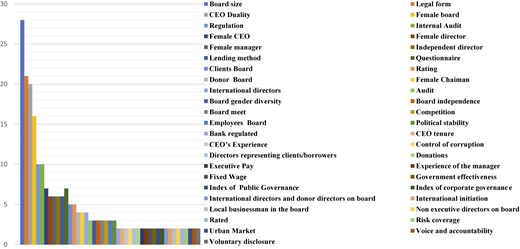
Studies generally distinguish between two types of governance: corporate governance and public governance. This systematic literature review identified 151 measures of governance. Public governance is operationalized using World Bank indicators, which form a governance index ranging from −2.5 to 2.5, This index combines six dimensions, namely control of corruption, government effectiveness, regulatory quality, rule of law, voice, and accountability, and political stability (Müller and Uhde, 2013; Silva and Chávez, 2015). Authors such as Anwar et al. (2021), Barry and Tacneng (2014), and Bibi et al. (2018) have utilized individual indicators from this framework. As for corporate governance, the literature revealed the use of a prominent index comprising seven binary measures, including board qualification, local directors, board size, presence of female boards, CEO/chairman duality, female CEO, and ownership (Iqbal et al., 2019; Nawaz et al., 2018). Figure 10 illustrates the different governance measures used by the reviewed studies.
4. Governance and performance: a causal exploration
Statistical findings from various studies revealed discrepancies in the understanding of the relationship between governance and MFIs’ performance. To illustrate these inconsistencies, this section first examines the link between corporate governance, specifically focusing on the three top indicators highlighted in Figure 10, and MFIs’ performance. Subsequently, it explores the relationship between public governance and MFIs’ performance.
4.1 Board size and performance
4.1.1 Board size and financial performance
The relationship between board size and FP is complex, influenced by various aspects, including studied contexts, legal forms, selected FP measures, and above all, the econometric methodologies adopted. Despite these complexities, a review of the literature revealed several studies concluding a typically positive relationship between board size and FP. These studies utilized various FP ratios, including financial efficiency, operational efficiency, ROA, ROE, operational self-sufficiency, and financial self-sufficiency (Bassem, 2009; Wale, 2015a, b; Hussain et al., 2023; Kyereboah-Coleman and Osei, 2008; Shettima and Dzolkarnaini, 2018; Uchenna et al., 2020). Proponents of this view argue that larger boards enhance financial performance due to the diverse expertise of their members, facilitating better decision-making and mitigating the potential dominance of a powerful CEO. However, other studies, such as Hideto Dato et al. (2020) and Van Damme et al. (2016), have found a negative relationship between board size and FP (specifically ROA and financial efficiency). This aligns with agency theory, which posits a negative correlation between board size and firm performance. Furthermore, several studies have reported a neutral effect of governance on performance, employing various measures of FP like operational self-sufficiency, operational expense ratio, ROA, operational cost, portfolio yield, ROE, financial self-sufficiency, yield on the gross loan portfolio, and capital asset ratio (Boubacar, 2019; Estapé-Dubreuil and Torreguitart-Mirada, 2015; Hasan et al., 2019; Hussain et al., 2019; Mersland and Strøm, 2009; Strøm et al., 2014; Thrikawala et al., 2016). Additionally, some studies, such as Beisland et al. (2014), Boubacar (2018), Delwar Hussain and Ahmed (2020), Gohar and Batool (2015), Hartarska (2005), Saeed et al. (2018), Tadele (2021), and Thrikawala et al. (2017), showed mixed results within the same research, highlighting the multifaceted nature of the board size-FP relationship.
4.1.2 Board size and social performance
The relationship between board size and SP has also been evaluated in the literature, yielding varying results. For example, Hartarska and Mersland (2012) found a positive relationship between board size and SP, measured by technical efficiency. While this suggests potential benefits of larger boards, such advantages may only hold up to a certain size, as excessively large boards could potentially lead to issues such as free-riding. Conversely, other studies have identified a negative relationship between board size and SP, measured by the number of active borrowers (breadth of outreach), the number of present clients divided by GDP per capita (depth of outreach), and the annual rate of change of active clients (Hussain et al., 2023; Kyereboah-Coleman and Osei, 2008). These findings resonate with the agency theory. Furthermore, several studies found no significant association between board size and SP, measured by ratios like the number of active borrowers (breadth of outreach), average loan size per borrower adjusted GNI (depth of outreach), the proportion of women borrowers, average loan size, female clients, and social efficiency (Beisland et al., 2014; Mersland and Strøm, 2009; Thrikawala et al., 2015, 2016, 2017; Van Damme et al., 2016). Additionally, a number of studies present mixed findings, reporting positive, negative, and neutral relationships. These studies utilize various indicators including the number of active borrowers (breadth of outreach), average loan size per borrower adjusted GNI (depth of outreach), average loan size, credit-client, proportion of women borrowers, number of MFI branches average loan size per borrower adjusted GNP, average loan size per borrower adjusted GDP, and the number of present clients divided by GDP per capita and female clients (Bassem, 2009; Boubacar, 2018, 2019; Delwar Hussain and Ahmed, 2020; Wale, 2015a, b; Estapé-Dubreuil and Torreguitart-Mirada, 2015; Gohar and Batool, 2015; Hartarska, 2005; Hideto Dato et al., 2020; Hussain et al., 2019; Saeed et al., 2018).
4.2 CEO duality and performance
4.2.1 CEO duality and financial performance
The relationship between CEO duality and FP has yielded mixed and inconclusive results in the literature (Kyereboah-Coleman and Osei, 2008). Some studies, such as Hasan et al. (2019) and Hussain et al. (2023), found a positive correlation between CEO duality and FP. These findings support the assertions of Jensen and Meckling (1976) and Shleifer and Vishny (1997) that combining the CEO and board chair roles can mitigate agency conflicts and enhance value creation. Additionally, these results partially resonate with the tenets of stewardship and stakeholder theories. Stewardship theory posits that a dedicated agent strives to optimize and safeguard owners' wealth (Davis et al., 1997), while stakeholder theory encourages board members to prioritize the interests of all stakeholders over solely those of the organization (Freeman and McVea, 2005). A plausible explanation for this positive outcome in MFIs could be that their founders are often driven by a commitment to social impact and poverty alleviation, thereby prioritizing social implications over personal financial gain (Hussain et al., 2023). Conversely, other studies found no significant relationship (Beisland et al., 2014; Hussain et al., 2019; Thrikawala et al., 2017; Van Damme et al., 2016). Additionally, several studies reported mixed findings, indicating positive, negative, or neutral relationships depending on the specific context (Beisland et al., 2019; Boubacar, 2018; Delwar Hussain and Ahmed, 2020; Gohar and Batool, 2015; Mersland and Strøm, 2009; Saeed et al., 2018; Thrikawala et al., 2016).
4.2.2 CEO duality and social performance
Most studies examining the relationship between CEO duality and SP found no significant association. These include Beisland et al. (2014), Gohar and Batool (2015), Hussain et al. (2019), Kyereboah-Coleman and Osei (2008), and Thrikawala et al. (2015, 2016, 2017). However, some studies, such as Hussain et al. (2023) and Van Damme et al. (2016), observed a negative relationship. This indicates that MFIs with separate CEO and board chair roles may perform better in terms of poverty alleviation than those where the CEO holds both positions. This finding aligns with the principles of agency theory, which posits that separating these roles improves the effectiveness of the board in its oversight function (Van Damme et al., 2016). Other studies, including Boubacar (2018), Delwar Hussain and Ahmed (2020), Hartarska and Mersland (2012), Mersland and Strøm (2009), and Saeed et al. (2018), reported mixed findings for the CEO duality-SP relationship.
4.3 Legal form and performance
The legal form, which is the structural framework under which an MFI operates, plays a pivotal role in its governance and ability to achieve its social and financial goals (Djan and Mersland, 2022). Different legal forms determine decision-making strategies and governance mechanisms (Barry and Tacneng, 2014). MFIs can exist as Non-Governmental Organizations (NGOs), credit unions/cooperatives, commercial banks, or Non-Bank Financial Institutions (NBFIs) (Ghose et al., 2018). Each of these forms possesses distinct characteristics, leading to varied orders of priorities and unique internal structures designed to help them achieve their dual objectives of financial sustainability and social outreach (Djan and Mersland, 2022).
4.3.1 Legal form and financial performance
Studies exploring the relationship between legal form and FP have produced mixed findings. These include Barry and Tacneng (2014), Beisland et al. (2014, 2019), Costa (2017), Djan and Mersland (2022), Ghose et al. (2018), Halouani and Boujelbène (2015), Ibrahim et al. (2018), Mumi et al. (2020), and Tchakoute (2010, 2011). Conversely, other authors, such as Bakker et al. (2014), Beisland et al. (2014), Bibi et al. (2018), Estapé-Dubreuil and Torreguitart-Mirada (2015), Hideto Dato et al. (2020), Khan et al. (2021), Mersland and Strøm (2008, 2009), and Tchakoute Tchuigoua (2018), argued that legal status has no significant impact on FP.
4.3.2 Legal form and social performance
Regarding the relationship between legal status and SP, the literature also demonstrated mixed findings. This is evident in studies such as Barry and Tacneng (2014), Beisland et al. (2014), Costa (2017), Djan and Mersland (2022), Estapé-Dubreuil and Torreguitart-Mirada (2015), Halouani and Boujelbène (2015), Mumi et al. (2020), and Tchakoute-Tchuigoua (2010, 2011). Furthermore, some studies, such as those by Bakker et al. (2014), Bibi et al. (2018), Ghose et al. (2018), Hideto Dato et al. (2020), Khan et al. (2021), and Mersland and Strøm (2008, 2009), found a neutral relationship between legal form and SP. Notably, only one study (Gupta and Mirchandani, 2020) observed a positive relationship. This study concluded that MFIs structured as NGOs and cooperatives tend to be more pro-social—emphasizing social outreach by serving more female borrowers and offering smaller loan sizes—compared to commercially oriented MFIs like banks and NBFIs. This finding suggests that the ownership structure of MFIs can influence their social performance.
4.4 Public governance index and performance
Our systematic review revealed limited research, specifically on public governance within the microfinance literature. Müller and Uhde (2013) proposed the public governance index as the most suitable tool for cross-country and longitudinal assessments due to its global coverage and focus on precision. This index, encompassing six key governance indicators, serves as a reliable measure for numerous studies investigating the impact of changes in governance quality. The six governance indicators incorporated in the public governance index were derived from 340 variables gathered from 35 data sources provided by 32 international organizations (Müller and Uhde, 2013).
4.4.1 Public governance index and financial performance
Only two studies within our sample utilized the public governance index as an exogenous variable. The first, by Müller and Uhde (2013), found a positive relationship between the public governance index and two FP proxies (operational self-sufficiency and ROA). They attributed these findings to the positive influence of good public governance on market certainty, which strengthens incentives and reduces agency and transaction costs, ultimately contributing to improved financial performance of MFIs. In contrast, Silva and Chávez (2015) reported mixed results. While they observed a positive relationship for two indicators (operational self-sufficiency and gross loan portfolio growth), their findings were neutral for portfolios at risk and negative for the write-off ratio.
4.4.2 Public governance index and social performance
The results concerning the public governance index and SP also emerged from the same studies mentioned in the public governance index-FP section. Müller and Uhde (2013) identified a positive relationship between the public governance index and average loan size per borrower adjusted for GDP. They explained this by suggesting that clients of microbanks operating under robust external governance are better positioned to capitalize on entrepreneurial opportunities and diversify their activities, leading to a demand for larger loans. Furthermore, since clients' creditworthiness could be enhanced under the influence of external governance, MFIs might be enabled to allocate higher loan amounts to individual borrowers (Müller and Uhde, 2013). In this aspect, Silva and Chávez (2015) found that the relationship was positive for the borrower growth rate and neutral for the average loan size growth rate.
4.5 Public governance indicators and performance
This section further examines the impact of each of the six dimensions of the public governance index on the dual performance of MFIs. For control of corruption, Müller and Uhde (2013) found no significant effect on the FP and SP of MFIs. However, Bibi et al. (2018) and Silva and Chávez (2015) identified a mixed relationship between corruption control and MFIs’ performance. The effectiveness of government showed variability across studies, with Barry and Tacneng (2014), Müller and Uhde (2013), Silva and Chávez (2015), and Tchakoute Tchuigoua (2018) reporting divergent findings. Quality of regulation also yields contradictory results, as evidenced by the studies conducted by Müller and Uhde (2013) and Silva and Chávez (2015). Similarly, political stability produced conflicting outcomes in studies by Anwar et al. (2021), Bibi et al. (2018), Müller and Uhde (2013), and Silva and Chávez (2015). Regarding the rule of law, Silva and Chávez (2015) found a neutral relationship with FP and mixed results with SP, whereas Müller and Uhde (2013) reported a positive relationship with both FP and SP. Finally, the indicator of voice and accountability exhibited paradoxical relationships with performance, as observed in studies by Anwar et al. (2021), Müller and Uhde (2013) and Silva and Chávez (2015).
5. Limitations of previous studies and research prospects
Previous studies on governance and microfinance performance exhibit several limitations across various dimensions, including theoretical frameworks, methodologies, econometric approaches, contexts, and sample sizes.
5.1 Analysis of theories
Since MFIs have a dual mission of achieving both financial and social objectives, most studies exploring the link between governance and MFI performance employ a multidimensional theoretical framework (Adusei, 2019; Adusei et al., 2017; Augustine, 2012; Bakar et al., 2019; Chakrabarty and Bass, 2014; Delwar Hussain and Ahmed, 2020; Djan et al., 2023; Estapé-Dubreuil and Torreguitart-Mirada, 2015; Hasan et al., 2019; Hussain et al., 2019, 2021, 2023; Iqbal et al., 2019; Mersland et al., 2011; Mori et al., 2015; Nawaz et al., 2018; Quayes and Hasan, 2014; Rambu Atahau et al., 2020; Saraswathy Amma et al., 2019; Thrikawala et al., 2017; Wamba et al., 2018). However, many of these theories are predominantly inspired by corporate and banking governance models, which often have a purely pecuniary aim. This can lead to theoretical gaps and inconsistencies in empirical validation. Furthermore, the majority of studies on MFI governance concentrate on shareholder and stakeholder perspectives, often overlooking cognitive and behavioral aspects. This limitation underscores the need to integrate all four approaches—shareholder, stakeholder, cognitive, and behavioral—for a comprehensive and nuanced understanding of the governance-MFI performance relationship. Each approach offers a distinct dimension. While shareholder and stakeholder theories address economic relationships and stakeholder interests, cognitive and behavioral approaches reveal decision-making processes, cognitive biases, and individual behavior within governance structures. Moreover, technological advancements such as fintech, artificial intelligence, and blockchain underscore the increasing significance of theoretical frameworks that encompass e-governance. In light of these advancements, it is imperative to re-evaluate traditional models to understand their potential impact on MFI performance in an ever-changing landscape.
5.2 Analysis of contexts
The research context, particularly the region and its specific governance landscape, plays a crucial role in understanding the relationship between governance and MFIs’ performance. While the present review included studies from various continents to broaden the scope, it did not specifically examine the MENA (Middle East and North Africa) region. Future research should address this gap by focusing on the unique governance characteristics and their impact on MFIs’ performance in the MENA region. Even with a smaller sample size, researchers can employ robust statistical methods like jackknife and bootstrap to ensure reliable findings (Thiétart, 2014). Additionally, comparative studies between different countries within the MENA region and beyond could provide deeper insights into the nuances of the governance-MFI performance relationship across diverse contexts.
5.3 Methodological analysis
According to this systematic review, quantitative studies with a positivist stance dominate (94.32%) the literature, while literature reviews (3.41%) and qualitative studies (2.27%) are scarce. Furthermore, most works rely on secondary data sources, such as the MIX market, rating reports from MicroRate, Microfinanza, Planet Rating, Crisil and M-Cril, and annual reports. Therefore, future researchers are encouraged to explore the use of primary data or data triangulation. Similarly, future research should prioritize investigating this topic at the agency level, as guaranteeing a direct impact of governance mechanisms on agency-level performance is not always straightforward.
5.4 Econometric analysis
Numerous studies have utilized classical econometric methods such as Ordinary Least Squares (OLS) with fixed effects or random effects to analyze governance-MFI performance association (Adusei et al., 2017; Anwar et al., 2021; Barry and Tacneng, 2014; Beisland et al., 2019; Boubacar, 2019; Chakrabarty and Bass, 2014; Dato et al., 2018; Wale, 2015a, b; Ghose et al., 2018; Ghosh and Guha, 2019; Gohar and Batool, 2015; Gul et al., 2017; Halouani and Boujelbène, 2015; Hartarska, 2005, 2009; Hasan et al., 2019; Hussain et al., 2019, 2023; Mia et al., 2022; Périlleux and Szafarz, 2015; Saeed et al., 2018; Shettima and Dzolkarnaini, 2018; Silva and Chávez, 2015; Tanin et al., 2019; Thrikawala et al., 2015, 2016; Vishwakarma, 2017). However, literature has also shown that the relationship between governance and performance suffers from endogeneity problems (Iqbal et al., 2019; Mumi et al., 2020; Nawaz et al., 2018). This bias can lead to misleading results. To address this issue, some researchers have employed alternative economic methods such as Generalized Method of Moments (GMM), Hausman Taylor, and the three-stage least squares method (Djan and Mersland, 2022; Hideto Dato et al., 2020; Rietveld et al., 2021). The heterogeneity of econometric methods may justify the observed divergence in the causal relationship between governance and performance.
5.5 Sample size in reviewed articles
Sample size plays an important role in research generalizability. This review identified several studies employing relatively small samples, with some even falling below 30 MFIs. For instance, Sharma and Rastogi (2022) used a sample of 25 MFIs, similar to Gohar and Batool (2015). Dato et al. (2018) and Saraswathy Amma et al. (2019) employed 23 and 20 MFIs, respectively. Additionally, Zouhayer et al. (2018) utilized 16 MFIs, while Boubacar (2018) and Wale (2015a, b) used 13 MFIs. Considering the relatively small sample sizes in these studies, the generalizability of their findings may be limited.
6. Implications and recommendations of the study
In response to the questions raised by this article and guided by a systematic analysis of the literature, our paper offers valuable contributions for researchers, decision-makers, and practitioners.
Develop a Tailored Governance Theory for MFIs: This article revealed the absence of a well-established theory explicitly explaining the causal relationship between various dimensions of governance and MFI performance. This highlights the urgent need for researchers to develop a theory specifically tailored to this complex issue, integrating the four key governance approaches: shareholder, stakeholder, cognitive, and behavioral.
Integrate Technology into Governance Frameworks: The rise of new technologies, including digital finance, blockchain, and fintech, is transforming governance and performance in MFIs. These innovations are poised to enhance both financial and social performance. Blockchain, for instance, enhances transparency and accountability by providing immutable records that support more effective risk management, while fintech tools enable data-driven insights into customer behavior and credit risk. Collectively, these technologies advance MFIs’ mission of financial inclusion. Future research should prioritize integrating technology into governance frameworks to explore its comprehensive impact on MFI performance.
Broaden Social Performance (SP) Measurement: While the multitude of variables employed across studies suggests a lack of consensus on SP measurement, most studies focus solely on microcredit services. We recommend expanding SP assessment to encompass a broader range of offerings, including micro-savings and micro-insurance, to capture a more holistic picture of social outreach.
Adopt a Synthetic Approach for Holistic Performance View: It is imperative to adopt a synthetic approach utilizing aggregate ratios to provide a more holistic view of MFIs’ performance, particularly in quantitative analyses. This complements the previous point by emphasizing the need for comprehensive measurement.
Incorporate Financial Inclusion Indicators in SP Assessment: This systematic review identified a significant gap in using financial inclusion indicators to assess SP, despite financial inclusion’s crucial role as a success factor and main objective of microfinance. Future studies should actively integrate these indicators.
Embrace Green Microfinance: Our study highlights the increasing focus on “Green Microfinance” within the microfinance discourse, encouraging decision-makers to integrate the environmental dimension into their actions and strategies.
Diversify Public Governance Indicators: This article found that authors primarily focus on the six dimensions of public governance selected by the World Bank. We argue that these indicators cannot be standardized, as they primarily focus on macroeconomic outcomes, neglecting other important aspects such as human rights, social equity, and environmental sustainability. Therefore, a more comprehensive set of indicators that reflects these broader societal impacts is strongly recommended.
Enhance Research on Gender Diversity in Governance: The review indicated a paucity of literature on the role of women in governance. Most studies emphasize conventional governance variables, with limited exploration of gender diversity indicators such as the Blau Index. Greater attention to this dimension would significantly enhance the understanding of gender diversity’s role in governance and its potential impact on the performance of MFIs.
Investigate Moderating Effects: This systematic review highlights a gap in the literature regarding the moderating effects of variables such as institutional experience, MFI size, and the role of digitalization on the relationship between governance and performance. Future research should consider incorporating these moderating variables to enhance the understanding of governance-performance dynamics.
Integrate Qualitative and Mixed Methods: The research methodology reveals that the majority of studies tend to focus solely on quantifiable variables. However, governance involves intangible factors such as transparency, management capacity, and corruption, which cannot be directly quantified. These elements need to be captured using qualitative items and appropriately modeled, perhaps using a structural equation model, to fully understand their impact. Our results also show that empirical analyses are mainly based on quantitative models, thus calling for the integration of qualitative approaches and mixed methods. This would enable microfinance managers and researchers to better understand the “why” and “how” of the observed effects, as many variables in this field are inherently qualitative and require deeper exploration through these methods.
7. Conclusion
This study investigated the relationship between governance and the performance of MFIs by conducting a systematic review of the existing literature, guided by the PRISMA approach. An exhaustive review of 88 studies, retrieved from two reputable databases (Scopus and Web of Science), was conducted following strict inclusion and exclusion criteria. Our analysis focused on quantifying performance, governance, and control variables within the microfinance context and examining the relationship between these elements. This comprehensive review revealed several notable findings.
Firstly, our quantitative analysis highlights a paucity of consensus on how to measure performance, governance, and control variables. In total, we identified 151 governance measures, 51 financial performance measures, and 45 social performance indicators. This extensive heterogeneity underscores the necessity for standardized measurement approaches in future research. Indeed, we recommend expanding assessments beyond microcredit to include micro-savings and microinsurance, and emphasizing the use of aggregated metrics for a more comprehensive evaluation.
The review also emphasizes the importance of an interdisciplinary approach to elucidate the causal relationship between governance and MFIs' performance. We propose the integration of shareholder, stakeholder, cognitive, and behavioral approaches, which have been largely unaddressed in existing literature.
Furthermore, we draw attention to the under-representation of women in MFI governance and urge further investigation into gender diversity metrics, such as the Blau Index. We also advocate for the adoption of qualitative and mixed methods to capture the complex, intangible dynamics between governance and MFI performance.
In addition, we investigated the potential impact of emerging technologies such as digital finance, blockchain, and fintech on MFIs' governance and proposed their integration to enhance performance. Future studies are encouraged to explore the moderating effects of variables such as digitalization, institutional experience, and the size of MFIs on the relationship between governance and performance.
Concerning the nature of the relationship between governance and MFI performance, our findings suggest a contingent relationship. The impact of governance on performance is multidimensional and largely depends on factors such as the legal status of the institution, the specific study context, sample selection, methodologies employed, and the particular indicators used. Notably, a considerable portion of the reviewed studies neglected the environmental dimension of performance, which limits the generalizability of some of their recommendations.
However, our conclusions are subject to certain limitations. First, restricting the analysis to two databases may have excluded relevant studies from other sources. Second, focusing exclusively on peer-reviewed articles could introduce selection bias, though the extensive sample size (88 studies) helps mitigate this concern. Lastly, the review only considered English and French publications, which may introduce linguistic bias.
Disclosure statement
No potential conflict of interest was reported by the authors.
We sincerely appreciate the editor, associate editor and three anonymous reviewers for their helpful comments and suggestions in improving the quality and content of the article.
The supplementary material for this article can be found online.