


The purpose of this paper is to investigate the impact of foreign direct investment (FDI) on the stock market development in Nepal.
The study used Johansen cointegration approach to determine long-run relationship and VEC Granger causality test to check the causal relations between the variables. The sample covered annual time-series data for the period 1996–2020.
The results suggest that FDI plays significant positive role in the stock market development in the long-run but inversely affect in the short-run. Unidirectional causality running from FDI to stock market development is observed in the long-run and bidirectional in the short-run. There is an insignificant positive relationship between exchange rate and FDI in the short-run. Banking sector development complements stock market development in the short-run but act as a substitute in the long-run. The statistically negative coefficient of exchange rate imply that the appreciation of the home currency encourage the development of the stock market in the long-run.
The positive and statistical coefficients of cointegration results indicate that FDI complements the development of stock market in Nepal in the long-run. Furthermore, the depreciation of the domestic currency may potentially contribute to the foreign direct investments in Nepal.
1. Introduction
The primary objectives of development in any economy are poverty reduction and improvement in standard of living of the people which are possible through investments and sustainable economic growth. However in the backdrop of resources constraint, least developed countries like Nepal cannot achieve these objectives all by itself (Majagaiya and Gu, 2010). This necessitates the poorer countries to explore and attract foreign aids and investments. Foreign aid is the global-transfer technology for reducing poverty (Toye, 2007) whereas foreign direct investment (FDI) is one of the major sources of external financing for emerging countries which also contributes in technology transfer, creates employment opportunities, enhance exports and lowers import dependency leading to an overall economic growth (De Mello, 1999). Economists argue that outward-oriented development strategies are likely to bring higher economic growth in a country than internally focused which further resonates the importance of FDI (Sethi and Sucharita, 2010). The inflow of FDI to poorer countries strengthens industrial development leading to economic growth and economic development (Bista, 2005).
FDI as foreign capital is an emerging aspect of capital resources in the world economy. Growth augmenting factor in developing as well as developed countries (Te Velde, 2006), FDI from foreign countries complements and encourages domestic investments in economies with scarce capital (Cristina and Levieuge, 2017). In subsequent years of financial liberalization since mid-1980s, FDI inflows in Nepal were relatively constant but insignificant. However, the proclamation of Nepal Foreign Investment and Technology Transfer Act (NFITTA) in 1992 and based on it the revised investment rules and regulations in 1996 aligned to open and liberal policies, paved the way for better organized FDIs in Nepal (Phuyal and Sunuwar, 2018). Nepal further opened up its economy and liberalization policies on FDI after taking the membership of World Trade Organization (WTO) in 2004. Being the members of the South Asian Preferential Trade Agreement (SAPTA) and the Bay of Bengal Initiative for Multi-Sectoral Technical and Economic Cooperation-Free Trade Area (BIMSTEC-FTA), Nepal has ample opportunities to attract FDI to enhance sustained economic growth. A tangible acceleration in inflow of FDI to Nepal happened in 1990s that peaked at US$28 million in 1997 which in 2020 has grown to US$166 million. FDI inflow is quite low in comparison to other least developed countries where average FDI was US$1705 million for Myanmar and US$1911 million for Ethiopia during 2018 and 2020 (UNCTAD, 2022). In the context of average FDI of US$1705 million for Myanmar and US$1911 million for Ethiopia during 2018 and 2020 (UNCTAD, 2022), the FDI inflow in Nepal is quite low given the adjoining markets with huge potential, inexpensive labor, favorable climate, abundant natural resources and more which directly impact the Nepalese economy.
Over the past two decades, stock market has surged as a remarkable channel to raise and mobilize long-run capital in developing countries (Su Dinh et al., 2017) which eventually contributes to long-run economic growth. As such the positive aspects of FDI to a host country must be reflected in the development of its stock market (Yartey, 2008) as stock markets are considered to reflect strength and health of an economy (Ramady, 2013). Formally opening its trading floor in 1994, Nepal Stock Exchange (NEPSE) is very young as compared to other international stock markets. Though in its initial stages, it did not get the due attention from the government and relevant stakeholders. However over the last couple of decades the Nepalese capital market has started establishing itself as an attractive trade avenue for small, big and institutional investors. With a market capitalization of around US$ 200 million in 1996 the Nepalese stock market has grown steadily with market capitalization of around US$ 15 billion in 2020.
Plethora of studies have explored the linkage between FDI and stock market development (Al Samman and Jamil, 2018; Raza et al., 2015; Raza and Jawaid, 2014; Abdul Malik and Amjad, 2013; Jeffus, 2005; Claessens et al., 2001) and their findings have strongly reinforced the importance of FDI in the development of stock market. The existing literature seems to be silent on least developed countries as most of the studies are carried out in developing and developed economies. Nepal has not been able to attract wide international research community so far that hinders the availability of good literature on FDI-stock market development nexus and the existing studies (Phuyal and Sunuwar, 2018; Yan and Majagaiya, 2011; Majagaiya and Gu, 2010; Bista, 2005) carried out in Nepal have more focused on relationship between FDI and economic growth discovering the influence of FDI on growth by all except Yan and Majagaiya (2011) who found that FDI does not adequately describe GDP. As discussed in the preceding section regarding stock market being a reflector of economic health, it would be interesting to know if the influence of FDI inflow in the Nepalese economy is actually reflected in the development of stock market.
Despite being one of the liberalized economies in South Asia, Nepal has not been able to portray expected growth and the FDI inflow is relatively low. Empirical studies have proven that stock market of host countries through institutional and regulatory reforms, listing requirements, disclosures and fair trading practices prepare a strong foundation to attract FDIs (Yartey, 2008). In this context, a closer investigation of FDI and stock market development nexus is critically important not only from policy point of view but also to contribute to the existing literature on least developed countries. The current study is quite different from many other studies as it also examines the relationship between FDI and exchange rate to reveal the influence of currency risk on FDI.
With an objective to examine the effectiveness of FDI in enhancing capital mobilization through stock market, this study thus aims to determine the relationship between FDI and stock market development in Nepal. Following the Introduction, the rest of the paper is organized as follows: Section 2 outlines brief literature review. Section 3 introduces data and methodology followed by empirical findings and discussions in Section 4. Section 5 concludes the paper with recommendations and suggestions.
2. Literature review
FDI is a cross-border investment in which one economy's resident has significant degree of influence or control on management of enterprise in another economy with at least 10% ownership (OECD, 2009). Stock market being an effective medium of portraying economic activity that also incorporates FDI, the relationship between FDI and stock market development can be comprehended through two divergent viewpoints. First, the negative relationship between FDI and stock market development adheres to the observation by Hausmann and Fernandez-Arias (2000a, b) that FDI is larger in financially underdeveloped and institutionally weak countries. Because of poor debt and equity market, FDI becomes an attractive alternative for the companies. Consistent to this view, Raza and Jawaid (2014) applying ARDL bounds testing approach for 18 Asian countries over 2000–2010 period, observed that FDI had significant negative long and short-run impact on the stock market development proxied by market capitalization. More recent study by Ho (2019) in Malaysia during the period 1981–2015 observed negative relationship of FDI and stock market capitalization both in the long and short-run.
The second view that FDI maintain positive relationship with capital market was forwarded by Claessens et al. (2001) who argue that foreign investors prefer country with sound institutions because some of them may prefer financing investment projects with external equity which eventually may raise the stock market liquidity. Jeffus (2005) observed significant positive impact of FDI on stock market development in four Latin American countries during 1988–2002. Abdul Malik and Amjad (2013) revealed positive role of FDI to promote stock market development in Pakistan by employing Johansen cointegration during the period of 1985–2011. Raza et al. (2015) analyzed annual time series data of Pakistan for the period 1976–2011 employing ARDL bounds testing technique and revealed positive impact of FDI on stock market capitalization both in short and long-run. Al Samman and Jamil (2018) examined the impact of FDI on stock market development of six Gulf Cooperation Council countries and observed significant long-run relationship and positive short-run impact. Olokoyo et al. (2020) examined the impact of foreign capital flows on stock market capitalization in Nigeria covering the period 1981 and 2018. Employing vector error correction model (VECM) analysis, the results revealed that foreign capital flows improved stock market performance in the long-run as well as in the short-run.
Significant positive relationships are confirmed in the literature between exchange rate and stock market development (Dube and Shoko, 2020; Ho and Odhiambo, 2018; Muktadir-al-Mukit, 2012). The negative impact of exchange rate on stock market development are also widely identified (Abdul Malik and Amjad, 2013; Javed and Akhtar, 2012). Nepal is an import based country in terms of raw material and finished products and the depreciation in home currency would lead to a huge chunk of capital flight from the country because of costly imported goods and finally, a reduction in dividend pay off of importing firms. Thus the empirical literature shows mixed relationships between exchange rate and stock market. Currency risk is also important to foreign investors (Abdul Malik and Amjad, 2013) since a depreciation of host currency is likely to increase FDI inflows because there lies a prospect of increasing the relative wealth of foreign investors (Takagi and Shi, 2011).
In the light of above empirical studies, it can be observed that there exist mixed evidences on the impact of FDI on stock market development. Moreover, the studies carried out in Nepal have just examined FDI-economic growth nexus which allows this research to fill the gap in the literature by examining the impact of FDI on the Nepalese stock market development. The following hypotheses are developed based on the existing literature for empirical analysis of this study:
There exists a positive relationship between FDI and stock market development in Nepal.
There exists a negative relationship between exchange rate (NRs/USD) and stock market development in Nepal.
There exists a positive relationship between FDI and exchange rate in Nepal.
3. Data, model and methodology
3.1 Data
The study uses annual time-series data of Nepal from 1996 to 2020 which are acquired from different issues of Economic Bulletin of Nepal Rastra Bank, the central bank of Nepal. Although the country went into first lockdown in multiple durations during the last quarter of the fiscal year (April–June, 2020), the stock market was on and the huge shock of COVID-19 pandemic was felt primarily in FY 2020/2021. As such, incorporating the data for the fiscal year 2019/2020 may have minimal impact on the analysis. Stock market capitalization as a percentage of GDP is used as a measure for stock market development (Ho, 2019; Raza and Jawaid, 2014). This proxy measures the size of stock market and is a good indicator to reflect the ability of stock market to mobilize capital and diversify risk (Demirguc-Kunt and Levine, 1996). FDI indicates the sum of equity capital, reinvestment of earnings along with other short and long-term capital reflected in balance of payments. Following the empirical literature, this study used net FDI inflows as percentage of GDP to proxy FDI (Ho, 2019; Al Samman and Jamil, 2018). Direct nominal exchange rate (NRS to US$) is used in the study (Abdul Malik and Amjad, 2013) and in order to examine the relationship between FDI and stock market development this study also incorporated three control variables in the basic model, widely used in the literature as possible determinants of stock market development which are inflation to measure the macroeconomic stability (Ho, 2019; Olokoyo et al., 2020), interest rate (Ouma and Muriu, 2014) and domestic credit to private sector to measure ability of financial system in channelizing savings into investment (Ho, 2019). All the variables except for descriptive study are used in logarithmic form. The negative values in FDI are adjusted using log(x+1) transformation.
3.2 Model specification and methodology
Previous studies (Abdul Malik and Amjad, 2013; Ho, 2019; Olokoyo et al., 2020 on single country data) have established that the capital market performance is influenced by various underlying factors at the macroeconomic level including FDI. Thus, in the present study we investigate the functional relationship that may exist between stock market development and macroeconomic factors by combining FDI with other financial and economic variables. A hypothesized functional relationship representing the dependence of stock market performance on FDI and other macro variables is specified as:
The examination of the relationships between these macro variables with stock market development is carried out through the following linear empirical equation:
The priori expectation of the relationships is such that δ1, δ5 > 0 and δ2, δ3, δ4 < 0 where, SMDt is market capitalization as a share of GDP to measure the stock market development at time t, FDIt is net FDI as a share of GDP at time t, INFt is the percentage change in consumer price index to measure inflation at time t, EXRt is direct exchange rate of Nepalese rupees to US dollar at time t, INTt is short-term interest rate measured by 91-days Treasury Bill, BANKt is domestic credit to private sector as a percentage of GDP used to measure the ability of financial institutions in channelizing savings into investments without including credit to public sector and μt is the usual error term.
Because FDI benefits both investing countries and host countries, empirical examination of the relationship between exchange rate and FDI is critical for the formulation of FDI policies (Kiyota and Urata, 2004). So, following Abdul Malik and Amjad (2013) the relationship between FDI inflow and stock market development of Nepal is also investigated using the following empirical equation:
The annual data series were first applied augmented Dickey–Fuller test (Dickey and Fuller, 1979) and Phillips–Perron test (Phillips and Perron, 1988) to examine their stationarity and thereby their order of integration. The Augmented Dickey–Fuller model tests unit root by testing the null hypothesis δ = 0 indicating the presence of unit root against δ < 0 for stationarity in the model given below:
Philips–Perron is a non-parametric test, testing for π = 0 for non-stationarity in the following model:
where, D is a deterministic trend component. All the variables under study showed integration of order one or I(1) indicating the existence of cointegration. At the onset of cointegration analysis, optimal lag length is determined using Akaike Information Criterion (AIC) and Schawartz Bayesian Criterion (SBC). As all the variables are integrated at order one, the study employed Johansen cointegration test (1991, 1995) to test the long-run relationship among the variables by examining a vector auto regressive (VAR) model of order p expressed as:
where, yt is a k-vector of I(1) variables, xt is a d-vector of deterministic exogenous variables affecting yt and ut vector of innovations. If yt is not affected by exogenous series, then the VAR model in equation (5) can be written as:
With cointegration transformation, equation (6) can be rewritten as:
where, and . The rank of Ai-1 matrix is tested and if rank (r) of , then the series have unit root and series are stationary if rank of . If the coefficient matrix has reduced rank r < k, then there exists cointegration. Upon confirmation of cointegration relationship, equation (7) can be written as:
where, is the error correction term, which reflects long-term equilibrium relationships between the variables and thus equation (8) can be written as:
The causal relationship between the variables can be acquired by the VECM in equation (9). The VECM approach of capturing Granger causality demonstrate one variable causes another but do not suggest the magnitude exactly (Rehman et al., 2016) and also unable to account beyond the sample period (Shahbaz et al., 2014). As such innovative accounting approach (IAA) popularized by Shan (2005) is employed that utilizes variance decomposition analysis (VDA) and impulse response function (IRF) to examine the impact of shocks and indicate the direction, magnitude and strength of causality between the variables.
4. Analysis and empirical results
4.1 Descriptive and correlation analysis
The descriptive statistics in Table 1 presents an overall frequency distribution of the variables under study. The average market capitalization of Nepal is observed to be around 26.5% of the GDP ranging from minimum of around 4.5% to a maximum of around 72.5%. The average net FDI inflow is just 0.22% of the GDP and average exchange rate is observed to be Nepalese rupees 81.964 per US dollar. During the study period the average inflation was around 7%. The average short-term interest rate is 3.83% and the average domestic credit to private sector is observed to be 43.55% of GDP. The small positive skewness values of all the variables show that mean values are clustered to the left at very low values indicating the data are fairly symmetrical however Kurtosis below 3 for all except interest rate indicate the distribution is platykurtic and produces fewer and less extreme outliers. The probability of Jarque–Bera coefficients indicates no violation of normality assumptions of the data.
Descriptive statistics and correlations
| SMD | FDI | EXR | INF | INT | BANK | |
|---|---|---|---|---|---|---|
| Descriptives | ||||||
| Mean | 26.462 | 0.221 | 81.964 | 6.957 | 3.826 | 43.556 |
| Maximum | 72.469 | 0.578 | 116.830 | 12.582 | 10.93 | 83.705 |
| Minimum | 4.527 | −0.072 | 56.525 | 2.435 | 0.132 | 22.306 |
| Std. Dev. | 19.942 | 0.199 | 17.451 | 2.775 | 2.732 | 17.389 |
| Skewness | 0.602 | 0.315 | 0.584 | 0.120 | 1.101 | 0.766 |
| Kurtosis | 2.253 | 1.889 | 2.151 | 2.035 | 3.863 | 2.562 |
| Jarque–Bera | 2.093 | 1.698 | 2.173 | 1.030 | 5.824 | 2.649 |
| Prob. | 0.351 | 0.428 | 0.337 | 0.597 | 0.0544 | 0.265 |
| Obs. | 25 | 25 | 25 | 25 | 25 | 25 |
| Correlations | ||||||
| lnSMD | 1 | |||||
| lnFDI | 0.278 | 1 | ||||
| lnEXR | 0.751*** | 0.38 | 1 | |||
| lnINF | 0.205 | 0.344 | −0.085 | 1 | ||
| lnINT | −0.478** | 0.007 | −0.580*** | −0.168 | 1 | |
| lnBANK | 0.898*** | 0.483** | 0.910*** | 0.082 | −0.451** | 1 |
Note(s): SMD = stock market capitalization as a percentage of GDP; FDI = Net FDI inflow as percentage of GDP; EXR = Nomimal exchange rate (NRs/USD); INF = percentage change in consumer price index (2011 = 100); INT = short-term interest rate (91-day treasury bill); BANK = domestic credit to private sector as a percentage of GDP; ln = natural logarithm; *** and **:correlation is significant at 0.01 and 0.05 level (2-tailed), respectively
The Pearson correlation matrix in the same table shows positive coefficient of FDI with stock market development although the coefficient is not significant. Exchange rate shows significant positive relationship with stock market development. The positive relationships are consistent to the hypothesized relationships. However the correlation result shows positive coefficient of exchange rate with FDI which is hypothesized other way round. The interest rate is observed to have negative and significant correlation coefficient with stock market development that aligns with the theoretical assumption and the positive significant coefficient of domestic credit to private sector shows that the development of banking institutions supports stock market development in Nepal. The low correlation coefficients are observed between regressors except for BANK and EXR, thus to avoid possible problem of multicollinearity these two variables are not included in the same model leading to estimation of two models.
4.2 Unit root tests
It is crucial to run unit roots tests so as to ensure the order of integration is not I(2) or higher. Table 2 shows the outcome of augmented Dickey–Fuller test and Philips–Perron test for unit roots and the results confirm that all the variables under consideration are stationary at the first difference and thus are integrated of order one or I(1). Based on this outcome, the study employs Johansen cointegration test to check whether there exists any long-run equilibrium relationship among the variables.
Unit root tests
| Variables | Augmented Dickey–Fuller | Philips–Perron | Order of integration | ||
|---|---|---|---|---|---|
| Level | First Diff. | Level | First Diff | ||
| lnSMD | −1.777 | −3.376** | −1.276 | −3.422** | I(1) |
| lnFDI | −2.033 | −6.644*** | −2.094 | −6.470*** | I(1) |
| lnEXR | −0.809 | −6.079*** | −0.671 | −6.087*** | I(1) |
| lnINF | −2.403 | −5.254*** | −2.433 | −5.394*** | I(1) |
| lnINT | −2.636 | −4.234*** | −2.543 | −5.398*** | I(1) |
| lnBANK | 0.670 | −6.062*** | 1.36 | −6.105*** | I(1) |
Note(s): *** and ** indicate level of significance at 1 and 5%, respectively
4.3 The cointegration tests
Given that the series are integrated of the first order, we examined cointegration of variables as specified in equation (1) and (2) based on the VAR approach Johansen cointegration test. Equation (1) is estimated along two models to avoid the inclusion of correlated regressors. The results reported in Table 3 show that both the Trace statistic and Max–Eigen statistics suggest the presence of cointegration among the variables under study at 1% and 5% significance levels respectively for the two models developed from equation (1). The cointegration estimation of equation (2) however did not show long-run relationship. Upon establishing the presence of cointegration among the variables, we examined the relationship and impact of independent variables using VECM in two models of equation (2).
Johansen cointegration test
| Hypothesis | Trace statistic | 0.05 critical value | Max-Eigen statistic | 0.05 critical value |
|---|---|---|---|---|
| FlnSMD [lnSMD | lnFDI, lnEXR, lnINF, lnINT] | ||||
| R = 0 | 118.4201*** | 88.3038 | 47.9383*** | 38.3310 |
| R ≤ 1 | 70.4816** | 63.8761 | 32.2064** | 32.1183 |
| R ≤ 2 | 38.2752 | 42.9152 | 25.1428 | 25.8232 |
| R ≤ 3 | 13.1324 | 25.8721 | 8.3254 | 19.3870 |
| R ≤ 4 | 4.8069 | 12.5179 | 4.8069 | 12.5179 |
| FlnSMD [lnSMD | lnFDI, lnINF, lnINT, lnBANK] | ||||
| R = 0 | 88.3038*** | 88.3038 | 52.4893*** | 38.3310 |
| R ≤ 1 | 63.8761 | 63.8761 | 29.1595 | 32.1183 |
| R ≤ 2 | 42.9152 | 42.9152 | 17.7274 | 25.8232 |
| R ≤ 3 | 25.8721 | 25.8721 | 7.5857 | 19.3870 |
| R ≤ 4 | 12.5179 | 12.5179 | 3.7138 | 12.5179 |
| FlnFDI [lnFDI | lnEXR] | ||||
| R = 0 | 23.5555 | 25.8721 | 0.5421 | 19.3870 |
| R ≤ 1 | 5.5882 | 12.5179 | 0.2157 | 12.5179 |
Note(s): Trend assumption: Linear deterministic trend; Lags interval (in first differences): 1 to 1; ** and *** represent significant at 5 and 1%, respectively
Table 4 presents the long-run coefficients of independent variables of both models of equation (1). The coefficients of both the models show that increase in FDI, significantly increase the stock market development. However, inflation (INF) significantly decreases the stock market development. Interest rate is observed to retain both negative and positive significant coefficients in the two models respectively. Exchange rate and banking sector development are observed to negatively influence the development of stock market. These results suggest that in the long-run, FDI, direct exchange rate (EXR), INF, short-term interest rate (INT) and domestic credit to private sector to represent banking sector development (BANK) have statistically significant impact on the stock market capitalization in the context of Nepal Stock Exchange. The high t-statistics of 8.5437 and 7.2906 indicate the strong influence of FDI on SMD. The positive impact of FDI on stock market development in the long-run is consistent to the findings of Jeffus (2005), Abdul Malik and Amjad (2013), Raza et al. (2015), Al Samman and Jamil (2018) and Olokoyo et al. (2020). The result however contradicts to the findings of Raza and Jawaid (2014) and Ho (2019).
Long-run estimates
| Dependent variable | ||||
|---|---|---|---|---|
| lnSMD | ||||
| Coefficients | t-statistics | Coefficients | t-statistics | |
| lnFDIt-1 | 13.8833*** | 8.5437 | 11.5487*** | 7.2906 |
| lnEXRt-1 | −19.6761*** | −6.7527 | ||
| lnINFt-1 | −3.4606*** | −5.9001 | −1.0394** | −2.4144 |
| lnINTt-1 | −1.7164*** | −5.4120 | 0.5253** | 2.2941 |
| lnBANKt-1 | −34.6875*** | −8.5766 | ||
Note(s): *, ** and *** represent significant at 10, 5 and 1% levels, respectively
The negative impact of exchange rate on stock market development contradicts to the findings of Dube and Shoko (2020), Ho and Odhiambo (2018) and Muktadir-al-Mukit (2012). However, the result is consistent to the findings of Ouma and Muriu (2014), Abdul Malik and Amjad (2013) and Javed and Akhtar (2012) and also supports the hypothesized relationship between exchange rate and stock market development in Nepal.
The negative relationship of inflation with stock market development supports the findings of Hsing (2014) in Romanian stock market, Ho (2019) in Malaysia and Olokoyo et al. (2020) in Nigeria. The negative relationship of interest rate with stock market development in the long-run supports the findings of Olokoyo et al. (2020), Hsing (2014) and Barnor (2014). The banking sector development is observed to be significantly and negatively impacting stock market development in the long-run which supports the findings of Ho (2019) in Malaysia. Contrary to the findings of other studies such as Yartey (2010) and Garcia and Liu (1999) which showed complementary relationship between banking sector development and stock market development, our findings suggest that in the long-run these two sectors are substitutes.
Furthermore, the short-run estimates are reported in Table 5 based on error correction model (ECM). For the first two models with SMD as the dependent variable, the result suggests that FDI has significant negative impact on stock market development at lag 1. The negative impact is consistent to the findings of Ho (2019) and Raza and Jawaid (2014). More specifically, a 1% decrease (increase) in FDI leads to around 1.3–1.7% increase (decrease) in the stock market development in the short-run and the strength of significance is strong at 5% level. The result however shows negative relationship between exchange rate and stock market development in the short-run steady with the findings of Abdul Malik and Amjad (2013) and Javed and Akhtar (2012). Although inflation shares positive relationship with stock market development in the short-run the relationship is insignificant in the second model. The negative and statistically significant lagged error correction terms suggest that short-run deviation in stock market development is corrected towards the long-run equilibrium by around 13% annually. The significance of the error term coefficient also confirms that FDI, EXR, INF, INT and BANK Granger cause SMD in the long-run. Examining the relationship between FDI and EXR in the short-run, the results show positive as hypothesized but insignificant relationship between FDI and exchange rate. The positive relationship resonates the findings of Tan et al. (2021) and Takagi and Shi (2011).
Short-run estimates
| Dependent variable = ΔlnSMD | Dependent = ΔlnFDI | |||||
|---|---|---|---|---|---|---|
| Coefficients | t-statistics | Coefficients | t-statistics | |||
| Constant | 0.1193 * | 1.8919 | −0.0775 | −0.9107 | −0.0187 | −0.8447 |
| ΔlnFDIt-1 | −1.7086 *** | −3.0903 | −1.3441 ** | −2.7418 | ||
| ΔlnEXRt-1 | −0.5061 | −0.5746 | 0.5094 | 1.7123 | ||
| ΔlnINFt-1 | 0.5051 *** | 3.0762 | 0.1932 | 1.4311 | ||
| ΔlnINTt-1 | 0.1931 * | 1.9695 | 0.1632 * | 1.8739 | ||
| ΔlnBANKt-1 | 2.8513 ** | 2.1978 | ||||
| ECMt-1 | −0.1358 *** | −3.4679 | −0.1331 *** | −3.8953 | ||
| Diagnostic tests | ||||||
| R2 | 0.5627 | 0.5846 | 0.5172 | |||
| Adj. R2 | 0.3957 | 0.4289 | 0.4410 | |||
| χ2 LM | 3.6444 | p = 0.0563 | 6.9294 | p = 0.0085 | 0.0526 | p = 0.8186 |
| χ2 JB | 1.9311 | p = 0.3807 | 3.8961 | p = 0.1425 | 0.8272 | p = 0.6612 |
| χ2 BPG | 13.2844 | p = 0.0.2082 | 15.0011 | p = 0.1320 | 3.3872 | p = 0.4952 |
Note(s): JB, Jarque–Bera test of normality; LM, Lagrange Multiplier test for serial correlation; BPG, Breush–Pagan–Godfrey test for heteroscedasticity. *, ** and *** represent significant at 10, 5 and 1% levels, respectively
4.4 VECM granger causality
The Granger representation theorem advocates the existence of Granger causality at least from one direction if variables are integrated of order one and cointegration among them are confirmed. As such this study also examines the direction of causality between all the variables by employing VECM Granger causality test which offers the insight on both short-run and long-run Granger causality. The results reported in Table 6 show the estimates for two models in equation (1). The evidence suggest that in the short-run FDI, INF, INT and BANK Granger cause SMD and SMD Granger cause FDI. In regard to long-run the result shows that the Granger causality runs from FDI, EXR, INF, INT and BANK to SMD and no causality runs from SMD to any other variables in the long-run. The models with FDI and INT as dependent variables are explosive because although significant the coefficients of lag of error correction term are positive that indicate the deviation in the short-run diverge from the equilibrium in the long-run. The models with INF and BANK as dependent variables although show conversions to equilibrium in the long-run but are not significant.
VEC Granger causality test
| Dependent variable | Types of causality | |||||
|---|---|---|---|---|---|---|
| Short-run independent variables | Long-run | |||||
| ΔlnSMD | ΔlnFDI | ΔlnEXR | ΔlnINF | ΔlnINT | ECMt-1 | |
| ΔlnSMD | … | 9.5499*** | 0.3302 | 9.4632*** | 3.8792** | −0.1358*** |
| (0.0020) | (0.5655) | (0.0021) | (0.0489) | (0.0032) | ||
| ΔlnFDI | 1.6464 | … | 0.3583 | 2.1279 | 1.9384 | 0.0574*** |
| (0.1994) | (0.5494 | (0.1446) | (0.1638) | (0.0014) | ||
| ΔlnEXR | 0.6846 | 0.5820 | … | 0.9065 | 4.7137** | −0.0339*** |
| (0.4080) | (0.4455) | (0.3410) | (0.0299) | (0.0023) | ||
| ΔlnINF | 1.4198 | 1.3935 | 0.2167 | … | 0.6028 | −0.0851 |
| (0.2334) | (0.2378) | (0.6415) | (0.4375) | (0.2119) | ||
| ΔlnINT | 1.5837 | 4.6371** | 0.1475 | 8.6740*** | … | 0.3321*** |
| (0.2082) | (0.0313) | (0.7009) | (0.0032) | (0.0058) | ||
| ΔlnSMD | ΔlnFDI | ΔlnINF | ΔlnINT | ΔlnBANK | ECMt-1 | |
|---|---|---|---|---|---|---|
| ΔlnSMD | … | 7.5177*** | 2.0481 | 3.5116* | 4.8305** | −0.1331*** |
| (0.0061) | (0.1524) | (0.0609) | (0.0280) | (0.0013) | ||
| ΔlnFDI | 3.5458* | … | 0.2814 | 0.4168 | 2.0360 | 0.0478*** |
| (0.0597) | (0.5958) | (0.5185) | (0.1536) | (0.0039) | ||
| ΔlnINF | 1.2012 | 0.5153 | … | 5.90E-05 | 0.4127 | −0.0260 |
| (0.2731) | (0.4728) | (0.9939) | (0.5206) | (0.6732) | ||
| ΔlnINT | 0.0089 | 8.2913*** | 4.3833** | … | 9.1483*** | 0.3672*** |
| (0.9248) | (0.0040) | (0.0363) | (0.0025) | (0.0001) | ||
| ΔlnBANK | 0.0762 | 0.0840 | 0.0531 | 0.0026 | … | −0.0046 |
| (0.7825) | (0.7719) | (0.8176) | (0.9589) | (0.5493) |
Note(s): *, ** and *** represent significant at 10, 5 and 1% levels, respectively. The χ2 statistics (for short-run) are reported with probability values in parenthesis
4.5 Variance decomposition analysis and impulse response function
VDA portrays the contribution of one variable in another variable due to stemming of innovative shocks (Pesaran and Shin, 1999). It determines how much of variance of each variable can be explained by exogenous shocks. The results of VDA are presented in Table 7. The proportion of the variance explained by its own past determines the relative exogeneity or endogeneity of a variable (Masih et al., 2009) as such most exogeneous variable will be explained mostly by its own shock and not by the others. The results show that at the end of the forecast horizon of 5 years, the forecast error variance of each variable contributed by its own shocks are stock market development (38.03%), FDI (63.86%), exchange rate (41.06%), inflation (69.05%), interest rate (48.34%) and domestic credit to private sector (66.78%). These results indicate that inflation is the most exogeneous of all. The result also shows that one standard deviation shock in FDI explains only 2.47% of variance of stock market development. Similarly one standard deviation shock in exchange rate explains 13.57% of variance of stock market development, inflation explains 13.69%, interest rate explains 10.50% and credit to private sector explains 21.72% of variance of stock market development undergoing a shock of one standard deviation.
Variance decomposition analysis
| Period | lnSMD | lnFDI | lnEXR | lnINF | lnINT | lnBANK |
|---|---|---|---|---|---|---|
| Variance Decomposition of lnSMD | ||||||
| 1 | 100.0000 | 0.0000 | 0.0000 | 0.0000 | 0.0000 | 0.0000 |
| 2 | 69.3206 | 2.5051 | 8.3353 | 5.9691 | 6.5540 | 7.3157 |
| 3 | 51.0144 | 2.9590 | 12.0309 | 10.9390 | 9.6412 | 13.3852 |
| 4 | 42.2132 | 2.4781 | 13.4101 | 13.1101 | 10.6558 | 18.1325 |
| 5 | 38.0355 | 2.4762 | 13.5711 | 13.6922 | 10.5037 | 21.7210 |
| Variance Decomposition of lnFDI | ||||||
| 1 | 20.5050 | 79.4949 | 0.0000 | 0.0000 | 0.0000 | 0.0000 |
| 2 | 16.6890 | 70.6067 | 0.1318 | 4.8212 | 7.6883 | 0.0627 |
| 3 | 15.0104 | 68.2330 | 1.5781 | 4.5570 | 10.1751 | 0.4462 |
| 4 | 14.9338 | 65.8951 | 2.7409 | 4.4939 | 10.9804 | 0.9555 |
| 5 | 15.5826 | 63.8616 | 3.6968 | 4.4409 | 10.7351 | 1.6827 |
| Variance Decomposition of lnEXR | ||||||
| 1 | 0.4343 | 2.1178 | 97.4477 | 0.0000 | 0.0000 | 0.0000 |
| 2 | 2.3302 | 10.7338 | 67.6146 | 9.9594 | 5.8804 | 3.4813 |
| 3 | 4.0528 | 19.2991 | 57.4804 | 8.0264 | 4.6911 | 6.4499 |
| 4 | 4.7461 | 27.1905 | 47.7764 | 6.7199 | 3.9881 | 9.5788 |
| 5 | 4.5172 | 32.1347 | 41.0604 | 5.7927 | 3.9165 | 12.5784 |
| Variance Decomposition of lnINF | ||||||
| 1 | 0.3793 | 7.6673 | 0.3691 | 91.5841 | 0.0000 | 0.0000 |
| 2 | 0.2627 | 7.9345 | 12.0246 | 76.9375 | 0.4073 | 2.4331 |
| 3 | 0.2768 | 6.8862 | 16.2339 | 72.5738 | 0.4482 | 3.5808 |
| 4 | 0.3614 | 6.4997 | 18.3512 | 70.1108 | 0.4776 | 4.1990 |
| 5 | 0.4874 | 6.4151 | 19.0782 | 69.0580 | 0.4861 | 4.4748 |
| Variance Decomposition of lnINT | ||||||
| 1 | 7.5898 | 7.8547 | 13.7693 | 5.7077 | 65.0782 | 0.0000 |
| 2 | 6.1235 | 5.5594 | 9.9192 | 12.1229 | 64.1302 | 2.1445 |
| 3 | 9.6528 | 7.3372 | 8.4697 | 14.4198 | 56.5715 | 3.5488 |
| 4 | 12.8807 | 11.0604 | 7.6371 | 13.5376 | 50.9729 | 3.9111 |
| 5 | 13.9424 | 14.1098 | 7.1548 | 12.5777 | 48.3448 | 3.8703 |
| Variance Decomposition of lnBANK | ||||||
| 1 | 12.4784 | 15.2625 | 7.6285 | 0.0230 | 3.1614 | 61.4459 |
| 2 | 11.2947 | 14.9133 | 7.3082 | 0.0563 | 1.6239 | 64.8033 |
| 3 | 9.0943 | 15.6540 | 6.6952 | 0.5411 | 1.3821 | 66.6329 |
| 4 | 7.0093 | 17.5619 | 6.1106 | 0.9406 | 1.2265 | 67.1528 |
| 5 | 5.4646 | 20.0844 | 5.5347 | 1.1329 | 0.9984 | 66.7848 |
Note(s): Cholesky Ordering: LNSMD LNFDI LNEXR LNINF LNINT LNBANK
The contribution of stock market development in explaining the forecast error variance of other variables appears to be relatively low. Such as one standard deviation of shock in the stock market development contributes to explain 15.58% of variance of FDI, 4.51% variance of exchange rate, 0.48% variance of inflation, 13.94% variance of interest rate and 5.46% variance of banking sector development. This suggests weak evidence of feedback causality from stock market development to other variables as observed in VEC granger causality. Overall, the contribution of banking sector development is greater in explaining the variance in stock market development followed by inflation, exchange rate, interest rate and FDI.
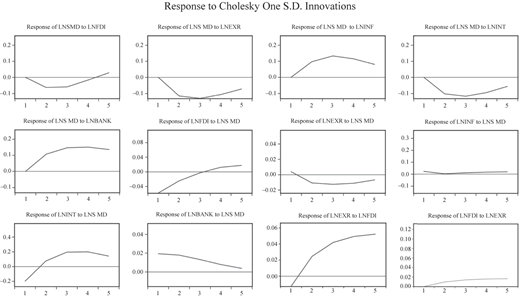
The results of the impulse response function in Figure 1 show that stock market development responds in the short-run (just in around two years) to the shocks (increase) given to FDI, exchange rate, inflation, interest rate and banking sector development. Also the shock given to stock market development is responded similarly by other variables. Following one standard deviation shock (increase) to FDI, stock market development appears to decline in the short-run and levels off to a steady state thereby again inclining in the long-run. One standard deviation shock (increase) to exchange rate also decreases the response of stock market development in the short-run that declines further for one more period and then moves higher. The response of stock market development to the shock to inflation is relatively high in the short-run, declining thereafter and eventually leveling off on the higher side. It is also observed that response of exchange rate is very high to one standard deviation shock (increase) to FDI and the response other way round is comparatively low.
5. Conclusion and policy implications
The focus of this study was to examine FDI and stock market development nexus to understand the role of FDI in stock market development in Nepal. The long-run relationship among FDI, stock market development and exchange rate was examined employing Johansen cointegration test in the presence of three additional macroeconomic variables: inflation rate, interest rate and banking sector development. Using time series first order integrated data from 1996 to 2020, we found the existence of long-run equilibrium relationship between stock market development and FDI but not between FDI and exchange rate. The model estimates of the coefficients reveal significant positive relationship between stock market development and FDI in the long-run and the Granger causality test confirms unidirectional causality running from FDI to stock market development. However in the short-run there exists bi-directional causality between them. There runs no causality from either way between exchange rate and FDI. Exchange rate, inflation, interest rate and banking sector development are observed to Granger cause stock market development in the long-run and short-run.
The positive and statistically significant relationship reflect that FDI complements the development of stock market in Nepal in the long-run but in the short-run goes for small negative adjustment as also confirmed through the impulse response function. The statistically negative impact of exchange rate on stock market development in the long-run imply that the appreciation of the home currency encourage the development of the stock market in the long-run as Nepal is an import based economy and the depreciation of foreign currency will lower the capital flight thereby potentially increasing the financial performance of the firms. The negative relationship between stock market development and inflation in the long-run indicate that the rise in the general price level bring additional uncertainty to the business there by lowering their returns and thus negatively impacting investors' confidence. The positive relationship of exchange rate with FDI indicates that depreciation of the home currency encourages the foreign investors to invest in Nepal. This depreciation of currency of host country lowers the production cost which eventually minimizes the relative cost of capital and is known as a relative wage channel. The result indicates that the relative wage channel allow investors' increased value in the home country in the short-run, however the relationship is not observed to be significant. The banking sector development is observed to complement the development of stock market in the short-run but stock market can be a substitute to banking sector in regard to channeling of funds and capital allocation in the long-run.
The empirical results suggest various steps that the government or the relevant policy makers can take to promote FDI thereby contributing to the development of stock market both in the long-run and the short-run. Conducive environment especially political commitment to ensure peace, security and stability along with consistent long-term business policies can be incorporated to attract foreign investments. As the government is incorporating different investment friendly legislations like FITTA, more focused should be entailed to the quality and priority of investments such as Phuyal and Sunuwar (2018) suggested export oriented FDI. As we are in the digital age, the government may also consider working on to integrate the Nepalese stock market with the international markets to facilitate the flow of funds at the best interest of the country's economic development. Identifying the areas of FDIs especially in the real sectors and bringing them to the domain of stock market would enhance their credibility, accountability and eventually productivity and profitability. The confidence of foreign investors as well as domestic investors can be boosted with appropriate monetary policy by adequately monitoring the volatility of the exchange rate, interest rate as well as inflation. The policy makers should also consider the ability of financial institutions in channelizing savings into investments that eventually complements the development of stock market in the short-run and diversify the financial systems in such a way that will eventually avoid dependence on banking system in the long-run. It is imperative that the policy makers give higher attention in formulating policies, especially tuning the exchange rates in the short-run so that it would balance both FDI and stock market development which show inverse relationship in the short-run. The theoretical relationships are observed to be suitable to understand and explain the phenomenon we investigated. But time span should be considered as we observed positive relationships of FDI with stock market development and exchange rate only in the long-run and the short-run respectively. However, the negative relationship of exchange rate with stock market development fully supports the theoretical foundation.
We believe that the empirical findings of our study will contribute to strengthen the understanding of investors, policy makers and researchers on the impact of FDI and other macroeconomic variables on emerging and early stage of stock market development. The results however cannot be generalized to all early developing markets because each economy has its own level of development. Future research may include additional macroeconomic variables in relation with FDI and their impact on capital market performance. Other indicators of market development such as liquidity, concentration, volatility may also be explored individually or as combined index to measure overall development. The future research may also consider other equivalent markets and make comparisons between them which could reveal consistency or inconsistency in early stage markets for theoretical contributions.

