


We estimate network spillovers across East Asian equity markets based on data on index returns to locate markets where equity shocks arise and where they impact. Focussed upon the context of the 1997 East Asian market crisis, our analysis explains why some markets were affected more than others. Further, were the Vietnam stock market to have been trading at that time, how it might have been affected.
Our analyses are based on novel panel data and spatial econometric techniques, adapted to “Big Data” contexts, to estimate network structural vector autoregression (SVAR) and vector autoregression (VAR) models estimated using additional information from East Asian and global markets.
We find that East Asian markets are interconnected through a sparse network, but this network has profound impacts across the markets, as evidenced during the 1997 East Asian crisis. We provide an explanation for why and how the Taiwan stock market was relatively immune to the crisis and highlight that the Vietnam market would likely have been affected very strongly.
The results have substantial implications for market development and regulation, as well as greater integration across stock markets in East Asia. This is particularly important for nascent markets like Vietnam and rapidly integrating markets like Taiwan. However, future research needs to integrate trade flows with financial markets to obtain more encompassing insights and policy.
Our work offers new perspectives on institutional organisation and the regulation of information flows and risks across East Asian markets, including markets that are more recently created (such as Vietnam), markets that are highly integrated (such as China and Korea) and markets that are evolving through enhanced network exposure (such as Taiwan).
We highlight that regional policy is important, as well as integration with regional (East Asian) and global markets. Development of robust resilient financial market institutions offers the best buffer against external shocks, which can otherwise have devastating impacts.
There is considerable debate about the nature and scale of contagion or interdependence during financial crises, not least the East Asian crisis of 1997. Indeed, there is no doubt that financial markets are interconnected. We offer new insights, from analysis of equity markets and their interdependence, on network effects spanning East Asian markets and their implications for crisis events.
Even more important than [trade] linkage, however, was the way that Asian economies were associated in the minds of investors. The appetite of investors for the region had been fed by the perception of a shared “Asian miracle.” When one country's economy turned out not to be all that miraculous after all, it shook faith in all the others. … A more potent source of contagion may have been more or less direct financial linkage. Not that Thais were big investors in Korea, or Koreans in Thailand; but the flows of money into the region were often channeled through “emerging market funds” that lumped all the countries together. When bad news came in from Thailand, money flowed out of these funds, and hence out of all the countries in the region. (Krugman, 1999)
1. Introduction
Financial contagion refers to the transmission of economic shocks across markets or countries, typically through financial channels, beyond what would be expected from fundamentals alone (Forbes and Rigobon, 2002). Contagion episodes have historically raised questions about the stability of interconnected financial systems, especially in emerging markets. The Asian financial crisis of 1997–1998 serves as a seminal episode to understand the dynamics of contagion, the role of regional interdependencies and the institutional frameworks that evolved to contain future risks. To provide a backdrop, we provide a contextual overview in the East Asian context, drawing attention to the crisis, post-crisis regulatory responses and the role of regional institutions like the Asian Development Bank (ADB) and more recently, the New Development Bank (NDB).
The literature on contagion distinguishes between three broad mechanisms, namely:
Pure contagion, where crises spread due to investor panic or herd behaviour, independent of economic fundamentals (Masson, 1999).
Fundamentals-based spillovers, where interconnected economies are affected through trade and financial linkages (Kaminsky and Reinhart, 2000).
Common shocks, where multiple countries are simultaneously affected by a shared external event, such as global supply chain disruptions, or a commodity price collapse or a US interest rate hike.
Empirical challenges arise in distinguishing between these mechanisms, as they often overlap. Advanced econometric methods – including spatial econometrics, factor models and structural VARs – have been developed to isolate these effects; see, for example, Forbes and Rigobon (2002), Dungey et al. (2005) and Boubakri and Guillaumin (2015). Recent work, such as research at the frontier of spatial econometrics and panel data involving network contagion matrices and instrumental variables generalized method of moments (GMM) (Bhattacharjee and Holly, 2013; Basak et al., 2018), attempts to identify causal cycles in financial markets, offering granular insight into how shocks spread across a system.
A key debate in the literature revolves around whether the cross-country influences in the East Asian crisis were, by their nature, contagion effects, or simply stable interdependence between markets (Corsetti et al., 1999; Forbes and Rigobon, 2002). Dornbusch et al. (2000) defined contagion as a “significant increase in cross-market linkages after a shock to an individual country (or group of countries), as measured by the degree to which asset prices or financial flows move together across markets relative to this co-movement in tranquil times”. Meanwhile Schwartz (2007) emphasizes that contagion “occurs only in circumstances in which other countries are free of the problems of the country that first experienced trouble and yet suffered capital flight.”
The above definitions suggest measuring contagion as co-movement that cannot be explained on the basis of fundamentals or global shocks. From this somewhat narrow point of view, Corsetti et al. (1999) and Forbes and Rigobon (2002) argue that weak fundamentals and evolving market interactions explained much of the cross-market correlations during the East Asian crisis in 1997–1998. On the other hand, Khan and Park (2009) found strong evidence of herding contagion.
Beyond the East Asian context, global shocks are found to explain part of co-movements in financial markets (Calvo and Reinhart, 1996; Chuhan et al., 1998) and, together, the macroeconomic environment is important (Bencivenga and Smith, 1992; Boyed et al., 2001). Hence, both macroeconomic fundamentals and global shocks need to be controlled for. Together, Boubakri and Guillaumin (2015) also highlight increasing regional integration of East Asian stock markets, which implies the challenges in decomposing contagion effects from market evolution in emerging markets.
Our work is distinct from the above literature in three important ways. Firstly, while much of the previous research has focussed on capital flight, aggregate economic performance and to some extent trading in currency markets, we focus on equity markets. In this respect, our work is closely related to Edwards et al. (2003), Yilmaz (2010) and Boubakri and Guillaumin (2015). Secondly, we condition on fundamentals and global shocks (Chuhan et al., 1998) but abstract somewhat from the question of whether there were contagion effects during the 1997 Asian crisis. Rather, in the spirit of Forbes and Rigobon (2002) and Yilmaz (2010), we focus more on measuring the co-movements between East Asian stock markets. Then, we estimate the causal mechanisms of directed information flow between markets and ask the question: how well does our estimated model capture co-movements during the East Asian financial crisis? Beyond the East Asian context, this approach is related to Diebold and Yilmaz (2009) and the large literature spawned by their influential work. Thirdly, and not least, we use spatial econometric methods for estimating cross-market interactions. Here, our foundations are based on the herding contagion argument in Krugman (1999), as well as recent research showing how investor behaviour can influence co-movement in stock returns (Basak et al., 2018; Bhattacharjee and Roy, 2019; Kumar et al., 2022).
Specifically, in the spirit of Diebold and Yilmaz (2009), we consider weekly stock returns data, based on key indexes in nine selected East Asian markets (China, Hong Kong, Indonesia, Korea, Malaysia, Taiwan, Thailand, the Philippines and Vietnam) and estimate a causal network interdependence matrix across these markets [1]. This estimation is based on an instrumental variables GMM approach originally proposed by Bhattacharjee and Holly (2013) and further developed in Ahrens and Bhattacharjee (2015), using as potential instruments weekly returns from about 50 other mature and emerging market indexes. This collection of other markets is based on Diebold and Yilmaz (2009). Based on these estimates, we analyse network influences across the East Asian markets, also focussing specifically on the period of the East Asian crisis [2]. We find that our estimated model fits stock returns data better than an alternate and standard VAR (vector autoregressive) model, both during the crisis and subsequently. This validates our empirical work and methodology but also emphasizes that network co-movements were broadly similar during the crisis. We take an agnostic view as to whether this finding implies contagion effects or evolution of regional integration (Boubakri and Guillaumin, 2015). However, this also provides important insights for post-crisis regulatory arrangements and institutional developments.
2. Institutional context of the East Asian financial crisis
2.1 Timeline and features
The East Asian financial crisis began in Thailand in July 1997 with the devaluation of the baht and quickly spread across the region, engulfing Indonesia (South) Korea, Malaysia and the Philippines, subsequently also spreading to Russia and on to Brazil (Radelet and Sachs, 1998; Brealey, 1999; Krugman, 1999). Its salient features included: (a) currency devaluations and rapid reserve depletion; (b) collapse of asset prices and bank insolvencies; (c) sharp reversals of capital flows, especially from foreign institutional investors; and (d) steep economic contractions and social unrest.
While the immediate triggers were domestic vulnerabilities (such as large current account deficits, overleveraged banks and weak regulatory frameworks), the scale and speed of contagion were surprising (Corsetti et al., 1999; Krugman, 1999). A key feature was how quickly and decisively markets in otherwise diverse economies co-moved, suggesting significant latent interdependence, perhaps enhanced by contagion effects (Forbes and Rigobon, 2002).
The East Asian crisis displayed several layers of contagion mechanisms, including the following:
Investor behaviour and herd effects: International investors, fearing wider regional exposure, engaged in rapid withdrawal from multiple East Asian markets, leading to correlated capital outflow (Radelet and Sachs, 1998; Krugman, 1999).
Financial interconnectedness: East Asian banks and corporations were interlinked through syndicated loans and offshore borrowing, causing problems in one system to reverberate through others (Krugman, 1999; Forbes and Rigobon, 2002).
Currency linkages: Many economies maintained de facto pegs to the US dollar. The devaluation of one currency put pressure on others to follow suit, reinforcing a downward spiral (Allen and Gale, 1999; Brealey, 1999).
Market perception: A lack of transparency in balance sheets and governance standards meant that investors lumped countries together as part of a vulnerable “East Asian bloc” (Goldstein, 1998).
2.2 Post-crisis reforms and regional institutional evolution
The aftermath of the crisis led to a wave of reforms, both within countries and across regional institutions. Countries such as Korea, Thailand and Indonesia undertook wide-ranging reforms in banking supervision, corporate governance and fiscal management. Capital adequacy norms were strengthened, non-performing loans addressed and central banks granted greater independence (Park and Lee, 2002).
While the IMF provided significant bailout packages, its conditionalities – including fiscal austerity and structural adjustments – were contentious. These experiences catalysed a broader push for Asian-led solutions to financial crises, setting the stage for regional coordination mechanisms (Stiglitz, 2002). The ADB, established in 1966, played a crucial stabilising role during and after the crisis. Although not a crisis lender like the International Monetary Fund (IMF), the Asian Development Bank (ADB) engaged in several important ways:
Policy-based lending: The ADB provided support for structural reforms in areas like financial governance, capital market development and social safety nets.
Technical assistance: Countries received support for institutional reforms in banking regulation, insolvency frameworks and debt management.
Knowledge production: The ADB conducted influential research on the causes and consequences of the crisis, helping to inform both domestic and regional policy.
In the post-crisis period, the ADB has focused on promoting macroeconomic stability, financial inclusion and regional financial integration (Boubakri and Guillaumin, 2015), including through the development of local currency bond markets under initiatives like the Asian Bond Markets Initiative (ABMI) (ADB, 2015).
2.3 The Chiang Mai Initiative and regional financial safety nets
A key regional response to the crisis was the creation of the Chiang Mai Initiative (CMI) in 2000, later evolved into the Chiang Mai Initiative Multilateralisation (CMIM). The CMIM is a multilateral currency swap arrangement among ASEAN+3 countries (ASEAN, China, Japan, South Korea). It provides a pool of foreign exchange reserves to be used in case of liquidity crises, reducing reliance on IMF programs. It symbolises a step towards regional self-insurance, although its usage has remained limited (Kawai and Lombardi, 2009). In parallel, ASEAN+3 Macroeconomic Research Office (AMRO) was set up to provide surveillance and early warning capacity.
Established in 2015 by the BRICS countries, the New Development Bank (NDB) is a relatively new actor but has growing significance for regional financial stability. Originally called the BRICS Bank, it promoted Global South-led collaboration to support financial market resilience, later extending its focus beyond the BRICS countries and being renamed NDB. Although its primary role is infrastructure financing, the NDB can play a role in countercyclical lending and emergency liquidity support, based on its convening power in the Global South, especially as it expands operations beyond BRICS to include countries in Asia (Humphrey, 2015). Its ability to issue bonds in local currencies and maintain greater sensitivity to local conditions could make it a more flexible actor than traditional multilaterals. As China is a founding member of both ADB and NDB, its dual role may encourage convergence or complementarity between institutions, though competition can constrain some of these benefits. The dual presence of China in both the ADB and the NDB reflects the increasingly multipolar nature of financial governance in the region, suggesting not only potential complementarities but also subtle tensions in institutional mandates and influence.
Market regulators in East Asia have significantly evolved since the crisis. There is stronger capital market oversight through agencies like the Financial Supervisory Service (South Korea), Securities and Exchange Commission (Thailand) and others. Furthermore, greater independence and coordination with central banks, especially in managing systemic risk. There was also the adoption of Basel III standards and macroprudential frameworks, not least a more explicit focus on foreign institutional investments (FIIs).
Last but not least, there have been greater regional peer review mechanisms via ASEAN Capital Markets Forum (ACMF) and engagement with IOSCO (International Organization of Securities Commissions). In combination with surveillance from institutions like AMRO and the ADB, this network provides multiple lines of defence against future contagion episodes.
3. Theory, data and models
Against the backdrop of the East Asian financial crisis of 1997 and subsequent reforms, in this section we measure co-movements between markets and causal information flows across the network of East Asian financial markets. Firstly, we discuss theory, integrating previous research and analyses, followed by description of our data and finally, our econometric models aligning theory with data.
3.1 Theory
Analyses of, and commentary on, the East Asian crisis has identified two important forces: (1) herding among investors influencing their portfolio choice and trading behaviour (Krugman, 1999; Masson, 1999); and (2) market and macroeconomic fundamentals and institutional fragilities in the countries of the region (Corsetti et al., 1999; Kaminsky and Reinhart, 2000; Forbes and Rigobon, 2002). In this paper, we focus more explicitly on the first channel, herding behaviour of investors, while controlling for the effect of fundamentals and institutions. Thus, we do not develop inferences on the question of whether there was a contagion but rather explore the less-investigated question about cross-market causal interactions.
Our starting point on theorising investor herding behaviour is captured well in the quote from Krugman (1999) at the top of this paper. One would naturally look towards the literature in finance to locate relevant structural theory on principles of portfolio construction. Unlike market microstructure, portfolio choice in finance does not have a multitude of structural models. The central model here is the Fama and French (1993) model, building upon the Capital Asset Pricing Model (CAPM), typically implemented with six factors and sometimes including a seventh factor on momentum. Then, the taste for East Asian stocks in the portfolios of global investors and sharp changes in such preferences can be understood by the exposure of these emerging markets along the factor returns on Fama–French and related factors (size, book-to-market, momentum, etc.).
Basak et al. (2018) and Bhattacharjee and Roy (2019) show how investor behaviour using factor-based portfolio choice induces structural interactions between returns on assets. Essentially, as the exposure to risk factors changes as a reaction to changes in investor preferences, this induces structural interactions between returns in different markets in a way that is related to optimal portfolio allocations in these markets. While Basak et al. (2018) find evidence of recursive structural interactions, Bhattacharjee and Roy (2019) demonstrate that cross-market interactions can exhibit more complex causal structures. However, a CAPM model including only returns on the market portfolio and network interactions provides about the same explanation for co-movements as a two-factor model based on size and book-to-market factors.
Conceptually, absence of cross-section variation in factor exposures implies that the Fama and French (1993) type models do not capture subtle variations, over time, in the factor exposures for each market. This then requires traders using these models for portfolio choice to diversify away corresponding risks. Then, the above structural model with network interactions (Bhattacharjee and Roy, 2019) theorises that traders sort themselves on heterogenous risk preferences. Given a specific preference type over multiple risk factors, they then choose their preferred exposure to the risks and create a diversified portfolio of stocks with this risk exposure. This behaviour generates interdependence across stock returns within this portfolio, but not beyond. This network can be identified either by clustering markets by exposure to risk factors, or by estimating the network interaction weights matrix across markets.
However, this empirical approach requires that the factor structure is modelled adequately. Failing this, inferences on clustering or network weights would be biased and inconsistent (Pesaran, 2006). Hence, and as might be expected, the factor structure is very important, with both time-specific factor (related to market portfolio) and fixed effects (related to market-specific factors) potentially exerting very strong effects on the returns of multiple portfolios.
3.2 Data and descriptive statistics
Our study uses two proprietary datasets representing the equity market performance in mature and emerging economy stock markets over the period from 1992 to 2025. These datasets were constructed using country-specific primary equity indices and reflect long-term market trends across a diverse set of global economies. Similar data have been widely used to analyse inter-market dynamics, equity portfolio performance and macro-financial interdependencies; see, for example, Forbes and Rigobon (2002), Edwards et al. (2003), Diebold and Yilmaz (2009), Yilmaz (2010) and Boubakri and Guillaumin (2015) in the East Asian context and beyond. We abstract from random walk and day of the week effects (Dubois and Louvet, 1996) by calculating weekly returns based on Last Price of the final trading day of each week. A brief description of the two datasets is provided below.
3.2.1 Mature markets dataset
The mature markets (developed countries) dataset consists of 8,309 daily observations spanning from May 29, 1992, to March 24, 2025. It includes two columns: Date and Last Price. The Date column captures the trading day, while the Last Price reflects an aggregated or representative value derived from the primary equity indices of selected mature markets. The dataset does not contain sectoral breakdowns, but the dataset provides a time-series of equity index movements in mature markets.
The 25th (first quartile), 50th (median) and 75th (third quartile) percentiles are 1,808.28, 3,899.83 and 4,639.09, respectively, suggesting both high volatility and a right-skewed distribution with more recent years showing higher market valuations. The data are drawn from Bloomberg’s flagship country-level indices for 30 developed economies. Some of the key indices and their corresponding Bloomberg tickers are presented in Table 1.
Selected mature markets and stock indices
| Country/market | Stock index |
|---|---|
| USA | S&P 500 (SPX index) |
| United Kingdom | FTSE 100 (UKX Index) |
| Germany | DAX Index (DAX Index) |
| France | CAC 40 (CAC Index) |
| Japan | Nikkei 225 (NKY Index) |
| Australia | S&P/ASX 200 (AS51 Index) |
| Canada | S&P/TSX Composite (SPTSX Index) |
| Switzerland | Swiss Market Index (SMI Index) |
| Hong Kong | Hang Seng Index (HSI) |
| (South) Korea | Korea Stock Exchange (KOSPI Index) |
Other European, Asian and Pacific Rim countries such as the Netherlands (AEX Index) and Singapore (STI Index) are also included. This diverse representation ensures that the dataset captures the behaviour of global mature equity markets across different regulatory regimes, currency zones and macroeconomic environments.
3.2.2 Emerging markets dataset
The emerging markets (developing countries) dataset comprises 8,180 daily observations over the slightly shorter period from January 3, 1992, to March 24, 2025. Similar to the mature markets dataset, it contains two variables: Date and Last Price. The dataset exhibits a mean of 716.60 and a standard deviation is 397.58, lower than that of the developed country dataset, but still substantial, reflecting the elevated volatility typically associated with emerging markets. The 25th, 50th and 75th percentiles are 479.82, 609.79 and 834.73, respectively. This dataset includes a wide array of markets from Latin America, Eastern Europe, the Middle East, Africa and Asia. Key indices are provided in Table 2.
Selected emerging markets and stock indices
| Country/market | Stock index |
|---|---|
| BRICS markets | |
| Brazil | Ibovespa (IBOV Index) |
| Russia | MOEX Russia Index (IMOEX Index) |
| India | Sensex (SENSEX Index) |
| China | Shanghai Composite Index (SHCOMP Index) |
| South Africa | FTSE/JSE All Share (JALSH Index) |
| Emerging markets | |
| Mexico | IPC Index (MEXBOL Index) |
| Saudi Arabia | Tadawul All Share (SASEIDX Index) |
| Indonesia | Jakarta Stock Exchange Composite Index (JCI) |
| Malaysia | FTSE Bursa Malaysia Index (FBMKLCI) |
| Taiwan | Taiwan Stock Exchange (TWSE Index) |
| Thailand | Stock Exchange of Thailand (SET Index) |
| The Philippines | Philippines Stock Exchange PSEi (PCOMP Index) |
| Vietnam | VN-Index (VNINDEX Index) |
Other markets such as Egypt (EGX30 Index) and Romania (BET Index) are also represented. This allows the dataset to serve as a proxy for equity market behaviour in emerging market economies, where geopolitical risk, currency volatility and commodity exposure may play a more prominent role than in mature markets.
Both datasets were constructed using historical index levels sourced from the Bloomberg Financial Database. The selection of indices was guided by the following criteria: (1) the index must be the primary equity benchmark in its respective country; (2) it must have sufficient historical span; and (3) it must be widely used in academic literature and institutional investment practice. Where countries had multiple indices (e.g. the USA, India and China), the most internationally recognised benchmarks were chosen.
There were a limited number of missing values, corresponding to non-trading days or market holidays. The data were cleaned for outliers and adjusted for index rebasing and structural breaks. All values are expressed in nominal terms, and weekly returns were calculated on this basis. This rendered all index weekly returns stationary in a time series sense. However, there is the potential for country-specific institutional and macroeconomic factors, which were addressed in the empirical analysis by including market fixed effects, as well as cross-section non-granularity (Pesaran, 2006; Bhattacharjee et al., 2022), which is akin to non-stationarity in the spatial or cross-section domain. This non-granularity required careful modelling based on East Asian and global market (index sentiment) factors.
3.2.3 Inter-market co-movements and network interdependence
We consider the nine markets indicated in italic to measure co-movements between East Asian equity markets; namely, China, (South) Korea, Hong Kong, Indonesia, Malaysia, Taiwan, Thailand, the Philippines and Vietnam. Our aim is to understand the causal mechanisms of information flow and potential spread of contagion between the markets. The inclusion of Hong Kong and Taiwan reflects focus on inter-market market dynamics rather than geopolitics. The above choice of markets was guided by our synthesis of the timeline and features of the East Asian financial crisis of 1997–1998, in turn based on the literature, particularly Radelet and Sachs (1998), Krugman (1999), Corsetti et al. (1999) and Forbes and Rigobon (2002). This motivated a combination of: (a) the experience of the East Asian crisis in how market shocks from Thailand spread across some East Asian markets (Korea, Indonesia, Malaysia and the Philippines); (b) resilience of some markets to the shock (China, Hong Kong and, to some extent, Taiwan); and (c) markets that subsequently emerged or became more integrated with East Asian and global markets after the crisis (Vietnam and Taiwan).
Since the stock exchange in Vietnam was constituted after the crisis (in 2000), the data used for estimation of co-movements and interdependencies span July 2000 to March 2025. Nonetheless, we use a latent variable approach to extend analysis backwards to the period of the East Asian financial crisis and thereby evaluate the potential for contagion during the crisis and evolving over subsequent periods. Figure 1 plots market returns, during the East Asian crisis (July 1997 to January 1998), for the eight markets (omitting the Vietnamese market, which had not begun trading yet). It is apparent from the plot how the downturn in the Thai market led sharp falls in the other markets, particularly Indonesia, Malaysia, the Philippines and Korea, but notably not so much China or Hong Kong.
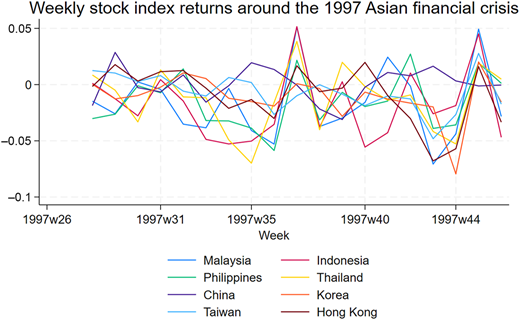
Market co-movements during the East Asian crisis of 1997–1998. Source: Figure by authors
Market co-movements during the East Asian crisis of 1997–1998. Source: Figure by authors
Table 3 reports descriptive statistics on weekly returns for the nine chosen East Asian markets over the entire sample period for which they have data, and also the period of the East Asian crisis, considered for this purpose as the period July to December 1997. As discussed, the data for Vietnam pertain only to a shorter period starting August 2000. The average returns in the equity market of Vietnam are also the largest, but this is naturally not comparable to the other markets because the period of crisis is not included here. Over the entire period, the equity market for China had the highest volatility in returns but also about the highest average returns, indicating a good connection between risk and return. In fact, the coefficient of variation for Hong Kong and China, at about 30, are the lowest, indicating the best value for investors. At the other end, Thailand has almost zero average returns, resulting in a coefficient of variation of almost 300, and Malaysia also evidence higher risk relative to returns with a coefficient of variation around 100. The equity market of Indonesia and the Philippines also evidence high volatility without correspondingly high returns. Average returns during the crisis are substantially lower for almost all the considered East Asian markets, except for China, which was immune to the crisis. All the other East Asian markets recorded negative returns during the crisis. The largest shortfalls in average returns are evidenced for Indonesia, followed by Korea and Malaysia.
Descriptive statistics – weekly returns in the selected markets (%)
| Weekly returns | Mean | Std. Dev | Observations | Start week | End week | Crisis |
|---|---|---|---|---|---|---|
| China | 0.053 | 1.886 | 1,640 | 6 Jan 1992 | 17 Mar 2025 | 0.09 |
| Hong Kong | 0.043 | 1.250 | 1,733 | 6 Jan 1992 | 17 Mar 2025 | −0.71 |
| Indonesia | 0.029 | 1.742 | 1,701 | 6 Jan 1992 | 17 Mar 2025 | −2.93 |
| (South) Korea | 0.019 | 1.577 | 1,731 | 6 Jan 1992 | 17 Mar 2025 | −2.10 |
| Malaysia | 0.012 | 1.203 | 1,731 | 6 Jan 1992 | 17 Mar 2025 | −2.10 |
| The Philippines | 0.021 | 1.361 | 1,731 | 6 Jan 1992 | 17 Mar 2025 | −1.59 |
| Taiwan | 0.032 | 1.239 | 1,691 | 6 Jan 1992 | 17 Mar 2025 | −0.53 |
| Thailand | 0.005 | 1.406 | 1,733 | 6 Jan 1992 | 17 Mar 2025 | −1.85 |
| Vietnam | 0.070 | 1.455 | 1,246 | 31 Jul 2000 | 17 Mar 2025 | – |
Note(s): (1) For each market, average weekly returns and standard deviation (in per cent) are computed over the available data, the dates for which are reported in the columns “Start week” and “End week”. The data are reasonably balanced with few missing values, except for Vietnam equity market, for which data start only about August 2000. (2) Over the entire sample period, the equity market for China had the highest volatility in returns but also about the highest average returns, indicating a good connection between risk and return. However, Indonesia evidence high volatility without correspondingly high returns. In this regard, the worst are Thailand and Malaysia with the highest coefficient of variation, indicating very poor returns and relatively higher risk. Vietnam evidences the highest average returns, but these figures are not comparable since they do not include the period of the crisis. (3) Average returns during the crisis (taken here as the period July–December 1997) are substantially lower for almost all the considered East Asian markets. However, it is clear that China was relatively immune to the crisis, while Indonesia, Korea and Malaysia are hardest hit
Apart from the above nine, our data include about 50 other mature and emerging market indices. Using the GMM methodology of Bhattacharjee and Holly (2013), weekly returns from these markets, as well as temporal lags from the chosen nine East Asian markets, were used to select instrumental variables to identify the network interdependence structure.
3.3 Models
We estimate two main models using the above data. They differ in how cross-market and over-time dynamics are modelled.
Our main model takes a structural view on cross-market interactions. Specifically, this network interaction (structural vector autoregression, SVAR) model explains return for an index East Asian market at time , denoted by a combination of impact from the corresponding returns from other indices at the same time , as well as the time-lagged returns for the same index.
where represents the influence from the -th East Asian market into the -th market, represents temporal (over time) persistence in returns, are institutional fixed effects for the -th market and are the errors which are iid in the temporal and cross-section dimensions. In other words, and are independent. Expressed in matrix form:
where boldcase quantities (, and ) denote corresponding (scalar) elements of the nine selected East Asian markets stacked together, is the matrix of spatial (network interaction) weights with zero diagonal elements but unrestricted causal market-to-market interactions represented by off-diagonal elements, is a diagonal matrix of influence of the lagged returns (persistence) and are the errors which are iid over time and across markets. In other words, and are assumed to be independent.
This is essentially the spatial lag (autoregressive) model (Anselin, 2002) with the only difference that here the spatial weights matrix is taken as unknown a priori and an object of inference, and hence the spatial autoregressive parameter is unidentified and omitted (Bhattacharjee and Holly, 2013). The above spatial lag model contains endogeneity due to simultaneous causality between the returns of different indices at a given time. Due to this endogeneity, any estimates of and based on ordinary least squares regression would be biased and inconsistent. Specifically, the correlation between the regressors and the regression errors violates the condition of independence of the residuals, which is required for the estimates to be consistent.
Note that the spatial lag model as set up in Eq. (1) above with temporal lags as an independent regressor is also a SVAR model, where the structural contemporaneous effects matrix is precisely the network interdependence matrix. In the traditional multivariate time series literature, the model is estimated by assuming some structure on the above structural matrix, typically under recursive or sign restrictions. In the corresponding spatial econometrics literature, there are also order restrictions, such as symmetry, recursive ordering, sparsity or nested structures (Bhattacharjee and Holly, 2013; Bhattacharjee et al., 2022; Basak et al., 2018). Further, note also that with minor modifications, this network model (Eq. 1) can also be set up as the popular spatial panel factor model (Pesaran, 2006):
where is a low-dimensional vector of factor time-series and are the corresponding market-specific loadings. The market-specific fixed effects are also integrated within the factor part of the model. Pesaran (2006) show that the above factor-augmented spatial model can accommodate potential nonstationarity and network strong dependence. In data that are high dimensional across both the cross-section and time series dimensions, one can use common correlated effects to model the factors , which in the current setting would imply average returns across the East Asian markets. However, since our cross-section dimension comprises only nine East Asian markets and is therefore not large, we use statistical factor analysis and estimate an East Asian market factor. This factor variable (and a global market factor) is included where necessary to ensure that the residuals from our model are weakly dependent. This factor augmentation is critical in drawing structural interpretations from a Fama and French (1993) type asset return model (Bhattacharjee and Roy, 2019).
Hence, the model is well set up in an econometric sense. It is also closely aligned with the theory outlined in Section 3.1. Specifically, the structural part of the model captures network interdependence induced by trader behaviour and herding (Krugman, 1999) while the impact of fundamentals (Kaminsky and Reinhart, 2000) is modelled by the factor structure including both fixed effects and market-specific factor loadings. Further interpretation of the impact of fundamentals and institutions can be gleaned by explicitly including macroeconomic and institutional variables. However, this is beyond the context of this current paper. Here we are interested in estimating and understanding structural interdependence between the East Asian equity markets. For this purpose, it is entirely adequate to account for fundamentals by including, as we do, the factor structure modelled in a general and robust way.
To circumvent the issue of endogeneity and identify the directed and potentially asymmetric matrix of network interactions between markets, we adopted the approach of Instrumental Variables regression using GMM. Specifically, we follow the methodology of Bhattacharjee and Holly (2013), where instruments are selected from a large candidate instrument set by repeated application of the Hansen–Sargan overidentifying restrictions -test (Hansen, 1982) and under-identification test (Kleibergen and Paap, 2006) and then combined optimally by using GMM. The candidate instrument set includes the returns from the previous periods, returns of some of the other Asian indices not directly in scope, and indices for Western developed economies (such as USA, UK, etc.). This approach for instrument choice is based on Roodman (2009) and is applicable in Big Data settings. A related approach based on the lasso was developed in Ahrens and Bhattacharjee (2015) and an alternate Big Data approach in Bhattacharjee and Sen (2024).
Beyond binary directed local interdependencies whereby shocks to stock indices in specific markets affect closely connected markets, there can also be strong dependence or spatial non-granularity (Pesaran, 2006) induced by the effects of global factors (Chuhan et al., 1998); this is a common cross-section and panel data feature akin to non-stationarity in time series data (Bhattacharjee et al., 2022). To model the impact of common factors, we also consider an East Asian and a global index. These indices were constructed by principal components factor analysis, capturing market sentiments inherent in the collection of returns across markets.
In addition to the above network SVAR model, we also consider a standard vector autoregression model (VAR) as a benchmark:
where the contemporaneous causal interaction effects modelled by are not included; instead, the lag-dependence modelled by is richer, unlike the diagonal structure of . The VAR model has weak exogeneity and can be estimated by standard OLS (ordinary least squares) or GLS (generalised least squares). The above SVAR and VAR models are designed to be approximately of similar dimensionality, particularly under a sparse structure of inter-market interactions. The key difference between the two models is that while the interactions are contemporaneous in the SVAR, they are time-lagged for the VAR model. However, the VAR model can be interpreted as the reduced form of the SVAR model:
This implies that the (first order) impulse responses of the SVAR and corresponding VAR model are given by (Koop et al., 1996):
which we use to understand cross-market diffusion and spread of the 1997 East Asian crisis.
4. Results and discussion
In this paper, our central goal is to develop insights about the spatial structure of influence across the market indices based on panel data varying over time (weeks from July 2000 to March 2025) and equity markets (nine chosen East Asian markets – China, Hong Kong, Indonesia, South Korea, Malaysia, Taiwan, Thailand, the Philippines and Vietnam). The choice of markets is discussed above. Also, as discussed earlier, the chosen time period is driven by the availability of data, particularly as the stock market in Vietnam started trading only in the second half of 2000. However, we use the period of the East Asian market crisis and immediate aftermath, particularly the five months July–November 1997, to validate our models out-of-sample. Together, we draw insights on latent interdependence, potentially enhanced by contagion during extreme market events (Forbes and Rigobon, 2002).
We use only a single temporal lag, , in our estimation. Our returns are weekly, and asset price signals move fast so that information diffusion across markets is largely complete within a week. This choice of a single weekly lag is validated in two ways. Firstly, in conducting panel unit root tests (Levin et al., 2002), we explore higher order lags but find that second and higher order lags do not offer additional fit to the data. Secondly, we apply information criteria (AIC/BIC) to our VAR model (Eq. 2), and this indicates a model with single lag as having the best fit to the data. Our central SVAR model (Eq. 1) is estimated market-by-market and hence the spatial weights matrix, , is estimated row-wise. In doing so, we pay attention to market-specific institutional features and macroeconomic environment (Bencivenga and Smith, 1992; Boyed et al., 2001) by including market fixed effects.
Together, global shocks explain part of co-movements in financial markets (Calvo and Reinhart, 1996; Chuhan et al., 1998). Therefore, we estimate two cross-market principal components factor-based indices, one at the global level and one for the East Asian markets. The global factor is included as a potential instrumental variable, whereas the East Asian factor is important for the most connected markets (China and Korea) that exhibit strong dependence. Including this East Asian market factor ensures that cross-section errors are weakly dependent (granular), which is then empirically verified (Pesaran, 2006).
4.1 Overall SVAR results
The estimates of SVAR model (Eq. 1) are presented in Table 4, where results are separately presented by the weak dependence part (top panel (a)) and strong dependence (bottom panel (b)), where estimates in the two panels can be aggregated to infer on overall cross-market interdependence and diffusion. The results of GMM instrumental variables regression produced a weak dependence structure across the nine markets, except for the two most-connected markets, China and Korea, where there is also an important East Asian aggregate market effect. The estimates for some select markets are discussed below.
Estimates of the SVAR model (Eq. 1) including the spatial dependence matrix across the nine markets under study
| (a) Estimates of (stationary) spatial weights matrix of network interactions between East Asian equity markets | ||||||||||||||
|---|---|---|---|---|---|---|---|---|---|---|---|---|---|---|
| Weak dependence | MYS | IDN | PHL | THA | CHN | VNM | KOR | TWN | HKG | Lag | Fxd effects | KP underid | Hansen J | RMSE |
| MYS (Malaysia) | 0.3242** | 0.3554** | 0.1447*** | −0.00023 | 0.0084 | 0.1048 | 0.0066 | |||||||
| (0.003, 0.645) | (0.031,0.680) | (0.066, 0.223) | ||||||||||||
| IDN (Indonesia) | −0.3819* | 0.3357* | 0.1265** | 0.00026 | 0.0264 | 0.4640 | 0.0103 | |||||||
| (−0.818, 0.055) | (−0.052, 0.723) | (0.027, 0.226) | ||||||||||||
| PHL (The Philippines) | 0.6330*** | 0.0757** | 0.00053 | 0.0015 | 0.7046 | 0.0098 | ||||||||
| (0.154, 1.112) | (0.001, 0.150) | |||||||||||||
| THA (Thailand) | −0.3241** | 0.4152** | 0.2835** | 0.1255*** | 0.00015 | 0.0146 | 0.6524 | 0.0089 | ||||||
| (−0.606, −0.042) | (0.013, 0.817) | (0.014, 0.553) | (0.061,0.190) | |||||||||||
| CHN (China) | 0.1356* | 0.1735*** | −0.00013 | 0.0435 | 0.8349 | 0.0106 | ||||||||
| (−0.019, 0.290) | (0.097, 0.250) | |||||||||||||
| VNM (Vietnam) | −0.6574* | 1.3059*** | 0.3361*** | 0.00102 | 0.0247 | 0.4962 | 0.0167 | |||||||
| (−1.319, 0.004) | (0.594,2.018) | (0.215, 0.457) | ||||||||||||
| KOR (South Korea) | −0.5420+ | 0.5969** | 0.3757* | −0.0041 | 0.00042 | 0.0379 | 0.5704 | 0.0085 | ||||||
| (−1.138, 0.054) | (0.067,1.127) | (−0.025, 0.777) | (−0.078, 0.069) | |||||||||||
| TWN (Taiwan) | −0.9114** | 1.0639* | 0.6538** | 0.0409 | 0.00015 | 0.0495 | 0.3700 | 0.0137 | ||||||
| (−1.788, −0.034) | (−0.009, 2.138) | (0.077, 1.231) | (−0.103, 0.185) | |||||||||||
| HKG (Hong Kong) | 0.7807*** | 0.1744*** | 0.00001 | 0.0274 | 0.6220 | 0.0106 | ||||||||
| (0.218, 1.343) | (0.051, 0.298) | |||||||||||||
| (b) Factor structure induced (nonstationary) effects of interactions across East Asian markets | |||||||||||||
|---|---|---|---|---|---|---|---|---|---|---|---|---|---|
| Strong dependence | MYS | IDN | PHL | THA | CHN | VNM | KOR | TWN | HKG | Lag | Fxd effects | Long-run coefficients | |
| E Asian market factor | 0.1644 | 0.1623 | 0.1601 | 0.1652 | 0.0984 | 0.0804 | 0.1757 | 0.1686 | 0.1702 | Factor | Lag | ||
| CHN (China) | 0.0010 | 0.0010 | 0.0009 | 0.0010 | 0.0005 | 0.0010 | 0.0010 | 0.0010 | 0.0002 | 0.00012 | 0.0059 | 0.3024 | |
| KOR (South Korea) | 0.0019 | 0.0018 | 0.0018 | 0.0019 | 0.0011 | 0.0009 | 0.0019 | 0.0019 | 0.0004 | 0.00050 | 0.0114 | 0.1879 | |
Note(s): (1) Only statistically significant (at 10% level) estimates are presented: * (10%), ** (5%) and *** (1%) level, with 95% confidence intervals in parentheses. (2) We regress returns in each market against the others and their own (lagged) values from the previous week, using instruments chosen from a large candidate set to address endogeneity. (3) Hansen J test (p-values) show that the instruments do not violate overidentifying restrictions (and are therefore valid instruments). The KP under-identification test (p-values) confirms that instruments have sufficient information content. (4) There is evidence of (spatial) strong dependence in the residuals. This relates to two major markets (China and Korea), where in addition to cross-market weak dependence, there is also evidence of impact of market-wide shocks, which is captured by a factor model including an aggregate East Asian market factor
From the estimated structure (Table 4 and Figure 2), it is evident that both the mature markets (Hong Kong and South Korea) in the region are acting like regional hubs of influence and risk transmission. They are both heavily impacted by movements in some of the other markets in the region as well as influencing other markets. This is due to the fact that they are both regionally embedded, globally exposed and financially open economies.
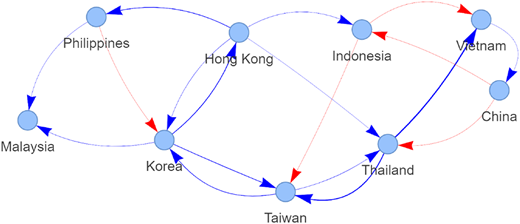
Network of cross-market interdependence estimated across the nine East Asian markets. Notes: Network estimated by applying GMM-based instrumental value regression on the market returns. The structure shows weak dependence among the markets with some of them being positive (blue) and some negative (red). Source: Figure by authors
Network of cross-market interdependence estimated across the nine East Asian markets. Notes: Network estimated by applying GMM-based instrumental value regression on the market returns. The structure shows weak dependence among the markets with some of them being positive (blue) and some negative (red). Source: Figure by authors
Hong Kong is a major hub for international investors accessing both Chinese and Asian equities and is highly responsive to regional spillovers alongside global risk sentiments. It also has often served as the proxy market for China with many international funds using HK-listed Chinese stocks (H-shares) to gain exposure in the emerging markets. These factors make the market respond elastically to global movements and transmit them to other markets. While Hong Kong receives strongest influences only from Korea (spatial weight ), it transmits influences across several markets (Table 5).
GMM estimates for weekly returns on Hong Kong equity index
| Predictor | Coefficient | Std. Err | z-score | P>|z| | 95% conf. Interval |
|---|---|---|---|---|---|
| r_MYS | 0.2898 | 0.252 | 1.15 | 0.251 | (−0.205, 0.785) |
| r_IDN | −0.1811 | 0.247 | −0.73 | 0.464 | (−0.666, 0.304) |
| r_PHL | 0.2855 | 0.437 | 0.65 | 0.514 | (−0.571, 1.142) |
| r_THA | −0.3985 | 0.378 | −1.06 | 0.291 | (−1.139, 0.342) |
| r_CHN | −0.2185 | 0.218 | −1.00 | 0.316 | (−0.645, 0.208) |
| r_VNM | 0.0030 | 0.088 | 0.03 | 0.973 | (−0.170, 0.176) |
| r_KOR | 0.7807 | 0.287 | 2.72 | 0.007 | (0.218, 1.343) |
| r_TWN | −0.1929 | 0.280 | −0.69 | 0.491 | (−0.742, 0.356) |
| (lag) r_HKG | 0.1744 | 0.063 | 2.77 | 0.006 | (0.051, 0.298) |
| Fixed Effect | 0.0000 | 0.000 | 0.03 | 0.975 | (−0.001, 0.001) |
Note(s): (1) GMM-based instrumental variable regression of returns to Hong Kong equity index from other East Asian markets and its own lagged value from the previous week. (2) Estimates indicate that the only (positive) statistically significant influence comes from South Korea (significant at the 1% level). (3) Abbreviations: r_CHN, r_HKG, r_IDN, r_KOR, r_MYS, r_PHL, r_THA, r_TWN and r_VNM denote weekly returns on equity indices for markets in China, Hong Kong, Indonesia, (South) Korea, Malaysia, the Philippines, Thailand, Taiwan and Vietnam, respectively
South Korea also mostly acts as an influencer market in the region, reflecting global and regional sentiments (Table 6). As discussed above, it picks up substantial shocks from the aggregate East Asian market, which is evidence of spatial strong dependence (Pesaran, 2006; Bhattacharjee et al., 2022). In addition, it is also substantially impacted by movements in the Taiwanese market. In fact, there is a direct and bidirectional influence from Thailand to Taiwan and Korea, which also reflects the strong supply chain of electronics manufacturing in Thailand, semiconductor production in Taiwan and the Deep tech industry of Korea. While investigating the influence structure for individual market sectors is beyond the scope of the current work, in future research it would be of interest to validate the underlying drivers behind this line of influence along sectoral lines combining the influences of goods trading with equity market herding (Krugman, 1999; Kaminsky and Reinhart, 2000).
GMM estimates for weekly excess returns on (South) Korea equity index (beyond the aggregate East Asian markets factor)
| Predictor | Coefficient | Std. Err | z-score | P>|z| | 95% conf. Interval |
|---|---|---|---|---|---|
| r_MYS | −0.4007 | 0.254 | −1.58 | 0.115 | (−0.899, 0.098) |
| r_IDN | 0.0179 | 0.176 | 0.10 | 0.919 | (−0.327, 0.362) |
| r_PHL | −0.5420 | 0.304 | −1.78 | 0.075 | (−1.138, 0.054) |
| r_THA | −0.0526 | 0.300 | −0.18 | 0.861 | (−0.640, 0.535) |
| r_CHN | −0.1768 | 0.133 | −1.33 | 0.183 | (−0.437, 0.084) |
| r_VNM | −0.0395 | 0.084 | −0.47 | 0.639 | (−0.204, 0.125) |
| r_TWN | 0.5969 | 0.270 | 2.21 | 0.027 | (0.067, 1.127) |
| r_HKG | 0.3757 | 0.204 | 1.84 | 0.066 | (−0.025, 0.777) |
| (lag) r_KOR | −0.0041 | 0.038 | −0.11 | 0.913 | (−0.078, 0.069) |
| Fixed Effect | 0.0004 | 0.000 | 1.39 | 0.165 | (−0.000, 0.001) |
Note(s): (1) GMM-based instrumental variable regression of excess returns to (South) Korean equity index from other East Asian markets and its own lagged value from the previous week. See Table 4 for the impact of the aggregate factor. Accounting for this factor structure is important; otherwise, the residuals show evidence of strong dependence. (2) Estimates indicate statistically significant influence at 5% level from Taiwan and at the 10% level from Hong Kong (positive) and the Philippines (negative). (3) Abbreviations: r_CHN, r_HKG, r_IDN, r_KOR, r_MYS, r_PHL, r_THA, r_TWN and r_VNM denote weekly returns on equity indices for markets in China, Hong Kong, Indonesia, (South) Korea, Malaysia, the Philippines, Thailand, Taiwan and Vietnam, respectively
The South Korean index is also adversely impacted (albeit weakly) by the Philippines. The most likely explanation is capital reallocation across the risk spectrum. An underlying surge in risk appetite of the investors can drive investments away from the more stable emerging market equity basket of Korea to riskier portfolios of the Philippines. Such equity trading behavioural influences would counteract those based on the cycles of international trade.
On the other hand, the Malaysian index shows indications of positive influence from both the Philippines and Korea, which reflects the significant presence of Malaysian financial institutions in the region (Table 7). Again, future sectoral analysis would be of interest to validate such linkages and corresponding interdependence patterns.
GMM estimates for weekly returns on Malaysia equity index
| Predictor | Coefficient | Std. Err | z-score | P>|z| | 95% conf. Interval |
|---|---|---|---|---|---|
| r_IDN | 0.0994 | 0.130 | 0.76 | 0.446 | (−0.156, 0.355) |
| r_PHL | 0.3242 | 0.164 | 1.98 | 0.048 | (0.003, 0.645) |
| r_THA | −0.1155 | 0.159 | −0.72 | 0.469 | (−0.428, 0.197) |
| r_CHN | −0.0315 | 0.117 | −0.27 | 0.788 | (−0.261, 0.198) |
| r_VNM | −0.0336 | 0.055 | −0.61 | 0.543 | (−0.142, 0.075) |
| r_KOR | 0.3554 | 0.165 | 2.15 | 0.032 | (0.031, 0.680) |
| r_TWN | −0.1113 | 0.093 | −1.20 | 0.229 | (−0.293, 0.070) |
| r_HKG | 0.0309 | 0.125 | 0.25 | 0.805 | (−0.214, 0.276) |
| (lag) r_MYS | 0.1447 | 0.040 | 3.63 | 0.000 | (0.066, 0.223) |
| Fixed Effect | −0.0002 | 0.000 | −1.03 | 0.302 | (−0.001, 0.000) |
Note(s): (1) GMM-based instrumental variable regression of returns to Malaysia equity index from other East Asian markets and its own lagged value from the previous week. (2) Estimates indicate that the only (positive) statistically significant influence arises from Korea and the Philippines (both at the 5% level). (3) Abbreviations: r_CHN, r_HKG, r_IDN, r_KOR, r_MYS, r_PHL, r_THA, r_TWN and r_VNM denote weekly returns on equity indices for markets in China, Hong Kong, Indonesia, (South) Korea, Malaysia, the Philippines, Thailand, Taiwan and Vietnam, respectively
Apart from the strong supply chain-driven influences running through Taiwan, the market also experiences a weak negative influence of the commodity-driven market of Indonesia (Table 8). One reason for such a trend could be the cyclical pulls of the commodity market versus technology market. These influences have become stronger in recent times as the Taiwanese market opened up rapidly to foreign investors and international trade in semiconductors became more prominent. At the time of the 1997 Asian market crisis, domestic investors accounted for about 90% of the trading in stocks, potentially explaining why the market was less affected by the crisis despite being one of the most volatile (Titman and Wei, 1999). However, this proportion fell to about 70% by 2006 (Chiang et al., 2012), potentially rendering the market more exposed to external shocks. We revert to this issue later in the paper.
GMM estimates for weekly returns on Taiwan equity index
| Predictor | Coefficient | Std. Err | z-score | P>|z| | 95% conf. Interval |
|---|---|---|---|---|---|
| r_MYS | −0.0377 | 0.851 | −0.04 | 0.965 | (−1.706, 1.631) |
| r_IDN | −0.9114 | 0.447 | −2.04 | 0.042 | (−1.788, −0.034) |
| r_PHL | −0.1444 | 0.495 | −0.29 | 0.771 | (−1.116, 0.827) |
| r_THA | 1.0639 | 0.548 | 1.94 | 0.052 | (−0.010, 2.138) |
| r_CHN | 0.0231 | 0.287 | 0.08 | 0.936 | (−0.540, 0.586) |
| r_VNM | 0.0627 | 0.116 | 0.54 | 0.588 | (−0.164, 0.289) |
| r_KOR | 0.6538 | 0.294 | 2.22 | 0.026 | (0.077, 1.231) |
| r_HKG | 0.1760 | 0.278 | 0.63 | 0.527 | (−0.370, 0.722) |
| (lag) r_TWN | 0.0409 | 0.073 | 0.56 | 0.576 | (−0.103, 0.185) |
| Fixed Effect | 0.0002 | 0.000 | 0.32 | 0.751 | (−0.001, 0.001) |
Note(s): (1) GMM-based instrumental variable regression of returns to Malaysia equity index from other East Asian markets and its own lagged value from the previous week. (2) Estimates indicate that the only (positive) statistically significant influences arise from Korea (at the 5% level) and to some extent from Thailand (at 10% level) but also negative externalities from Indonesia (at the 5% level). Persistence (effect of own lag) is not statistically significant. (3) Abbreviations: r_CHN, r_HKG, r_IDN, r_KOR, r_MYS, r_PHL, r_THA, r_TWN and r_VNM denote weekly returns on equity indices for markets in China, Hong Kong, Indonesia, (South) Korea, Malaysia, the Philippines, Thailand, Taiwan and Vietnam, respectively
The other major observation from the analysis is the strong influence of Thailand index returns on the market index for Vietnam (Table 9). There is a prominent line of investment in the agriculture, energy and infrastructure sectors of Vietnam by major Thai firms. Also, this reinforces the status of Thailand's index as an early indicator for the economy of the entire region, particularly when it comes to interest rate shifts or inflation patterns. Furthermore, this implies that, had it been traded at the time of the 1997 East Asian crisis, the stock market in Vietnam would likely have been the single most affected. This underscores the importance of both market development and macroprudential regulation to support the nascent stock market in Vietnam through its evolution (Allen and Gale, 1999; Brealey, 1999).
GMM estimates for weekly returns on Vietnam equity index
| Predictor | Coefficient | Std. Err | z-score | P>|z| | 95% conf. Interval |
|---|---|---|---|---|---|
| r_MYS | −0.0062 | 0.403 | −0.02 | 0.988 | (−0.796, 0.784) |
| r_IDN | −0.6574 | 0.338 | −1.95 | 0.052 | (−1.319, 0.004) |
| r_PHL | −0.2451 | 0.386 | −0.64 | 0.525 | (−1.001, 0.511) |
| r_THA | 1.3059 | 0.363 | 3.59 | 0.000 | (0.594, 2.018) |
| r_CHN | −0.1379 | 0.264 | −0.52 | 0.601 | (−0.655, 0.380) |
| r_KOR | 0.4571 | 0.385 | 1.19 | 0.235 | (−0.297, 1.211) |
| r_TWN | −0.1604 | 0.464 | −0.35 | 0.730 | (−1.070, 0.749) |
| r_HKG | −0.0576 | 0.446 | −0.13 | 0.897 | (−0.931, 0.816) |
| (lag) r_VNM | 0.3361 | 0.062 | 5.44 | 0.000 | (0.215, 0.457) |
| Fixed Effect | 0.0010 | 0.001 | 1.71 | 0.087 | (−0.000, 0.002) |
Note(s): (1) GMM-based instrumental variable regression of returns to Malaysia equity index from other East Asian markets and its own lagged value from the previous week. (2) Estimates indicate that the only (positive) statistically significant influence arises from Thailand (at the 1% level) and to some extent negative influence from Indonesia (but only at the 10% level). Persistence (effect of own lag) is not statistically significant. (3) Abbreviations: r_CHN, r_HKG, r_IDN, r_KOR, r_MYS, r_PHL, r_THA, r_TWN and r_VNM denote weekly returns on equity indices for markets in China, Hong Kong, Indonesia, (South) Korea, Malaysia, the Philippines, Thailand, Taiwan and Vietnam, respectively
Finally, like Korea, the market in China is globally connected and highly influenced by movements in aggregate returns across the East Asian region. To model this, we construct a statistical factor combining the nine Asian markets in scope using Principal Components. Based on the regression coefficient and the factor loadings across the nine markets, we estimated the strong dependence structure of China against the other markets. The structure revealed a nearly uniform influence of all the markets on the Chinese market.
When directly regressed against this aggregate factor, returns from Chinese market showed statistically significant linkages. However, beyond domestic institutional and global shocks (Chuhan et al., 1998), there were no significant links of influence into China in the weak dependence structure estimated by GMM instrumental variables regression. There are, however, negative influences from China into Thailand and, to a lesser extent, Indonesia.
4.2 (Out-of-sample) analysis: period of the 1997 East Asian crisis
Based on the same data, we also estimated a standard VAR model (Eq. 2). We do not present these results separately but draw inferences on the spread of the 1997 East Asian crisis from its origins in Thailand using a comparison of out-of-sample forecasts of the two models. We start with a comparison of the estimated impulse response matrices of the two models (Eq. 3), based on Koop et al. (1996), specifically for market shocks from Thailand.
Figure 3 shows that the orthogonalized impulse responses, based on the VAR model (Eq. 2), for an impulse originating from Thailand, are relatively small for most markets, evidencing weak cross-market interactions. However, impulse responses upon Thailand itself, and upon Korea, are strong, followed by Taiwan and Hong Kong. From Table 10, it is also clear that the SVAR model (Eq. 1) evidences much larger impulse responses from the Thai equity market than the VAR model (Eq. 2). Given that the East Asian crisis originated from the financial markets in Thailand, it is then apparent that its rapid spread across East Asian markets (Corsetti et al., 1999; Krugman, 1999) is better captured by the network SVAR model (Eq. 1). However, both models predict a strong response on the stock market of Taiwan, which is contrary to the evidence of the crisis (Titman and Wei, 1999).
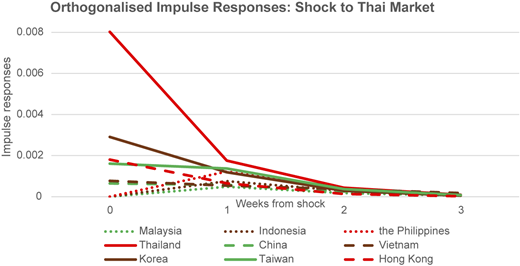
Orthogonalised impulse responses from the estimated VAR model (Eq. 2), based on impulses from the equity market index returns for Thailand. Notes: Most responses are small, except for Thailand itself, Korea, the Philippines and Taiwan. The responses for Korea die out quickly. Thailand, the Philippines and Taiwan are the only ones statistically significant at the 10% level or below at the one-week horizon. Source: Figure by authors
Orthogonalised impulse responses from the estimated VAR model (Eq. 2), based on impulses from the equity market index returns for Thailand. Notes: Most responses are small, except for Thailand itself, Korea, the Philippines and Taiwan. The responses for Korea die out quickly. Thailand, the Philippines and Taiwan are the only ones statistically significant at the 10% level or below at the one-week horizon. Source: Figure by authors
| Impulse: THA | MYS | IDN | PHL | THA | CHN | VNM | KOR | TWN | HKG |
|---|---|---|---|---|---|---|---|---|---|
| SVAR | 0.274 | 0.103 | 0.263 | 0.570 | 0.095 | 0.676 | 0.532 | 0.860 | 0.416 |
| VAR | 0.049 | 0.053 | 0.139 | 0.183 | 0.025 | 0.028 | 0.072 | 0.118 | 0.021 |
| Difference | 0.226 | 0.050 | 0.125 | 0.386 | 0.070 | 0.648 | 0.460 | 0.742 | 0.395 |
Note(s): (1) Estimated impulse responses from a 1 standard deviation shock to the weekly returns to the Thailand equity market on the same market and all other East Asian markets in one week, based on Eq. (3). The underlying estimates of the SVAR model (Eq. 1) are obtained row-wise by applying the GMM instrumental variables discussed in the text. VAR model (Eq. 2) estimates are obtained by applying OLS row-wise, which produces ML estimates. (2) The SVAR model (Eq. 1) produces larger impulse responses across all the considered East Asian markets. (3) Abbreviations: CHN, HKG, IDN, KOR, MYS, PHL, THA, TWN and VNM denote weekly returns on equity indices for markets in China, Hong Kong, Indonesia, (South) Korea, Malaysia, the Philippines, Thailand, Taiwan and Vietnam, respectively
At the heart of the crisis, average weekly returns in Indonesia, Malaysia, the Philippines, Thailand and Korea dropped, respectively, by 1.9%, 1.7%, 1.5%, 1.3% and 1.1% over the period July–November 1997. Over a longer period from July 1997 to January 1998, the fall was 2.2%, 1.0%, 0.9%, 0.8% and 1.2%, respectively. It is evident that the impact was longer and deeper in Indonesia and, to some extent, also in Korea. On the other hand, the impact was much smaller in Taiwan, and the equity markets in China remained resilient from the interaction effects.
Based on out-of-sample predictions from these models, we ask how far these dynamics were matched by the above two models. For the period July–November 1997, the root mean squared (one week ahead) forecast errors (RMSFE), averaged across the eight chosen East Asian markets (except Vietnam), was 2.5% for the SVAR model (Eq. 1), which is 8.3% lower than that of the VAR model (Eq. 2).
This forecast superiority of the network interactions SVAR model (Eq. 1) is evident and remarkable. The superior performance of our network SVAR model would have been greater, were it not for Taiwan, for which the RMSFE is about 40–60% worse than the VAR model (Eq. 2). Despite very high trading volumes and volatility, Taiwan was affected very little by the 1997 East Asian crisis, which is an acknowledged enigma (Titman and Wei, 1999; Chiang et al., 2012). It turns out that return forecasts for Taiwan from the SVAR model have a substantially lower bias than the VAR (−0.03% as compared with −0.54%), but the volatility implied by the model is correspondingly larger.
Note also that the data used for estimation came from a much later period. Then, the superior performance of the network model also highlights the fact that network interdependencies were stable and largely unaffected by the East Asian crisis, which may be viewed as evidence against the contagion hypothesis (Corsetti et al., 1999; Forbes and Rigobon, 2002). Clearly, Taiwan is a counterexample to this general observation. Given the strong spillover impact from Thailand to Taiwan in both the estimated models, it can perhaps be argued that interaction effects waned somewhat during the crisis. Conversely, perhaps stronger interactions developed later as the Taiwan market evolved towards greater foreign investor activity (Chiang et al., 2012) and greater trade, particularly in semiconductors.
Finally, the Vietnamese market commenced trading and development only after the crisis. However, its strong interdependence with the Thai market suggests that it might have suffered the sharpest downfall due to its enhanced exposure to Thailand and other East Asian markets. This underscores the need to prioritise market reforms and institutional development in the Vietnam stock market.
4.3 Comparison with previous studies
A direct comparison of the findings in this paper with previous literature is challenging. Very few studies have considered equity returns across the East Asian markets and even fewer have done so over the period of the East Asian crisis. However, our results are clearly consistent with the analysis of Krugman (1999) and Masson (1999), suggesting that herding by global investors may have exacerbated the impacts of the East Asian crisis. While we account for the impact of fundamentals and institutional quality on asset returns and their co-movements, we do not aim to explicitly identify relevant fundamentals and institutional structures. Together, it is not our main objective to validate whether there were contagion effects during the crisis. Importantly, the out-of-sample predictions from our network model for the crisis period dominate those of the reduced form VAR model, suggesting strong network interdependencies identified by the SVAR model (Eq. 1).
Beyond the immediate literature for the East Asian region, our findings on network effects are also validated by the literature on cross-market and cross-asset information flows and structural interactions. In particular, the sequencing of opening and closing times of different markets has been observed to produce the so-called “meteor shower” phenomenon in returns (Hamao et al., 1990), and similar evidence for asset returns were discussed in Basak et al. (2018). While the physical proximity of the East Asian markets preclude potential for such meteor shower effects, our GMM methodology clearly highlights asymmetric information flow and interdependence between markets. This is also explained by similarity in portfolios held by investors and herding in changes to such portfolios. Specifically, if traders choose their diversified portfolio with a preferred risk exposure, this trading behaviour generates interdependence across returns within this portfolio, but not beyond. In Basak et al. (2018) and Bhattacharjee and Roy (2019), these exposures are estimated by a Fama and French (1993) factor model; the network is identified by clustering the assets on this estimated exposure vector. Here, we estimate the network structure by drawing upon recent developments in spatial econometrics.
We verify our estimated model by comparing findings against a benchmark VAR model (Eq. 2). In doing so, we find better goodness-of-fit for our network structural SVAR model (Eq. 1), both for the post-crisis (in-sample) period and the period of the Asian financial crisis (out-of-sample). We also validate weak dependence of the residuals of our estimated SVAR model to verify that the factor structure adequately accounts for strong dependence. This exercise reveals that the equity markets in China and Korea have strong influences from the global shocks, interpreted here as returns on the aggregate East Asian market index. Accounting for this strong dependence, the residuals of our SVAR model exhibit weak dependence character, further validating our estimation results.
5. Conclusion
This paper highlights the importance of modelling network interdependencies in emerging equity markets, particularly the emerging East Asian market economies. Several insights from our modelling and evidence for the Asian financial crisis remain highly relevant today.
Firstly, financial co-movements across equity markets in East Asia are persistent. Indeed, as highlighted in this paper and related empirical work, regional equity markets often display latent interdependencies (Forbes and Rigobon, 2002), including strong and weak spatial dependence. Emerging markets are characterised by quality uncertainty and investor herding (Krugman, 1999), particularly as limit or market order investment portfolios generate structured ordering of markets in terms of information flow and lead to cross-market co-movements (Basak et al., 2018; Bhattacharjee and Roy, 2019). In turn, such conditions can seriously limit the efficiency benefits from competition and welfare loss (Muthoo and Mutuswami, 2011). This emphasizes the need for continued focus on development of market institutions and transparency.
Second, our work highlights the role of non-stationarity and structural breaks. In particular, in markets like China and Korea, changing policy regimes and investor sentiments introduce complex dynamics that must be modelled carefully. Together, regime changes and major crisis events highlight the need to carefully understand and model higher order and complex dependence to mitigate against extreme market reactions (Kumar et al., 2022).
Third, this study emphasizes the need for multi-institutional responses (Radelet and Sachs, 1998; Brealey, 1999). Just as the ADB, CMIM and national regulators evolved after 1997, any future episode will likely require coordination across ADB, NDB, CMIM and perhaps IMF in a “multiple lender” world; see, for example, Schwartz (2007).
Contagion in East Asian financial markets remains a topic of vital importance, both empirically and institutionally. The 1997–1998 crisis exposed systemic weaknesses and galvanised significant reform at both national and regional levels. Institutions such as the ADB and newer actors like the NDB are central to the region’s evolving financial architecture.
The empirical work in this paper contributes to this broader understanding by identifying structural features in the region’s market interactions – such as strong dependence factors and causal cycles – that conventional models may overlook. A historical and institutional perspective enriches our interpretation of such results and informs how the development of market institutions would need to proceed and how the region might respond to future shocks. Future work focusing on inter-sectoral linkages and the interlinkages between trade and financial markets (Krugman, 1999; Kaminsky and Reinhart, 2000) will be valuable. Bayesian estimation of VAR and SVAR models is gaining popularity. Based on our findings here, it may be possible to design priors and conduct Bayesian estimation in future research. Similarly, integrating equity markets with trade remains an important area of future research.
We thank Ahmet Kaya and Adrian Pabst for helpful comments and suggestions. This is independent work by the researchers, and the views do not in any way represent the institutions to which the authors belong. The usual disclaimer applies.
Notes
Abbreviations for the markets are standard: CHN (China), HKG (Hong Kong), IDN (Indonesia), KOR (Korea), MYS (Malaysia), TWN (Taiwan), THA (Thailand), PHL (the Philippines) and VNM (Vietnam).
Note that the Ho Chi Minh Stock Exchange started trading only in 2000, and the crisis predates this. However, we can account for evolving market networks using our approach.

