This paper introduces the Better Marketing for a Better Africa (BMBA) model, a contextually adaptive framework that addresses the unique sustainability challenges in Sub-Saharan African markets while aligning marketing strategies with the Sustainable Development Goals.
Qualitative research using semi-structured interviews with 21 experts across Sub-Saharan Africa, including marketing professionals, sustainability experts, business strategists, and policymakers. Thematic analysis identified key themes that inform the development of the BMBA model.
Four critical pillars emerged in this study: Cultural-Market Analysis, Community-Driven Value Creation, Operational Excellence and Sustainable Supply, and Agile Collaboration. These address regional challenges while fostering sustainable business practices through cultural intelligence, community engagement, supply chain sustainability, and adaptable strategies.
This empirically grounded framework, specifically designed for African contexts, bridges global sustainability principles with local market realities, making a significant contribution to sustainability marketing literature in emerging economies.
Introduction
Africa transcends its geographical bounds as a continent of profound contrasts – resource-rich yet development-challenged, where extreme poverty coexists with emerging prosperity, and cultural diversity interweaves with complex economic systems. As businesses navigate Sub-Saharan African (SSA) markets, traditional marketing models often fall short in addressing the realities of a continent where 1.4 billion people are not just consumers but communities seeking meaningful development pathways.
The urgency to reimagine marketing strategies in Africa is clear. With over one-third of its population living in extreme poverty, rising youth unemployment, and growing inequality gaps (Statista, 2023; ILO, 2022), the continent faces a critical juncture where business practices must transcend profit-making to become drivers of inclusive development. The varied socio-economic and environmental contexts require a shift beyond traditional marketing approaches that focus primarily on customer acquisition or firm-specific outcomes. What is needed is a framework that positions marketing as a force capable of addressing systemic challenges while supporting sustainable business growth.
This imperative aligns with “Better Marketing for a Better World” (BMBW), introduced by Chandy et al. (2021), which highlights marketing’s potential to improve stakeholder well-being beyond conventional commercial goals. However, while BMBW offers valuable global insights, its application within African contexts remains underexplored, creating a gap in understanding how sustainability marketing principles can be effectively adapted to address SSA’s distinct challenges and opportunities.
The Better Marketing for a Better Africa (BMBA) model emerges as a response to this gap, offering a comprehensive framework specifically tailored to the African context. Unlike generic sustainability approaches, BMBA recognizes the continent’s unique characteristics: its rich cultural tapestry spanning diverse languages and traditions, fragmented supply chains requiring innovative solutions, and dynamic regulatory environments calling for adaptive strategies. The model operates through four interconnected pillars – Cultural-Market Analysis, Community-Driven Value Creation, Operational Excellence and Sustainable Supply, and Agile Collaboration – that function as a continuous, cyclical process ensuring businesses remain anchored in practical sustainability principles while adapting to evolving market conditions.
BMBA’s theoretical foundation integrates virtue ethics theory and the Triple Bottom Line (TBL) model, highlighting the interconnectedness of people, planet, and profit within African market contexts. This integration demonstrates that sustainable marketing in Africa cannot rely on superficial initiatives but must deeply embed ethical principles and community-centric values into business operations. The framework challenges traditional trade-off mindsets between profitability and sustainability, advocating instead for symbiotic relationships where ethical marketing practices promote both social impact and business success.
This paper makes significant contributions to both theoretical understanding and practical application within sustainability marketing. Theoretically, it advances discussions on sustainability marketing in developing economies by synthesizing established frameworks – virtue ethics, TBL, and cultural intelligence theory – within the African context. The paper provides an empirically-based framework linking global sustainability principles with local market realities, serving as a resource for scholars researching sustainability marketing in emerging economies.
Practically, BMBA provides tangible implementation strategies for businesses operating in African markets, directly supporting multiple Sustainable Development Goals (SDGs): SDG 4 (Quality Education) through deeper understanding of sustainable business practices, SDG 8 (Decent Work and Economic Growth) via ethical supply chains, SDG 9 (Industry, Innovation, and Infrastructure) through sustainable industrialization, SDG 10 (Reduced Inequalities) via culturally sensitive marketing, and SDG 17 (Partnerships for the Goals) through collaborative sustainability solutions.
The paper proceeds as follows: Section 2 presents the theoretical foundations underpinning BMBA. Section 3 details the qualitative methodology employed. Section 4 introduces the BMBA model and its four pillars. Section 5 provides empirical validation through expert interviews. Section 6 examines theoretical contributions. Section 7 presents practical applications through case studies. Section 8 discusses implementation challenges, and Section 9 concludes with future research directions.
Theoretical foundation
The development of the BMBA model requires a strong theoretical foundation that recognises the complex interaction between cultural dynamics, economic realities, and sustainability requirements within African markets. This foundation builds on established theoretical frameworks while adapting them to reflect the unique features of Sub-Saharan African business environments, forming a coherent conceptual base for sustainable marketing practices.
The BMBA model is primarily grounded in the “Better Marketing for a Better World” (BMBW) framework, which fundamentally challenges traditional marketing paradigms by portraying marketing as a force for societal betterment rather than just profit-making. Chandy et al. (2021) described BMBW as an approach that expands marketing’s influence beyond firm performance to include the well-being of various stakeholders and institutions worldwide. This view recognises a significant gap between the conventional focus of marketing research and the discipline’s broader potential to positively or negatively impact society (Chandy et al., 2021). Empirical research by Viswanathan et al. (2021) further supports this transformative role of marketing, especially in improving the lives of subsistence consumers in extreme poverty. In the African context, this gap is especially evident given the continent’s development challenges and the potential for marketing to act as a catalyst for meaningful social change.
Adapting BMBW principles to African markets requires recognising the contextual nuances that set SSA apart from other global regions. African markets feature diverse cultural landscapes, differing levels of infrastructure development, and distinct socio-economic challenges that necessitate customised approaches (Nachum et al., 2023). Transforming BMBW into BMBA reflects this contextual adjustment, ensuring that sustainability marketing principles align with local realities while maintaining academic rigour. This process acknowledges that although global sustainability principles offer valuable guidance, their realisation must be interpreted through an understanding of African cultural values, economic frameworks, and social dynamics. This adaptation resonates with frugal innovation principles documented in emerging markets, where resource constraints drive creative solutions that deliver value through simplicity and accessibility (Radjou and Prabhu, 2015). Unlike frugal innovation’s primary focus on cost optimization, BMBA emphasizes cultural-market integration as the starting point for sustainable value creation, recognizing that affordability alone cannot address Africa’s complex sustainability challenges.
Central to BMBA’s theoretical foundation is virtue ethics theory, which emphasises the cultivation of virtuous character traits as the basis of ethical conduct (Dyck and Manchanda, 2021). Unlike rule-based ethical approaches that focus on compliance with predetermined standards, virtue ethics transcends regulatory frameworks by embedding moral excellence into organisational identity. Within the BMBA context, virtue ethics manifests through the integration of cultural sensitivity, environmental stewardship, and community engagement as core organisational virtues. This approach positions businesses not merely as economic entities pursuing profit maximisation but as ethical agents committed to positive social transformation (Dyck and Manchanda, 2021). The virtue ethics foundation ensures that BMBA strategies emerge from a genuine commitment to societal well-being rather than superficial attempts to appear socially responsible. This approach aligns with research on African consumer behavior showing that purchasing decisions are deeply embedded in communal values and social identity rather than individual utility maximization (Adeleye et al., 2020). BMBA builds on these insights by positioning community engagement not as a marketing tactic but as fundamental business orientation.
The TBL model forms the second pillar of BMBA’s theoretical foundation, highlighting the interconnectedness of people, planet, and profit in sustainable business practices (Slaper and Hall, 2011). The TBL model transcends traditional profit-focused paradigms by asserting that businesses should be accountable for their impact on people and the environment, in addition to financial results (Hammer and Pivo, 2017). In African contexts, this framework becomes especially relevant due to the continent’s abundant natural resources, diverse communities, and economic development goals. The TBL approach helps guide BMBA implementation by ensuring that marketing strategies consider their impact on community well-being, environmental preservation, and economic sustainability in a holistic manner rather than in isolation (Norman and McDonald, 2004).
The theoretical foundation is further reinforced by three core assumptions that guide BMBA’s use within African markets. BMBA distinguishes itself from conventional sustainability frameworks through its cyclical, context-responsive design. While models like Porter and Kramer’s (2011) Creating Shared Value emphasize business-society alignment, BMBA foregrounds cultural intelligence as prerequisite rather than outcome. Similarly, unlike linear CSR frameworks, BMBA’s iterative structure ensures continuous adaptation to Africa’s dynamic market conditions. The contextual relevance assumption acknowledges that sustainability strategies must correspond with the unique challenges, opportunities, and cultural traits of each African market (Burton-Jones and Volkoff, 2017). This assumption dismisses one-size-fits-all methods in favour of adaptable frameworks that respond to local conditions while upholding broader sustainability commitments. The community-centric values assumption regards community engagement as essential for sustainable marketing success in Africa, aligning with research highlighting the importance of community and societal values in theoretical models (Archer, 1996). The symbiosis of profit and purpose assumption disputes traditional trade-off mindsets by proposing that economic success and positive social impact can be realised simultaneously (Haffar and Searcy, 2017). This assumption draws on emerging business literature that questions the need to choose between profitability and sustainability.
These theoretical foundations collectively establish a comprehensive framework that guides BMBA development and implementation, ensuring the model remains both academically rigorous and practically applicable within the complex landscape of African marketing environments.
Methodology
This study employed a qualitative research design to develop and validate the BMBA framework, focusing on the unique socio-economic, cultural, and environmental factors that influence sustainable marketing practices across Sub-Saharan Africa. The qualitative approach was chosen for its ability to explore complex phenomena in their natural settings and produce rich, contextual insights vital for theory development (Creswell and Poth, 2018). Given the exploratory nature of sustainable marketing frameworks specific to African contexts, qualitative methodology offered the flexibility needed to capture nuanced perspectives and emergent themes that quantitative approaches might miss (Eisenhardt, 1989).
The research employed a purposive sampling method to select 21 participants from East, West, and Southern Africa, ensuring geographical diversity and a broad range of expertise related to sustainable marketing in SSA. Purposive sampling was selected for its ability to identify information-rich cases that best shed light on the research questions (Patton, 2015). The participant group included seven marketing professionals from leading African and multinational firms, six sustainability experts specialising in emerging markets, four business strategists from African consultancies focused on economic development, and four policymakers and NGO leaders engaged in sustainable development initiatives. This varied composition provided multiple viewpoints on sustainable marketing challenges and opportunities, boosting the credibility and transferability of the results (Lincoln and Guba, 1985). Data saturation was achieved after 18 interviews, with three additional interviews confirming no new themes emerged. The 21-participant threshold aligns with Guest et al.’s (2006) findings that thematic saturation typically occurs within 12–20 interviews for homogeneous expert samples, particularly when complemented by purposive sampling across diverse professional roles and geographic regions.
Data collection involved semi-structured interviews carried out via video conferencing, each lasting between 45 and 80 min. Semi-structured interviews were chosen for their ability to provide enough structure for comparison while allowing flexibility to explore emerging themes and follow unexpected insights (Kvale and Brinkmann, 2009). The interview guide was created through extensive literature review and initial discussions with industry experts, ensuring alignment with research goals while remaining sensitive to African market contexts. Questions covered various aspects of sustainable marketing, including cultural navigation strategies, community engagement methods, supply chain sustainability integration, and adaptability mechanisms in dynamic market environments. All interviews were recorded and transcribed verbatim to ensure accuracy and support detailed analysis (Braun and Clarke, 2006). Example questions included: “How do cultural factors influence sustainable marketing strategies in your market?”, “Describe successful community engagement initiatives you’ve observed”, and “What supply chain sustainability challenges are most pressing?”
Data analysis followed the rigorous six-phase thematic analysis approach outlined by Braun and Clarke (2006), ensuring systematic and credible interpretation of interview data. The analysis began with familiarisation through repeated reading of transcripts, followed by systematic coding of relevant data extracts using an inductive approach that allowed themes to emerge organically from the data rather than being imposed by pre-existing frameworks (Thomas, 2006). NVivo 12 software facilitated systematic coding, with inter-coder reliability established at 0.87 (Cohen’s kappa) across two independent coders. Initial codes were subsequently collated into potential themes through iterative discussions among the research team, ensuring coherence and meaningfulness in relation to research questions. The reviewing phase involved critical assessment of themes against both coded extracts and the complete dataset, with themes lacking sufficient support being refined or discarded (Nowell et al., 2017).
Multiple strategies were employed to enhance the credibility and trustworthiness of the findings. Triangulation was achieved through the inclusion of diverse participant perspectives from different sectors, geographical regions, and professional backgrounds within the SSA context (Denzin, 2012). Peer debriefing sessions with external experts provided critical scrutiny of emerging interpretations and challenged potential researcher biases (Lincoln and Guba, 1985). Member checking was carried out with a subset of participants who reviewed and provided feedback on the themes derived from their interviews, with this feedback incorporated into the final analysis to enhance validity (Birt et al., 2016).
The analytical process maintained reflexivity through regular team discussions that acknowledged researcher positionality and potential influences on data interpretation (Finlay, 2002). Detailed audit trails documented analytical decisions and theme development processes, ensuring transparency and enabling assessment of the research’s dependability (Nowell et al., 2017). This methodological rigour ensured that the BMBA model emerged from robust empirical foundations while remaining grounded in the lived experiences and practical insights of experts operating within SSA’s complex marketing environments.
The BMBA model
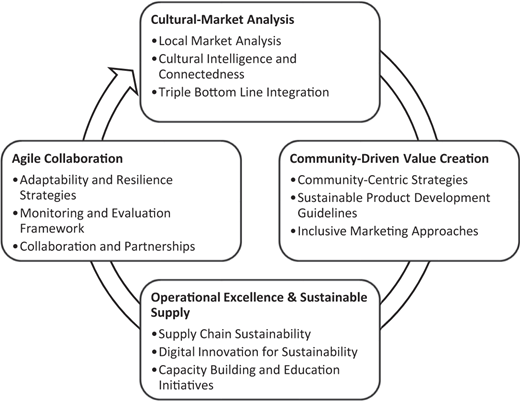
The BMBA model represents a comprehensive and contextually adaptive marketing framework tailored to address the unique socio-economic, cultural, and environmental challenges in Sub-Saharan Africa. BMBA stresses the importance of integrating cultural intelligence, community-centric value creation, sustainability within supply chains, and strategic flexibility as foundational elements for sustainable marketing success. The model, shown in Figure 1, functions as a continuous, cyclical process that helps businesses navigate the complex landscape of African marketing while anchoring them in practical sustainability principles. This iterative loop begins with Cultural-Market Analysis, where companies gather in-depth cultural and market insights that inform all subsequent activities. These insights then drive Community-Driven Value Creation, shaping engagement strategies that focus on social impact alongside commercial goals. The process moves on to Operational Excellence and Sustainable Supply, aligning operations with market and community insights to ensure comprehensive sustainability. The cycle concludes with Agile Collaboration, where businesses adapt and innovate through strategic partnerships with stakeholders. These partnerships then feed back into Cultural-Market Analysis, perpetuating the cycle and promoting ongoing refinement and responsiveness to changing market conditions.
Foundational Pillar 1: Cultural-Market Analysis - Cultural-Market Analysis serves as the foundational pillar upon which effective BMBA strategies are built. It recognises that successful, sustainable marketing in Africa starts with a deep understanding of local landscapes and a keen awareness of cultural nuances. This pillar includes three vital components that work together to create the knowledge necessary for culturally sensitive and contextually appropriate marketing initiatives.
The Local Market Analysis is the initial component, requiring businesses to conduct comprehensive assessments of the economic, social, and environmental dimensions unique to each African market. This analysis goes beyond conventional market research to include sustainability assessments that consider local ecological limits, social aspirations, and economic prospects (Leonidou and Leonidou, 2011). The process involves continuous dialogue with the local environment rather than a one-time data collection, making sure businesses stay aware of changing market dynamics and emerging opportunities. This continuous assessment lays the foundation for Triple Bottom Line integration by providing the contextual understanding needed to match sustainability goals with local realities.
Cultural Intelligence and Connectedness constitute the second component, highlighting that cultural nuances are not just considerations but fundamental elements shaping marketing campaign narratives. This component requires businesses to cultivate deep cultural intelligence that exceeds superficial adaptations to include authentic understanding of community stories, values, and aspirations (Bae, 2017). Cultural connectedness acts as a bridge linking businesses with consumers while demonstrating genuine appreciation for Africa’s rich diversity. This approach acknowledges that inclusive marketing strategies must stem from recognising that Africa is a mosaic of diverse cultures and traditions rather than a single, uniform entity (White and Kuyoro, 2023).
Triple Bottom Line Integration completes this pillar by ensuring that social, environmental, and economic dimensions interconnect to form sustainable narratives that resonate with consumers. The TBL framework goes beyond theoretical application to become the core of marketing efforts, ensuring that profitability is balanced with consideration for people and the planet (Slaper and Hall, 2011). The insights from sustainability assessments and cultural intelligence integrate smoothly into TBL implementation, developing connected approaches that influence product development, marketing messaging, and distribution channel selection.
Foundational Pillar 2: Community-Driven Value Creation – This positions community-centred values at the heart of BMBA implementation, integrating strategies that engage local communities while fostering sustainable social impact. This pillar recognises that businesses operating in African markets cannot achieve long-term success in isolation from the communities they serve, requiring genuine integration into the local social fabric.
Community-Centric Strategies form the foundation of this pillar, involving active participation in community life by listening to local needs and aligning business objectives with community aspirations. These strategies position businesses as integral community members rather than external stakeholders, building trust while gaining valuable insights into local needs and preferences (Alcadipani and Rodrigues de Oliveira Medeiros, 2020). Community engagement goes beyond corporate social responsibility initiatives to include genuine partnership development, where businesses actively contribute to community well-being while pursuing commercial objectives.
Sustainable Product Development Guidelines are based on community engagement insights, focusing on creating products that meaningfully contribute to community well-being rather than just meeting environmental standards. These guidelines ensure that every part of product development, from raw material selection to design and packaging, demonstrates a commitment to sustainability and community benefit. The development process incorporates community feedback and addresses local needs, ensuring that products serve both market demands and social improvement goals.
Inclusive Marketing Approaches complete this pillar by extending beyond product promotion to storytelling that connects with diverse audiences while communicating positive social impact. Inclusive marketing acts as a bridge linking community values with brand ethos, ensuring that social impact remains central rather than peripheral to marketing messages (Rust, 2020). This strategy guarantees that the benefits of economic activity are shared fairly with communities that form the backbone of African markets, creating positive social impact that reaches well beyond traditional profit margins.
Foundational Pillar 3: Operational Excellence and Sustainable Supply – This integrates sustainability principles into core business activities and supply chain management, recognising that genuine sustainability requires integration throughout organisational activities rather than superficial green initiatives.
Supply Chain Sustainability focuses on engaging with suppliers while recognising unique challenges and opportunities characterising African supply chains. This component treats supply chain sustainability as an innovation opportunity rather than a compliance burden, encouraging businesses to incorporate local participation and align suppliers with organisational sustainability ethos (Shete et al., 2020). The approach respects local sustainability needs while building supplier capacity to meet environmental and social standards.
Digital Innovation for Sustainability acts as the technological enabler for sustainable operations, using digital tools to improve transparency, efficiency, and environmental responsibility across business processes. Digital innovation becomes an integrated approach that influences all operational areas, whether adopting blockchain for supply chain traceability or utilizing data analytics for resource optimisation. This component ensures that technological advancement supports rather than replaces human-centred approaches to sustainability.
Capacity Building and Education Initiatives complete this pillar by extending beyond technology adoption to workforce and community development. These initiatives recognize that sustainable operations require skilled personnel and informed communities, prompting businesses to invest in education programmes that engage suppliers, partners, and consumers. Capacity building creates sustainable ecosystems where all stakeholders have the knowledge and skills necessary to embrace and maintain sustainable practices.
Foundational Pillar 4: Agile Collaboration – This addresses the dynamic nature of African markets by stressing adaptability and collaborative approaches to sustainability challenges, recognising that sustainable marketing success requires responsive strategies and strategic partnerships.
Adaptability and Resilience Strategies recognise that African markets present both challenges and opportunities, requiring businesses to view change as an innovation catalyst rather than a threat. These strategies foster organisational mindsets that embrace uncertainty while upholding sustainability commitments, ensuring that businesses remain relevant in rapidly evolving market conditions (Hammerschlag et al., 2020).
The Monitoring and Evaluation Framework provides the systematic approach necessary for informed decision-making and continuous improvement. This framework extends beyond metric collection to establish feedback loops that inform adaptive management decisions, ensuring that sustainability goals remain achievable and measurable rather than just aspirational. The monitoring system becomes the foundation for evidence-based strategy refinement.
Collaboration and Partnerships complete the BMBA cycle by recognising sustainability as a shared responsibility requiring active partnerships with government agencies, NGOs, local communities, and even competitors. Collaboration pools expertise, ideas, and resources to address complex sustainability challenges that no single organisation can resolve alone. These partnerships create dynamic cycles where collaborative insights inform adaptability strategies, driving businesses and broader ecosystems towards sustainable practices while encouraging innovation and shared learning across organisational boundaries.
Empirical validation
The thematic analysis of 21 expert interviews across Sub-Saharan Africa revealed four key themes that provide empirical support for the BMBA model’s foundational pillars. These themes emerged organically from participants’ lived experiences and professional insights, offering robust support for the framework’s theoretical foundations while demonstrating its practical relevance within diverse African market contexts.
Cultural intelligence and market embeddedness
A dominant theme across all interviews highlighted the critical role of cultural intelligence in successful marketing within SSA markets. Participants consistently stressed that understanding and respecting cultural diversity is not optional but a necessary prerequisite for establishing a sustainable business presence in the region. A marketing executive from a leading West African telecommunications company stated, “You cannot simply transplant Western marketing strategies here and expect them to work. You need to immerse yourself in the local culture, understand the nuances, and tailor your approach accordingly.” This view was reinforced by sustainability experts who linked cultural intelligence directly to community trust-building processes.
The theme demonstrated that market embeddedness extends beyond surface-level cultural awareness to include deep integration into local market structures. Participants described how businesses that position themselves as integral community members rather than outsiders achieve greater long-term success in navigating SSA’s complexities. A sustainability expert from Southern Africa noted, “Sustainability is not just about the environment; it’s about people. And if you want to work with people in Africa, you need to show that you understand and respect their culture.” This finding directly supports the Cultural-Market Analysis pillar, confirming that cultural intelligence forms the basis for all subsequent BMBA activities. These findings directly informed the Cultural-Market Analysis pillar’s three-component structure emphasizing local analysis, cultural intelligence, and TBL integration.
Community-centric value creation
The significance of community engagement in creating value was a common theme across participant interviews, with representatives from all sectors agreeing that businesses cannot succeed without connecting to the communities they serve. A business strategist from a West African consultancy highlighted, “In Africa, communities are the backbone of any successful business. If you are not engaging with the community, you are missing out on a huge opportunity to create value.” This view was supported by several concrete examples where community partnership approaches produced better results than traditional top-down business models.
An NGO leader from East Africa provided a compelling example of community-centric value creation by describing a partnership between a local business and the community for sustainable agriculture development: “The business didn’t just come in and impose their ideas. They worked with the community to understand their needs and co-create a solution. As a result, the initiative has been a huge success, benefiting both the business and the community.” Participants consistently connected community engagement to broader sustainable development goals, emphasising that authentic engagement creates economic value while contributing to social and environmental well-being. This theme offers strong empirical support for the Community-Driven Value Creation pillar, demonstrating that community partnership approaches are strategic imperatives rather than merely philanthropic activities. This theme shaped the Community-Driven Value Creation pillar, particularly informing the development of community-centric strategies, sustainable product guidelines, and inclusive marketing approaches that position businesses as authentic community partners.
Sustainability in supply chains
Participants from various industries stressed the strategic importance of incorporating sustainability into supply chain management, highlighting both moral obligations and competitive benefits. A sustainability expert from Southern Africa noted, “In a region where supply chains are often fragmented and fragile, integrating sustainability can actually help to stabilise and strengthen these networks.” This view was supported by a multinational consumer goods marketing professional who described successful sustainable supply chain implementation in East Africa: “We worked closely with local suppliers to ensure that our raw materials were sourced sustainably. This not only improved the quality of our products but also enhanced our brand reputation among consumers who value sustainability.”
The theme showed that sustainable supply chains boost operational resilience, with participants noting that businesses adopting sustainable practices are better equipped to withstand market disruptions. This finding supports the Operational Excellence and Sustainable Supply pillar while emphasising the linked benefits of embedding sustainability throughout business operations. Participant insights on supply chain resilience directly shaped the Operational Excellence and Sustainable Supply pillar’s focus on supplier engagement, digital innovation, and capacity building.
Adaptability and resilience
The ability to adapt and maintain resilience proved to be a critical success factor given the dynamic and often unpredictable nature of SSA markets. A West African policymaker noted, “Regulations change, markets shift, and consumer preferences evolve. If you are not adaptable, you will struggle to keep up.” This theme was reinforced by numerous examples of businesses successfully navigating changing circumstances through strategic agility.
A business strategist from East Africa explained how a local company adjusted its business model during the COVID-19 pandemic: “They were quick to recognise the shift in consumer behaviour and adapted their operations accordingly. This agility allowed them to not only survive but actually grow during the pandemic.” Participants emphasised that adaptability requires proactive strategic innovation rather than merely reactive responses, with successful businesses continuously seeking new opportunities while maintaining sustainability commitments. This theme affirms the Agile Collaboration pillar, confirming that adaptability and partnership approaches are essential for thriving in the dynamic African market environments. These strategic agility examples informed the Agile Collaboration pillar’s emphasis on adaptability strategies, monitoring frameworks, and multi-stakeholder partnerships.
These four themes collectively offer strong empirical support for the BMBA model, showing that the framework’s theoretical foundations align with practical realities experiences of marketing professionals, sustainability experts, business strategists, and policymakers across Sub-Saharan Africa.
Theoretical contribution
The BMBA framework advances sustainability marketing theory in three significant ways. First, it contextualizes the Better Marketing for a Better World concept for Sub-Saharan African markets, demonstrating how global sustainability principles require substantial adaptation to address regional realities of cultural diversity, supply chain fragmentation, and dynamic regulatory environments. Second, it synthesizes virtue ethics theory and the Triple Bottom Line model within an emerging market context, showing how ethical character and stakeholder accountability intersect in resource-constrained settings. Third, it extends cultural intelligence theory beyond cross-cultural marketing to position cultural understanding as foundational to sustainable business practices. By empirically grounding these theoretical integrations through expert interviews and case validation, BMBA bridges the gap between sustainability marketing scholarship and emerging economy practice.
Practical applications
The BMBA model’s theoretical framework gains concrete meaning through its practical implementation across diverse African business contexts. Four strategic case studies demonstrate how organizations have successfully applied BMBA principles, providing actionable insights for businesses seeking to integrate sustainable marketing practices within Sub-Saharan African markets.
Cultural-market analysis: Safaricom’s M-Pesa revolution
Safaricom’s M-Pesa exemplifies exceptional cultural-market analysis and responsiveness within Kenya’s financial sector, demonstrating how deep local understanding can foster transformative innovation. The service’s remarkable success results from Safaricom’s keen awareness of Kenya’s mobile phone penetration combined with a cultural appreciation for community-based financial transactions. Rather than imposing external financial models, Safaricom carried out comprehensive market analysis that uncovered widespread demand for accessible, secure financial services that align with existing social structures.
The M-Pesa campaign went beyond simply promoting a service to become a celebration of Kenyan financial culture, recognising traditional money transfer practices while adding technological improvements. Safaricom’s approach showed strong cultural intelligence by recognising that successful financial inclusion depended on integrating with existing community trust networks rather than replacing traditional systems. The company’s success demonstrates how businesses can use Cultural-Market Analysis to find opportunities that match technological abilities with cultural values, creating solutions that meet both commercial goals and community needs. This case clearly shows that sustainable marketing success in Africa requires a true understanding of local contexts rather than just applying global models.
Community-driven value creation: Unilever’s lifebuoy health initiative
Unilever’s Lifebuoy handwashing campaign in South Africa exemplifies Community-Driven Value Creation through partnerships with the Department of Education and Department of Health. Recognising pressing hygiene education needs, especially regarding preventable diseases, Unilever engaged deeply with local communities rather than imposing top-down health interventions. The campaign progressed from product promotion to become a comprehensive health education movement that addressed genuine community priorities.
Unilever’s success stemmed from aligning campaign objectives with community needs identified through collaborative workshops and stakeholder consultations. The initiative provided health education resources, accessible hygiene products, and community capacity building that created a lasting impact beyond immediate commercial gains. The company’s approach demonstrates how businesses can achieve Community-Driven Value Creation by positioning themselves as partners in community development rather than external service providers. This case shows that sustainable marketing requires genuine collaboration with communities to co-create solutions that address real needs while building brand loyalty through authentic social contribution.
Operational excellence and sustainable supply: EcoCash’s agricultural innovation
EcoCash’s development of EcoFarmer in Zimbabwe exemplifies transformative Operational Excellence and Sustainable Supply Chain innovation within the agricultural sector. Recognising agriculture’s pivotal role in Zimbabwe’s economy, EcoCash leveraged digital platforms to create comprehensive solutions that connect farmers with markets while improving supply chain efficiency and sustainability. The initiative tackled fragmented agricultural supply chains that restricted farmer income potential and market access.
EcoFarmer’s success rests in its dual impact strategy, simultaneously enhancing farmer livelihoods and developing more sustainable agricultural supply chains through digital integration. The platform offers farmers market information, financial services, and supply chain connectivity that cut intermediary costs while ensuring fair prices. EcoCash’s innovation shows how digital technologies can improve supply chain sustainability while meeting local economic development needs. This case demonstrates that Operational Excellence and Sustainable Supply require innovative methods that utilise available technologies to address systemic challenges and generate shared value for all stakeholders.
Agile collaboration: partnership for aflatoxin control in Africa (PACA)
The PACA exemplifies Agile Collaboration through its multi-stakeholder approach to agricultural health challenges across several African countries. PACA demonstrates effective collaboration by bringing together governments, research institutions, private sector organisations, and international agencies to tackle aflatoxin contamination in agricultural products. The partnership’s success comes from its adaptive management approach that responds to evolving scientific knowledge and changing market conditions.
PACA’s monitoring and evaluation framework enables ongoing strategy refinement based on field results and stakeholder feedback, ensuring that interventions stay relevant and effective across different contexts. The partnership combines expertise from various disciplines and organisations to tackle complex agricultural challenges that individual entities cannot resolve alone. PACA’s collaborative model fosters dynamic feedback loops where monitoring insights guide adaptive strategies, driving the entire network towards improved agricultural sustainability. This case shows that Agile Collaboration requires structured approaches to partnership management and ongoing learning. The success of the partnership demonstrates how effective monitoring frameworks support adaptable management, while collaborative structures strengthen individual organisational capabilities to tackle complex sustainability issues.
While these cases demonstrate BMBA’s practical applicability across diverse sectors, critical evaluation reveals important limitations and contextual dependencies. M-Pesa’s success reflects Kenya’s unique regulatory environment and mobile infrastructure, factors not universally present across SSA markets. Unilever and PACA’s multi-stakeholder approaches demand financial and relational resources often unavailable to smaller enterprises. EcoFarmer’s digital-first platform excludes farmers with limited technological access, illustrating tensions between innovation and inclusion. Cross-industry analysis shows financial services and FMCG sectors achieve scale more readily through digital platforms, while agricultural interventions face persistent infrastructure constraints. BMBA pillar implementation involves strategic trade-offs: speed-to-market versus cultural-market depth, digital innovation versus equitable access, organizational autonomy versus collaborative partnership. Effective adoption requires context-specific pillar prioritization based on organizational capacity, industry dynamics, and market maturity rather than simultaneous implementation across all pillars.
Implementation challenges and solutions
Despite its comprehensive framework, BMBA implementation encounters significant challenges within Sub-Saharan Africa’s complex business environment. Four critical obstacles consistently appear across various market contexts, each requiring targeted strategic responses to achieve successful sustainable marketing integration.
Economic Constraints and Resource Limitations: Economic constraints are the most widespread challenge for businesses aiming for sustainability in emerging economies (Anand et al., 2021). Limited financial resources often see sustainability initiatives as luxury investments rather than essential strategies, creating hurdles for small and medium enterprises. The solution is to adopt phased implementation strategies that focus on high-impact, low-cost initiatives first. Businesses can start with community engagement and cultural intelligence development before moving on to more resource-heavy supply chain changes. This step-by-step approach allows organisations to demonstrate the value of sustainability while gradually building financial capacity for full implementation.
Limited Technological Infrastructure: Inadequate access to advanced technologies across diverse African regions hampers the adoption of digital sustainability solutions (Boateng et al., 2022). Instead of considering technological limitations as insurmountable obstacles, businesses should utilise existing communication channels common in specific areas. SMS campaigns, radio broadcasts, and community-based initiatives can effectively promote sustainability messages where internet connectivity is limited. This adaptable approach ensures inclusive sustainability communication that reaches all stakeholder groups regardless of their technological access levels.
Cultural Diversity Navigation: Africa’s complex cultural diversity creates notable challenges for businesses aiming to implement consistent sustainability strategies across various markets (Busia, 2023). The solution involves significant investment in cultural intelligence assessments that offer deep insights into local values, traditions, and communication preferences. Businesses must dedicate sufficient time and resources to grasp cultural nuances, enabling authentic campaign development that connects with diverse communities while maintaining overarching sustainability commitments.
Supply Chain Fragmentation: Fragmented supply chains marked by limited transparency and coordination pose significant challenges to integrating sustainability (de Melo and Twum, 2021). Collaborative methods provide effective solutions by encouraging open communication among suppliers, manufacturers, and distributors. Digital technologies, especially blockchain applications, can improve supply chain transparency and foster trust among fragmented network participants. Strategic supplier development programmes that strengthen local capacity for sustainable practices build resilient supply networks, supporting long-term sustainability goals while enhancing operational efficiency.
Conclusion and future research
The BMBA model represents a paradigm shift towards contextually relevant sustainable marketing within Sub-Saharan Africa’s dynamic business environment. Through its four foundational pillars, BMBA offers a comprehensive framework that integrates social equity and environmental responsibility into core marketing strategies. Empirical validation via 21 expert interviews across SSA confirms that BMBA addresses genuine market needs while providing practical solutions to complex sustainability challenges. Case studies from Safaricom, Unilever, EcoCash, and PACA demonstrate successful implementation across various sectors, delivering actionable insights for organizations pursuing sustainable competitive advantage within African markets.
As African markets evolve towards greater environmental and social awareness, organizations adopting BMBA principles will gain competitive advantages while contributing meaningfully to continental development. Future research should pursue several critical directions. First, quantitative validation through large-scale surveys across multiple SSA countries would test the framework’s generalizability and enable statistical examination of relationships between pillars. Structural equation modeling could assess how Cultural-Market Analysis influences subsequent pillar effectiveness and business performance outcomes.
Second, longitudinal studies tracking businesses implementing BMBA over 3–5 years would reveal long-term impacts on financial performance, community well-being, and environmental outcomes while identifying critical success factors and common implementation challenges. Third, cross-sectoral comparative studies examining BMBA application differences between manufacturing, services, and agricultural sectors would clarify industry-specific adaptation requirements and determine which pillars prove most critical in different contexts.
Fourth, technology-mediated applications warrant investigation, particularly how digital tools can enhance framework accessibility in infrastructure-limited regions and democratize sustainable marketing capabilities for small enterprises. Finally, behavioral economics research exploring consumer responses to sustainability messages within African cultural contexts through experimental designs would identify which message framings – community benefit, environmental preservation, or economic empowerment – resonate most strongly across diverse SSA markets, ensuring BMBA remains dynamic and responsive to evolving consumer expectations.