


The purpose of this paper is to propose and test a model designed to realize employee and organizational performance gains in developing economies.
Data were collected through a survey involving 35 organizations using electronic human resource management (e-HRM) systems. A purposive sampling technique was employed. Regression analysis making use of Process macro in Statistical Package for the Social Sciences (SPSS) was used to analyze the data.
Despite its infancy in African countries, e-HRM use has a positive effect on employee and organizational performance. The organization-wide gains are enhanced through employee performance mediation.
Electronic-HRM use, complemented by human resource best practices that impact positively on individual performance, is likely to enhance organizational performance gains. Employee performance mediation effect is likely to further enhance the effect of e-HRM usage on organizational performance.
This study represents a first attempt to examine the role of employee performance as an intervening variable in the relationship between e-HRM use and organizational performance. The findings bring into attention the role of organizational members' performance in explaining organizational performance gains. The findings also result in a model that should lead to increased employee and organizational performance.
1. Introduction
Achieving business excellence in the current chaotic and fluid business environment has become a mammoth challenge for many corporates. Organizations have had to refocus their strategies, in order to “beat” the chaotic business order. In despair, human capital has generated interest among strategic human resource management (SHRM) practitioners as an alternative option to navigating organizations toward sustained competitive advantage. Organizations now realize the potential of employees as a source of competitive advantage. As such, there is need to pay attention to those human resource practices that best leverage these assets.
The SHRM theorists have argued for the deployment of performance enhancing Human Resource Management (HRM) practices (Combs et al., 2006) to maximize employee returns and ultimately organizational outcomes. The high performance work practices increase employee knowledge, skills and abilities (KSAs). These KSAs are further leveraged by employees for higher productivity and better decision making, both of which help increase organizational performance. In developed economies, a number of studies show that employee and organizational performance gains are achieved through e-HRM use (Ruël and van der Kaap, 2012; Bondarouk and Ruel, 2013; Strohmeier and Kabst, 2014; Obeidat, 2016). Organizations that combine effective HRM practices and effective e-HRM use are therefore likely, at organizational level, to be more productive and profitable than those that do not (Johnson and Guental, 2011).
In all this, developing economies have adopted information technology (IT) in a lukewarm manner. Electronic HRM has been implemented to carry out mundane tasks at a very basic level (Muriithi et al., 2014). African countries have not fully participated in the IT revolution like the developed world (Ejiaku, 2014) due to a host of challenges that include insufficient skills, low IT penetration rate and poor IT infrastructure. The HR function in Africa has not been proactive in its use of technology. The few initiatives made have, by and large, originated from IT experts (Wachira, 2010). Africa needs to say a goodbye to transactional e-HRM (payroll and benefits) and welcome strategic e-HRM (Summer, 2006; Muriithi et al., 2014). Strategic e-HRM applications are more likely to yield positive employee and organizational gains, such as increased user satisfaction with the e-HRM system, positive attitudes with the IT system, strategic orientation and manager empowerment. There is, however, a belief that positive consequences arising from e-HRM implementation in developed economies could be replicated in African countries, notwithstanding the phenomenon's infancy status.
In order to maximize organizational performance gains, a number of scholars have suggested incorporating mediating variables in explaining the e-HRM–organizational performance link. Factors that may play a mediating role have been muted (Strohmeier and Kabst, 2014; Obeidat, 2016) but not fully explored. “The idea that e-HRM systems introduced to achieve a particular goal will automatically lead to that outcome may be simplistic and unrealistic” (Parry and Tyson, 2011, p. 338). As a result, the motivation of this paper is to suggest that despite its infancy, e-HRM use in Zimbabwe yields positive employee and organizational performance. The direct effect of e-HRM on organizational performance can be enhanced through mediation effects of the employee performance variable.
2. Literature review
A number of theoretical propositions have been cited in the literature, explaining how e-HRM use translates itself into employee and organizational performance gains. For the purposes of this study, the technology imperative and moderate determinism theoretical propositions are used.
2.1 Technology imperative (strict determinism) approach
The focus of this imperative is on the role of technology in realizing organizational performance. Under this approach, IT is treated as an independent variable and organizational performance, a dependent variable (Strohmeier, 2009). Technology is seen as “a given material substance with tangible technical properties and services that have to be used by the targeted employees” (Bondarouk, 2011, p. 7). “HRM technology has predictive consequences in organizations” (Orlikowski and Scott, 2008, p. 439). It interacts with various aspects of organizations to produce outcomes at the individual employee and organizational level. At the individual employee level, outcomes of interest are intention to use e-HRM, attitude toward e-HRM and efficiency. At the organizational level, focus is on increased effectiveness of the HR function and improved organizational performance.
Electronic HRM use is measured in terms of perceived usefulness and its ease of use. Automating HRM can lead to specific strategic benefits which are wholly dependent on technology intervention. Bondarouk and Ruel (2007) established that the use of e-HRM applications positively led to an increase in HRM effectiveness. “Easiness and quality of e-HRM correlate significantly with strategic and technical HRM effectiveness” (Bondarouk and Ruel, 2007, p. 12). Electronic HRM is, thus, perceived as resulting in intended organizational performance gains. A wide body of literature, however, shows that this approach has failed to explain away contradictory consequences of e-HRM use. The failure to explain persistent divergent consequences is leading many researchers to question its empirical relevance.
2.2 Moderate determinism (contingency model) approach
The moderate determinism approach states that technology largely explains organizational performance (Strohmeier, 2009). However, there are a number of contingent factors, which moderate the effect of e-HRM use on organizational performance. These factors are organizational size, human usage of technology and technology itself (Strohmeier, 2009; Parry, 2011).
Employing e-HRM in big organizations could result in cost reductions as economies of scale are realized whereas if the same system were applied in small organizations, cost reductions may not be realized. Size is a clear determinant of first, whether an organization has e-HRM at all, and second, whether it adopts certain e-HRM applications (Bondarouk and Ruel, 2006; Strohmeier and Kabst, 2009; Parry, 2011). A different set of organizational consequences would also result from different e-HRM usage. Adequate and well-versed usage of IT could result in intended organizational performance consequences being realized. Inappropriate and underutilization of the same IT could give different organizational outcomes.
The usefulness and easiness of use of e-HRM applications determine human usage of technology (Voermans and Van Veldhoven, 2007; Ruël and van der Kaap, 2012; Marler and Fisher, 2013). Electronic-HRM usage was also established to be a strong predictor of the creation of a strategic role for the HRM function (Wahyudi and Park, 2014). The approach assumes that if IT is widely and heavily utilized due to user positive attitudes, individual and organizational performance gains would result.
Some researchers have suggested that the impact of e-HRM on organizational performance depends on the type of e-HRM applications used (Voermans and Van Veldhoven, 2007; Marler and Fisher, 2013; Wahyudi and Park, 2014). A range of different types of information systems will result in different consequences. For example, manager self-service could result in the decentralization of the HRM function whilst enterprise resource planning could result in centralization of the HRM function (Strohmeier and Kabst, 2009). Ruel et al. (2007, p. 287) noted that “the quality aspect of e-HRM application had significant, positive effects on strategic HRM effectiveness”.
This approach is, however, challenged to explain different consequences within comparable contexts. The approach is also challenged to explain different consequences of comparable technologies. Despite these challenges, this approach offers a more plausible explanation of consequences. Consequently, this study makes use of this approach.
The mechanism by which e-HRM use might result in organizational improvements, however, remains unclear (Parry, 2011). The success of e-HRM is partly dependent on the behaviors of a number of actors (employees and line managers). Their ability and willingness to work with newly introduced IT applications are key to organizational success (Piabuo et al., 2017). This paper, therefore, seeks to investigate the effect of e-HRM use on employee performance. It further explores the role of employee performance as a moderating variable in explaining consistent organizational gains due to e-HRM use.
2.2.1 Conceptual development and hypotheses
2.2.1.1 e-HRM use
Electronic-HRM use refers to the use of web technology–based channels to support the implementation of HRM strategies, policies and practices in organizations. The ultimate aim is to achieve organizational excellence (Ruel et al., 2007; Bondarouk, 2011).
2.2.1.2 Employee performance
Sonnentag et al. (2008) defined the construct as “the total expected value to the organization of the discrete behavioral episodes that an individual carries out over a standard period of time.” There are two key implications of this definition. Firstly, employee performance is behavior indexed. “In particular, it is an aggregated property of multiple, discrete behaviors that occur over some span of time” (Motowidlo, 2003, p. 39). A second implication is that the property of behavior to which performance refers, is its expected value to the organization.
2.2.1.3 Organizational performance
Organizational performance is a conglomerate of financial outcomes (e.g. profit or market value), organizational outcomes (e.g. productivity or customer satisfaction) and human resource outcomes (job satisfaction or commitment) (Bethke-Langenegger et al., 2011; Roman et al., 2012).
2.2.1.4 Electronic-HRM macro level consequences
Bondarouk and Ruel (2009, p. 507) defined e-HRM consequences as “the value received from e-HRM use.” These consequences consist of all phenomena that “accompany and/or follow the application of information technology, whether helpful or harmful” (Strohmeier, 2007, p. 2). Macro level consequences are the overall outcomes of implementing e-HRM in an organization.
2.2.1.5 e-HRM use and organizational performance
Electronic HRM use enhances organizational performance by improving cost efficiencies and HRM processes (Marler and Fisher, 2013). When viewed as a way of performing HR administrative tasks, e-HRM use could lead to lower HR staff headcount as generic labor is substituted by IT. The phenomenon, thus, has the capacity of streamlining the transactional HR processes culminating in increased efficiency and effectiveness (Bondarouk and Ruel, 2007).
The literature also shows that e-HRM supports a strategic orientation of the HR function (Ruel et al., 2007; Marler, 2009). As time is freed, HR professionals find time to embark on strategic activities such as strategic planning, talent management and knowledge management for competitive alignment of organizations. These activities help organizations move into new markets by providing managers with better information for effective decision making (Parry, 2011). This study hypothesizes that in organizations employing e-HRM, the phenomenon has the propensity to engineer organizational performance gains. It is assumed that this relationship obtains in developing economies as well. The first hypothesis, therefore, is the following:
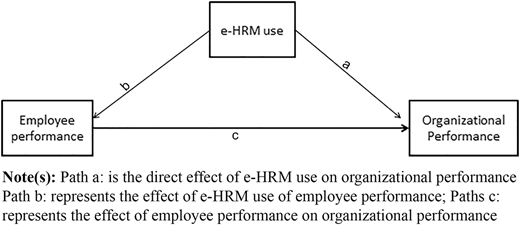
There exists a direct effect of e-HRM use on organizational performance (Path b in Figure 1).
2.2.1.6 e-HRM and employee performance
The early literature posited that there are mediating variables linking e-HRM use and employee performance. Three IT performance link models, the Utilization approach (1975–1991), Task-Technology Fit (1995) and the Technology to Performance Chain (1995) models were produced. The Utilization model assumes that if IT is widely and heavily utilized due to user positive attitudes, individual performance will improve. The critique of the model has focused on the existence and use of involuntary information systems. An involuntary system could be widely and heavily used, not out of interest but out of lack of options. The utilization of such a system would not lead to increased performance.
The task-technology fit model (1995) postulates that if “an information system has the features that allow it to address the requirements of tasks performed, then individual employee performance improves” (Goodhue and Thompson, 1995, p. 214). However, the fit alone will not give increased performance as increased performance is out of utilization of a system in the first place. The third model, the Technology to Performance Chain model integrates the Utilization and Task-Technology Fit models. The model significantly explains employee effectiveness, productivity and performance in their jobs (Goodhue and Thompson, 1995).
The Autor, Levy and Murnane (ALM) model (2006) divides jobs into two categories: the routine and nonroutine tasks. “Routine jobs have a higher probability of being automated whereas non-routine jobs are more difficult for technology to absorb” (Melian-Gonzalez and Bulchand-Gidumal, 2016, p. 2,160). Technology substitutes workers who perform tasks that can be reduced to programmed rules. As such, there is bound to be heavy investment in sectors that employ routine labor. At the same time, information technology complements workers in performing non-routine tasks. Consequently, investment in IT in these jobs is likely to be lower.
The implementation of e-HRM alters work processes, information flows and introduces new technical applications that employees have to utilize. “Employees frequently find such technology enabled organizational change to be a major challenge” (Sykes et al., 2014, p. 51). As a result, a dip in job performance is usually observed in the short run as employees adapt to the new technology (Tafti et al., 2007). Improved job performance, though, is likely to be recorded in the long run. The implication of this finding is that management should train users in e-HRM applications if the desired effect is to be realized in a short run.
The prima facie reason for introducing e-HRM in organizations is to enhance employee and organizational effectiveness. An increase in the frequency and duration of e-HRM use, therefore, leads to an improvement in employee performance. This study assumes that by imparting positively on employee performance, e-HRM use will lead to intended organizational performance gains on a more consistent basis.
The second hypothesis therefore, is the following:
There exists an indirect effect of e-HRM use on organizational performance through employee performance (Path b and Path c in Figure 1).
3. Methodology
The study focused on organizations using e-HRM applications. A total of 112 organizations from 18 sectors of the Zimbabwean economy made up the population of interest. The inclusion criteria for selecting participating organizations for the study were the following:
The organization should have a minimum of 50 employees.
It should have implemented e-HRM application(s) for at least one year, at the time of determining the sample size.
A total of 35 organizations from 12 sectors met the inclusion criteria (see Table 1). The inclusion criteria were informed by the resource demands of e-HRM systems. Only big organizations are in a position to meet these demands. Parry (2011, p. 1,151) reported that “past empirical evidence has found a positive relationship between e-HRM and organisation size.” Furthermore, the use and level of maintenance of the systems are determined by the size of an organization (Haines and Lafleur, 2008; Strohmeier and Kabst, 2009; Slavić and Berber, 2013). Organizations employing at least 50 employees are deemed big by Zimbabwean standards. At least, one year was deemed long enough a period for e-HRM systems to be embedded within organizations. A three-year period or more has also been suggested to allow for e-HRM to bring about a return on investment (Parry and Tyson, 2011; Bondarouk and Ruel, 2013). In this study, a minimum of one year was used.
Survey sample distribution
| Respondents | Technology | Beverages | Agriculture | Retail | Mining | Banking | Agro-industrial | Food | Insurance | Industrial | Building | Education | Total |
|---|---|---|---|---|---|---|---|---|---|---|---|---|---|
| Population (Organizations) | 6 | 8 | 17 | 5 | 14 | 13 | 8 | 3 | 4 | 11 | 12 | 11 | 112 |
| Sample (Organizations) | 2 | 3 | 3 | 1 | 6 | 5 | 3 | 2 | 2 | 2 | 3 | 3 | 35 |
| Sample (respondents) | |||||||||||||
| HR Managers | 5 | 10 | 5 | 1 | 12 | 5 | 4 | 2 | 2 | 2 | 4 | 9 | 61 |
| HR department employees | 20 | 35 | 9 | 4 | 31 | 14 | 10 | 10 | 7 | 14 | 20 | 26 | 200 |
| IT professionals | 2 | 10 | 3 | 1 | 12 | 5 | 3 | 2 | 2 | 2 | 3 | 7 | 52 |
| Line managers | 20 | 35 | 9 | 1 | 31 | 14 | 10 | 10 | 7 | 14 | 20 | 26 | 197 |
| Total | 47 | 90 | 26 | 7 | 86 | 38 | 27 | 24 | 18 | 32 | 47 | 68 | 510 |
Individuals of interest were HR managers, all line managers and IT specialists. These individuals “plan, implement and perform e-HRM and hence are of vital importance” (Strohmeier 2007, p. 21). A stratified convenience sampling technique was used to draw a sample of 510 respondents.
Data were collected through a structured questionnaire. Likert type scales indicating agreement or disagreement with regards the realization of suggested outcomes were chosen. The instrument was piloted on 20 respondents. A “drop and pick” method was used to administer the questionnaire (Bryan, 2008) due to its relatively higher response rate (Baruch and Holton, 2008).
3.1 Measures
A four-section questionnaire covered e-HRM use, employee performance, organizational performance and personal details.
3.1.1 e-HRM use scale
The instrument was developed from validated research instruments used by Ruel et al. (2007) and Wahyudi and Park (2014). The six-item instrument has two latent variables: perceived ease of use and system usefulness. Its Cronbach's alpha statistic is 0.93.
3.1.2 Employee performance scale
A validated six-item Goodman and Svyantek (1999) job performance scale was used to measure this construct. The scale has three latent variables: contextual performance, task performance and conscientiousness. A Cronbach's alpha statistic of 0.85 has been reported for this scale (Yusoff et al., 2014).
3.1.3 Organizational performance scale
The work of Bondarouk and Ruel (2013) and Panos and Bellou (2016) were reviewed to arrive at the organizational performance questionnaire. The nine-item instrument is divided into three latent variables: operational performance, relational performance and transformational performance.
3.1.4 Control variables
Three control items informed by the literature as influential on organizational performance were included in the analysis. These variables are: the number and type of e-HR applications (Bondarouk and Ruel, 2009), experience and knowledge of IT (Bondarouk and Ruel, 2013).
3.2 Assessing the measurement model
Although these scales have been reported in the literature, a scale validation process was, nonetheless, carried out. The purpose was to identify and eliminate poorly performing manifest variables. Once the exploratory factor analysis (EFA) and confirmatory factor analysis (CFA) were performed, the measurement models were assessed. To validate the measurement models, the following tests were carried out: internal consistency test, composite reliability test and discriminant validity test.
The internal consistency statistics for the three scales ranged from 0.76 to 0.94, exceeding the recommended value of 0.70 (Hair et al., 2010). The factor loading of all items exceeded the recommended a value of 0.50 (Hair et al., 2010). Composite reliability values which depict the degree to which an instrument measures the concept that it is intended to measure ranged from 0.81 to 0.94, exceeding the recommended value of 0.70 (Hair et al., 2010). The Average Variance Extracted (AVE) which reflects the overall amount of variance in the indicators accounted for by the latent construct were in the range of 0.60–0.79, exceeding the recommended value of 0.50 (Hair et al., 2010). The scales are convergent and valid. The discriminant validity values range from 0.77 to 0.89. The square roots of AVE values (discriminant values) were greater than the highest correlations with any other construct. The scales are discriminant and valid. In total, the measurement model demonstrated adequate validity and reliability.
3.3 Assessing the structural model
After validating the measurement model, hypotheses were tested using a conditional process modelling program. The program utilizes ordinary least squares framework to test for both direct and indirect effects (Hayes, 2012). The lower level and upper level of the regression coefficients were calculated based on 10,000 iterations in a bootstrapping model and 95% level of confidence. If the confidence interval (95%) spans “0”, then a mediation hypothesis is insignificant. If it does not, the mediation hypothesis is significant. Therefore, one can say with 95% confidence, that mediation is present (Preacher and Hayes, 2008). The interpretation of size of effect made use of Acock's (2014) interpretation of beta ranges. Acock (2014, p. 272) categorized the beta values as follows: “β < 0.2 = weak effect; 0.2 < β < 0.5 = moderate effect; and β > 0.5 = strong effect.”
4. Results and discussion
The empirical analysis is based on 12 sectors, namely, technology, beverages, banking, mining, insurance, education, building, industrial, food, agro-industrial, retail and agriculture.
4.1 Factor analysis
The EFA, making use of principal axis factoring with Promax rotation, was conducted to examine the underlying patterns of e-HRM use, employee performance and organizational performance. The EFA of e-HRM use revealed two latent factors (perceived ease of use and system usefulness). They are meaningful as their eigenvalues are greater than 1 (>1), and they cumulatively explain 71.8% of the variance. CFA was then conducted to confirm the constructs. The Goodness of Fit Indices (GFIs) were used to evaluate the CFA. The results showed a good fit [comparative fit index (CFI) = 1.00; root mean square error of approximation (RMSEA) = 0.041; standard root mean square residual (SRMR) = 0.026; GFI = 099; Χ2/df = 1.55 and normal fit index (NFI) = 0.99].
With regards to employee performance, three latent factors (contextual performance, task performance and conscientiousness) emanated from this EFA exercise. The three factors are meaningful as their eigenvalues are greater than 1 (>1). Factors 1 (contextual performance), 2 (task performance) and 3 (conscientiousness) explain 42.11, 25.14 and 15.63% of the variance, respectively – a cumulative total of 82.88%. CFA was conducted to confirm the constructs. The model results showed a good fit (CFI = 0.99; RMSEA = 0.039; SRMR = 0.04; GFI = 098; Χ2/df = 1.5 and NFI = 0.98).
EFA was also used identify latent factors of organizational performance. Three latent factors (operational, relational and transformational performance) emanated from this EFA. The three factors are meaningful as their eigenvalues are greater than 1 (>1) and they cumulatively explain 70.31% of the variance. The model results showed a good model fit (CFI = 1.00; RMSEA = 0.029; SRMR = 0.026; GFI = 099; Χ2/df = 1.27 and NFI = 0.99).
4.2 Descriptive statistics
The mean scores, standard deviations and Pearson correlations for all the three variables were calculated. Electronic HRM use has a positive and significant correlation with organizational performance (r = 0.547 and p < 0.01). Employee performance has a positive and significant correlation with organizational performance (r = 0.304 and p < 0.01). Electronic HRM use has a positive and significant correlation with employee performance (r = 0.178 and p < 0.01). Among the control variables, there is a positive and significant correlation between tenure and age (r = 0.830 and p < 0.01). A total of 325 valid responses were received, representing a 64% response rate. The calculation of correlation between variables is the basis for mediation testing, as well as the basis for ruling out moderation testing. “It is desirable that the moderator variable be uncorrelated with both the independent and dependent variables in order to provide a clearly interpretable interaction term” (Baron and Kenny, 1986, p. 1,174). Employee performance is, therefore, a mediating variable in this study.
4.3 Regression analysis
To test the hypotheses, regression analysis making use of Process macro in Statistical Package for the Social Sciences (SPSS), was performed. The lower level and upper level of the regression coefficients were calculated based on 10,000 iterations in a bootstrapping model and 95% level of confidence. The regression outputs were used to test total, direct and indirect effects models. The mediating effects model was based on the test logic of Preacher and Hayes’ (2008) approach. The prerequisite to mediation test is to establish a positive effect of an independent variable (e-HRM use) on the dependent variable (organizational performance).
4.3.1 Direct total effect of e-HRM use on organizational performance
The coefficient of e-HRM use on organizational performance, without an intervening variable, is strong and significant (β = 0.5254, SE = 0.0448 and p < 0.05). This model is significant and explains 0.2987 (30%) of the variance in organizational performance (see Table 2, Model 2). This result is validated by a number of studies (Strohmeier, 2009; Parry and Tyson, 2011; Parry, 2011; Ruël and van der Kaap, 2012; Bondarouk and Ruel, 2013; Wahyudi and Park, 2014; Marler and Fisher, 2013; Obeidat, 2016). Despite its infancy status, e-HRM use improves organizational performance. Investing in e-HRM systems is defensible on the basis of organizational gains such as empowerment of managers and improving talent management. Parry and Tyson (2011), however, argue that the introduction of e-HRM systems alone will not automatically lead to organizational outcomes. There is need for intervening variables in order to enhance the effect.
Direct and indirect effects of e-HR use on e-HRM macro level consequences
| Y: Organizational performance | ||||||
| X: e-HR use (use) | ||||||
| M: Employee performance (perf) | ||||||
| Sample Size: 325 | ||||||
| Outcome variable: | ||||||
| Employee performance | ||||||
| Model summary | ||||||
| R | R-sq | MSE | F | df1 | df2 | p |
| 0.1785 | 0.0319 | 0.2059 | 10.6299 | 1.0000 | 323.0000 | 0.0012 |
| Model 1 | ||||||
| coeff | SE | t | p | LLCI | ULCI | |
| Constant | 3.4142 | 0.2250 | 15.1726 | 0.0000 | 2.9715 | 3.8569 |
| e-HR use | 0.1639 | 0.0503 | 3.2603 | 0.0012 | 0.0650 | 0.2628 |
| Outcome variable: | ||||||
| Organizational performance | ||||||
| Model summary | ||||||
| R | R-sq | MSE | F | df1 | df2 | p |
| 0.5856 | 0.3429 | 0.1537 | 84.0071 | 2.0000 | 322.0000 | 0.0000 |
| Model 2 | ||||||
| coeff | SE | t | p | LLCI | ULCI | |
| constant | 1.1591 | 0.2544 | 4.5556 | 0.0000 | 0.6585 | 1.6596 |
| e-HR use | 0.4888 | 0.0441 | 11.0739 | 0.0000 | 0.4020 | 0.5756 |
| Employ perf | 0.2236 | 0.0481 | 4.6518 | 0.0000 | 0.1290 | 0.3182 |
| Direct and indirect effects of X on Y | ||||||
| Model 3 | ||||||
| Direct effect of X on Y | ||||||
| Effect | SE | t | p | LLCI | ULCI | |
| 0.4888 | 0.0441 | 11.0739 | 0.0000 | 0.4020 | 0.5756 | |
| Indirect effect(s) of X on Y: | ||||||
| Effect | BootSE | BootLLCI | BootULCI | |||
| Employ perf | 0.0367 | 0.0143 | 0.0119 | 0.0673 | ||
| Analysis notes and errors | ||||||
| Level of confidence for all confidence intervals in output: 95.0000 | ||||||
| Number of bootstrap samples for percentile bootstrap confidence intervals: 10,000 | ||||||
Note(s): LLCI: Lower Level Confidence Interval, ULCI: Upper Level Confidence Interval
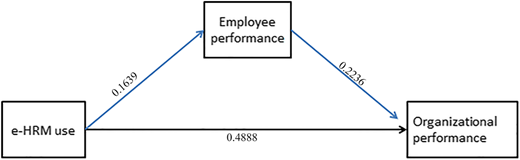
4.3.2 Effect of e-HRM use on employee performance (β = 0.1639, SE = 0.0503 and p < 0.05)
The results show that e-HRM use has a positive and significant effect on employee performance. The effect is, however, weak (see Figure 2; Table 2, Model 1). Wide utilization of an information system leads to positive improvements in individual performance (Addo-Tenkorang and Helo, 2011; D'Ambra et al., 2013; Rajan and Baral, 2015; Kaygusuz et al., 2016). This happens through simplification of task processes, knowledge acquisition, enhancement of the quality of information and improvement in the quality of decision making (Bondarouk and Ruel, 2006; Parry, 2011; Wahyudi and Park, 2014; Obeidat, 2016). Electronic HRM increases job autonomy leading to a sense of mastery, thereby contributing to increased job satisfaction and well-being (Pugno, 2008). Employees who are satisfied about their jobs tend to have more positive perceptions about the organization as an entity and therefore deliver an improved service (Hui et al., 2004).
4.3.3 There exists an indirect effect of e-HRM use on organizational performance through employee performance
The coefficient of e-HRM use on employee performance is positive and significant (β = 0.1639, SE = 0.0503 and p < 0.05). The coefficient of employee performance on organizational performance is also positive and significant as shown in Figure 2 (β = 0.2236, SE = 0.0481 and p < 0.05). The mediation effects model found mediation linked to employee performance. The direct effect of e-HRM use on organizational performance is strong, positive and significant (β = 0.4888, SE = 0.0441 and p = < 0.05). The indirect effect of e-HRM use on organizational performance is positive and statistically significant (β = 0.0367 and p < 0.05). Zero falls outside of the calculated interval of 0.0119–0.0673 (see Table 1, Model 3). Employee performance as an intervening variable (and not moderating), improves the model quality. This model is significant and explains 3,429 (34%) of the variance in organizational performance. The second hypothesis is duly accepted. Management needs to invest in high performance work practices that reinforce employee performance in a bid to enhance the effects of e-HRM use on organizational performance.
4.4 Implications for theory and practice
The findings of this study contribute to theory development in several ways. The findings show a strong support for the hypothesized relationship between e-HRM use and organizational performance. The results support previous studies that envisage e-HRM as having a strong predictive ability on individual and organizational performance (Ruel et al., 2007; Marler and Fisher, 2013; Bondarouk, 2014; Obeidat, 2016).
Another implication is related to the mediation efforts of employee performance. The study explains the mediating role of employee performance in the e-HRM use and organizational performance link. By enhancing the level of employee performance in organizations, managers maximize the intended individual and organizational outcomes. The managerial implication of the study is in that e-HRM should be implemented alongside high performance work practices, so as to increase employee performance. This reinforces e-HRM effect on organizational performance. Despite its current infancy stage in Africa, e-HRM systems are capable of positively effecting employee and organizational performance.
5. Conclusion
The study emphasized the effect of e-HRM use on individual employee and organizational performance. It further confirmed that employee performance serves as a mediating mechanism on the relationship between e-HRM use and organizational performance. The study is, however, not without limitations. First, the study is based on cross-sectional data. Such data have limitations when it comes to determining causality. The study also suffers from a single source bias. Notwithstanding these limitations, the study proposes an integrated model wherein employee performance mediates the relationship between e-HRM use and organizational performance. This model enhances the effects of e-HRM use on employee and organizational performance.

