Fractional order nonlinear evolution equations (FNLEEs) pertaining to conformable fractional derivative are considered to be revealed for well-furnished analytic solutions due to their importance in the nature of real world. In this article, the autors suggest a productive technique, called the rational fractional -expansion method, to unravel the nonlinear space-time fractional potential Kadomtsev–Petviashvili (PKP) equation, the nonlinear space-time fractional Sharma–Tasso–Olver (STO) equation and the nonlinear space-time fractional Kolmogorov–Petrovskii–Piskunov (KPP) equation. A fractional complex transformation technique is used to convert the considered equations into the fractional order ordinary differential equation. Then the method is employed to make available their solutions. The constructed solutions in terms of trigonometric function, hyperbolic function and rational function are claimed to be fresh and further general in closed form. These solutions might play important roles to depict the complex physical phenomena arise in physics, mathematical physics and engineering.
The rational fractional -expansion method shows high performance and might be used as a strong tool to unravel any other FNLEEs. This method is of the form .
Achieved fresh and further abundant closed form traveling wave solutions to analyze the inner mechanisms of complex phenomenon in nature world which will bear a significant role in the of research and will be recorded in the literature.
The rational fractional -expansion method shows high performance and might be used as a strong tool to unravel any other FNLEEs. This method is newly established and productive.
1. Introduction
Fractional calculus originating from some speculations of Leibniz and L'Hospital in 1695 has gradually gained profound attention of many researchers for its extensive appearance in various fields of real world. Exact traveling wave solutions to fractional order nonlinear evolution equations (FNLEEs) are of fundamental and important in applied science because of their wide use to depict the nonlinear fractional phenomena and dynamical processes of nature world. The FNLEEs and their solutions in closed form play fundamental role in describing, modeling and predicting the underlying mechanisms related to the biology, bio-genetics, physics, solid state physics, condensed matter physics, plasma physics, optical fibers, meteorology, oceanic phenomena, chemistry, chemical kinematics, electromagnetic, electrical circuits, quantum mechanics, polymeric materials, neutron point kinetic model, control and vibration, image and signal processing, system identifications, the finance, acoustics and fluid dynamics [1–3]. The closed form wave solutions of these equations [4–6] are greatly helpful to realize the mechanisms of the complicated nonlinear physical phenomena as well as their further applications in practical life. Some attractive powerful approaches take into account in the recent research area related to fractional derivative associated problems [7–9]. Therefore, it has become the core aim in the research area of fractional related problems that how to develop a stable approach for investigating the solutions to FNLEEs in analytical or numerical form. Many researchers have offered different approaches to construct analytic and numerical solutions to FNLEEs as well as integer order and put them forward for searching traveling wave solutions, such as the He-Laplace method [10], the exponential decay law [11], the reproducing kernel method [12], the Jacobi elliptic function method [13], the -expansion method and its various modifications [14–18], the exp-function method [19], the sub-equation method [20, 21], the first integral method [22], the functional variable method [23], the modified trial equation method [24], the simplest equation method [25], the Lie group analysis method [26], the fractional characteristic method [27], the auxiliary equation method [28, 29], the finite element method [30], the differential transform method [31], the Adomian decomposition method [32, 33], the variational iteration method [34], the finite difference method [35], the homotopy perturbation method [36] and the He's variational principle [37], the new extended direct algebraic method [38, 39], the Jacobi elliptic function expansion method [40], the conformable double Laplace transform [41] etc. But each method does not bear high acceptance for the lacking of productivity to construct the closed form solutions to all kind of FNLEEs. That is why; it is very much indispensable to establish new techniques.
In this study, we offer a newly established technique, called the rational fractional -expansion method [42], to investigate closed form analytic wave solutions to some FNLEEs in the sense of conformable fractional derivative [43]. This effectual and reliable productive method shows its high performance through providing abundant fresh and general solutions to the suggested equations. The obtained solutions might bring up their importance through the contribution to analyze the inner mechanisms of physical complex phenomena of real world and make an acceptable record in the literature.
2. Preliminaries and methodology
2.1 Conformable fractional derivative
A new and simple definition of derivative for fractional order introduced by Khalil et al. [43] is called conformable fractional derivative. This definition is analogous to the ordinary derivative
where and . According to this classical definition, . According to this perception, Khalil has introduced order fractional derivative of as
If the function is differentiable in for and exists, then the conformable derivative at is defined as . The conformable integral of is
This integral represents usual Riemann improper integral.
The conformable fractional derivative satisfies the following useful properties [43]:
If the functions and are -differentiable at any point , for , then
, where is any constant.
if is differentiable, then .
Many researchers used this new derivative of fractional order in physical applications due to its convenience, simplicity and usefulness [44–46].
2.2 Methodology
In this subsection, we discuss the main steps of the rational fractional -expansion
method to examine exact traveling wave solutions to FNLEEs. A fractional partial differential equation in the independent variables is supposed to be as follows:
where ; , are unknown functions, is a polynomial in and it's various partial derivatives of fractional order. Maintain the following steps to unravel Eqn (2.2.1) by the rational fractional -expansion technique.
Let us consider the nonlinear fractional composite transformation
which reduces Eqn (2.2.1) to the following ordinary differential equation of fractional order with respect to the variable :
We might take anti-derivative of Eqn (2.2.3) term by term as many times as possible and integral constant can be set to zero as soliton solutions are sought.
Step 1: Suppose the traveling wave solution of Eqn (2.2.1) can be expressed as follows:
where and are unknown constants to be determined later and satisfies the following auxiliary nonlinear ordinary differential equation of fractional order:
where , are arbitrary constants and denotes the conformable fractional derivative of order for with respect to .
The nonlinear fractional complex transformation , reduces Eqn (2.2.5) into the following second order ordinary differential equation:
whose solutions are well-known. Since , with the aid of the solutions of Eqn (2.2.6), we can obtain the solutions of Eqn (2.2.5) as follows:
where and are arbitrary constants.
Step 2: The positive constant can be determined by taking homogenous balance between the highest order linear and nonlinear terms appearing in Eqn (2.2.3).
Step 3: Substitute (2.2.4) and (2.2.5) into Eqn (2.2.3) with the value of obtained in step 2, we obtain a polynomial in . Setting each coefficient of the resulted polynomial to zero gives a set of algebraic equations for and by means of the symbolic computation software, such as Maple, provides the values of constants.
Step 4: Inserting the values of and into (2.2.4) along with (2.2.7)–(2.2.9), the closed form traveling wave solutions to the nonlinear evolution Eqn (2.2.1) are obtained.
3. Formulation of the solutions
In this section, the exact analytic traveling wave solutions to the nonlinear space-time fractional potential Kadomtsev–Petviashvili (PKP) equation, the nonlinear space-time fractional Sharma–Tasso–Olver (STO) equation and the nonlinear space-time fractional Kolmogorov–Petrovskii–Piskunov (KPP) equation are constructed.
3.1 The nonlinear space-time fractional PKP equation
This well-known equation is given as
With the aid of the fractional compound transformation
Eqn (3.1.1) is turned into the following ordinary differential equations of fractional order due to the variable :
Taking anti-derivative of (3.1.3) yields
Considering the homogenous balance to Eqn (3.1.4), the solution (2.2.4) becomes
Eqn (3.1.4) together with (3.1.5) and (2.2.5) becomes a polynomial in equating whose coefficients to zero and solving provides the following outcomes:
where are free parameters.
where are free parameters.
Insert the values appeared in (3.1.6) and (3.1.7) in the solution (3.1.5) provide the following expressions for exact analytic solutions:
where .
The expressions (3.1.8) and (3.1.9) along with (2.2.7)–(2.2.9) make available the following closed form traveling wave solutions in terms of hyperbolic function, trigonometric function and rational function:
3.1.1 Solution 1
When ,
Choose , then (3.1.10) becomes
where .
When ,
The choice of gives way
where .
When
Choosing yields
where
3.1.2 Solution 2
When
Assigning provides
where .
When
Conveying offers
where
When ,
The transmission puts forward
where .
3.2 The nonlinear space-time fractional STO equation
Consider the nonlinear space-time fractional STO equation
Using the complex fractional transformation
Eqn (3.2.1) reduces to the following fractional order ordinary differential equation with respect to the variable :
Taking anti-derivative of Eqn (3.2.3) yields
Applying the homogeneous balance method to Eqn (3.2.4) the solution (2.2.4) takes the form (3.1.5).
Eqn (3.2.4) under the use of solution (3.1.5) and Eqn (2.2.5) creates a polynomial in whose coefficients assigning to zero and solving yields the outcomes:
where are all arbitrary constants.
where are all unknown parameters.
Utilizing the values available in (3.2.5) and (3.2.6) in (3.1.5) provide the following expressions for analytic solutions:
where .
The expressions (3.2.7) and (3.2.8) along with (2.2.7)–(2.2.9) make available the following closed form traveling wave solutions in terms of hyperbolic function, trigonometric function and rational function:
3.2.1 Solution 1
When
Fixing serves
where .
When
Setting up provides
where .
When ,
Putting gives out
where .
3.2.2 Solution 2
When
Selecting yields
where .
When
Assigning reduces
where .
When
Using , we obtain
where .
3.3 The nonlinear space-time fractional KPP equation
The nonlinear space-time fractional KPP equation is
The fractional complex transformation
reduces Eqn (3.3.1) to
Applying the homogeneous balance method to Eqn (3.3.3) the solution (2.2.4) takes the form (3.1.5).
Using Eqn (3.1.5) and Eqn (2.2.5), Eqn (3.3.3) forms a polynomial in whose coefficients assigning to zero and solving gives up the following outcomes:
where are all unknown parameters.
Inserting the values from (3.3.4) in (3.1.5) provides the following expressions for exact wave analytic solutions:
where .
Eqn (3.3.5) together with (2.2.7)–(2.2.9) presents the following exact traveling wave solutions:
When
Applying gives
where .
When ,
Using yields
where .
When
Fixing gives way
where .
4. Graphical representations
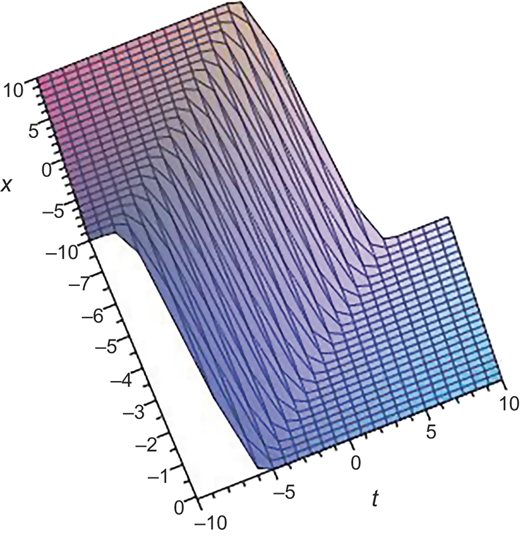
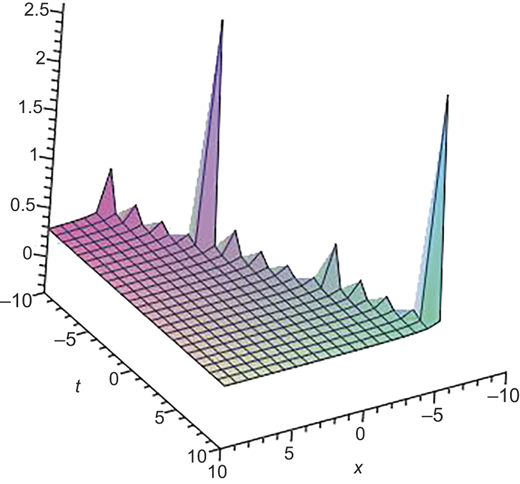
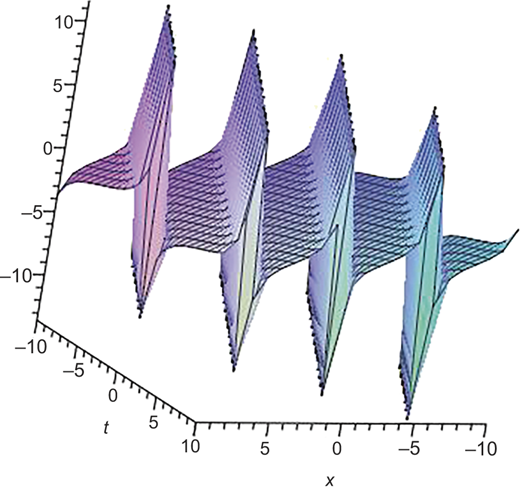
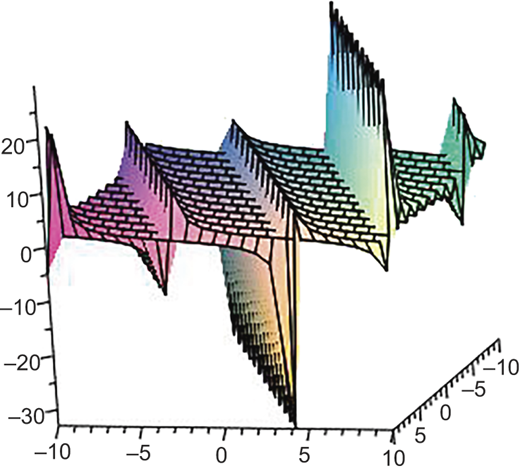
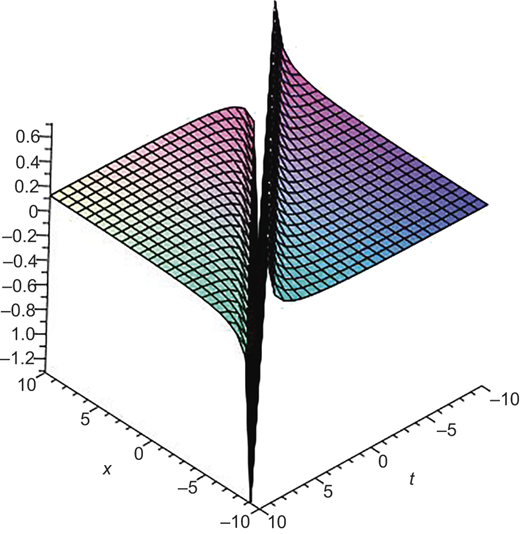
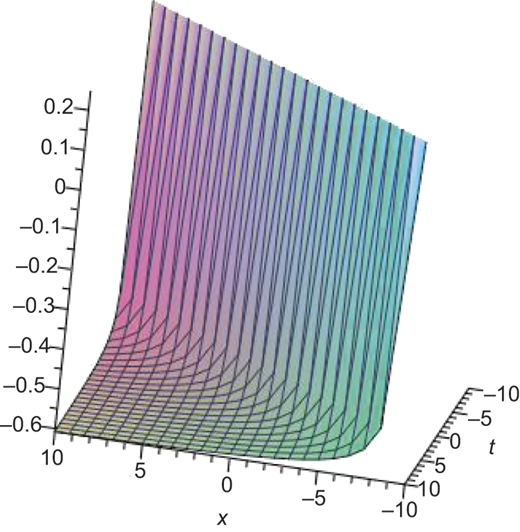
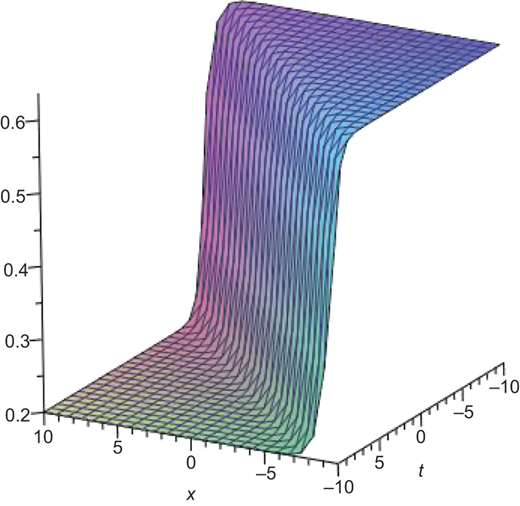
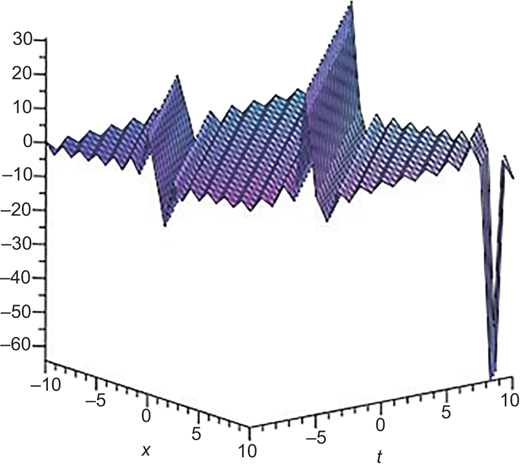
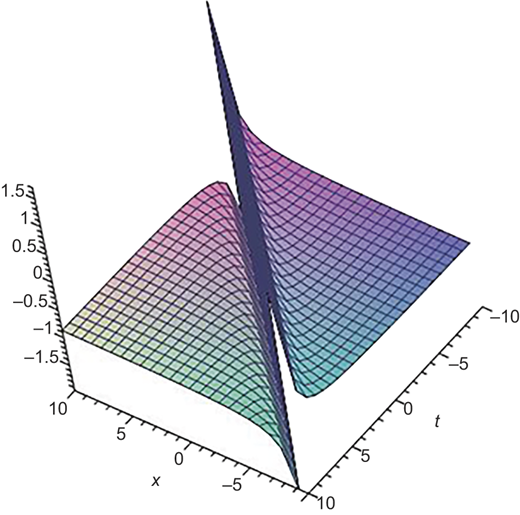
Some of the furnished solutions in this paper are depicted graphically for their physical appearance which stands for different shapes of soliton, like, kink-type soliton, singular kink-type soliton, periodic soliton, singular periodic soliton etc. The solution (3.1.11) represents the shape of kink-type soliton for and within shown in Figure 1. Eqn (3.1.13) stands for the singular periodic soliton for and within , Eqn (3.1.15) takes the form of singular kink shape soliton for and in the range exposed in Figure 2. Eqn (3.1.17) represents kink-type soliton for and within , Eqn (3.1.19) gives the shape of periodic soliton for and in the interval given away in Figure 3. Eqn (3.1.21) stands for the singular periodic soliton for and within the range . The solution (3.2.10) represents the kink-type soliton for and within . Eqn (3.2.12) stands for periodic soliton with and in the interval shown in Figure 4. Eqn (3.2.14) presents singular kink soliton for and within the range revealed in Figure 5. Eqn (3.2.16) takes the form of kink-type soliton for and with . Eqn (3.2.18) gives the shape of periodic soliton for and in the interval . Eqn (3.2.20) represents singular kink-type soliton for and within shown in Figure 6. The solution (3.3.7) represents the kink-type soliton for and in the range made known in Figure 7. Eqn (3.3.9) stands for periodic soliton for and within the interval given away in Figure 8. Eqn (3.3.11) takes the form of singular kink-type soliton for , and in the range exposed in Figure 9.
The physical appearance of solutions to FNLEEs bears great importance to depict different phenomena arisen in various fields of nature in real world. This paper consists of some fresh and general solutions among which few are graphically brought up.
5. Conclusion
The core aim of this study is to make available further general and fresh closed form analytic wave solutions to the nonlinear space-time fractional PKP equation, the nonlinear space-time fractional STO equation and the nonlinear space-time fractional KPP equation through the suggested rational fractional -expansion method. The offered method has successfully presented attractive solutions to the considered equations and shown its high performance. So far we know the achieved solutions are not available in the literature and might create a milestone in research area to analyze the physical structure and behavior of the real life events that correspond to the fractional related models. Therefore, it may be claimed that the rational fractional -expansion method in deriving the closed form analytical solutions is simple, straightforward and productive. This method might be taken into account for further implementation to investigate any FNLEEs arising in various fields of applied mathematics and mathematical physics. The obtained solutions in terms of trigonometric function, hyperbolic function and rational function containing many free parameters are claimed to be fresh and further general which will take place in the literature.