


A matrix is a -matrix if for every , the sum of all principal minors is nonnegative. In this paper, we study some necessary and sufficient conditions for a digraph to have -completion. Later on we discuss the relationship between and -matrix completion problem. Finally, a classification of the digraphs of order up to four is done based on -completion.
1. Introduction
A partial matrix is a real square matrix with some specified entries while other entries are unspecified. By completion of a partial matrix, we have to choose specific values for the unspecified entries. The matrix completion problem studies those partial matrices which have desired type of completions.
A real matrix is a -matrix (-matrix) if every principal minor of is positive (nonnegative). A real matrix is a -matrix if for every , , where is the sum of all principal minors of . The matrix is -matrix if for every , . Clearly a -matrix is a -matrix but not conversely.
A partial -matrix is a partial matrix in which for every for which all principal submatrices are fully specified. Similarly a partial -matrix is a partial matrix in which for every .
To make a completion of a partial matrix, a specific choice of value for the unspecified entries is chosen. Thus the main motive of matrix completion problem is to investigate the properties of partial matrices and find out those partial matrices which have a particular type of completions. In the last few years, research is done for different classes of matrices in the area of Matrix Completion Problems. Several researchers have developed many results of matrix completion problems for different classes of matrices including and , -matrices (e.g.,[2–5,7,8,10,14]). To see the details of the definition and properties of different classes of partial matrices (i.e or -partial matrices) and results regarding matrix completion problems, we suggest [9].
From the beginning of matrix completion problems, we have found that graphs and digraphs are widely used in solving the matrix completion problems. A digraph is a pair , where is a finite nonempty set of objects, called vertices, and is a set of ordered pairs of vertices, called arcs or directed edges. We use and to denote the vertex set and the arc set of respectively and we write frequently (respectively, ) to say that (respectively ). An arc in the arc set of a digraph , which is called a loop at the vertex is allowed in our given definition. Most of the graph-theoretic terms used in this article can be found in any standard book, for example [1,6]. However for the convenience of the readers’ of this article, we request them to follow the introduction part of the article [11–13].
In this paper, we have studied the (combinatorial) -matrix problem. In Section 2, we have defined the partial -matrix and the -matrix completion problem. We have discussed the relationship between digraphs and -completion in Section 3. We have discussed some necessary and sufficient conditions for -matrix completion problem in Section 4. In Section 5, we tried to find out the relationship between and -matrix completion problem. Finally in Section 6, we have singled out of all digraphs of order up to 4 with -matrix completion.
2. Partial -matrices and their completion problem
A partial -matrix is a partial matrix in which for every for which all principal submatrices of are fully specified. In Proportion 2.1, we characterize as follows.
Proposition 2.1. Suppose is a partial matrix. Then is a partial -matrix if and only if exactly one of the following holds:
(i) At least one diagonal entry of is not specified.
(ii) All diagonal entries are specified so that and has an off diagonal unspecified entry.
(iii) All entries of are specified and is a -matrix.
A completion of a partial -matrix is called a -completion of , if is a -matrix. If is a -matrix, then any matrix which is permutation similar to is a -matrix. As a consequence any digraph isomorphic to which has -completion also has -completion.
Any partial matrix with all unspecified diagonal entries has -completion. By choosing sufficiently large values for the unspecified diagonal entries, the desired -completion of is obtained. Now consider a partial -matrix with unspecified diagonal entries at positions . We may not get a -completion of in case is fully specified. To see this, the partial matrix,
where denotes an unspecified entry, does not have -completion. For any completion of , we have . However, if has an unspecified entry and has a -completion, then has a -completion. By choosing sufficiently large values for the unspecified diagonal entries, a -completion of can be obtained. We write our observations in the following results:
If a matrix omits all diagonal entries, then has -completion.
Suppose be a partial -matrix in which the diagonal entry at position is unspecified. If the principal submatrix of is not fully specified and has Q-completion, then has -completion.
Suppose be a partial -matrix in which the diagonal entries at positions are unspecified. If the principal submatrix of is not fully specified and has -completion, then has -completion
The following example shows that the converse of Corollary 2.4 is not true.
Consider the partial matrix,
where denotes the unspecified entries. We show that has -completions, though there are occasions when does not have -completion. For , consider the completion of defined as follows:
Then,
where is a polynomial in of degree at most . Consequently, is a -matrix for sufficiently large , and therefore, has -completion. However, the partial -matrix
with unspecified entry , is the principal submatrix of induced by its diagonal . That does not have -completion is evident, because for any completion of .
Remark 2.6. We can see that in Theorem 2.3 may not be a partial -matrix. If all the specified diagonal entries are zero, then Theorem 2.3 does not hold automatically. Also Example 2.5 shows that may not have -completion. To see that consider a partial -matrix
with unspecified entry . does not have -completion since for any completion of , we have .
3. Digraphs and -completions
An partial matrix specifies a digraph if for , if and only if the th entry of is specified. As an example, we can see that the partial -matrix in Example 2.5 specifies the digraph in Figure 1.
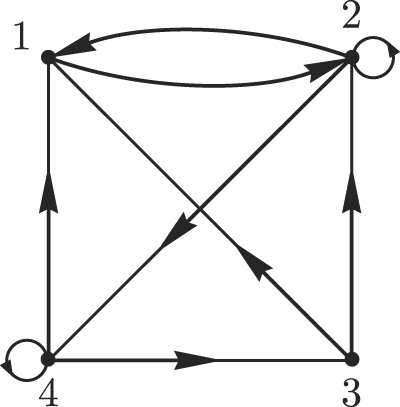
Theorem 3.1. Suppose is a partial matrix specifying the digraph . If the partial submatrix of induced by every strongly connected induced subdigraph of has -completion, then has -completion.
Proof. First we consider the case when has two strong components say, and . Later on the general result will automatically follow from induction. If required, by a relabelling of the vertices of , we have
where is a partial -matrix specifying , and contains all unspecified entries. Now, we have has a -completion . Consider the completion
by choosing all entries in as well as all unspecified entries in as . Then, for we have,
Here, we mean whenever exceeds the size of . Thus can be completed to a -matrix ■.
The proof of the following result is similar.
Theorem 3.2. Suppose is a partial matrix specifying the digraph . If the partial submatrix of induced by each component of has a -completion, then has a -completion.
The converse of Theorem 3.1 is not true. For example, every partial -matrix specifying the digraph in Figure 1 has -completion, although the strong component induced by vertices does not have -completion (see Example 3.3).
Example 3.3. Consider the digraph in Figure 1. We show that has -completion, but the strong component induced by vertices does not have -completion. Let be a partial -matrix specifying . Then for , can be completed to a -matrix (see Example 2.5) but the principal submatrix induced by the digraph i.e. does not have -completion. To see that does not have -completion, consider the partial -matrix
with unspecified entry . Then for any -completion of , we have and hence does not have -completion.
The property of having -completion is not hereditary which can be also seen from Example 2.5.
4. The -completion problem
A digraph has -completion, if every partial -matrix specifying can be completed to a -matrix. The main motive of -matrix completion problem is to study and classify all digraphs based on -completion.
4.1 Sufficient conditions for -matrix completion
Theorem 4.1. If a digraph of order has -completion, then any spanning subdigraph of has -completion.
Proof. Suppose be a spanning subdigraph of and be a partial -matrix specifying the digraph . Consider a partial matrix obtained from by specifying the entries corresponding to as . Since , by Proposition 2.1, is a partial -matrix specifying . Let be a -completion of . Clearly, is a -completion of . ■
Theorem 4.2. Suppose be a digraph such that is stratified. If it is possible to sign the arcs of so that the sign of every cycle in is of positive sign, then has -completion.
Proof. Suppose be a partial -matrix specifying the digraph . For any , consider a completion of by choosing the unspecified entry (using the sign of the arc in ). Then for each , we have,
where is the number of permutation subdigraphs of order in and is a polynomial of degree less than . If contains all loops, then the trace of any partial -matrix specifying is nonnegative; if omits a loop, then , where is the number of loops in and . Now by choosing sufficiently large results, becomes a -matrix. ■
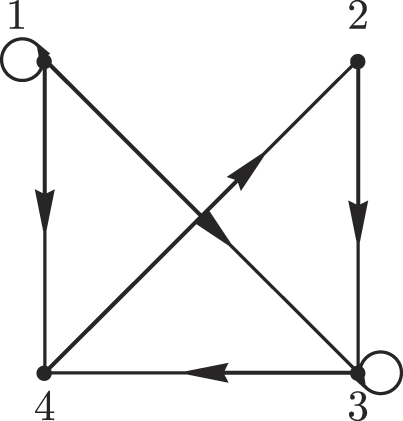
Example 4.3. Consider the complement in Figure 2 of the digraph in Figure 1. It can be easily seen that the digraph is stratified. Also it is possible to sign the arcs of with positive sign, thus by Theorem 4.2 the digraph has -completion.
Corollary 4.4. If is a digraph and has a stratified spanning subdigraph that has a signing in which the sign of every cycle is +, then has -completion.
4.2 Necessary conditions for -matrix completion
In this section we provide some necessary conditions for a digraph to have -completion.
Theorem 4.5. Suppose be a digraph of order which includes all loops. If has no -cycle, then does not have -completion.
Proof. Let be a digraph of order which includes all loops. Suppose be a partial -matrix specifying the digraph which is defined as follows:
It is clear that is a partial -matrix specifying . Now does not contain a -cycle, then for any completion of , we have . Thus does not have -completion. ■
Consider the digraph In Figure 3. Suppose
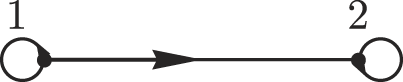
be a partial -matrix specifying the digraph . Then for any completion of , we have by Theorem 4.5. Hence, cannot be completed to a -matrix.
Corollary 4.7. If a digraph of order includes all loops and has -completion, then must not be a tournament or subdigraph of a tournament.
Proof. If is a tournament or a subdigraph of a tournament, then it does not contain a -cycle. Hence, the result follows. ■
The converse of Theorem 4.5 is not true which follows from Example 4.8.
Example 4.8. Consider the digraph in Figure 4. The complement of the digraph i.e. contains a -cycle. But does not have -completion. Consider a partial -matrix
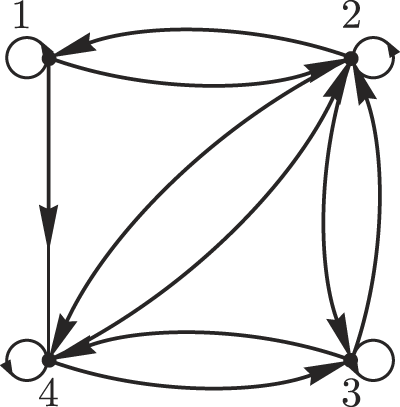
specifying the digraph . Then for any completion of , we have . Hence, cannot be completed to a -matrix.
5. Comparison between -completion and -completion
Although every -matrix is a -matrix, but the completion problem of these two classes is different. We list these observations in the following result.
Theorem 5.1. If a digraph has -completion, then it must also have -completion.
Proof. Suppose be a digraph that has -completion and be a partial -matrix specifying the digraph . Then, the sums of all fully specified principal minor of same order of are positive. Since the determinant and each principal minor of a matrix are a continuous function of its entries, there is such that the partial matrix obtained from by decreasing the specified diagonal entries by is a partial -matrix. Since a partial -matrix is a partial -matrix, is a partial -matrix specifying . Consequently, has a -completion . We now have a -completion of , namely, , where is the identity matrix. ■
The following equivalent corollary is immediate.
Corollary 5.2. Any digraph which does not have -completion does not have -completion.
But the converse of Theorem 5.1 is not completely true which can be seen in the following two cases.
Case 1. Suppose includes all loops. In this case has -completion but does not have -completion.
Example 5.3. Consider the symmetric -cycle (Figure 5) which includes all loops. Now has -completion (see Example 2.2 of [4]). To see that does not have -completion, consider the partial -matrix
specifying . For a completion of , the 3 × 3 principal minor is given by
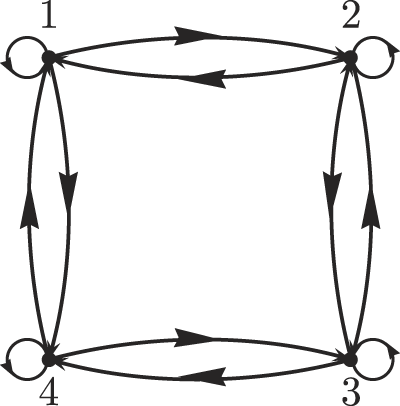
Then we have and cannot be completed to a -matrix.
Case 2. Suppose omits at least a loop. Then we have the following theorem:
Theorem 5.4. Suppose be a digraph such that omits at least a loop. If has -completion, then must have -completion.
Proof. Suppose be a partial -matrix specifying . Since omits at least a loop, thus at least a diagonal entry of is unspecified. Thus is a partial -matrix. Since has -completion, can be completed to a -matrix . Consequently, is a -matrix. ■
6. -Completion of digraphs of small order
With the help of the results obtained in the previous sections, we will sort out all digraphs of order which have loops at all its vertices and have -completion. In this regard we will take the help of the nomenclature of the digraphs as per their order in [6, Appendix, p. ]. Here, denotes the th member digraph with loop at each vertices and it has (non-loop) arcs.
As we know that any matrix under permutation similarity to a -matrix is also a -matrix, if a digraph has -completion, then any isomorphic digraph of has -completion, that is, any digraph obtained by labelling the unlabelled digraph associated to has -completion.
Clearly, any digraph of order (with or without a loop) has -completion. There are only two non-isomorphic digraphs of order with loops say, and have -completion.
The rest of the section is broken up into a series of lemmas.
Lemma 6.1. For , the digraphs which are listed below do not have -completion.
Proof. Each of the digraphs listed above satisfies Theorem 4.5 and hence the result follows. ■
Lemma 6.2. The digraphs and do not have -completion.
Proof. In Example 5.3, it is seen that the digraph (i.e. ) does not have -completion. Suppose
be a partial -matrix specifying the digraph . Now for any -completion of , we have . Hence does not have -completion. ■
Lemma 6.3. For , the digraphs which are listed below do not have -completion.
Proof. Each of the digraphs does not have -completion, thus by Corollary 5.2 the above digraphs do not have -completion. ■
Theorem 6.4. For , the digraphs which are listed below have -completion.
Proof. The complement of each of the digraphs is stratified and it is possible to sign the arcs of the with positive sign, thus by Theorem 4.2, each of the digraphs listed above has -completion. ■
Remark 6.5. In this paper, the -matrix completion is discussed. Some necessary and sufficient conditions for a digraph to have -completion are discussed. Although these conditions helped us to single out the digraphs of order at most as to -completion, the problem is far from being completely solved. A complete characterization for a digraph to have -completion is still unresolved. Out of 218 digraphs of order , only 11 digraphs are still not singled out to have -completion or not. Since the -completion problem is not still fully solved, thus the following digraphs , are not classified according to the -completion.
The publisher wishes to inform readers that the article “The Q0-matrix completion problem” was originally published by the previous publisher of the Arab Journal of Mathematical Sciences and the pagination of this article has been subsequently changed. There has been no change to the content of the article. This change was necessary for the journal to transition from the previous publisher to the new one. The publisher sincerely apologises for any inconvenience caused. To access and cite this article, please use Sinha, K. (2019), “The Q0-matrix completion problem”, Arab Journal of Mathematical Sciences, Vol. 27 No. 1, pp. 119-128. The original publication date for this paper was 26/08/2019.

