In intellectual disability healtcare, providing accessible information on treatment proposals is a necessary part of shared decision-making. However, although the medication use of especially psychotropic drugs is high, people with intellectual disability often lack knowledge about these prescriptions. Accessible written medication information is often not available. The authors aimed to fill this gap.
Four individuals with intellectual disability (the panel), their coach, pharmacists and intellectual disability healthcare professionals/researchers collaborated in this inclusive research project. A coproduction method was used. The healthcare professionals/researchers developed a set of 64 Dutch leaflets on psychotropic drugs for use in people with intellectual disability based on 29 accessible English leaflets. A checklist for the panel was developed to review each leaflet draft. The drafts were adapted according to the panel’s recommendations. The final drafts were presented in a meeting of the project group and stakeholders.
The main adaptations in the drafts were textual changes, including adding headings and frequent side effects and layout changes in photos and colours. The results of the checklists and stakeholders’ feedback revealed that the quality and accessibility of the leaflets overall were very clear.
More (inclusive) studies are needed to investigate whether the use of the leaflets is effective in improving the patients’ medication knowledge and shared decision-making.
Stakeholders welcomed the availability of accessible leaflets on psychotropic medication. This methodology could be used by other professionals to develop similar accessible information for their own populations.
Introduction
Health literacy is an important issue that clinicians should take into account in treatment proposals to their patients, especially in medication treatments (Miller, 2016). When patients do not understand the information about their medication use, there is a risk of low treatment adherence and adverse events. Understandable information may even be more important for patients with intellectual disabilities, as was described in a study about the experiences of people with intellectual disabilities with medication use (Flood and Henman, 2021). Health literacy of patients is also an important topic in the process of shared decision-making (Flood and Hennan, 2021; Muscat et al., 2020). Shared decision-making requires two parties, the health-care professional and the person receiving the treatment, to work together in a process of balancing the advantages and disadvantages of treatment options suited to the person’s values and preferences. However, many people with intellectual disabilities are dependent on support from their families and/or support professionals. Therefore, in medication treatments caregivers of people with intellectual disabilities are important stakeholders. However, caregivers may have limited knowledge about the medication use of the person they care for (Arscott et al., 2010). Therefore, the provision of accessible written/printed information about the drug may contribute to adequate treatment adherence as well as to the process of shared decision-making.
The medication use among people with intellectual disabilities is high. This is likely related to the high frequencies of comorbid mental and physical (chronic) disorders in this population (Straetmans et al., 2007; O'Dwyer et al., 2018). In people with intellectual disabilities, one of the most frequently prescribed classes of medication is psychotropic medication (O'Dwyer et al., 2018; Song et al., 2023) and within this class, antipsychotics are by far the most prescribed agents (O'Dwyer et al., 2018; Perry et al., 2018; Deb, 2024), often for challenging behaviour outside licenced indications (Sheehan et al., 2015; de Kuijper and Hoekstra, 2017). In those off-label prescriptions, the availability of accessible information about the medication is even more important to carefully weigh the risks against the benefits in a shared decision-making process. However, studies have shown that people with intellectual disabilities and their caregivers are often insufficiently informed about their medication use by their pharmacists or doctors (Fish et al., 2017; Deb, 2024; Crossley and Withers, 2009; Arscott et al., 2010; Heslop et al., 2005), a prerequisite in the shared decision-making process and medication adherence. In these aforementioned and other (de Kuijper et al., 2024; Chinn, 2020) studies on the provision of information about medication to people with intellectual disabilities, the need for accessible medication leaflets is highlighted.
In the development of accessible materials, it is recommended to involve the consumers in this process (Pharos, 2024). A coproduction method is an excellent way to involve consumers and other stakeholders like healthcare professionals in a research or design project. Coproduction is an inter stakeholder collaborative approach to improving healthcare services by enabling service users, caregivers and professionals to collaborate and co-design better services. A coproduction method has been successfully used in previous projects with people with intellectual disabilities (Deb and Limbu, 2022). Examples are the development of “Tools for Talking” (Link tohttps://toolsfortaliking.wordpress.com), a set of resources for use by people with intellectual disabilities and service providers to facilitate cultural-sensitive communication (Unwin et al., 2016), and a study on preferred outcomes of treatments for challenging behaviour from the perspective of people with intellectual disabilities (de Kuijper et al., 2023).
In the UK, accessible leaflets on 31 commonly used psychotropics for people with intellectual disabilities have been coproduced involving people with intellectual disabilities, their caregivers and other relevant stakeholders (see Link tohttps://spectrom.wixsite.com/project) (Deb et al., 2020). These information leaflets could be printed and handed over to the person with intellectual disability and the caregivers. The prescriber and the caregiver can take the person with intellectual disability through the information in the leaflets, which should encourage shared decision-making and treatment adherence. However, in the Netherlands, these accessible leaflets are not available for people with intellectual disabilities and their caregivers.
We aimed to address the lack of accessible information on psychotropic medication in the Netherlands. We set up an inclusive project to develop a set of accessible medication leaflets in the Dutch language on a range of psychotropic medications for use by people with a mild intellectual disability and their caregivers. In this paper, we described the development of this set of accessible medication leaflets by coproduction of experts by experience, healthcare professionals and a researcher.
Methods and materials
Design and participants
In this project, we used a coproduction method in which experts by experience, healthcare professionals and researchers collaborated to develop accessible medication leaflets (so-called inclusive research). For this, the project leader (first author [GdK], an intellectual disability physician and researcher) invited a coach and a group of experts by experience who were affiliated with an intellectual disability service provider to participate in the project. Experts by experience could participate when they had language skills, were adults and competent and had experience with medication use. The coach selected and invited eligible participants. Four experts by experience (one male with a moderate and three females with a mild intellectual disability) consented to become a member of the project group. Other participants included three mental healthcare nurses and a research assistant, like the first author, all affiliated with an intellectual disability specialised mental healthcare centre, and two pharmacists, affiliated with a pharmacy research and education centre. The main task of the project group was to develop a set of accessible leaflets on a range of psychotropic drugs. The set should be presented and offered for testing to other stakeholders like parents, legal representatives, physicians and other professionals in intellectual disability care and pharmacists and their consumers in community and institutional care. A speech therapist was available to advise the project group on the kind of images which could best be used in the leaflets.
Ethical issues
All participants were adults and contributed voluntarily to the project. The input of all participants was processed anonymously. Ethical review was not necessary as the project was not a medical research project, experts by experience acted as researchers rather than participants in this project, no health-related data were collected from them, and the participants were not exposed to potentially harmful interventions.
Materials
We started with the 31 accessible English psychotropic medicine leaflets, which are freely available from the SPECTROM website Link tohttps://spectrom.wixsite.com/project) with copyright attached to them (Deb et al., 2021).
We developed accessible materials for the experts by experience i.e. information and education about psychotropic medication and a checklist for the assessment of the draft leaflets:
The information and education materials on psychotropic drug use included easy-read documents on:
indications, effects and side effects of psychotropic drugs;
challenging behaviour; and
studies among service users about their experiences with psychotropic drug use and PowerPoint presentations for review during project group meetings.
The checklist contained 11 items, each with space for adding comments. Questions were about:
how easy it is to understand the information;
the suitability of the pictures, the text layout and the wording;
how comprehensive the information is and if further information on medication is needed; and
the overall impression of the leaflets
(see Results section/Step 2 Table 1).
Questions could be answered as either “yes” (if they agreed with the draft leaflets) or “no” (if they did not agree). The panel members were asked to provide the reason for saying “no” and accompanying recommendations for improvement/change.
To get feedback from the stakeholders on the testing of the leaflets, we developed an accessible evaluation form which contained questions about stakeholder’s opinions about the usability, text and formatting of the leaflets, whether the content of the leaflet was discussed and understood, and some personal questions (age, education and literacy). Also, there was space for comments. The form could be completed by all the users of the leaflet, i.e. the healthcare professionals who handed the leaflet to their patients and by the patients and/or patients’ caregivers who received the leaflet and with whom it was discussed. We also wrote a working instruction for the healthcare professionals on the way the leaflets should be used (not just hand over to the patient, but also explain the content of the leaflet), how to get access to the leaflets (a link with a password to a secured digital map) and how to print hard copies of the leaflets to give to the patient.
Guidelines in the development process of the leaflets, the accessible information materials, checklist and evaluation form were the key principles about the design of leaflets containing consumer medication information (Raynor and Dickinson, 2009), the information of the National Health Service (National Health Service, NHS Foundation Trust, 2024) and a Dutch Expertise Centre (Pharos, 2024) regarding the development of easy-to-read materials. Recommendations were followed where applicable in discussion with the project group members.
Procedures
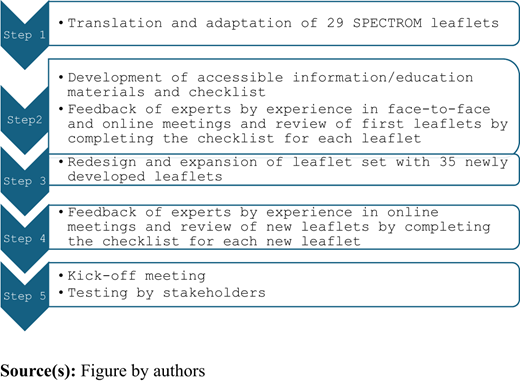
The set of leaflets was developed in five steps from March 2020 to September 2024 (Figure 1).
Step 1.
In the beginning, the project leader and a pharmacist from her network translated 29 of the 31 available English leaflets to Dutch in a backwards and forwards procedure to ensure content validity. Then, in discussion with the project leader, the leaflets were adapted by the two pharmacists–members of the project group according to Dutch practice, professional guidelines and legislations with permission from the SPECTROM lead (last author, SD). We did not use the leaflet on trifluoperazine because this agent is not registered in the Netherlands, nor the leaflet on chlorpromazine because this agent in Dutch practice is only prescribed in palliative care.
Step 2.
To introduce the project to the experts by experience, the project leader and coach developed accessible information and educational materials on psychotropic drug use. The information materials were sent two weeks in advance to the experts by experience to prepare for two on-site meetings of the experts by experience with the coach, the two nurses and the project leader in autumn 2020.
The nurses, project leader and coach developed an accessible checklist of 11 items, each with space for adding comments, for use by the panel (the four participating experts by experience) to review the draft leaflets. The aim was to send a checklist for each leaflet that should be reviewed by each individual panel member by mail and email to complete online or on paper.
During the two on-site meetings the information and education materials were reviewed on a group level. Also, the experiences and expectations of the experts by experience on being informed and involved in pharmacological treatments were discussed. In the second meeting, in addition to these issues, the content and the format of the Dutch version of the accessible leaflets were presented and discussed, along with information on the way of reviewing the leaflets. Instructions for each of the four experts by experience of the panel members included the following:
Read the leaflets and look at the formatting and pictures.
Complete the checklist for each leaflet (one agent per leaflet).
Complete the checklist at your own pace/take your time!
Ask your caregiver, coach or the nurse when something is not clear. They can explain and inform you.
We welcome your suggestions for improvement.
The third and fourth meetings of the nurses, the experts by experience and coach, were conducted online. These meetings further clarified the review process, commented on the drafts and discussed questions raised by the group members. Moreover, the nurses and the coach created an App group for the experts by experience to put questions and remarks for the review process at an individual and group level. At the end of step 2 in December 2020, in a final meeting of the two nurses, the project leader, the experts by experience and their coach, recommendations were made for finalising the drafts of the translated 29 leaflets based on the results of the review process and the following discussion. As a next step, the panel recommended developing accessible leaflets on additional psychotropic medications that were not available on the SPECTROM site.
Step 3.
Step 3 started with redesigning and adapting the 29 draft leaflets based on the recommendations and reviews from the experts by experience in step 2. This work was done by a new nurse and research assistant who joined the project group because the two nurses who had participated in the project group so far were no longer available. The content of drafts for 35 extra leaflets on psychotropic medication not available on the SPECTROM site was made by the pharmacists and the intellectual disability physician. The choice was based on a list of frequently prescribed agents for psychiatric or behavioural symptoms from a parallelly running study among prescribers in Dutch long-term care. These included leaflets on missing psychotropic agents, alpha- and beta-blockers and agents against dementia.
Then, the leaflets were formatted and reviewed by the nurse, the research assistant and the coach.
Step 4.
Step 4 contained a second review round by the experts by experience. After finalising the 35 drafts, these were sent in parts (per psychotropic drug group) to the panel for review by completing the checklist for each leaflet. During this process, from December 2021 to September 2022, three online meetings, in addition to App-contacts on demand, took place. With the agreement of all the group members, the final drafts were established. For the field-testing, we developed working instructions about the way to use the leaflets and an evaluation form for feedback from the consumers of the leaflets. Then invitations were sent to regional professional organisations (of intellectual disability physicians, general practitioners (GPs), pharmacists and mentors/legal representatives), intellectual disability service providers and mental healthcare organisations in the northeast of the Netherlands for a kick-off meeting as the starting point for testing in the field.
Step 5.
This final step started with the presentation of the final draft leaflets in a kick-off meeting of the project group and invited stakeholders in September 2022. All those stakeholders were also invited to test the draft leaflets. Professionals and parties, i.e. intellectual disability, mental healthcare and primary care organisations and pharmacies who agreed with testing received a working instruction and a list with the generic names of medications of which a leaflet was available. They were also asked without obligation to complete the evaluation form and to handle this form to the consumers of the leaflet. Forms could be sent back by e-mail or stamped reply envelopes.
Data collection and analyses
Data were collected by the nurses and research assistant and included the answers and comments on the questionnaires (checklist and evaluation forms). Also, they reported on the content of online meetings and App group during weekly meetings with the project leader.
Microsoft Excel was used for the processing of the data.
Data were anonymously stored and safeguarded according to the European data protection rules and policies of Geestelijke GezondheidsZorg (GGZ) Drenthe, the institution where the research was conducted.
Results
In this section, the results of the review process and details about the content and formatting of the leaflets are presented step by step.
Step 1.
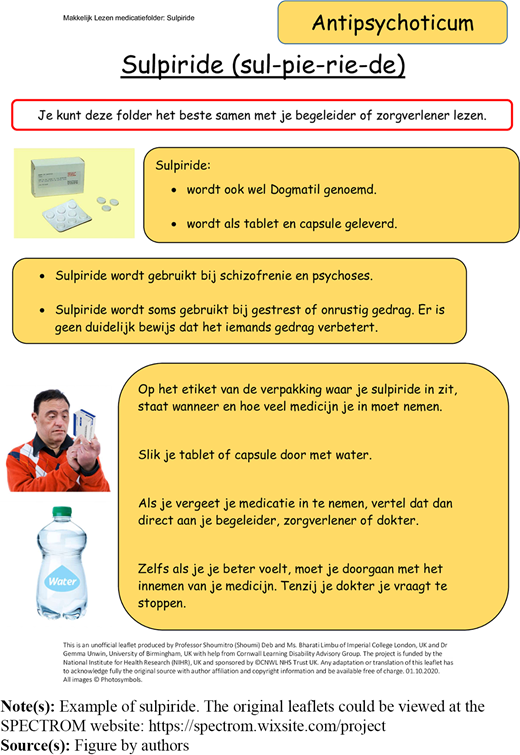
Figure 2 shows an example of the first draft of the leaflet after translation.
The pharmacists formulated principles regarding the further development of the leaflets. These included agreement on intended consumers (people with a mild intellectual disability), Dutch resources on pharmaceutical agents and prescription guidelines, basic structure (English leaflets), use of patient-friendly terms and headings/sections. The chosen sections were indication, name of agent (generic and brand names), dosage forms, way of use, side effects, warnings, contraindications and when to stop the medication. The sections were filled with discussions of the pharmacists and the intellectual disability physicians, with feedback from the nurses. The main change in the format of the leaflets was the addition of headings. The change in the text was the addition of the most frequent (1%–10%) side effects.
Step 2.
The first 29 translated and adapted leaflets had largely the same layout, pictures and colours as the SPECTROM leaflets and included psychotropics under the following classes: antipsychotics (n = 11), antidepressants (n = 8), anxiolytics and hypnotics (n = 3), antiepileptics (n = 5), psychostimulant (n = 1) and lithium (n = 1). This set was reviewed by the panel of experts by experience by completing the checklist for each leaflet. Table 1 shows the results of their judgements.
In general, the panel members judged uniformly about the clarity of information regarding the indication, side effects and problem-solving for questions regarding medication use. They were less uniform regarding the clarity of pictures and understanding of words. Suggestions for improvement were provided on the checklist and discussed during the third, fourth and fifth meetings. Most comments were made on the pictures, layout and colours of the leaflets. Discussions were about pictures, which could be confusing, the formatting, which did not properly fit the text and the aligning of the text within the format, which did not look so good. Also, they mentioned that some terms were difficult to understand, e.g. the naming of symptoms and side effects. In addition, they had comments on how the leaflets should be used like:
“Explanation by your doctor or nurse is necessary”;
“Reading with your caregiver is helpful”; and
“I will show my day-to-day supervisor”.
All the experts, by experience, were very enthusiastic about being part of the project group that developed the leaflets. They indicated that they had learned a lot about psychotropic medication and wished they had known earlier. They strongly recommended making the leaflets available for all people with intellectual disabilities who are prescribed psychotropics and for their families and support professionals. They noted that using the leaflets would likely improve the shared decision-making process. Remarks were:
“Everybody should receive these leaflets because it is good to get understandable information”; and
“In this way, you will be taken seriously when discussing medicines with the doctor”.
Finally, they recommended developing leaflets for all psychotropic medications that are frequently prescribed in Dutch intellectual disabilities mental healthcare.
Step 3.
The text, layout, colours and pictures in the first set of draft leaflets on 29 psychotropic medications were adapted, and the 35 newly developed leaflets were formatted according to the previous (step 2) comments of the experts by experience. As was recommended by the speech therapist who supported the project group, the experts by experience also preferred the use of photos instead of pictures. Furthermore, they advised on the use of symbols next to the sections to make clear what the content is about, e.g. a warning sign.
Table 2 shows the psychotropics included in the first set of leaflets and those added in the second set.
Step 4.
The checklist was used to judge the newly developed leaflets. The experts, based on their experience, advised on sentences, text blocks and font size. They wanted to change the bright yellow colour of the English leaflets to muted colours because, in their opinion, the use of bright colours is inappropriate for information on medication use (“medicines are no sweets”).
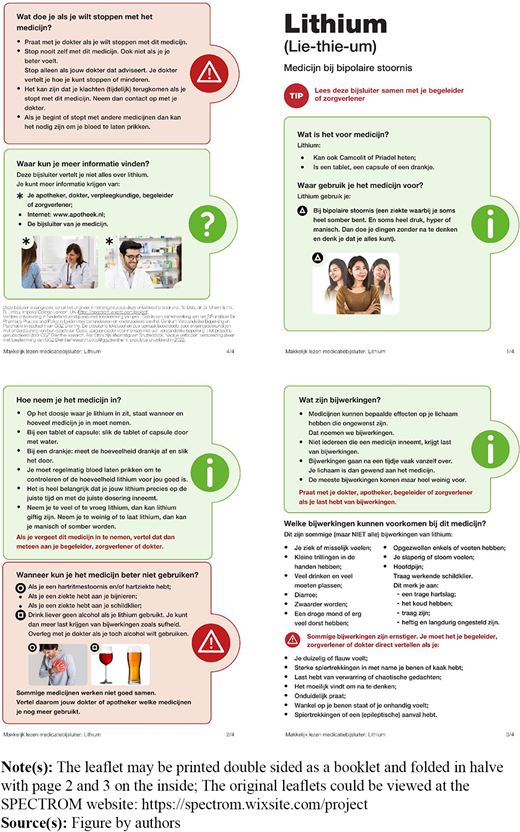
An example of the final draft is shown in Figure 3.
Step 5.
This step started with the presentation of the leaflets to stakeholders at the kick-off meeting. The meeting included an interview of the nurse with the experts by experience about the development process of the leaflets and their experiences regarding participation in the project. The experts, by experience, said that they learned a lot about medication use. They stressed that the provision of this kind of information is very important to be a good partner in the shared decision-making process of one’s own medication use. Most care professionals welcomed the development of the leaflets for use in intellectual disability care and suggested to use them at a wider scale. Suggestions for dissemination included online availabilities, e.g. spoken versions, and to draw attention by social media.
Unfortunately, we did not receive completed evaluation forms, probably because this was not mandatory. However, we received verbal feedback through phone calls and email correspondence between the research assistant and the nurses with the participating stakeholder parties. In general, as is written at the top of each leaflet, they agreed that a healthcare professional should review the leaflet with the patient and/or caregiver.
Based on stakeholders’ suggestions, some minor adaptations to the layout were made. An important adaptation was the addition of an insert. This blank sheet can be used to customise the prescription of the medication next to the general information on the leaflet, e.g. by writing the dose, the expected effects on the patient’s complaints and specific warnings. Furthermore, stakeholders provided a lot of comments about how the leaflets should be used and the way of dissemination. Suggestions depended on the care sector. For example, in intellectual disability care, the leaflets are less suitable for clients and could best be used by support professionals to improve their own and their clients’ knowledge about psychotropic drug use. In contrast, community pharmacists, GPs, psychiatrists and nurses in mental healthcare indicated that the leaflets could also be suitable for use by people with low literacy and patients with borderline intellectual functioning.
Discussion and conclusion
Discussion
In this inclusive research project, a coproduction of experts by experience, their coach, pharmacists, nurses and an intellectual disability physician in the Netherlands, 64 accessible medication leaflets on psychotropic medications were developed, next to the legally required leaflets from pharmaceutic companies. By this, we added to other Dutch accessible information resources regarding health issues and medication use, which are nevertheless often not suitable for people with intellectual disability. By including experts by experience with a mild intellectual disability in the development process, the leaflets would likely comply with the standards of creating accessible health information (Pharos, 2024).
By testing the final drafts by people with intellectual disabilities and their caregivers, legal representatives, pharmacists and professionals in intellectual disability care and mental healthcare organisations, we received additional suggestions to improve the leaflets. An example is the adding of an insert on which an authorised healthcare professional can write individualised information regarding the patient’s medication. In that way the leaflets can be tailored to the patient’s personalised health information needs (Chinn and Homeyard, 2017).
The availability of accessible leaflets may, in addition to improving the information on psychotropic medication for people with intellectual disabilities and their caregivers, enhance shared decision-making. However, this is not always the case. In some cases, accessible health information is available but not used by the care professional. In other instances, accessible information was handed as part of unsolicited health advice and not shared with the patient (Chinn, 2020). Also, the content of the leaflet may confuse a person with mild intellectual disabilities and lead to less medication knowledge than before reading the leaflet (Strydom and Hall, 2001). Therefore, as was also indicated by intellectual disability care organisations in our study, prescribers or pharmacists should hand over the leaflets to their patients and/or patients’ caregivers and take them through the information (Chinn, 2020. Developing a toolkit with instructions for caregivers and support staff should help the implementation of these accessible leaflets and lead to improved shared decision-making.
An unintended yet relevant outcome of this project was the potential for wider use of the leaflets by people with low literacy or borderline intellectual functioning. Therefore, we asked the Pharos institution (Pharos, 2024) to test the leaflets by their panel of people with low literacy. The panel judged that the leaflets were suitable for use in that population.
Strengths and limitations
A strength of this project was the input from the experts by experience. By reviewing the various drafts of the leaflets, they provided constructive criticisms and advice for improvement about the colours, pictures, layout and legibility of the content. Another important contribution to the project came from the participating pharmacists and the intellectual disability physician, which ensured the reliability of the accessible information about psychotropic medications adapted to the clinical practice of intellectual disability healthcare. The involvement in the project of the coach and the nurses in specialised mental healthcare enabled appropriate communication with the experts by experience, which ensured that the comments and advice from the experts by experience were properly incorporated into the development of the accessible leaflets.
A strength of this project is also that the methods we used may serve as an example for healthcare professionals in other countries to develop accessible medication leaflets in their own language. Yet, it is important to take care that the participating professionals all have ample experience and knowledge about working with people with intellectual disability from their own working fields. This will facilitate appropriate wording in the translation process. On the one hand, the nurses take care that the wording is understandable for people with intellectual disabilities. On the other hand, the pharmacists and physicians take care that the wording is pharmaceutically and medically correct.
A main limitation of this project was that we did not investigate whether the experts by experience with intellectual disabilities really understood the information on the leaflets by testing their knowledge after reading and taking through a leaflet. Furthermore, we did not investigate the effect on increased medication knowledge of consumers (caregivers and patients), treatment adherence and satisfaction on shared decision-making. Additional studies are needed.
Another limitation of this project could be that the panel of experts by experience was less likely to provide negative comments about the leaflets because of the impact of participating in the project. We tried to address this potential limitation by using a coproduction method and an inclusive research design, which, among other requirements, means that the researchers take care that all participants are equal partners (de Kuijper et al., 2023; Embregts et al., 2018). An example is that the experts by experience got support from their coach who stimulated them to express their own opinions. Moreover, we asked the panel members explicitly to provide suggestions for improvement in the open space of the checklist which they completed individually in their own environment.
Conclusion
The availability of accessible psychotropic medication leaflets in the Dutch language may be a promising development in improving treatment adherence and shared decision-making in psychotropic medication use by people with intellectual disabilities and/or low literacy in the Netherlands and in Dutch-speaking countries.
Practice and research implications
The methodology described in this paper may encourage others to develop similar accessible information for their own population.
The next step will be to implement the leaflets in intellectual disability care, hospital care and mental healthcare organisations in the Netherlands and to monitor the implementation process. Also, we will investigate their usability in community care, including ways of disseminating the leaflets, e.g. multimedia resources.
Studies, preferably inclusive studies in which researchers collaborate with people with intellectual disabilities, are needed to investigate the effect of the leaflets on medication knowledge of consumers, treatment adherence and shared decision-making.
The experts by experience and their coach, affiliated to Cosis, care provider, the Netherlands.
Source of funding: This study was funded by GGZ Drenthe, the Netherlands; Foundation Mental Healthcare Drenthe the Netherlands; Award-id COZ.februari2020 and COZjuli2021.
Conflict of interest statement: The authors have no conflicts of interest to declare.
Data availability statement: Data of this study is available on request via research.cvbp@ggzdrenthe.nl, indicating “Makkelijk-lezen medicatie informatie”.