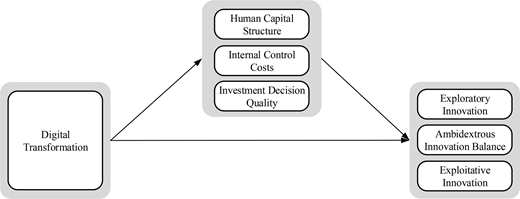
This study aims to examine whether digital transformation promotes exploratory and exploitative innovation as well as their balanced development, and to investigate the mechanisms through which digital transformation affects firms’ ambidextrous innovation.
Using firm-year observations of Chinese A-share listed companies from 2013 to 2022, this study empirically examines the effects of digital transformation on exploratory innovation, exploitative innovation and the balance between them, and further investigates the underlying mechanisms and heterogeneous effects.
Digital transformation significantly promotes both exploratory and exploitative innovation, but its effect is stronger on exploratory innovation, thereby widening the gap between the two innovation modes. Human capital structure, internal control costs and investment decision quality constitute important transmission mechanisms. The imbalance-aggravating effect is more pronounced among non-manufacturing and non-high-tech firms and in regions with weaker institutional environments. A more developed digital environment strengthens the positive effect of digital transformation on exploitative innovation.
This study moves beyond the conventional focus on whether digital transformation promotes innovation by adopting a balance-oriented perspective on organizational ambidexterity. It reveals the asymmetric effects of digital transformation on exploratory and exploitative innovation and identifies multiple internal mechanisms through which such imbalance emerges.
1. Introduction
In the contemporary digital economy, innovation constitutes the cornerstone of firms’ sustainable competitive advantage. Ambidextrous innovation, which involves simultaneous engagement in exploratory (radical, new knowledge-seeking) and exploitative (incremental, existing knowledge-refining) activities, is widely regarded as an effective approach to strengthening organizational adaptability and long-term performance (Junni et al., 2013; Saleh et al., 2023). Originating from March’s (1991) seminal research, this theoretical paradigm argues that firms need to balance the exploration of new possibilities and the exploitation of established certainties to sustain growth. After long-term development, China has achieved remarkable progress in boosting exploratory innovation capacity. Nevertheless, substantial obstacles persist in efficiently translating scientific and technological achievements into real productive forces, resulting in technological bottlenecks in key domains (Zhang et al., 2023a). Accordingly, realizing synergy and equilibrium between exploration and exploitation is essential for technological progress and the cultivation of new quality productive forces (Farzaneh et al., 2022).
Against this backdrop, China’s 14th Five-Year Plan emphasizes accelerating enterprise digital transformation, fostering cross-industry innovation through digital technologies and optimizing the commercialization of innovation outcomes. The deep integration of digital technologies − characterized by pervasiveness, substitutability and synergistic properties (Verhoef et al., 2021) − enables firms to collect, process and analyze vast data resources (Nambisan et al., 2017). This leads to the digitalization of innovation factors, virtualization of innovation networks and diversification of innovation entities (Wang, 2021), compelling firms to adapt continuously. Existing research has established that digital transformation positively influences R&D optimization, improves innovation efficiency (Li et al., 2022), facilitates new product development (Dabic et al., 2023) and promotes corporate digital technology innovation (Fang and Liu, 2024). It facilitates knowledge and technology flow, thereby reshaping and expanding the knowledge boundaries of firms (Plekhanov et al., 2023), and has been identified as a critical condition for implementing ambidextrous innovation (Liu et al., 2023a).
However, despite the potentially mixed consequences of digital transformation (Urban and Plattfaut, 2025), the existing literature reveals two critical gaps. First, while digital transformation is widely acknowledged to promote both exploratory and exploitative innovation, its specific impact on the balance between the two remains unclear and empirically inconsistent. For example, Li and Xiong (2025) and Jiang et al. (2024) have explored the heterogeneous impacts of digital transformation on ambidextrous innovation. Nevertheless, their analyses do not adopt a balance-oriented perspective, nor do they unpack the specific internal mechanisms proposed in this study. These limitations leave the effect of digital transformation on ambidextrous innovation balance insufficiently understood.
Some studies suggest that, under digital transformation, firms tend to allocate more resources to exploratory innovation than exploitative innovation (Urbinati et al., 2020). In contrast, other perspectives highlight its role in optimizing processes and enhancing existing capabilities, thereby supporting exploitative innovation (Lamperti et al., 2023; Banalieva and Dhanaraj, 2019). This divergence indicates a significant theoretical and empirical gap. A pressing question emerges:
How does digital transformation influence the balance of ambidextrous innovation, and through what mechanisms does this occur?
Second, most prior studies have examined external factors (e.g. institutional and technological environments) influencing this relationship, often overlooking the critical internal mechanisms through which digital transformation reshapes a firm’s innovation efficiency and strategic choices. Enhancing innovation capability fundamentally depends on improving innovation efficiency and controlling innovation costs (Iansiti and Lakhani, 2020). Digital transformation fosters cross-departmental collaboration, reduces coordination and management costs, optimizes resource allocation and thereby elevates overall innovation efficiency (Peng and Tao, 2022). Yet, the role of internal governance and control mechanisms − such as internal control costs and investment decision quality − in mediating the relationship between digital transformation and ambidextrous innovation balance remains underexplored.
To fill these research gaps, this study concentrates on two core dimensions:
investigating the effect of digital transformation on the balance of ambidextrous innovation; and
exploring the mediating mechanisms within firms, especially from the lens of internal control costs.
Specifically, this paper adopts human capital structure, internal control costs and investment decision quality as pivotal mediators to unpack how digital transformation improves the level, efficiency and quality of corporate innovation, and further clarify the pathways linking digital transformation to ambidextrous innovation. In this way, the present research moves beyond the oversimplified “promotion narrative” prevalent in extant literature and develops a more refined understanding of the nexus between digital transformation and firm innovation.
2. Literature review and research hypotheses
2.1 Digital transformation and ambidextrous innovation
Organizational ambidextrous innovation theory posits that exploratory innovation originates from new ideas and concepts, leading to fundamental changes in the technologies, products and services of a firm, as well as a complete disruption of the status quo. By contrast, exploitative innovation involves reconfiguring and reusing existing products through established technological trajectories and paradigms − a form of incremental innovation (March, 1991). Digital technology, characterized by its pervasiveness, substitutability and synergistic properties (Verhoef et al., 2021), can generate new business opportunities and markets for firms while driving the transformation of products and technological paradigms. First, the adoption of digital technologies strengthens a firm’s external knowledge acquisition capability, which facilitates the progression of exploratory innovation (Gobble, 2018). Second, the utilization of digital platforms and tools enhances interaction and collaboration with external stakeholders, facilitating the joint development of new products and services (Nambisan et al., 2017). Such collaborative and open innovation models promote the realization and diffusion of exploratory innovation.
Digital technology also possesses editability, generativity and traceability (Nambisan et al., 2017), attributes that can optimize business processes, enhance operational efficiency and promote innovative activities. On the one hand, digital technologies − through automation and intelligence − enable the real-time monitoring of production processes, prompting firms to uncover the latent value of existing innovation resources, advance technological upgrades and expand the functionalities of products and services (Lamperti et al., 2023). This function improves a firm’s capacity to integrate new and existing resources and optimizes resource allocation. On the other hand, digital transformation enables firms to swiftly identify and eliminate bottlenecks and inefficiencies in the innovation process, facilitating a more refined management and optimization of technological processes. This development enhances overall operational efficiency and establishes a sustained competitive advantage in existing technological domains, which in turn propels exploitative innovation (Banalieva and Dhanaraj, 2019).
Based on the foregoing insights, existing evidence suggests that digital transformation can facilitate ambidextrous innovation (Chen et al., 2025), while providing firms with advanced capabilities for knowledge identification, capture and transformation. It enhances a firm’s ability to sense external opportunities, access diverse knowledge pools and engage in disruptive experimentation, thereby strongly promoting exploratory innovation (Gobble, 2018; Kraus et al., 2023). Concurrently, digital technologies, through automation, data analytics and process virtualization, allow firms to uncover latent value in existing resources, optimize production and improve products and services incrementally, thus fostering exploitative innovation (Lamperti et al., 2023; Banalieva and Dhanaraj, 2019). Consequently, the following hypothesis is proposed:
Digital transformation exerts a positive impact on both (a) exploratory and (b) exploitative innovation within firms.
2.2 Digital transformation and the balance of ambidextrous innovation
Ambidextrous innovation balance implies that a firm is capable of simultaneously pursuing exploratory and exploitative innovation activities − driving breakthrough innovations while refining and optimizing existing capabilities (Farzaneh et al., 2022). The application of digital technology endows firms with digital identification, capture and transformation capabilities, which may positively affect the balance of ambidextrous innovation. First, a firm’s digital capabilities enable it to sense external opportunities and threats, tap into potential new markets and foster exploratory innovation to better adapt to technological changes and environmental uncertainties (Zhang et al., 2017). Second, digital technology enhances a firm’s ability to acquire and integrate heterogeneous external resources, which can then be transformed into internal innovation outputs, thereby promoting exploitative innovation. Third, digital transformation drives firms to make significant investments and incur high hidden costs in exploring new technologies (Lyytinen et al., 2016), while the short-term economic benefits and cumulative technological knowledge derived from exploitative innovation serve as safeguards for undertaking exploratory innovation. The synergy between these two forms of innovation becomes a powerful engine for enhancing the competitive advantage of a firm.
However, exploratory and exploitative innovations differ significantly in resource requirements, technological trajectories and risk-return profiles (Guisado-González et al., 2017) and are subject to resource constraints and organizational inertia. Accordingly, a competitive tradeoff may emerge between firms’ exploratory and exploitative innovation activities in the digital context (Kim et al., 2012). Furthermore, digital technologies exert heterogeneous effects on these two types of innovation. On the one hand, digital transformation enables firms to acquire and integrate external knowledge resources more efficiently, thereby stimulating intensive exploratory innovation activities and fostering an exploration-biased digital innovation strategy. On the other hand, digital transformation requires substantial corporate investment and generates considerable implicit costs in the exploration of emerging technologies. Although such technological exploration benefits firms’ long-term performance, it may also lead to excessive reliance on new technologies, crowding out the improvement of existing technologies and operational processes (Lyytinen et al., 2016). While digital technologies empower firms to unlock the value of existing resources and facilitate exploitative innovation, the complexity and uncertainty inherent in digital transformation create substantial difficulties for firms in achieving the simultaneous balance of exploratory and exploitative innovations.
The effect of digital transformation on the balance between exploration and exploitation is theoretically complex. From one perspective, digital capabilities can enhance a firm’s dynamic capabilities, enabling better management of the tensions between exploration and exploitation. Digital tools improve information processing, resource flexibility and strategic agility, potentially allowing firms to pursue both activities more effectively and achieve balance (Zhang et al., 2017). The synergies created − where exploitative innovation provides short-term stability to fund exploratory ventures − can be amplified through digital integration. This leads to the following hypothesis:
Digital transformation enhances the balance of ambidextrous innovation within firms.
Conversely, the very nature of digital transformation may inherently favor exploration. The high visibility and potential rewards of disruptive digital innovation, coupled with the substantial investments and managerial attention required, might lead firms to prioritize exploratory projects at the expense of exploitative ones (Lyytinen et al., 2016). Furthermore, exploratory and exploitative innovations compete for the same finite resources and follow different technological trajectories, creating inherent tradeoffs (Kim et al., 2012; Guisado-González et al., 2017). If digital transformation disproportionately boosts the marginal returns or perceived strategic importance of exploration, it can destabilize the balance. The underlying reason is that the high visibility, high reward potential and substantial upfront investments with high hidden costs for exploring new technologies (Lyytinen et al., 2016) naturally incline firms to allocate more resources to exploratory innovation at the expense of exploitative innovation, thereby exacerbating the imbalance. Thus, the following competing hypothesis is proposed:
Digital transformation exacerbates the imbalance of ambidextrous innovation within firms.
2.3 The mediating role of human capital structure
In the context of the digital economy, advancements in production technology and automation are continuously progressing. Enhanced technological innovation efficiency increases firms’ demand for information technology talent (Malik et al., 2021). Firms now rely on a workforce endowed with multidisciplinary knowledge and high-level skills to drive innovation, optimize products and boost R&D capabilities. Simultaneously, digital transformation has profound impacts on the core technologies and business models of a firm, deepening the complementary effect between information technology and highly skilled labor and further promoting the influx of high-tech talent and upskilling of existing employees (Guerra and Valle, 2024).
During digital transformation, a highly skilled workforce not only improves production efficiency but also enhances management practices by optimizing organizational structures and skill matching. This effect leads to greater utilization of existing technologies and knowledge, significantly bolstering exploitative innovation. The adoption of digital technology also compels firms to invest in higher-level human capital, enabling them to efficiently drive product development and technological breakthroughs using advanced digital tools and explore market opportunities. These outcomes, in turn, strengthen exploratory innovation and ultimately enhance both the quality and impact of innovation.
Digital transformation fundamentally alters skill requirements, increasing the demand for a workforce proficient in data analytics, software development and digital tool application − individuals with multidisciplinary knowledge and higher education levels (Malik et al., 2021; Guerra and Valle, 2024). This drives an upgrade in the human capital structure (HCS). An upgraded HCS is a critical resource for innovation. Highly skilled employees are better equipped to conduct cutting-edge R&D, driving exploratory innovation. By facilitating the integration of advanced knowledge into innovation processes, an improved HCS serves as a key channel through which digital transformation boosts overall innovation performance. Therefore, the following hypothesis is proposed:
The human capital structure of a firm mediates the relationship between digital transformation and ambidextrous innovation.
2.4 The mediating role of internal control costs
Internal control requires firms to allocate resources judiciously. Firms can enhance their innovation efficiency by rigorously controlling and monitoring R&D costs. Digital technology has reshaped internal management processes by redefining the competitive models, mechanisms and boundaries of a firm (Porter and Heppelmann, 2014). It has also reduced search and management costs in information transmission, thereby enhancing the efficiency of resource organization and allocation (Zhang et al., 2023b). Consequently, a higher degree of digitalization can help firms lower internal control costs and achieve more efficient organizational management and operations.
As digital technology becomes increasingly integrated, internal coordination processes are continuously optimized, leading to significant reductions in control costs. On the one hand, digital technology is often incorporated as a supportive component within the business operations framework (Lyytinen et al., 2016), serving to monitor production tool usage and evaluate production unit efficiency in real time. This practice helps reduce marginal internal control costs, enhance organizational information search and integration capabilities, facilitate the effective merging of heterogeneous resources, nurture exploratory innovation capabilities and expand innovation boundaries (Wang and Shao, 2024). On the other hand, digital transformation promotes real-time and transparent production processes, which aids in quality enhancement and efficiency improvement. It also boosts inter-departmental collaboration and lowers supervisory costs within business processes, thereby driving down internal control costs while improving production efficiency (Tian et al., 2024), ultimately enhancing exploitative innovation activities.
Internal control costs (ICC) encompass the expenses related to coordinating internal divisions, managing information flows and mitigating agency problems. Digital transformation, through intelligent management systems and seamless information sharing, significantly optimizes internal coordination processes (Zhang et al., 2023b; Porter and Heppelmann, 2014). This leads to a reduction in ICC. Lower ICC frees up resources that can be reallocated to R&D. Reduced bureaucratic friction and improved information integration facilitate the merging of heterogeneous knowledge, nurturing exploratory innovation (Wang and Shao, 2024). Concurrently, enhanced operational transparency and inter-departmental collaboration lower supervisory costs and improve production efficiency, directly benefiting exploitative innovation (Tian et al., 2024). Thus, the cost-saving effect of digitalization is a vital mechanism for enabling innovation. On the basis of the aforementioned, the following hypothesis is proposed:
Internal control costs mediate the relationship between digital transformation and ambidextrous innovation.
2.5 The mediating role of investment decision quality
During digital transformation, firms leverage digital technology to efficiently collect and analyze internal and external information, thereby enhancing management’s understanding of financial conditions and market environments. By establishing a digital governance system to optimize the decision-making process, firms can reduce self-serving behaviors among management. This process enhances information transparency within the firm and provides management with more accurate and timely decision-making support, thus reducing uncertainty and arbitrariness in investment decisions. Enhanced information transparency further mitigates the information asymmetry between the firm and external markets, improves resource allocation efficiency and reduces inefficient investment behaviors (Liu et al., 2023b).
Digital innovation also strengthens the flow of information and coordination of resource allocation among different departments, facilitating the execution and implementation of investment decisions and enhancing the efficiency of converting innovative outcomes. On the one hand, the real-time, precise information flow provided by digital applications helps managers make high-quality choices in uncertain environments. It enhances their ability to recognize innovation opportunities, reduces uncertainties and risks during the exploratory process and promotes breakthroughs in cutting-edge technologies as well as the development of new products and services (Nambisan et al., 2017). On the other hand, firms use digital means to assess and leverage existing technological assets and production resources, thereby effectively integrating internal and external resources, enhancing the market competitiveness of their products and services. Improved operational efficiency coupled with reduced management costs enables firms to achieve higher profitability and stronger market adaptability during exploitative innovation (Adner et al., 2019).
Digital transformation enhances investment decision quality (IDQ) by improving the information environment. Digital tools enable efficient collection and analysis of internal and external data, increasing information transparency and reducing asymmetry (Liu et al., 2023b). This allows managers to make more accurate, timely and less arbitrary investment decisions, moving capital allocation closer to the optimal level. High-quality investment decisions reduce uncertainty in long-term, risky R&D projects, thereby promoting exploratory innovation (Nambisan et al., 2017). They also ensure that investments in existing technologies and assets are efficient and well-targeted, bolstering exploitative innovation (Adner et al., 2019). By improving the efficiency of capital allocation toward innovative activities, enhanced IDQ is a crucial pathway linking digital transformation to innovation outcomes. Hence, the following hypothesis is proposed:
The quality of investment decisions mediates the relationship between digital transformation and ambidextrous innovation.
Therefore, the theoretical framework of this study is presented in Figure 1.
3. Research design
3.1 Data collection
The empirical sample covers A-share companies traded on the Shanghai and Shenzhen stock exchanges between 2013 and 2022. Financial firms are excluded because of their distinctive regulatory and operating features. We also remove firms designated as ST or *ST and firm-year records for which the key variables cannot be constructed due to missing information. These screening criteria leave 20,978 firm-year observations for the analysis. To reduce the sensitivity of the estimates to extreme values, all continuous measures are truncated at the 1st and 99th percentiles. The data are assembled from several sources. The firm-level digital transformation measure is constructed using information from the China Securities Information Database. Patent information used to identify exploratory and exploitative innovation comes from the China Research Data Service Platform (CNRDS) and Wind. The measures of human capital structure, internal control costs, investment decision quality and the remaining control variables are drawn from the China Stock Market and Accounting Research (CSMAR) Database.
3.2 Variable definitions
3.2.1 Dependent variables.
Ambidextrous innovation. Patent applications are used to operationalize the two dimensions of ambidextrous innovation. Invention patents, which generally involve greater technological novelty and functional improvement, are treated as indicators of exploratory innovation (Explore), whereas utility model and design patents are more closely associated with incremental improvements in product structure or appearance and are therefore used to represent exploitative innovation (Exploit). Specifically, Explore is calculated as the natural logarithm of one plus the number of invention patent applications, while Exploit is calculated as the natural logarithm of one plus the combined number of utility model and design patent applications. This transformation accommodates zero observations and reduces distributional skewness. Following Cao et al. (2009), ambidextrous innovation balance (Balance) is measured as the absolute difference between Explore and Exploit. A lower value of Balance indicates a closer alignment between the two innovation dimensions.
3.2.2 Key independent variable.
Digital transformation. Firm-level digital transformation (Digital) is quantified using textual information disclosed in the Management Discussion and Analysis (MD&A) section of annual reports. For each firm-year, occurrences of terms related to artificial intelligence, big data, cloud computing, blockchain and other digital technology applications are aggregated. Because MD&A sections vary in length across firms and years, the raw keyword count is divided by the total number of words in the corresponding section. The resulting length-adjusted keyword intensity is used to measure Digital, with larger values indicating a higher degree of digital transformation.
3.2.3 Mediating variables.
Human capital structure. Education is widely recognized as an important determinant of a firm’s human capital profile, with employee educational attainment often reflecting workforce skill levels. Accordingly, human capital structure (Hcs) is operationalized as the share of employees holding a bachelor’s degree or above. Higher values reflect a more highly educated workforce.
Internal control costs. Internal control costs encompass two main components:
the management costs required to coordinate and integrate activities across various internal divisions; and
the efficiency losses and supervisory expenses incurred to mitigate agency problems (Yuan et al., 2021).
Therefore, this study measures internal control costs (Icc) using the ratio of management expenses, where higher values denote higher internal control costs.
Investment decision quality. Effective investment decision-making hinges on accurately capturing investment opportunities to ensure that actual investments approach the optimal level, thereby enhancing investment efficiency. Drawing on the investment efficiency framework developed by Biddle et al. (2009), this study estimates the association between corporate investment and growth opportunities to evaluate firms’ capital utilization efficiency. Sales growth rate is adopted to measure growth opportunities, and the expected investment level is calculated via equation (1):
where Investmenti, t + 1 denotes the investment of firm i in period t + 1, and Growth represents firm i’s growth opportunities in period t, measured as the percentage change in sales revenue from period t to period t + 1. The regression residual reflects the discrepancy between actual and optimal investment levels. Thus, the absolute value of the residual is used to indicate inefficient investment (Idq), with lower values representing higher investment decision quality.
3.2.4 Control variables.
Based on prior studies and the key factors influencing ambidextrous innovation, the following control variables are included: firm age (Age), leverage (Lev), ownership concentration (Top1), proportion of independent directors (Indep), cash flow (Cash), firm growth (Grow), CEO duality (Dual), fixed asset ratio (Fixed) and board size (Board).
The definitions and measurement methods of these variables are summarized in Table 1.
3.3 Model construction
Based on the theoretical analysis and research hypotheses, this study posits that digital transformation influences the ambidextrous innovation of firms. Accordingly, we construct the following empirical models:
where i and t denote the firm and year, respectively; Innovation represents exploratory and exploitative innovations; Balance denotes the balance of ambidextrous innovation; Digital represents digital transformation; α1 is the constant term; controls represents the set of control variables; year and industry denote year and industry fixed effects, respectively; and εi, t is the random error term. According to the theoretical model, if the coefficient of Digital (α2) in equation (2) is significantly positive, it indicates that digital transformation promotes both exploratory and exploitative innovation, thereby supporting H1. Furthermore, if in equation (3), the coefficient of Digital (μ2) is negative, it implies that digital transformation fosters a more balanced ambidextrous innovation, supporting H2a. Conversely, if μ2 is positive, it suggests that digital transformation exacerbates imbalance, thereby supporting the competing hypothesis H2b.
4. Analysis of empirical results
4.1 Descriptive statistics
Table 2 presents the descriptive statistics for the main variables. The mean value of digital transformation (Digital) is 0.998 with a standard deviation of 1.048, indicating that some sample firms exhibit a high level of digitalization. Nonetheless, there is notable heterogeneity across firms. The mean for exploratory innovation (Explore) is 1.209 (with a maximum of 5.808 and a minimum of 0), and for exploitative innovation (Exploit), the mean is 1.231 (with a maximum of 5.768 and a minimum of 0). The balance of ambidextrous innovation (Balance) ranges from 0 to 3.332, with a median of 0.288. Overall, the sample firms exhibit similar average levels of exploratory and exploitative innovation, while substantial variation exists in the balance between the two innovation modes. Substantial variation also exists in human capital structure, internal control costs and investment decision quality.
4.2 Benchmark regression
Table 3 reports the baseline estimates. Columns (1), (3) and (5) include year and industry fixed effects but exclude the control variables. Across these specifications, the coefficient on digital transformation is positive and statistically significant at the 1% level. After introducing the controls, Columns (2) and (4) show that a one-unit increase in digital transformation corresponds to increases of 0.230 and 0.139 in exploratory and exploitative innovation, respectively. Meanwhile, Column (6) demonstrates that each one-unit increment in digital transformation elevates ambidextrous innovation imbalance by 0.078. Collectively, these findings suggest that digital transformation facilitates both exploratory and exploitative innovation, which supports H1. Nevertheless, the stronger promotional effect on exploratory innovation relative to exploitative innovation reveals that digital transformation triggers an imbalance between the two innovation dimensions, thus verifying H2b.
4.3 Endogeneity issues
4.3.1 Instrumental variable test.
Potential endogeneity may bias the estimated effect of digital transformation on ambidextrous innovation. We therefore implement an instrumental-variable approach using the mean digital transformation intensity of other firms operating in the same city–industry cell, with the focal firm excluded. This peer-based measure should be strongly associated with a firm’s own digitalization because firms exposed to the same local and industrial environment tend to face similar technological conditions. At the same time, it is unlikely to affect the focal firm’s innovation outcomes directly through its internal resource-allocation decisions, supporting the exclusion condition. The models are re-estimated using two-stage least squares (2SLS). Table 4 shows a strong first-stage relationship between the instrument and digital transformation, while the Kleibergen−Paap statistics provide additional evidence against weak identification. In the second stage, digital transformation retains a positive and statistically significant effect on both exploratory and exploitative innovation as well as on their imbalance. The baseline conclusions therefore remain unchanged after accounting for potential endogeneity.
4.3.2 Heckman two-step method.
Firms with relatively high levels of digital transformation may differ systematically from their counterparts in ways that are also related to innovation outcomes, raising concerns about nonrandom sample selection. We address this issue using the Heckman two-step procedure. The selection equation defines a binary indicator (If_Digital) equal to one when a firm’s digital transformation level exceeds the corresponding industry average and zero otherwise. The mean digital transformation level of other firms located in the same city (IV) is introduced as the exclusion variable. Based on the first-stage estimates, the inverse Mills ratio (IMR) is then derived and incorporated into the outcome equation to account for selection effects. Table 5 shows that the city-level peer measure is positively associated with the selection indicator at the 1% significance level. After the IMR is included, the estimated coefficient on digital transformation remains positive and statistically significant. The baseline results are therefore insensitive to correction for potential sample selection.
4.4 Robustness checks
4.4.1 Alternative measurements.
As an alternative measure of digital transformation, we construct a keyword-based index from firms’ annual reports. Specifically, the occurrences of five digitalization-related terms − “artificial intelligence technology,” “big data technology,” “cloud computing data,” “blockchain technology” and “digital technology application” − are summed for each firm-year observation. The resulting count is transformed using (ln(1 + x)) and denoted as Dcg. On the other hand, we measure exploratory innovation input (RDE) using R&D expenditures during the research phase and exploitative innovation input (RDI) using expenditures during the development phase, scaled by the beginning-of-year total assets. Furthermore, we construct a new variable for ambidextrous innovation imbalance (RD_B), calculated as |RDE – RDI|, where a larger value indicates a greater imbalance between exploratory and exploitative innovation inputs. The empirical results in Tables 6 and 7 show that the core explanatory variable remains significantly positive.
4.4.2 Alternative estimation methods.
Since ambidextrous innovation is a count variable with a highly skewed distribution, employing OLS may introduce estimation errors. To address this, we construct dummy variables (If_Explore, If_Exploit, If_Balance; set to 0 if the corresponding variable equals 0, and 1 otherwise) and estimate the model using a Probit regression. As reported in Table 8, the coefficients for digital transformation remain significantly positive, reinforcing the conclusion that digital transformation promotes ambidextrous innovation and intensifies its imbalance. Thus, our results are robust.
4.4.3 Additional robustness checks.
To further mitigate endogeneity concerns, we incorporate higher-order joint fixed effects (industry × year) in addition to the standard time and industry fixed effects. The corresponding results are presented in Table 9. Moreover, we exclude firms that did not file any patent applications throughout the entire sample period, with the results reported in Table 10. The coefficient on digital transformation remains significantly positive, thereby confirming the robustness of our findings.
5. Mechanism tests
The theoretical analysis suggests that digital transformation can upgrade the human capital structure of a firm, improve internal communication and collaboration, reduce monitoring costs, enhance R&D investment and improve investment decision quality, thereby fostering innovation. To test these hypothesized effects, we use a stepwise mediation analysis and design the following mediation models:
where i and t denote firm and year, respectively; M represents the mediating variable (human capital structure, internal control costs or investment decision quality); and controls represents the set of control variables consistent with Models (2) and (3). Year and industry denote fixed effects, β1、γ1 and λ1 are constants and δi,t is the error term.
5.1 Mediation test for human capital structure
Table 11 reports the mediation results for human capital structure. The first specification shows that digital transformation (Digital) is positively associated with human capital structure (Hcs) at the 1% significance level, suggesting that digitalization is accompanied by an upgrading of firms’ workforce composition. When Hcs is introduced into the models for exploratory innovation (Explore), exploitative innovation (Exploit) and ambidextrous innovation balance (Balance), its coefficient remains significantly positive, while the estimated effect of Digital becomes smaller than that in the baseline regressions reported in Table 3. The Sobel and bootstrap tests provide further evidence of a partial mediating effect of Hcs, supporting H3.
5.2 Mediation test for internal control costs
Table 12 summarizes the mediation analysis for internal control costs (Icc). The first-stage estimate shows that digital transformation (Digital) is negatively related to Icc at the 1% significance level, implying that greater digitalization is associated with lower internal control costs. After Icc is incorporated into the models for exploratory innovation (Explore), exploitative innovation (Exploit) and ambidextrous innovation balance (Balance), its coefficient remains significantly negative, while the magnitude of the coefficient on digital is reduced relative to the baseline estimates in Table 3. This attenuation, together with the Sobel and bootstrap results, supports a partial mediating role of internal control costs and provides evidence in favor of H4.
5.3 Mediation test for investment decision quality
Table 13 shows the mediation analysis results for investment decision quality (Idq) using the stepwise regression method. Column (1) indicates that digital transformation (Digital) significantly reduces investment inefficiency (i.e. improves investment decision quality). In columns (2), (3) and (4), when Explore, Exploit and Balance are added, respectively, the coefficient for Idq remains significantly negative, and the coefficient for Digital is reduced compared to the benchmark (Table 3). Sobel and bootstrap tests confirm that investment decision quality partially mediates the relationship between digital transformation and ambidextrous innovation, thereby supporting H5.
6. Further analysis
6.1 Heterogeneity analysis
6.1.1 Industry heterogeneity.
The strategic decisions of a firm are influenced by the external environment and industry structure, both of which affect its investment in innovation and choice of innovation strategy. Firms are grouped into manufacturing and non-manufacturing sectors for regression analysis, and Fisher tests are conducted to compare group differences. As shown in Table 14, digital transformation positively promotes ambidextrous innovation in manufacturing firms; its innovation-driving effect is more pronounced in manufacturing firms. By contrast, for non-manufacturing firms, the application of digital technologies expands innovation boundaries and alleviates information barriers, thereby having a more pronounced effect on enhancing exploratory innovation. However, under resource constraints, a heavy focus on exploratory innovation may crowd out exploitative innovation, leading to greater imbalance.
6.1.2 Technological attribute heterogeneity.
A firm’s technological capabilities and accumulated reserves significantly shape its strategic development. Using the high-tech enterprise directory, we categorize firms into high-tech and non-high-tech groups and estimate separate regressions, accompanied by Fisher tests. As presented in Table 15, under digital transformation, high-tech and non-high-tech firms exhibit significant differences in exploratory innovation, exploitative innovation and the balance of ambidextrous innovation. Although digital transformation significantly promotes both exploratory and exploitative innovation in high-tech and non-high-tech firms, its imbalance-aggravating effect is significantly weaker among high-tech firms. This finding indicates that high-tech firms, owing to their superior technological accumulation and R&D capabilities, are able to more fully capitalize on the benefits of digital transformation, thereby demonstrating stronger innovation growth and a more balanced innovation portfolio. In contrast, non-high-tech firms, with weaker technological foundations and limited access to resources, face greater challenges in leveraging digital innovation.
6.1.3 External institutional environment heterogeneity.
The institutional environment, which is shaped by legal frameworks and government policies − especially intellectual property protection − exerts a direct influence on corporate behavior. Drawing on provincial indicators from the 2018 China Marketization Index Report to measure the development of market intermediary organizations and the legal environment, this study divides the sample regions into those with a stronger institutional environment and those with a weaker one according to the sample median. The results of subgroup regressions and Fisher tests (Table 16) shows that digital transformation significantly fosters innovation in both institutional settings, although this positive effect is more pronounced among firms located in regions with a weaker institutional environment. This result implies that in the digital economy, firms can leverage digital platforms and tools to integrate into broader innovation ecosystems, fostering collaboration among heterogeneous innovation agents and mobilizing greater innovation efforts.
6.1.4 External digital environment heterogeneity.
Internet-based digital infrastructure improves local information conditions and transparency, compelling firms to integrate into innovation networks. Using principal component analysis to construct a digital economy indicator system for Chinese cities (drawing on data for internet development and digital inclusive finance), this study groups firms into high and low digital economy regions. Group regressions and Fisher tests (Table 17) reveal that while digital transformation significantly promotes both exploratory and exploitative innovation across regions, it more effectively supports technological exploration and new field development. This situation leads firms to allocate relatively more resources toward exploration, thus exacerbating the imbalance. Moreover, the positive effect on exploitative innovation is stronger in regions with a high digital economy than in those with a low digital economy because of superior digital infrastructure, abundant technological resources and stronger support from the innovation ecosystem.
6.2 Economic consequences
Building on the previous analysis, this study further investigates whether digital transformation can enhance the total factor productivity (TFP) of firms by promoting ambidextrous innovation. Specifically, we use a stepwise mediation analysis to test if digital transformation improves TFP via its impact on ambidextrous innovation. The mediation models are specified as follows:
where TFP is measured following the method of (Levinsohn and Petrin, 2003), and AI represents ambidextrous innovation (including its balance). The definitions of all other variables remain as previously described.
Tables 18–20 present the results of the mediation analysis. In Table 18, column (1) shows that the coefficient on Digital is significantly positive at the 1% level, indicating that digital transformation significantly enhances firm total factor productivity (TFP). Consistent with the benchmark findings in Table 3, column (2) confirms that digital transformation significantly promotes exploratory innovation, exploitative innovation and the degree of imbalance. In column (3), the coefficients for exploratory innovation (Explore), exploitative innovation (Exploit) and the imbalance index (Balance) are all significantly positive at the 1% level, while the coefficient for Digital decreases correspondingly. Sobel and bootstrap tests confirm that exploratory innovation, exploitative innovation and innovation imbalance partially mediate the effect of digital transformation on TFP. These findings imply that the increases in exploratory and exploitative innovation, together with the resulting innovation imbalance, subsequently translates into improvements in firm productivity.
7. Conclusion and contributions
7.1 Conclusions
Using data on Chinese A-share listed firms spanning the period from 2013 to 2022, this research offers a systematic investigation into the influence of digital transformation on corporate ambidextrous innovation, along with the mechanisms underlying this relationship. The principal conclusions are summarized below.
First, regarding the main effects, digital transformation demonstrates a significant dual driving effect on both exploratory and exploitative innovation. With the digitalization of innovation factors and virtualization of innovation networks, the evolution of innovation paradigms in the digital context enables firms to not only repurpose existing resources but also identify and develop potential new markets. This facilitates the transformation of heterogeneous resources into competitive advantages, thereby enhancing both types of innovation activities. However, the study reveals an important paradox: while digital transformation promotes both exploratory and exploitative innovation, it simultaneously leads to a significant imbalance in ambidextrous innovation. This imbalance primarily manifests as a stronger promoting effect on exploratory innovation compared to exploitative innovation. The underlying reason lies in the fact that digital transformation drives substantial investment and incurs high hidden costs for exploring new technologies to improve long-term performance, which may cause firms to become overly dependent on new technologies at the expense of improving existing ones.
Second, the mechanism analysis confirms the significant mediating roles of human capital structure, internal control costs and investment decision quality in the relationship between digital transformation and ambidextrous innovation. Digital technology introduces intelligent and transparent decision support systems that refine organizational division of labor. This optimization process upgrades human capital structure, reduces internal control costs and improves the efficiency of allocating innovation resources, ultimately enhancing investment decision quality. These improvements enable firms to respond flexibly to market changes and innovation demands, increase the success rate of exploratory innovation and promptly detect and correct issues in the innovation process. However, while overall innovation efficiency is enhanced, improved internal management and investment quality lead firms to allocate substantial time and resources toward breakthrough innovation to secure market position. This heightened emphasis on exploratory innovation further exacerbates the imbalance between exploratory and exploitative innovations.
Third, the heterogeneity analysis indicates that both external environments and firm-specific characteristics significantly influence the impact of digital transformation on ambidextrous innovation. Specifically, the beneficial effects of digital transformation on ambidextrous innovation are stronger among manufacturing firms and high-tech enterprises, while the imbalance in ambidextrous innovation is more pronounced among non-manufacturing and non-high-tech firms. Moreover, compared to regions with well-developed institutional environments, firms in areas with poor institutional conditions tend to rely more on digital transformation to elevate their innovation levels, placing greater emphasis on exploratory innovation and thereby increasing the imbalance. With respect to regional digital economy development, although the effects on exploratory innovation and innovation balance appear broadly similar across regions, firms located in areas with a more advanced digital economy – supported by superior digital infrastructure and stronger innovation ecosystems – are more likely to optimize resource allocation in ways that enhance exploitative innovation.
7.2 Theoretical contributions
This research advances the existing body of literature on digital transformation and innovation management by offering several key theoretical contributions.
First, it deepens our understanding of how digital transformation affects both the magnitude and balance of ambidextrous innovation. The results challenge the simplistic “promotion narrative” prevalent in existing literature by demonstrating that digital transformation tends to create a “digital divide” between exploration and exploitation. This raises important questions about whether traditional ambidexterity theory, which often assumes a feasible and beneficial balance, fully captures the unique dynamics of innovation in the digital era.
This study not only verifies that digital transformation exerts a positive effect on both exploratory and exploitative innovation but also demonstrates that digital transformation may widen the gap between the two innovation modes. This evidence points to the non-equilibrium character of digital innovation and thereby enriches the theoretical implications of ambidextrous innovation in the context of the digital economy. The results challenge the simplistic “promotion narrative” prevalent in existing literature and raise important questions about whether traditional ambidexterity theory fully captures innovation modes in the digital era, thus warranting further investigation.
Second, the empirical results enrich the literature on the mechanisms through which digital transformation empowers firm innovation. By examining the mediating roles of human capital structure, internal control costs and investment decision quality, this study provides a more comprehensive understanding of how digital transformation drives firms’ ambidextrous innovation. The findings clarify the linkage between internal management decisions and innovation outcomes in a digital context, thereby extending research on human capital theory, internal control frameworks and investment decision models under digital conditions. This multi-mechanism perspective offers a finer-grained analysis of the “black box” through which digital transformation influences innovation.
Third, by integrating macro- and micro-level data, this study explores the heterogeneous effects of digital transformation on ambidextrous innovation from both firm-specific and external environmental perspectives. The findings uncover systematic differences in innovation mode choices and balance among firms in different industries, with varying technological attributes, and operating under distinct institutional environments and digital governance levels. These insights contribute to the institution-based understanding of firm innovation performance in a digital context and provide a more nuanced framework for analyzing the contingent nature of digital transformation effects.
7.3 Limitations and future research directions
This study has several limitations that offer avenues for future research. First, our sample is restricted to Chinese A-share listed companies, so cross-country comparisons would be valuable to test generalizability. Second, we measured ambidextrous innovation using patent-based proxies; future research could adopt alternative measures such as survey instruments, textual analysis or case studies. Third, the mediating mechanisms we identified (human capital, internal control, investment decision quality) are not exhaustive; other factors such as organizational culture, leadership or external collaboration networks may also play important roles. Finally, future research could explore moderators that help firms mitigate the imbalance effect, such as governance mechanisms or strategic flexibility, thereby offering more actionable guidance for managers.