This study aims to examine how artificial intelligence (AI) maturity translates into entrepreneurial success in incubators and accelerators by testing startup adaptability as a key mechanism and governance as a contextual boundary condition.
Cross-sectional survey data from 101 incubator and accelerator professionals in leading innovation economies were analyzed using partial least squares structural equation modeling to estimate direct, mediation and interaction effects.
AI maturity contributes to entrepreneurial success primarily through startup adaptability, while AI usage and knowledge transfer show no consistent direct performance effects. Interaction tests indicate no significant moderation effects for ethical governance or sectoral context in this sample, suggesting that contextual influences may operate through upstream enabling conditions rather than short-term interaction patterns.
The cross-sectional design limits causal inference about capability development over time. Single-informant, program-level perceptions may introduce common-source bias and reduce sensitivity to founder-level learning dynamics. The modest sample size restricts statistical power for interaction testing, and limited variance in governance and sectoral conditions within leading innovation economies may attenuate detectable moderation effects. The marginal AVE for knowledge transfer suggests construct heterogeneity; future research should disaggregate exposure versus enactment and use behaviorally anchored indicators. Longitudinal, multirespondent and sector-balanced designs are needed to validate boundary conditions.
Managers of incubators and accelerators should prioritize AI maturity investments in data quality, system integration and analytical skills before expecting measurable performance gains. AI-generated insights yield value when embedded into routines that support disciplined iteration, such as structured selection panels, milestone reviews and mentoring processes. Given the weak role of knowledge transfer, programs should shift from exposure-oriented training toward co-execution models that translate learning into enacted practice. Governance should be implemented as enabling infrastructure (auditability, accountability, transparency) that supports trustworthy routine integration.
Strengthening AI maturity and responsible governance in entrepreneurial support organizations can improve transparency, fairness and accountability in venture selection and resource allocation. When AI insights are routinized into decision-making, incubators and accelerators may better support evidence-based experimentation, reduce informational asymmetries and increase the effectiveness of public and private innovation investments. Emphasizing governance as enabling infrastructure – rather than compliance alone – can enhance stakeholder trust and legitimacy of AI-assisted judgments. Over time, such practices may contribute to more resilient entrepreneurial ecosystems and more inclusive access to high-quality support mechanisms.
The study advances mechanism-based explanation beyond descriptive tool-focused accounts by integrating institutional theory and dynamic capabilities theory to clarify how AI-enabled routines convert capability foundations into program-level outcomes.
1. Introduction
Artificial intelligence (AI) has evolved from an experimental tool into a foundational organizational capability within entrepreneurship-supporting institutions. Incubators and accelerators – organizations that select ventures, structure mentoring and training and broker access to networks and finance – provide a particularly relevant context for assessing whether AI can transform informational advantages into program-level performance outcomes (Giuggioli and Pellegrini, 2023; Chalmers et al., 2021; Reim et al., 2020). Despite growing interest, cumulative and mechanism-based evidence remains limited: catalogs of tools and applications still outnumber theoretically grounded explanations that clarify how organizational routines and controls translate AI capabilities into measurable outcomes, and much of the literature emphasizes startup-level adoption or corporate “readiness” rather than the processes embedded within incubators and accelerators (Davidsson and Sufyan, 2023; Obschonka and Audretsch, 2020). Building on this gap, we propose and test a structural account in which AI capabilities influence entrepreneurial success primarily through entrepreneurial adaptability, defined as the routinized translation of AI-generated signals into iterative decisions, and contingent on governance arrangements that confer reliability, transparency and legitimacy on AI-assisted judgments (Dennehy et al., 2023; Karimi and Zade, 2024; Ogundipe et al., 2024; Nyoto et al., 2024). Consistent with IT, the argument follows DiMaggio and Powell’s (1983) insight that formal structures and norms shape organizational uptake and credibility, implying that AI’s effects depend on the governance architecture in which they are embedded.
The analysis operationalizes six latent constructs aligned with the thesis-based measurement instrument – AI maturity, AI adoption and use, knowledge transfer, startup adaptability, ethical (innovation) governance and entrepreneurial success – and evaluates theoretically motivated direct, mediated and conditional relationships among them. Conceptually, AI maturity captures the readiness of data, infrastructure and skills, whereas AI adoption and use reflect the enactment of these capabilities within organizational routines (Dennehy et al., 2023; Mikalef and Gupta, 2021). Knowledge transfer represents how mentoring, training and data-driven learning disseminate and absorb insights across programs (Upadhyay et al., 2022; Fang, 2023). Startup adaptability denotes disciplined iteration in response to informational signals, consistent with dynamic capabilities research emphasizing sensing, interpretation and reconfiguration under uncertainty (Shepherd and Majchrzak, 2022; Teece et al., 2016; Teece, 2018). Ethical/innovation governance is treated as a boundary condition that shapes credibility and uptake of AI-enabled assessments, especially where reliable oversight is necessary for acceptance and sustained use (Ogundipe et al., 2024; Nyoto et al., 2024).
Empirically, we draw on a structured cross-sectional survey of 101 professionals working in incubators and accelerators across leading innovation economies (Dutta et al., 2023) and estimate the proposed model using partial least squares structural equation modeling (PLS-SEM). Following established protocols, we assess indicator reliability and internal consistency, convergent and discriminant validity using HTMT and the Fornell–Larcker criterion, effect sizes and predictive relevance (Hair et al., 2019, 2020; Henseler et al., 2016; Fornell and Larcker, 1981). Overall, the central argument is straightforward: AI’s value extends beyond tool possession. When AI-derived insights are integrated into adaptive routines and governed by institutional frameworks that discipline and legitimize their application, quantifiable advantages can emerge. The next section reviews the literature supporting each construct and develops the hypotheses that guide empirical analysis.
2. Literature review and hypotheses
The growing body of research on AI in entrepreneurial settings has shifted attention from cataloging tools toward understanding the organizational competences and institutional arrangements required to generate value from AI. This shift is particularly relevant for incubators and accelerators, which operate as structured entrepreneurial support organizations responsible for venture selection, mentoring and training, network orchestration and the allocation of limited resources. In such environments, AI can enhance screening, monitoring and learning processes by improving the speed and consistency of information processing and decision support.
However, the performance contribution of AI remains contingent on whether AI-enabled information is effectively integrated into routine practices and whether it is recognized as a legitimate and actionable basis for decision-making. Recent reviews in the incubation and acceleration context emphasize these operational challenges and highlight that AI-driven capabilities must be embedded within program-level processes to yield measurable outcomes (Giuggioli and Pellegrini, 2023; Chalmers et al., 2021; Reim et al., 2020). At the ecosystem level, research similarly indicates that the field is still dominated by descriptive insights, with relatively fewer cumulative and theory-driven explanations of how AI affects entrepreneurial performance mechanisms (Davidsson and Sufyan, 2023). Taken together, this suggests that AI-related outcomes in incubator and accelerator settings cannot be explained adequately through descriptive inventories of tools alone; instead, it is necessary to specify the organizational mechanisms through which AI capabilities are converted into performance-relevant routines.
From a capability perspective, DCT suggests that organizations gain advantages not simply from adopting advanced technologies, but from their ability to sense opportunities and threats, interpret and mobilize information and reconfigure resources under uncertainty (Teece, 2018). In this view, AI becomes valuable when it strengthens adaptive capacity rather than functioning as an isolated technical asset. Yet even technically robust algorithmic recommendations can face resistance or limited uptake when accountability, transparency and oversight mechanisms are underdeveloped. This underscores the institutional role of governance as a critical condition for legitimacy and sustained adoption in AI-enabled entrepreneurial support programs (Ogundipe et al., 2024; Nyoto et al., 2024). Governance mechanisms may operate as an enabling infrastructure that supports responsible use, mitigates perceived risks and facilitates organizational acceptance of AI-informed decisions.
Building on these insights, this study integrates DCT and IT to specify the mechanisms and boundary conditions through which AI influences program outcomes. Therefore, we expect AI maturity to influence entrepreneurial success primarily through its capacity to foster startup adaptability. In this study, adaptability is operationalized at the venture level and is therefore referred to as startup adaptability throughout the study. In addition, governance may condition the legitimacy and sustained uptake of AI-enabled decision-making within incubator and accelerator settings. Accordingly, the following section develops hypotheses linking AI maturity and AI adoption and use to entrepreneurial success through startup adaptability and knowledge transfer, while examining the extent to which ethical (innovation) governance conditions these relationships.
2.1 Theoretical foundations
Building on DCT and IT, our conceptual model delineates how incubators and accelerators leverage AI-related capacities to achieve entrepreneurial success. DCT highlights an entity’s capability for perceiving environmental transformations, exploiting nascent possibilities via resource adjustment and reforming assets to secure lasting dominance (Teece, 2018). In the framework of entrepreneurial development programs, these capabilities translate into cycles of knowledge acquisition, empirical testing and responsive operational structures facilitating successful venture pivots. Yet, DCT itself does not light the reasons up for disparate results originating from identical capabilities across different institutional contexts.
IT complements this perspective by highlighting how organizational behavior is both enabled and limited by such formal rules, norms and pressures for legitimacy (DiMaggio and Powell, 1983). To be considered as trustworthy, AI-enhanced decision-making systems require operational attachment to governance protocols that ensure openness, uphold ethical standards and enforce accountability. Thus, blossoming capabilities can lead to greater startup adaptability, and the framework of institutional governance offers the normative base that justifies AI implementation and bolsters its steady contribution to entrepreneurial success.
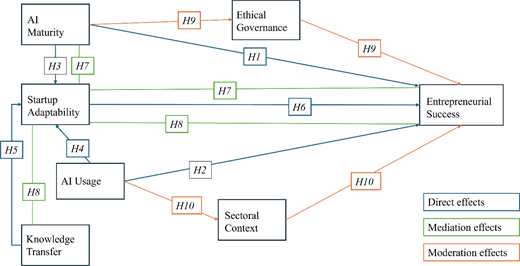
A consolidated theoretical model is formed and presented in Figure 1, connecting the reflective aspects of AI maturity, AI usage, startup adaptability, knowledge transfer, entrepreneurial agility and ultimate success within incubator and accelerator programs. The model specifies both direct relationships and mechanism-based pathways, proposing that AI-related capabilities translate into performance primarily when embedded into routinized adaptability. In addition, ethical (innovation) governance and sectoral context are incorporated as boundary-condition constructs and operationalized through interaction terms to evaluate whether institutional oversight and industry heterogeneity shape the strength of AI–performance relationships.
In Figure 1, entrepreneurial success is modeled as a function of both direct AI-related inputs and indirect capability-building mechanisms centered on startup adaptability. AI maturity, AI usage and knowledge transfer are specified as antecedents of startup adaptability, which functions as the most proximal driver of entrepreneurial success. In addition, ethical governance and sectoral context are treated as theoretically motivated boundary conditions and assessed via interaction terms that test whether institutional oversight and industry heterogeneity condition AI–performance relationships. While these interaction effects were not statistically significant in this sample (Table 8), their inclusion reflects the study’s theory-driven effort to evaluate conditional mechanisms alongside the core adaptability-based pathway.
Figure 1 also distinguishes contextual boundary conditions through moderation tests. Ethical (innovation) governance is modeled as an institutional infrastructure that may condition whether AI maturity translates into entrepreneurial success through an interaction effect (H9), reflecting mechanisms related to legitimacy, transparency and accountable AI-assisted decision-making. Sectoral context is similarly treated as a contextual boundary condition and examined through an interaction effect with AI usage (H10), acknowledging that industry environments may shape how AI-enabled practices are interpreted and enacted.
2.2 Constructs and proposed relationships
In our framework and proposed model, AI maturity signifies the state of readiness concerning data assets, supporting infrastructure and expertise, which is foundational for systematic and scalable application of AI-enabled analytics and decision support (Dennehy et al., 2023; Mikalef and Gupta, 2021; Karimi and Zade, 2024). AI adoption and usage refer to the scope and regularity of applying AI-enabled analytics capability, automation and decision assistance within day-to-day work processes. Importantly, adoption intensity reflects tool utilization, but it does not necessarily indicate that AI outputs have been institutionalized into formal routines and decision rules (Upadhyay et al., 2022; Baek et al., 2023).
Knowledge transfer, achieved via mentorship, training activities, guidelines and data-informed learning practices, supports the dissemination of techniques and standardizes approaches across supported ventures. Its performance consequences are expected to materialize primarily when transferred knowledge is translated into enacted behavioral change and routine adjustments – rather than when it remains at the level of exposure or awareness alone (Upadhyay et al., 2022; Fang, 2023; Schiavone et al., 2023). Startup adaptability is defined as systematic refinement in venture execution – encompassing strategic pivoting, experimentation frequency and responsive resource reallocation – through which informational signals are converted into iterative action. (Shepherd and Majchrzak, 2022; Teece et al., 2016).
Ethical/innovation governance comprises standards and controls that make AI-assisted decisions transparent, auditable and acceptable to stakeholders. Following DiMaggio and Powell’s institutional argument, such structures shape credibility, legitimacy and stable uptake of AI-enabled practices in entrepreneurial support programs (DiMaggio and Powell, 1983; Ogundipe et al., 2024; Nyoto et al., 2024). At the program level, entrepreneurial success refers to improvements in venture selection quality, venture progress and performance outcomes that are attributable to incubation and support processes (Audretsch et al., 2019; Giuggioli and Pellegrini, 2023).
Accordingly, the proposed model emphasizes that AI maturity is expected to translate into entrepreneurial success primarily through its capacity to strengthen startup adaptability, while AI usage and knowledge transfer are likely to yield measurable returns only when they become embedded in routinized decision practices under credible governance arrangements.
2.3 Conceptual implications
Three implications follow from this theoretical framing. First, consistent with DCT, AI is unlikely to produce performance gains through direct effects alone; rather, its value should emerge when AI-derived insights are embedded into organizational mechanisms that regularly process, absorb and translate information into iterative action – most notably, startup adaptability (Shepherd and Majchrzak, 2022; Teece et al., 2016). This logic implies not only direct relationships between AI-related capabilities and adaptability but also that adaptability may operate as a key mediating mechanism through which AI maturity and related program inputs translate into entrepreneurial success. Second, rather than functioning merely as an adjunct to compliance, ethical/innovation governance represents a contextual boundary condition that may shape whether AI-enabled routines are perceived as legitimate, trustworthy and consistently actionable, thereby conditioning the effectiveness of AI capability development (Ogundipe et al., 2024; Nyoto et al., 2024). Third, knowledge transfer is expected to matter insofar as it triggers changes in decision routines and enacted practices; as a stand-alone input, its effect may remain weak unless it is connected to behavioral change and capability formation (Upadhyay et al., 2022; Schiavone et al., 2023). Finally, because incubator and accelerator outcomes are shaped by heterogeneous contexts, sectoral conditions may influence how AI usage translates into success across programs (Leitão et al., 2022; Madaleno et al., 2022). Collectively, these premises motivate the hypotheses below, aligned with the constructs operationalized in this study.
Direct effects:
AI maturity is positively associated with entrepreneurial success (Dennehy et al., 2023; Mikalef and Gupta, 2021).
AI adoption and use are positively associated with entrepreneurial success (Upadhyay et al., 2022; Baek et al., 2023).
AI maturity is positively associated with startup adaptability (Dennehy et al., 2023; Karimi and Zade, 2024).
AI adoption and use are positively associated with startup adaptability (Upadhyay et al., 2022; Baek et al., 2023).
Knowledge transfer is positively associated with startup adaptability (Upadhyay et al., 2022; Schiavone et al., 2023).
Startup adaptability is positively associated with entrepreneurial success (Shepherd and Majchrzak, 2022; Teece et al., 2016).
Mediation hypotheses:
Startup adaptability mediates the relationship between AI maturity and entrepreneurial success (Teece et al., 2016; Teece, 2018; Zhou and Li, 2019).
Startup adaptability mediates the relationship between knowledge transfer and entrepreneurial success (Vincent and Zakkariya, 2021; Mata et al., 2024; Hernández-Linares et al., 2024).
Moderation hypotheses:
Ethical governance moderates the relationship between AI maturity and entrepreneurial success (Ogundipe et al., 2024; Nyoto et al., 2024; OECD, 2025).
Sectoral context moderates the relationship between AI usage and entrepreneurial success (Leitão et al., 2022; Madaleno et al., 2022).
These theories collectively suggest certain indirect pathways, chief among them that knowledge transfer plays a major indirect role through the same channel and that AI maturity and application lead to success through startup adaptability. The measurement tool and analytical techniques used to test these relationships are described in detail in the section that follows.
3. Materials and methods
The current research draws on a theory-informed, cross-sectional survey of incubator- and accelerator-based experts in the leading innovation economies. Recruitment followed a predefined study protocol, drawing contacts from organizational lists and professional networks. Participation was entirely voluntary and anonymous, and procedures all conformed to institutional ethical requirements. The empirical objective is to test a structural model in which AI capabilities influence entrepreneurial performance at the program level by primarily organizational mechanisms (startup adaptability) and under boundary conditions (ethical governance), rather than as pure direct effects.
3.1 Survey instrument and design
The survey measured six latent constructs using multi-item, five-point Likert-type scales (1 = strongly disagree to 5 = strongly agree). Items were adapted from validated prior scales and complemented where necessary with newly developed items to reflect the incubator/accelerator context. Three to five reflective indicators were assigned to each construct with the conceptual domain assured of its adequate coverage. Pilot test with ten practitioners and two academic experts confirmed clarity, face validity and completion time (=8 min); feedback elicited minor rewriting of two items.
Table 1 describes the operational definitions, theoretical anchors and analytical roles of the constructs. It shows how each one of the latent variables has direct equivalence with its theoretical foundations – DCT, IT and technology-acceptance models such as TAM/UTAUT – ensuring conceptual consistency between literature and the empirical model.
Collectively, these operational definitions provide measurement consistency and serve as the empirical basis for the ensuing structural equation analysis.
3.2 Sampling and data collection
The target population comprised managers, analysts and program officers working in incubator and accelerator organizations operating in leading innovation-driven economies (Dutta et al., 2023). Given the specialized nature of AI-enabled incubation and the absence of a comprehensive global registry of programs actively using AI, we used a nonprobabilistic purposive sampling approach. Participants were recruited through professional associations, accelerator networks and LinkedIn groups, yielding 138 preliminary responses. To ensure data quality, we applied standard screening procedures, including completeness thresholds, embedded attention checks and response-quality diagnostics based on time and pattern consistency. After these checks, the final analytic sample consisted of n = 101 valid cases. Participants came from North America, Europe and East Asia and represented diverse institutional types, including public, private and university-affiliated programs.
This sampling strategy prioritizes analytic relevance and access to informed institutional respondents rather than statistical representativeness. The chosen respondent roles were expected to possess program-level knowledge regarding AI-related practices, governance arrangements and operational decision routines, allowing their assessments to serve as organizational proxies in line with prior entrepreneurship and organizational research. Nonetheless, we acknowledge that modest sample size and the focus on leading innovation economies may introduce selection effects and restricted variance (particularly in governance-related conditions), which may limit the detectability of small conditional effects. These implications for generalizability and boundary conditions are addressed in the Limitations section. Before modeling, we inspected missingness, normality and outliers and analyzed complete cases.
3.3 Analytical procedure
Due to the predictive nature of the model, the presence of multiple latent variables, and postulated indirect effects, estimation utilized PLS-SEM. In line with Fornell and Larcker (1981), Henseler et al. (2016) and Hair et al. (2019, 2020), assessment went through three phases:
Measurement-model assessment – indicator reliability (outer loadings ≥ 0.64), internal consistency (Cronbach’s α; composite reliability [CR]) and convergent validity (AVE ≥ 0.50).
Discriminant validity testing – Fornell–Larcker criterion and HTMT ratios.
Structural model evaluation – multicollinearity (VIF < 5), path coefficients with bootstrap inference (5,000 resamples), effect sizes (f2) and explanatory/predictive power (R2, Q2).
Procedural remedies against common-method bias included randomized item ordering, varied scale anchors and complete respondent anonymity. Post-hoc diagnostics followed Bryman (2016), Creswell and Creswell (2018) and Field (2013).
Sectoral context was theorized as a boundary condition and empirically evaluated via an interaction test with AI usage (H10; Table 8). The interaction effect was not statistically significant (β = 0.098, p = 0.330). Given limited between-sector variance in our sample and modest power for interaction detection, we interpret sectoral context as a contextual boundary condition warranting further investigation in sector-balanced and larger samples rather than as a focal explanatory driver in the present specification.
3.4 Ethical compliance
All participants were informed about the study’s academic purpose, voluntary nature and data-protection procedures. No personal identifiers were collected, and aggregated findings were reported exclusively. Ethical approval was obtained from Marmara University’s research ethics committee.
The final structural specification mirrors the hypotheses: AI maturity and AI adoption/use are modeled as antecedents; AI use also acts as an antecedent of both startup adaptability and entrepreneurial success (H4, H2); knowledge transfer serves as a learning input to adaptability; startup adaptability operates as the central mechanism; ethical/innovation governance moderates the AI maturity→ success relationship (H9); and entrepreneurial success is the focal endogenous outcome.
4. Results
The measurement model shows satisfactory item performance: all retained indicators load ≥0.64 and are statistically significant (Table 2).
Internal consistency is adequate, with CR between 0.793 and 0.895 and Cronbach’s α between 0.698 and 0.795 (Table 3).
Convergent validity holds for all constructs except knowledge transfer (AVE = 0.495), which is marginally below the 0.50 benchmark but retained on theoretical grounds given acceptable CR and a high primary loading (Table 4). Discriminant validity meets the Fornell–Larcker and HTMT criteria.
Turning to explanatory power, the model accounts for R2 = 0.126 of entrepreneurial success (weak) and R2 = 0.052 of startup adaptability (very weak), consistent with a mechanism-focused specification (Table 5). The R2 statistics for entrepreneurial success (0.126) and startup adaptability (0.052) indicate modestly explained variance in the endogenous constructs. Such values, while numerically small, are not unusual in organizational and entrepreneurship research that aims to elucidate specific mechanisms in complex, multidetermined social processes. Guidelines for PLS-SEM note that R2 interpretation must be contextualized by research aims, model complexity and disciplinary norms; values that would be considered “weak” in laboratory settings may still be theoretically and practically informative in field studies focused on theory testing and mechanism identification (Hair et al., 2019; Henseler et al., 2016). In some research domains, R2 values substantially below conventional thresholds (e.g. =0.10) are accepted when predictor effects are significant and when the phenomenon is influenced by many unobserved factors (Raithel et al., 2012; Ozili, 2022). In our case, the low R2 underscores the multifactorial nature of program success and cautions against interpreting the model as a comprehensive prediction engine; rather, the model is intended to test theoretically motivated causal pathways (direct, mediated, conditional) and to identify key organizational mechanisms (e.g. adaptability) that operate even when a large portion of variance remains unexplained. Complementary evaluation metrics (e.g. Q2 predictive relevance, PLSpredict) and targeted sensitivity checks (e.g. adding program-level controls such as program age, size or funding structure where available) can further assess out-of-sample predictive performance and the robustness of the substantive conclusions (Hair et al., 2019).
Direct effects reveal a clear and consistent pattern (Table 6). Entrepreneurial success is directly driven only by startup adaptability (β = 0.321, p = 0.001; H6 supported), whereas AI maturity (β = 0.031, p = 0.750; H1 not supported) and AI usage (β = 0.069, p = 0.494; H2 not supported) show no significant direct effects on success. This pattern indicates that AI-related capabilities do not translate into measurable performance gains unless they are converted into adaptive execution capacity at the venture level.
Upstream relationships further reinforce this mechanism. AI maturity positively predicts startup adaptability (β = 0.228, p = 0.019; H3 supported), while AI usage (β = 0.072, p = 0.812; H4 not supported) and knowledge transfer (β = −0.030, p = 0.756; H5 not supported) do not exhibit significant effects. Accordingly, AI maturity appears to function as an enabling condition for startup adaptability rather than as an immediate performance driver, consistent with the view that performance benefits arise primarily through routinized adaptation rather than through AI-related inputs alone.
To further examine the mechanism implied by the model, we next test whether startup adaptability carries the effects of AI maturity and knowledge transfer onto entrepreneurial success (H7 and H8), and we subsequently assess whether the AI–performance links vary under governance and sectoral boundary conditions (H9 and H10).
Mediation analyses provide additional support for the proposed mechanism (Table 7). Consistent with H7, AI maturity exhibits a positive indirect effect on entrepreneurial success through startup adaptability (a = 0.228; b = 0.321; indirect = 0.073), while the direct effect of AI maturity on entrepreneurial success remains nonsignificant (c′ = 0.031). The VAF value (0.702) indicates that the total effect of AI maturity is largely transmitted via startup adaptability, reinforcing the interpretation that AI maturity contributes to success primarily by enabling adaptive execution routines rather than by exerting an immediate performance impact.
In contrast, H8 is not supported. Knowledge transfer does not demonstrate a meaningful indirect effect on entrepreneurial success through startup adaptability (a = −0.030; b = 0.321; indirect = −0.010), and the direct effect remains weak (c′ = −0.043). This pattern suggests that knowledge transfer does not consistently translate into enacted adaptability in the sampled programs, indicating a potential implementation gap between exposure-oriented learning activities and capability formation.
Moderation tests (Table 8) revealed no statistically significant interaction effects on entrepreneurial success. Specifically, neither the ethical governance × AI maturity interaction (β = −0.045, p = 0.634; H9 not supported) nor the sectoral context × AI usage interaction (β = 0.098, p = 0.330; H10 not supported) reached significance. These results suggest that, within this sample, the primary mechanism linking AI-related capabilities to program outcomes operates through startup adaptability rather than through conditional interaction effects. Importantly, the nonsignificant interaction terms do not rule out a contextual role for governance or sectoral conditions; instead, they indicate that such boundary conditions may exert influence through upstream enabling mechanisms (e.g. data integrity, accountability, legitimacy) or require larger and more heterogeneous samples for stable detection. Accordingly, both ethical governance and sectoral context are retained as theoretically motivated boundary conditions and are reported transparently as interaction tests rather than interpreted as focal explanatory drivers in the present specification. These findings suggest that AI contributes to program outcomes primarily through routinized startup adaptability rather than through direct effects of maturity or usage and that the core mechanism remains stable across the observed governance and sectoral conditions in this data set. Given the modest sample size and the possibility of restricted variance in key boundary-condition constructs, the moderation results should be interpreted cautiously and considered indicative rather than definitive.
Although the interaction effects were not statistically significant, this does not rule out a contextual role of governance. Instead, it suggests that governance may operate through upstream enabling mechanisms – such as strengthening data integrity, accountability and institutional legitimacy – that support sustained uptake of AI-enabled routines, as discussed further in the Discussion and Limitations sections. Regarding boundary conditions, sectoral context was examined as a moderator (boundary condition) of the AI usage–success relationship. The sectoral context × AI usage interaction was not statistically significant (β = 0.098, p = 0.330), and the results did not provide sufficient evidence of a stable sector-based conditional pattern in this sample, consistent with limited between-sector variance.
Overall, the results indicate that startup adaptability is the most proximal driver of program-level success, while AI maturity exerts its influence primarily through this mechanism rather than via a direct effect. In contrast, knowledge transfer does not consistently translate into startup adaptability, highlighting a potential implementation gap between exposure and enactment. The following section discusses these patterns through the lenses of institutional and dynamic capability perspectives and derives implications for governance and ecosystem actors, including program-level recommendations and policy considerations that emphasize governance as enabling infrastructure for responsible and legitimate AI integration rather than as a short-term performance amplifier.
5. Discussion
This study clarifies how AI maturity contributes to entrepreneurial success within incubators and accelerators by highlighting startup adaptability as the central transmission mechanism. From dynamic capabilities’ perspective, AI maturity appears valuable when it enables reconfiguration and responsive decision-making under uncertainty rather than when treated as a stand-alone technological asset. Institutionally, the findings suggest that governance and sectoral conditions may shape the environment in which AI-enabled routines are adopted and sustained, even if their moderating effects are not immediately observable in cross-sectional models (OECD, 2025; Leitão et al., 2022; Madaleno et al., 2022).
Overall, the results support a mechanism-first view of AI in incubation and acceleration programs. Among all modeled constructs, startup adaptability emerges as the most robust direct driver of entrepreneurial success, while AI maturity contributes indirectly through its positive effect on adaptability. In contrast, AI usage and knowledge transfer do not show significant direct paths to success. This pattern reinforces the dynamic capability argument that value creation stems less from technology presence and more from an organization’s capacity to sense, interpret and reconfigure resources through disciplined iteration (Teece et al., 2016; Teece, 2018; Shepherd and Majchrzak, 2022). Practically, AI improves effectiveness only when informational signals are converted into methodical, cyclical action embedded within decision routines. In line with prior mediation-oriented capability research, this mechanism-based interpretation is consistent with evidence showing that dynamic capabilities transmit the benefits of foundational resources into performance through adaptive and innovation-related processes (Zhou and Li, 2019; Lin et al., 2014).
The distinction between AI maturity and AI usage helps explain this mechanism. AI maturity – reflected in data readiness, infrastructure integration and analytical competence – forms the enabling foundation for experimentation, learning and capability development (Mikalef and Gupta, 2021; Dennehy et al., 2023; Karimi and Zade, 2024). In contrast, usage metrics primarily capture the frequency or extent of tool adoption and may not reflect whether AI outputs have been institutionalized into core routines such as venture selection protocols, mentoring structures or milestone evaluation criteria. In ecosystems involving multiple stakeholders, deployment without routinization is unlikely to generate consistent performance returns, which is consistent with prior evidence emphasizing that AI-driven value depends on organizational embedding rather than tool adoption alone (Chalmers et al., 2021; Giuggioli and Pellegrini, 2023; Davidsson and Sufyan, 2023).
The nonsignificant findings for knowledge transfer – both directly and indirectly via startup adaptability – should be interpreted primarily as evidence of a measurement and operationalization challenge rather than as an indication that knowledge transfer is unimportant. In practice, knowledge transfer processes may be heterogeneous, combining exposure-oriented formats (e.g. workshops, webinars, playbooks) with more practice-embedded mechanisms (e.g. mentoring that co-navigates AI tools and enforces routine change), and these components may not produce equivalent capability outcomes (Upadhyay et al., 2022; Schiavone et al., 2023). Moreover, transfer effects may depend on the maturity of supporting data pipelines and analytic literacy; without such foundations, training can increase awareness without producing enacted capability. Finally, the program-level measurement approach may not fully capture founder-level learning dynamics, which can attenuate observable effects at the institutional outcome level. Together, these considerations point to an implementation gap between exposure and enactment that warrants refined measurement and multilevel research designs. This interpretation is consistent with broader evidence that knowledge-related inputs tend to influence performance when they are accompanied by absorptive and adaptive capabilities that enable assimilation and enacted routine change (Sancho-Zamora et al., 2021; Lin et al., 2014).
The nonsignificant moderation results for governance and sectoral context should also be interpreted with caution. Limited variance in governance conditions within advanced innovation economies may reduce statistical detectability, and the modest sample size limits power for interaction estimation. Substantively, governance may operate less as a short-term boundary condition of the adaptability–success association and more as an upstream enabling infrastructure that shapes data integrity, auditability, accountability and institutional legitimacy. Governance may also play an ambivalent role: enabling discipline that strengthens credibility while excessive procedural rigidity constrains experimentation. Future research should therefore distinguish enabling versus constraining governance configurations and test their differential effects using larger, more heterogeneous samples and designs that better capture contextual variation. From a policy standpoint, this upstream view of governance aligns with recent assessments emphasizing that trustworthy AI adoption depends on foundational accountability and oversight infrastructures rather than on compliance formality alone (OECD, 2025).
Low R2 values further underscore that performance in entrepreneurial support organizations is inherently multifactorial and shaped by a broad set of organizational, ecosystem and macro-level determinants beyond the constructs included in this parsimonious mechanism-based model. In this context, modest explained variance does not necessarily undermine the theoretical relevance of the tested pathways; rather, it indicates that the model captures a meaningful but partial mechanism within a wider causal landscape (Hair et al., 2017; Henseler et al., 2016). This interpretation accords with methodological discussions cautioning against rigid R2 thresholds in social-science field settings, where modest explanatory power may still be consistent with theoretically meaningful mechanism tests (Ozili, 2022; Raithel et al., 2012). Factors such as founder human capital, mentor density and quality, program design maturity and prevailing capital-market conditions may account for additional variance in entrepreneurial success and adaptability, yet these were not modeled here to preserve theoretical focus and avoid overfitting given the available sample size. This perspective aligns with prior work suggesting that AI is more likely to enhance – rather than replace – core institutional design and human capital processes in entrepreneurial support ecosystems (Reim et al., 2020; Chalmers et al., 2021).
Consistent with this interpretation, the marginally subthreshold AVE for knowledge transfer (0.495) should be treated as a substantive limitation rather than a statistical anomaly. The result suggests construct heterogeneity that can attenuate structural paths and contribute to nonsignificant effects. Future research should refine this construct by separating exposure from enactment and incorporating behaviorally anchored indicators that capture observable routine change (e.g. documented decision-rule updates, iteration frequency, process redesign). Such measurement improvements, combined with longitudinal and multirespondent designs, would enable stronger tests of whether knowledge transfer influences adaptability only when it is translated into enacted organizational routines. These measurement and explanatory-power constraints also provide a relevant backdrop for interpreting nonsignificant moderation effects, as restricted variance and limited power may obscure conditional relationships that could emerge more clearly in sector-balanced and governance-diverse settings, particularly given the documented heterogeneity of incubator and accelerator impacts across contexts (Leitão et al., 2022; Madaleno et al., 2022).
Theoretically, these findings advance mechanism-based understanding of AI capabilities in incubators and accelerators by moving beyond descriptive “tool lists” and specifying how capability foundations translate into performance through routinized adaptability. For practitioners, the results suggest prioritizing AI maturity investments in data quality, system integration and analytical skills before expecting measurable performance returns; redesigning mentoring and evaluation processes to ensure that AI-enabled insights are enacted in decision routines; and approaching governance as enabling infrastructure that strengthens legitimacy and responsible use rather than as a narrow compliance exercise (Giuggioli and Pellegrini, 2023; Dennehy et al., 2023; Teece et al., 2016). For policy and ecosystem stakeholders, the implication is that interventions should focus on foundational data and governance capabilities that support trustworthy adoption and routine integration, particularly in settings where resource constraints and institutional fragmentation can otherwise prevent AI maturity from translating into entrepreneurial outcomes (OECD, 2025).
6. Implications
The evidence equates to a managerial evolution for incubators and accelerators. They first need to develop AI maturity – clean, shareable data streams, appropriate tooling and analytics capabilities – before they reprogram operating rituals to enable model output to trigger concrete decisions in selection panels, milestone reviews and mentor meetings (Teece et al., 2016; Mikalef and Gupta, 2021; Dennehy et al., 2023). In practice, managers should codify “learning-to-action” guidelines such as pre-negotiated pivot or resource redirection levels based on predictive evidence and monitor iteration pace as a critical performance metric that reflects routinized adaptability.
Given that knowledge transfer did not translate into measurable performance gains under the current operationalization and in this sample, mentoring practices should move beyond exposure-based activities toward co-execution. Mentors can increase impact by pairing AI tools with real venture scenarios and systematically documenting resulting strategic adjustments, thereby converting training into enacted routines and implemented habits (Upadhyay et al., 2022; Schiavone et al., 2023). Although governance did not emerge as a significant boundary condition in the present model, it remains critical as an upstream enabling infrastructure that supports adoption legitimacy, accountability and trustworthy use. Accordingly, flexibility should be balanced with responsible oversight rather than treated as a purely compliance-driven constraint. Mechanisms such as open postmortems, proportional bias testing, data-provenance traces and lightweight model cards can provide credibility and transparency without discouraging iteration (Ogundipe et al., 2024; Nyoto et al., 2024). Good protection should be rigorous in principles but adaptive in implementation, consistent with policy guidance emphasizing that effective AI governance depends on practical accountability structures and trustworthy data ecosystems (OECD, 2025). Because of the narrow explanatory potential, dashboards should monitor complementary drivers as well as flexibility. A realistic design would integrate capability metrics (maturity, digital literacy), routine metrics (iteration pace, pivot discipline) and outcome metrics (progress, budgeting, survival) to iteratively refine program theory (Hair et al., 2019, 2020). At the policy level, public funders who want to build “AI-ready” ecosystems should fund bundles of infrastructure, skills and day-to-day transformation, rather than individual tool buys. Evaluation criteria should prioritize routinized evidence – recorded decision changes, audit trails and reliable governance practices – over pilot project quantity, particularly in multiactor settings where institutional embedding shapes whether AI maturity translates into entrepreneurial outcomes (Reim et al., 2020; Chalmers et al., 2021; OECD, 2025). Importantly, these policy recommendations do not depend on a statistically significant moderation effect of governance; rather, they follow from the empirical finding that AI generates measurable value primarily when embedded into routinized adaptability, which in practice requires foundational data and governance infrastructures that enable trustworthy integration at scale.
7. Limitations and future research
This study has several limitations that require careful consideration. First, cross-sectional design constrains causal inference about dynamic learning and capability development. Longitudinal or panel designs that follow ventures through selection, acceleration and postgraduation phases would better capture how routines of startup adaptability emerge, stabilize and produce sustained performance gains. Relatedly, the use of single-informant, program-level data raises the possibility of common-source bias; future work should triangulate responses from managers, mentors and founders and, where possible, link perceptual measures with objective venture outcomes to strengthen causal claims and external validity.
Second, measurement precision can be improved. The marginally subthreshold AVE for knowledge transfer points to construct heterogeneity and suggests the need to distinguish conceptually and operationally between exposure (e.g. training, workshops, informational sessions) and enactment (e.g. copiloted tool usage, mandated process change). While some interpretive explanations are plausible, the evidence more directly points to a measurement and operationalization issue, as indicated by the marginal AVE and the likely heterogeneity of knowledge transfer processes in practice. Future instruments should include behaviorally anchored indicators that capture actual practice change rather than awareness alone. In addition, where sectoral context was considered, limited between-sector variance in our sample reduced its contribution to the final model. Replication with larger and more diverse sectoral samples is needed to test whether sectoral boundaries condition AI-driven mechanisms. Future research should further examine these boundary conditions using sector-balanced samples or multigroup approaches to identify whether AI-enabled mechanisms differ across industry contexts.
Third, the nonsignificant interaction effects involving governance may reflect two nonexclusive explanations: limited variance in governance within the sampled advanced innovation economies, and a substantive role for governance as an upstream enabling infrastructure rather than as a simple statistical moderator of performance pathways. In practice, governance may primarily operate by improving data curation, auditability, accountability and perceived legitimacy – conditions that enable adoption – rather than by directly amplifying short-term interaction effects. Consequently, future research should disaggregate governance into enabling (e.g. transparency tools, lightweight audit trails, model documentation) and constraining (e.g. procedural rigidity, compliance burdens) dimensions and test their differential effects. Experimental or quasi-experimental manipulations of governance intensity, or comparative studies across regulatory regimes, would be particularly valuable to reveal conditional mechanisms (Ogundipe et al., 2024; Nyoto et al., 2024).
Fourth, statistical power considerations warrant attention. Interaction effects typically require substantially larger samples than main effects for stable estimation; with our modest N, the ability to detect small-to-moderate moderating effects was limited. Future studies should conduct a priori power analyses for moderation tests, pursue larger and more heterogeneous samples and consider multirespondent or nested designs (e.g. ventures within programs) to enable multilevel modeling of contextual effects.
Finally, robustness checks and alternative estimation strategies can strengthen confidence in the results. While PLS-SEM is appropriate for exploratory, prediction-oriented models with complex mediation (Henseler et al., 2016; Hair et al., 2019, 2020), complementary analyses – such as CB-SEM or Bayesian SEM robustness checks, predictive hold-out tests (PLSpredict) and post-hoc sensitivity/power analyses – remain valuable avenues for future work to assess stability and generalizability across estimation frameworks and sampling contexts.
Collectively, these limitations point toward a research agenda that emphasizes:
Longitudinal and multirespondent empirical designs;
Refined measurement that differentiates exposure from enactment;
Disaggregated conceptualizations of governance; and
Methodological triangulation and larger samples to uncover conditional effects.
Such efforts will clarify how AI maturity, governance structures and capability formation jointly shape entrepreneurial program performance in diverse incubation and acceleration contexts.
8. Conclusion
This study offers an institutionally embedded capability-based account of how AI contributes to entrepreneurial support organizations in incubator and accelerator settings. Empirically, the results point to a clear mechanism: startup adaptability emerges as the most proximal driver of program-level entrepreneurial success, while AI maturity contributes primarily through enabling this adaptive capacity rather than through direct performance effects. AI usage and knowledge transfer, as operationalized in this study, do not translate into measurable success unless they are embedded in routines that consistently convert learning into disciplined action.
For executives, the action agenda is straightforward: in foundational AI maturity – data quality, infrastructure integration and analytical skills – and then redesign mentoring, selection and review processes so that AI-enabled insights reliably trigger iterative decision-making under enabling governance arrangements. For researchers, the agenda lies in longitudinal identification, multi-informant measurement and more granular modeling of boundary conditions, including refined measures that distinguish exposure from enactment in knowledge transfer. By shifting attention from technological artifacts to organizational capabilities and adaptive routines, the study provides a mechanism-based roadmap for translating investment into entrepreneurial performance in incubators and accelerators (Teece et al., 2016; Dennehy et al., 2023; Giuggioli and Pellegrini, 2023). At the policy level, the findings support initiatives that prioritize foundational data and governance infrastructures – rather than isolated tool acquisition – to enable trustworthy and routinized AI integration across entrepreneurial support ecosystems (OECD, 2025).
Declaration of generative AI and AI-assisted technologies in the writing process:
During the preparation of this article, the author used AI software to assist in language refinement and to double-check the completeness of reported results and statistical calculations. The author verified all outputs independently and takes full responsibility for the accuracy and integrity of the final manuscript.
Ethics Statement
This research was conducted in accordance with institutional ethical guidelines. Informed consent was obtained from all participants, and no personal identifying information was collected.
Plain language summary
This study explored how artificial intelligence (AI) affects the success of startup incubators and accelerators. The authors surveyed 101 professionals working in innovation-driven economies to understand how AI helps these organizations operate better. The results show that AI supports success mainly by helping startups adapt quickly to change. However, sharing knowledge alone does not always improve performance unless people and institutions are aligned. Good governance improves trust and transparency in AI use. Overall, our findings highlight that incubators should focus on strong governance, quality data and flexible management to fully benefit from AI technologies.