Skip to Main Content
Purpose

The aim of this paper is to advance a critical pedagogical framework, combining critical pedagogy, design research, architectural theory and experiential learning. It addresses global challenges at the intersection between urban peripheries and the Anthropocene – the centre of the climate crisis is a spatial crisis – preparing students as engaged architect citizens capable of reshaping collective life.

Design/methodology/approach

The framework is examined through a case study of the author’s final year architectural theory module, “The Periphery as a Critical Project”, elucidating its theoretical underpinning and presenting a visual analysis of student projects. Methods include reflective module design, fieldwork, close-reading of literature across disciplines, design research, experiential learning strategies and an inventive “theorypractice”.

Findings

The research demonstrates that theorypractice articulates a transformative and experiential learning experience, articulating architectural education as a site for critical engagement with urgent challenges. The approach equips students with critical thinking and making skills, cultivates a commitment to civic responsibility and encourages alternative visions for the Anthropocene. The paper concludes with concepts and practices to define an emerging architectural pedagogy for the Anthropocene.

Practical implications

The research provides guidance for educators in architecture, aligning with RIBA reforms emphasising “history, theories, methodologies” and experiential learning in allied fields such as urban studies, environmental planning and social policy, focused on climate and social resilience, spatial justice and critical literacy. More broadly it aims at preparing engaged architect citizens who can work on and with the world.

Originality/value

This paper contributes an original framework and novel methodology, bringing together theoretical and design research from architecture, urban studies, design, critical pedagogy and environmental humanities to expand experiential learning within architectural theory, an underexplored position. It addresses urgent issues related to urban peripheries, climate change, and how we educate future architects in times of crisis, offering a model for allied fields facing similar societal challenges.

The aim of education is to be a provocation to thought; the aim of thought is the renovation of the world.

—McKenzie Wark (2010).

At a time of crises, from housing and uneven urbanisation to climate change and challenges on critical knowledge, it is urgent that education today be predicated on engaging with the major pressures of the day, actively and reflectively working on the world (Easterling, 2021; Giroux, 2021; Haraway, 2016; Raunig, 2013; The Edu-Factory Collective, 2009). Education is a link in a chain to imagine new forms for society and to realise them. For Gregotti (1968), the place of the university and the education of the architect, was a “dynamic dialectic” between schools of architecture and professional experience on one level, university and society on another level. Gregotti (1968, p. 118) argued that architects should neither “withdraw from present difficulties […] to a utopian ideal”, nor “indulge in reactionary currents”. Instead, he affirmed the need to challenge dominant practices and thinking with radical avant-garde discourse. Reflecting on what he called “The Critical Reasons for the Project”, Gregotti (1996, p. 21) argued that “project-making” in architecture should simultaneously critique the present and envision the possibilities for an alternative future. Gregotti’s reflections remain current and are part of a critical legacy that informs my approach (Holm and McEwan, 2019; McEwan, 2021, 2023, 2024).

One of the aims of this paper is to build on Gregotti’s argument, reflecting on how “project-making” in architecture makes contact with critical pedagogical strategies, design research and with the urgent issues of our time concerning urbanisation under the pressure of the Anthropocene. I develop a pedagogical framework and contribute a theoretical foundation for what in the lecture hall and studio I call more straightforwardly “thinking-through-making”. This approach integrates critical thought and practice – “theorypractice” – as an experiential learning process. The research is guided by the following questions:

  1. How can critical pedagogies and experiential learning strategies support students to articulate positions on urgent urban, political and environmental matters, towards a commitment to civic responsibility?

  2. What theoretical narratives, critical practices and conceptual frameworks address the challenge of the Anthropocene, particularly in relation to urban peripheries?

  3. What ways can an architectural pedagogy for the Anthropocene articulate critical modes of knowledge and address disciplinary concerns such as living together, issues of representation and the spatial condition of peripheralisation?

By reflecting on these questions, the paper contributes to ongoing discourse on architectural education in responding to global pressing issues, and opens onto wider discourse in allied fields such as urban studies, environmental planning and social policy. There is a pressing need to continuously articulate critical consciousness about climate and social resilience, spatial and environmental justice, and counter the ever-darker forces of post-truth narratives.

The paper argues that education is a link in what Laclau and Mouffe ([1985] 2014) called “chains of equivalence”, whereby different ideas and practices construct relays to build a chain in opposition to a common adversary or towards a common challenge. It resonates with Wark’s (2020, p. 4) proposal for a “common task” combining “different ways of knowing the world, to find points of contact between them, and also points of difference”. For Wark, the common challenge is to question how to think and act in the time of the Anthropocene, the present geological era where natural and social forces are entangled with the commodity form of capitalist development. Moore (2015, p. 189) argues the more appropriate term to define this “uneven and messy […] violent civilization” is the Capitalocene, a position notably arrived at with references to architectural historian Lewis Mumford. Easterling (2021, p. 11) invokes Laclau and Mouffe to argue for “interplays” that produce links between ideas and activities to disrupt inertia: “Transposing from a nominative to an active register, the intent of designing interplay is not to fix positions but to initiate interactivity—to disrupt loops and binaries”. For Easterling, an interplay is not only an object but the “shaping of dispositions and activities”, tacit knowledge that can remain undeclared yet set off a “chain reaction” of latent potentials that unfold over time. I bring these concerns into a disciplinary and pedagogical context.

Experiential learning is typically associated with approaches that challenge instruction-based learning (for surveys, see Salama (2010, 2015, 2019). Instead, experiential learning develops inquiry-based approaches with origins in Dewey’s (1997) “learning by doing”, and later Boyer’s (1990, p. 24) expansive approach to scholarship: “Active, not passive, learning encourages students to be critical, creative thinkers, with the capacity to go on learning after their college days are over”. Experiential learning sits in relation to traditions of critical pedagogy such as in Giroux (2020, 2022), where it is “critical learning” to make a “public sphere” and empower students to be active critical citizens. For Freire ([1970] 2000, p. 77): “Authentic thinking, thinking that is concerned about reality, does not take place in ivory tower isolation, but only in communication. If it is true that thought has meaning only when generated by action upon the world, the subordination of students to teachers becomes impossible”. Recently, figures in architectural discourse have brought critical pedagogical approaches into dialogue with how design education responds to contemporary social and ecological challenges (for example, Boana and Lee Peragine, 2024; Iturbe, 2024; Pope, 2024).

In this paper, experiential learning is characterised as learning about pressing challenges and experimenting with how to apply critical architectural knowledge for real-world conditions – such as the periphery–Anthropocene intersection – to make learning authentic, relevant and operative. Key techniques are a hybrid “theorypractice”, combining thinking-through-writing and thinking-through-making, bringing together architectural knowledge practices with knowledge practices notionally outside of architecture, to find the “points of contact” and “points of difference”. At the centre of the climate crisis is a spatial crisis and consequently the challenge is architectural, material and pedagogical as much as political, economic and environmental. The task is generational and must begin by preparing students to become engaged architect citizens capable of reshaping collective life.

The author’s final year undergraduate architectural theory module and its assignment, “The Periphery as a Critical Project”, is used as a case study to elucidate the concepts and practices at stake. I argue that some of its key characteristics – synthesising theory and design research, thinking and making, drawing and writing, studying the periphery and the Anthropocene together – articulate modes of experiential learning, enabling students to connect critical knowledge with real-world issues through acts of making. I combine concepts and practices from architecture, design research, critical theory, critical pedagogy and the more political-oriented side of the environmental humanities. Such a critical pedagogy develops a transformative approach to learning. It is a necessary endeavour, when architecture theory has been resistant to thinking critically about the climate crisis as the most urgent pressure we face today. It entails the broadening of pedagogical scope to amplify critical discourse to think reflectively about contemporary issues, turning education into an Iemancipatory project and architectural education as a site for critical engagement with urgent challenges. The approach equips students with critical thinking and making skills, cultivates a commitment to civic responsibility and articulates possibilities for alternative visions for the Anthropocene.

This paper is organised as a text and a suite of visual work produced by students in The Periphery as a Critical Project. The first section reflects on the methodology, providing an overview of the module design, the relation between teaching and research, and the methods for this paper. The second and third sections present theoretical reflections on the periphery–Anthropocene nexus, and the design research-critical pedagogy nexus. The fourth section presents a visual analysis of work produced by students. The conclusion puts forward a set of concepts and practices to define an emerging architectural pedagogy for the Anthropocene. Finally, the framework put forward here has two main contributions. The first is disciplinary, providing a model for architectural educators to bring experiential learning about pressing issues into theory modules and undergraduate research, particularly relevant amid the reforms in UK architectural education (RIBA, 2021; Goodricke and Murray, 2024). The second contributes a link within a chain of equivalence towards a generational aim of changing how we think and act under the pressure of climate and capitalist crises. This would be the “common task” of collective reorientation, using education and architecture as critical practices to question the status quo, towards the conditions of possibility for future transformation.

The structure of “The Periphery as a Critical Project” architectural theory module is designed with written work, creative practice and practical workshops, to support all students. The module uses the freedom offered by “equivalence” in the assessment descriptor. Instead of a traditional 5000-word text, usually called “illustrated written assignment”, the assignment is adjusted to an equally weighted, hybrid text- and design-based project. It is framed as a theory and design research project, explored by thinking-through-making. In this context, “design research” refers to the use of creative practices, particularly drawing and model making, as cognitive tools for thinking about, and actively reflecting on, pressing issues. Overall, the aim of student work is to develop a coherently articulated, critical and speculative position that addresses an aspect of the periphery–Anthropocene nexus. The main open-ended question students address is: What is the urban condition today, in the time of the Anthropocene?

For the module assessment, students typically produce drawings, photoworks and artefacts, investigating an idea related to peripheries and Anthropocene discourse, which is a thinking-through-making exercise, alongside an experimental text theorising a particular aspect of the periphery–Anthropocene intersection, which is a thinking-through-writing exercise. This “alternative assessment” has been shown to widen participation in a module often seen by students as “difficult” (Bryan and Clegg, 2006). Alternative assessment supports students with, for instance dyslexia or dyscalculia, to engage actively and meaningfully with their learning. It encourages students who may not have thought that theory is relevant to practicing architecture to explore pressing urban and environmental issues through acts of “critical making” (Ratto, 2011).

The module is organised into two parts. The first part is a series of theoretical lectures paired with a creative practice workshop to provide the theoretical and methodological framework through which individual project work is undertaken. The workshops involve design and writing exercises undertaken in the class and related to the development of individual projects. This provides the critical context, knowledge base, methods and critical tools, which students use to explore self-directed ideas. The second part is a series of practical and more open-ended workshops that focus on the development of individual projects. These sessions involve design exercises, iterations and refinements. Individual projects are developed outside of lecture and workshop time and include reading key texts from the brief and additional project specific, student selected texts. Projects develop by writing, drawing and artefact making. The themes of these “open” workshops are decided via one-minute essays by students, which are undertaken after each session to inform the focus of the following workshop.

One-minute essays serve as a continuous feedback tool, building a discourse and class consciousness. Students receive an A4 sheet with two questions: “What was the most important thing you learned in today’s lecture?” and “What important questions remain in your thought as the session concludes?” Students write anonymously for one minute on each question, at the end of each session, then submit the papers to me as they leave. One-minute essays encourage active learning, reflection, and prompt students to revisit lecture and workshop content. Students write about their theory projects, addressing conceptual and pragmatic issues. I respond to the essays the following week, selecting some to read and discuss. This method has proved an effective way to develop an inclusive and discursive practice of learning, informing class discussion, directing ongoing sessions, and alleviating anxiety about asking questions in front of peers.

What I call a “discursive brief” guides student’s through the steps of project development, incorporating concrete examples of previous student’s work, methodologies, peer reviews, collaborative study using online forums to share resources and the one-minute essay process. The brief guides critical analysis, encouraging engagement through reading list guidance, thematically linked to lectures with signposting to other resources such as films, photography, fiction, design projects, Instagram accounts, and other artefacts of culture that resonate with the periphery–Anthropocene nexus, which strict analytic accounts do not. It guides students from early conceptual ideation through drawing analyses and artefact making, to exploring their ideas through experimental writing techniques and how their ideas are synthesised in made books, peer reviewed, and communicated in a co-curated exhibition. The exhibition of undergraduate theory research is non-typical for architecture programmes, so tends to be sited in leftover spaces that students carve out of the institutional envelope.

The experiential learning process is guided by knowledge acquisition through creative practice, abstraction, reflection – thinking-through-making – and application to urban peripheral sites as a “field lab”. Experiential learning requires students to develop critical knowledge using core disciplinary tools such as drawing, experiment with how this knowledge impacts on real-world contexts, and how to communicate that acquired knowledge outward, such as by exhibition. By investigating peripheral urbanisation and its relation to the forces of the Anthropocene, The Periphery as a Critical Project connects architectural theory to real conditions, preparing students to understand the spatial and social impacts of their work.

The module is designed so that there is a mutual relation between teaching and research, framed as the interplay of teaching-led research and research-led teaching. There are parallel design research talks delivered by educators, scholars and architects, including talks by Holm (2022), Lechner (2021), Bartoli and Stollmann (2019), Bartoli and Linden et al. (2019), Haralambidou (2020) and Dorrian and Hawker (2015), Dorrian et al. (2022). Individuals are asked to talk about a pressing issue facing the discipline and how they address this through design research and teaching. The talks are intended to expand the frame of reference for what is theory and its interplay with design and research, articulating different forms of creative practice as equivalent to, but different from, textual practice.

In anonymous student feedback, the interplay between teaching and research is highlighted for its aid in improving understanding. For instance, students write: “The research experiences improved my theoretical understanding and enjoyment” and “these research experiences provoke further thinking”. [1] While such an approach can be critiqued (Marsh and Hattie, 2002), I have found the recursivity between teaching in dialogue with research a crucial method and it has an institutional tradition in figures such as Boyer (1990), Healey and Jenkins (2009), Harland (2016), and Brew (2017). Student’s efforts are recognised in this endeavour such as in what Neary (2020) has proposed in Student as Producer on the critical interaction between student learning, agency, and capacity to “work on the world”. The ethos of “student as producer” positions students as collaborators in the production of knowledge, acting as co-curators and partners in The Periphery as a Critical Project, enabling a recognition of the self in a world of their own design, enhancing agency and imparting a sense of collective responsibility. This inflects back into the author’s scholarly pursuits. If students are thinking-through-making, it is possible to argue also for thinking-through-teaching.

This paper is organised as a text in dialogue with a suite of visual work. The visual analyses show the creative practice pursued by students in The Periphery as a Critical Project and incorporates a sense of the student voice as a visual “public sphere”. On one hand, the purpose is to demonstrate how students respond to the pedagogical strategies, showing how critical thinking and design research are applied to real-world issues. On the other hand, the relationship between text and image, between theory and practice, performed in this paper, mirrors the approach performed in the module and student projects. Consequently, the paper is designed as a theoretical and a methodological reflection on subject specific concerns and global pressing issues on urban peripheries in the time of the Anthropocene, in dialogue with a pedagogical reflection related specifically to the module, delivery and outcomes.

A series of “close-readings” structure the paper, investigating key themes in architectural and urban theory, environmental humanities and critical pedagogy. I have explored the efficacy of these methodologies elsewhere (McEwan, 2021, 2023, 2024). Put concisely, I define close-reading as a practice of closely focused analysis of texts and artefacts that produces situated, conceptual and formal knowledge. Close-reading combines with writing and drawing, as close-writing and close-drawing. This humanities-based approach is borrowed from the text-based practices of philosophy, where close-reading is a form of writing, as in close-writing, and is generative (for paradigms see Barthes 1977, 2013; and more recently Wark, 2004, 2015, 2021). One writer reads another closely so that knowledge advances by reflecting on, and reworking, past ideas to create new ideas, which establishes a discourse. I also use close-reading to reflect on my pedagogical pursuits, calling it close-pedagogy.

Transposed to the representational language of architecture, close-reading is overlaid with critical and creative practices, using closely focused drawing and mapping techniques, as close-drawing. Key references include Viganò’s (2016) idea of the “project as knowledge producer Agrest’s (1991, 2019) and Gandelsonas (1999) critical practices of drawing and understanding representation as a cognitive pursuit and disciplinary tool of thought. Close-drawing gains critical purchase on tacit knowledge that cannot be grasped by textual analysis alone. Overall, this combinatory “theorypractice” methodology develops collaborative forms of knowledge by reading different disciplines and knowledge practices together.

The Periphery as a Critical Project is foregrounded on core disciplinary concerns on urbanism and urbanisation, and on pressing issues on the climate crisis, the social imagination and how architecture engages with these issues. If the “short twentieth-century” (Hobsbawm, 1995) was a century of cities – Berlin (Hilberseimer, [1927] 2012), Brasilia (Evenson, 1973), Manhattan (Koolhaas, 1994), Beijing (Wang, 2016) – I argue this is a century of peripheries – suburbs (Lerup, 2017), exurbs (Gandelsonas, 1999), fringes (Branzi, 2006), sprawl (Bruegmann, 2006; Xaveer de Geyter Architects, 2002; Hayden, 2004), second nature (Agrest, 2018). The planet is wrapped by a continuous periphery, which generates a new layer of the earth’s crust. Lectures in The Periphery as a Critical Project investigate the corollary between the production of peripheral urban space and the forces of the Anthropocene, its typologies, and forms of development. It argues that the fundamental context for contemporary practice is the Anthropocene, the name given to the present geological age when natural forces and social forces are entangled, and within which the commodity form of capitalism is the primary cause of permanent planetary change (see in particular, Chakrabarty, 2021; Haraway, 2016; Moore, 2015; Wark, 2015). It argues that the climate crisis is a spatial crisis and a material challenge, and consequently an architectural challenge.

In lectures such as “The City–Periphery–Anthropocene Entanglement” and “World-Making: Close-Reading the Periphery-Anthropocene Nexus”, the city-periphery and periphery–Anthropocene relationships are situated in readings of key texts. Easterling’s (1999) Organisation Space, Gandelsonas’s (1999) X-Urbanism, and Virilio’s ([1983] 1991) Lost Dimension, to name a few, provide a compelling counter-history to the formative stage of peripheralisation focused on the postwar period known as the “Great Acceleration”, a key moment in the development of the Anthropocene. Texts such as Haraway’s (2016) Staying with the Trouble, Parikka’s (2015) A Geology of Media, and Wark’s (2015) Molecular Red provide inventive counter-readings for what constitutes the Anthropocene. They are critical towards its Anthro-centric categorisation, some preferring terms such as Capitalocene, serving to name the agent of exploitative capitalist development rather than humanity in general as the dominant force changing the planet. To find pathways out of the present crisis, we need to rethink settlement patterns and collective life – an aim of student projects, which speculate on this common task.

To retain a disciplinary focus, theories and projects of “typology”, or simply “type”, are addressed in the lecture “Low Typologies of the Anthropocene”. The paradigmatic theories of type as an analytical and generative principle in architecture, investigated for example by Rossi ([1966] 1982), Moneo (1978), and Bandini (1984), are discussed in relation to the more unusual and “banal” building typologies and urban forms that make up our periphery in the time of the Anthropocene – infrastructure networks, industrial complexes, business districts, logistics parks, retail outlets, storage facilities, agricultural fields, recreational zones, and extending suburbs sitting amongst nature reserves and sites of exceptional beauty. As Lechner (2021) argues, such typologies are the “peripheral monuments” that have become the large-scale periphery-defining typologies that influence our everyday experience. Other lectures and key readings pull these core issues apart, transgressing the themes, investigating their limit conditions, and amplifying theoretical and critical knowledge. Many other voices and artefacts are discussed, such as films, photography, fiction and social media accounts. Together, the different elements reflect the heterogeneous structure and aesthetic of the urban periphery itself.

Today, the periphery has become the place where most of the global population is concentrated and is amongst the most shared experiences on the planet. We live, learn, love and often loathe in the periphery. As a spatial condition, peripheries are uneven, fragmenting urban form into an endless global condition (Smith, [1984] 2010). The periphery is not usually associated with concepts related to “cityness” such as density, cultures of congestion, history, power or imagination. The periphery is not usually considered to have a coherent hierarchy of figure and ground, monuments and fabric in the way that historical cities have civic institutions and open public places situated within a continuous fabric. Instead, the periphery is sometimes all figure, sometimes all ground. It is big box stores and ancient artefacts situated by geotechnical and hard infrastructure. The periphery is a space of robust randomness that can be beautiful but is an ugly beauty.

To address the periphery–Anthropocene nexus as a spatial, conceptual and formal construct, it is necessary to draw upon urban studies, architectural theory and paradigmatic projects for urban peripheries, to explore themes around architectural typology, nature, artifice, infrastructure and urbanisation. Then to place these ideas and projects in dialogue with theories and practices from Anthropocene studies, developing a theoretical framework through which to test ideas, reflect on notions of periphery and Anthropocene from the perspective of political, and critical thought, art and allied practices. It is to use architectural methods such as drawing and writing as critical tools and knowledge practices. This establishes a theoretical framework towards the periphery–Anthropocene, develops a reading on what is the urban condition today, and outlines the concepts, typologies and modes of representation, needed to articulate a common task.

Student projects articulate the theoretical and critical knowledge they learn in the lectures and by independent study through a close engagement with both real situations and by turning the architectural imagination into something material, raw and useable. Students produce a thinking machine to explore ideas through a process of thinking-through-making, capturing the tacit knowledge (Agrest, 1991; Allen, 2009; Haralambidou, 2013). There is no specification for the thinking machine or if it is singular, but it should be a made object, influenced by art and allied practice, and be exhibition standard. The thinking machine encourages creativity, criticality and open-ended inquiry. It can take the form of a model, drawing, print, suite of photographs, casting, film or installation. In parallel, a text is developed as a thinking-through-writing exercise, using experimental practices of “making” texts (LeWitt, 1969; Burroughs, 1989; Wark, 2004). The material is synthesised as a portfolio of thought experiments in a book to produce a coherent argument about the periphery–Anthropocene, and an exhibition is co-curated.

In workshops, students develop creative practice outputs. To provide a focus and a point of departure, individual projects begin by a closely focused drawn analysis of an assigned paradigmatic plan resonant with periphery and Anthropocene discourse. Students are assigned one of the following: Ildefons Cerdà’s Barcelona Extension Plan (1859), Le Corbusier’s Radiant City (1929–30), Ludwig Hilberseimer’s Vertical City (1924), Constant Nieuwenhuys’s New Babylon (1960), Robert Venturi and Denise Scott Brown’s Las Vegas Strip (1968), Aldo Rossi’s Analogical City (1976), Diana Agrest and Mario Gandelsonas’s Los Angeles (1985), Andrea Branzi’s Agronica (1995) or Design Earth’s After Oil (2016). We begin the workshop, for which students bring an A4 or A3 layout/tracing pad, a clutch pencil and a printout of their assigned plan, by drawing elements of the plan.

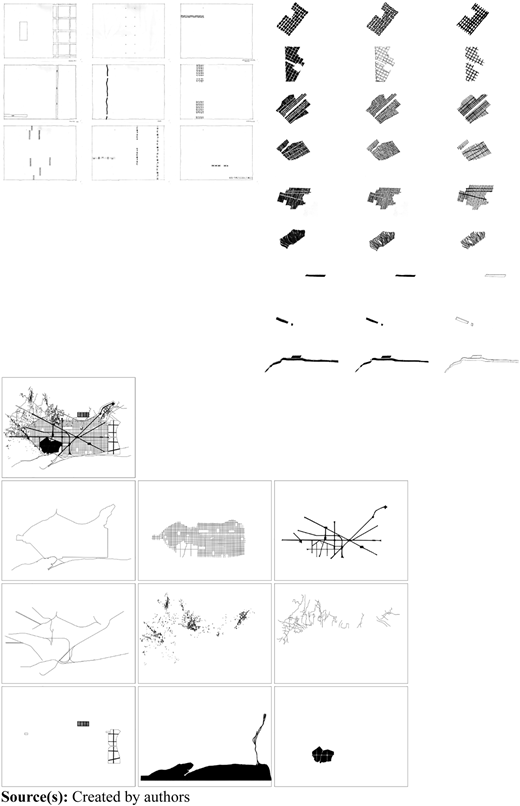
The aim of initial workshops is to generate inventories of elements of the assigned plan (Figure 1). Students analyse and interpret their plan by drawing it, tracing in the first instance, peripheral relationships such as centre/edge, core/periphery and intensity/margin. Workshops follow with exercises that explore typological forms and conditions such as edges, borders and fields; and then Anthropocenic typologies and conditions such as infrastructure, geologies, geotechnics, media and more interpretive relations such as natureculture (Haraway, 2016) and @technofossils, 2024. These inventories are intended to articulate a formal language and an analytic process, primarily by drawing, followed by speculative montages. They constitute the first part of a thinking-through-making portfolio.

Students identify a peripheral condition of Newcastle, our university city and the place we use as an experiential field lab. Students choose from four peripheral sites. There is a Village, Throckley, a historic settlement on the land line of Hadrian’s Wall and Newcastle’s political boundary, containing “garden city” typologies, and identified as a growth area in Newcastle’s Local Plan. There is an Airport, a paradigm non-place (Augé, [1995] 2023) with Newcastle International situated between historic villages and the ring road, confronting big and small scale, with expansive fields. There is a Suburb, where developer Taylor Wimpey is building Brunton Rise, a typical mono-functional suburb, recognisable for its anywhere and nowhere characteristics. There is a Data Park, the Cobalt Data Park and its environs, intersecting inside and outside the ring road loop, materialising digital capitalism, and confronting a taxonomy of infrastructure types such as hard/soft, material/immaterial and under/on/overground.

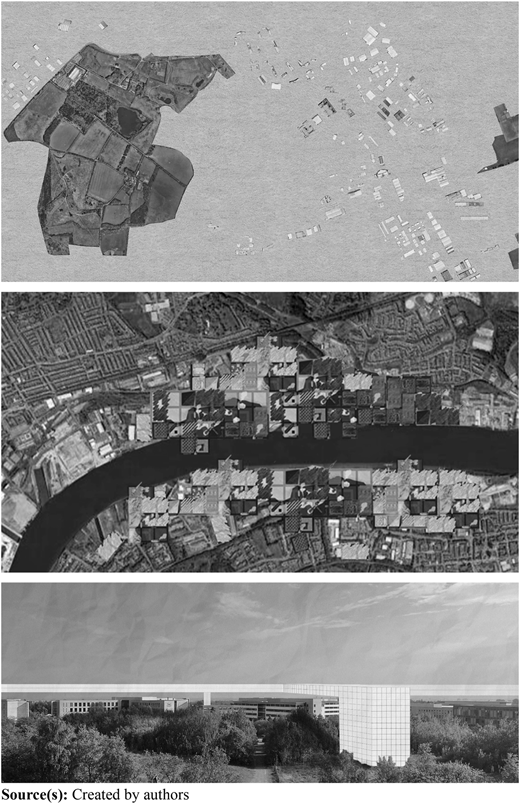
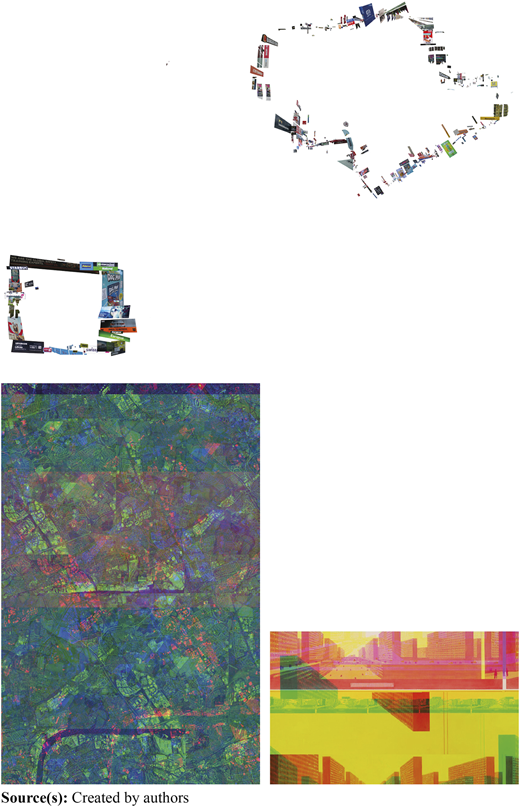
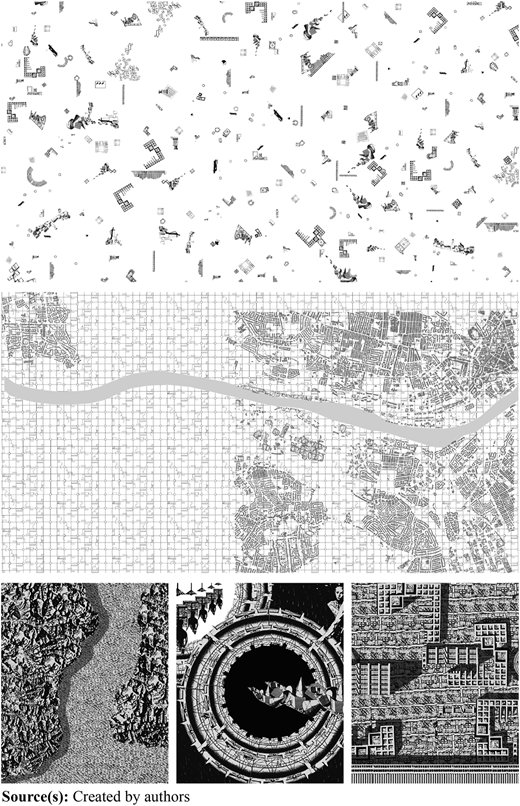
Students select one peripheral site, produce a suite of inventories to understand its key features, typologies and conditions, then walk the site and write about it. Students montage their paradigm plan into the peripheral site, exploring the consequences. A single representation that brings together this entanglement montage aims to articulate a principal typological and Anthropocenic condition for further investigation. Students use collage, montage, and axonometric diagram. This is the point at which the interplay of critical knowledge and a real condition is most pronounced. It serves to situate the thinking process, yet remain unapologetically speculative (Figure 2, Figure 3, Figure 4).

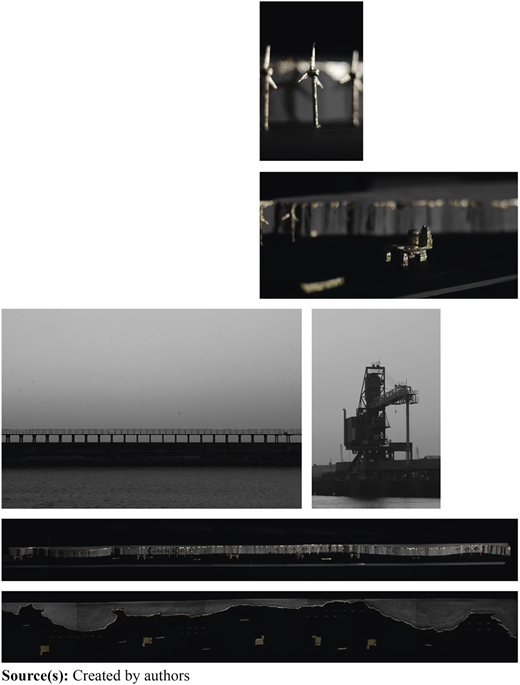
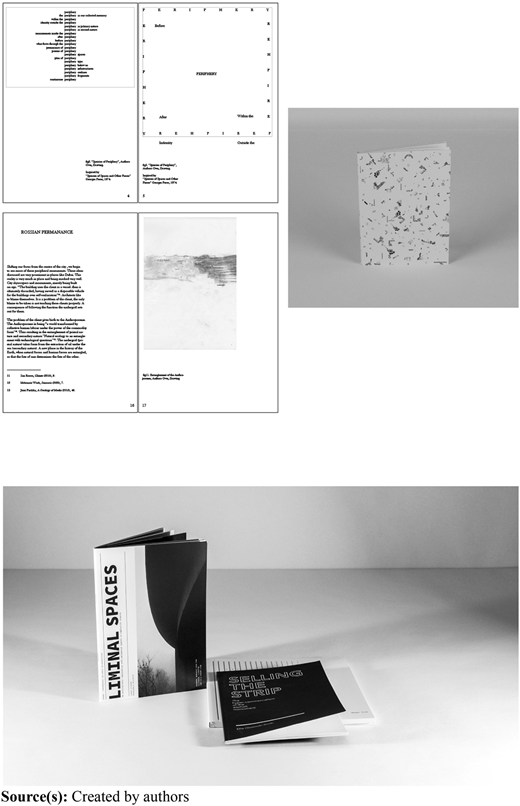
Students craft an artefact, which may be a constructed object, a drawing, a montage, a film or something else, to distil their central idea. It may be an abstract representation or distillation of their larger agenda, but a discrete and beautifully crafted artefact is encouraged for its power of persuasion. The nature and form of the artefact is determined and argued for by the individual student in relation to their overall analysis, research and speculation on the periphery–Anthropocene nexus. The chosen artefact – the thinking machine – is exhibited (Figure 5, Figure 7). A book comprising all elements of the project, synthesises drawings, montages, curated work in progress and written texts, containing a textual and visual argument of equal weight and significance (Figure 6). It demonstrates a coherent project that defines and argues a critical position (See Figure 7).

The Periphery as a Critical Project has run for two years at Northumbria University School of Architecture. It has been adjusted to test alternative sites for fieldwork, iterate theoretical content and substitute paradigm plans in response to what produces compelling ideas in student projects. It is illuminating to reflect on how students evaluate the approach, sampling comments from the anonymous module questionnaire. Students highlight the relationship between theory, practice and experiential inquiry: “The module was inspiring and very intellectually stimulating”; “I appreciated the attempt to make it more hands-on than other theory modules which I found to be better in terms of my understanding and enthusiasm for the project”; “A very interesting module, which I found challenging yet beneficial”; “I really appreciated working in groups to applicate what we’ve been taught”; “I liked the creative form of submission and curation (book) … boosting theory into practice”; “Very challenging and very interesting, applicable to present global issues”. [2].

I have concentrated on thinking-through-making as an experiential learning strategy focused on non-text based creative practice. Yet there is a creative practice of writing and along with it a mode of knowledge and thinking (McEwan, 2022a, b). Students “make” their texts, but in the past sessions this has been limited primarily to the graphic design of their books – page layout, graphic form, compelling production value of the book itself and understanding the book as a “quasi-portfolio”. All of which is important (and expensive). One criticism is the neglected processual element of experimental thinking-through-writing, such as what is evidenced in the construction of texts such as Rossi’s (1981) A Scientific Autobiography to name an architectural example, or McKenzie Wark’s A Hacker Manifesto (2004) to name a critical theory example. Nevertheless, students take great care in what they are producing and if they are taking care in the production, students are actively engaging, thinking and learning by making.

Students develop theoretical approaches for the urban periphery to produce projects that are critical readings. Understood in these terms, thinking-through-making resonates as a critical pedagogy that transforms knowledge, rather than simply consuming it. The students use old ideas and projects, developed into new ideas and projects through critical and experiential consciousness. They negotiate the relationships between theory and practice, critical analysis and applied knowledge, real sites and power dynamics. Giroux (2020, p. 2) argues that “critical pedagogy is … the outcome of particular struggles and is always related to the specificity of particular contexts, students, communities, and available resources. It draws attention to the ways in which knowledge, power, desire, and experience are produced under specific basic conditions of learning and illuminates the role that pedagogy plays as part of a struggle over assigned meanings, modes of expression, and directions of desire, particularly as these bear on the formation of the multiple and ever contradictory versions of the ‘self’ and its relationship to the larger society”. For Giroux and others, critical pedagogy is a practice that enables students to think critically about how knowledge is related to power and their self-constitution, to use knowledge to critique the world in which we live, and to change it. To repeat Wark (2010), from the paper epigraph: “The aim of education is to be a provocation to thought; the aim of thought is the renovation of the world”.

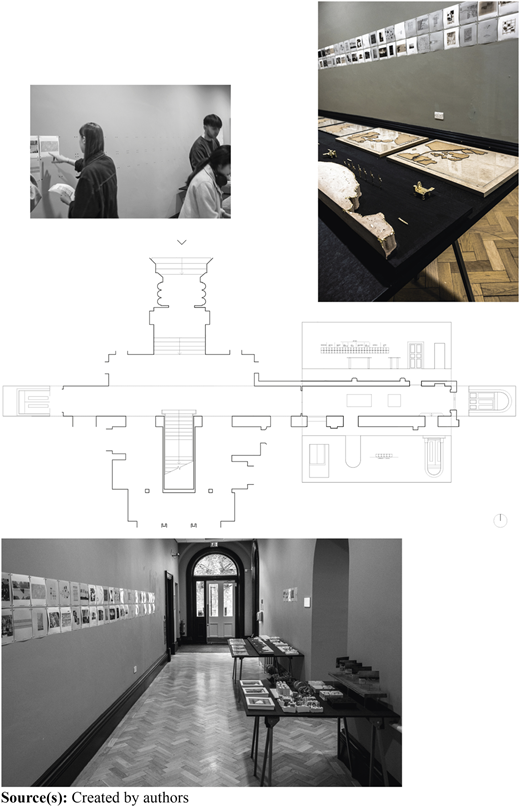
The following visual essay shows creative practice work from The Periphery as a Critical Project. It comprises drawings, objects, books and documentation from a co-curated exhibition. Each student submitted a single piece of work representing their theoretical investigations, and included drawings, photo essays, montages, a film and a suite of objects. The exhibition was held in a peripheral corridor of architecture’s Sutherland Building. A team of five self-selected students worked on the design, production, and installation. We tested paper types (matte, gloss, vinyl, trace) and different dimensions of paper. We decided on a simple composition of square pieces on the wall, using tracing paper for line drawings, and gloss paper for images such as photographs and montages. Objects were displayed on square and double square tables. To avoid damaging the walls, we used small magnets instead of nails, frames or shelves.

The visual analysis is captioned with a thinking-through-making methodology, student name and project titles, summarising research themes. The sequence follows the approximate methodological stages of project development. However, it is important to recognise the interplay between different visual and textual methods, and the mix of planned, speculative and reflective work.

The architecture school is not the only place to articulate change, but it is one place. In The Periphery as a Critical Project, students produce critical readings of past projects, which are inserted into real sites on the Newcastle periphery field lab – imagining new ways to inhabit the peripheral urban landscape. It is a speculative project and yet brings abstraction and messy reality into close dialogue. To conclude, let us name some concepts and practices that define an emerging architectural pedagogy for the Anthropocene.

The Periphery as a Critical Project emphasises an experiential approach that can be called a theorypractice for the peripheryAnthropocene, in recognition that the perceived split between theory and practice can be closed. Theorypractice is about learning from theoretical perspectives and real conditions, to work on the world, exemplified in some of the student outcomes shown in the earlier visual analyses. If one of the lessons of critical pedagogy is the way it combines reflection and action to articulate a sense of agency and civic engagement, then one way to bring that ethos into the spatial, material and representational modes of architecture, is close-reading as theorypractice combining analytical and generative techniques of writing, drawing, making and thinking.

Research-led Teaching, Teaching-led Research develops a culture of dialogue and connection across modes of practice and encourages alternative forms of assessment to develop critical thinking through practices of critical making, expanding the register of experiential learning particularly in the context of theory modules. Recognising that architecture graduates pursue different pathways – urbanism, planning, interior design, curation, filmmaking, further study, academia – and many architecture practices begin with exhibitions or conduct theoretical research projects, this framework supports these alternative routes (for example see, Aydemir and Jacoby, 2024; Voet et al., 2022; Waite, 2022).

The pedagogical framework puts forward a useful model to enhance experiential learning, showing how critical thinking and creative practice are articulated as thinking-through-making pedagogies in theory- and research-based modules. It provides architectural educators with an example that can be tailored for different institutions, pedagogical traditions, and global contexts, particularly useful during a time when architectural education is being radically reformed. This is evident by RIBA’s (2021) six “Themes and Values” adjusted from the previous eleven “Graduate Attributes and Criteria”, now including a dedicated theme on “History, Theories, Methodologies”, foregrounding the importance of research and theory in education. The Periphery as a Critical Project responds to these reforms and provides an adaptable model for how to meet new professionally validated thematic areas in an inventive way, but also suggests pathways for inquiry and innovation in architectural education globally.

Lastly, there is a movement towards wider critical and societal concerns. I argue that the disciplinary framework and pedagogical approach is a link in a chain of equivalence with a broader aim for changing how we think and act under the pressure of the Anthropocene with its attendant spatial, ecological and capitalist crises. Reimagining how collective life can be otherwise starts at architecture school. The Periphery as a Critical Project contributes to an interplay of dispositions and theorypractices that act as a relay between teacher and learner, architect and researcher, individual to collective practices and ideas, where students are active participants of the research and education culture of the university as hybrid producer-scholar-teacher-students. It is a contribution towards a common task of working on the world using the periphery–Anthropocene interplay as a site to address global challenges, in this case imagining different futures of the urban periphery under the climate crisis, opening onto issues such as housing, uneven urbanisation, democracy and capitalism. Consequently, this paper articulates an architectural pedagogy for the Anthropocene as one step in a broader critical project aimed at preparing engaged architect citizens who can work on and with the world.

I would like to acknowledge the students who contribute to The Periphery as a Critical Project, particularly those whose work is reproduced here. I also thank Ashraf Salama and the peer reviewers for insightful comments.

1.

Northumbria University Module Evaluation Questionnaire, 2022–23.

2.

Selected from Northumbria University Module Evaluation Questionnaire’s, 2022–2023 and 2023–2024.

Support: This work was supported by a Northumbria University Distinguished Teaching and Excellence Award for Research Enriched Education, 2023–2024.
@technofossils
(
2024
), “
Technofossils are the artifacts of our existence. What do they say?
”,
available at:
 https://www.instagram.com/technofossils/?hl=en
Agrest
,
D.
(
1991
),
Architecture from without: Theoretical Framings for a Critical Practice
,
MIT Press
,
Cambridge, MA
.
Agrest
,
D.
(
2018
),
Architecture of Nature/Nature of Architecture
,
ORO Editions/Applied Research & Design
,
Novato, CA
.
Allen
,
S.
(
2009
), “Notations and diagrams: mapping the intangible”,
[1989/1997/2007]
, in
Practice: Architecture, Technique and Representation
,
Routledge
,
London and New York
, pp.
41
-
70
.
Augé
,
M.
(
2023
), Non-Places: Introduction to an Anthropology of Supermodernity,
[1995] (Translated by J. Howe)
,
Verso
,
London
.
Aydemir
,
A.Z.
and
Jacoby
,
S.
(
2024
), “
Architectural design research in small practices
”,
Archnet-IJAR: International Journal of Architectural Research
, Vol. 
18
No. 
1
, pp. 
191
-
205
, doi: .
Bandini
,
M.
(
1984
), “
Typology as a form of convention
”,
AA Files
, Vol. 
6
, pp. 
73
-
82
.
Barthes
,
R.
(
1977
), “The death of the author”,
[1968]
, in
Heath (tran.)
,
S.
(Ed.),
Image, Music, Text
,
London: Fontana
, pp. 
142
-
148
.
Barthes
,
R.
(
2013
),
How to Live Together: Novelistic Simulations of Some Everyday Spaces
,
Translated by, Briggs, K. Columbia University Press
,
New York
.
Bartoli
,
S
.
and
Stollmann
,
J
. (Eds) (
2019
),
Tiergarten, Landscape of Transgression: This Obscure Object of Desire
,
Park Books
,
Zurich
.
Boano
,
C.
and
Lee Peragine
,
R.
(
2024
), “
A pedagogy of uselessness: challenging solutionism and utility in the Anthropocene through architectural pedagogy
”,
The Journal of Architecture
, Vol. 
29
No. 
4
, pp. 
1
-
24
, doi: .
Boyer
,
E.L.
(
1990
),
Scholarship Reconsidered: Priorities of the Professoriate
,
Princeton University Press
,
Princeton, NJ
.
Branzi
,
A.
(
2006
),
Weak and Diffuse Modernity: The World of Projects at the Beginning of the 21st Century
,
Translated by Price, A., Skira
,
Milan, London
.
Brew
,
A.
(
2017
),
Research and Teaching: Beyond the Divide
,
[2006]
,
Bloomsbury
,
London
.
Bruegmann
,
R.
(
2006
),
Sprawl: A Compact History
,
University of Chicago Press
,
Chicago
.
Bryan
,
C
.
and
Clegg
,
K
. (Eds) (
2006
),
Innovative Assessment in Higher Education
,
Routledge
,
London
.
Burroughs
,
W.
(
1989
),
Interzone
,
Picador
,
London
.
Chakrabarty
,
D.
(
2021
),
The Climate of History in a Planetary Age
,
University of Chicago
,
Chicago
.
Dewey
,
J.
(
1997
),
Experience and Education
,
Simon & Schuster
,
New York
.
Dorrian
,
M.
and
Hawker
,
A.
(
2015
), “
The exhibition as an ‘urban thing
”,
Interstices Journal of Architecture and Related Arts
, Vol. 
16
, pp. 
7
-
16
, doi: .
Dorrian
,
M.
,
Eeckhout
,
R.
and
Hendrickx
,
A.
 
(Eds)
(
2022
),
Drawing Architecture: Conversations on Contemporary Practice
,
Lund Humphries
,
London
.
Easterling
,
K.
(
1999
),
Organization Space: Landscapes, Highways, and Houses in America
,
MIT Press
,
Cambridge, MA
.
Easterling
,
K.
(
2021
),
Medium Design: Knowing How to Work on the World
,
Verso
,
Brooklyn, NY
.
Evenson
,
N.
(
1973
),
Two Brazilian Capitals: Architecture and Urbanism in Rio de Janeiro and Brasília
,
Yale University Press
,
New Haven, CT
.
Freire
,
P.
(
2000
),
Pedagogy of the Oppressed [1970]
,
Continuum
,
Translated by Ramos, M.B.
,
London
.
Gandelsonas
,
M.
(
1999
),
X-urbanism: Architecture and the American City
,
Princeton Architectural Press
,
New York
.
Giroux
,
H.A.
(
2020
),
On Critical Pedagogy
,
Bloomsbury
,
London, NY
.
Giroux
,
H.A.
(
2021
),
Race, Politics, and Pandemic Pedagogy: Education in a Time of Crisis
,
Bloomsbury
,
London, NY
.
Giroux
,
H.A.
(
2022
),
Pedagogy of Resistance: Against Manufactured Ignorance
,
Bloomsbury
,
London, NY
.
Goodricke
,
D.
and
Murray
,
L.
(
2024
),
Architecture Apprenticeship Handbook
,
RIBA Publications
,
London
.
Gregotti
,
V.
(
1968
),
New Directions in Italian Architecture
,
Translated by, Salvadori, G.
,
George Braziller
,
London, NY
.
Gregotti
,
V.
(
1996
),
Inside Architecture
,
Translated by Wong, P. and Zaccheo, F.
,
MIT Press
,
Cambridge, MA
.
Haralambidou
,
P.
(
2013
),
Marcel Duchamp and the Architecture of Desire
,
Routledge
,
London
.
Haralambidou
,
P.
(
2020
), “
The female body politic: enacting the architecture of the book of the city of ladies
”,
Architecture and Culture
, Vol. 
8
Nos
3-4
, pp. 
385
-
406
, doi: .
Haraway
,
D.J.
(
2016
),
Staying with the Trouble: Making Kin in the Chthulucene
,
Duke University Press
,
Durham
.
Harland
,
T.
(
2016
), “
Teaching to enhance research
”,
Higher Education Research and Development
, Vol. 
35
No. 
3
, pp. 
461
-
472
, doi: .
Hayden
,
D.
(
2004
),
A Field Guide to Sprawl
,
W. W. Norton & Company
,
New York
.
Healey
,
M.
and
Jenkins
,
A.
(
2009
),
Developing Undergraduate Research and Inquiry
,
The Higher Education Academy
,
New York
.
Hilberseimer
,
L.
(
2012
),
Metropolisarchitecture
,
[1927] Edited by R. Anderson. Translated by J. Dawson and R. Anderson
,
GSAPP: Columbia Books on Architecture
,
New York
.
Hobsbawm
,
E.
(
1995
),
Age of Extremes: The Short Twentieth Century, 1914-1991
,
Abacus
,
London
.
Holm
,
L.
(
2022
),
Reading Architecture with Freud and Lacan
,
Routledge
,
London
.
Holm
,
L.
and
McEwan
,
C.
(
2019
), “
The city as critical project – a poetics of collective life
”,
Arq: Architectural Research Quarterly
, Vol. 
23
No. 
2
, pp. 
179
-
194
, doi: .
Iturbe
,
E.
(
2024
), “Doubt, rapture, power, and knowledge: a four-Part Reflection on architectural education”, in
Atak
,
T.
,
Callejas
,
L.
,
Scelsa
,
J.
and
Tandberg
,
J.J.
(Eds),
Pedagogical Experiments in Architecture for a Changing Climate
,
Routledge
,
New York
, pp.
242
-
250
.
Koolhaas
,
R.
(
1994
),
Delirious New York: A Retroactive Manifesto for Manhattan
,
The Monacelli Press
,
New York
,
[1978]
.
Laclau
,
E.
and
Mouffe
,
C.
(
2014
),
Hegemony and Socialist Strategy: towards a Radical Democratic Politics
,
[1985]
,
Verso
,
London
.
Lechner
,
A.
(
2021
),
Thinking Design: Blueprint for an Architecture of Typology
,
Park Books
,
Zürich
.
Lerup
,
L.
(
2017
),
The Continuous City: Fourteen Essays on Architecture and Urbanisation
,
Park Books
,
Zürich
.
LeWitt
,
S.
(
1969
), “
Sentences on conceptual art
”,
Art-Language: The Journal of Conceptual Art
, Vol. 
1
No. 
1
, pp. 
11
-
13
.
Marsh
,
H.W.
and
Hattie
,
J.
(
2002
), “
The relation between research productivity and teaching effectiveness: complementary, antagonistic, or independent constructs?
”,
The Journal of Higher Education
, Vol. 
73
No. 
5
, pp. 
603
-
641
, doi: .
McEwan
,
C.
(
2021
), “
The city as a critical project: toward an architecture of the multitude
”,
Scroope: Cambridge Architecture Journal
, No. 
30
,
Arch-ademy
, pp. 
25
-
46
.
McEwan
,
C.
(
2022a
), “
Analogical writing: practices of collective life
”,
NOIA Magazine
, No. 
2
, pp. 
22
-
25
.
McEwan
,
C.
(
2022b
), “
Ghostwriting an authorship without aura
”,
Lo Squaderno
, No.
62
 
Ghosts [Crowds]
, pp.
9
-
12
.
McEwan
,
C.
(
2023
), “
Architectural pedagogy for the Anthropocene: theory, critique and typological urbanism
”,
Archnet-IJAR: International Journal of Architectural Research
, Vol. 
17
No. 
3
, pp. 
478
-
495
, doi: .
McEwan
,
C.
(
2024
),
Analogical City
,
Brooklyn, NY
,
Punctum
, doi: .
Moneo
,
R.
(
1978
), “
On typology
”,
Oppositions
, Vol. 
13
, pp. 
23
-
45
.
Moore
,
J.W.
(
2015
),
Capitalism in the Web of Life: Ecology and the Accumulation of Capital
,
Verso
,
New York
.
Neary
,
M.
(
2020
),
Student as Producer: How do Revolutionary Teachers Teach?
,
Zero Books
,
Hampshire
.
Parikka
,
J.
(
2015
),
A Geology of Media
,
University Of Minnesota Press
,
Minneapolis
.
Pope
,
A.
(
2024
),
Inverse Utopia: Urbanism and the Great Acceleration
,
Birkhäuser Verlag GmbH
,
Basel
.
Ratto
,
M.
(
2011
), “
Critical making: conceptual and material studies in technology and social life
”,
The Information Society: International Journal
, Vol. 
27
No. 
4
, pp. 
252
-
260
, doi: .
Raunig
,
G.
(
2013
),
Factories of Knowledge Industries of Creativity
,
Translated by Derieg, A.
,
MIT Press
,
Los Angeles, CA.; Cambridge, MA
.
RIBA
(
2021
),
The Way Ahead: an Introduction to the New RIBA Education and Professional Development Framework and an Overview of its Key Components
,
RIBA Publications
,
London
.
Rossi
,
A.
(
1981
),
A Scientific Autobiography
,
Translated by Venuti, L.
, 
MIT Press
,
Cambridge, MA
.
Rossi
,
A.
(
1982
),
The Architecture of the City [1966]
,
MIT Press
,
Translated by Ghirardo, D. and Ockman, J.
,
Cambridge, MA
.
Salama
,
A.M.
(
2010
), “
Delivering theory courses in architecture: inquiry-based, active, and experiential learning integrated
”,
Archnet-IJAR: International Journal of Architectural Research
, Vol. 
4
Nos
2-3
, pp. 
278
-
295
.
Salama
,
A.M.
(
2015
),
Spatial Design Education: New Directions for Pedagogy in Architecture and beyond
,
Routledge
,
London
.
Salama
,
A.M.
(
2019
), “
Methodological research in architecture and allied disciplines: philosophical positions, frames of reference, and spheres of inquiry
”,
Archnet-IJAR: International Journal of Architectural Research
, Vol. 
13
No. 
1
, pp. 
8
-
24
, doi: .
Smith
,
N.
(
2010
),
Uneven Development: Nature, Capital and the Production of Space
,
[1984]
,
Verso
,
London
.
The Edu-Factory Collective
(
2009
),
Toward a Global Autonomous University: Cognitive Labor, the Production of Knowledge, and Exodus from the Education Factory
,
Autonomedia
,
New York
.
Viganò
,
P.
(
2016
),
Territories of Urbanism: the Project as Knowledge Producer
,
EPFL Press
,
Lausanne
,
Translated by S. Piccolo
.
Virilio
,
P.
(
1991
),
Lost Dimension [1983]
,
Translated by Moshenberg, D.
,
Semiotext(e); MIT Press
,
Cambridge, MA
.
Voet
,
C
.
,
Schreurs
,
E
.
and
Thomas
,
H
. (Eds) (
2022
),
The Hybrid Practitioner: Building, Teaching, Researching Architecture
,
Leuven University Press
,
Leuven
.
Waite
,
R.
(
2022
), “
Dropping out: what is turning students off becoming an architect?
”,
18 October
,
The Architects' Journal
,
available at:
 https://www.architectsjournal.co.uk/news/dropping-out-what-is-turning-students-off-becoming-an-architect
Wang
,
Y.
(
2016
),
A Century of Change: Beijing's Urban Structure in the 20th Century
,
Springer
,
Switzerland, AG
.
Wark
,
M.
(
2004
),
A Hacker Manifesto
,
Harvard University Press
,
Cambridge, MA
.
Wark
,
M.
(
2010
), “
The aims of education
”,
Kritikos: An International and Interdisciplinary Journal of Postmodern Cultural Sound, Text and Image
, Vol. 
7
,
1 July-August, available at:
 https://intertheory.org/wark.htm
Wark
,
M.
(
2015
),
Molecular Red: Theory for the Anthropocene
,
Verso
,
London, NY
.
Wark
,
M.
(
2020
),
Sensoria: Thinkers for the Twenty-First Century
,
Verso
,
New York
.
Wark
,
M.
(
2021
),
Philosophy for Spiders: on the Low Theory of Kathy Acker
,
Duke University Press
,
Durham and London
.
Xaveer de Geyter Architects
(
2002
),
After-Sprawl: Research for the Contemporary City
,
NAi Publishers
,
Rotterdam
.
Bartoli
,
S.
,
Linden
,
S.
,
Clausen
,
M.
,
Sonjasdotter
,
Å.
,
Wüst
,
F.
,
Grotz
,
K.
and
Rahemipour
,
P.
(Eds) (
2019
),
Licht Luft Scheisse: Perspectives on Ecology and Modernity
,
adocs Verlag
;ngbk, Hamburg and Berlin
.
Published by Emerald Publishing Limited. This article is published under the Creative Commons Attribution (CC BY 4.0) licence. Anyone may reproduce, distribute, translate and create derivative works of this article (for both commercial and non-commercial purposes), subject to full attribution to the original publication and authors. The full terms of this licence may be seen at http://creativecommons.org/licences/by/4.0/legalcode

Data & Figures

Figure 1
A diagram presents a collection of urban inventory drawings arranged across multiple groupings on a single sheet.The diagram is organized into three distinct groupings across the sheet. Top-left grouping: A 3 by 3 arrangement of nine rectangular panels is shown. The panels in the top row contain fine line drawings depicting grid structures, elevation profiles, and plan outlines. The middle row panels show vertical line elements resembling section cuts or structural profiles. The bottom row panels contain sparse linear and text elements, with one panel featuring a detailed horizontal plan with fine annotations. Top-right grouping: A grid of small axonometric or plan-view block forms is arranged in rows and columns of three across. The forms vary in their fill patterns across the three columns — the left column shows solid black filled forms, the center column shows lighter or outlined forms, and the right column shows forms with dot or texture patterns. The rows progress from smaller compact forms at the top to larger and more elongated forms toward the bottom. Below the block forms, three rows of smaller elements are shown: a row of short horizontal bars, a row of smaller rectangular elements, and a row of long thin horizontal line forms. Bottom grouping: A 3 by 3 grid of rectangular panels is shown, with one additional standalone panel in the upper-left position outside the grid. Row 1 of the grid: The standalone panel depicts a city street grid plan with a large black filled form near the lower-left area and bold lines indicating major roads or axes crossing the grid. Row 2 of the grid: The left panel shows a simplified outline of a landmass or irregular boundary. The center panel shows a loosely gridded cluster of small rectangular elements forming an irregular overall shape. The right panel shows a network of intersecting lines of varying weights radiating and crossing in multiple directions. Row 3 of the grid: The left panel shows a branching line structure resembling an organic or river network. The center panel shows a scattered cluster of irregular black forms of varying sizes. The right panel shows a dispersed arrangement of small irregular fragments spread across the panel. Row 4 of the grid: The left panel shows a small rectangular element and a ladder-like vertical structure positioned in the lower-right area. The center panel shows a large black landmass form occupying the lower portion with a thin vertical element rising above it. The right panel shows a single compact black form positioned in the lower-center area.

Inventories. Close-readings of Los Angeles, Agronica and Barcelona. Maya Vahidi, Amorous Periphery; Alex Butler, Reading the Landscape Grid; Aryana Kholia, Centre = Periphery

Figure 1
A diagram presents a collection of urban inventory drawings arranged across multiple groupings on a single sheet.The diagram is organized into three distinct groupings across the sheet. Top-left grouping: A 3 by 3 arrangement of nine rectangular panels is shown. The panels in the top row contain fine line drawings depicting grid structures, elevation profiles, and plan outlines. The middle row panels show vertical line elements resembling section cuts or structural profiles. The bottom row panels contain sparse linear and text elements, with one panel featuring a detailed horizontal plan with fine annotations. Top-right grouping: A grid of small axonometric or plan-view block forms is arranged in rows and columns of three across. The forms vary in their fill patterns across the three columns — the left column shows solid black filled forms, the center column shows lighter or outlined forms, and the right column shows forms with dot or texture patterns. The rows progress from smaller compact forms at the top to larger and more elongated forms toward the bottom. Below the block forms, three rows of smaller elements are shown: a row of short horizontal bars, a row of smaller rectangular elements, and a row of long thin horizontal line forms. Bottom grouping: A 3 by 3 grid of rectangular panels is shown, with one additional standalone panel in the upper-left position outside the grid. Row 1 of the grid: The standalone panel depicts a city street grid plan with a large black filled form near the lower-left area and bold lines indicating major roads or axes crossing the grid. Row 2 of the grid: The left panel shows a simplified outline of a landmass or irregular boundary. The center panel shows a loosely gridded cluster of small rectangular elements forming an irregular overall shape. The right panel shows a network of intersecting lines of varying weights radiating and crossing in multiple directions. Row 3 of the grid: The left panel shows a branching line structure resembling an organic or river network. The center panel shows a scattered cluster of irregular black forms of varying sizes. The right panel shows a dispersed arrangement of small irregular fragments spread across the panel. Row 4 of the grid: The left panel shows a small rectangular element and a ladder-like vertical structure positioned in the lower-right area. The center panel shows a large black landmass form occupying the lower portion with a thin vertical element rising above it. The right panel shows a single compact black form positioned in the lower-center area.

Inventories. Close-readings of Los Angeles, Agronica and Barcelona. Maya Vahidi, Amorous Periphery; Alex Butler, Reading the Landscape Grid; Aryana Kholia, Centre = Periphery

Close modal
Figure 2
A diagram presents three urban inventory drawings arranged in a vertical sequence of three rows.The diagram is arranged in three rows, each depicting a distinct urban inventory drawing. Top row: A large white field is scattered with numerous small architectural plan fragments and building footprint drawings. The fragments vary in shape and size, including L-shaped, rectangular, curved, and irregular forms. They are distributed across the full width of the field without any apparent grid or organizational structure, giving the appearance of dispersed urban elements. Middle row: A wide horizontal urban plan is shown, depicting a dense city fabric divided by a broad curving gray band representing a river running from left to right across the composition. On both sides of the river, the plan shows closely packed building footprints and street patterns drawn in fine lines. A regular grid of faint square cells overlays the entire plan, dividing the urban fabric into equal units. The building density is higher on the right side of the plan and in certain clusters on the left. Bottom row: Three plans are presented side by side. Bottom row, left plan: A dense cluster of small building footprints is shown alongside a curving gray band, suggesting a river or pathway edge. The buildings are tightly packed and vary in orientation. Bottom row, center plan: A circular structure is shown with concentric rings forming the building perimeter. The interior of the circle is dark, and small figurative elements are visible within the central void. Hanging light fixtures or structural elements are visible at the top of the composition. Bottom row, right plan: A dense urban fabric is shown with a mix of large rectangular block structures and smaller building footprints arranged in a grid-like pattern. The blocks vary in size and internal subdivision.

Montage entanglement. Exploring peripheral typologies. Anna Hodgson, Monumental Landscapes; Simon Greenan, Analogical Nature; William Taylor, Informational Landscape

Figure 2
A diagram presents three urban inventory drawings arranged in a vertical sequence of three rows.The diagram is arranged in three rows, each depicting a distinct urban inventory drawing. Top row: A large white field is scattered with numerous small architectural plan fragments and building footprint drawings. The fragments vary in shape and size, including L-shaped, rectangular, curved, and irregular forms. They are distributed across the full width of the field without any apparent grid or organizational structure, giving the appearance of dispersed urban elements. Middle row: A wide horizontal urban plan is shown, depicting a dense city fabric divided by a broad curving gray band representing a river running from left to right across the composition. On both sides of the river, the plan shows closely packed building footprints and street patterns drawn in fine lines. A regular grid of faint square cells overlays the entire plan, dividing the urban fabric into equal units. The building density is higher on the right side of the plan and in certain clusters on the left. Bottom row: Three plans are presented side by side. Bottom row, left plan: A dense cluster of small building footprints is shown alongside a curving gray band, suggesting a river or pathway edge. The buildings are tightly packed and vary in orientation. Bottom row, center plan: A circular structure is shown with concentric rings forming the building perimeter. The interior of the circle is dark, and small figurative elements are visible within the central void. Hanging light fixtures or structural elements are visible at the top of the composition. Bottom row, right plan: A dense urban fabric is shown with a mix of large rectangular block structures and smaller building footprints arranged in a grid-like pattern. The blocks vary in size and internal subdivision.

Montage entanglement. Exploring peripheral typologies. Anna Hodgson, Monumental Landscapes; Simon Greenan, Analogical Nature; William Taylor, Informational Landscape

Close modal
Figure 3
A visual shows 3 panels combining landscape fragments, urban aerial imagery, and a panoramic urban scene.The visual consists of three horizontal panels arranged vertically, each presenting a different composite representation of landscapes and urban environments. The top panel shows a large irregular land fragment composed of aerial photographic textures including fields, vegetation, and water bodies. This fragment appears on the left side of the panel. To the right, numerous smaller rectangular and irregular fragments are scattered across the surface. These pieces vary in size and orientation and resemble cropped segments of aerial terrain or built areas distributed across the open field. The middle panel presents an aerial view of an urban area divided by a wide curving river running horizontally across the frame. On both sides of the river, dense street networks and building blocks are visible. Across the central area near the river, a grid of square tiles overlays the aerial imagery. Each tile contains a different texture or pattern, forming a patchwork of varied surfaces positioned over the urban landscape. The bottom panel shows a wide panoramic view of a landscape with trees occupying the lower portion of the scene. A long elevated horizontal structure extends across the image above the tree canopy. Rectangular structural supports descend vertically from the elevated structure at intervals. Beyond the trees, several mid-rise buildings appear in the distance beneath an open sky.

Montage entanglement. Speculative montages placing the architectural imagination into real conditions. Anna Hodgson, Monumental Landscapes; Libuse Plevacova, Human Nature and Urban Nature; Ollie Clare, Nieu-Castle

Figure 3
A visual shows 3 panels combining landscape fragments, urban aerial imagery, and a panoramic urban scene.The visual consists of three horizontal panels arranged vertically, each presenting a different composite representation of landscapes and urban environments. The top panel shows a large irregular land fragment composed of aerial photographic textures including fields, vegetation, and water bodies. This fragment appears on the left side of the panel. To the right, numerous smaller rectangular and irregular fragments are scattered across the surface. These pieces vary in size and orientation and resemble cropped segments of aerial terrain or built areas distributed across the open field. The middle panel presents an aerial view of an urban area divided by a wide curving river running horizontally across the frame. On both sides of the river, dense street networks and building blocks are visible. Across the central area near the river, a grid of square tiles overlays the aerial imagery. Each tile contains a different texture or pattern, forming a patchwork of varied surfaces positioned over the urban landscape. The bottom panel shows a wide panoramic view of a landscape with trees occupying the lower portion of the scene. A long elevated horizontal structure extends across the image above the tree canopy. Rectangular structural supports descend vertically from the elevated structure at intervals. Beyond the trees, several mid-rise buildings appear in the distance beneath an open sky.

Montage entanglement. Speculative montages placing the architectural imagination into real conditions. Anna Hodgson, Monumental Landscapes; Libuse Plevacova, Human Nature and Urban Nature; Ollie Clare, Nieu-Castle

Close modal
Figure 4
A visual presents four architectural montages exploring urban and media themes across two groupings.The visual is organized into two groupings positioned across the sheet. Top grouping: Two collage compositions are shown, both constructed from small rectangular fragments of printed media, signage, and graphic elements arranged to form closed loop or ring shapes. The upper composition is larger and positioned toward the upper-right area of the sheet. It consists of numerous small fragments including printed signs, labels, booklets, and graphic panels arranged in an irregular ring or oval shape. The fragments vary in orientation and size, and the center of the ring is left open. The lower composition is smaller and positioned toward the left side of the sheet, below the upper composition. It is similarly constructed from small rectangular printed fragments arranged in a tight square ring formation. The fragments include colorful printed materials and signage elements, and the center of the square form is open. Bottom grouping: Two rectangular compositions are shown side by side in the lower portion of the sheet. The left composition is a large vertical rectangle depicting a dense layered urban aerial view. Multiple overlapping map or satellite layers are superimposed, creating a complex multi-layered surface. Street networks, block patterns, and open spaces are partially legible beneath the layered tones. A dark curving band is visible in the lower portion. The right composition is a smaller horizontal rectangle depicting a stylized urban streetscape. Tall building facades with regular fenestration are visible on both sides of a central receding street. Horizontal bands of varying tones divide the composition, and the overall rendering has a fragmented or digitally distorted appearance.

Montage entanglement. Exploring media technologies and the urban periphery. Dylan Lewthwaite, Spectacle of the Periphery; Tom Hellier, Corrupted Peripheries

Figure 4
A visual presents four architectural montages exploring urban and media themes across two groupings.The visual is organized into two groupings positioned across the sheet. Top grouping: Two collage compositions are shown, both constructed from small rectangular fragments of printed media, signage, and graphic elements arranged to form closed loop or ring shapes. The upper composition is larger and positioned toward the upper-right area of the sheet. It consists of numerous small fragments including printed signs, labels, booklets, and graphic panels arranged in an irregular ring or oval shape. The fragments vary in orientation and size, and the center of the ring is left open. The lower composition is smaller and positioned toward the left side of the sheet, below the upper composition. It is similarly constructed from small rectangular printed fragments arranged in a tight square ring formation. The fragments include colorful printed materials and signage elements, and the center of the square form is open. Bottom grouping: Two rectangular compositions are shown side by side in the lower portion of the sheet. The left composition is a large vertical rectangle depicting a dense layered urban aerial view. Multiple overlapping map or satellite layers are superimposed, creating a complex multi-layered surface. Street networks, block patterns, and open spaces are partially legible beneath the layered tones. A dark curving band is visible in the lower portion. The right composition is a smaller horizontal rectangle depicting a stylized urban streetscape. Tall building facades with regular fenestration are visible on both sides of a central receding street. Horizontal bands of varying tones divide the composition, and the overall rendering has a fragmented or digitally distorted appearance.

Montage entanglement. Exploring media technologies and the urban periphery. Dylan Lewthwaite, Spectacle of the Periphery; Tom Hellier, Corrupted Peripheries

Close modal
Figure 5
A composite visual shows small metallic models, industrial waterfront photos, and long horizontal landscape studies.The visual presents several photographs and elongated graphic panels arranged vertically on the page. At the top, two close-up photographs show small metallic models placed on a dark surface. The upper photograph displays a thin vertical metallic element with three short blades extending outward from a central point. The second photograph below shows a small metallic structure with two upright vertical pieces positioned on the same dark surface. Additional blurred metallic forms appear farther back in the scene. Below these photographs, two landscape-oriented photos appear side by side. The left photo shows a long pier-like structure extending horizontally across a body of water. The structure contains evenly spaced vertical supports beneath a continuous horizontal deck. The right photo shows a tall industrial structure composed of multiple stacked platforms, ladders, and structural frames rising above the water. Further down, a long horizontal strip shows a continuous line of small illuminated structures arranged along a dark base, forming an extended linear composition. At the bottom, another elongated horizontal panel displays a layered cross-sectional landscape profile. The upper edge forms an irregular contour resembling a shoreline or terrain edge, while several small rectangular forms appear beneath the contour line across the dark lower portion.

Artefact. Close-reading the coastal edge. Timea Lewkot, Peripheries Unbound

Figure 5
A composite visual shows small metallic models, industrial waterfront photos, and long horizontal landscape studies.The visual presents several photographs and elongated graphic panels arranged vertically on the page. At the top, two close-up photographs show small metallic models placed on a dark surface. The upper photograph displays a thin vertical metallic element with three short blades extending outward from a central point. The second photograph below shows a small metallic structure with two upright vertical pieces positioned on the same dark surface. Additional blurred metallic forms appear farther back in the scene. Below these photographs, two landscape-oriented photos appear side by side. The left photo shows a long pier-like structure extending horizontally across a body of water. The structure contains evenly spaced vertical supports beneath a continuous horizontal deck. The right photo shows a tall industrial structure composed of multiple stacked platforms, ladders, and structural frames rising above the water. Further down, a long horizontal strip shows a continuous line of small illuminated structures arranged along a dark base, forming an extended linear composition. At the bottom, another elongated horizontal panel displays a layered cross-sectional landscape profile. The upper edge forms an irregular contour resembling a shoreline or terrain edge, while several small rectangular forms appear beneath the contour line across the dark lower portion.

Artefact. Close-reading the coastal edge. Timea Lewkot, Peripheries Unbound

Close modal
Figure 6
A composite layout shows book pages, a patterned booklet, and two publications displayed on a flat surface.The visual presents a composite arrangement of book pages and photographs of printed publications. In the upper left area, four book pages are displayed in a two by two grid. The top left page contains a list of phrases arranged in a vertical column. The top right page contains the word “PERIPHERY” placed near the center and surrounded by other words arranged along the edges of the page. The bottom left page contains a text block with the heading “ROSSIAN PERMANANCE” above several paragraphs of text and numbered references. The bottom right page contains a grayscale drawing resembling a landscape positioned above a caption. To the right of these pages, a photograph shows a standing booklet placed on a flat surface. The booklet cover contains numerous small scattered graphic fragments distributed across a light surface. The lower portion of the visual shows a photograph of two publications placed on a flat surface. One book stands upright with the title “LIMINAL SPACES” printed vertically along the cover. In front of it lies another publication with the title “SELLING THE STRIP” printed on its cover. A second booklet lies partially beneath the front publication, with only its edges and a small portion of the cover visible.

Books. Students synthesise thinking-through-making and thinking-through-writing experiments into designed books. Kieran Ward, After Oil After Rossi; Edward Oldridge, Liminal Spaces; Ellie Olszewski-Smith, Selling the Strip

Figure 6
A composite layout shows book pages, a patterned booklet, and two publications displayed on a flat surface.The visual presents a composite arrangement of book pages and photographs of printed publications. In the upper left area, four book pages are displayed in a two by two grid. The top left page contains a list of phrases arranged in a vertical column. The top right page contains the word “PERIPHERY” placed near the center and surrounded by other words arranged along the edges of the page. The bottom left page contains a text block with the heading “ROSSIAN PERMANANCE” above several paragraphs of text and numbered references. The bottom right page contains a grayscale drawing resembling a landscape positioned above a caption. To the right of these pages, a photograph shows a standing booklet placed on a flat surface. The booklet cover contains numerous small scattered graphic fragments distributed across a light surface. The lower portion of the visual shows a photograph of two publications placed on a flat surface. One book stands upright with the title “LIMINAL SPACES” printed vertically along the cover. In front of it lies another publication with the title “SELLING THE STRIP” printed on its cover. A second booklet lies partially beneath the front publication, with only its edges and a small portion of the cover visible.

Books. Students synthesise thinking-through-making and thinking-through-writing experiments into designed books. Kieran Ward, After Oil After Rossi; Edward Oldridge, Liminal Spaces; Ellie Olszewski-Smith, Selling the Strip

Close modal
Figure 7
A composite visual shows exhibition photographs and a central architectural plan drawing.The visual is composed of several photographs and a line drawing arranged across the page. In the upper left area, a photograph shows three people standing near a wall display. One person faces the wall while holding a sheet of paper, and two others stand nearby looking toward the display. Multiple small rectangular prints are arranged in a horizontal row along the wall. In the upper right area, a photograph shows a table displaying several rectangular boards and small objects. The boards contain map-like or diagrammatic patterns. A wall behind the table displays a continuous row of small images arranged in a horizontal line. At the center of the visual, a large architectural line drawing shows a symmetrical plan with a long horizontal axis and a central vertical projection. The drawing includes multiple rooms and structural outlines arranged around corridors and stair-like elements. Below the central drawing on the right side, a smaller rectangular diagram contains simplified interior elements arranged in a plan view. At the bottom of the visual, a photograph shows a long gallery corridor with wooden flooring. Tables placed along the corridor display small models and printed materials. The walls contain a continuous row of photographs or drawings arranged in a horizontal sequence leading toward a doorway at the far end.

Exhibition. Peripheries, co-curated with Timea Lewkot, Alanis Burgess, Kerl Vargas, Tom Hellier, Ali Abu Zannad. Plan/elevation drawing by Vargas

Figure 7
A composite visual shows exhibition photographs and a central architectural plan drawing.The visual is composed of several photographs and a line drawing arranged across the page. In the upper left area, a photograph shows three people standing near a wall display. One person faces the wall while holding a sheet of paper, and two others stand nearby looking toward the display. Multiple small rectangular prints are arranged in a horizontal row along the wall. In the upper right area, a photograph shows a table displaying several rectangular boards and small objects. The boards contain map-like or diagrammatic patterns. A wall behind the table displays a continuous row of small images arranged in a horizontal line. At the center of the visual, a large architectural line drawing shows a symmetrical plan with a long horizontal axis and a central vertical projection. The drawing includes multiple rooms and structural outlines arranged around corridors and stair-like elements. Below the central drawing on the right side, a smaller rectangular diagram contains simplified interior elements arranged in a plan view. At the bottom of the visual, a photograph shows a long gallery corridor with wooden flooring. Tables placed along the corridor display small models and printed materials. The walls contain a continuous row of photographs or drawings arranged in a horizontal sequence leading toward a doorway at the far end.

Exhibition. Peripheries, co-curated with Timea Lewkot, Alanis Burgess, Kerl Vargas, Tom Hellier, Ali Abu Zannad. Plan/elevation drawing by Vargas

Close modal

Supplements

References

@technofossils
(
2024
), “
Technofossils are the artifacts of our existence. What do they say?
”,
available at:
 https://www.instagram.com/technofossils/?hl=en
Agrest
,
D.
(
1991
),
Architecture from without: Theoretical Framings for a Critical Practice
,
MIT Press
,
Cambridge, MA
.
Agrest
,
D.
(
2018
),
Architecture of Nature/Nature of Architecture
,
ORO Editions/Applied Research & Design
,
Novato, CA
.
Allen
,
S.
(
2009
), “Notations and diagrams: mapping the intangible”,
[1989/1997/2007]
, in
Practice: Architecture, Technique and Representation
,
Routledge
,
London and New York
, pp.
41
-
70
.
Augé
,
M.
(
2023
), Non-Places: Introduction to an Anthropology of Supermodernity,
[1995] (Translated by J. Howe)
,
Verso
,
London
.
Aydemir
,
A.Z.
and
Jacoby
,
S.
(
2024
), “
Architectural design research in small practices
”,
Archnet-IJAR: International Journal of Architectural Research
, Vol. 
18
No. 
1
, pp. 
191
-
205
, doi: .
Bandini
,
M.
(
1984
), “
Typology as a form of convention
”,
AA Files
, Vol. 
6
, pp. 
73
-
82
.
Barthes
,
R.
(
1977
), “The death of the author”,
[1968]
, in
Heath (tran.)
,
S.
(Ed.),
Image, Music, Text
,
London: Fontana
, pp. 
142
-
148
.
Barthes
,
R.
(
2013
),
How to Live Together: Novelistic Simulations of Some Everyday Spaces
,
Translated by, Briggs, K. Columbia University Press
,
New York
.
Bartoli
,
S
.
and
Stollmann
,
J
. (Eds) (
2019
),
Tiergarten, Landscape of Transgression: This Obscure Object of Desire
,
Park Books
,
Zurich
.
Boano
,
C.
and
Lee Peragine
,
R.
(
2024
), “
A pedagogy of uselessness: challenging solutionism and utility in the Anthropocene through architectural pedagogy
”,
The Journal of Architecture
, Vol. 
29
No. 
4
, pp. 
1
-
24
, doi: .
Boyer
,
E.L.
(
1990
),
Scholarship Reconsidered: Priorities of the Professoriate
,
Princeton University Press
,
Princeton, NJ
.
Branzi
,
A.
(
2006
),
Weak and Diffuse Modernity: The World of Projects at the Beginning of the 21st Century
,
Translated by Price, A., Skira
,
Milan, London
.
Brew
,
A.
(
2017
),
Research and Teaching: Beyond the Divide
,
[2006]
,
Bloomsbury
,
London
.
Bruegmann
,
R.
(
2006
),
Sprawl: A Compact History
,
University of Chicago Press
,
Chicago
.
Bryan
,
C
.
and
Clegg
,
K
. (Eds) (
2006
),
Innovative Assessment in Higher Education
,
Routledge
,
London
.
Burroughs
,
W.
(
1989
),
Interzone
,
Picador
,
London
.
Chakrabarty
,
D.
(
2021
),
The Climate of History in a Planetary Age
,
University of Chicago
,
Chicago
.
Dewey
,
J.
(
1997
),
Experience and Education
,
Simon & Schuster
,
New York
.
Dorrian
,
M.
and
Hawker
,
A.
(
2015
), “
The exhibition as an ‘urban thing
”,
Interstices Journal of Architecture and Related Arts
, Vol. 
16
, pp. 
7
-
16
, doi: .
Dorrian
,
M.
,
Eeckhout
,
R.
and
Hendrickx
,
A.
 
(Eds)
(
2022
),
Drawing Architecture: Conversations on Contemporary Practice
,
Lund Humphries
,
London
.
Easterling
,
K.
(
1999
),
Organization Space: Landscapes, Highways, and Houses in America
,
MIT Press
,
Cambridge, MA
.
Easterling
,
K.
(
2021
),
Medium Design: Knowing How to Work on the World
,
Verso
,
Brooklyn, NY
.
Evenson
,
N.
(
1973
),
Two Brazilian Capitals: Architecture and Urbanism in Rio de Janeiro and Brasília
,
Yale University Press
,
New Haven, CT
.
Freire
,
P.
(
2000
),
Pedagogy of the Oppressed [1970]
,
Continuum
,
Translated by Ramos, M.B.
,
London
.
Gandelsonas
,
M.
(
1999
),
X-urbanism: Architecture and the American City
,
Princeton Architectural Press
,
New York
.
Giroux
,
H.A.
(
2020
),
On Critical Pedagogy
,
Bloomsbury
,
London, NY
.
Giroux
,
H.A.
(
2021
),
Race, Politics, and Pandemic Pedagogy: Education in a Time of Crisis
,
Bloomsbury
,
London, NY
.
Giroux
,
H.A.
(
2022
),
Pedagogy of Resistance: Against Manufactured Ignorance
,
Bloomsbury
,
London, NY
.
Goodricke
,
D.
and
Murray
,
L.
(
2024
),
Architecture Apprenticeship Handbook
,
RIBA Publications
,
London
.
Gregotti
,
V.
(
1968
),
New Directions in Italian Architecture
,
Translated by, Salvadori, G.
,
George Braziller
,
London, NY
.
Gregotti
,
V.
(
1996
),
Inside Architecture
,
Translated by Wong, P. and Zaccheo, F.
,
MIT Press
,
Cambridge, MA
.
Haralambidou
,
P.
(
2013
),
Marcel Duchamp and the Architecture of Desire
,
Routledge
,
London
.
Haralambidou
,
P.
(
2020
), “
The female body politic: enacting the architecture of the book of the city of ladies
”,
Architecture and Culture
, Vol. 
8
Nos
3-4
, pp. 
385
-
406
, doi: .
Haraway
,
D.J.
(
2016
),
Staying with the Trouble: Making Kin in the Chthulucene
,
Duke University Press
,
Durham
.
Harland
,
T.
(
2016
), “
Teaching to enhance research
”,
Higher Education Research and Development
, Vol. 
35
No. 
3
, pp. 
461
-
472
, doi: .
Hayden
,
D.
(
2004
),
A Field Guide to Sprawl
,
W. W. Norton & Company
,
New York
.
Healey
,
M.
and
Jenkins
,
A.
(
2009
),
Developing Undergraduate Research and Inquiry
,
The Higher Education Academy
,
New York
.
Hilberseimer
,
L.
(
2012
),
Metropolisarchitecture
,
[1927] Edited by R. Anderson. Translated by J. Dawson and R. Anderson
,
GSAPP: Columbia Books on Architecture
,
New York
.
Hobsbawm
,
E.
(
1995
),
Age of Extremes: The Short Twentieth Century, 1914-1991
,
Abacus
,
London
.
Holm
,
L.
(
2022
),
Reading Architecture with Freud and Lacan
,
Routledge
,
London
.
Holm
,
L.
and
McEwan
,
C.
(
2019
), “
The city as critical project – a poetics of collective life
”,
Arq: Architectural Research Quarterly
, Vol. 
23
No. 
2
, pp. 
179
-
194
, doi: .
Iturbe
,
E.
(
2024
), “Doubt, rapture, power, and knowledge: a four-Part Reflection on architectural education”, in
Atak
,
T.
,
Callejas
,
L.
,
Scelsa
,
J.
and
Tandberg
,
J.J.
(Eds),
Pedagogical Experiments in Architecture for a Changing Climate
,
Routledge
,
New York
, pp.
242
-
250
.
Koolhaas
,
R.
(
1994
),
Delirious New York: A Retroactive Manifesto for Manhattan
,
The Monacelli Press
,
New York
,
[1978]
.
Laclau
,
E.
and
Mouffe
,
C.
(
2014
),
Hegemony and Socialist Strategy: towards a Radical Democratic Politics
,
[1985]
,
Verso
,
London
.
Lechner
,
A.
(
2021
),
Thinking Design: Blueprint for an Architecture of Typology
,
Park Books
,
Zürich
.
Lerup
,
L.
(
2017
),
The Continuous City: Fourteen Essays on Architecture and Urbanisation
,
Park Books
,
Zürich
.
LeWitt
,
S.
(
1969
), “
Sentences on conceptual art
”,
Art-Language: The Journal of Conceptual Art
, Vol. 
1
No. 
1
, pp. 
11
-
13
.
Marsh
,
H.W.
and
Hattie
,
J.
(
2002
), “
The relation between research productivity and teaching effectiveness: complementary, antagonistic, or independent constructs?
”,
The Journal of Higher Education
, Vol. 
73
No. 
5
, pp. 
603
-
641
, doi: .
McEwan
,
C.
(
2021
), “
The city as a critical project: toward an architecture of the multitude
”,
Scroope: Cambridge Architecture Journal
, No. 
30
,
Arch-ademy
, pp. 
25
-
46
.
McEwan
,
C.
(
2022a
), “
Analogical writing: practices of collective life
”,
NOIA Magazine
, No. 
2
, pp. 
22
-
25
.
McEwan
,
C.
(
2022b
), “
Ghostwriting an authorship without aura
”,
Lo Squaderno
, No.
62
 
Ghosts [Crowds]
, pp.
9
-
12
.
McEwan
,
C.
(
2023
), “
Architectural pedagogy for the Anthropocene: theory, critique and typological urbanism
”,
Archnet-IJAR: International Journal of Architectural Research
, Vol. 
17
No. 
3
, pp. 
478
-
495
, doi: .
McEwan
,
C.
(
2024
),
Analogical City
,
Brooklyn, NY
,
Punctum
, doi: .
Moneo
,
R.
(
1978
), “
On typology
”,
Oppositions
, Vol. 
13
, pp. 
23
-
45
.
Moore
,
J.W.
(
2015
),
Capitalism in the Web of Life: Ecology and the Accumulation of Capital
,
Verso
,
New York
.
Neary
,
M.
(
2020
),
Student as Producer: How do Revolutionary Teachers Teach?
,
Zero Books
,
Hampshire
.
Parikka
,
J.
(
2015
),
A Geology of Media
,
University Of Minnesota Press
,
Minneapolis
.
Pope
,
A.
(
2024
),
Inverse Utopia: Urbanism and the Great Acceleration
,
Birkhäuser Verlag GmbH
,
Basel
.
Ratto
,
M.
(
2011
), “
Critical making: conceptual and material studies in technology and social life
”,
The Information Society: International Journal
, Vol. 
27
No. 
4
, pp. 
252
-
260
, doi: .
Raunig
,
G.
(
2013
),
Factories of Knowledge Industries of Creativity
,
Translated by Derieg, A.
,
MIT Press
,
Los Angeles, CA.; Cambridge, MA
.
RIBA
(
2021
),
The Way Ahead: an Introduction to the New RIBA Education and Professional Development Framework and an Overview of its Key Components
,
RIBA Publications
,
London
.
Rossi
,
A.
(
1981
),
A Scientific Autobiography
,
Translated by Venuti, L.
, 
MIT Press
,
Cambridge, MA
.
Rossi
,
A.
(
1982
),
The Architecture of the City [1966]
,
MIT Press
,
Translated by Ghirardo, D. and Ockman, J.
,
Cambridge, MA
.
Salama
,
A.M.
(
2010
), “
Delivering theory courses in architecture: inquiry-based, active, and experiential learning integrated
”,
Archnet-IJAR: International Journal of Architectural Research
, Vol. 
4
Nos
2-3
, pp. 
278
-
295
.
Salama
,
A.M.
(
2015
),
Spatial Design Education: New Directions for Pedagogy in Architecture and beyond
,
Routledge
,
London
.
Salama
,
A.M.
(
2019
), “
Methodological research in architecture and allied disciplines: philosophical positions, frames of reference, and spheres of inquiry
”,
Archnet-IJAR: International Journal of Architectural Research
, Vol. 
13
No. 
1
, pp. 
8
-
24
, doi: .
Smith
,
N.
(
2010
),
Uneven Development: Nature, Capital and the Production of Space
,
[1984]
,
Verso
,
London
.
The Edu-Factory Collective
(
2009
),
Toward a Global Autonomous University: Cognitive Labor, the Production of Knowledge, and Exodus from the Education Factory
,
Autonomedia
,
New York
.
Viganò
,
P.
(
2016
),
Territories of Urbanism: the Project as Knowledge Producer
,
EPFL Press
,
Lausanne
,
Translated by S. Piccolo
.
Virilio
,
P.
(
1991
),
Lost Dimension [1983]
,
Translated by Moshenberg, D.
,
Semiotext(e); MIT Press
,
Cambridge, MA
.
Voet
,
C
.
,
Schreurs
,
E
.
and
Thomas
,
H
. (Eds) (
2022
),
The Hybrid Practitioner: Building, Teaching, Researching Architecture
,
Leuven University Press
,
Leuven
.
Waite
,
R.
(
2022
), “
Dropping out: what is turning students off becoming an architect?
”,
18 October
,
The Architects' Journal
,
available at:
 https://www.architectsjournal.co.uk/news/dropping-out-what-is-turning-students-off-becoming-an-architect
Wang
,
Y.
(
2016
),
A Century of Change: Beijing's Urban Structure in the 20th Century
,
Springer
,
Switzerland, AG
.
Wark
,
M.
(
2004
),
A Hacker Manifesto
,
Harvard University Press
,
Cambridge, MA
.
Wark
,
M.
(
2010
), “
The aims of education
”,
Kritikos: An International and Interdisciplinary Journal of Postmodern Cultural Sound, Text and Image
, Vol. 
7
,
1 July-August, available at:
 https://intertheory.org/wark.htm
Wark
,
M.
(
2015
),
Molecular Red: Theory for the Anthropocene
,
Verso
,
London, NY
.
Wark
,
M.
(
2020
),
Sensoria: Thinkers for the Twenty-First Century
,
Verso
,
New York
.
Wark
,
M.
(
2021
),
Philosophy for Spiders: on the Low Theory of Kathy Acker
,
Duke University Press
,
Durham and London
.
Xaveer de Geyter Architects
(
2002
),
After-Sprawl: Research for the Contemporary City
,
NAi Publishers
,
Rotterdam
.
Bartoli
,
S.
,
Linden
,
S.
,
Clausen
,
M.
,
Sonjasdotter
,
Å.
,
Wüst
,
F.
,
Grotz
,
K.
and
Rahemipour
,
P.
(Eds) (
2019
),
Licht Luft Scheisse: Perspectives on Ecology and Modernity
,
adocs Verlag
;ngbk, Hamburg and Berlin
.

Languages

or Create an Account

Close Modal
Close Modal