This study investigates how computationally measured formal properties of building façades relate to human verbal perceptions of façade character. It focuses on two key formal dimensions, complexity and order, and examines whether these measurable visual properties correspond to the language observers use when describing façade drawings.
The study combined a dataset of 108 façade line drawings with verbal responses collected from 51 participants. Visual complexity was measured using fractal dimension, while formal order was measured using a computational framework based on bilateral symmetry and two-axis rhythm regularity. Participants' spoken descriptions were transcribed and processed to derive two image-level language variables: “complexity-language score” and “order-language score”. Descriptive statistics, Spearman correlation, ordinary least squares regression, and a 2 × 2 complexity-order typology were used to examine the relationships between computational measures and verbalised perceptions.
The results show that façade drawings vary meaningfully in both computational complexity and formal order. Fractal dimension was positively associated with complexity-related language, while the order index was positively associated with order-related language. Regression models further showed that complexity predicted complexity-language, whereas order predicted order-language. The typology analysis suggested that order-related language was strongest for façades combining relatively low complexity with high order.
The study contributes a reproducible computational framework for analysing façade character from line drawings and linking formal image properties to open verbal descriptions. It also introduces a novel human-centred method for operationalising verbalised perception and connecting computational form analysis with architectural perception research.
1. Introduction
Architectural character is often discussed in terms of two broad formal properties: complexity and order (Hildebrand, 1999; von Meiss, 1990). In façade studies, these dimensions recur in discussions of beauty, harmony, attractiveness, and visual preference (Padovan, 1999; Scruton, 2021). For example, Lee and Ostwald (2023) argue that complexity and order, together with the closely associated property of harmony, are among the most common formal variables used to quantify the aesthetic character or properties of a building façade. Likewise, Park (2022) contends that designs that appear random and those that appear ordered are often distinguished not by their constituent elements alone, but by their underlying spatial logic, and that symmetry provides key insight into compositional balance and harmony. Such research argues that architectural aesthetic character is not only a matter of taste, but can also be rigorously examined through measurable formal properties in façades (Franz, 2006). More broadly, environmental psychology has long shown that people's emotions and experiences are shaped by the environments they encounter, and that formal properties of the built environment can influence preference, stress, and anxiety (Li et al., 2025). This interest in linking computable visual characteristics of the built environment with human judgement is also evident in urban-scale research using street imagery and machine learning to evaluate façade quality and street-wall continuity (Liu et al., 2017).
Early mathematical approaches similarly conceptualised formal character through relations between order and complexity. Birkhoff (1933) proposed an aesthetic measure (M) based on the ratio of order to complexity (C/O), while Bense's information aesthetics (1965) connected formal organisation with information, entropy, redundancy, and organisation. Although these foundational models do not provide a complete account of architectural perception, they established the enduring premise that formal character can be investigated through measurable relations between complexity and order.
A substantial body of research has operationalised the study of complexity in architecture and environmental aesthetics. In a foundational façade-preference study, Stamps (1999) defined three physical factors of façades—surface complexity, silhouette complexity, and façade articulation—and reported that each correlated strongly with subjective impressions, with surface complexity emerging as the most important predictor of visual preference. Stamps (2003) later proposed statistical entropy as a measure of visual diversity and reported a strong relationship between entropy and rated visual diversity in environmental scenes. More recently, fractal dimensions have begun to provide a repeatable computational measure of visual complexity in façade representations and may be used to quantify several aspects of architectural aesthetic character (Lee and Ostwald, 2023, 2024; Ma et al., 2020; Ostwald and Vaughan, 2016). Lee and Ostwald (2024) extend this line of inquiry by pairing fractal dimension with measures of perplexity, showing that complexity and diversity together can differentiate façade types and offer a more holistic reading of visual character.
By contrast, order has more often been theorised than operationalised. Salingaros (1997) framed architectural response through the relation between architectural temperature and harmony, and subsequent work argued that people tend to prefer ordered complexity rather than either randomness or monotonous repetition (Salingaros, 2011). Park (2022), using a rigorous mathematical definition of order through symmetry principles, group operations, and hierarchical subsymmetries, shows that reflection, translation, rotation, and glide reflection provide an explicit and explainable basis for analysing architectural order. Furthermore, symmetry can reveal both local and global compositional structure. More recent empirical and mathematical studies have begun to address the role of symmetry in façade aesthetics (Azemati et al., 2020) and the regularity of opening patterns in building façades (Ilgaz et al., 2025). However, these contributions remain partial and do not yet amount to a broadly adopted computational framework for measuring formal order in architectural drawings.
Human perception is also central to architecture because built environments influence emotions, preferences, behaviours, and physiological responses (Abu Qadourah and Alnusairat, 2025; Kavee and Flanigan, 2025; Li et al., 2025). In built-environment research, subjective indicators derived from self-reported measures, questionnaires, and descriptive assessments are recognised as essential for understanding human perception, even though they are inherently difficult to compare and quantify, as perception is inherently subjective and encompasses qualitative as well as psychological dimensions (Li et al., 2025). Stamps' façade studies (1999, 2003) further show that measurable physical façade variables can relate strongly to subjective impressions, while Lee and Ostwald (2023) note that there are still few methods available for modelling and predicting façade attractiveness from formal properties. Collectively, these studies suggest that the computational properties of façades and human readings and responses to them should not be treated as separate domains but as linked aspects of research on architectural and urban experience.
These strands of scholarship highlight two related limitations. First, compared with complexity, which already has a relatively mature computational tradition through fractal-dimension analysis, computational order measures for façade representations—typically line drawings or other controlled depictions—remain limited. Lee and Ostwald (2024) note that the holistic qualities of proportion and harmony have rarely been addressed quantitatively and that there are still few appropriate measures for rigorously testing such claims. Existing work on order is therefore either strongly theoretical, focused on specific geometric sub-problems such as opening regularity, or concerned with symmetry in photographic or experimentally prepared façade sets rather than with a reproducible order framework for façade line drawings (Azemati et al., 2020; Ilgaz et al., 2025; Park, 2022). This gap is especially important because line drawings of façades provide controlled visual stimuli, reducing the confounding effects of colour, materiality, lighting, vegetation, and contextual distractions, and are therefore particularly suitable for studying the formal character of façades (Lee and Ostwald, 2023).
Second, although subjective measures are essential for understanding human perception, they are difficult to compare, quantify, and verify because perception is inherently interpretive (Li et al., 2025). Much previous work has relied on preference ratings, semantic differentials, or biometric responses. While valuable, these approaches do not fully capture how observers articulate the character of a façade. Open verbal descriptions can reveal how people perceive and distinguish qualities such as balance, rhythm, simplicity, richness, detail, and formality. They are especially useful when the aim is not only to identify which façade is preferred, but also to understand how its formal properties are interpreted. In this respect, verbal data offer a productive bridge between computational image analysis and architectural perception.
The present study addresses these limitations by linking computationally derived measures of complexity and order in façade representations (elevation drawings) to participants' verbal descriptions of the architectural character of those same representations. Rather than relying on rating scales alone, the study uses open-ended spoken responses, transcribed and analysed computationally, to derive summary language measures. This makes it possible to examine the geometric or formal properties of a façade and human verbalised perceptions of it in the same analytical framework.
The present study investigates the relationship between computationally measured façade character and human verbal perception using a dataset of 108 façade drawings. It has two objectives. First, it develops a computational framework for analysing façade drawings through one established complexity measure, fractal dimension, and one newly operationalised order framework based on bilateral symmetry and two-axis rhythm regularity. Second, it examines whether these computational measures correspond to, and can predict, participants' verbalised perceptions of façade character. Accordingly, the study addresses three research questions:
How do façade drawings vary in computationally measured complexity and formal order?
How are complexity-related and order-related perceptions expressed in participants' verbal descriptions of those façades?
To what extent can computational measures of façade complexity and order predict the corresponding human-perception language measures?
In doing so, this research extends aesthetic and psychological enquiries about the character of architecture beyond complexity alone, contributes a reproducible computational approach to order in façade drawings, and links formal image properties directly to open verbal perceptions of architectural aesthetic character. Notably, the computational approach to verbalised perceptions is also novel in this context, although it is more common in other fields.
Section 2 outlines the methodology, including data collection and processing, computational measures of façade drawings, computational analysis of verbal descriptions, and analytic procedures. Section 3 presents the results on façade complexity and order, language-based perception measures, and the relationships between visual properties and human perceptions. Section 4 discusses the findings, limitations, and implications, with a brief note on the exploratory high-consensus subset. Section 5 concludes the paper and identifies directions for future work. Beyond façade analysis itself, the study contributes a computer-based and interpretable workflow for linking formal visual properties with human perception, with potential relevance to broader built-environment analytics and urban design evaluation.
2. Methodology
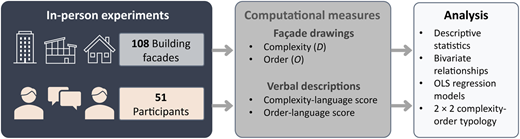
This study employed a multi-stage methodology to examine the relationship between computationally measured façade character and human verbal perception. The research combined in-person description experiments with image-based computational analysis and statistical modelling. First, a set of 108 façade drawings was presented to participants in a controlled survey setting, and verbal descriptions of each were collected as perception data. Second, computational measures were derived from the same façade drawings, including complexity (D) and order (O). Third, the verbal responses were processed to generate two corresponding language-based measures: “Complexity-language score” and “Order-language score”. These computational and verbal measures were then compared through descriptive statistics, bivariate analysis, OLS regression models, and a 2 × 2 complexity-order typology. Figure 1 provides an overview of this computational pipeline and reproducible workflow. It shows how the study integrates two data streams, façade drawings and participant verbal descriptions, into a unified analytical framework for examining the relationship between measurable formal properties and perceived architectural character.
2.1 Data collection and processing
The study used a dataset of 108 façade line drawings derived from architectural computer-aided design (CAD) files sourced from online repositories. The line drawings depicted typical European or North American buildings, although similar examples are also like those found in many Asian and Pacific Rim countries. To limit cultural or social confounding factors, no major public or religious buildings or recognisable landmark buildings were chosen. The image set was curated to provide variation in scale, symmetry, articulation, repetition, and overall compositional density, while maintaining a consistent drawing mode. Line drawings were preferred to photographs because they reduce contextual and material confounds, thereby providing a more controlled basis for analysing formal structure (Lee and Ostwald, 2023).
Human perception data were collected through an in-person survey involving 51 participants aged over 18 years, in accordance with a formally approved human ethics protocol (HC Number: 220520) at UNSW Sydney. Although perceptions of building façades may be influenced by gender, age, and cultural background, these differences were not examined in the present study because the focus was on controlled line-drawing stimuli rather than demographic variation. Participants were randomly allocated to survey sets so that each façade image received 17 verbal descriptions. Each participant described four sets of nine line-drawing façade images in person, focusing on architectural character and formal properties.
After an explanation of terms and concepts, the collection of formal confirmations of participation, and completion of a trial set of questions (no data collected), the experiment commenced. At the beginning of each set, participants were given a 10-s visual preview. For each stimulus, they were then invited to speak for approximately 35 s about the façade's architectural character and its salient architectural features. Spoken responses were audio-recorded and transcribed for analysis. Participants were also given 10 s to compare the buildings in each set, reducing monotony and providing a brief pause between verbal description tasks. In this study, participants' spoken responses were treated as descriptive perception data.
The transcript corpus was cleaned before analysis. Non-semantic fillers, hesitations, and transcription artefacts were removed where they did not contribute interpretable architectural meaning. The descriptions were then linked to the corresponding image identifiers, allowing all visual and verbal variables to be aggregated at the image level. In this way, each façade image served as the unit of analysis for subsequent computational and statistical procedures.
2.2 Computational measures of façade drawings
This study measured the 108 façade drawings using one complexity and two order measures. In the present study, complexity in façade representations was measured using fractal dimensions, while order was operationalised using bilateral symmetry and two-axis rhythm regularity.
2.2.1 Complexity (D)
Visual complexity was measured using the box-counting fractal dimension, , which has been widely used in architectural research to quantify the relative density and distribution of geometric information in an image (Lee and Ostwald, 2024; Ostwald and Vaughan, 2016). In façade studies, fractal dimensions have been used to measure and compare architectural aesthetic character, with lower values indicating less complex compositions and higher values indicating more complex ones (Lee and Ostwald, 2023). The fractal dimension of a façade image is defined as:
where is the number of occupied boxes at scale . In practice, is calculated as the slope of the regression line in the log-log plot of box count against box size.
In the present study, fractal dimension was calculated in ImageJ using FracLac. Each façade drawing was prepared as a line-based elevation image and analysed using the box-counting procedure. The FracLac settings followed the configuration identified as most stable in previous façade research (Lee and Ostwald, 2023): maximum grid size = 25% of the bounding box, grid position = 12 positions, scaling coefficient = the golden ratio (), and minimum grid size = 10 pixels. A Python script is also provided in the Supplementary Material - Script 1. Fractal dimension is used here as a focused measure of geometric complexity rather than a complete representation of architectural complexity, which may also involve entropy, component diversity, interconnectivity, and hierarchical organisation (Lee and Ostwald, 2024).
2.2.2 Order (O)
Four order-related properties were initially considered for the present study: symmetry, rhythm, alignment, and proportion. However, alignment was excluded because it overlapped conceptually and computationally with rhythm in the present dataset. Proportion was also excluded because its consistent measurement across the full image set would require explicit architectural landmarking, which is beyond the scope of this paper. Thus, in this research, formal order was operationalised using two image-based measures: bilateral symmetry and two-axis rhythm regularity. These measures are treated as indicators of a specific type of geometric order based on axial balance and interval regularity, rather than as a comprehensive measure of architectural order. This approach is grounded in architectural theory, where order is closely associated with symmetry, repetition, and harmonic relations among parts and wholes (Lee and Ostwald, 2024; Park, 2022). It is also consistent with methodological work on façade symmetry and regularity in building elevations (Azemati et al., 2020; Ilgaz et al., 2025).
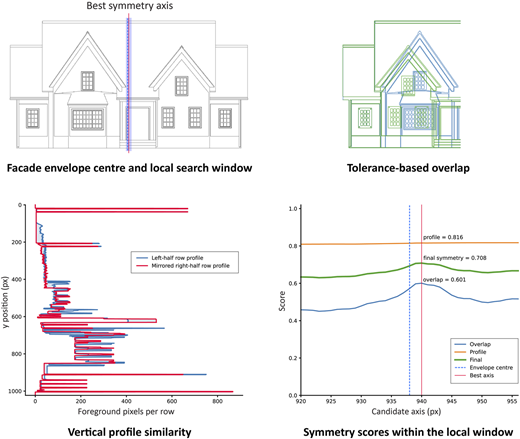
“Bilateral symmetry” is the extent to which the left and right halves of a façade correspond around a vertical axis. Following Park (2022), symmetry was treated as a measure of axial compositional balance. For each façade, the symmetry axis was initially anchored at the centre of the cropped façade envelope and then refined within a narrow local search window to reduce bias arising from minor irregularities at the perimeter. This search window was defined as ±1% of the façade-envelope width, with a minimum half-range of 2 pixels, and was clipped to remain within the façade envelope. As shown in Figure 2, the optimal symmetry axis for the example façade was located at 940 px, rather than at the envelope centre of 938 px. For each candidate axis, the façade was divided into left and right halves, and the right half was mirrored for comparison with the left. Two complementary similarity measures were then computed. The first was a tolerance-based overlap score, which compared the mirrored binary halves while allowing a small dilation margin to accommodate minor drafting and pixel-level deviations. The second was a vertical profile similarity, which compared the row-wise distribution of foreground pixels in the two mirrored halves. The final symmetry score was defined as the average of these two components and ranged from 0 to 1, with higher values indicating stronger bilateral symmetry.
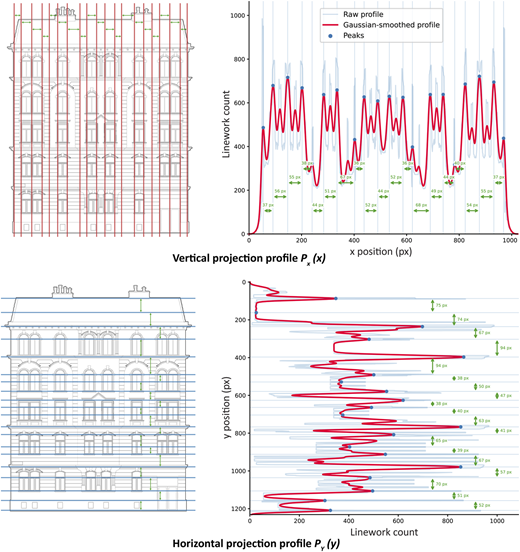
Second, “rhythm regularity” measured the consistency of repeated compositional intervals in both horizontal and vertical directions. This broader formulation was adopted because rhythm in façade composition is not limited to the recurrence of vertical emphases across width. Architectural rhythm may also arise from the repeated spacing of horizontal bands, storey lines, sill lines, or other layered elements across height. Park (2022) provides a useful theoretical basis for this view by distinguishing one-directional repetition in frieze-like patterns from two-directional repetition in wallpaper-like patterns, where motifs recur at regular intervals across a plane. Recent work on façade regularity also supports the idea that regularity depends on more than one geometric relation, including positional conformity in both horizontal and vertical directions (Ilgaz et al., 2025). For each binary façade image, as illustrated in Figure 3, two one-dimensional projection profiles were derived. The first was a vertical projection profile, which captured the horizontal distribution of linework and was used to detect repeated vertical divisions such as bays, openings, pilasters, or other upright articulations:
The second was a horizontal projection profile, which captured the vertical distribution of linework and was used to detect repeated horizontal layers such as floor bands, sill lines, lintel lines, cornices, or other stacked compositional divisions:
where is the binary façade image. Each profile was smoothed using a Gaussian filter to reduce local noise while preserving dominant structural peaks. Peaks in and were interpreted as concentrations of repeated compositional information in the horizontal and vertical directions, respectively.
For each axis, the distances between adjacent peaks were calculated. If the interval sequence along the x-axis is , and the interval sequence along the y-axis is , then the regularity of spacing in each direction was measured using the coefficient of variation:
where and are the mean interval spacings, and and are their standard deviations. These were then transformed into directional rhythm scores:
This transformation maps more regular spacing to values nearer 1 and more irregular spacing to lower values. The final two-axis rhythm score was defined as the average value of both directional rhythm scores. Thus, a façade received a high rhythm score when it displayed both regular repetition of vertical divisions across width and regular repetition of horizontal layers across height. A lower score indicated that repetition was inconsistent in one or both directions.
To provide a single index of this type of geometric order, the symmetry and rhythm scores were averaged. A higher order index (O) indicates that a façade is both more axially balanced and more rhythmically regular. This two-measure framework was retained because it is theoretically grounded, reproducible from façade line drawings, and directly interpretable in relation to architectural aesthetic character. A Python script for this order measure was used for this purpose (see Supplementary Material - Script 2).
All order measures were computed from binary façade line drawings using a deterministic Python workflow. Images were read and pre-processed in OpenCV (Bradski, 2000), array operations were handled in NumPy (Harris et al., 2020), signal smoothing and binary dilation were performed in SciPy (Virtanen et al., 2020), and scikit-image was used for skeletonisation where required (van der Walt et al., 2014). Each drawing was converted to grayscale, thresholded to a binary line image, cropped to the foreground bounding box, and resized so that the shorter side equalled 1,024 pixels. To preserve faint linework during rescaling, an occupancy-preserving procedure was used. The resulting binary image was used for both order measures.
2.3 Computational analysis of verbal descriptions
Participants' verbal responses were analysed as image-linked perception data. Because each façade image was associated with one set of computational visual measures, the verbal descriptions were also aggregated at the image level. This made it possible to compare measurable formal properties of façades, such as complexity and order, with the language participants used when describing them. The text analysis focused on two summary variables, “Complexity-language score” and “Order-language score”, which served as the main human-perception measures in this research.
The scoring procedure was implemented in a custom Python script (provided in the Supplementary Material - Script 3). Using only standard library modules, the script employed “re” for tokenisation and text cleaning, along with basic file-handling and string-processing functions. Text was converted to lowercase, spacing and apostrophes were standardised, filler terms and common function words were removed, and frequent lexical variants were normalised through a manual mapping and light stemming.
The two language scores were derived from custom lexicons after preprocessing, tokenisation, stopword removal, and lexical normalisation. Each description could contribute to both scores if it contained cues from both lexicons. At the image level, each score represents the proportion of usable descriptions containing at least one cue from the relevant lexicon. These two variables were intended to provide text-side counterparts to the computational façade measures.
“Complexity-language score” captured verbal descriptions of façade complexity, including detail, intricacy, ornament, variation, and visual richness. For each façade image, the score was calculated as the proportion of usable participant descriptions that contained at least one complexity-related cue. In contrast, “Order-language score” captured verbal descriptions of façade order, including symmetry, balance, regularity, repetition, and proportional organisation. For each façade image, the score was calculated as the proportion of usable participant descriptions that contained at least one order-related cue. Table 1 summarises the two derived lexicons used to calculate these scores.
Because the language scores were generated through deterministic lexicon matching rather than repeated manual classification, conventional inter-rater reliability was not calculated. Nevertheless, researcher judgement informed the selection and normalisation of lexical cues. For this reason, complete lexicons and scoring scripts are provided to support transparency and reproducibility.
2.4 Analytic procedures
The analytic strategy proceeded in four stages. First, descriptive statistics were calculated for the computational façade measures and the two main language measures. Second, bivariate relationships between visual measures and language measures were examined using Spearman rank correlation. Spearman correlation was selected as the primary test because several variables were bounded proportions and were not assumed to be normally distributed.
Third, two image-level ordinary least squares (OLS) regression models were estimated. In both models, “Complexity” (D) and “Order” (O) indexes of façade images were entered as predictors. The first model predicted “Complexity-language score” and the second predicted “Order-language score”. Standardised regression coefficients were also calculated to compare the relative contribution of the two predictors within each model.
Fourth, the façade set was grouped into a 2 × 2 complexity-order typology using the sample medians of “D” and “O”. This produced four groups: low complexity-low order (LL), low complexity-high order (LH), high complexity-low order (HL), and high complexity-high order (HH). The typology was used as an interpretive device to compare the mean “Complexity-language score” and mean “Order-language score” across four façade types. Differences among the groups were examined using the Kruskal-Wallis test and one-way ANOVA.
3. Results
3.1 Complexity (D) and order (O) of façade images
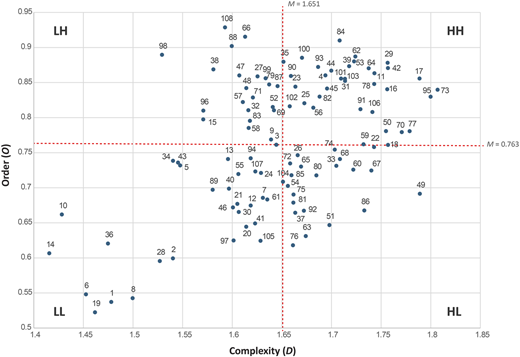
Across the 108 façade drawings, “D” ranged from 1.416 to 1.807, with a mean of 1.651 (SD = 0.081) and a median of 1.657. These values indicate that the dataset contains a meaningful spread of visual complexity rather than clustering around a narrow range of geometric density. “O”, calculated as the mean of symmetry and rhythm, ranged from 0.522 to 0.929, with a mean of 0.763 (SD = 0.096) and a median of 0.765. These results confirm that the façade set spans a useful range of formal character along both dimensions. The joint distribution of “D” and “O” in Figure 4 suggests that the image set includes both simple and dense façades, as well as weaker and stronger manifestations of formal order. This spread confirms that using the 108 drawings as a basis for comparative analysis of computational façade character is reasonable.
3.2 Complexity- and order-language scores
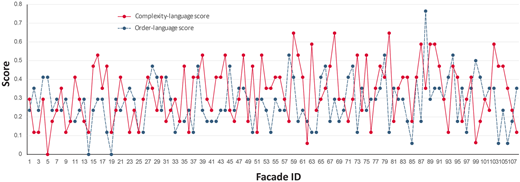
As shown in Figure 5, “Complexity-language score” ranged from 0 (one image) to 0.647, with a mean of 0.328 (SD = 0.153) and a median of 0.294. “Order-language score” ranged from 0 (two images) to 0.765, with a mean of 0.275 (SD = 0.127) and a median of 0.294. These distributions indicate that participants did not describe all façades in the same way. Rather, some stimuli elicited more order-related language, whereas others elicited more complexity-related language. The language scores also suggest that order and complexity were not simply opposites. Some façades attracted relatively high scores on both measures, while others scored low on both, indicating that participants distinguished multiple aspects of façade character rather than responding along a single evaluative dimension.
3.3 Relationships between visual properties and human perceptions
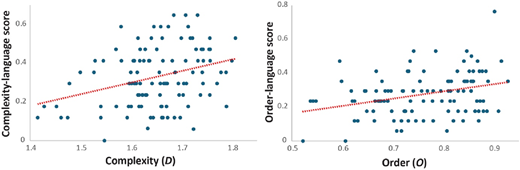
The computational and verbal measures were compared directly at the image level. Bivariate analysis using Spearman correlation showed that “D” was positively associated with “Complexity-language score” (ρ = 0.283, p = 0.003), while “O” was positively associated with “Order-language score” (ρ = 0.303, p = 0.001). By contrast, “D” was not significantly associated with “Order-language score” and “O” was not significantly associated with “Complexity-language score”. As shown in Figure 6, these results indicate modest, domain-specific correspondence rather than close equivalence between computational measurement and verbal perception.
The regression models reinforced this pattern. Two image-level OLS regression models in Table 2 were estimated using Complexity (D) and Order (O) as predictors. For “Complexity-language score”, the overall model was significant, explaining 10.1% of the variance (R2 = 0.101, p = 0.004). “D” was a significant positive predictor (B = 0.597, β = 0.318, p = 0.003), whereas “O” was not significant. This indicates that complexity-related language increased with computational complexity, independent of order. For Order-language score, the overall model was also significant, explaining 14.6% of the variance (R2 = 0.146, p < 0.001). “O” was a significant positive predictor (B = 0.577, β = 0.436, p < 0.001), whereas “D” was a significant negative predictor. In summary, these models indicate that order-related language is primarily predicted by formal order, whereas complexity-related language is primarily predicted by visual complexity. However, the correlation coefficients were modest, and the models explained 10.1% and 14.6% of the variation in the respective language scores. The computational measures, therefore, capture a meaningful but limited component of verbalised perception.
The 2 × 2 complexity-order typology further clarified the pattern. As shown in Figure 4, using median splits for “D” and “O”, the 108 façades were classified into four groups: LL (n = 32), LH (n = 22), HL (n = 22), and HH (n = 32). Order-language score was highest in the LH group (M = 0.362), followed by HH (0.272), HL (0.251), and LL (0.235). The difference across the four groups was significant (Kruskal-Wallis H = 12.214, p = 0.0067; ANOVA F = 5.343, p = 0.0018). Complexity-language score was highest in the HL group (M = 0.369), followed by HH (0.347), LH (0.332), and LL (0.279), but the overall group difference was not significant (Kruskal-Wallis H = 4.693, p = 0.196; ANOVA F = 1.830, p = 0.146). Collectively, the correlation, regression, and typology analyses indicate that computational complexity and computational order map onto corresponding kinds of perceptual language, but in different ways. Order-language is especially strong in façades that combine relatively low complexity with high order, whereas complexity-language varies more gradually with computational complexity.
4. Discussion
4.1 Complexity, order, and human perception
This study set out to examine whether computational measures of façade character align with the language people use to describe façades. The results support that proposition. “D” was associated with complexity-related language, whereas “O” was associated with order-related language. This is important because it shows that formal measures derived from façade geometry can be linked meaningfully to open verbal descriptions of architectural character, rather than only to rating scales or preference judgements.
The findings also clarify that complexity and order play different roles in façade perception. In the present dataset, “O” operated as the clearer predictor of order-language. Once order was included in the regression model, greater complexity slightly reduced order-language, suggesting that façades are most readily described as orderly when their formal organisation remains legible rather than being obscured by excessive visual density. This interpretation is consistent with Park's (2022) argument that perceived order depends on the underlying spatial logic of a design, and with Salingaros's (1997, 2011) argument that organised complexity differs from randomness because coherent relations among parts remain legible across scales.
By contrast, complexity-language was explained primarily by “D” and not by “O”. This suggests that participants were sensitive to geometric density, articulation, and formal richness even when they did not describe the same façades as more ordered. In this respect, the findings extend Stamps's (1999, 2003) work on complexity, diversity, and preference by showing that complexity is not only associated with liking or preference, but is also detectable in the language observers use when describing façades. Likewise, the results complement Lee and Ostwald's (2023, 2024) computational studies by showing that formal measures developed for façade analysis can be linked to human verbal interpretation rather than remaining only image-side descriptors.
The typology analysis offers a particularly useful interpretive contribution. The highest order-language score occurred in the low complexity–high order group, indicating that order-language is strongest when balance and repetition are salient without being visually overloaded. This result provides a useful bridge between Park's (2022) concern with explicit spatial order, Salingaros's (2011) concern with organised complexity, and Lee and Ostwald's (2023) concern with measurable façade character. It suggests that architectural order is not merely the opposite of complexity; rather, order may be most perceptually legible when paired with a relatively restrained level of geometric density.
This pattern can also be interpreted through a Gestalt understanding of composition, in which perceived character arises from relations among parts and the whole rather than from individual elements alone (Bilgic and Ebbini, 2024; Koffka, 1935). The highest “Order-language score” occurred in the low complexity-high order group, suggesting that order was most readily perceived when symmetry and regularity remained legible without excessive visual density. This pattern is consistent with the distinction between coherent or organised complexity and visual complexity that lacks an immediately legible compositional structure. However, because the study did not measure preference or attractiveness, it cannot determine whether one complexity-order combination was perceived as more appealing than another.
4.2 The relative weighting of symmetry and rhythm
The present order framework initially assumes equal weighting among its constituent measures. In this formulation, the bilateral symmetry score is defined as the average of tolerance-based overlap and profile similarity, while the final order index is defined as the average of symmetry and rhythm. Although this equal-weight approach is transparent and reproducible, the results suggest that these components may not contribute equally to human perceptions of order.
To examine this issue, alternative weightings were explored using the image-level association between the computational order index and the “Order-language score”. First, within the bilateral symmetry measure, a weighted combination of symmetry overlap and symmetry profile was tested. When symmetry overlap and symmetry profile were weighted 0.7 and 0.3, respectively, the Spearman correlation between the resulting order index and the “Order-language score” increased slightly from ρ = 0.303 to ρ = 0.317. A further optimisation indicated that the highest correlation was obtained when symmetry overlap was weighted approximately 0.88 and symmetry profile 0.12, producing ρ = 0.323. This result suggests that tolerance-based overlap contributes more strongly than profile similarity to the perception of order in the present façade set.
Second, the relative contributions of symmetry and rhythm to the final order index were explored by allowing their weights to vary while summing to 1. The results indicated that the strongest association with the “Order-language score” was obtained under weightings that favoured symmetry, with a maximum Spearman correlation of ρ = 0.344. Although the empirically optimised solution favoured symmetry, this outcome is best understood as specific to the present stimuli and language measure, rather than as evidence that rhythm is unimportant to architectural order more broadly.
This pattern is theoretically plausible. Bilateral symmetry, especially as captured by tolerance-based overlap, is a global and rapidly legible property of a façade. Observers can detect mirrored balance almost immediately, and it is therefore unsurprising that symmetry overlap aligns closely with verbal descriptions using terms such as “balanced”, “even”, “formal”, or “the same on both sides”. By contrast, rhythm regularity often depends on a more sequential reading of repeated intervals, layers, or alignments across the façade. Such organisation may still contribute to architectural order, but it appears less likely to be explicitly verbalised in short open-ended descriptions. In other words, rhythm may shape perception implicitly without being readily named in language.
These findings suggest two related implications. First, the present equal-weight order framework remains useful as a general and interpretable starting point, but it does not fully reflect the relative perceptual salience of its components in this dataset. Second, symmetry overlap may function as a particularly efficient proxy for formal order in façade line drawings. Just as fractal dimension has become a widely used single measure of visual complexity in built-environment research, a symmetry-overlap measure may provide a comparable rapid index of formal order, especially in studies using controlled façade representations. This does not mean that rhythm should be discarded altogether. Rather, it suggests that rhythm may be better understood as a secondary or complementary dimension of order whose contribution depends on the mode of representation, the nature of the stimulus, and the type of human response being collected.
At the same time, these optimised weights should be interpreted cautiously. They were derived empirically from the present dataset to maximise association with one specific language measure, and they may therefore reflect sample-specific tendencies rather than general perceptual constants. Future research should test whether similar weighting patterns are observed in other façade datasets, in coloured or photographic stimuli, and in studies using alternative perceptual measures such as ratings, eye-tracking, or physiological responses.
4.3 Consensus score (Cs)
Since participants responded in short open-ended language rather than fixed rating categories, it would be useful to estimate the extent to which different observers used similar terms when describing the same image. In this study, a “Consensus score” (Cs) was developed to assess whether some façades elicited more convergent verbal descriptions than others. This score can, therefore, serve as an indicator of interpretive convergence, allowing the main image–language relationships to be explored under conditions of relatively higher agreement.
The Cs was calculated as the mean pairwise lexical similarity among the usable descriptions of the same façade. After preprocessing, each description was represented as a set of cleaned tokens. A corpus-wide inverse document frequency (IDF) weight was calculated for each token so that words shared by many descriptions contributed less strongly than more distinctive terms. Pairwise similarity between two descriptions was then computed using IDF-weighted binary cosine similarity within a vector-space framework (Manning et al., 2008; Salton et al., 1975), and the final Cs for each image was calculated as the average of all pairwise similarities among its descriptions. Because the metric is based on lexical overlap rather than deeper semantic modelling, it is interpreted comparatively within the dataset rather than against an external benchmark.
Cs ranged from 0.036 to 0.104 across the 108 façade drawings, with M = 0.060 and SD = 0.011. Although these values are low on an absolute 0 to 1 scale, this is expected given the short, open-ended nature of the descriptions and the conservative lexical similarity measure. The scores, therefore, indicate not an absence of agreement, but a modest degree of shared vocabulary within an overall pattern of lexical diversity. Using the mean Cs as an internal threshold, 49 images were classified as high-consensus and 59 as low-consensus. Within the high-consensus subset, the relationship between computational complexity and complexity-language became stronger (Spearman ρ = 0.481, p = 0.0005; Pearson r = 0.512, p = 0.0002). The relationship between computational order and order-language was weaker but remained positive (Spearman ρ = 0.281, p = 0.050; Pearson r = 0.311, p = 0.029).
These exploratory results suggest that the formal properties of some façades may invite more convergent verbal interpretation than others, and that the link between formal image properties and descriptive language becomes clearer when participants describe a façade in more similar terms. In particular, computational complexity appears to align more strongly with complexity-language under conditions of greater interpretive convergence. However, because the high-consensus subset was defined using an internal threshold rather than an external benchmark, this analysis should be interpreted with caution and regarded as suggestive rather than conclusive. Accordingly, these findings are discussed here as exploratory observations and are best treated as a direction for follow-up research.
4.4 Limitations
This study has four main limitations. First, the order framework used here is necessarily selective. Although bilateral symmetry and two-axis rhythm provide a practical and interpretable basis for computational order, they do not exhaust broader architectural concepts such as harmony, proportion, hierarchy, or compositional coherence. The present framework should therefore be understood as a reproducible starting point rather than a complete account of architectural order. Other dimensions, including proportion, hierarchy, closure, connectivity, and multiscale compositional coherence, may provide complementary measures of order and Gestalt organisation.
Second, the use of line drawings, while methodologically valuable for controlling visual confounds and relevant to early-stage architectural design, reduces the phenomenological richness of real façades and excludes material, colour, texture, lighting, and contextual cues. The findings, therefore, concern formal compositional character under controlled visual conditions rather than the full experience of built architecture.
Third, the text analysis relied on a transparent lexicon-based approach rather than manual qualitative coding or deeper semantic modelling. This choice improved interpretability and reproducibility, but lexicon construction involved researcher judgement and thus may not capture contextual changes in meaning or individual expressive habits. Future research should compare the resulting scores with independently coded transcript samples or richer semantic language models.
Fourth, the statistical analysis was conducted at the image level. This was appropriate for linking image-level visual measures to image-level language summaries, but it necessarily compressed individual differences in wording and interpretation. Future research could extend the present framework by combining segmentation-based semantic part measures, participant-level multilevel modelling with a larger participant sample, and richer language-representation methods. Future studies could also compare responses to matched line drawings, controlled renderings, photographs, physical models, and real façades to determine which relationships remain stable across representational and experiential conditions.
5. Conclusion
This study examined how computationally measured formal properties of architectural façades relate to human verbal descriptions using a dataset of 108 line drawings and 51 participant responses. The findings support an affirmative answer to all three research questions. The façade set displayed meaningful variation in both “D” and “O”; participants used language that differentiated façades in terms of complexity and order, and the computational measures aligned with those verbal interpretations in systematic but distinct ways. “D” was more closely connected to complexity-related description, whereas “O” was more closely connected to order-related description. More broadly, the study demonstrates how interpretable computer-based measures and open verbal data can be combined to support human-centred analysis of the built environment. The modest but statistically significant relationships show that the computational measures capture only part of the variation in verbalised perception.
These results show that computational complexity and computational order are both potentially meaningful in architecture, but they have different perceptual impacts. Fractal dimension analysis provided a stable method for measuring visual complexity across the façade set. Similarly, the order framework proposed in this study, which was based on bilateral symmetry and two-axis rhythm, offered a reproducible means of operationalising formal order from façade line drawings. This is important because, compared with complexity, computational order measures for façade drawings remain relatively underdeveloped in the literature. The present study, therefore, contributes not only an empirical finding but also a methodological framework for making formal order computationally analysable in a transparent and repeatable way.
The complexity–order typology further suggests that architectural order is most perceptually salient when regularity and balance are present without excessive visual density. In other words, order is not simply the opposite of complexity; rather, it appears to be most legible when compositional structure remains clear. The exploratory Consensus analysis adds an additional reading: some formal conditions may not only be measurable but also invite more stable, shared interpretations among observers.
Overall, the study contributes a reproducible framework for linking architectural aesthetic character and human perception. It shows that complexity and order can be measured computationally from façade line drawings and that these measures are meaningfully reflected in the language people use to describe them. In doing so, it helps move façade-aesthetics research from isolated visual metrics towards a more integrated account of how formal properties are perceived, described, and interpreted. Future work can build on this foundation by expanding the order framework, using richer semantic language models, and comparing controlled line drawings with coloured or photographic façades. In this way, the paper contributes not only to façade-aesthetics research, but also to the development of computational methods for analysing how formal properties of built environments are perceived, described, and potentially evaluated at larger scales.
The supplementary material for this article can be found online.