

To build public trust in the accounting profession, previous research studies have stressed the need for ethics education. This present research aims to investigate the effects of teaching ethics using the ethics education toolkit (EET) developed by the International Accounting Education Standards Board on accounting students’ moral judgment.
An experimental design was used to determine the effects of teaching ethics using the EET on moral judgment. Data were obtained using the multidimensional ethics scale questionnaire and analysed with multiple linear regression. Factor analysis was performed to obtain the four moral philosophies defined in the literature.
The results confirm that use of the EET improves the moral judgment of accounting students. The influence of utilitarianism and relativism on moral judgment was reduced, while the students’ ability to recognise violating an unwritten contract as an unethical act was improved. Contrary to expectations, the influence of justice on moral judgment decreased.
The study may benefit academics by showing positive outcomes of EET use. The EET is a well-developed teaching tool, also suitable for educators insufficiently qualified to develop their own ethics courses or facing time constraints.
The EET was developed to support implementation of ethics education in programmes for professional accountants. By investigating the applicability and effects of the tool in higher education, this study aims to develop moral judgment in accounting students before they enter the accounting profession.
1. Introduction
The accounting profession’s integrity has come into question following the corporate scandals at the turn of the century. Those scandals have altered understanding of the accounting profession, where actions are now also assessed from social and moral viewpoints (Carnegie et al., 2021). To restore public trust, changes in accounting education (notably with more ethics-related elements) are seen as essential. This has drawn the attention of researchers investigating whether ethics can be taught (Ponemon, 1993; Ritter, 2006) and confirming that accounting education requires increased ethical content (Low et al., 2008; Mintz, 2007; Tweedie et al., 2013).
The need for a stronger focus on ethics finds support in the requirements of international education accreditation programmes such as AACSB [1], AMBA [2] and EQUIS [3]. Although these accreditations mandate ethics-related content, the absence of clear implementation guidelines causes difficulty given the lack of ethics topics in accounting textbooks (McNair and Milam, 1993; Tweedie et al., 2013), not enough educators qualified to teach ethics (Dellaportas et al., 2014; Rebele and Pierre, 2021) and time constraints (Dellaportas et al., 2014; McNair and Milam, 1993) that lead to educators’ modest engagement in the field (Mintz, 2007). Developing tools for teaching ethics could be a way to overcome these problems as they provide guided assistance for teaching ethics.
To maximise the improvement in students’ moral judgment, an educator must understand the reasoning behind the ethical decision-making process. According to Cohen et al. (2001), the rationale for such reasoning can be measured with respect to four moral philosophies:
justice;
relativism;
utilitarianism; and
contractualism.
This study investigated whether students’ moral development can be improved through use of the ethics education toolkit (EET) and the rationale behind this improvement. An experimental design was used to answer these research questions. Data were obtained using a multidimensional ethics scale (MES) questionnaire and analysed using multiple linear regression. The results confirmed that using the EET improved students’ moral judgment and is thus effective while teaching ethics in accounting. In line with expectations, use of the EET reduced the influence of utilitarianism and relativism and helped students recognise that violating an unwritten contract is an unethical act. Unexpectedly, the results revealed the smaller influence of justice on moral judgment.
Our paper contributes to the literature by providing evidence that use of the existing tools that guide educators through the teaching process helps overcome several challenges related to the teaching of ethics. Overall, the results demonstrate the EET’s usefulness while teaching ethics in accounting.
The remainder of the paper is organised as follows: Section 2 provides a literature review and develops the hypotheses, Section 3 describes the research methodology, Section 4 presents the empirical analysis and results, whereas Section 5 summarises the main findings before presenting the study’s practical implications and limitations.
2. Literature review and hypotheses development
Accountants influence the business decisions of many users of annual reports, making the effectiveness of such users’ decisions depend on the quality of the financial statements. Financial statements should be prepared in compliance with the highest ethical standards. Ethics in accounting is defined as a philosophical concept based on moral principles and a reflective decision-making process that addresses the issues of right and wrong behaviour (Onyebuchi, 2011).
The importance of ethics in accounting has grown following the corporate scandals at the turn of the century. These scandals revealed a considerable lack of ethics in both public accountability and financial reporting. To efficiently implement ethics topics in accounting education, broader curricular issues should not be disregarded. Course strategies often build on developing traditional technical skills and hardly include any other disciplines (Russell and Smith, 2003). However, the accounting curriculum should ensure that students are best prepared for the workplace. The professional skills they require have increased, as has the importance of non-technical or generic skills, among which ethics is crucial for the accounting profession (Dellaportas, 2006; Karaibrahimoğlu et al., 2009; Melé, 2005; Molyneaux, 2004). Despite being very important in the workplace, students often receive limited generic skills through education. This gap in expectations between students’ skills and what firms expect (Anis, 2017; Chaffer and Webb, 2017) can be managed by carefully planning curriculums.
The growing importance of ethics education in accounting is confirmed by a comprehensive literature review (Poje and Zaman Groff, 2022) that shows ever more articles being published in the field as well as the increasing number of research subfields. Ethics education in accounting research builds on the theory of cognitive moral development (Kohlberg, 1958) and the ethical decision-making process (Rest, 1986). Rest (1986) states that the ethical decision-making process starts with moral awareness, whereby an individual must first be aware of a problem. Next comes a moral judgment or evaluation of a morally questionable action. After evaluating the action, the individual reveals their moral intention. In the last step – moral behaviour – the individual executes their moral intention.
A considerable body of literature has developed regarding the inclusion of ethics education into the curriculum (Hartman and Werhane, 2009; Jonson et al., 2015) and measuring the effectiveness of specific teaching approaches (Blanthorne, 2017; Loeb, 2015; Martinov-Bennie and Mladenovic, 2015; Tweedie et al., 2013). For decades, researchers have investigated whether a stand-alone course or integrating ethics content into existing courses is more appropriate (Dellaportas, 2006; Hartman and Werhane, 2009; Jonson et al., 2015; Martinov-Bennie and Mladenovic, 2015), without a consensus being reached. This decision is closely tied to the available teaching hours. In 1999, the Bologna Process was launched with the signing of the Bologna Declaration by 29 European countries. Since then, it has expanded to include 48 countries and represents a series of reforms aimed at improving the quality and consistency of higher education across Europe. The main objectives of the Bologna Process include promoting the mobility of students and academics, enhancing the comparability and compatibility of degrees and improving the overall quality and relevance of higher education (NJIT). Following implementation of the Bologna Process, teaching hours were decreased (Kovtun and Stick, 2009). The reduction is mainly explained by the first cycle of studies having been cut from four or five to three years (Cardoso et al., 2008). Ethics content can only be implemented at the expense of further cuts in teaching hours for developing technical competence (Rebele and Pierre, 2019). These limitations make an integrated ethics course a more viable solution. Our research focuses on a solution faculties are able to implement without a major intervention in existing curriculums.
The next challenge is deciding on the teaching method. Various teaching approaches such as case studies (Cheng and Flasher, 2018), active learning (Loeb, 2015), thematic approach (Tweedie et al., 2013), role-playing (Taplin et al., 2018) and virtual-reality-based learning (Sholihin et al., 2020) prove to be efficient when teaching ethics. There is no consensus in the literature on which teaching technique is superior. The lack of guidance in teaching ethics is particularly problematic given the lack of ethics topics in accounting textbooks (McNair and Milam, 1993; Tweedie et al., 2013), shortfall of educators qualified to teach ethics (Dellaportas et al., 2014; Rebele and Pierre, 2021) and time constraints (Dellaportas et al., 2014; McNair and Milam, 1993).
To overcome these barriers, educators can reach for developed tools that demand no specialisation in ethics and may spare a large amount of time for course preparation. Viable examples of such tools include EET (IAESB, 2006), JUSTICE (Lau et al., 2007), Honour Codes (Kidwell, 2001) and Giving Voice to Values (Mintz, 2016). Among currently available tools, the EET was selected because it was developed by the International Accounting Education Standards Board (IAESB, 2006) to assist the International Federation of Accountants (IFAC) – the accounting standard-setting body – ensure good practices in accounting ethics education and development.
Teaching with the EET concentrates on active learning and case studies. The case studies are presented in the form of five videos. Learners are expected to consider various aspects of accountability and responsibility of the individuals featured in the videos. EET is organised as a toolkit that guides the educator through the educational process (see Section 3.1 for more information on the experimental design). Liu et al. (2012) report that both active learning and case studies improve moral judgment. The fact the EET involves these two approaches leads us to posit the following hypothesis:
The EET improves students’ moral judgment.
Moral philosophies are the motivation for individuals’ moral judgment (Scanlon, 1982). Different moral philosophies used in an ethical decision-making process can lead to a different moral judgment (Reynolds, 2006). Based on this finding, Reidenbach and Robin (1988) developed the MES that measures five moral philosophies (justice, deontology, relativism, utilitarianism and egoism) with 30 items. These items were reduced by the same authors two years later (Reidenbach and Robin, 1990) to eight that capture three moral philosophies:
moral equity;
relativism; and
contractualism.
In a later MES version, Cohen et al. (1998) expanded the 8 items to 12, corresponding to five moral constructs:
justice;
deontology;
relativism;
utilitarianism; and
egoism.
Since the items of deontology from Cohen’s MES correspond to contractualism in Reidenbach and Robin’s (1990) 8-item MES, this term is used in our study. We use the 12-item MES scale developed by Cohen et al. (1998) because it is widely used in business ethics research (Gupta, 2010; Leonard et al., 2017; Shawver and Sennetti, 2009) and also because Cohen focuses on accountants and auditors. Like the study by Cohen et al. (2001), we confirm that items of egoism do not load uniquely and are, hence, excluded from the study (see Section 4.1).
The moral philosophies used while making a moral judgment depend on individuals’ preferences and can vary in the context (Bartels et al., 2015; Kara et al., 2016). Individuals can decide according to what they believe is just, fair and morally right. In this case, their motivation is based on moral philosophy justice. When the motivation for moral judgment is based on personal, cultural or social circumstances, the decision is built on relativism. When one measures the outcome of an action and believes that it is ethical if it maximises the good of all individuals, the decision is based on utilitarianism. The most formalised decisions – those based on the social contract – originate from moral philosophy contractualism:
The more an action is just (justice), contextually acceptable (relativism), brings the greatest good to the greatest number of people (utilitarianism) and does not violate the social contract (contractualism), the less it is perceived as unethical (moral judgment).
The concept of justice stems from Aristotle, who defined justice as the principle of the equal treatment of equals (Ross, 1956). It refers to the belief that an action is ethical if it is just, fair and morally right (Reidenbach and Robin, 1990). As such, justice is especially important in financial accounting, where the true and fair presentation concept is central to professional regulation and practice. Kohlbergs’ theory (1958) of moral development identifies the post-conventional level as the highest level of moral development on which individuals develop their own principles, whereas moral judgment is determined by principles of justice (Nguyen et al., 2008). As the EET promotes critical thinking and the importance of true and fair presentation in accounting, we expect that ethics training with the EET results in a higher level of moral development with justice having a stronger influence:
Justice interacts with ethics education to predict moral judgment such that the justice effect is stronger among students who participated in ethics education.
Relativism refers to the idea that there is no universal right or wrong but that actions can only be judged relative to a certain personal, cultural or social setting. In accounting, relativism is reflected in variations between national accounting standards that may incorporate different values and other cultural or social preferences. Ethics training with the EET is embedded in a given accounting setting, along with the applicable legislation and professional standards, which leave little or no room for personal, cultural or social preferences. It entails the independent resolution of ethical dilemmas in line with relevant accounting standards and professional codes of ethics. We, therefore, expect that ethics training with the EET reduces the effect of relativism:
Relativism interacts with ethics education to predict moral judgment such that the relativism effect is weaker among students who participated in ethics education.
Utilitarianism considers the consequences of an action: if it brings the greatest benefit to the greatest number of people, it is ethical. Individuals make decisions by weighing the effects of different actions on society. Such a quantitative approach to ethics is not viable in very regulated professions like accounting. Additional ethics training with the EET unveils the complex range of interactions between actions and their consequences that cannot be judged by quantitative measures. This evaluation should instead be based on individuals’ own moral principles and professional standards. We thus expect utilitarianism to become less important in the ethical decision-making process after EET training:
Utilitarianism interacts with ethics education to predict moral judgment such that the utilitarianism effect is weaker among students who participated in ethics education.
Contractualism is a rule-based moral philosophy that refers to written and unwritten contracts (Reidenbach and Robin, 1990). Moral judgment is concerned with the act itself and adherence to rules, whereas the outcome is less emphasised. Accounting professionals operate in a highly regulated environment. Understanding the importance of following written (laws, professional standards and codes) and unwritten contracts (promises), as well as the consequences of non-compliance, is crucial in the profession. The EET cases stimulate discussions of how the fundamental principles of ethics, as found in the Code of Ethics for Professional Accountants, can be applied in different situations. The tool, thus, highlights the importance of the Code of Ethics and extends awareness of what accountants must consider while making both professional decisions and ethical judgments. We expect that additional ethics education with the EET leads to contractualism having a bigger influence:
Contractualism interacts with ethics education to predict moral judgment such that the contractualism effect is stronger among students who participated in ethics education.
3. Research methodology
3.1 Methodology
This study used an experimental design to consider whether (and how) the teaching of ethics in accounting with use of the EET affects students’ moral judgment. Permission to teach ethics using the EET and to conduct a study based on it was obtained from the IFAC. The sample consisted of a homogeneous group of third-year accounting students. The students were enrolled in a three-year Accounting undergraduate study programme. They were divided into two groups: treatment and control. The treatment group attended additional lectures that followed the EET guidelines. The latter included five scenarios and a guide for facilitating discussions. The control group received no additional ethics education. Teaching ethics was conducted using the EET in two separate 3-h sessions. The opening hour of the first session was dedicated to an introduction to ethics in accounting. Two scenarios were discussed in the next 2 h. The other three scenarios were discussed in the second 3-h session.
Teaching with the EET uses case studies and active learning. The case studies are presented in the form of videos and consist of five different ethical dilemmas (IAESB, 2015):
what a plan;
what a waste;
country practice;
no control; and
a new job.
Before showing the video to the students, the educator briefly introduced the case. The students then watched a video, which was followed by a discussion. The discussion consisted of recognising facts, defining ethical issues, identifying principles and rules, specifying possible alternatives, comparing alternatives and assessing the consequences. The teacher acted as the moderator of the discussion, which took the form of an exchange of students’ opinions. The students were not allowed to criticise others’ opinions but only to express their own. The goal of the discussion was not for students to arrive at the same opinion so much as to broaden their perspective. At the end of each case, the students evaluated the action shown in the video by making moral judgment.
To avoid response bias in the treatment group, the same scale was used to measure the variables in the pre-test (before treatment) and post-test (after treatment), albeit the dilemmas were different. This enabled us to test differences between groups resulting from the treatment. Because the ethical issues are context-specific, we distributed the questionnaire concerning five ethical dilemmas in the pre-test to demonstrate that no differences existed between the treatment and control groups prior to the treatment. Among the original eight dilemmas developed by Cohen et al. (2001), the five dilemmas most closely related to accounting (bribe, early shipment, loan, gifts and bad debt) were used.
In the post-test, participants completed the questionnaire with respect to three new ethical dilemmas developed by Uddin and Gillett (2002). In their study, five dilemmas (Moderating revenues, Reclassifying assets, Prebilling shipments, Consigned goods and Hiding information) were developed, with each participant being randomly given only one. Among these five dilemmas, we selected three (Moderating revenues, Reclassifying assets and Hiding information) with which the students in the sample were most familiar, and each student was given all three dilemmas for consideration. This reduction of the dilemmas meant less time was needed to complete the questionnaire. As a result, all questionnaires were completed in full.
For each vignette (in the pre- and post-test), the respondents had to answer the MES questionnaire ( Appendix 1) containing 12 questions related to the five philosophical constructs of justice, relativism, utilitarianism, egoism and contractualism. The answers provided were measured on a Likert scale from 1 to 7. To obtain moral philosophies defined in the literature, we performed exploratory factor analysis using principal axis factoring on the 12 question items and a varimax rotation in SPSS. Moral judgment was analysed using multiple linear regression using the lme4 package for R, with moral philosophies, experimental group and gender as independent variables. Gender was included as a control variable to address potential gender-based disparities in moral judgment. The question of whether gender differences exist in moral judgment has been a topic of discussion for several decades, with inconsistent findings reported in the literature. While some researchers have reported differences in moral judgment based on gender, such as Ng et al. (2017), others have found no significant differences, such as Leonard et al. (2017). To isolate the impact of independent variables on moral judgment, we controlled for gender in our study. We also analysed the interaction between experimental group and moral philosophies because it simultaneously determines how these factors are related to the outcome variable moral judgment.
To obtain information about students’ perception of the treatment, an additional questionnaire with open-ended questions was distributed to the treatment group after the treatment.
3.2 Sample
The experiment was conducted at a school with triple-crown-accreditation (EQUIS, AACSB and AMBA). The third year of the Accounting undergraduate study programme had 72 accounting students enrolled, 60 of whom were willing to participate in the experiment. We expected that not every student in the experimental group would attend all of the additional lectures and accordingly assigned more students to the treatment group (42) than to the control group (18). Students were randomly assigned to the experimental group. As our expectations regarding students’ participation in the additional lectures (experiment) were not met (more students attended than expected), the experimental group is larger than the control group.
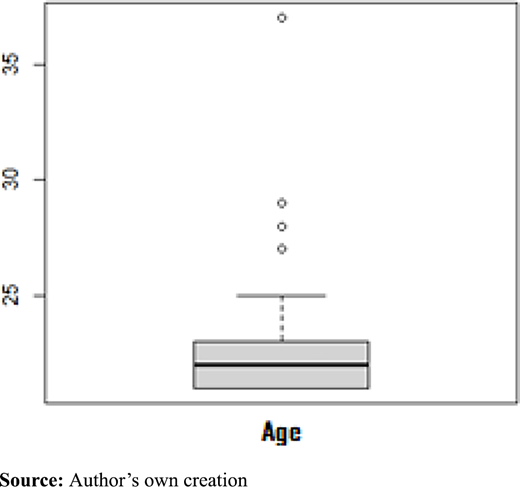
The sample consists of 60 third-year accounting students (43 female, 17 male). Five students above the age of 25 were identified as outliers and were subsequently excluded from further analysis ( Appendix 2). Thus, the final sample includes 55 students (age M = 22.1, SD = 1.10, range: 21–25 years, 75.4% female). The sample was further divided into two groups based on the treatment received: the treatment group (received treatment, N = 41, age M = 21.8, SD = 0.96, range: 21–25 years, Nfemales = 33) and the control group (no treatment, N = 14, age M = 22.9, SD = 1.24, range: 21–25 years, Nfemales = 9).
4. Results
4.1 Measurement of the variables
We performed exploratory factor analysis using principal axis factoring on the 12 question items and a varimax rotation in SPSS to obtain the moral philosophies defined in the literature. The analysis showed that the item “acceptable to my family” loaded similarly on two factors ( Appendix 3) and was, hence, excluded from further analysis. Moreover, because items of egoism could not be loaded uniquely on factor egoism, and due to its lower reliability (Cronbach’s α 0.53), two items related to egoism were excluded from further analysis ( Appendix 3), like in the Cohen et al. (2001) study. The sampling adequacy of the final model, measured with the KMO, is 0.801, which according to Field (2009), is good. The KMO values for each variable were above the minimum of 0.5 (Field, 2009), varying between 0.761 and 0.853. Furthermore, Bartlett’s test of sphericity [χ2(36) = 959.6, p < 0.001] showed the variables were correlated and, therefore, suitable for principal axis factoring (Field, 2009). To ensure the factor scores were uncorrelated, Anderson–Rubin was used as the factor scores method. The items that load on the same factor suggest that factor 1 represents justice, factor 2 contractualism, factor 3 relativism and factor 4 utilitarianism, with Cronbach’s α between 0.70 and 0.93 ( Appendix 4).
4.2 Pre-test
No statistically significant differences were found in moral judgment between the treatment and control groups on the pre-test data prior to the experiment (all p > 0.159). There were also no statistically significant differences in moral philosophies between the groups (all p > 0.068), except for the mean utilitarianism score for the Gifts dilemma [t(28) = –2.16, p = 0.040] (Table 1). In addition, there were no significant correlations between the experimental group and moral philosophies or moral judgment (all p > 0.101, Table 2).
Pre-test descriptive statistics
| Experimental group | ||||||||||
|---|---|---|---|---|---|---|---|---|---|---|
| Control group | Treatment group | Total | Differences between experimental groups | |||||||
| (N = 14) | (N = 41) | (N = 55) | ||||||||
| Mean | SD | Mean | SD | Mean | SD | t | df | p | sig. | |
| Moral dilemma | ||||||||||
| Bribe | ||||||||||
| Justice | 3.95 | 1.61 | 3.34 | 1.40 | 3.50 | 1.47 | 1.27 | 20.1 | 0.220 | |
| Relativism | 4.04 | 1.34 | 3.94 | 1.64 | 3.96 | 1.56 | 0.22 | 27.5 | 0.828 | |
| Utilitarianism | 5.54 | 1.26 | 5.44 | 1.44 | 5.46 | 1.38 | 0.24 | 25.4 | 0.813 | |
| Contractualism | 4.61 | 2.25 | 4.60 | 2.01 | 4.60 | 2.05 | 0.01 | 20.6 | 0.989 | |
| Moral judgment | 4.79 | 1.63 | 4.61 | 1.64 | 4.65 | 1.62 | 0.35 | 22.7 | 0.730 | |
| Early shipment | ||||||||||
| Justice | 3.29 | 1.63 | 3.35 | 1.85 | 3.33 | 1.78 | –0.12 | 25.3 | 0.904 | |
| Relativism | 3.46 | 1.42 | 3.63 | 1.85 | 3.59 | 1.74 | –0.36 | 29.3 | 0.725 | |
| Utilitarianism | 4.32 | 1.50 | 4.77 | 1.53 | 4.65 | 1.52 | –0.96 | 23.0 | 0.349 | |
| Contractualism | 3.36 | 1.92 | 3.54 | 2.07 | 3.49 | 2.01 | –0.30 | 24.2 | 0.770 | |
| Moral judgment | 4.79 | 1.63 | 4.80 | 1.79 | 4.80 | 1.74 | –0.04 | 24.7 | 0.971 | |
| Loan | ||||||||||
| Justice | 2.45 | 1.14 | 2.44 | 1.61 | 2.44 | 1.49 | 0.03 | 31.7 | 0.973 | |
| Relativism | 2.50 | 1.19 | 3.33 | 1.96 | 3.12 | 1.82 | –1.88 | 37.6 | 0.068 | |
| Utilitarianism | 3.89 | 1.70 | 4.24 | 1.65 | 4.15 | 1.65 | –0.67 | 21.9 | 0.509 | |
| Contractualism | 2.86 | 1.86 | 2.54 | 1.73 | 2.62 | 1.75 | 0.57 | 21.2 | 0.578 | |
| Moral judgment | 5.71 | 1.33 | 5.20 | 1.81 | 5.33 | 1.70 | 1.15 | 30.7 | 0.261 | |
| Gifts | ||||||||||
| Justice | 2.69 | 1.25 | 2.97 | 1.71 | 2.90 | 1.61 | –0.64 | 30.2 | 0.528 | |
| Relativism | 2.86 | 1.52 | 3.50 | 1.74 | 3.34 | 1.70 | –1.31 | 25.5 | 0.201 | |
| Utilitarianism | 3.21 | 1.34 | 4.17 | 1.67 | 3.93 | 1.63 | –2.16 | 27.9 | 0.040 | * |
| Contractualism | 2.36 | 1.29 | 2.80 | 1.91 | 2.69 | 1.77 | –0.98 | 33.5 | 0.333 | |
| Moral judgment | 5.64 | 1.34 | 5.00 | 1.69 | 5.16 | 1.62 | 1.45 | 28.3 | 0.159 | |
| Bad debt | ||||||||||
| Justice | 2.74 | 1.25 | 2.60 | 1.25 | 2.64 | 1.24 | 0.35 | 22.5 | 0.727 | |
| Relativism | 2.79 | 1.37 | 3.24 | 1.57 | 3.13 | 1.52 | –1.04 | 25.6 | 0.308 | |
| Utilitarianism | 4.25 | 1.48 | 4.23 | 1.70 | 4.24 | 1.64 | 0.04 | 25.8 | 0.970 | |
| Contractualism | 2.75 | 1.61 | 2.55 | 1.35 | 2.60 | 1.41 | 0.42 | 19.5 | 0.680 | |
| Moral judgment | 5.21 | 1.42 | 5.17 | 1.30 | 5.18 | 1.32 | 0.10 | 20.9 | 0.921 | |
Notes:
Mean scores related to moral philosophies (justice, relativism, utilitarianism and contractualism) close to 7 indicate that an action is perceived as just (justice), contextually acceptable (relativism), bringing the greatest good to the greatest number of people (utilitarianism) or not violating the social contract (contractualism). For the moral judgment variable, responses close to 1 indicate that an action is ethical;
*p < 0.05
Pre-test Pearson correlation matrix
| Justice | Relativism | Contractualism | Utilitarianism | Moral judgment | |
|---|---|---|---|---|---|
| Justice | 1 | ||||
| Relativism | 0.670*** | 1 | |||
| Contractualism | 0.628*** | 0.537*** | 1 | ||
| Utilitarianism | 0.324*** | 0.274*** | 0.332*** | 1 | |
| Moral judgment | –0.751*** | –0.638*** | –0.603*** | –0.297*** | 1 |
| Experimenta | –0.017 | –0.078 | –0.020 | –0.045 | 0.036 |
Notes:
***p < 0.001. a0 = control group; 1 = treatment group; N = 55 (number of students)
The results presented in Table 3 also show that the experimental group does not significantly predict moral judgment in any dilemma. The interactions between moral philosophies and the experimental group were also not significant. No differences in moral judgment were thereby revealed between the treatment and control group prior to the treatment.
Pre-test model
| Dependent variable: Moral judgment | Five types of moral dilemmas | |||||||||
|---|---|---|---|---|---|---|---|---|---|---|
| Bribe | Early shipment | Loan | Gifts | Bad debt | ||||||
| F | p | F | p | F | p | F | p | F | p | |
| Experiment | 1.09 | 0.303 | 0.31 | 0.581 | 1.26 | 0.268 | 0.29 | 0.592 | 0.09 | 0.761 |
| Justice | 28.27 | < 0.001*** | 21.68 | <0.001*** | 10.95 | 0.002** | 40.68 | <0.001*** | 20.05 | <0.001*** |
| Relativism | 22.33 | < 0.001*** | 7.65 | 0.008** | 13.47 | <0.001*** | 17.97 | <0.001*** | 13.79 | <0.001*** |
| Utilitarianism | 3.83 | 0.057 | 3.27 | 0.077 | 8.22 | 0.006** | 11.88 | 0.001** | 17.66 | <0.001*** |
| Contractualism | 11.70 | 0.001** | 11.64 | 0.002** | 21.96 | <0.001*** | 17.64 | <0.001*** | 18.53 | <0.001*** |
| Gender | 2.63 | 0.112 | 0.12 | 0.726 | 1.44 | 0.237 | 0.23 | 0.636 | 0.02 | 0.880 |
| Exp × Justice | 0.00 | 0.989 | 0.16 | 0.690 | 0.17 | 0.682 | 0.05 | 0.821 | 0.94 | 0.337 |
| Exp × Relativism | 0.05 | 0.830 | 0.59 | 0.448 | 0.03 | 0.857 | 0.08 | 0.780 | 0.07 | 0.794 |
| Exp × Utilitarianism | 2.42 | 0.127 | 0.16 | 0.695 | 0.76 | 0.388 | 0.59 | 0.445 | 0.12 | 0.728 |
| Exp × Contractualism | 1.86 | 0.180 | 0.59 | 0.447 | 2.71 | 0.107 | 0.01 | 0.904 | 0.97 | 0.330 |
| R2 | 0.549 | 0.612 | 0.630 | 0.786 | 0.585 | |||||
Notes:
**p < 0.01; ***p < 0.001; N = 55 (number of students)
4.3 Post-test
4.3.1 Descriptive statistics.
Students perceived all dilemmas [Moderating revenues: t(54) = 5.85, p < 0.001; Reclassifying assets: t(54) = 8.92, p < 0.001; Hiding information: t(54) = 10.32, p < 0.001] as slightly unethical (moral judgment values above 4), with a statistically significant difference in the level of unethicality [F(1, 163) = 4.65, p = 0.040] among the dilemmas. Of the three dilemmas, the action related to Hiding information was perceived as the most unethical (M = 5.69), and that related to Moderating revenues as the least (M = 5.16).
The results revealed no significant difference in the mean scores for moral judgment (Table 4, all p > 0.087). Testing the differences between groups for all moral philosophies showed a significant difference only for the contractualism mean score for the Moderating revenues dilemma [t(19) = 3.79, p = 0.001].
Pre-test descriptive statistics
| Experimental group | ||||||||||
|---|---|---|---|---|---|---|---|---|---|---|
| Control group | Treatment group | Total | Differences between experimental groups | |||||||
| (N = 14) | (N = 41) | (N = 55) | ||||||||
| Mean | SD | Mean | SD | Mean | SD | t | df | p | sig. | |
| Moral dilemma | ||||||||||
| Moderating revenues | ||||||||||
| Justice | 3.88 | 1.70 | 3.16 | 0.99 | 3.35 | 1.23 | 1.50 | 16.14 | 0.153 | |
| Relativism | 4.39 | 1.56 | 3.74 | 1.26 | 3.91 | 1.35 | 1.41 | 19.09 | 0.175 | |
| Utilitarianism | 5.11 | 1.39 | 4.65 | 1.15 | 4.76 | 1.22 | 1.12 | 19.41 | 0.277 | |
| Contractualism | 4.68 | 1.73 | 2.74 | 1.39 | 3.24 | 1.70 | 3.79 | 19.10 | 0.001 | ** |
| Moral judgment | 4.50 | 2.03 | 5.39 | 1.18 | 5.16 | 1.48 | –1.55 | 16.10 | 0.140 | |
| Reclassifying assets | ||||||||||
| Justice | 3.12 | 1.67 | 2.59 | 0.94 | 2.73 | 1.18 | 1.12 | 15.92 | 0.281 | |
| Relativism | 4.04 | 1.46 | 3.29 | 1.26 | 3.48 | 1.34 | 1.70 | 20.03 | 0.105 | |
| Utilitarianism | 5.04 | 1.39 | 4.50 | 1.36 | 4.64 | 1.38 | 1.25 | 22.14 | 0.225 | |
| Contractualism | 2.96 | 1.45 | 2.34 | 1.34 | 2.50 | 1.38 | 1.42 | 21.12 | 0.171 | |
| Moral judgment | 4.93 | 1.69 | 5.80 | 1.10 | 5.58 | 1.32 | –1.82 | 16.90 | 0.087 | |
| Hiding information | ||||||||||
| Justice | 2.69 | 1.80 | 2.15 | 0.85 | 2.28 | 1.17 | 1.09 | 15.01 | 0.293 | |
| Relativism | 3.32 | 1.58 | 2.83 | 1.33 | 2.95 | 1.40 | 1.05 | 19.71 | 0.308 | |
| Utilitarianism | 3.79 | 1.77 | 3.82 | 1.35 | 3.81 | 1.45 | –0.06 | 18.46 | 0.953 | |
| Contractualism | 2.68 | 1.62 | 2.27 | 1.24 | 2.37 | 1.34 | 0.86 | 18.46 | 0.399 | |
| Moral judgment | 5.36 | 1.78 | 5.80 | 0.95 | 5.69 | 1.22 | –0.90 | 15.60 | 0.383 | |
Notes:
Mean scores related to moral philosophies (justice, relativism, utilitarianism and contractualism) close to 7 indicate that an action is perceived as just (justice), contextually acceptable (relativism), bringing the greatest good to the greatest number of people (utilitarianism) or not violating the social contract (contractualism). For the moral judgment variable, responses close to 1 indicate that an action is ethical. **p < 0.01
In line with expectations, the experimental group was positively correlated with moral judgment (r = 0.239, p = 0.002, Table 5). Students in the treatment group perceived the dilemmas as more unethical than those in the control group. As expected, moral judgment was negatively correlated with all four moral philosophies (all p < 0.001). The experimental treatment was negatively correlated with the moral philosophies justice (r = –0.206, p = 0.008), relativism (r = –0.194, p = 0.012) and contractualism (r = –0.284, p < 0.001), indicating that students in the treatment group viewed the dilemmas as less just and fair, less contextually acceptable and more in violation of the social contract than students in the control group.
Post-test Pearson correlation matrix
| Justice | Relativism | Contractualism | Utilitarianism | Moral judgment | |
|---|---|---|---|---|---|
| Justice | 1 | ||||
| Relativism | 0.469*** | 1 | |||
| Contractualism | 0.594*** | 0.406*** | 1 | ||
| Utilitarianism | 0.416*** | 0.337*** | 0.463*** | 1 | |
| Moral judgment | –0.676*** | –0.361*** | –0.598*** | –0.478*** | 1 |
| Experimenta | –0.206** | –0.194* | –0.284*** | –0.100 | 0.239** |
Notes:
*p < 0.05; **p < 0.01; ***p < 0.001. a0 = control group; 1 = treatment group; N = 55 (number of students)
4.3.2 Hypotheses testing.
Among the predictors of moral judgment, the main effect of the treatment was significant for the Moderating revenues and Reclassifying assets dilemmas, showing the treatment’s positive effect on moral judgment (Table 6; Figures 1 and 2), and thereby confirming hypothesis H1. In contrast, for the Hiding information dilemma, the EET had no statistically significant effect on moral judgment. The results of the descriptive statistics revealed that students are most critical of this dilemma, evaluating it as the most unethical among the three dilemmas. When a morally questionable action is rated as highly unethical, additional training can only lead to a small (statistically non-significant) improvement in moral judgment.
Hypotheses testing
| Dependent variable: Moral judgment | Three types of moral dilemmas | |||||||||
|---|---|---|---|---|---|---|---|---|---|---|
| Moderating revenues | Reclassifying assets | Hiding information | ||||||||
| F | p | sig | F | p | sig | F | p | sig | ||
| H1 | Experiment | 9.69 | 0.003 | ** | 9.57 | 0.003 | ** | 1.64 | 0.207 | |
| H2 | Justice | 42.06 | < 0.001 | *** | 39.96 | < 0.001 | *** | 8.39 | 0.006 | ** |
| Relativism | 5.77 | 0.021 | * | 4.35 | 0.043 | * | 2.60 | 0.114 | ||
| Utilitarianism | 12.46 | < 0.001 | *** | 11.79 | 0.001 | ** | 8.76 | 0.005 | ** | |
| Contractualism | 22.68 | < 0.001 | *** | 2.74 | 0.105 | 2.98 | 0.091 | |||
| H3a | Exp × Justice | 5.31 | 0.026 | * | 7.98 | 0.007 | ** | 2.22 | 0.143 | |
| H3b | Exp × Relativism | 2.64 | 0.111 | 4.78 | 0.034 | * | 6.30 | 0.016 | * | |
| H3c | Exp × Utilitarianism | 12.65 | < 0.001 | *** | 2.13 | 0.151 | 8.59 | 0.005 | ** | |
| H3d | Exp × Contractualism | 0.13 | 0.719 | 7.02 | 0.011 | * | 0.94 | 0.338 | ||
| R2 | 0.724 | 0.665 | 0.530 | |||||||
Notes:
*p < 0.05; **p < 0.01; ***p < 0.001; N = 55 (number of students)
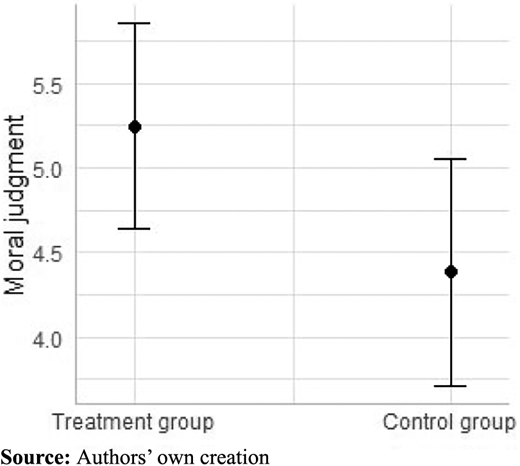
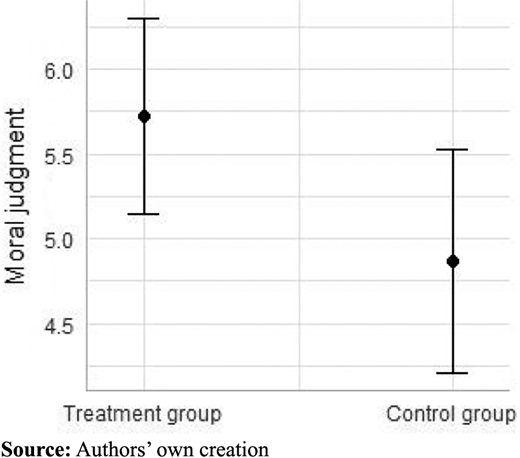
The main effects of moral philosophies (Figure 3) were also significant for each dilemma, confirming hypothesis H2. All four moral philosophies are significant predictors of moral judgment for the Moderating revenues dilemma. This was not the case for either of the other dilemmas. For the Reclassifying assets dilemma, the main effects were significant for three out of four moral philosophies, and for the Hiding information dilemma, the main effects were significant for two moral philosophies (Table 6). This confirms the findings of previous research (Cohen et al., 2001; Kara et al., 2016), showing that moral judgment is issue-specific.
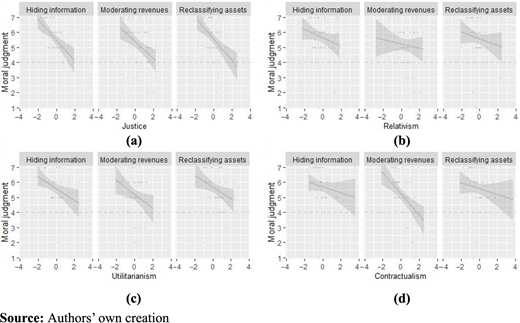
Main effect of moral philosophies on moral judgment for each type of moral dilemma
Main effect of moral philosophies on moral judgment for each type of moral dilemma
Similarly, statistically significant interactions between the treatment and moral philosophies also depended on the dilemma. The interaction between experimental group and moral philosophy justice is significant for Moderating revenues and Reclassifying assets dilemmas. A change in the justice score implies a smaller effect on the moral judgment of students in the treatment group than those in the control group (Figures 4 and 5). Hypothesis H3a, therefore, cannot be confirmed.
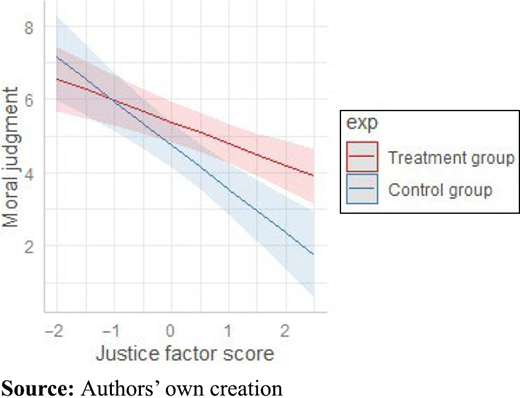
Interaction effect of the treatment and the moral philosophy justice for the Moderating revenues dilemma
Interaction effect of the treatment and the moral philosophy justice for the Moderating revenues dilemma
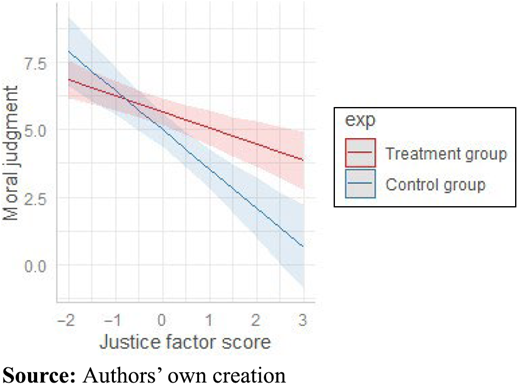
Interaction effect of the treatment and the moral philosophy justice for the Reclassifying assets dilemma
Interaction effect of the treatment and the moral philosophy justice for the Reclassifying assets dilemma
Comparable results are reported for relativism for the Reclassifying assets and Hiding information dilemmas. Relativism had a smaller impact on students’ moral judgment in the treatment group compared to the control group (Figures 6 and 7). This confirms hypothesis H3b, but only with respect to these two dilemmas.
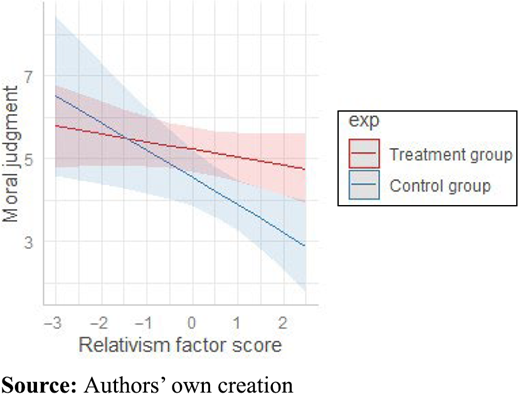
Interaction effect of the treatment and the moral philosophy relativism for the Reclassifying assets dilemma
Interaction effect of the treatment and the moral philosophy relativism for the Reclassifying assets dilemma
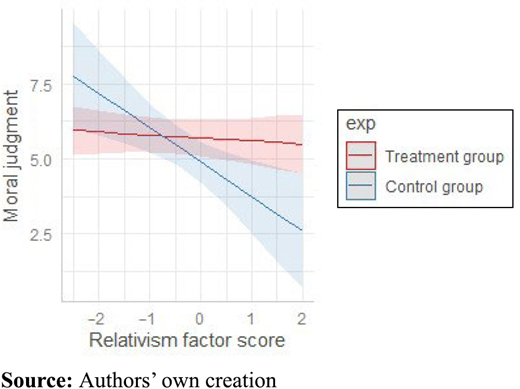
Interaction effect of the treatment and the moral philosophy relativism for the Hiding information dilemma
Interaction effect of the treatment and the moral philosophy relativism for the Hiding information dilemma
Utilitarianism also had less of an impact on students’ moral judgment in the treatment group compared to the control group for the Moderating revenues and Hiding information dilemmas (Figures 8 and 9). This confirms hypothesis H3c, yet only as concerns these two dilemmas.
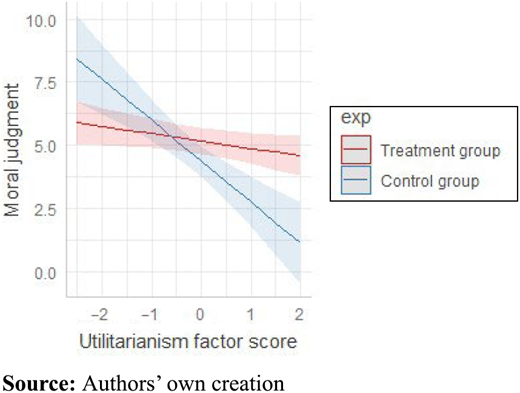
Interaction effect of the treatment and the moral philosophy utilitarianism for the Moderating revenues dilemma
Interaction effect of the treatment and the moral philosophy utilitarianism for the Moderating revenues dilemma
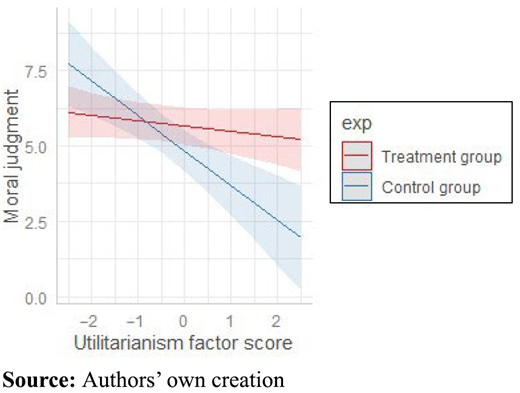
Interaction effect of the treatment and the moral philosophy utilitarianism for the Hiding information dilemma
Interaction effect of the treatment and the moral philosophy utilitarianism for the Hiding information dilemma
The interaction between experimental group and moral philosophy contractualism was significant for the Reclassifying assets dilemma, revealing that students in the control group did not recognise the violation of an unwritten contract as an unethical action, whereas students in the treatment group did (Figure 10). This confirms hypothesis H3d, but only for the Reclassifying assets dilemma.
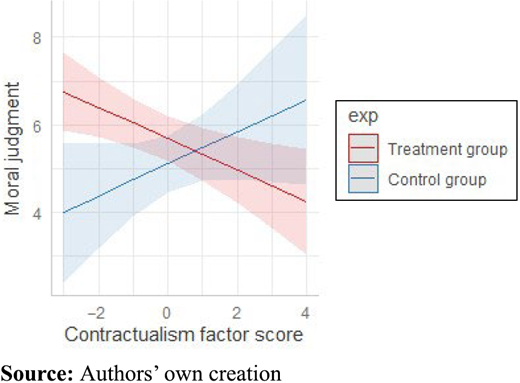
Interaction effect of the treatment and the moral philosophy contractualism for the Reclassifying assets dilemma
Interaction effect of the treatment and the moral philosophy contractualism for the Reclassifying assets dilemma
Alongside the variables included in Table 6: hypotheses testing, we controlled for gender. Gender was not found to be a predictor of moral judgment in any dilemma [FModerating revenues (1, 44) = 1.18, p = 0.283; FReclassifying assets (1, 44) = 0.20, p = 0.655; FHiding information (1, 44) = 0.09, p = 0.760].
The results of open-ended questionnaire revealed that teaching ethics with the EET was well received by the students, who believed it had broadened their perspective on the wide scope of ethical decision-making. They appreciated learning about the difficulties faced in the accounting profession and wanted more courses of this type in the future. Almost 60% of the students felt that the lectures had made them more aware of the importance of ethics, whereas 35% reported the level of their awareness had not changed as it was already high before the treatment. The students who believed that the additional ethics training was effective believed that the videos were a good representation of the dilemmas faced by professional accountants and that the debates had broadened their view of the possible responses and their implications:
Now I see the bigger picture in situations and how action can affect others.
I have started to think about some additional aspects that I had not considered before, there really is a broader picture to look at and there is not only one right decision.
I learned that ethics is important because there are many possible scenarios where it is necessary to act ethically.
The lecture made me aware of how many ethical judgments can occur in accounting, as well as ways/ideas for how we can respond to them.
5. Conclusion
Integrating ethics topics into accounting education is vital for restoring integrity and public trust in the accounting profession after several corporate scandals. Despite many researchers confirming the positive effect of ethics education, no optimal or generally applicable method for teaching ethics has yet to be proposed.
Accounting students are expected to become professionals in this field. If they develop ethical principles as students, they will bring them along when they enter the profession. This paper is a response to the evident need to improve ethics in accounting. It focused on the implications of using the EET, an education tool developed to assist IFAC bodies support the implementation of ethics education in programmes for professional accountants. By investigating the applicability and effects of the tool in higher education, this study sought to develop moral judgment in accounting students before they enter the accounting profession.
The results confirmed that teaching ethics with the EET improves students’ moral judgment and influences the effect of moral philosophies on moral judgement. The tool reduced the impact of justice, utilitarianism and relativism on moral judgment in two out of three dilemmas and helped students recognise the violation of an unwritten contract as an unethical action. Adherence to rules and codes in accounting is strongly emphasised in the EET.
Although the study shows an improvement in students’ moral judgment as a result of the EET, use of this tool cannot cover every aspect of moral judgment. Focusing on the Code of Ethics improved the students’ moral judgment based on contractualism. Yet, this improvement comes at the expense of other moral philosophies. While the decline of utilitarianism and relativism was both expected and beneficial, the decline of justice shows that the EET must be combined with other tools.
This paper contributes to literature in the field of ethics education in accounting in several ways. Firstly, an experimental design was used to empirically confirm the effectiveness of using a pre-developed tool for ethics education in accounting. Secondly, by showing the simultaneous effect of ethics education and underlying moral philosophies on moral judgment, the study provides novel insight into the factors affecting moral judgment. Thirdly, the paper provides evidence revealing that the challenges associated with teaching ethics can at least be somewhat overcome by using pre-developed teaching tools. The study also gives a starting point for future research on combining different teaching tools to promote the development of moral philosophy justice in accounting students and, in turn, contribute to their further moral development.
The study addresses academia by highlighting the benefits of teaching ethics using the EET. As an important practical implication, the paper demonstrates that teaching with the EET improves students’ moral judgment. The EET is a well-developed teaching tool; along with the guidelines, it is suitable for educators insufficiently qualified to develop their own ethics courses or under time constraints. Implications from the students’ perspective are in line with empirical results: the majority of participating students believed the lectures had broadened their understanding of responsibility and ethical action in accountancy.
This study has some limitations. Firstly, the MES questionnaire is based on gathering quantitative data based on self-report, which is limited by individuals’ ability to self-evaluate. The questionnaire contains numerical scales that can sometimes be inaccurate and subject to individuals’ tendency to give extreme or middle responses to all questions. Secondly, the sample includes a single business school. A sample from a different geographical location or cultural setting could yield different results in the context presented. Thirdly, the sample size was quite small as it was limited to the whole cohort of third-year undergraduate accounting major students.
Funding: This work was supported by the University of Ljubljana, School of Economics and Business; and Slovenian Research Agency (ARRS) program P5-0161.
Notes
Association to Advance Collegiate Schools of Business, based in Florida, USA.
Association of Masters of Business Administration, based in UK.
EFMD Quality Improvement System; European Foundation for Management Development (EFMD), based in Belgium.
References
Appendix 1
MES questionnaire
| Unjust | 1 | 2 | 3 | 4 | 5 | 6 | 7 | Just |
| Unfair | 1 | 2 | 3 | 4 | 5 | 6 | 7 | Fair |
| Not morally right | 1 | 2 | 3 | 4 | 5 | 6 | 7 | Morally right |
| Not acceptable to my family | 1 | 2 | 3 | 4 | 5 | 6 | 7 | Acceptable to my family |
| Culturally unacceptable | 1 | 2 | 3 | 4 | 5 | 6 | 7 | Culturally acceptable |
| Traditionally unacceptable | 1 | 2 | 3 | 4 | 5 | 6 | 7 | Traditionally acceptable |
| Not self-promoting for me | 1 | 2 | 3 | 4 | 5 | 6 | 7 | Self-promoting for me |
| Not personally satisfying for me | 1 | 2 | 3 | 4 | 5 | 6 | 7 | Personally satisfying me |
| Produces the least utility | 1 | 2 | 3 | 4 | 5 | 6 | 7 | Produces the greatest utility |
| Minimizes benefits while maximizes harm | 1 | 2 | 3 | 4 | 5 | 6 | 7 | Maximizes benefits while minimizes harm |
| Violates an unwritten contract | 1 | 2 | 3 | 4 | 5 | 6 | 7 | Does not violate an unwritten contract |
| Violates an unspoken promise | 1 | 2 | 3 | 4 | 5 | 6 | 7 | Does not violate an unspoken promise |
| The action described above is: | Ethical | 1 | 2 | 3 | 4 | 5 | 6 | 7 | Unethical |
Appendix 2
Appendix 3
MES factors
| Items | Rotated factor loadings | |||||
|---|---|---|---|---|---|---|
| J | R | C | U | E | ||
| Q1 | Just | 0.893 | 0.138 | 0.223 | 0.095 | 0.123 |
| Q2 | Fair | 0.865 | 0.126 | 0.255 | 0.124 | –0.022 |
| Q3 | Morally right | 0.765 | 0.321 | 0.212 | 0.128 | –0.055 |
| Q4 | Acceptable to my family | 0.532 | 0.400 | 0.241 | 0.292 | –0.034 |
| Q5 | Culturally acceptable | 0.300 | 0.740 | 0.128 | 0.127 | 0.166 |
| Q6 | Traditionally acceptable | 0.191 | 0.815 | 0.139 | 0.140 | 0.215 |
| Q7 | Self-promoting for me | 0.005 | 0.206 | 0.059 | 0.210 | 0.576 |
| Q8 | Personally satisfying me | –0.040 | 0.254 | 0.171 | 0.518 | 0.312 |
| Q9 | Produces the greatest utility | 0.147 | 0.035 | 0.126 | 0.817 | 0.121 |
| Q10 | Maximizes benefits while minimizes harm | 0.341 | 0.168 | 0.200 | 0.549 | 0.087 |
| Q11 | Does not violate an unwritten contract | 0.337 | 0.184 | 0.790 | 0.193 | 0.044 |
| Q12 | Does not violate an unspoken promise | 0.352 | 0.139 | 0.805 | 0.248 | 0.120 |
| Cronbach’s α | 0.93 | 0.80 | 0.90 | 0.70 | 0.53 | |
Notes:
J-justice, R-relativism, C-contractualism and U-utilitarianism. Extraction method = principal axis factoring. Rotation method = Varimax with Kaiser normalization. Rotation converged in 6 iterations. Factor scores method = Anderson–Rubin. Factor loadings greater than 0.40 appear in italics (Field, 2009)
Appendix 4
MES factors without egoism and Q4
| Items | Rotated factor loadings | ||||
|---|---|---|---|---|---|
| J | C | R | U | ||
| Q1 | Just | 0.820 | 0.246 | 0.199 | 0.219 |
| Q2 | Fair | 0.890 | 0.253 | 0.135 | 0.189 |
| Q3 | Morally right | 0.747 | 0.232 | 0.319 | 0.141 |
| Q5 | Culturally acceptable | 0.252 | 0.134 | 0.824 | 0.140 |
| Q6 | Traditionally acceptable | 0.161 | 0.156 | 0.792 | 0.157 |
| Q9 | Produces the greatest utility | 0.101 | 0.184 | 0.099 | 0.600 |
| Q10 | Maximizes benefits while minimizes harm | 0.241 | 0.162 | 0.176 | 0.785 |
| Q11 | Does not violate an unwritten contract | 0.297 | 0.817 | 0.196 | 0.213 |
| Q12 | Does not violate an unspoken promise | 0.314 | 0.792 | 0.163 | 0.289 |
| Cronbach’s α | 0.93 | 0.91 | 0.85 | 0.70 | |
Notes:
J-justice, R-relativism, C-contractualism and U-utilitarianism. Extraction method = principal axis factoring. Rotation method = Varimax with Kaiser normalization. Rotation converged in 6 iterations. Factor scores method = Anderson–Rubin. Factor loadings greater than 0.40 appear in italics (Field, 2009)

