


The relationship between risk and return has been widely analysed in the scope of listed companies. However the present literature leaves uncovered an important study area with regards to privately held firms. In order to cover this gap, this study analyses the risk-return trade-off in the context of private enterprises. Furthermore, the authors incorporate the contingent effect of being a family firm on the abovementioned relationship.
Using information from the SABI (Sistema de Análisis de Balances Ibéricos) database, a sample of 2,297 private manufacturing firms were analysed for the period of 2009–2016. So as to ascertain the proposed hypotheses, dynamic panel data methodology was applied. Specifically, the authors estimated the two-step general method of moments (GMM).
The obtained findings reveal that, according to prospect theory arguments, privately held firms adopt a conservative attitude toward risk when results are higher than a target level, while becoming risk seeking when results are lower than a target level. Moreover, the fact of being a family firm softens the risk-return relationship both when performance is above the target level and also when firms find themselves in the lowest performing case.
This article is, to the best of the authors' knowledge, one of the first studies dealing with the risk-return relationship in a privately held firm context. Moreover, the inclusion of being a family firm as a contingent factor in the abovementioned link is a complete novelty.
La relación riesgo-rentabilidad ha sido ampliamente analizada en el ámbito de las empresas cotizadas. Sin embargo, la literatura existente deja al descubierto una importante área de estudio en relación con las empresas no cotizadas. Para cubrir esta brecha, el presente estudio analiza el binomio riesgo-rentabilidad en el contexto de empresas privadas. Adicionalmente, incorporamos el efecto contingente de ser una empresa familiar sobre esta relación.
Utilizando información de la base de datos SABI (Sistema de Análisis de Balances Ibéricos) se analizó una muestra de 2.297 empresas manufactureras privadas para el período 2009–2016. Para comprobar las hipótesis propuestas se aplicó la metodología de datos de panel, específicamente, utilizamos el Método de los Momentos Generalizado (GMM).
Los resultados muestran que, de acuerdo con la Teoría Prospectiva, las empresas no cotizadas presentan una mayor aversión al riesgo cuando su nivel de rentabilidad es superior al valor de referencia establecido, mientras que presentan una mayor propensión al riesgo cuando su rentabilidad es inferior al valor de referencia. Además, el hecho de ser una empresa familiar suaviza la relación riesgo-rentabilidad en ambos escenarios.
Este es uno de los primeros estudios en abordar la relación riesgo-rentabilidad en el contexto de empresas no cotizadas. Además, la inclusión de ser una empresa familiar como factor contingente es completamente novedosa.
1. Introduction
The risk-return trade-off is a well-known research topic in financial and accounting literature. This trade-off shows, according to the expected utility theory (Von Neumann and Morgenstern, 1947), that investors attempt to reach the highest return with the minimum risk. The risk-return relationship has been the focus of much theoretical and empirical research (Das Gupta and Pathak, 2018). A considerable number of studies have shown this positive relationship (Koutmos, 2015) although some others have found a negative relationship (Bowman, 1980; Andersen et al., 2007; Patel et al., 2018). Nevertheless, all these investigations have been developed in a stock market context and few studies exist analysing the risk-return relationship (hereafter R-RR) in privately held firms. In this vein, this research was motivated by the call for more comprehensive research on the R-RR (Das Gupta and Pathak, 2018; Chari et al., 2019), in a privately held firms' context. Additionally, and given the prevalence of family firms worldwide (Zellweger, 2017; Martínez-Romero, 2018; Vieira, 2020) we incorporated the contingent effect of being a family firm in the abovementioned relationship (Díez-Esteban et al., 2017). Thus, this paper aims to answer the following research questions:
Is there a positive or a negative R-RR in privately held firms?
To what extent the fact of being a family firm influences the R-RR in privately held firms?
Based on the prospect theory (Kahneman and Tversky, 1979) we argue that, at the organizational decision-making level (Antoncic, 2003), firms adopt a negative attitude toward risk when results are higher than a target level, while become risk seeking when results are lower than the target level. This argument is also in accordance with behavioural theory (Cyert and March, 1963), showing how managers behave depending on expectations (Wiseman and Gómez-Mejia, 1998). When managers expect performance outcomes below the aspiration level, they take actions to improve their expected returns and vice versa, they diminish the level of risk when the expected performance is above aspirations (Andersen et al., 2007).
When referring to privately held family firms, literature shows that they face strategic decisions more conservatively than non-family firms (Gómez-Mejia et al., 2007; Chrisman and Patel, 2012) trying to protect their socioemotional wealth (hereafter SEW) (Gómez-Mejia et al., 2007; Berrone et al., 2010; Martínez-Romero and Rojo-Ramírez, 2016). SEW is defined as “the non-financial aspects of the firm that meet the family's affective needs, such as identity, the ability to exercise family influence, and the perpetuation of family dynasty” (Gómez-Mejia et al., 2007, p. 106), and today, is considered the pivotal frame of reference for strategic decision-making in family firms (Berrone et al., 2012). More specifically, depending on whether strategic decisions involve a threat to current SEW or contribute to increase or preserve SEW, such decisions might increase risk aversion or risk seeking, respectively (Chrisman and Patel, 2012). Herein, considering the fact that family firms pursue both family and economic goals (Zellweger and Nason, 2008; Gómez-Mejia et al., 2011) we argue that the relevance attached to target levels, will be different in family and non-family privately held firms. To test the proposed relationships, we developed an empirical application based on a sample of 2,297 Spanish private firms, (979 family firms and 1,318 non-family firms) over the period 2009–2016. In particular, we estimated a dynamic panel data model by applying the two-step general method of moments (GMM). The results indicate that when firms perform above the target level, there is a positive association between risk and return. On the contrary, the R-RR becomes negative for firms performing below the target level. Moreover, in the case of family firms, it can be argued that these businesses soften the R-RR only in the most favourable and in the most unfavourable scenarios.
Our article makes some interesting contributions to existing literature. First, it analyses the unexplored relationship between risk and return within the context of privately held firms, showing the relevance of the prospect theory as a theoretical approach to analyse risk preferences in these types of firms. Second, it confirms that the R-RR is softened in privately held family firms in very favourable and very unfavourable situations, while in situations of acceptable risk, they prefer to maintain a balance between financial and SEW priorities.
2. Theoretical background
2.1 Risk-return trade-off
The positive risk-return relationship is considered to be a cornerstone in finance theory (Sharpe, 1964; Ghysels et al., 2005). Several studies have confirmed this positive association, embodied in the general equilibrium of the Capital Asset Pricing Model (Melgarejo-Molina and Vera-Colina, 2010; Koutmos, 2015). Commonly known as risk-return trade-off, this relationship is based on the premise that individual investors will only accept higher levels of risk if they get higher returns (risk-averse).
Despite the multiple studies postulating a positive relationship between risk and return (Ghysels et al., 2005; Brick et al., 2015), there are also empirical studies revealing a negative or inconclusive association between them (Patel et al., 2018; Santacruz, 2019; Chari et al., 2019). Specifically, the seminal paper of Bowman (1980) pointed out a negative relationship between accounting return and accounting risk (variance of the accounting return). He concluded that higher average profit firms will have lower risk based on the following arguments: (1) within a given industry, good management takes higher returns and lower risks; and (2) when managers are risk-seeking, they will assume higher risk levels even with lower returns. The Bowman's risk-return paradox for strategic management questions the traditional assumption about risk-averse behaviour, since higher risks and lower expected returns will be accepted (Núñez-Nickel and Cano-Rodriguez, 2002). The Bowman's paradox has been explained attending to different theories, strategic managerial decision-making and statistical weakness (Andersen et al., 2007). For example, Baker et al. (2011) show that stocks with high beta earned lower returns that low volatility stocks. According to the decisional context, risk preferences change the decision-making process, and thus the risk-return relationship (Kahneman and Tversky, 1987). In this sense, prospect theory states that decision-makers use a target or reference point (e.g. the mean of the industry returns) for defining their attitude toward risk choices (a shift of reference point alters the preference order of prospects). Different theories have explained the dynamic behaviour of financial ratios toward a target value. Previous literature has assumed that the “target” ratio is determined as the average value of the industry in which a firm operates (Lev, 1969; Wu and Ho, 1997; Gallizo and Salvador, 2003; Gallizo et al., 2008). This adjustment process is driven by the costs companies incur when they diverge from the target value. Specifically, the adjustment process is motivated by two factors: managers' actions and passive industry factors (Lev, 1969; Lee and Wu, 1988; Wu and Ho, 1997). This way, managers can reach their targets by applying accounting procedures or by considering specific ratios' values, which are controlled through firm strategies (Wu and Ho, 1997).
Individuals are risk-averse when prospects are positive (results are higher than the target level) and risk-seeking when prospects are negative (results are lower than the target level) (Kahneman and Tversky, 1987). This theory assumes that (1) investors evaluate outcomes based on their perception of losses and gains in comparison with a target level; (2) investors are loss-averse [1]; (3) investors are risk-averse for gains and risk-seeking for losses (Li and Yang, 2013).
The application of the prospect theory to organizational decision-making level has been carried out by several researchers (Antoncic, 2003; Andersen et al., 2007; Shimizu, 2007; Bric et al., 2015). Fiegenbaum and Thomas (1988) were the first to apply the prospect theory at the organization level (across firms and within industries). These authors confirmed the Bowman's paradox, showing that US industrial firms below their target level (industry average return) had a negative association between risk and return. Conversely, firms tend to be risk-averse when returns are above the target level, supporting the prospect theory propositions. Similar results were found in (Brick et al., 2015; Antoncic, 2003) who reveal that risk and return are negatively associated for below-target firms (low performing) and positively related for above-target firms (high performing). The arguments to support this paradox through the prospect theory are also consistent with the behavioural decision theory (Diéz-Esteban et al., 2017).
The behavioural decision theory shows that firms' decision-making, and hence risk behaviour, depends on the gap between expected performance level and their aspiration level (Cyert and March, 1963). According to this theory, a negative relationship arises as managers expect performance to fall below the aspiration level. In this sense, managers will try to take riskier actions to implement organizational changes searching for increase expected returns toward their aspiration level (Greve, 1998). When the expected performance is above aspirations, managers do not consider it necessary to increase risk, and therefore, a positive R-RR will exist (Andersen et al., 2007).
Since Bowman's findings, recent studies have examined the risk-taking behaviour of public firms. Andersen et al. (2007) also found a negative R-RR using a model that allows firms to adjust their position in a changing environment. Díez-Esteban et al. (2017) showed a U-shape behaviour for a sample of 791 listed international firms over the period 2001–2013. Their findings reveal a negative R-RR for firms below a break point, consistently with the prospect and behavioural theories. Patel et al. (2018) tried to replicate the Bowman's Paradox across 12,235 firms from 28 countries in Asia, Europe, South Africa, India, Japan and Korea for the 1998–2012 period. Cross-sectional and longitudinal analysis were consistent with the prospect theory and behavioural theory explanations, except for India, Japan and Korea for which a positive correlation between risk-return was shown. Santacruz (2019) included new financial ratios to measure the return and the coefficient of variation instead of just standard deviation or variance as a firm's risk-taking variable. Findings were consistent with the prospect theory except in the financial industry. Chari et al. (2019) demonstrated, using US listed firms for the period 1995 to 2016, the existence of risk and return paradox in a cross-sectional and longitudinal analysis. They also analysed how CEO career concerns and corporate governance mechanisms lead to explain this paradox.
To our knowledge, previous studies have not applied the prospect theory's propositions, using as target level the industry average return (Lev, 1969; Wu and Ho, 1997; Gallizo and Salvador, 2003; Gallizo et al., 2008), in the analysis of the R-RR of privately held firms. Therefore, we propose:
A positive relationship between risk and return exists when privately held firms' performance is above the target level.
A negative relationship between risk and return exists when privately held firms' performance is below the target level. Specifically, this relationship is steeper as greater the gap is between the target level and the obtained return.
2.2 The moderating effect of being a family firm in the risk-return relationship
Extant research shows that family firms face strategic decisions differently to non-family firms (Gómez-Mejía et al., 2007; Berrone et al., 2010; Chrisman and Patel, 2012). Family firms have been traditionally characterized by conservative strategic decision-making and risk-averse tendencies (Lim et al., 2010; Muñoz-Bullón and Sanchez-Bueno, 2011), seeking to avoid excessive outcomes variability (La Porta et al., 1999). However, some studies show that family firms do not always behave as risk averse as expected (Gómez-Mejia et al., 2007; Nguyen, 2011; González et al., 2021), as they can embrace higher strategic risk when facing threats to their SEW (Gómez-Mejía et al., 2010; Kotlar et al., 2014). Based on the behavioural agency model, Wiseman and Gómez-Mejía, (1998) stated that family firms face strategic decisions according to a perspective of gains or losses in reference to SEW. Specifically, Gómez-Mejía and colleagues argued that family firms' owners and managers are loss averse regarding their SEW, assuming that family firms respond similarly to risky options, as the ultimate goal of family firms is preserving their emotional endowments (Berrone et al., 2012; Martínez-Romero and Rojo-Ramírez, 2016, 2017). However, Chrisman and Patel (2012) specified that family firms, and thus their goals, are heterogeneous rather than homogeneous, and consequently, might adopt different attitudes towards risk depending on different circumstances. Accordingly, strategic decisions involving high levels of risk, might increase both risk aversion and risk seeking, depending on whether such decisions involve a threat to current SEW or conduct to increase or preserve SEW, respectively (Chrisman and Patel, 2012).
Focusing on the R-RR, family firms are supposed to exert a different impact on such a relationship than non-family firms (Díez-Esteban et al., 2017; Alessandri et al., 2018; Lude and Prügl, 2019). We have hypothesized in the former section that the positive (negative) relationship between risk and return depends on whether firm performance is above (below) a target level, namely the industry average return. Herein, we state that such a relationship is contingent upon the family nature of the firm (Díez-Esteban et al., 2017), to the extent that, in family firms, target levels involve both family and economic goals (Berrone et al., 2012; Kellermanns et al., 2012). Consequently, family and non-family firms are supposed to display significant differences in the relevance they assign to such target levels (Kotlar et al., 2014). Inspired by Kotlar et al. (2014), we argue that family firms will weaken the R-RR. Specifically, high performing family firms will prioritize emotional over purely financial goals (Gómez-Mejia et al., 2018; Manzaneque-Lizano et al., 2020), adopting a conservative behaviour (Craig et al., 2014; Miller and Le Breton-Miller, 2014; Pittino et al., 2013). That is, when performing above a specific target (e.g. the industry average return), family firms will give preference to family goals, such as transferring the firm to subsequent generations, fulfilling needs for belonging and affect or cultivating family values (Berrone et al., 2012; Sciascia et al., 2015; Zellweger and Astrachan, 2008), rather than to economic goals.
Notwithstanding the above, low performing family firms will continue to attach importance to emotional goals (Kotlar et al., 2014). Although it is true that family firms perceive lower performance as compared to their historical outcomes as a threat to the family's economic and emotional endowment (Chrisman and Patel, 2012; Sciascia et al., 2015) this is not the case when the reference point is the average industry performance, as family firms do not perceive this circumstance as a risk of failure (Kotlar et al., 2014). On the contrary, family firms are disposed to accept lower returns than those of competitors, as long as this allows them to obtain other SEW utilities (Martínez-Romero and Rojo-Ramírez, 2017; Zellweger, 2017).
Therefore, either when performance is above (positive R-RR) or below (negative R-RR) the target setting, considering as the target setting the average industry performance (Lev, 1969; Fiegenbaum and Thomas, 1988), family firms are going to overweigh emotional over purely economic goals, adopting conservative behaviours, and thus, undermining the R-RR. Stated formally:
Family firms soften the risk-return relationship, in such a way that, family firms weaken the positive risk-return relationship existing when performance is above the target level but, family firms also weaken the negative risk-return relationship existing when performance is below the target level.
3. Data and methodology
3.1 Sample and data
The empirical data presented in this study come from the SABI (Sistema de Análisis de Balances Ibéricos) database, which provides accounting and financial information on Spanish firms. We selected Spanish private manufacturing [2] firms based on the criterion established in the National Classification of Economic Activities (NACE Rev 2 [3]). Once all the information was obtained [4] we eliminated observations related to firms with anomalies in their financial statements that may distort firms' behaviour. To reduce the effect of outliers in our sample, we discarded observations if they fall in the 1% tails of the respective variables' distribution. This is a standard technique used in prior literature (Chaddad et al., 2005). The final sample comprised 2,297 firms, of which 979 were family firms and 1,318 were non-family firms.
3.2 Variables
3.2.1 Risk and return
The trade-off between return and risk is represented by the return on invested capital (ROIC, i.e. net operating profit to invested capital) and its standard deviation. From a stakeholder perspective, ROIC is a better measure for economic profitability than ROA, because the main concern for investors is the invested capital (fixed asset plus working capital) they have to finance, and not the total assets the firm has (Rojo-Ramírez, 2019). Furthermore, there are many previous studies using ROIC for measuring economic profitability (e.g. Brück et al., 2018; Copeland et al., 2000; Firk et al., 2016; Martínez-Romero and Rojo-Ramírez, 2017).
With respect to risk, it has been calculated as the standard deviation of ROIC using its four previous years. This is a typically ex-post risk measure used in previous literature on the prospect and behavioural theories (Brick et al., 2015; Patel et al., 2018; Chari et al., 2019).
3.2.2 Target levels
The prospect theory (Kahneman and Tversky, 1979) explains both positive and negative relationships between risk and return by identifying target levels. This theory differentiates between low- and high-performing firms based on their return results and the target value set (Díaz-Esteban et al., 2017). According to our theoretical background, we selected as an external target the mean return of the industry (Lev, 1969) and, what is more, a new sub-category was added to include the financial situation of a firm when it does not reach the industry average (Ruano-Pardo and Salas-Fumás, 2004). As a result, three settings were established depending on the risk level of the firm (Díez-Esteban et al., 2017; Patel et al., 2018; Chari et al., 2019). Risk level 1 includes firms with a return above the external performance benchmark, namely the average ROIC of the firms belonging to the same industry. Risk level 2 groups, firms with a positive ROIC but under the external performance benchmark. Lastly, Risk level 3 is made up of firms with negative EBIT (internal performance benchmark), considering that these firms have the highest risk.
3.2.3 Family firm variable
As we wish to test whether the family character of the firm exerts an influence on the R-RR, we introduce the variable family firm. Family firm is measured as a dichotomous variable taking the value 1 for family firms and the value 0 for non-family firms. SABI classifies firms according to their legal nature, the ownership concentration, and lone founder's or family's involvement in the firm's ownership, management or governance (López-Gracia and Sánchez-Andújar, 2007). However, the SABI database does not include information regarding whether a firm is a family firm or not. Therefore, we followed the proposal of López-Delgado and Diéguez-Soto (2015), grounded on the involvement approach (Chrisman et al., 2005), which considers that family control and family involvement are sufficient to make a firm a family business, and based on a family name criteria, thus identify family firms (Garcia-Castro and Sharma, 2011; Martínez-Romero et al., 2019). Accordingly, to identify family involvement, we checked the surname relationships among the shareholders, the chief executive officer (CEO) and board of directors. In this regard, we identified family ties by taking advantage of the Spanish custom of giving children two surnames, one from each parent. Therefore, the probability that there is a match between two internal stakeholders' surnames (shareholders, CEO and directors) that do not belong to the same family is low. The surnames of all shareholders, managers and directors were compared in a similar vein than Gómez-Mejia et al. (2001) and Sacristan-Navarro et al. (2011), among others.
3.2.4 Control variables
We also controlled for different business characteristics that might affect the R-RR. Firm size, was measured as the logarithm of the number of employees, to the extent that larger firms are related to lower risk (Zellweger et al., 2012). Firm age was calculated as the natural logarithm of years since the firm's establishment (McConaughy et al., 2001; Revilla et al., 2016). Firm age is an important factor for the firm's survival, as young firms tend to be more financially constrained than older firms, which in turn increase their risk of failure (Andersen et al., 2007). Efficiency was represented by total sales to operational costs (Rojo-Ramírez, 2019). To consider the evolution of the economic cycle we use the variable GDP growth rate. Moreover, as risk and return tend to vary across industries, we introduced the industry in which firms operate using a set of dummies for each of the two-digit NACE codes in our sample (Zellweger et al., 2012). Finally, year dummies were also included in the models.
3.3 Model
This study extends previous work on the R-RR considering the inclusion of the family firm effect under different risk level appreciations. By regressing the return on invested capital () on firm risk () and other explanatory variables (which are explained below), we test Hypothesis 1a using the following panel-data model:
Moreover, to test Hypothesis 1b the following panel-data model was used:
Finally, to test Hypothesis 2, which includes the family firm variable to analyse its effect on the R-RR, we applied the following model:
Where represents the return for the firm in the time period. is the intercept and represents the estimated values of regression coefficients with the following breakdown: ; the variables crossed with family firm ; and the control variables . Finally, the error term , includes the terms and , which represent, respectively, the individual and the time effects of the model. are independent and identically distributed and are distributed N
To test our hypothesis, we utilise the dynamic panel procedure where the lagged dependent variable is included as an explanatory factor. The static estimations are inconsistent even if the spatial-temporal error terms are uncorrelated because is correlated with . To control the heteroscedasticity across firms, we apply the two-step GMM estimator for the dynamic model (Arellano and Bond, 1991). This specification uses the conditions of available moments by merging a set of conditions achieved from the different equations where lagged levels are applied as instruments and with an added set of moment conditions provided from the equation in level (McGuinness et al., 2018). The incorporation of a lagged dependent variable controls the potential endogeneity. Furthermore, the consistency of the GMM approach depends on the overall validity of the instruments and the set of specification tests. First, we consider the lagged dependent variable and the explicative variables as endogenous because they are built from financial firm parameters, and as such, cannot be considered exogenous (Kremp et al., 1999; García-Teruel and Martínez-Solano, 2010). Moreover, the lagged variables are included in the model as instruments. These instruments are uncorrelated with the error term in the current period (Wooldridge, 2002). The two-step system GMM is consistent when there is no second-order serial correlation between the error term of the first-differenced equation. In order to test this condition , the Arellano-Bond test for second-order serial correlation, i.e. AR(2), is applied. The null hypothesis in AR(2) indicates no second-order correlation (the null hypothesis must not be rejected). In addition, the overall validity of the instruments in GMM estimator is tested through the Hansen (1982) test for over-identifying restrictions. The null hypothesis must not be rejected to confirm that the instruments used are valid.
4. Results
4.1 Descriptive analysis
Table 1 displays the descriptive statistics of the variables used in the econometric model. The mean value of the ROIC is 8.91% in family firms and 9.78% for non-family firms. Thus, apparently family firms bear less risk than non-family firms and accordingly, obtain lower returns. The mean value of risk in family firms and non-family firms is 7.06% and 7.62%, respectively. These findings are consistent with the risk aversion attitude of family firms. We also compare the mean of control variables to test significant differences between family and non-family firms. Table 1 shows that risk and return values are higher in non-family than in family firms. These results seem consistent with our previous arguments stating that family and non-family firms may not share the same goals (Kotlar et al., 2014).
Descriptive statistics for family and non-family firms
| Family firms | Non-family firms | ||||||||||
|---|---|---|---|---|---|---|---|---|---|---|---|
| Mean | S.D. | Minimum | Maximum | Obs. | Mean | S.D. | Minimum | Maximum | Obs. | t-testa | |
| ROIC | 0.0891 | 0.0810 | −0.6482 | 0.6763 | 4,920 | 0.0978 | 0.1045 | −1.5352 | 2.1569 | 6,370 | 4.783*** |
| Risk | 0.0706 | 0.0484 | 0.0005 | 0.4561 | 4,920 | 0.0762 | 0.0499 | 0.0015 | 0.4735 | 6,370 | 6.016*** |
| Risk_level1 | 0.0403 | 0.0496 | 0 | 0.4063 | 1,135 | 0.0462 | 0.0542 | 0 | 0.0542 | 1,479 | 6.0453*** |
| Risk_level2 | 0.0124 | 0.0335 | 0 | 0.3900 | 938 | 0.0114 | 0.0315 | 0 | 0.3565 | 1,105 | −1.708* |
| Risk_level3 | 0.0177 | 0.0404 | 0 | 0.0404 | 2,847 | 0.0184 | 0.0418 | 0 | 0.4203 | 3,786 | 0.908 |
| Efficiency ratio | 0.0369 | 0.0463 | −0.6969 | 0.5900 | 4,920 | 0.0372 | 0.0519 | −1.053 | 0.9775 | 6,370 | 0.349 |
| Firm size | 3.8154 | 1.0005 | 0.6931 | 9.015 | 4,920 | 4.2164 | 1.0583 | 0.6931 | 9.5435 | 6,370 | 20.419*** |
| Firm age | 3.5557 | 0.2909 | 3.0910 | 4.9190 | 4,920 | 3.6170 | 0.3232 | 3.0910 | 4.9126 | 6,370 | 10.42*** |
Note(s): *, ** and *** indicate statistical significance at the 10%, 5%, and 1% levels, respectively. aThe t-test is built under the assumption of equal variances between groups. The t-value test is the maximum level of significant to reject the hypothesis null of equal variances (Greene, 2003)
Abbreviation: ROIC, return on invested capital
Table 2 presents the bivariate correlations for the analysed variables. Pearson correlation matrix shows a negative relationship between ROIC and risk levels 2 and 3. Furthermore, ROIC is negatively correlated with age, while it is positively correlated with efficiency and size. The variation inflation factors (VIFs), which evaluate the presence of multi-collinearity in the sample, reveal the absence of multi-collinearity concerns (values are below 4.5) (Hair et al., 1998).
Correlation Matrix
| 1 | 2 | 3 | 4 | 5 | 6 | 7 | 8 | ||
|---|---|---|---|---|---|---|---|---|---|
| 1 | ROIC | 1 | |||||||
| 2 | Risk | 0.1359*** | 1 | ||||||
| 3 | Risk 1 | 0.6090*** | 0.5506*** | 1 | |||||
| 4 | Risk 2 | −0.1578*** | 0.1980*** | −0.3053*** | 1 | ||||
| 5 | Risk 3 | −0.4843*** | 0.3408*** | −0.3688*** | −0.1622*** | 1 | |||
| 6 | Efficiency | 0.2143*** | 0.0149 | 0.1445*** | −0.0409*** | −0.1329*** | 1 | ||
| 7 | Size | 0.1231*** | 0.0201* | 0.1274*** | −0.0805*** | −0.0741*** | 0.0269*** | 1 | |
| 8 | Age | −0.0371*** | −0.0413*** | −0.0281*** | −0.0151 | −0.0019 | −0.0209 | 0.3123*** | 1 |
Note(s): Pairwise correlations *, ** and *** indicate statistical significance at the 10%, 5%, and 1% levels, respectively
Abbreviation: ROIC, return on invested capital
4.2 Explanatory analysis
Table 3 presents the results of the two-step system GMM panel data model, we regressed ROIC over their explicative variables by incorporating instrumental variables. The dependent and explanatory variables were thrice-lagged values. Generally, and as shown in Table 3, the Hansen test confirmed that the instruments applied are valid, whereas a non-significant AR(2) showed that there were no problems with serial correlation in the residuals. Hence, the results obtained in Model 1 to Model 4 were consistent. Model 1 shows a positive and significant relationship between risk and return . Moreover, efficiency and firm size exert a positive and significant effect (), respectively on ROIC, whilst age exerts a negative and significant impact on ROIC (; ). Previous findings are in line with McConaughy et al. (2001) who showed that larger, younger and more efficient firms obtain higher ROIC levels. Finally, we also control for the evolution of the economic situation by including the GDP growth rate. The relationship between ROIC and GDP growth rate is positive and statistically significant ().
Dynamic GMM estimation
| Model 1 | Model 2 | Model 3 | Model 4 | |
|---|---|---|---|---|
| 0.1591*** | 0.1059** | 0.1056** | 0.1090** | |
| Risk (std ROIC) | 0.2354*** | |||
| Risk level 1 | 0.4763*** | 0.4672*** | 0.5799*** | |
| Risk level 2 | −0.1677*** | −0.1666*** | −0.1508*** | |
| Risk level 3 | −0.6610*** | −0.6440*** | −0.7946*** | |
| Family business | −0.0057** | −0.0008 | ||
| Risk level 1 × FB | −0.1596* | |||
| Risk level 2 × FB | −0.0381 | |||
| Risk level 3 × FB | 0.2560* | |||
| Efficiency | 0.5161*** | 0.4078*** | 0.4289*** | 0.4101*** |
| Size | 0.0704*** | 0.0436*** | 0.0449*** | 0.0348*** |
| Age | −0.0811*** | −0.0442*** | −0.0473*** | −0.0360*** |
| GDP | 0.0016*** | 0.0007*** | 0.0007*** | 0.0004** |
| Constant | 0.0480*** | 0.0416*** | 0.0495*** | 0.0462** |
| Industry | yes | yes | yes | yes |
| Year | yes | yes | yes | yes |
| AR(1) | −4.81*** | −4.01*** | −3.95*** | −3.95*** |
| AR(2) | 0.72 (0.472) | −0.31 (0.759) | −0.16 (0.874) | −0.37 (0.711) |
| Hansen test | 1.61 (0.204) | 0.22 (0.641) | 2.21 (0.137) | 1.79 (0.181) |
| Observations | 11,460 | 11,460 | 11,266 | 11,266 |
| IV | 89 | 115 | 128 | 167 |
Note(s): Abbreviation: ROIC, return on invested capital. All estimations have been carried out using the 2-stage GMM estimator. AR(2) is a test for second-order serial autocorrelation in first difference residuals, distributed asymptotically as N(0.1) under the null hypothesis of no serial correlation. The Hansen Test is a test of over-identifying restrictions distributed asymptotically under the null hypothesis of validity of instruments as Chi-squared. Standard errors in parenthesis. (*), (**), and (***) indicate statistical significance at the 10%, 5%, and 1% levels, respectively
In Model 2, we go a step further by distinguishing between different risk level categories as was explained in Section 3.2. Following the firm level prospect theory, the findings confirm a positive and statistically significant association between risk and return for firms with a ROIC over the target level (risk level 1, high-performing firms). That is, risk level 1 exerts a positive and significant effect on ROIC which confirms our first hypothesis (H1a). On the contrary, risk level 2 exerts a negative and significant impact on ROIC . This outcome confirms the risk-return paradox by demonstrating how financial circumstances change the attitudes toward risk preferences. Herein, we introduced those firms under the target level and with a negative EBIT (risk level 3, lowest-performing firms). Risk level 3 shows a negative stronger and significant coefficient indicating that the relationship between risk and return is even more negative in the lowest performing firms. Higher risk level leads firms to implement significant organizational changes searching to increasing their returns toward the target value, supporting H1b. Hence, the obtained results are in line with those of Díez-Esteban et al. (2017) and Patel et al. (2018).
Our last hypothesis concerns the moderating effect of family firms in the R-RR. Previously, Model 3 shows that, being a family firm implies an important change in the attitude towards risk. Model 4 disclosures that the coefficients of the interaction terms and were, respectively, negatively significant and positively significant). Clearly, family firms soften the risk-return trade-off. The former findings show that family firms negatively moderate the relationship between risk and return when they perform over the benchmark, prioritizing family over financial objectives. On the contrary, low performing family firms positively moderate this R-RR giving priority to financial over family goals and becoming risk-taking. These results are consistent with Berrone et al. (2012). Therefore, it can be stated that H2 is supported. Finally, the Wald test holds up the validity of these models.
To provide a more nuanced picture of the moderating effect of being a family firm in the R-RR, in each of the analysed scenarios, the interaction effects are graphically represented in Figures 1 and 2. On the one hand, for those firms with returns above the benchmark (risk level 1), Figure 1 reveals that the R-RR is lower in family than in non-family firms. On the other hand, for those firms with negative EBIT (risk level 3), Figure 2 shows that the negative R-RR is less pronounced in family firms than in non-family firms, being the slope less steep in the former than in the latter.
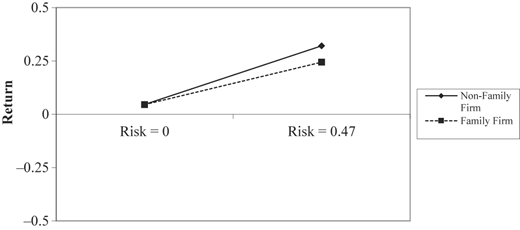
Moderating effect of being a family firm in the R-RR for firms with returns above the mean ROIC of the industry (risk level 1)
Moderating effect of being a family firm in the R-RR for firms with returns above the mean ROIC of the industry (risk level 1)
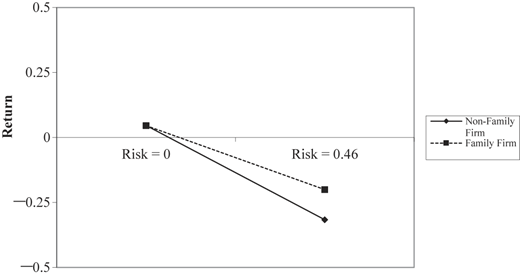
Moderating effect of being a family firm in the R-RR for firms with returns below the mean EBIT of the industry (risk level 3)
Moderating effect of being a family firm in the R-RR for firms with returns below the mean EBIT of the industry (risk level 3)
Furthermore, to support the robustness of our results, we also conducted a number of additional tests. First, we replicated our analysis using return on equity ratio (ROE) as alternative dependent variable. Second, we calculated different proxies for the distinct risk levels, by estimating a dummy variable for each risk level and its interaction terms in the Models 1–4 (Martínez-Romero et al., 2020a, b). We got similar results [5] to those obtained in the main analysis. Particularly, our hypotheses were supported with the same level of significance.
5. Discussion and conclusion
This study was motivated by the call for more comprehensive research on the risk-return relationship (Díez-Esteban et al., 2017; Das Gupta and Pathak, 2018; Chari et al., 2019), in a private firm context and considering the family nature of the analysed firms. Thus far, the R-RR has been studied in public firms (e.g. Chari et al., 2019), and empirical research analysing how family firms influence such relationship is still scarce (Díez-Esteban et al., 2017).
Therefore, the aim of the present study was twofold. First, we wanted to explore the R-RR for privately held firms to fill this traditional void. We also draw attention to another aspect of great importance, which is the different risk situation of firms. In this regard, not only did we study the R-RR, but we also distinguished between different risk levels and analysed its differential effects on firms' returns. A further aim was to investigate when and to what extent, the family nature of the firm influences and conditions the R-RR in the different scenarios.
Our regression analyses support H1a inasmuch as when firms perform above the target level, there is a positive association between risk and return. Moreover, H1b is also supported, as there is a negative relationship between risk and return for firms performing below the target level. Specifically, this negative association is more pronounce as higher the level of risk is. That is, the R-RR becomes more negative as higher the gap is between the target level and the obtained return.
On the other hand, H2 is partially supported as we found that family firms soften the R-RR only in the most favourable and in the most unfavourable scenarios. Namely, family firms weaken the positive R-RR existing when performance is above the target level (risk level 1) and also weaken the negative R-RR existing when firms are in the lowest performing case (risk level 3). It could be said that family firms only take the market average as a reference point in favourable and very unfavourable scenarios. This behaviour may be due to family firms not perceiving the average industry performance as a critical target as non-family firms do, which can be explained by the behavioural theory. Family firms are disposed to accept lower returns when this allows them to preserve their SEW, which is the same as stating that their aspiration levels are different from those of non-family firms. When family firms reach acceptable performance levels, so as to protect the family aspects, they are not really concerned with external performance benchmarks. Thereby, family firms are less influenced by the market than non-family firms due to their long-term orientation that conditions their strategic decision-making (Lumpkin and Brigham, 2011). Hence, family firms tend to adopt a more conservative approach, becoming loss-averse and prioritizing emotional over financial objectives (Berrone et al., 2012; Kotlar et al., 2014).
The fact that H1a and H1b behaved as we expected indicates the relevance of investigating the R-RR in privately held firms under the prospect theory. Our findings are in line with those of Antoncic (2003) or Brick et al. (2015), among others, in quoted firms, who revealed that risk and return are negatively associated for below-target firms (low performing) and positively related for above-target firms (high performing). Indeed, very fresh research also obtained similar results (Díez-Esteban et al., 2017; Patel et al., 2018).
Regarding the moderating effect that family firms exert on the R-RR, our findings reveal interesting insights. As previously stated, family firms pursue not only economic, but also family goals (Kellermans et al., 2012; Rojo-Ramírez and Martínez-Romero, 2018). Specifically, our findings reveal that family firms tend to prioritize non-economic objectives, such as cultivating family values, transferring the firm to subsequent generations, and fulfilling needs for belonging and affect, over purely financial objectives (Berrone et al., 2012; Sciascia et al., 2015), both when performing above the industry target level and when they underperform. Our findings are in line with those of Díez-Esteban et al. (2017) who found a less steep relationship between risk and return in family than in non-family firms, emphasizing the more conservative attitude of the former with respect to the latter, as well as their higher risk aversion. Moreover, our findings highlight the importance attached to non-economic goals by family firms, which seems to prioritize SEW utilities over purely financial goals under all possible risk scenarios (Zellweger, 2007; Martínez-Romero and Rojo-Ramírez, 2017; Martínez-Romero et al., 2022).
Our article contributes to the literature in several ways. First, to the best of our knowledge there are no previous studies analysing the R-RR (Fiegenbaum, 1990), and specifically, the Bowman's paradox (Bowman, 1980) in the context of privately held firms. Thus far, prior research investigating the R-RR has focused on public firms (Patel et al., 2018), and the investigation of the family influence on the abovementioned relationship is scarce (Díez-Esteban et al., 2017). Therefore, our study emphasizes the relevance of prospect theory as theoretical approach to analyse risk preferences in privately held firms. Moreover, by focusing on private family firms, which represent the vast majority of firms worldwide (La Porta et al., 1999), we respond to the call for further research on private family firms' financial performance (Martínez-Romero et al., 2020a, b).
Second, our findings reveal the moderating role of family firms in the R-RR. Specifically, our findings emphasize that the family nature of the firm soften the R-RR, highlighting the risk-aversion behaviour in these types of firms. To the best of our knowledge, previous studies have not considered the R-RR analysis in a private context. In particular, previous studies suggest that private family firms can embrace higher risk when facing threats (Gómez-Mejia et al., 2007; Nguyen, 2011; Kotlar et al., 2014). Prior research reveals that, as a matter of fact, this only occurs when they face high-risk situations. In moderate risk situations (below the market but with positive returns) the obtained results show that family businesses are cautious and barely pay attention to the market. In any case, the obtained results emphasize the conservative behaviour of family firms (Claessens et al., 2002; Sciascia et al., 2015) under both low and high-risk scenarios.
Third, and related to the abovementioned considerations, the present study brings together the two highly relevant research fields of family firm and finance. In this regard, our study contributed to the scholarly debate about financial decisions in family firms, an area of research that has offered mixed and controversial results and which offers several promising research avenues (Michiels and Molly, 2017; Diéguez-Soto et al., 2022).
Furthermore, we should note some practical implications of our research. As has been previously demonstrated, the R-RR shall be conditioned upon the family nature of the firm. Accordingly, it is of utmost importance for family firms to learn how to manage their SEW endowment, to make the most of it. To this end, there should be a balance between the rational and the emotional endowments of family firms.
Our study has certain limitations that also provide interesting avenues for future research. First, we performed our analysis for Spanish manufacturing firms, so we must confirm whether our findings could be extrapolated to other countries and also for longer period of time (Brick et al., 2015). Second, the R-RR might be influenced by environmental factors or by market forces. Although we controlled for sub-industry effects, it would be interesting to improve the understanding of environmental circumstances on such relationships. Therefore, future studies could address these issues. Third, it is of interest to take into account the possible heterogeneity of family firms (Rovelli et al., 2021) in their behaviour towards risk, which opens an interesting avenue for research to achieve a better understanding of the R-RR. Finally, although we follow previous research (e.g. Gómez-Mejia et al., 2001) to identify family firms based on the involvement approach, the use of alternative definitions of family firms may lead to different results.
Notes
Loss aversion accounts the preference options for riskier actions that avoid losses altogether over less risky options that minimize the size of loss (Wiseman and Gómez-Mejia, 1998).
Following the NACE classification, the activities included in our analysis correspond to the codes 10–33 groups.
NACE is the standard classification of productive economic activities in the EU.
We selected firms with at least 10 employees and 500,000 euros of income each year.
Detailed results for the additional estimations can be obtained from the authors upon request.

