


This study aims to explore how economic, subjective, and cultural capital factors impact cultural consumption decisions in Chile, using data from the last National Survey of Cultural Participation in Chile.
Using advanced machine learning techniques, such as the LightGBM predictive model and SHapley Additive exPlanations (SHAP) analysis, we investigate how age, gender, educational level and access barriers, such as economic limitations and lack of time, influence the diversity and frequency of cultural consumption.
Hours dedicated to work and study affect cultural consumption differently according to gender, age and educational level, which should be considered in cultural inclusion policies. Additionally, we find that childhood cultural participation has a more pronounced positive impact on individuals with lower educational levels, supporting the importance of promoting access to culture from an early age to balance long-term differences in cultural consumption.
These findings contribute both theoretically and methodologically to the understanding of the various factors influencing cultural consumption and their interrelations. They recommend a review of cultural policies toward a more inclusive and adaptive approach to promote participation across all sectors of society, considering observations from a middle-income country such as Chile.
1. Introduction
Cultural goods are those whose value lies not solely in their functionality but also in their capacity to convey symbolic meaning, aesthetic expressions and creative content. These encompass a wide spectrum, including books, films, theater, music, visual arts, heritage manifestations and cultural festivals (Boggs, 2009). The significance of this sector goes beyond entertainment: cultural industries generate $2.3 trillion annually worldwide, representing 3.1% of the global gross domestic product and employing 6.2% of the global workforce (UNESCO, 2022). In Chile, the cultural sector has experienced significant growth, as reflected in the increased budget allocation for arts and heritage. The 2025 Budget Law proposal suggests a historic 45.8% increase compared to 2024, totaling 481 billion Chilean pesos, reaching a budget nearly four times higher than in 2020 (Dirección de Presupuestos, Ministerio de Hacienda, 2025; Oficina de Información, 2025). These figures underscore the economic and symbolic importance of cultural goods and the need to understand their consumption patterns.
This topic is particularly relevant because the consumption of cultural goods not only contributes to social well-being and individual happiness (Hand, 2018; Lee and Heo, 2021) but also serves as an indicator of human development and social cohesion. However, despite its importance, understanding the factors that motivate people to consume these goods remains limited.
To date, much of the literature has examined the relationship between cultural consumption and socioeconomic variables, integrating psychological and rational choice theories (Leguina et al., 2022; Suarez-Fernandez et al., 2020) and employing econometric methodologies, such as logit and probit models (Buigut and Amaize, 2020; Falk and Katz-Gerro, 2016). Nonetheless, the complex interplay between cultural capital, tastes, prior experiences and sociodemographic conditions (income and education) remains insufficiently understood (Ateca-Amestoy and Prieto-Rodriguez, 2013; Cellini and Cuccia, 2021). Furthermore, the cumulative nature of cultural consumption, shaped by early exposure and learning, demands nonlinear and more sophisticated approaches (Biferale et al., 2024), as well as the inclusion of affective dimensions in purchasing decisions (Marinao-Artigas et al., 2019).
The primary gap lies in the lack of models that comprehensively address the interactions among cultural capital, individual preferences and socioeconomic conditions in middle-income economies. While patterns have been identified within certain social strata (Ateca-Amestoy and Prieto-Rodriguez, 2013), there remains a shortage of complex analytical approaches that consider multiple factors simultaneously (Biferale et al., 2024; Cellini and Cuccia, 2021). To overcome these limitations, the application of advanced methodologies, including psychological and rational choice theories (Leguina et al., 2022; Suarez-Fernandez et al., 2020), as well as logit and probit models (Buigut and Amaize, 2020; Falk and Katz-Gerro, 2016), offers a pathway to capture the inherent complexity of cultural consumption (Biferale et al., 2024). This approach is particularly relevant in emerging countries, where cultural dynamics differ from those observed in developed economies (Gutierrez-Navratil et al., 2024; Ozkan and Kurtulus, 2024). Additionally, understanding the role of cultural capital, affective experiences and socioeconomic conditions demands stronger theoretical foundations (Weingartner, 2019) and the recognition that multiple variables, beyond demographic factors, influence cultural behavior (Molinillo and Japutra, 2017).
The contribution of this study is grounded in the development of an analytical framework that integrates subjective factors, sociodemographic characteristics and cultural capital through the use of big data analysis tools and machine learning techniques. This approach addresses the need for more robust theoretical frameworks (Weingartner, 2019) and aligns with the recommendation of adopting complex and multidimensional approaches (Molinillo and Japutra, 2017). By incorporating the role of cultural capital in shaping tastes and practices (Bourdieu, 1979), considering the evolution of preferences over time (Ateca-Amestoy and Prieto-Rodriguez, 2013) and addressing the specificities of emerging economies (Biferale et al., 2024; Gutierrez-Navratil et al., 2024; Ozkan and Kurtulus, 2024), this study expands both theoretical and empirical bases. As a result, it offers an analytical approach capable of capturing both linear and nonlinear interactions, thereby providing a deeper and more contextualized understanding of cultural consumption in heterogeneous environments.
The methodology combines representative surveys of cultural consumption in Chile with machine learning techniques, such as LightGBM and SHapley Additive exPlanations (SHAP), which enable the examination of large datasets and the identification of complex patterns in cultural participation (Dhar, 2013). These methods, along with data provided by Chile’s Ministry of Cultures, Arts and Heritage (2018), allow for detailed and transparent analysis, addressing the limitations of traditional models (Buigut and Amaize, 2020; Cellini and Cuccia, 2021; Falk and Katz-Gerro, 2016). This approach aims to enhance predictive accuracy and the interpretation of interactions among the various factors influencing cultural demand, providing new evidence and greater clarity about the underlying motivations for consumption.
In this way, the present study advances the literature on the consumption of cultural goods by proposing a holistic analytical framework. On the one hand, it strengthens theoretical foundations by integrating perspectives on cultural capital, subjective preferences and socioeconomic variables. On the other hand, it employs big data analysis techniques that more accurately capture the complexity of the phenomenon. This approach not only provides deeper insights for academic research but also holds significant implications for designing more inclusive and effective cultural policies in middle-income contexts.
The structure of the article is as follows. Section 2 reviews the literature and discusses the main theoretical approaches to cultural consumption. This is followed by a presentation of the methodology, detailing the use of machine learning techniques and the data sources employed (Section 3). Subsequently, the results are presented, followed by an analysis of their theoretical and practical implications (Section 4). Finally, the article concludes with a discussion of its conclusions, limitations and potential future research directions, highlighting how the findings contribute to the formulation of cultural policies and provide a richer, more nuanced understanding of cultural goods consumption in developing economies (Sections 5 and 6).
2. Literature review and theoretical framework
The study of cultural consumption is an area of research enriched by a diversity of theoretical and methodological approaches that reflect its interdisciplinary nature. This section provides a review of the literature and the theoretical framework underpinning the current research. Appendix A in the Supplementary materials includes a list of relevant recent articles.
One of the most influential theories in the study of cultural consumption is Pierre Bourdieu’s theory of cultural capital (1979). According to Bourdieu (1979), cultural capital refers to a set of knowledge, skills, education and other advantages that an individual accumulates over their lifetime, enabling them to achieve a favorable social and economic position. Bourdieu (1979) posited that privileged social classes use cultural capital as a means of distinction, adopting “high-level” cultural practices to maintain and reproduce their social status.
These cultural practices are consumed within a market that not only facilitates access to these goods but also shapes consumption by creating and promoting symbols and lifestyles that consumers adopt, generating experiences that imbue cultural practices with meaning and enrichment (Ozkan and Kurtulus, 2024). In this way, the market contributes to defining which cultural products and experiences are considered valuable, influencing cultural preferences and reinforcing social hierarchies through consumption.
The theory of cultural capital has been supported by numerous studies demonstrating a strong correlation between educational attainment, income levels and participation in cultural activities (Buigut and Amaize, 2020; Falk and Katz-Gerro, 2016; Katz-Gerro, 2002). However, Hanchard et al. (2023) pointed out that although consumption decisions are influenced by cultural capital, the theoretical framework has limitations when addressing the pluralization and diversification of consumption.
Despite these limitations, the theory of cultural capital remains a robust framework for understanding how social stratification and socioeconomic conditions shape cultural practices. While more recent research has highlighted greater diversity in tastes and increasing permeability across different cultural manifestations (Bronner and de Hoog, 2021; Katz-Gerro and Sullivan, 2023), cultural capital retains its relevance in explaining the relationship among education, economic resources and access to culture.
This perspective is particularly pertinent in developing countries, where economic inequalities are compounded by educational and symbolic barriers, deepening cultural divides (Gutierrez-Navratil et al., 2024; Ozkan and Kurtulus, 2024). Thus, Bourdieu’s (1979) theoretical framework not only explains traditional hierarchies but also provides a foundation for understanding the contemporary complexity of cultural consumption, serving as a conceptual anchor for integrating more flexible approaches that address current social transformations.
In contrast to Bourdieu’s (1979) perspective, the theory of cultural omnivores developed by Peterson and Simkus (1992) offers an alternative view of cultural consumption among the upper classes. This theory suggests that individuals of high social status do not confine themselves to consuming exclusively “high” culture but instead exhibit more diverse cultural tastes that encompass both high culture and popular culture. Empirical studies have corroborated this theory, showing that education, income and occupational prestige are associated with greater diversity in cultural tastes (Bronner and de Hoog, 2021; Chan and Goldthorpe, 2007; Katz-Gerro and Sullivan, 2023; Sintas, 2002). This phenomenon of cultural omnivorism reflects a trend among the upper and upper-middle classes to consume a wide range of cultural goods, using this diversity as a new form of social distinction in a context in which traditional cultural hierarchies are being challenged.
Psychological theories complement sociological perspectives by providing crucial insights into cultural consumption. Theories of consumption-based learning (Garboua and Montmarquette, 1996) and “rational addiction” (Becker and Murphy, 1988) highlight that prior consumption of cultural goods enhances appreciation and shapes future consumption decisions (Chen and Tang, 2021; Espinosa et al., 2021; Manolika and Baltzis, 2020). These experiences, accumulated from childhood, are key to the development of artistic tastes (Throsby et al., 2024). Moreover, each exposure to culture generates a feedback process that adjusts future consumption decisions, either reinforcing or altering them (Quero-Gervilla, 2013). These approaches emphasize that cultural consumption is a cumulative and dynamic process in which past experiences play a crucial role in shaping cultural preferences.
The impact of socioeconomic factors on cultural consumption has been widely documented, with education standing out as a key determinant in this area. Suarez-Fernandez et al. (2020) demonstrated that higher levels of education are strongly correlated with increased cultural consumption. This finding aligns with various studies highlighting the central role of education in building cultural capital and serving as a key predictor of cultural consumption (Baik and Heo, 2023; Gutierrez-Navratil et al., 2024; Lee and Heo, 2023; Rodríguez-Puello and Iturra, 2024). In this regard, Ateca-Amestoy and Castiglione (2023) suggested that education has a greater impact on the consumption of in-person cultural activities than digital ones. Conversely, a lack of education can perpetuate barriers that exclude certain groups from cultural participation, as noted by Heikkilä and Lindblom (2023). This underscores the importance of education not only as a facilitator of cultural access but also as a tool for preventing marginalization. While income remains a critical factor in accessing cultural goods, particularly those with high costs (Bille, 2024), its impact is less pronounced in highly educated contexts, suggesting that education can mitigate some of the financial constraints on cultural consumption.
Social stratification, as proposed by Bourdieu (1979), imposes significant barriers to cultural access, and Chile is no exception. Empirical evidence shows that over more than a decade, higher educational levels have been consistently associated with greater participation in cultural goods, such as literature, cinema, museums and theater, underscoring the role of cultural capital in cultural consumption (Valdés-Elizalde et al., 2024). However, for lower social classes, these educational inequalities are compounded by economic barriers, such as the cost of events and geographic barriers, such as a lack of transportation, as well as by a lack of knowledge or interest in these activities. In this context, traditional economic determinants exert a stronger influence on cultural consumption patterns than on proximity to cultural offerings, reinforcing disparities in access (Biferale et al., 2024).
Another relevant aspect is gender, which also plays a significant role in cultural consumption. Several studies have shown that women participate more than men in cultural activities, including those related to socialization and high-culture events (Baik and Heo, 2023; Chen and Tang, 2021). Additionally, women are more engaged in high-level cultural activities, while men are more likely to avoid both elite and popular culture (Heikkilä and Lindblom, 2023). Katz-Gerro and Sullivan (2023) noted that women in lower social classes face greater barriers to accessing culture. Meanwhile, McAndrew and Widdop (2021) caution that in many studies, gender is often treated as a control variable, underestimating its impact on cultural consumption.
Age is another key factor in cultural consumption, serving as one of the strongest predictors of participation as individuals grow older (Fluharty et al., 2021). Cultural preferences and patterns vary significantly across the life cycle due to factors such as education and daily challenges. In general, younger individuals show a greater interest in popular culture, such as contemporary cinema and music, whereas older adults tend to favor high-culture activities, such as opera and theater (Throsby et al., 2024). Bille (2024) demonstrated that the frequency of participation in cultural activities tends to decline with age, although the type of cultural activity preferred may shift. Young adults (18–35 years old) are more likely to engage in a wide range of cultural activities due to their higher levels of cultural and social capital, while older adults tend to focus on activities they perceive as more valuable and meaningful. These dynamics are also evident in the Chilean context, where participation in cultural activities decreases with age, and women participate more than men in various activities. This indicates patterns of stratification by age and gender that align with international findings (Valdés-Elizalde et al., 2024).
Early cultural participation has lasting effects on individuals’ cultural preferences and their ability to engage in cultural activities throughout their lives. Leguina et al. (2022) and Myrczik et al. (2022) have shown that cultural experiences during childhood and youth can shape cultural preferences and habits in adulthood. This finding highlights the importance of promoting cultural participation from an early age to ensure equitable and sustainable cultural development. Bille (2024) suggested that educational programs that include museum visits, art workshops and music classes can spark interest in culture and provide individuals with the tools necessary to appreciate and enjoy cultural activities. Moreover, policies that promote education and cultural accessibility can effectively increase cultural participation, regardless of income level. However, while the democratization of popular culture is more easily achieved due to support from major industries, elite culture faces greater challenges because of its reliance on public funding and the cultural capital required to access it (Gutierrez-Navratil et al., 2024).
Marital status also significantly influences cultural consumption. Married individuals or those in stable relationships tend to participate more in cultural activities than single individuals. This may be due to the influence of partners and families on the selection of cultural activities. Throsby et al. (2024) found that couples often participate together in cultural activities, which can increase both the frequency and diversity of cultural consumption. This finding highlights the importance of social networks and personal relationships in shaping cultural habits.
The influence of structural and contextual barriers on access to cultural goods has also been a topic of study in the literature. Ateca-Amestoy and Prieto-Rodriguez (2013) pointed out that economic limitations, lack of time and other structural barriers can significantly affect cultural demand. Borowiecki and Prieto-Rodriguez (2015) suggested that cultural consumption patterns are integrated and multifaceted, challenging the notion that cultural activities are consumed in isolation. In this regard, cultural capital plays a crucial role in individuals’ ability to access and enjoy cultural activities (Katz-Gerro, 2002; Šebová and Révészová, 2020). In Chile, education and income levels are significant determinants of cultural participation (Peters Núñez, 2021). However, Olivos and Wang (2023) emphasized that deep economic barriers exacerbate this relationship, creating more pronounced stratification in cultural access. As a result, economic inequality limits opportunities, even for those with educational capital, reinforcing social gaps in cultural consumption.
The literature review highlights how cultural capital, socioeconomic barriers and demographic factors influence cultural consumption. However, gaps remain to be explored, particularly in contexts such as Chile. This theoretical framework will serve as the foundation for analyzing cultural consumption patterns in Chile, guiding the study’s research questions and methodology.
3. Methodology
3.1 Data collection and processing
To address the research questions and objectives, data on cultural goods consumption in Chile during 2017 were analyzed using the National Survey of Cultural Participation (Ministerio de las Culturas, las Artes y el Patrimonio, 2018). This survey represents the cultural practices of the Chilean population aged 15 and older in urban areas, covering 12,151 participants selected through stratified sampling.
Initial data processing involved recoding categorical and numerical variables, developing new metrics and consolidating existing variables. Table 1 presents all the variables used, categorized into five conceptual groups: sociodemographics, cultural capital, participation and leisure, access barriers and an index of consumption of other cultural goods.
Summary of variables and data in the 2017 cultural consumption study: variables selected for predictive models
| Variable | Type* | Mean | SD | 6v | Allv | 12v |
|---|---|---|---|---|---|---|
| Book consumptiona | Bin. | 0.34 | 0.47 | x | x | x |
| Cinema attendancea | Bin. | 0.35 | 0.48 | x | x | x |
| Concert attendancea | Bin. | 0.27 | 0.44 | x | x | x |
| Dance events attendancea | Bin. | 0.21 | 0.40 | x | x | x |
| Museum visitsa | Bin. | 0.16 | 0.37 | x | x | x |
| Library visitsa | Bin. | 0.15 | 0.35 | x | x | x |
| Theater attendancea | Bin. | 0.11 | 0.31 | x | x | x |
| Visual arts events attendancea | Bin. | 0.13 | 0.34 | x | x | x |
| ICC: book consumption | Num. (0–8) | 0.23 | 0.24 | x | x | x |
| ICC: cinema attendance | Num. (0–8) | 0.25 | 0.27 | x | x | x |
| ICC: concert attendance | Num. (0–8) | 0.20 | 0.22 | x | x | x |
| ICC: dance events attendance | Num. (0–8) | 0.15 | 0.18 | x | x | x |
| ICC: museum visits | Num. (0–8) | 0.10 | 0.12 | x | x | x |
| ICC: library visits | Num. (0–8) | 0.12 | 0.14 | x | x | x |
| ICC: theater attendance | Num. (0–8) | 0.08 | 0.10 | x | x | x |
| ICC: visual arts events attendance | Num. (0–8) | 0.13 | 0.15 | x | x | x |
| Age categoryb | Cat. | 2.57 | 1.12 | x | x | x |
| Marital statusc | Bin. | 0.47 | 0.50 | x | x | |
| Genderd | Cat. | 0.42 | 0.49 | x | x | x |
| Socioeconomic quintilee | Cat. | 2.62 | 1.31 | x | x | |
| Employment statusf | Bin. | 0.56 | 0.50 | x | ||
| Vehicle ownershipg | Bin. | 0.34 | 0.47 | x | ||
| Household size | Num. (1–6) | 2.87 | 1.45 | x | ||
| Educational levelh | Cat. | 2.09 | 1.28 | x | x | x |
| Parents’ educationh | Cat. | 1.42 | 0.95 | x | ||
| Presence of artists in familya | Bin. | 0.12 | 0.32 | x | ||
| Family encouragement of arta | Bin. | 0.15 | 0.35 | x | x | |
| Significant artistic momenta | Bin. | 0.09 | 0.29 | x | ||
| Childhood visits to cultural spaces | Num. (0–9) | 1.86 | 2.13 | x | x | |
| Childhood participation in artistic activities | Num. (0–6) | 2.05 | 1.98 | x | ||
| Participation in artistic workshops | Num. (0–7) | 0.02 | 0.17 | x | x | |
| Cultural activities for pleasure | Num. (0–23) | 8.11 | 6.89 | x | x | |
| Weekly work and study hours | Num. (0–35) | 9.03 | 7.45 | x | x | |
| Weekly household care hours | Num. (0–32) | 8.24 | 5.24 | x | ||
| Weekly leisure hours | Num. (0–8) | 0.24 | 0.68 | x | x | |
| Barriers due to discomfort | Num. (0–3) | 0.12 | 0.36 | x | ||
| Barriers due to lack of interest | Num. (0–6) | 0.42 | 0.64 | x | x | |
| Barriers due to practical restrictions | Num. (0–8) | 0.96 | 0.85 | x | x |
Note(s): Variable descriptions: aBin. (0, 1): 0 = No, 1 = Yes; bAge Category: 1 = 15–29, 2 = 30–44, 3 = 45–59, 4 = 60+; cMarital Status: 0 = Single, 1 = In a relationship; dGender: 0 = Female, 1 = Male; eSocioeconomic Quintile: Socioeconomic levels from lowest (1) to highest (5); fActivity: 0 = Inactive, 1 = Active; gVehicle Ownership: 0 = No, 1 = Yes; hEducational Level and Parents’ Education: 0 = No formal education, 1 = Primary, 2 = Secondary, 3 = Technical, 4 = University; v, Variables used for predictive models
Source(s): Own elaboration
To optimize the accuracy of the predictive model, principal component analysis (PCA) was employed. This technique reduces dimensionality by transforming the original variables into principal components that retain most of the variance in the data. Initially, 23 variables were used. PCA helped identify and select representative variables from each group of similar vectors, resulting in 12 key variables, as shown in Table 1 and Figure 1. The original 23 variables, along with their categories, technical names, descriptions and construction methods, are detailed in the Supplementary materials in Appendix B.
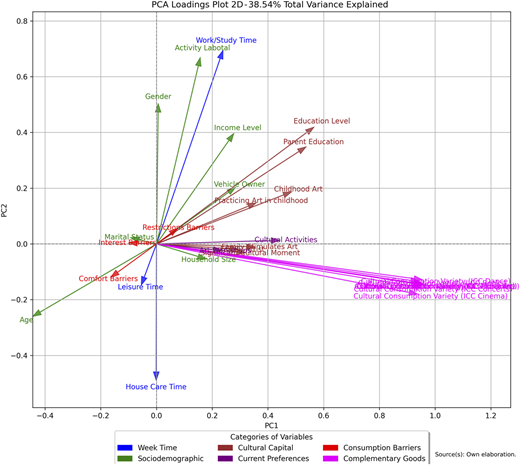
Figure 1 shows how the vectors represent the relationship of the variables with the principal components, using colors to indicate different dimensions (sociodemographic, cultural capital, etc.). When two vectors of the same color, such as “educationLevel” and “parentEducation,” have similar directions, it may be considered to use only one of those two variables in the model, simplifying the analysis without losing precision. Variables with opposite directions or different colors provide unique information and should not be replaced.
Table 1 presents the mean values and standard deviations of the variables. After testing various combinations of variables, three key groups were identified: a base set of 6 variables, a full model with 23 variables and a simplified version with 12 variables. The final variables were selected for their ability to represent the dimensions of cultural consumption, discarding redundant ones to optimize the model.
The results indicated that there were no significant correlations between the variables studied (all with values below 0.5), suggesting relative independence between the different dimensions of cultural consumption.
3.2 Transformations and recoding of variables
Significant transformations and recordings were performed to ensure the homogeneity and comparability of the data. These included the following:
3.2.1 Homogenization
The level of education and parental education were rescaled to homogenize the educational categories.
3.2.2 Composite indices
Indices such as ChildGoesToArt and ChildEngagesInArt were created. For example, ChildGoesToArt aggregates dichotomous variables such as ChildGoesToMuseum and ChildGoesToArtGalleries, resulting in a maximum index value of 9. These transformations were crucial to ensuring the integrity and consistency of the analysis.
3.3 Composite Cultural Consumption Index (ICC)
A Composite Cultural Consumption Index (ICC) was developed to comprehensively evaluate the dynamics of cultural consumption. The construction of the ICC excluded the cultural good under study and summed the consumption of other cultural goods, scaling the result from 0 to 1 according to the formula:
3.4 Addressing imbalance in cultural goods consumption
A considerable imbalance in the consumption of cultural goods was detected. To tackle this challenge, oversampling techniques based on k-means and SMOTE were employed, following Douzas et al.’s (2018) approach, thereby balancing the dataset and improving the accuracy of the predictive models.
3.5 Imputation of missing values
Missing values were imputed using the KNNImputer, ensuring the quality and consistency of the consolidated dataset while minimizing the impact of missing data.
3.6 Variables related to available time
Variables such as workStudyWeek, houseCareWeek and leisureWeek were coded to calculate the total weekly allocation of hours in each context using the following formulas:
3.7 Barriers to cultural consumption
The variables were grouped into three main categories: discomfort, disinterest and constraints. Each category includes specific variables, represented in formulas (5), (6) and (7), respectively:
Discomfort:
Disinterest:
Constraints:
3.8 Model optimization
To optimize the predictive models, RandomSearchCV was used, following the methodology of Bergstra and Bengio (2012), to identify the optimal hyperparameters for LightGBM.
3.9 Predictive analysis with LightGBM
3.9.1 Advanced machine learning techniques
Advanced machine learning techniques were employed, referring to gradient boosting algorithms such as LightGBM and XGBoost, which adaptively combine numerous simple decision trees to achieve accurate predictions (Martínez-Vargas et al., 2022). In our study, LightGBM was selected for its interpretability using the SHAP method. These algorithms have demonstrated outstanding results in regression and classification contexts. The formulation of LightGBM focused on optimizing the loss function:
where is the loss function that measures the discrepancy between the actual value and the prediction , represents the model parameters, is the total number of samples, and is the total number of trees in the model. is the regularization term that penalizes model complexity to prevent overfitting. This approach follows the practical analysis of gradient-boosting algorithms by Bentéjac et al. (2021).
3.10 Impact of features on prediction
To analyze the impact of features on the model’s predictions, the SHAP technique, based on game theory (Lundberg and Lee, 2017), was employed. SHAP assigns a value to each feature, indicating its importance in the prediction of each sample and providing detailed and understandable explanations of the model’s behavior, even in complex algorithms. The SHAP value is calculated by considering all possible combinations of features:
where represents the SHAP value for feature , indicating its contribution to the model’s prediction. is the set of all features, is a subset of features that does not include , and is the model’s prediction using the set of features . The term is a weighting coefficient based on the number of features in . This approach allows for a comprehensive evaluation of the importance of each feature in the global predictive model.
3.10.1 Segmentation and multidimensional analysis
The data were segmented based on demographic and socioeconomic variables, such as age, gender and educational level, enabling a detailed analysis of how these variables influence cultural consumption. The use of SHAP was essential for identifying the relative importance of each variable within these segments.
3.10.2 Optimization of feature selection and methodology for multidimensional predictive analysis
Experiments were conducted with various datasets and variable analyses to propose a simpler and more efficient model. Using SHAP values, the impact of each variable on the models was evaluated. Additionally, PCA was implemented to identify variables with similar variances:
where is the original data matrix with centered variables, is the matrix of eigenvectors and is a diagonal matrix with eigenvalues. This approach simplifies the model, reducing its complexity while ensuring the retention of its accuracy and predictive capability.
3.11 Hyperparameters of LightGBM
In the experiment with LightGBM, the essential hyperparameters determined as optimal by RandomSearchCV were learning rate 0.05, random state 42, boosting type gbdt, binary objective, 200 estimators, maximum depth 15 and 40 leaves.
3.12 Performance metric
The selected performance metric was accuracy, which represents the proportion of correct predictions over the total predictions made by the model, mathematically expressed as:
where TP represents true positives, TN denotes true negatives, FP represents false positives and FN denotes false negatives. Since the original classes were imbalanced, an oversampling procedure was applied to balance the classes and enable a more appropriate evaluation using this metric.
4. Results and discussion
Different combinations of variables were tested in a predictive model with 23 variables derived from the literature (Table 1) using feature engineering techniques. As shown in Table 2, the average accuracy increased from 73% with 6 variables to 87% with 23 variables. When selecting the 12 most relevant variables, the average performance equaled that of 23 variables, demonstrating that feature engineering allows for simpler models without sacrificing accuracy, although slight losses occur in some cases. In the case of cinema, a 1% improvement was observed with the use of 12 variables. Out of 4,741 predictions, 3,798 were correct (1,846 true positives and 1,952 true negatives), yielding an accuracy of 80.11%, demonstrating the model’s effectiveness.
Performance improvement based on accuracy scores for the 2017 model
| Variables | 6v | 23v | 12v selected |
|---|---|---|---|
| Books | 69.39% | 78.88% | 77.88% |
| Cinema | 76.12% | 80.11% | 81.35% |
| Concert | 70.04% | 82.30% | 82.02% |
| Dance | 71.28% | 87.30% | 86.69% |
| Library | 72.71% | 91.12% | 90.31% |
| Museum | 78.24% | 92.27% | 91.06% |
| Theater | 74.02% | 93.90% | 92.68% |
| Visual Arts | 73.45% | 92.63% | 92.11% |
Note(s): v, Variables used for the predictive models
Source(s): Own elaboration
Although predictive accuracy is essential, it is insufficient to fully understand the dynamics of cultural consumption, highlighting the importance of interpreting the underlying reasons behind predictions (Lundberg and Lee, 2017). In this context, the SHAP method is pivotal due to its ability to attribute predictions to specific features, enabling both a global and individual understanding of variable importance (Hu and Wang, 2023). This approach identifies how each factor influences predictions by deconstructing contributions at a granular level and uncovering nonlinear patterns, subtle interactions and heterogeneous responses (Lundberg and Lee, 2017; Van den Broeck et al., 2021). Furthermore, its foundation in cooperative game theory and machine learning establishes SHAP as a robust tool for analyzing complex dynamics.
Figure 2 visualizes this ranking, highlighting participation in cultural activities since childhood, economic quintile and the diversity of other cultural consumptions as the most influential factors. In contrast, family stimulation and consumption barriers due to external restrictions are less relevant. Other factors, such as age and barriers related to interest, show variations depending on the cultural good.
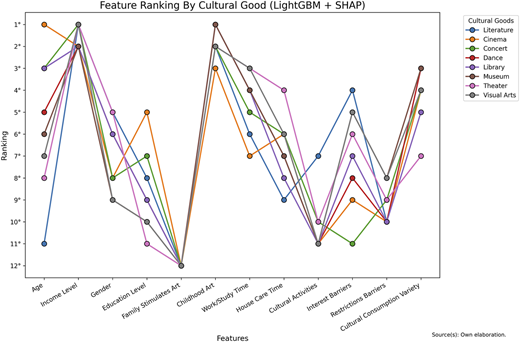
A notable example can be found in the literature, where personal motivation plays a more critical role in its consumption compared to other cultural goods. This visualization allows for the identification of key patterns to design effective cultural policies.
The SHAP swarm plots in Figure 3 illustrate how features influence the probability of cultural consumption. Positive values (to the right) indicate an increase in the probability of consumption, while negative values (to the left) reflect a decrease. For example, in Art in Childhood (cultural participation during childhood), most red values (high values) are concentrated on the right side, meaning that individuals who participate more during childhood are more likely to consume cultural goods. In contrast, blue values (low values) cluster on the left, indicating a lower probability of consumption for those with little childhood participation. This supports Bourdieu’s (1979) cultural capital theory and Becker and Murphy’s (1988) rational addiction theory. Similarly, No Interest reflects a negative impact, aligning with Borowiecki and Prieto-Rodriguez (2015), who emphasized the importance of addressing cultural disinterest.
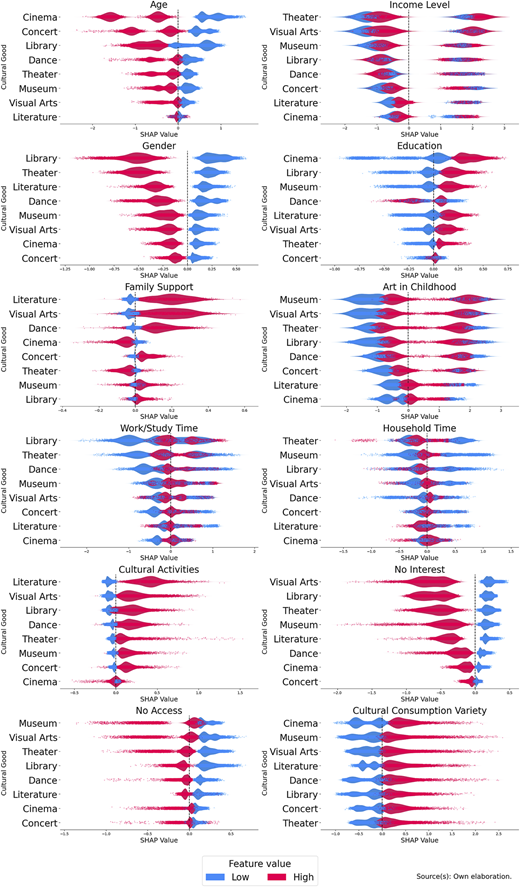
The SHAP technique revealed that participation in cultural consumption decreases with age, which aligns with the findings of Peters Núñez (2021) and Buigut and Amaize (2020). Advanced predictive models show that the impact of age and economic income is more complex than traditional analyses suggest. Significant differences were observed based on gender and time dedicated to work or study. Women showed a greater inclination toward cultural consumption, particularly in libraries and theaters, as work or study hours increased, consistent with Katz-Gerro and Sullivan (2023). In contrast, men did not exhibit a defined pattern. Figure 4 indicates that women (in red) participate more in activities such as libraries, theaters and museums, while men (in blue) are more likely to attend cinema and concerts. Points on the left show that being male decreases the likelihood of participating in these cultural goods, while points on the right indicate an increase. This reflects the general trend of cultural participation by gender.
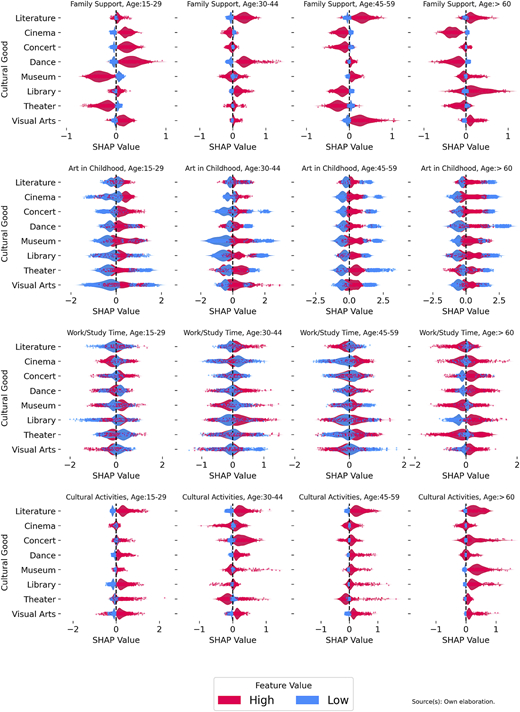
Impact of socio-family and work factors on cultural consumption segmented by age
Impact of socio-family and work factors on cultural consumption segmented by age
The segmented analysis shows how family stimulation strongly influences the consumption of literature and visual arts, with an increasing impact across different age groups. In contrast, activities such as cinema and concerts have high predictive power among individuals under 30 years of age. For the literature, this is clearly observed in the age ranges Age: 30–44, Age: 45–59 and Age: >60, where red values shift significantly to the right, reflecting this trend. This pattern underscores the importance of early cultural exposure (Leguina et al., 2022). This analysis can be replicated with other variables in the chart to better understand the behavior of each age group.
Income and educational level are critical factors in cultural consumption. For individuals with university or postgraduate education, the impact of income is diffuse, with no clear pattern. However, as shown in Figure 5, specifically in the lines for No formal education and Primary (representing individuals with no education and those with only primary education, respectively), higher income quintiles, represented in red, strongly align to the right, indicating a significant increase in the likelihood of cultural consumption. As the analysis shifts to higher educational levels, this phenomenon becomes more diffuse, suggesting that cultural capital acquired through education reduces dependence on income for cultural participation, reinforcing Bourdieu’s (1979) theory of cultural capital.
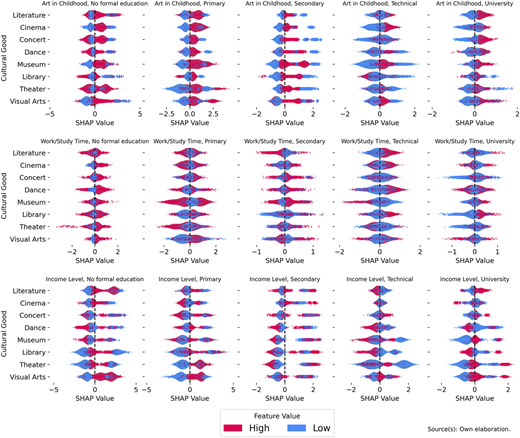
Impact of income, work hours and childhood participation on cultural consumption by educational level
Impact of income, work hours and childhood participation on cultural consumption by educational level
This same pattern can be observed in other variables in the chart, further supporting the idea that cultural capital and income interact in a complex way depending on educational level.
A notable finding is the relationship between work or study hours and cultural consumption. Figure 6 examines the variable workStudyWeek, representing weekly work or study hours. Red values in the chart indicate more than 16 h per week, showing that Female (women) have a higher probability of participating in cultural activities when working or studying more than 16 h. In contrast, for Male (men), this relationship is more diffuse, with no clear trend. This suggests that for women, work and study not only provide economic resources but also facilitate access to culture, aligning with the social identity and curiosity theory of Manolika and Baltzis (2020).
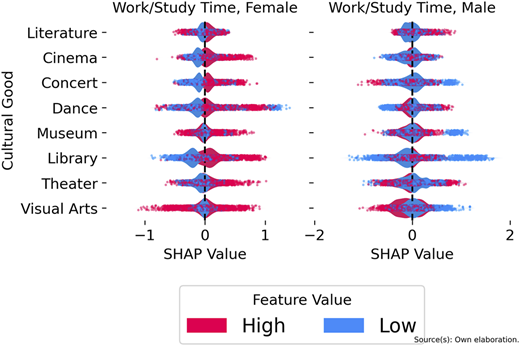
Although Baik and Heo (2023) found that cultural consumption generally decreases with increased work hours, participation in the fine arts increases. Additionally, educational level significantly influences cultural consumption, with highly educated individuals being more likely to attend artistic events. Our study reveals significant differences by age, gender and educational level, confirming the trend observed by Baik and Heo (2023) across most segments and highlighting the need to consider complex interactions between factors when studying cultural consumption.
Our study examines how barriers to consumption, particularly disinterest, vary depending on the type of cultural good. Some cultural goods are more resilient to a lack of prior stimulation, while others are more sensitive. This highlights the complexity of cultural substitution influenced by previous experiences and the level of accumulated cultural capital. This finding underscores the importance of considering the intersectionality of barriers when designing cultural policies, as suggested by Šebová and Révészová (2020).
Early participation in cultural activities is a key determinant of cultural consumption in adulthood, transcending educational levels. It can significantly compensate for those with less formal education, emphasizing the need for early cultural intervention programs to maximize their lifelong impact, particularly among individuals with lower educational attainment.
5. Conclusions
This study revealed complex and multidimensional patterns of cultural consumption in Chile, a middle-income country, challenging the traditional distinctions between popular culture and high culture. Contemporary sociocultural dynamics are progressively blurring these boundaries, suggesting a more integrated and accessible cultural field. This observation is supported by our findings, which show that diverse demographic groups participate in a wide range of cultural activities. This phenomenon may be related to the cultural omnivorousness hypothesis (Peterson and Simkus, 1992), which posits that high-status individuals consume both elitist and non-elitist forms of culture (Olivos and Wang, 2023).
However, it is crucial to highlight that despite this trend toward more eclectic consumption, Chile continues to experience high levels of inequality that impact cultural participation. As noted by Olivos and Wang (2023), cultural participation in Chile remains highly stratified, explained by significant economic barriers to cultural access.
A key finding is the relationship between work or study hours and cultural participation. We found that individuals dedicating more than 16 h per week to these activities, particularly women over 59 years old and those with primary education or no formal education, showed a higher likelihood of consuming cultural goods. This result contrasts with previous studies suggesting that long working hours limit participation in cultural activities (Baik and Heo, 2023). Our research suggests that, for certain demographic groups, work and study may provide not only economic resources but also social networks that facilitate access to culture.
Additionally, we observed significant differences by gender. Women show a greater inclination toward cultural consumption, particularly in activities such as libraries and theaters. This finding aligns with studies indicating that women participate in cultural activities more frequently than men (Baik and Heo, 2023; Cellini and Cuccia, 2021; Chen and Tang, 2021; Lagaert and Roose, 2018; Manolika and Baltzis, 2020). Heikkilä and Lindblom (2023) also highlighted that men are more likely to avoid cultural participation.
Income and educational level are key factors in cultural consumption. Our results show that, for individuals with lower educational attainment, higher incomes increase the likelihood of consuming cultural goods, particularly high culture. However, at higher income levels, education becomes more determinant than income. This finding aligns with studies that highlight the relevance of both factors in cultural consumption. Almeida et al. (2020), Baik and Heo (2023) and Cellini and Cuccia (2021) emphasized that both education and income are crucial determinants, although several authors have stressed that education is more important for cultural consumption (Chen and Tang, 2021; Falk and Katz-Gerro, 2016). Additionally, Biferale et al. (2024) and Molinillo and Japutra (2017) pointed out that factors such as gender and age influence cultural consumption, suggesting that it depends on a complex interaction of sociodemographic variables.
Our study also introduces a new perspective on how barriers to consumption, particularly disinterest, vary depending on the type of cultural good. We found that some cultural products are more resilient to a lack of prior stimulation, while others are more sensitive. This reflects the complexity of cultural substitution, which is influenced by previous experiences and the level of accumulated cultural capital. In this regard, Throsby et al. (2024) emphasized that the development of artistic tastes is shaped by exposure to art from childhood, which affects future preferences and choices. Similarly, Espinosa et al. (2021) highlighted that taste is formed through prior cultural experiences.
Cultural participation in childhood is a key factor in cultural consumption during adulthood, regardless of educational level. Our analysis reveals that early exposure to cultural activities significantly increases the likelihood of consumption in later stages, even among individuals with lower education levels, which aligns with studies that underscore the importance of continuous participation from childhood (Chen and Tang, 2021; Lee and Heo, 2023).
The use of advanced machine learning techniques, such as LightGBM and SHAP, enabled the identification and visualization of nonlinear interactions among the factors studied. This addresses the need for more complex approaches to understanding the dynamics of cultural consumption, as suggested by Cellini and Cuccia (2021). The interpretation of SHAP values provided a detailed understanding of the impact of each variable on the probability of cultural consumption, revealing complex patterns that traditional models might overlook.
In terms of implications for cultural management, our findings highlight the need for cultural policies that address inequalities in access and participation. In particular, prioritizing early cultural education is crucial, as it not only significantly influences cultural consumption in adulthood but can also overcome barriers, such as proximity to cultural events, as suggested by Biferale et al. (2024). Promoting cultural programs targeted at individuals with lower educational levels, as indicated by Heikkilä and Lindblom (2023), could help mitigate current disparities. Furthermore, as Falk and Katz-Gerro (2016) emphasized, public cultural policy can act as an equalizing force, facilitating access to culture despite economic and educational barriers.
To maximize impact, it is essential to expand cultural subsidies and offer greater flexibility in schedules and accessibility, particularly in contexts such as Chile, where economic barriers are particularly high (Olivos and Wang, 2023). Additionally, cultural tourism is proposed as an effective strategy to diversify offerings and improve infrastructure, contributing to social well-being (Biferale et al., 2024) and, in turn, benefiting both residents and visitors, who also drive the local economy (Guaita Martínez et al., 2022).
This study provides empirical evidence that enhances the theoretical understanding of cultural consumption in middle-income economies by addressing the gaps identified in the literature. By analyzing the multidimensional interactions among cultural capital, subjective factors and sociodemographic factors and applying advanced machine learning techniques, it offers new perspectives that can guide the development of more inclusive and effective cultural policies. Promoting a society that values and actively participates in culture, regardless of socioeconomic or educational level, is essential for sustainable and equitable cultural development.
6. Limitations and future research directions
This study has limitations that should be considered in future research. The data are sourced from urban areas within the National Survey of Cultural Participation in Chile, which restricts generalizability to rural regions. Future studies should include rural samples to provide a more comprehensive perspective. Additionally, variables such as the influence of social networks and the quality of cultural infrastructure were not included; incorporating these factors could yield a more detailed understanding.
The analysis relies on data from 2017, which may not reflect current conditions, particularly in the post-COVID-19 context. Updating the dataset would allow researchers to verify whether the observed patterns persist or have shifted. The results, contextualized within a middle-income country, also suggest comparative research lines with other nations to validate and extend the findings.
Funding for open access charge was provided by the University of Malaga/CBUA.
Field: Business
Declaration of conflict of interest: The authors have no conflicts of interest to declare.
References
The supplementary material for this article can be found online.

