Skip to Main Content

Nuclei segmentation is the cornerstone task in histology image reading, shedding light on the underlying molecular patterns and leading to disease or cancer diagnosis. Yet, it is a laborious task that requires expertise from trained physicians. The large nuclei variability across different organ tissues and acquisition processes challenges the automation of this task. On the other hand, data annotations are expensive to obtain, and thus, deep learning (DL) models are challenged to generalize to unseen organs or different domains. This work proposes local-to-global NuSegHop (LG-NuSegHop), a self-supervised pipeline developed on prior knowledge of the problem and molecular biology. There are three distinct modules: (1) a set of local processing operations to generate a pseudolabel, (2) NuSegHop a novel data-driven feature extraction model and (3) a set of global operations to post-process the predictions of NuSegHop. Notably, even though the proposed pipeline uses no manually annotated training data or domain adaptation, it maintains a good generalization performance on other data sets. Experiments in three publicly available data sets show that our method outperforms other self-supervised and weakly supervised methods while having a competitive standing among fully supervised methods. Remarkably, every module within LG-NuSegHop is transparent and explainable to physicians.

Cancer diagnosis from biopsy tissue specimens has been the standard way to tumor detection and grading. Cancerous and healthy cells have distinct molecular profiles which can provide important visual cues to pathologists. Nuclei segmentation is a fundamental task within this diagnosis pipeline, because the nuclei cell topology, size and shape play a crucial role to cancer grade reading. Hematoxylin and Eosin (H and E)-stained images give rise to this molecular profile by highlighting the nuclei cells and it has been the cornerstone process for histolopathological slides preparation (Nasir et al., 2023).

Undoubtedly, histopathological image reading is a painstaking task. It relies on very subtle visual cues, requiring also highly expertise. On top of this, digitized slides are captured usually under a high magnification level, typically ranging from 20x-40x. That results in very high resolution images which pathologists need to examine thoroughly to recognize potentially cancerous regions. Given that multiple cores usually sampled out of each patient, one can realize that analyzing histology slides is a fairly time consuming and laborious task (Gurcan et al., 2009). Computer-aided diagnosis (CAD) tools are meant to automate certain physicians’ tasks, offering also a more objective decision making process. Automated nuclei segmentation can expedite the slide reading process by highlighting the molecular patterns and enhance pathologist’s reading. Moreover, it can be used as the intermediate step toward whole-slide classification (WSI) for models aiming to learn the pattern of clusters that nuclei form and map that to a grade group of cancer (Chan et al., 2023; Lou et al., 2024).

Nuclei segmentation poses several challenges to models and algorithms. At first, the H and E staining process (Magoulianitis et al., 2023) involves many steps carried out manually from humans and thus it is far from stable and noise-free. Staining artifacts can also increase the intra-class distance, while during the image acquisition process, the type of scanner and its parameterization can also affect the nuclei appearance (Tosta et al., 2019). Another challenge that modern deep learning (DL) models are faced with is the lack of large annotated data sets, because it is a labor intensive task that only expert pathologists can perform. Therefore, data annotation is expensive and also subject to high inter-observer variability (Elmore et al., 2016), which regards this problem as learning from noisy labels.

There is a plethora of works in existing literature which approach the problem from different angles. Prior to the DL-based methods, most of the works focused on unsupervised methodologies. For instance, different variants of thresholding operations (Phoulady et al., 2016; Win and Choomchuay, 2017a), active contours (Beevi et al., 2016) and level sets (Faridi et al., 2016), watershed algorithm (Koyuncu et al., 2016; Liu et al., 2021c), Graph cuts (Al-Kofahi et al., 2009) and K-means clustering (Win et al., 2017b). Those approaches were mostly relied on biological priors of the problem, particularly about the nuclei appearance, shape and size.

It has been almost a decade since the advent of DL in the medical imaging field. For segmentation tasks, fully convolutional pipelines, such as U-Net (Ronneberger et al., 2015) are popular choices among the researchers for semantic segmentation. Fully supervised methods use U-Net as backbone architecture (Graham et al., 2019; Kiran et al., 2022), also coupled with attention mechanisms tailored to focusing the learning on the error-prone regions (i.e. nuclei boundaries) (Liu et al., 2024; Zhou et al., 2019). Because fully supervised methods are heavily challenged from the lack of large annotated data sets, weakly supervised methods (Lin et al., 2024; Zhang et al., 2024) attempt to learn either using less labels or point-wise annotations (Lin et al., 2023; Qu et al., 2020b). Furthermore, unsupervised learning methods use self-supervision and specifically use domain adaptation (Hsu et al., 2021) and predictive learning (Sahasrabudhe et al., 2020) to transfer the nuclei appearance from other domains. Nevertheless, they fail to achieve a competitive performance.

Despite their success in other computer vision problems, DL models are challenged in the medical imaging tasks, mainly due to the lack of large data sets. More importantly, DL models are often criticized as “black-boxes” from physicians (Plass et al., 2023), because inherently their feature learning process is intricate. Moreover, to achieve a good performance, backbone models require pretraining on the ImageNet. As such, it is unclear how the representations can be adapted from a natural imaging domain to the biological one. Furthermore, those models fail to explicitly incorporate human’s prior knowledge which is important for a transparent decision making from the tools.

All the mentioned reasons motivate this work to attempt a fully unsupervised pipeline and also decouple from the DL paradigm. Instead, a novel data-driven feature extraction model for histology images is introduced, namely NuSegHop. It is a linear, feedfoward and multiscale model to learn the local texture from the histology images. Our approach is based on the green learning (GL) (Kuo and Madni, 2022) paradigm which offers a framework for feature learning at a significantly lower complexity, where the features can be seamlessly interpreted (Kuo et al., 2019). The proposed pipeline consists of three major modules, starting with a set of local processing operations using priors of the task to generate a pseudolabel. Then, NuSegHop is used in a self-supervised manner to predict a heatmap for nuclei presence. Finally, a set of global processing operations takes place as a post-processing to decrease the false negative and positive rates, also in a self-supervised manner. Overall, the full pipeline incorporates self-supervised learning and priors insights, ranging from local areas (i.e. patches), up to global image decisions. Therefore, the overall proposed pipeline is named local-to-global NuSegHop (LG-NuSegHop).

The main contributions of this work are:

  • NuSegHop as a data-driven feature extraction model to learn the texture in histology images in an unsupervised way.

  • LG-NuSegHop self-supervised pipeline which combines local and global image processing techniques, along with the NuSegHop model for nuclei segmentation.

  • Competitive performance in three diverse data sets among other DL-based supervised and weakly supervised models. Also, extensive quantitative and qualitative comparisons and discussions are offered to help realizing in which cases supervision makes a difference in this task.

  • Cross-domain experiments showing high generalization performance across multi-organ data sets, with different staining methods.

In this section we provide an overview of methods about nuclei segmentation across different categories, beginning with the traditional pipelines that our work has elements from, and further including the DL state-of-the-art methods. For a more comprehensive and detailed overview of nuclei segmentation, a recent survey (Magoulianitis et al., 2023) conducted that provides detailed explanations and comparisons.

Earlier works relied mostly on priors from the nuclei appearance and certain assumptions to solve the problem. Threshodling was fundamental in early segmentation works, where different methods propose mechanisms for calculating the appropriate threshold to binarize the input image. A popular algorithm in many works is Otsu’s thresholding (Cai et al., 2014; Phoulady et al., 2016), trying to minimize the intra-class variance or maximizing the inter-class one and automatically discover the best threshold. Win and Choomchuay (2017a) apply a median filter on each color component and then perform Otsu’s thresholding on the grayscaled image, followed by morphological operations to refine the output. A locally adaptive thresholding mechanism on linear color projections has been also proposed in (Magoulianitis et al., 2022b).

Watershed algorithm (Roerdink and Meijster, 2000) is another popular approach that uses topological information to segment an image into regions called catchment basins. This algorithm requires initial markers which are the seeds of the catchment basis. It is a popular choice in many works a post-processing step to find the nuclei boundaries (Liu et al., 2021c; Xie et al., 2020a).

2.2.1 Full supervision.

The initial DL-based works (Xing et al., 2015) fully relied on pathologists’ annotations to learn the nuclei color and texture variations. Region-proposal works use Mask-RCNN to detect the nuclei (Liang et al., 2022; Roy et al., 2023). One of the most popular architectures for medical image segmentation used as a backbone in several works is the U-Net (Ronneberger et al., 2015). Kumar et al. (2017) proposed a three-way CNN model trained to supervise the nuclei boundaries. Instead of a binary map, it produces a ternary one which helps distinguishing better the nuclei from background. Essentially, this study shows that attention on the nuclei boundary improves the accuracy of the detection and segmentation.

CIA-Net (Zhou et al., 2019) leverages the mutual dependencies between nuclei and their boundaries across different scales, and combines two distinct decoders, one for nuclei and one for their contours. It also proposes the Truncated Loss for diminishing the influence of outlier regions and mitigate the noisy labels effect. Moreover, to enhance the multi-scale learning capabilities, it introduces lateral connections between the encoder and decoder in each layer. In this way, the texture information learned in the early layers can be combined with the semantic features from the deeper ones. Graham et al. (2019) introduce Hover-Net, a multibranch network that is trained on segmentation, classification and pixel distance from the nuclear mass targets. In the loss function, the mean squared error (MSE) is calculated between the ground truth and the distance map, as well as the MSE of the distance gradients. By including the gradients into the loss function, it was found that it helped to delineate the nuclei boundaries more accurately.

As emphasized, full label collection in this task is expensive and not in abundance. To this end, point-wise labels (Qu et al., 2020b; Yoo et al., 2019) can be used to learn the appearance of nuclei from partial point annotations. Furthermore, it is possible to combine point annotations and a limited number of full nuclei masks to enhance the learning process and improve the results (Qu et al., 2020a).

2.2.2 Self-supervision.

Several methods have used self-supervision, to learn from a different task domain and transfer the knowledge into nuclei segmentation. Domain adaptation is a popular self-supervised choice because it exploits the large volumes of labeled data from other domains, and then apply it to the target domain. Domain adaptive region-based CNN (DARCNN) is proposed in (Hsu et al., 2021) which learns definition of objects from a generic natural object detection data set (Lin et al., 2014) and adapts it on the biomedical data sets. This is possible through a domain separation module that learns domain specific and domain invariant features. Liu et al. (Liu et al., 2020) propose the cycle consistent panoptic domain adaptive mask RCNN (CyC-PDAM) that learns from fluorescence microscopy images and synthesizes H and E stained images using the CycleGAN (Zhu et al., 2017). Contrastive learning is another way for applying self-supervision. Xie et al. (2020b) propose an instance aware self-supervised method which involves scale-wise triplet learning and count ranking to implicitly learn nuclei from the different magnification levels.

Predictive learning is another alternative to learn representations implicitly from the data. Sahasrabudhe et al. (2020) have proposed a method on the assumption that the image magnification level can be determined by the texture and size of nuclei. In turn, this can be used as a self-supervised signal to detect nuclei locations and seed the watershed algorithm. Zheng et al. (2018) have proposed a method that generates pseudo labels obtained from an unsupervised module using k-means clustering on the hue-saturation-intensity (HSI) colorspace. Then, an SVM classifier is trained on a feature vector with color and texture, as well as topological attributes. Our work is conceptually similar to that work, because it creates a pseudolabel from local thresholding operations and then uses self-supervision at a global level.

GL, has been recently introduced in Kuo and Madni (2022), aiming to provide a more transparent feed-forward feature extraction process, at a small complexity and model size (Kuo et al., 2019; Yang et al., 2021). The proposed feature extraction model create a multi-scale feature extraction and creates a rich spatial-spectral representation of the input image (Chen et al., 2020). Instead of convolutional filters trained with backpropagation, principal component analysis (PCA) is used to learn the local subspace across different layers, where each feature has larger receptive field along deeper stages. Following GL’s terminology, each layer is called “Hop,” in which features are learned in an unsupervised and data-driven way.

Within the medical imaging field, Liu et al. (2021b, 2021a) have proposed the first works on segmentation and classification tasks. Also, GL has recently achieved competitive results in prostate cancer detection from magnetic resonance images (Magoulianitis et al., 2024). From the same framework, a U-Net inspired model, namely GUSL, has been introduced for medical image analysis segmentation problems, with applications to prostate gland segmentation. It is a fully supervised method, meant to offer multi-scale feature extraction and semantic segmentation at different scales, introducing a novel coarse-to-fine scale regression model. Our core proposed module, NuSegHop, uses the channel-wise Saab transform from GL for pixel-wise feature extraction and classification in a self-supervised manner. To the best of our knowledge, this is the first GL-based work in digital histology.

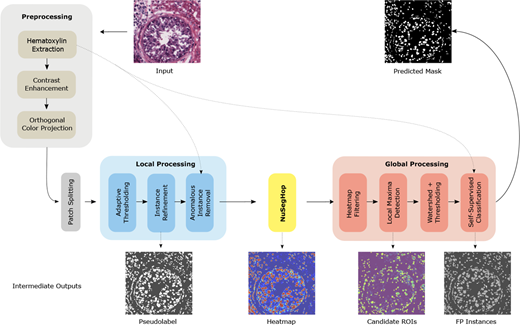
Although the existing DL-based methods usually comprise one model that is trained in an end-to-end manner using backpropagation, LG-NuSegHop has distinct modules, and each of those has a discrete task within the pipeline. This approach decouples from the DL paradigm, and one of its key benefits is the transparency of every step, because every module has a specific task and role within the overall pipeline. The proposed pipeline comprises three distinct modules that operate successively. In Section 3.1, we describe the image preprocessing steps, meant to enhance the input image toward the subsequent operations. In Section3.2, the local pixel-wise operations are described to predict a pseudolabel for NuSegHop, where its architecture and process is detailed in Section 3.3. The global processing modules are presented in 3.4. An overview of the entire proposed LG-NuSegHop pipeline is illustrated in Figure 1.

The preprocessing modules aim at preparing the input image tile for the subsequent local processing module which is mainly based on thresholding. Thus, the key goals are: (1) highlight the nuclei over the background and (2) convert the color image into grayscale.

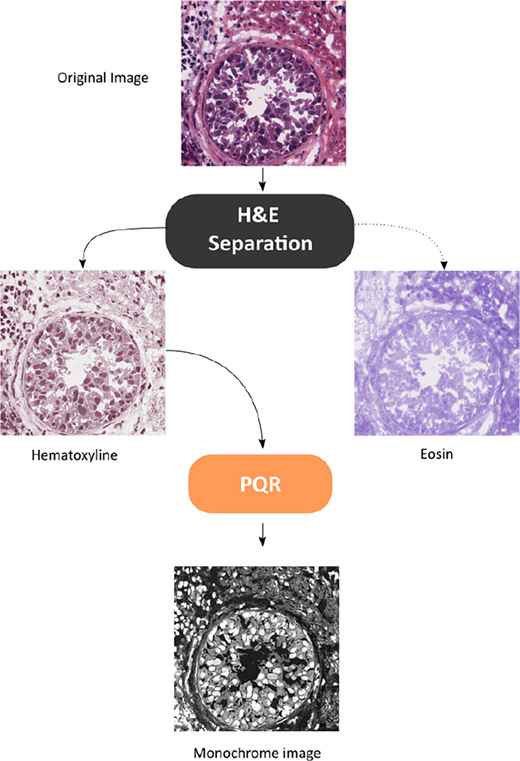
Prior to thresholding, the goal is to make nuclei more distinct over the background tissue. From the theory of the H and E staining process, hematoxylin principally colors the nuclei cells to a darker color (e.g. blue or dark-purple), while eosin mainly stains the cytoplasm and other structures in the background area. There are several methods in literature for carrying out this color conversion. We choose the work of Salvi et al. (2020). It is an singular value decomposition (SVD)-geodesic based method for stain separation, after converting the input image from RGB to the optical density space, where SVD can be more effective. Another benefit from stain separation, it helps mitigating the large stain variability across different images which is one of the challenges in this task.

After separating the stain colors using the orthogonal spaces from SVD, we project all pixels on the Hematoxylin’s subspace – eigenvector from SVD corresponding to nuclei – to create image H. To further enhance this separation and make also nuclei boundary more distinct – especially for images that suffer from blurry artifacts due to the staining or acquisition process – we apply histogram equalization.

The last preprocessing step to prepare the input tile for the thresholding operation is convert it to grayscale. Although other color spaces (e.g. LAB) could be an option, in our earlier work (Magoulianitis et al., 2022a) we have shown a more optimal way to convert the image into grayscale. Transformation across different colorspaces use certain formula to map pixel values from one domain to the other. PQR, named after the three channels of principal component analysis, is a data-driven way for color conversion, adapted to the input content. It is based on SVD to calculate the color subspace direction that maximizes the data variance. One advantage is the better energy compaction in one channel, comparing to a fixed colorspace conversion. Moreover, finding the color conversion that maximizes the variance is particularly important for the subsequent thresholding operation, because we assume that along the direction of that subspace, the separation between nuclei and background is maximized. Therefore, after SVD, we linearly project patches Hp from the H image on its first principal component P (p-value) to convert from color to grayscale. Because, different areas of the tile may have different statistics, we perform PQR independently after the image is split in local patches which are subject to thresholding. An illustrative example of PQR is shown in Figure 2. The color conversion formulae are as follows:

(1)
(2)

The main purpose of this module is to create a pseudolabel for training NuSegHop. This module uses simple, yet effective and intuitive image processing techniques at a local level. It uses prior knowledge of the problem and self-supervision locally, to filter out error predictions from the unsupervised local processing. To this end, certain assumptions are made, to overcome the lack of supervision:

  1. The bi-modal distribution according to which at a local area histogram there are two peaks, where the lower intensity corresponds to nucleus and the brighter to background. Preprocessing is meant to accentuate this assumption.

  2. Local similarity where adjacent nuclei tend to have less color or texture variations.

  3. Larger low intensity components are less likely to be false positives than the smaller instances.

3.2.1 Adaptive thresholding.

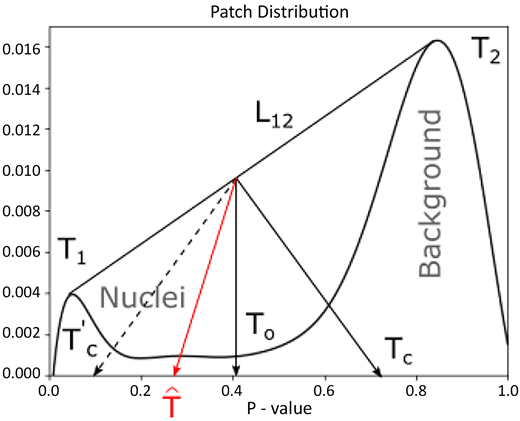
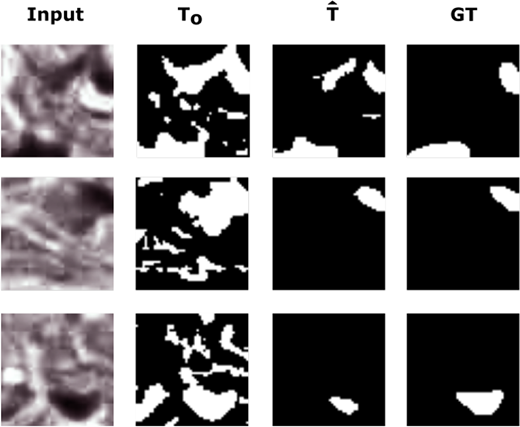
The thresholding method we propose is adaptive in two ways: (1) scale-wise and (2) intensity-wise. The input image is split into patches of size P50×50 and the process starts out with estimating the local distribution. If the bi-modal criteria are not met, the process tries also patches of 25×25 and 100×100. This is to adapt on different nuclei sizes or magnification levels. On the other hand, the threshold at each local patch is automatically adjusted based on the local area statistics. One choice for threshold calculation is to simply pick the intermediate value between the two peaks. Yet, we opt for a more adaptive way to calculate the optimal threshold (Magoulianitis et al., 2022b), thus reducing the under or over segmentation effects and eventually create a less noisy pseudolabel for self-supervision. Given the histogram and the two main peaks T1 and T2 under the bi-modal assumption, we define as L12 the line crosses through T1, T2, the intermediate point To where the threshold correction is about To=T1+T22. Also, Tc is defined as the intercept point of the intensity value axis of the histogram and the perpendicular line of L12, passing from To (see Figure 3). By using this heuristic and simple method to correct the intermediate p-value from (P)QR pre-processing, the local thresholding is more resilient to false positive and negative pixels. More details can be found in (Magoulianitis et al., 2022b). A λ hyperparameter is used to control the amount of correction about To. The adjusted threshold T^ formula is calculated using equation (3):

(3)

3.2.2 Morphological instance refinement.

Although adaptive thresholding works well in areas with relatively low variation, there are patches where the color variance is higher, thereby causing over or under segmentation effects. Morphological processing has been widely used in literature for processing binarized images. To refine the thresholding operation, we apply a set of morphological operations, such as hole filling, small instance removal and nuclei splitting. Priors about the nuclei size and shape are incorporated to apply simple morphological processing and filter out noisy instances. For nuclei splitting, the convex hull algorithm is used to detect highly deep curvatures that are not indicative of nuclei shape. This step is significant because subsequent operations operate on a per-instance base.

3.2.3 Locally anomalous instance removal.

To further filter out larger instances that are possible to be false positives, we carry out a simple local comparison among the detected instances. For this operation we need a larger patch, to include more nuclei instances and make the comparison effective. Hence. for this submodule a 200×200 patch is used. In each large patch, the first criterion for query instances q is the size. That is, if an instance has a small to medium size, it will be compared against the rest larger instances r that provide reference, according to assumption 3 (see Section 3.2). We create a reference representation by forming the ensemble from the nonquery instances. This can be viewed as a first step of introducing self-supervision locally in our pipeline, coupled with priors from the task. Intuitively, abnormally looking instances at a certain feature space can be regarded as anomalies and in turn eliminated. We define, Q={q1,q2,,qN} the instances being tested and R={r1,r2,,rM} the reference instances.

Regarding the feature representation, we use the HSI colorspace from the H image, along with the channel-wise contrast value. For similarity comparison, a Gaussian kernel is used to measure the distance between each query instance xj and the ensemble reference xR [see equation (4)], and determine the anomaly instances that are subject to removal obtaining a similarity score S [see equation (5)]. Instances q that have a lower similarity with their local reference class R from a predefined threshold Ts are removed from the foreground:

(4)
(5)

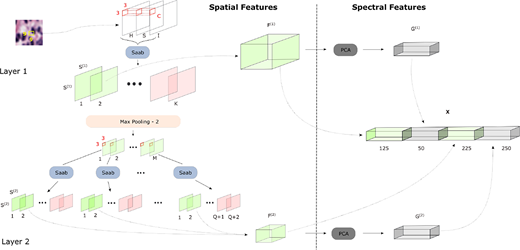
After the local processing module operations, we have obtained an initial segmentation output using no labels or training data. This output can be used as a pseudolabel to a classifier. Aiming at obtaining a probability heatmap for nuclei segmentation, we propose a novel and unsupervised feature extraction method, named NuSegHop, to learn the local texture of nuclei for pixel-wise classification. Other methods in the past (Zheng et al., 2018) have used hand-crafted features or pure color-based methods which lack robustness. A data-driven and multiscale feature extraction is proposed in this paper for pixel-wise nuclei segmentation using the GL paradigm (Kuo et al., 2019). This method has as a key advantage the low complexity and small model size, which is essential for fast inference. Moreover, the GL-based feature extraction module is linear and thereby more transparent and interpretable (Yang et al., 2021). This is another major distinction from the DL models that use backprogagation for learning feature representations. NuSegHop learns features in a feed-forward manner and does not require large data sets to obtain robust feature representations. Therefore, GL-based methods have certain advantages in specific tasks and this is why we opt for such a feature extraction method. A detailed architecture of NuSegHop is illustrated in Figure 4.

For NuSegHop, the H image is converted into the HSI colorspace before feature extraction. Originally, a window area A of size S(1)×S(1) is considered to characterize the area about a pixel. For this problem, we choose S(1)=9, because too small windows may not be able to learn the local texture, while larger ones may induce more noise into feature learning. NuSegHop learns the texture within the window area in two scales S1 and S2, to give multiscale properties in the feature space. The core operation in NuSegHop for texture learning is the Saab transform (Kuo et al., 2019), which is based on the PCA, applied in two ways: (1) spatial and (2) spectral. The full feature extraction diagram of NuSegHop is shown in Figure 4.

3.3.1 Feature learning – spatial Saab.

To learn the texture across different local areas within a window, a neighborhood construction with filters of spatial size of f(1)×f(1) is applied with stride 1 and equal padding. Because the input image has three color channels, each local neighborhood defines a cuboid C(1) with size K(1)=f(1)×f(1)×3 which contains the local HSI color information. As a consequence, K(1) is the maximum number of extracted subspaces from the Saab transform in layer 1. L(1)=S(1)×S(1) such cuboids can be extracted from a window at layer-1 using padding on A. By sampling across windows centered on the pixels of the original image, one can create a tensor T(1) for training with size N×L(1)×K(1), where N the number of sampled pixels from the input image to training NuSegHop. In turn, T(1) can be used for training layer-1 and calculate the subspaces [equation (6)] used for feature extraction. After SVD matrix decomposition, the rows of V are the eigenvectors correspond to the orthogonal subspaces of the signal [see equation (7)]:

(6)
(7)

In training, Saab transform is applied on C(1) to extract K(1) orthogonal subspaces (i.e. principal components). Moreover, because many principal components may carry no significant energy – as it is dictated from their corresponding eigenvalues – they can be discarded to remove unnecessary complexity and noise. That is, the first M principal components are retained, with M<K(1).

We define the weight matrix W(1)RM×K(1) which contains all the information to decomposing the cuboids into their spectral representations by projecting onto the extracted principal components. After training, W incudes the weights for feature extraction. For instance, to perform spatial feature extraction in layer 1, one needs to multiply L(1) cuboids extracted within A window, and project them along the M principal components. To formulate this operation, we construct matrix C with size L(1)×K(1), where its rows contain the cuboids. By multiplying them, we calculate matrix F of size L(1)×M which includes all the spatial features of layer-1 [see equation (8)]. Spectral maps F(1) in layer 1 are obtained from the matrix F, by reshaping it back to size S(1)×S(1)×M. We view each principal component as a different spectral local representation of A:

(8)

We also concatenate as additional feature (one more column in F) the mean of each local cuboid in both layers [equation (9)], because apart from the texture, the local color is also important to differentiate nuclei from background. If we are to draw a parallel with circuit theory, the DC component is the mean color and AC are the textures derived from the Saab transform. Thus, F is now of size L(1)×(M+1):

(9)

In layer-2, feature map F(1) is fed as input after a max-pooling layer. The spatial feature extraction process in layer-2 is similar to layer-1, with one difference, the Saab transform is applied independently on each of the M+1 feature maps of layer-1 (Chen et al., 2020). Therefore, after neighborhood construction each cuboid C(2) has a shape of K(2)=f(2)×f(2)×1. Also, the spatial size of L(2)=S(2)×S(2)=(S(1)/2)×(S(1)/2) after max-pooling. The filter sizes and output shapes of each layer are show in in Table 1.

Independent Saab transforms as many as M+1 are applied on tensors with size of N×L(2)×K(2). After channel-wise Saab transform in layer-2, each spectral map originally has a size of S(2)×S(2)×(M+1)×K(2), after concatenating all the feature maps from the channel-wise Saab transforms. Energy-based spectral truncation is also applied in layer-2. Supposing that Q principal components are kept from each channel-wise Saab transform (Q<C(2)), then the final layer-2 spectral maps will have a shape of S(2)×S(2)×(M+1)×(Q+1), adding also the DC channels in the same way as in layer 1. The energy threshold for both layers is set at Te=1e03.

3.3.2 Feature learning – spectral Saab.

Spatial-wise Saab provides a spectral analysis of A across all its spatial regions at the scales of S(1) and S(2)A. Therefore, each feature has a spatial correspondence. Yet, it is required to extract features that have a global reference to A as well. Those features are unassociated from the spatial domain and meant to capture different patterns within A area, such as boundary transitions from nuclei to background. To this end, on each spectral map F(1) and F(2) from layers 1 and 2, we apply a PCA using the spectral maps’ spatial components as features. By doing so, the transformed signal will have no spatial correspondence anymore. This is performed independently for every M+1 and (M+1)×(Q+1) spectral maps for layers 1 and 2, respectively. The spectral features Gs(l) from each layer is simply the union of all PCA transformed spatial features Fs(1). [see equations (10) and (11)]. The same Te is used to filter out the principal components and reduce the dimensionality.

(10)
(11)

The last step in NuSegHop is to concatenate all the spatial and spectral features from both layers to form the final feature X that characterizes A. After concatenation the top 100 discriminant features are selected (Yang et al., 2022). This provides a rich spatial-spectral feature representation about the color and texture of the local neighborhood under A. Besides, in the Saab feature space, the spectral dimensions are uncorrelated because the principal components are orthogonal by definition.

NuSegHop enables for fast pixel-wise predictions, requiring no supervision for its feature extraction part. Having extracted the features on each W, one can train a classifier using the pseudolabels from the local processing module. We train an Xtreme Gradient Boosting (XGB) classifier and use its probability predictions to generate a heatmap P^. Each pixel contains the probability of belonging to the foreground.

In the LG-NuSegHop pipeline each module has a clear scope for improving certain aspects of the nuclei segmentation task. Therefore, each module’s purpose and output are transparent. The linearity property in NuSegHop features enables the visualization of the local patterns that weigh in classifying a pixel. Concretely, during inference, one can trace back the more “informative” NuSegHop feature dimensions of the classifier. In turn, those features can be mapped back to the input layer – using the inverse Saab transform –, to elucidate the texture and color patterns they correspond to. In other words, NuSegHop enables the pathologist to review the visual elements that classify a certain region as nuclei or background. This seamless decision interpretation provides great advantages in clinical applications because pathologists can understand the decision-making process of the tool, thereby making it more trustworthy for clinical deployment.

This module aims at integrating the locally made decisions, based on color and texture, and perform a global post-processing. Most operations from the local processing group are pixel-wise and carried out in local patches of the original image to reduce variability, whereas global processing has the entire information about the image.

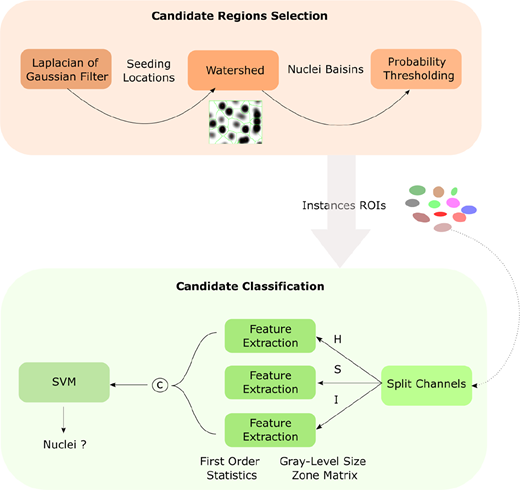
As mentioned, locally-based decisions may miss faintly stained nuclei or misclassify background areas as nuclei. The goal of moving from local to global decisions is to decrease the false negative (FN) rate by including more instances as candidates, based on the probability areas from the local decisions. Because, it is inevitable for this process to give rise to false positives (FP), self-supervision is also used at the end of the global processing modules to help discern potentially FP instances. A diagram of the global processing pipeline is shown in Figure 5.

3.4.1 Heatmap filtering.

Out of our observations on the obtained probability heatmap P, most of the nuclei are predicted with high confidence from NuSegHop module. This refers to solid stained instances that can be easily recognized from their color and texture. As we want to decrease the complexity of the global processing unit, large instances are retained and we consider only the less confident ones for the subsequent module (i.e. local maxima detection). This helps both the complexity and efficiency. To do so, the heatmap and the predicted mask from NuSegHop are considered to calculate the per instance confidence, by taking the average from all pixels belong to the instance. Highly confident instances with average probability more than 0.95 are removed from the local maxima detection submodule. After this submodule we obtain the filtered heatmap P.

3.4.2 Local maxima detection.

This submodule aims mainly at increasing the recall ratio of nuclei, on the remaining areas after instance filtering, where the NuSegHop unit is not confident. Texture and color variations or faintly stained nuclei from the local processing module result in scattered high probability areas that during binarization become isolated small instances. The goal is to detect those areas and create candidate ROIs as foreground. Given the filtered heatmap P this task boils down to a local maxima detection (LMD). We apply a Laplacian of Gaussian filter (LoG) to detect “blob-like” regions which corresponds to potential nuclei instances. The Gaussian filter is meant to smooth and unify the pixel-wise heatmap estimation, thus to mitigating the color and texture variance.

3.4.3 Watershed post-processing.

For the highly confident instances, their boundary is typically distinct and can be determined from the local processing modules and in turn from the heatmap. However, for the low confidence instances that are hard to be accurately classified based on the heatmap. We can detect the position of the nuclei but it is hard to estimate accurately their boundaries, because those areas are outliers when training the classifier. As long as the rough locations of candidates are obtained from the previous module, we their centroids to seed the watershed algorithm, and find the adjacent nuclei boundary lines. This helps areas with multiple less confident nuclei located therein, where their boundaries estimation is more challenging. As a last step, we binarize the filtered heatmap, appending back also the confident instances using a probability threshold to create instances for the subsequent classification and false positive reduction. As it is desired to include many candidates, so to increase the recall rate, we choose a lower probability threshold Tp=0.35. This typically increases the false positive rate, but the subsequent module is devised to mitigate that.

3.4.4 Self-supervised instance classification.

The final step of the proposed pipeline is a self-supervised instance-based classification to detect nuclei that their representation falls out of the normal nuclei and their appearance is closer to background.

This ROI instance based classification is similar to FLAIR module but with two main differences: (1) it is performed in a global level and (2) there are no size-based criteria to select instances.

The hypothesis here is the following: so long as the majority of instances is correctly classified, the minority of instances that are false positives do not affect the ensemble learning, as they are statistically less significant. Moreover, if their representation is closer to the background, rather than the foreground then they are simply classified as false positives and are removed from the final segmentation output.

For feature extraction and classification, we use the H image and convert it to the HSI colorspace (as in NuSegHop). We apply feature extraction on each channel separately and concatenate them before the classifier’s input. For features we opt for the first order statistics to learn the color characteristics, as well as the gray-level zone matrix which includes several features that capture the rough texture of the nuclei (Lofstedt et al., 2019). Here, we choose an SVM classifier with a radial basis kernel, to predict for each instance the probability of being a true positive.

This section includes details of the experiments conducted in this work to validate the efficiency of our work, as well as potential areas of improvement. The data sets used for experiments and comparisons are briefly introduced in subsection 4.1, while the metrics for the quantitative analysis in 4.2. In addition, our method is compared against other state-of-the-art methods, from unsupervised to weakly and fully supervised methods in 4.3. Furthermore, an ablation study is carried out in 4.4 to evaluate how different modules affect the performance, accompanied with visualization examples (4.4.1). In subsection 4.5 we discuss on the findings from the comparisons with the state-of-the-art.

Three publicly available data sets are chosen to compare our proposed methodology.

MoNuSeg (Kumar et al., 2019) The multiorgan nuclei segmentation (MoNuSeg) data set includes 30 training image tiles of size 1,000 ×1,000 and magnification level 40×, comprising 21,623 nuclei. Also, 14 testing imag tiles are available for benhmarking. The extracted tiles come from histological slides of breast, liver, kidney, prostate, bladder, colon and stomach collected from The Cancer Genome Atlas(TCGA) (Tomczak et al., 2015). Also, the samples collected come from different hospitals and patients. Therefore, it is a fairly diverse data set across different aspects that challenges the generalization ability of the segmentation model. The Aperio ImageScope was used for digitizing the slides.

CryoNuSeg (Mahbod et al., 2021) This is the first H and E multiorgan data set from frozen samples. Slides digitization from frozen samples involves a different process and therefore the nuclei appearance is different. This technique pertains intra-operative surgical sessions and its major benefit is that it can be performed rapidly. Yet, the requirement for a quick slide preparation, staining and digitization comes at the expense of the image quality. The data set provides 30 digitized images of size 512×512, acquired at a 40× magnification level. The slides come from 10 different organs (larynx gland, adrenal, lymph nodes, pancreas, skin, pleura, mediastinum, thyroid gland, thymus, testes) and there exist 7,596 annotated nuclei.

CoNSeP (Graham et al., 2021) This data set includes 41 image tiles from 16 slides of patients with colorectal adenocarcinoma. 27 tiles are used for training and 14 for testing. The extracted tiles are of size 1,000 × 1,000. The Omnyx VL120 scanner was used for the slides digitization at a 40× magnification level. Overall, 24,319 nuclei are annotated.

For performance evaluation, we use three different metrics, that have been commonly used in the literature. It is worth noting that nuclei segmentation is an instance-level segmentation problem. That is, a nucleus instance needs to be detected and then segmented. F1 score is the harmonic mean of the precision and recall. The F1 score regards nuclei segmentation as an instance detection problem, without taking into account the segmentation aspect. To complete our metrics, we also include the Aggregated Jaccard Index (AJI) metric (Kumar et al., 2017) and the Panoptic Quality (PQ) (Kirillov et al., 2019). These two metrics are more suitable for instance-level segmentation problems as they take into account both aspects. In particular, PQ calculates the detection quality (DQ), as well as the segmentation quality as a similarity measure with the ground truth. Dice similarity coefficient is also included in our comparisons to measure the segmentation performance.

4.3.1 Experimental setup.

To have a thorough understanding on the advantages and weaknesses of our work, we compare it against several state-of-the-art works with different levels of supervision. At first, we compare our method with other self-supervised methods on the MoNuSeg data set, which use no labels from the target data sets. Another category is the weakly supervised methods that either use less training samples from the annotation masks or point annotations. Moreover, we include in our analysis a few popular fully supervised methods, so as to provide a thorough comparison of our work.

Before we delve into the comparisons, one aspect we would like to stress is that our method does not use any training data for parameters learning. Yet, because there are several hyperparameters (see Table 2) need adjustment, we use 6 out of the 30 training images randomly from the MoNuSeg data set to finetune the LG-NuSegHop. This can be viewed as the validation set of our experiments. Hence, the hyperparameters are empirically finetuned using this validation set. At first, we adjust the local processing module, using the AJI and F1 score calculated from the intermediate (i.e. pseudolabel) output. Then, NuSegHop and global processing modules are adjusted together. For all the modules we tune the hyperparameters to maximize the AJI metric, whereas in the last module of the global processing set (self-supervised instance classification) we try to maximize the F1 score, because it is an ROI-wise classification task.

After the model is fixed, we test it out on the three testing data sets. This aims at testing how well our model generalizes to data with inherent discrepancies. However, we individually finetune LG-NuSegHop hyperparameters on each data sets using their a subset of their training data, to also test the performance when LG-NuSegHop is adapted to a certain domain.

4.3.2 Performance benchmarking.

At first glance, LG-NuSegHop has a competitive standing in comparison with other works, including also the fully supervised ones (Tables 3, 4 and 5). In the MoNuSeg data set, it outperforms by large margins the self and weakly supervised works in terms of all the reported metrics, with a 0.651 AJI. It also has an impressive performance standing among the fully supervised works, including sophisticated models for nuclei segmentation, such as HoVer-Net (Graham et al., 2019) and CDNet (He et al., 2021) (see Table 3). However, other models such as NucleiSegNet (Lal et al., 2021) and CIA-Net (Zhou et al., 2019) achieve higher performance in AJI, yet LG-NuSegHop achieves a competitive standing in detecting nuclei based on the F1 score (0.892 vs 0.901). Comparing our method with GUSL model from the GL methodology, it achieves an AJI score of 0.673. The full supervision of GUSL helps to learn the more challenging distinctions between nuclei and background, which are hard to capture by a self-supervised method. Yet, in terms of F1 score, the detection performance is similar. Also, when fine-tuned using all the MoNuSeg training images, the performance increases slightly to the 0.658 AJI score and 0.892 F1 score. In terms of the Dice score our method also achieves the best performance among the weakly and self supervised methods by significant difference from the second leading performance (0.791 vs 0.774).

In the CryoNuSeg, our method surpasses all the weakly supervised methods by large margins, achieving an AJI of 0.545 (Table 4). Comparing with the Dice coefficient and PQ, only the recently proposed DAWN (Zhang et al., 2024) has a better performance. Besides, from the fully supervised category LG-NuSegHop achieves a higher AJI score from the state-of-the-art. Remarkably, even when it is not finetuned on the CryoNuSeg data (i.e. baseline model), LG-NuSegHop achieves a competitive performance in this data set, where the acquisition process is considerably different than the standard H and E staining process. When finetuned on the same domain, the AJI performance increases further to 0.567. Overall, our method achieves a high AJI and PQ performance comparing to the other supervised methods. Full supervision in this data set seems to boost more the segmentation performance, as one can see from the higher Dice score, comparing to the weakly or unsupervised methods.

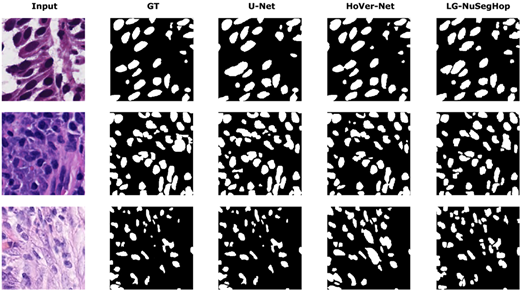
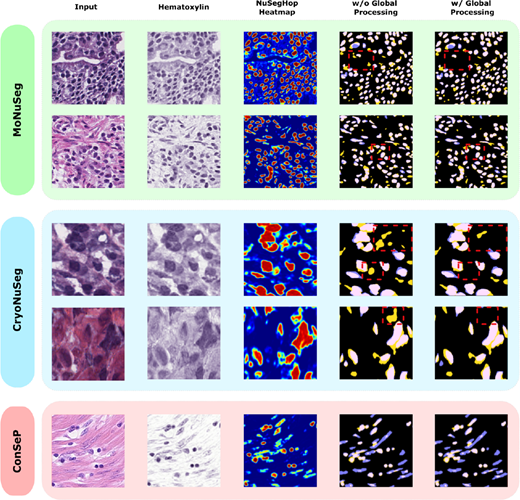
In the third data set under comparison, CoNSeP, all methods achieve a lower performance –compared to the other data sets –, because it has a large intra-class variance, where nuclei have quite different textures. Hence, this data set is challenging for most methods. LG-NuSeg achieves an AJI of 0.422 without any finetuning (Table 5). Comparing to the weakly supervised methods it has a competitive performance across all metrics. Only the point annotations (Tian et al., 2020) and DAWN (Zhang et al., 2024) methods perform better. Compared to the fully supervised works, the performance gap is larger. Yet, if we finetune the hyperparameters on the training images, the AJI score increases significantly to 0.461, surpassing most of the weakly supervised works and narrowing the gap with the fully supervised ones, such as U-Net. Considering all the metrics, in this data set fully supervised methods achieve a higher performance in both segmentation and detection metrics. Therefore, one can infer that when the nuclei appearance variance is higher, supervision is crucial for both detecting and delineating the nuclei cells. This can be also observed in Figure 6, where our method achieves a good segmentation result in MoNuSeg and CryoNuSeg, while in CoNSeP, for certain nuclei types it is more challenging to detect and segment them accurately without supervision or any domain adaptation.

As LG-NuSegHop is a pipeline consisting multiple processing steps and modules, we conduct an ablation study with different modules to demonstrate their efficacy and importance within the overall pipeline. Table 6 shows a few comparisons between the PQR and LAB color conversion as a pre-processing step, as well as the contribution of the local processing modules. Table 7 at first compares a handcrafted feature extraction approach against NuSegHop. In turn, we progressively add the global processing modules to test the performance improvement.

First of all, one can observe that our PQR pre-processing conversion helps both the detection and segmentation metrics. Also, the adaptive thresholding improves significantly the AJI over the non-adaptive one. Morphological post-processing is important to remove noisy instances and split nuclei and it is reflected from the large improvement of the F1 score (see Table 6). LAIR module also provides a small improvement in F1 score, by filtering some false positives in images, wherever it is more likely to have a high false positive rate. On the other hand, by replacing a handcrafted feature extraction in lieu of NuSegHop, all metrics drop significantly. Moreover, local maxima detection on NuSegHop’s heatmap improves mainly the detection performance by recalling areas that indicate nuclei existence. It is also evident that both watershed and self-supervised instance classification help to improve mainly the detection aspect of the task, by reducing the false positive rate and delineate the nuclei more precisely (see Table 7).

4.4.1 Qualitative analysis.

In the last part of our analysis, two visualization comparisons are provided. In Figure 7, one can observe how the adaptive thresholding can help in segmenting local patches, where the bi-modal assumption is not very pronounced. The binarization performance is compared over a more conservative thresholding by choosing the intermediate point. It is demonstrated that the adjustment of the threshold about the intermediate point between the histogram peaks, helps to reduce the false positive areas upfront in LG-NuSegHop and thereby provides a less noisy pseudolabel to NuSegHop. Moreover, in Figure 8, we illustrate a few examples across the three data sets and compare the instance self-supervised classification module operation in removing false positive instances as the last post-processing step of LG-NuSegHop. In MoNuSeg, our method achieves better results and in turn we can see that the false positive and negative rate is lower. CryoNuSeg yields a higher rate of false positives, which is mitigated from the global processing module. The ConSeP image has a higher false negative rate and hence the instance classification module does not have much effect.

From the quantitative and qualitative analysis, it is evident the importance and role of each individual module. In LG-NuSegHop pipeline other modules (e.g. instance classification) are meant to increase the detection accuracy and other the segmentation (i.e. NuSegHop). Overall, our proposed methodology achieves a very competitive performance among other self-supervised or weakly and fully supervised methods. It is worth noting that even without any finetuning on the target data sets, LG-NuSegHop outperforms most of the weakly supervised methods and can be compared to the state-of-the-art fully supervised ones. This seamless generalization ability provides a huge advantage of our method, because there is no need to form a training data set or have a pathologists to annotate data. It can be deployed in a plug-n-play manner for nuclei segmentation and achieve a competitive performance in certain data sets (e.g. CryoNuSeg) or to provide pseudolabel to another self-supervised model.

As already mentioned, LG-NuSegHop is a pipeline that relies on human’s prior knowledge in solving the problem and requires certain assumptions to hold. From experimenting with the three diverse data sets, we can observe that our method shows a relatively lower performance on the CoNSeP data set. This can be attributed to the fact that the local similarity assumption is very weak in this data set. The nuclei instances have a large distance in shape and color, thus challenging for the local processing module to predict a less noisy pseudolabel for NuSegHop. In turn, it is also hard for the self-supervision to improve significantly over the pseudolabel prediction, resulting in a higher false negative rate.

From the experiments, fully supervised methods on the CoNSep data set have a higher gap in performance both from the weakly supervised methods and the LG-NuSegHop one. Our method fits better into MoNuSeg and CryoNuSeg assumptions where the intra-class distance is relatively smaller and can yield a competitive performance even without any finetuning. One higher level conclusion that can be drawn from this comparison is that the nuclei segmentation problem on certain histology images can be solved solely by relying on clinical and biology prior knowledge using no or little supervision (Tables 3 and 4). Yet, when certain assumptions are not well met, full supervision is needed to learn the nuclei variability and achieve a higher performance (see Table 5). Another observation from the results and the comparison with different metrics is that our method is more effective on the detection aspect of the problem over the segmentation one, especially on the CryoNuSeg. The main reason is the appearance of the nuclei – faintly stained –, sourcing from the staining process. The lack of explicit full supervision makes harder for our method to accurately learn the boundaries distinctions for this type of staining. Thus, our method achieves a better Dice score, compared to the weakly supervised methods, but HoVer-Net and CDNet achieve better results due to their fully supervised training, which is crucial for this data set in the accurate delineation of nuclei.

LG-NuSegHop can offer a high nuclei segmentation performance and generalize well with no specific domain adaptation. For example, although our method does not require any training from MoNuSeg, we use 6 images for hyperparameter finetuning. So, LG-NuSegHop is inherently adapted to this domain to a certain extend. Two recent works that have carried out domain adaptation from MoNuSeg (train) to CryoNuSeg (test), have achieved an AJI of 0.452 (Li et al., 2023) and 0.484 (Zhang et al., 2024). For the same domain shift, LG-NuSegHop achieves an AJI of 0.545. Therefore, one can infer that supervision may not always be in favor of the cross domain generalization. We contend that for this task, biology priors and human insights play a pivotal role to mitigate the domain adaptation requirement.

From a complexity standpoint, LG-NuSegHop uses simple image processing operations pre and post the NuSegHop module with very low complexity. NuSegHop has a total number of parameters equal to 40K for feature extraction. Notably, the local processing pipeline and NuSegHop can be implemented in parallel to achieve a very short inference time. On the other hand, DL state-of-the-art solutions require several million of parameters and special equipment (e.g. large GPUs) for model deployment. For instance, as a reference point, HoVer-Net requires about 11.04s to predict an image of size 1,000 × 1,000 using a GPU with 12GB memory (Graham et al., 2019). On the same comparison, LG-NuSegHop requires about 9.38s on average to predict a histology image of the same size, adopting a multi-thread implementation and deployed on a Intel Xeon CPU E5-2620 v3 at 2.40GHz.

As a final remark, it is also important to emphasize once more that within our pipeline every module is intuitive and transparent, including the feature extraction process in NuSegHop module. We underline this advantage as it is crucial for medical image solutions to be explainable to physicians, so that they can be effectively used in real clinical settings.

This work proposes the LG-NuSegHop pipeline for unsupervised nuclei segmentation from histology images. A novel feature extraction model named NuSegHop is introduced to learn the local texture. Regarding NuSegHop, several custom-made image processing modules are proposed to preprocess the input image, provide a pseudo label, and post-process the predicted heatmap to increase the nuclei detection rate. Key advantages of our method are the generalization ability to unseen domains with inherent discrepancies and the small number of parameters. Every proposed module is intuitive and transparent, based on specific biological priors of the problem. In future work, we will investigate ways to focus NuSegHop feature extraction on the nuclei boundaries, aiming to improve its segmentation performance. Moreover, another research direction is the incorporation of supervision into our current pipeline, in the challenging areas where the unsupervised approach has certain limitations, thus benefiting from the expert’s knowledge.
Al-Kofahi
,
Y.
,
Lassoued
,
W.
,
Lee
,
W.
and
Roysam
,
B.
(
2009
), “
Improved automatic detection and segmentation of cell nuclei in histopathology images
”,
IEEE Transactions on Bio-Medical Engineering
, Vol.
57
No.
4
, pp.
841
-
852
.
Beevi
,
S.
,
Nair
,
M.S.
and
Bindu
,
G.
(
2016
), “
Automatic segmentation of cell nuclei using Krill Herd optimization based multi-thresholding and localized active contour model
”,
Biocybernetics and Biomedical Engineering
, Vol.
36
No.
4
, pp.
584
-
596
.
Cai
,
H.
,
Yang
,
Z.
,
Cao
,
X.
,
Xia
,
W.
and
Xu
,
X.
(
2014
), “
A new iterative triclass thresholding technique in image segmentation
”,
IEEE Transactions on Image Processing: a Publication of the IEEE Signal Processing Society
, Vol.
23
No.
3
, pp.
1038
-
1046
.
Cao
,
H.
,
Wang
,
Y.
,
Chen
,
J.
,
Jiang
,
D.
,
Zhang
,
X.
,
Tian
,
Q.
and
Wang
,
M.
(
2022
), “
Swin-Unet: Unet-like pure transformer for medical image segmentation
”, in
European Conference on Computer Vision
,
Springer
, pp.
205
-
218
.
Chan
,
T.H.
,
Cendra
,
F.J.
,
Ma
,
L.
,
Yin
,
G.
and
Yu
,
L.
(
2023
), “
Histopathology whole slide image analysis with heterogeneous graph representation learning
”, in
Proceedings of the IEEE/CVF Conference on Computer Vision and Pattern Recognition
, pp.
15661
-
15670
.
Chen
,
Y.
,
Rouhsedaghat
,
M.
,
You
,
S.
,
Rao
,
R.
and
Kuo
,
C.-C.J.
(
2020
), “
Pixelhop++: a small successive-subspace-learning-based (SSL-based) model for image classification
”, in
2020 IEEE International Conference on Image Processing (ICIP)
,
IEEE
, pp.
3294
-
3298
.
Elmore
,
J.G.
,
Nelson
,
H.D.
,
Pepe
,
M.S.
,
Longton
,
G.M.
,
Tosteson
,
A.N.
,
Geller
,
B.
,
Onega
,
T.
,
Carney
,
P.A.
,
Jackson
,
S.L.
,
Allison
,
K.H.
and
Weaver
,
D.L.
(
2016
), “
Variability in pathologists’ interpretations of individual breast biopsy slides: a population perspective
”,
Annals of Internal Medicine
, Vol.
164
No.
10
, pp.
649
-
655
.
Faridi
,
P.
,
Danyali
,
H.
,
Helfroush
,
M.S.
and
Jahromi
,
M.A.
(
2016
), “
An automatic system for cell nuclei pleomorphism segmentation in histopathological images of breast cancer
”, in
2016 IEEE Signal Processing in Medicine and Biology Symposium (SPMB)
,
IEEE
, pp.
1
-
5
.
Graham
,
S.
,
Jahanifar
,
M.
,
Azam
,
A.
,
Nimir
,
M.
,
Tsang
,
Y.-W.
,
Dodd
,
K.
,
Hero
,
E.
,
Sahota
,
H.
,
Tank
,
A.
,
Benes
,
K.
, et al. (
2021
), “
Lizard: a large-scale dataset for colonic nuclear instance segmentation and classification
”, in
Proceedings of the IEEE/CVF International Conference on Computer Vision
, pp.
684
-
693
.
Graham
,
S.
,
Vu
,
Q.D.
,
Raza
,
S.E.A.
,
Azam
,
A.
,
Tsang
,
Y.W.
,
Kwak
,
J.T.
and
Rajpoot
,
N.
(
2019
), “
Hover-net: simultaneous segmentation and classification of nuclei in multi-tissue histology images
”,
Medical Image Analysis
, Vol.
58
, p.
101563
.
Gurcan
,
M.N.
,
Boucheron
,
L.E.
,
Can
,
A.
,
Madabhushi
,
A.
,
Rajpoot
,
N.M.
and
Yener
,
B.
(
2009
), “
Histopathological image analysis: a review
”,
IEEE Reviews in Biomedical Engineering
, Vol.
2
, pp.
147
-
171
.
He
,
H.
,
Wang
,
J.
,
Wei
,
P.
,
Xu
,
F.
,
Ji
,
X.
,
Liu
,
C.
and
Chen
,
J.
(
2023
), “
Toposeg: topology-aware nuclear instance segmentation
”, in
Proceedings of the IEEE/CVF International Conference on Computer Vision
, pp.
21307
-
21316
.
He
,
H.
,
Huang
,
Z.
,
Ding
,
Y.
,
Song
,
G.
,
Wang
,
L.
,
Ren
,
Q.
,
Wei
,
P.
,
Gao
,
Z.
and
Chen
,
J.
(
2021
), “
Cdnet: centripetal direction network for nuclear instance segmentation
”, in
Proceedings of the IEEE/CVF International Conference on Computer Vision
, pp.
4026
-
4035
.
Hsu
,
J.
,
Chiu
,
W.
and
Yeung
,
S.
(
2021
), “
Darcnn: domain adaptive region-based convolutional neural network for unsupervised instance segmentation in biomedical images
”, in
Proceedings of the IEEE/CVF Conference on Computer Vision and Pattern Recognition
, pp.
1003
-
1012
.
Kiran
,
I.
,
Raza
,
B.
,
Ijaz
,
A.
and
Khan
,
M.A.
(
2022
), “
DenseRes-Unet: segmentation of overlapped/clustered nuclei from multi organ histopathology images
”,
Computers in Biology and Medicine
, Vol.
143
, p.
105267
.
Kirillov
,
A.
,
He
,
K.
,
Girshick
,
R.
,
Rother
,
C.
and
Dollar
,
P.
(
2019
), “
Panoptic segmentation
”, in
Proceedings of the IEEE/CVF Conference on Computer Vision and Pattern Recognition
, pp.
9404
-
9413
.
Koyuncu
,
C.F.
,
Akhan
,
E.
,
Ersahin
,
T.
,
Cetin-Atalay
,
R.
and
Gunduz-Demir
,
C.
(
2016
), “
Iterative h-minima-based marker-controlled watershed for cell nucleus segmentation
”,
Cytometry. Part A: The Journal of the International Society for Analytical Cytology
, Vol.
89
No.
4
, pp.
338
-
349
.
Kumar
,
N.
,
Verma
,
R.
,
Anand
,
D.
,
Zhou
,
Y.
,
Onder
,
O.F.
,
Tsougenis
,
E.
,
Chen
,
H.
,
Heng
,
P.-A.
,
Li
,
J.
,
Hu
,
Z.
, et al. (
2019
), “
A multi-organ nucleus segmentation challenge
”,
IEEE Transactions on Medical Imaging
, Vol.
39
No.
5
, pp.
1380
-
1391
.
Kumar
,
N.
,
Verma
,
R.
,
Sharma
,
S.
,
Bhargava
,
S.
,
Vahadane
,
A.
and
Sethi
,
A.
(
2017
), “
A data set and a technique for generalized nuclear segmentation for computational pathology
”,
IEEE Transactions on Medical Imaging
, Vol.
36
No.
7
, pp.
1550
-
1560
.
Kuo
,
C.-C.J.
and
Madni
,
A.M.
(
2022
), “
Green learning: introduction, examples and outlook
”,
Journal of Visual Communication and Image Representation
, Vol.
90
, p.
103685
.
Kuo
,
C.-C.J.
,
Zhang
,
M.
,
Li
,
S.
,
Duan
,
J.
and
Chen
,
Y.
(
2019
), “
Interpretable convolutional neural networks via feedforward design
”,
Journal of Visual Communication and Image Representation
, Vol.
60
, pp.
346
-
359
.
Lal
,
S.
,
Das
,
D.
,
Alabhya
,
K.
,
Kanfade
,
A.
,
Kumar
,
A.
and
Kini
,
J.
(
2021
), “
NucleiSegNet: robust deep learning architecture for the nuclei segmentation of liver cancer histopathology images
”,
Computers in Biology and Medicine
, Vol.
128
, p.
104075
.
Li
,
Z.
,
Li
,
C.
,
Luo
,
X.
,
Zhou
,
Y.
,
Zhu
,
J.
,
Xu
,
C.
,
Yang
,
M.
,
Wu
,
Y.
and
Chen
,
Y.
(
2023
), “
Toward source-free cross tissues histopathological cell segmentation via target-specific finetuning
”,
IEEE Transactions on Medical Imaging
, Vol.
42
No.
9
, pp.
2666
-
2677
.
Liang
,
H.
,
Cheng
,
Z.
,
Zhong
,
H.
,
Qu
,
A.
and
Chen
,
L.
(
2022
), “
A region-based convolutional network for nuclei detection and segmentation in microscopy images
”,
Biomedical Signal Processing and Control
, Vol.
71
, p.
103276
.
Lin
,
T.-Y.
,
Maire
,
M.
,
Belongie
,
S.
,
Hays
,
J.
,
Perona
,
P.
,
Ramanan
,
D.
,
Dollar
,
P.
and
Zitnick
,
C.L.
(
2014
), “
Microsoft coco: common objects in context
”, in
Computer Vision–ECCV 2014: 13th European Conference, Zurich, Switzerland, September 6-12, 2014, Proceedings, Part V 13
,
Springer
, pp.
740
-
755
.
Lin
,
Y.
,
Qu
,
Z.
,
Chen
,
H.
,
Gao
,
Z.
,
Li
,
Y.
,
Xia
,
L.
,
Ma
,
K.
,
Zheng
,
Y.
and
Cheng
,
K.-T.
(
2023
), “
Nuclei segmentation with point annotations from pathology images via self-supervised learning and co-training
”,
Medical Image Analysis
, Vol.
89
, p.
102933
.
Lin
,
Y.
,
Wang
,
Z.
,
Zhang
,
D.
,
Cheng
,
K.-T.
and
Chen
,
H.
(
2024
), “
BoNuS: boundary mining for nuclei segmentation with partial point labels
”,
IEEE Transactions on Medical Imaging
, Vol.
43
No.
6
.
Liu
,
D.
,
Zhang
,
D.
,
Song
,
Y.
,
Zhang
,
F.
,
O’Donnell
,
L.
,
Huang
,
H.
,
Chen
,
M.
and
Cai
,
W.
(
2020
), “
Unsupervised instance segmentation in microscopy images via panoptic domain adaptation and task re-weighting
”, in
Proceedings of the IEEE/CVF Conference on Computer Vision and Pattern Recognition
, pp.
4243
-
4252
.
Liu
,
W.
,
Zhang
,
Q.
,
Li
,
Q.
and
Wang
,
S.
(
2024
), “
Contrastive and uncertainty aware nuclei segmentation and classification
”,
Computers in Biology and Medicine
, Vol.
178
, p.
108667
.
Liu
,
X.
,
Xing
,
F.
,
Yang
,
C.
,
Kuo
,
C.-C.J.
,
Babu
,
S.
,
El Fakhri
,
G.
,
Jenkins
,
T.
and
Woo
,
J.
(
2021a
), “
Voxelhop: successive subspace learning for ALS disease classification using structural MRI
”,
IEEE Journal of Biomedical and Health Informatics
, Vol.
26
No.
3
, pp.
1128
-
1139
.
Liu
,
X.
,
Xing
,
F.
,
Gaggin
,
H.K.
,
Wang
,
W.
,
Kuo
,
C.-C.J.
,
El Fakhri
,
G.
and
Woo
,
J.
(
2021b
), “
Segmentation of cardiac structures via successive subspace learning with Saab transform from cine MRI
”, in
2021 43rd Annual International Conference of the IEEE Engineering in Medicine and Biology Society (EMBC)
,
IEEE
, pp.
3535
-
3538
.
Liu
,
X.
,
Guo
,
Z.
,
Cao
,
J.
and
Tang
,
J.
(
2021c
), “
MDC-net: a new convolutional neural network for nucleus segmentation in histopathology images with distance maps and contour information
”,
Computers in Biology and Medicine
, Vol.
135
, p.
104543
.
Lofstedt
,
T.
,
Brynolfsson
,
P.
,
Asklund
,
T.
,
Nyholm
,
T.
and
Garpebring
,
A.
(
2019
), “
Gray-level invariant haralick texture features
”,
Plos One
, Vol.
14
No.
2
, p.
e0212110
.
Lou
,
W.
,
Wan
,
X.
,
Li
,
G.
,
Lou
,
X.
,
Li
,
C.
,
Gao
,
F.
and
Li
,
H.
(
2024
), “
Structure embedded nucleus classification for histopathology images
”,
IEEE Transactions on Medical Imaging
, Vol.
43
No.
9
.
Magoulianitis
,
V.
,
Alexander
,
C.A.
and
Kuo
,
C.-C.J.
(
2023
), “
A comprehensive overview of computational nuclei segmentation methods in digital pathology
”,
arXiv preprint arXiv:2308.08112
.
Magoulianitis
,
V.
,
Yang
,
J.
,
Yang
,
Y.
,
Xue
,
J.
,
Kaneko
,
M.
,
Cacciamani
,
G.
,
Abreu
,
A.
,
Duddalwar
,
V.
,
Kuo
,
C.-C.J.
,
Gill
,
I.S.
, et al. (
2024
), “
PCa-RadHop: a transparent and lightweight feed-forward method for clinically significant prostate cancer segmentation
”,
Computerized Medical Imaging and Graphics: The Official Journal of the Computerized Medical Imaging Society
, Vol.
116
, p.
102408
.
Magoulianitis
,
V.
,
Han
,
P.
,
Yang
,
Y.
and
Kuo
,
C.-C.J.
(
2022a
), “
An unsupervised Parameter-Free nuclei segmentation method for histology images
”, in
2022 IEEE International Conference on Image Processing (ICIP)
,
IEEE
, pp.
226
-
230
.
Magoulianitis
,
V.
,
Yang
,
Y.
and
Kuo
,
C.-C.J.
(
2022b
), “
HUNIS: high-performance unsupervised nuclei instance segmentation
”, in
2022 IEEE 14th Image, Video, and Multidimensional Signal Processing Workshop (IVMSP)
,
IEEE
, pp.
1
-
5
.
Mahbod
,
A.
,
Schaefer
,
G.
,
Bancher
,
B.
,
Low
,
C.
,
Dorffner
,
G.
,
Ecker
,
R.
and
Ellinger
,
I.
(
2021
), “
CryoNuSeg: a data set for nuclei instance segmentation of cryosectioned H&E-stained histological images
”,
Computers in Biology and Medicine
, Vol.
132
, p.
104349
.
Nasir
,
E.S.
,
Parvaiz
,
A.
and
Fraz
,
M.M.
(
2023
), “
Nuclei and glands instance segmentation in histology images: a narrative review
”,
Artificial Intelligence Review
, Vol.
56
No.
8
, pp.
7909
-
7964
.
Phoulady
,
H.A.
,
Goldgof
,
D.B.
,
Hall
,
L.O.
and
Mouton
,
P.R.
(
2016
), “Nucleus segmentation in histology images with hierarchical multilevel thresholding”, in
Medical Imaging 2016: Digital Pathology
,
SPIE
, Vol.
9791
, pp.
280
-
285
.
Plass
,
M.
,
Kargl
,
M.
,
Kiehl
,
T.-R.
,
Regitnig
,
P.
,
GeiSSler
,
C.
,
Evans
,
T.
,
Zerbe
,
N.
,
Carvalho
,
R.
,
Holzinger
,
A.
and
Muller
,
H.
(
2023
), “
Explainability and causability in digital pathology
”,
The Journal of Pathology. Clinical Research
, Vol.
9
No.
4
, pp.
251
-
260
.
Qu
,
H.
,
Yi
,
J.
,
Huang
,
Q.
,
Wu
,
P.
and
Metaxas
,
D.
(
2020a
), “
Nuclei segmentation using mixed points and masks selected from uncertainty
”, in
2020 IEEE 17th International Symposium on Biomedical Imaging (ISBI)
,
IEEE
, pp.
973
-
976
.
Qu
,
H.
,
Wu
,
P.
,
Huang
,
Q.
,
Yi
,
J.
,
Riedlinger
,
G.M.
,
De
,
S.
and
Metaxas
,
D.N.
(
2019
), “
Weakly supervised deep nuclei segmentation using points annotation in histopathology images
”, in
International Conference on Medical Imaging with Deep Learning
,
PMLR
, pp.
390
-
400
.
Qu
,
H.
,
Wu
,
P.
,
Huang
,
Q.
,
Yi
,
J.
,
Yan
,
Z.
,
Li
,
K.
,
Riedlinger
,
G.M.
,
De
,
S.
,
Zhang
,
S.
and
Metaxas
,
D.N.
(
2020b
), “
Weakly supervised deep nuclei segmentation using partial points annotation in histopathology images
”,
IEEE Transactions on Medical Imaging
, Vol.
39
No.
11
, pp.
3655
-
3666
.
Roerdink
,
J.B.
and
Meijster
,
A.
(
2000
), “
The watershed transform: definitions, algorithms and parallelization strategies
”,
Fundamenta Informaticae
, Vol.
41
Nos
1-2
, pp.
187
-
228
.
Ronneberger
,
O.
,
Fischer
,
P.
and
Brox
,
T.
(
2015
), “
U-net: convolutional networks for biomedical image segmentation
”, In
Medical Image Computing and Computer-Assisted Intervention–MICCAI 2015: 18th International Conference, Munich, Germany, October 5-9, 2015, Proceedings, Part III 18
,
Springer
, pp.
234
-
241
.
Roy
,
K.
,
Saha
,
S.
,
Banik
,
D.
and
Bhattacharjee
,
D.
(
2023
), “
Nuclei-net: a multistage fusion model for nuclei segmentation in microscopy images
”.
Sahasrabudhe
,
M.
,
Christodoulidis
,
S.
,
Salgado
,
R.
,
Michiels
,
S.
,
Loi
,
S.
,
Andre
,
F.
,
Paragios
,
N.
and
Vakalopoulou
,
M.
(
2020
), “
Self-supervised nuclei segmentation in histopathological images using attention
”, In
MedicalImage Computing and Computer Assisted Intervention–MICCAI 2020: 23rd International Conference, Lima, Peru, October 4–8, 2020, Proceedings, Part V 23
,
Springer
, pp.
393
-
402
.
Salvi
,
M.
,
Michielli
,
N.
and
Molinari
,
F.
(
2020
), “
Stain color adaptive normalization (SCAN) algorithm: separation and standardization of histological stains in digital pathology
”,
Computer Methods and Programs in Biomedicine
, Vol.
193
, p.
105506
.
Song
,
Z.
,
Du
,
P.
,
Yan
,
J.
,
Li
,
K.
,
Shou
,
J.
,
Lai
,
M.
,
Fan
,
Y.
and
Xu
,
Y.
(
2023
), “
Nucleus-aware self-supervised pretraining using unpaired image to-image translation for histopathology images
”,
IEEE Transactions on Medical Imaging.
Tian
,
K.
,
Zhang
,
J.
,
Shen
,
H.
,
Yan
,
K.
,
Dong
,
P.
,
Yao
,
J.
,
Che
,
S.
,
Luo
,
P.
and
Han
,
X.
(
2020
), “
Weakly-supervised nucleus segmentation based on point annotations: a coarse-to-fine self-stimulated learning strategy
”, in
Medical Image Computing and Computer Assisted Intervention–MICCAI 2020: 23rd International Conference, Lima, Peru, October 4–8, 2020, Proceedings, Part V 23
,
Springer
, pp.
299
-
308
.
Tomczak
,
K.
,
Czerwiska
,
P.
and
Wiznerowicz
,
M.
(
2015
), “
Review the cancer genome atlas (TCGA): an immeasurable source of knowledge
”,
Współczesna Onkologia
, Vol.
1A
No.
1
, pp.
68
-
77
.
Tosta
,
T.A.A.
,
de Faria
,
P.R.
,
Neves
,
L.A.
and
do Nascimento
,
M.Z.
(
2019
), “
Computational normalization of H&E-stained histological images: progress, challenges and future potential
”,
Artificial Intelligence in Medicine
, Vol.
95
, pp.
118
-
132
.
Vo
,
V.T.-T.
and
Kim
,
S.-H.
(
2023
), “
Mulvernet: nucleus segmentation and classification of pathology images using the HoVer-Net and multiple filter units
”,
Electronics
, Vol.
12
No.
2
, p.
355
.
Wang
,
H.
,
Xu
,
G.
,
Pan
,
X.
,
Liu
,
Z.
,
Lan
,
R.
and
Luo
,
X.
(
2022
), “
Multi-task generative adversarial learning for nuclei segmentation with dual attention and recurrent convolution
”,
Biomedical Signal Processing and Control
, Vol.
75
, p.
103558
.
Wang
,
Z.
,
Zhang
,
Y.
,
Wang
,
Y.
,
Cai
,
L.
and
Zhang
,
Y.
(
2024
), “
Dynamic pseudo label optimization in point-supervised nuclei segmentation
”,
arXiv preprint arXiv:2406.16427
.
Win
,
K.Y.
and
Choomchuay
,
S.
(
2017a
), “
Automated segmentation of cell nuclei in cytology pleural fluid images using OTSU thresholding
”, in
2017 International Conference on Digital Arts, Media and Technology (ICDAMT)
,
IEEE
, pp.
14
-
18
.
Win
,
K.Y.
,
Choomchuay
,
S.
and
Hamamoto
,
K.
(
2017b
), “
K mean clustering based automated segmentation of overlapping cell nuclei in pleural effusion cytology images
”, in
2017 International Conference on Advanced Technologies for Communications (ATC)
,
IEEE
, pp.
265
-
269
.
Xie
,
L.
,
Qi
,
J.
,
Pan
,
L.
and
Wali
,
S.
(
2020a
), “
Integrating deep convolutional neural networks with marker-controlled watershed for overlapping nuclei segmentation in histopathology images
”,
Neurocomputing
, Vol.
376
, pp.
166
-
179
.
Xie
,
X.
,
Chen
,
J.
,
Li
,
Y.
,
Shen
,
L.
,
Ma
,
K.
and
Zheng
,
Y.
(
2020b
), “
Instance-aware self-supervised learning for nuclei segmentation
”, In
Medical Image Computing and Computer Assisted Intervention–MICCAI 2020: 23rd Inter National Conference, Lima, Peru, October 4–8, 2020, Proceedings, Part V 23
,
Springer
, pp.
341
-
350
.
Xing
,
F.
,
Xie
,
Y.
and
Yang
,
L.
(
2015
), “
An automatic learning-based framework for robust nucleus segmentation
”,
IEEE Transactions on Medical Imaging
, Vol.
35
No.
2
, pp.
550
-
566
.
Yang
,
J.
,
Magoulianitis
,
V.
,
Alexander
,
C.A.C.
,
Xue
,
J.
,
Kaneko
,
M.
,
Cacciamani
,
G.
,
Abreu
,
A.
,
Duddalwar
,
V.
,
Kuo
,
C.-C.J.
,
Gill
,
I.S.
, et al. (
2025
), “
GUSL: a novel and efficient machine learning model for prostate segmentation on MRI
”,
arXiv preprint arXiv:2506.23688
.
Yang
,
Y.
,
Magoulianitis
,
V.
and
Kuo
,
C.-C.J.
(
2021
), “
E-pixelhop: an enhanced pixelhop method for object classification
”, In
2021 Asia-Pacific Signal and Information Processing Association Annual Summit and Conference (APSIPA ASC)
,
IEEE
, pp.
1475
-
1482
.
Yang
,
Y.
,
Wang
,
W.
,
Fu
,
H.
,
Kuo
,
C.-C.J.
, et al. (
2022
), “
On supervised feature selection from high dimensional feature spaces
”,
APSIPA Transactions on Signal and Information Processing
, Vol.
11
No.
1
.
Yoo
,
I.
,
Yoo
,
D.
and
Paeng
,
K.
(
2019
), “
Pseudoedgenet: Nuclei segmentation only with point annotations
”, In
Medical Image Computing and Computer Assisted Intervention–MICCAI 2019: 22nd International Conference, Shenzhen, China, October 13–17, 2019, Proceedings, Part I 22
,
Springer
, pp.
731
-
739
.
Zhang
,
Y.
,
Wang
,
Y.
,
Fang
,
Z.
,
Bian
,
H.
,
Cai
,
L.
,
Wang
,
Z.
and
Zhang
,
Y.
(
2024
), “
DAWN: domain-adaptive weakly supervised nuclei segmentation via cross-task interactions
”,
arXiv preprint arXiv:2404.14956
.
Zheng
,
X.
,
Wang
,
Y.
,
Wang
,
G.
and
Liu
,
J.
(
2018
), “
Fast and robust segmentation of white blood cell images by self-supervised learning
”,
Micron (Oxford, England: 1993)
, Vol.
107
, pp.
55
-
71
.
Zhou
,
Y.
,
Onder
,
O.F.
,
Dou
,
Q.
,
Tsougenis
,
E.
,
Chen
,
H.
and
Heng
,
P.-A.
(
2019
),“
Cia-net: robust nuclei instance segmentation with contour-aware information aggregation
”, in
Information Processing in Medical Imaging 26th International Conference, IPMI 2019, Hong Kong, China, June 2–7, 2019, Proceedings 26
,
Springer
, pp.
682
-
693
.
Zhou
,
Y.
,
Wu
,
Y.
,
Wang
,
Z.
,
Wei
,
B.
,
Lai
,
M.
,
Shou
,
J.
,
Fan
,
Y.
and
Xu
,
Y.
(
2023
), “
Cyclic learning: bridging image-level labels and nuclei instance segmentation
”,
IEEE Transactions on Medical Imaging
, Vol.
42
No.
10
, pp.
3104
-
3116
.
Zhu
,
J.-Y.
,
Park
,
T.
,
Isola
,
P.
and
Efros
,
A.A.
(
2017
), “
Unpaired image-to-image translation using cycle-consistent adversarial networks
”, in
Proceedings of the IEEE International Conference on Computer Cision
, pp.
2223
-
2232
.
Published by Emerald Publishing Limited. This article is published under the Creative Commons Attribution (CC BY 4.0) licence. Anyone may reproduce, distribute, translate and create derivative works of this article (for both commercial and non-commercial purposes), subject to full attribution to the original publication and authors. The full terms of this licence may be seen at Link to the terms of the CC BY 4.0 licenceLink to the terms of the CC BY 4.0 license.

Data & Figures

Figure 1.
A workflow diagram shows preprocessing, local processing, N u S e g H o p, and global processing steps leading from input images to predicted nuclei masks.A workflow diagram presents nuclei segmentation processing stages. The input image enters preprocessing, which includes hematoxylin extraction, contrast enhancement, and orthogonal color projection. The output is split into patches. Patches enter local processing with adaptive thresholding, instance refinement, and anomalous instance removal, producing a pseudolabel. The pseudolabel feeds N u S e g H o p, which outputs a heatmap. The heatmap enters global processing with heatmap filtering, local maxima detection, watershed plus thresholding, and self supervised classification. Intermediate outputs include pseudolabel, heatmap, candidate R O Is, and false positive instances. The final output is a predicted mask.

An overview of LG-NuSegHop pipeline. Pre-processing applies image enhancement to prepare the image for the local processing modules. NuSegHop receives as input the pseudolabel and predicts a heatmap. In the last step, global processing modules increase the nuclei detection rate using information across the entire input image

Figure 1.
A workflow diagram shows preprocessing, local processing, N u S e g H o p, and global processing steps leading from input images to predicted nuclei masks.A workflow diagram presents nuclei segmentation processing stages. The input image enters preprocessing, which includes hematoxylin extraction, contrast enhancement, and orthogonal color projection. The output is split into patches. Patches enter local processing with adaptive thresholding, instance refinement, and anomalous instance removal, producing a pseudolabel. The pseudolabel feeds N u S e g H o p, which outputs a heatmap. The heatmap enters global processing with heatmap filtering, local maxima detection, watershed plus thresholding, and self supervised classification. Intermediate outputs include pseudolabel, heatmap, candidate R O Is, and false positive instances. The final output is a predicted mask.

An overview of LG-NuSegHop pipeline. Pre-processing applies image enhancement to prepare the image for the local processing modules. NuSegHop receives as input the pseudolabel and predicts a heatmap. In the last step, global processing modules increase the nuclei detection rate using information across the entire input image

Close modal
Figure 2.
A processing diagram shows an original histology image separated into hematoxylin and eosin components, then transformed into a monochrome image using P Q R.A vertical processing diagram shows steps applied to a histology image. At the top, an original image is shown. An arrow leads to a step labelled H and E separation. This step produces two outputs. One output is labelled hematoxylin. The other output is labelled eosin. The hematoxylin output continues downward to a step labelled P Q R. An arrow from P Q R leads to a final monochrome image shown at the bottom. The arrows indicate the sequence from the original image through separation and transformation to the monochrome result.

An illustration of the main preprocessing steps, involving stain separation and the PQR method to convert color into grayscale

Figure 2.
A processing diagram shows an original histology image separated into hematoxylin and eosin components, then transformed into a monochrome image using P Q R.A vertical processing diagram shows steps applied to a histology image. At the top, an original image is shown. An arrow leads to a step labelled H and E separation. This step produces two outputs. One output is labelled hematoxylin. The other output is labelled eosin. The hematoxylin output continues downward to a step labelled P Q R. An arrow from P Q R leads to a final monochrome image shown at the bottom. The arrows indicate the sequence from the original image through separation and transformation to the monochrome result.

An illustration of the main preprocessing steps, involving stain separation and the PQR method to convert color into grayscale

Close modal
Figure 3.
A line chart shows patch distribution across p value with nuclei and background regions separated by multiple threshold points.The horizontal axis shows p value from 0 to 1. The vertical axis shows patch distribution from 0 to about 0.016. Two smooth curves represent nuclei and background distributions. The nuclei distribution is higher at low p values and decreases after about 0.2. The background distribution is low at small p values and rises strongly after about 0.5, peaking near 0.85. Several thresholds are marked. T sub 1 appears near p value 0.05. T sub c prime appears slightly above 0.05. T hat is marked near p value 0.25. T sub o is marked at p value 0.4. Another T sub c appears near p value 0.75. L sub 12 connects a point near p value 0.4 to a point near the background peak.

Demonstration of the P-value distribution in a local patch where the bimodal assumption holds. The auxiliary lines to calculate the adapted threshold T^ are also depicted

Figure 3.
A line chart shows patch distribution across p value with nuclei and background regions separated by multiple threshold points.The horizontal axis shows p value from 0 to 1. The vertical axis shows patch distribution from 0 to about 0.016. Two smooth curves represent nuclei and background distributions. The nuclei distribution is higher at low p values and decreases after about 0.2. The background distribution is low at small p values and rises strongly after about 0.5, peaking near 0.85. Several thresholds are marked. T sub 1 appears near p value 0.05. T sub c prime appears slightly above 0.05. T hat is marked near p value 0.25. T sub o is marked at p value 0.4. Another T sub c appears near p value 0.75. L sub 12 connects a point near p value 0.4 to a point near the background peak.

Demonstration of the P-value distribution in a local patch where the bimodal assumption holds. The auxiliary lines to calculate the adapted threshold T^ are also depicted

Close modal
Figure 4.
A multi-stage diagram shows spatial and spectral feature extraction using Saab layers, max pooling, and P C A from an input image patch.A structured pipeline diagram shows feature extraction across two layers. An input image patch enters three channels labelled H, S, and I. Small 3 by 3 regions are processed through Saab in layer 1, producing multiple feature maps labelled S superscript 1. Max pooling with factor 2 reduces these maps. The pooled outputs pass through Saab again in layer 2, producing feature maps labelled S superscript 2. These are combined into spatial features labelled F superscript 1 and F superscript 2. Each spatial feature block is processed by P C A to produce spectral features labelled G superscript 1 and G superscript 2. The resulting feature vectors are concatenated into a final feature representation with segment sizes labelled 125, 50, 225, and 250.

Graphical overview of the proposed NuSegHop for feature extraction. It consists of two layers that operate in two different scales. From both layers two types of features are extracted: (1) spatial and (2) spectral. With red we depict the extracted feature maps that have low energy and will be discarded. All the spatial feature maps (green color) are concatenated to extract the spectral ones (gray color)

Figure 4.
A multi-stage diagram shows spatial and spectral feature extraction using Saab layers, max pooling, and P C A from an input image patch.A structured pipeline diagram shows feature extraction across two layers. An input image patch enters three channels labelled H, S, and I. Small 3 by 3 regions are processed through Saab in layer 1, producing multiple feature maps labelled S superscript 1. Max pooling with factor 2 reduces these maps. The pooled outputs pass through Saab again in layer 2, producing feature maps labelled S superscript 2. These are combined into spatial features labelled F superscript 1 and F superscript 2. Each spatial feature block is processed by P C A to produce spectral features labelled G superscript 1 and G superscript 2. The resulting feature vectors are concatenated into a final feature representation with segment sizes labelled 125, 50, 225, and 250.

Graphical overview of the proposed NuSegHop for feature extraction. It consists of two layers that operate in two different scales. From both layers two types of features are extracted: (1) spatial and (2) spectral. With red we depict the extracted feature maps that have low energy and will be discarded. All the spatial feature maps (green color) are concatenated to extract the spectral ones (gray color)

Close modal
Figure 5.
A workflow diagram shows candidate region selection followed by candidate classification for nuclei detection using filtering, watershed, feature extraction, and S V M.A workflow diagram is organised into two main stages. The first stage is candidate regions selection. It includes Laplacian of Gaussian filter leading to seeding locations, then watershed, then nuclei basins, and probability thresholding. This stage outputs instances R O I s. The second stage is candidate classification. Instances R O I s enter split channels labelled H, S, and I. Each channel feeds a feature extraction step. Feature extraction includes first order statistics and gray level size zone matrix. The extracted features are combined and passed to S V M, which outputs a nuclei decision.

An overview of the global processing pipeline. The laplacian of gaussian filter detects local minima from the NuSegHop heatmap to decrease the false negative rate. Watershed and probability thresholding binarize the image and delineate nuclei boundary from the heatmap. Candidate instances are classified in a self-supervised manner to detect any false positives

Figure 5.
A workflow diagram shows candidate region selection followed by candidate classification for nuclei detection using filtering, watershed, feature extraction, and S V M.A workflow diagram is organised into two main stages. The first stage is candidate regions selection. It includes Laplacian of Gaussian filter leading to seeding locations, then watershed, then nuclei basins, and probability thresholding. This stage outputs instances R O I s. The second stage is candidate classification. Instances R O I s enter split channels labelled H, S, and I. Each channel feeds a feature extraction step. Feature extraction includes first order statistics and gray level size zone matrix. The extracted features are combined and passed to S V M, which outputs a nuclei decision.

An overview of the global processing pipeline. The laplacian of gaussian filter detects local minima from the NuSegHop heatmap to decrease the false negative rate. Watershed and probability thresholding binarize the image and delineate nuclei boundary from the heatmap. Candidate instances are classified in a self-supervised manner to detect any false positives

Close modal
Figure 6.
A grid compares input histology images with ground truth and three nuclei segmentation outputs from U Net, HoVer Net, and L G N u S e g H o p.A multi-row and multi-column grid compares nuclei segmentation results. The first column shows input histology image patches with visible cell nuclei. The second column shows G T segmentation masks where nuclei appear as filled shapes on a dark background. The third column shows U Net predicted masks. The fourth column shows HoVer Net predicted masks. The fifth column shows L G N u S e g H o p predicted masks. Each row corresponds to the same input sample across all columns. The masks show similar nuclei locations across methods with differences in shape boundaries and separation between adjacent nuclei.

Visual comparisons of LG-NuSegHop with HoVer-Net and U-Net on patch examples from MoNuSeg (first row), CryoNuSeg (second row) and ConSeP (third row) data sets

Figure 6.
A grid compares input histology images with ground truth and three nuclei segmentation outputs from U Net, HoVer Net, and L G N u S e g H o p.A multi-row and multi-column grid compares nuclei segmentation results. The first column shows input histology image patches with visible cell nuclei. The second column shows G T segmentation masks where nuclei appear as filled shapes on a dark background. The third column shows U Net predicted masks. The fourth column shows HoVer Net predicted masks. The fifth column shows L G N u S e g H o p predicted masks. Each row corresponds to the same input sample across all columns. The masks show similar nuclei locations across methods with differences in shape boundaries and separation between adjacent nuclei.

Visual comparisons of LG-NuSegHop with HoVer-Net and U-Net on patch examples from MoNuSeg (first row), CryoNuSeg (second row) and ConSeP (third row) data sets

Close modal
Figure 7.
A grid compares input image patches with T 0 masks, T hat masks, and G T masks across three example rows.A multi-row grid compares input images and corresponding binary masks. The first column shows input image patches. The second column shows T 0 masks with filled regions on a dark background. The third column shows T hat masks with fewer filled regions than T 0. The fourth column shows G T masks representing reference regions. Each row shows the same sample across all columns. The filled regions differ in size and shape between T 0, T hat, and G T, with T hat appearing more selective than T 0.

Illustrative examples of the adaptive filtering from the local processing module. To is the intermediate point between the two peaks of the bi-modal distribution and the T^ the adapted threshold about To. The input patch is shown after the staining normalization

Figure 7.
A grid compares input image patches with T 0 masks, T hat masks, and G T masks across three example rows.A multi-row grid compares input images and corresponding binary masks. The first column shows input image patches. The second column shows T 0 masks with filled regions on a dark background. The third column shows T hat masks with fewer filled regions than T 0. The fourth column shows G T masks representing reference regions. Each row shows the same sample across all columns. The filled regions differ in size and shape between T 0, T hat, and G T, with T hat appearing more selective than T 0.

Illustrative examples of the adaptive filtering from the local processing module. To is the intermediate point between the two peaks of the bi-modal distribution and the T^ the adapted threshold about To. The input patch is shown after the staining normalization

Close modal
Figure 8.
A multi-row grid compares input images, hematoxylin images, N u S e g H o p heatmaps, and nuclei segmentation results with and without global processing.A multi-row and multi-column grid presents nuclei segmentation comparisons across three datasets labelled M o N u S e g, Cryo N u S e g, and C o N S e P. Each dataset occupies one horizontal block. Columns show input image patches, hematoxylin transformed images, N u S e g H o p heatmaps indicating nuclei likelihood, segmentation without global processing, and segmentation with global processing. Each row shows the same sample across all columns. The segmentation outputs show individual nuclei regions extracted from the input. The global processing column shows more consistent separation of adjacent nuclei compared with the version without global processing.

Visualization examples of the nuclei segmentation performance in three data sets. It is also compared the performance of the instance ROI classification within the global processing module. The true positive areas are marked with white, the false positives with yellow and the false negatives with blue. Red boxes highlight areas where the false positive removal is successful

Figure 8.
A multi-row grid compares input images, hematoxylin images, N u S e g H o p heatmaps, and nuclei segmentation results with and without global processing.A multi-row and multi-column grid presents nuclei segmentation comparisons across three datasets labelled M o N u S e g, Cryo N u S e g, and C o N S e P. Each dataset occupies one horizontal block. Columns show input image patches, hematoxylin transformed images, N u S e g H o p heatmaps indicating nuclei likelihood, segmentation without global processing, and segmentation with global processing. Each row shows the same sample across all columns. The segmentation outputs show individual nuclei regions extracted from the input. The global processing column shows more consistent separation of adjacent nuclei compared with the version without global processing.

Visualization examples of the nuclei segmentation performance in three data sets. It is also compared the performance of the instance ROI classification within the global processing module. The true positive areas are marked with white, the false positives with yellow and the false negatives with blue. Red boxes highlight areas where the false positive removal is successful

Close modal
Table 1.

Architecture of the proposed NuSegHop

Layer nameF resolutionf sizeStride
Layer 1(9×9)×3(3×3)×1(1×1)×1
Max-pool 1(5×5)×1(2×2)×1(2×2)×1
Layer 2(5×5)×1(3×3)×1(1×1)×1
Table 2.

Summary of hyperparameters configuration in LG-NuSegHop, finetuned on a small subset of training images from MoNuSeg

HyperparameterValue
Local processing
λ (adapt. Thresh.)0.2
S (lair)0.7
γ (lair)0.1
NuSegHop
Energy Te10e4
# Spectral dimensions10
XGB – # trees100
XGB – tree depth4
XGB – learning rate0.075
Global processing
Blob threshold (LoG)0.05
Tp0.35
Table 3.

Performance benchmarking with self, weakly and fully supervised methods in the MoNuSeg data set

MethodAJIF1Dice
Self supervised
DARCNN (Hsu et al., 2021)0.4460.5410
Self-Attention (Sahasrabudhe et al., 2020)0.5350.747
CyC-PDAM (Liu et al., 2020)0.5610.748
Nucleus-Aware (Song et al., 2023)0.5930.759
Weakly supervised
Partial points (Qu et al., 2019)0.5430.7760.732
Point annotations (Lin et al., 2023)0.5620.7760.744
BoNuS (Lin et al., 2024)0.6070.7800.767
Cyclic learning (Zhou et al., 2023)0.6360.7740.774
Fully supervised
U-Net (Ronneberger et al., 2015)0.5430.779
RCSAU-Net (Wang et al., 2022)0.6190.82
HoVer-Net (Graham et al., 2019)0.6180.826
CDNet (He et al., 2021)0.6330.831
TopoSeg (He et al., 2023)0.643
GUSL (Yang et al., 2025)0.6730.8860.803
NucleiSegNet (Lal et al., 2021)0.6880.813
CIA-Net (Zhou et al., 2019)0.6910.901
LG-NuSegHop (baseline)0.6510.8870.778
LG-NuSegHop (dom. Adapted)0.6580.8920.791
Table 4.

Performance benchmarking with weakly and fully supervised methods in the CryoNuSeg data set

MethodAJIDicePQ
Weakly supervised
BoNuS (Lin et al., 2024)0.4310.6930.399
Partial points (Qu et al., 2019)0.4100.6820.357
DAWN (Zhang et al., 2024)0.5080.8040.476
Pseudoedgenet (Yoo et al., 2019)0.3210.6200.306
DoNuSeg (Wang et al., 2024)0.4410.6720.306
Fully supervised
U-Net (Ronneberger et al., 2015)0.4690.6970.403
HoVer-Net (Graham et al., 2019)0.5260.8040.495
Swin-unet (Cao et al., 2022)0.5240.8490.498
CDNet (He et al., 2021)0.5390.7760.499
LG-NuSegHop (baseline)0.5450.7030.419
LG-NuSegHop (dom. Adapted)0.5670.7230.479
Table 5.

Performance benchmarking with weakly and fully supervised methods in the CoNSeP data set

MethodAJIDicePQ
Weakly supervised
Pseudoedgenet (Yoo et al., 2019)0.2210.3310.153
BoNuS (Lin et al., 2024)0.3540.6510.380
Partial points (Qu et al., 2019)0.3660.6460.391
Point annotations (Tian et al., 2020)0.4640.7490.398
DAWN (Zhang et al., 2024)0.5090.8050.477
Fully supervised
U-Net (Ronneberger et al., 2015)0.4990.7610.434
HoVer-Net (Graham et al., 2019)0.5130.8370.492
CDNet (He et al., 2021)0.5410.8350.514
Mulvernet (Vo and Kim, 2023)0.5150.8330.482
LG-NuSegHop (baseline)0.4220.6540.407
LG-NuSegHop (dom. Adapted)0.4610.6910.427
Table 6.

Ablation study on the MoNuSeg data set with combinations of preprocessing and local processing modules

LABPQRToT^Morph. Refin.LAIRAJIF1DICE
0.6050.7630.732
0.6110.7790.738
0.5830.7450.705
0.5950.7490.721
0.6080.7740.728
Table 7.

Ablation study on the MoNuSeg data set with different global processing modules. NuSegHop data-driven features are also compared with a set of hand-crafted features for nuclei segmentation. All the pre-processing and local processing operations are kept to their best configuration

Zheng et al. (2018) NuSegHopLMDWatershedROI clasf.AJIF1DICE
0.6220.8130.740
0.6410.8360.763
0.6470.8750.769
0.6510.8830.772
0.6580.8920.778

Supplements

References

Al-Kofahi
,
Y.
,
Lassoued
,
W.
,
Lee
,
W.
and
Roysam
,
B.
(
2009
), “
Improved automatic detection and segmentation of cell nuclei in histopathology images
”,
IEEE Transactions on Bio-Medical Engineering
, Vol.
57
No.
4
, pp.
841
-
852
.
Beevi
,
S.
,
Nair
,
M.S.
and
Bindu
,
G.
(
2016
), “
Automatic segmentation of cell nuclei using Krill Herd optimization based multi-thresholding and localized active contour model
”,
Biocybernetics and Biomedical Engineering
, Vol.
36
No.
4
, pp.
584
-
596
.
Cai
,
H.
,
Yang
,
Z.
,
Cao
,
X.
,
Xia
,
W.
and
Xu
,
X.
(
2014
), “
A new iterative triclass thresholding technique in image segmentation
”,
IEEE Transactions on Image Processing: a Publication of the IEEE Signal Processing Society
, Vol.
23
No.
3
, pp.
1038
-
1046
.
Cao
,
H.
,
Wang
,
Y.
,
Chen
,
J.
,
Jiang
,
D.
,
Zhang
,
X.
,
Tian
,
Q.
and
Wang
,
M.
(
2022
), “
Swin-Unet: Unet-like pure transformer for medical image segmentation
”, in
European Conference on Computer Vision
,
Springer
, pp.
205
-
218
.
Chan
,
T.H.
,
Cendra
,
F.J.
,
Ma
,
L.
,
Yin
,
G.
and
Yu
,
L.
(
2023
), “
Histopathology whole slide image analysis with heterogeneous graph representation learning
”, in
Proceedings of the IEEE/CVF Conference on Computer Vision and Pattern Recognition
, pp.
15661
-
15670
.
Chen
,
Y.
,
Rouhsedaghat
,
M.
,
You
,
S.
,
Rao
,
R.
and
Kuo
,
C.-C.J.
(
2020
), “
Pixelhop++: a small successive-subspace-learning-based (SSL-based) model for image classification
”, in
2020 IEEE International Conference on Image Processing (ICIP)
,
IEEE
, pp.
3294
-
3298
.
Elmore
,
J.G.
,
Nelson
,
H.D.
,
Pepe
,
M.S.
,
Longton
,
G.M.
,
Tosteson
,
A.N.
,
Geller
,
B.
,
Onega
,
T.
,
Carney
,
P.A.
,
Jackson
,
S.L.
,
Allison
,
K.H.
and
Weaver
,
D.L.
(
2016
), “
Variability in pathologists’ interpretations of individual breast biopsy slides: a population perspective
”,
Annals of Internal Medicine
, Vol.
164
No.
10
, pp.
649
-
655
.
Faridi
,
P.
,
Danyali
,
H.
,
Helfroush
,
M.S.
and
Jahromi
,
M.A.
(
2016
), “
An automatic system for cell nuclei pleomorphism segmentation in histopathological images of breast cancer
”, in
2016 IEEE Signal Processing in Medicine and Biology Symposium (SPMB)
,
IEEE
, pp.
1
-
5
.
Graham
,
S.
,
Jahanifar
,
M.
,
Azam
,
A.
,
Nimir
,
M.
,
Tsang
,
Y.-W.
,
Dodd
,
K.
,
Hero
,
E.
,
Sahota
,
H.
,
Tank
,
A.
,
Benes
,
K.
, et al. (
2021
), “
Lizard: a large-scale dataset for colonic nuclear instance segmentation and classification
”, in
Proceedings of the IEEE/CVF International Conference on Computer Vision
, pp.
684
-
693
.
Graham
,
S.
,
Vu
,
Q.D.
,
Raza
,
S.E.A.
,
Azam
,
A.
,
Tsang
,
Y.W.
,
Kwak
,
J.T.
and
Rajpoot
,
N.
(
2019
), “
Hover-net: simultaneous segmentation and classification of nuclei in multi-tissue histology images
”,
Medical Image Analysis
, Vol.
58
, p.
101563
.
Gurcan
,
M.N.
,
Boucheron
,
L.E.
,
Can
,
A.
,
Madabhushi
,
A.
,
Rajpoot
,
N.M.
and
Yener
,
B.
(
2009
), “
Histopathological image analysis: a review
”,
IEEE Reviews in Biomedical Engineering
, Vol.
2
, pp.
147
-
171
.
He
,
H.
,
Wang
,
J.
,
Wei
,
P.
,
Xu
,
F.
,
Ji
,
X.
,
Liu
,
C.
and
Chen
,
J.
(
2023
), “
Toposeg: topology-aware nuclear instance segmentation
”, in
Proceedings of the IEEE/CVF International Conference on Computer Vision
, pp.
21307
-
21316
.
He
,
H.
,
Huang
,
Z.
,
Ding
,
Y.
,
Song
,
G.
,
Wang
,
L.
,
Ren
,
Q.
,
Wei
,
P.
,
Gao
,
Z.
and
Chen
,
J.
(
2021
), “
Cdnet: centripetal direction network for nuclear instance segmentation
”, in
Proceedings of the IEEE/CVF International Conference on Computer Vision
, pp.
4026
-
4035
.
Hsu
,
J.
,
Chiu
,
W.
and
Yeung
,
S.
(
2021
), “
Darcnn: domain adaptive region-based convolutional neural network for unsupervised instance segmentation in biomedical images
”, in
Proceedings of the IEEE/CVF Conference on Computer Vision and Pattern Recognition
, pp.
1003
-
1012
.
Kiran
,
I.
,
Raza
,
B.
,
Ijaz
,
A.
and
Khan
,
M.A.
(
2022
), “
DenseRes-Unet: segmentation of overlapped/clustered nuclei from multi organ histopathology images
”,
Computers in Biology and Medicine
, Vol.
143
, p.
105267
.
Kirillov
,
A.
,
He
,
K.
,
Girshick
,
R.
,
Rother
,
C.
and
Dollar
,
P.
(
2019
), “
Panoptic segmentation
”, in
Proceedings of the IEEE/CVF Conference on Computer Vision and Pattern Recognition
, pp.
9404
-
9413
.
Koyuncu
,
C.F.
,
Akhan
,
E.
,
Ersahin
,
T.
,
Cetin-Atalay
,
R.
and
Gunduz-Demir
,
C.
(
2016
), “
Iterative h-minima-based marker-controlled watershed for cell nucleus segmentation
”,
Cytometry. Part A: The Journal of the International Society for Analytical Cytology
, Vol.
89
No.
4
, pp.
338
-
349
.
Kumar
,
N.
,
Verma
,
R.
,
Anand
,
D.
,
Zhou
,
Y.
,
Onder
,
O.F.
,
Tsougenis
,
E.
,
Chen
,
H.
,
Heng
,
P.-A.
,
Li
,
J.
,
Hu
,
Z.
, et al. (
2019
), “
A multi-organ nucleus segmentation challenge
”,
IEEE Transactions on Medical Imaging
, Vol.
39
No.
5
, pp.
1380
-
1391
.
Kumar
,
N.
,
Verma
,
R.
,
Sharma
,
S.
,
Bhargava
,
S.
,
Vahadane
,
A.
and
Sethi
,
A.
(
2017
), “
A data set and a technique for generalized nuclear segmentation for computational pathology
”,
IEEE Transactions on Medical Imaging
, Vol.
36
No.
7
, pp.
1550
-
1560
.
Kuo
,
C.-C.J.
and
Madni
,
A.M.
(
2022
), “
Green learning: introduction, examples and outlook
”,
Journal of Visual Communication and Image Representation
, Vol.
90
, p.
103685
.
Kuo
,
C.-C.J.
,
Zhang
,
M.
,
Li
,
S.
,
Duan
,
J.
and
Chen
,
Y.
(
2019
), “
Interpretable convolutional neural networks via feedforward design
”,
Journal of Visual Communication and Image Representation
, Vol.
60
, pp.
346
-
359
.
Lal
,
S.
,
Das
,
D.
,
Alabhya
,
K.
,
Kanfade
,
A.
,
Kumar
,
A.
and
Kini
,
J.
(
2021
), “
NucleiSegNet: robust deep learning architecture for the nuclei segmentation of liver cancer histopathology images
”,
Computers in Biology and Medicine
, Vol.
128
, p.
104075
.
Li
,
Z.
,
Li
,
C.
,
Luo
,
X.
,
Zhou
,
Y.
,
Zhu
,
J.
,
Xu
,
C.
,
Yang
,
M.
,
Wu
,
Y.
and
Chen
,
Y.
(
2023
), “
Toward source-free cross tissues histopathological cell segmentation via target-specific finetuning
”,
IEEE Transactions on Medical Imaging
, Vol.
42
No.
9
, pp.
2666
-
2677
.
Liang
,
H.
,
Cheng
,
Z.
,
Zhong
,
H.
,
Qu
,
A.
and
Chen
,
L.
(
2022
), “
A region-based convolutional network for nuclei detection and segmentation in microscopy images
”,
Biomedical Signal Processing and Control
, Vol.
71
, p.
103276
.
Lin
,
T.-Y.
,
Maire
,
M.
,
Belongie
,
S.
,
Hays
,
J.
,
Perona
,
P.
,
Ramanan
,
D.
,
Dollar
,
P.
and
Zitnick
,
C.L.
(
2014
), “
Microsoft coco: common objects in context
”, in
Computer Vision–ECCV 2014: 13th European Conference, Zurich, Switzerland, September 6-12, 2014, Proceedings, Part V 13
,
Springer
, pp.
740
-
755
.
Lin
,
Y.
,
Qu
,
Z.
,
Chen
,
H.
,
Gao
,
Z.
,
Li
,
Y.
,
Xia
,
L.
,
Ma
,
K.
,
Zheng
,
Y.
and
Cheng
,
K.-T.
(
2023
), “
Nuclei segmentation with point annotations from pathology images via self-supervised learning and co-training
”,
Medical Image Analysis
, Vol.
89
, p.
102933
.
Lin
,
Y.
,
Wang
,
Z.
,
Zhang
,
D.
,
Cheng
,
K.-T.
and
Chen
,
H.
(
2024
), “
BoNuS: boundary mining for nuclei segmentation with partial point labels
”,
IEEE Transactions on Medical Imaging
, Vol.
43
No.
6
.
Liu
,
D.
,
Zhang
,
D.
,
Song
,
Y.
,
Zhang
,
F.
,
O’Donnell
,
L.
,
Huang
,
H.
,
Chen
,
M.
and
Cai
,
W.
(
2020
), “
Unsupervised instance segmentation in microscopy images via panoptic domain adaptation and task re-weighting
”, in
Proceedings of the IEEE/CVF Conference on Computer Vision and Pattern Recognition
, pp.
4243
-
4252
.
Liu
,
W.
,
Zhang
,
Q.
,
Li
,
Q.
and
Wang
,
S.
(
2024
), “
Contrastive and uncertainty aware nuclei segmentation and classification
”,
Computers in Biology and Medicine
, Vol.
178
, p.
108667
.
Liu
,
X.
,
Xing
,
F.
,
Yang
,
C.
,
Kuo
,
C.-C.J.
,
Babu
,
S.
,
El Fakhri
,
G.
,
Jenkins
,
T.
and
Woo
,
J.
(
2021a
), “
Voxelhop: successive subspace learning for ALS disease classification using structural MRI
”,
IEEE Journal of Biomedical and Health Informatics
, Vol.
26
No.
3
, pp.
1128
-
1139
.
Liu
,
X.
,
Xing
,
F.
,
Gaggin
,
H.K.
,
Wang
,
W.
,
Kuo
,
C.-C.J.
,
El Fakhri
,
G.
and
Woo
,
J.
(
2021b
), “
Segmentation of cardiac structures via successive subspace learning with Saab transform from cine MRI
”, in
2021 43rd Annual International Conference of the IEEE Engineering in Medicine and Biology Society (EMBC)
,
IEEE
, pp.
3535
-
3538
.
Liu
,
X.
,
Guo
,
Z.
,
Cao
,
J.
and
Tang
,
J.
(
2021c
), “
MDC-net: a new convolutional neural network for nucleus segmentation in histopathology images with distance maps and contour information
”,
Computers in Biology and Medicine
, Vol.
135
, p.
104543
.
Lofstedt
,
T.
,
Brynolfsson
,
P.
,
Asklund
,
T.
,
Nyholm
,
T.
and
Garpebring
,
A.
(
2019
), “
Gray-level invariant haralick texture features
”,
Plos One
, Vol.
14
No.
2
, p.
e0212110
.
Lou
,
W.
,
Wan
,
X.
,
Li
,
G.
,
Lou
,
X.
,
Li
,
C.
,
Gao
,
F.
and
Li
,
H.
(
2024
), “
Structure embedded nucleus classification for histopathology images
”,
IEEE Transactions on Medical Imaging
, Vol.
43
No.
9
.
Magoulianitis
,
V.
,
Alexander
,
C.A.
and
Kuo
,
C.-C.J.
(
2023
), “
A comprehensive overview of computational nuclei segmentation methods in digital pathology
”,
arXiv preprint arXiv:2308.08112
.
Magoulianitis
,
V.
,
Yang
,
J.
,
Yang
,
Y.
,
Xue
,
J.
,
Kaneko
,
M.
,
Cacciamani
,
G.
,
Abreu
,
A.
,
Duddalwar
,
V.
,
Kuo
,
C.-C.J.
,
Gill
,
I.S.
, et al. (
2024
), “
PCa-RadHop: a transparent and lightweight feed-forward method for clinically significant prostate cancer segmentation
”,
Computerized Medical Imaging and Graphics: The Official Journal of the Computerized Medical Imaging Society
, Vol.
116
, p.
102408
.
Magoulianitis
,
V.
,
Han
,
P.
,
Yang
,
Y.
and
Kuo
,
C.-C.J.
(
2022a
), “
An unsupervised Parameter-Free nuclei segmentation method for histology images
”, in
2022 IEEE International Conference on Image Processing (ICIP)
,
IEEE
, pp.
226
-
230
.
Magoulianitis
,
V.
,
Yang
,
Y.
and
Kuo
,
C.-C.J.
(
2022b
), “
HUNIS: high-performance unsupervised nuclei instance segmentation
”, in
2022 IEEE 14th Image, Video, and Multidimensional Signal Processing Workshop (IVMSP)
,
IEEE
, pp.
1
-
5
.
Mahbod
,
A.
,
Schaefer
,
G.
,
Bancher
,
B.
,
Low
,
C.
,
Dorffner
,
G.
,
Ecker
,
R.
and
Ellinger
,
I.
(
2021
), “
CryoNuSeg: a data set for nuclei instance segmentation of cryosectioned H&E-stained histological images
”,
Computers in Biology and Medicine
, Vol.
132
, p.
104349
.
Nasir
,
E.S.
,
Parvaiz
,
A.
and
Fraz
,
M.M.
(
2023
), “
Nuclei and glands instance segmentation in histology images: a narrative review
”,
Artificial Intelligence Review
, Vol.
56
No.
8
, pp.
7909
-
7964
.
Phoulady
,
H.A.
,
Goldgof
,
D.B.
,
Hall
,
L.O.
and
Mouton
,
P.R.
(
2016
), “Nucleus segmentation in histology images with hierarchical multilevel thresholding”, in
Medical Imaging 2016: Digital Pathology
,
SPIE
, Vol.
9791
, pp.
280
-
285
.
Plass
,
M.
,
Kargl
,
M.
,
Kiehl
,
T.-R.
,
Regitnig
,
P.
,
GeiSSler
,
C.
,
Evans
,
T.
,
Zerbe
,
N.
,
Carvalho
,
R.
,
Holzinger
,
A.
and
Muller
,
H.
(
2023
), “
Explainability and causability in digital pathology
”,
The Journal of Pathology. Clinical Research
, Vol.
9
No.
4
, pp.
251
-
260
.
Qu
,
H.
,
Yi
,
J.
,
Huang
,
Q.
,
Wu
,
P.
and
Metaxas
,
D.
(
2020a
), “
Nuclei segmentation using mixed points and masks selected from uncertainty
”, in
2020 IEEE 17th International Symposium on Biomedical Imaging (ISBI)
,
IEEE
, pp.
973
-
976
.
Qu
,
H.
,
Wu
,
P.
,
Huang
,
Q.
,
Yi
,
J.
,
Riedlinger
,
G.M.
,
De
,
S.
and
Metaxas
,
D.N.
(
2019
), “
Weakly supervised deep nuclei segmentation using points annotation in histopathology images
”, in
International Conference on Medical Imaging with Deep Learning
,
PMLR
, pp.
390
-
400
.
Qu
,
H.
,
Wu
,
P.
,
Huang
,
Q.
,
Yi
,
J.
,
Yan
,
Z.
,
Li
,
K.
,
Riedlinger
,
G.M.
,
De
,
S.
,
Zhang
,
S.
and
Metaxas
,
D.N.
(
2020b
), “
Weakly supervised deep nuclei segmentation using partial points annotation in histopathology images
”,
IEEE Transactions on Medical Imaging
, Vol.
39
No.
11
, pp.
3655
-
3666
.
Roerdink
,
J.B.
and
Meijster
,
A.
(
2000
), “
The watershed transform: definitions, algorithms and parallelization strategies
”,
Fundamenta Informaticae
, Vol.
41
Nos
1-2
, pp.
187
-
228
.
Ronneberger
,
O.
,
Fischer
,
P.
and
Brox
,
T.
(
2015
), “
U-net: convolutional networks for biomedical image segmentation
”, In
Medical Image Computing and Computer-Assisted Intervention–MICCAI 2015: 18th International Conference, Munich, Germany, October 5-9, 2015, Proceedings, Part III 18
,
Springer
, pp.
234
-
241
.
Roy
,
K.
,
Saha
,
S.
,
Banik
,
D.
and
Bhattacharjee
,
D.
(
2023
), “
Nuclei-net: a multistage fusion model for nuclei segmentation in microscopy images
”.
Sahasrabudhe
,
M.
,
Christodoulidis
,
S.
,
Salgado
,
R.
,
Michiels
,
S.
,
Loi
,
S.
,
Andre
,
F.
,
Paragios
,
N.
and
Vakalopoulou
,
M.
(
2020
), “
Self-supervised nuclei segmentation in histopathological images using attention
”, In
MedicalImage Computing and Computer Assisted Intervention–MICCAI 2020: 23rd International Conference, Lima, Peru, October 4–8, 2020, Proceedings, Part V 23
,
Springer
, pp.
393
-
402
.
Salvi
,
M.
,
Michielli
,
N.
and
Molinari
,
F.
(
2020
), “
Stain color adaptive normalization (SCAN) algorithm: separation and standardization of histological stains in digital pathology
”,
Computer Methods and Programs in Biomedicine
, Vol.
193
, p.
105506
.
Song
,
Z.
,
Du
,
P.
,
Yan
,
J.
,
Li
,
K.
,
Shou
,
J.
,
Lai
,
M.
,
Fan
,
Y.
and
Xu
,
Y.
(
2023
), “
Nucleus-aware self-supervised pretraining using unpaired image to-image translation for histopathology images
”,
IEEE Transactions on Medical Imaging.
Tian
,
K.
,
Zhang
,
J.
,
Shen
,
H.
,
Yan
,
K.
,
Dong
,
P.
,
Yao
,
J.
,
Che
,
S.
,
Luo
,
P.
and
Han
,
X.
(
2020
), “
Weakly-supervised nucleus segmentation based on point annotations: a coarse-to-fine self-stimulated learning strategy
”, in
Medical Image Computing and Computer Assisted Intervention–MICCAI 2020: 23rd International Conference, Lima, Peru, October 4–8, 2020, Proceedings, Part V 23
,
Springer
, pp.
299
-
308
.
Tomczak
,
K.
,
Czerwiska
,
P.
and
Wiznerowicz
,
M.
(
2015
), “
Review the cancer genome atlas (TCGA): an immeasurable source of knowledge
”,
Współczesna Onkologia
, Vol.
1A
No.
1
, pp.
68
-
77
.
Tosta
,
T.A.A.
,
de Faria
,
P.R.
,
Neves
,
L.A.
and
do Nascimento
,
M.Z.
(
2019
), “
Computational normalization of H&E-stained histological images: progress, challenges and future potential
”,
Artificial Intelligence in Medicine
, Vol.
95
, pp.
118
-
132
.
Vo
,
V.T.-T.
and
Kim
,
S.-H.
(
2023
), “
Mulvernet: nucleus segmentation and classification of pathology images using the HoVer-Net and multiple filter units
”,
Electronics
, Vol.
12
No.
2
, p.
355
.
Wang
,
H.
,
Xu
,
G.
,
Pan
,
X.
,
Liu
,
Z.
,
Lan
,
R.
and
Luo
,
X.
(
2022
), “
Multi-task generative adversarial learning for nuclei segmentation with dual attention and recurrent convolution
”,
Biomedical Signal Processing and Control
, Vol.
75
, p.
103558
.
Wang
,
Z.
,
Zhang
,
Y.
,
Wang
,
Y.
,
Cai
,
L.
and
Zhang
,
Y.
(
2024
), “
Dynamic pseudo label optimization in point-supervised nuclei segmentation
”,
arXiv preprint arXiv:2406.16427
.
Win
,
K.Y.
and
Choomchuay
,
S.
(
2017a
), “
Automated segmentation of cell nuclei in cytology pleural fluid images using OTSU thresholding
”, in
2017 International Conference on Digital Arts, Media and Technology (ICDAMT)
,
IEEE
, pp.
14
-
18
.
Win
,
K.Y.
,
Choomchuay
,
S.
and
Hamamoto
,
K.
(
2017b
), “
K mean clustering based automated segmentation of overlapping cell nuclei in pleural effusion cytology images
”, in
2017 International Conference on Advanced Technologies for Communications (ATC)
,
IEEE
, pp.
265
-
269
.
Xie
,
L.
,
Qi
,
J.
,
Pan
,
L.
and
Wali
,
S.
(
2020a
), “
Integrating deep convolutional neural networks with marker-controlled watershed for overlapping nuclei segmentation in histopathology images
”,
Neurocomputing
, Vol.
376
, pp.
166
-
179
.
Xie
,
X.
,
Chen
,
J.
,
Li
,
Y.
,
Shen
,
L.
,
Ma
,
K.
and
Zheng
,
Y.
(
2020b
), “
Instance-aware self-supervised learning for nuclei segmentation
”, In
Medical Image Computing and Computer Assisted Intervention–MICCAI 2020: 23rd Inter National Conference, Lima, Peru, October 4–8, 2020, Proceedings, Part V 23
,
Springer
, pp.
341
-
350
.
Xing
,
F.
,
Xie
,
Y.
and
Yang
,
L.
(
2015
), “
An automatic learning-based framework for robust nucleus segmentation
”,
IEEE Transactions on Medical Imaging
, Vol.
35
No.
2
, pp.
550
-
566
.
Yang
,
J.
,
Magoulianitis
,
V.
,
Alexander
,
C.A.C.
,
Xue
,
J.
,
Kaneko
,
M.
,
Cacciamani
,
G.
,
Abreu
,
A.
,
Duddalwar
,
V.
,
Kuo
,
C.-C.J.
,
Gill
,
I.S.
, et al. (
2025
), “
GUSL: a novel and efficient machine learning model for prostate segmentation on MRI
”,
arXiv preprint arXiv:2506.23688
.
Yang
,
Y.
,
Magoulianitis
,
V.
and
Kuo
,
C.-C.J.
(
2021
), “
E-pixelhop: an enhanced pixelhop method for object classification
”, In
2021 Asia-Pacific Signal and Information Processing Association Annual Summit and Conference (APSIPA ASC)
,
IEEE
, pp.
1475
-
1482
.
Yang
,
Y.
,
Wang
,
W.
,
Fu
,
H.
,
Kuo
,
C.-C.J.
, et al. (
2022
), “
On supervised feature selection from high dimensional feature spaces
”,
APSIPA Transactions on Signal and Information Processing
, Vol.
11
No.
1
.
Yoo
,
I.
,
Yoo
,
D.
and
Paeng
,
K.
(
2019
), “
Pseudoedgenet: Nuclei segmentation only with point annotations
”, In
Medical Image Computing and Computer Assisted Intervention–MICCAI 2019: 22nd International Conference, Shenzhen, China, October 13–17, 2019, Proceedings, Part I 22
,
Springer
, pp.
731
-
739
.
Zhang
,
Y.
,
Wang
,
Y.
,
Fang
,
Z.
,
Bian
,
H.
,
Cai
,
L.
,
Wang
,
Z.
and
Zhang
,
Y.
(
2024
), “
DAWN: domain-adaptive weakly supervised nuclei segmentation via cross-task interactions
”,
arXiv preprint arXiv:2404.14956
.
Zheng
,
X.
,
Wang
,
Y.
,
Wang
,
G.
and
Liu
,
J.
(
2018
), “
Fast and robust segmentation of white blood cell images by self-supervised learning
”,
Micron (Oxford, England: 1993)
, Vol.
107
, pp.
55
-
71
.
Zhou
,
Y.
,
Onder
,
O.F.
,
Dou
,
Q.
,
Tsougenis
,
E.
,
Chen
,
H.
and
Heng
,
P.-A.
(
2019
),“
Cia-net: robust nuclei instance segmentation with contour-aware information aggregation
”, in
Information Processing in Medical Imaging 26th International Conference, IPMI 2019, Hong Kong, China, June 2–7, 2019, Proceedings 26
,
Springer
, pp.
682
-
693
.
Zhou
,
Y.
,
Wu
,
Y.
,
Wang
,
Z.
,
Wei
,
B.
,
Lai
,
M.
,
Shou
,
J.
,
Fan
,
Y.
and
Xu
,
Y.
(
2023
), “
Cyclic learning: bridging image-level labels and nuclei instance segmentation
”,
IEEE Transactions on Medical Imaging
, Vol.
42
No.
10
, pp.
3104
-
3116
.
Zhu
,
J.-Y.
,
Park
,
T.
,
Isola
,
P.
and
Efros
,
A.A.
(
2017
), “
Unpaired image-to-image translation using cycle-consistent adversarial networks
”, in
Proceedings of the IEEE International Conference on Computer Cision
, pp.
2223
-
2232
.

Languages

or Create an Account

Close Modal
Close Modal