


The purpose of the study was to ascertain the influence of innovation conviction, innovation mindset and innovation creed on the performance of women entrepreneurs in South African small and medium enterprises and their capacity for innovation. The study also examined how proactive personality and entrepreneurial education moderate the relationship between innovative capability and women entrepreneurs' performance.
The study used a quantitative research design and administered a questionnaire to collect data from participants. Since there was no sampling frame available, purposive sampling, a non-probability sampling technique, was used to select suitable respondents who were identified as entrepreneurial women. Data were collected from 304 women entrepreneurs in the Gauteng province of South Africa. The data were analyzed using smart partial least squares.
The findings demonstrated that innovation conviction, innovation mindset and innovation creed have a positive impact on innovation capability. It was also discovered that innovation capability, proactive personality and entrepreneurial education all positively and significantly impact women entrepreneurs' performance. Furthermore, the results showed that entrepreneurial education and proactive personality had a positive and significant moderating effect on the nexus between innovation capability and the performance of women entrepreneurs.
This study will add to the body of knowledge on women's small business management and entrepreneurship in Africa, two topics that are typically ignored by academics in developing nations.
Introduction
Women are more likely to become entrepreneurs when they are active in company innovation, which has expanded significantly over the past ten years (Ratten, 2011; Riandika & Mulyani, 2020). Ascher (2012) argued that policymakers may lessen barriers to the performance of women entrepreneurs if they framed policies to foster innovation, creativity and creative growth. Popović-Pantić (2014) remarked on the paucity of research that focuses on innovations among female entrepreneurs. It is impossible to separate the participation and function of women in these activities from the growth and progress of entrepreneurship in a nation (Riandika & Mulyani, 2020). The quality of the entrepreneurial activity driven by innovation creates value (Ferraris, Santoro, & Papa, 2018; Saiz-Alvarez & Martínez, 2019; Mashapure et al., 2022), and entrepreneurship with innovation will help further knowledge development that can be used for entrepreneurship and value co-creation. Innovation is very important, as it influences the performance of women entrepreneurs (Lai, Nathan, Tan, & Chan, 2010; Nair, 2016).
For an entrepreneur to succeed, having the conviction to innovate is crucial since it will drive more innovation into their company (Lai et al., 2010). Additionally, this study made the case that it is crucial to examine the precursor to innovation, IM of women entrepreneurs in small and medium firms (SMEs). The purpose of this study is to examine the significance of innovation conviction (ICN), innovation mindset (IM), innovation creed (ICD), innovation capability, proactive personality and entrepreneurial education as major catalysts for promoting the performance of women entrepreneurs in South Africa. ICN assesses a company's determination to adopt innovation (Kuczmarski, 1996). An inventive mentality refers to all the actions that a person can do to impact the innovation process, with a particular emphasis on actions that are intended to generate and use ideas (De & Den, 2007; Kabonga, Zvokuomba, Nyagadza, & Dube, 2023). According to Lai et al. (2010), an ICD, or the female entrepreneur's belief and drive for increasing innovation, is necessary for women entrepreneurs. Entrepreneurs with an innovative mindset will prioritize innovation as a strategy to achieve business success and apply strategic management techniques and intellectual capital management, as contrasted to a SME owner-manager who lacks an IM, according to research on SMEs (Volná, Kohnová, Bohdalová, & Holienka, 2015). Therefore, women company owners must adopt the proper mindset, conviction and creed to apply innovation in their daily operations.
It is crucial to note that the mechanisms through which these innovation precursors—ICN, IM and ICD—influence the innovation capability and performance of women entrepreneurs are sometimes characterized as tepid and still require increased scientific rigor. Furthermore, the lack of research on these three innovation precursors on the relationship between innovation capability and performance of women entrepreneurs is truly astonishing and now justifies academic scrutiny and empirical investigation given the significance of ICN, IM and ICD in fostering innovation capability and women's entrepreneurial success. The fact that previous research papers have generally been undertaken in developed nations makes this argument for looking into the effects of ICN, IM and ICD on innovation capability and performance of women entrepreneurs perhaps the strongest (Lai et al., 2010). As a result, less is known about similar topics in developing nations like South Africa and other African nations. Therefore, in the case of a neglected setting of women entrepreneurs managing SMEs in underdeveloped nations, this gap merits empirical investigation.
In light of the foregoing, it is critical to note that there is still a lack of empirical data pertaining to the relationships between the importance of innovation conviction, innovation mindset, innovation creed, innovation capability, proactive personality and entrepreneurial education as well as their roles as important catalysts for enhancing the performance of women entrepreneurs. As a result, additional academic reflections are deemed necessary. The majority of the literature on the topic is based on examples from other nations, including Malaysia, Pakistan, Saudi Arabia, Turkey and Singapore (among others). For instance, Lai et al. (2010) explore the impact of innovation on the performance of female entrepreneurs in Malaysia. Additionally, Zeb and Ihsan (2020) investigated the effects of innovation and entrepreneurship on the success of women-owned small and medium-sized businesses in Pakistan. In the context of the Kingdom of Saudi Arabia, Kemppainen (2019) investigated the characteristics that contribute to the success of female entrepreneurs (KSA). Additionally, Cansiz and Tekneci (2018) investigate the relationship between social, cultural and economic capital and the success of women entrepreneurs operating in Turkey's technoparks in their paper, “Innovation and Technology-based Women Entrepreneurs in Turkey”. Additionally, Subramaniam and Islam (2014) investigated how technology and innovation affected the performance of women entrepreneurs in Singapore's small and medium-sized businesses.
The impact of innovation conviction, innovation mindset, innovation creed, innovation capability, proactive personality and entrepreneurial education as key catalysts that stimulate the performance of women entrepreneurs is remain unclear, despite the growing body of innovation research focused on women entrepreneurs. The significance of entrepreneurial abilities on the performance of women entrepreneurs in South Africa has been the focus of previous academic study in a variety of fields within the South African environment (Zizile & Tendai, 2018); How women entrepreneurs engaged in green entrepreneurship can contribute to the development of a green economy in South Africa (Maziriri, Mapuranga, Maramura, & Nzewi, 2019; Kabonga, Zvokuomba, & Nyagadza, 2021); assessing the impact of the Women Entrepreneurship Programme on potential female entrepreneurs in Nkonkobe Municipality, South Africa (Agholor, Smith, Oyelana, & Ibrahim, 2015); and measuring the (Jiyane, 2012).
The impact of innovation conviction, innovation mindset, innovation creed, innovation capability, proactive personality, entrepreneurial education and the performance of women entrepreneurs in South Africa was not examined by these studies, even though they are informative. By employing a sample of female entrepreneurs from a developing nation environment, this paper attempts to close the gap. The use of structural equation modeling (SEM) to test the relationships between innovation conviction, innovation mindset, innovation creed, innovation capability, proactive personality, entrepreneurial education and the performance of women entrepreneurs is also significant. Very few researchers, if any, have done so. The thorough examination of pertinent literature reveals a research gap that needs to be filled. Additionally, there is a dearth of literature that takes an integrated approach to measuring women's capacity for creativity and their performance as entrepreneurs. As a result, this study opens wider perspectives by providing a proven model that illustrates the cause-and-effect link between many circumstances, the demand for success and the performance of female entrepreneurs. The main deficiency found is that, despite the government's ongoing efforts to promote the same, there is little research (conducted in the South African context) connected to micro-entrepreneurs in the women's entrepreneurship segment. This study makes an effort to close the gaps that have been found, contribute to the body of knowledge regarding the success of women entrepreneurs and offer policymakers some implications. The results of this study will motivate female business owners to think about the value of innovation conviction, innovation mindset, innovation creed, innovation capability, proactive personality and entrepreneurial education on their performance and help to advance a women-based entrepreneurial culture in South Africa. To the best of the researchers' knowledge, no prior study has examined the variables in the conceptual model suggested in this study in relation to the South African setting, making it distinctive. In addition, several researchers have identified the moderating influence of entrepreneurial education (Gupta & Sharma, 2018; Shah, Amjed, & Jaboob, 2020; Seyoum, Chinta, & Mujtaba, 2021), but no study has examined this influence on the relationship between women entrepreneurs' performance and their capacity for innovation. In addition, authors including Wang, Weng, Kiani and Ali, as well as Saunila, Pekkola, and Ukko (2014), have validated the moderating impact of proactive personality. However, no study has examined its role as a moderator between the innovative capability and the performance of women entrepreneurs. In order to fill this gap, this study will make a substantial contribution.
The remainder of the article is structured as follows: The study context is presented initially, and then a review of the Social Cognitive Theory and the Schumpeter's Theory of Innovation is given. A theoretical model and the development of the hypothesis come next. The results and discussions are then provided, followed by the research design and methods. The consequences, constraints and future study directions are covered in the paper's concluding sections.
Research context
The relevance of selecting women entrepreneurs in South Africa
Due to the low success rate of women entrepreneurs in South Africa, this study concentrated on identifying the variables that can improve the performance of female entrepreneurs. It is significant to note that South Africa's corporate landscape continues to be underrepresented by women (SME South Africa, 2022), even though more than half of the country's population is female, only 34% of SMEs in South Africa are run by women. This finding is in line with a survey that Facebook conducted in conjunction with the World Bank and the Organization for Economic Co-operation and Development (OECD). Therefore, it is crucial to encourage women to start businesses since those who do so are more likely to support their families, provide for their needs and create possibilities for them. This is because women are crucial to the expansion of the economy and that their lower engagement in the South African economy is reflected in a lack of innovation (Rachelson, 2019), which supports the necessity of the current scientific investigation.
Theoretical stance
For the purpose of developing the framework that supports a research study's theory, a theoretical foundation is offered. The theoretical underpinnings of this work are provided in the discussion that follows.
Schumpeter’s theory of innovation
The theoretical framework for this research study is provided by Schumpeter's theory of innovation. Joseph Schumpeter put up the idea in 1928 and contends that businesspeople might develop fresh prospects for profit by employing creative strategies (Schumpeter, 1928). Once more in 1934, Schumpeter emphasized the importance of entrepreneurship in the hunt for fresh chances for creativity and invention that include the possibility of making money (Schumpeter, 1934). Loh and Dahesihsari (2013) emphasize Schumpeter's perspective on entrepreneurship as being intuitive and imaginative - to accomplish tasks without being overly analytical, creative and inventive, as well as to have the ability to overcome self-doubt, surmount uncertainty and manage unfavorable conditions. Porter (1992) backed up Schumpeter's theory by asserting that innovation is essential to small businesses' long-term growth, particularly in the current highly competitive global business climate. Women entrepreneurs are defined as individuals who “initiate, organize and operate business enterprises and desire to test their mettle in innovative and competitive jobs,” according to Tripathi's study (2005, p. 1). Schumpeter views a woman entrepreneur as an inventor and initiator. To ensure the success of her company overall, she also wants to monitor and control every part of it. The Schumpeterian innovation theory offers the potential to expand on the innovation notion and foster growth among SMEs, including women's businesses, according to scholars like Murphy (2010) and Orwa (2021). The adoption of ICN, IM and ICD as crucial entrepreneurial predecessors that boost women entrepreneurs' performance and innovative capability in South Africa was supported by the Schumpeter theory of innovation.
Social cognitive theory
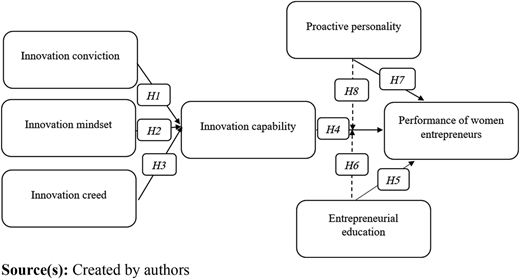
The second theory supporting the study is the social cognitive theory, which holds that people are active agents who shape the circumstances of their existence. This theory is in keeping with the research topic (Bandura, 2018; Wei, Liu, & Sha, 2019). If they think that their skills and actions can produce the desired results, women today pursue their ambitions (Bandura, Caprara, Barbaranelli, Gerbino, & Pastorelli, 2003). Through regularly modifying their beliefs and behaviors, entrepreneurial education aids in the improvement of their cognitive abilities which results in more entrepreneurship that is directional, coherent and purposeful (Wei et al., 2019). In this study, ICN, IM and ICD are investigated as antecedents of innovation capability and performance using the social cognitive theory, with entrepreneurial education and proactive personality as moderating variables. Social cognitive theory posits that learning in individuals occurs as a result of social context interaction involving the individual, behavior and environment (Alvarez-Risco, Del-Aguila-Arcentales, Rosen, & Yáñez, 2022). This therefore provides support for the relationship between entrepreneurship education and performance of women entrepreneurs. Within the context of the present study the individual would refer to the entrepreneurial woman while the environment is represented by entrepreneurial educational environment which is depicted in Figure 1, the conceptual model. Basing on the social cognitive theory Leblanc, Rousseau, and Harvey (2022) postulate that proactive personality and innovation exist within the same framework. Thus the present study, also grounded in the social cognitive theory presents proactive personality and innovation capability in the same conceptual model both leading to a mutual outcome (performance) and in the context of the present study, performance of entrepreneurial women. Learning is no longer a single behavior but is now implemented in a complex relational structure, moving from observation (Bandura, 1978) to involvement (Sims & Sinclair, 2008; Tavella & Franco, 2015; Wei et al., 2019) in a network (Berks, 2009; Chen & Chang, 2014). While general education focuses on students' growth, the entrepreneurial curriculum system lays the groundwork for enhancing women's entrepreneurship skills. As a result, teaching about women's entrepreneurship may give pupils more assurance that they can handle challenging situations. The requirements and traits of women entrepreneurs must be taken into account in order to completely comprehend the changes in entrepreneurship education.
Conceptual model and hypothesis development
The conceptual model illustrating the various linkages and routes between the investigated constructs is shown in Figure 1. The development of the research's hypotheses will then be covered in the sections that follow.
Main effects
Innovation conviction, innovation mindset, innovation creed and innovation capability
Any economy must incorporate innovation to grow and thrive, as it benefits customers, businesses and the whole economy (Cornell University, INSEAD & WIPO, 2017; Mendoza-Silva, 2021; Forsman et al., 2011). Innovation conviction, innovation mindset, innovation creed, innovation capability, proactive personality and entrepreneurial education are important catalysts that boost the performance of women entrepreneurs (Hogan, Soutar, McColl-Kennedy, & Sweeney, 2011). Innovation raises the standard of women's entrepreneurial activity, which results in the generation of value (Saiz-Alvarez & Martínez, 2019; Mashapure et al., 2022). Innovation in entrepreneurship promotes the growth of knowledge, which can be a result of entrepreneurship and value co-creation (Ferraris et al., 2018; Nair, 2016). Successful women entrepreneurs need to have impactful innovation creed in order to yield the best out of their efforts (Wei et al., 2019). Innovation creed and innovation mindset are two elements which work hand in hand to perfect the development of the entrepreneurial skill among women. The influence of innovation conviction, innovation mindset, innovation creed, innovation capability, proactive personality and entrepreneurial education as key catalysts that stimulate the performance of women entrepreneurs is remain unclear, despite the growing body of innovation research focused on women entrepreneurs (Volná et al., 2015). An innovative mindset for the women entrepreneurs calls for openness to change, embraces creativity, think outside the box and big, should give room for the development of courage on how to get ideas connected to yield a complete success for the whole organization (Subramaniam & Islam, 2014). Innovation capability is one of the major elements of an organization’s excellence, and it relates to how it shows and offer some dynamics answers to performance issues and the probability for expansion (Panayides, 2006). When an organization is able to adequately create new dynamics for enhanced performance, this signifies the level of competency necessary for innovation capability (Lai et al., 2010). To some extent, the room for this growth may come into play as a result of the skills necessary for switching and reflex good for a given selected market (Hernández-Perlines, Ariza-Montes, Han, & Law, 2019). Women entrepreneurs with innovative mindsets and innovation creed normally see the importance of innovation as a blueprint to achieve business organizational sustainable success and use strategic management methods for human capital management (Kemppainen, 2019). When an individual is able to positively influence the innovation process for women entrepreneurs, with a particular emphasis on actions that are intended to generate and use ideas, which would result in an inventive mentality (De & Den, 2007). Women entrepreneurs with an enhanced innovation creed and mindset, they are able to spot the major trends in the market which may otherwise be dismissed as the normal market churn (Mendoza-Silva, 2021). Innovation capability amongst women entrepreneurs call for utilization of capabilities and resources in form of novel processes, products and services (Nair, 2016). However, some women entrepreneurs prove to be efficient and better in innovation success than others, due to varied capacity differences (Ferraris et al., 2018). Further to this, women entrepreneurs’ innovation capabilities are contingent upon market characteristics and novelty (Forsman et al., 2011). In accordance with this, innovation is a crucial issue whereby organizations can improve their performance and can lead to the development of unique products and services as a way of generating value for businesses and also secure a competitive edge (Delgado-Verde, Mart_ın-de Castro, & Navas-L_opez, 2011; Damanpour, 1991; Frishmmar et al., 2012). The entrepreneurial success of small and medium-sized businesses owned and operated by women is significantly impacted by entrepreneurship and innovation (Zeb & Ihsan, 2020; Hogan et al., 2011). Through entrepreneurial education, women can develop their entrepreneurial abilities, and to better identify prospective business possibilities, they must better comprehend the entrepreneurial community.
The development of organizational capacities and long-term innovation development are required to improve the development of innovation conviction, mindset, creed, capability and proactive personality (Gault, 2018). If women are aware that their actions and abilities can result in the development of achievement of the desired or planned results, then they should pursue their goals (Bandura et al., 2003). It is impossible to separate the participation and function of women in these activities from the growth and progress of entrepreneurship in a nation (Riandika & Mulyani, 2020; Damanpour, 1991). To emphasize this point even more, innovation capability is defined as an organization's capacity to transform ideas successfully and continually into new products, processes and systems that benefit the organization as a whole as well as its stakeholders (Samson et al., 2017; Lawson & Samson, 2001). As a result, we hypothesize that:
Innovation conviction (ICN) has a significant association with innovation capability (IC)
Innovation mindset (IMT) has a significant association with innovation capability (IC)
Innovation creed (ICD) has a significant association with innovation capability (IC)
Innovation capability and performance of women entrepreneurs
Innovation capability refers to a company's propensity to adopt a novel development or technology before its competitors (Panayides, 2006; Rogers & Shoemaker, 1971). The ability of an organization to give novel solutions to performance issues and chances for company growth is another way to define innovation capability (Panayides, 2006). Ability to innovate improves performance (Saunila et al., 2014). The ability of an organization to continuously adjust its market offer, operations and management systems to market requirements is referred to as the firm's innovation capability (Hernández-Perlines et al., 2019). Success in many industries depends more and more on the capacity to discover new business prospects and the quick growth of the knowledge required to innovate, which keeps a firm's competitive advantage from eroding (Santos-Vijande, L´opez-S´anchez, & Gonz´alez-Mieres, 2012; Saunila, 2014). Therefore, there is broad agreement among academics and practitioners that a firm's capacity to create innovative services and products to address environmental changes is the key to enhancing long-term profitability and development potential (Grissemann, Plank, & Brunner-Sperdin, 2013; Tajeddini, Martin, & Altinay, 2020). Adapting to changing demands and making changes to cut costs and improve the quality of what they provide allows businesses to increase profit margins and the value they provide to customers (Tang, Wang, & Tang, 2015). Digital leadership and sustainable success are linked to innovation capability in small and medium-sized businesses (SMEs) (Borah, Iqbal, & Akhtar, 2022). According to the 2012 theory put forth by Zawislak, Cherubini Alves, Tello-Gamarra, Barbieux, and Reichert (2012), innovative abilities and capability are linked. Additionally, Saunila (2020) contends that SMEs have a more direct relationship between innovation performance and capabilities. As a result, we believe that:
There is a relationship between innovation capability and performance of women entrepreneurs
Entrepreneurial education and performance of women entrepreneurs
The relationship between entrepreneurial education and the success of women entrepreneurs needs to be made clear. According to Maziriri and Chivandi (2020), entrepreneurship education significantly and favorably affects the entrepreneurial performance of SMEs. In response, Van Der Sluis, Van Praag, and Vijverberg (2008) contend that if education raises levels of entrepreneurial performance, investment in training (upcoming) entrepreneurial visionaries should be supported. According to the human capital hypothesis, acquired knowledge is crucial to the execution of science, facilitating the synthesis and acquisition of new knowledge as well as atonement and adaptation to changing conditions (Weick, 1996). Additionally, Van Der Sluis et al. (2008) found that education enhances the performance of the entrepreneur in a variety of ways, such as business survival, business growth, or the emergence of associations in speculation. The success of women entrepreneurs is thus a direct result of the education they receive on entrepreneurship (Maziriri, Nyagadza & Chuchu, 2022). Based on the aforementioned illustrations, the following assertion is made:
There is a relationship between entrepreneurial education and performance of women entrepreneurs
Moderating effect of entrepreneurial education
Direct and indirect interactions between the variables under consideration are also conceivable, in addition to the stated relationships shown in the conceptual model. For this reason, entrepreneurial education is included as a moderating variable in Figure 1. Despite the fact that the hypothesis statements (H1, H2, H3 and H4) established the fundamental connections between the research variables, a clearer comprehension of these intricate connections can help to explain this phenomenon. Numerous studies take entrepreneurial education into account as a moderator factor. For instance, Gupta and Sharma (2018) conducted an empirical study to evaluate the moderating role of entrepreneurial education in the relationship between entrepreneurial qualities and intention. Shah et al. (2020) also found that entrepreneurial education moderates the association between a person's attitude, sense of self-efficacy, perceptions of social norms and intention to become an entrepreneur. The moderating effects of entrepreneurial education on the connection between social support and social entrepreneurial intention were also established by Seyoum et al. in 2021.
It is important to note that there have been no precise empirical estimates of how entrepreneurial education may influence performance of women entrepreneurs in ways that go beyond linear relationships because, as was mentioned above, many previous studies have examined the moderating role of entrepreneurial education. This prompts the following line of inquiry:
Does entrepreneurial education moderate the relationship between entrepreneurial education and the performance of women entrepreneurs?
By addressing this research question, a better theoretical understanding of the relationship between entrepreneurial education and the success of women entrepreneurs is gained. Additionally, some empirical insights into the extent to which this relationship is moderately influenced by entrepreneurial education are offered. In light of the foregoing explanations, the following theory is suggested:
Entrepreneurial education positively and significantly moderates the relationship between innovation capability and performance of women entrepreneurs
Proactive personality and performance of women entrepreneurs
Our theoretical justifications imply that a proactive personality affects how well women function as entrepreneurs. According to Thompson's research from 2005, people with proactive personalities perform well because they take initiative and engage in network building on a personal level. Greguras and Diefendorff (2010) found that proactive personality and performance have a positive, direct association; as a result, our conceptual model incorporates this direct relationship (see Figure 1). Furthermore, proactive personalities are change-oriented, which means they prefer to alter the environment around them to better suit their requirements as opposed to merely adjusting to it or adapting it (Li, Gill, Wang, Safdar, & Sheikh, 2022). Such people frequently seek out new, more effective methods of doing things to increase their performance (Li et al., 2022). As a result, the following assertion can be made:
There is a relationship between proactive personality and performance of women entrepreneurs
Moderating effect of proactive personality
Proactive personality has been found to influence job success and entrepreneurial inclinations in earlier studies (Crant, 1996; Bergeron, Schroeder, & Martinez, 2014). Numerous study topics, including job instability, unethical pro-organizational behavior and moral identity, have been found to be correlated with proactive personality (Wang, Weng, Kiani, & Ali, 2022). According to Seibert, Crant, and Kraimer (1999), proactive personality may directly correlate with work success, serving as a performance indicator for people. This performance is assessed from a financial and operational standpoint and is directly impacted by innovation capability (Saunila et al., 2014). Additionally, proactive personality is hypothesized by Saunila et al. (2014) to impact the association significantly and favorably between innovation capability and performance. The outcome of this influence is considerable. Based on the literature mentioned above, the following hypothesis is put forth.
Proactive personality positively and significantly moderates the relationship between innovation capability and performance of women entrepreneurs
Methodological aspects
Sample and data collection
The participants in this study are South African women business owners. Johannesburg, which is the study's target area, is widely renowned for its SME sector. Purposive sampling was utilized in this study because the respondents were chosen based on the following criteria: only women who own and operate their own enterprises and real estate; women who work in the SME sector; and women who meet the criteria in accordance with South African law (the National Small Business Act 102 of 1996). Small and medium-sized businesses in South Africa must meet the following requirements: they must employ 50 to 200 people, have an annual turnover between R10 million and R40 million, and have total gross asset values between R3.75 million and R15 million. In this research endeavor, 350 questionnaires were personally administered (offline) to women entrepreneurs. Among these, 304 women entrepreneurs participated by responding to the questionnaire, resulting in a subsequent response rate of 86.8%. The Krejcie and Morgan (1970) formula was used to calculate the sample size because it was necessary to create a confidence interval (typically +5%). (Maziriri, Nyagadza, Mabuyana, Rukuni, & Mapuranga, 2023; Nyagadza, Mazuruse, Muposhi, & Chigora, 2022).
Measurement instrument and questionnaire design
All the 36 items used to measure the variables were adapted from prior studies (see Appendix). The respondents’ beliefs were captured using a five-point Likert-type scale anchored on “strongly disagree” as one (1) and “strongly agree” as five (5).
Respondent profile
Table 1 shows the participants' representation. The respondents were asked to report their demographic information, including age, highest level of education, whether the business is a family business, number of years in business and area in which the business is situated. The sample comprised 304 female respondents, all of whom are entrepreneurs and are readily available to participate in the study. Most of these respondents were between the ages of 31-39 (31.9%), followed closely by those between 50- 59 (31.6%). The third largest age cohort were respondents falling between the ages of 40-49 (18.4%), while the respondents in the age groups 18-30 (12.2%) and 60 and older (5.9%) make up the remainder of the total age groups. The study also aimed to discover whether the businesses run by women entrepreneurs are family businesses. Table 2 indicates that more than half of these respondents (64.1%) do not run a family business, while the rest disclosed that they do run a family business (35.9%). In the survey, respondents were asked to indicate the years they have been operating their respective businesses. Interestingly, 52.3% of respondents indicated that they had been in operation for 11-20 years. In addition, 39.5% indicated 4-6 years, while 5.3% indicated 7-10 years and 3.0% indicated 1-3 years. The businesses were located between the Central Business District (CBD) and industrial areas. In Table 1, the results show that a majority (74.0%) of the respondents have businesses in industrial areas, while the remaining participants (26.0%) have businesses in the CBD.
Sample demographic characteristics (n = 304)
Demographic | Variables | Frequency (n) | Percentage (%) |
|---|---|---|---|
| Age | 18-30 | 37 | 12.2 |
| 31-39 | 97 | 31.9 | |
| 40-49 | 56 | 18.4 | |
| 50-59 | 96 | 31.6 | |
| 60 + | 18 | 5.9 | |
| Is this a family business? | Yes | 109 | 35.9 |
| No | 195 | 64.1 | |
| How long have you been in business? | 1-3 years | 9 | 3.0 |
| 4-6 years | 120 | 39.5 | |
| 7-10 years | 16 | 5.3 | |
| 11-20 years | 159 | 52.3 | |
| In which area is your business situated? | CBD | 79 | 26.0 |
| Industrial | 225 | 74.0 |
Source(s): Created by authors
Scale accuracy analysis
| Research constructs | Variable | Mean value | Scale mean | SD | Scale SD | Cronbach’s test | CR | AVE | Factor loadings | VIF (outer) values | |
|---|---|---|---|---|---|---|---|---|---|---|---|
| Item total | α | ||||||||||
| ICN | – | – | 4.695 | – | 1.236 | – | 0.842 | 0.894 | 0.679 | – | |
| ICN1 | 4.728 | – | 1.314 | – | 0.765 | – | – | – | 0.857 | 1.826 | |
| ICN2 | 4.630 | – | 1.224 | – | 0.712 | – | – | – | 0.859 | 1.935 | |
| ICN3 | 4.719 | – | 1.160 | – | 0.787 | – | – | – | 0.800 | 1.986 | |
| ICN4 | 3.963 | – | 1.327 | – | 0.701 | – | – | – | 0.777 | 1.989 | |
| IM | – | – | 4.105 | – | 1.197 | – | 0.827 | 0.897 | 0.745 | – | |
| IM1 | 4.613 | – | 1.094 | – | 0.788 | – | – | – | 0.916 | 2.018 | |
| IM2 | 4.251 | – | 1.398 | – | 0.721 | – | – | – | 0.877 | 2.561 | |
| IM4 | 4.369 | – | 1.232 | – | 0.734 | – | – | – | 0.791 | 1.987 | |
| ICD | – | – | 4.230 | – | 1.450 | – | 0.893 | 0.926 | 0.757 | ||
| ICD1 | 3.928 | – | 1.477 | – | 0.772 | – | – | – | 0.839 | 1.624 | |
| ICD2 | 4.101 | – | 1.498 | – | 0.789 | – | – | – | 0.905 | 1.770 | |
| ICD3 | 3.713 | – | 1.593 | – | 0.788 | – | – | – | 0.876 | 1.785 | |
| ICD4 | 4.195 | – | 1.625 | – | 0.797 | – | – | – | 0.859 | 1.826 | |
| ICAP | – | – | 4.456 | – | 1.462 | – | 0.854 | 0.896 | 0.633 | – | – |
| ICAP1 | 4.582 | – | 1.213 | – | 0.716 | – | – | – | 0.816 | 1.973 | |
| ICAP2 | 4.748 | – | 1.235 | – | 0.755 | – | – | – | 0.810 | 1.892 | |
| ICAP3 | 4.630 | – | 1.227 | – | 0.752 | – | – | – | 0.723 | 1.692 | |
| ICAP4 | 4.569 | – | 1.317 | – | 0.782 | – | – | – | 0.868 | 1.752 | |
| ICAP5 | 4.826 | – | 1.333 | – | 0.721 | – | – | – | 0.754 | 1.778 | |
| POWE | – | – | 4.351 | – | 1.321 | – | 0.899 | 0.922 | 0.666 | – | – |
| POWE1 | 3.513 | – | 1.261 | – | 0.721 | – | – | – | 0.742 | 1.334 | |
| POWE2 | 3.822 | – | 1.168 | – | 0.737 | – | – | – | 0.813 | 1.432 | |
| POWE3 | 3.921 | – | 1.188 | – | 0.734 | – | – | – | 0.835 | 1.338 | |
| POWE4 | 4.102 | – | 1.168 | – | 0.773 | – | – | – | 0.764 | 1.785 | |
| POWE5 | 4.231 | – | 1.398 | – | 0.756 | – | – | – | 0.922 | 1.553 | |
| POWE6 | 4.331 | – | 1.232 | – | 0.768 | – | – | – | 0.808 | 1.567 | |
| EED | – | – | 3.497 | – | 1.247 | – | 0.855 | 0.899 | 0.691 | – | – |
| EED1 | 3.670 | – | 1.188 | – | 0.734 | – | – | – | 0.701 | 1.987 | |
| EED2 | 3.464 | – | 1.168 | – | 0.830 | – | – | – | 0.865 | 2.008 | |
| EED3 | 3.307 | – | 1.398 | – | 0.749 | – | – | – | 0.845 | 2.061 | |
| EED4 | 4.547 | – | 1.232 | – | 0.816 | – | – | – | 0.812 | 2.642 | |
| PP | – | – | 3.359 | – | 1.547 | – | 0.930 | 0.943 | 0.735 | – | – |
| PP1 | 3.561 | – | 1.449 | – | 0.701 | – | – | – | 0.749 | 1.564 | |
| PP4 | 4.852 | – | 1.534 | – | 0.737 | – | – | – | 0.883 | 1.234 | |
| PP5 | 4.821 | – | 1.626 | – | 0.755 | – | – | – | 0.914 | 1.345 | |
| PP6 | 4.974 | – | 1.416 | – | 0.767 | – | – | – | 0.882 | 1.438 | |
| PP7 | 4.843 | – | 1.433 | – | 0.778 | – | – | – | 0.839 | 1.547 | |
| PP8 | 4.387 | – | 1.457 | – | 0.780 | – | – | – | 0.866 | 1.678 | |
Note(s): ICN = innovation conviction; IM = innovation mindset; ICD = innovation creed; ICAP = innovation capability; POWE = performance of women entrepreneurs; EED = entrepreneurial education; PP = proactive personality
Source(s): Created by authors
Statistical analysis procedure
The researcher used the Statistical Package for Social Science (SPSS), Version 26 to evaluate the data pertaining to the demographic profile of the respondents, while the latest software version of SMART-PLS 4 was used to analyze the model. The statistical analysis performed in this study includes measures such as: (1) measurement model – testing of reliability analysis and validity analysis, and (2) structural model analysis – examining the path coefficients between observed coefficients.
Reliability analysis
Table 2 specifies the different measures that were used to assess the reliability and validity of the constructs for the study.
Measurement model assessment
The outer model was assessed first by values of composite reliability (to assess internal consistency), outer loadings (to assess indicator reliability) and average variance extracted (to assess convergent validity). Composite reliability is an appropriate measure of internal consistency reliability because it accounts for the different outer loadings of the indicator variable. In contrast, Cronbach’s alpha assumes all indicators to be equally reliable (Hair, Hult, Ringle, & Sarstedt, 2017; Maziriri, Nyagadza, et al., 2023). For all the research constructs, the lowest value for each respective item load is 0.701. It is vital to indicate that on innovation mindset, one item was deleted, which is IM3, on entrepreneurial education, one item was deleted, which is EED5, and on proactive personality two items were also deleted, which is PP2 and PP3, because the outer loadings were less than 0.5 (Anderson & Gerbing, 1988). All individual item loadings surpassed the recommended value of 0.5 (Anderson & Gerbing, 1988). This shows that all measuring instruments are satisfactory and reliable as all items showed convergent validity, with more than 50% of the variance of each item shared with their respective construct (Fraering & Minor, 2006). As shown in Table 2, the Cronbach’s alpha test results ranged between 0.827 and 0.930, which is above the 0.70 benchmark for acceptable internal consistency reliability (Field, 2013). As revealed in Table 3 results, the lowest composite reliability (CR) value of 0.894 is well above the suggested value of 0.6 (Hulland, 1999), while the lowest obtained average variance extracted (AVE) value of 0.633 is also above the recommended value of 0.4 (Anderson & Gerbing, 1988). This shows the accomplishment of convergent validity, and further confirms the excellent internal consistency and reliability of the measuring instruments used. As such, a sufficient level of discriminating validity was revealed by all the variables. These results have generally provided evidence of acceptable levels of reliability of the research scale (Chinomona & Chinomona, 2013; Maziriri, Mashapa, Nyagadza, & Mabuyana, 2023). Field (2013) states that discriminant validity refers to items measuring different concepts. Table 3 presents the results of the discriminant validity analysis.
Discriminant validity (HTMT)
| Variables | EED | ICAP | ICD | IM | POWE | PP | EED x ICAP | PP x ICAP |
|---|---|---|---|---|---|---|---|---|
| EED | ||||||||
| ICAP | 0.646 | |||||||
| ICD | 0.776 | 0.748 | ||||||
| ICN | 0.653 | 0.782 | 0.594 | |||||
| IM | 0.649 | 0.587 | 0.822 | |||||
| POWE | 0.568 | 0.430 | 0.501 | 0.338 | ||||
| PP | 0.726 | 0.480 | 0.777 | 0.737 | 0.382 | |||
| EED x ICAP | 0.312 | 0.272 | 0.093 | 0.130 | 0.351 | 0.188 | ||
| PP x ICAP | 0.157 | 0.131 | 0.196 | 0.128 | 0.131 | 0.146 | 0.578 |
Note(s): HTMT = heterotrait-Monotrait-ratio; ICN = innovation conviction; IM = innovation mindset; ICD = innovation creed; ICAP = innovation capability; POWE = performance of women entrepreneurs; EED = entrepreneurial education; PP = proactive personality
Source(s): Created by authors
Discriminant validity was evaluated using the Hetero-Trait-Monotrait Ratio (HTMT) criterion (Table 4), despite recommendations from previous studies (Henseler, Hubona, & Ray, 2016; Verkijika & De Wet, 2018) indicating that HTMT is more suitable to evaluate discriminant validity than Fornell–Larcker's commonly used criteria. When taking a more conservative position, discriminant validity is reached when the HTMT value is below 0.9 or 0.85 (Verkijika & De Wet, 2018; Neneh, 2019; Maziriri, Mashapa, et al., 2023). Table 4 reveals that the highest obtained HTMT value is 0.822, which is below the conservative value of 0.85. As such, all the constructs meet the criteria for discriminant validity.
Structural model assessment
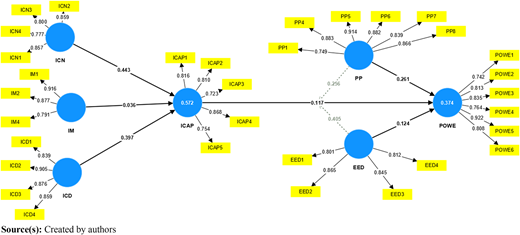
Inner model (structural model) (Figure 2) was assessed to test the relationship between the endogenous and exogenous variables. The path coefficients were obtained by applying a non-parametric, boot-strapping routine (Vinzi, Chin, Henseler, & Wang, 2010), with 261 cases and 5 000 samples for the non-return model (two-tailed; 0.05 significance level; no sign changes). The fitness of the model was assessed using the goodness of fit (GoF) and the standardized root mean square residual (SRMR). These indices will be elucidated in the subsequent sections.
Assessment of the goodness of fit (GoF)
Overall, R2 for innovation capability and the performance of women entrepreneurs in Figure 2 indicate that the research model explains 57.2% and 37.4% of the variance in the endogenous variables, respectively. The following formulae were given by Tenenhaus, Vinzi, Chatelin, and Lauro (2005) and the global GoF statistic for the research model was calculated using the following equation:
where AVE represents the average of all AVE values for the research variables and R2 represents the average of all R2 values in the full path model. The calculated global GoF is 0.57, which exceeds the threshold of GoF >0.36 suggested by Wetzels, Odekerken-Schröder, and Van Oppen (2009). Therefore, it can be concluded that the research model has a good overall fit.
Common method bias (CMB)
For PLS-SEM, common method bias (CMB) is detected through a full collinearity assessment approach (Kock, 2015). VIF values should be lower than the 3.3 threshold (Hair, Ringle, & Sarstedt, 2011; Kock, 2015). This is indicative that the model is free from common method bias. Any value greater than 3.3 means that the model is affected by CMB. Therefore, following standard procedures in business research, the variance inflation factor (VIF) values were computed instead of reporting the collinearity issues in this work. As shown in Table 3, multicollinearity was evaluated by looking at the variance inflation factor (VIF) and the findings showed that VIF values of all constructs were less than 3.3 (Kock & Lynn, 2012). The outcome thus supported the notion that CMB does not seem to be a problem in the investigation.
The standardized root mean square residual (SRMR)
The SRMR is an index of the average standardized residuals between the observed and the hypothesized covariance matrices (Chen, 2007). The SRMR is a measure of estimated model fit. When SRMR = <0.08, then the study model has a good fit (Hu & Bentler, 1998); with a lower SRMR being a better fit. Table 5 shows the theoretical model’s SRMR was 0.07, which revealed that the model had a good fit, whereas the Chi-Square was equal to 1918.087 and NFI equal to 0.900 was also measured, meeting the recommended threshold for NFI (Afthanorhan & Afthanorhan, 2013).
Coefficient of determination (R2)
Examination of the coefficient of determination (R2) value of the endogenous constructs was carried out as part of the analysis in the study. Schumacher, Erol, and Sihn (2016) define the R2 value as the percentage of variance in the variable that is accounted for by association in the independent variable groups. R2 values of 0.75, 0.5 and 0.25 can be considered substantial, moderate and weak, respectively (Hair, Risher, Sarstedt, & Ringle, 2019). Very high values of R2 may result in model overfitting the data and may also lead to a spurious relationship, provided that the R2 value is greater than the Durbin Watson. In this study, innovation capability and the performance of women entrepreneurs had the following R2, respectively: 0.572 and 0.374. This showed that the developed model has a moderate to substantial explaining power (Hair et al., 2019).
Predictive relevance (Q2)
In addition to R2 as a predictive criterion, Hait et al. (2017) recommend that researchers examine Q2 to assess the predictive relevance of the structural model. Predictive applicability of constructs must be positive and with values greater than zero (Hair et al., 2019). The size of the Q2 effect (in Table 6) allows evaluating how an exogenous construct contributes to an endogenous latent construct Q2 as a measure of predictive relevance, which can be small (0.02), medium (0.15) or large (0.35). The Q2 values are explained in Table 5. The study obtains a Q2 of 0.347 for innovation capability and 0.253 for the performance of women entrepreneurs, which is within the required limit and supports that the path model’s predictive relevance was adequate for the endogenous construct.
Results of the structural equation model analysis
| Hypothesis | Proposed hypothesis relationship | Beta coefficients (β) | T-statistics | P-values | Decision |
|---|---|---|---|---|---|
| H1 | ICN → ICAP | 0.443 | 5.073 | 0.000 | Supported |
| H2 | IM → ICAP | 0.036 | 0.278 | 0.780 | Not-supported |
| H3 | ICD → ICAP | 0.397 | 3.620 | 0.000 | Supported |
| H4 | ICAP → POWE | 0.117 | 1.969 | 0.010 | Supported |
| H5 | EED → POWE | 0.124 | 2.173 | 0.030 | Supported |
| H6 Moderating effect | ICAP*EED → POWE | 0.405 | 4.975 | 0.000 | Supported |
| H7 | PP → POWE | 0.261 | 2.937 | 0.000 | Supported |
| H8 Moderating effect | ICAP*PP → POWE | 0.256 | 3.044 | 0.000 | Supported |
Note(s): ⁎ p < 0.05; ⁎⁎ p < 0.01. Arrows signify the relationships between each construct to indicate the proposed hypothesis. ICN = innovation conviction; IM = innovation mindset; ICD = innovation creed; ICAP = innovation capability; POWE = performance of women entrepreneurs; EED = entrepreneurial education; PP = proactive personality
Source(s): Calculated from the survey results; Created by authors
Effect size (f2)
Effect size (f2) is a measurement that tells the impact of change in the R2 value when a specified exogenous construct is ignored in the model (Hair et al., 2019). An effect size f 2 0.30, 0.3 f 2 0.50 and f 2 >0.50 is thought to represent a weak, moderate and strong effect, respectively (Bliwise, 2006).
Effect size is calculated using the following equation:
where, R2 is the coefficient of determination.
From Table 5, f2 values for innovation capability and the performance of women entrepreneurs are considered strong.
Path model
The PLS estimation path coefficients values and the item loadings for the research construct, are shown in Figure 2.
Hypotheses testing results
After evaluating and concluding the hypothesized measurement and structural model, the next action was to evaluate the cause-and-effect relationships among latent variables through path analysis (Nusair & Hua, 2010). Nusair and Hua (2010) observe that SEM states that specific latent variables directly or indirectly influence other specific latent variables with the model, causing estimation results that depict how these latent variables are associated. For this study, the estimation results obtained through hypothesis testing are illustrated in Table 6. The table demonstrates the proposed hypotheses, path coefficients, t-statistics and whether a hypothesis is rejected or supported. According to Beneke and Blampied (2012), t-values indicate whether a significant relationship exists between variables in the model and path coefficients, demonstrating the strength of the relationships in the model. In addition, Chin (1998) as well as Maziriri, Nyagadza, et al. (2023), also suggests that t > 1.96 indicates a relationship significance and that higher path coefficients indicate strong relationships among latent variables (Drawing from the results in Table 6, H1 (β = 0.443; t = 5.073), H3 (β = 0.397; t = 3.620), H4 (β = 0.117; t = 1.969), H5 (β = 0.124; t = 2.173), H6 (β = 0.405; t = 4.975), H7 (β = 0.261; t = 2.937) and H8 (β = 0.256; t = 3.044), are supported significantly because the t-statistics are greater than 1.96. However, H2 (β = 0.036; t = 0.278) was rejected as the relationship between innovation mindset and innovation capability was insignificant. The significance of relationship between innovation mindset and innovation capability was a result of the fact that behaviors of individuals can influence the innovation capability and leads to generation of novel ideas (De & Den, 2007; Kabonga et al., 2021). This enhances the development of progressive mindset and effective organizational capabilities in the long term.
Discussion of results
The findings revealed that ICN, IM and ICD have a positive impact on innovative capability. This is the case since ICN, IM and ICD are important catalysts for enhancing women's entrepreneurial innovation performance (Hogan et al., 2011). Innovation increases the quality of women's entrepreneurial activity, which generates value (Saiz-Alvarez & Martínez, 2019; Mashapure et al., 2022). As a result of entrepreneurship and value co-creation, innovation in entrepreneurship fosters the expansion of knowledge (Ferraris et al., 2018; Nair, 2016). The results revealed that innovation capability has a major impact on how well women entrepreneurs perform. These findings support the work of Saunila (2020), who also emphasizes the closer connection between performance and innovation in SMEs. This study also discovered that entrepreneurship education plays a critical role in predicting how well women entrepreneurs perform. Notably, these findings support the findings of Van Der Sluis et al. (2008), who contend that education promotes higher levels of entrepreneurial performance. Therefore, it is advised to make investments in entrepreneurship education. These findings support Schneider, Bach, Wagner, Blacher, and Thöle's (2017) hypothesis that education and training can enhance women entrepreneurs' entrepreneurial performance. It has also been discovered that proactive personalities help women entrepreneurs succeed better in their businesses. These findings are in line with Thompson's (2005) research, which shown that proactive people perform well because they exercise personal initiative and engage in network development. Additionally, other studies have demonstrated a beneficial connection between proactive personality and performance (Greguras & Diefendorff, 2010).
The statistical analysis showed that entrepreneurial education moderates or strengthens the relationship between innovation capability and performance of women entrepreneurs. This result is consistent with several international research that have examined the moderating role of the entrepreneurial education variable in diverse contexts (Gupta & Sharma, 2018; Shah et al., 2020; Seyoum et al., 2021). As there are gaps in the research on the moderating effect of entrepreneurial education on the nexus between innovation capability and performance of women entrepreneurs, this study adds a fresh understanding or adds new theoretical knowledge by broadening our understanding of entrepreneurial education as a factor that can stimulate the innovation capability. Understanding how the moderating variable (entrepreneurial education) interacts with the nexus between the innovation capability and performance of women entrepreneurs is essential. For instance, the practical implication of this finding is that if women entrepreneurs are equipped with entrepreneurial skills and knowledge (entrepreneurial education), they have a strong desire to accomplish large entrepreneurial endeavors and will be more likely to perform very well in their entrepreneurial ventures. Furthermore, the results revealed that proactive personality moderates the nexus between innovation capability and performance of women entrepreneurs. This finding is consistent with those made by Wang et al. (2022) as well as Saunila et al. (2014), who found that proactive personality considerably and positively moderates the association between performance and innovation capability.
The interaction plot for the entrepreneurial education moderating variable
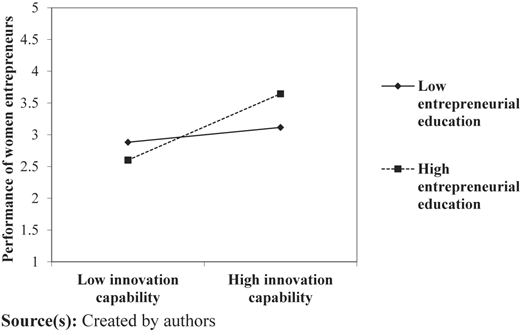
To assess the moderating role of entrepreneurial education, this study used a product indicator method (PIM) using PLS-SEM (Chin, 2010). PIM was used because the suggested moderating construct was continuous (Rigdon, Schumacker & Wothke, 2017). Cohen’s (1988) rules were used to assess the moderating effects. Regarding H6 (entrepreneurial education moderates the innovation capability – performance of women entrepreneurs’ relationship), the interaction terms (β = 0.405, p = 0.000) were significant (Table 6, Figure 2). Hence, H6 was supported.
The interaction plot in Figure 3 presents a better understanding of this association. The slope for the link between innovation capability and performance of women entrepreneurs moderated by entrepreneurial education showed that the relationship became stronger when there was high entrepreneurial education (Figure 3). More specifically, as illustrated in Figure 3, when entrepreneurial education is high, the impact of innovation capability on the performance of women entrepreneurs tends to be stronger. Figure 3 shows that the performance of women entrepreneurs increases with an increase in innovation capability. However, this increase is more pronounced for individuals (women entrepreneurs) with a high level of entrepreneurial education, compared with those with a low level of entrepreneurial education.
The interaction plot for the proactive personality moderating variable
To assess the moderating role of entrepreneurial education, this study used a PIM using PLS-SEM (Chin, 2010). PIM was used because the suggested moderating construct was continuous (Rigdon et al., 2017). Cohen’s (1988) rules were used to assess the moderating effects. Regarding H6 (entrepreneurial education moderates the innovation capability – performance of women entrepreneurs’ relationship), the interaction terms (β = 0.405, p = 0.000) were significant (Table 6, Figure 2). Hence, H6 was supported.
The interaction plot in Figure 3 presents a better understanding of this association. The slope for the link between innovation capability and performance of women entrepreneurs moderated by entrepreneurial education showed that the relationship became stronger when there was high entrepreneurial education (Figure 3). More specifically, as illustrated in Figure 3, when entrepreneurial education is high, the impact of innovation capability on performance of women entrepreneurs tends to be stronger. Figure 3 shows that performance of women entrepreneurs increases with an increase in innovation capability. However, the increase is more pronounced for individuals (women entrepreneurs) with a high level of entrepreneurial education compared to those with a low level of entrepreneurial education.
The interaction plot for the proactive personality moderating variable
Furthermore, this study proposed and empirically supported the view that a PP would be beneficial for the establishment of innovation capability and ultimately entrepreneurial performance. This was supported by the significance of the interaction term ICAP× PP (β = 0.256, p < 0.01), thus supporting hypothesis H8. The nature of this interaction is presented in Figure 4.
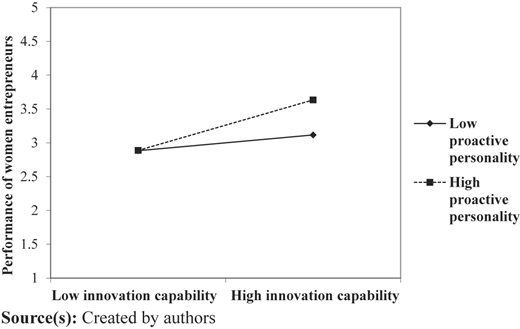
From Figure 4, it is observed that as innovation capability increases, its influence on the performance of women entrepreneurs is more pronounced for individuals with a high level of PP than for those with low levels of PP.
Theoretical contributions
Based on this study, each dimension of innovation – specifically, ICD, ICN and IM – exhibits varying degrees of influence on women entrepreneurs' ability to innovate and their performance. According to a study by Lai et al. (2010), female business owners in Malaysia required to instil an innovation culture within their organizations. The results of the data research essentially suggest that business leaders should adopt the proper IM and conviction to secure entrepreneurial success at work. These discoveries provide fresh data and new perspectives on female entrepreneurs in South Africa. This is the case because the variables from the study's model strengthen Schumpeter's theory by emphasizing the entrepreneurship perspective as being intuitive and innovative, that is, to perform tasks without being overly analytical, creative and inventive, as well as to have the ability to overcome self-doubt, conquer uncertainty and manage unfavorable surroundings. The long-term entrepreneurial growth of women's small businesses depends on innovation, particularly in the current highly competitive global business environment. Women entrepreneurs start, organize and run businesses with the goal of showcasing their abilities in cutting-edge and competitive fields of work. According to the Social Cognitive theory, one of the variables in this study was entrepreneurial education since it helps women's cognitive skills by regularly modifying their thoughts and behaviors and makes entrepreneurship more directional, logical and purposeful (Wei et al., 2019). While general education focuses on student growth, the entrepreneurial curriculum system serves as the cornerstone for enhancing women's entrepreneurship. Because of this, teaching about women's entrepreneurship may give kids more self-assurance that they can handle challenging situations. This study extends the social cognitive theory by showing the essence of ICN, IM and ICD as precursors for innovation capability and performance, where entrepreneurial education and proactive personality are moderating variables.
Practical implications
The study's conclusions have applications for female entrepreneurs. It is very crucial to adopt a special understanding of how ICN, IM and ICD would function as important antecedents for innovation potential and the performance of women entrepreneurs. To improve their ability to identify business possibilities, women need to become fully immersed in the entrepreneurial community in addition to learning entrepreneurial skills through entrepreneurial education. The three main facets of entrepreneurial capability for entrepreneurial education are ICN, IM and ICD. The findings of this study can also be used by policymakers who want to improve the quantity and caliber of entrepreneurs. To promote ICN, IM and ICD and aim for their achievement and entrepreneurial performance, it is crucial that the government and policymakers pay attention to the development of women's entrepreneurial education. Women's entrepreneurship education places more of an emphasis on practical application of knowledge to advance professional entrepreneurial abilities than on the transmission of theoretical knowledge.
This study proved that women entrepreneurs perform considerably and favorably when they have a proactive personality. Since people with a high proactive personality are more likely to improve the business performance of SMEs, a strategy to foster and develop this personality feature among women entrepreneurs is necessary. It is crucial to investigate how similar training programs can be utilized to boost women's entrepreneurship because prior research indicates that proactive behavior can be considerably enhanced by training (Kirby, Kirby, & Lewis, 2002). It is crucial to make sure that such programs consider personality characteristics, particularly with regard to a proactive personality, as many nations are implementing entrepreneurship education to improve intentions and subsequent behavior (Premand, Brodmann, Almeida, Grun, & Barouni, 2016).
Limitations and directions for future research
Empirical research has limits, just like most studies. The study used a non-probability convenience sampling technique, which was the first caveat. The lack of consideration for probability sampling limits the generalizability of the research findings, so the results should be evaluated with care. This study's exclusive focus on female business owners in Johannesburg is another drawback. It is advised that future studies explore various gender viewpoints or perhaps perform a comparison study between female and male entrepreneurs as the study's sample may be regarded to be too small. Additionally, it might be stated that the study's study area does not accurately represent South Africa or Africans in general. Nevertheless, given that Johannesburg is regarded as the economic center of South Africa and all of Africa, the aforementioned restrictions can be stated to be of little relevance. The population of Johannesburg reflects the diversity of the African continent. In line with this, the future research may look into the geographic regions and the other various factors (such as level of education, family set-up, roles and socialization, cultures, financial literacy, social psychological influence, government policy towards empowerment, among others) affecting the women entrepreneurship in South Africa. Studying more geographic regions on the subject would provide much more diverse perceptions regarding women entrepreneurship considering that even though Johannesburg has a large diverse population, all participants are exposed to more or less the same environment which could have created respondent bias in the study.
Funding: This research did not receive any specific grant from funding agencies in the public, commercial, or not-for-profit sectors.
References
Further reading
Appendix Measurement scales
Innovation conviction (Lai et al., 2010)
ICN1-Personally, successful businesswomen are aware of several other industries that have grown through innovation.
ICN2- Successful businesswomen know that profit margins of existing product lines will continue to fall because of competition.
ICN3-Successful businesswomen have noticed that at least one of their key competitors has successfully increased its competitive advantage through implementation of innovation.
ICN4-Successful businesswomen can reduce cost structures, streamline work force and re-engineer processes.
Innovation mindset (Lai et al., 2010)
IM1-Successful businesswomen will use innovation and launch new products that accelerate their company’s value.
IM2-Successful businesswomen will conduct consumer research studies prior to idea generation for proper problems and needs identification.
IM3-Successful businesswomen listen to others within the organization who talk about their positive, enthusiastic, supportive and “can-do” attitude towards innovation
IM4-Successful businesswomen make innovation an attractive career for their employees to pursue.
Innovation creed (Lai et al., 2010)
ICD1-Successful business women believe that innovative new products and services are integral to the company’s future success
ICD2-Successful businesswomen believe that internal innovation will yield greater returns
ICD3-Successful businesswomen believe that innovation should be one of the top five priorities and remain on the “to-do” list
ICD4-Successful businesswomen believe that an effective IM can motivate employees to perform better and be more productive
Innovation capability (AlNuaimi, Singh & Harney, 2021)
ICAP1-My firm has generated many innovative and valuable ideas.
ICAP2-My firm promotes an environment that is encouraging our capability to create innovative and valuable ideas.
ICAP3-My firm devotes a lot of time in creating innovative and valuable ideas.
ICAP4-My firm believes creating innovative and valuable ideas as being essential activities
ICAP5-My firm actively generates innovative and valuable ideas
Performance of women entrepreneurs (Hasan & Almubarak, 2016)
POWE1-There is an increase in sales and profitability during the three last years
POWE2-My business doesn’t have the capacity to develop new products and processes
POWE3-I don’t think that my business will survive and continue its activity forever
POWE4-More than 50% of profit are reinvested in the business
POWE5-My business is offering high quality of products and services
POWE6-I am committed with social responsibility, i.e. employing local nationals.
Entrepreneurial education (Duong, 2022)
EED1-My school education helped me develop my sense of initiative – a sort of entrepreneurial attitude
EED2-My school education helped me to understand the role of entrepreneurs in society better
EED3-My school education made me interested in becoming an entrepreneur
EED4-My school education gave me skills and know-how that enable me to run a business
EED5-My school education has equipped me with the necessary abilities and expertise to start my own business
Proactive personality (Luo, Huang, & Gao, 2022)
PP1-I am always looking for a better way
PP2-I tend to face a challenge directly.
PP3-If I believe in an idea, nothing can stop me from realizing it
PP4-If I firmly believe in something, I tend to achieve it whatever
PP5-Nothing makes me more exciting than seeing my idea turned into reality.
PP6-I am always looking for a new method to make my life better
PP7-I enjoy facing and overcoming difficulties
PP8-I am always hoping to be the special one in a group (perhaps in the whole world).

