The purpose of this paper is to discuss policy-relevant findings regarding strategies for mainstreaming gender in achieving sustainable post-disaster reconstruction (PDR).
An exploratory case study was used to explore the implementation of gender mainstreaming strategies and the link to sustainable PDR. The Bantul and Sleman regencies of Yogyakarta province provide a unique site for researching PDR as they are located in a region that is more strongly affected by earthquakes than nearly any other in Indonesia. Data were collected through interviews with 17 key stakeholders and 26 beneficiaries who were involved during and after the earthquake. To support the interview findings, surveys involving 50 policy makers and 150 beneficiaries were conducted. Content analysis and t-statistics were used in analyzing the data.
Gender mainstreaming strategies within sustainable reconstruction should incorporate strategies for protecting against gender vulnerabilities and for promoting gender capacities. Both are fundamental to the achievement of sustainable PDR.
The paper establishes comprehensive strategies for mainstreaming gender under three pillars (i.e. economic, social and environmental) of sustainable development. The findings benefit relevant policy makers by improving the policy performance of gender mainstreaming in the affected communities in enhancing sustainable PDR.
1. Introduction
Disasters that result from natural or human-induced hazards are gender constructed. The gendered construction of disasters results from unequal relationships between women and men in society, and these lead, in turn, to women’s vulnerability. Therefore, socially constructed roles often make women more vulnerable to hazards. As Enarson (2012, p. 9) writes, “[…] gender shapes the social worlds within which natural hazards occur.” Hence, “gender-blind” reconstruction policies and programs can only lead to an increase in women’s vulnerability, a widening of gender disparities and the creation of unsustainable development in affected communities (Yonder et al., 2005). Studies have found that failure to address gender issues within post-disaster reconstruction (PDR) policies and programs hinders the opportunities for reconstruction to achieve community resilience and sustainable development (Drolet et al., 2015). Thus, gender mainstreaming is vital to achieving sustainable development through reconstruction (Enarson, 2012).
The gender and built environment literature highlights the vital role of mainstreaming gender in achieving sustainable PDR (Ginige et al., 2014). Childs (2006) points out that although many reconstruction policies are purposed to give equal benefits to women and men, in practice, men often receive more benefits from the policies. Enarson and Chakrabarti (2009) reported that the reconstruction of India, Sri Lanka, Thailand and Indonesia left women comparatively more vulnerable as they had little access to houses, health services, jobs and financial support. On the other hand, studies have also found that female capacity and leadership are necessary to achieve effective reconstruction and sustainable development (Drolet et al., 2015). Scholars affirm that when women are empowered, they have the capacity to improve their lives as well as those of their families and communities, both in short- and long-term development (Drolet et al., 2015).
However, few studies offer a detailed elaboration of specific strategies for mainstreaming gender within PDR. Aboobacker and Nakray (2011) explain that while gender is widely recognized as an important consideration in development theory and practice, the integration of gender mainstreaming into thinking and practices in PDR is just beginning. Gender and development scholars have also shown that the acknowledgment of women’s capacities and strengths in development policy is important to enhance the sustainability of development (Bradshaw, 2015). However, few studies in PDR explore the ways in which women’s capacities and strengths should be integrated into policy decisions and all formal arrangements related to recovery and reconstruction (Coles et al., 2015). This area is still underexplored and thus calls for investigation into how gender mainstreaming is linked to PDR and how it could help policy makers to design better policies and frameworks to achieve sustainable PDR. Hence, this study is purposed to provide policy-relevant findings regarding strategies for mainstreaming gender to achieve sustainable PDR.
2. Literature review and knowledge gaps
Some literature tends to discuss gender mainstreaming and sustainable PDR concepts as two separate components (Enarson, 2014; Gaillard et al., 2015). However, the two issues are fundamentally interrelated. Sustainable PDR is not achievable and complete unless gender mainstreaming is a fundamental aspect of it. Gender issues cannot be discussed separately from PDR (Drolet et al., 2015).
Gender mainstreaming is a strategy to promote decision making and policy that considers the needs and interests of women and men (Bradshaw, 2015). The goal is for development policy and programs to achieve a real, sustainable contribution toward equality between women and men. Nevertheless, increasing inequality occurs in some unforeseen matters. Sustainable PDR can be achieved if policies and measures consider women’s and men’s concerns as well as their knowledge and experience (Yonder et al., 2005). However, increasing women’s vulnerability and the neglect of women’s capacities during reconstruction hinders women’s potential to contribute to the creation of sustainable PDR. The integration of gender mainstreaming thus offers many potential benefits for sustainable PDR. Promoting women’s voices within the reconstruction planning process improves awareness of those voices, which is a major step toward sustainable PDR. Within the reconstruction process itself, establishing the institutionalization of gender mainstreaming ensures the equal access to, participation in and control of reconstruction benefits for both women and men. Hence, identifying and recognizing barriers to structures, procedures and cultures that may hamper women’s access to PDR processes enhances gender equality within the affected communities. Integrating gender mainstreaming into PDR thus ensures that economic, social and environmental reconstruction benefits women and men equally in the affected communities.
The need to integrate gender mainstreaming into PDR has been emphasized by many studies (Enarson and Chakrabarti, 2009; Amaratunga and Haigh, 2011; Yi and Yang, 2014; Gotham and Cheek, 2017). Enarson and Chakrabarti (2009), in their review of disaster reconstruction across developing countries, found evidence that gender mainstreaming is addressed marginally and is often missing in the disaster reconstruction phase. The United Nations International Strategy for Disaster Reduction (UNISDR, 2006), in their policy review, acknowledge that the majority of recovery and reconstruction efforts in many affected countries still reflect traditional gender stereotypes and male bias. Smyth and Sweetman (2015), in their review of gender and resilience in several developing countries, report that, although women had less access to rescue and relief and faced much greater vulnerability than men, a gender-aware and gender-sensitive approach is often missing from the response of the administration. Furthermore, Drolet et al. (2015) assert that exposure to environmental hazards and risk of catastrophic disasters are influenced by social structures, particularly those related to gender. However, planning for PDR predominantly focuses on the physical management of disasters and also tends to be “gender blind.” These situations result in women’s needs and capacities being overlooked in favor of men’s needs and capacities. This results not only in women being put under additional pressure but also in a limiting of women’s engagement within the PDR process, in which their opinions and points of view are vital for achieving sustainability.
The interest in studies in gender mainstreaming within disaster management and built environment studies is relatively new (Smyth and Sweetman, 2015; Paton and Johnston, 2017). The concerns relating to the study of gender and disaster are largely drawn from the sociology and development literature. These studies give a clear explanation and undeniable evidence that women are the primary victims of hazards and disasters (see among others, Enarson and Chakrabarti, 2009; Aboobacker and Nakray, 2011; Gaillard et al., 2015). Despite the increasing concern regarding gender mainstreaming within disaster management, the relatively scant research examines how this concept can be integrated into practice and the theory of sustainable PDR (Aboobacker and Nakray, 2011). Scholars explain that, while gender is widely recognized as an important consideration in development theory and practice, the integration of gender mainstreaming into thinking and practices in PDR is just beginning. Gender and development scholars have also shown that acknowledgment of women’s capacities and strengths in development policy is important to enhance the sustainability of development (Bradshaw, 2015).
However, some studies in PDR explore the ways in which women’s capacities and strengths should be integrated into policy decisions and all formal arrangements related to recovery and reconstruction. Ariyabandu and Wickramasinghe (2003, p. 9) state that: “Gender differences in the disaster have been discussed primarily in the context of vulnerability. Women’s abilities to mitigate hazards and prevent disasters and to cope with and recover from the effects of disaster have not sufficiently been taken into account or developed.” Participation of both genders and partnerships between women and men have been highlighted by gender and development scholars as one pillar of sustainable development. However, little is known about the methods of supporting and maintaining participation and partnership between women and men for longer periods of time in community PDR (Yonder et al., 2005). This area remains underexplored; thus, further evaluation is required in terms of how gender mainstreaming is linked to sustainable PDR and how it could help policy makers to design better policies and frameworks for more sustainable PDR.
In sum, the need is evident for integrating gender mainstreaming into PDR (Amaratunga and Haigh, 2011; Yi and Yang, 2014; Paton and Johnston, 2017). Research concerning gender mainstreaming in PDR has also become more relevant for disaster-affected countries, which try to build safer and more sustainable environments away from disaster-prone areas. Hence, there is a necessity to undertake research addressing the question of how to integrate gender mainstreaming into sustainable PDR. In this context, this research aims to explore the ways of mainstreaming gender in PDR to formulate policy-relevant findings that integrate a gender mainstreaming perspective into the sustainable development agenda. The case of PDR in earthquake-prone areas in Indonesia is examined to explain why, how and to what extent gender mainstreaming should be integrated within PDR policies and practices to positively contribute to the sustainable reconstruction and development agenda.
3. Study context
The increased number of natural and human hazards in Indonesia has severely affected living conditions for women. The increasing hazards in the country do not affect women and men equally. Inequalities in vulnerability and exposure to hazards, in addition to inequalities in capabilities, opportunities and shares of resources, are significantly detrimental to women and put them in a more vulnerable situation. The number of women killed due to natural and human-made hazards between 2000 and 2009 was four to five times greater than that of men (National Disaster Management Agency, 2014). The reasons for this atrocious situation are similar across regencies and include the fact that many women chose to stay behind to protect, save or look for their children and other family members, while men were often able to flee from the scene of the hazards. On Nias Island, North Sumatra, when the tsunami struck the beach in 2004, many women were waiting for the fishermen to bring in the catch, since women are involved in sea-product processing and market trading. In other cases, women were affected by the tsunami while engaging in their morning ritual of bathing on the beach. However, it is not only in terms of casualties that women suffered; it is also the case that women must confront more difficulties than men due to the endemic patriarchal cultures within the existing society.
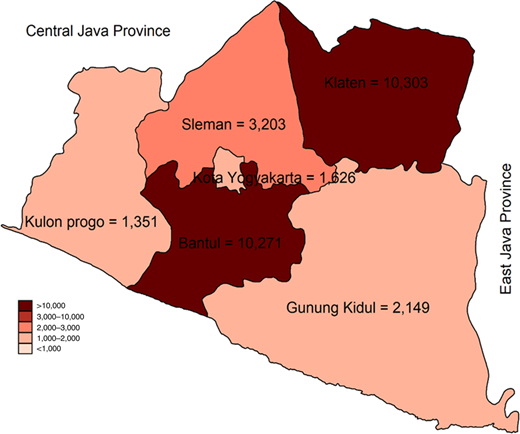
This study was conducted in Bantul and Sleman regencies in the province of Yogyakarta, Indonesia (see Figure 1). At 5:5 a.m. (local time) on May 27, 2006, both regencies were hit by a powerful earthquake measuring 5.9 on the Richter scale. The quake caused severe damage in both areas. The total number of deaths was massive at approximately 10,271 people in Bantul and 3,203 people in Sleman. The economic losses from the quake were estimated at US$3.3bn. The quake also left 779,287 people homeless. Women were the most vulnerable group during the Bantul and Sleman quake, accounting for 6,012 and 1,876 of the dead, respectively (National Disaster Management Agency, 2014). The earthquake also caused various social and economic problems among women such as an increased number of households headed by women, homelessness, lack of access to basic needs and increasing violence against women. More women had to live without their families, and this produced an increased risk of violence. Further, women’s unemployment created major economic issues. Women who were able to work had to accept low wages. Moreover, in the small business sector, women faced issues such as increasing debt and lack of financial credit and productive assets. Regarding physical vulnerability, disabled, pregnant and older women were severely affected. Most of them lacked access to the basic health services that they needed. Hence, PDR in both areas was purposed to address such vulnerabilities.
4. Research design and analytical approach
This research is focused on issues of gender mainstreaming and sustainable PDR in the Bantul and Sleman regencies of Yogyakarta Province. Hence, the unit of analysis of this study is strategies for mainstreaming gender into sustainable PDR in both affected regencies. Since women are a group whose concerns and interests remain to be mainstreamed within the context of PDR, this research chose women as the focus of gender mainstreaming.
4.1 Case study design
This research used an exploratory case study to explore how gender mainstreaming strategies were implemented in PDR contexts. As Yin (2009) explains, an exploratory case study is a suitable design that can facilitate the answering of the how and what questions of events within real-life contexts. Considering the specific context of PDR, gender mainstreaming practices, and the timescales of PDR implementation, the case of gender mainstreaming in PDR in the regencies of Bantul and Sleman, Yogyakarta Province, was selected.
Yin (2009) posits that using multiple sources of evidence is of particular importance in conducting an exploratory case study. Therefore, a data triangulation technique with the use of multiple sources of evidence was applied in this research. Ghauri and Grønhaug (2005) explain that triangulation involves using a combination of data collection techniques to prove a particular phenomenon within a study. The collection of data using different techniques can lead to a more accurate conclusion. Accordingly, in this study, the researcher used interviews, questionnaires and documentation to gather data regarding gender mainstreaming and sustainable PDR.
4.1.1 Procedures for interview data collection
The research used semi-structured interviews as the primary technique for collecting data. The semi-structured interviews were conducted with policy makers, implementers, beneficiaries and experts involved in PDR in both affected regencies. In total, 17 policy makers and implementers and 26 beneficiaries were interviewed. In semi-structured style interviews with policy makers and policy implementers, the discussions followed general questions such as: Why is mainstreaming gender during PDR important? What strategies were used to mainstream gender into reconstruction? In what ways can gender mainstreaming promote sustainable PDR? The interview guidelines for beneficiaries were prepared to capture information regarding the conditions for women and men during and after earthquake reconstruction, how gender issues were addressed during reconstruction and the impact of addressing and not addressing gender issues on the sustainability of reconstruction. Interviews with eight experts were also conducted to validate the research findings.
4.1.2 Procedures for survey data collection
Questionnaire surveys, as a supplement to the semi-structured interviews, were also conducted as part of the study. Two types of questionnaire surveys were used. First, the questionnaire survey for policy makers and policy implementers consisted of questions intended to investigate the benefits of gender mainstreaming. Second, the questionnaire survey for beneficiaries was used to investigate gender vulnerabilities and capacities during PDR, as well as the impact of addressing gender concerns on the social, economic and environmental dimensions of reconstruction sustainability in both affected regencies. Two different Likert scales were used to capture respondents’ opinions and behavioral determinants in this study. Throughout the analysis of the questionnaires, different values were assigned to each scale. The questionnaires were pre-tested before being distributed to the respondents to ensure the logical flow of questions and the respondents’ understanding of all of the questions.
The questionnaire surveys were not purposed for generalizing the findings; rather, they were conducted principally as a triangulation technique within the case studies. In total, 50 completed questionnaires for policy makers and implementers were returned within the two case studies with 25 per case, while 150 completed questionnaires for beneficiaries were returned within two case studies, with 50 for the Sleman reconstruction case and 100 for the Bantul reconstruction case. The number of women and men who returned questionnaires was relatively balanced.
4.2 Analytical approach
4.2.1 Content analysis
This study used content analysis to assess the semi-structured interviews (Schreier, 2012). The analysis was suitable as this research explores respondents’ views about various gender mainstreaming strategies and their benefits for enhancing sustainable PDR. As such, it requires in-depth inquiry about key informants’ attitudes and opinions about issues surrounding gender mainstreaming and sustainable PDR. Schreier (2012) states that content analysis can be time consuming due to the length of interviews. NVivo version 11 computer software was used to help with the analysis of the interview data.
4.2.2 One-sample t-test
Surveys were used as supplements to the interviews within both case studies. The surveys focused on analyzing the benefits of gender mainstreaming strategies under the three pillars of sustainable PDR. Likert scales were used to measure respondents’ answers. The survey data were analyzed using Stata software, Version 13.1. The researcher ensured that the data were entered with high accuracy (100 percent). The cleaning of the data was conducted by checking the existing outliers and missing data. The researcher checked thoroughly to ensure that any outliers and missing data were due to missing responses rather than to data entry errors.
The final data sets were then analyzed using descriptive statistics techniques and inferential statistics. First, mean values of the questionnaire data were used to identify benefits of mainstreaming gender into three indicators of sustainable PDR. Second, the one-sample t-test was used to examine whether some indicators of sustainable PDR were categorized as more important than other factors (Sirkin, 2006). This research used a mean score of ⩾4.00, which indicates that the respondent’s response is important or very important to the indicators, to determine that certain indicators were more important than others.
5. Data analysis and results
5.1 Strategies in mainstreaming gender
Based on interviews with key stakeholders, various strategies have been introduced for mainstreaming gender into PDR in Bantul and Sleman regencies. The strategies can be divided into those for reducing gender vulnerabilities and those for strengthening gender capacities. The qualitative findings presented in Tables I and II show various strategies that have been introduced for mainstreaming gender during PDR in both regencies. The two affected regencies have introduced the same strategies for reducing gender vulnerability as they were experiencing quite similar issues during the process of reconstruction. For example, to address women’s economic vulnerability, both regencies have introduced strategies such as protecting women from indebtedness and protecting women’s rights to productive assets. To reduce environmental vulnerability, both regencies have introduced strategies such as improving the availability of safe, clean water and sanitation, providing safe and secure housing reconstruction and maintaining public facilities. Strategies to reduce social vulnerability include providing health insurance, maintaining the Posyandu (a community-based, integrated health service) program, protecting women from sexual violence and abuse and providing social benefits for poor women and men.
The informants also report similarities in the gender mainstreaming strategies chosen to promote women’s and men’s capacities during reconstruction in the two regencies. For example, to enhance the economic capacities of both genders, both Bantul and Sleman have implemented strategies such as enlarging business markets, expanding job opportunities for women and men, funding and providing technical assistantships for small- and medium-sized enterprises (SMEs) and supporting community savings and credit institutions. With regard to the promotion of gender capacity in ensuring the environmental sustainability of reconstruction, both regencies have introduced strategies such as involving women and men in debris and salvage management, involving women and men in waste management, encouraging women’s leadership in the Kampong improvement program and mobilizing women in village labor. Regarding promoting women’s and men’s capacities to promote social sustainability, both regencies have implemented strategies such as empowering women’s and men’s groups in disaster response, involving women in village assemblies and providing disaster preparedness training for women and men.
5.2 Benefits of mainstreaming gender into sustainable PDR
The data from this study’s interviews and surveys with beneficiaries, policy makers and implementers generated relatively similar findings regarding the benefits of mainstreaming gender for achieving PDR in terms of economic, social and environmental sustainability in the two regencies. Table III presents the synthesis of interview findings, illustrating similar benefits of mainstreaming gender in the dimensions of sustainable PDR.
Table IV presents results from the combined data set of the responses of male and female beneficiaries as well as those of policy makers and implementers. The results show that poverty reduction, the growth of SMEs and increased job opportunities are the most important benefits. Regarding social sustainability, it appears that the strengthening of community social capital, improvements in education and health services, and increasing Posyandu are among the most important benefits. In terms of environmental sustainability, the respondents perceived that the expansion of areas with earthquake warning systems and friendly housing environments are among the most important benefits. Overall, the findings suggest that the acknowledgment and incorporation of women’s knowledge and experience within PDR are essential for enhancing sustainable PDR in the districts.
6. Discussion of results
Gender and built environment studies highlight that mainstreaming gender within PDR is required to enhance sustainable PDR (Enarson, 2014; Ginige et al., 2014; Bradshaw, 2015). The findings of this study confirm the benefits of mainstreaming gender in PDR within the context of economic, social and environmental sustainability. This study shows that gender mainstreaming strategies within the context of sustainable PDR should incorporate strategies not only for protecting against women’s vulnerabilities but also for promoting women’s capacities. Both strategies are required to create gender equality and women’s empowerment, both of which are fundamental to sustainable PDR. It is thus important to emphasize that this should be seen as a continuum and to balance any discussion with examples of capacities at the positive end (Blaikie et al., 2014; Smyth and Sweetman, 2015). The two case studies show relatively similar gender mainstreaming strategies to address gender vulnerability and to strengthen gender capacity. While strategies to address gender vulnerability are purposed to address economic, social, physical, political and cultural vulnerabilities, the strategies to strengthen gender capacity are purposed to promote women’s and men’s capacities to enhance sustainable PDR.
6.1 Gender mainstreaming strategies to achieve economically sustainable PDR
The findings suggest several strategies to reduce economic vulnerability. These include: protecting women’s right to productive assets by implementing productive assets rights, protecting unpaid women through an equal payment policy, protecting women from high domestic burdens and protecting women from indebtedness by providing inexpensive financial credit schemes and establishing a Grameen bank. Strategies to strengthen women’s economic capacities include the following: mobilizing and creating rotating savings and credit associations, and supporting women in agricultural markets and in creating and developing SMEs.
6.2 Gender mainstreaming strategies to achieve socially sustainable PDR
The findings highlight the following strategies to reduce social vulnerability: providing social benefits for poor women, providing a health insurance scheme for poor women, providing social assistance for women with inadequate social ties and providing alternative education for women and girls. Strategies to strengthen women’s social capacity include the strengthening of community social capital by improving the role of Posyandu and PKK (family welfare programs) in the PDR process.
6.3 Gender mainstreaming strategies to achieve environmentally sustainable PDR
The findings reveal several strategies to reduce environmental vulnerability, such as: providing shelters and centers for homeless women, providing secure and safe places for women and girls, and protecting women and girls from sexual abuse and violence. Strategies to strengthen women’s environmental capacities include: promoting women’s groups in waste and recycling management, promoting women’s groups in sustainable farming and food production, and strengthening women’s roles in creating a green environment.
7. Conclusion and implications of findings
Policy makers and implementers should integrate gender mainstreaming strategies to enhance sustainable PDR. The strategies should have two goals: protecting against gender vulnerabilities and promoting gender capacities. Both types of strategies are fundamental to the achievement of sustainable PDR. The relevant gender mainstreaming strategies for reducing gender vulnerability and for strengthening gender capacities can serve as lessons learned for policy makers and policy implementers in mainstreaming gender within PDR. This study establishes comprehensive strategies for mainstreaming gender under three pillars (i.e. economic, social and environmental) of sustainable development. The findings benefit relevant policy makers by aiding them in their efforts to improve policy performance of gender mainstreaming in the affected communities to enhance sustainable reconstruction.