


Information gaps hinder effective decision-making in minimizing construction waste (CW) in building projects. The existing literature has not sufficiently explored these gaps or the strategies to address them. This paper aims to investigate the critical reasons for these gaps and identify top-level strategies to bridge them, emphasizing their interrelationships during the building design stage to effectively minimize CW.
A survey inviting 30 experts from the Australian construction industry, each possessing over 15 years of experience and at least 8 years in waste minimization (WM). The survey yielded 15 responses for interpretive structural modelling (ISM), resulting in a 50% response rate. The qualitative evaluation prioritized specialist insights over quantity, in line with previous research. ISM facilitated the formation of a hierarchical model, while Matrice d’Impacts Croisés-Multiplication Appliquée à un Classement (MICMAC) analysis was employed to assess influencing factors.
The findings indicated that knowledge gaps, technical issues and collaboration challenges are significant reasons for existing information gaps in decision-making related to minimizing CW. Additionally, “gaps in information” and “time pressure” are primary drivers of these issues. Although “defining stakeholder engagement” emerged as a key strategy to bridge these gaps, it exhibits low driving power.
These research findings make significant contributions by identifying top-level reasons for information gaps and proposing strategies to mitigate them within the design decision-making process, ultimately aiming to minimize CW. Additionally, the article aspires to furnish both academia and practitioners with an intensive comprehension; utilizing ISM and MICMAC analysis unveils intricate interdependencies, thereby paving the way for a deeper understanding of these phenomena and fostering ongoing discourse in the realm of CW minimization research directly contributing towards populating novel concepts as net zero carbon practices. The study was limited to decision-making at the design stage of commercial buildings.
This study contributes novel insights to existing literature, offering valuable guidance to decision-makers during the design phase. Tailored strategies, aligned with specific considerations, furnish practical information to stakeholders within the design team, thereby enhancing the efficiency and effectiveness of decision-making processes. Ultimately, these contributions advance the building construction industry by facilitating the minimization of construction waste. The significance of integrating all findings to derive clear interpretations is highlighted, emphasizing the positive impact of interconnected strategies in addressing the overarching goal of waste minimization in construction projects.
This study contributes original insights by investigating critical reasons for information gaps and strategies to bridge them in building design decisions, enhancing decision-making processes in the construction industry through ISM and MICMAC methodologies.
1. Introduction
Information sharing plays a crucial role in the decision-making process of building construction projects, especially when it comes to minimizing construction waste (CW). The availability and accessibility of accurate information significantly influence the effectiveness of decisions regarding waste reduction strategies, ultimately determining the success of a project. When required information is not available, decision-makers are hindered in selecting the most appropriate CW minimization strategies, which can lead to suboptimal project outcomes (Lu et al., 2017; Wijewickrama et al., 2021a). Therefore, identifying the necessary information and ensuring its availability throughout the decision-making process is essential for achieving optimal CW minimization.
A major challenge in many construction projects is the presence of information gaps, where essential data is either missing, incomplete, or delayed. These gaps hinder effective decision-making, particularly in selecting suitable strategies for minimizing CW, thus impacting project sustainability and environmental goals (Onubi et al., 2020). Identifying these information gaps—distinguishing between the required information and what is currently available—is vital for improving the decision-making process. Existing literature identifies several reasons for these gaps, including poor communication, technical knowledge deficiencies, and misalignment between project stakeholders (Roba et al., 2018; Smithson and Ben-Haim, 2015). Such gaps are especially critical in the design phase of a construction project, as this phase sets the foundation for waste management practices throughout the entire construction lifecycle.
To address these information gaps, it is necessary not only to identify them but also to understand their underlying causes. Various factors contribute to information gaps, such as limited knowledge, technical challenges, and lack of collaboration among stakeholders (Hayes et al., 2013; Majidi et al., 2019). Understanding the reasons for these gaps, along with their interactions, is essential for developing strategies to bridge them and improve decision-making efficiency. This study aims to investigate the critical reasons behind information gaps in building design and propose strategies to address these gaps in the context of minimizing CW.
The study’s objectives encompass two main aspects. Initially, identifying critical reasons behind information gaps and developing strategies to address them. Subsequently, bridging these gaps during building construction design to minimize CW, while exploring interrelationships among reasons and strategies. In the initial phase of this study, a literature review was conducted to identify critical reasons for information gaps. Subsequently, semi-structured interviews were performed to uncover additional causes and strategies for addressing these gaps. Although this preliminary analysis is crucial, it is not extensively discussed here, as the focus is on examining the relationships between the identified reasons for information gaps and the corresponding strategies derived from thematic analysis. The authors employed NVivo 2020 to derive themes from the data, forming the study’s foundational basis; however, these themes are detailed in a separate manuscript in-progress. Although the process of theme generation is not discussed, the finalized themes (reasons for information gaps and strategies to bridge these gaps) are presented in Table 1. This preliminary work formed the basis for identifying top-level reasons and strategies through the current analysis. Therefore, the aim of this article is to explore the interrelationships among these themes while identifying the top-level reasons and strategies, grounding its analysis on the generated themes. Saka and Chan (2020) mentioned that previous studies often utilized traditional methods like mean score or Relative Importance Index (RII) to identify critical factors or strategies in construction projects. However, they overlooked exploring the interrelationships among these factors. In contrast, recent studies within the construction sector, have employed Interpretive Structural Modelling (ISM) and Matrice d'Impacts Croisés-Multiplication Appliquée à un Classement (MICMAC) methodologies (Onososen et al., 2022; Saka and Chan, 2020; Shrivas and Singla, 2022). These methodologies allow for the construction of hierarchical models that categorize and analyse the driving and dependent relationships between the factors influencing information gaps and the strategies needed to address them.
Themes: reasons for information gaps and strategies to bridge the information gap
| Reasons for information gaps | |
|---|---|
| R1 Gaps in the information itself | Missing information |
| Assuming information | |
| Non-availability of information in a timely manner | |
| Different levels of information quality | |
| Uncertainties | |
| R2 Knowledge gap | Lack of up-to-date knowledge of the design team about CW minimization methods |
| Lack of technical knowledge from the design team leading to sharing wrong information | |
| Lack of awareness of the design team regarding the benefits of CW minimization | |
| Design team members’ limited awareness of important information-sharing platforms | |
| R3 Technical issues | Issues with accessing information-sharing platforms due to lack of training and knowledgeability |
| The differences between the formats of the information and issues of compatibility of platforms in terms of sharing information | |
| R4 Issues of defining the roles and duties of the design team | Lack of support from the parties of the design team for planning, and managing the duties in the information-sharing process |
| Lack of clarity on roles and information-sharing responsibilities of the design team members | |
| Conflicts within the design team | |
| R5 Time pressure | Compromising the information quality and process of information sharing |
| Limited time allocated for the decision-making process | |
| R6 Lack of/issues of collaboration of the design team with other stakeholders | Limiting/restricting information sharing opportunities because of representing organization rules and ethics |
| Reluctance of the design team members to share information with other parties | |
| Collaboration issues with other stakeholders (eg: CW handlers, CW minimization experts, client, suppliers) | |
| Intervention of the client results in too many designs changes | |
| Lack of collaboration with suppliers (affects making decisions on material: availability, supply quantities, composition, new arrivals) | |
| Lack of supportiveness from the organizations to allocate funding to collaborative information-sharing platforms | |
| R7 Having no contractual obligation to share information within consultancy agreements | No design team member is bound by an agreement to share information (only share information with mutual understanding) |
| Strategies to bridge the information gaps | |
| S1 Improving the decision-making process to allow the inclusion of opinions from CW expertise/stakeholder perspectives | Following an effective decision-making process to select the best from the options |
| Create an environment to share team members’ previous experiences on CW minimization | |
| Define the time frame for the design stage decision-making process | |
| S2 Outsourcing CW-related specialists to share CW statistics for building projects | Enhance the collaboration with CW management companies |
| S3 Defining stakeholder engagement | Develop practice guidelines for design team members to define responsibilities in the design stage CW minimization |
| Clear assignment of roles | |
| S4 Initiating government incentives for projects practising CW minimization | Motivation to achieve CW minimization goals |
| S5 Introducing user-friendly information management and sharing systems | Invest in and improve a wide range of information technology systems to work collaboratively |
| Train professionals to be familiar with modern information-sharing platforms | |
| Conducting awareness programmes to highlight the benefits of CW minimization and the importance of information sharing toward that | |
| Provide accessibility to industry collaborative information platforms/published research outcomes databases to update the knowledge on CW minimization | |
| S6 Improving the information flow | Establishing a mechanism to transfer the feedback/experiences from the actual CW waste handlers |
| Involving/engaging suppliers at the design stage by selecting a suitable procurement strategy to obtain valuable information to improve the decision-making process for minimizing CW | |
| Establish procedures to verify the accuracy of information sharing among the design team | |
| S7 Design improvements | Standardization of design to improve buildability |
| Increased use of off-site prefabrication to control waste and damage | |
| Avoid over-specification of materials to ensure fewer difficulties in sourcing | |
| S8 Alliancing and collaboration | Having an idea of supplier flexibility in supplying materials (e.g. in providing smaller quantities of materials) |
| Educate clients about measures to reduce waste levels | |
| S9 Contractual aspects | Formalise contractual clauses of the design team members to enhance collaboration within the design team |
Source(s): (Ajayi et al., 2017 R2, R7; Akinade et al., 2018 S3, S4, S5, S6; Hamzeh et al., 2017 S2, S4, S7, S9; Pirzadeh et al., 2020 R1, R3, R7; Porwal et al., 2020 R2, R4, R5, R6; Tan et al., 2021S1, S2, S4, S6; Vo-tran and Kanjanabootra, 2013 S4, S7, S8, S9; Wijewickrama et al., 2021 R1, R3, R5, R6, R7; Wijewickrama et al., 2021a R3, R4, R6)
Effective information sharing during the design phase is essential not only for minimizing CW but also for supporting broader sustainability goals, such as achieving net-zero carbon emissions. By addressing information gaps and ensuring that decision-makers have the right data, it becomes easier to select the most effective strategies for CW reduction. These strategies typically focus on improving energy efficiency, using renewable energy sources, and adopting sustainable materials—key measures that reduce both operational and embodied carbon in buildings (Futuremadeinaustralia.gov.au, 2024). By optimizing decision-making during the design phase, progress toward net-zero carbon goals can be accelerated, demonstrating the importance of identifying and resolving information gaps.
This study is particularly valuable because it fills a critical gap in the literature by examining the reasons for information gaps and their impact on CW minimization strategies in the design phase. While previous research has focused on waste management practices, limited attention has been paid to identifying and addressing the underlying reasons for information gaps, which are fundamental to improving decision-making. By employing advanced methodologies like ISM and MICMAC, the study provides a robust framework for understanding how these gaps and strategies are interconnected, offering valuable insights into their relationships. This research contributes to the field by improving decision-making processes in construction projects and advancing the broader sustainability goals of the industry.
2. Literature review
2.1 Importance of information in decision making process of building construction projects towards minimizing CW
CW poses environmental and economic challenges, impacting project goals. Research focuses on sustainable practices like on-site waste management, material reuse, waste estimation, and recycling to mitigate these impacts and promote efficient construction practices amid environmental concerns and rising costs (Wang et al., 2019). The 3 R strategies (reduce, reuse, recycle) for CW are hierarchically organized, with waste reduction being the most effective and cost-efficient approach. It prevents CW generation, reduces costs, and mitigates environmental impacts, emphasizing the necessity of holistic waste minimization (WM) for sustainable development (Ding et al., 2018).
Within the process of CW minimization, concentrating on the generation of waste is significant (Jayasinghe et al., 2019). Even though waste is generated throughout the construction project phases, about one-third of CW arises from design decisions (Sáez et al., 2019). Proper strategies to avoid waste through the decisions at the design stage are, therefore, a fundamental step concerning accomplishing WM of the projects at the minimum cost because the traditional design process makes little consideration of the impact of design decisions on the amount of physical waste produced at the construction stage (Mahinkanda et al., 2023). Enhancing decision-making in building design is paramount, as it relies on accurate and comprehensive information. This research identifies necessary information through literature and expert opinions, covering materials, regulations, preparation, supply chain, site details, and waste generation data. Comprehensive information supports decision-making theories, especially crucial in building construction projects, ensuring informed choices and effective outcomes throughout the design stage (Govindan et al., 2016; Mahbub, 2015; Mdallal and Hammad, 2019; Mhatre et al., 2021). Insufficient information leading to gaps necessitates effective bridging for successful design decision-making (Horita et al., 2017). Identifying gap causes precedes strategy formulation. This study has already identified these causes, alongside nine primary strategies derived from initial research and existing literature. Table 1 summarizes the gaps and their explanations, providing a comprehensive overview to facilitate informed decision-making in the design process.
Information gaps in CW minimization hinder sustainable practices, arising from missing, delayed, or inconsistent information, and reflecting deficiencies in data management and dissemination. A key issue is the design team’s limited technical knowledge on CW minimization, which affects decision-making and project efficiency. This is compounded by inadequate training, technological barriers, and incompatible information-sharing platforms. Structural challenges, such as unclear roles, conflicts, and inadequate support for information-sharing, undermine collaboration, while time pressures force rushed decisions, lowering information quality. Additionally, restrictive organizational policies and limited supplier engagement weaken collaboration across the value chain. To bridge these gaps, strategies like stakeholder-inclusive decision-making, outsourcing CW specialists, and leveraging government incentives are essential. User-friendly information management systems, standardized processes, and formalizing contractual obligations can improve collaboration, waste reduction, and accountability, transforming these gaps into opportunities for more sustainable CW minimization and improved project outcomes.
3. Research methodology
3.1 ISM and MICMAC approach for identifying the intricate relationships among variables
The ISM technique, introduced by Warfield (1974), provides a method for analysing complex systems by breaking them down into subsystems using expert knowledge and experience. Emphasizing the quality and depth of responses over quantity, ISM typically requires input from a small group of knowledgeable experts, sometimes as few as two participants (Ravi and Shankar, 2005). This method necessitates a smaller pool of respondents compared to conventional surveys (Onososen and Musonda, 2022). The ISM technique has been widely used to examine intricate systems in various fields, including the construction sector, due to its effectiveness in modelling hierarchical relationships among variables and clarifying their driving and dependency dynamics (Kumar and Purbey, 2018).
The MICMAC technique was developed by Duperrin and Godet (1973). MICMAC involves categorizing variables based on their levels of driving and dependence power, offering a structured method for analysing complex systems. Therefore, through modelling the hierarchical relationships among variables, identifying the driving and dependence power between them, and categorizing variables based on their driving and dependence power, researchers can achieve a comprehensive understanding by employing both ISM and MICMAC in a study, thereby paving the way for a deeper understanding. By combining these two techniques, researchers can gain a deeper understanding of the underlying structure and dynamics of the variables under study. This holistic perspective is valuable for making informed decisions and designing effective interventions or strategies. Additionally, employing both ISM and MICMAC can help in validating the results obtained from each technique independently (Attri et al., 2013). By comparing and cross-referencing the findings from both techniques, researchers can ensure the robustness and reliability of their analysis, thus enhancing the credibility of their research outcomes.
3.2 Demographic distribution of experts
The study invited 30 Australian construction industry experts to participate in an ISM survey via email, with 15 completing the questionnaire. Ultimately, 15 experts completed the questionnaires, having been selected based on their extensive experience in the construction industry as specified above. The 50% response rate was partially attributed to the complexity of the ISM survey form, necessitating additional explanations from the researchers and consuming respondents’ time. Experts were chosen based on extensive industry experience (over 15 years), including architects, engineers, and QSs, and involvement in WM (over 8 years). Specifically, convenience and snowball sampling techniques within the framework of non-probability sampling were employed to ensure a robust and representative sample size. This approach aligns with prior investigations in construction management research, exemplified by the works of Akbari Ahmadabadi and Heravi (2019) and Mao et al. (2015). Snowball sampling is preferred when it is difficult to get responses from some sample members who are chosen randomly (Sekaran and Bougie, 2016). Müller and Turner (2007) conducted a study examining the influence of project managers on project success using this sampling method which was subsequently adopted by Liu et al. (2018) to analyse risk pathways in construction projects. Nevertheless, an ISM application necessitates a comparatively smaller pool of respondents compared to conventional surveys (Onososen, 2022; Saka and Chan, 2020). There is no consensus on the requisite number of respondents for ISM in existing literature. Ravi and Shankar (2005) and Mitra Debnath and Shankar (2012) engaged with two experts each, Shen et al. (2016) and Liu et al. (2018) collaborated with five experts each, and Ahuja et al. (2017) consulted with seven experts. Given the novelty of the concepts in design stage decision-making towards CW, this method was considered suitable for evaluating the identified factors as this approach prioritizes the expertise and experiential insights of the specialists rather than the quantity of respondents (Saka and Chan, 2020). The focus of the method is on the quality of the responses and not on the quantity of the respondents, thus, a few knowledgeable and experienced experts are often needed for the survey, which can be as few as two (Ravi and Shankar, 2005).
3.3 ISM approach
ISM is a well-established data analysis method for identifying relationships between various factors within a complex system. Researchers have increasingly used this approach to examine the interrelationships between factors associated with a problem. According to Attri et al. (2013), ISM is “a process aimed at assisting the human being to better understand what he/she believes and to recognize clearly what he/she does not know” (p. 1171). In this study, ISM was employed to identify relationships among the “reasons for information gaps,” developed during the initial stage of data analysis, and to analyse strategies to bridge these gaps.
ISM offers a valuable approach to investigate the interrelationships within a system, providing insights into both direct and indirect relationships among its factors. As noted by Saka and Chan (2020), this method breaks down complex systems into distinct subsystems with the help of expert knowledge. This allows for the creation of a multi-level structural model that clearly elucidates intricate relationships. The rationale for adopting ISM in this study lies in its effectiveness for exploring complex systems, helping to identify reasons for information gaps and strategies to overcome them. ISM’s reliance on expert experience and the quality of responses, rather than the quantity, aligns with the study’s needs, where expert availability is limited, and traditional survey methods are challenging (Saka and Chan, 2020). There are limited number of experts in the field who can provide practical knowledge on strategies for waste minimization (Wijewickrama et al., 2021a). Therefore, ISM was a suitable choice for this research According to Saka and Chan (2020), the ISM methodology involves two main steps: establishing a hierarchical structure between variables and assessing their driving-power and dependence-power.
3.4 MICMAC analysis
Following the utilization of the ISM technique to gather findings, the subsequent phase of the study involved employing the MICMAC technique. The objective of this analysis was to assess the driving and dependent capabilities of the identified factors. These factors were categorized into autonomous, dependent, linkage, and independent categories utilizing the concepts of dependence power and driving power (Rana et al., 2022; Saka and Chan, 2020; Shaik and Dhir, 2021; Shrivas and Singla, 2022). Within this study, an exploration was conducted into the interrelationship between each reason for causing the information gaps and each strategy to bridge identified gaps.
4. Results
4.1 Structural self-interaction matrix (SSIM)
The questionnaire respondents identified and determined the dynamic of “reasons for the information gaps” and “strategies to bridge the information gap” separately in the given section of the questionnaire (i and j) respectively as per the given instructions with four symbols (V, A, X and O), which implies:
V = “Reason/Strategy i” aids in influencing “Reason/Strategy j”, but “Reason/Strategy j” does not affect “Reason/Strategy i”
A = “Reason/Strategy j” aids in influencing “Reason/Strategy i” while “Reason/Strategy j”is unaffected by “Reason/Strategy i”.
X = “Reason/Strategy i” aids in influencing “Reason/Strategy j”, and vice versa.
O = “Reason/Strategy i” and “Reason/Strategy j” are unrelated
Note:
i for vertical IDs
j for horizontal IDs
The present study presents the findings derived from a collection of 15 questionnaire responses, which have been consolidated into a table called structural self-interaction matrix (SSIM), separately for reasons for information gaps and strategies to bridge the existing information gap. The aggregation process employed in this research aims to mitigate subjectivity by following the principle of “Minority gives way to the majority,” as previously advocated by Saka and Chan (2020).
4.2 Initial reachability matrix
As a subsequent procedure, the SSIM underwent a transformation into an initial reachability matrix through the application of the following principles. The reachability matrix, a binary representation capturing directed associations among variables, was constructed by assigning values of 1 and 0 instead of the V, A, X, and O relationships. Therefore, at this step, the SSIM was converted into a preliminary reachability matrix and those matrices are prepared from the SSIM of “reasons for the information gaps” and “strategies to bridge the information gap”.
If the cell entry is:
V in SSIM, cell i, j will be 1 and cell j, i will be 0
A in SSIM, cell i, j will be 0 and cell j, i will be 1
X in SSIM, cell i, j will be 1 and cell j, i will be 1
O in SSIM, cell i, j will be 0 and cell j, i will be 0
4.3 Final reachability matrix
The final reachability matrix in ISM integrates transitivity assumptions, essential for variable relationships. Manual verification or loop statements are error-prone and time-consuming. Employing a Python function ensures accuracy, as illustrated in Figure 1, enhancing efficiency in evaluating reasons or strategies.
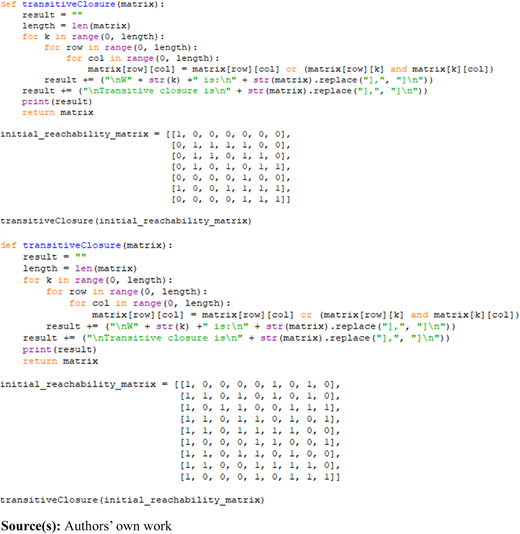
Python functions for checking the transitivity and to derive the final reachability matrix
Python functions for checking the transitivity and to derive the final reachability matrix
4.4 Hierarchical structure of the “reasons for information gaps” and “strategies to bridge the information gap”
This study utilizes a methodological approach to analyse the “reasons for information gaps” in distinct levels, involving the identification of reachability, antecedent, and intersection sets for each reason. The process employs the final reachability matrix, where the reachability set encompasses the reason itself and related factors with a value of 1 in the corresponding row, while the antecedent set includes factors with a value of 1 in the corresponding column. The intersection set comprises common elements from both sets. Results are presented in Table 2, showcasing these sets for all identified reasons. “Reasons” sharing identical sets are categorized under the same level. Consequently, R2, R3, R4, R6, and R7 are classified as level 1 due to their identical reachability and intersection sets.
Level 1, 2 and 3 of the hierarchical structure of the “reasons for the information gaps” using the final reachability matrix
| Reason for the information gap | Reachability set | Antecedent set | Intersection | Level |
|---|---|---|---|---|
| R1 | 1 | 1, 2, 3, 4, 6, 7 | 1 | |
| R2 | 1, 2, 3, 4, 5, 6, 7 | 2, 3, 4, 6, 7 | 2, 3, 4, 6, 7 | 1 |
| R3 | 1, 2, 3, 4, 5, 6, 7 | 2, 3, 4, 6, 7 | 2, 3, 4, 6, 7 | 1 |
| R4 | 1, 2, 3, 4, 5, 6, 7 | 2, 3, 4, 6, 7 | 2, 3, 4, 6, 7 | 1 |
| R5 | 0 | 2, 3, 4, 6, 7 | ||
| R6 | 1, 2, 3, 4, 5, 6, 7 | 2, 3, 4, 6, 7 | 2, 3, 4, 6, 7 | 1 |
| R7 | 1, 2, 3, 4, 5, 6, 7 | 2, 3, 4, 6, 7 | 2, 3, 4, 6, 7 | 1 |
| R1 | 1 | 1 | 1 | 2 |
| R5 | 0 | |||
| R5 | 0 | 3 |
Source(s): Authors’ own work
After categorizing level 1 of the hierarchical structure, “2,3,4,6,7” were erased from the subsequent iteration entirely as demonstrated in Table 3. The same procedure, which was used in categorizing level 1 of the “reasons for the information gaps” in the hierarchical structure, was followed in categorizing the levels 2 and level 3 as illustrated in the following part of Table 2.
Level 1 and 2 of the hierarchical structure of the “strategies” using the final reachability matrix
| “Strategies” to address the information gap | Reachability set | Antecedent set | Intersection | Level 1 |
|---|---|---|---|---|
| S1 | 1, 2, 4, 5, 6, 7, 8, 9 | 1, 2, 3, 4, 5, 6, 7, 8, 9 | 1, 2, 4, 5, 6, 7, 8, 9 | |
| S2 | 1, 2, 4, 5, 6, 7, 8, 9 | 1, 2, 3, 4, 5, 6, 7, 8, 9 | 1, 2, 4, 5, 6, 7, 8, 9 | |
| S3 | 1, 2, 3, 4, 5, 6, 7, 8, 9 | 3 | 3 | 1 |
| S4 | 1, 2, 4, 5, 6, 7, 8, 9 | 1, 2, 3, 4, 5, 6, 7, 8, 9 | 1, 2, 4, 5, 6, 7, 8, 9 | |
| S5 | 1, 2, 4, 5, 6, 7, 8, 9 | 1, 2, 3, 4, 5, 6, 7, 8, 9 | 1, 2, 4, 5, 6, 7, 8, 9 | |
| S6 | 1, 2, 4, 5, 6,7, 8, 9 | 1, 2, 3, 4, 5, 6, 7, 8, 9 | 1, 2, 4, 5, 6, 7, 8, 9 | |
| S7 | 1, 2, 4, 5, 6, 7, 8, 9 | 1, 2, 3, 4, 5, 6, 7, 8, 9 | 1, 2, 4, 5, 6, 7, 8, 9 | |
| S8 | 1, 2, 4, 5, 6, 7, 8, 9 | 1, 2, 3, 4, 5, 6, 7, 8, 9 | 1, 2, 4, 5, 6, 7, 8, 9 | |
| s9 | 1, 2, 4, 5, 6, 7, 8, 9 | 1, 2, 3, 4, 5, 6, 7, 8, 9 | 1, 2, 4, 5, 6, 7, 8, 9 |
| “Strategies” to address the information gap | Reachability set | Antecedent set | Intersection | Level 2 |
|---|---|---|---|---|
| S1 | 1, 2, 4, 5, 6, 7, 8, 9 | 1, 2, 4, 5, 6, 7, 8, 9 | 1, 2, 4, 5, 6, 7, 8, 9 | 2 |
| S2 | 1, 2, 4, 5, 6, 7, 8, 9 | 1, 2, 4, 5, 6, 7, 8, 9 | 1, 2, 4, 5, 6, 7, 8, 9 | 2 |
| S4 | 1, 2, 4, 5, 6, 7, 8, 9 | 1, 2, 4, 5, 6, 7, 8, 9 | 1, 2, 4, 5, 6, 7, 8, 9 | 2 |
| S5 | 1, 2, 4, 5, 6, 7, 8, 9 | 1, 2, 4, 5, 6, 7, 8, 9 | 1, 2, 4, 5, 6, 7, 8, 9 | 2 |
| S6 | 1, 2, 4, 5, 6, 7, 8, 9 | 1, 2, 4, 5, 6, 7, 8, 9 | 1, 2, 4, 5, 6, 7, 8, 9 | 2 |
| S7 | 1, 2, 4, 5, 6, 7, 8, 9 | 1, 2, 4, 5, 6, 7, 8, 9 | 1, 2, 4, 5, 6, 7, 8, 9 | 2 |
| S8 | 1, 2, 4, 5, 6, 7, 8, 9 | 1, 2, 4, 5,6, 7, 8, 9 | 1, 2, 4, 5, 6, 7, 8, 9 | 2 |
Source(s): Authors’ own work
An analytical framework is employed to classify strategies addressing information gaps. Herein, the same approach has been explained under the level separation for the “reasons for information gaps.” It was utilized to identify reachability, antecedent, and intersection sets for each strategy using a final reachability matrix. Table 3 presents these sets for all strategies, aiding structured analysis. Strategies with identical sets are designated to the same level. Strategy S3 is classified as level 1 due to congruence between reachability set “3” and intersection set “3”, as depicted in Table 3.
After categorizing level 1 of the hierarchical structure, “3” was deleted from the next iteration completely. The same procedure, which was used in categorizing level 1 of the “strategies for addressing the information gaps” in the hierarchical structure, was followed in categorizing the levels 2.
4.5 MICMAC analysis
4.5.1 Reasons for the information gaps
The MICMAC analysis was employed to identify the dependence power and driving force attributed to each reason. Dependence power is determined by aggregating the values within a row corresponding to a particular reason in the final reachability matrix, while driving power is calculated by summing the values within a column representing a reason in the same matrix.
Autonomous category: Reasons demonstrate limited driving force and weak interdependence, indicating loose connections within the system.
Linkage category: Entities show pronounced agency and interdependence, with interventions leading to ripple effects and feedback loops. Reasons such as “knowledge gap” and “technical issues” fall into this category, emphasizing their significance and interconnected nature.
Dependent category: Reasons exhibit robust dependence power but limited driving power.
Independent category: The identified reasons exhibit significant driving power but limited dependence. Key factors, such as “gaps in information” and “time pressure,” strongly drive information gaps in decision-making for minimizing CW, typically classified as independent or linkage categories per MICMAC analysis
This is used to partition the reasons in a two-dimensional diagram (diagraph) as shown in Figure 2.
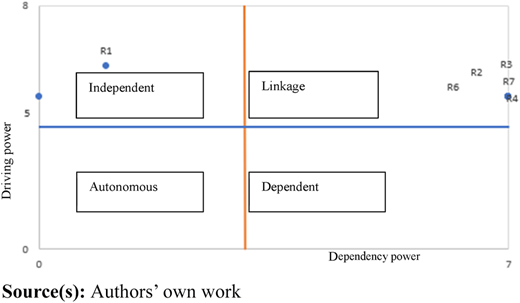
Diagraph and MICMAC analysis for “reasons for the information gaps”
Diagraph and MICMAC analysis for “reasons for the information gaps”
Independent factors such as R1 – “Gaps in the information itself” and R5 – “time pressure” exhibit high driving powers, dominating the analysis. Additionally, factors R2, R3, R4, R6, and R7 demonstrate both high dependence and high driving powers, forming linkages between dependent and independent factors. Variables in this quadrant exhibit dynamic behaviour, where actions on one variable impact others and themselves. No variable falls in quadrants 1 and 2, while all seven variables fall in quadrants 3 and 4, indicating strong driving power. These variables are crucial, as changes in any of them influence others.
4.5.2 Strategies to bridge the information gap
The MICMAC analysis elucidates the dynamics of dependence power and driving force across strategic avenues. Dependence power reflects a strategy’s reliance on other components, and in contrast, driving power showcases a strategy’s capacity to influence and advance initiatives The categorization for “strategies” was visualized in Figure 3, utilizing dependence and driving power:
Autonomous quadrant: Factors with minimal influence and interdependency, termed autonomous, had no identified strategies.
Dependent quadrant: Factors with low driving power yet significant dependency, including one factor (S3).
Linkage quadrant: Factors with high driving power and considerable dependency, encompassing remaining strategies, extending toward the independent quadrant boundary.
Independent quadrant: Factors with substantial driving power but limited dependency, with no strategies identified in this study.
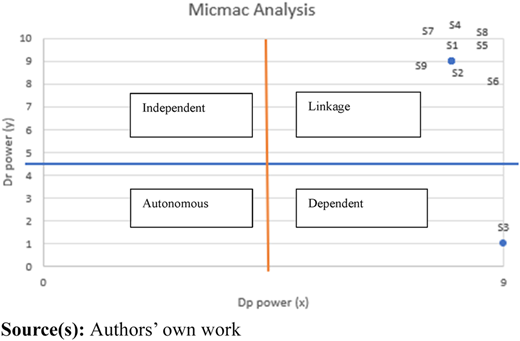
Diagraph and MICMAC analysis: strategies to bridge the information gap
Diagraph and MICMAC analysis: strategies to bridge the information gap
5. Discussion
The reasons for these existing information gaps affecting the effective outcome of CW minimization decisions have not been well identified, despite there still being gaps in the required information. With the emerging building designs and studies on enhancing the decision-making process, it has not been well identified the reasons for these existing information gaps affecting the effective outcome of CW minimization decisions.
5.1 Reasons for information gaps
The identification of reasons for information gaps affecting the effectiveness of CW minimization decisions is a crucial aspect of this study. While the existing literature has highlighted information gaps, there remains a lack of detailed analysis regarding the specific factors that hinder effective decision-making in CW minimization. This study fills this gap by identifying key reasons for these information gaps, which include knowledge deficiencies, technical challenges, and collaboration difficulties. The findings support previous research by Goulart Coelho et al. (2017) and Wu et al. (2022), which emphasize that information gaps often arise due to project-related characteristics such as the complexity of the design process and the insufficient sharing of critical information among stakeholders.
To effectively address these information gaps, it is essential to mitigate the project-related challenges that affect decision-making during the design stage. Enhancing team knowledge on CW minimization practices and improving awareness of information-sharing platforms can significantly reduce knowledge gaps. Furthermore, developing technical knowledge, promoting collaboration among design team members, and clarifying roles and responsibilities are key actions that can bridge these gaps at the design stage. These strategies align with findings from Tan et al. (2021), who highlighted the importance of formalized communication channels and team coordination in reducing CW.
The study also identifies that “gaps in information” and “time pressure” play significant roles as drivers behind other information gaps. The findings reinforce conclusions by Alqahtani and Whyte (2016) that time pressure, particularly during critical phases of construction, leads to rushed decisions and poorer information quality. To bridge the information gap at this level, it is crucial to avoid assumptions, delays, and low-quality information while minimizing uncertainty. This is particularly relevant as the study’s MICMAC analysis categorizes these reasons as independent and with high driving power, indicating their central role in influencing other factors as indicated in Figure 4.
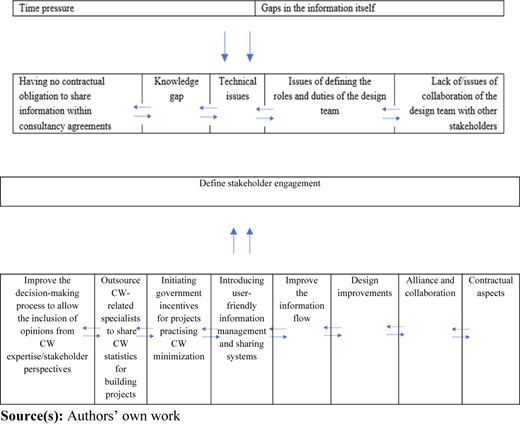
Graphical illustration of driving power and dependence power of reasons and strategies
Graphical illustration of driving power and dependence power of reasons and strategies
5.2 Strategies to bridge the information gaps
The study builds upon existing literature by aligning strategies to bridge information gaps with the identified reasons for these gaps in CW minimization decision-making. Previous studies, such as those by Akmam et al. (2018), have emphasized the importance of team collaboration and new information-sharing platforms in reducing information gaps. The findings of this study corroborate these strategies and offer a deeper understanding of how they can be implemented to improve decision-making during the design phase. The ISM approach identified and categorized these strategies into a two-level hierarchical structure, with “defining stakeholder engagement” emerging as the most crucial strategy. This aligns with the work of Saka and Chan (2020), who noted that defining stakeholder roles and promoting communication is essential for ensuring that all relevant information is available to decision-makers.
MICMAC analysis further categorized the strategies, emphasizing that stakeholder engagement, while critical, depends on other strategies to be fully effective. The findings indicate that, although stakeholder engagement has low driving power, it can be positively influenced by other strategies such as improving decision-making processes, outsourcing CW specialists, and initiating government incentives. This insight extends the work of Onubi et al. (2020), who suggested that collaboration with external specialists and stakeholders can enhance the adoption of effective waste minimization strategies. The study highlights the importance of improving information management systems to facilitate better collaboration and sharing of knowledge, a strategy that is consistent with findings from Majidi et al. (2019) on the role of technology in facilitating decision-making in construction projects.
The study contributes novel insights to existing literature by providing practical, actionable strategies for bridging information gaps, particularly in the context of CW minimization. These strategies, when implemented effectively, have the potential to significantly enhance the decision-making efficiency and effectiveness of design teams. This research advances the building construction industry by providing a clearer path toward minimizing CW, ultimately contributing to more sustainable practices. The integration of these strategies into building design processes offers a valuable contribution to the literature on sustainable construction practices.
Compared to existing literature, the use of ISM and MICMAC methodologies in this study is highly appropriate for analysing the complex relationships involved in CW minimization. These methods provide a structured framework for understanding the interdependencies among various factors affecting CW decisions. However, the study’s reliance on expert knowledge introduces potential subjectivity, which may affect the generalizability of the findings. The sample size of 15 experts, while adequate for a ISM analysis, may not fully capture the diversity of perspectives within the broader construction industry. Furthermore, the lack of empirical validation in real-world projects challenges the external validity of the proposed model. Despite these limitations, the study provides strong practical applications, offering valuable insights into strategies like stakeholder engagement and improved information-sharing systems, which can guide decision-makers in enhancing CW minimization efforts. Future research should expand on these findings by testing the model in diverse construction contexts and employing various methods to validate its effectiveness across a broader range of projects.
This study’s insights into bridging information gaps not only contribute to academic knowledge but also offer practical guidance for the construction industry. By focusing on the interrelationships between reasons and strategies, the research provides a solid foundation for further empirical investigations. Future studies should validate these findings through larger-scale research and explore the long-term impact of implementing these strategies on CW minimization and sustainability efforts in construction. These efforts would ensure the broader applicability and effectiveness of the proposed model across various construction projects and help foster more effective waste reduction practices in the industry.
6. Conclusion
This study highlights the critical importance of addressing information gaps in building construction projects, especially in the context of CW minimization. The research identifies several key reasons for these gaps, including knowledge deficiencies, technical challenges, and collaboration issues, with “gaps in information” and “time pressure” being the primary drivers. Through the use of ISM and MICMAC analyses, the study not only uncovers the interconnected nature of these factors but also offers strategies to mitigate them. These strategies include stakeholder engagement, outsourcing CW specialists, and leveraging government incentives, all of which play crucial roles in improving decision-making and promoting sustainable construction practices. However, it is noted that stakeholder engagement, despite being a key strategy, is influenced by other strategies due to its relatively low driving power, emphasizing the need for integrated approaches in tackling these information gaps.
The findings of this study provide significant theoretical and practical contributions. From a theoretical perspective, the research contributes a novel framework that deepens our understanding of the interrelationships between information gaps and the strategies designed to bridge them, thereby enhancing decision-making processes in building design aimed at CW minimization. This framework, grounded in ISM and MICMAC methodologies, serves to advance academic knowledge on the role of information sharing and decision-making in construction management. Practically, the study offers actionable insights for construction design teams, showing how better information sharing and collaboration can lead to more effective waste management strategies and help align construction projects with net-zero carbon goals. By addressing critical drivers such as knowledge gaps and time pressure, the research underscores the importance of clear communication and structured decision-making processes in achieving sustainable construction outcomes.
In terms of future research directions, the study emphasizes the need for empirical validation of the proposed model. While the ISM and MICMAC methodologies provide valuable insights, the reliance on expert knowledge in these approaches may introduce some subjectivity, which could limit the generalizability of the results across different project contexts. Future studies should therefore focus on testing the model in real-world settings with a larger sample size to evaluate the applicability of the identified gaps and strategies across diverse construction projects. Moreover, the integration of quantitative methodologies such as multi-criteria decision-making (MCDM) frameworks could further refine the model and strengthen theory-building efforts in this area. Longitudinal studies could also be conducted to assess the long-term impact of bridging information gaps on CW minimization and sustainability efforts, thereby providing a deeper understanding of the lasting benefits of improved information sharing.
This research represents a significant contribution to both the academic field and the construction industry, offering a practical framework that enhances decision-making in CW minimization. The study provides a foundation for further empirical research and highlights the value of addressing information gaps in achieving sustainable construction practices. As the industry moves toward net-zero carbon goals, the integration of effective waste management strategies, as proposed in this study, will play a crucial role in advancing both environmental and economic sustainability in construction projects. It is recommended that construction industry stakeholders prioritize investment in information-sharing platforms, stakeholder training, and collaborative decision-making processes to bridge identified gaps and foster more sustainable practices in future projects.
The authors would like to acknowledge the Australian government’s financial support through an Australian Government Research Training Program (RTP) Scholarship for PhD studies and support from the University of South Australia.

