Artificial Intelligence (AI) is a growing technology impacting several business fields. The agricultural sector is facing several challenges, which may be supported by the use of such a new advanced technology. The aim of the paper is to map the state-of-the-art of AI applications in agriculture, their advantages, barriers, implications and the ability to lead to new business models, depicting a future research agenda.
A structured literature review has been conducted, and 37 contributions have been analyzed and coded using a detailed research framework.
Findings underline the multiple uses and advantages of AI in agriculture and the potential impacts for farmers and entrepreneurs, even from a sustainability perspective. Several applications and algorithms are being developed and tested, but many barriers arise, starting from the lack of understanding by farmers and the need for global investments. A collaboration between scholars and practitioners is advocated to share best practices and lead to practical solutions and policies. The promising topic of new business models is still under-investigated and deserves more attention from scholars and practitioners.
The paper reports the state-of-the-art of AI in agriculture and its impact on the development of new business models. Several new research avenues have been identified.
1. Introduction
Artificial intelligence (AI) is a growing technology that is attracting the interest of both academics and practitioners (Arora et al., 2022). Several definitions of AI have been given periodically, redefining the concept according to the latest advancements. In one of the earliest definitions, Kok et al. (2002, p. 2) called it “an area of study in the field of computer science concerned with the development of computers able to engage in human-like thought processes such as learning, reasoning, and self-correction.”
Today, AI is widely employed in several fields, and its applications are progressing, becoming more precise and performant, including manufacturing (Bagnoli et al., 2022), healthcare (Cobianchi et al., 2023; Loftus et al., 2020), banking and finance (Doumpos et al., 2023), aviation (Kulida and Lebedev, 2020) and hospitality (Goel et al., 2022). Among its several applications, AI is being employed in the agricultural field as well, with the aim of improving yield, efficiency and profitability (Dal Mas et al., 2023) and developing economic forecasts (Chu et al., 2019; Lebelo et al., 2022). AI in the agricultural sector includes innovative technologies such as field sensors, drones, farm management software tools, automated machinery and water and fertilizer management solutions (Arora et al., 2022; Misra et al., 2022; Romanello and Veglio, 2022; Trivelli et al., 2019). In this category, new innovative farming techniques such as vertical farming (Biancone et al., 2022; Musa and Basir, 2021; Saad et al., 2021), aquaculture, insect breeding and precision agriculture can be included (Dal Mas et al., 2023; Trivelli et al., 2019).
AI in agriculture can play a strategic role. Indeed, at a global level, the agricultural sector has a value of 3,6 trillion dollars, providing the 4% of the global gross domestic product (GDP) with a stable measure during the last twenty years. Moreover, in some developing countries, it accounts for more than 25% of GDP (FAO, 2022). Such a critical industry stands as a food and energy base of the new economy, mainly because it ensures food security (Magasumovna et al., 2017).
Still, various implicit problems have been historically challenging the agricultural sector. The first of such issues is undoubtedly the number of workers which is significantly collapsed with a progressive difficult-to-employ workforce. For instance, between 2000 and 2022, the global workforce employed in agriculture collapsed from 40% to 27%, representing a reduction of 177 million people (FAO, 2022). These data underline the technological impact in this field in the last century, with a food production increment per person less than proportional with the population growth; this previous more than doubled between 1950 and 1998 (Sunding and Zilbermanof, 2001). In the last years, there has been a similar trend with an increasing population but decreasing productivity caused by climate change and desertification, with a decline of 134 million hectares of cultivated land between 2000 and 2020 (FAO, 2022). For these reasons, achieving food security in a sustainable way is one of the objectives included in the United Nations (UN) 2030 Sustainable Goals with the Zero-Hunger program (European Commission, 2017). A country can be considered food secure “if food is available, accessible, nutritious and stable across the other three dimensions” (Musa and Basir, 2021, p. 3087). According to the latest FAO World Food and Agriculture – Statistical Yearbook (2022), in 2021, 770 million people were undernourished, with an increment of 150 million from 2020 (Wijerathna-Yapa and Pathirana, 2022). As a result, it emerges a growing need to modify agricultural methods and available technologies so that “maximum crops can be attained and human effort can be reduced” (Saad et al., 2021).
Innovation technology, digitalization and AI could, therefore, represent some of the ways and strategies to mitigate the abovementioned issues, achieve sustainability goals and manage the climate change challenge (DiVaio et al., 2020; Yela Aránega et al., 2022). For this reason, the topic of AI applications in agriculture is worth investigating as an opportunity to address some of the cited problems creating new business scenarios in the agricultural sector (Amoussohoui et al., 2022). While the digital revolution has already changed the world (Bresciani et al., 2018, 2021b), only in the last years the agricultural sector has started to integrate information and communication technologies in traditional farming with the aim of improving crop yield efficiency, reducing costs and optimizing process inputs with the usage of data (Boursianis et al., 2022).
AI has proved its capability to lead to new business models (Dal Mas et al., 2021; Wamba-Taguimdje et al., 2020). A business model can be defined as “a modeling and representation tool [which] represents a dynamic system, made of elements coherently in the relationship between them. The business model is used to understand the logic of an organization for the value creation” (Bagnoli et al., 2018, p. 56). Creating new business models in agriculture could support the sector's development, providing solutions to the abovementioned issues, also under a sustainability lens (Biancone et al., 2022; Shukla and Sengupta, 2021).
Starting from these premises, the article aims to deepen the state-of-the-art of the application of AI-related technologies in agriculture, as depicted by the most recent literature. More in detail, the paper is intended to advance the knowledge about the possibility of leading to new business models in the agricultural sector with the usage of AI as a disruptive technology, highlighting the actual situation, the main benefits and barriers, identifying new avenues for research, practice and policy (Vaska et al., 2021). Employing a review of the current literature, the study seeks to examine the following research questions (RQs).
What can be the contribution of AI to the agricultural sector, especially in the creation of new business models?
What research implications emerge?
The paper is organized as follows. Section 2 reports the methodological remarks in conducting the study. Section 3 summarizes the main findings of the literature analysis. Section 4 discusses the main results of the research questions in a critical way. Section 5 depicts the limitations and future policy avenues.
2. Methodology
2.1 Selection criteria
The paper adopts a structured literature review (SLR) defined by Massaro et al. (2016, p. 767) as “a method for studying a corpus of scholarly literature, to develop insights, critical reflections, future research paths, and research questions.” As recommended by the methodological articles by Massaro et al. (2016) and Kraus et al. (2020, 2022), the authors prepared a literature review protocol to guide the analysis creating a framework to select, analyze and assess the academic production to ensure the study “to be reproducible, well-evidenced, and transparent, resulting in a sample inclusive of all relevant and appropriate studies” (Kraus et al., 2022, p. 2579).
In accordance with previous studies (Secinaro and Calandra, 2021), the scientific database Scopus was employed to find relevant contributions to be analyzed. The search key “Artificial intelligence AND Agriculture AND Business model” in the title, abstract or keywords, conducted on September, 13th 2022, led to 73 total contributions [1]. As recommended by previous articles (Bresciani et al., 2021a), to cross-validate the results, the same search query was verified in the EBSCO Business Premier and Web of Science (WoS) datasets, leading to the same results.
As the initial number of documents was not too extensive, the authors decided to keep all the source types to be assessed in more detail by reading the provided abstracts to ensure eligibility. Interestingly enough, several published conference proceedings appeared in the document list. Most literature reviews tend to exclude such sources, as they are considered less rigorous than articles published in peer-reviewed journals. Still, when considering cutting-edge research topics like the ones connected to the development of modern technologies, early results may be shared at conferences before being sent out for a more rigorous peer review journey. Therefore, the authors decided to consider conference proceedings eligible in the sample as they provide “insights into the areas of debate that will later appear in academic journals” (Dumay et al., 2016, p. 168).
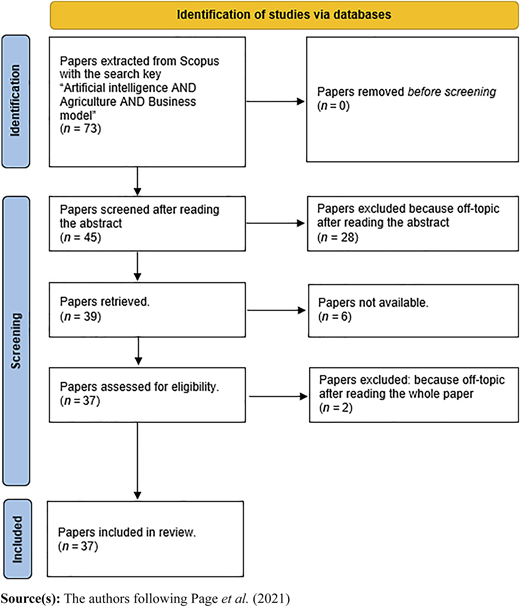
After reading all the abstracts, of those 73 journal papers, conference proceedings, books, book chapters and editorials, 45 have been considered appropriate for the analysis, while 28 were considered off-topic, as they did not deal with the theme under a managerial or economic lens, rather an information technology or computer science one. Of these 45 eligible works, 6 of them were not retrieved, while the other 39 were coded using the Nvivo software. During the codification process, two additional papers were excluded because they were off-topic after eligibility. The final sample of 37 works was considered appropriate, as very close to the target of 40 articles which “indicates that the domain has reached sufficient maturity for review” (Paul et al., 2021, p. 4).
The following Figure 1 reports the selection process following the PRISMA methodology (Page et al., 2021, Schünemann et al., 2021).
2.2 Coding framework
In coding the items using Nvivo, several nodes were gathered from previous studies, while others were decided following an extensive discussion among the authors, considering the specific field of investigation.
The first node refers to the type of authors dividing them among academics, practitioners and collaborations (Dal Mas et al., 2020). The second node refers to the source type. The third node maps the location where the study is conducted, grouping countries by continent (Massaro et al., 2015). The fourth group of nodes refers to the employed research method (Paoloni et al., 2021).The fifth node concerns the agricultural sector, while the sixth category lists the problems to solve and the objectives to reach. In this last node, the sub-nodes were added while coding the papers, employing an open coding approach. The seventh node analyzes the technology used and reported in the studies. The eighth node group maps the application in agriculture, while the ninth node focuses on identifying sources which treat a business model. The ninth node is about the eventual possibility of leading a new business model. The tenth node analyzes the eventual connection with sustainability issues. Last but not least, the last nodes refer to the presence of research, practice and policy implications.
3. Results
Table 1 reports the bibliographic details of the 37 articles and conference proceedings which were included in the literature review. While the earliest work dates back to 2005, twenty-four contributions (65% of the total sample) were published after 2017, highlighting the increasing interest in this topic in the last few years.
The following Table 2 underlines the results of the Nvivo coding, following the defined framework.
Concerning the node about authorship, authors are mainly represented by academics with twenty-five contributions. Interestingly, eight works result from a collaboration between scholars and practitioners. Five articles are authored by practitioners, mainly belonging to institutional agricultural research centers.
Twenty-one sources are represented by journal articles, while sixteen are conference papers.
Concerning the location of the study, twenty-four sources specify the place where the investigation was conducted, while thirteen papers have no specific area as they refer to specific technological solutions or algorithms. Considering the documents that do declare the location of their investigation, eleven sources are focused on Asia and seven on America (including both North and South America). Six references refer to Europe, while Africa and Oceania have respectively two papers for each continent. However, there is not an absolute predominance. Therefore, it may be claimed that the sample is well representative worldwide.
When referring to the research methodology, the vast majority of the sources (26 papers, equal to 70% of the total sample) are represented by case studies, while the remaining eleven papers are literature reviews. Still, the formers are mainly represented by theoretical investigations which focus on a new technological application presentation and discussion. Neither success (or failure) stories nor business translation experiences are reported.
Focusing on the agricultural sector, fifteen sources relate to the cultivation of plants, while some argue about the business in general terms. Animal production is treated in six papers, while only one article discusses fish farming. All in all, there seems to be good coverage of topics, which expresses the various interests both from general and specific research groups.
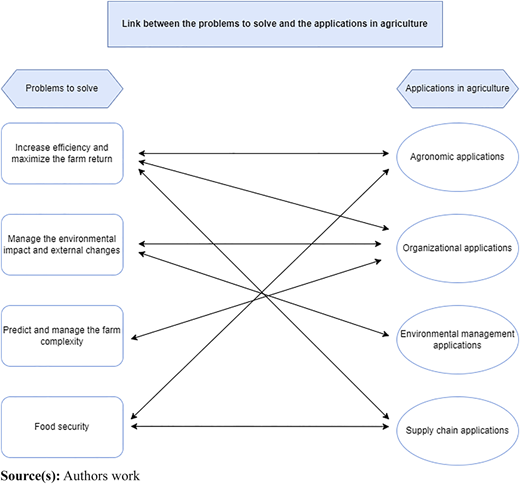
Regarding the specific issues and problems that stimulated the analysis, the goal of a significant number of sources refers to increasing efficiency and maximizing the farm return, with twenty-six papers. The need to manage the environmental impact and the external changes are treated in twenty-four articles. Moreover, nineteen papers discuss the issue of predicting and managing farm complexity, but, at the same time, great relevance is given to the food-security problem, discussed in nine sources. The research piece by Ahmed et al. (2022) is an example of this last issue. In the paper, the authors predict that climate change, especially global warming and increasing temperatures, could put half of the global population in trouble due to the declined crop productivity. Only two articles report other objectives. The different types of issues are strictly connected, with some articles arguing about more problems together. As an example, managing farm's complexity may lead to an increase in efficiency and profitability, creating a sort of turbo effect. For instance, Bogomolov et al. (2021) highlight the connection between the need to improve yields with the desertification problem and the related reduction of pesticides. The following Table 3 describes in more detail each sub-node with more specific problems to be taken into consideration.
Concerning the technologies that are mentioned within the papers, a significant number of sources treat Decision Support Systems (DSS), which stands as the most present technology. Only nineteen articles specifically refer to AI and Machine Learning. Other technologies with great relevance that are reported in the articles are represented by Big Data Analytics and the internet of Things (IoT). Other less-discussed technologies are represented by drones and robots (eight papers), cloud computing (seven articles), geographical indication systems and other technologies (six papers). Finally, biotechnology, Blockchain and autonomous devices are named in three pieces. Although the research has been based on AI as the leading keyword, the selected articles report several kinds of technologies, given their outstanding level of integration and complementarity. DSS is the most used technology because it represents the predecessor of AI. Within AI, we find all the sources which discuss Machine Learning and all its specializations, such as Artificial Neural Networks and Deep Learning.
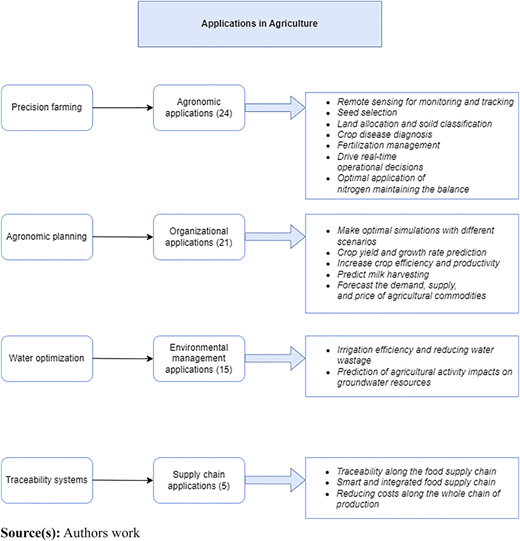
The node about the applications in agriculture allowed the investigation of the proposed applications in the agriculture field, leading to four main results. The first and the most treated is precision farming and other types of agronomic applications discussed in twenty-four papers. Agronomic planning and economic applications are reported by twenty-one sources. Less common applications are represented by water optimization with environmental management and supply chain applications with traceability systems, which are discussed respectively in fifteen and five papers. The following Figure 2 reports the main AI-based applications, dividing them into categories and naming those which were cited by more than two articles.
There seems to be a link between the applications and the problems to solve; the former tries to find feasible solutions by employing innovative and practical ways. For instance, Li et al. (2022) propose an Artificial Internet of Things (AIOT), which permits to obtain crop growth parameters in real-time, supporting farmers in managing farm complexity and unpredictability. Furthermore, the proposed solution makes intelligent recommendations for fertilization, crop disease detection and irrigation optimization. Another example is represented by Skobelev et al. (2019), who offer several precision farming solutions with the objective of increasing productivity and efficiency of crop production. Moreover, benefits include cost reductions along the chain of production. The following Figure 3 shows the link between the problems to be solved and the applications, underlining several connections.
One of the critical points of the analysis was to understand the type of business models reported by the articles as a consequence of the application of AI. Interestingly enough, despite mentioning the words “Business model” either in the title, abstract and/or keywords, most sources do not report any kind of business model. Indeed, only seventeen papers responded positively to this question. Among such sources, the most discussed business model is surely represented by smart farming with thirteen articles, followed by data-driven business models with eight papers and, finally, the general industry 4.0 business model with only two sources. However, findings are very connected to each other because both data-driven and smart farming are part of the more inclusive industry 4.0 business models, which permit enhancing the value proposition, solving critical factors and delivering meaningful experiences to customers (Bagnoli et al., 2022; Pietrewicz, 2019).
The following node is connected to the previous one, investigating the possibility of AI leading to a new business model. Again, most articles do not mention any type of new business model, with only six papers trying to address such a challenge. Among these articles, two sources propose a platform business model used for the food supply chain where the key participants of the agriculture industry can sell and offer their products and services with the use of smart contracts. Moreover, they can exchange data by enriching a common dataset (Skobelev et al., 2019; Sood et al., 2022). The same number of sources propose an Agritech 4.0 business model with an integrated food supply chain, where the new technologies permit to integrate both food production and food distribution, ensuring transparency, traceability and customer satisfaction (Eashwar and Chawla, 2021; Wolfert et al., 2017). Finally, supply chain management 5.0 and new information-based systems based on traceability are reported. The former proposes a new supply chain solution based on driverless autonomous vehicles for transporting and smart contracts with face recognition, while the second treat a new system based on recommended guidelines and documentation requirements for decision-making processes to ensure traceability along the chain (Ahamed and Vignesh, 2022; Li et al., 2017a). However, an interesting consideration is that all four new solutions are inherent to the food supply chain and to the need to reduce complexity through technology integration. These efforts are also addressed to reduce global food waste along the food chain, which, according to a 2011 FAO report, equals one-third of the global production (UN Environment Programme, 2021).
Another point of analysis referred to a potential connection with sustainability issues. Interestingly, most articles discuss sustainability issues, with only fourteen pieces not considering environmental or social topics. Five different kinds of sustainability issues can be reported. The first and the most treated is the use of fertilizers, nitrates and heavy metals, which pollute agricultural soil and water (eight references, equal to 35% of the total sample) and after the need to reduce the use and waste of water in the agricultural sector. The other topics are related to the need to produce climate-oriented and ecologically friendly applications, the need to achieve the food-security in a sustainable way and the need to make sustainable the production of some types of foods which actually heavily impact the environment.
Concerning the advantages gathered from the application of AI, almost all the sources (34 papers equal to 92% of the total sample) explain the benefits of the new technology implementations in the agricultural sectors. The most discussed advantages are represented by the organizational advantages and the decision-making support. Other advantages are related to the efficiency benefits and the productivity increase, while only two pieces for each pro speak about environmental benefits and food-safety issues with the possibility to control food compliance easily.
Another node concerns the disadvantages. Interestingly enough, just seven articles discuss the cons, with the majority of the sources not discussing such issues. Some examples are represented by the inevitable loss of income related to the compliance with water restrictions for small vineyards farms or the fact that some irrigation decision-making systems are crop specific for a given area with a consequent great complexity to generalize the methods for other crops and areas (Carmona et al., 2011; Nada et al., 2014).
About the barriers that can limit the spreading of new technology, only fourteen papers discuss innovation barriers. The two most significant ones are the farmers' lack of technical knowledge about information and communication technologies (ICT) and emerging technologies and the limited equipment, Internet access, storage capacity and high-quality data, especially in developing countries. Bogomolov et al. (2021), for instance, highlight the lack of qualified personnel and high-quality Internet access as two of the main problems in the field of applied digital technologies in the Russian agricultural industry, which hinder productivity and efficiency improvement. Six papers deal with the high investment cost and low perceived effectiveness. From such a perspective, Wakjira et al. (2021) analyze a case of precision beekeeping in Indonesia and Ethiopia, highlighting the impossibility of using commercial systems of remote bee colony monitoring because local beekeepers cannot afford them. Finally, some sources treat the mismatch between farmers' practical needs and the available applications, data control and data security problem, the lack of integration of the food supply chain, the large energy consumption of these innovations and the user psychological barriers to the implementation.
Concerning the research implications, only sixteen papers report any, ten concerning the need to extend and integrate the study with new data types or focus on new related issues. The remaining sources advocate testing the proposed method, analyzing profoundly new aspects and finally explaining the need to develop new solutions and technologies.
Concerning the practical implications, twenty-six sources lead to some practical consequences, especially for farmers. Such a topic appears to merge theoretical insights and practical applications, and it welcomes practical user solutions. Themes include the potential to help farmers in the decision-making process, support everyday farming operations, and to increase efficiency and effectiveness. No surprise AI is historically strictly connected to decision-making support, with a substantial increase in the last years as a consequence of the availability of new data sources and the decreasing cost of technological tools (Secinaro et al., 2022). AI is able to make the needed changes in the decision-making process supporting new ways to identify the critical variables of the decision space, the interpretation of the process, the final result and the several alternatives with the possibility to replicate the transaction, reducing time and costs (Shrestha et al., 2019). Another significant practical implication concerns the possibility of helping farmers manage the implicit farm unpredictability in the planning process. Finally, some sources provide farmers with new emerging and integrated technologies to develop and test.
Last but not least, only nine papers report some policy implications, mainly represented by government involvement. Four articles explain as governments should use agricultural data from fields to improve policy-making decisions, learning from data to create better future forecasts. At the same time, four sources recommend governments subscribe to new investment plans to enhance the technological transition, for instance, in publicly accessible digital infrastructures, protecting platform workers' rights and customer privacy (Chiles et al., 2021). Other contributions encourage policymakers to support farmers in technology knowledge acquisition by creating advisory units composed of experts (Sood et al., 2022), and to support social innovation by engaging the younger generations (Wakjira et al., 2021).
4. Discussion
As already explained in the introduction, this study aims to examine and better understand the role of AI in the agricultural sector, focusing on the possibility of AI creating new business models and understanding the research implications.
4.1 State-of-the-art and new applications of AI in the agricultural field
In addressing the first research question, results depict a lively situation characterized by a high speed of change and development. In such a perspective, findings report many collaborations and the presence of papers authored by practitioners, which looks unusual in academia, where the academic-practitioner divide exists in many fields (Massaro et al., 2018). Such a finding suggests that this topic represents an advanced and high-technical field where theory is strictly connected to practical applications. Innovation happens first in practice and can lead then to academic works and reasoning. Therefore, the practitioners' role in the field is extremely important. Academics are so invited to partner with managers and private companies to study the advancements and innovations in the field, share the best practices and business cases and suggest methodologies to assess the technology, measure and report its impacts, suggesting practical, research and policy implications.
Moreover, the unusually high number of conference proceedings extracted from Scopus and included in the sample can be connected with the previous point concerning the role of practitioners. Indeed, when high-technological fields are under the academic lens, scholars tend to present an early-stage draft of their works at conferences, getting feedback from their fellows before submitting their articles for peer review. In the case of AI, it seems like the implementation of new technologies and new agricultural innovations are initially presented during conferences and only after being discussed in the academic literature. Conferences, congresses and professional and institutional meetings then become relevant places where the latest advances are presented, shared and discussed.
Regarding the types of technology, although the research key used in Scopus specifically mentioned the words “Artificial Intelligence,” twelve different kinds of technologies are reported. This fact may be explained as AI is only a part of a greater system of Industry 4.0 digital paradigms used as methods to develop analysis and prediction with further disciplines such as data science, electronic engineering and so on. For this reason, AI is a technology that may be fully integrated with other digital paradigms such as smart manufacturing, autonomous and collaborative robots, augmented and virtual reality, industrial IoT, cloud computing, big data analytics and cybersecurity, permitting to reach economies of scale with high levels of personalization. A complementarity among technologies emerges. Notably, particularly significant seems the relationship between AI and IoT, merged by Li et al. (2022) in the new term “AIOT.”
As already reported in the results, a relevant number of practical implications are related to decision-making support provided by these new technological implementations. At this point, the farmers' capacity to use these innovations in the right way looks fundamental. About the practical application in agriculture, precision farming emerges as a new method to increase efficiency and reduce losses. Precision agriculture could be defined as a new method of smart agriculture which permits connecting resources with needs, growing, in this way, efficiency and productivity while also reducing the environmental impact and the unpredictability of the farm return (Boursianis et al., 2022).
4.2 Research methods
Also the research methods second the academic-practitioner alliance in this field. Indeed, the research methods adopted underline how case studies play a vital role in the literature. Most of these cases do not “tell” the success or failure stories of companies or farmers. Still, they assess and discuss new innovations and their practical applications, still with little emphasis on the consequences for the business, the technology acceptance and ethics dynamics and the need to engage in new educational paths to gain new competencies and skills. That is also why most cases do not refer to any specific geographical location, as new applications may be employed everywhere. Even if such a development may sound “natural” considering the field and the speed of change, the scientific community belonging to the management, organization and accounting fields should contribute to the multidisciplinary debate by sharing more success stories, even comparing multiple cases, highlighting the advantages and disadvantages of some solutions. In addition, another key issue may be represented by the rate of acceptance of these new applications in practice. Therefore, quantitative research methods like surveys and questionnaires should be tested by agricultural operators, who directly use the technological application during their everyday operations, or Delphi panels to assess the potential of some new solutions, even in their early stage of development. Researchers should target small and medium farmers, who represent the majority of agricultural enterprises in several continents, but who often have little capital to invest and a lower level of technological knowledge. The latter is indeed reported in the barriers as one of the most significant hurdles to digital transactions. For this reason, trade associations and agricultural consortia may organize open recurring conferences to diffuse and disseminate the opportunities brought forth by AI and Industry 4.0 to all the operators in this field.
4.3 Geographical areas
Another interesting result comes from the locations where the studies were conducted. The topic is widely diffused around the world, with a concentration in Asia, which is actually the hub of global innovation. Asian countries are implementing several policies to support innovation, start-ups and the creation of business incubators (GT staff reporters, 2023). From the yet limited sample, Europe is actually even behind the USA and South America. Furthermore, while Africa appears in the sample with just a few contributions, it may represent an exciting outlet for technology providers, given its significant presence of arable land and the actual low level of technological advancement. While more barriers may be present than elsewhere (especially concerning the lack of infostructure and the financial investments needed), Africa stands as a continent whose development may largely benefit from AI.
4.4 Business model innovation
In addressing the business model topic, interesting thoughts should be made. Even the papers that somehow mention the matter do not clearly explain the business model name. Interestingly, there is a lack of business model definition in all these papers. Still, new technologies are supposed to be the triggers of new business models with technology-driven innovation (Biancone et al., 2022; Bresciani et al., 2021a; Secinaro et al., 2022). The discouraging results open up exciting research avenues in mapping and defining new business models in the agricultural field, their unique features, the opportunities they may bring, the outcomes, the operational consequences and needs and the chance to involve different stakeholders with relevant implications for business practices as well. Researchers may borrow some sound results and experiences scouted in other fields.
4.5 Connection to sustainability issues
Although the research did not mean to focus on the sustainability issue in agriculture, findings show that the two topics are highly related. Farmers should take into consideration the environmental impact of their activity. Moreover, there is an influence of the environmental variables on the seasonal outcome, which determines the farm profit. This is intrinsically at the core of farm management, but now, with digital technology support, it is possible to manage farm unpredictably. A new innovative paradigm is given by vertical farming, a new way of production which permit to control all the agricultural variables using the so-called Controlled Environmental Agriculture together with the nature co-design, increasing resilience and circularity through hydroponic cultivation and advanced led lighting systems (VanGerrewey et al., 2022) AI can create new sustainable business models improving the technical-scientific quality of the production system. For this reason, a focus should be placed on applications which provide both profit and sustainability (DiVaio et al., 2020), also leading to new sustainable business models for value creation.
Starting from the analysis of the results, the following Table 4 summarizes the new research avenues for each of the identified macro-topics.
5. Conclusions
The article underlines the potential role of multiple AI solutions in disrupting the agricultural sector by offering sound opportunities to farmers and entrepreneurs in the field to support their decision-making process and increase the farm's profitability. Still, literature and practice are in progress, with more solutions and applications being developed and tested and more opportunities to disrupt business models, even fostering sustainability practices. Academic engagement with professionals stands as a relevant strategy to stimulate the debate, study the managerial and organizational dynamics and suggest and spread new business procedures.
Several new research avenues have, therefore, been suggested: from the employment of both quantitative and qualitative research methodologies to a deeper collaboration with practitioners, from spreading best practices and lessons learned to comparative studies among different contexts and countries. Promising research themes include the features of potential new business models, the degree of technology acceptance up to the educational needs of farmers and communities, among others.
5.1 Limitations
As with all studies, this has limitations. Even if the methodology can be considered rigorous and replicable, the sample of analyzed sources is small, with the use and cross-checking of a limited number of scientific datasets. In addition, the coding process may leave room for subjectivity. Moreover, the speed of technology development and the quantity of new academic pieces published every month may impact the validity of the results. Such limitations may lead to further research opportunities to frame the phenomenon and its fascinating yet helpful outcomes, also scouting the so-called “grey literature” coming from governmental institutions, consultancy firms, patent datasets, professional magazines and reviews and recognized practice blogs, as reported by other studies (Dal Mas et al., 2023; Secinaro et al., 2022).
5.2 Policy implications
While practice implications are more connected to technological advances and the application of new business models, some relevant policy implications emerge.
Policies may be linked to the identified barriers in the practical applications of these new AI-based solutions. These barriers include the lack of farmers' ICT knowledge and technology acceptance dynamics. Findings explain how these barriers in some cases are agricultural specific, such as in the case of the complexity and lack of integration of the food supply chain, but the majority are represented by general barriers to the implementation, which are common to all other sectors. As already suggested, the agricultural field could borrow or adapt solutions created and already implemented for other sectors solving a significant number of problems. For this reason, policymakers should stimulate the collaboration between key agricultural stakeholders and actors involved in different sectors, to solve the general barriers to the implementation. Governments play a vital role in fostering the creation of new general solutions and the adaptation of existing systems, including the availability of dedicated funds or tax privileges to support farmers (especially small-sized companies) in technology acquisition. Knowledge translation and dissemination initiatives involving multiple stakeholders like agricultural consortia, technology providers, research institutes and universities could help to overcome the acceptance issues and the understanding of the new opportunities for the single farm and the more comprehensive ecosystem.
Note
Scopus advanced search string: “TITLE-ABS-KEY (artificial AND intelligence AND agriculture AND business AND model)”