Social supermarkets (SSMs) are increasingly being used as a form of food aid. However, there is limited literature on how these models operate. The aim of this study is to investigate existing SSM models’ standard operating procedures and related barriers and facilitators.
Data were collected from nine SSMs in the form of interviews with SSM managers. Data were thematically analysed to identify key principles relating to SSM operations and deductively analysed to identify key barriers and facilitators.
There were variations regarding how these models were operated by different organisations, with differences including those relating to membership criteria, food sourcing and pricing. Although there were operational differences, some common key principles were identified, including the importance of wraparound provision, the need to diversify food sources and the need for flexibility on a case-by-case basis. Various barriers and facilitators were also identified.
There is currently limited research on SSM operating practices. This exploratory study addresses that gap, providing direct insight and advice from the managerial perspective related to developing and managing SSMs.
1. Introduction
There are various food aid models operating throughout the United Kingdom (UK) and internationally. Food banks are longstanding entities, established in 1967 in the United States, with Europe following almost two decades later in France (1984), Italy (1989) and Germany (1993). Meanwhile, the first Australian food bank opened in 1992. The Social Supermarket (SSM) model is a less frequently used mode of food aid in comparison to food banks (food pantries) but the literature indicates a developing interest in, and piloting of, models of food aid provision which offer an element of choice, whether food pantries trialling a “choice pantry” model, or those which are more explicit in following a SSM model (that being one which not only offers participants choice, but which often has a physical set-up to facilitate “browsing”, and which in addition offers wraparound support services). To date, the SSM model has been more common in certain regions, particularly Europe and the UK, and the terminology used varies across regions. For example, SSMs are referred to as “community shops” in Britain and “Emporia of Solidarity” in Italy (Andriessen et al., 2020). As SSMs are a relatively new concept, there is limited literature on the management and operations of these food aid models (Schneider et al., 2015). This study therefore aims to investigate existing SSM models’ standard operating procedures and related barriers and facilitators.
2. Literature review
2.1 Evolution of SSMs as a food aid model
Food banks have traditionally been used to provide food aid but have various limitations, including associated stigma, lack of choice for users and the short-term nature of the food support (Bazerghi et al., 2016). SSMs have been developed to address some of these limitations. Food banks and SSMs are both typically operated by non-profit organisations and receive their food supply from redistributed surplus food and/or donations. While food banks will typically involve a storage room containing ambient food which is often pre-packed into parcels for recipients, a SSM involves food being displayed in a room on shelves and in fridges/freezers, similar to a regular retail store. Food bank recipients receive emergency food parcels free of charge, while recipients of food from SSMs sign up to be a member to receive longer-term food support, and will make a monetary contribution (e.g. set amount per shop or a set membership fee per month) for their groceries. SSMs are referred to in the literature as an alternative food retail distribution model as they offer food at subsidised prices (often up to 50–70% off the regular retail price or given away free of charge) to help low-income consumers manage household expenses (Holweg et al., 2010; Holweg and Lienbacher, 2016). These models additionally reduce food waste as typically most or all of their food supply comes from redistributed surplus food (Michelini et al., 2018; Knežević et al., 2021). A key aspect of SSMs is that they offer wraparound (and social) support, for example, skills development, training, debt advice and cooking classes (Saxena and Tornaghi, 2018). The SSM model includes wraparound supports as it is recognised that solely providing food does not address issues contributing to food insecurity (Tarasuk et al., 2014), and these supports can help members address or manage insufficient income. For example, benefit checks may help members identify additional sources of income they are entitled to, or budgeting classes, debt advice, housing advice or cooking classes can help members maximise their current income. These wraparound supports are often conducted in-house by the organisation or can alternatively or additionally be facilitated externally.
The SSM concept originated in Europe in the late 1980s (Lienbacher et al., 2021; NEPHU, 2025), and various adaptations of the model have since been introduced internationally. In Europe, SSMs are spread across the continent in countries including France, Austria, Belgium, Switzerland and Romania, and although there are no up-to-date estimates of prevalence, in 2013 it was estimated that there were approximately 1,000 SSMs operating in Europe (Graslie, 2013). Most of these will offer additional wraparound support services (Graslie, 2013); however, models vary. For example, Czechia has developed Social Super Discount Stores where anyone can buy affordable food products approaching their shelf-life to reduce food waste at the population level, but they do not require any membership or any ancillary support services that would help their customers improve their financial, life skills or employment situations (Sadílek, 2021). Elsewhere globally adaptations on the SSM concept have been introduced, for example, in the USA in 2015 “Daily Table”, a new kind of retail grocery store that offers fresh produce and grocery items as well as ready-to-cook and grab-and-go prepared meals at affordable prices was introduced (Michelini et al., 2018), and Australia have also piloted and implemented variations on the model (Pettman et al., 2023).
In 2013, the first SSM, “Community Shop”, was opened in the UK, as a subsidiary of Company Shop, a British re-distributor of commercial surplus food. Community Shop provides surplus food from UK retailers at a reduced price of 30% and collaborates with Citizens’ Advice to provide debt advice, upskilling, and curriculum vitae advice (Company Shop Group, 2025). More recently, Feeding Britain has supported a network of “Affordable Food Clubs” in the UK These aim to improve people’s access to affordable nutritious food by bringing it into communities where people live, and include a variety of model types including SSMs, “pop-up” pantries and food buses. They also offer specialist income maximisation support, including benefits and credit, debt and savings advice to address the wider issues that members may be facing. The support extends to include social activities such as communal growing, cooked meals and holiday clubs for children and families (Feeding Britain, 2025). In Northern Ireland in 2017, funding from the government [Department for Communities (DfC)] was allocated to pilot five SSMs across the region. These SSMs were supplied with redistributed surplus food from FareShare (a UK-operated food redistribution organisation) with fresh fruit and vegetables, chilled/frozen meats to augment food provision and offered wraparound services of healthy eating and cooking on a budget classes and other services as a condition of membership to their clients. Since then, funding supports have been extended across Northern Ireland, with government funding now allocated at the council level by the Department for Communities (Belfast City Council, 2026).
2.2 Rationale for SSMs as a food aid model
Although there are variations in models worldwide, and variations in how SSMs are termed – for example, community supermarkets, SSMs, community markets, food clubs and pantries (Saxena and Tornaghi, 2018; Ranta et al., 2024), there is generally a consensus that a SSM model is more progressive and sustainable than a food bank approach to food aid. Food aid recipients can feel shame and a lack of dignity when using food banks, and pre-selected food hampers can lead to food waste if they do not meet clients’ food preferences (Remley et al., 2010; van der Horst et al., 2014; Schweitzer et al., 2024; Ranta et al., 2024). Therefore, a food aid model that allows recipients to make their own food choices is preferred (Remley et al., 2010; Booth et al., 2018; Rizvi et al., 2021 Mulrooney et al., 2023). SSMs aim to provide a more dignified shopping experience, allowing members to make their own food choices (Berri and Toma, 2023; Pettman et al., 2023), and many also offer items in addition to food (e.g. toiletries and household products), as maintaining personal and social standards is an important aspect of member dignity (Andriessen et al., 2020).
SSMs can also offer opportunities to socialise through communal areas or communal events that bring the community together (Ranta et al., 2024; Mulrooney et al., 2023). These further contribute to reducing social stigma and shame that can be attached to food insecurity (Purdam et al., 2016; Garthwaite, 2016) and assist in meeting the social needs of those in the community. This may be particularly important for those who are isolated or have mental health issues. In addition to meeting general food sustenance needs and social needs, SSMs can potentially play a role in meeting nutritional needs by diversifying dietary intake and therefore potentially improving the healthiness of diets, as they can introduce members to new foods (Mulrooney et al., 2023). Previous studies have found that food bank parcels are often not nutritionally adequate, and SSMs are considered to provide better opportunity for more nutritious choices by offering fresh and healthier food options, and allowing users to choose their own food items (Simmet et al., 2017; Lindberg et al., 2019; Booth et al., 2018). Some SSMs offer different levels of subsidy, with more nutritional foods receiving greater discounts while other less nutrient-dense foods are available at full price (de Renobales et al., 2015).
2.3 SSM operations and gaps in knowledge
SSMs vary in their operations, with some restricted to lower-income consumers who are deemed at risk of poverty (Bech-Larsen et al., 2019), while others have a more open approach. Additionally, some may offer a mobile distribution service to increase accessibility (Feeding Britain, 2025). Typically, access to SSMs is restricted, with specific membership criteria as an indicator of need, for example, receipt of benefits, and/or income below a certain amount. SSMs who follow an open approach will typically instead operate a two-tier system whereby only registered members get the lowest prices and non-members pay the prices of a conventional store (Henley, 2022). An open approach has the benefit of being less stigmatising, and it can create revenue to support operations; however, it may be more complex to manage and to maintain their non-profit identity. As social enterprises, SSMs are distinct from retailers in not operating for profit and instead focusing on a social mission aspect (Dees, 1998; Holweg and Lienbacher, 2011; Ranta et al., 2024). As SSMs typically receive redistributed and donated food, it is important that the social mission and non-profit aspects are maintained to avoid any conflict of interest with mainstream retailers. This is a particularly important consideration if a more open, as opposed to restricted, approach is used to membership.
As SSMs offer a membership approach, this requires more oversight than typical food bank operations. The physical store set up and facilitation of browsing and payment for members, as well as support related to wraparound service provision, creates further managerial and resource implications. As SSMs are fairly limited in their adoption in comparison to food banks, there is currently limited research on SSM operating procedures (e.g. barriers and facilitators). Current literature on SSMs and food pantries indicate that barriers to developing and operating a SSM include funding, lack of staff/volunteers needed to facilitate a choice model and difficulties with procurement of food (e.g. logistical challenges in receiving the food and/or difficulty setting up agreements with donation organisations due to concerns by donors that adequate food safety procedures are not being used) (De Boeck et al., 2017; Mousa and Freeland-Graves, 2017; Martin et al., 2024). This study addresses this gap, specifically considering the context of SSMs and providing direct insight and advice from the managerial perspective related to developing and managing SSMs.
3. Methods
3.1 Sample and data collection procedures
Interviews were conducted with managers from nine SSMs in Northern Ireland. This research was part of an all-island knowledge exchange project between Northern Ireland (where SSMs are well established) and the Republic of Ireland (where SSMs are not established). Participating SSMs were recruited via email – details about the study were sent to relevant organisations, and those who were willing to participate responded via return email. Thirty SSMs were contacted, and of these, ten responded. One of these used a voucher system whereby recipients got vouchers to use in a mainstream grocery retailer rather than receiving food from a SSM; therefore, only nine of those who responded were eligible to participate in data collection, having met the inclusion criteria of a SSM model with a physical store designed for this purpose. A semi-structured interview guide was used with questions relating to food procurement, food offering, operations, staffing and volunteer numbers, member numbers/capacity, sign-up process, membership payment, advice for new SSMs, barriers/difficulties to running a SSM, recommendations for SSM managers and details on wraparound services. Photos were also taken where appropriate (i.e. when visiting a SSM when there were no members present). Interviews were not recorded, but detailed field notes were taken instead. Interviews lasted for approximately one hour. Ethical approval for this study was granted by both authors’ institutions’ respective ethics committees (University College Cork Social Research Ethics Committee and Ulster University Ethics Filter Committee).
3.2 Data analysis
Following the interviews, data were typed up, and all data were read and re-read by the researchers to achieve data familiarisation. A two-stage data analysis process was followed, involving both a deductive directed content analysis and an inductive thematic analysis. This approach was taken as the deductive element addressed the specific research aim in categorising data relating to operations, barriers and facilitators (advice), and the inductive element allowed for further exploration of the data to identify other emerging themes (Erlingsson and Brysiewicz, 2017; Beacom et al., 2022). As a first step, descriptive data related to the operations of each SSM were identified and summarised within pre-determined categories (opening hours, member numbers, staff/volunteer numbers, permitted frequency of shop, membership term duration, membership criteria, model type, pricing, retail offering, wraparound support service offering and additional provisions). Identified barriers and advice for new SSMs setting up were also deductively summarised within these respective pre-determined categories (barriers and advice). The researchers then discussed each case, noting key aspects that emerged during discussions. Cross-case analysis was then conducted whereby the researchers compared data across cases to identify commonalities across the data on operations and barriers and advice, and to identify key emerging themes across the dataset (Braun and Clarke, 2006).
3.3 Findings
Findings are presented as follows: Section 1 presents an overview of descriptive data relating to the operations of those SSMs in the sample; Section 2 presents key principles for SSM operations that emerged from the inductive analysis as key themes; and Section 3 presents an overview of barriers and advice related to setting up and running a SSM, as identified by the SSM managers.
4. Descriptive data relating to SSM operations
4.1 Sample overview
There were differences across each SSM with regard to how they operated. SSMs opened between two and four days per week, with five of the SSMs offering an evening opening slot. Member numbers ranged from 50–300 per quarter; staff numbers ranged from one to five paid roles and one to 22 volunteers. The frequency of shops varied, with the majority offering a weekly shop, while one offered a fortnightly shop. There were differences in their model with regards to the time-bound nature of membership, membership duration ranged from 12 weeks up to 12 months, or rather than offering a time-bound period, members were offered a set number of shops as needed – in this case members would receive a card with a set number of shops and that would be stamped each time they visit and it could be renewed if needed. There was also some variation with regards to payment, with members paying either a set fee to be able to access a weekly shop (fee per month or fee per shop) or paying per item at the store. One model’s members paid both a membership fee and paid for the cost of items.
4.2 Differences in the model
Most (n = 8) followed a traditional SSM model – that is, membership-based food provision aimed solely at those experiencing, or at risk of poverty, with wraparound services offered.
One operated as a SSM with mandatory wraparound but also included food bank provision for those who may be unable, for certain reasons, to come to the SSM and participate in wraparound at that point in time – for example, people with severe mental illness or drug addictions, as they would be more difficult to accommodate in the SSM. They had a follow-on member-based shopping experience, which is situated in the high street and does not have any of the food bank or SSM branding. It is considered an affordable shop, and many who exit the SSM model proceed to access food from the affordable shop. Alternatively, some who are referred to the affordable shop will go directly there if they do not necessarily need the wraparound support but require food assistance in the short term – for example, students. One was quite distinct from the others in that it was developed as a store for the entire community and not targeted specifically to those struggling to afford food. They source local and seasonal produce and label the products at cost price on the shelves so that members recognise the value of the food. The amount of discount members receive depends on income – low-income members will receive a 75% discount on the cost price, while those who do not struggle with food affordability will pay the cost price and a monthly donation. This allows the store to be largely financially self-sufficient, and although they receive some food from a local food redistribution organisation (Fareshare), they mostly source and purchase their own food for (discounted) sale. Although they do not consider themselves to be a traditional SSM, they do offer wraparound services and one-to-one assessments, but they do not require members to avail of these. Compared with the others in the sample, this model had the longest term of membership – members could stay for up to one year, receiving a 75% discount on items, and after that they would have a reassessment meeting to check if they were able to progress to a 50% discount. Due to the cost price labelling system, it is more feasible for them to retail a more limited selection of items which they source themselves, and any additional items received through donations are offered for free.
4.3 Pricing
Various pricing options were used across models – with traffic light colour coding most commonly used. For this approach, foods and other items are colour coded according to value, and members are limited to choose a certain number of items within each category per shop. A similar approach used by two SSMs in the sample was shapes coding – where shapes were used instead of colour coding to indicate value and number of items permitted.
Instead of coding items, one SSM used the approach of providing members with a shopping list with suggested quantities of items within each product category.
4.4 Retail offering
All SSMs offered a range of ambient, chilled and frozen foods. In addition to food, all of the SSMs offered additional items such as toiletries, household products and pet food. One of the SSMs also sold fresh pre-prepared meals (e.g. soup and curry) cooked on site. Some SSMs also offered specific foods to meet particular dietary requirements, e.g. gluten-free options. In addition to the foods that were eligible for members to choose as part of their quota, some SSMs had additional foods which were provided free of charge, for example, foods that were donated and therefore did not comply with their pricing arrangements.
4.5 Wraparound provision
All SSMs visited offered wraparound support services, for example, classes or courses on money management, personal development and cooking skills. Most of the SSMs had private rooms available for the wraparound provision/one-to-one meetings, as well as group spaces for the wraparound courses. As the wraparound courses were offered in groups, this provided further opportunity for members to socialise. One of the SSMs had a training kitchen which was used for courses and rented out to other organisations to bring in further revenue to support the SSM.
4.6 Additional provisions
Most of the SSMs had community or social initiatives, for example, a communal area where members could socialise, drop in cafes, monthly dinners and summer day trips. One had a clothing bank, another had a Repair and Share sewing room, and another had a scheme to provide family toiletries and to facilitate saving in a credit union. One had a community baby club initiative whereby they provide family toiletries for a £5 fee and incentivise child savings by signing babies up to the credit union, and if the family saves £2 for the baby, they match it.
5. Key principles
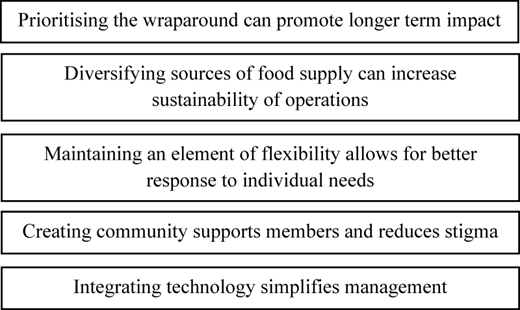
Data analysis revealed five key principles (Figure 1), which were common aspects that were emphasised or most discussed by the managers in the sample.
5.1 Prioritising the wraparound can promote longer-term impact
The importance of the wraparound was heavily emphasised. Many of the SSM managers referred to the wraparound provision as the key part of the SSM, even more so than the food: “Wraparound is the biggest benefit.” Most managers mentioned it is important to have the wraparound as a required condition of SSM membership, and that it is important to follow up (rather than signposting) and ensure people are engaging in it because of the benefits wraparound support can provide:
I feel you need regular check-ins with your members to see how or if their situation is improving and how you can support them in that journey so whilst the food aspect is important, a key part is the wraparound.
One manager noted that often members will build up a supply of food and not need to visit the SSM anymore, but will continue to avail of wraparound services for up to two years.
5.2 Diversifying sources of food supply can increase the sustainability of operations
All of the SSMs had multiple sources of food supply. Primary food supply sources for the SSMs were Fareshare (a food redistribution organisation in the UK), private/business donations and buying their own stock. For most of the SSMs, the main source was Fareshare. Some used profit made from the membership fees to buy their own stock, and one of the organisations had a food truck which operated to bring in extra money to supplement the purchase of food supplies. SSM managers emphasised the importance of different sources of food supply to make it more sustainable because donations are not necessarily regular, and the types and quantity of food that the food redistribution organisations have each week can vary:
It’s important to research your food sources and supplies. Shelves go from stacked to empty very quickly and nothing looks worse than a poorly stocked shop.
5.3 Maintaining an element of flexibility allows for a better response to individual needs
The importance of being flexible was also emphasised – although each SSM had set operating practices, examples were provided explaining how they would be flexible on a case-by-case basis: for example, extending the membership term if needed, or allowing larger families to have more frequent shops or a greater number of items. Flexibility regarding requiring wraparound was also discussed. For example, one SSM manager noted that if someone was grieving or had very bad mental health, they might focus on the food and delay the wraparound:
[we] realise that if people are grieving or [have] poor mental health the priority might just be to supply them with food in the meantime and then we can promote the wraparound more at a later stage.
There was also evidence of flexibility regarding accommodations made for other cultures: for example, providing shopping lists in different languages and stocking specific products for particular groups (e.g. asylum seekers).
5.4 Creating community supports members and reduces stigma
Quite a few of the SSMs visited had a communal area and several ran community events, and that social aspect was discussed as being beneficial to create a sense of community and reduce stigma:
[we] usually find [after members’ first visit] they are okay and will be more likely to get tea or coffee and sit and chat with others coming and going in the social area or watch TV, whereas first time they usually don't.
The social aspect was also useful from the perspective of staff and volunteers getting to know members because as they became familiar with members, it helped them to identify any who need extra support. For example, one manager cited an example of an asylum seeker who was not eligible for free school meals or benefits and could not afford the SSM; they were able to sit down with her to hear more about her situation and to use their own contacts to set up school meals. Another example from the SSM, which has a follow-on Affordable Food Club, explained how, during a conversation with one of the members, they found out she had received a cancer diagnosis since leaving the SSM and so had become more vulnerable again, and they recommended that she return to the SSM.
One SSM manager discussed how, in their experience, building relationships with members improved engagement with wraparound support services:
[the] benefits are relational – so having the pantry and building relationships helps to get people then to come to [for example] the cooking courses whereas other community courses struggle to get people in.
5.5 Integrating technology simplifies management
Another aspect that was emphasised as being useful to help with management was integrating technology, and the participating SSM managers used IT systems for a range of functions such as managing referrals, tracking memberships (e.g. number of shops and engagement with wraparound) and tracking outcomes. The consensus was that using IT systems could save a significant amount of time and money in comparison to having a staff member complete these tasks. Two of the SSMs in a particular council area were members of a specific IT system for food pantries – Your Local Pantry – a UK-based pantry management software tool that prospective pantry members can use to find their nearest SSM, and that supports SSM managers with various pantry activities such as receiving referrals, managing memberships, supporting their marketing and supporting compliance with food hygiene regulations:
We are part of [council area] where there are five social supermarkets. Initially, everyone had their own way of operating, but we are now all part of Your Local Pantry and the difference it is making is huge.
Other SSMs used other systems to track members and to manage referrals. The general consensus was that using IT systems could save a lot of time and money, in comparison to having a staff member complete these tasks.
6. Developing and managing a SSM: barriers and advice
SSM managers noted various barriers or difficulties they experienced that others should be aware of and provided advice to organisations thinking about establishing a SSM.
6.1 Barriers
Funding and set-up costs were discussed as a potential barrier, and that organisations would ideally have a long-term lease or ownership of a building or room from which to operate the SSM. Sourcing of food and setting up initial partnerships was also reported to be time-consuming and labour-intensive, particularly the time and commitment that is needed to support members with the wraparound aspect and the one-to-one assessments and check-ins. Therefore, prospective SSMs should make sure they have enough staff and volunteers. Security and safety considerations and dealing with people under the influence of alcohol or drugs and people with convictions were also indicated as a barrier. It is important to be aware of how to deal with this if a situation arises, and to put safeguarding procedures in place for staff and volunteers. For example, one manager mentioned the need to ensure there were extra staff/volunteers present if someone who may have posed a risk was visiting, or that they would ask that the person’s support worker also attend as a chaperone. If this were not possible, they would provide a food parcel instead to be collected. Another SSM had extra staff who acted as security personnel during the evening slots.
6.2 Advice
Much of the advice that was given related to the key themes discussed above, for example, making sure to prioritise the wraparound support and adopting technology. Additional advice provided related to the importance of planning ahead – mapping the area and getting partners and stakeholders on board from the start. Managers should be mindful of other food initiatives in the area and should research with regard to food supply, finances, how to sustain the SSM in the long term, and the number of volunteers needed. They should also consider what wraparound services there was merit in providing on signposting to their members. There was importance attached to having a paid coordinator rather than relying fully on volunteers, and all SSMs visited had at least one paid member of staff for governance and accountability reasons. It was also noted that member payment is important to maintain the service. The importance of dignity was highlighted, and various ways the SSM shopping experience could be developed to contribute towards this were discussed: for example, having the shop set up to look like a regular supermarket, not selling out-of-date food and giving people choice were all considered important. Managers need to consider food hygiene and be able to comply with inspections. Training staff and volunteers was also mentioned as important, and training across various aspects is required: for example, training related to operations, including how to use technology system(s), and training on food hygiene and food allergies. One manager suggested the best approach was to start off small and do it well – “even if you only had capacity for 20 people but were able to do that well giving them food and making sure to do the wraparound”. Another manager noted that the SSM had been “a challenging experience … especially in the first year – but the outcomes/successes have heavily outweighed the difficulties”. This positive sentiment was echoed by other managers who similarly emphasised the community benefits, as well as the personal reward they felt working in their role:
SSM has been life-changing for people.
Best project of my 30 years of community working.
Overall, if you can just do it … it makes such a difference to people’s lives.
7. Discussion
Previous research has identified that the SSM concept and related operations can vary across countries and organisations (Holweg and Lienbacher, 2016). The current study supports this finding, as although the sample was limited geographically, we also found variations regarding how these models were operated by different organisations. This indicates that for organisations seeking to develop a SSM model, there may not necessarily be one particular “best practice” model to follow, but that instead each organisation may make different decisions on model aspects as best suits their local context. As previously discussed, SSMs can be considered an example of social entrepreneurship (Holweg and Lienbacher, 2011). The related literature suggests that co-creation, i.e. the process of involving the target community during the development phase, can increase the value and usefulness of social entrepreneurial endeavours and can ultimately empower the community (Mathibe et al., 2023; Rado and Nuchpaim, 2024). Therefore, consultations with those in the community whom the SSM would target may be useful during the development phase, and later evaluation with members could also help to increase the value of the service. If the organisation developing the SSM is already integrated within the community, they are best positioned to know what the particular needs of their target clientele are, and designing an approach tailored to their area and clientele is likely preferable to having a centralised approach (Klindzic et al., 2016; Lee et al., 2023). Knežević et al. (2021) conducted a study on European consumer perceptions of SSMs and found a high level of agreement among respondents that religious communities should support the work of SSMs and that local or national governments should provide facilities and finance for SSMs. Respondents also supported an improvement in the legal framework related to SSMs, but there was a lower level of agreement relating to state bodies controlling SSMs. These findings further support the previous discussion regarding local community organisations having the flexibility to tailor an approach to SSM operations that suits their area and clientele. Klindzic et al. (2016) identify various SSM stakeholders at the societal, organisational and individual levels. Societal level stakeholders include the local community and government, organisational level stakeholders include those in the non-profit sector (civil society and religious organisations) and those in the profit sector (retailers), and individual level stakeholders include social entrepreneurs, volunteers, users and donors. These stakeholders will each have different roles, interests, expectations and motives, and it therefore may be useful to include this full range of stakeholders in any consultation related to SSM development.
As discussed by SSM managers, a key aspect of SSMs that differentiates them from food banks, and for many the aspect of the SSM that is most beneficial, is the wraparound supports provided. Previous research with SSM members who have completed their membership found that 94% agreed that wraparound supports helped them to identify barriers to overcoming their present situation, and 91% agreed that wraparound supports had helped them to identify actions and solutions to overcome these barriers (Department for Communities, 2020). Therefore, considering the dual support for wraparound services, both from the manager and member perspective, it is recommended that SSMs ensure that wraparound is a key focus of the SSM. Consultations with new members may therefore particularly focus on which wraparound supports would be most beneficial, and managers/volunteers may purposely engage with members throughout the duration of their membership to check if they are engaging with supports and if they are finding them useful. When planning the wraparound support offering, managers can consider both potential in-house and external supports that could be offered, and will likely want to avoid duplicating existing supports in the community in-house.
Diversifying sources of food supply was discussed by managers as essential to ensure continuity of supply. Diversifying food sources may also help to improve the overall quality and acceptability of the food offering and thereby reduce any shame or stigma related to receiving food aid. Previous research has found that food provided by food banks is often on or beyond the expiration date (van der Horst et al., 2014). Although redistributed surplus food must be safe, and typically will only be redistributed when still safe for consumption (i.e. when it has reached the internal retail “sell-by” date as opposed to “use-by” date, or when it is near or past the “best before” date, or near the “use-by” date, or when it is overstocked or has damaged packaging (Garrone et al., 2014; Berri and Toma, 2023), it is possible that by the time the food reaches the recipient it may have passed the best-before or use-by date. In addition to this food potentially being unsafe to consume, the reduced quality nature of this food may further contribute to negative emotional effects such as feelings of shame (van der Horst et al., 2014). In this study, managers discussed supplementing redistributed food (which is likely to be close to the best before date) with fresh produce from local butchers, greengrocers and other retailers. The layout of a physical store in the SSM model and the inclusion of fridges and freezers further increases the diversity of food products which can be made available to members. In comparison, food banks often rely on distributing food via pre-prepared parcels which do not often include fresh, refrigerated or frozen items (Oldroyd et al., 2022). If SSMs provide a range of fresh products from local suppliers and communicate this to members, it may help remove stigma. The increased variety of foods can also improve the nutritional quality of the offering (Simmet et al., 2017; Booth et al., 2018; Oldroyd et al., 2022). SSMs are also seen as beneficial in facilitating members’ browsing and choosing their own products, rather than being provided with a pre-selected parcel, and this element of choice can further reduce feelings of shame and stigma (Purdam et al., 2016; Booth et al., 2018; Ranta et al., 2024). Previous research with SSM members found that 98% agreed that SSMs provide a form of food aid that is respectful of people’s dignity and freedom (Department for Communities, 2020), further endorsing the value of a choice model.
SSMs have potential to reanimate local communities and increase social connectedness in the community (Lindberg et al., 2019; Department for Communities, 2020; Finegan and Cawley Buckley, 2023), and a key observation that emerged in the current study was that the SSMs were not only providing the material support of food but were also creating an opportunity for social support and facilitating development of social connections within the community. This was achieved in various ways in the SSMs sampled, for example, through coffee mornings, organised dinners or other events, social spaces for members and summer day trips. SSM managers may therefore want to consider how they can likewise integrate opportunities for connection into their operations.
SSM managers discussed the usefulness of technology to simplify SSM operations from a managerial perspective. The literature also suggests additional technological adaptions which can be integrated in an SSM context, for example, allowing clients to select food items in advance online (Martin et al., 2024). An online SSM model may increase the capacity of an organisation (e.g. if opening hours are limited due to a lack of volunteers), or it may be a considered option if an organisation does not have the space to physically host an SSM. Allowing members to choose online and collect a parcel may be beneficial for those with restricted mobility or other issues which may impact their ability to browse the physical store. On the other hand, however, those browsing online may be less likely to benefit from the social aspects of the SSM, and SSM managers may consider an online choice approach as more time-consuming for volunteers who will then be required to select and package the items.
Although the literature indicates preference for a choice model (Carroll and Schichtl, 2022; Martin et al., 2024; Ranta et al., 2024), some barriers to offering choice have also been identified, including a lack of staff/volunteers and space constraints (Martin et al., 2024). In the current study, lack of volunteer help was not cited as an issue, and although having adequate space was mentioned as important, lack of space was not discussed as a significant barrier, with the organisations appearing to have had adequate existing space that could be used for the SSM. Instead, the most prominent barrier discussed was the cost associated with starting up and maintaining the model.
This study presents various principles for the development and management of SSMs, and the next step in this study is to further analyse and translate the findings into a framework which can inform SSM design.
8. Conclusion
In conclusion, this study provides guidance on the development and management of SSMs from a managerial perspective. The study is exploratory and it is acknowledged that the sample size and geographical context provide limitations; however, findings are considered transferable to other regions. SSMs were positively discussed as a more progressive form of food aid which can help recipients access food in a less stigmatising manner than other traditional forms of food aid, such as food banks. The wraparound support element of SSMs was discussed as an attribute of the SSM model, which was particularly helpful for members and differed from other forms of food aid. It is acknowledged, however, that food aid does not solve food insecurity and that longer-term food insecurity response should focus on addressing the structural causes of food insecurity. In the short term, however, there is merit in food aid organisations considering how they can provide food aid in a way that provides dignity for the recipient and where other supports can be used to improve the person’s situation as far as possible. The SSM model lends itself to this approach to food aid, and this research can therefore contribute towards informing food aid providers with regard to developing a more sustainable food aid response.