

ABSTRACT
Long-term exposure to high levels of bromate (ozonation byproduct) from drinking water can cause serious health issues including cancer. In this research project, two methods were used for bromate removal, the first one is composed of three adsorbent materials, and they are granular activated carbon, sandy soil and biochar. Biochar is a natural organic material and is full of carbon atoms that was produced from locally available mango wood by pyrolysis process. This research is considered as the first project in Oman used biochar. The second method was ZnO nanorods irradiated with visible light that is termed also as photocatalytic degradation. Ion chromatography (IC) was used to measure the bromate concentration before and after treatment processes. The results showed that the bromate in ozonated drinking water samples were completely removed by biochar composite.
1 Introduction
Bromate does not exist in natural surface water or aquifer (Butler et al., 2005). In exceptional cases, bromate can be found naturally in drinking water sources as in Slovakia at concentrations 1 to 40 µg/L (Barlokova et al., 2017). Bromate is formed through Ozonation process when ozone gas used to disinfect bromide water as following reactions shows (Aljundi, 2011):
Moreover, bromate can be formed in concentrated hypochlorite solution used to disinfect drinking water. According to WHO (world health organization) (2003), potassium and sodium bromate are strong oxidizers mainly used in neutralizing solution of permanents wave and dying of textiles using sulfur dyes. Several safety evaluation reports show that potassium bromate is highly harmful as it causes DNA damage in rat’s kidney and lipid peroxidation (Kurokawa et al., 1990). Tynan et al. (1993) classified bromate as possible carcinogenic anion even though there is not any study in humans so far. However, exposure to high bromate level may cause gastrointestinal symptoms such as vomiting, nausea, abdominal pain and diarrhea. Most of the bromate effects can be cured. Higher bromate concentrations lead to lasting consequences such as hearing loss and kidney effects. Ingesting bromate for long time increases the chance of exposure to cancer (Kruithof et al., 1992). Surprisingly, some studies showed that ingested bromate is stable in the body (Ali et al., 2005). Potassium bromate lowers the body consumption of drugs and therefore may contribute to kidney disturbance which is responsible for drug excretion (Ali et al., 2005).
Ion chromatography (IC) is used for bromate analysis in drinking water. Recently, IC is used in parallel with other seven different methods and they are varying in detection limit from 0.02 to 1.3 10 µg/L. (GOC, 2018). Bromate is highly soluble, stable in water at room temperature, does not volatilize, is not removed by boiling, and difficult to remove using conventional treatment technologies (Butler et al., 2005). Amy and Siddiqui (1999) stated that there are several technological bromate removal methods such as UV radiation, coagulation, ion exchanger, membrane processes and adsorption. Additionally, Adsorption processes are usually used for disinfection removal and to remove various organic and inorganic substances. Gwenzi et al. (2017) stated that biochar is an excellent adsorbent which can remove physical, chemical and biological contaminants from water unlike existing conventional methods which work for the removal of specific type of contaminants. In addition, it is non-expensive adsorbent and can be collected from existing biomass. Moreover, biochar does not produce undesirable substances in treated water. Furthermore, photocatalysis is another option to eliminate bromate by converting bromate to bromide (Oosawa and Grätzel, 1988; Al-Ekabi et al., 1993; Lindner et al., 1997). A study conducted by Alsewaileh (2019) in which they used date palm biochar to remove bromate by using pyrolysis process (burned biomass in the absence of oxygen at 300 °C and 700 °C). They studied the effect of different biochar doses, initial pH and bromate concentration on adsorption process. The study was done for initial pH of 2, 0.1g/L of biochar with serial levels of bromate of 5, 10, 15 and 20 µg/L. It was found that the pyrolysis of biochar under 300 °C the removal percentage was 19.3%, 14.5%, 14.9% and 13.6% respectively of the tested bromate doses. However, zero reduction in bromate concentration for biochar made at 700 °C. The study concluded that the higher temperature for biochar preparation was not effective in bromate removal. Additionally, Hong et al. (2016) had done a study to remove bromate from water by polypyrrole tailored activated carbon. The study used nut shell based activated carbon (NAC) to deposit polypyrrole (Ppy) in the pores. The polypyrrole nut shell based activated carbon Ppy-NAC had positive charges that increase the bromate adsorption capacity. The results reveal that 62.5 mg of bromate adsorbed in to one gram of Ppy-NAC at pH 6 (bromate reduction increases as pH increases). Therefore, the bromate removal by Ppy-NAC was much higher than pristine NAC. The bromate solution was found to contain chloride ions that occurs due to exchange with bromate during adsorption. Finally bromate removal by Ppy-NAC included reduction reaction to bromide and ion exchange. The process shown in the Figure 2 explains the reduction process.
The aims of this project are 1- Investigate the presence of bromate in bottled water samples using ion chromatography (IC); and 2-Examine the efficiency of bromate removal by using ZnO Nano particles, activated carbon plus sandy soil and mango wood biochar by selecting the optimal dose and column regeneration.
2 Materials and methods
2.1 Procedure 1
Seventeen water samples were collected (Fourteen different brands of bottled water, one from well and two from falaj). The samples were analyzed for several parameters: pH using pH meter, Turbidity, Electrical conductivity (EC) using EC meter, heavy metals using Inductively coupled plasma (ICP), Total organic carbon (TOC) using TOC analyzer, bromate and inorganic anions using ion chromatography (IC), hardness using titration by ethylene diamine tetra acetic acid (EDTA) and alkalinity using titration by H2SO4.
2.2 Procedure 2
Biochar was produced by Crop Science Department, CAMS at Sultan Qaboos University. It was prepared through pyrolysis process. At first, dried branches of mango wood were placed in small closed drum as a feedstock. Then, the small drum placed in the bigger drum and space was filled with tree waste as a fuel. Small hole was cut at the bottom of the big drum to allow oxygen to flow in. The temperature was 300 °C and allowed to heat for two hours. Then biochar was collected, crushed and washed with distilled water.
2.3 Procedure 3
Two adsorption columns were prepared. The first column was filled with granular biochar up to 60 cm. The second column was filled with granular activated carbon up 15 cm and then 32cm of sandy soil. Then the bromate solution was passed through the columns. Later, the filtered water was collected after one pore volume (allowing any impurities to go out) and analyzed the bromate using IC.
2.4 Procedure 4
Zinc oxide substrates were prepared in three steps using microwave hydrothermal (MAH) process. Firstly, the glass slides were cleaned intensively followed by seeding and later by the growth of the zinc oxide nanorods. Secondly, the bromate solution (63.1 ppb) was exposed to photocatalytic degradation using zinc oxide nanorods under solar stimulation. Then, the solution was collected after 5 hours for IC Analysis.
2.5 Procedure 5
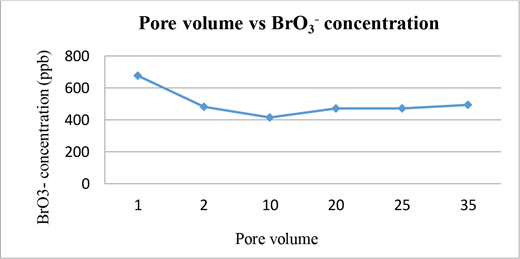
Biochar column of height 20 cm and 2 cm in diameter was prepared. The pore volumes of KBrO3 were calculated through the following equations and the prepared solution of 500 ppb was passed through the column and collected after 1, 2, 3, 10, 20, 25 and 35 pore volumes. The collected pore volumes were filtered by filtered paper to remove impurities. Then IC was used to measure bromate concentrations.
3 Results and discussion
The results from IC for Bromate and anions concentrations for 17 water samples are shown on Tables 1 and 2, respectively. The results for falaj 1, 2 and well water confirm that bromate does not exist in nature. In all 14 bottled water samples, they did not have bromate except in Al Thawarah that was due to contribution of high bromide concentration (<0.05mg/L) that reacted with ozone. The concentration of bromate in Al Thawarah was 63.1 ppb which is six times more than the allowable level (<10 ppb).
Bromate and anions concentration for the first 10 samples
| Sample ID | Bromate (ppb) | Anions (ppm) | ||||||
|---|---|---|---|---|---|---|---|---|
| BrO3- | F- | Cl- | NO- | Br− | NO3- | PO3− | (SO4)2- | |
| Falaj 1 | 0 | 0.26 | 47 | 0 | 0.15 | 0 | 0 | 61 |
| Falaj 2 | 0 | 0.23 | 35 | 0 | 0.13 | 0 | 0 | 45 |
| Well Water | 0 | 0.25 | 369 | 0.2 | 0.6 | 89 | 0 | 1392 |
| Tanuf | 0 | 0 | 37 | 0 | 0 | 0.38 | 0 | 14 |
| Masafi | 0 | 0.03 | 19 | 0 | 0 | 1.62 | 0 | 15 |
| Majan | 0 | 0 | 0.13 | 0 | 0 | 0.07 | 0 | 55 |
| Barzman | 0 | 0.024 | 55 | 0 | 0.09 | 3.05 | 0 | 16 |
| Tiba | 0 | 0.02 | 23 | 0 | 0 | 0.39 | 0 | 30 |
| Salsabeel | 0 | 0 | 21 | 0 | 0 | 0 | 0 | 23 |
| Al Thawarah Nakhal | 63.1 | 0 | 17 | 0 | 0.59 | 5 | 0 | 9 |
Bromate and anions concentration for the second 7 samples
| Sample ID | Bromate (ppb) | Anions (ppm) | ||||||
|---|---|---|---|---|---|---|---|---|
| BrO3- | F- | Cl- | NO- | Br− | NO3- | PO3− | (SO4)2- | |
| Al Khadra | 0 | 0 | 12 | 0 | 0 | 0 | 0 | 30 |
| Al Jabal Al Akhdar | 0 | 0 | 30 | 0 | 0 | 0.36 | 0 | 16 |
| Oasis-Oman | 0 | 0 | 14 | 0 | 0 | 0 | 0 | 30 |
| Aquafina | 0 | 0 | 0.11 | 0 | 0 | 0.16 | 0.32 | 75 |
| Oasis- Abudhabi | 0 | 0 | 39 | 0 | 0 | 0 | 0 | 4 |
| Al Jarziz | 0 | 0 | 23 | 0 | 0 | 0 | 0 | 14 |
| Junior Darbat Salalah | 0 | 0 | 22 | 0 | 0 | 0 | 0 | 18 |
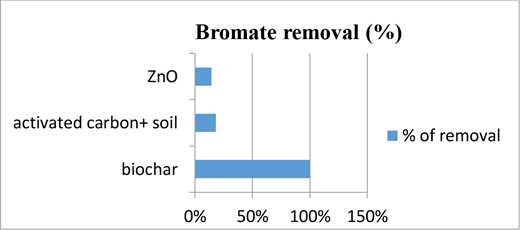
Two new removal methods were applied to Al Thawarah water. Figure 1 showed the removal percentage of bromate. The bromate concentration diminishes by 100 %, 18.30 % and 14.30 % for biochar, activated carbon plus sandy soil and ZnO nanorods respectively. ZnO nanorods could remove some of the existing bromate through the reactive oxygen species (ROS) which was produced by redox reaction that extensively react with bromate (water contaminant).
Bromate removal percentage with two methods
The above results showed that adsorptive materials were more effective especially biochar that can be considered as an excellent removal method for bromate from drinking water. In addition, Figure 2 shows that bromate concentration decreases until 10 pore volume and after that the concentration increases due to biochar need for regeneration.
Pore volume vs BrO3- concentration
4 Conclusion
In conclusion, bromate is usually found in drinking water as a result of water treatment during disinfection, rather than through source water contamination. The presence of bromate in treated drinking water is primarily related to the reaction between ozone and naturally occurring bromide in source water. In addition, it can be found in chlorinated water containing bromide ions. Based on Omani drinking water standards, the proposed guideline for bromate in drinking water is a maximum acceptable concentration of 0.01 mg/L (10 µg/L). However, bromate is classified as a possible human carcinogen. Therefore, in this project, two removal methods were used for bromate, the first method used two adsorbents, which were biochar and activated carbon plus sandy soil. The second method was ZnO nanorods. This project is considered as first to use Mango wood Biochar in bromate removal. Ion chromatography was used to analyze bromate in water. The results showed that bromate in ozonated drinking water were efficiently removed by biochar.
5 Acknowledgement
The authors would like to greatly thank those who helped them to achieve this project successfully, especially Food and Water Laboratories Center at the Ministry of Municipalities and Water Resources and Nanotechnology Research Center (NRC) at Sultan Qaboos University.
