This paper aims to determine how environmental sustainability (ES) can be integrated into the customer experience (CX). In order to accomplish this, the paper uses a customer journey (CJ) perspective. Speculatively, the paper analyses the experiential stakeholder ecosystem beyond the CJ to verify the obstacles to the implementation of ES.
This paper uses a qualitative analysis of in-depth interviews with multiple stakeholders within the food delivery ecosystem. The multi-stakeholder analysis allows the authors to explore the problem not only from an operational point of view but also from a strategic point of view since in the delivery of a service the value for the end customer is the result of the efforts of several players.
The results shed light on the importance attributed to ES by the players that make up the food delivery ecosystem. The findings emphasise the importance of an ecosystemic view amongst stakeholders to achieve ES.
This research extends the scarce and embryonic literature on a sustainable CX by applying a CJ perspective, by revealing how and with which touchpoints it is possible to be environmentally sustainable in the design of the CX.
1. Introduction
The role of environmental sustainability (ES) in designing and delivering a successful customer experience (CX) is becoming a topic of discussion for both scholars and managers (Calza et al., 2023; Ta et al., 2022; Moliner et al., 2019; Signori et al., 2019) due to the growing importance of being centred not only on customers but also on the planet (Vignoli et al., 2021). Nevertheless, there is a lack of empirical evidence on how businesses can achieve both objectives. There is a broad agreement that being oriented to both people and the planet is crucial (Calza et al., 2023; Anderson et al., 2021; Pardo-Jaramillo et al., 2020; Signori et al., 2019), especially since the 2030 Agenda for Sustainable Development has sensitised governments, firms and citizens to the inclusion within business strategies of the 17 Sustainable Development Goals (SDGs), which highlight the importance of placing people at the centre of decisions by governments and therefore by companies (see https://sdgs.un.org/goals). However, it has proved hard to put the customer and the environment concurrently at the heart of the business, and examples are rare, with few reports and studies in the literature. It requires managers and entrepreneurs to redesign their process management, by encapsulating green touchpoints to drive engaging experiences across the consumer journey. However, this challenge remains open on both a practical and a theoretical level (Cain, 2022; KPMG, 2019).
Theoretically, amidst the ongoing discussions regarding environmental concerns and prioritising customer needs, there is a growing demand for investigating the reasons behind the limited implementation of customer-centric and environmentally friendly practices in business operations (Signori et al., 2019). In response to this need, this study addresses the call to environmental sustainability in when firms design and deliver successful customer experiences.
Existing literature has predominantly explored ES and CX individually (Homburg et al., 2017; Bettley and Burnley, 2008), and only recently some studies are starting to design new integrative frameworks for companies to adopt the same mindset in strategies and operational processes (Signori et al., 2019; Galati et al., 2019), still fewer are the studies that have explored the perspective of supply chain management and ecosystems to find the implementation of convergence (Legenvre et al., 2022).
Customer experience management (CEM) has been defined as the management of the customer–firm relationship throughout the entire customer journey, starting from need generation and extending to post-purchase stages (Lemon and Verhoef, 2016). Building upon this definition, Homburg et al. (2017) identified three key factors (cultural mindset, strategic directions, and firm capabilities) that are crucial in strategically managing the customer experience. Moreover, the same authors demonstrated that the investment to be customer experience-oriented offers several advantages, including the potential for product differentiation, increased customer loyalty and positive word-of-mouth, cross-selling opportunities, reduced price sensitivity, and the cultivation of a positive reputation (Klink et al., 2020).
On the other hand, previous studies on sustainability (Hockerts, 2015; Walsh and Dodds, 2017) have identified several opportunities related to corporate sustainability, namely efficiency gains, attracting customers and the creation of new markets, social branding, recognising as contributing factors to generating business and to gaining a competitive advantage (Woo and Kim, 2019; Bangsa and Schlegelmilch, 2020). These efforts include not only the creation of environmentally conscious product features but also extend to associated marketing processes (Awan, 2011).
This literature reflects the need for companies to be “eco” and at the same time offer efficient and satisfying experiences to their customers (Orsato, 2006) and at the same time demonstrates how much these two competitive objectives lead to the same market and growth opportunities. In this sense, it would be appropriate to converge towards a model that is convergent.
On this debate defined by Orsato (2006) as “eco-efficiency”, a recent key contribution on the topic has been provided by Calza et al. (2023) has explored the trends in the theme of sustainability amongst studies on the CX by exploring an integrated approach to ES and CX both theoretically and empirically by proposing an original integrated framework based on an orientation to long-term collaboration amongst stakeholders as a key to success in achieving environmental sustainability and customer experience centricity and compete successfully.
Considering this background and recognising the lack of research in the management literature, the present study is intended to answer the following research questions: How firms can implement sustainability in customer experience processes? To answer the research question, the study adopts a customer journey (CJ) perspective, using it as a frame to define the phases and touchpoints that connect the company with the customer in providing an environmentally sustainable experience.
Second, starting from a convergence between two theoretical frameworks proposed by Homburg et al. (2017) and Walsh and Dodds (2017), this research extends the analysis of the CJ processes to the entire business ecosystem, by considering all the stakeholders involved in the supply chain as they are fundamental in achieving the objective of successfully combining CX and ES.
To achieve these aims, an empirical analysis which tests the CJ model in the food delivery sector has been carried out to outline current processes and how they could be improved by making the touchpoints more sustainable.
The food delivery industry has been chosen for three main reasons. First, it is not seen merely as a food transport service, but as an experiential process that includes all the steps of the customer journey from pre-order to the post-delivery; second, it involves multiple actors to allow the cogs of the service to work (i.e. reservation technology providers, restaurants, drivers, third packaging providers, etc) and then it is possible to analyse where there is resistance to sustainability and how it can be overcome. Finally, considering the materials related to delivery packaging, transport and the supply chain, this sector has amongst the primary objectives, not only to be efficient in the delivery of the experience but also to be sustainable.
In doing so, the current paper offers novel and concrete insights which consolidate the literature and provides a practical model for entrepreneurs and managers who want to differentiate themselves by directing their marketing towards sustainability. In particular, compared to previous studies that analyse the CX and ES individually and theoretically, this study offers an innovative perspective to investigate obstacles and solutions to reach a sustainable customer experience through a sustainable experiential ecosystem.
In light of the above, the paper is organised as follows. Section 2 reviews the relevant literature on customer experience, environmental sustainability and sustainable experiential ecosystem. Section 3 describes the research methodology, including the case study analysed and the research setting. Section 4 presents the study results. The final section discusses the findings and the implications of our study. Limitations and future research are analysed in the conclusion.
2. Theoretical background
2.1 Customer experience
Although the concept of CX management is not new (Schmitt, 2010), there is no consensus on its definition (Chiang, 2022). Both theoretically and practically, CX has been defined in different ways; however, most scholars converge towards an interpretation of the CX as a subjective reaction (sensorial, affective, cognitive, relational, and behavioural responses) to certain marketing stimuli along the entire CJ, from the pre-to the post-purchase stage (Schiavone et al., 2020; Hamilton and Price, 2019; Lemon and Verhoef, 2016; Homburg et al., 2017; Lemke et al., 2011). From this definition, it follows that there is a sequence of stages and touchpoints that link a firm with the consumer (Lemon and Verhoef, 2016). Using the CJ as a focal point is an initial step in the design of sustainable CXs and promotes lean processes and cooperative approaches within the whole ecosystem (Gummesson, 2008).
The CJ refers to the different stages and touchpoints that customers experience while interacting with a company, starting from their initial engagement (pre-purchase stage) with the firm and extending to the post-consumption phase (Palazón et al., 2022; Richardson, 2010; Lemon and Verhoef, 2016). For each stage, Lemon and Verhoef (2016) identified four categories of touchpoints: brand-owned touchpoints are the tools provided directly by the company, such as advertisements and websites; partner-owned touchpoints are those developed and managed by the firm's partners, such as apps or virtual reality marketing tools; customer-owned touchpoints are those managed by customers themselves, such as word-of-mouth, forums and blogs; finally, social touchpoints, such as external review platforms like forums and communities, have the ability to influence customer decisions at every stage. Another categorisation of touchpoints has been suggested by Vannucci and Pantano (2020). It involves the presence or absence of a human component; that is, touchpoints are classified as personal (e.g. in-store interactions) and non-personal (e.g. chatbot).
Becker and Jaakkola (2020) extended the definition of the CX by underlining the non-deliberate and spontaneous consumer responses, which shows the strategic role of touchpoints in inducing and stimulating consumer reactions (De Keyser et al., 2020). Touchpoints have been defined as the verbal and non-verbal tools that connect a firm with consumers (Ieva and Ziliani, 2018). More recently, Chiang (2022) affirms that touchpoints are key to the delivery an insightful CX because they allow all the phases of the CJ to be mapped, from when the lead is acquired through to the consumer becoming a customer, and in this way it is possible to monitor the CJ to improve it and make it more profitable. In other words, the CX might be shaped along the CJ, through a series of touchpoints that can improve the process both for the company and for the final consumer (Arici et al., 2022; Cambra-Fierro et al., 2022). However, the analysis of environmentally sustainable touchpoints in the CX is lacking, despite this being one of the main priorities of marketing research (Calza et al., 2023). Some scholars have addressed the environmental advantages that may be derived from the implementation of deep CXs. In particular, Chiang (2022) has theorised the achievement of a reduction in customer churn, increased revenue and enhanced employee satisfaction. In this paper, as well as demonstrating that a strategic and structured vision of CX can bring advantages in terms of increasing customer loyalty and positive word of mouth, promoting cross-selling and brand reputation, and reducing price sensitivity (Klink et al., 2020), we demonstrate that it is also necessary to enhance the company's environmental and social sustainability.
2.2 Implementing environmental sustainability in the customer experience
Environmental sustainability emphasises the interdependence between a firm's business operations and the environment (Younis and Sundarakani, 2020). Until now, marketing has focussed on creating levers relating to environmental sustainability, for example products with ecological materials and distribution with more environmentally friendly means, as well as communicating the company's environmental commitment to its customers. There is, though, no systemic approach to creating CXs that can operationally reflect a strategic mindset oriented towards ES (Albino et al., 2009).
Environmental sustainability is widely recognised as a strategic tool that can be used to position businesses in the market, differentiate their products and services, and gain the trust of environmental stakeholders. As a marketing tool, ES is also referred to as green marketing, and it encompasses a wide range of products and services, including consumer goods, industrial goods and various services (Polonsky, 1994; Christofi et al., 2015).
Green marketing encourages sustainable consumption as well as cleaner manufacturing by encouraging the creation of green products (Mishra and Sharma, 2014; Rex and Baumann, 2007; Dangelico and Vocalelli, 2017). Peattie and Belz (2010) addressed the concept of sustainable marketing in a broad perspective that includes building and maintaining sustainable relationships with customers, the natural environment and the social environment (Belz, 2006). According to this view, sustainability marketing is oriented to building long-term relationships, as opposed to the conventional focus on short-term transactions. Hence, sustainability marketing involves the integration of social and environmental attributes into marketing management (Labanauskaite et al., 2020; Adamashvili et al., 2021).
Recently, an effort to make a convergence between CX and ES has been made to by some authors (Christofi et al., 2015) who presented a list of research opportunities arising from an integrated approach. Specifically, Christofi et al. (2015) highlighted the similarities between the goals and benefits of CRM practices and corporate social responsibility initiatives. According to the authors, CRM acts as a promotional tool for products, aiding in enhancing sales performance and, in the long run, contributing to improving corporate brand reputation. This, in turn, secures crucial resources from stakeholders. From the perspective of consumers, CRM practices associated with a brand foster more positive sentiments and evaluations, thereby positively influencing consumer choices (Hoeffler and Keller, 2002; Koschate-Fischer et al., 2012).
Furthermore, integrating CRM and sustainability can have a positive impact on the implementation of sustainability within an organisation, based on the previous analysis of the concept. Christofi et al. (2015) also express concerns about the possibility of CRM-practicing companies forming partnerships with environmentally oriented organisations, allowing them to position their brand in the environmental dimension of sustainability without necessarily embodying it in practice.
According to this view and with specific reference to the CX, Signori et al. (2019, p. 161) have defined a sustainable CX as the “process that creates holistic value thanks to the customer's engagement derived by sensations, feelings, cognitions, and behaviours evoked by sustainable stimuli, based on economic, social and environmental sustainability”. With the introduction of “sustainable stimuli”, this definition supports the idea of the present research to define ES touchpoints within the CX. Indeed, there is the need to redefine the marketing stimuli in the light of two consumer characteristics that are increasingly being recognised: sensitivity to the protection of the planet, and concern about personal health (Sorrentino et al., 2022). The operational levers of traditional marketing, understood as the 4 or 7 “P”s (McCarthy, 1960; Booms and Bitner, 1981), need to be transformed towards a focus on customer relationships and sustainable development. Accordingly, Peattie and Belz (2010) proposed a new “4Cs” sustainability marketing mix (Belz and Peattie, 2009), which is a customer-oriented approach to marketing that considers Customer solutions, Customer cost, Convenience and Communication.
There is a need for a perspective that integrates ES with the CX. In the present research, our goal is precisely to verify how environmental but also social sustainability can be included in CJ processes. In the light of the work by Calza et al. (2023), the inclusion of sustainability within the CX is possible only if that objective is shared by all of the actors in the ecosystem. The next section therefore focusses on the perspective of the players who make up the individual services comprising the CJ to verify the importance of a strategic approach shared between the company and its partners.
2.3 From the customer journey to a sustainable experiential ecosystem: theoretical speculations and research gaps
The literature has documented the great recent interest of both scholars and businesses in the issue of sustainability in the creation of the CX. Some recent articles have addressed the combination of the two topics from the consumer's perspective by analysing preferences for environmentally friendly products (Vehmas et al., 2018) or by pointing out the importance of long-term collaboration amongst different stakeholders and collaborative interaction with the end-user to achieving a sustainable strategic framework for an environmentally sustainable CX (Mihardjo and Rukmana, 2019).
In the present work, the issue is addressed from a more complex point of view, with the aim of understanding and analysing how an orientation towards sustainability can be concretely implemented in the marketing actions that connect the company and the customer. To do this, a preliminary analysis must be done at an operational level on the possibility of having ES touchpoints, before undertaking an analysis of a strategic nature concerning the involvement of suppliers and partners who contribute to ES when they provide their part of the CX.
Calza et al. (2023) reinforced this view by developing a new concept: environmentally oriented customer experience management (EOCEM). They used it in an analysis of ES in the creation of CXs as a first strategic and then an operational step EOCEM puts at the centre of decision-making both the customer's centrality and ES, by providing an orientation to long-term collaboration and sharing amongst the stakeholders within the firm's ecosystem.
To similar conclusions achieve the paper of Komulainen et al. (2018). Authors demonstrated with empirical analysis in financial service supply chain, that to provide superior value experience, a multitude of actors in the whole service supply chains or service ecosystems more broadly, need to be involved and aligned.
It is coherent with the new lens through which analyse purpose, processes and functions of supply chain in a global competitive environment (Lusch, 2011).
The theoretical lens named service-dominant logic (S-D logic) has put particular relevance to supply chain management, identifying its “super” role, which integrates the functions of marketing, product development and customer service. This new approach highlight that Supply chain is refocussing on partnerships, relationships, networks, value creation and value constellations (Bovet and Martha, 2000) as it seeks a more transcending perspective (Vargo and Lusch, 2008).
Indeed, focussing on the linear CJ is no longer enough in an age when companies now compete primarily on CX. The CX comprises many relationships and processes, so it is crucial to look at the entire connected landscape, or ecosystem (Barari and Furrer, 2018; Ramaswamy, 2020; Lipkin and Heinonen, 2022). Forrester (2013, 2017) introduced the notion of a CX ecosystem comprising the entire chain of business processes and relations that are a part of the product/service received by the end-user, and that therefore includes the firm's customers, partners and operating environment, which all combine to determine the quality of the CX. People involved in these processes (including the end-user) may or may not be aware of the different relationships involved in bringing the product to the end-user. As is true of any ecosystem, everyone needs to work together to achieve success.
Even though a customer may never interact with the firm's suppliers or know who its email marketing provider is, these relationships may still impact their overall experience.
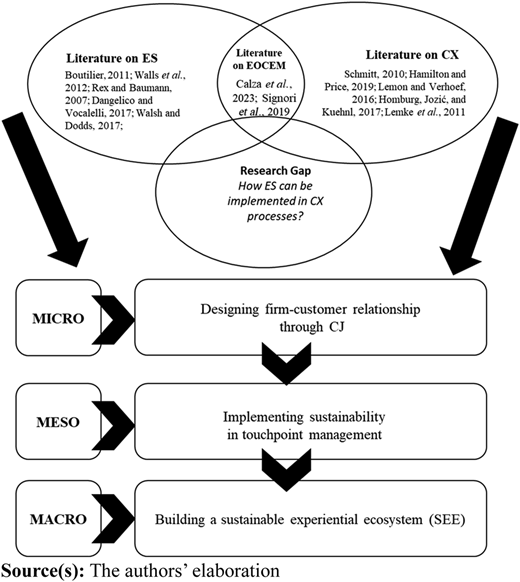
A good customer ecosystem involves well-systematised processes for providing a good CX. It is like a multi-tiered connection between different processes, directly impacting the final product. The delivery of the CX is dependent on a complex ecosystem, which implies that companies do not have complete ownership of the experiences they offer. In this intricate ecosystem, partners and even customers play a role in delivering various aspects of the CX. As a result, companies need to consider how they can empower all parties involved in its delivery. Within the debate on the incorporation of ES in the creation and delivery of a successful CX, the contribution of an integrated approach to an operating model for the firm has received insufficient attention (Calza et al., 2023; Signori et al., 2019). This study responds to this gap in the literature in three ways. First, it maps the linear CJ in a specific service context. Second, it analyses the touchpoints that connect the firm with the customer along the steps of the CX. Finally, it analyses the stakeholders that are behind the touchpoints, to outline the experiential ecosystem. From this analysis, it will be possibly to show how it is possible to achieve ES within the processes and possibly understand the obstacles to its implementation (see Figure 1).
The context of food delivery is particularly appropriate to such an analysis, as food delivery is a complex service with an assembly of different touchpoints in an omnichannel environment which involves several stakeholders. A first attempt to analyse the CJ in the context of mobile food ordering apps (MFOAs) was made by Rita et al. (2022). They defined online food delivery services as internet-based platforms that enable customers to order and receive food at their preferred location without being responsible for meal preparation. The authors analyse the elements of the journey that can improve customer satisfaction (e.g. content personalisation and customer reviews). That study stimulated us to continue the research by analysing the improvement of the CX, starting from a configuration of a more environmentally sustainable delivery process. Consistent with the aforementioned discussion, this study focusses on a case study of a company in the food delivery sector that has adopted sustainable touchpoints (Aoki et al., 2020).
3. Research method
3.1 Research approach
To address the research questions and account for the exploratory nature of this study, we employed the case study method (Eisenhardt, 1989; Yin, 2009), because it allows for the analysis of the object or phenomenon of study within its real-life context (Stake, 1995; Yin, 2003) and can uncover new aspects of the issue being studied (e.g. Dubois and Gadde, 2014; Eisenhardt and Graebner, 2007). For this case study, we focussed on an Italian food delivery company called Alfonsino. Food delivery is a dynamic and constantly evolving industry, particularly in the expanding Italian market, which made it an appropriate context to explore. Food delivery is not simply a matter of transporting food, but an experiential process in which customers choose what to order and from whom, and expect a timely and satisfactory experience. It is a complex service that involves multiple stakeholders. To obtain a comprehensive view of the experiential ecosystem, multiple sources of evidence were employed to triangulate the data (Yin, 2009). Specifically, secondary information was gathered from various sources, including archival records and physical artefacts (such as the official mobile app), online documentation encompassing reports, statistical data, specialised press articles. Primary data were collected trough in-depth interviews with various stakeholders of the food delivery ecosystem, including the company's managers, delivery riders (rather than drivers, as most deliveries are by motorcycle), partners, employees and customers, resulting in a total of 40 interviews (see Table 1).
To cover as much as possible all the players of the food delivery chain in the different phases of the CJ, the sample was created using a purposeful sampling approach (Suri, 2011), selecting respondents from each category to analyse potential opportunities for each sub-dimension from the pre-to post-experience stages.
We utilised a prespecified protocol, which was adapted for each stakeholder interviewed, to explore the food-delivery experience, the orientation to ES and touchpoint management. By comparing the perspectives of interviewees with elements that emerged from the theoretical framework, we aimed to uncover new perspectives and facets of the phenomenon under study (Eisenhardt and Graebner, 2007), ultimately seeking to test our intuitions against the reality of what is revealed in the interviews (Dubois and Gadde, 2014).
3.2 Alfonsino
Alfonsino is a ground-breaking startup established in 2016 by three young Italian entrepreneurs in Caserta, a city in the southern Campania region of Italy. In November 2021, the company was listed on the stock exchange. Its primary objective is to offer food delivery within small cities in Italy (those with populations ranging from 50,000 to 250,000). These areas are typically overlooked by major food delivery services such as Uber Eats, Just Eat, or Deliveroo. Alfonsino employs Facebook's chatbox and a user-friendly app that is compatible with major operating systems to arrange the collection and delivery of orders. Presently, Alfonsino additionally offers delivery services for food shops, chemists, florists, wine sellers and other local shops. The company serves over 300 Italian cities in 6 regions, but 70% of its customers are located in the Campania region. The delivery range is limited to 3 km, in keeping with the size of the cities it is designed to serve. Alfonsino collaborates with approximately 950 companies, 95% of which are small enterprises. The company receives around 30,000 orders every month.
3.3 Research process
From April 2022 to January 2023 we conducted 40 interviews with various stakeholders involved in Alfonsino's ecosystem. The study's purpose was not fully disclosed to the interviewees, to prevent bias in their responses. A pre-set question protocol was used for each stakeholder category (see Table 1) and the interviews lasted approximately 20–30 min. Managers and staff were interviewed face-to-face at Alfonsino's headquarters, partners were interviewed at their stores by appointment, customers were interviewed at our University Department and riders were interviewed by telephone with prior authorisation. To ensure robust results, we conducted 20 further interviews after achieving data saturation with 20 interviews. The interviews were conducted in Italian, audio-recorded, transcribed verbatim and anonymised. We then used a coding process to categorise the data into themes and categories, the interpretation of which are the basis of the study's findings. Since our research focussed on a “how?” question (how is ES implemented in CX in food delivery?) and there was no pre-existing theoretical framework, we designed an exploratory research study. We did not set out to test any specific propositions or hypotheses.
4. Results
4.1 Mapping the customer journey
The food delivery experience is the result of teamwork by multiple players (restaurant, rider, delivery provider, app provider, etc.), which for the customer not only translates into a home-delivery food service but has a much broader meaning, linked to saving time, comfort and the freedom to choose what to obtain (not only what type of cuisine but also, as mentioned in section 3.2, a range of goods) and when and how to obtain it. For this reason, Alfonsino's food delivery experience is designed and managed to be more than a technological process but also a satisfactory CX. As stated by the CEO, “in Alfonsino all marketing actions are aimed at making the customer journey of our consumers extremely satisfying. We adopt a customer-focused approach, daily rewarding their trust with the best shopping experience on the market. We provide our consumers with a premium service, constantly monitoring all interactions between them and the brand, with the aim of creating long-term loyalty”. The company attentively listens to its customers, especially their reviews, in order to configure a process that anticipates the latent needs of customers. More concretely, marketing staff specified that “The specific phases of the shopping experience are managed from a ‘purchase funnel’ perspective, in which the order placed on our app represents only the last phase of an omnichannel path, shaped to guarantee maximum customer satisfaction, before, during and after the purchase”. This philosophy translates into the implementation of a CX. In fact, as with all food delivery apps, the process takes place through an online order that arrives on the restaurateur's Alfonsino tablet and is prepared and collected in the time slots pre-set by the customer. At the same time, the notification is also read on the devices of the riders, who can book a delivery to make. Once the rider books the delivery, the restaurant has 20 min to prepare. In these steps, Alfonsino aims to manage the preparation and delivery of the meal in advance for the management of customer expectations and satisfaction. Although this approach is largely oriented towards customer satisfaction, we also questioned whether it is also environmentally sustainable, including for the other players in the ecosystem, and it is this aspect of the company's operations that is the subject of the present case study.
4.2 Implementing environmental sustainability in touchpoint management
The main objective of this research was to verify how ES is implemented in CX processes in food delivery. Alfonsino stated that “environmental sustainability is extremely important for offering a quality experience to our customers, who are increasingly sensitive to environmental issues and more inclined to trust companies that are inspired by sustainable behaviour models”. More concretely, the company communicates that: “together with our commercial partners we have been working for some time, not only in reducing the amount of packaging for deliveries, but also in adopting more eco-friendly solutions. This commitment often translates into real awareness campaigns aimed at customers, to generate an up-lift on the consumer experience itself”. Often there is an “ecological cutlery” option at no extra cost for the customer to add to the cart, although the company states that “ecological cutlery, while representing a sustainable touchpoint, is not included by default, to promote more responsibility for these tools, especially within the home, and thus reduce their environmental impact”. Operationally, ES is implemented for the packaging supplied to the Alfonsino's partners (e.g. paper shopping bags) and the packaging supplied by the partners themselves (boxes and, in some cases, cutlery and napkins).
Also in terms of communication, space is given to ES, with the use of social channels to promote more responsible consumption and encourage the use of some of the company's ecologically oriented services. For example, a recent partnership offers a home car wash service, which allows for a 99% reduction in water waste, in addition to the customer saving time.
One of the major obstacles that the company encounters in implementing sustainability, as underlined by the CEO, “is linked to our logistics chain, which by its very nature presupposes an environmental impact. Added to this are other exogenous factors that are difficult to manage, which can be summarised in the choices and behaviours of business partners and delivery collaborators, which directly impact our arbitrariness, consequently reflecting on the customer's journey”.
4.3 Evolving towards a sustainable experiential ecosystem (SEE)
It emerged from the case study that food delivery is a strongly customer-oriented industry and that the entire delivery experience is set up to meet customer expectations. ES is currently implemented only in communications, that is, with the aim of enhancing consumer awareness of ES issues, and in packaging, but for the creation of a CX that is environmentally sustainable, it seems necessary to share values and activities throughout the CJ. Our multistakeholder analysis, in fact, aims to understand how ES is perceived and practised by the various players in the food delivery chain and where improvements might be made. This concept emerges from the answers of the partners interviewed. Indeed, a local restaurateur claimed, “To date, I believe that sustainability does not make you more competitive from an economic point of view, since everything that is sustainable has a higher cost; nevertheless, it is a duty for companies to approach this type of concept more and more”; another one stated, “Since the consumer has become and is (especially the very young) very attentive to these issues, being and communicating attention to the environment could build customer loyalty and in any case foster a positive reputation”.
There is a shared perception of all Alfonsino's food and non-food partners that ES is increasingly valued by consumers, especially the younger ones. However, although this is an acquired value, it does not seem to be present in daily lifestyles. More than half of the customers interviewed declared that, although they believe that ES is important, they do not prioritise it in their daily purchases. A commitment to ES has to translate into a willingness to pay a premium price to purchase an environmentally friendly product.
To be able to speak of a CX that is environmentally sustainable, it is necessary to share “sustainability” amongst all operators. Here, the interviews with the riders were extremely interesting. Almost all the riders interviewed stated that they are environmentally conscious. In their work, the implementation of sustainability concerns above all the choice of means of transport. One rider stated: “as for the sustainability in the work of the riders, it depends on the riders themselves, in choosing the means of transport. For the rest [other stakeholders], the use of disposable items depends exclusively on the shops that collaborate with this company, and they are beyond the responsibility of the rider”. Most of the riders perceived the company to have a good profile in terms of sustainability. One of them declared that “the company supports environmental sustainability through donations; one of the main initiatives is to preserve bee colonies, since they have drastically decreased in number due to pollution”. However, at the same time, it emerges that a centralised policy or an incentive for the use of sustainable transport would be desirable. To evolve towards a genuinely sustainable experience, it is not enough to be customer-oriented and deliver ecological packaging but to share an orientation towards sustainability amongst all the operators in the process. This step would be even more efficient if it were centralised by the company, through a series of actions: selection of partners, supply of electric scooters/cars, intelligent systems for ride optimisation, use of technologies for food preservation.
To support the ecosystem perspective, the company has recently launched a digital marketplace dedicated to delivering any goods that allows supplier companies to interact directly with their consumers, guaranteeing the latter the possibility of having access to professional delivery services, offered by a network of independent couriers.
As stated by the CEO, “we welcome the development phase of the new platform with great confidence, as we are sure it will help us reach our efficiency goals faster thanks to the network”. This introduction, together with the launch of the new table reservation service, is representative of a transformative path that reflects the company's willingness to adapt to the continuous evolution of market dynamics and to create long-term value”.
5. Discussion
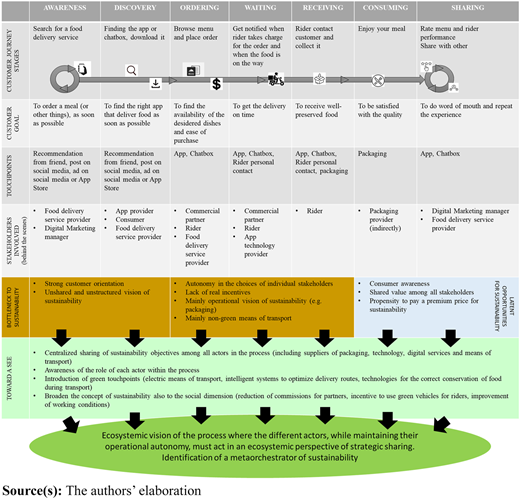
Based on the findings, we have developed a conceptual framework that explores an expanded version of the CJ, seeking to implement the environmental dimension of sustainability in the operational processes of the supply chain. It is presented in Figure 2, which highlights (working from top to bottom) a triple passage. First of all, it identifies the customer journey through which it is possible to define consumer behavioural steps and tools to connect company and customer; Secondly, the model highlights the operational processes of the experience supply chain and finally, it identifies the key to success for a convergence between the environmental dimension and customer orientation in the implementation of a sustainable experiential ecosystem, thus contributing novel insight into EOCEM (Calza et al., 2023; Signori et al., 2019) and extends the literature that recently had begun to explore this convergence (Christofi et al., 2015).
The model is so developed. The first element of the framework outlines the CJ along all the micro-phases of the food-delivery service experience and the related customer goals and touchpoints for each phase. Then, based on these touchpoints, the key stakeholders behind CX delivery are identified to suggest how ES can be introduced along these phases. The perspective of the CJ is thereby extended to an ecosystem vision of the process. In particular, without prejudice to the gears that allow the experience to be delivered to the customer, the multi-stakeholder approach has allowed us to understand what the current obstacles are (the bottleneck) and how the CJ can be redesigned to be efficient and sustainable at the same time.
In the final row of Figure 2, the elements that currently do not allow for full and shared implementation of sustainability in the management of the CX are listed. Currently, Alfonsino has a strong customer orientation, with prioritisation of speed of delivery, the variety of services available and the customer's autonomy in order management. Nevertheless, ES is valued, and this commitment is shared at all levels of the ecosystem, although little is done in practice. The only sustainable actions have been the abolition of the use of plastic in food packaging supplied by commercial partners and company communications aimed at making consumers aware of more environmentally responsible behaviour. Sustainability is left to the stakeholders, without a real incentive from the company. In the case of riders, there is no real incentive to use sustainable transport.
One the one hand, there is an awareness of their environmental responsibility on the part of consumers and an intention to pay a premium price, and, on the other hand, there is a shared awareness amongst companies that being sustainable strategically contributes to competitive advantage and that some actions could be implemented in the process of managing the whole experience and making it more environmentally sustainable.
Consequently, it is believed that in order to evolve towards a sustainable CX, it is important that the company plays the role of “metaorchestrator” within the ecosystem in order to share the value and importance of sustainability in a top-down manner amongst all stakeholders, including indirect ones (e.g. suppliers of packaging and means of transport). In this way it will be possible to build an ecosystem of actors who strategically share not only a customer orientation but also an environmental orientation. In this sense, the metaorchestrator will also be able to implement more concrete actions, such as providing an economic incentive for riders to use electric transport, but also to provide for the inclusion of other green touchpoints in the experience, such as intelligent systems for optimisation of the paths or technologies for the preservation of food.
Last but not least, it is believed that to evolve towards a complete SEE, sustainability must also be understood at a social level, which in this specific case means reducing commissions for business partners or improving the working conditions of riders.
Therefore, starting from the case study, we tried to develop a conceptual model that summarise and encapsulate the main outcomes of the empirical evidence.
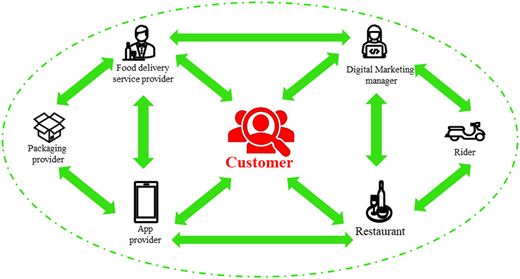
Particularly, the implementation of customer and environmental centricity requires the development and an integration amongst the different players of the wider supply chain where all the activities and information flow is driven by a shared sustainable mission, therefore the dual goal of putting the customer and the environment at the centre is achieved through sharing between the players of an enlarged supply chain that we have defined as a sustainable experiential ecosystem (see Figure 3 below).
More in depth, as explained in the figure, the competitiveness of companies that is based on the centrality of the customer experience and protection of the environment as critical success factors can be implemented at the ecosystem level, so between the actors in the supply chain. In this vein, the players will have to set both goals as strategic at an individual level and share these values in the operational processes of the supply chain.
6. Implications of the study
6.1 Theoretical contributions
This research enriches the literature on management, marketing and sustainability in several ways. First, it reflects a perspective which considers sustainability as a strategic element of the CX (Homburg et al., 2017). In particular, it advances previous studies on customer experience management (Calza et al., 2023; Ta et al., 2022; Moliner et al., 2019; Signori et al., 2019) by giving a concrete analytical perspective that analyses sustainability as a critical success factor within experience management. Specifically, this study demonstrates how the dual objective of being customer-centric and planet-centric can be implemented through green touchpoint management by introducing sustainable touchpoints and technologies to facilitate the experience and reduce environmental impact. Moreover, this study also demonstrates that an ecosystemic vision of shared values is also necessary to achieve ES in operational processes, which in turn requires the creation of a long-lasting alliance with partners. Indeed, previous studies on CX have not paid attention to the environmental context and have not analysed the role of the CJ in the formation of an experiential ecosystem. This research overcomes this view of the CX by extending the analysis to the entire ecosystem behind the scenes of the CJ. This study contributes to recent research on sustainable CX (Signori et al., 2019) by exploring how companies can practically integrate environmental protection with a successful CX within their business ecosystem. Additionally, it builds upon recent efforts to identify latent trends in customer-centricity and sustainability (Pardo-Jaramillo et al., 2020) by using empirical research to question firm personnel on how they achieve ES goals and prioritise the CX. This research also enhances the literature on green marketing by demonstrating how experience management can serve as a strategic tool that can be used to position companies in the market, differentiate products and services and build trust with environmental stakeholders.
6.2 Managerial implications
This study presents innovative findings that can benefit managers and entrepreneurs. They must consider the advantages of integrating CX and ES. Although it is necessary for all companies, particularly service companies, to integrate CX and ES, it is a complex task. Previous studies have suggested techniques, such as CJ mapping, to understand the impact of particular touchpoints on CX formation and strategic partnerships to build long-term alliances with like-minded partners. This research demonstrates that an integrated approach to being socially and environmentally conscious is achievable by implementing a SEE. The results show that CX formation is more intricate and dynamic when viewed from a customer ecosystem perspective. Service companies should, therefore, adopt an ecosystem view of CX to gain insights into how touchpoints interact with the social and cultural contexts in the meso- and macro-layers during the CJ. An ecosystem view of the CX enables companies to gain a more realistic understanding of it, and leverage this to enhance their competitive advantage. Moreover, integrating environmental thinking into all aspects of marketing allows companies to attract new customers, retain existing ones, improve customer feedback and enhance corporate image (KPMG, 2019). Our results suggest that to implement the SEE model a new cultural mindset has to be developed within the company, one based on respect for the environment and the centrality of the customer in operational processes and strategic decisions. Firms that use this approach will also ensure they accomplish the SDG, particularly those relating to affordable and clean energy, decent working conditions and economic growth.
Moreover, sharing a customer and environmental orientation also can make firms more green, as in the case of electric transport or biodegradable packaging. In this sense, it is relevant for companies to use technologies to optimise processes, as in the case of devices that optimise delivery routes. This is important to keep processes efficient. In fact, the risk is that green processes can reduce the efficiency required by customer experience management; this would be the case if bicycles replaced the use of motorbikes or cars.
6.3 Concluding remarks: limitations and future directions
The current competitive goals for firms are delivering successful experiences for customers and being responsible towards the natural environment (Calza et al., 2023). These two goals have rarely been investigated jointly. This study has demonstrated empirically that creating successful experiences for the customer and ES are possible, starting from sustainable touchpoints combined with a strategic sharing of objectives amongst all the stakeholders behind the management of those touchpoints. The present study offers an operational model to deliver green and successful CXs by reshaping business processes. The model delineated, named SEE, is the first to strategically and operationally implement ES in the CJ, demonstrating that it is necessary to have an ecosystem vision to achieve both objectives. In this sense, the model demonstrates that each stakeholder must take its share of responsibility towards the environment. In fact, however, if touchpoints are managed correctly, it is possible to deliver CX in an efficient and sustainable way at the same time.
The study is not without limitations, but these can be considered in future research. First, the main limitation is linked to the explorative nature of case study analysis and to the inductive approach used because it could be ambiguous in outcomes, highlighting the need for further methodological improvements.
Secondly, the analysis of a case study based on a single industry does not allow for the generalisation of the findings. The validity of the model could be tested through a cross-industry comparison. Moreover, the exploratory analysis examines an ecosystem of direct suppliers, and future research could also consider indirect suppliers (for example those in packaging and transport). In addition, given the growing discussion on sustainable CX, it would be beneficial for future research to extend the model by incorporating the triple-bottom-line sustainability framework. With a focus on prioritising human needs, it is crucial to place greater emphasis on comprehending the effects of the social aspect of sustainability when implementing CX strategies.
Finally, according to the results, to continue the research in this field, it is interesting to investigate how sustainability can be implemented in the user experience design, considering that digital touchpoints are strategic in the customer journey to attract, engage and retain customers.