Skip to Main Content
Purpose

Blockchain technology (BC) has emerged as a transformative tool for driving sustainability across various sectors, with notable implications for the agri-food industry. However, documented success stories and sector-specific research have been limited. This study examines the mechanisms by which BC facilitates the achievement of sustainability goals. Specifically, it investigates how BC-related benefits contribute to companies' success in attaining sustainability outcomes and supporting their strategies.

Design/methodology/approach

This study uses Qualitative Comparative Analysis (QCA) to examine the connections between adoption conditions and sustainability outcomes. It uses crisp-set QCA and Boolean algebra to represent the case membership as dichotomous values (0 or 1). Semi-structured interviews were conducted with 52 Italian agri-food firms and BC providers, identified through snowball sampling. This configurational approach reveals how companies adopt BC and its impact on achieving sustainability goals.

Findings

The results reveal that BC supports sustainability by (1) strengthening business relationships, (2) providing technical resources, (3) enhancing process effectiveness, and (4) sustaining market performance. Based on how these benefits combine, this study identifies three distinct adoption pathways: technology-driven, process-driven, and value-driven, each representing a unique strategy for leveraging BC to achieve sustainability goals.

Originality/value

This study deepens how BC intersects sustainability and offers actionable insights into its benefits and adoption configurations. It stands out as one of the first studies to examine the detailed pathways that companies follow when integrating BC into sustainability strategies. By addressing this emerging topic, this study underscores the context-specific mechanisms through which BC facilitates sustainable business transformations.

Sustainability has emerged as a pivotal concern in global policy and business discourse, as evidenced by high-profile initiatives such as the United Nations 2030 Agenda—featuring the 17 Sustainable Development Goals (SDGs)—and the European Green Deal, both of which advocate for a comprehensive and systemic transformation toward sustainability. However, despite the increasing visibility and normative influence of these frameworks, the practical realisation of sustainability goals remains a complex and unresolved issue for many organisations, industries, and communities. Recent studies underscore these challenges by examining integrated sustainability performance frameworks and the evolving landscape of sustainability reporting practices (Arianpoor and Salehi, 2021; Salehi and Arianpoor, 2021; Arianpoor et al., 2023). The persistent gap between sustainability ambitions and implementation outcomes underscores the critical need for innovative, technology-driven solutions to support and accelerate achieving these goals (Arianpoor and Borhani, 2024; Louta et al., 2024). Within this context, emerging digital technologies, particularly blockchain (BC), have attracted significant interest because of their potential to facilitate sustainable transformation by enabling transparent, decentralised information systems that increase perceived trust and reduce asymmetries among stakeholders, while improving efficiency and coordination among organisations (Blanco-González-Tejero et al., 2024). BC, a decentralised ledger system (Nakamoto, 2008) characterised by transparency, immutability, and secure transaction verification (Pan et al., 2020), has evolved far beyond its initial applications in cryptocurrency and fintech (Tapscott and Tapscott, 2017; Russo-Spena et al., 2022). The agri-food industry has major environmental and social implications and is a key sustainability sector (Dai et al., 2023; Giganti et al., 2024). BC improves safety and traceability (Antonucci et al., 2019; Feng et al., 2020), supports flexible value chains, and drives innovation (Cozzio et al., 2023; Sharma et al., 2024). It helps create smart agri-food systems when integrated with complementary technologies, such as the Internet of Things (IoT) and artificial intelligence (AI) (Rehman et al., 2023; Sezer et al., 2024).

Despite the extensive literature on BC’s business benefits, its role as a strategic enabler of sustainability remains insufficiently investigated and empirically substantiated (Arianpoor et al., 2023; Spigarelli et al., 2024). Many recent studies have used conceptual or one-dimensional perspectives to focus on specific applications or indirect effects. For example, BC has been investigated for its ability to reduce environmental impacts and raise awareness about energy, water, and land consumption (Mukherjee et al., 2021; Jan et al., 2024; Rani et al., 2024), as well as its capacity to foster inclusive trade, enhance market information, and ensure greater legal certainty (Sezer et al., 2024). However, integrating BC into organisations and supply chains presents several challenges. High implementation costs (Yadav et al., 2024), technical barriers, resistance to data sharing, and the need for organisational process redesign can hinder widespread adoption (Jiang et al., 2022; Spigarelli et al., 2024). These obstacles are exacerbated by limited awareness and the absence of standardised frameworks for BC integration (Koehler et al., 2022; Kouhizadeh et al., 2020; Mulligan et al., 2024). Furthermore, studies that adopt excessively positive evaluations often overestimate the innovative potential of BC without providing concrete evidence to substantiate their claims (Ali et al., 2021; Spigarelli et al., 2024). In addition, the degree of BC adoption and its impact vary significantly across industries and among firms within the same sector, reflecting differences in integration levels and strategic approaches (Bag et al., 2022; Kannan et al., 2024; Jiang et al., 2022; Schinckus, 2020). This variability highlights the need for a deeper exploration of BC’s tangible and measurable benefits to strategic processes, particularly in advancing sustainability implementation (Aslam et al., 2023; Dadsena et al., 2024; Friedman and Ormiston, 2022) and reporting practices (Arianpoor and Salehi, 2021; Salehi and Arianpoor, 2021). Indeed, except for a few notable contributions (Arianpoor et al., 2023), a clear understanding of how BC enables sustainability-oriented strategies and drives value creation is still lacking. Building on this foundation, this study seeks to expand the empirical base by exploring how BC’s benefits can be configured to make sustainability goals more operational and actionable within organisational contexts. Developing such insights is crucial for enabling organisations to make informed investment decisions and fully leverage the transformative potential of BC (Friedman and Ormiston, 2022; Oguntegbe et al., 2022).

Accordingly, this study is guided by the following research question: R1) How does BC support companies achieving sustainability goals? R2) What are the possible configurations of the benefits that enable firms to realise these goals?

To address these research questions, this study adopts a configurational approach, which is particularly appropriate for investigating causal complexity, namely, the coexistence of multiple interrelated conditions that collectively shape outcomes. Specifically, this study employs a crisp-set qualitative comparative analysis (csQCA) to analyse data obtained from in-depth interviews with managers of agri-food companies using BC technology and their technology providers (Kumar et al., 2022). The agri-food sector is well-positioned to benefit from BC, given its inherent structure and the critical importance of food sustainability (Gidanti et al., 2024). As technological innovation transforms this industry, new market entrants reshape traditional practices, generating opportunities to improve efficiency, product quality, and sustainability performance (Rana et al., 2021; Paul et al., 2021). By employing a complexity-oriented perspective, this study moves beyond linear explanations using QCA (Kumar et al., 2022) to capture the nuanced interplay of factors that influence the role of BC in promoting sustainability. This approach is particularly valuable in the context of interdependent systems, such as the agri-food supply chain, where dynamic interactions among technological, environmental, and organisational dimensions give rise to intricate patterns of causality (Mazzucchelli et al., 2021).

This study makes three key contributions to the literature on business sustainability strategies. First, while existing studies emphasise BC’s potential and general benefits, this study advances the field by empirically examining four specific and actionable benefits: strengthening business relationships, providing technical resources, enhancing operational process effectiveness, and sustaining market performance. Second, it provides new insights into the diverse pathways that firms adopt and leverage BC, offering a detailed understanding of its real-world applications. The findings revealed that the impact of BC on sustainability is amplified when BC benefits converge under specific conditions. Third, this study identifies three approaches to BC adoption: technology-driven, process-driven, and value-driven. These approaches illustrate the varying degrees to which BC facilitates sustainable business transformation depending on how effectively firms integrate and leverage BC benefits within their strategic processes.

The remainder of this paper is structured as follows. Section 2 reviews the relevant literature and outlines the study’s propositions. Section 3 details the methodology, and Section 4 presents the analysis and results. The following sections discuss these findings and introduce the proposed framework. Section 6 highlights the contributions and implications for practitioners and suggests directions for future research.

Several theoretical studies and conceptual models (Pan et al., 2020; Jan et al., 2024; Sharma et al., 2024) have systematically examined and provided evidence of the multifaceted benefits of BC adoption, highlighting its diverse and measurable impacts on sustainability strategies (Park and Li, 2021; Jan et al., 2024). The broader literature on blockchain consistently highlights its contribution to sustainability by increasing operational transparency and advancing sustainability through fraud reduction, improved traceability, and inclusive innovation (Jiang et al., 2022; Rana et al., 2019). Beyond a purely technological focus, numerous studies underscore the critical importance of adopting comprehensive sustainability performance metrics and examining their interdependencies (Arianpoor and Salehi, 2021; Arianpoor et al., 2023; Zimon et al., 2022), particularly in addressing the urgency posed by contemporary crises (Arianpoor and Tajdar, 2024). In doing so, they highlight the pressing need for an integrated framework that captures both the strategic intent and leverage mechanisms inherent to sustainable business practices.

Such an expanded lens paves the way for future scholarly inquiry into BC-enabled sustainability strategies, promoting a shift from isolated, case-specific implementations to a broader, integrated-level examination of blockchain’s potential to reshape sustainability strategies. It provides firms with a robust foundation for evaluating sustainability performance through a multidimensional lens (Arianpoor and Salehi, 2021), reinforcing the strategic value of technologies such as blockchain in meeting integrated sustainability goals.

This is particularly evident in sectors such as agri-food, where complexity and the imperative for transparency and quality assurance have driven growing interest in BC owing to its transformative potential across multiple supply chain dimensions (Mangla et al., 2002; Jan et al., 2024). Research demonstrates that reliable mechanisms to verify product origin, ensure safety, and promote sustainability address the growing consumer demand for ethical, high-quality food products (Rana et al., 2021). In the agri-food business, BC technology strengthens food safety by enabling the rapid identification of contamination sources and efficient recall processes, thus mitigating supply chain risks (Hao et al., 2020; Iftekhar et al., 2020).

In addition to consumer-facing benefits, BC contributes to operational efficiency by allowing precise inventory tracking, waste reduction, and resource allocation optimisation, which are key factors in meeting environmental goals and achieving economic sustainability (Sharma et al., 2024; Jan et al., 2024). Moreover, many studies recognise that technological solutions alone cannot resolve sustainability issues in supply chains (Rani et al., 2024; Vu et al., 2022). Achieving high levels of traceability and transparency to address social or environmental goals requires the willingness and ability to share internal data and redesign processes and activities (Bag et al., 2022; Lezzi et al., 2024; Xue et al., 2021), as well as to manage perceptions of legitimacy and system trustworthiness within the wider network of stakeholders (Blanco-González-Tejero et al., 2024). Effective BC adoption profoundly affects the organisational processes and resources necessary for successful implementation (Jiang et al., 2022; Nandi et al., 2020; Zhao et al., 2019). Despite extensive research, a significant gap remains in understanding how BC benefits are realised and combined to contribute effectively to a company’s sustainability strategy. Much of the literature focuses on the isolated aspects of BC or simulation-based models (Pan et al., 2020), neglecting empirical insights into their broader effects (Spigarelli et al., 2024). Addressing this gap requires a comprehensive approach to examine the extensive implications of BC, particularly its role in aligning competitive strategies with socio-environmental objectives (Bag et al., 2022; Arianpoor and Borhani, 2024). The next section investigates these interconnected aspects and outlines the research propositions.

This study focuses on four critical dimensions of BC benefits: business relationships, technical resources, operational processes, and market performance. These dimensions, grounded in the existing literature and detailed in the text, were selected for their potential to yield actionable insights that inform and enhance organisational decision-making and performance outcomes.

Business relationships: BC is pivotal for transforming business relationships (Rejeb et al., 2021). BC contributes to fair relationships by fostering trust, enabling knowledge sharing, and influencing power dynamics (Mulligan et al., 2024; Rani et al., 2024). Most importantly, BC’s potential to enhance collaboration among supply chain participants underlines its pivotal role in establishing resilient and sustainable agri-food systems (Rogerson and Parry, 2020; Rejeb et al., 2021). By providing a secure and transparent framework, BC allows companies to engage in collaborative efforts more confidently, promoting balanced and equitable interactions between the parties (Khan et al., 2022). Peer-to-peer collaborations have demonstrated significant efficiency gains and growth opportunities, paving the way for more substantial and enduring partnerships (Pandey et al., 2024; Rogerson and Parry, 2020; Rani et al., 2024). This potential to strengthen and sustain long-term collaborations highlights BC’s broader role in advancing sustainable supply chain integration (Friedman and Ormiston, 2022), fostering innovative and cooperative approaches to business relationships.

Technical resources: Some scholars have debated the integration of BC with the Internet of Things (IoT) and other technologies, such as Artificial Intelligence (AI), for applications in data recording, monitoring, coding, and sharing (Iftekhar et al., 2020; Liu et al., 2021; Zhu and Li, 2021). This integration is particularly significant because BC enhances communication and transparency within proprietary IoT systems (Dey and Shekhawat, 2021). Moreover, synergy between BC and Communication Technology (ICT) has driven advancements in smart farming, information security, and sustainable water management (Jan et al., 2024; Liu et al., 2021). By addressing IoT-related data-use challenges, BC facilitates the effective management of these systems, enabling companies to harness the full potential of their technological investments (Kamble et al., 2020). This capability is vital for fostering sustainable development because it ensures that technological innovations meaningfully contribute to long-term environmental and social goals (Angelis and da Silva, 2019; Stranieri et al., 2021).

Operational processes: New data processes are transformed through real-time data capture and secure BC-based monitoring, reducing reliance on costly manual checks, while improving operational efficiency and accountability (Hasan et al., 2020; Pan et al., 2020). Studies demonstrate that these advancements are particularly important in areas such as inventory management, forecasting, and regulatory oversight, where the dematerialisation of processes has significantly streamlined operations (Kamble et al., 2020; Lezzi et al., 2024). Such transformations minimise human error, enhance consistency and speed, and support environmental practices by optimising resource use and reducing waste (Xue et al., 2021). Beyond operational improvements, BC facilitates the creation of new organisational knowledge, extending beyond technical data to encompass insights into operational and business intelligence (Martinez et al., 2019; Nandi et al., 2020; Pan et al., 2020). For example, BC-enabled order management systems leverage platform data to drive organisational process efficiency and efficacy, and align business strategies with sustainable growth objectives (Martinez et al., 2019). BC has become a crucial enabler of business performance and long-term sustainability goals by integrating operational efficiency with data-driven business intelligence.

Market performance: Integrating BC into certification processes enhances sustainability efforts and improves market performance and brand reputation (Nandi et al., 2020; Rana et al., 2021). By providing a transparent and verifiable certification framework, such as organic or fair trade, BC enables companies to align with increasing consumer demand for ethical and environmentally conscious practices (Kouhizadeh et al., 2020; Rana et al., 2021). This alignment reinforces a company’s market position while fostering trust among stakeholders. Moreover, token-based systems powered by BC further elevate brand reputation by promoting customer engagement and loyalty through innovative and interactive methods (Aslam et al., 2023). Beyond reputation, these systems are critical in addressing challenges, such as food fraud, which can severely impact financial performance and erode consumer confidence (Li et al., 2021). Consequently, BC integration enhances operational transparency and establishes a foundation for sustainable market growth by building trust and delivering value to businesses and consumers.

Concentrating on these dimensions facilitates a deeper understanding of how BC can generate tangible benefits while offering insights into emerging pathways for organisations to address sustainability strategies. This analysis underpins the following proposition:

Proposition 1.

BC supports sustainability goals by strengthening relationships, providing new technical resources, enhancing operational processes effectiveness, and sustaining market performance.

Each dimension represents a distinct benefit; however, their combined effects may be more significant than their individual contribution. The interplay between strengthened relationships, new resources, enhanced operational processes, and improved market performance creates a synergistic framework that enables businesses to pursue sustainability (Cozzio et al., 2023). Similarly, strong relationships can foster new data efficiency, further reinforcing sustainability strategies (Dey and Shekhawat, 2021; Xu et al., 2024). This multidimensional impact underscores the importance of viewing BC benefits as interconnected, rather than isolated. Thus, the analysis proposes the following proposition.

Proposition 2.

The combined benefits of BC across relationships, technical resources, operational processes and market performance create a synergistic effect that supports sustainability goals.

This study employed Qualitative Comparative Analysis (QCA) to investigate BC’s contributions to sustainability goals by strengthening relationships, introducing new technical resources, enhancing operational process efficiency, and maintaining market performance. The QCA was chosen for its capacity to identify causal relationships between conditions and outcomes, focusing on cases within a multidimensional framework (Ragin and Strand, 2008). Its application has gained prominence in business and management research, especially in exploring causality under complex (Chen and Chen, 2024; Fu et al., 2024; Vargas-Zeledon and Lee, 2024), dynamic (Chen et al., 2023; Gómez-Olmedo et al., 2024; Huang et al., 2023; Yao and Li, 2023), and uncertain conditions (Casalegno et al., 2023; Wei et al., 2024).

QCA, which is based on a configurational approach, is particularly suited for examining the interplay of factors influencing the role of BC in promoting sustainability. Rooted in the principle of causal complexity, the configurational approach explores how different combinations of technological, organisational, and contextual factors may converge to produce similar sustainability outcomes (Di Paola et al., 2025). QCA conceptualises cases as configurations of relevant conditions and identifies causal recipes leading to the outcome. Several studies have demonstrated that it is useful in both small-N (10–50 cases) and large-N (over 50 cases) studies (Greckhamer et al., 2013).

This approach was further enriched through an iterative and analytical abstraction process to synthesise theoretical frameworks with empirical insights. Specifically, the abstraction and synthesis methodology proposed by Rahmani and Leifels (2018) was adopted because it closely aligns with the QCA’s focus on identifying combinations of conditions that led to specific outcomes. The detailed steps of this process are outlined below:

The extant literature conceptualizes QCA as a methodology and data-analysis technique. First, QCA affects research design, notably case selection, data collection, and concept identification (Schneider and Wagemann, 2012). This study purposively selected an intermediate number of cases and examined them using a cross-sectional design and semi-structured interviews (Thomann and Maggetti, 2020). The iterative nature of QCA investigations has encouraged researchers to move back and forth between relevant knowledge and case studies (Thomann and Maggetti, 2020).

This study involved a case-oriented QCA application by implementing crisp-set qualitative comparative analysis (csQCA). In csQCA, the membership of cases in the outcome and conditions is represented by dichotomous values, namely, 0 for non-membership in the set and 1 for membership in the set. The QCA assesses the existence of a relationship between conditions and the outcome of interest (Fiss, 2011), elucidating connections between necessity or sufficiency for both individual conditions and their combinations (Di Paola et al., 2025). A condition is considered sufficient when its occurrence ensures the outcome although it may arise in its absence. Conversely, a condition is deemed necessary when its existence is imperative for the outcome. Without this, the outcome cannot occur.

The three salient characteristics of QCA are as follows: (1) conjunctural causation—multiple conditions may yield outcomes; (2) equifinality—diverse configurations can result in identical outcomes; and (3) causal asymmetry—conditions and outcomes are linked through asymmetrical relationships (Delery and Doty, 1996).

This study focuses on cases in Italy, a country renowned for its pivotal role in agri-food production, exports, and territorial preservation. Italy’s distinction as the European leader in “Protected Denomination of Origin,” “Protected Geographical Indication,” and “Traditional Speciality Guaranteed” products underscores its dedication to quality and diversity within the agri-food sector.

Data collection employed a snowball sampling method initiated through the Italia4Blockchain, the leading BC association in Italy. This approach enabled identifying a network comprising providers offering BC-based services and their clients, such as agri-food firms, that actively incorporate BC into their operations. Fifty-two firms, 20 technology providers and 32 agri-food enterprises satisfied the study criteria and participated in the study ( Appendix). Analysing providers and their client firms allowed for a nuanced exploration of the technical and organisational dimensions of BC adoption.

Two researchers conducted semi-structured interviews over 18 months starting in January 2021 to gather in-depth data. Online or in-person interviews lasted approximately an hour. Drawing on theoretical frameworks, the interview questions analysed the literature-supported benefits of BC adoption (Table 1) and were directed to both groups. They focus on the benefits and reasons that drive agri-food enterprises to embrace BC services and their overall perspectives. Furthermore, the interviews explored the sustainability strategies of these organizations to gain insight into their primary goals and developmental trajectories. For agri-food companies, participants were predominantly CEOs, supplemented by production, quality, and marketing managers, who provided diverse organizational perspectives on BC adoption. The interviews targeted individuals who directly supported clients during the BC adoption process, ensuring that the responses reflected strategic and operational insights. All interviews were transcribed and translated to support comprehensive analysis and interpretation.

The analysis was based on knowledge of and involvement with the cases. After identifying the conditions and measures for analysis, each researcher individually analysed the transcripts, categorized the study’s conditions and outcomes, and independently coded the data using a binary rating (Berg-Schlosser and De Meur, 2009). The interviewer’s response guided the assignment of binary ratings, with a value of one or zero indicating whether the benefits discussed were perceived as achieved. The same method was used to evaluate sustainability goals, allowing for the identification of companies’ primary focus areas and developmental trajectories. Through an iterative process of comparing interview responses with insights from the literature, the two researchers collaboratively refined and validated the identified measures by establishing complete inclusion or exclusion from the set (Schneider and Wagemann, 2012). Table 1 presents the operationalization of these criteria.

The R statistical packages Set Methods and fsQCA (Dusa, 2019; Oana and Schneider, 2021), and fsQCA software (Ragin and Davey, 2022) were used to investigate and simplify the truth table of all possible condition combinations and corresponding cases for csQCA. These procedures yield sufficient and necessary conditions (or combinations thereof) for positive and negative outcomes (Medina-Molina and de la Sierra Rey-Tienda, 2022). The results of the solution paths emerging from the analysis were then interpreted.

Following Rahmani and Leifels’s (2018) iterative process, researchers moved back and forth between empirical findings and theoretical constructs to refine their analysis. This approach ensured that the emergent patterns in the data were grounded in real-world evidence and within a broader theoretical framework. Through iterative abstraction, subsequent analysis allowed for the integration of multiple perspectives, capturing a deeper exploration of the causal pathways underpinning the role of BC in advancing sustainability goals. This process produced a new conceptual framework that was not purely conceptual but grounded in tangible and practical evidence, making it applicable across diverse contexts.

The initial dataset contained dichotomous values, and no additional calibration was required before conducting necessity and sufficiency tests. The analysis examined positive and negative outcomes associated with when companies achieve sustainability goals related to BC-based services (Y) and when companies attain no environmental or social goals associated with implementing BC-based services (∼Y), respectively.

The necessity analysis utilised a consistency level of 0.9 for both situations (Y and ∼Y), as per Legewie (2013), and an RoN score greater than 0.5 (Oana and Schneider, 2021) (Table 2).

Necessity analysis showed that none of the analysed conditions, either in terms of their existence or absence, is necessary for Y or ∼ Y.

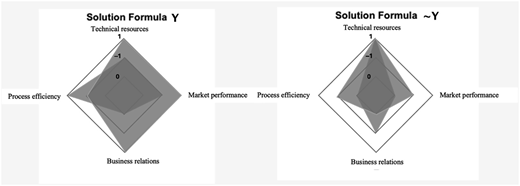
After the necessity test, a sufficiency analysis was conducted. Literature on sufficiency tests proposes a minimum consistency level of 0.75. The data enabled the attainment of a higher threshold of 0.85. The frequency threshold is set to 1. Table 3 presents parsimonious solutions for the sufficiency test for both Y and Y (Ragin and Strand, 2008).

Figure 1 illustrates the parsimonious solutions for the sufficiency test for both Y and Y, in the form of radar plots.

Oana and Schneider (2021) proposed a procedure to verify the robustness of their analysis results. This study implements csQCA and encompasses a sensitivity test for frequency and consistency parameters and the calculation of the robustness parameters using a fit-oriented methodology. Table 4 presents the results of the robustness test.

The test identified a range of parameters that fit when the solution remains robust. In addition, it produced two alternative solutions to finalise the fit-oriented test by selecting fit parameters outside the sensitivity range. In this step of the procedure, a frequency threshold of 3 was set for both Y and ∼Y and a consistency threshold of 0.75 for Y and 0.65 for ∼ Y. Then, the procedure determined the robustness of the solution by examining its overlap with the alternative solutions. RFSC_minTS and RFsc_maxTS quantified the overlap with alternative solutions, whereas Rfcons and Rfcov indicated a fit for consistency and coverage (Table 4).

The sufficiency test solutions revealed two distinct pathways associated with positive outcomes (Solutions 1 A and 1 B) and two pathways related to negative outcomes (Solutions 2 A and 2 B).

The first path (1 A) represents a configuration in which sustainability goals are achieved through enhanced process efficiency despite the absence of both substantial resource augmentation and improved market performance. Firms that exemplify this pathway are predominantly small-scale enterprises that have adopted blockchain technology primarily for their technical functionalities. These enterprises leverage blockchain to enhance their tracking and tracing mechanisms, thereby significantly improving operational transparency, data accuracy, and resource optimization. Such enhancements are instrumental in supporting and maintaining sustainability objectives, emphasizing operational efficiency as a critical pathway toward sustainability. In these cases, the utilization of blockchain promotes streamlined internal processes, reduces operational redundancies, and minimizes resource wastage, thereby aligning directly with sustainability principles. Although some firms also reported improved regulatory compliance and accountability due to enhanced transparency, this aspect was primarily perceived as internally relevant and was not explicitly assessed in terms of its contribution to sustainability credentials.

1 B) The second path corresponds to a configuration in which the outcome of achieving sustainability goals is associated with the presence of substantial new resources, strengthened and more manageable relational networks, and improved market performance, combined with the absence of enhanced process efficiency. In this configuration, blockchain facilitates the deepening and broadening of relationships across supply chains, and enhances firms' strategic positioning in the marketplace. Notably, the blockchain’s capacity to allow companies to foster extensive relationships involving institutional entities and certification bodies creates a robust ecosystem founded on transparency and trust. Firms following this pathway typically include medium-sized enterprises with certified premium products and significant international market reach. These companies strategically differentiate themselves by effectively utilizing blockchain-enabled transparency and traceability to reinforce consumer trust, product authenticity, and accountability throughout their supply chains. Additionally, blockchain adoption allows these firms to leverage enhanced information sharing and data interoperability, significantly improving their responsiveness to market demands and sustainability standards. The resultant strategic alignment with external stakeholders, including suppliers, distributors, regulatory agencies, and certification bodies, further solidifies their market positions and supports integrated sustainability goals.

Furthermore, two additional configurations identified by the sufficiency test result in negative outcomes for sustainability goals, indicating scenarios in which blockchain adoption fails to generate conducive sustainability benefits (Solutions 2 A and 2 B). Both configurations underscore the critical limitations associated with blockchain implementation, which primarily delivers new internal resources. In Solution 2 A, the acquisition of new resources alone yields negative outcomes when firms cannot translate these resources into stronger or more effective relational networks. Similarly, in Solution 2 B, the mere accumulation of new resources without concurrent improvements in process effectiveness or market performance resulted in unsatisfactory sustainability outcomes. These configurations illuminate significant constraints in focusing exclusively on blockchain-driven internal resource enhancement, without adequately addressing the relational dynamics within supply chains or achieving tangible improvements in market performance. Therefore, these findings emphasise the necessity for companies to strategically integrate blockchain-acquired resources with relational and market-oriented initiatives to realise comprehensive and meaningful sustainability goals.

This study addresses BC as a technological innovation that can serve as a strategic enabler of systemic transformation in sustainability strategies (Arianpoor and Borhani, 2024; Kannan et al., 2024; Tiscini et al., 2020). Some successful international experiences confirm this trend in agri-food. The Silal Fresh case exemplifies how blockchain technology strengthens supply chain relationships by effectively addressing product safety concerns, extending product shelf life, and minimising waste. These effects permeate all supply chain partners, augmenting the overall efficiency and sustainability. The World Economic Forum indicates that this technology can address communication, privacy, and trust issues within supply chains (Van Niekerk, 2024). IBM’s Food Chain also illustrates the increasing relevance of blockchain in advancing sustainability objectives. Farmer Connect, powered by IBM Blockchain, was initially designed to improve supply chain transparency by linking key stakeholders from growers to retailers, thereby ensuring enhanced efficiency, equity, and responsibility in coffee sourcing.

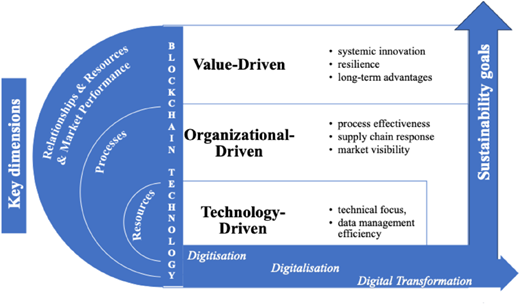
Building on the findings and through an iterative and analytical process of abstraction, this study synthesises theoretical frameworks with empirical insights (Rahmani and Leifels, 2018). Consequently, this study presents a comprehensive framework that defines three distinct approaches to BC adoption: technology-, process-, and value-driven (Figure 2).

These three approaches are positioned along a continuum that aligns with Bloomberg (2018) framework of digitisation, digitalisation, and cultural transformation in BC adoption. This framework provides a structured and holistic perspective offering insights into the various pathways through which BC adoption supports sustainability goals.

The first technology-driven approach viewed BC as a technical innovation to renew resources and enhance data storage, retrieval, and utilisation (Hasan et al., 2020; Martinez et al., 2019). Companies adopting this approach discuss BC as a solution for foundational operational applications, emphasising internal and strictly digital interventions. BC allows companies to mitigate the risks associated with information storage, enables secure data storage, and facilitates internal objectives through a more fluid flow of information within the organisation (Liu et al., 2021; Sharma et al., 2024; Xue et al., 2021). Organisations included in configuration paths that fail to establish a link between BC benefits and sustainability goals (Solution 2 A and Solution 2 B) fall into this category. While this approach acknowledges the benefits of BC regarding new digital resources and technological development, it does not recognise how these aspects could contribute to developing a broader strategic vision. By emphasising BC’s functional and technical digitisation benefits, it prioritises immediate tangible advantages with limited impacts, such as data integrity and transaction accuracy.

In the case of a process-driven approach, the benefits of BC extend beyond secure data storage to emphasise organisational process effectiveness and integrate new data-driven decision-making capabilities to support sustainability strategies (Mukherjee et al., 2021). Companies in the configuration path (1 A) exemplify this approach. The foundational data-driven advantage of BC, widely recognised in the literature (Xue et al., 2021), highlights its value as a tool for achieving initial sustainability objectives. For instance, the formal coordination mechanisms enabled by BC contribute to improving organisational processes to respond efficiently to supply chain demands and strengthen chain positioning (Hasan et al., 2020; Martinez et al., 2019). However, this approach often prioritises individual choices and business goal-driven outcomes, focusing primarily on operational improvements and localised gains rather than systemic transformation. Companies adopting this strategy tend to operate in silos, leveraging BC solutions tailored to their strategic needs (Pan et al., 2020). This reinforces a fragmented approach, in which companies privilege business advantages at the expense of shared long-term benefits (Kshetri, 2018).

The value-driven approach represents a holistic strategic framework in which BC technology fundamentally redefines business relations and value creation (Angelis and da Silva, 2019; Kannan et al., 2024; Xu et al., 2024). This approach entails cultural and operational transformations that aim for systemic innovation and alignment with broader sustainability goals. Companies in configuration path 1 B exemplify this approach. For these companies, the relational benefits of BC are viewed as integral to a comprehensive framework that connects them with a broader ecosystem of actors, including organisational stakeholders, institutional forces, and network partners (Li et al., 2021). This perspective emphasises the crucial role of a company’s internal capabilities, particularly its ability to harness emerging tools and technologies while fostering a culture of innovation. Complementary technologies such as sensors, the Internet of Things (IoT), and artificial intelligence (AI) are powerful catalysts for effective systemic transformation. This integration reinforces trust and enables companies to align responsible objectives with market performance metrics, ultimately enhancing long-term resilience, sustainability strategies, and value creation (Pandey et al., 2024).

These key findings illuminate how BC functions as a transformative tool for sustainability (Dadsena et al., 2024; Tiscini et al., 2020). Theoretical contributions show how BC transforms from a functional technology to a systemic innovation driver, providing managers actionable insights to match BC deployment with sustainability goals. According to this study, future research should focus on BC’s contextual factors and systemic impact of BC. Table 5 presents these contributions to the relevant literature, practical implications, and future research opportunities.

This study examined how BC helps companies achieve sustainability goals. This study offers three key contributions that expand on the existing literature.

First, this study highlights the evolution of BC from a functional tool to a catalyst for innovation and sustainability (Arianpoor and Borhani, 2024; Jan et al., 2024; Angelis and da Silva, 2019; Bag et al., 2022; Dai et al., 2023; Kannan et al., 2024). Drawing on the extensive literature (Dey and Shekhawat, 2021; Feng et al., 2020; Kamble et al., 2020; Khanfar et al., 2021; Li et al., 2021), this analysis focuses on four critical benefits of BC: strengthening relationships, providing new resources, enhancing process effectiveness, and sustaining market performance. Evidence demonstrates how these benefits contribute to sustainability within a company’s strategic focus (Proposition 1). Moving beyond general discussions of BC’s advantages, this study addresses recent calls for more precise guidelines to analyse the antecedents, benefits, and sustainability impacts of BC adoption (Jan et al., 2024; Jiang et al., 2022). In particular, and in line with prior models of business sustainability performance that emphasise the role of digital infrastructure in achieving multi-dimensional outcomes, this research contributes by demonstrating how BC can be strategically operationalised to advance firm-level sustainability goals.

Second, findings provide novel insights into how firms adopt and leverage the multifaceted benefits of blockchain (BC) to achieve sustainability outcomes, reflecting the intricate dynamics of real-world applications. While prior studies have often focused on isolated examples or theoretical potential (Jan et al., 2024; Jiang et al., 2022), this study explores the configurational effects of BC benefits and their strategic implications. The analysis demonstrates that the impact of BC on sustainability is amplified when certain BC benefits synergise under specific conditions (Proposition 2). The results, which delineate two configurational paths, provide evidence of how companies adopt differentiated approaches to BC. First, the benefit of process enhancement (Solution 1 A) enables firms to align their operations with sustainability objectives by emphasising the role of BC in operational transparency, accuracy, and resource optimisation (Feng et al., 2020; Kamble et al., 2020; Xu et al., 2024). This improved internal efficiency directly informs the primary sustainability goals. Second, the transformative impact of BC emerges when the combined benefits involve relational improvements, integration of new resources, and enhanced market performance (Solution 1 B). In this context, this study reveals that the relational benefits attributed to BC (Friedman and Ormiston, 2022; Dai et al., 2023; Upadhyay et al., 2021) are more significant when paired with advanced technological resources, such as AI and IoT. This synergy is further strengthened when the benefits of BC translate into improved market performance (Xu et al., 2024; Rehman et al., 2023; Kannan et al., 2024). Thus, BC’s effectiveness depends on strategic alignment, stakeholder collaboration, and coherence with broader organisational strategies. These approaches align with recent research on the importance of tailoring BC solutions to organisational contexts (Spigarelli et al., 2024) but go further by offering differentiated pathways for implementation across different organisations.

Third, the study proposes an integrative framework delineating three archetypal approaches to embedding BC within organisational strategy: process-driven, technology-driven, and value-driven. This continuum extends from internal process optimisation to externally oriented collaboration and stakeholder engagement. In line with recent studies (Jan et al., 2024; Mulligan et al., 2024), our framework emphasises that unlocking the transformative potential of BC requires more than isolated technological applications, which calls for complementary organisational practices and context-sensitive strategic frameworks. By introducing context-sensitive configurations to BC adoption, the framework provides a more nuanced understanding of how organisations can navigate some of the sustainability trade-offs inherent to BC technologies (Schinckus, 2020), thereby facilitating the development of tailored, strategically aligned adoption pathways.

In addition, this study adds to the theoretical discourse on sustainability performance by addressing the increasing scholarly emphasis on the development and application of comprehensive multidimensional sustainability metrics (Arianpoor and Salehi, 2021; Arianpoor et al., 2023; Zimon et al., 2022). Specifically, the proposed framework can serve as an analytical lens for addressing the complex and interdependent dimensions of sustainability performance. In doing so, it offers a structured means for theorising how BC-enabled strategies simultaneously affect economic, environmental, and social outcomes while revealing their systemic interactions. This approach enhances the theoretical clarity on how organisations can interpret, manage, and integrate sustainability goals within technology-mediated contexts.

This study presents several implications for practitioners regarding the tangible and practical enhancement of sustainability goals through BC implementation.

First, it provides evidence of how BC functions as a strategic asset, addressing complex sustainability challenges that create tangible impacts across interconnected aspects (Pandey et al., 2024; Jiang et al., 2022). BC’s multiple and context-dependent impacts offer managers several opportunities to exploit, according to their perception that it may evolve from a foundational technological solution to a systemic driver of innovation and sustainability transformation. This dual role underscores the importance of adopting a tailored and multifaceted approach to BC to elucidate its transformative role in fostering sustainable and innovative practices in firms and across industries.

Second, the findings indicate that organisations can translate the advantages of BC implementation into sustainability goals, albeit under specific conditions. Notably, this virtuous mechanism can be initiated when management effectively guides technology implementation through comprehensive integration into business processes (Nandi et al., 2020). This integration manifests as a substantial transformation of these processes, fundamentally altering work routines, digitalising, and streamlining activities throughout the entire value chain, encompassing operations, marketing, and logistics (Kamble et al., 2020). On the other hand, comparable sustainability goals advantages can be attained by organisations that effectively utilise BC to enhance their competitive position in the market and optimise the management of interactions with stakeholders, including but not limited to primary stakeholders such as customers and suppliers. From this perspective, managers must develop more confidence in BC integrity and the capacity to manage data, thereby reducing errors and the system’s vulnerability to misconduct (Rejeb et al., 2021). These aspects encompass several activities such as payment processing, data storage, intelligent logistics management, and IoT transactions, whose credibility and adoption may increasingly depend not only on technical functionality but also on how their benefits are communicated and perceived by users and partners (Blanco-González-Tejero et al., 2024). Nevertheless, managers must possess a comprehensive understanding of the interoperability and scalability challenges associated with different BCs to effectively manage their technological choices, both internally and within the supply chain context, particularly concerning the potential for connectivity with other entities belonging to the same supply chain as well as the reputational risks associated with technology misalignment or poor public engagement (Hardjono et al., 2019; Blanco-González-Tejero et al., 2024).

Third, this study demonstrates the need for managers to be cognisant of the advantages technology offers on different sides. While adopting a BC appears promising for all companies, certain aspects must be considered to maintain the firm’s sustainability goals. Despite the importance of fostering an organizational environment conducive to the utilization of new technologies through the promotion and development of specific knowledge and skills regarding the advantages and methods of implementing new technologies, the results indicate that the role of factors related to the penetration of technology into business processes or the development and strengthening of business relationships are essential for companies to achieve these goals. This aspect explains why BC may appear promising for all companies, but its effects and benefits are sometimes of different scope and significance (Aslam et al., 2023). Cultural transformation, the capacity to invest in the digitisation of processes or to improve supply chain management, necessitates engaging stakeholders, including regulators, industry partners, and customers, to construct a supportive network that facilitates BC adoption and optimisation. These aspects highlight managers’ roles in driving technological transformation in firms by extending beyond the availability of promising technologies ready to be adopted in the market, to include active shaping of trust and legitimacy through strategic stakeholder engagement and transparency practices (Blanco-González-Tejero et al., 2024).

Additionally, by illustrating how BC enhances these dimensions, especially in contexts with low standardisation of non-financial reporting, our results offer actionable insights for managers to respond to ongoing calls for greater transparency, legitimacy, and stakeholder accountability in sustainability reporting (Arianpoor et al., 2023; Zimon et al., 2022). This study emphasises the importance of comprehensive sustainability measurements and their interrelations (Arianpoor and Salehi, 2021), reinforcing the need for integrative frameworks that can accommodate both the financial and non-financial dimensions. Blockchain has emerged as a promising mechanism to support such integration by enhancing transparency, traceability, and stakeholder accountability within sustainability reporting systems.

The findings and contributions of this study offer several avenues for further research.

First, further research might enhance the understanding of the role of BC-related benefits in various specialised sustainability practices, such as circular ones. BC may play a crucial role in facilitating supply chain circularity by enabling the tracing of materials across the supply chain and ensuring transparency and provenance. Further investigation into this element may facilitate adaptation or expansion of the framework to include these specificities. Moreover, future investigations may include different or additional antecedents to explore their contribution to achieving strategic goals such as sustainability.

Second, the findings underscore the importance of interactions between BC-related benefits in generating strategic effects. For instance, this study showed that specific relationships are critical when coupled with enhanced technical and technological competencies. This alignment fortifies inter-organisational ties and generates broader market impacts, illustrating BC’s potential as a transformative enabler of sustainability goals. In this regard, additional research could go beyond the tier-one strategy utilised in this study, focusing on including agri-food enterprises and their technology providers in the empirical analysis. Future studies should include participants at other supply chain levels. This extension may reveal more about the use of BC in the supply chain, including indirect factors, to augment the findings. Future research could expand the conceptual framework to different organizational contexts and/or industries, uncover essential modifications according to other scenarios, and develop a deep understanding of various business contexts.

Third, technology-driven, process-driven, and value-driven approaches offer scholars a continuum to examine BC’s transformative potential. This categorization provides scholars with a structured lens to investigate the various pathways that companies pursue when aligning BC implementation with sustainability objectives and organisational contexts (Sezer et al., 2024). In a dynamic perspective, further longitudinal studies should examine how the adoption of BC evolves in response to different contextual conditions such as improved technological competences, changing regulations, or economic conjuncture. In addition, studies could explore how reputational risks and narrative-building influence the sustainability outcomes of different adoption paths over time (Blanco-González-Tejero et al., 2024).
Ali
,
O.
,
Jaradat
,
A.
,
Kulakli
,
A.
and
Abuhalimeh
,
A.
(
2021
), “
A comparative study: blockchain technology utilisation benefits, challenges and functionalities
”,
IEEE Access
, Vol. 
9
, pp. 
12730
-
12749
, doi: .
Angelis
,
J.
and
da Silva
,
E.R.
(
2019
), “
Blockchain adoption: a value driver perspective
”,
Business Horizons
, Vol. 
62
No. 
3
, pp. 
307
-
314
, doi: .
Antonucci
,
F.
,
Figorilli
,
S.
,
Costa
,
C.
,
Pallottino
,
F.
,
Raso
,
L.
and
Menesatti
,
P.
(
2019
), “
A review of blockchain applications in the agri‐food sector
”,
Journal of the Science of Food and Agriculture
, Vol. 
99
No. 
14
, pp. 
6129
-
6138
, doi: .
Arianpoor
,
A.
and
Borhani
,
S.A.
(
2024
), “
The interaction of blockchain technology, audit process, and the international financial reporting standards
”,
Accounting Research Journal
, Vol. 
38
No. 
1
, pp. 
35
-
58
, doi: .
Arianpoor
,
A.
and
Salehi
,
M.
(
2021
), “
A framework for business sustainability performance using meta-synthesis
”,
Management of Environmental Quality: An International Journal
, Vol. 
32
No. 
2
, pp. 
175
-
192
, doi: .
Arianpoor
,
A.
and
Tajdar
,
S.S.N.
(
2024
), “
The relationship between firm risk, capital structure, cost of equity capital, and social and environmental sustainability during the COVID-19 pandemic
”,
Journal of Facilities Management
, Vol. 
22
No. 
2
, pp. 
234
-
255
, doi: .
Arianpoor
,
A.
,
Salehi
,
M.
and
Daroudi
,
F.
(
2023
), “
Nonfinancial sustainability reporting, management's legitimate authority and enterprise value
”,
Social Responsibility Journal
, Vol. 
19
No. 
10
, pp. 
1900
-
1916
, doi: .
Aslam
,
J.
,
Saleem
,
A.
and
Kim
,
Y.B.
(
2023
), “
Blockchain-enabled supply chain management: integrated impact on firm performance and robustness capabilities
”,
Business Process Management Journal
, Vol. 
29
No. 
6
, pp. 
1680
-
1705
, doi: .
Bag
,
S.
,
Rahman
,
M.S.
,
Gupta
,
S.
and
Wood
,
L.C.
(
2022
), “
Understanding and predicting the determinants of blockchain technology adoption and SMEs' performance
”,
International Journal of Logistics Management
, Vol. 
34
No. 
6
, pp. 
1781
-
1807
, doi: .
Berg-Schlosser, D. and De Meur, G.
(
2009
), “Qualitative Comparative Analysis (csQCA) as an approach”, in
Rihoux, B. and Ragin, C.C. (Eds)
,
Configurational Comparative Methods: Qualitative Comparative Analysis (QCA) and Related Techniques
,
Sage Publications
,
Thousand Oaks and London
, pp.
1
-
18
.
Blanco-González-Tejero
,
C.
,
Cano-Marin
,
E.
,
Ulrich
,
K.
and
Giralt-Escobar
,
S.
(
2024
), “
Leveraging blockchain for industry funding: a social media analysis
”,
Sustainable Technology and Entrepreneurship
, Vol. 
3
No. 
3
, 100071, doi: .
Bloomberg
,
J.
(
2018
), “
Digitization, digitalisation, and digital transformation: confuse them at your peril
”,
Forbes
, Vol. 
28
, pp. 
1
-
6
.
Casalegno
,
C.
,
Civera
,
C.
,
Cortese
,
D.
and
Zardini
,
A.
(
2023
), “
In search of the enabling factors for public services resilience: a multidisciplinary and configurational approach
”,
Journal of Innovation and Knowledge
, Vol. 
8
No. 
1
, 100337, doi: .
Chen
,
Y.
and
Chen
,
Z.
(
2024
), “
Can e-government online services offer enhanced governance support? A national-level analysis based on fsQCA and NCA
”,
Journal of Innovation and Knowledge
, Vol. 
9
No. 
3
, 100526, doi: .
Chen
,
M.
,
Wang
,
H.
,
Liang
,
Y.
and
Zhang
,
G.
(
2023
),
Net and configurational effects of determinants on cloud computing adoption by SMEs under cloud promotion policy using PLS-SEM and fsQCA
,
Journal of Innovation and Knowledge
, Vol. 
8
No. 
3
, 100388, doi: .
Cozzio
,
C.
,
Viglia
,
G.
,
Lemarie
,
L.
and
Cerutti
,
S.
(
2023
), “
Toward an integration of blockchain technology in the food supply chain
”, 
Journal of Business Research
, Vol. 
162
, 113909, doi:
Dadsena
,
K.K.
,
Pant
,
P.
,
Paul
,
S.K.
and
Pratap
,
S.
(
2024
), “
Overcoming strategies for supply chain digitisation barriers: implications for sustainable development goals
”,
Business Strategy and the Environment
, Vol. 
33
No. 
1
, pp. 
260
-
273
, doi: .
Dai
,
M.
,
Massaro
,
M.
,
Ndou
,
V.
and
Raguseo
,
E.
(
2023
), “
Blockchain technologies for sustainability in the agrifood sector: a literature review of academic research and business perspectives
”,
Technological Forecasting and Social Change
, Vol. 
187
, 122186, doi:
Delery
,
J.E.
and
Doty
,
D.H.
(
1996
), “
Modes of theorising in strategic human resource management: tests of universalistic, contingency, and configurational performance predictions
”,
Academy of Management Journal
, Vol. 
39
No. 
4
, pp. 
802
-
835
, doi: .
Dey
,
K.
and
Shekhawat
,
U.
(
2021
), “
Blockchain for sustainable e-agriculture: literature review, architecture for data management, and implications
”, 
Journal of Cleaner Production
, Vol. 
316
, 128254, doi:
Di Paola
,
N.
,
Chari
,
S.
,
Iannacci
,
F.
and
Kraus
,
S.
(
2025
), “
Configurational theory in business and management research: status quo and guidelines for the application of qualitative comparative analysis (QCA)
”,
Technological Forecasting and Social Change
, Vol. 
211
, 123907, doi: .
Dusa
,
A.
(
2019
),
QCA with R. A Comprehensive Resource
,
Springer International Publishing
,
Bucharest
.
Feng
,
H.
,
Wang
,
X.
,
Duan
,
Y.
,
Zhang
,
J.
and
Zhang
,
X.
(
2020
),
Applying blockchain technology to improve agri-food traceability: a review of development methods, benefits and challenges
”,
Journal of Cleaner Production
, Vol. 
260
, 121031, doi:
Fiss
,
P.C.
(
2011
), “
Building better causal theories: a fuzzy set approach to typologies in organisation research
”,
Academy of Management Journal
, Vol. 
54
No. 
2
, pp. 
393
-
420
, doi: .
Friedman
,
N.
and
Ormiston
,
J.
(
2022
), “
Blockchain as a sustainability-oriented innovation: opportunities for and resistance to blockchain technology as a driver of sustainability in global food supply chains
,
Technological Forecasting and Social Change
, Vol. 
175
, 121403, doi:
Fu
,
H.
,
Xu
,
M.
,
Wu
,
Y.
and
Wang
,
W.
(
2024
),
What facilitates frugal innovation?–A configurational study on the antecedent conditions using fsQCA
,
Journal of Innovation and Knowledge
, Vol. 
9
No. 
3
, 100522, doi:
Giganti
,
P.
,
Borrello
,
M.
,
Falcone
,
P.M.
and
Cembalo
,
L.
(
2024
), “
The impact of blockchain technology on enhancing sustainability in the agri-food sector: a scoping review
”,
Journal of Cleaner Production
, Vol. 
456
, 142110, doi: .
Gómez-Olmedo
,
A.M.
,
Diéguez
,
M.E.
and
Pascual
,
J.A.V.
(
2024
),
Redefining success in innovative crowdfunding projects: empirical evidence of effective mindful consumption promotion in Kickstarter
,
Journal of Innovation and Knowledge
, Vol. 
9
No. 
4
, 100558, doi: .
Greckhamer
,
T.
,
Misangyi
,
V.F.
and
Fiss
,
P.C.
, “The two QCAs: from a small-N to a large-N set theoretic approach, configurational theory and methods in organisational research”, in
Research in the Sociology of Organizations
, pp. 
49
-
75
, doi: .
Hao
,
Z.
,
Mao
,
D.
,
Zhang
,
B.
,
Zuo
,
M.
and
Zhao
,
Z.
(
2020
), “
A novel visual analysis method of food safety risk traceability based on blockchain
”,
International Journal of Environmental Research and Public Health
, Vol. 
1
No. 
7
, 2300, doi:
Hardjono
,
T.
,
Lipton
,
A.
and
Pentland
,
A.
(
2019
), “
Toward an interoperability architecture for blockchain autonomous systems
”,
IEEE Transactions on Engineering Management
, Vol. 
67
No. 
4
, pp. 
1298
-
1309
, doi: .
Hasan
,
M.R.
,
Shiming
,
D.
,
Islam
,
M.A.
and
Hossain
,
M.Z.
(
2020
), “
Operational efficiency effects of blockchain technology implementation in firms
”,
Review of International Business and Strategy
, Vol. 
30
No. 
2
, pp. 
163
-
181
, doi: .
Huang
,
Y.
,
Bu
,
Y.
and
Long
,
Z.
(
2023
),
Institutional environment and college students' entrepreneurial willingness: a comparative study of Chinese provinces based on fsQCA
,
Journal of Innovation and Knowledge
, Vol. 
8
No. 
1
, 100307, doi: .
Iftekhar
,
A.
,
Cui
,
X.
,
Hassan
,
M.
and
Afzal
,
W.
(
2020
), “
Application of blockchain and internet of things to ensure tamper-proof data availability for food safety
”,
Journal of Food Quality
,
May
, 5385207, doi:
Jan
,
A.
,
Salameh
,
A.A.
,
Rahman
,
H.U.
and
Alasiri
,
M.M.
(
2024
), “
Can blockchain technologies enhance environmentally sustainable development goals performance in manufacturing firms? Potential mediation of green supply chain management practices
”,
Business Strategy and the Environment
, Vol. 
33
No. 
3
, pp. 
2004
-
2019
, doi: .
Jiang
,
S.
,
Jakobsen
,
K.
,
Bueie
,
J.
,
Li
,
J.
and
Haro
,
P.H.
(
2022
), “
A tertiary review on blockchain and sustainability with focus on sustainable development goals
”,
IEEE Access
, Vol. 
10
, pp. 
114975
-
115006
, doi: .
Kamble
,
S.
,
Gunasekaran
,
A.
and
Gawankar
,
S.A.
(
2020
), “
Achieving sustainable performance in a data-driven agriculture supply chain: a review for research and applications
”,
International Journal of Production Economics
, Vol. 
219
, pp. 
179
-
194
, doi: .
Kannan
,
D.
,
Amiri
,
A.S.
,
Shaayesteh
,
M.T.
,
Nasr
,
A.K.
and
Mina
,
H.
(
2024
), “
Unveiling barriers to the integration of blockchain-based circular economy and Industry 5.0 in manufacturing industries: a strategic prioritisation approach
”,
Business Strategy and the Environment
, Vol. 
33
No. 
4
, pp. 
2145
-
2167
, doi: .
Khan
,
S.M.
,
Shujaat
,
K.
,
Gupta
,
H.
and
Zaman
,
S.M.
(
2022
), “
Blockchain technologies as enablers of supply chain mapping for sustainable supply chains
”,
Business Strategy and the Environment
, Vol. 
31
No. 
1
, pp. 
468
-
486
, doi: .
Khanfar
,
A.
,
Iranmanesh
,
M.
,
Ghobakhloo
,
M.
,
Senali
,
M.G.
and
Fathi
,
M.
(
2021
), “
Applications of blockchain technology in sustainable manufacturing and supply chain management: a systematic review
”,
Sustainability
, Vol. 
13
No. 
14
, 7870, doi:
Koehler
,
S.
,
Bager
,
P.
and
Massimo
,
P.
(
2022
), “
Sustainability standards and blockchain in agro-food supply chains: synergies and conflict
, 
Technological Forecasting and Social Change
, Vol. 
185
, 122041, doi:
Kouhizadeh
,
M.
,
Saberi
,
S.
and
Sarkis
,
J.
(
2020
), “
Blockchain technology and the sustainable supply chain: theoretically exploring adoption barriers
”,
International Journal of Production Economics
, Vol. 
231
,
January
, 107831, doi:
Kshetri
,
N.
(
2018
), “
Blockchain’s roles in meeting key supply chain management objectives
”,
International Journal of Information Management
, Vol. 
39
, pp.
80
-
89
.
Kumar
,
S.
,
Sahoo
,
S.
,
Lim
,
W.M.
,
Kraus
,
S.
and
Bamel
,
U.
(
2022
), “
Fuzzy-set qualitative comparative analysis (fsQCA) in business and management research: a contemporary overview
”,
Technological Forecasting and Social Change
, Vol. 
178
,
May
, 121599, doi:
Legewie
,
N.
(
2013
), “
An introduction to applied data analysis with qualitative comparative analysis
”,
Forum Qualitative Sozialforschung/Forum: Qualitative Social Research
, Vol. 
14
No. 
3
, 15, doi:
Lezzi
,
M.
,
Del Vecchio
,
V.
and
Lazoi
,
M.
(
2024
), “
Using blockchain technology for sustainability and secure data management in the energy industry: implications and future research directions
”,
Sustainability
, Vol. 
16
No. 
18
, p.
7949
, doi: .
Li
,
K.
,
Lee
,
J.Y.
and
Gharehgozli
,
A.
(
2021
), “
Blockchain in food supply chains: a literature review and synthesis analysis of platforms, benefits and challenges
”,
International Journal of Production Research
, Vol. 
61
No. 
11
, pp. 
3527
-
3546
, doi: .
Liu
,
W.
,
Shao
,
X.
,
Liu
,
C.
,
Xiao
,
P.
,
Li
,
C.
,
Z
,
K.
,
Xing
,
X.
and
You
,
R.
(
2021
), “
A systematic literature review on applications of information and communication technologies and blockchain technologies for precision agriculture development
”,
Journal of Cleaner Production
, Vol. 
298
, 126838, doi:
Louta
,
M.
,
Banti
,
K.
and
Karampelia
,
I.
(
2024
), “
Emerging technologies for sustainable agriculture: the power of humans and the way ahead
”,
IEEE Access
, Vol. 
12
, pp. 
103468
-
103495
, doi: .
Mangla
,
S.
,
Kazancoglu
,
Y.
,
Yildizbasi
,
A.
,
Calik
,
O.
and
Ahmet
,
C.
(
2022
), “
A conceptual framework for blockchain-based sustainable supply chain and evaluating implementation barriers: a case of the tea supply chain
”,
Business Strategy and the Environment
, Vol. 
31
No. 
1
, pp. 
374
-
390
, doi: .
Martinez
,
V.
,
Zhao
,
M.
,
Blujdea
,
C.
,
Han
,
X.
,
Neely
,
A.
and
Albores
,
P.
(
2019
), “
Blockchain-driven customer order management
”,
International Journal of Operations and Production Management
, Vol. 
39
Nos
6/7/8
, pp. 
993
-
1022
, doi: .
Mazzucchelli
,
A.
,
Gurioli
,
M.
,
Graziano
,
D.
,
Quacquarelli
,
B.
and
Aouina-Mejri
,
C.
(
2021
), “
How to fight against food waste in the digital era: key factors for a successful food sharing platform
”,
Journal of Business Research
, Vol. 
124
, pp. 
47
-
58
, doi: .
Medina-Molina
,
C.
and
de la Sierra Rey-Tienda
,
M.
(
2022
), “
The transition towards the implementation of sustainable mobility. looking for generalization of sustainable mobility in different territories by the application of QCA
”,
Sustainable Technology and Entrepreneurship
, Vol. 
1
No.
2
, 100015, doi:
Mukherjee
,
A.A.
,
Singh
,
R.K.
,
Mishra
,
R.
and
Bag
,
S.
(
2021
), “
Application of blockchain technology for sustainability development in the agricultural supply chain: justification framework
”,
Operations Management Research
, Vol. 
15
No. 
1
, pp. 
46
-
61
, doi: .
Mulligan
,
C.
,
Morsfield
,
S.
and
Cheikosman
,
E.
(
2024
), “
Blockchain for sustainability: a systematic literature review for policy impact
”,
Telecommunications Policy
, Vol. 
48
No. 
2
, 102676, doi: .
Nakamoto
,
S.
(
2008
), “
Bitcoin: a peer-to-peer electronic cash system
”,
available at:
 https://bitcoin.org/bitcoin.pdf
Nandi
,
M.L.
,
Nandi
,
S.
,
Moya
,
H.
and
Kaynak
,
H.
(
2020
), “
Blockchain technology-enabled supply chain systems and supply chain performance: a resource-based view
”,
Supply Chain Management: International Journal
, Vol. 
25
No. 
6
, pp. 
841
-
862
, doi: .
Oana
,
I.-E.
and
Schneider
,
C.Q.
(
2021
), “
A robustness test protocol for applied QCA: theory and R software application
”,
Sociological Methods and Research
, Vol. 
53
No. 
1
, pp. 
57
-
88
, doi: .
Oguntegbe
,
K.F.
,
Di Paola
,
N.
and
Vona
,
R.
(
2022
), “
Behavioural antecedents to blockchain implementation in agri-food supply chain management: a thematic analysis
”, 
Technology in Society
, Vol. 
68
No. 
1
, 101927, doi:
Pan
,
X.
,
Pan
,
X.
,
Song
,
M.
,
Ai
,
B.
and
Ming
,
Y.
(
2020
), “
Blockchain technology and enterprise operational capabilities: an empirical test
,
International Journal of Information Management
, Vol. 
52
, 101946, doi:
Pandey
,
A.K.
,
Daultani
,
Y.
and
Pratap
,
S.
(
2024
), “
Blockchain technology enabled critical success factors for supply chain resilience and sustainability
”,
Business Strategy and the Environment
, Vol. 
33
No. 
2
, pp. 
1533
-
1554
, doi: .
Park
,
A.
and
Li
,
H.
(
2021
), “
The effect of blockchain technology on supply chain sustainability performances
,
Sustainability
, Vol. 
13
No. 
4
, 1726, doi:
Paul
,
T.
,
Mondal
,
S.
,
Islam
,
N.
and
Rakshit
,
S.
(
2021
), “
The impact of blockchain technology on the tea supply chain and its sustainable performance
”,
Technological Forecasting and Social Change
, Vol. 
173
, id: 121163, doi:
Ragin
,
C.C.
and
Davey
,
S.
(
2022
),
Fuzzy-Set/Qualitative Comparative Analysis 4.0
,
Department of Sociology, University of California
,
Irvine, CA
.
Ragin
,
C.C.
and
Strand
,
S.I.
(
2008
), “
Using qualitative comparative analysis to study causal order
”,
Sociological Methods and Research
, Vol. 
36
No. 
4
, pp. 
431
-
441
, doi: .
Rahmani
,
F.
and
Leifels
,
K.
(
2018
), “
Abductive grounded theory: a worked example of a study in construction management
”,
Construction Management and Economics
, Vol. 
36
No. 
10
, pp. 
565
-
583
, doi: .
Rana
,
R.
,
Giungato
,
P.
,
Tarabella
,
A.
and
Tricase
,
C.
(
2019
), “
Blockchain applications and sustainability issues
”,
Amfiteatru Economic
, Vol. 
21
No. 
13
, pp. 
861
-
870
, doi: .
Rana
,
R.
,
Tricase
,
C.
and
De Cesare
,
L.
(
2021
), “
Blockchain technology for a sustainable agri-food supply chain
”,
British Food Journal
, Vol. 
123
No. 
11
, pp. 
3471
-
3485
, doi: .
Rani
,
P.
,
Sharma
,
P.
and
Gupta
,
I.
(
2024
), “
Toward a greener future: a survey on sustainable blockchain applications and impact
”,
Journal of Environmental Management
, Vol. 
354
, 120273, doi:
Rehman
,
K.U.
,
Andleeb
,
S.
,
Ashfaq
,
M.
,
Akram
,
N.
and
Akram
,
M.W.
(
2023
), “
Blockchain-enabled smart agriculture: enhancing data-driven decision making and ensuring food security
”,
Journal of Cleaner Production
, Vol. 
427
, 138900, doi:
Rejeb
,
A.
,
Keogh
,
J.G.
,
Simske
,
S.J.
,
Stafford
,
T.
and
Treiblmaier
,
H.
(
2021
), “
Potentials of blockchain technologies for supply chain collaboration: a conceptual framework
”,
International Journal of Logistics Management
, Vol. 
32
No. 
3
, pp. 
973
-
994
, doi: .
Rogerson
,
M.
and
Parry
,
G.C.
(
2020
), “
Blockchain: case studies in food supply chain visibility
”,
Supply Chain Management: An International Journal
, Vol. 
25
No. 
5
, pp. 
601
-
614
, doi: .
Russo-Spena
,
T.
,
Mele
,
C.
and
Pels
,
J.
(
2022
), “
Resourcing, sensemaking and legitimising: blockchain technology-enhanced market practices
”,
Journal of Business and Industrial Marketing
, Vol. 
38
No. 
9
, pp. 
1806
-
1821
, doi: .
Salehi
,
M.
and
Arianpoor
,
A.
(
2021
), “
The relationship among financial and non-financial aspects of business sustainability performance: evidence from Iranian panel data
”,
The TQM Journal
, Vol. 
33
No. 
6
, pp. 
1447
-
1468
, doi: .
Schinckus
,
C.
(
2020
), “
The good, the bad and the ugly: an overview of the sustainability of blockchain technology
”,
Energy Research and Social Science
, Vol. 
69
, 101614, doi:
Schneider
,
C.Q.
and
Wagemann
,
C.
(
2012
),
Set-Theoretic Methods for the Social Sciences: a Guide to Qualitative Comparative Analysis
,
Cambridge University Press
,
London
.
Sezer
,
M.D.
,
Kazancoglu
,
Y.
,
Mangla
,
S.K.
and
Lafci
,
C.
(
2024
), “
Smart, sustainable, and resilient food supply chains in disruptive events context
”,
Business Strategy and the Environment
, Vol. 
33
No. 
7
, pp. 
6125
-
7688
, doi: .
Sharma
,
A.
,
Bhatia
,
T.
,
Singh
,
R.K.
and
Sharma
,
A.
(
2024
), “
Developing the framework of the blockchain-enabled agri-food supply chain
”,
Business Process Management Journal
, Vol. 
30
No. 
1
, pp. 
291
-
316
, doi: .
Spigarelli
,
F.
,
Compagnucci
,
L.
and
Lepore
,
D.
(
2024
), “
Blockchain unlocking collaborative opportunities for environmental sustainability through innovation intermediaries
”,
The Journal of Technology Transfer
, Vol. 
50
No. 
2
, pp. 
516
-
551
, doi:
Stranieri
,
S.
,
Riccardi
,
F.
,
Meuwissen
,
M.P.
and
Soregaroli
,
C.
(
2021
), “
Exploring the impact of blockchain on the performance of agri-food supply chains
”,
Food Control
, Vol. 
119
,
January
, 107495, doi:
Tapscott
,
D.
and
Tapscott
,
A.
(
2017
), “
How blockchain will change organisations
”,
MIT Sloan Management Review
, Vol. 
58
No. 
2
, pp. 
10
-
13
, doi: .
Thomann
,
E.
and
Maggetti
,
M.
(
2020
), “
Designing research with qualitative comparative analysis (QCA): approaches, challenges, and tools
”,
Sociological Methods and Research
, Vol. 
49
No. 
2
, pp. 
356
-
386
, doi: .
Tiscini
,
R.
,
Testarmata
,
S.
,
Ciaburri
,
M.
and
Ferrari
,
E.
(
2020
), “
The blockchain as a sustainable business model innovation
”,
Management Decision
, Vol. 
58
No. 
8
, pp. 
1621
-
1642
, doi: .
Upadhyay
,
A.
,
Mukhuty
,
S.
,
Kumar
,
V.
and
Kazancoglu
,
Y.
(
2021
), “
Blockchain technology and the circular economy: implications for sustainability and social responsibility
”,
Journal of Cleaner Production
, Vol. 
293
, 126130, doi:
Van Niekerk
,
M.
(
2024
),
From Source to Stomach: How Blockchain Tracks Food Across the Supply Chain and Saves Lives
,
World Economic Forum
,
12 Aug. 2024, available at:
 www.weforum.org/stories/2024/08/blockchain-food-supply-chain/
Vargas-Zeledon
,
A.A.
and
Lee
,
S.Y.
(
2024
), “
Configurations of institutional enablers that foster inclusive entrepreneurship: a fuzzy-set qualitative comparative analysis
,
Journal of Innovation and Knowledge
, Vol. 
9
No. 
4
, 100549, doi: .
Vu
,
N.
,
Ghadge
,
A.
and
Bourlakis
,
M.
(
2022
), “
Evidence-driven model for implementing blockchain in food supply chains
”,
International Journal of Logistics Research and Applications
, Vol. 
26
No. 
5
, pp. 
568
-
588
, doi: .
Wei
,
W.
,
He
,
Z.
and
Xiang
,
G.
(
2024
), “
Why co-working spaces in an analogical environment exhibit different recovery abilities under the COVID-19 shock? Evidence from China
”,
Journal of Innovation and Knowledge
, Vol. 
9
No. 
3
, 100508, doi: .
Xu
,
Y.L.
,
Sarfraz
,
M.
,
Sun
,
J.M.
,
Ivascu
,
L.
and
Ozturk
,
I.
(
2024
), “
Advancing corporate sustainability via big data analytics, blockchain innovation, and organisational dynamics-a cross-validated predictive approach
”,
Business Strategy and the Environment
, Vol. 
33
No. 
4
, pp. 
2636
-
2656
, doi: .
Xue
,
X.
,
Dou
,
J.
and
Shang
,
Y.
(
2021
), “
Blockchain-driven supply chain decentralised operations–information sharing perspective
”,
Business Process Management Journal
, Vol. 
27
No. 
1
, pp. 
184
-
203
, doi: .
Yadav
,
A.
,
Sachdeva
,
A.
,
Garg
,
R.K.
,
Qureshi
,
K.M.
,
Mewada
,
B.G.
,
Al-Qahtani
,
M.M.
and
Qureshi
,
M.R.N.M.
(
2024
), “
Challenges of blockchain adoption for manufacturing supply chain to achieve sustainability: a case of the rubber industry
”, 
Heliyon
, Vol. 
10
No. 
20
, e39448: doi
Yao
,
M.
and
Li
,
J.
(
2023
),
The causal exploration of digital entrepreneurial psychological capital configurations based on fsQCA
,
Journal of Innovation and Knowledge
, Vol. 
8
No. 
1
, id.100291, doi: .
Zhao
,
G.
,
Liu
,
S.
,
Lopez
,
C.
,
Lu
,
H.
,
Elgueta
,
S.
,
Chen
,
H.
and
Boshkoska
,
B.M.
(
2019
), “
Blockchain technology in agri-food value chain management: a synthesis of applications, challenges and future research directions
”,
Computers in Industry
, Vol. 
109
, pp. 
83
-
99
, doi: .
Zhu
,
L.
and
Li
,
F.
(
2021
), “
Agricultural data sharing and sustainable development of ecosystem based on block chain”, Journal of Cleaner Production
, Vol. 
315
, 127869, doi:
Zimon
,
G.
,
Arianpoor
,
A.
and
Salehi
,
M.
(
2022
),
Sustainability reporting and corporate reputation: the moderating effect of CEO opportunistic behaviour
,
Sustainability
, Vol. 
14
No.
3
, 1257, doi:
Published by Emerald Publishing Limited. This article is published under the Creative Commons Attribution (CC BY 4.0) licence. Anyone may reproduce, distribute, translate and create derivative works of this article (for both commercial and non-commercial purposes), subject to full attribution to the original publication and authors. The full terms of this licence may be seen at Link to the terms of the CC BY 4.0 licence.

Data & Figures

Figure 1
Two radar charts compare the values for “Solution Formula Y” and “Solution Formula approximately Y” across four categories.The two radar charts compare the configurations included in “Solution Formula Y” and “Solution Formula ∼Y” across four categories: “Technical resources”, “Process efficiency”, “Business relationships” and “Market performance”. Each category is represented by an axis radiating from the center of the chart, with three concentric diamond-shaped rings marking values respectively equal to 0, to -1 (absence), and to 1 (presence) while moving from the center to the corner. Each chart represents a Q C A solution formula composed of two causal configurations identified as sufficient, respectively, for the presence (Y) or absence (∼Y) of the outcome.  In the left chart (Solution Formula Y), the values for the two configurations are as follows: Configuration 1 A: Process efficiency - present, Technical resources – absent, Market performance – absent. Configuration 1 B: Technical resources – present, Business relations – present, Market performance – present, Process efficiency - absent. In the right chart (Solution Formula ∼Y), the values are: Configuration 2 A: Technical resources – present, Business relations – absent. Configuration 2 B: Technical resources – present, Process efficiency – absent, Market performance – absent.

Radar charts of the sufficiency test. Source: Authors’ own work

Figure 1
Two radar charts compare the values for “Solution Formula Y” and “Solution Formula approximately Y” across four categories.The two radar charts compare the configurations included in “Solution Formula Y” and “Solution Formula ∼Y” across four categories: “Technical resources”, “Process efficiency”, “Business relationships” and “Market performance”. Each category is represented by an axis radiating from the center of the chart, with three concentric diamond-shaped rings marking values respectively equal to 0, to -1 (absence), and to 1 (presence) while moving from the center to the corner. Each chart represents a Q C A solution formula composed of two causal configurations identified as sufficient, respectively, for the presence (Y) or absence (∼Y) of the outcome.  In the left chart (Solution Formula Y), the values for the two configurations are as follows: Configuration 1 A: Process efficiency - present, Technical resources – absent, Market performance – absent. Configuration 1 B: Technical resources – present, Business relations – present, Market performance – present, Process efficiency - absent. In the right chart (Solution Formula ∼Y), the values are: Configuration 2 A: Technical resources – present, Business relations – absent. Configuration 2 B: Technical resources – present, Process efficiency – absent, Market performance – absent.

Radar charts of the sufficiency test. Source: Authors’ own work

Close modal
Figure 2
A diagram links blockchain technology’s value to digital transformation and sustainability goals.The diagram has a horizontal arrow at the bottom labeled “Digitisation,” “Digitalisation,” and “Digital Transformation” from left to right in a stepwise manner. A vertical arrow on the right, labeled “Sustainability goals,” points upward. On the left side, a vertical rectangle labeled “Key dimensions” contains three leftward-pointing semicircular arcs, starting closely at the bottom, and spaced apart at the top. The labels of these arcs from bottom arc (innermost) to top arc (outermost) are as follows: “Resources,” “Processes,” and “Relationships and Resources and Market Performance.” Along the left vertical side of the central section, the text “BLOCKCHAIN TECHNOLOGY” is written from top to bottom. The central section is divided into three horizontal sections. The top section is labeled “Value-Driven” and contains bullet points: “systemic innovation,” “resilience,” and “long-term advantages.” The middle section is labeled “Organizational-Driven” and contains bullet points: “process effectiveness,” “supply chain response,” and “market visibility.” The bottom section is labeled “Technology-Driven” and contains bullet points, “technical focus,” and “data management efficiency.” The “Resources” arc covers the “Technology-Driven” section, and the horizontal label “Digitisation” at the top left. The “Processes” arc covers the “Organizational-Driven” section, and the horizontal label “Digitalisation” at the middle. The “Relationships and Resources and Market Performance” arc covers the “Value-Driven” section, and the horizontal label “Digital Transformation” at the bottom right.

A framework of blockchain adoption for sustainability. Source: Authors' own work

Figure 2
A diagram links blockchain technology’s value to digital transformation and sustainability goals.The diagram has a horizontal arrow at the bottom labeled “Digitisation,” “Digitalisation,” and “Digital Transformation” from left to right in a stepwise manner. A vertical arrow on the right, labeled “Sustainability goals,” points upward. On the left side, a vertical rectangle labeled “Key dimensions” contains three leftward-pointing semicircular arcs, starting closely at the bottom, and spaced apart at the top. The labels of these arcs from bottom arc (innermost) to top arc (outermost) are as follows: “Resources,” “Processes,” and “Relationships and Resources and Market Performance.” Along the left vertical side of the central section, the text “BLOCKCHAIN TECHNOLOGY” is written from top to bottom. The central section is divided into three horizontal sections. The top section is labeled “Value-Driven” and contains bullet points: “systemic innovation,” “resilience,” and “long-term advantages.” The middle section is labeled “Organizational-Driven” and contains bullet points: “process effectiveness,” “supply chain response,” and “market visibility.” The bottom section is labeled “Technology-Driven” and contains bullet points, “technical focus,” and “data management efficiency.” The “Resources” arc covers the “Technology-Driven” section, and the horizontal label “Digitisation” at the top left. The “Processes” arc covers the “Organizational-Driven” section, and the horizontal label “Digitalisation” at the middle. The “Relationships and Resources and Market Performance” arc covers the “Value-Driven” section, and the horizontal label “Digital Transformation” at the bottom right.

A framework of blockchain adoption for sustainability. Source: Authors' own work

Close modal
Table 1

Measurements

Benefits on (condition)ItemsValueMeasurement
Business relationships
  • Foster connections with customers, suppliers, auditors, and institutions

  • Streamline and optimise the flow of information with all key stakeholders

0 or 10 = no benefits perceived
1 = benefits perceived
Technical resources
  • Provide the accessibility of advanced tools and technologies

  • Optimise technologies resource integration and utilisation

  • Refine data analysis capabilities to inform decisions

0 or 1
Operational processes
  • Improve efficiency and effectiveness across operational processes (logistics, transportation, sales, etc.)

0 or 1
Market performance
  • Achieve increased sales and improved customer retention

  • Enter new markets and channels

  • Strengthen brand awareness and cultivate a positive brand image

0 or 1
Outcome   
Sustainability Goals
  • Achieve energy savings, raw material efficiency or reuse, water conservation, and reduced emissions

  • Ensure fair market prices, contribute to local community projects, support smallholder farmers, and enhance compliance with ethical standards

0 or 10 = no goals pursued
1 = goals pursue
Source(s): Authors’ own work
Table 2

Overview of the necessity test

Y∼Y
Cons.NecCov.NecRoNCons.NecCov.NecRoN
Technical resources0.53850.53850.60.4620.4620.65
Process efficiency0.61540.57140.60.4620.4290.6
Business relations0.96150.56820.20.7310.4320.2
Market performance0.84620.53660.30.7310.4630.3
∼Technical resources0.46150.46150.60.5380.5380.6
∼Process efficiency0.38460.41670.60.5380.5830.7
∼Business relations0.03850.1250.80.2690.8750.9
∼Market performance0.15380.36360.80.2690.6360.9
Note(s)

Signals the negation of the condition or the outcome

Source(s): Authors' own work
Table 3

Overview of the sufficiency test

Y∼Y
Path1 A1 B2 A2 B
Technical resourcesTechnical resources
Process efficiencyProcess efficiency 
Business relations Business relations 
Market performanceMarket performance 
Raw coverage0.0770.154Raw coverage0.1540.154
Unique coverage0.0770.154Unique coverage0.1150.115
Consistency11Consistency11
Solution coverage0.231Solution coverage0.269
Solution consistency1Solution consistency1

Note(s): ● = causal condition present

○ = causal condition absent

Source(s): Authors' own work
Table 4

Robustness test

Condition00.51
Sensitivity ranges - Y    
parametersraw consistencylower: 0.7threshold: 0.85upper: 0.99
 frequencylower: 1threshold: 1upper: 2
Robustness parameters
fit orientedRfcons: 1Rfcov: 0.667RFSC_minTS: 0.667RFsc_maxTS: 0.286
Sensitivity ranges -  Y
parametersraw consistencylower: 0.76threshold: 0.85upper: 0.99
 frequencylower: 1threshold: 1upper: 2
Robustness parameters
fit orientedRfcons: 1Rfcov: 0.572RFSC_minTS: 0.571RFsc_maxTS: 0.538
Source(s): Authors' own work
Table 5

Contributions, implications, and further research

Theoretical contributionsConnections to literatureImplications for practitionersFurther research
1. BC as a Driver of Innovation and Sustainability
  • Leverage BC to foster innovation, streamline processes, and enhance stakeholder relationships

  • Position BC as a strategic asset to optimise market performance and sustainability in business processes

RQ: What is the role of blockchain-related benefits to specific sustainability practices, such as in circular economy initiatives?
RQ: What are the contributions of different BC-related benefits to the strategic alignment?
2. Complex Real-World Applications of BC for Sustainability
  • Understand real-world complexities to align technical and strategic goals

  • Align BC with broader strategies and stakeholder collaboration

  • Optimise internal processes and external supply chain dynamics

RQ: How do the specific relational dynamics and technical competencies enabled by blockchain technology interact to drive sustainability outcomes?
RQ: How does blockchain technology impact the sustainability practices of organisations beyond tier one suppliers in the agri-food supply chain?
RQ: How does blockchain technology impact various organisational contexts or different industries?
3. Framework for Integrating BC into Organisational Strategies
  • Provide a roadmap for implementing BC across industries, balancing operational optimisation with external stakeholder integration

  • Offer insights for integrating transparency, legitimacy, and stakeholder accountability in sustainability reporting

RQ: How do the technology-driven, process-driven, and value-driven pathways for blockchain implementation interact and evolve as companies experience new technology?
RQ: To what extent can regulation or economic conjuncture impacts be systematically categorised and measured to assess BC’s role as a technological and systemic enabler?
Source(s): Authors’ own work
Table A1

Firms included in the study.

Main product typologyN. FirmsN. IntervieweesRoles of interviewees
Beverage23Two quality managers
One ICT manager
Blockchain solutions33Three project managers
Bran22One CEO
One product manager
Cheese11One product manager
Coffee12One owner
One quality manager
Cured meat33One CEO
One quality manager
One product manager
Fish11One e-supply chain manager
Food IT solutions77Seven project managers
Food preparations35One owner
One CEO
One marketing manager
Frozen food11One ICT manager
Fruit and vegetables22One technology manager
One product manager
IT services and consultancy33Three project managers
IT solutions77Seven project managers
Meat33One CEO
Two marketing managers
Olive oil59Three CEO
Two product managers
One sales manager
One logistics manager
One quality manager
One ICT manager
Pasta33Three product quality managers
Rice and cereals22Two product quality managers
Wine35One CEO
Two quality managers
One ICT manager
One export manager
Source(s): Authors' own work

Supplements

References

Ali
,
O.
,
Jaradat
,
A.
,
Kulakli
,
A.
and
Abuhalimeh
,
A.
(
2021
), “
A comparative study: blockchain technology utilisation benefits, challenges and functionalities
”,
IEEE Access
, Vol. 
9
, pp. 
12730
-
12749
, doi: .
Angelis
,
J.
and
da Silva
,
E.R.
(
2019
), “
Blockchain adoption: a value driver perspective
”,
Business Horizons
, Vol. 
62
No. 
3
, pp. 
307
-
314
, doi: .
Antonucci
,
F.
,
Figorilli
,
S.
,
Costa
,
C.
,
Pallottino
,
F.
,
Raso
,
L.
and
Menesatti
,
P.
(
2019
), “
A review of blockchain applications in the agri‐food sector
”,
Journal of the Science of Food and Agriculture
, Vol. 
99
No. 
14
, pp. 
6129
-
6138
, doi: .
Arianpoor
,
A.
and
Borhani
,
S.A.
(
2024
), “
The interaction of blockchain technology, audit process, and the international financial reporting standards
”,
Accounting Research Journal
, Vol. 
38
No. 
1
, pp. 
35
-
58
, doi: .
Arianpoor
,
A.
and
Salehi
,
M.
(
2021
), “
A framework for business sustainability performance using meta-synthesis
”,
Management of Environmental Quality: An International Journal
, Vol. 
32
No. 
2
, pp. 
175
-
192
, doi: .
Arianpoor
,
A.
and
Tajdar
,
S.S.N.
(
2024
), “
The relationship between firm risk, capital structure, cost of equity capital, and social and environmental sustainability during the COVID-19 pandemic
”,
Journal of Facilities Management
, Vol. 
22
No. 
2
, pp. 
234
-
255
, doi: .
Arianpoor
,
A.
,
Salehi
,
M.
and
Daroudi
,
F.
(
2023
), “
Nonfinancial sustainability reporting, management's legitimate authority and enterprise value
”,
Social Responsibility Journal
, Vol. 
19
No. 
10
, pp. 
1900
-
1916
, doi: .
Aslam
,
J.
,
Saleem
,
A.
and
Kim
,
Y.B.
(
2023
), “
Blockchain-enabled supply chain management: integrated impact on firm performance and robustness capabilities
”,
Business Process Management Journal
, Vol. 
29
No. 
6
, pp. 
1680
-
1705
, doi: .
Bag
,
S.
,
Rahman
,
M.S.
,
Gupta
,
S.
and
Wood
,
L.C.
(
2022
), “
Understanding and predicting the determinants of blockchain technology adoption and SMEs' performance
”,
International Journal of Logistics Management
, Vol. 
34
No. 
6
, pp. 
1781
-
1807
, doi: .
Berg-Schlosser, D. and De Meur, G.
(
2009
), “Qualitative Comparative Analysis (csQCA) as an approach”, in
Rihoux, B. and Ragin, C.C. (Eds)
,
Configurational Comparative Methods: Qualitative Comparative Analysis (QCA) and Related Techniques
,
Sage Publications
,
Thousand Oaks and London
, pp.
1
-
18
.
Blanco-González-Tejero
,
C.
,
Cano-Marin
,
E.
,
Ulrich
,
K.
and
Giralt-Escobar
,
S.
(
2024
), “
Leveraging blockchain for industry funding: a social media analysis
”,
Sustainable Technology and Entrepreneurship
, Vol. 
3
No. 
3
, 100071, doi: .
Bloomberg
,
J.
(
2018
), “
Digitization, digitalisation, and digital transformation: confuse them at your peril
”,
Forbes
, Vol. 
28
, pp. 
1
-
6
.
Casalegno
,
C.
,
Civera
,
C.
,
Cortese
,
D.
and
Zardini
,
A.
(
2023
), “
In search of the enabling factors for public services resilience: a multidisciplinary and configurational approach
”,
Journal of Innovation and Knowledge
, Vol. 
8
No. 
1
, 100337, doi: .
Chen
,
Y.
and
Chen
,
Z.
(
2024
), “
Can e-government online services offer enhanced governance support? A national-level analysis based on fsQCA and NCA
”,
Journal of Innovation and Knowledge
, Vol. 
9
No. 
3
, 100526, doi: .
Chen
,
M.
,
Wang
,
H.
,
Liang
,
Y.
and
Zhang
,
G.
(
2023
),
Net and configurational effects of determinants on cloud computing adoption by SMEs under cloud promotion policy using PLS-SEM and fsQCA
,
Journal of Innovation and Knowledge
, Vol. 
8
No. 
3
, 100388, doi: .
Cozzio
,
C.
,
Viglia
,
G.
,
Lemarie
,
L.
and
Cerutti
,
S.
(
2023
), “
Toward an integration of blockchain technology in the food supply chain
”, 
Journal of Business Research
, Vol. 
162
, 113909, doi:
Dadsena
,
K.K.
,
Pant
,
P.
,
Paul
,
S.K.
and
Pratap
,
S.
(
2024
), “
Overcoming strategies for supply chain digitisation barriers: implications for sustainable development goals
”,
Business Strategy and the Environment
, Vol. 
33
No. 
1
, pp. 
260
-
273
, doi: .
Dai
,
M.
,
Massaro
,
M.
,
Ndou
,
V.
and
Raguseo
,
E.
(
2023
), “
Blockchain technologies for sustainability in the agrifood sector: a literature review of academic research and business perspectives
”,
Technological Forecasting and Social Change
, Vol. 
187
, 122186, doi:
Delery
,
J.E.
and
Doty
,
D.H.
(
1996
), “
Modes of theorising in strategic human resource management: tests of universalistic, contingency, and configurational performance predictions
”,
Academy of Management Journal
, Vol. 
39
No. 
4
, pp. 
802
-
835
, doi: .
Dey
,
K.
and
Shekhawat
,
U.
(
2021
), “
Blockchain for sustainable e-agriculture: literature review, architecture for data management, and implications
”, 
Journal of Cleaner Production
, Vol. 
316
, 128254, doi:
Di Paola
,
N.
,
Chari
,
S.
,
Iannacci
,
F.
and
Kraus
,
S.
(
2025
), “
Configurational theory in business and management research: status quo and guidelines for the application of qualitative comparative analysis (QCA)
”,
Technological Forecasting and Social Change
, Vol. 
211
, 123907, doi: .
Dusa
,
A.
(
2019
),
QCA with R. A Comprehensive Resource
,
Springer International Publishing
,
Bucharest
.
Feng
,
H.
,
Wang
,
X.
,
Duan
,
Y.
,
Zhang
,
J.
and
Zhang
,
X.
(
2020
),
Applying blockchain technology to improve agri-food traceability: a review of development methods, benefits and challenges
”,
Journal of Cleaner Production
, Vol. 
260
, 121031, doi:
Fiss
,
P.C.
(
2011
), “
Building better causal theories: a fuzzy set approach to typologies in organisation research
”,
Academy of Management Journal
, Vol. 
54
No. 
2
, pp. 
393
-
420
, doi: .
Friedman
,
N.
and
Ormiston
,
J.
(
2022
), “
Blockchain as a sustainability-oriented innovation: opportunities for and resistance to blockchain technology as a driver of sustainability in global food supply chains
,
Technological Forecasting and Social Change
, Vol. 
175
, 121403, doi:
Fu
,
H.
,
Xu
,
M.
,
Wu
,
Y.
and
Wang
,
W.
(
2024
),
What facilitates frugal innovation?–A configurational study on the antecedent conditions using fsQCA
,
Journal of Innovation and Knowledge
, Vol. 
9
No. 
3
, 100522, doi:
Giganti
,
P.
,
Borrello
,
M.
,
Falcone
,
P.M.
and
Cembalo
,
L.
(
2024
), “
The impact of blockchain technology on enhancing sustainability in the agri-food sector: a scoping review
”,
Journal of Cleaner Production
, Vol. 
456
, 142110, doi: .
Gómez-Olmedo
,
A.M.
,
Diéguez
,
M.E.
and
Pascual
,
J.A.V.
(
2024
),
Redefining success in innovative crowdfunding projects: empirical evidence of effective mindful consumption promotion in Kickstarter
,
Journal of Innovation and Knowledge
, Vol. 
9
No. 
4
, 100558, doi: .
Greckhamer
,
T.
,
Misangyi
,
V.F.
and
Fiss
,
P.C.
, “The two QCAs: from a small-N to a large-N set theoretic approach, configurational theory and methods in organisational research”, in
Research in the Sociology of Organizations
, pp. 
49
-
75
, doi: .
Hao
,
Z.
,
Mao
,
D.
,
Zhang
,
B.
,
Zuo
,
M.
and
Zhao
,
Z.
(
2020
), “
A novel visual analysis method of food safety risk traceability based on blockchain
”,
International Journal of Environmental Research and Public Health
, Vol. 
1
No. 
7
, 2300, doi:
Hardjono
,
T.
,
Lipton
,
A.
and
Pentland
,
A.
(
2019
), “
Toward an interoperability architecture for blockchain autonomous systems
”,
IEEE Transactions on Engineering Management
, Vol. 
67
No. 
4
, pp. 
1298
-
1309
, doi: .
Hasan
,
M.R.
,
Shiming
,
D.
,
Islam
,
M.A.
and
Hossain
,
M.Z.
(
2020
), “
Operational efficiency effects of blockchain technology implementation in firms
”,
Review of International Business and Strategy
, Vol. 
30
No. 
2
, pp. 
163
-
181
, doi: .
Huang
,
Y.
,
Bu
,
Y.
and
Long
,
Z.
(
2023
),
Institutional environment and college students' entrepreneurial willingness: a comparative study of Chinese provinces based on fsQCA
,
Journal of Innovation and Knowledge
, Vol. 
8
No. 
1
, 100307, doi: .
Iftekhar
,
A.
,
Cui
,
X.
,
Hassan
,
M.
and
Afzal
,
W.
(
2020
), “
Application of blockchain and internet of things to ensure tamper-proof data availability for food safety
”,
Journal of Food Quality
,
May
, 5385207, doi:
Jan
,
A.
,
Salameh
,
A.A.
,
Rahman
,
H.U.
and
Alasiri
,
M.M.
(
2024
), “
Can blockchain technologies enhance environmentally sustainable development goals performance in manufacturing firms? Potential mediation of green supply chain management practices
”,
Business Strategy and the Environment
, Vol. 
33
No. 
3
, pp. 
2004
-
2019
, doi: .
Jiang
,
S.
,
Jakobsen
,
K.
,
Bueie
,
J.
,
Li
,
J.
and
Haro
,
P.H.
(
2022
), “
A tertiary review on blockchain and sustainability with focus on sustainable development goals
”,
IEEE Access
, Vol. 
10
, pp. 
114975
-
115006
, doi: .
Kamble
,
S.
,
Gunasekaran
,
A.
and
Gawankar
,
S.A.
(
2020
), “
Achieving sustainable performance in a data-driven agriculture supply chain: a review for research and applications
”,
International Journal of Production Economics
, Vol. 
219
, pp. 
179
-
194
, doi: .
Kannan
,
D.
,
Amiri
,
A.S.
,
Shaayesteh
,
M.T.
,
Nasr
,
A.K.
and
Mina
,
H.
(
2024
), “
Unveiling barriers to the integration of blockchain-based circular economy and Industry 5.0 in manufacturing industries: a strategic prioritisation approach
”,
Business Strategy and the Environment
, Vol. 
33
No. 
4
, pp. 
2145
-
2167
, doi: .
Khan
,
S.M.
,
Shujaat
,
K.
,
Gupta
,
H.
and
Zaman
,
S.M.
(
2022
), “
Blockchain technologies as enablers of supply chain mapping for sustainable supply chains
”,
Business Strategy and the Environment
, Vol. 
31
No. 
1
, pp. 
468
-
486
, doi: .
Khanfar
,
A.
,
Iranmanesh
,
M.
,
Ghobakhloo
,
M.
,
Senali
,
M.G.
and
Fathi
,
M.
(
2021
), “
Applications of blockchain technology in sustainable manufacturing and supply chain management: a systematic review
”,
Sustainability
, Vol. 
13
No. 
14
, 7870, doi:
Koehler
,
S.
,
Bager
,
P.
and
Massimo
,
P.
(
2022
), “
Sustainability standards and blockchain in agro-food supply chains: synergies and conflict
, 
Technological Forecasting and Social Change
, Vol. 
185
, 122041, doi:
Kouhizadeh
,
M.
,
Saberi
,
S.
and
Sarkis
,
J.
(
2020
), “
Blockchain technology and the sustainable supply chain: theoretically exploring adoption barriers
”,
International Journal of Production Economics
, Vol. 
231
,
January
, 107831, doi:
Kshetri
,
N.
(
2018
), “
Blockchain’s roles in meeting key supply chain management objectives
”,
International Journal of Information Management
, Vol. 
39
, pp.
80
-
89
.
Kumar
,
S.
,
Sahoo
,
S.
,
Lim
,
W.M.
,
Kraus
,
S.
and
Bamel
,
U.
(
2022
), “
Fuzzy-set qualitative comparative analysis (fsQCA) in business and management research: a contemporary overview
”,
Technological Forecasting and Social Change
, Vol. 
178
,
May
, 121599, doi:
Legewie
,
N.
(
2013
), “
An introduction to applied data analysis with qualitative comparative analysis
”,
Forum Qualitative Sozialforschung/Forum: Qualitative Social Research
, Vol. 
14
No. 
3
, 15, doi:
Lezzi
,
M.
,
Del Vecchio
,
V.
and
Lazoi
,
M.
(
2024
), “
Using blockchain technology for sustainability and secure data management in the energy industry: implications and future research directions
”,
Sustainability
, Vol. 
16
No. 
18
, p.
7949
, doi: .
Li
,
K.
,
Lee
,
J.Y.
and
Gharehgozli
,
A.
(
2021
), “
Blockchain in food supply chains: a literature review and synthesis analysis of platforms, benefits and challenges
”,
International Journal of Production Research
, Vol. 
61
No. 
11
, pp. 
3527
-
3546
, doi: .
Liu
,
W.
,
Shao
,
X.
,
Liu
,
C.
,
Xiao
,
P.
,
Li
,
C.
,
Z
,
K.
,
Xing
,
X.
and
You
,
R.
(
2021
), “
A systematic literature review on applications of information and communication technologies and blockchain technologies for precision agriculture development
”,
Journal of Cleaner Production
, Vol. 
298
, 126838, doi:
Louta
,
M.
,
Banti
,
K.
and
Karampelia
,
I.
(
2024
), “
Emerging technologies for sustainable agriculture: the power of humans and the way ahead
”,
IEEE Access
, Vol. 
12
, pp. 
103468
-
103495
, doi: .
Mangla
,
S.
,
Kazancoglu
,
Y.
,
Yildizbasi
,
A.
,
Calik
,
O.
and
Ahmet
,
C.
(
2022
), “
A conceptual framework for blockchain-based sustainable supply chain and evaluating implementation barriers: a case of the tea supply chain
”,
Business Strategy and the Environment
, Vol. 
31
No. 
1
, pp. 
374
-
390
, doi: .
Martinez
,
V.
,
Zhao
,
M.
,
Blujdea
,
C.
,
Han
,
X.
,
Neely
,
A.
and
Albores
,
P.
(
2019
), “
Blockchain-driven customer order management
”,
International Journal of Operations and Production Management
, Vol. 
39
Nos
6/7/8
, pp. 
993
-
1022
, doi: .
Mazzucchelli
,
A.
,
Gurioli
,
M.
,
Graziano
,
D.
,
Quacquarelli
,
B.
and
Aouina-Mejri
,
C.
(
2021
), “
How to fight against food waste in the digital era: key factors for a successful food sharing platform
”,
Journal of Business Research
, Vol. 
124
, pp. 
47
-
58
, doi: .
Medina-Molina
,
C.
and
de la Sierra Rey-Tienda
,
M.
(
2022
), “
The transition towards the implementation of sustainable mobility. looking for generalization of sustainable mobility in different territories by the application of QCA
”,
Sustainable Technology and Entrepreneurship
, Vol. 
1
No.
2
, 100015, doi:
Mukherjee
,
A.A.
,
Singh
,
R.K.
,
Mishra
,
R.
and
Bag
,
S.
(
2021
), “
Application of blockchain technology for sustainability development in the agricultural supply chain: justification framework
”,
Operations Management Research
, Vol. 
15
No. 
1
, pp. 
46
-
61
, doi: .
Mulligan
,
C.
,
Morsfield
,
S.
and
Cheikosman
,
E.
(
2024
), “
Blockchain for sustainability: a systematic literature review for policy impact
”,
Telecommunications Policy
, Vol. 
48
No. 
2
, 102676, doi: .
Nakamoto
,
S.
(
2008
), “
Bitcoin: a peer-to-peer electronic cash system
”,
available at:
 https://bitcoin.org/bitcoin.pdf
Nandi
,
M.L.
,
Nandi
,
S.
,
Moya
,
H.
and
Kaynak
,
H.
(
2020
), “
Blockchain technology-enabled supply chain systems and supply chain performance: a resource-based view
”,
Supply Chain Management: International Journal
, Vol. 
25
No. 
6
, pp. 
841
-
862
, doi: .
Oana
,
I.-E.
and
Schneider
,
C.Q.
(
2021
), “
A robustness test protocol for applied QCA: theory and R software application
”,
Sociological Methods and Research
, Vol. 
53
No. 
1
, pp. 
57
-
88
, doi: .
Oguntegbe
,
K.F.
,
Di Paola
,
N.
and
Vona
,
R.
(
2022
), “
Behavioural antecedents to blockchain implementation in agri-food supply chain management: a thematic analysis
”, 
Technology in Society
, Vol. 
68
No. 
1
, 101927, doi:
Pan
,
X.
,
Pan
,
X.
,
Song
,
M.
,
Ai
,
B.
and
Ming
,
Y.
(
2020
), “
Blockchain technology and enterprise operational capabilities: an empirical test
,
International Journal of Information Management
, Vol. 
52
, 101946, doi:
Pandey
,
A.K.
,
Daultani
,
Y.
and
Pratap
,
S.
(
2024
), “
Blockchain technology enabled critical success factors for supply chain resilience and sustainability
”,
Business Strategy and the Environment
, Vol. 
33
No. 
2
, pp. 
1533
-
1554
, doi: .
Park
,
A.
and
Li
,
H.
(
2021
), “
The effect of blockchain technology on supply chain sustainability performances
,
Sustainability
, Vol. 
13
No. 
4
, 1726, doi:
Paul
,
T.
,
Mondal
,
S.
,
Islam
,
N.
and
Rakshit
,
S.
(
2021
), “
The impact of blockchain technology on the tea supply chain and its sustainable performance
”,
Technological Forecasting and Social Change
, Vol. 
173
, id: 121163, doi:
Ragin
,
C.C.
and
Davey
,
S.
(
2022
),
Fuzzy-Set/Qualitative Comparative Analysis 4.0
,
Department of Sociology, University of California
,
Irvine, CA
.
Ragin
,
C.C.
and
Strand
,
S.I.
(
2008
), “
Using qualitative comparative analysis to study causal order
”,
Sociological Methods and Research
, Vol. 
36
No. 
4
, pp. 
431
-
441
, doi: .
Rahmani
,
F.
and
Leifels
,
K.
(
2018
), “
Abductive grounded theory: a worked example of a study in construction management
”,
Construction Management and Economics
, Vol. 
36
No. 
10
, pp. 
565
-
583
, doi: .
Rana
,
R.
,
Giungato
,
P.
,
Tarabella
,
A.
and
Tricase
,
C.
(
2019
), “
Blockchain applications and sustainability issues
”,
Amfiteatru Economic
, Vol. 
21
No. 
13
, pp. 
861
-
870
, doi: .
Rana
,
R.
,
Tricase
,
C.
and
De Cesare
,
L.
(
2021
), “
Blockchain technology for a sustainable agri-food supply chain
”,
British Food Journal
, Vol. 
123
No. 
11
, pp. 
3471
-
3485
, doi: .
Rani
,
P.
,
Sharma
,
P.
and
Gupta
,
I.
(
2024
), “
Toward a greener future: a survey on sustainable blockchain applications and impact
”,
Journal of Environmental Management
, Vol. 
354
, 120273, doi:
Rehman
,
K.U.
,
Andleeb
,
S.
,
Ashfaq
,
M.
,
Akram
,
N.
and
Akram
,
M.W.
(
2023
), “
Blockchain-enabled smart agriculture: enhancing data-driven decision making and ensuring food security
”,
Journal of Cleaner Production
, Vol. 
427
, 138900, doi:
Rejeb
,
A.
,
Keogh
,
J.G.
,
Simske
,
S.J.
,
Stafford
,
T.
and
Treiblmaier
,
H.
(
2021
), “
Potentials of blockchain technologies for supply chain collaboration: a conceptual framework
”,
International Journal of Logistics Management
, Vol. 
32
No. 
3
, pp. 
973
-
994
, doi: .
Rogerson
,
M.
and
Parry
,
G.C.
(
2020
), “
Blockchain: case studies in food supply chain visibility
”,
Supply Chain Management: An International Journal
, Vol. 
25
No. 
5
, pp. 
601
-
614
, doi: .
Russo-Spena
,
T.
,
Mele
,
C.
and
Pels
,
J.
(
2022
), “
Resourcing, sensemaking and legitimising: blockchain technology-enhanced market practices
”,
Journal of Business and Industrial Marketing
, Vol. 
38
No. 
9
, pp. 
1806
-
1821
, doi: .
Salehi
,
M.
and
Arianpoor
,
A.
(
2021
), “
The relationship among financial and non-financial aspects of business sustainability performance: evidence from Iranian panel data
”,
The TQM Journal
, Vol. 
33
No. 
6
, pp. 
1447
-
1468
, doi: .
Schinckus
,
C.
(
2020
), “
The good, the bad and the ugly: an overview of the sustainability of blockchain technology
”,
Energy Research and Social Science
, Vol. 
69
, 101614, doi:
Schneider
,
C.Q.
and
Wagemann
,
C.
(
2012
),
Set-Theoretic Methods for the Social Sciences: a Guide to Qualitative Comparative Analysis
,
Cambridge University Press
,
London
.
Sezer
,
M.D.
,
Kazancoglu
,
Y.
,
Mangla
,
S.K.
and
Lafci
,
C.
(
2024
), “
Smart, sustainable, and resilient food supply chains in disruptive events context
”,
Business Strategy and the Environment
, Vol. 
33
No. 
7
, pp. 
6125
-
7688
, doi: .
Sharma
,
A.
,
Bhatia
,
T.
,
Singh
,
R.K.
and
Sharma
,
A.
(
2024
), “
Developing the framework of the blockchain-enabled agri-food supply chain
”,
Business Process Management Journal
, Vol. 
30
No. 
1
, pp. 
291
-
316
, doi: .
Spigarelli
,
F.
,
Compagnucci
,
L.
and
Lepore
,
D.
(
2024
), “
Blockchain unlocking collaborative opportunities for environmental sustainability through innovation intermediaries
”,
The Journal of Technology Transfer
, Vol. 
50
No. 
2
, pp. 
516
-
551
, doi:
Stranieri
,
S.
,
Riccardi
,
F.
,
Meuwissen
,
M.P.
and
Soregaroli
,
C.
(
2021
), “
Exploring the impact of blockchain on the performance of agri-food supply chains
”,
Food Control
, Vol. 
119
,
January
, 107495, doi:
Tapscott
,
D.
and
Tapscott
,
A.
(
2017
), “
How blockchain will change organisations
”,
MIT Sloan Management Review
, Vol. 
58
No. 
2
, pp. 
10
-
13
, doi: .
Thomann
,
E.
and
Maggetti
,
M.
(
2020
), “
Designing research with qualitative comparative analysis (QCA): approaches, challenges, and tools
”,
Sociological Methods and Research
, Vol. 
49
No. 
2
, pp. 
356
-
386
, doi: .
Tiscini
,
R.
,
Testarmata
,
S.
,
Ciaburri
,
M.
and
Ferrari
,
E.
(
2020
), “
The blockchain as a sustainable business model innovation
”,
Management Decision
, Vol. 
58
No. 
8
, pp. 
1621
-
1642
, doi: .
Upadhyay
,
A.
,
Mukhuty
,
S.
,
Kumar
,
V.
and
Kazancoglu
,
Y.
(
2021
), “
Blockchain technology and the circular economy: implications for sustainability and social responsibility
”,
Journal of Cleaner Production
, Vol. 
293
, 126130, doi:
Van Niekerk
,
M.
(
2024
),
From Source to Stomach: How Blockchain Tracks Food Across the Supply Chain and Saves Lives
,
World Economic Forum
,
12 Aug. 2024, available at:
 www.weforum.org/stories/2024/08/blockchain-food-supply-chain/
Vargas-Zeledon
,
A.A.
and
Lee
,
S.Y.
(
2024
), “
Configurations of institutional enablers that foster inclusive entrepreneurship: a fuzzy-set qualitative comparative analysis
,
Journal of Innovation and Knowledge
, Vol. 
9
No. 
4
, 100549, doi: .
Vu
,
N.
,
Ghadge
,
A.
and
Bourlakis
,
M.
(
2022
), “
Evidence-driven model for implementing blockchain in food supply chains
”,
International Journal of Logistics Research and Applications
, Vol. 
26
No. 
5
, pp. 
568
-
588
, doi: .
Wei
,
W.
,
He
,
Z.
and
Xiang
,
G.
(
2024
), “
Why co-working spaces in an analogical environment exhibit different recovery abilities under the COVID-19 shock? Evidence from China
”,
Journal of Innovation and Knowledge
, Vol. 
9
No. 
3
, 100508, doi: .
Xu
,
Y.L.
,
Sarfraz
,
M.
,
Sun
,
J.M.
,
Ivascu
,
L.
and
Ozturk
,
I.
(
2024
), “
Advancing corporate sustainability via big data analytics, blockchain innovation, and organisational dynamics-a cross-validated predictive approach
”,
Business Strategy and the Environment
, Vol. 
33
No. 
4
, pp. 
2636
-
2656
, doi: .
Xue
,
X.
,
Dou
,
J.
and
Shang
,
Y.
(
2021
), “
Blockchain-driven supply chain decentralised operations–information sharing perspective
”,
Business Process Management Journal
, Vol. 
27
No. 
1
, pp. 
184
-
203
, doi: .
Yadav
,
A.
,
Sachdeva
,
A.
,
Garg
,
R.K.
,
Qureshi
,
K.M.
,
Mewada
,
B.G.
,
Al-Qahtani
,
M.M.
and
Qureshi
,
M.R.N.M.
(
2024
), “
Challenges of blockchain adoption for manufacturing supply chain to achieve sustainability: a case of the rubber industry
”, 
Heliyon
, Vol. 
10
No. 
20
, e39448: doi
Yao
,
M.
and
Li
,
J.
(
2023
),
The causal exploration of digital entrepreneurial psychological capital configurations based on fsQCA
,
Journal of Innovation and Knowledge
, Vol. 
8
No. 
1
, id.100291, doi: .
Zhao
,
G.
,
Liu
,
S.
,
Lopez
,
C.
,
Lu
,
H.
,
Elgueta
,
S.
,
Chen
,
H.
and
Boshkoska
,
B.M.
(
2019
), “
Blockchain technology in agri-food value chain management: a synthesis of applications, challenges and future research directions
”,
Computers in Industry
, Vol. 
109
, pp. 
83
-
99
, doi: .
Zhu
,
L.
and
Li
,
F.
(
2021
), “
Agricultural data sharing and sustainable development of ecosystem based on block chain”, Journal of Cleaner Production
, Vol. 
315
, 127869, doi:
Zimon
,
G.
,
Arianpoor
,
A.
and
Salehi
,
M.
(
2022
),
Sustainability reporting and corporate reputation: the moderating effect of CEO opportunistic behaviour
,
Sustainability
, Vol. 
14
No.
3
, 1257, doi:

Languages

or Create an Account

Close Modal
Close Modal

Gift article access

As a benefit of your subscription, you can share temporary access to restricted articles.

Each link will stop working after 30 days or 10 uses. You may create up to 10 links in a 30 day period.

Please sign in to your personal account to gift article access.

Register

Gift article access

As a benefit of your subscription, you can share temporary access to restricted articles.

Each link will stop working after 30 days or 10 uses. You may create up to 10 links in a 30 day period.

Gift articles remaining: --

Gift article access

Each link will stop working after 30 days or 10 uses. You may create up to 10 links in a 30 day period.

Gift articles remaining: --

Gift article access

As a benefit of your subscription, you can share temporary access to restricted articles.

Each link will stop working after 30 days or 10 uses.

You have reached the limit of 10 links within a 30 day period.