


Knowledge-intensive processes (KiPs) are typically viewed as business processes performed by knowledge workers making complex decisions. Increasing digitalization of KiPs through AI and other means reduces the adequacy of that view. This conceptual contribution proposes and illustrates an updated view of KiPs based on a work system perspective (WSP) that expands the scope of BPM.
Three WSP approaches are proposed to analyze KiPs. First, work system models are used with different degrees of specificity to support different stakeholders. Second, continuous design dimensions are proposed for visualizing important KiP issues and challenges. Third, the roles and responsibilities of digital agents in relation to different facets of work are analyzed. The three approaches are introduced using a running example and are evaluated using a real-world KiP involving diagnostic radiology.
The three WSP approaches help to analyze KiPs and attain a greater understanding by offering an integrated view of KiPs that spans management and technical viewpoints.
This conceptual contribution shows how ideas and models related to the WSP provide paths for integrated visualization and analysis of KiPs. The paper extends Business Process Management (BPM) by providing approaches that stakeholders with different concerns and interests can use for describing and analyzing KiPs that may be automated to varying degrees.
1. Introduction
The competitive importance of knowledge work and knowledge workers has been recognized for decades (Davenport, 2005). Recent research has focused on increasingly digitalized knowledge-intensive processes (KiPs), which rely on a combination of knowledge, automation, expertise and experience of people performing the activities (Di Ciccio et al., 2015). Underlying ideas about KiPs, such as knowledge, knowledge work, knowledge worker and KiP, have been defined and discussed in different ways that typically overlap to some extent. For example, the importance of tacit and codified knowledge, personal expertise and experience, and the ability to achieve business results even when processes are only partially specified has been stressed (Berniak-Woźny and Szelągowski, 2022; Di Ciccio et al., 2015).
1.1 Gap
Most KiP definitions assume that KiPs are performed by knowledge workers making complex decisions (Berniak-Woźny and Szelągowski, 2022). That assumption is increasingly challenged by the IT-enabled structuring and automation of major sub-processes and, in some instances, the entirety of processes previously performed by knowledge workers. Medical diagnosis, drug discovery and surgery supported by robotic devices are examples of KiPs. Other examples include the discovery of documents for legal cases, complex financial services related to stock trading and portfolio management, customer service systems and screening of resumes submitted by job applicants. The trend toward increasing digitalization implies that defining and analyzing KiPs only through the lens of human knowledge workers making complex decisions no longer suffices, even though most KiPs still require human attention. This calls for new approaches to describing and analyzing KiPs.
1.2 Goal
This conceptual contribution shows how ideas and models related to the widely applicable work system perspective (WSP) can be used for visualizing and analyzing KiPs. Such analysis techniques are potential extensions of BPM, even though they are not currently associated with BPM or with digital innovation. We do not suggest a mechanical method for describing, analyzing or designing KiPs because KiPs vary widely and often are semi-structured or unstructured. Instead, we present and organize ideas and models that can be applied at different levels of depth and formality depending on stakeholder concerns. Using these ideas and models, design choices for KiPs can be analyzed and visualized in an integrated way.
1.3 Contribution to BPM
This conceptual paper adds to and integrates two divergent streams of concepts, models and methods of BPM research and practice. Its ideas contribute directly to BPM practice and research involving concepts, models, software and technical methods for describing and analyzing business processes. That stream emphasizes tools and methods for documentation, although it touches on many other topics. Two such methods are Business Process Model and Notation (BPMN) for routine business processes and Case Management Model and Notation (CMMN) for KiPs. A widely used BPM textbook (Dumas et al., 2018) describes those and many other tools and methods in depth. This paper also contributes to the management-oriented stream whose process-centric view of enterprises overlaps with general management, operations management and organizational behavior. A BPM handbook (vom Brocke and Rosemann, 2015) represents that stream through six core elements of BPM: strategic alignment, governance, methods, information systems, people and culture.
The technical nature of most current BPM tools and methods does not fit the needs or interests of many stakeholders who are not IT professionals. Similar issues have been discussed many times with regard to enterprise modeling (e.g. Sandkuhl et al., 2018), alternative modeling methods (Bork and Alter, 2020), IS development in general and even explainability in AI. Many KiPs are guided by run-time decisions and improvisation based on knowledge and experience, even when protocols guide some steps. Overall, this paper extends mainstream BPM by addressing the lack of easily used approaches that stakeholders with different concerns and interests can use for describing and analyzing KiPs that may be automated to varying degrees.
1.4 Organization
A background section discusses knowledge work and KiPs; work systems and the WSP; existing overlaps between BPM and the WSP; and challenges for BPM and digital innovation presented by KiPs. The rest of the paper discusses three approaches through which the WSP can contribute to identifying and discussing issues related to KiPs in specific settings. Alternative forms of work system modeling can support stakeholders with different needs for specificity in thinking about KiPs, as illustrated using a real-world KiP involving the development of a stem cell-based medication (Section 3). Continuous design dimensions organized around elements of the work system framework point to different directions for possible improvements in KiPs (Section 4). Organized consideration of roles and responsibilities of digital agents supports visualizing aspects of KiPs that are not highlighted by concepts and methods typically associated with BPM and digital innovation (Section 5). The three approaches are evaluated using a different real-world KiP for diagnostic radiology (Section 6). The conclusion summarizes the main points and the paper’s implications for KiPs, for BPM, and for digital innovation.
2. Background
This section discusses knowledge and KiPs. It summarizes work system theory and explains the overlap with BPM. It concludes with specific challenges posed by KiPs.
2.1 Knowledge and knowledge-intensive processes
A widely cited paper on knowledge management (Alavi and Leidner, 2001) emphasizes that knowledge can be viewed from different perspectives. Knowledge types in that article include tacit (mental models and local know-how), explicit (articulated, generalized), individual, social, declarative (know-about), procedural (know-how), causal (know-why), conditional (know-when), relational (know-with) and pragmatic (useful knowledge). KiPs frequently involve a combination of explicit knowledge related to subject matter and tacit knowledge gained from the experience of knowledge workers.
Recent papers have explored knowledge-intensity and KiPs. An influential survey (Di Ciccio et al., 2015) said that the main distinctive elements of KiPs are captured in a definition in Vaculin et al. (2011): “processes whose conduct and execution are heavily dependent on knowledge workers performing various interconnected knowledge-intensive decision-making tasks. KiPs are genuinely knowledge, information and data centric and require substantial flexibility at design- and run-time.” A recent literature review of business process knowledge-intensity (Berniak-Woźny and Szelągowski, 2022) identified 18 definitions of KiPs published after 2010. Those definitions typically accounted for “the role of knowledge, the role of the knowledge worker and the environment in which the process is planned and executed.” The most common process execution characteristics included unpredictability, flexibility, uniqueness, contextuality, complexity, numerous exceptions or dependence on decisions based on knowledge of process participants. The difficulty in describing KiPs effectively using BPMN and similar tools led to KiP-friendly techniques such as CMMN. This paper shows that a broader understanding of KiPs calls for other approaches on different levels of depth and formality.
2.1.1 An updated definition of a KiP
This paper’s updated definition of a KiP is “a process whose execution involves interconnected tasks that require specialized, contextualized knowledge, experience, and/or expertise.” That definition assumes that a KiP is not routine clerical work that might be automated using RPA, robotic process automation (Vu et al., 2023). It does not say that KiPs are necessarily unpredictable and cannot be mapped out in advance. To the contrary, some KiPs proceed in a predictable way and can be mapped out in advance on a high level of abstraction, such as many forms of medical diagnosis. The updated definition fits the assumption that KiPs may involve any combination of mastery of a body of knowledge, expertise, experience, tacit knowledge, flexibility, creativity, collaboration, conformance or nonconformance with pre-defined event sequences, and use or non-use of general guidelines, heuristics and constraints.
Unlike the definition in Vaculin et al. (2011), the updated definition assumes that KiPs might be automated partially or completely. Hence, automation of knowledge-intensive decisions or tasks in a KiP does not disqualify it as a KiP. Consider two KiPs that are targets of medical products currently being developed by US startup firms backed by many investors. In one case, pediatricians tend to over-prescribe antibiotics due to difficulty determining whether earaches in small children are caused by viruses unaffected by antibiotics or by bacteria that are susceptible to antibiotics. Initial usage in a large US hospital shows that a new device based on ultrasound makes that distinction much more reliably than pediatricians based on recognizable symptoms. The new device and its diagnostic capabilities constitute a digital innovation that automates part of an important decision process. In the second case, chemotherapy agents are selected for treating a patient’s tumor through trial and error. This process is based on current standard practices or an oncologist’s experience. Often, it generates no beneficial effect and causes unnecessary pain and harm for patients. A new device and statistical analysis protocol use living tumor cells obtained during a biopsy to assess the likely efficacy of multiple agents against the patient’s specific tumor. Initial applications have proved encouraging. Once again, partial automation of a knowledge-intensive decision process seems likely to generate much better results for oncologists and for their patients. In both cases, a KiP would remain a highly knowledge-intensive KiP even after crucial steps are automated. Note: there is no guarantee that either digital innovation will succeed in the market, even though they provide instructive examples of KiPs.
2.2 Work systems, work system theory and work system perspective
This paper includes highly abbreviated coverage of ideas about work systems and work system theory that have been published many times, e.g. in articles cited in different parts of this paper.
2.2.1 Work system theory
Work is the use of resources to produce product/services for human or non-human customers or for oneself. Those resources include human, informational, physical, financial and other types of resources. Work systems (WS) are a natural unit of analysis for thinking about systems in organizations. WSs are described by the three parts of work system theory (WST) in Figure 1: the definition of WS, the work system framework and the work system life cycle model (Alter, 2013). The first and/or in the definition of WS addresses trends toward automation of work by saying that WSs may be sociotechnical systems (with human participants doing some of the work) or totally automated systems. Many of the same WS properties apply equally to sociotechnical WSs and totally automated WSs, regardless of the extent to which technologies in those systems are viewed as intelligent, smart or AI-based and regardless of whether their IT-based capabilities are viewed as digital innovations. Many of those properties also apply to special cases of WS such as information systems, projects and information system development. This paper does not use the life cycle model, which describes how a WS evolves over time. Work in WSs can be structured to varying degrees, ranging from unstructured to semi-structured to structured.
 A diagram illustrating the components and life cycle of a work system. Panel A: Work System Framework. A triangular framework with three main layers. The top layer is labeled Customers. The middle layer is labeled Product/Services and Processes and Activities. The bottom layer is labeled Participants, Information, and Technologies. The framework is surrounded by labels indicating Environment, Strategies, and Infrastructure. Panel B: Work System Life Cycle Model. A flowchart depicting the life cycle of a work system. The stages are Initiation of a project, Development of resources needed for implementation, Implementation of new work system, and Operation and Maintenance of the work system. Arrows indicate the flow and adaptations between these stages, including options to terminate or re-design the system.
Three components of work system theory (Alter, 2013). Definition of work system. A system in which human participants and/or machines perform work (processes and activities) using information, technology, and other resources to produce specific product/services for internal and/or external customers and/or for themselves
A diagram illustrating the components and life cycle of a work system. Panel A: Work System Framework. A triangular framework with three main layers. The top layer is labeled Customers. The middle layer is labeled Product/Services and Processes and Activities. The bottom layer is labeled Participants, Information, and Technologies. The framework is surrounded by labels indicating Environment, Strategies, and Infrastructure. Panel B: Work System Life Cycle Model. A flowchart depicting the life cycle of a work system. The stages are Initiation of a project, Development of resources needed for implementation, Implementation of new work system, and Operation and Maintenance of the work system. Arrows indicate the flow and adaptations between these stages, including options to terminate or re-design the system.Three components of work system theory (Alter, 2013). Definition of work system. A system in which human participants and/or machines perform work (processes and activities) using information, technology, and other resources to produce specific product/services for internal and/or external customers and/or for themselves
2.2.2 Work system method
WST is the conceptual core underlying various versions of the work system method (WSM), a semi-formal systems analysis method for business professionals developed over several decades through gradual refinement of systems analysis templates used by employed MBA and Executive MBA students as part of their coursework. Individual students or teams of students used WSM templates to produce over 700 management briefings recommending improvements of problematic IT-reliant work systems during 2003-2017, mostly in their own organizations (e.g. Truex et al., 2010). That type of analysis and similar goals apply to many situations where KiPs are analyzed.
2.2.3 Work system framework
The work system framework in Figure 1 identifies nine elements of a basic understanding of a work system’s form, function and environment during a period when it retains its identity even as incremental changes may occur. Processes and activities, participants, information and technologies are completely within the WS. Customers and product/services may be partially inside and partially outside because customers often participate in activities within a WS. Environment, infrastructure and strategies are external to the WS and are mentioned in an analysis if they have direct impacts on its operation and therefore are important for understanding the WS. Customers are not viewed as part of a WS’s environment because they may participate in that WS, e.g. in medical care, education, custom software development and management consulting.
2.2.4 Work system perspective
WST underpins the evolving WSP, which extends WST to include concepts and generalizations that touch on workarounds, system interactions, facets of work, work system principles and many other topics (Alter, 2022b). This paper uses WST extensions related to roles of digital agents, facets of work and design dimensions.
2.2.5 KiPs as work systems
The elements of the work system framework can be used to describe KiPs because KiPs always involve purposeful activities, always involve human and/or automated actors, always involve information and knowledge, and always produce product/services for their customers. The fact that KiPs can be viewed in the same terms as work systems will be used throughout this paper.
2.2.6 Roles of digital agents
Digital innovation involves innovative uses of digital agents in activities in WSs and/or in product/services for customers. Digital agents are software-driven entities that perform activities after they are launched in a variety of ways. Digital agents satisfy the definition of a work system and are totally automated WSs on their own right. A detailed description of digitalized WSs calls for describing digital agent roles which might occur anywhere along a spectrum from the lowest to the highest direct involvement in the execution of the WS. The following spectrum was developed iteratively to expand on aspects of Shneiderman’s (2020) human-centered AI (HCAI) framework (Alter, 2022a):
Monitor a KiP. A digital agent might monitor aspects of a KiP’s processes and activities, e.g. to generate alarms related to not meeting deadlines.
Provide information. A digital agent might provide information that helps in achieving a KiP’s goals.
Provide capabilities. A digital agent might provide analytical, visualization and computational capabilities that help KiP participants achieve their objectives.
Control activities. A digital agent could check the outcome of activities, thereby directly influencing the progress of activities within a KiP.
Coproduce activities. An advanced digital agent might collaborate with KiP participants. Complementary responsibilities might even be ingrained in shared initiative in human–computer interactions, depending on the status of the work.
Execute activities. A digital agent might execute KiP activities that should not or cannot be delegated to people. For example, a digital agent might perform activities that are difficult, dangerous or impossible for people to perform.
2.2.7 Facets of work
These are aspects of work that can be observed or analyzed, such as making decisions, communicating, processing information and coordinating. The notion of “facet” is an analogy to how a cut diamond consists of a single thing with many facets that can be observed or analyzed. Describing a KiP in detail calls for identifying and explaining important facets of the work that it performs.
Most of the 18 facets of work in Table 1 apply to almost all WSs, although some are more important than others for specific WSs. The facets of work in Table 1 were selected based on the following criteria: they apply to both sociotechnical and totally automated WSs, are associated with many relevant concepts, bring evaluation criteria and design trade-offs, have sub-facets and bring open-ended questions for analysis and design (Alter, 2021). The iterative design process that led to the selection of the 18 facets might have led to a different set of facets, perhaps 14 or 27. Also, the facets of work are often not independent. For example, the facet of making decisions often involves other facets such as communicating, learning and processing information.
Facets of work (Alter, 2021)
| 18 facets of work | ||
|---|---|---|
| Making decisions | Communicating | Providing information |
| Representing reality | Learning | Coordinating |
| Performing physical work | Providing service | Applying knowledge |
| Planning | Improvising | Performing support work |
| Creating value | Thinking | Controlling execution |
| Processing information | Interacting socially | Maintaining security |
2.3 Overlap between BPM and the work system perspective
BPM and the WSP evolved along different paths, but currently overlap in various ways. The overlaps go back to 2005, when a BPR framework in a paper on best practices in business process redesign (Reijers and Mansar, 2005) built on the “work centered analysis framework” from the third edition of Alter (1999). The BPR framework in that paper included customers, products, information, technology, business processes (an operational view and a behavioral view) and organization (consisting of structure and “population”).
Van der Aalst (2013) identified 20 BPM research use cases that mostly involved process models, process execution and uses of event data. Alter and Recker (2017) used WST to propose 17 additional BPM research use cases and directions, illustrating that WST and its extensions suggest issues that were beyond the scope of much BPM research in 2017.
Gross et al. (2021) extended the Reijers and Mansar BPR framework by proposing a design space for exploring process redesign alternatives. Five of the six layers of that design space are core elements of the work system framework in Figure 1 (customer, product/service, business process, information and technology); the sixth replaces participants with organization. Those six layers are linked to 19 areas of concern that resemble facets (Table 1), even though Gross et al. (2021) call them dimensions. For example, coordination, trigger and outcome were called dimensions of process, and infrastructure and automation were called dimensions of technology. Tables in Gross et al. (2021) identify guiding questions and characteristics for all 19 dimensions that they identify. This paper interprets the term dimension differently by treating dimensions as continuous design variables extending along an axis, typically from low to high.
Going a step further, Marjanovic (2022) combined WST and a knowledge-based view (KBV) to propose a three-stage business analytics process for improving KiPs. It applied that process to a planning system. Future research might explore possible synergies between this paper’s ideas and the ideas in that paper.
Finally, the scope of WSP’s vision at the WS level can be compared with the enterprise-level vision underlying managerially oriented views of BPM in sources such as the core described by vom Brocke and Rosemann (2015). It can also be compared with a recent Delphi study of future BPM capabilities in view of digitalization (Kerpedzhiev et al., 2021), which uses updated capabilities of six core elements of BPM from Rosemann and vom Brocke (2015). Beyond the current scope, Alter (2024) showed how a new extension of WSP could support capabilities identified by that Delphi study.
2.4 BPM challenges presented by knowledge-intensive processes
The elements of the work system framework can be used to describe KiPs because KiPs always involve purposeful activities, always involve human and/or automated actors, always involve information and knowledge, and always produce product/services for their customers. Table 2 identifies some of the challenges for BPM and digital innovation presented by KiPs. It is based partly on properties of KiPs identified in Berniak-Woźny and Szelągowski (2022) and Di Ciccio et al. (2015).
KiP-related challenges for BPM and digital innovation
| Work system element | Challenges for BPM and digital innovation presented by KiPs |
|---|---|
| Customers |
|
| Product/services |
|
| Processes and activities |
|
| Participants |
|
| Information |
|
| Technologies |
|
| Environment |
|
| Infrastructure |
|
| Strategies |
|
3. Work system models with different degrees of specificity for different stakeholders
The first of this paper’s three approaches for applying aspects of the WSP to KiPs recognizes that stakeholders with different purposes for visualizing and analyzing KiPs should be supported by different levels of detail and technical sophistication. The technical nature of most current BPM tools and methods does not fit the needs or interests of many stakeholders who are not IT professionals. Aspects of that topic have been discussed many times with regard to enterprise modeling, IS development in general and even the challenge of explainability in AI. Overall, this paper extends mainstream BPM by addressing the lack of easily used approaches that stakeholders with different concerns and interests can use for describing and analyzing KiPs that may be automated and digitalized to varying degrees.
This section builds on Table 2 through an example showing that KiPs can be viewed as WSs using any of seven levels of specificity that support different stakeholder purposes and therefore apply different WS metamodels (Bork and Alter, 2020). A “work system snapshot” (a tool from WSM) in Figure 2 summarizes the example, in which biomedical researchers create a plan for the development of a stem cell-based medicinal product for low back pain (not cited due to participation by one of the authors). The same type of work system snapshot was used as part of WSM in hundreds of management briefings mentioned earlier. The plan includes experiments and tests since the existing knowledge from experience and scientific literature is not sufficient. The plan includes alternative paths that will be selected dynamically based on discoveries earlier in the process. Modifying those alternative paths may need improvisation because many experimental results cannot be anticipated. Multiple labs need to collaborate in setting up the plan and discussing the outcome of experiments since no single lab has all the needed capabilities. Collaborations with ethics experts and regulatory consultants are needed to ensure that the final medication will be acceptable from regulatory and ethical viewpoints.
 The table is divided into four main sections: Customers, Product/Services, Processes and activities, and Participants, Information, Technologies. The Customers section lists medicine agencies such as EMA, FDA, pharmaceutical companies, and scientists. The Product/Services section includes specifications for a stem cell-based medicinal product, scientific papers and patents, and approval from regulatory, ethical, and marketing experts. The Processes and activities section details the steps taken by scientists, data scientists, regulatory experts, ethical experts, and marketing experts in producing and evaluating stem cell-based medical products. The Participants section lists scientists, regulatory experts, ethics experts, and data scientists. The Information section includes scientific knowledge about stem cells and stem-cell research, preliminary development plans, modified development plans, experimental results, and scientific papers and patents. Row 1: Customers, Product/Services.
Work system snapshot of a KiP for developing a stem cell-based medicinal product. (Source. Authors' own work)
The table is divided into four main sections: Customers, Product/Services, Processes and activities, and Participants, Information, Technologies. The Customers section lists medicine agencies such as EMA, FDA, pharmaceutical companies, and scientists. The Product/Services section includes specifications for a stem cell-based medicinal product, scientific papers and patents, and approval from regulatory, ethical, and marketing experts. The Processes and activities section details the steps taken by scientists, data scientists, regulatory experts, ethical experts, and marketing experts in producing and evaluating stem cell-based medical products. The Participants section lists scientists, regulatory experts, ethics experts, and data scientists. The Information section includes scientific knowledge about stem cells and stem-cell research, preliminary development plans, modified development plans, experimental results, and scientific papers and patents. Row 1: Customers, Product/Services.Work system snapshot of a KiP for developing a stem cell-based medicinal product. (Source. Authors' own work)
The following bullet items identify seven levels of specificity (Bork and Alter, 2020) that might be used in describing this KiP for different purposes. A key point is that detailed, high-accuracy documentation is only essential for some purposes related to this KiP.
Purpose 1: Naming. The KiP is called “develop a stem cell medicinal product.” Naming a WS (or KiP) in relation to its purpose focuses on the primary concerns of most stakeholders much more than calling it an AI system, a big data system or another term related to techniques that are used.
Purpose 2: Capabilities. The KiP’s capabilities include designing development plans, performing experiments, evaluating experiments, using deep learning to draw scientific conclusions and evaluating products from scientific, regulatory, ethical and marketing perspectives.
Purpose 3: Summary. The format of the work system snapshot in Figure 2 is designed to summarize a work system (or KiP’s) scope and operation on a single page. This way, big-picture issues can be identified and discussed easily without being sidetracked by resolving details that can be analyzed after big-picture issues are discussed.
Purpose 4: Resources used or produced by activities. It is possible to identify human, informational and technical resources used by each activity in Figure 2. A simplified version of that type of table appeared in Bork and Alter (2020, p. 16).
Purpose 5: Documentation. Typical documentation methods for clarifying process flows and logic include CMMN for flows of a KiP, class diagrams or ERD for information and so on. That type of detailed documentation is more useful for structured and semi-structured processes and less useful for unstructured processes that unfold dynamically. The stem cell-based development process is semi-structured. A paper (Ozturk Yurt et al., 2023) explains how this KiP can be documented.
Purpose 6: Simulation or digital twins. A detailed model of this process might enable simulation or creation of a digital twin. Both simulations and the digital twin might be useful for this KiP at multiple stages in the planning and development process, as many of the original uncertainties are resolved experimentally.
Purpose 7: Automation. The KiP summarized in Figure 2 is a largely human-centric process supported by advanced biomedical technology. Deep learning has been applied in other stem cell research to aid in steps such as characterizing stem cells. In the future, deep learning technology might be applied for evaluating interim results and may even offer alternatives to lab and animal testing (Ouyang et al., 2023). Thus, the KiP could become digitalized to a greater degree.
4. Continuous design dimensions for visualizing issues
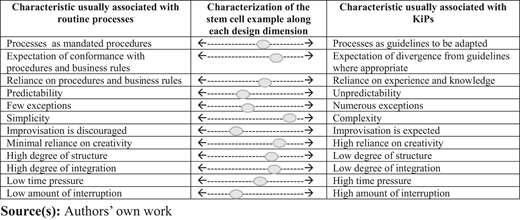
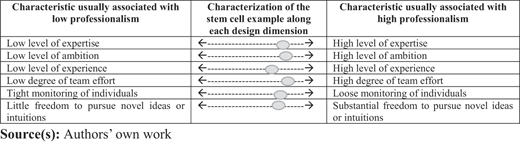
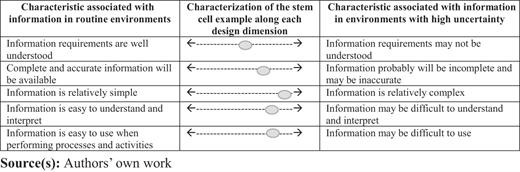
The second of this paper’s three approaches for applying aspects of the WSP to KiPs uses design dimensions, which we view as design choices along a continuum extending from low to high, e.g. a process may be anywhere from totally unstructured to totally structured. Digitalization is a driving force for reconsidering existing design choices and introducing new design choices. Design dimensions are useful for thinking about KiPs because they provide a way to discuss important issues without becoming overwhelmed by details and clarifications that are not needed for big-picture understandings. This section uses four tables based on elements of the work system framework to organize design dimensions that are especially relevant for KiPs. It illustrates them using the stem cell product example. In each case, a table identifies design dimensions and uses a circular symbol to indicate the current positioning of the KiP in Figure 2 on each dimension based on subjective understandings of the situation by an individual involved in the stem cell effort. The related question for stakeholders is whether the current positioning should be moved to the left or to the right along each design dimension, and if so, what types of changes would be needed. Many design dimensions that apply to most WSs also apply to KiPs, although some are especially relevant to KiPs.
4.1 Design dimensions related to customers and product/services
Customer-related capabilities identified by the Delphi study of future BPM capabilities at the enterprise level (Kerpedzhiev et al., 2021) included customer literacy and customer centricity. For KiPs, those capabilities boil down to understanding what a KiP’s customers value across the entire sequence of activities that start with service requests and end with follow-up after receiving a KiP’s product/services.
Table 3 includes dimensions related to customers and product/services because those dimensions tend to combine aspects of the customer’s view of the product/services and the customer’s involvement in producing the product/services. Table 3 is based on the service value chain framework (SVCF) (Alter, 2010, p. 205), which was developed to bring more of a service mindset to thinking about WSs but which also can be applied to most KiPs. The SVCF expresses a service mindset by recognizing several key aspects. First, product/services may be co-produced. Next, providers and customers may capture value throughout the process. Also, customer–provider interactions often occur in service requests, in request fulfillment, and in subsequent follow-up. Finally, providers and customers may have different degrees of mutual visibility as the process unfolds.
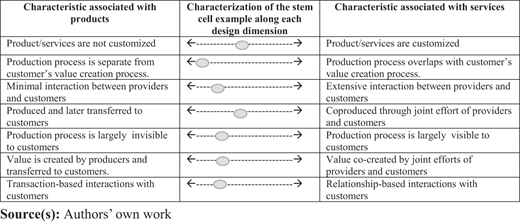
Table 3 raises questions for the KiP example. It might be possible to increase value capture throughout the KiP, especially if interactions between providers and customers could be improved and if work in the KiP were more visible to customers. The issue of transaction-based versus relationship-based interactions with customers leads to asking whether strengthening relationships with customers might lead to better results.
4.2 Design dimensions related to processes and activities in KiPs
Many of the design dimensions in Table 4 address issues frequently associated with KiPs, such as the way that the KiP is not guided by mandated procedures and may involve divergence from typical guidelines for similar projects. The issue of few versus many exceptions leads to questions about what exceptions might mean for this KiP and how they can be identified and resolved. The last four design dimensions in Table 4 apply to most WSs. The positioning of this KiP as semi-structured is based on using stage gates and heuristics to provide early warnings as problems arise. A reasonably high degree of integration is needed to coordinate efforts in several labs. The time pressure for this exploratory research project is viewed as neither low nor high. The low rate of interruptions tries to promote this project’s efficiency and effectiveness.
4.3 Design dimensions related to participants in KiPs
While it might seem strange to talk about design dimensions for participants, KiPs (and many other WSs) need to be designed based on realistic expectations for KiP participants, as is illustrated in Table 5. In the stem cell KiP, junior and senior researchers collaborate, senior researchers coach and supervise junior researchers, and all are skilled, ambitious knowledge workers. On the other hand, tight monitoring of individuals and little freedom to pursue novel intuitions might be a contentious issue for individuals who view themselves as high-level professionals.
4.4 Design dimensions related to information about the environment in KiPs
Many KiPs operate in environments involving substantial uncertainty (Di Ciccio et al., 2015; Berniak-Woźny and Szelągowski, 2022). Because of this, information about the environment can be incomplete or ambiguous, and therefore hard to understand and use. Digitalization allows for more information gathering, but does not always lead to more relevant information. Table 6 identifies typical dimensions related to information about the environment in KiPs. Stakeholders using Table 6 to think about the stem cell product KiP example might conclude that little can be done about its high-risk environment and poorly understood complexity. However, obtaining additional useful information or making that information easier to use might increase efficiency and reduce risk. The initial positioning on the dimensions in Table 6 might change as more information is obtained through experiments while the KiP executes.
5. Roles and responsibilities of digital agents in work systems
The third of this paper’s three approaches for applying aspects of the WSP to KiPs involves the extent to which digital agents might have important responsibilities across the spectrum of roles mentioned in Section 2.2. A description of the KiP that is more detailed than the work system snapshot in Figure 2 can reveal many relevant ways in which digital agents can be applied. A two-dimensional agent–responsibility framework in Figure 3 (Alter, 2022a) provides an organized approach for identifying relevant possibilities. The horizontal axis is a spectrum of digital agent roles. The vertical axis is six of the 18 facets of work in Table 1. Those six were selected because they are most relevant for this situation. Combining those two dimensions potentially pinpoints many design issues, e.g. the extent to which a digital agent should monitor (role) decisions (facet) or provide capabilities (role) for communicating (facet). Other facets of work would be selected for other situations based on relevance to those situations.
 A table titled the agent responsibility framework with six selected facets of work and their spectrum of responsibilities. The table has six rows and six columns. The row labels are Making decisions, Communicating, Processing information, Applying knowledge, Representing reality, and Improvising. The column headers are Monitor work system, Provide information, Provide capabilities, Control activities, Coproduce activities, and Execute activities.
The agent responsibility framework (Alter, 2022a), abbreviated by showing 6 selected facets out of 18
A table titled the agent responsibility framework with six selected facets of work and their spectrum of responsibilities. The table has six rows and six columns. The row labels are Making decisions, Communicating, Processing information, Applying knowledge, Representing reality, and Improvising. The column headers are Monitor work system, Provide information, Provide capabilities, Control activities, Coproduce activities, and Execute activities.The agent responsibility framework (Alter, 2022a), abbreviated by showing 6 selected facets out of 18
The following bullet list illustrates how each of the six roles (italicized and bolded) might apply to one of the facets of work (underlined) in Figure 3. Many other combinations of roles and facets could have been mentioned, e.g. two examples in Alter (2022a) that involve other facets of work.
Monitoring decision-making to provide alerts when known protocols and heuristics are not used (worth noting, but possibly OK in some instances).
Providing information that helps teams communicate during deliberations about how to interpret experimental results.
Providing capabilities that enable the information processing needed for analysis based on deep learning algorithms.
Controlling execution of experiments by applying knowledge to ensure compliance with known methods.
Coproducing the analysis performed through human-machine dialogues between researchers and (extremely advanced) digital agents that help by representing reality in nonobvious ways.
Executing an algorithm that uses a model to chart a non-obvious optimal path to help in improvising a way to overcome obstacles.
Table 7 illustrates that the idea of design dimensions can be applied to each of the facets just as that idea applies to the core elements of the work system framework (e.g. in Tables 3–6). In this case, Table 7 includes two design dimensions for each of the six facets of work for the stem cell medication case. Managers or developers discussing this table’s content might wonder about a number of directions for possible improvements. Perhaps the evaluation criteria are actually too simple and need to be more complex. Perhaps more communication effort is needed due to differences in organizational cultures across participants. Perhaps new methods are needed to make the processing of specific types of information more efficient. And so on. The overall conclusion just for facets of work is that typical BPM tools such as BPMN or CMMN do not highlight many of the issues that need to be addressed in the effective management of this KiP.
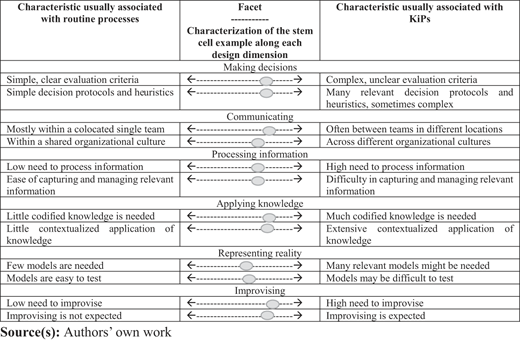
Consistent with the spirit of KiPs, stakeholders who apply these ideas need to use their own knowledge and experience to decide how to use them efficiently and effectively. Looking at all 108 possible cells in an agent–responsibility framework (6 roles × 18 facets) is neither practical nor useful for stakeholders who want to think more deeply about what roles digital agents might play and how those roles might link to digital agent applications that could improve important facets of work in a KiP. While direct use of the agent responsibility framework might seem overwhelming, that framework could inspire a variety of tools based solely on the individual axes (spectrum of roles and facets of work) or based on selected combinations, e.g. controlling multiple facets of work.
6. Evaluation
This evaluation section applies the three new approaches for understanding and analyzing KiPs to a real-world KiP in which AI tools were being tested to gain efficiency and to improve the quality of the diagnosis performed by radiologists (Lebovitz et al., 2021). Customers for this KiP are patients of radiologists. The product/services are the production and interpretation of radiology images along with other patient care. Beyond typical processes that radiologists perform, an additional input is the AI-based interpretation of radiology images based on a machine learning (ML) algorithm supplied by an external vendor.
In contrast with an R&D setting such as the stem cell medication example, the environment of diagnostic radiology is relatively well understood in terms of scientific literature and regulatory guidelines. Ideally, the ML-based AI tools promise to reduce human workload without sacrificing quality. Lebovitz et al. (2021) discuss how a US hospital exploring the potential use of those tools revealed uncertainty about the validity of the diagnosis procedures, both for the AI tools and for human experts. For example, AI tools consider one image at a time, while radiologists typically consider a series of images of the same patient. Ideally, AI tools promise to provide scalable, objective interpretations of radiology images. Since the consequences of an incorrect diagnosis are serious, radiologists who use the AI tools also need to consider other information before making a diagnosis. Lebovitz et al. (2021) explain how the new tools sometimes tend to challenge the exercise of professional judgment through a lack of alignment with how radiologists make and verify decisions in everyday practice.
Here are brief observations about applying this paper’s three approaches to this diagnostic radiology case:
6.1 First approach: alternative work system models
The AI-based digital innovation in this case added a new capability (purpose 2 in Section 3) of verifying the diagnosis based on ML. A work system snapshot could summarize (purpose 3) the initial (“as is”) WS and could compare it to various idealized (“to be”) WSs that rely on AI-based tools to varying extents. Much of Lebovitz et al. (2021) concerns how the new WS might operate. Resources used or produced by specific activities could be described (purpose 4). Documentation using BPMN or CMMN could be produced (purpose 5), but it is unclear how that would have led to insights in this case. This situation was not ready for simulation or automation (purposes 6 and 7). Overall, considering alternative work system models provides stakeholders with an organized approach for analyzing the AI-enabled KiP at different levels of specificity.
6.2 Second approach: continuous design dimensions related to work system elements
Tables in the same general format as Tables 3–6 could be presented for this example. Due to space limitations, we only show Table 8, which concerns information about the environment.
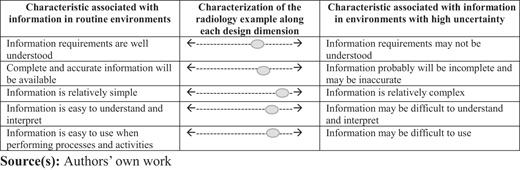
Information requirements in this case were initially thought to be well understood and AI tools promised objective interpretations. After experimenting with the AI tools, the knowledge workers discovered that the requirements were not so clear since they did not fully understand the best way to interpret radiology images. Also, they came to realize that the way AI tools were trained to interpret images in isolation did not match the best practices of radiology, which looks at a series of images of the same patient. They also realized that in some situations multiple interpretations of an image are possible. As a result, it became apparent that the relevant information was difficult to understand and interpret. Using the second approach can help knowledge workers reflect on the different design dimensions of a KiP.
6.3 Third approach: roles and responsibilities of digital agents
A detailed look at Lebovitz et al. (2021) reveals some ambiguity about the different roles that digital agents might play, largely due to issues concerning whether the new tools would undermine professional judgment (an interesting issue for many KiPs that are potentially amenable to digital innovations). At some point in the future, an external observer might imagine that extended versions of the tools could operate at multiple points along the spectrum of roles in Figure 3: monitor the WS, provide information, provide capabilities that radiologists could use, control aspects of diagnostic radiology and perhaps coproduce or even automate interpretation of images. It is not obvious how radiologists would respond to those changes. However, radiologists in the case study did express interest in using automated interpretation of images as an input to their professional work. Table 9 uses the same format as Table 7 to show how the same six facets of work would be viewed differently and would raise different issues in this setting versus the stem-cell medication setting. Thus, the third approach can help in fostering discussions among radiologists and business analysts attempting to redesign the KiP in order to maximize benefit from AI.
Two design dimensions for each of the six facets of work that are relevant for the diagnostic radiology KiP
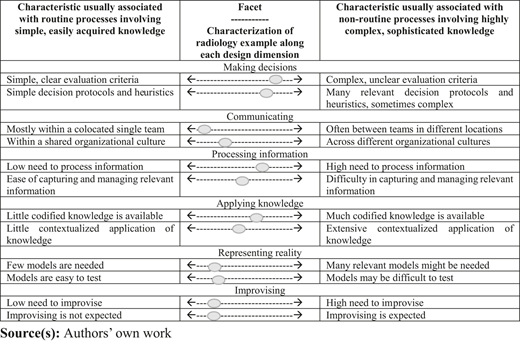
The brief discussion of the three approaches in the above example illustrates their potential use for attaining a greater understanding of specific KiPs. As with most conceptual contributions, real-world application is needed to provide stronger evidence.
7. Conclusion
This conceptual paper presented three new approaches for understanding and analyzing KiPs: (1) alternative work system models with different degrees of specificity to support different stakeholders, (2) continuous design dimensions for visualizing important issues and challenges, and (3) roles and responsibilities of digital agents in relation to different facets of work. Those ideas could extend BPM practice because they are not mainstream in the BPM community and often are not mentioned in discussions of digital innovation. Conclusions related to KiPs and BPM include the following:
7.1 Regarding KiPs
This paper went beyond existing discussions of knowledge work and KiP characteristics. It presented new approaches for understanding and analyzing KiPs as WSs that may be automated to varying degrees. Seeing KiPs as WSs implies that WST and the broader WSP can be applied to KiPs. This paper used the WSP as the basis for applying the three new approaches to two KiP examples: the stem-cell medication example and the diagnostic radiology example.
This paper addressed aspects of many of the BPM challenges in Table 2, even though length limitations allowed only a brief explanation of some of its main points. Many related ideas are explained in much more depth in WST-related papers cited in each section. To our knowledge, none of the three approaches to understanding and analyzing KiPs appears prominently in the existing literature related to KiPs or BPM or digital innovation.
This paper’s updated definition of a KiP emphasizes extensive use of knowledge in a process but does not assume characteristics that apply in some situations where knowledge is used intensively but not in others. Examples of such characteristics include unpredictability, uncertainty in the environment, numerous exceptions and extensive reliance on collaboration and on tacit knowledge. Those characteristics were present in the stem cell example, but apply less in the three other KiP examples involving pediatrics, oncology and radiology. In all three of those cases, more codified and well-organized knowledge was available, unpredictability usually fell within known ranges and collaboration was important, but not as important as in the stem cell medication example. While tacit knowledge was important in those three cases, all of them involved trying to reduce reliance on tacit knowledge through digital innovations that apply codified and organized knowledge to produce beneficial outcomes. Tacit knowledge of professional experts remains crucial in all of those cases, even as key decisions become more structured.
7.2 Regarding BPM
To our knowledge, WST and WSP are typically viewed as quite separate from BPM, even though examples from the BPM literature noted in Section 2.3 incorporate ideas that are strongly related to WST. Most of the ideas in this paper’s three approaches to supporting the analysis of KiPs are equally relevant to most processes and hence to important parts of BPM in general.
Both the ideas presented here and aspects of the WSP that were not discussed might be applied to existing BPM case studies. These aspects include design principles, workarounds, system interactions, the work system life cycle model, applications to security and risk, and lightweight modeling tools. Trying these out in practice can help explore the potential value of using aspects of WSP in BPM. We believe that this paper’s new approach to KiPs and their application to the KiP examples imply their broad relevance to BPM.
7.3 Managerial implications
All four of the examples discussed here (the stem cell medication, diagnostic radiology, diagnosis of earaches in children and selection of chemotherapy agents) constitute digital innovations because they rely on new uses of IT to improve processes, product/services and/or customer experiences. While KiPs often are not primary topics in general discussions of digital innovation, this paper’s four examples illustrate that high-value KiPs provide many opportunities for digital innovation. Managers can use the three approaches presented in this paper to leverage digital innovation through KiPs. Knowledge workers can use the approaches to gain an improved understanding of the KiPs they participate in. Business analysts can use the three approaches in assessing the potential impact of AI and other digital technologies on KiPs. For all three groups of workers, the presented approaches provide an integrated way to analyze and visualize design choices for KiPs.
7.4 Future work
One strand of future work is applying the three approaches in practical case studies to evaluate in more detail the value of using WSP to analyze KiPs. Another strand includes other aspects of WSP, such as workarounds, in order to enhance the scope of the KiP analysis.

