

China section in agricultural and applied economic association: history, growth, contribution and outlook
On July 26, 2009, at the Agricultural and Applied Economics Association (AAEA) annual meeting at Milwaukee, Wisconsin, US, scholars of China Section gathered for its inauguration meeting. This meeting marked the official founding of China Section, which is the first section named by a country in the AAEA history. At this meeting, bylaws were passed by the members of China Section to set the missions and operation rules for years to follow. As published on the Exchange (AAEA, 2009), “this section is intended to facilitate collaboration among AAEA members and other professionals on agricultural and applied economic issues related to China, to disseminate information and to mentor junior AAEA members with an interest in this area, and to serve as a bridge between AAEA and other professional organizations with a China focus worldwide.” To celebrate the tenth anniversary of the China Section, this article will document the section history, introduce its growth over the past ten years, highlights its contribution to AAEA and the profession, and discuss the prospects of its future.
The history
As China opened its door and entered the world with its economic development miracle more than four decades ago, its agricultural economic issues quickly caught the attention of academia internationally. First, its agricultural and rural development, then its food and fiber market, its environment and resource, and its trade policy have been studied by both Chinese scholars and scholars in the world, such as Lin (1987, 1992), Fan et al. (1994), Huang and Rozelle (1995) and Wailes et al. (1998). Led by economists in the China team of the Market and Trade Division in the USDA Economic Research Service, especially Dr. Francis Tuan, a group of agricultural economists with common interests in China issues started to meet regularly at the AAEA annual meetings. Young Chinese scholars, then mostly international doctoral students and post-doctoral researchers from China, were also welcomed into the network, irrespective of their research interests and benefitted from the network in a professional world at a time with very few Chinese agricultural economists. The interests in China were elevated by its accession to the World Trade Organization in 2001, evidenced by the establishment of the USDA sponsored committee called WCC_101 to organize Chinese agricultural market studies, and a large number of publications on the topic such as Martin (2001), Diao et al. (2003), Felloni et al. (2003), Huang et al. (2004) and Marchant and Song (2005). Drs. Scott Rozelle, Mary Marchant, Tom Wahl, Wen Chern, Henry Kinnucan, Dave Abler and Eric Wailes were all actively involved and made the group highly visible in the profession. Most of them have continued to study China issues decades later.
The year 2008 marked the beginning of AAEA's reforming its structure to establish sections and allocate certain annual conference presentation slots to each section. Working with the core group, Dr. Holly Wang wrote a proposal to establish the China Section and invited more than 40 supporters, most of whom were established AAEA members, to co-sign, following the AAEA procedure. Because it was the first section named with a country, some concerns were raised by the AAEA Executive Board, including the cannibalization possibility of existing sections and potential overcrowding of future sections named by countries, etc. After careful communications, China Section was approved by the AAEA Executive Board in 2009, with Drs. Holly Wang, Xiaobo Zhang and Francis Tuan as the founding chair, the chair-elect [1] and the treasurer/secretary. A total of 86 scholars immediately joined the new section as founding members, the first success after its founding.
The section's primary functions occur during the AAEA annual conferences, including track sessions for paper presentations, business meetings and member networking events. Two paper sessions were successfully organized; the byLaw was voted on and passed by members at this inauguration meeting, and an annual paper award for junior scholars was established with Drs. Wuyang Hu and Xiaohua Yu as the first award co-chairs. Dr. Pei Xu was the web-coordinator who helped to launch the website.
The committee structure of China Section is under the general rules of AAEA. Each chair serves for three years during his/her chair-elect, chair and past-chair terms. Each treasurer/secretary's term is also three years. China Section has benefitted from many passionate and capable professionals serving on the committees. Their names are listed in Table A1 in the Appendix.
Officers of China section committee
| Year | Chair | Treasurer/Secretary | Member at-large |
|---|---|---|---|
| Founding 2010 | Holly Wang | Francis Tuan | N/A |
| 2010–2011 | Xiaobo Zhang | Francis Tuan | N/A |
| 2011–2012 | Qiuqiong Huang | Francis Tuan | N/A |
| 2012–2013 | Dave Abler | James Hansen | N/A |
| 2013–2014 | Wuyang Hu | James Hansen | N/A |
| 2014–2015 | Yanhong Jin | James Hansen | N/A |
| 2015–2016 | Songqing Jin | Elizabeth Gooch | N/A |
| 2016–2017 | Guzhen Zhou | Elizabeth Gooch | N/A |
| 2017–2018 | Yuqing Zheng | Elizabeth Gooch | N/A |
| 2018–2019 | Jian Zhang | Di Fang | N/A |
| 2019–2020 | Baohui Song | Di Fang | N/A |
| 2020–2021 | Chengfang Liu | Di Fang | Fujin Yi |
| 2021–2022 | Yu Yvette Zhang |
Note(s): NA stands for not applicable. As the section grows, the member at-large position was added to the committee in 2020
The growth
The China Section has had a healthy growth over the past ten years with its membership almost doubled (Figure 1). In the first year of 2009–2010, the majority, or 67 members, were from US universities and institutions, 11 from China and eight from other countries including Australia, Canada, Ecuador, Italy and Japan. Among the 67 US members, 25 were originally from mainland China going abroad after the 1980s (Figure 2) [2]. It is interesting to see that the largest category of China Section founding membership was non-Chinese scholars from US institutions. This indicates that during that time, there was an extensive interest in Chinese agricultural economics issues among US economists. Also, among the 25 Mainland Chinese members from the US institutions, about half were graduate students. During the early 2000s, there were rather few faculty members in US institutions who were of Chinese origin [3].
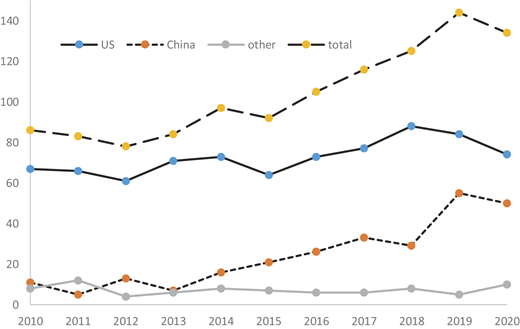
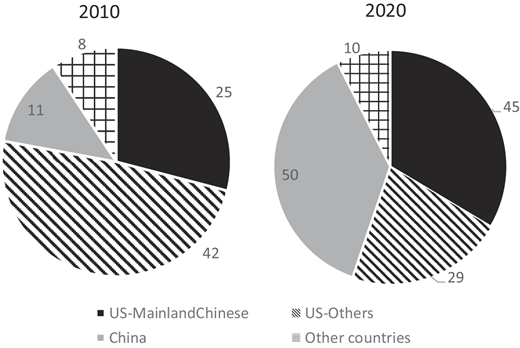
In addition to students and scholars in the US, the section has attracted a growing number of members from outside the US, particularly from Mainland China. The number of scholars from China attending AAEA annual conferences and enrolling as AAEA members as well as China Section members has increased from 11 to 50 (a 4.5-fold increase) over the past ten years. While the US-based scholars from the Mainland China has also almost doubled during the ten years contributed jointly by more graduate students joining the faculty team and more Chinese graduate students and visiting scholars in the US, the US membership has grown slowly because non-Chinese US membership has dropped. The total membership growth is mostly driven by the expanding membership of scholars from Chinese institutions.
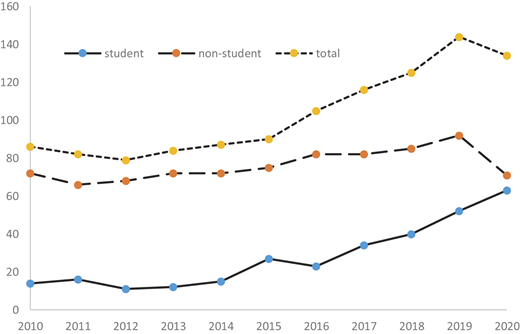
Figure 3 reports the membership growths for students and nonstudents separately. We see the growth of non-student membership is steady, and the total membership growth is mostly driven by students. It is encouraging that the section has been increasingly attractive to young members, the fresh blood and the future of the profession of agricultural economics. This also shows that the section is fulfilling its mission of mentoring and providing a friendly environment for junior scholars.
China Section has organized track sessions for members to present their papers at the annual meetings. Two sessions were allocated by AAEA to the section during early years, which was based on the section membership size. Because one major benefit for members is to secure very competitive presentation slots at the AAEA annual meetings, the section leaders have worked hard to accommodate as many high-quality papers as possible for their members. In earlier years, the section co-organized sessions with other sections who could gave it more slots, such as the senior section and graduate section. Later on, as allowed by AAEA, lightening sessions were adopted that can accommodate more short presentations. Most recently, as the membership grows and as the submissions grow dramatically, the section has successfully requested more sessions from the executive board, reaching three till 2019. For the virtual conference of 2020, this number was further raised to four.
Contributions to AAEA and the profession
In addition to serving its own members, the section has made significant contribution to the AAEA and to the profession of agricultural economics. Organizing track sections with participants from both in and outside the section to exchange information is one contribution. Another one is that section members have made individual contributions to the profession, many of which are recognized by AAEA with various awards, from student competition awards, quality of communication awards, outstanding AJAE article awards and policy analysis award, to publication of endurance quality awards. These individual awards are in a large number and will not be listed here, while the AAEA fellows will be introduced in next section. Thereafter, several specially organized activities by China Section are highlighted.
In 2018, a major trade dispute between the US and China erupted. China imposed high tariffs on major agricultural commodities imported from the US as a retaliation to the US tariff on Chinese manufacturing products. Tariff rates and scopes from both countries were changed frequently and unpredictably, and agricultural economists were highly sought by media and policymakers. Choices, AAEA's own outreaching magazine, has published a special symposium on this topic guest edited by section members Marchant and Wang (2018) with many articles contributed by section members, such as Zheng et al. (2018), Hansen et al. (2018) and Liu et al. (2018). Public hearing was held by the US Congress with professional testimonies given by agricultural economists, all of whom are China Section members, Drs. Fred Gale, Carl Pray, Holly Wang and David Ortega (Wang, 2018). Against this background, led by Drs. Baohui Song and Holly Wang, China Section won a competitive opportunity to organize its first Post-Conference at AAEA 2019 annual meetings, “Challenges, Implications, and the Future of Agricultural Trade between the US and China”. This marked another milestone of the section history to have a high impact event in the profession.
In 2019, China Section's past and current chairs, Drs. Yuqing Zheng, Songqing Jin and Jian Zhang, guest edited a special issue for Agribusiness: An International Journal, with the theme “The Twenty-First Century Agribusiness in China” (Zheng et al., 2019). In this issue, eight papers were published addressing e-commerce, consumer preferences related to safety and quality, and industry competition along the value chain, all of which are important topics of modern agricultural economy. This is also a remarkable achievement that elevated China Section's scholarly output and impact to the profession.
In 2020, as the AAEA annual meetings moved online, China Section held four track sessions with 32 papers presented, which were selected from 168 submissions through a rigorous review process. Participants across the world joined the virtual sessions. Total number of participant times reached 331 for the four sessions, thanks to the relaxation of room capacity constraints or the registration and logistic costs.
China Section has organized reunion receptions regularly at the AAEA annual meetings, mostly coordinating with institutions such as the journal of China Agricultural Economic Review (CAER), China Agricultural University, Renmin University, Zhejiang University and Nanjing Agricultural University, since the mid-2010s and during the triannual conferences of the International Agricultural Economist Associations (IAAE). They were well-attended by China Section members and AAEA members from different countries. These events serve to facilitate networking and communications among agricultural economists all over the world, increase the exposure and reputation of the section and AAEA at IAAE and also help Chinese universities in their international exchanges.
Section member characteristics
Bridging the professional exchanges between the US and China on agricultural economics topics relevant to China is one of the core missions of the China Section. More information beyond the members' country of origin is needed to assess the section's achievements. To document the human resource assets of the section, a quick survey was distributed to about 600 China Section WeChat group members in May 2020 by Dr. Junbiao Zhang from Huazhong Agricultural University. All survey participants were active China section participants who reside all over the world. A total of 103 responses were received [4]. Descriptive statistics are summarized in Table 1.
Descriptive statistics of the AAEA China Section member survey
| China | USA | Other countries | Total | |||||
|---|---|---|---|---|---|---|---|---|
| Count | %* | Count | %* | Count | %* | Count | %** | |
| Respondent current position | 78 | 75.7 | 22 | 21.4 | 3 | 2.9 | 103 | 100 |
| Female | 36 | 78.3 | 8 | 17.4 | 2 | 4.3 | 46 | 44.7 |
| Ph.D degree*** | 42 | 40.8 | 45 | 43.7 | 16 | 15.5 | 103 | 100 |
| Post-doc position*** | 14 | 48.3 | 9 | 31.0 | 6 | 21.7 | 29 | 28.2 |
| China Section member | 57 | 70.4 | 21 | 25.9 | 3 | 3.7 | 81 | 78.6 |
| AAEA member | 58 | 69.9 | 22 | 26.5 | 3 | 3.6 | 83 | 80.6 |
| AAEA other section member | 7 | 25.9 | 19 | 70.4 | 1 | 3.7 | 27 | 26.2 |
| Academic administrator | 27 | 100 | 0 | 0 | 0 | 0 | 27 | 26.2 |
| President/Chair of academic associations | 2 | 20.0 | 8 | 80.0 | 0 | 0 | 10 | 9.7 |
| SSCI/SCI journal (guest) editor# | 10 | 71.4 | 3 | 21.4 | 1 | 7.1 | 14 | 13.6 |
| SSCI/SCI journal associate editor# | 2 | 25 | 5 | 62.5 | 1 | 12.5 | 8 | 7.8 |
Note(s): *The percentages in these columns are based on the corresponding total number of each row
**The percentage in this column is based on the total 103 survey respondents
***The country category is based on PhD degree granted countries and post-doctoral hosting countries instead of countries of current positions
#SSCI means Social Science Citation Index, and SCI means Science Citation Index
Among all agricultural economists with Ph.D. degrees who are closely affiliated with the AAEA China Section and are in the WeChat group, three-quarters of them are currently working in China including those who work for international organizations located in China, about one-quarter are in the US, and only three respondents are in other countries. These statistics are slightly different from the actual China Section membership because there are many active participants who may not be formally registered members at the time of survey [5]. Most of these respondents from China joined the section either because they were AAEA members before they returned to China from the US, or they once participated AAEA conferences from China. These overwhelming percentages show the section's strong tie with China through its services to its members. The gender distribution is basically balanced with 44.7% of females overall, slightly more females than males in China, but significantly lower in the US with only 8 out of 22 being female scholars.
Among the 103 respondents, 58.3% receive their Ph.D. degrees from outside of China, among whom 43.7% from the US, 14.7% from other countries including EU countries (6.8%), Canada (3.9%), Japan (2.9%) and Australia (1.0%); while the other 41.7% received their doctoral degrees from China. The significant percentage of Chinese domestic doctoral degree holders show that Chinese scholars are very active in international exchange, and indeed many have visiting scholar experiences overseas. About 28.2% have post-doctoral experience, with about half of them having such experience in China, 31% in the US, 10% in the EU and 7% in Japan.
About 80% of all respondents are current or past AAEA members and a similar percentage as the China Section members. While almost all respondents from the US and other countries are AAEA and China Section members, about a quarter of respondents from China are not. It shows that potential interests in the section and AAEA from China are strong among professionals who have had not participated in the AAEA conferences yet. As for the membership of other AAEA sections, only 26.2% of the respondents are current or past members, 75% of whom are from the US and other countries with only a few from China. This shows that professionals from the US and other countries are more engaged with general activities in AAEA, while most of those from China are solely attracted by the China Section.
Many section members have taken leadership roles either as administrators in their home institutions, presidents/chairs of international academic associations and/or as journal editors. Over 27 or 26% of the respondents have had taken college deanship or even higher positions in Chinese universities, but no such positions outside China. This shows that Chinese faculty members affiliated with China Section are relatively highly regarded for their leadership skills among their peers in China, but they are still on the way to prove themselves in the US and other countries for such administrative positions, even though their leadership may be well recognized through other channels. As for serving as president/chair of international academic associations, ten respondents had such experience as section chairs, mostly associated with the AAEA China Section. The majority of these are positioned overseas. These statistics suggest that China Section members and close affiliates have been active in leadership roles. Those in China perform more administrative services, while those outside China perform more academic services. Fourteen respondents have served as editors or guest editors of SSCI/SCI journals, and eight respondents have served as associate editors of SSCI/SCI journals with some overlaps. CAER has provided the most opportunities for such positions among all journals.
Four Chinese section members were/are (co)editors of prominent journals in agricultural economics including Drs. Junjie Wu for American Journal of Agricultural Economics, Holly Wang for Food Policy and Kevin Chen and Wuyang Hu for Canadian Journal of Agricultural Economics. There are a large number of Chinese Section members who were or are associate editors or editorial board members for major agricultural and applied economics journals besides the three mentioned above, such as Agricultural Economics, World Development, Australian Journal of Agricultural and Resource Economics and more.
Figure 4 shows the statistics of the years that these respondents' first joined. Only a few respondents joined AAEA before 2002, but since then the numbers have grown significantly from all areas, especially from China. In the past five years, the number of scholars who joined AAEA and China Section from China were eight times of that from the US. Giving the cumulative effects, these may show that 1) more Chinese scholars returned to China from the US in recent years and stayed with China Section to keep academic connection with the AAEA; 2) Chinese scholars recently joined the US institutions are less enthusiastic in joining the AAEA China Section and 3) scholars from other countries are less motivated to joint AAEA China Section. The latter two results are possible because China Section as a professional organization focuses on the research on China agricultural economic issues instead of members who are Chinese citizens or Chinese Americans. For those newly employed in the US and other countries, if their research focus is not about China, many do not feel necessary to join in the China Section.
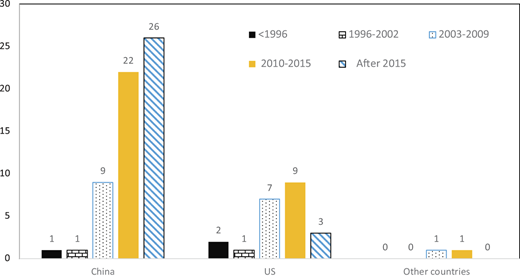
Because an important motivation for scholars from China to join AAEA is for them to participate in the annual meetings with presenting papers or playing other important roles, scholars from China join the AAEA are largely paper presenters. Therefore, Figure 4 also supports that more scholars from Mainland China have participated in the AAEA annual meetings; many of them presented papers at the section's track sessions, joined the section events and became members. The actual numbers of scholars from China to attend the AAEA meetings are reportedly to have grown substantially from 12 in 2010 to 62 in 2019 (Wang et al., 2021).
China Section has eight members who are also AAEA fellows, the highest academic honor in the profession (See Appendix Table A2). Seven of them have spent most of their career in the US, and only Dr. Jikun Huang is China based. Other than Drs. Scott Rozelle and Jikun Huang, whose research is primarily about China, all the rest have built their research mostly on issues in the US and world. Nevertheless, all of them have conducted some studies about China.
Outlook
Over the past ten years, China Section has made tremendous contribution to its members, to the AAEA in large, to China academia and to the agricultural economics profession in the world. Following the successful launch of China Section, AAEA approved many other sections with focus on a country or a region in the world, including Africa Section, Australasia Section and Latin American Section. Some of these sections have strong ties with organizations in corresponding regions of the world. For example, Australasia Section is collaborated with Australian Agricultural and Resource Economics Society. China Section's international members have tripled, among which members from China have grown five times and many agricultural economists from other countries with research interests in Chinese issues also join the section. China Section together with other sections has helped AAEA to become a world leading agricultural professional association that makes a bigger impact beyond the US.
Drawn from the survey responses, we can see the section has provided satisfactory services to its members. For the question asking respondents to evaluate the section's service in comparison to other sections, almost all rank China Section higher than other sections to some degree, in terms of organization, member participation and career development [6]. It is possible that the more one involves in a section the more he/she feels benefited, which is a good sign to show member satisfactory and support for the section. Respondents have contributed many ideas for future section activities, with a high demand for academic conferences/seminars outside AAEA meetings, especially in China. Hosting training workshops and organizing agribusiness tours are also mentioned by multiple respondents.
China Section has grown healthily over its first decade, thanks to all section members, leaders of the section and AAEA, as well as many supporting institutions and individuals throughout the world. There are always new challenges on the way and opportunities to be identified. One of the challenges is the shrinking size as well as the share of non-Chinese membership. As a subsidiary of AAEA, which has a large membership who are non-Chinese or non-Chinese Americans and has great resources among them, involving more general AAEA members to help the section develop further and improve its diversity is critical. Second, the membership is relatively young, partly evidenced by Figure 3, and they actively participate in programs which is promising for future. There is, however, a relatively lack of programs that can attract and involve AAEA most established members, such as those AAEA fellows as in Table A2 and beyond. These highly influential economists can bring valuable mentorship to the section if they can be more involved with section activities. Third, China Section has been growing in size in terms of membership, conference sessions, papers published in journals and journal special issues guest edited. There is still room for the outputs to be improved in quality and impacts to be expanded in both depth and scope. This can be achieved by, for example, publishing China studies in top journals, disseminating research results in outlets that can reach the policymakers and the public, assuming leadership positions that can leverage with bigger teams to generate more academic outputs and many other activities and channels.
At the most recent section business meeting in August 2020 with more than fifty attendees online, suggestions are made to enrich the section's communication tool for members and for the public. Specifically, a website that can release timely news, promote scholarly outputs, announce upcoming activities, connect to individual member's website and exchange collaboration, employment and/or mentoring opportunities may be needed. Such communication tools shall be inclusive to all members of the section, the AAEA and the profession.
The AAEA China Section is still growing, together with its members and with important economic issues relevant to China, US and the world. The first ten years of AAEA China section have laid a solid foundation for the section to build upon. May the section be brought up to a new level in the next decade to serve its members, AAEA and the agricultural economics profession in the world.
The author thanks Dr. Junbiao Zhang for providing the survey data, Drs. Yu Zhang and Chengfang Liu for their contributions to the early version of this article and Drs. Songqing Jin, Yuqing Zheng, Baohui Song, Wuyang Hu, Guzheng Zhou and Jian Zhang for great comments. The author also thanks the anonymous reviewers for their detailed comments.
Notes
The first Chair-Elect was appointed instead of elected by members because there were no members at the founding stage.
The US-Mainland Chinese category only includes members who were originally from Mainland China and went abroad after 1980.
Section membership needs to be renewed annually. Also, the 2020 member statistics were last updated in September 2020, which means the numbers for the whole year may be larger, albeit the negative impact of Covid-19.
AAEA China Section WeChat group was started at the summer conference at San Francisco in 2015 for the convenience of social event communication during the meeting. It grew quickly beyond the capacity limit of 500 and a second group was added in 2018. A weakness of this survey is that senior agricultural economists are less represented because they do not use WeChat or not subscribe to the section group. Also, no non-Chinese speaking China Section members are surveyed.
Notice, to be a China Section member, one must also be an AAEA member. The high AAEA membership fee ($25 for student and $90 for professionals as of 2020) can be a disincentive for scholars outside the U.S. The fee represents a financial cost for scholars from developing countries, including China and these scholars may not have an equal chance to participate in the annual meetings due to higher costs involved in traveling and accommodation.
The majority of respondents from China did not answer but only a few from all other countries did not answer, because most respondents from China are not familiar with other sections hence not able to compare.
References
Appendix

