This study examines the potential for diverse information flows between traditional and green energy markets, focusing on three key financial instruments that represent various dimensions of the global energy transition, with the moderating roles of economic policy uncertainty (EPU) and monetary policy intervention (MPI). Accordingly, three key financial instruments analysed in this study are the iShares USD Green Bond ETF (BGRN), the iShares Global Clean Energy ETF (ICLN), and the S&P 500 Energy Index (SP500EN).
Employing the recently developed quantile-on-quantile transfer entropy (QQTE) method introduced by Yao et al. (2025), we analyse data spanning from January 4, 2019, to April 25, 2025.
Empirical analysis revealed that information flow from the clean energy market to both green bond and traditional energy markets persists in the lower and median quantiles when the effects of policy regimes (EPU and MPI) were ignored. However, the connection between the two alternative markets diminishes in the presence of EPU and MPI. Further, the traditional energy market remains a main shock transmitter even after controlling for EPU and MPI.
The robust linkage between the traditional (oil) market and the clean energy market, especially in the absence of policy uncertainty or intervention, suggests that the conventional energy market can complement the clean energy market during the energy transition period, provided policy stability and non-intervention prevail. However, the weak contagion between the two alternative markets implies that portfolio diversification benefits exist between green fixed-income and conventional energy equities, particularly during policy intervention and climatic policy uncertainty, as well as between portfolios sensitive to sector-specific shocks.
To the best of our knowledge, none of the previous studies have used the newly proposed quantile-on-quantile transfer entropy (QQTE) method by Yao et al. (2025) to examine interactions between the two alternative energy markets. Compared to the various approaches employed in previous studies, the newly proposed QQTE method, based on the QTE of Zhang and Zhao (2022), can detect nonlinear feedback connections across quantiles.
1. Introduction
The multifaceted link between traditional energy markets and clean markets needs clarification, given the need to promote optimisation and advancement of global energy technologies to enhance environmental quality and overall sustainable development (Arif, Hasan, Alawi, & Naeem, 2021; Duan, Xiao, Ren, Taghizadeh-Hesary, & Duan, 2023; Rao, Lucey, Kumar, & Lim, 2023). Explaining the linkage between these alternative markets is crucial at this stage of the energy transition, as it contributes to improving energy security and managing the environmental impacts of extreme climate variability (Chen, Chen, & Zhou, 2024).
The complementary role of clean energy sources during the energy transition has been emphasised in the literature (Duan et al., 2023). For example, traditional energy sources (such as fossil fuels and nuclear power) can serve as a dependable baseload that supports the provision of a stable energy supply, particularly in the face of intermittent energy from clean sources within the current energy transition process. Furthermore, conventional energy sources can support grid stability by providing the necessary flexibility and responsiveness during periods of suboptimal green or clean energy production. Moreover, traditional energy sources can act as a standby power supply in case of crises (severe weather events or outages) in clean energy markets [1]. In addition, traditional energy markets can promote the advancement and utilisation of energy storage technologies that can absorb surplus green energy and discharge it when required (Arif et al., 2021; Rao et al., 2023; Duan et al., 2023).
The integration of green energy markets into the entire energy system can benefit traditional energy markets, particularly when it drives innovation in grid management and control systems, enhancing energy flow efficiency and strengthening market resilience. Traditional markets are also complemented by green energy markets (such as solar, wind, and hydro) by fostering a wider energy mix and possibly lessening reliance on unpredictable and sometimes expensive traditional sources, while simultaneously decreasing the environmental impact of energy production and consumption. Innovation and economic growth driven by green energy initiatives have the potential to stimulate the creation of new firms and generate employment opportunities, even within traditional energy industries (Zhang, 2024; Serat, Danishmal, & Mohammadi, 2024).
The role of policy in shaping the relationship between traditional and green energy markets represents a critical area of research, as it helps to explain the key external driver of inter-sectoral linkages within the energy system and its implications for sustainable development (Chen, Jiang, Dai, & Liu, 2025; Zhang, Hong, & Ding, 2023; Pham, Nguyen, & Do, 2024). The transition from traditional energy to renewable (green) energy requires energy policies and strategies (Drago & Gatto, 2022; Yatim, Mamat, Mohamad-Zailani, & Ramlee, 2016). However, policy uncertainty may pose significant challenges to both fossil energy markets and green energy markets, as well as their interconnectedness (Ren, Li, He, & Lucey, 2023). For instance, the link between the two alternative energy markets can be impacted by climate policy uncertainty, which generates instability and moderates' investment decisions. Ambiguity in climate policies can lead to changes in the demand for and supply of both fossil fuels and renewable energy, affecting their relative prices and investment portfolios (Ren et al., 2023; Pham et al., 2024; Chen et al., 2025).
This study contributes to filling key gaps in the existing body of literature. First, there is a dearth of studies that have investigated the relationship between traditional and green energy markets. Besides, few earlier studies have focused exclusively on the role of crises and market conditions in the relationship, while a few have recognised the importance of policy uncertainty in the linkage. Second, the existing studies have utilised diverse methods of analysis ranging from the DCC-GARCH-MIDAS model and quantile-on-quantile method (Zhang et al., 2023; Chen et al., 2025), time-frequency quantile approach (Saeed, Bouri, & Alsulami, 2021; Arif et al., 2021; Umar, Farid, & Naeem, 2022; Rao et al., 2023; Duan et al., 2023; Pham et al., 2024; Qi, Pang, Li, & Huang, 2025), time-varying Granger causality test (Ren et al., 2023; Dias, Teixeira, Alexandre, & Chambino, 2023), BEKK model and network analysis (Chen, Chen, Chen, Gu, & Zhou, 2023), time-frequency wavelet based-multiple cross-correlation and cross-quantilogram correlation methods (Tiwari, Trabelsi, Abakah, Nasreen, & Lee, 2023; Farid, Karim, Naeem, Nepal, & Jamasb, 2023) to QVAR-minimum spanning tree method (Wu, Li, & Qin, 2024) that have produced diverse and inconclusive results.
To the best of our knowledge, none of the aforementioned studies have used the newly proposed quantile-on-quantile transfer entropy (QQTE) method by Yao et al. (2025) to examine interactions between the two alternative energy markets. Compared to the various approaches employed in previous studies, the newly proposed QQTE method, based on the QTE of Zhang and Zhao (2022), can detect nonlinear feedback connections across quantiles. In addition, the findings of this study have the potential to inform evidence-based policy suggestions and choices among diverse stakeholders in sustainable development, including policymakers, energy market regulators, portfolio managers, policy analysts, and academics.
The objective of this study is to apply the recently proposed QQTE method to examine the nonlinear transmission of information between traditional and green energy markets, particularly under shocks of varying intensity related to economic policy uncertainty and changes in market conditions. Accordingly, the pathways and magnitude of nonlinear shock diffusion between these markets are rigorously analysed in the context of CPU, monetary policy intervention (MPI), and broader market fluctuations. The empirical analysis in this study reveals that information flow from the clean energy market to both green bond and traditional energy markets persists in the lower and median quantiles when the effects of policy regimes (EPU and MPI) are not taken into account. However, the connection between the two alternative markets diminishes in the presence of EPU and MPI. Furthermore, the traditional energy market remains a primary shock transmitter even after controlling for policy uncertainty and monetary policy stance.
The remainder of this work is structured as follows: Section 2 reviews the literature, while Section 3 discloses the methodology covering models and the dataset utilised in the research. Section 4 presents the results and analyses the implications of portfolio diversification and hedging. Finally, Section 5 summarises the report with policy suggestions and directions for subsequent work.
2. Literature review
There are a few studies on the link between traditional energy markets and clean energy markets. This Section summarises the principal findings of these studies.
The majority of the studies reported that weak or negligible interlinks exist among clean energy markets and traditional energy markets, with diverse results in terms of volatility connectedness between the two alternative markets at different periods, frequencies and quantiles (Umar et al., 2022; Farid et al., 2023; Tiwari et al., 2023; Qi et al., 2025; Chen et al., 2025; Arif et al., 2021). Only Saeed et al. (2021) study reported that the interaction between clean markets and traditional energy markets is larger at both left and right tails but lower in the middle.
There are mixed findings regarding the role of alternative markets. While it was indicated that clean energy was the net contributor of the largest volatility spillovers, green bonds were the net recipients of volatility spillovers in the entire network (Duan et al., 2023). The main net shock transmitter is clean energy markets, while the primary receiver is the traditional (natural gas) market (Wu et al., 2024). In addition, Rao et al. (2023) and Qi et al. (2025) found several cases where commodities emitted or received spillovers.
Several studies disclosed that the COVID-19 or Russian-Ukraine crisis had a significant diverse effect on the spillover between traditional energy markets and green/clean markets (Duan et al., 2023; Wu et al., 2024; Umar et al., 2022; Arif et al., 2021; Farid et al., 2023; Chen et al., 2023; Pham et al., 2024). For instance, Duan et al. (2023) reported that the COVID-19 crisis had a substantial impact (at various quantiles) on the spillovers between the alternative markets under review. Moreover, Umar et al. (2022) observed that contagion effects between alternative energy markets rose during the crisis, while Arif et al. (2021) also uncovered increased interdependence between the alternative energy markets during the COVID-19 crisis era. Furthermore, Chen et al. (2023) found that, although clean energy markets contribute to market stability, traditional energy markets remain essential to ensure energy supply during the COVID-19 crisis. However, Farid et al. (2023) found that the clean energy market is somewhat unconnected with traditional (dirty) energy markets during the COVID-19 crisis. Similarly, Wu et al. (2024) noted that the dependency between green and traditional energy markets decreased around the time of the Russia–Ukraine conflict, while linkages between traditional energy markets increased at various quantiles following the conflict.
The few studies done on the role of policy or policy uncertainty in the link between traditional energy markets and green/clean energy markets reported dissimilar findings. For instance, the findings of Saeed et al. (2021), which were obtained using quantile connectedness methods, include the fact that connectedness between green and traditional (dirty) energy markets is driven by macroeconomic conditions, with the US dollar generally having a positive impact, whilst the oil market uncertainty enhanced the spillovers at the lower quantile. Similarly, apart from reporting substantial time dependence and diverse Granger causality between traditional and green markets, Ren et al. (2023) disclosed that such causality mostly occurred during unusual weather conditions or the introduction of key climate policies. Similarly, Chen et al. (2025), using the DCC-MIDAS model and the quantile-on-quantile (QQ) method, found evidence of an uneven and nonlinear positive effect of climate policy uncertainty (CPU) on long-term linkages between green bonds and green stocks. Qi et al. (2025) employed a time-frequency domain approach and concluded that CPU and advancements in artificial intelligence exert heterogeneous effects on the connectedness among carbon, energy, and green stock markets across both time and high-frequency domains, with predominantly positive impacts over the long term. In contrast, Zhang et al. (2023), applying the GARCH-MIDAS-RV-CPU model, found that CPU has a negative impact on the relationship between traditional energy (crude oil) and clean energy, also highlighting heterogeneity in the long-term influence of CPU on the connections between crude oil and various clean energy sources. Additionally, using a quantile connectedness approach, Pham et al. (2024) found that CPU reduces interactions among green stocks.
It can be seen from the previous studies reviewed above that diverse methods of analysis have been utilised, ranging from DCC-GARCH-MIDAS model and quantile-on-quantile method (Zhang et al., 2023; Chen et al., 2025), time-frequency quantile approach (Saeed et al., 2021; Arif et al., 2021; Umar et al., 2022; Rao et al., 2023; Duan et al., 2023; Pham et al., 2024; Qi et al., 2025), time-varying Granger causality test (Ren et al., 2023; Dias et al., 2023), BEKK model and network analysis (Chen et al., 2023), time-frequency wavelet based-multiple cross-correlation and cross-quantilogram correlation methods (Tiwari et al., 2023; Farid et al., 2023) to QVAR-minimum spanning tree method (Wu et al., 2024). These various methods have produced diverse and inconclusive results, as can be inferred in the above review. Furthermore, none of the studies have employed the newly proposed method (QQTE) to analyse the relationship between the two alternative energy markets.
3. Data and methodology
This study examines the directional flow of information among three key financial instruments that represent different dimensions of the global energy transition. The selected assets are the iShares USD Green Bond ETF (BGRN), the iShares Global Clean Energy ETF (ICLN), and the S&P 500 Energy Index (SP500EN) [2]. The data span from January 4, 2019, to April 25, 2025, with a total of 1,553 daily observations for each series. The study's period coverage is based on daily data availability across the variables. The analysis is conducted on the logarithmic daily returns, calculated as:
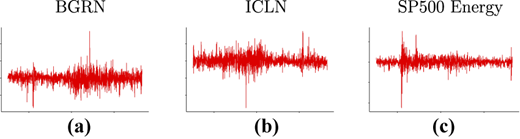
where rt is the return on day t, and Pt denotes the closing price on that day. The log-return transformation is preferred for its statistical properties: it stabilises variance and improves comparisons across series with different price levels. Figure 1 illustrates the return series for the three ETFs. Notably, the return distributions exhibit time-varying volatility and asymmetry, motivating the use of a nonlinear and distribution-aware framework. As shown in Table 1, the stationarity tests reported that the series have a mean-reverting behaviour. This means that all the variables are stationary at level, I (0).
BGRN captures the performance of USD-denominated investment-grade green bonds issued globally to finance environmental projects, thus serving as a proxy for climate-oriented fixed-income markets. ICLN, on the other hand, reflects investor sentiment toward clean energy equities worldwide, encompassing sectors such as solar, wind, and energy storage. The SP500EN represents conventional energy firms (e.g. oil and gas) within the S&P 500. This triad of instruments enables an investigation into how financial shocks and information propagate among green bonds, clean energy equities, and traditional energy stocks – an inquiry of increasing relevance amid the structural shifts induced by decarbonisation policies, ESG investment trends, and climate risk awareness. The set of these endogenous variables is obtained from the investing.com database.
In addition to the variables for the baseline analysis (BGRN, ICLN, SP500EN), we incorporate policy variables to examine how policies can influence the strength and structure of information transmission through a conditioning mechanism. Specifically, we include two proxies for policy uncertainty: (i) Economic Policy Uncertainty (EPU) index, which captures time-varying macroeconomic and regulatory ambiguity, and (ii) a monetary policy stance, defined as the effective federal funds rate (EFFR), which is computed as a volume-weighted average of rates on brokered federal funds trades [3], which reflects the intensity and liquidity impact of monetary operations. The EPU index was obtained from the Baker, Bloom, and Davis (2016) webpage, while the EFFR was obtained from the official site of the Federal Reserve Bank of New York. Compared to the earlier patchy measures, the transparency, ease of use, and elasticity of the Baker et al. (2016)'s index have engendered its broad applicability (Al-Thaqeb & Algharabali, 2019; Qian, Tan, Power, & Mandal, 2025) [4].
For empirical analysis, we adapt the newly proposed QQTE by Yao et al. (2025) to explore the relationship between the traditional energy market (SP500EN) and the green energy market (BGRN, ICLN). It is worth noting that this approach is a hybrid of the QQ method and the transfer entropy (TE) approach. On the one hand, the QQ approach measures interdependence at various quantiles of a variable with those of another variable. It explores the complex and heterogeneous dependence between the two variables (Sim & Zhou, 2015; Shahbaz, Zakaria, Shahzad, & Mahalik, 2018; Balcilar, Elsayed, Khalfaoui, & Hammoudeh, 2025). For instance, the effect of traditional energy price shocks on the green energy market may be heterogeneous, depending on diverse market conditions and size as well as direction of energy price shocks (Tiwari, Adewuyi, & Roubaud, 2019). Thus, the green energy market may respond to traditional energy market shocks differently depending on whether it is in bearish or bullish states; and whether traditional energy market shocks are large or smaller, negative or positive. On the other hand, the transfer entropy method is used to measure the amount and pattern of directed information flow between different variables. It measures the variability in future condition one variable by understanding the previous conditions of another variable, while recognising the effect of its own former states (Papla & Siedlecki, 2024; Wang & Wang, 2021; Baez, 2022). Based on a theory in physics, in an independent system, entropy (a measure of uncertainty) changes or remains unchanged depending on how the system reacts and the characteristics of the foreign intrusion into the system (Papla & Siedlecki, 2024). Thus, apart from analysing the complex and heterogeneous dependence between the two variables (green and traditional energy markets) via the QQ, the asymmetric role of external or additional variables, such as climatic policy uncertainty (CPU), in this complex and heterogeneous relationship can also be investigated with the inclusion of TE.
The QQTE method extends the Quantile Transfer Entropy (QTE) of Zhang and Zhao (2022), which was a quantile blend of Shannon (1948) transfer entropy (Schreiber, 2000). It is a model-free, information-theoretic measure in a quantile-specific domain, allowing one to uncover asymmetries and tail-dependencies that standard linear or full-distribution methods may overlook.
The fundamental principle of Shannon entropy theory stipulates that, for a discrete Random Variable (RV) X with a specified probability distribution p(x), the mean number of bits necessary to optimally encode independent draws from the X distribution can be calculated as follows:
The Shannon's entropy is a measure of uncertainty for X. This uncertainty increases with the number of bits that are needed to encode the realisation sequence of X. However, this formula is a univariate idea and does not account for any possible relationship between two different RVs. Therefore, to quantify the flow of information between two different RVs, Shannon's entropy is merged with the Kullback and Leibler (1951) distance. Moreover, by considering an underlying Markov process (Schreiber, 2000), we can measure the transfer of entropy (or disorder) from two different RVs. The Shannon Transfer Entropy (TE) from X to Y is defined as:
where the dynamic structure of the joint probability distribution corresponds to a stationary Markov process of order k and m, for X and Y, respectively. Following the Markov process:
In this bivariate case, the information flow from X to Y is represented by the deviation from the generalised Markov property relying on the Kullback-Leibler distance. The TE quantifies the additional information about the future of X provided by the past of Y, beyond what is already known from the past of X. A significantly positive measure indicates a causal-like (directional) dependence.
We provide an extension at different quantiles. The QQTE evaluates information flow conditional on specific quantiles of the return distribution, discretises the series using quantile binning (e.g. τ ∈ {0.05, 0.10, …, 0.95}). Then, it estimated the TE for each quantile. The result could be interesting given that it enables the detection of tail-risk spillovers and state-dependent causal influences. The estimation procedure is based on Yao et al. (2025). Thus, the lag structure is fixed to p = 1, the quantile binning is employed, and we use 100 bootstrap replications.
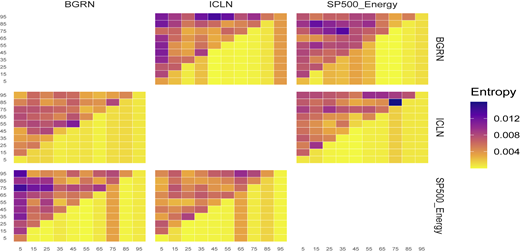
We provide results in the form of an entropy surface, which shows quantile-dependent information flow, allowing for a quantile-based interpretation of the directional dynamics among green bonds, clean energy equities, and traditional energy stocks.
Furthermore, to condition each QQTE estimate on the uncertainty measures of economic and monetary policy discussed above, we follow the following procedure. For each directional relationship (from variable X to variable Y), we compute the QQTE not on the raw target series Y, but rather on the residuals of an auxiliary OLS regression of Y on the chosen uncertainty proxy Z:
where the residuals allow us to assess whether the predictive power of X is independent of or mediated by broader economic conditions. This conditioning framework allows for a more nuanced interpretation of transfer entropy results by disentangling pure market-driven informational spillovers from those that may be confounded or amplified by systemic uncertainty.
4. Results with discussion
4.1 Presentation, analysis and discussion of results
This analysis explores the dynamic and state-dependent information flow among green bonds (BGRN), clean energy equities (ICLN) and the traditional energy sector (S&P 500 Energy Index) using a QQTE approach. This method captures how dependence between these financial assets varies not only in magnitude but also across different market conditions, ranging from extreme downturns to bullish rallies.
From Figure 2, it emerges that the relationship between BGRN and ICLN has interesting implications. Specifically, a clear pattern of information flow is observed from green bonds to clean energy equities in the upper quantiles, indicating that positive shocks in the green bond market often precede or coincide with similarly positive movements in clean energy stocks. This behaviour suggests that green bonds, typically considered more stable and forward-looking instruments, may act as leading indicators for investor sentiment or capital flows into the clean energy sector. In periods of optimism, such as when environmental policy announcements or ESG momentum strengthen, green bond returns appear to signal broader support for the energy transition, which is then reflected in equity prices.
In contrast, the reverse relationship (ICLN to BGRN) displays a much weaker and more scattered pattern of information transfer. This asymmetry highlights the distinct roles that these asset classes play in the market, which aligns with the findings of Duan et al. (2023). While green bonds may influence expectations in the equity space, clean energy equities do not exert a comparably strong influence on bond pricing. This could reflect the greater sensitivity of equities to short-term volatility and investor rotation, whereas bonds, especially those within the ESG framework, are more anchored to long-term fundamentals and institutional investment strategies.
When examining the relationship between green bonds and the traditional energy sector, the results are even more subdued. Both directions – BGRN to S&P 500 Energy and vice versa – show limited evidence of meaningful information flow. This suggests that these two markets operate largely in parallel, shaped by distinct drivers. The green bond market is propelled by sustainability objectives and regulatory incentives, while the fossil fuel sector remains closely tied to commodity prices, geopolitical risks, and cyclical demand. This result is in line with the findings of most previous studies that limited or negligible information flow exists between the traditional and green/clean energy markets (Umar et al., 2022; Farid et al., 2023; Tiwari et al., 2023; Qi et al., 2025; Chen et al., 2025; Arif et al., 2021). The near absence of significant contagion between them suggests that diversification benefits may persist between green fixed income and conventional energy equities, particularly in portfolios that are sensitive to sector-specific shocks.
A more complex interaction is observed between clean energy and fossil fuel equities. There is evidence of modest spillovers from ICLN to the S&P 500 Energy Index, particularly during downturns. This could indicate that periods of stress in the clean energy sector, potentially driven by rising interest rates, supply chain disruptions, or political uncertainty, influence broader energy market sentiment or trigger portfolio-wide de-risking. Conversely, the influence of fossil fuel equities on clean energy stocks appears slightly stronger in mid-to-upper quantiles, hinting at some strategic capital reallocation. For example, gains in traditional energy may lead investors to rotate profits into clean energy positions, especially when both sectors are perceived as competing assets within energy-themed portfolios.
From a financial perspective, these results offer valuable implications. First, they reinforce the role of green bonds as not merely passive instruments of capital allocation, but also as sources of informational leadership within the broader green finance ecosystem. For investors and policymakers alike, this highlights the importance of monitoring bond market dynamics as potential indicators of equity performance in the clean and renewable energy sector. Second, the asymmetry and nonlinearity of spillovers underscore the need to incorporate state-dependent risk models in portfolio construction. Tail risks – both positive and negative – appear to drive much of the interdependence, which standard models may underestimate. Finally, the weak linkage between green and fossil fuel assets reflects the ongoing bifurcation of financial markets, which is aligned with the energy transition. However, the existence of some conditional spillovers during periods of turbulence suggests that full segmentation has not yet been achieved. Understanding these evolving linkages is crucial not only for asset managers seeking diversification but also for regulators and policymakers aiming to assess systemic risk in an increasingly climate-sensitive financial environment.
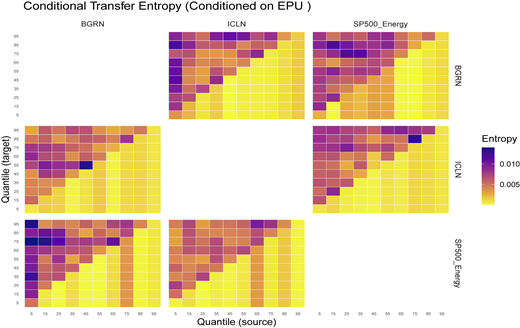
When conditioning on economic policy uncertainty (EPU, Figure 3), a clear dampening of entropy levels is observed across all asset pairs. The strong BGRN to ICLN relationship becomes notably weaker, suggesting that part of the observed information flow was driven by shared exposure to policy uncertainty rather than direct market signalling. Similarly, stress-related spillovers from ICLN to fossil fuel equities largely disappear, indicating that what appeared to be contagion in the unconditional model may instead reflect market-wide reactions to uncertain policy environments.
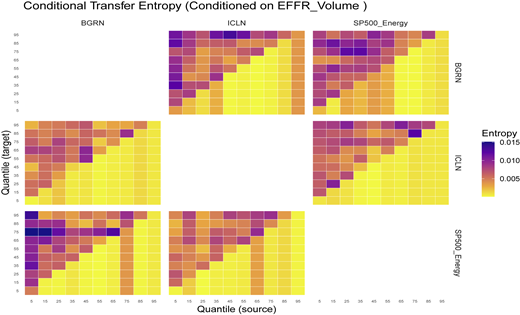
In contrast, conditioning on monetary policy (via EFFR with respect to volume, Figure 4) leads to a more selective attenuation of spillovers. While the BGRN to ICLN relationship remains partly intact, especially in the upper quantiles, the negative spillovers from ICLN to SP500 Energy are significantly reduced. This suggests that monetary tightening is a significant driver of downside co-movements, particularly for capital-intensive sectors that are sensitive to interest rate changes.
From a policy and investment standpoint, these findings carry critical implications. The sensitivity of green and clean energy markets to EPU highlights the centrality of policy credibility and transparency in maintaining stability across sustainability-focused asset classes. When uncertainty dominates the macro landscape, the informational content of price signals diminishes, making it harder for investors to distinguish between structural shifts and noise. In contrast, the partial persistence of green bond leadership under monetary control highlights their potential role as policy-resilient instruments, particularly in environments that support long-term investment flows.
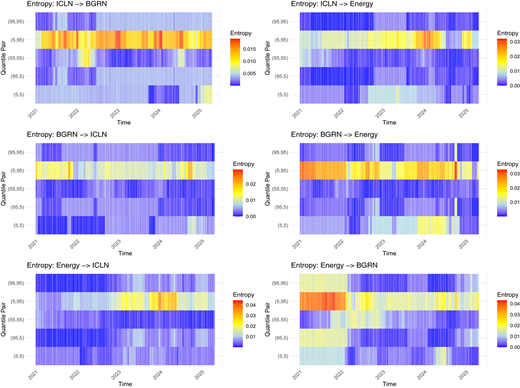
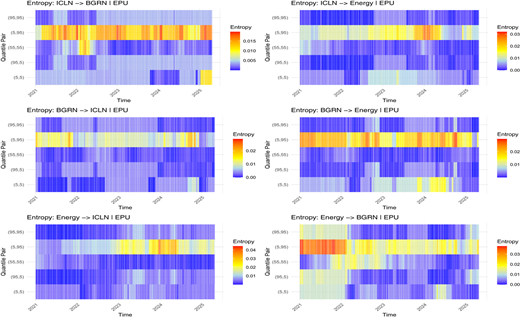
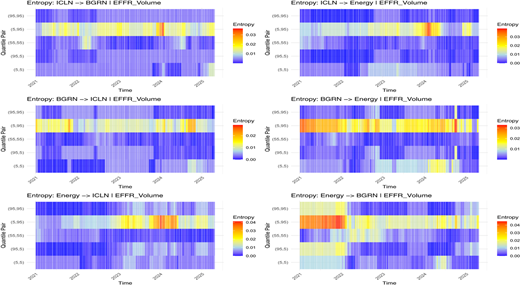
Since we had a static view of this relationship, we proceeded with computing a rolling version of the previous model where the rolling window starts from the first observation available the 4th of January 2021. The choice of this rolling was performed to focus this dynamic analysis on the period after the COVID-19 pandemic. It can be seen from Figures 5–7 that the directional information flows between green finance (BGRN), clean energy (ICLN), and conventional energy (SP500 Energy) have evolved over time, both unconditionally and when conditioned on key policy-related variables: economic policy uncertainty (EPU) and monetary policy (proxied by EFFR volume).
The unconditioned results (Figure 5) show relatively stable but heterogeneous patterns of spillovers across time and quantiles. We could summarise the key findings as follows. First, there is a persistent information flow from clean energy (ICLN) to both BGRN and SP500 Energy, particularly strong in lower and median quantiles during high-volatility periods like early 2022. Second, BGRN → ICLN linkages, while present, tend to be weaker and more localised in time, suggesting that green bonds tend to absorb rather than transmit shocks. Third, strong and relatively symmetric spillovers from the SP500 Energy sector to both ICLN and BGRN are evident, especially in the upper quantiles, indicating that bullish conditions in traditional energy can propagate to green assets during certain regimes.
When controlling for economic policy uncertainty (Figure 6), the magnitude and structure of many transfer entropy linkages change meaningfully. The ICLN → BGRN and ICLN → Energy effects weaken, especially after 2022, implying that EPU acts as a common driver of returns, diminishing the direct spillover effect once filtered out. The flows from traditional energy to BGRN and ICLN persist more visibly, especially in the upper quantiles. This highlights that conventional energy retains a role in influencing green assets, even when the broader policy environment is taken into account. The conditional structure under EPU reveals that uncertainty episodes do not merely amplify noise but also restructure the paths through which information flows, making clean energy less influential and more reactive to macroeconomic shocks.
Under monetary policy conditioning (Figure 7), another layer of nuance emerges. Transfer entropy from BGRN and ICLN to Energy becomes even more muted, especially in the last part of the sample (2023–2025), suggesting that monetary policy actions or liquidity shocks absorb part of the variation that would otherwise appear as inter-market spillovers. This implication could reflect the restrictive monetary policies pursued by central banks. Conversely, Energy → ICLN and Energy → BGRN remain resilient, with strong entropy patterns in the (95,5) and (95,95) quantile pairs, especially after late 2022. This fact implies that traditional energy retains its systemic footprint regardless of the monetary context, perhaps due to its role as a benchmark or reference sector. Importantly, some effects seen in the unconditioned model – particularly ICLN's leading role – become significantly dampened when monetary liquidity is accounted for, suggesting that liquidity conditions drive much of the information that seemed previously attributable to clean energy alone.
Across all three settings, a consistent message emerges: while clean and green finance can influence traditional sectors, their power to do so diminishes substantially in the face of macroeconomic uncertainty or monetary interventions. The resilience of traditional energy as an information source, even when controlling policy regimes, indicates its central role in shaping cross-sector dynamics. This finding aligns with that of Zhang et al. (2023), which found that CPU has adverse and heterogeneous effects on the long-term connection between traditional energy (crude oil) and various clean energy sources examined. From a policy standpoint, these findings imply that financial linkages in green markets are sensitive to policy regimes, especially uncertainty, suggesting a need for stabilisation measures during turbulent periods.
4.2 Robustness checks
This section presents a comprehensive set of robustness checks to validate the empirical findings [5].
4.2.1 Evaluation of the Markov property
To evaluate whether a Markov process adequately approximates the dynamics of each variable, we estimated discrete-state Markov models of orders 1 through 5 using quantile-based discretisation (5 states). Model selection criteria (AIC and BIC) consistently favoured a first-order Markov process for all variables, indicating that the future state of the series depends primarily on its immediately preceding state (Table 2). Thus, a first-order Markov process is the most parsimonious and empirically appropriate specification for all variables. The goodness-of-fit, measured as the average log-likelihood per observation, showed only slight improvement for higher orders, further confirming that first-order dynamics dominate (see Table 2). This validates the use of first-order Markov models for characterising the short-term transition probabilities and supports their integration into subsequent transfer entropy and sensitivity analyses. Therefore, a first-order Markov structure sufficiently captures the temporal dependencies required for the QQTE estimation.
4.2.2 Sensitivity of the results to alternative temporal embedding
To assess whether the estimated information flows depend on the temporal embedding, we conducted a lag-sensitivity analysis for all variable pairs, computing Transfer Entropy (TE) for lag lengths ranging from 0 to 5. Table 3 reports the full set of results. Across all specifications, TE values remain confined to a narrow band (approximately 0.003–0.013), and no directional reversal of the information flow is observed. Moreover, no new causal edges emerge at higher lags, and the relative ordering of TE magnitudes remains stable. These results indicate that the TE-based causal structure is not sensitive to lag selection, supporting the robustness of our baseline findings. Consequently, the main conclusions regarding the directional information flow between (1) renewable energy equities, (2) green bonds, and (3) energy markets are not driven by specific lag choices.
4.2.3 Direction of causality between policy uncertainty variable and green/traditional energy markets: any reverse causality?
To address the concerns regarding the assumed direction of causality from policy uncertainty to green and energy markets, we conduct formal Granger causality tests between each market variable X (ICLN, BGRN, Energy) and the two policy-related proxies Z (EPU and EFFR). This allows us to verify whether market dynamics may themselves contribute to shaping policy uncertainty or monetary policy conditions. Results, reported in Table 4, indicate that:
There is no evidence that EPU is Granger-caused by green or energy markets (all p-values are higher than 20%), supporting the assumption that EPU can be treated as exogenous with respect to the financial variables considered. This finding is inconsistent with that of Zhao, Wang, Dong, Shahbaz, and Ni (2023), which found bidirectional causality.
For monetary policy (EFFR), BGRN and Energy exhibit significant predictive power (p < 0.01 and p < 0.05 respectively). However, the reverse direction (EFFR to markets) is not statistically significant, suggesting that these links capture short-run feedback from market activity to policy conditions rather than bidirectional causality.
Overall, these results show that reverse causality is limited and does not undermine our identification strategy. The policy proxies can be considered weakly exogenous in the context of the QQTE estimation. Nevertheless, we explicitly acknowledge the presence of partial feedback effects (particularly between clean energy markets and monetary policy), which supports the interpretation of our results as policy-related interdependence rather than unidirectional causation.
4.2.4 Exogeneity issue
To assess the exogeneity of the policy proxies Z (EPU and EFFR), we conducted a preliminary endogeneity check. For each target variable Y, we estimated the regression:
Thereafter, we computed the Pearson correlation between the residuals and the policy proxy Zt. The results in (Table 5) show correlations that are effectively zero and statistically insignificant, indicating no detectable endogeneity. This supports the assumption that Z can be treated as exogenous. Accordingly, computing the QQTE on the residuals provides a valid measure of the interdependence between X and Y conditional on the policy environment, capturing “policy-driven interdependence” without bias from the direct effect of the policy proxy.
4.2.5 Standard quantile transfer entropy (QTE) as a benchmark
As a robustness check, we computed the standard Quantile Transfer Entropy (QTE) at three representative quantiles (5%, 50%, 95%), treating each target variable directly without conditioning on the full distribution of the source (Table 6). The QTE results broadly confirm the patterns observed with the QQTE. In particular, BGRN appears to exert moderate positive information flow towards ICLN in upper quantiles, consistent with the idea that green bonds may act as leading indicators for investor sentiment or capital allocation in the clean energy sector. The reverse direction (ICLN to BGRN) remains weak, supporting the asymmetric relationship noted earlier.
For the interactions between green bonds and the traditional energy sector, both QTE and QQTE indicate minimal information transfer, reinforcing the view that these markets largely operate independently, shaped by distinct drivers – sustainability objectives for green bonds versus commodity and cyclical factors for fossil fuels.
Regarding clean energy and fossil fuel equities, QTE results corroborate the presence of modest spillovers in both directions. Notably, QQTE provides richer insights by revealing that the direction and intensity of information flow vary across quantiles: clean energy tends to influence fossil fuel equities in the central to upper quantiles, while feedback from traditional energy is more pronounced in the lower quantiles. This nuance, captured only by the QQTE, highlights its added value in uncovering state-dependent dynamics that are not fully observable with standard QTE.
Collectively, the robustness checks confirm that the main conclusions – regarding the asymmetric, nonlinear, and policy-sensitive nature of information transmission across green bonds, clean energy equities, and traditional energy assets – are not driven by modelling assumptions or parameter choices. The directional hierarchy of spillovers, particularly the role of traditional energy as a persistent shock transmitter and the conditional behaviour of green and clean energy markets, remains stable across specifications.
5. Conclusions and policy implications
This work examines the directional flow of information between traditional and green energy markets, focusing on three key financial instruments to proxy different dimensions of the global energy transition, with the moderating role of economic policy uncertainty (EPU). The selected energy assets analysed are the iShares USD Green Bond ETF (BGRN), the iShares Global Clean Energy ETF (ICLN), and the S&P 500 Energy Index (SP500EN). We employ the new QQTE approach by Yao et al. (2025) on a sample of daily log returns from January 4, 2019, to April 25, 2025.
Some interesting and empirically relevant results emerged. First, there is a persistent flow of information from clean energy to both the green bond market and the traditional energy market, which is predominantly strong in lower and median quantiles during high-volatility periods such as early 2022. Second, there is weaker and limited information flow from the green bond market to the clean energy market over time, thus indicating that green bonds tend to be a shock absorber rather than a shock transmitter. Third, robust and moderately symmetric spillovers from the traditional energy market to both the clean energy and green bond markets exist, particularly in the upper quantiles. These shreds of evidence prove that bullish conditions in traditional energy can spread to the green energy market during specific time episodes. However, the results show that, although clean energy and green bond markets can influence the traditional energy market, their impact diminishes in the presence of macroeconomic policy uncertainty (including climatic policy uncertainty) and monetary policy interventions. Further, the traditional energy market remains a main shock transmitter even after controlling for policy uncertainty and monetary policy stance.
These findings provide valuable policy implications for different stakeholders interested in promoting sustainable development and encouraging investment in alternative energy markets. The robust linkage between the traditional (oil) market and the clean energy market, especially in the absence of policy uncertainty or intervention, suggests that the conventional energy market can complement the clean energy market during the energy transition period, provided policy stability and non-intervention prevail. However, the weak contagion between the two alternative markets implies that portfolio diversification benefits exist between green fixed-income and conventional energy equities, particularly during policy intervention and climatic policy uncertainty, as well as between portfolios sensitive to sector-specific shocks. Thus, these findings indicate that financial linkages within clean markets are highly sensitive to policy regimes – particularly to policy uncertainty – highlighting the need for stabilisation measures during turmoil to preserve diversification benefits for investors.
Since this study is only the first exploration of these relationships, the main limitation of this study lies in its limited market coverage. Future research should consider extending the analysis to include a broader range of traditional and green/clean energy markets, as well as other relevant resource and financial markets, such as metals and foreign exchange. Additionally, several alternative forms of policy uncertainty could be considered, such as those related to oil and metal markets, fiscal policy, and trade policy.
The authors are grateful to the Editor and the anonymous referees for their highly constructive comments and suggestions, which substantially improved the article.
Notes
For the sake of completeness, green sources are included in clean sources henceforth, we use the term clean for referring to green sources.
Among the papers that have used iShares USD Green Bond ETF (BGRN) and iShares Global Clean energy ETF (ICLN) as a proxy for green bond market and clean energy stock market, are;
Nguyen, M.N. Ruipeng Liu, R. Li, Y. (2025), Performance of energy ETFs and climate risks, Energy Economics, 141, https://doi.org/10.1016/j.eneco.2024.108031
Gabriel, V. M. Lozano, M.B. Matias, M.F.L. I. Neves, M.E. Rebelo, S.C.F. (2025), Global Spillovers Between Sustainable and Traditional ETFs: Crisis Dynamics and Policy Implications, 16 (5), 862–873, https://doi.org/10.1111/1758-5899.70073
Xu, Y., Bouri, E., Saeed, T., Wen, Z., 2020. Intraday return predictability: Evidence from commodity ETFs and their related volatility indices. Resour. Policy 69, 101830.
Xu, D. Hu, Y. Corbet, S. Lang, C. (2024), Return connectedness of green bonds and financial investment channels in China: Implications for hedging and regulation, Research in International Business and Finance, 70 (Part A), https://doi.org/10.1016/j.ribaf.2024.102329.
Klee, E. Senyuz, Z. Yoldas, E. (2019) Effects of Changing Monetary and Regulatory Policy on Money Markets,” International Journal of Central Banking, International Journal of Central Banking, 15(4), 165–205.
Lagos, R., & Navarro, G. (2023). Monetary Policy Operations: Theory, Evidence, and Tools for Quantitative Analysis, NBER Working Paper No. 31370, National Bureau of Economic Research.
Baker et al. (2016) modified the earlier economic policy uncertainty (EPU) index by constricting a single, publicly accessible, and reproducible index, pooling diverse sources like newspaper reporting and tax code variations.
Al-Thaqeb, S.A. Algharabali, B.G. (2019), Economic policy uncertainty: A literature review, The Journal of Economic Asymmetries, 20, https://doi.org/10.1016/j.jeca.2019.e00133.
Qian, B. Tan, Y, Power, G. Mandal, A. (2025), Economic policy uncertainty, information production, and transparency, International Review of Financial Analysis, 103, https://doi.org/10.1016/j.irfa.2025.104203.
We would have checked the robustness of our results using other measures of EPU and monetary policy variable but they are not freely available on a daily basis. Given the assumptions of our model and its scope, switching to monthly data could compromise the economic and financial relevance of our work, with probably very marginal implications.