This study investigates language choices through the lens of organizational identity and shows that these choices have symbolic value beyond verbal narratives in constructing and expressing an international identity. In doing so, this study introduces a new area of investigation to the language-sensitive stream of International Business (IB) research.
This is a qualitative case study of a small Finnish digital firm that explores which languages (i.e. national languages) are chosen as the firm pursues internationalization.
The case company constructs and expresses an international identity through its language choices. Internationalization triggers changes that result in adapting the firm's language choices to new situations. These choices range from bilingual to multilingual and finally to an English-dominant approach, expressing differences from “noninternational” firms and similarities to international firms, their preferred comparison group. Although their language choices change over time, the identity claim of being international remains the same.
To date, language-sensitive IB research has not addressed the symbolic value of language choices in constructing and expressing organizational identity. This article brings together three streams of literature: internationalization of small digital firms, organizational identity and language choices in internationalizing firms. It builds the argument that, through the symbolic value, language choices play a central role in a firm's transformation into an international firm. Both internal and external language choices are important in expressing an international identity to various audiences, such as customers, employees, industry peers and other network members.
Introduction
Internationalization implies constant changes for a firm. One aspect of change that has received scant attention concerns the organizational identity of a firm that embarks on internationalization. Organizational identity refers to the central features that, in the eyes of the organization's members, form the essence of who they are as an organization and what their goals are (Albert and Whetten, 1985; Cornelissen et al., 2007; Edman, 2016; Gioia et al., 2013; Kreiner et al., 2015). Organizational identity shapes a firm's strategy and survival (Edman, 2016). Therefore, constructing and expressing an identity that supports internationalization becomes crucial. A firm may also face identity tensions related to adapting the identity to changing situations while preserving what is essential for the organization (Kreiner et al., 2015).
In the course of internationalization, firms also face the need to make language choices (Welch et al., 2001). Previous language-sensitive research in International Business (IB) has investigated the complexity and pervasiveness of language issues in multinational enterprises (MNEs). This study, however, focuses on language choices in small and medium-sized enterprises (SMEs) that internationalize. Previous research has addressed language choice in SMEs as a matter of external communication, i.e., deciding which national languages are used in international business relationships, mainly with customers. The choice typically takes place between English and a multilingual strategy (Talukder and Barner-Rasmussen, 2024). Factors influencing the choice include the availability of language skills for the firm, the perceived competitive advantage of using a customer's language, and also customers' language preferences, which are related to individual linguistic identities (Bordia and Bordia, 2015; Hurmerinta et al., 2015; Karhunen et al., 2023; Talukder and Barner-Rasmussen, 2024).
However, while language is known to be an important marker of individual identity (Bordia and Bordia, 2015; Karhunen et al., 2023), its role in constructing and expressing organizational identities remains largely underexplored in IB. Furthermore, we know little about the formation of organizational identity in new firms, particularly those who aspire internationalization. To address these omissions, I pose the following research question: How do language choices construct and express the international identity of an internationalizing small firm? Based on an interpretive case study approach (Mees-Buss et al., 2022; Piekkari et al., 2009; Piekkari and Welch, 2018), I adopt the lens of organizational identity to investigate the language choices of an internationalizing small Finnish digital firm. The findings show that language choices have symbolic value beyond words that are spoken (Hornikx et al., 2024): the choice of language in itself constructs and expresses the organization's identity as an international firm.
This article contributes to language-sensitive IB research by identifying the symbolic value of language choice at the firm level. The findings indicate that the role language plays in the internationalization of small firms is greater than recognized to date. Constructing and expressing an international identity is a central aspect in a firm's transformation into an international actor, and language choice plays a key role in the process. Furthermore, the lens of organizational identity reveals that both internal and external language choices are important for a small firm in expressing its international identity to various audiences, consisting of customers, employees (current and potential), industry peers and other network members.
This article is structured as follows: I begin by reviewing previous literature on the internationalization of small digital firms, organizational identity and language choices in internationalizing firms to build the theoretical background for the study. The following section explains the qualitative case study approach, case selection as well as data collection and analysis techniques. The findings show how different language choices in three different phases have been used to construct and express the international identity of the case firm while maintaining the essential identity claim of being international. Thereafter, I discuss the findings and the limitations of the study, suggesting avenues for future research. The article ends with reflections on the practical and societal implications of the findings.
Theoretical background
SMEs form the backbone of most economies (UNCTAD, 2024). Approximately 90% of businesses worldwide are SMEs, accounting for more than 50% of employment (World Bank, 2019). Thus, SMEs are crucial contributors to economic development (World Bank, 2019), and many societies rely on their growth to ensure societal well-being (Coviello and Munro, 1995). This study investigates the internationalization process of a small firm where language choices become a means of constructing and expressing the firm's identity as an international player.
While “language” can mean many things in an organization – national, corporate, technical or electronic (Brannen et al., 2014) – and language choices are made at many levels, e.g., regarding vocabulary and register, this article addresses language choice in terms of which so-called national languages are used in a firm, where, when, with whom, and why. I draw on three streams of literature – namely internationalization of small firms, especially digital firms due to the industry of the case company (e.g., Amdam et al., 2020; Monaghan et al., 2020), organizational identity (e.g., Gioia et al., 2010, 2013; Kreiner et al., 2015) and language choice in internationalizing firms (e.g., Sanden and Kankaanranta, 2018; Talukder and Barner-Rasmussen, 2024) – to build the argument that language choices have symbolic value in constructing and expressing an identity that supports the firm's internationalization. Both internal and external language choices are important in expressing an international identity to various audiences, such as customers, employees, industry peers and other network members. As digital firms in particular have the ability to reach new markets while operating from their home country (Ye et al., 2022), they need to balance the identity tensions arising from their international aspirations, yet rather local realities.
Internationalization of small digital firms
The implications of digitalization are currently the topic of a lively and important discussion in the field of IB (Stallkamp et al., 2023). While some firms undergo a digital transformation, others are “born digital”, i.e., they leverage digital technology for production, operations and product delivery from their inception, which facilitates the engagement with global markets at the very start (Fraccastoro et al., 2025; Knight et al., 2025; Yang et al., 2025). “[D]igital industries can be delineated into pure digital industries (e.g., social media, search engines, online gaming, etc. where the final products are virtual and rely minimally on offline physical assets) and digitally-enabled industries (e.g., online shopping, ride-sharing, food delivery, etc., where the final products are often physical)” (Yang et al., 2025, p. 6). The case company in this study falls into the first category as it sells a digital solution, namely software-as-a-service (SaaS). Such a business is based on a “licensing and distribution model in which software is hosted by service providers and is made available for customers over the internet” (Saltan and Smolander, 2021, p. 1).
Many founders of digital firms seem to have a “global by default” mindset (Birkinshaw, 2022, p. 621), and internationalization “may represent an idealized development path for young entrepreneurial firms” (Monaghan and Tippmann, 2018, p. 491). However, the strategies digital firms use for internationalization are diverse (Stallkamp et al., 2023), and for many such firms, early and rapid internationalization is planned, but for others it is not – it may even be accidental (Hennart, 2014; Monaghan et al., 2020). Social cues from relevant others, such as industry peers, may be particularly influential for the internationalization of entrepreneurial firms with limited international experience (Amdam et al., 2020). Digital firms in general are highly network-oriented (Ye et al., 2022), and scholars have found that the actors within these networks have a widely shared understanding of guidelines and sets of heuristics for how to internationalize (Monaghan and Tippmann, 2018). Seeing other firms internationalize may serve as inspiration to follow in their footsteps, although the outcomes of the internationalization process vary (Amdam et al., 2020).
Digitalization lowers the barriers related to entering foreign markets (Ye et al., 2022). Research on internationalizing digital firms suggests that, compared to other types of businesses, e.g., manufacturing companies, such firms may be able to internationalize faster, with a broader geographical scope and with less of a physical footprint, i.e., without having to establish subsidiaries (Yang et al., 2025). In fact, digital firms can operate from their home country base, yet easily reach customers both at home and in foreign markets (Ye et al., 2022). Digital entry modes can also be localized, e.g., by providing websites in the languages of target markets. Nevertheless, it is also common to opt for a more global approach, namely, using English-language websites (Domurath et al., 2020; Vadana et al., 2019). However, Stallkamp et al. (2023) found that it is not uncommon for digital firms to still establish a physical presence in key markets to have access, e.g., to locally embedded human resources. Regardless of entry mode, expanding to a new market has repercussions for a firm's organizational identity. This is the topic of the next subsection.
Organizational identity
Extant research has focused on organizational identity in established MNEs where an identity already exists (e.g., Colman et al., 2022; Edman, 2016; Pant and Ramachandran, 2017). However, from the perspective of new firms, the question is how an organizational identity is formed in the first place. This is an underexplored aspect in the research on organizational identity (Gioia et al., 2010, 2013; Oliver and Vough, 2020). According to Gioia et al. (2013), the formation of an organizational identity begins with initial identity claims or articulation of a guiding vision by the organization's founder(s). In addition to reflecting the goals and ideals of “who we are”, and an organizational field or comparison group of “who we are like”, these claims can implicitly or explicitly rule certain features out, i.e., “who we are not” (Gioia et al., 2013). During the process of forming an organizational identity, the organization also needs to define what it means to be who they want to be. Through exploring similarities and differences with other organizations, a consensus begins to form among the organizational members regarding their distinctive features (Gioia et al., 2013).
Organizational members often refer to their organization's identity in descriptive characteristics (Kreiner et al., 2015). However, as organizations are faced with constant change, be it through entering new markets or recruiting new employees, Kreiner et al. (2015) argue that organizational identity is, in fact, manifested in identity tensions and the ongoing process of determining (1) what aspects of the identity are essential or negotiable, (2) what is consistent or changeable and (3) what connects or differentiates the organization from others. Through shared narratives, practices and discourses (Amdam et al., 2020; Cornelissen et al., 2007; Gioia et al., 2013; Ravasi and Canato, 2013), an organizational identity provides an interpretative system that guides individuals' sense-making within the organization (Cornelissen et al., 2007; Gioia et al., 2013). It is also about “giving sense” (Gioia et al., 2013, p. 160) since constructing organizational identity aims to legitimize the organization in the eyes of relevant stakeholders (Cornelissen et al., 2007).
Whereas identity concerns who an organization is, legitimacy refers to the organization's relationship with its surrounding environment (Dupuis, 2008). Stakeholders, such as customers, employees and financiers, hold expectations about how a certain kind of organization should act. New firms are compared to existing ones to assess whether they meet the minimum standards of membership of a particular category of organizations (van Werven et al., 2015). If stakeholder expectations are met, the organization is granted legitimacy, meaning a positive judgment that the firm is competent and to be taken seriously (Bangara et al., 2012; Díez Martín et al., 2010; Gioia et al., 2013; Zimmerman and Zeitz, 2002). Established firms can rely on a historical track record of performance and reputation in pursuing legitimacy, but a new firm must be more proactive and, for example, imitate the identities and actions of existing organizations in a relevant field (Bangara et al., 2012; Gioia et al., 2013; Santos, 2022; van Werven et al., 2015). Verbal narratives and storytelling are important ways of constructing organizational identities and pursuing legitimacy (Cornelissen et al., 2007; Gioia et al., 2013). Furthermore, organizations can also make implicit claims about their identity that do not require logical and linear argumentation structures. This can be done, e.g., through visual communication (Santos, 2023) and, as is argued in this article, through language choices (Hornikx et al., 2024), to which I turn in the next subsection.
Language choice in internationalizing firms
Previous language-sensitive IB research has mainly focused on large MNEs, which are considered multilingual by definition (Fredriksson et al., 2006). Thus, language choice is addressed as an internal management issue concerning, e.g., which language(s) to use in communication with employees who do not share a native language. On the other hand, in SMEs, language choice has typically been treated as a matter of external communication, i.e., which language(s) to use with international customers, largely overlooking the possibility that SMEs also make internal language choices. However, today, migration is a phenomenon that “touches nearly all corners of the world” (Hajro et al., 2021, p. 1), which means that small and locally operating firms, too, can become internally multilingual. Therefore, while the present study focuses on small internationalizing firms, language choice is approached both as an internal and external issue.
In external communication with customers, language choice is typically made between two language strategies: an English-only or multilingual strategy (Talukder and Barner-Rasmussen, 2024). The choice between the two strategies depends mainly on what language skills are available for the firm, i.e., the existing language skills of employees and others in the firm's network (Hurmerinta et al., 2015; Talukder and Barner-Rasmussen, 2024), and what the customers' language preferences are, e.g., whether they require the use of their native language. English holds an undisputed role as the language of international business (Fredriksson et al., 2006; Tietze, 2004). It is a lingua franca, i.e., a language shared and used by nonnative speakers in intercultural encounters (Brannen et al., 2014). Talukder and Barner-Rasmussen (2024) found that decision-makers who take the lingua franca role of English as a given are less likely to adopt a multilingual strategy for their external communication. However, although English is the most commonly adopted language in international business, “the proficiency as well as the willingness of people to communicate in English should not be taken for granted” in all markets (Liu et al., 2015, p. 67). Furthermore, an English-only strategy may result in underutilizing the actual language abilities available for the firm (Talukder and Barner-Rasmussen, 2024).
A multilingual strategy, i.e., speaking the language of the customer, can provide an important competitive advantage for a firm (e.g., Knowles et al., 2006; Mughan, 1990; Talukder and Barner-Rasmussen, 2024), particularly when language skills are accompanied by relevant cultural skills (Hurmerinta et al., 2015). To increase the availability of language skills within a firm, it has been suggested that firms can recruit foreign-born employees, i.e., individuals with a migrant background residing in the firm's home country (Rižnar and Rybnicek, 2017; Welch et al., 2001) [1]. The presence of foreign-born employees allows for a firm to connect with customers in target markets through a shared native language, i.e., a linguistic match, which may enhance the quality of customer relationships (Sui et al., 2015). Recruiting foreign-born employees can, thus, provide new linguistic resources, but it may also present the firm with a need for choosing a common working language internally.
For enabling internal communication in an international organization, English is the typical choice. While “the decision to use English [as a common company language] once used to be a choice made by managers, nowadays no decisions are needed” (Sanden and Kankaanranta, 2018, p. 557). It may be “due more to external (industry) pressures and “emergent” processes than to strategic decisions” (Fredriksson et al., 2006, p. 419) that English becomes the common company language. Therefore, policies regarding language use are not always explicitly formalized (Sanden and Kankaanranta, 2018). English as a company language is sometimes met with resistance among employees (e.g., Wilmot, 2017), and in practice, local languages often exist alongside the company language (Karhunen et al., 2023).
Beyond the obvious purpose of language choice to enable and facilitate communication – be it internally or externally – the act of choosing a language conveys meaning and, thus, has symbolic value (Hornikx et al., 2024). Understanding a symbol requires a shared interpretation of its meaning. For example, a native-like use of English as a company language may be instrumental for portraying a firm as a legitimate actor (Kankaanranta et al., 2018) and can further a firm's international image and brand to attract international employees and create new international opportunities (Linn et al., 2018; Michalski and Śliwa, 2021; Neeley, 2012). Thus, the internal language choice also has an external audience. Language choices can also be used to create an association with a certain country as has been found in research on international advertising (Hornikx et al., 2024). However, Hornikx et al. (2024) noted that the use of English in this context differs from other languages: English “can also be linked to specific countries [where it is spoken as a native language] such as the UK and the US, but in the majority of cases – because of its global use – it is associated with internationalness, modernity, and success” (Hornikx et al., 2024, p. 273).
Thus, to answer the research question of how language choices construct and express the international identity of an internationalizing small firm, I have integrated insights from three streams of literature: internationalization of small digital firms, organizational identity and language choice in internationalizing firms. I build the argument that language choices, both internally and externally, have symbolic value in the internationalization process of small firms.
Qualitative case study
In this section, I will introduce the methodological choices made in this study. I begin with a brief overview of the case study method, and then explain case selection, data collection and analysis.
A qualitative case study “is a research strategy that involves more than the choice of method for data collection or analysis” (Piekkari and Welch, 2018, p. 345). A case study is well-suited to the current study as I seek to understand and explain a social phenomenon (Welch et al., 2022), i.e., how language choices construct and express the international identity of an internationalizing small firm. This study draws on data from a single case organization. However, a single case does not mean it is a sample of one since the careful study of the case allows for within-case comparisons, such as comparing language choices made in different periods of time (Welch et al., 2022). “A single case can be a very powerful example” (Siggelkow, 2007, p. 20) that “leads researchers to see new theoretical relationships and question old ones” (Dyer and Wilkins, 1991, p. 614).
Case selection
The case company is a small Finnish digital firm, “Softa” (pseudonym to protect the identity of the company and the participants). At the start of the research project, my objective was to study the language choices of a small internationalizing firm that has recruited foreign-born employees to see how their native language skills are leveraged for internationalization. After reaching out to several potential firms, I came across the case company through a newspaper article that highlighted Softa's multilingual staff as an important asset in the internationalization of this digital firm. Initial discussions with the founder-owner-CEO in 2021 and other public data sources indicated that, out of the firms contacted, the phenomenon of interest would be most “transparently observable” (Pettigrew, 1990, p. 275) at Softa. Softa had more foreign-born employees (50% of 40 people) than the other companies I had contacted, and their staff was more diverse in terms of nationalities (15) and native languages (15). The CEO of Softa was willing to participate in the study and let me contact their employees. Furthermore, the digital industry is a well-suited setting for the study since digital firms can internationalize rather easily since inception, hence, they may confront the need to make language choices early in their development.
Softa was founded in Finland in 2012. Its business is selling licenses to use the software product (the interviewees referred to what they offer as “product”) to business-to-business customers. During the time of data collection, 2022–2023, most of Softa's revenue came from outside Finland [2]. Many of their customers are MNEs, meaning that the contact person(s) in a customer organization may be in one country while the end-users are in many others. Typically, customers first buy a smaller number of licenses but end up purchasing more as they become convinced that the product brings them value. Softa has two physical locations in Finland; their first location is in a mid-sized Finnish town, and the second office is in the capital area. The CEO mainly sits in the mid-sized town office. However, people at Softa referred to the offices by the name of the town and not, e.g., as “headquarters” and “subsidiary.” Most of the foreign-born employees were located in the office near the capital and worked in sales-related roles at the customer interface.
Choosing a Finnish firm was partly due to convenience since Finland is my country of origin and residence, but Finland is also a suitable context for studying the language choices of internationalizing small firms. Finland is a small economy (population 5.9 million) in Northern Europe that relies heavily on exports. The Finnish language is not spoken anywhere else, and most Finns rely on English for international communication. The status of English as a foreign language is strong, and in the past decades, the number of Finns studying languages other than English has declined drastically. Finnish society struggles with an aging population, and immigration is one of the solutions suggested to ensure future well-being. However, immigration is a rather new phenomenon in Finland, and especially small firms tend to have many concerns regarding the recruitment of foreign-born employees since they often lack both experience and resources for such a recruitment process and onboarding (Niemi et al., 2024; Tuononen et al., 2021). The resulting linguistic and cultural diversity may also be perceived as risky and laborious (Tuononen et al., 2021). Despite the rather high level of English as a foreign language among Finns, one important reason for not recruiting foreign-born employees is the unwillingness of the local staff to speak English at work (Niemi et al., 2024).
Data collection
The data consists of semi-structured interviews, language diaries, company website and social media, and other publicly available sources such as newspapers and online articles. Table 1 summarizes the data sources and the main purpose of each type of data.
The first interviews were conducted in May of 2022. The plan was to continue conducting interviews in September, after the vacation months, but then I was told that it was not a good time. Later, I discovered that during that time, Softa went through major changes, and several people were let go. The interview process then continued at the beginning of 2023. Although I had not planned it that way, conducting interviews at two different points in time provided me with valuable data showing how the company was evolving. Remote work was common at Softa, so instead of observing people and their language choices at work, I developed a language diary template for the participants to take notes of their language use at work-related interactions (see Appendix 2 for questions on the template). However, only four people, one manager and three employees, returned the diary. Others commented in the interviews that they found it too time-consuming and preferred to discuss language choices during the interviews.
The interviews were conducted online in Teams (10) and face-to-face (2). In both cases, the interviews were recorded (video/voice) and then transcribed by the researcher. The main theme of the interviews was the internationalization of Softa and the role of each participant in it. The interviews covered, e.g., the background of the interviewees, languages spoken by the interviewees and in the company in general, company culture, and other management practices (see Appendix 1 for the interview guide). The interviewees included the CEO, who was interviewed twice, decision-makers (3), all born and raised in Finland, and foreign-born employees (7) from different countries of origin around the world. Those who had been involved in the firm longer, mainly the decision-makers, were able to shed light on the past and how the firm had developed. Most of the foreign-born employees were rather recent recruits, and their interviews offered information about the current situation. Since I was interested in how language skills were leveraged for firm internationalization, I focused on the people who were at the customer interface.
The data concerning the website was collected through Wayback Machine (https://web.archive.org/), which could be described as a public archive containing snapshots of websites and their past versions. I went through all the versions of Softa's website I could find and took notes on anything related to language choices and internationalization, such as different language versions of the website. With Softa's social media account, the process was similar: I went through all their posts since the account was established in 2015 until 2023, took notes about languages used in the texts and videos (some in Finnish, the majority in English). I also found posts concerning the recruitment of new employees as well as information about webinars and events where the CEO and some of the managers talked about the internationalization and growth of Softa.
Data analysis
The interviews were conducted either in my native language, Finnish (5), or in English (7), and the data were analyzed in the language of the interview. I have translated the quotes (in the Findings section) that were originally in Finnish into English as part of my multilingual dataset. The goal was to maintain the meaning as closely as possible, but it is important to acknowledge that translation always brings an added layer of interpretation (Tietze, 2018). Since some of the English-language data sources are publicly available, such as the company's website, direct quotes would make the case company identifiable through an online search. Therefore, I have modified those quotes while aiming to maintain the meaning.
The analysis and theorizing rely on hermeneutic interpretation, meaning that the emerging theory is the result of an active and imaginative construction based on my interpretations (Mees-Buss et al., 2022). As I could not have foreseen what I would find in the field, the research project was adapted and revised along the way. I began the research with the objective of studying the language choices of an internationalizing small firm that has recruited foreign-born employees. I was initially under the impression that I was indeed studying a case of leveraging linguistic matches (Sui et al., 2015), i.e., connecting sellers and buyers who shared a native language, for internationalization. However, the interviews soon revealed that, while such a strategy had existed in the past, Softa had shifted to pushing English in almost all their external communication. This was an unexpected finding that puzzled me because it contradicted my expectations as well as previous research that has suggested foreign-born employees' native language skills are important resources for internationalizing firms (e.g., Rižnar and Rybnicek, 2017; Sui et al., 2015; Welch et al., 2001). This surprising empirical observation provided me the opportunity to identify an exciting research phenomenon (Dubois and Gadde, 2014): Through an iterative reading of the interview transcripts, I realized that managers and employees alike were using the narrative of being an international firm to make sense of and give sense to their language choices both in the past and at the time of the interviews. This realization led me to explore organizational identity as an analytical lens.
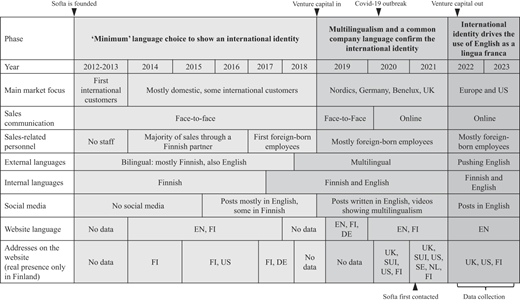
The first interview (out of two) conducted with the CEO already pointed out that there had been two influential events in Softa's journey that had an impact on their language choices: receiving venture capital (in 2019) and the outbreak of the COVID-19 pandemic (2020). As a consequence, I have analyzed their internationalization and related language choices in three phases (see Table 2): (1) the early years during which Softa was more of a side-project; (2) intense internationalization and growth upon receiving venture capital; and (3) the period following the outbreak of COVID-19 pandemic, which pushed all of Softa's communication online. Despite the influence of these two important events, shifting from one phase to another had not been clear-cut but gradual. Furthermore, since all the interviews were conducted during the third phase, previous phases were addressed retrospectively. As a result, the sense-making regarding these past phases was also retrospective.
After identifying the different phases in Softa's journey in terms of how they communicated with customers, I wanted to see how the phases would be visible in their website language choices. Moreover, it had already come up in the first interview with the CEO that Softa had kind of virtual addresses in other countries. Therefore, I listed their addresses year by year, or as they were available on Wayback Machine. Although not directly related to language choices, I realized that changes in the addresses over time were consistent with the phases of language choices I had identified.
I approached Softa's social media account in a similar way to how I did with their website. In the second interview with the CEO, we discussed some of my observations from social media and the website, and he confirmed that their idea for social media was to keep the content non-product-related, focusing on things like who joined the company (at least for a Finn, it was easy to spot all the non-Finnish names among the recruits introduced), events they attended and what they did together etc. In addition to the posts about new employees, I found videos of Softa's employees speaking their native languages, demonstrating the diversity of their staff in terms of languages and nationalities. I began to wonder who these posts were targeted at. I went through their followers and found that in addition to many private people (including current and perhaps future employees), there were also followers that could potentially be customer organizations or industry peers in Finland and abroad. Furthermore, as some posts indicated that the CEO and other managers had participated in webinars and industry events where they would talk about Softa's internationalization and growth, these observations strengthened my conclusion that Softa was presenting its international identity to a wider audience, not only to customers. I will now turn to present the findings.
Findings
At Softa, we speak more than ten different native languages and have customers all over the world. We really are an international company.
a blog post on Softa's website in (2022)
This opening quote is from a blog post on Softa's website celebrating the company's achievements on its 10th anniversary. It explicitly shows their identity claim of being an international firm, and language is closely linked to this self-definition. In this section, I will show how language choices have played a role in constructing and expressing the organizational identity of Softa as an international firm. At Softa, language choices were made in relation to product, internal communication, and external communication. The findings are presented in three parts according to the temporal phases identified during the analysis. Although language choices at Softa have changed over time, their claim to be an international firm has remained the same. Table 2 summarizes the findings.
None of the people involved in establishing Softa had prior experience in international business. However, they had extensive experience in the field of information technology (IT) in Finland, and internationalizing a product represented a new and attractive challenge after “seeing it all” in the domestic IT business. The idea for developing a software product arose from customer needs identified in the business operations of a firm where some of the founding members were involved. Seeing the potential of the product, the CEO said he had a dream of building an international firm. This constituted the initial identity claim at Softa.
“Minimum” language choice to show an international identity
In this subsection, I will explain how the use of English in the early years can be seen as a minimum requirement (van Werven et al., 2015) to “qualify” as international and to show that Softa is not just a domestic firm. The local language, Finnish, is not spoken elsewhere, so another language was needed to reach international customers. Due to the role of English as a lingua franca and the fact that it was the only foreign language spoken by the people involved in the creation of Softa, it was the natural choice. In the early years, the local language, Finnish, was also extensively used for domestic sales. Thus, Softa's approach to customers was bilingual.
Internationalization was a goal for Softa from the very beginning, and the aim was to internationalize immediately instead of first conquering the domestic market.
For a software-as-a-service company, scaling the business is possible only if you are international.[…] We didn’t start by building a product for the Finnish market that we would then try to internationalize. Rather, we have tried to build an international product that we just happen to sell in Finland as well. (Interview with CEO)
The product was first launched in English. Furthermore, English was used in marketing and on Softa's website. The English-language website soon proved worthwhile in attracting customers from other countries. In the early years, their website provided extensive information also in the local language, Finnish.
The very first customers were companies with international operations but headquartered in Finland. This meant that the end users of the product were in several countries, although the customer contact was still in the home market.
Our first customer was a very international Nordic organization […] that used English in its international communication. […] Then we got a customer – just by accident – from Canada in the very beginning. There was also one [customer] from Switzerland who actually flew into Finland to negotiate a deal with us. […] Even though [many of the first customers] were Finnish organizations, they operated in international markets. (interview with CEO)
However, Softa's early international sales were more of a reaction to inquiries from abroad than the result of proactive sales efforts. Softa remained a side project for the CEO, who was still working for another company during the first years, from 2012 until 2019. To increase their internationalization efforts, the first foreign-born employee was recruited a few years after founding Softa. This was a native English speaker with a part-time contract, and their task was to produce marketing and product support material in English. Furthermore, to give an impression of a physical presence in the US market, Softa acquired a virtual address in the United States and listed it on their website, “just for appearance” (interview with CEO). To date, there has been no physical subsidiary or sales office in any country other than Finland.
I don’t think it’s that big of a deal in Europe, but especially when selling to the US, it has been really important to have like a local presence. You know, offices and all. […] That’s why we also have a US address on our website. (interview with CEO)
Softa also began to collaborate with a Finnish firm in the hopes of increasing sales. However, this partner firm did not have international aspirations, nor language skills beyond Finnish. Therefore, Softa's sales were very much focused on the domestic market. Nevertheless, in the interviews, the CEO underlined that an international outlook “has always been in our DNA”. Thus, the phase with a strong focus on the domestic market was presented in the interviews as a kind of deviation from their international path.
Multilingualism and a common company language confirm the international identity
In this subsection, I will explain how language choices are seen to confirm Softa's international identity. After receiving external funding, Softa's approach to new markets became multilingual, and new language resources were acquired through the recruitment of foreign-born employees. This enabled Softa to connect with customers by adapting to the languages of target markets, but internally, they now needed a common company language. The solution was to use English alongside the local language, Finnish, although no formal decision regarding internal language use was ever made. These language choices underlined that they were different from purely domestic firms but also more “international” than many Finnish firms that had international operations but would not want to recruit foreign-born employees due to the changes it would imply to their internal working language.
When Softa succeeded in acquiring external funding from a foreign venture capitalist in 2019, the CEO was able to focus full-time on Softa. The foreign venture capitalist also became a board member for Softa, and, from that moment on, all the documents related to board work were drafted in English.
In addition to website versions in English and Finnish, Softa also had a German-language website around 2017, and the website promised “multilanguage support.” Different language versions of the software product were gradually made available. In 2023 (i.e., approximately 10 years after establishing the firm), there were ten languages to choose from.
Since we operate in international markets, we need to be able to support the end-users in that the software is available in their language. That’s something that has always been clear to us. (interview with CEO)
During this phase, the website had a long list of international addresses reflecting the key market areas (see Table 2). Some of these addresses were so-called “office hotels”: For a regular fee, one gets an address at the “hotel”. If and when the office space at the “hotel” is used, that is charged separately. These offices were sometimes used by Softa's foreign-born employees, e.g., when visiting their families in their countries of origin.
External funding allowed Softa to recruit many new employees, and recruiting foreign-born employees became a part of Softa's strategy:
We decided quite early on to recruit people who speak different languages, people who have moved to Finland, for example for their studies, relationship or work, and so, we can employ them to support our internationalization. (interview with CEO)
Foreign-born employees complemented the existing language skills of founders and first local employees (all spoke Finnish as a native language and English as the only foreign language at a professional level). Placed at the customer interface, the role of foreign-born employees was to facilitate access to certain country markets through a localized language approach, i.e., connecting sellers and customers based on their shared native language.
We initially chose markets like the UK, Benelux, and Nordics, and we kind of set out to find people who speak these languages, native speakers, and we tried to target these markets based on languages, meaning that a Dutch person would sell to the Netherlands, and a Brit would sell to the UK. (Manager-3)
Digitalization makes firms physically more flexible and able to employ talent regardless of their location (Monaghan et al., 2020). In early 2019, Softa's social media account also described them as a group of people “working in various locations”. However, in reality, Softa's top managers wanted to build an organization where the employees would be able to get together physically. This ruled out “a satellite structure” (Manager-3) where they would have individual employees or small offices in different countries (see, e.g., Monaghan and Tippmann, 2018). As a result, Softa's potential pool of talent had to be in Finland already. Furthermore, as a small firm, Softa lacked the resources, experience, and processes for recruiting employees and relocating them directly from abroad. Softa's first location is in a mid-sized Finnish town, but in 2019, they opened another office close to the capital area. That is where most of Finland's immigration is concentrated, so having an office there meant expanding the talent pool of potential foreign-born employees.
English emerged as the common language of internal communication with the arrival of foreign-born employees who did not speak the local language (very few of them had any skills in Finnish). In practice, Finns would still speak Finnish with other Finns, and when there were multiple native speakers of other languages, such as French and Dutch, those languages were also heard around the office, particularly the office near the capital. At its peak, approximately 40 people were working at Softa, half of them foreign-born, representing 15 different countries and native languages.
The important role played by foreign-born employees in the international growth of the company was also highlighted in the newspaper article through which I first became aware of Softa. Softa was described as “a prime example of how international labor migration can be beneficial to Finland”. Furthermore, people at Softa shared the view that an international firm should have an international staff, which would also be reflected in the company's language choices.
I think we [the foreign-born employees] play a role in kind of validating the fact that Softa is an international organization, by having international people that are then communicating with their customers in their native language. […] If your goal is to grow internationally, you need people who fit that profile. (Employee-7)
I really don’t understand why so many companies insist on speaking Finnish [internally] even though they are doing international business, because … I mean, if we only had Finnish customers, then it would make sense [to have only Finnish employees and speak only Finnish internally]. But for us, that’s not the case. We do have Finnish customers, but our goals are outside Finland. So why should we have only Finnish employees, then? (Manager-2)
The national and linguistic diversity of the staff was also made visible through Softa's social media account. The posts contained photos of employees and also videos showing Softa's employees speaking their native languages. Since Softa did not require its employees to have any knowledge of the local language (contrary to many other firms in Finland), and since there were many foreign-born employees already in the company, their social media account could be seen as a way for Softa to present itself as an international firm and as an attractive employer to new potential foreign-born employees (Linn et al., 2018; Michalski and Śliwa, 2021; Neeley, 2012). Thus, languages were used to express their identity to a wide audience, not only towards customers. The content of the account was not managed by the CEO, but instead by people in marketing and HR-related roles, which further shows that portraying Softa as “international” was indeed a shared narrative.
The shift away from the multilingual phase began when the managers were not satisfied with the sales generated by foreign-born employees through linguistic matches (Sui et al., 2015).
But then we realized that it’s not just about the language. To be able to match sales skills […] with language skills, and then [taking into account] the pool of talent available for us [in Finland], it can be just an impossible equation. So, we need to prioritize sales skills, and language skills come second. We do require excellent English language skills, I mean like really fluent English, from all our salespeople. But whether they speak French, or German, or some other special language, that’s not necessary if the sales skills are there. This is something we learned through experience. (interview with CEO)
The use of languages other than English by salespeople also created problems and frustration internally.
We had a problem with this one salesperson. They would close the deal with the customer in [their shared native language] and all the communication would be in [that language]. So it was really hard for the rest of us to know what was going on, especially in the customer success team – and it’s their job to then take care of the customer and grow the business. So, this is one of the reasons we have made this change [towards using English]. Customers just have to accept that we do things in English. But it’s really not a problem because we are dealing with pretty international companies. (interview with CEO)
Thus, the need to ensure the flow of information internally also contributed to pushing English as the language of external communication. The previous quote from the CEO also shows an important shift in the mindset: instead of Softa adapting their language choice, it is now the customers who need to accept the choice made by Softa.
International identity drives the use of English as a lingua franca
In this subsection, I will explain how the international identity of Softa became a driver for their language choices: English was used because they were international, although they still employed native speakers of several languages. At this stage, Softa's international identity was constructed by underlining similarities with other firms that they perceived as “international”: companies that use English and that are “just international”, without a clear country of origin. Thus, Softa's approach towards customers at this stage was English-dominant, relying strongly on English as a lingua franca. Other languages were still used at the customer interface, but very seldom.
After encountering problems in their multilingual approach to internationalization, the shift towards a practically standardized use of English at the customer interface was accelerated by a change in the way Softa was running its business. The COVID-19 pandemic forced Softa to move all its communication online, i.e., all sales calls, negotiations, and customer support were done via communication tools online, whereas before the pandemic – despite having a digital product – they relied on “traditional” ways of selling, i.e., traveling and visiting customers in person.
Back in the day, we just didn’t have any money to actually open up sales offices [in other countries] … and also, that would have required that someone move there [to some other country] … and which countries should those be? So, we were just flying from Finland to Germany, to Switzerland and so on. We would try to meet with as many customers as possible during one visit. But then Covid put an end to this [way of operating]. (interview with CEO)
However, people at Softa soon realized that online communication was working well for them. Compared to their previous way of traveling to physically meet and negotiate with customers, they found that the online setting led to lower demands in terms of knowing a customer's language and culture, “especially in the Western world with fairly similar societies” (interview with CEO), where most of their customers are. After the pandemic, they have started to travel again and visit key customers occasionally, but most of the work is still done online and in English.
During the pandemic, Softa experienced financial struggles. They parted ways with the venture capitalist and decided not to pursue more external funding. Under the intense pressure for growth to satisfy the needs of the external investor, the company recruited a lot of personnel. However, their sales had not grown enough to sustain that number of employees. Some employees were let go, and others left voluntarily to pursue other career opportunities, lowering the headcount from 40 to 30. Most of the people who left the company were foreign-born employees. As a result, there were no longer multiple speakers of the same native language. Thus, only English – alongside the local language Finnish – was now heard around the office.
[T]here was a time when Finnish people were the minority in the company, so you can imagine how international it was. [ …] But we still have a healthy number of international people working [in the company] (Employee-10)
The extensive use of English in customer relationships was further justified by the profile of Softa's customers. Softa mainly targets customers within a few industries where they have seen that their product offers the most value, and they prefer large corporations because that affords them growth potential with existing customers. Since these are international organizations, they often have their own language policies that also favor the use of English both internally and with suppliers, like Softa.
We mainly do business with very international companies, and their language might be English even though the customer is [physically] in France or Germany or somewhere else, so it [language] has not really been an issue. Sure, we have people [in the company] who speak multiple languages, but mainly we do everything in English. (interview with CEO)
The shift from a multilingual approach towards customers to English-dominant was seen as something positive.
[Now] we’re able to work with more quality and efficiency. We’re like “one global” with the idea that we have a person from country A, country B and C and so on, and they all sell to all markets. Not just that a Brit would only sell to the UK. (Manager-3)
English as a lingua franca was seen to work well for them in their external communication. The decision-makers spoke highly of the English skills of their employees. Only when selling to native English-speaking customers, a native, or at least a near-native-level, English speaker would be assigned to take care of the customer case. The use of English is also related to the firm's credibility as an international actor.
A Finn can sell to a Finnish purchasing person and speak Finnish even if it’s an international organization [based in Finland], but all the documents, material, contracts and all, we need to have it in English. We wouldn’t really be credible if we only operated in Finnish [with such customer], if we didn’t have documents in English. (Manager-3)
Eventually, Softa even gave up providing customer support in the local language, Finnish, and the decision was justified by their international clientele.
Because our company is expanding globally […] we would like to provide better international service as a whole, and English is then of course the way to go. […] If you still desire [service in] Finnish, then we will of course help you, but the response time might be longer than one day. So, I just think it’s important for people to understand that we are working with an international audience and the support, therefore, is also international. (Employee-6)
English is seen as the natural choice for an international firm.
So then we were like ‘but hey, we're an international company, everyone should do business in English’. So, only the select few who are so used to Finnish, who really need Finnish, they will have their own special moments [with support in Finnish]. (Employee-9)
Whereas the decision-makers underlined the benefits of their “one global” and English-dominant approach, most of the foreign-born employees interviewed still mentioned the flexibility of their organization to attend to customers in multiple languages as a distinctive feature compared to competitors. Other SaaS companies tend to move or outsource their customer service to India, often leading to English being the only possible language of customer service.
For example, if you have a lot of German customers, it helps to get someone German. You know, it helps to get someone Dutch and imagine them speaking in their own language. It's an instant, you know … It's very different to discussing in English. (Employee-10)
The language diaries also showed that employees would occasionally use their basic-level foreign language skills for just a little bit of small talk in the customer's native language as an effort to create a positive impression, and one employee reported that sometimes they would resort to using AI translation just to be able to ensure communication with a customer who could not communicate in English.
However, when discussing how often other languages than English were actually used – not just their potential benefits – it is clear Softa has shifted from proactively providing multiple languages to only doing so when necessary.
[The use of other languages than English] is actually very limited. We try to aim to keep everything in English, even with Finnish customers. We are actually starting a project with Finnish customers. We will try to, you know, push more towards the [use of] English language. I mean, of course, we will still offer the Finnish language if it's necessary. Definitely. But we will try to provide English as a first language. (Employee-6)
As a consequence of pushing the use of English, customers may be able to use their native language at one point in their relationship with Softa but then be pushed to use English again at another. This could be a problem for some customers:
The only thing is, I’m always a little bit fearful because of what happens next [in a customer relationship]. […] Because we don’t have someone in that role that will be able to [serve the customer] in their language. (Employee-7)
Most of Softa's customers are based in Europe and North America, the latter being their focus for future growth, but they also have customers in other continents. As a small company, Softa has limited resources, and the management needs to carefully consider how to use them. Consequently, they seem to overlook markets where they cannot operate in English. While discussing a particular market they have decided to ignore, the CEO said that “[the people there] have very poor language skills, and we don't have anyone who speaks their language.” My interpretation of this quote is that the lack of English skills in this market in question is considered as poor language skills, but the fact that Softa does not have anyone who speaks the language of that market is not – because, at Softa, they speak English, which they believe to be the language of international business. As the following quote from a discussion on the potential language needs in the company shows, Softa's need for other languages is explained through the lack of English fluency on the customer's side.
There was this one German company who was … actually, they were having a hard time speaking English so that's why German was needed, especially in a couple of cases. And then, well, France … They would rather speak French and … So maybe those two only because of the lack of English fluency there. But English [is needed] for sure, and it is like, you know, it's also expected, and you should know how to speak English if you’re going to do business internationally. (Employee-9)
When discussing competitors and other SaaS companies in general, the CEO notes that many of them have a very “international DNA.” The DNA metaphor was also used when referring to Softa, underlining their similarity with other international firms. The DNA metaphor seems to imply that these companies did not become international but were born that way. It also suggests that the company's country of origin is irrelevant.
We don’t really do [benchmarking] from that angle, like, how international they [the competitors] are or how they show it. It’s more like how they have been able to grow and how they do their marketing. But as an example, there are many international SaaS-companies that come out of Israel, like really successful ones. From Estonia, too. But no one really cares about where they are from. (interview with CEO)
Even though the CEO denies such benchmarking in terms of how their competitors show their “international DNA”, Softa has also taken measures to blur their origin. Finland is still mentioned on the website – it is their only real location – but other locations listed include the United States and the United Kingdom. Since 2022, Softa did not even have a Finnish language website anymore, only English.
It’s not that we are ashamed of being from Finland, it’s just not something we want to highlight [ …] I don’t really want people to think that we come from a certain country. I would rather have them think that we are this global SaaS company that just comes from somewhere and sells to any country. […] We have tried a lot of different things [to support our internationalization], but this is what we are going with now […] And it is because there are a lot of other companies like us. (interview with CEO)
Thus, through their language choices both internally and externally, Softa seeks to express its organizational identity as an international firm.
We are just kind of a global actor. (interview with CEO)
In sum, these findings from Softa show the process of constructing an organizational identity, i.e., defining who they are as an organization, who they are like – or not. Their initial identity claim of being international reflects the “idealized development path” among entrepreneurial firms (Monaghan and Tippmann, 2018, p. 491) as well as the global nature of the digital industry. “International” as the essence of their identity remained the same over time, although language choices and the narratives around them changed. Table 3 summarizes the process of identity formation and change and connects it to the language choices made at Softa as well as their approach to internationalization.
In the early years, being international required the use of another language alongside the local language, Finnish. English as their international language was a rather unquestioned and obvious choice due to its role as the language of international business – it was also the only language in which the founding members had a professional proficiency. Using English at this stage can be described as reaching the minimum standards of membership (van Werven et al., 2015) in the category of international firms. The symbolic value of language choice became more salient when they underlined differences from “noninternational” firms. As a result of recruiting foreign-born employees, Softa was able to pursue a competitive advantage by localizing language use towards customers, but on the other hand, they were now internally multilingual and needed a common company language. However, despite the availability of staff who spoke several languages, they came to push the use of English. Although the language choice was the same as in the early years – English – the sense-making was different. Using English was seen to express similarity with international industry peers and other international firms. Furthermore, it allowed Softa to blur its country of origin and to be seen as a successful “global actor” – even though, in reality, they were a small organization operating from a single country base.
Discussion
This study extends our understanding of the role of language in internationalizing firms. While previous language-sensitive IB research has tended to investigate language issues in large MNEs, in this study, I specifically set out to explore how language choices construct and express the international identity of a small internationalizing firm.
By identifying the symbolic value of language choice in constructing and expressing an international identity at the firm level, this study contributes to the language-sensitive IB research. Previous literature on organizational identity has tended to equate “language” with verbal narratives and discourse. While language has been studied as a marker of individual identity (Bordia and Bordia, 2015; Karhunen et al., 2023), this study indicates that language is also closely connected to organizational identity. Through its symbolic value, language choice constructs and expresses organizational identity in an implicit manner, without the need to build logical arguments (Santos, 2023).
The lens of organizational identity draws attention to the internal changes that internationalization triggers in an organization (Kreiner et al., 2015; Welch and Luostarinen, 1988). Previous research has suggested that language choice in small internationalizing firms is driven by language availability, ease of communication and relationship quality with customers (Hurmerinta et al., 2015; Talukder and Barner-Rasmussen, 2024). However, the findings from this study reveal that constructing and expressing an international identity is a central part of the internationalization process, i.e., of a firm's transformation into an international actor, and language choices play a key role in this process. Moreover, previous language-sensitive research has largely focused on language choice as a matter of external communication in internationalizing small firms, but this study shows that SMEs, too, may be faced with internal language choices. Both external and internal language choices are important in constructing an international identity and expressing it to a wide audience, including customers, financiers, industry peers, etc. In conclusion, identifying the symbolic value of language choice indicates that language plays a larger role in small firm internationalization than has been recognized to date.
Furthermore, the findings from Softa raise interesting questions about different underlying assumptions regarding what it means to internationalize and be an international firm. Much of existing research looks at internationalization as firms “from somewhere” reaching out to customers in other distinct places. The concept of place is considered fundamental for IB research “as the dynamic interplay between firms and their locations shapes strategic decisions, competitive positioning, and organizational identity” (Wang et al., 2025, p. 965). However, for Softa, being international ultimately meant being “from nowhere,” a global actor, implying a different ideological assumption about the essence of “international”. Such assumptions are likely to influence a firm's language choices, too. For example, a firm with a strong sense of origin may insist on using the local language internally, whereas a more globally oriented firm, such as Softa, would not require its employees to use the local language but instead opt for using a lingua franca.
Limitations and future research
Although organizational identity has external audiences, too, this article has only focused on the sense-making by the managers and employees within the internationalizing organization. However, including views from external stakeholders, such as customers, industry peers and financiers, could have provided a more nuanced interpretation of the case company's identity and language choices. Another limitation is that much of the data was collected retrospectively. Therefore, for example, the interviews only revealed a retrospective sense-making of language choices during the first and second phases of internationalization instead of real-time accounts.
The findings from Softa call for new perspectives on the internationalization of small firms. Instead of expanding its organization, as many digital firms do (Monaghan and Tippmann, 2018), to key markets and establishing a network of sales offices to enable a more localized approach towards customers, Softa had a different strategy. They internationalized their staff by recruiting foreign-born employees in the firm's country of origin. Thus, Softa became multilingual, although not a multinational enterprise with multiple locations. Such a strategy for internationalization calls for future research to understand it better. While previous language-sensitive IB research has investigated primarily the external language choices of small internationalizing firms, this study indicates that SMEs today can also face the need to make internal language choices. The management of internal language diversity is widely covered in the context of MNEs, but future research could explore whether and how SMEs differ in this regard.
Softa's story also underlines the complexity of firm internationalization. IB research typically studies internationalization as outward operations, but that is only one aspect of internationalization. Welch and Luostarinen (1988) proposed a holistic approach that would also take into account inward internationalization, such as imports. Furthermore, their approach suggests that outward and inward activities are connected, influence each other and trigger internal changes within the firm. Recently, it has been suggested that the recruitment of foreign-born employees could also be conceptualized as inward internationalization, a form of importing knowledge and abilities that can support outward internationalization (Niskavaara, 2024). Inspired by Welch and Luostarinen (1988) as well as by Fortwengel (2021, p. 1069), who asked “when and how exactly does an MNE start to see itself as an MNE?,” I call for future research to take such a holistic approach. This will allow us to extend our understanding of firm internationalization, e.g., when and how a new firm starts to see itself as international.
Practical and societal implications
As language choices speak louder than words, it is important that managers of internationalizing firms be aware of the implications of their decisions and make them deliberately. While the development of Softa's language choices underlines the globalized nature of the digital industry, in other contexts, it may be relevant to make language choices that emphasize a company's country of origin or its ability to localize customer experience. Understanding and purposefully using the symbolic value of language choices may enable firms to reach their audiences more efficiently both near and far, thus supporting firm internationalization.
Language choices at the firm level also have implications for societal dynamics, particularly regarding migrants and their employment. The importance of immigration in addressing workforce shortages and demographic challenges is widely recognized, although also debated. Firms that require the use of the local language – and often at a high level – raise barriers for the employment of migrants, which may push foreign-born employees to jobs that are below their actual skills and education level, hindering integration into society. On the other hand, firms where multilingualism is viewed positively can have a competitive advantage, but they also send a signal to the broader society that foreign-born employees are valued and accepted even when their local language skills are not (yet) at a professional level. This is likely to result in better integration not only into the workplace but also into society. Furthermore, foreign-born employees can provide firms with new international opportunities, leading to better results for the firm but also for society at large.
Conclusion
This study has taken the lens of organizational identity to explore the language choices of a small Finnish digital firm. The findings show that the choice of which so-called national language(s) to use can express membership in a desired reference group, as well as highlight differences from and similarity with relevant others. While previous research on the internationalization of small firms has studied language from the point of view of communication and relationship quality, this study indicates that language plays an even larger role in firm internationalization than previously understood. By identifying the symbolic value of language choices in constructing and expressing an international identity at the firm level, this study introduces a new area of investigation to language-sensitive IB research.
I would like to express my gratitude to the editors and anonymous reviewers for their insightful feedback, which greatly contributed to finalizing this article. I also wish to acknowledge the support and constructive comments received from the GEM&L community and the Aalto University International Business Unit. My heartfelt thanks go to Rebecca Piekkari and Catherine Welch for their exceptional guidance and encouragement in writing this article.
Appendix 1 Interview guide
Personal information and background, including
Country of origin
Education and previous work experience
How did you end up in Finland?
Language skills and their use at work
Current job
How did you end up at Softa?
What do you do?
Internationalization
Company
What is it like to work there?
Language practices
Internationalization
Foreign-born employees
Diversity and its management
Other management practices
Appendix 2 Template for language diary
Please try to take notes of ALL the situations where you speak, listen, read or write during 1–2 days
Oral/written communication
What kind of situation/communication? (meeting, email, etc.)
What language(s)?
With/to whom?
Why that/those language/s?
What kind of topic(s)?
Other comments or thoughts
Notes
Many terms related to immigration carry connotations about an individual's level of education, country of origin (or countries of previous residence), or motivation for migrating. While these factors may influence a migrant's ability to contribute to firm internationalization, this is not always the case. Therefore, to avoid any negative associations, this study uses the neutral term “foreign-born employee.” It refers only to the status of “employee” and origin in a country other than the location of the employing firm (Niskavaara, 2024). It is also assumed that the person spent their formative years elsewhere than in the country of the employing firm.
Apart from this statement, I was not given access to Softa's sales figures.