Crafting career sustainability is challenging in high-stakes contexts such as elite sport, which demand total commitment and intense physical competition. In our study, we build on the theoretical lens of tensions to explore how the seemingly sustainable and unsustainable aspects of elite athlete careers are in constant interplay. Our research question is: What tensions do elite athletes encounter in their careers, and how do these tensions affect their career sustainability?
We use a narrative methodology, drawing on 21 in-depth interviews with elite athletes competing at the highest international level. Through retrospective sensemaking, the athletes narrated key events, transitions, emotions, successes and failures in their careers.
Athletes’ narration constructs three tensions: the tension of performance, the tension of identity and the tension of work economy. Interpreting these, we employ the metaphor of knots between time, context and person. The findings demonstrate that career sustainability is tensional and shaped by how individuals navigate and interpret the complexities around them.
To address the tension of performance, national teams and academies should invest in psychological coaching that helps athletes decouple self-worth from competitive outcomes and frame success and failure as cyclical learning processes rather than existential judgments. To manage the tension of identity, sport organizations could facilitate structured opportunities for athletes to engage with nonsporting mentors and networks, enabling the development of alternative identities alongside athletic commitment. Regarding the tension of the work economy, we emphasize multi-year athlete grants alongside entrepreneurial training, including branding, marketing and legal literacy.
Career sustainability is in a constant state of flux in high-stakes environments. The seemingly unsustainable elements, such as mental and physical burdens, total commitment, collegial competition and forced autonomy, can also serve to empower athletes.
Introduction
Career sustainability has been theorized as a dynamic process where the viability and meaningfulness of a career are shaped by the interaction of time, context and person (De Vos et al., 2020). This evolves through accumulated experiences of successes, setbacks, and transitions, as individuals continuously interpret and reconfigure their career trajectories in relation to shifting contextual conditions (Donald et al., 2024; Greenhaus et al., 2024). Here, temporality captures how careers unfold over time, while context encompasses both professional and private life aspirations that influence career-related sensemaking. The personal dimension reflects the meaning individuals attach to their careers and their capacity to make proactive decisions across the career journey (De Vos et al., 2020).
Elite sport provides an intriguing entry point for career sustainability. It has been conceptualized as a high-stakes context, characterized by existential nature, power asymmetries, as well as totalizing institutional structures and demands for commitment (Way, 2023). Within such, individuals face intense psychological, physical and systemic pressures, often with little margin for error (Dohlsten et al., 2021; Richardson and McKenna, 2020). Athletes’ careers are thus embedded in organizational cultures that exert substantial control over both livelihood and identity (Monton and Block, 2025; Way, 2023), inherently challenging the ideal of building careers on stability, agency and well-being (Talluri et al., 2022). Career sustainability then extends beyond individual resilience and must be co-produced within shifting work and institutional arrangements that determine whose careers flourish and whose become precarious over time (see Donald et al., 2024; Greenhaus et al., 2024).
Moreover, professional athletes usually reach their peak in their 20s, with rapid transitions into elite levels typically occurring in late adolescence (Ronkainen and Ryba, 2018). This short window creates psychological and structural pressures to prioritize short-term success over long-term health (Dohlsten et al., 2021). In the midst of temporal pressure to succeed, ambition, workload and performance often spill over into personal life. This makes elite sport not just a profession but a life project with a fundamental personal meaning (Ryba et al., 2015.). While this provides purpose and dedication – building blocks of career longevity – it also creates risks, as linking self-worth to performances turns uncertainty into a personal concern (Carless and Douglas, 2013). Additionally, although resilience and grit are praised as key traits of elite athletes, they can hide underlying factors. For instance, limited autonomy and lack of institutional support may force athletes to persevere out of necessity rather than choice or instinct (Dohlsten et al., 2021; Steinbrink and Ströhle, 2023). This has an effect on both professional and personal spheres of life.
We claim that high-stakes careers in elite sport reveal a paradoxical dynamic: they are driven by commitment and passion yet physically and mentally demanding to the point of unsustainability (see Richardson and McKenna, 2020). Subsequently, we employ the theoretical lens of tension: the coexistence of seemingly opposing elements within one’s career that are continuously negotiated in individual meaning-making – not just through conflict but as a dynamic force that creates synergy (Smith and Lewis, 2011). This resonates with elite athletes, who aim to cope with or even benefit from, the unsustainable aspects rather than trying to eliminate them (Dohlsten et al., 2021; Richardson and McKenna, 2020). Our data consists of in-depth interviews with 21 elite athletes who reflected on their careers through retrospective sensemaking, narrating key events, transitions and emotions (see Fetzer et al., 2023). Our narrative approach (Bujold, 2004) emphasizes a fluid and context-dependent understanding of career sustainability (e.g. Chudzikowski et al., 2020). Specifically, we explore the following research question: What tensions do elite athletes encounter in their careers and how do these tensions affect their career sustainability?
Our theoretical contribution is illustrating how seemingly unsustainable aspects can actually be drivers of career sustainability, and vice versa. We argue that career sustainability cannot be deduced from elements conventionally labelled as unsustainable, such as physical intensity, precarity or uncertainty. Under particular relational and institutional settings, these elements may cultivate adaptability, reflexivity and long-term career viability. Indeed, while elite athlete careers have previously been described as inherently unsustainable (Monton and Block, 2025; Richardson and McKenna, 2020), we argue that sustaining such careers is not merely about accumulating resources to offset demands (Richardson and McKenna, 2020) but about integrating the “unsustainable” into one’s career narrative. Therefore, in high-stakes contexts, career sustainability presents the art of living with contradictions instead of eliminating the unsustainable (see Chudzikowski et al., 2020).
Our empirical contribution thus lies in exploring how elite athletes narrate their (un)sustainable career trajectories by interpreting the “knotted” temporal, personal and contextual elements in these (see De Vos et al., 2020). With this narrative approach, we demonstrate that tensions are not disruptions to be resolved but means through which career sustainability is continually shaped (see Mishra et al., 2024). This also responds to calls to utilize workplace and organizational theories when exploring professional sport (e.g. Arnold et al., 2018; Aversa et al., 2025; Isoard-Gautheur et al., 2024). In our view, the high-stakes context of elite sport offers a lens into intensified organizational life, generating insights into both sport careers and contemporary performance-driven cultures (Aversa et al., 2025).
Tensions in career sustainability
Previous research has highlighted the importance of understanding tensions in career sustainability (e.g. Chudzikowski et al., 2020; Mitra and Buzzanell, 2017; Sugiyama et al., 2024), helping us theorize the contradictory demands that elite athletes may be prone to choose to navigate and live with rather than resolve (Smith and Lewis, 2011). Such tensions arise when individuals question whether their values and goals are being met (personal tension), when relationships and role models are valued differently (relational tension), or when comparisons with colleagues alter career expectations (collective tension). Tensions can also evolve over time as individuals reflect on their past, present and anticipated future selves (temporal tension) (Sugiyama et al., 2024). Navigating or even embracing tensions rather than just coping with them has been linked to increased resilience (Ghares et al., 2022), better resource management and goal commitment (De Mon et al., 2022), as well as greater long-term adaptability and peak performance (Smith and Lewis, 2011). People often manage tensions by focusing on one aspect at a time, understanding that navigation is an ongoing process rather than a temporary fix (Chan and Hedden, 2023; De Mon et al., 2022).
In a rare study linking a demanding professional context and career sustainability, Chudzikowski et al. (2020) found that workers in a top-tier consulting firm navigated tensions to maintain a sense of career sustainability by conforming to the demanding promotion timelines to focus on career advancement. Similarly, Mitra and Buzzanell (2017) emphasize that career-related meaning-making arises not only from pleasurable aspects but also from intensely challenging, unsettling and even annoying career experiences. According to Peat and Perrmann-Graham (2023), individuals may strategically maintain the perceived downsides of tensions rather than reduce them, as their identity work requires reinforcing certain expectations. Indeed, Baruch and Wardi (2016) have urged researchers to focus on the dark sides of contemporary careers to create a more realistic discourse around them. Especially precarious forms of work lacking conventional safety nets demand a continuous balancing act between sustainable and unsustainable (Mishra et al., 2024). This aligns with Richardson and McKenna’s (2020, p. 11) argument that the “unsustainable demands in elite athlete careers should not be viewed as inherently problematic or something to be managed away.” Bakker and Demerouti (2017) suggest that for some, high career-related demands can paradoxically serve as a source of vigor and motivation. This may particularly occur in high-stakes contexts; elite athletes, at least, often embrace tensions and even leverage them as valuable resources rather than viewing them as obstacles (see Dohlsten et al., 2021; Morgan et al., 2015; Richardson and McKenna, 2020).
Building on this expanding body of research, scholars have called for moving beyond binary, contradictory frameworks toward a more dynamic, processual understanding of tensions. We suggest that tensions are inherent in high-stakes careers, where traditional ideas of career sustainability (see Greenhaus et al., 2024) may not fully capture the complexity of lived experiences. In our article, supported by a narrative approach, this perspective offers a more nuanced understanding of career sustainability, grounded in individual meaning-making and contextually embedded experiences in elite sports (see Mishra et al., 2024; Talluri et al., 2022).
Research methodology
Our narrative approach is about understanding how elite athletes interpret their careers and experiences over time by linking events into meaningful episodes (Bujold, 2004). This is especially useful for studying individual efforts toward career sustainability (Chudzikowski et al., 2020), as it can reveal synergies and conflicts between values and career demands (Wolf, 2019). Here, narratives are both the means of sensemaking and the outcome of that process (Chudzikowski et al., 2020). Moreover, the temporal element is essential in understanding careers – drawing on Ricoeur (1980), the human experience of time is inherently narrative, as meaning emerges through entangling past, current and possible future events into an intelligible continuum. This creates temporal sequences to the narration, which are essential for identifying patterns of career sustainability, as athletes integrate dispersed experiences into comprehensible sensemaking and connect life events into a coherent whole (see Bujold, 2004). Ultimately, both narratives and careers depend on key elements of time, context and the individual (De Vos et al., 2020). Therefore, the narrative framework is highly effective for our research setting.
Narrative methodologies in elite sport offer a holistic and contextually embedded understanding of athletes’ careers, foregrounding psychological, social and cultural dimensions that move beyond performance-driven narratives (Carless and Douglas, 2013; Ronkainen and Ryba, 2018; Ryba et al., 2015). Here, the value of a narrative approach lies in its ability to capture the complexities and nuances of career changes and disruptions, highlighting individual uniqueness (Bujold, 2004). As elite athletes reflect on past events, they engage in identity formation, exploring how they want to be perceived and addressing the “Who am I?” question (see Brewer and Petitpas, 2017; Carless and Douglas, 2013; Maitlis, 2022). This approach helps both the athletes and the researchers gain a more holistic understanding of these careers.
We conducted in-depth interviews with 21 individual-sport elite athletes from Finland as part of a larger research project focusing on social sustainability in high-performance sport organizations (see Table 1). Participants were selected based on institutional indicators of achieved elite level. To ensure the rigorous definition of an “elite athlete”, we used the five-tier classification by McKay et al. (2022). The participants – 13 males and 8 females – are aged between 21 and 32 (median 26.5), and their years as a full professional athlete range from 2 to 19 (median 7). They come from various personal backgrounds, living alone, with parents, with partners or with families and children. All of them represent middle or upper-middle-class, and their educational levels range from vocational training to higher education degrees. The sample is ethnically homogeneous, mirroring the broader demographic composition of Finnish society and thereby reflecting the relatively limited diversity characteristic of the national context.
The informants were guided to reflect on the early stages of their careers, including childhood and motivations for becoming professionals, followed by their current experiences, such as emotional highs and lows during training and competition, and the role of social relationships. The interviews concluded with future-oriented reflections on post-sport plans and what their careers had meant and demanded. To improve credibility and confirmability, all interviews were recorded and transcribed. To maintain anonymity, each participant was assigned a pseudonym used throughout the text.
Importantly, positioned as cultural insiders within the sport community, we benefited from enhanced access and relational trust during the interviews (see Berger, 2015). In a concrete sense, this provided familiarity with the normative logics of sport and sport-specific vocabulary, which we utilized as an analytical resource to recognize subtle meanings and context-sensitive probing not only during the interviews but also in the analysis – for instance, when the participants talked about “superstars” in the team environment or reflected their status as somewhere in between an entrepreneur and a worker. Acknowledging the risks associated with such proximity, we engaged in sustained reflexive practice through constant iterative dialogue to critically interrogate our assumptions and interpretations, especially during the coding process.
Data analysis procedure
Initial coding was conducted by the first author and followed by regular consensus-building discussions with the second author. Coding interpretations were discussed and argued until a joint understanding was reached, ensuring analytic transparency and close grounding in participants’ narratives. Next, we go through our analysis procedure in detail. This is summarized in Table 2.
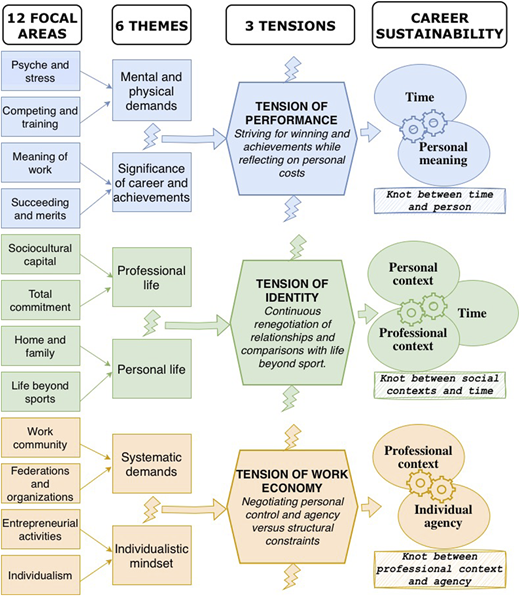
We employed holistic-content narrative analysis (see Lieblich et al., 1998) to interpret meaning within the broader context of individual careers, aiming to identify core patterns and focal points from the informants’ stories (e.g. Jen et al., 2023; Pajakoski et al., 2025). The process started by conducting multiple close readings of all transcripts, taking initial notes and identifying recurring issues, events and meanings that athletes consistently emphasized. In line with holistic-content analysis, we viewed these as core patterns (see Jen et al., 2023). These included narration about emotions during training and competition, commitment to athletic careers and civilian life, work communities, entrepreneurial pursuits and institutional support or lack thereof in the sports system. Next, using NVivo software, we coded the text segments within these patterns, paying attention to their emphasis, repetition and interconnections across individual accounts, consistent with holistic-content narrative analysis. Through iterative discussion, we organized these into 12 distinct focal areas and combined similar focal areas into six themes. It became clear from the focal areas that, for example, both major successes and deep setbacks were described as empowering, while the overall career was seen as a dream job, albeit one that required sacrifices in civilian life. Similarly, colleagues and sports organizations appeared as both sources of conflict and support. Third, we abductively moved between theory, data, and our research questions, striving to understand the various nuances of sustainable and unsustainable career experiences. We interpreted these dynamics as tensions (see Smith and Lewis, 2011; Sugiyama et al., 2024), formed by three pairs of themes. Tensions, therefore, are narrative-level constructs that capture how contradictory, yet interconnected meanings are woven across athletes’ careers over time. While segment-level coding served to organize focal areas into themes, interpretation was conducted at the level of whole narratives, focusing on how meanings were connected and shifted over the course of a career in the athletes’ narration (see Lieblich et al., 1998).
Finally, having revisited the literature on career sustainability (De Vos et al., 2020; Donald et al., 2024; Greenhaus et al., 2024), we recognized that each tension as a holistic narrative represented an interplay between the personal, temporal and contextual dimensions. We adopt the metaphor of knots to describe the analytical inseparability of these dimensions in the narratives, as the athletes narrate their experiences to a meaningful whole, particularly in moments of ambiguity and insecurity, to sustain a high-stakes career (Bujold, 2004; Ricoeur, 1980). For instance, the tension of performance knots together the athletes’ constant but uncertain performance demands (time) and personally meaningful career aspirations (person). Importantly, this enables exploring career sustainability dimensions in dynamic interaction as suggested by De Vos et al. (2020). Altogether, the three tensions – performance, identity and work economy – each illustrate how seemingly conflicting experiences and meanings simultaneously shape career (un)sustainability due to knots between the temporal, contextual and personal aspects of a career.
In Table 3, we illustrate the analytical process using example quotes from interviews with Yaroslava, Bjorn and Lindsey, also to enhance transparency of our analysis. It shows how contradicting perceptions of career sustainability were identified across all interviews, although some core patterns were highlighted more in certain interviews than others. Additionally, it illustrates how core patterns form the basis for the holistic narratives of performance, identity and work economy tensions.
The analytic progression of the study is visualized in Figure 1, illustrating how the 12 focal areas were merged into themes and further interpreted as three core tensions that represent narrative constructs through which athletes navigate the complexities of their careers. We synthesize these tensions into knots, illustrating the inseparable interaction between the career sustainability dimensions of time, person and context (see De Vos et al., 2020).
Next, in the findings section, we introduce the tensions of performance, identity and the work economy, empirically showing how they shape the (un)sustainability of an elite athlete’s career.
Findings
Tension of performance
The tension of performance arises from balancing highly meaningful career goals with personal growth and from ongoing self-reflection on whether one’s values align with this process (see De Vos et al., 2020). This reflects both temporal and personal tensions, as athletes’ sense of career is limited to the pressurized timeframe within which they must meet their own achievement expectations and receive external validation (see Sugiyama et al., 2024). Here, endurance transcends balance, aligning with Smith and Lewis’s (2011) view of an enduring negotiation between ideals, physical limitations and time pressure that cannot be solved but only accepted and navigated.
Professional athletes are known for setting ambitious goals early in life (Ronkainen and Ryba, 2018). This early commitment creates a linear, future-oriented timeline for their careers, where achievements and goals define success. As Daniel described: “At a very young age, I decided to become the best in the world and win Olympic gold,” adding that “sport has been everything to me ever since, the most important thing in life.” Similarly, Catherine said her Olympic projects for Tokyo 2024; Paris 2020 started when she was 14 years old. In these stories, success is seen heavily as a time-sensitive opportunity: peak performance must be reached within a certain age range (see Carless and Douglas, 2013; Ryba et al., 2015).
Here, the (un)sustainability of a career manifest as a constant shifting between goals, body and time – a process in which the individual seeks meaning and stability within a situation that is inherently limited and changeable. After achieving a major victory, Katie cried “not tears of joy but anxiety and relief,” feeling she had only met everyone else’s expectations, reflecting that the transition to the top happened too quickly and at too young an age. Niclas, in contrast, only succeeded in his later years, but similarly narrated how it was also disappointing to see how nothing changed in daily work or overall life. Indeed, while an elite athlete’s career is often seen as a clear line with a beginning and an end, from their perspective, it might be more of a cycle in which success and failure follow each other while the striving for perfection remains constant. This is mentally challenging, as Florence explains: “Successes bring pressure always to repeat those, whereas bad races only increase the fear of failure.”
The tension of performance suggests that linking development and growth closely with self-esteem is inherent. This leads to high motivation but can also create a situation where every achievement feels inadequate. As a result, the tension is not just psychological but also socially and temporally influenced, affecting how elite athletes make sense of what to accomplish to feel personally valuable. As Oscar explained: “It’s sick how those medals guide your life perspective. And nothing is ever enough. If you have one, you could have another.” While Morgan et al. (2015) have demonstrated that professional athletes often interpret failures as motivation to overcome setbacks, our data shows that this comes at the cost of not being able to fully enjoy successes. The dimensions of time and meaning are also evident in the difficulty of retiring. Catherine reflects on this in her narrative account, saying: “When the flame burns so brightly, it will eventually fade. I know I will never feel the same passion for anything else as I do for sports.” Indeed, when sports have been a central life project and source of identity from childhood, leaving it all behind can mean losing a sense of self and lead to mental distress (e.g. Brewer and Petitpas, 2017; Ivarsson and Gledhill, 2024).
In summary, the tension of performance intertwines the deep sense of meaning elite athletes attribute to their careers with the intense, timely demands of performance. Therefore, we see this tension as a knot between meaning and time (see De Vos et al., 2020). This tension is especially pronounced among elite-level athletes, whose sense of meaning is cultivated through an extended narrative of deliberate practice and long-term investment. However, their time at the highest level is often comparatively brief. This creates immediate temporal pressures to quickly recover from setbacks and consistently achieve more. Consequently, hardships are regularly experienced not as mere performance failures but as existential disruptions that threaten the accumulated meaning of the career itself (see Richardson and McKenna, 2020; Ryba et al., 2015).
Tension of identity
The tension of identity emphasizes how professional and personal contexts intertwine in shaping the career sustainability of elite athletes (Greenhaus and Kossek, 2014). This illustrates relational tension (Sugiyama et al., 2024), in which the value and meaning of social relationships across both domains are constantly renegotiated, and comparisons with life outside sport are regularly made.
Here, career sustainability is shaped through meaningful interactions between sport and nonsport domains (Henriksen et al., 2010). Family and close relationships often serve as a way to detach from the athlete role, as Venus explains: “When I’m with my boyfriend and family, I’m not the ‘athlete-me.’” However, professional life extends into personal life when working in demanding environments (Reid et al., 2025), which can cause stress and raise identity-related concerns about whether something is being compromised (Lee et al., 2011; Schooreel et al., 2017). Strong identification through sport can thus become burdensome, as Eric reflected: “It’s such a big part of my identity, unfortunately. It dictates everything I do.” This shows how prioritizing one’s career fosters growth and achievement but also risks limiting social relationships and narrowing sources of meaning to just professional performance (see Carless and Douglas, 2013; Ryba et al., 2015). As Pernilla reflected in her narrative account: “It’s impossible to know if something else would completely be your thing because this is so all-encompassing.” This highlights how the same commitment that drives excellence can also restrict the ability to imagine other identities or futures beyond sport.
In individual sports, professional status must be continually re-earned, unlike in team sports, where contracts provide security and recognition. This career insecurity (Hofer, 2025) intensifies the tension of identity, since setbacks or injuries can escalate into existential crises rather than just temporary professional difficulties (e.g. Ivarsson and Gledhill, 2024) as Ian illustrates: “If I had a career-ending injury now, my pension would be thirty cents per month.” Many athletes reflected on this, however theoretical, possibility of living a safer life outside of sport, which could both stabilize their identity and reduce financial risks. Echoing Carless and Douglas’s (2013) idea of those who only “play the part” of a professional athlete, the tension of identity appears to capture privately maintained professional identities while outwardly adhering to the performance narrative when necessary. As Eric reflected: “I feel like I’m much less of an athlete than many others around. I don’t feel like I have to achieve anything anymore to be happy.”
Previous research has also shown that social capital and collegial belonging are essential relational aspects of career sustainability in elite sports (Morgan et al., 2015; Richardson and McKenna, 2020). This finding is also evident in our data. Niclas, for example, mentioned that without his two close friends on the national team, his career would have ended a long time ago. Similarly, Allyson emphasized how the professional sports environment differs from “ordinary work,” explaining that “you spend so much time together that your colleagues become close friends.” Through these ties, athletes engage in relational agency, whereby meaning and motivation are co-constructed rather than maintained individually. This type of agency fosters resilience not only through self-reliance but also because of interdependence, allowing athletes to maintain their commitment while managing the personal pressures and identity demands of an all-encompassing career.
In conclusion, the tension of identity captures how professional and personal contexts of a career offer resources but also vulnerabilities for maintaining career sustainability. This highlights a knot between these two contexts and the temporal sense of career (see De Vos et al., 2020), as commitment to career enables growth, achievement and recognition in the present, yet it also requires postponing or narrowing alternative identities, prompting ongoing reflection on what may be meaningful beyond sport (see Brewer and Petitpas, 2017; Carless and Douglas, 2013). This tension is managed with a strong sense of collegiality and viewing a sports career as a temporary phase of total commitment and athlete identity. Therefore, career sustainability in high-stakes contexts seems inherently relational and temporal, requiring the ability to navigate and even shift the boundaries between the personal and professional selves.
Tension of work economy
The tension of the work economy reflects how the interaction between individual agency and structural expectations shapes career (un)sustainability. In this collective tension (Sugiyama et al., 2024), athletes constantly negotiate what aspects of their career they can control, and which are shaped by structural forces and necessities. Here, career (un)sustainability develops within this dynamic between autonomy and dependence.
Despite the national team environments organized by the Finnish Olympic Committee (FOC) and sports federations, athletes manage their careers in an entrepreneurial manner, without the institutional security that employment contracts provide. Most recounted that there is no guidance on career planning, thereby exposing a contradiction: while entrepreneurship has become essential for sustaining a professional career in professional individual sports (Vidal-Vilaplana et al., 2025), athletes are mostly left to develop these skills on their own. As a result, maximizing individual agency and proactivity becomes key to career sustainability (see Ge et al., 2023). The athletes describe this as learning to “find and manage commercial partnerships,” as Sergey explains, or becoming “as much of an influencer as an athlete,” as narrated by Allyson. When systemic support is limited, athletes must take greater responsibility for their actions.
Previous research has emphasized that elite athletes often experience constrained agency due to structural vulnerability (e.g. Steinbrink and Ströhle, 2023). However, the present data reveal that several athletes also consciously choose to manage their careers independently and remain outside their federations, describing how these, along with the FOC, lack the competence and expertise to understand the realities of the elite level. In this context, individualism serves a protective function, reflecting a delicate balance between the need for support and traits of professional athletes that resemble entrepreneurial orientations (Simarasl et al., 2024). Catherine’s narrative account illustrates this: she “loved being the CEO who calls the shots,” but was also frustrated, describing the sport system as bureaucratic and old-fashioned and serving only the interests of the structures rather than the athletes. Indeed, while elite athletes use individualistic autonomy as a protective strategy, they sometimes experience it as a burden. Deriving meaning and motivation from their own agency while also depending on timely and appropriate institutional support creates a nexus where the prerequisites for sustaining a professional career and preserving personal agency are deeply interconnected (see De Vos et al., 2020).
Career sustainability is evolving through an ongoing dialogue between individuals and structures, also within national team environments. These social systems follow a merit-based hierarchy, where superstars are treated better and gain greater influence. This is generally accepted and lived with. As Florence mentions, those who have achieved success likely understand what it takes. According to Oscar, it is important to “have a superstar who advocates for the entire group,” even to the extent that “the federation and the whole sport depend on them.” Superstars also wield more power in their career planning, often relying less on institutional support, such as a national team environment, than others. We interpret this to mean that they not only set the example through their daily performance but also inspire others to increase their individual agency within the system. From a career sustainability perspective, this demonstrates that agency is not static but a form of situational and context-dependent power that offers fleeting opportunities only within specific institutional conditions (see Chudzikowski et al., 2020; De Mon et al., 2022; Mishra et al., 2024). This highlights a key interaction between individual capacity to act (agency) and the structural conditions that enable or restrict such action (context).
Overall, we interpret the tension of the work economy as rooted in the knot between professional context and individual agency (see De Vos et al., 2020). The athletes’ narration depicts a shifting nexus in which opportunities for career sustainability briefly emerge, depend on structural conditions and require ongoing negotiation. This leads to a complex interaction in which elite athletes value their personal status and demonstrate strong motivation for entrepreneurial pursuits but also criticize the elite sports system for offering too little structural support or for interfering excessively.
Discussion
Tensions have been explored before in career sustainability research, striving to understand the elements that both enable thriving and pose risks for vulnerabilities that individuals continuously reflect on and navigate (e.g. Chudzikowski et al., 2020; De Mon et al., 2022; Mitra and Buzzanell, 2017). However, adding to these, we contribute to the theory development of sustainable careers (De Vos et al., 2020) by illustrating how seemingly unsustainable aspects can actually be drivers of career sustainability, and vice versa. For instance, vast mental and physical demands, total commitment, collegial competition and forced autonomy can also be empowering and thus contribute to career sustainability. Similarly, elements such as high meaningfulness of career, success and merit, sociocultural capital and individualism may also hinder it. This suggests that, especially in high-stakes settings, tensions make career sustainability an inherently subjective phenomenon (see Mishra et al., 2024; Talluri et al., 2022), as it is not achieved by eliminating the unsustainable but by negotiating it into one’s career narrative (see Bujold, 2004). The inherent uncertainties may become sources of growth and resilience, keeping career sustainability in constant flux. Thus, careers may not be merely sustained by accumulating resources to meet inherently high demands (Richardson and McKenna, 2020), but by dynamically navigating opposing forces (Sugiyama et al., 2024), where the unsustainable becomes even a necessity for long-term viability.
Tensions are thus not static contradictions but active mechanisms through which meaning is synthesized over time (see Sugiyama et al., 2024). This dynamic became visible in how performance- and identity-related tensions intensified as athletes’ careers progressed – even among the highly successful – as the constant striving for more achievements strained personal life and alternative identities. However, life beyond sport also served as a fundamental buffer in avoiding basing self-worth solely on sport performances. Similarly, the tension of the work economy emerged gradually. During the initial professional seasons, athletes struggled with the necessity of entrepreneurial activities due to limited structural support, only to excessively value their individual agency, as professional status – through both sporting achievements and entrepreneurial initiative – enabled greater autonomy. Therefore, athletes did not resolve tensions in isolation. Rather, their efforts to explain or ease one tension by narrating past, present and possible futures were often about reconfiguring other ones, thus producing narrative knots between temporal, contextual and personal dimensions of career sustainability (see Bujold, 2004; Ricoeur, 1980). In this way, our findings also respond to calls to examine the interplay between these dimensions (De Vos et al., 2020; Donald et al., 2024) and show – returning to our empirical contribution – that career sustainability develops through tensions rather than despite them. Altogether, this provides an intriguing perspective for the theory development of sustainable careers (De Vos et al., 2020); one in which career sustainability is not merely the absence of unsustainable elements, but rather the art of living with contradictions.
Although sensemaking of career sustainability is inherently influenced by how individuals navigate and interpret the complexities around them (Ge et al., 2023; Hofer, 2025), it should be viewed as intertwined with social networks and institutional expectations (see Donald et al., 2024). Even strong agency encounters structural constraints, creating tensions that require ongoing self-renewal and navigation (Mishra et al., 2024). We bring this up as sustainable careers have been conceptualized not only in terms of their dimensions but also through individual indicators of health, happiness and productivity (De Vos et al., 2020; Donald et al., 2024; Greenhaus et al., 2024). Yet our study expands on this by suggesting that such elements are neither universal nor static but interpreted and prioritized differently across contexts. In this process, individuals may find empowerment in the very features that seem unsustainable, not searching for mere sustainability from their careers but being motivated by the inherent hardships due to strong commitment and calling (see Greenhaus et al., 2024). However, all the athletes underlined how a highly meaningful career multiplies performance pressures. This supports arguments that a strong sense of calling may tie performance to self-worth and increase psychological burden (Lysova et al., 2018). Thus, rather than simply making a career more or less healthy, happy or productive, tensions trigger a process of sensemaking through which individuals negotiate what career sustainability means for them.
Finally, career research has been criticized for insufficient attention to context, prompting calls for localized and situated conceptualizations that foreground tensions embedded in specific settings (De Vos et al., 2020; Chudzikowski et al., 2020). Indeed, while individual agency may serve as the engine of career sustainability, the context shapes the road ahead (see Mishra et al., 2024; Talluri et al., 2022). Similar high-stakes dynamics to our research are likely present in other professional domains, warranting a more critical examination of what renders careers sustainable and under which conditions. In addition, we further propose the bodily context of work as an additional dimension of a high-stakes environment. In elite sport, the body is not merely a tool but the central site of both sustainability and vulnerability. Integrating this dimension into career theory opens new ways to problematize career sustainability (see Johns, 2006).
Practical implications
Based on our findings, attempting to eliminate the unsustainable from elite athlete careers seems misguided. Instead, the key question should be how to support individuals who are willing to pursue such a path. To address the tension of performance, national teams and youth academies should invest in psychological coaching that helps athletes decouple self-worth from competitive outcomes and frame success and failure as cyclical learning processes rather than existential judgments with strict deadlines (see Ivarsson and Gledhill, 2024). To manage the tension of identity, sports organizations could facilitate structured opportunities for athletes to engage with nonsporting mentors and networks, enabling the development of alternative identities alongside athletic commitment (see Carless and Douglas, 2013). Regarding the tension of the work economy, recent improvements in Finland include extending athlete grants to two years – but these could be complemented by entrepreneurial training, including branding, marketing and legal literacy. Such initiatives would reduce the burden of forced autonomy and be particularly valuable before the elite phase and financial security (see Vidal-Vilaplana et al., 2025). Finally, given the well-documented challenges of athlete retirement, sport organizations should implement pre-transition programs that support athletes in envisioning and preparing for post-sport identities while they are still active. Taken together, these measures can help ensure that the intense demands of elite sport function as resources for growth and resilience rather than as sources of accumulating stress that lead to burnout or identity crisis (see Hong and Fraser, 2023).
Limitations of the research
Our study has some limitations. First, as Bujold (2004) notes, narrative methods make it hard to explicitly underline the motivations behind different career choices. However, our goal was not to make broad generalizations but to provide rich, context-specific insights into career sustainability within a particular setting. Second, our analysis did not explicitly adopt a gender lens. This was a deliberate analytical choice and not an unintentional oversight. While gender-related topics such as motherhood and its implications for identity tensions are undoubtedly highly relevant (e.g. McGannon et al., 2025), our analytical focus was directed toward tensions that the athletes described as locally shared across career phases and life situations. Finally, echoing Bamberger (2008), we recognize that contextually embedded research may delimit the immediate transferability of theoretical insights across settings. Accordingly, while our analysis speaks most directly to elite sport and potentially to other high-stakes career environments, its applicability within broader societal contexts warrants careful examination. However, we see this limitation as necessary for privileging contextual depth in order to illuminate localized complex dynamics.
Credit authorship contribution statement
Joakim Särkivuori: Conceptualization, Formal analysis, Methodology, Writing, Visualization. Suvi Heikkinen: Conceptualization, Funding acquisition, Investigation, Writing.
Ethics approval statement
Based on The Finnish National Board on Research Integrity (TENK) Guidelines (2019), an ethical review statement was not needed for this study as it did not consider (a) deviation from informed consent, (b) intervention in physical integrity, (c) minors under 15 without parental consent, (d) exceptionally strong stimuli, (e) risk of mental harm or (f) safety threats. Informed consent was obtained from all participants before taking part in the study, prior to commencing data collection, with detailed information about the purpose of the research and participants’ rights. The authors confirm having maintained and respected the autonomy, confidentiality and anonymity of all respondents throughout the study, used collected data solely for the purposes of this study, ensured transparency in data handling and reporting, and avoided any form of coercion or undue influence in securing participation.